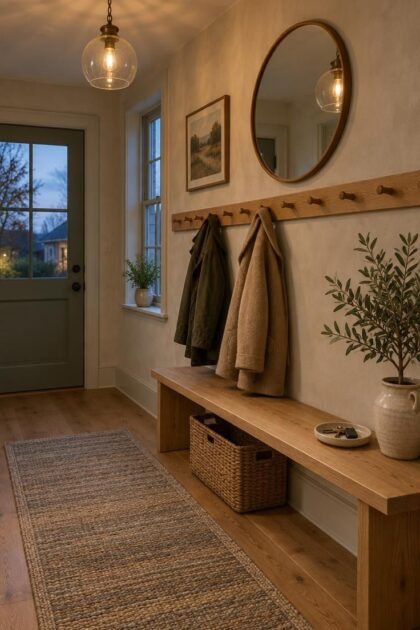
This post may contain affiliate links. If you make a purchase through these links, we may earn a commission at no additional cost to you.
A compact entry can become the hardest-working few feet in a house when one clear visual system handles the landing, hanging, and shoe stashing.
The ideas below focus on small walls, narrow hallways, and shallow corners, so each setup reads as a calm drop zone rather than a crowded catchall.
Warm wood, painted paneling, woven textures, and one strong focal wall carry most of the visual weight.
Every option pairs a place to sit or pause with hooks, baskets, or a slim shelf at hand height.
The result is a tidy first impression that still takes wet coats, mail, and everyday shoes without spilling into the hall.
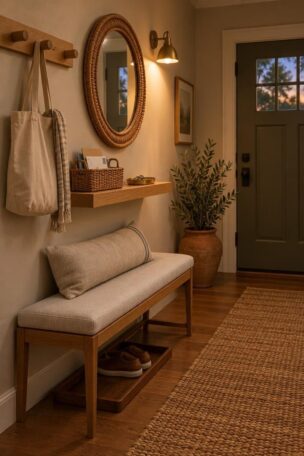
Warm Oak Peg Rail and a Slim Shoe Bench Against a Pale Plaster Wall
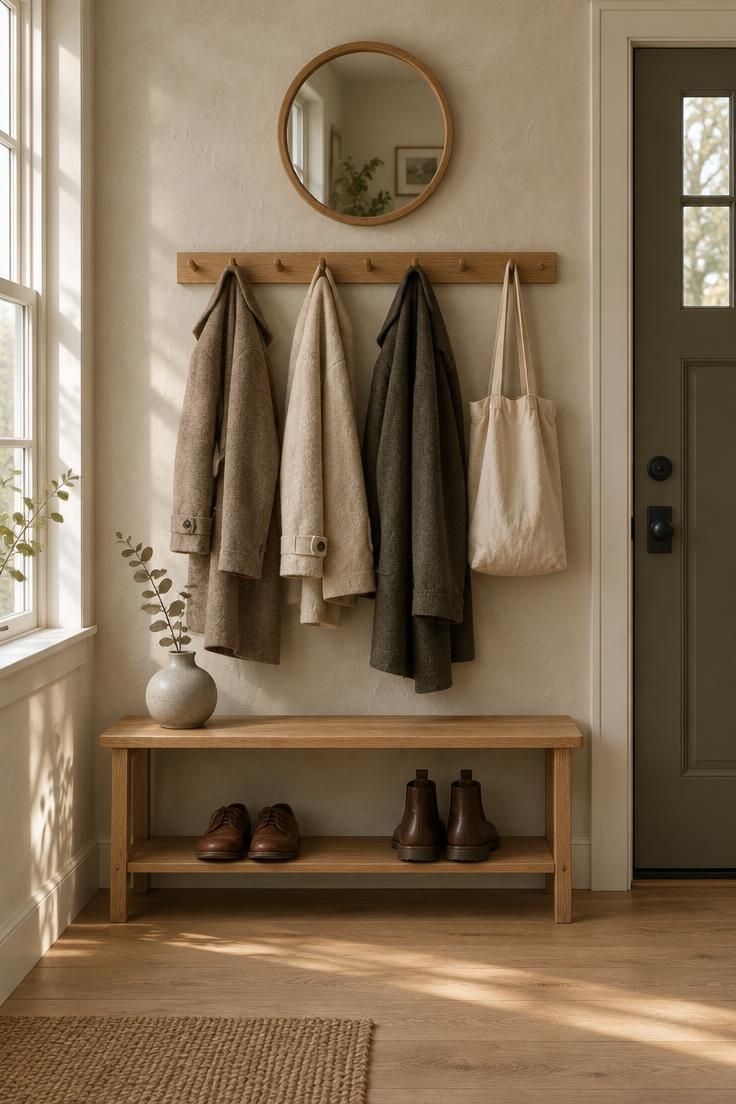
For a beadboard hook wall, the wall just wide enough for a door and a coat is the classic starting point for a mini mudroom entryway, and this arrangement answers it with height instead of depth.
A single oak peg rail runs horizontally at a comfortable reach, and the shallow bench beneath it holds its shoes on an open lower shelf.
Because the bench stops well short of the walkway, the floor stays mostly visible, which keeps a tight foyer from feeling bottom-heavy.
The round mirror above the pegs gives the stack a soft center and catches light from a nearby window.
Oak brings a honeyed warmth that sits easily against pale plaster, and the mix of matte wall texture with a satin-finished rail adds depth without pattern.
Three to five pegs is the sweet spot: enough rhythm to read as intentional, few enough that each coat has breathing room.
A pale oak top wipes clean easily, while the open shoe shelf keeps daily pairs at hand.
The honest tradeoff is visibility.
Open pegs and an open shoe shelf display whatever is in use, so the look stays crisp only when the rail is edited down to the current layers.
A quick seasonal swap, heavier coats up top and lighter jackets at the ends, keeps the rail from turning into a bulkhead.
For households with a rotating cast of bags and scarves, a single lidded basket on the bench seat can absorb the overflow.
Where the composition wins is proportion.
The rail sits above the bench with a hand's width of wall between them, and the mirror repeats the roundness of nothing else in the frame, giving the eye one soft moment in an otherwise linear stack.
This suits a wall beside the front door in a house or apartment where the entry is a passage rather than a room.
Style Blueprint:
- Warm white oak peg rail with simple rounded pegs
- Shallow bench with an oak top and an open shoe shelf below
- Round wood-framed mirror sized to sit within the rail's width
- Limewash or matte plaster paint in a warm off-white
- Three to five neutral coats and one canvas tote, nothing more
Color-Drenched Beadboard Wall with a Slim Storage Bench and Brass Hooks
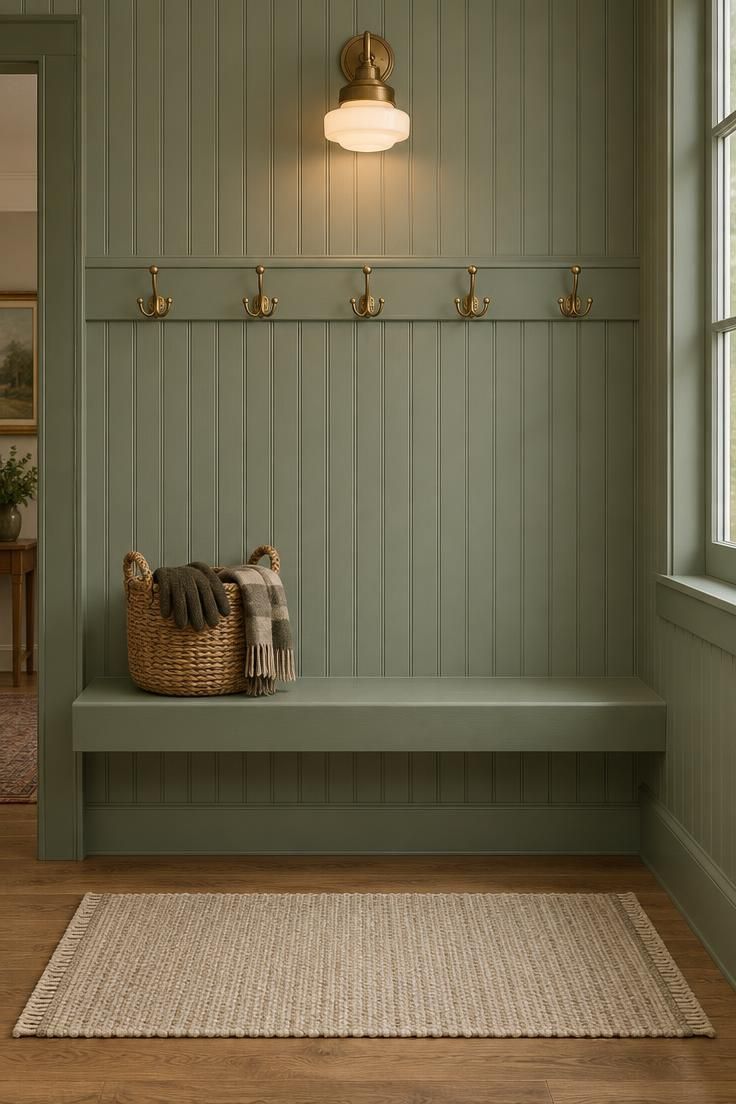
Painting the paneling, the bench, and the trim in one color turns a few feet of hallway into a single calm block.
Beadboard's vertical grooves add texture to that block without introducing a second color, and a slim bench in the same sage appears to hover, leaving floor visible beneath it.
Five brass double hooks bridge the upper and lower halves, their warm metal the only accent in the frame.
This is where a small entryway bench with hooks earns its place: the bench gives a spot to sit and pull on shoes while the hooks above keep the current coat off the seat.
The monochrome approach hides the seams between separate pieces, so a freestanding bench reads almost like millwork.
Brass ages into a soft patina that softens the cool green, and a woven basket on the seat introduces one natural texture against all that paint.
A shallow runner protects the floor where wet shoes land.
Maintenance is the practical question with painted seating.
Shoes scuff the bench edge and the lower beadboard, so a washable runner in front of the bench and a low tray for wet pairs keep the finish looking cared for.
The basket handles the small items that would otherwise scatter: gloves, a scarf, a dog lead.
This look suits a hallway corner where a deeper built-in would narrow the path.
Because the bench projects barely past the beadboard, a corridor keeps its full walking width, and the color-drenching makes the shallow depth feel deliberate rather than skimped.
Style Blueprint:
- Beadboard paneling painted floor to ceiling in soft sage or warm putty
- Slim bench in the same paint color, set with a shadow gap below
- Five brass double hooks in a single even row
- One seagrass basket on the seat for gloves and small items
- Washable cream flat-weave runner at the base
Design Pro-Tip: When color-drenching a small entry, paint the bench, paneling, and trim in the same sheen level so the separate pieces visually merge into one built-in look.
Half-Closet Drop Zone with a Lidded Bench and Cane Baskets
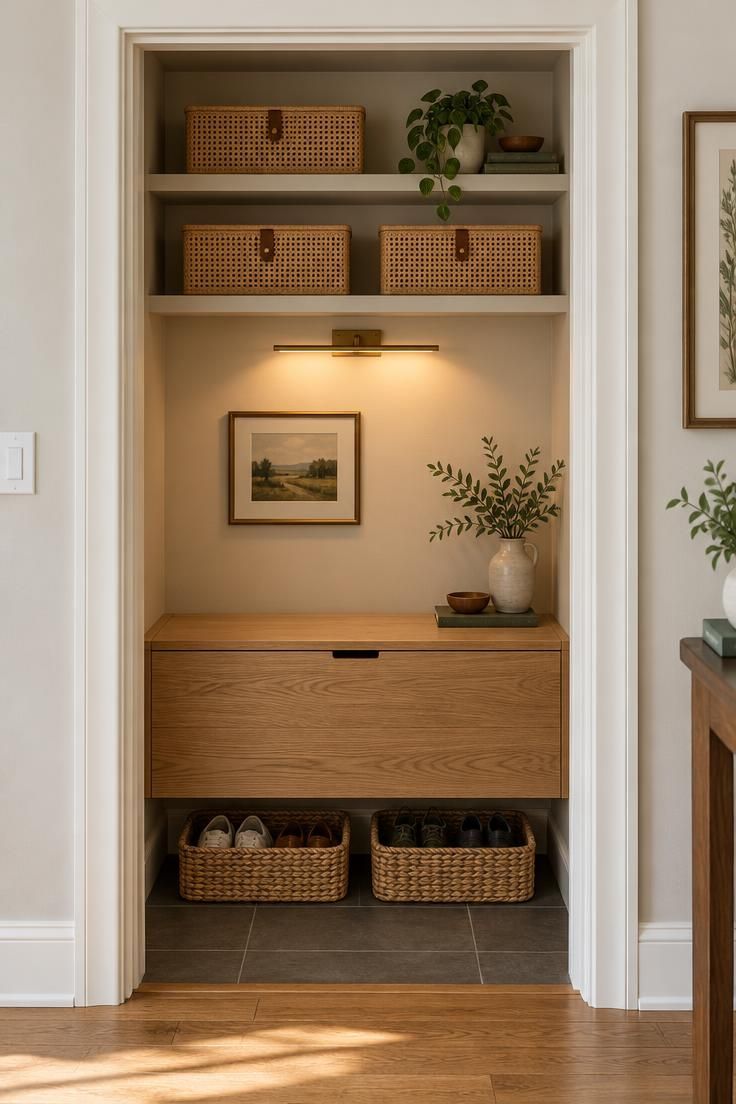
A shallow front closet with the door taken off becomes an open niche that holds more than it did closed.
Inside, a built-in oak bench with a lift lid hides seasonal shoes, while two upper shelves carry cane-webbing baskets for gloves, hats, and dog leads.
Warm white paint on the surrounding trim keeps the opening bright, and a slim brass picture light above the bench makes the recess feel like a designed moment rather than a stripped closet.
This is one of the most space-efficient versions of an entryway closet drop zone, because the depth already exists.
The lift lid is the quiet engine of the setup.
Off-season pairs and bulky items sit out of sight under the seat, and the bench top doubles as a landing for a bag or a folded umbrella.
Cane baskets on the shelves add texture and let a little air and light through, which keeps the upper zone from reading as heavy.
Think about what belongs under the lid before committing.
Items that are fine sitting out of sight for a season, spare sneakers or winter boots, suit the bench interior best.
The shoes in daily rotation are better served by a pair of low baskets on the floor at the closet mouth, where they can be kicked off and scooped up without lifting anything.
Because the niche is framed by its own trim, the whole arrangement reads as a small room within the hall.
The picture light does double duty as task light and focal point, drawing the eye into the recess instead of letting it skim past.
This suits a foyer where the closet sits beside the door and an open niche would otherwise look like missing furniture.
Style Blueprint:
- Shallow closet opening with door removed and trim painted warm white
- Built-in oak bench with a lift lid for seasonal shoes
- Two upper shelves with cane-webbing baskets and leather pulls
- Slim brass picture light above the bench
- Pair of low woven baskets on the floor for daily shoes
Freestanding Hall Tree with a Curved Back and Rounded Hooks in a Small Rental Entry
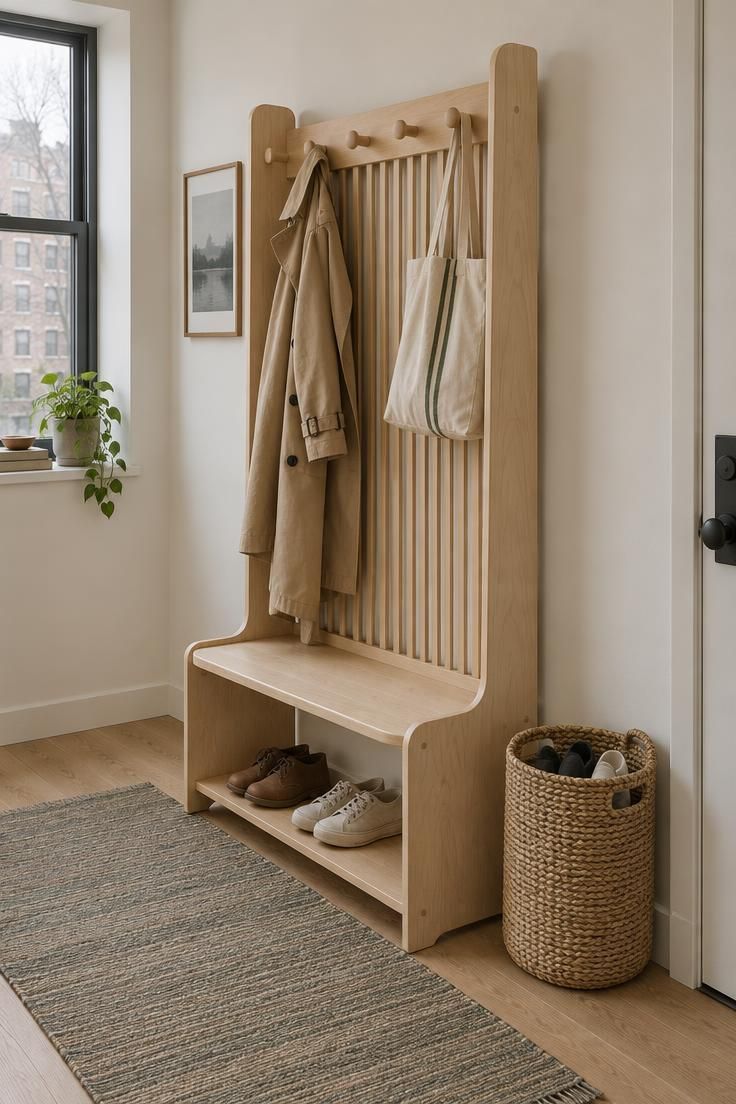
For a rental or any entry where walls should stay untouched, a slim freestanding hall tree does the whole job in one movable piece.
Pale curved birch keeps the silhouette light, and the rounded hooks and slatted back avoid the blocky, heavy look that solid furniture can bring to a tight foyer.
A woven floor basket stands beside it for shoes, and a flat-weave runner slips under the base to catch wet footprints.
No drilling, no commitment, and the rental-friendly hall tree can move with the household.
The curve is doing real visual work.
A rounded back and softened edges let the piece sit close to a wall without crowding the door swing, and the open slats keep sightlines through the frame.
Birch's pale tone reads airy against almost any wall color, which matters in a small rental where repainting is not an option.
The tradeoff is clutter.
An open bench and open hooks gather visual noise faster than closed storage, so one closed basket on the floor, or a lidded bin on the bench, gives the eye somewhere to rest.
Keeping the hooks to the current season's outerwear prevents the rack from becoming a coat pile.
Weight and footprint deserve a thought before buying.
A freestanding piece needs a stable base, and a curved back should still sit flush enough to avoid wobbling on a runner.
Measure the door swing first, then choose the narrowest version that still offers a usable seat.
Style Blueprint:
- Slim curved-birch hall tree with a bench, rounded hooks, and a slatted back
- Woven floor basket beside the base for shoes
- Flat-weave runner in a muted tone slipped under the frame
- One closed bin on the bench to contain small clutter
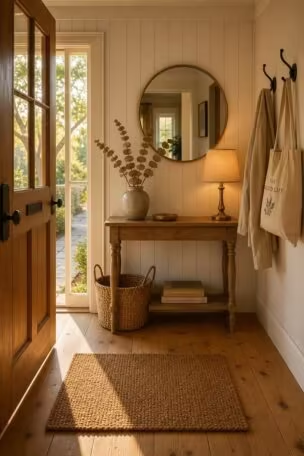
Painted Console with Three Woven Baskets as a Narrow Hallway Landing
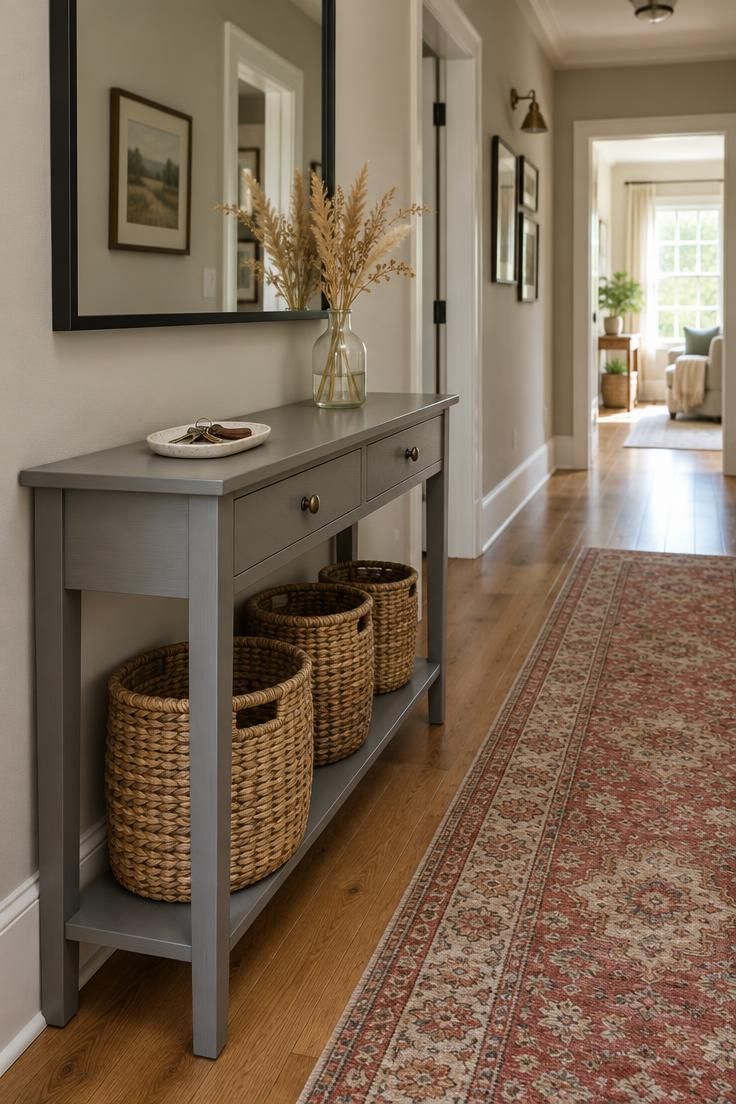
When a bench would crowd the path, a shallow console takes over the landing duties.
Three graduated woven baskets slide fully under the lower shelf, holding shoes, umbrellas, and anything else that would otherwise pile on the floor.
On top, a small ceramic tray catches keys and a glass vase holds dried grasses.
A long narrow mirror above reflects the opposite wall and stretches the corridor visually, which makes the passage feel wider than it is.
Paired with a narrow hallway storage bench elsewhere in the home, this console covers the lighter-duty entries where seating is not needed.
The console depth is the key decision.
A shallow top keeps the walkway clear while still offering a waist-height surface for mail and keys.
Baskets that fit fully beneath the shelf mean the floor reads as open, and the three graduated sizes create a gentle rhythm rather than a wall of storage.
Basket weave and painted wood soften the hallway's hard lines, and the runner adds warmth underfoot.
A long mirror is the one element that changes how the corridor feels, bouncing daylight from the far end and adding a vertical line that counters the narrow width.
Maintenance stays simple: baskets get a periodic shake-out, and the painted console wipes down with a damp cloth.
The tradeoff is that baskets conceal rather than organize, so a quick sort now and then keeps them from becoming bottomless.
A tray on top sets a clear boundary for the small daily items.
Style Blueprint:
- Slim painted console in soft gray with a lower shelf
- Three graduated woven baskets sized to slide under the shelf
- Small ceramic catchall tray and a single glass vase with dried stems
- Long narrow black-framed mirror mounted above
- Faded vintage-style runner in red and cream
Wallpaper-Lined Cubby Grid Inside a Shallow Alcove
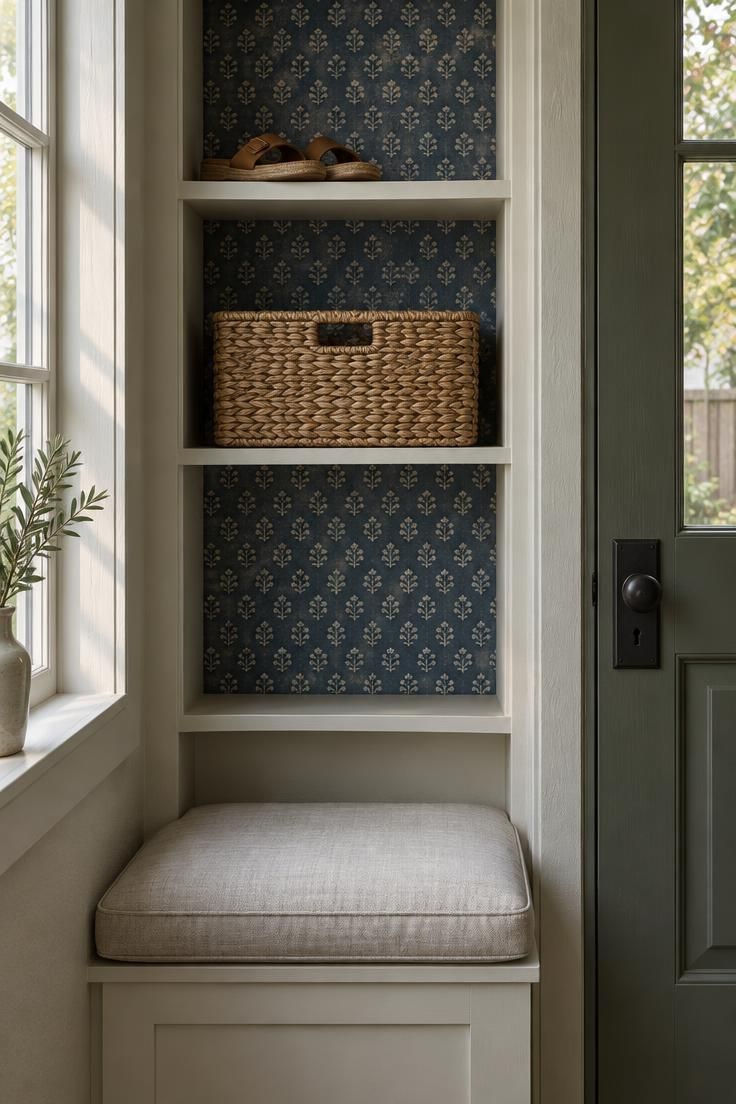
An irregular alcove beside a back door can take a cubby grid that would look repetitive as a long run of lockers.
Three stacked open cubbies fit into the recess, each back lined with a small-scale block-print wallpaper in faded indigo.
The white painted frame around them contains the pattern, so the small footprint never feels overwhelmed.
A single woven basket in the middle cubby breaks up the grid, and a low bench below gives the niche a seat.
Wallpaper inside a cubby is a low-commitment move.
It adds pattern and a finished look without covering a full wall, and the faded indigo blue reads warm against white paint.
The repetition of the block print across three backs creates a soft rhythm, and the open fronts let the pattern show between stored items.
Dust is the honest cost.
Patterned cubby backs show scuffs and dust more than plain paint, so a quick wipe-down keeps the print crisp, and shallow cubbies are easier to reach than deep ones.
Keep the top cubby for light or occasional items, the middle for the basket, and the lowest within easy reach.
The bench below ties the niche to the room.
A pale linen cushion softens the seat, and the white frame keeps the whole arrangement reading as part of the architecture rather than an add-on.
This suits a side or back entry where a guest might pause, and it works in an old house where the alcove is not quite square.
Since the block print repeats across all three backs, choose a wallpaper with a small enough motif that the pattern stays legible even inside the shallow cubbies, and be ready for a little extra dusting because the deeper texture of paper can trap lint that painted surfaces do not.
Style Blueprint:
- Three stacked open cubbies fitted into the alcove
- Small-scale block-print wallpaper in faded indigo lining each back
- White painted frame and low bench in the same finish
- One woven basket in the middle cubby
- Pale linen cushion on the bench seat
Design Pro-Tip: Cut wallpaper panels to the exact cubby back dimensions with a small overlap at the edges, so the pattern reads as a continuous inset rather than a patch that stops short.
Dark Slate Bench and Charcoal Hooks Against a Warm White Wall
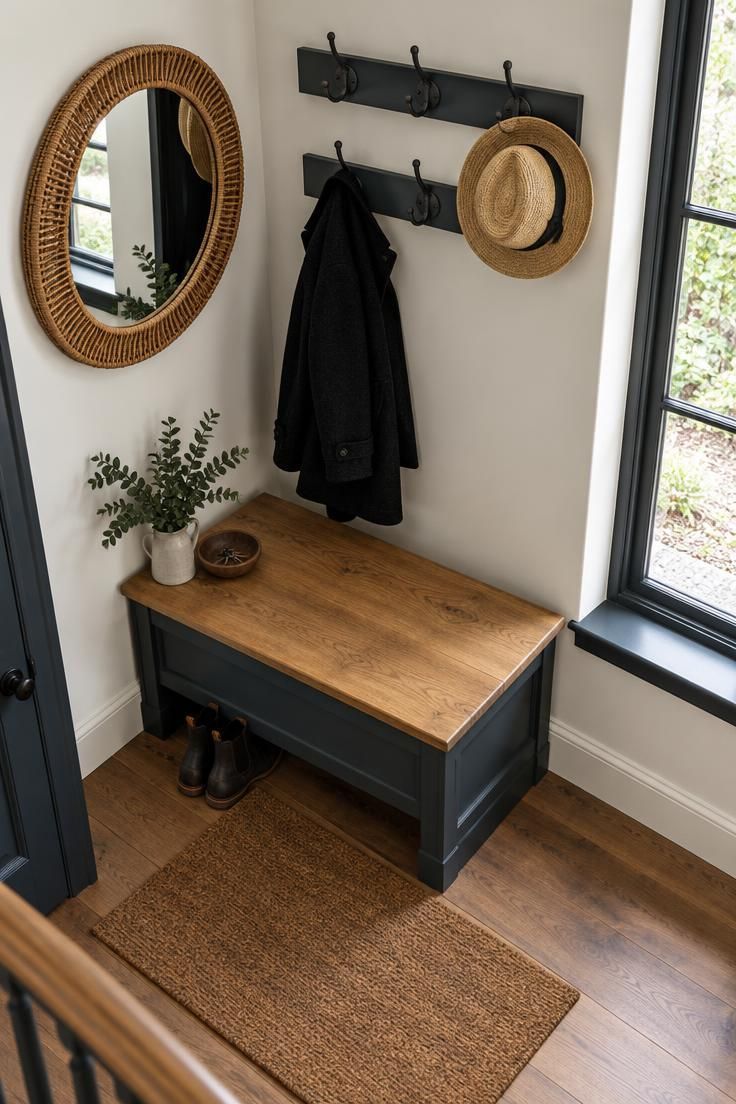
A dark bench against a pale wall is the strongest contrast move in a small entry, and it works because the light backdrop keeps the dark mass from swallowing the corner.
Here a slate-painted bench with a solid oak top sits beneath two rows of matte charcoal hooks, and a round rattan mirror softens the geometry above.
A coir mat in front defines where the drop zone begins and catches grit before it travels.
The two hook rows add capacity without widening the footprint.
Upper hooks take the coats that hang longest, lower hooks hold hats, bags, and the dog lead.
Charcoal on charcoal keeps the hardware quiet, letting the oak top and rattan mirror carry the warmth in the frame.
Dark paint shows dust and scuffs quickly, which is the tradeoff for that crisp line.
A bench cushion in a washable fabric protects the seat and lifts the dark mass with a lighter note.
The oak top, oiled rather than lacquered, takes the wear of keys and bags with less fuss.
This look wants daylight.
An entry that already receives strong natural light gives the dark bench a bright backdrop to sit against, and the coir mat's rough texture counters the smooth paint.
In a dim corner, the same arrangement would need a wall light to keep the dark surface readable.
Style Blueprint:
- Bench painted dark slate with a solid oak top
- Two rows of matte charcoal double hooks
- Round rattan-framed mirror on a warm white wall
- Low coir mat defining the drop-zone edge
- Washable bench cushion in a light neutral
Cane-Front Shoe Cabinet with a Tray-and-Sconce Vignette
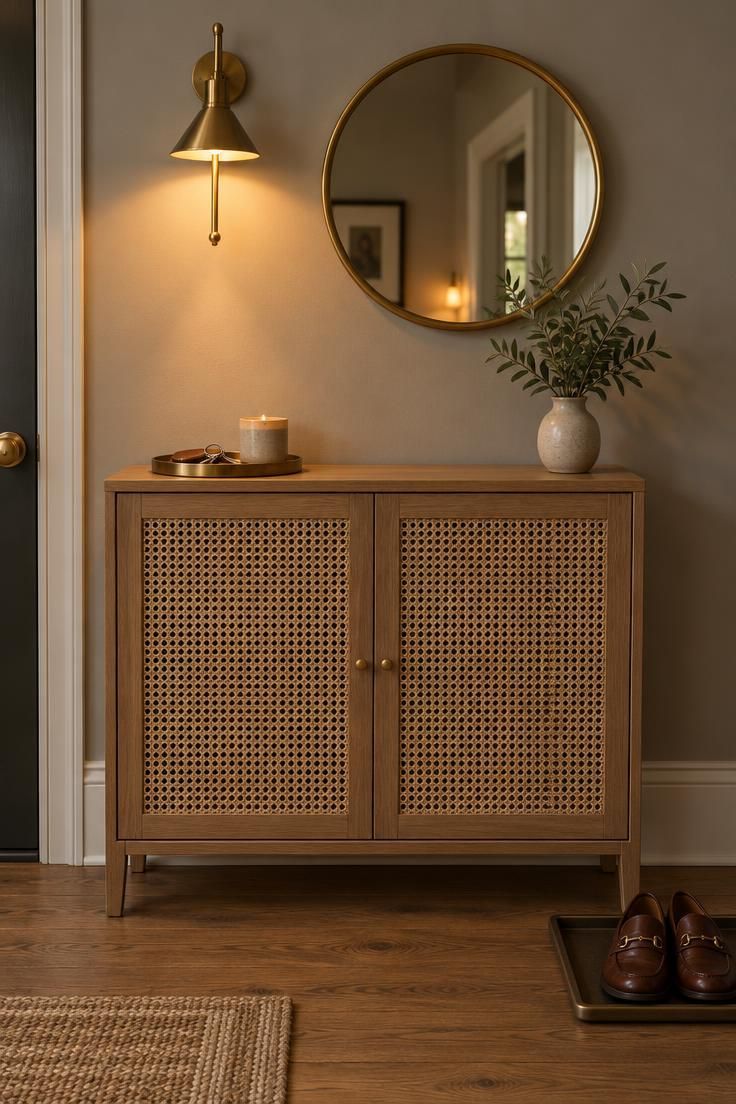
A shallow cane-front cabinet closes shoes away entirely while still bringing texture to the entry.
Two doors with cane webbing hide the pairs inside, and the top becomes a small stage for a round tray of keys and a single candle.
Above it, a slim brass sconce washes the wall with warm light, and a round brass mirror beside the sconce doubles the glow.
This is the refined alternative to an open bench, with clutter concealed and warmth on display.
Cane webbing is the detail that keeps the cabinet from looking like plain storage.
The weave lets a little shadow and light through, and the brass knobs pick up the sconce's finish.
A shallow depth keeps the piece from projecting into the walkway, so it suits a wall that a full bench would crowd.
Moisture is the practical limit.
Cane doors are better for occasional or dry shoe storage than for soaking-wet boots, since water can mark the weave.
A boot tray on the floor catches the wettest pairs, and the cabinet handles the rest.
The tray-and-sconce vignette gives the composition a top note.
The tray corrals keys and small change, the candle adds a warm point of light, and the mirror reflects the sconce to make the corner feel taller.
This suits a foyer where guests pass through and the entry should read as a finished room, not a staging area.
Style Blueprint:
- Shallow cane-front shoe cabinet with brass knobs
- Small round tray and a stoneware candle on the top
- Slim brass sconce above the cabinet
- Round brass-framed mirror beside the sconce
- Boot tray on the floor for wet pairs
Under-Stair Pocket with a Low Bench, Short Hook Rail, and Basket Tower
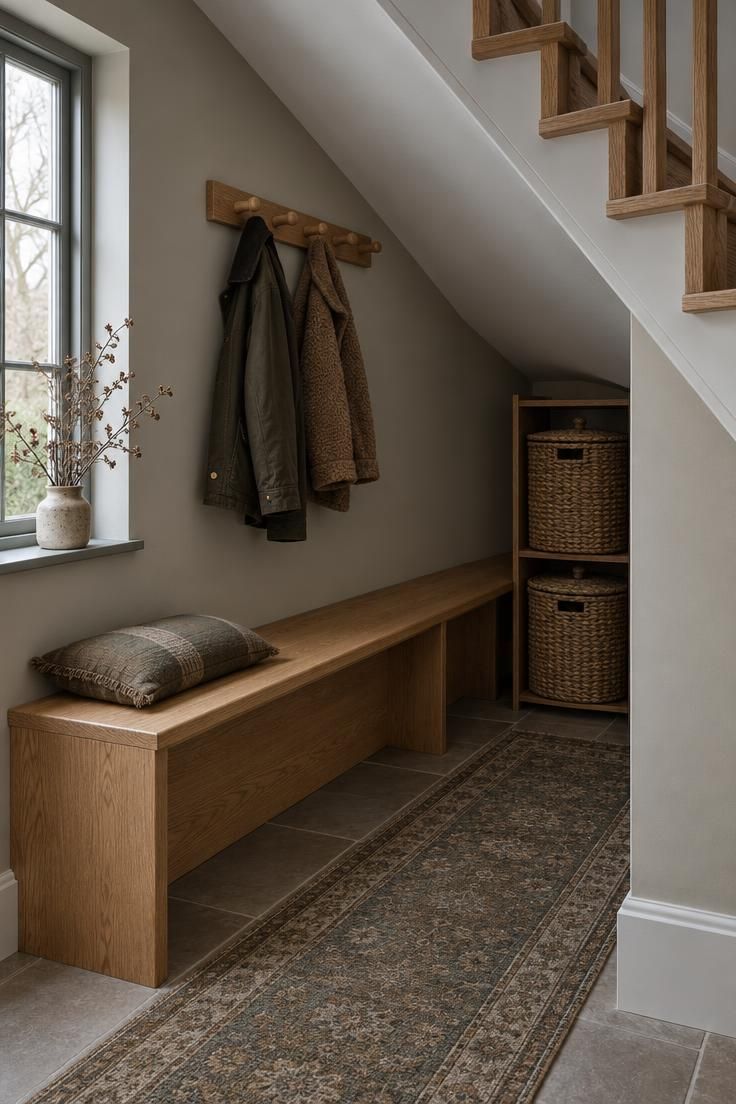
The space under a staircase is often dead square footage, and a low bench that follows the slope turns it into a working mini mudroom entryway.
A short peg rail on the sloped wall holds the current season's jackets, while a tall narrow basket tower in the deepest corner hides off-season gear in two lidded baskets.
A subdued runner anchors the floor, and a small ceramic pot of dried branches gives the bench end a finishing note.
The slope is the design constraint and the charm.
A bench top that steps down with the stair can look intentional when the surface stays mostly clear, and the varying seat height suits different household members.
Keeping the peg rail at the higher end leaves room for coats to hang without pooling on the bench.
Long coats are the limit.
The lower end of the slope cannot take a full-length jacket, so short jackets and children's coats belong there, with longer outerwear at the high end.
The peg rail holds only the current season, and the basket tower handles the rotation.
Baskets are what make the corner feel ordered rather than improvised.
Lidded baskets hide bulky items, and the narrow tower fits into a depth a cabinet could not use.
This is a no-alteration idea beyond the hooks, and it works in a house where the stair wall faces the back door.
Style Blueprint:
- Low oak bench following the slope of the stair
- Short peg rail with four pegs at the higher end
- Tall narrow basket tower with two lidded baskets
- Subdued flat-weave runner on the floor
- Small ceramic pot with dried branches on the bench end
Woven Basket and Runner Layering with a Low Slatted Shoe Bench
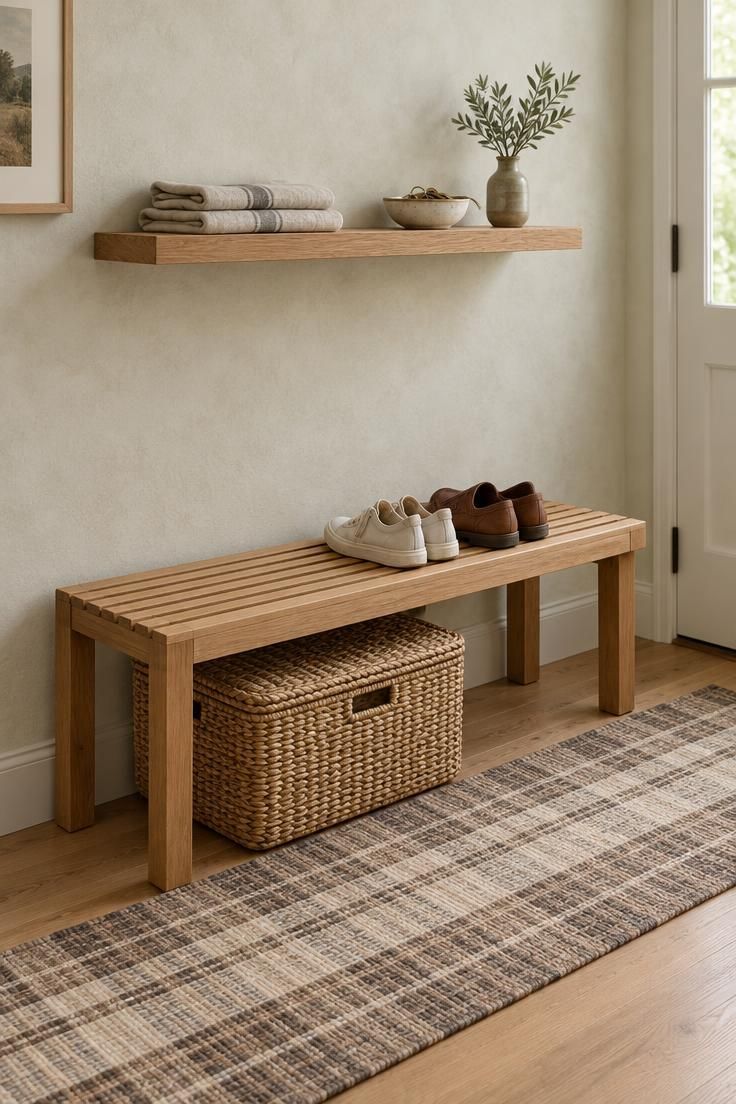
In a wide hallway or entry, the floor itself can become the design surface.
A low slatted oak bench holds two pairs of shoes, a lidded seagrass basket sits underneath, and a plaid flat-weave runner extends a few inches past the bench on each side.
Above, a single floating oak shelf carries folded linen or a bowl for keys.
The key to the composition is the visible strip of floor between the runner and the wall, which keeps the whole arrangement from feeling bottom-heavy.
Layering here does the work that extra furniture would otherwise do.
The runner defines the drop zone, the basket hides the clutter, and the slatted bench lets shoes dry and air.
Muted browns and creams in the plaid tie the oak and seagrass together without introducing a new color.
Dust settles into both the basket weave and the runner pile, so a periodic shake-out keeps the corner fresh.
The floating shelf adds a landing at a comfortable height, and its shallow depth keeps the composition light.
Two or four objects on the shelf read better than a crowded line.
This setup suits an entry where seating is secondary to a clear floor.
The bench is low enough to perch on but shallow enough to leave the walkway open, and the runner catches grit before it spreads.
It is the least architectural of the ideas here, relying on freestanding pieces and a textile to build the zone.
Style Blueprint:
- Low slatted oak shoe bench
- Lidded seagrass basket tucked underneath
- Plaid flat-weave runner extending beyond the bench on both sides
- Single floating oak shelf above with a bowl or folded linen
Design Pro-Tip: Let the runner extend just past the bench on each side so the textile frames the bench, and keep a few inches of bare floor at the wall to preserve an airy edge.
Mirror-and-Conservatory Bench Vignette with a Catchall Tray and Pendant
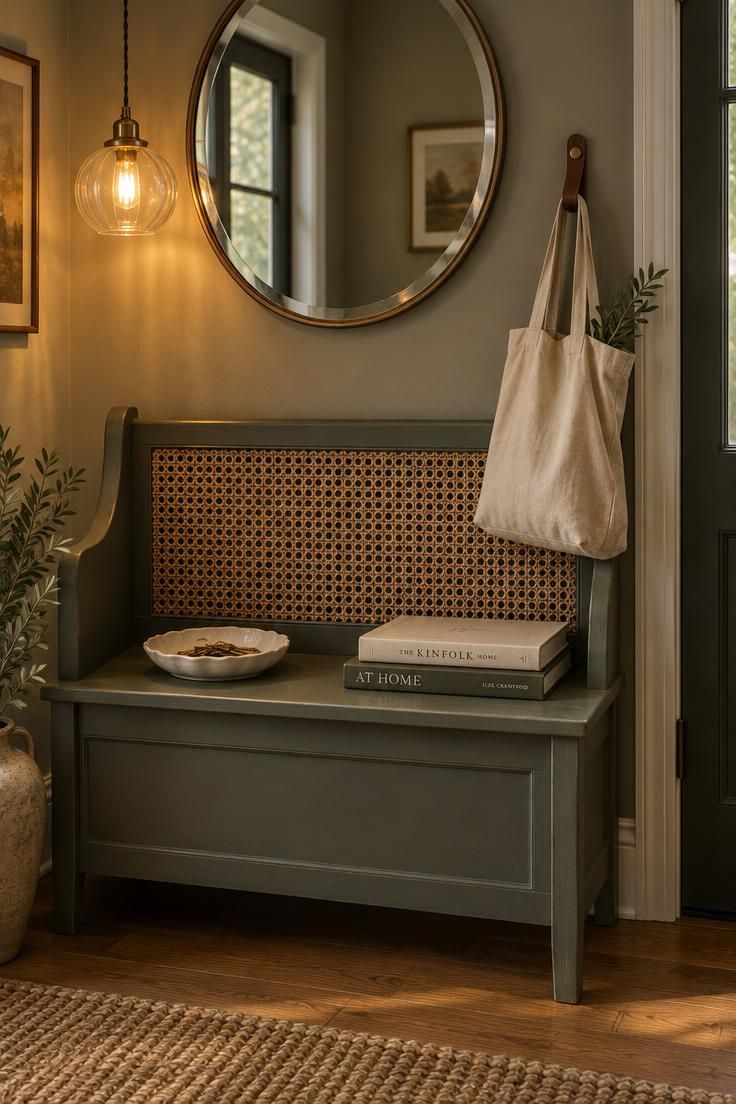
This corner takes a more styled, less purely utilitarian view of the mini mudroom, and it suits a side entry or a foyer where guests pass through.
A painted bench with a cane back panel sits beneath a round beveled mirror and a small glass pendant.
The seat stays mostly empty except for a ceramic catchall tray and a small stack of books, while a single leather loop hook above the back holds a tote or a light jacket.
The mirror reflects the pendant at eye level, which makes the corner feel taller and more considered.
Cane on the back panel adds a soft, dark texture against the painted frame, and the beveled mirror catches light at its edge.
The single leather loop is a quiet detail that reads as deliberate rather than accidental.
The hook is not meant for heavy coats, which is the tradeoff to accept.
It works best for one bag or a lightweight layer, with heavier outerwear kept on a separate rail elsewhere.
The bench seat is a landing and a display surface, not a shoe shelf, so this version trades utility for a gentler composition.
The tray is the practical center.
Keys, sunglasses, and small change land there, and the books give the seat a lived-in note.
This suits a foyer where the entry should look furnished, and it leaves the heavier storage work to another wall or closet nearby.
Style Blueprint:
- Painted bench with a cane back panel
- Round beveled mirror above the bench
- Small glass pendant hung to one side
- Ceramic catchall tray and a short stack of books on the seat
- Single leather loop hook for a tote or light layer
Conclusion
A small entry works best when one wall does three jobs at once: a place to pause, a place to hang the current layer, and a place to drop the day's carry.
Warm wood, painted paneling, cane, and woven baskets can build that zone without taking over the entry, whether the space is a rental, a narrow hallway, or an under-stair pocket.
The shared principles stay the same: keep the arrangement stacked, give the eye one strong focal point, and let the floor stay visible.
Choose the version that matches how the household comes and goes, with a few closed baskets for the clutter and one honest surface for the keys.