This post may contain affiliate links. If you make a purchase through these links, we may earn a commission at no additional cost to you.
The entryway closet is often the hardest-working small space in a home, catching coats, shoes, bags, and daily clutter before it spreads.
A warm makeover can turn this dim, narrow spot into a welcoming part of the arrival experience.
The ideas below focus on visual warmth and practical layering that works in real households, not just staged photos.
Each one can stand alone, and each can be combined with another as time and budget allow.
Boutique-Style Hanging Rail with Matching Wooden Hangers
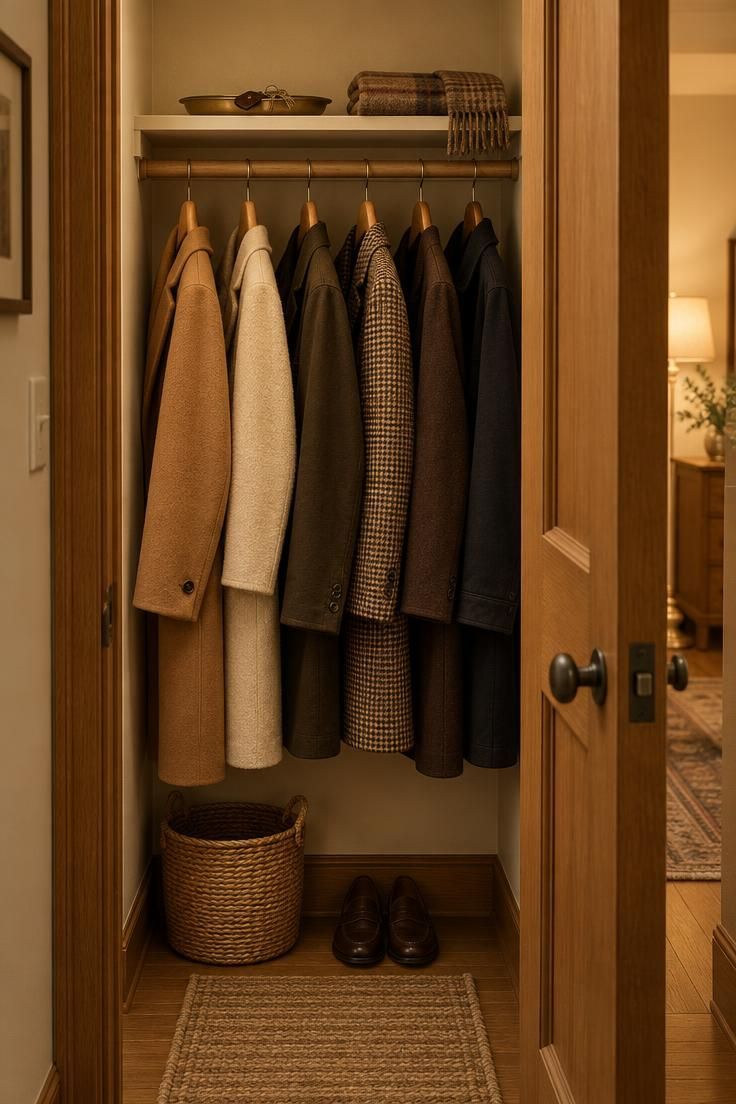
The most immediate shift in this closet comes from subtraction.
Mixed wire and plastic hangers disappear, replaced by one set of wooden hangers in a consistent tone, and only the current season's coats stay on the rod.
Spacing matters as much as uniformity.
Garments breathe when there is a hand's width between them, and the rod no longer reads as a solid block of fabric when the door opens.
A shallow brass tray on the shelf above gives keys and sunglasses a defined home, while a small felt bin corrals gloves and a folded beanie.
Both objects stay low so the shelf line remains visible from the doorway.
This approach suits a household with a modest coat count, or one with a second closet for bulky outerwear and off-season pieces.
Editing is the tradeoff: the look depends on a place to send the coats that no longer fit the display.
Anyone comparing mudroom-style entryway storage with this edited display can notice the contrast quickly.
Utility storage favors volume, while this version favors restraint, and the two approaches can share a closet if the depth allows both a rod and a floor basket.
Style Blueprint:
- One set of matching wooden hangers in a single wood tone
- A shallow tray for keys and a small felt bin for gloves
- Only current-season coats on the rod, spaced with visible gaps
- A low-profile woven runner and a single floor basket
Warm Wood Bench and Low Hooks for a Mudroom-Style Drop Zone
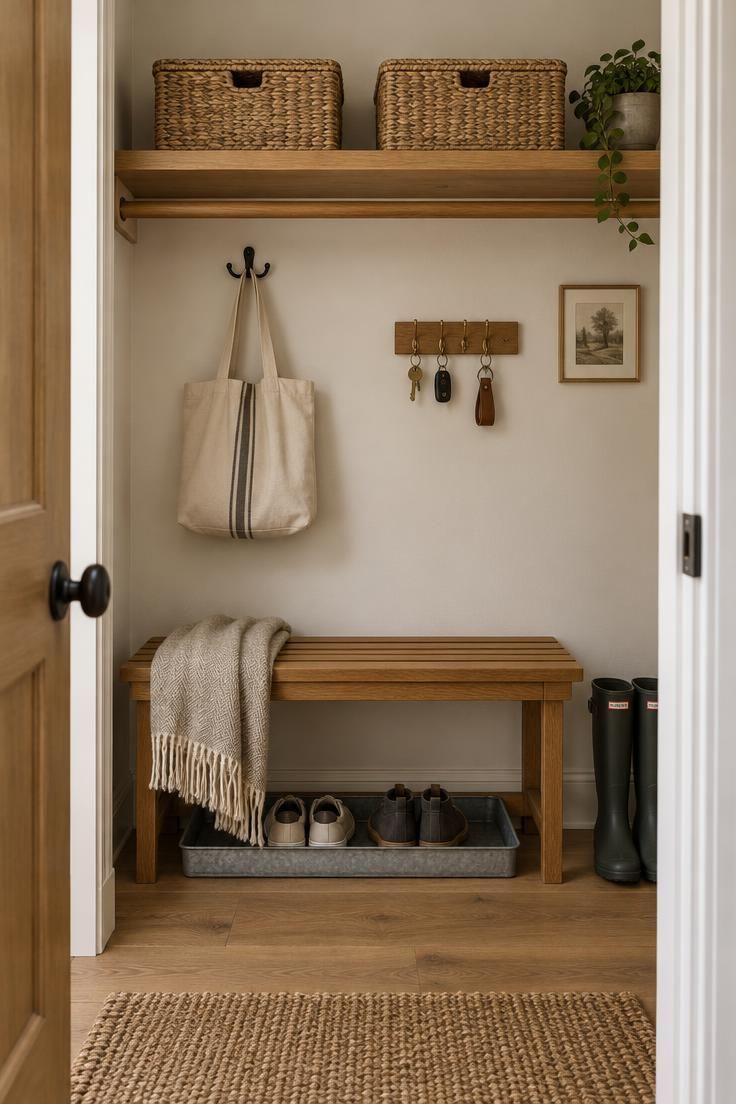
A bench changes how a closet gets used.
It gives a place to sit while pulling on shoes, and it creates a natural shelf for a bag that arrives mid-commute.
Low hooks placed at bench height keep everyday items within easy reach.
A leash, a small tote, and a light jacket can hang there without competing with the rod above.
The boot tray sits beside the bench rather than in front of it, which keeps the walking path clear.
Shoes land on the tray, and the closet floor stays visible around it.
Good entryway closet organization depends on matching the storage to the habit.
If the bench collects mail and loose receipts, a small tray on its surface helps contain them, and a weekly reset keeps the surface from disappearing under paper.
Open storage shows disorder more readily than closed cabinets.
This layout rewards a household that resets the bench each evening and accepts that the closet will never look untouched.
Two lidded baskets on the upper shelf hold hats, gloves, and seasonal accessories that are not needed daily.
Lids keep dust off the contents, though they add a step for anyone reaching for a scarf in a hurry.
Style Blueprint:
- A slatted wood bench sized to the closet width
- Black double hooks mounted at bench height
- A boot tray with a raised lip for wet shoes
- Two lidded baskets on the upper shelf
- A small tray on the bench for keys and mail
Deep Green Back Wall with Brass Hardware and a Slim Rug
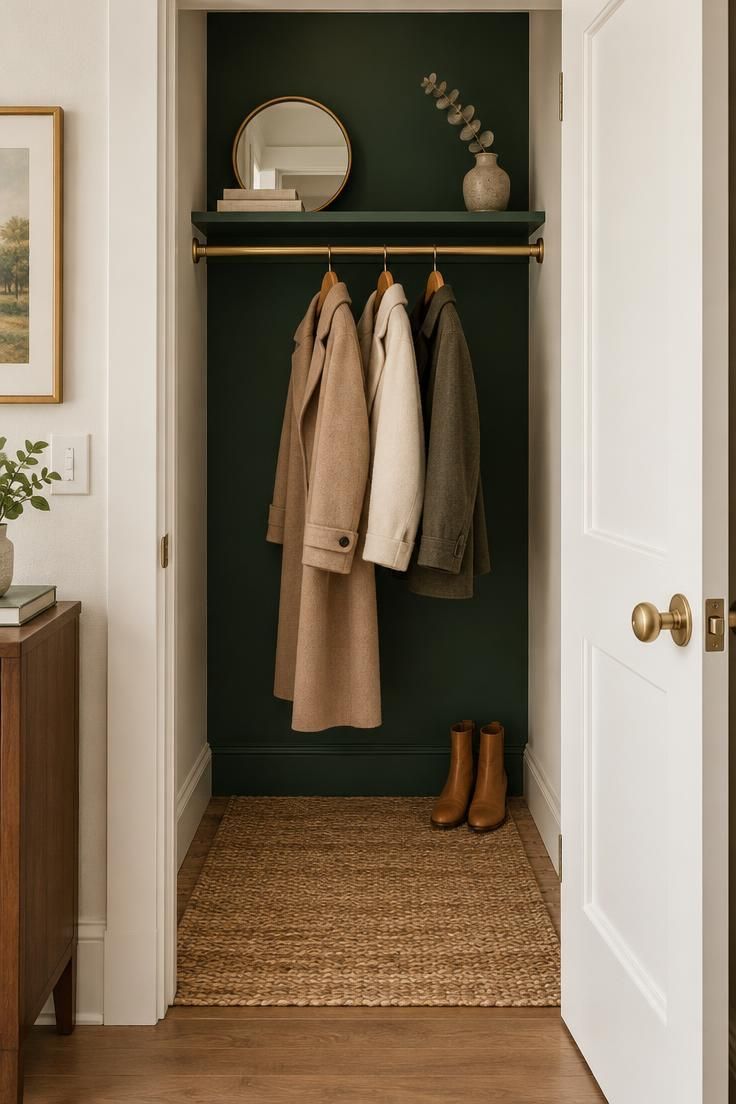
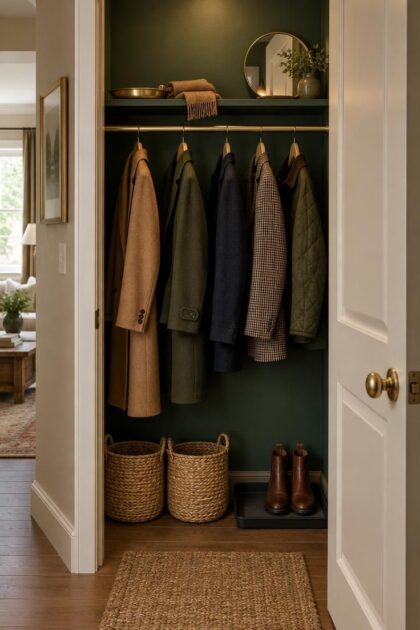
Color does the heavy lifting in this version.
A deep green back wall turns the closet into a reveal, and the warm white side walls keep the narrow space from closing in.
Brass hardware brings warmth against the green.
A rod, a hook, and a small mirror frame in the same finish read as a considered set rather than an accumulation of parts.
The runner matters more than its size suggests.
A flatwoven jute in a low profile adds texture underfoot and defines the closet floor without interfering with the door.
Small entryway closet lighting decides whether a dark interior reads as dramatic or simply dim.
In a closet with no fixture, a small battery-operated light mounted under the shelf gives the green wall enough illumination to show its depth.
The mirror on the shelf bounces whatever light reaches the closet back into the space.
It also gives a last glance before leaving, which makes the shelf feel purposeful rather than decorative.
Natural wood, leather, and brass sit comfortably against deep green, so coats in camel, cream, and charcoal keep the palette coherent.
Bright primary colors would fight the wall, which is worth knowing before adding a colorful rain jacket to the rod.
Style Blueprint:
- Deep green paint on the back wall, warm white on the sides
- Matching brass rod and hook hardware
- A low-profile flatwoven jute runner
- A small round mirror on the shelf
- A battery-operated light for the unlit interior
Layered Shelf and Basket Grid for Vertical Storage
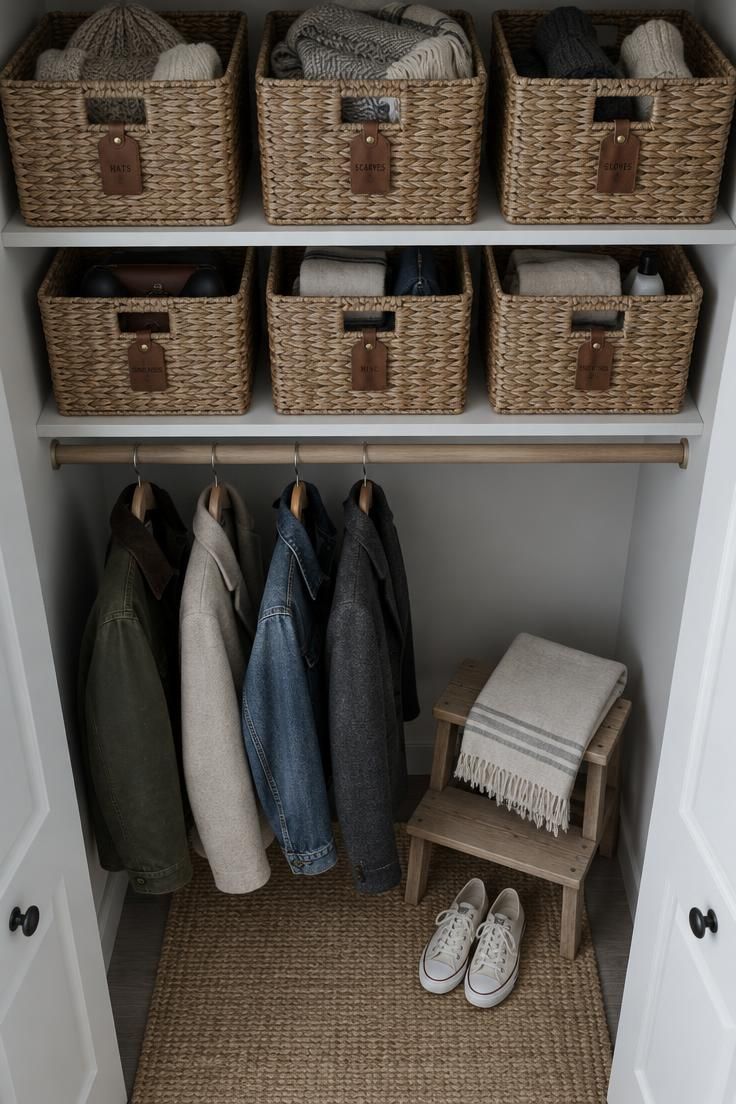
Vertical space above the rod is the most underused part of a typical entryway closet.
A second shelf turns that gap into working storage without touching the closet's footprint.
The visual key is alignment.
Tops of baskets set level with one another, consistent spacing between them, and one basket material throughout make the shelf read as a system rather than a collection.
Tied leather tags identify scarves, gloves, and pet gear.
Chalk labels work as well, and both can be changed when the contents change.
Before adding a shelf, measure the longest coat on the rod.
A shelf placed too low cuts into hanging clearance, and a coat that drags on a basket defeats the purpose of the upper storage.
Lidded or labeled baskets are less convenient for items touched daily.
A household that grabs gloves every morning may prefer one open bin at the end of the row for quick access.
A small step stool earns its place on the floor here.
Reaching the upper shelf without one means stretching, and a stool that tucks beside the rod stays out of the way between uses.
Style Blueprint:
- A second shelf added above the existing one
- One basket material and size repeated across both levels
- Leather or chalk tags for contents
- A low step stool that stores on the closet floor
- Coat length checked before the shelf height is set
Design Pro-Tip: Group baskets by what gets touched most, placing daily items at the end of the row nearest the door and seasonal pieces toward the back.
Battery Puck Light and Warm White Shelf Glow
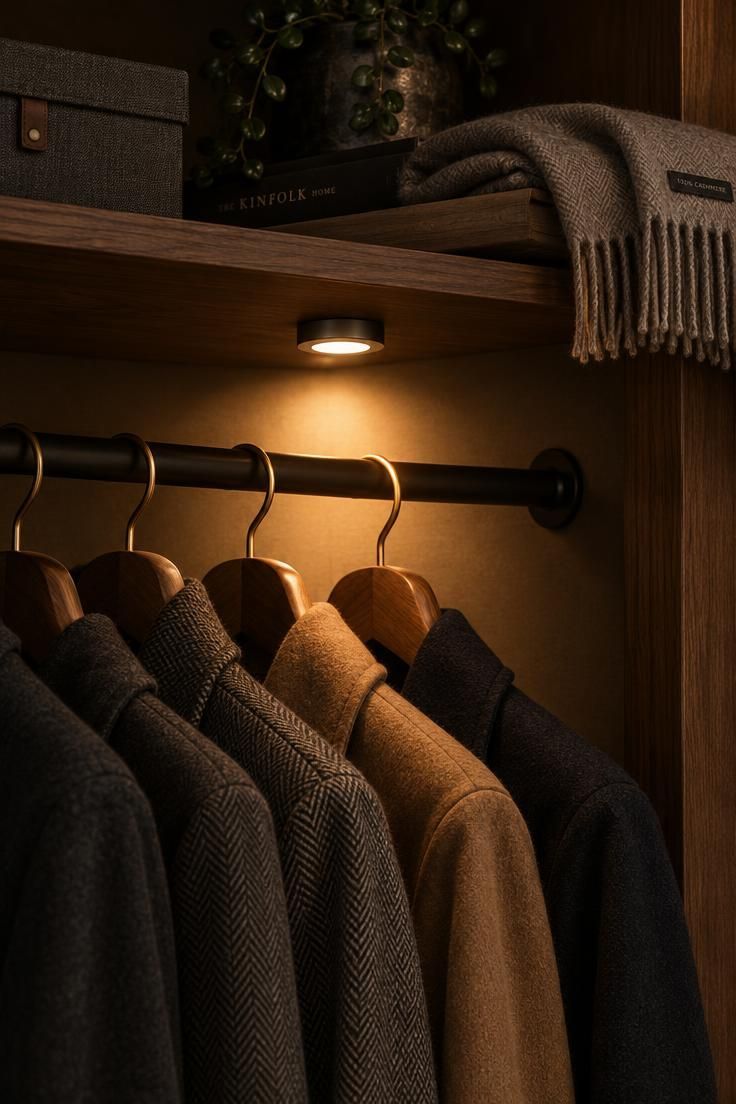
A single small light changes when a closet becomes usable.
In the evening, a dark rod turns into a guessing game, and a warm glow under the shelf removes that friction.
Warm white output flatters wood tones and coat fabrics.
A cooler tone reads more utilitarian, which suits a utility closet but works against a warm entry.
Placement matters as much as the fixture.
Centering the light under the shelf lets the glow pool across the rod contents instead of glaring from one corner.
Battery operation keeps this firmly in decorating territory with no wiring to plan.
The tradeoff is maintenance.
Batteries need periodic replacement, and a light that dims quietly over months can go unnoticed until the closet feels dark again.
A moody, low-light interior still needs readable detail.
Choosing a light with a soft, even spread rather than a tight spotlight keeps coat colors and textures distinguishable from the doorway.
Style Blueprint:
- One battery-operated puck light under the top shelf
- Warm white output rather than cool white
- Center placement for an even pool of light
- A calendar reminder for battery replacement
Over-the-Door Organizer with Slim Pockets and Hooks
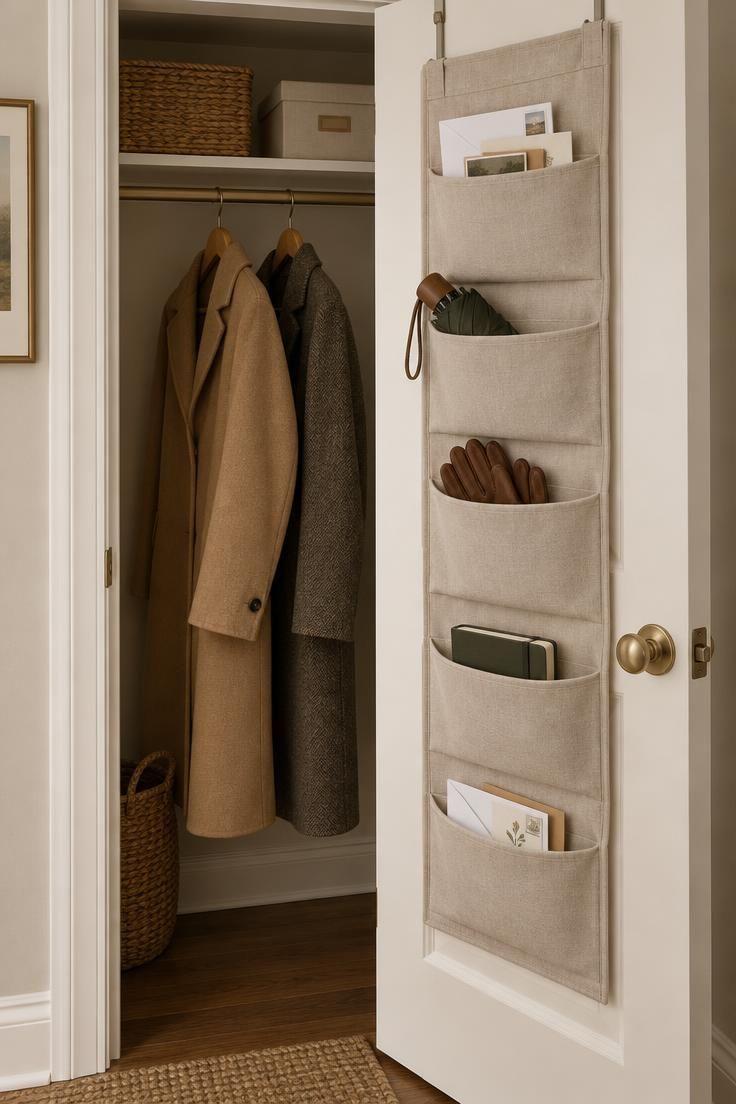
The inside of the closet door is free real estate.
A slim fabric organizer uses it for the small items that otherwise end up on a counter or the floor.
Flat pockets suit mail, gloves, a thin notebook, and a compact umbrella.
Nothing bulky goes in, which keeps the organizer flat against the door.
Color choice keeps the organizer from reading as an added object.
A tone close to the door or wall color lets it blend into the architecture instead of announcing itself.
Fit deserves a check before committing.
The gap between the door and its frame needs enough clearance for the organizer's hooks, and a tight gap can cause rubbing as the door swings.
This is one of the more flexible entryway closet door ideas because it reverses easily.
The organizer lifts off, the door returns to plain, and no hardware marks remain.
Behind the door, the rod stays free for coats.
Splitting storage between the door and the rod keeps each surface from overcrowding, which is what makes the arrangement hold up over time.
Style Blueprint:
- A slim fabric organizer with flat pockets
- A color matched to the door or wall
- Door and frame clearance checked before hanging
- Only thin items stored in the pockets
Woven Baskets on the Floor with a Boot Tray and Labels
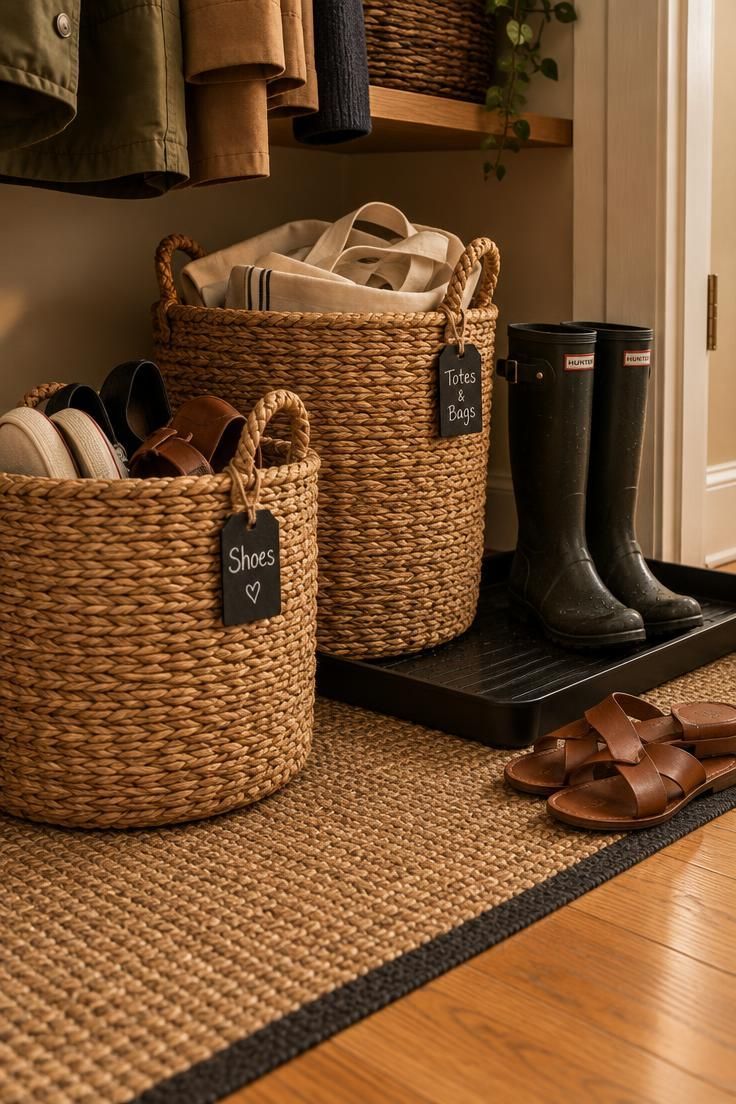
Floor storage works hardest in a shallow closet.
Two or three woven baskets in graduated heights hold shoes, slippers, and reusable bags while keeping the floor from turning into a jumble.
The boot tray gives wet footwear a defined spot.
A raised lip contains drips, and the tray sits at the front where shoes come off rather than at the back of the closet.
Chalk labels on basket handles make the contents legible at a glance.
A guest can find an umbrella without opening three baskets, and household members stop guessing where things belong.
Using baskets of different heights creates a stepped line that reads more naturally than a matched row.
The tallest basket goes against the side wall, and shorter ones step down toward the door.
Woven textures can snag on rough hooks or hardware edges.
Smooth finishes on hooks and shelves reduce wear on the fibers, which matters in a closet where baskets slide in and out daily.
The tradeoff with open baskets is visibility.
Contents show, dust settles, and a quick wipe-down every few weeks keeps the woven look from reading as neglected.
Style Blueprint:
- Two or three woven baskets in graduated heights
- A metal boot tray with a raised lip at the front
- Chalk or tied labels on each basket
- Smooth hook and shelf finishes to protect fibers
- A periodic wipe-down for open baskets
Tonal Wood Slat Closet Door with Wall-Mounted Coat Pegs Beside It
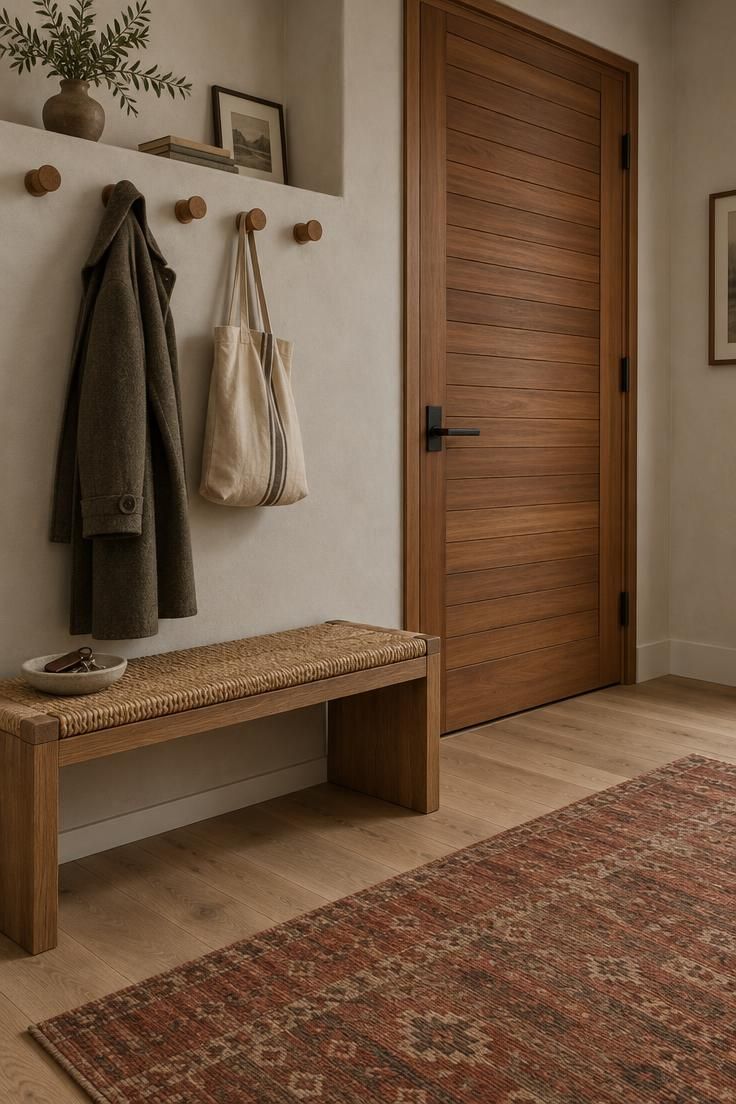
A slatted wood door gives the closet a warmer presence than a solid painted panel or mirror.
The narrow gaps between slats add texture without making the entry feel busy.
Wall-mounted pegs just beside the door take over the job that a console table would normally perform.
They hold one or two everyday coats and a bag at shoulder height, so the floor stays open and the walking path remains clear.
A low bench underneath the pegs offers a place to sit while removing shoes without adding a second tabletop surface to maintain.
A shallow stoneware dish on one end collects loose pocket items, while the woven seagrass cushion keeps the seat from feeling cold or hard.
The bench height and the peg height are the two decisions worth testing before copying this layout.
Space the pegs far enough apart that a heavy wool coat and a canvas tote do not crowd each other, and choose a bench depth that does not compete with the closet door swing.
The wood tones do most of the color work here.
Teak slats, oak pegs, and white oak flooring repeat the same warm family, while the rust and clay rug adds a deeper accent that grounds the composition.
Style Blueprint:
- A horizontal wood slat closet door in warm teak
- Rounded oak wall pegs mounted on a shallow plaster ledge
- A low bench with a woven seagrass cushion below
- A stoneware dish for keys and pocket items
- A flat-weave rug in rust and clay tones underfoot
Folded Sweater Wall with Clip Hooks and a Dressing Stool
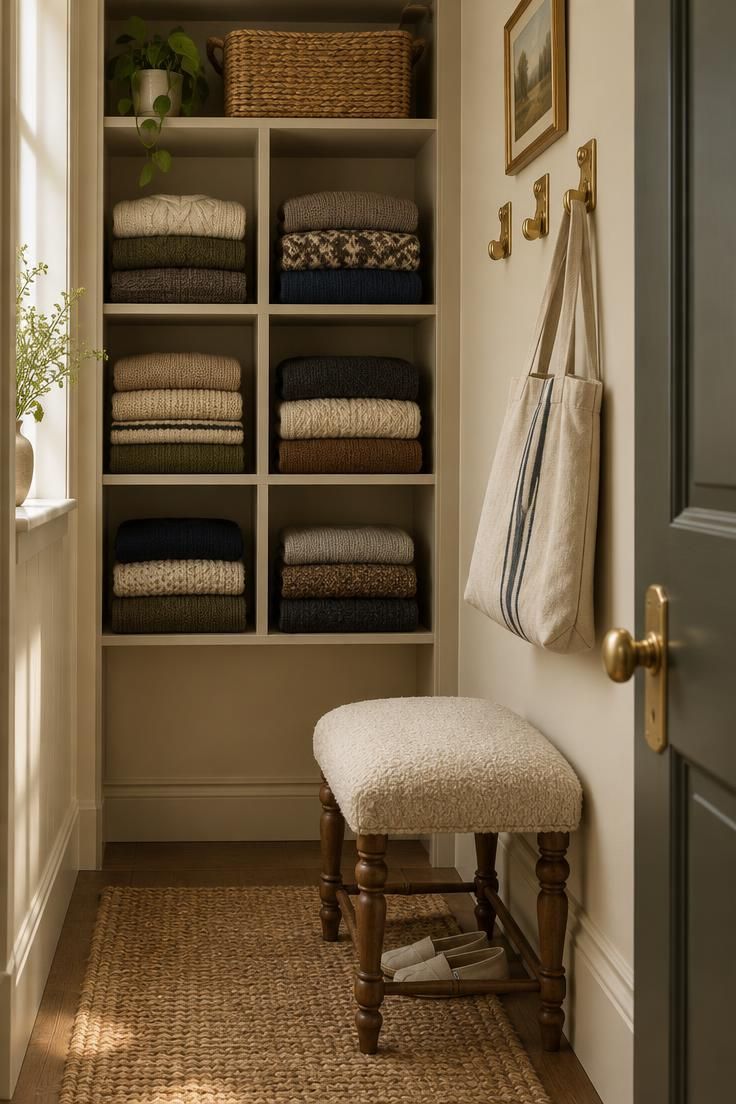
Folding bulky sweaters onto open cubbies changes how the closet reads.
Stacks of knitwear form a softer, quieter front than rows of hanging coats, and they keep thick fabrics from crowding the rod.
Clip hooks give small carry items a place without adding another shelf.
A canvas tote, a lightweight scarf, or a lint brush can hang from the clips and still remain easy to grab on the way outside.
The low dressing stool makes the closet function as a brief stop for shoes and bags.
Its upholstered top offers a softer surface than a wooden bench, while the open space beneath holds a pair of slip-on shoes.
This idea suits a closet used as a holding spot rather than full coat storage.
Sweaters, cardigans, and knit wraps stay visible, while heavier outerwear likely moves to a nearby hall closet or wall rack.
Keeping the cubbies shallow avoids the bulky look that deep shelving can create.
Folded pieces sit near the front edge, and the arrangement reads as a warm textile wall from across the entryway.
A seagrass bin on the upper shelf provides a natural counterpart to the oat fabric and brass hardware.
The overall mix stays restrained, with warm neutrals and a single metal finish repeating through the small space.
Style Blueprint:
- Open cubbies with folded sweaters instead of hanging rods
- Brass clip hooks mounted in a narrow vertical line
- Low upholstered stool with space for one pair of shoes
- Seagrass bin above for gloves, hats, or pet leashes
- Warm ivory wall color with brass and oat as the accent pair
Design Pro-Tip: Fold each sweater with the same front width so the stacks look intentional, then place the most worn color at eye level where it will be reached first.
Warm Honey Stained Bench with a Round Mirror and Chunky Knit Pillow
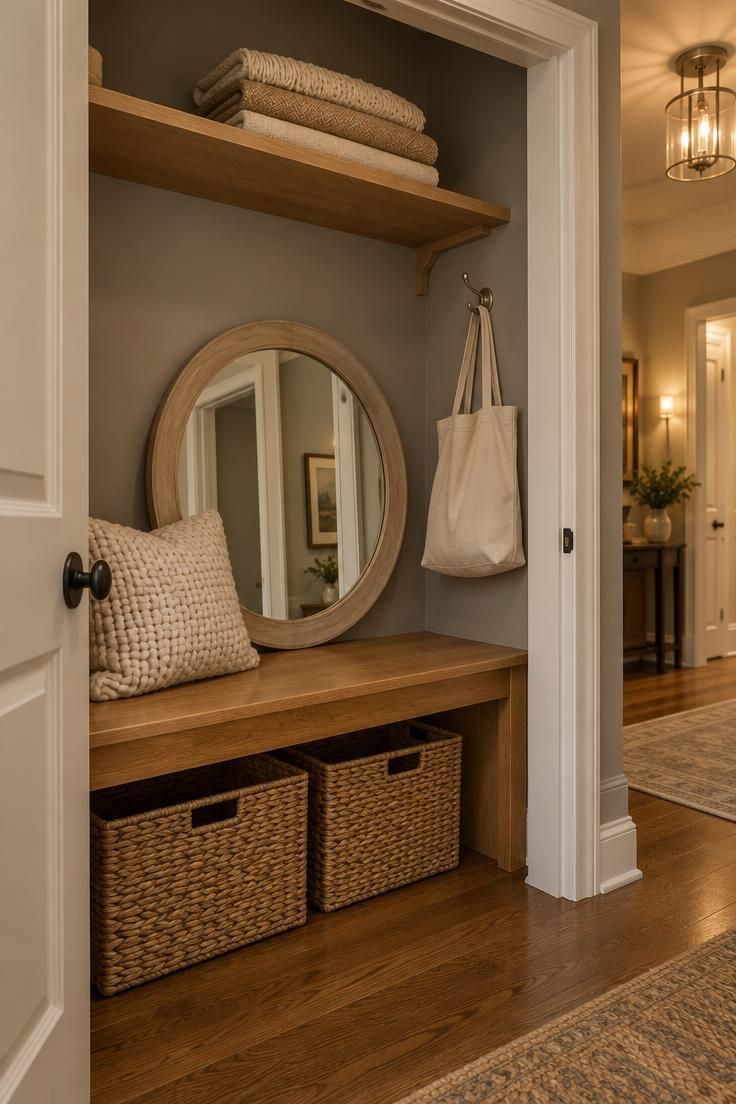
A bench inside the closet changes how the space works without waiting for a separate mudroom.
It belongs in the entry sequence, but it is tucked just enough to keep the doorway clear.
Honey stained wood adds warmth against a pale gray wall.
The finish reads as older and softer than a raw oak piece, which suits a small closet that could otherwise feel stark.
The round mirror leaning on the back wall does two small jobs.
For a front door drop zone, it bounces light while the door is open, and the scale keeps the bench from becoming the only object in view.
Under the bench, two flat woven baskets catch indoor slippers and low shoes.
Because the baskets sit open rather than lidded, household members can drop and grab footwear without opening a cabinet.
A high shelf above the bench holds folded throws instead of a display arrangement.
The stack doubles as a soft landing zone when a coat needs to come off quickly and the hanging rod is already full.
Style Blueprint:
- Honey stained wood bench placed inside the closet
- Round pale oak framed mirror leaning on the back wall
- Two flat woven baskets beneath the bench
- Chunky cream knit pillow on one bench end
- High shelf with folded throws above the bench
Conclusion
A welcoming entryway closet balances practical storage with a few warm, thoughtful details.
Small changes in hangers, lighting, baskets, or a back-wall finish can shift how the space feels at the start and end of every day.
Choose the idea that matches the closet's daily use and available depth, and leave room for the household to maintain it without effort.