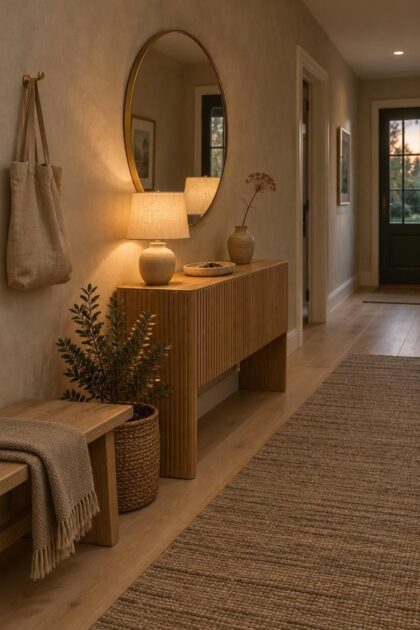
This post may contain affiliate links. If you make a purchase through these links, we may earn a commission at no additional cost to you.
A small entryway asks a lot of a few square feet.
Shoes land here, keys get dropped here, and the last glance in the mirror happens here, usually while you are already running late.
Because the space is viewed in motion and often relies on a single light source, composition that reads at a glance matters more than fine detail.
The ideas below treat a modern entryway as a design direction rather than one fixed look.
Warm minimalism, soft contemporary curves, and crisp black-and-white schemes all belong in the conversation.
What matters is choosing a few moves that keep the path clear and the surfaces calm.
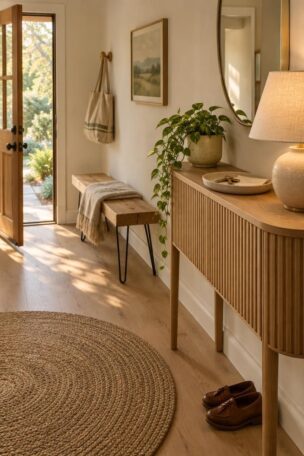
Slim Fluted Console with a Floating Top and Hidden Drawer
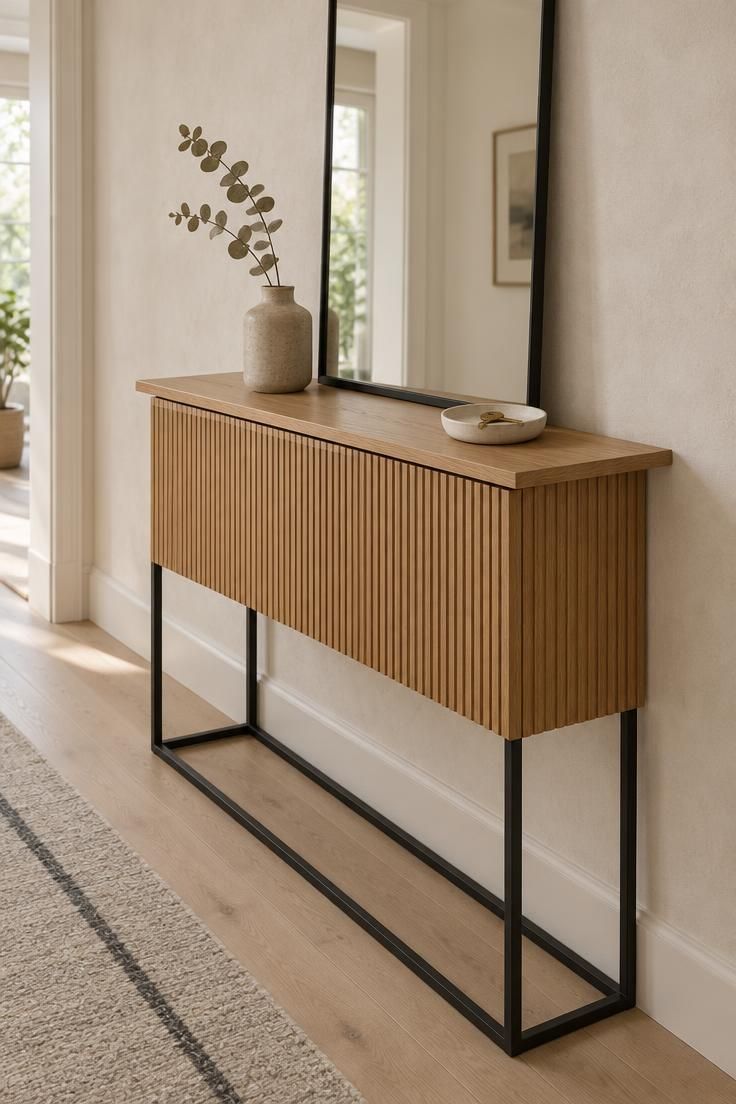
A slim fluted wood console earns its place by depth rather than width.
Keeping the body shallow leaves the walking path open, which is the difference between a usable hall and one you edge past sideways.
The thin floating top reads as a single horizontal line, and a drawer tucked flush into the body gives mail and keys somewhere to vanish without adding a second piece of furniture.
Vertical fluting brings warmth that a flat painted panel cannot, and it plays well against the cool, squared geometry of a matte black base.
That contrast of warm grain and dark metal is one of the quieter signatures of current modern entryway design.
A shallow tray or dish on top keeps the daily drop contained, so the surface stays composed even on a rushed morning.
There is a practical tradeoff worth knowing before you commit.
Fluting on a solid wood body collects less dust than open shelving, since there are no horizontal ledges for debris to settle on.
A dark finish, though, shows fingerprints and smudges more readily than a pale one, and the recessed drawer pull area is where those marks tend to gather.
Style Blueprint:
- A shallow console with a fluted wood front and a visible open base
- One warm metal accent, such as a brass key or tray, against dark hardware
- A leaning rectangular mirror with a thin, simple frame
- A single runner in a subtle stripe to define the path
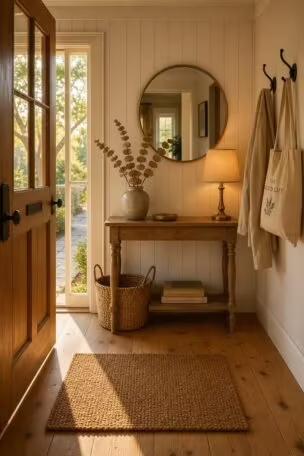
Round Mirror Above a Low Oak Bench with Open Shelf Below
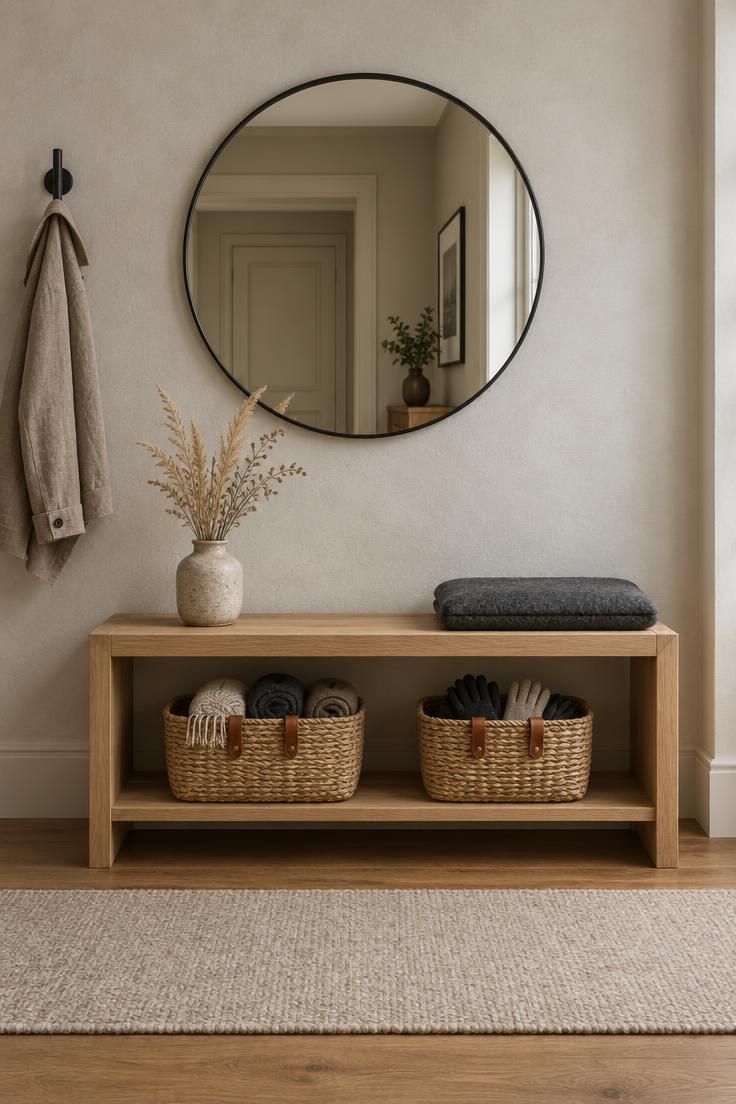
A round mirror centered over a low bench does two jobs at once.
It introduces a soft curve into a wall of straight edges, and it bounces light from whatever source the entryway has.
Centering the circle above the bench also creates a vertical axis that makes a narrow wall feel intentional rather than leftover.
The bench itself is the anchor.
A low seat gives you somewhere to sit for shoes, which matters more than most people expect in a space where you are usually standing on one foot.
This is the plainest form of an entryway bench with storage: everything is visible, so everything must be edited.
That openness is the tradeoff.
An exposed shelf shows exactly what you put there, which is why baskets and bins do the real work of keeping the look calm.
Two seagrass baskets hold scarves, gloves, and the odds and ends that would otherwise scatter.
Without them, the shelf becomes a shelf of loose shoes.
One maintenance note: a mirror near the door catches fingerprints, dust, and the occasional shoulder bag.
Wiping it down weekly keeps the reflection clear, and a black frame shows dust more than a pale one would.
Style Blueprint:
- A large round mirror with a slim frame, centered over a bench
- A low oak bench with a single open shelf
- Two matching seagrass or woven baskets for hidden storage
- One folded wool cushion in a deeper neutral
Wall-Mounted Leather-Strap Shelf with Low Shoe Cubbies
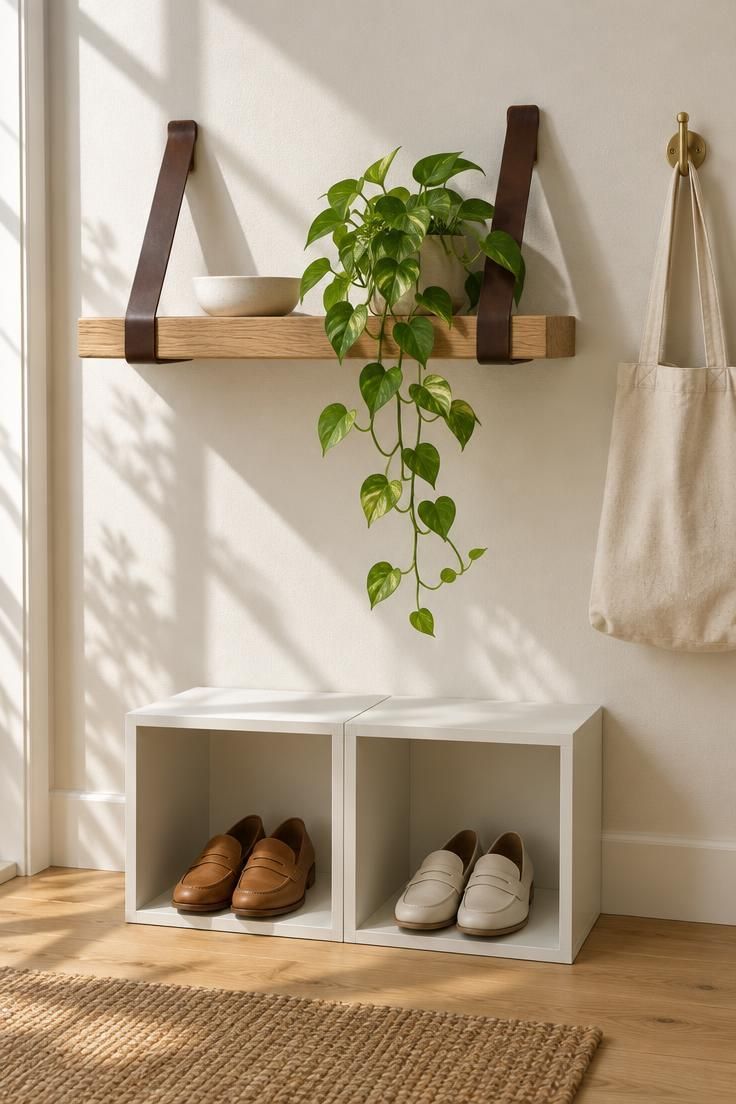
Wall-mounted pieces free the floor, and that is the entire logic of this arrangement.
A strap-hung shelf takes up no footprint at all, which means the walking path stays clear from the door all the way in.
Two low shoe cubbies below handle the pairs that would otherwise pile up at the threshold.
The shelf depth does the deciding for you.
It is enough for mail, a small lamp, or a ceramic bowl, but not enough to become a catch-all.
Cubbies keep shoes off the floor and grouped in pairs, which reads cleaner than a single open rack.
In a tight corner, this combination gives you a landing surface, a place for shoes, and vertical interest without a full bench.
There is a limit to what this layout can hide.
Open cubbies reveal what is inside them every time, so shoes look best if you rotate pairs seasonally and keep the current ones tidy.
Lined baskets in the cubbies solve the problem, at the cost of one extra step when you come home.
The plant is doing quiet work in the composition.
A trailing vine softens the top edge of the shelf and draws the eye upward, which makes a short wall feel taller.
A low-light-tolerant variety handles a windowless corner better than a sun-loving one.
Shoe cubbies with open fronts are the most honest storage in the entry.
What you see is what you own, and a weekly edit keeps the arrangement from drifting.
Style Blueprint:
- A wall-mounted shelf with a strap or bracket detail in a warm tone
- Two stacked shoe cubbies in a light finish
- One small plant with trailing growth
- A shallow ceramic bowl for keys or mail
- A single brass or dark metal hook as a small accent
Design Pro-Tip: Keep the shelf depth consistent with the widest item you actually place there, so nothing overhangs the edge and catches on a sleeve as you pass.
Closed Shoe Cabinet with Fluted Doors and a Floating Display Shelf
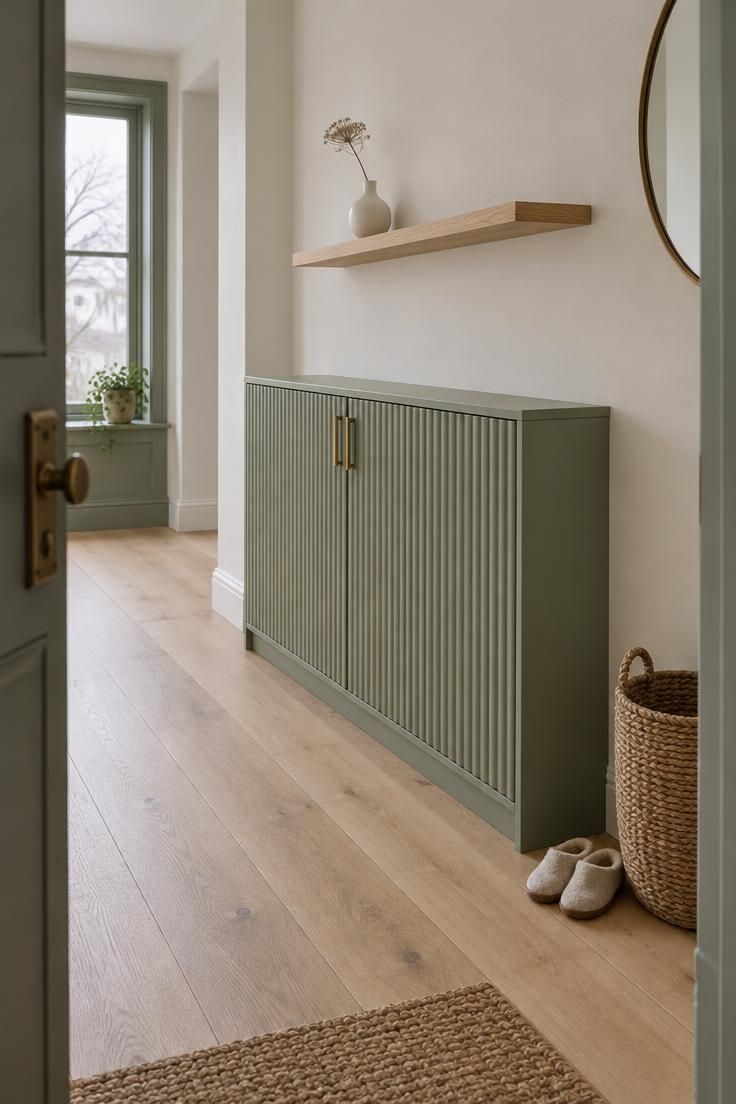
A closed cabinet changes the character of a small entry.
Shoes disappear behind a solid front, and the surface above stays clear because the cabinet top is not treated as a second landing zone.
This is the most direct way to keep a modern entryway calm, since visual noise is the main thing that makes a tight space feel tight.
The fluted doors carry texture rather than pattern.
Vertical grooves add shadow and rhythm to an otherwise plain cabinet face, and they hide scuffs and light scratches better than a smooth painted front would.
Brass pulls give the piece a single warm accent against the muted green.
Above the cabinet, a shallow floating shelf holds one small object and nothing else.
A vase with a single stem, or a slim dish for keys, is enough.
The shelf is display, not storage, and treating it that way keeps the composition from becoming busy.
Two practical notes follow the material.
The grooves in a fluted front collect dust in the channels, so a soft brush or a vacuum with a brush attachment every few weeks keeps them sharp.
And a painted cabinet finish holds up best away from direct moisture, so a spot near a frequently wet door needs more attention than a sheltered one.
Style Blueprint:
- A closed shoe cabinet with a fluted or ribbed door front
- One muted green, clay, or greige finish for the cabinet body
- A floating shelf above, kept to a single object or dish
- Slim brass or matte black pulls, one metal family only
- A natural fiber basket on the floor for umbrellas or bags
Renter-Friendly Peg Rail and Floating Shelf over a Runner
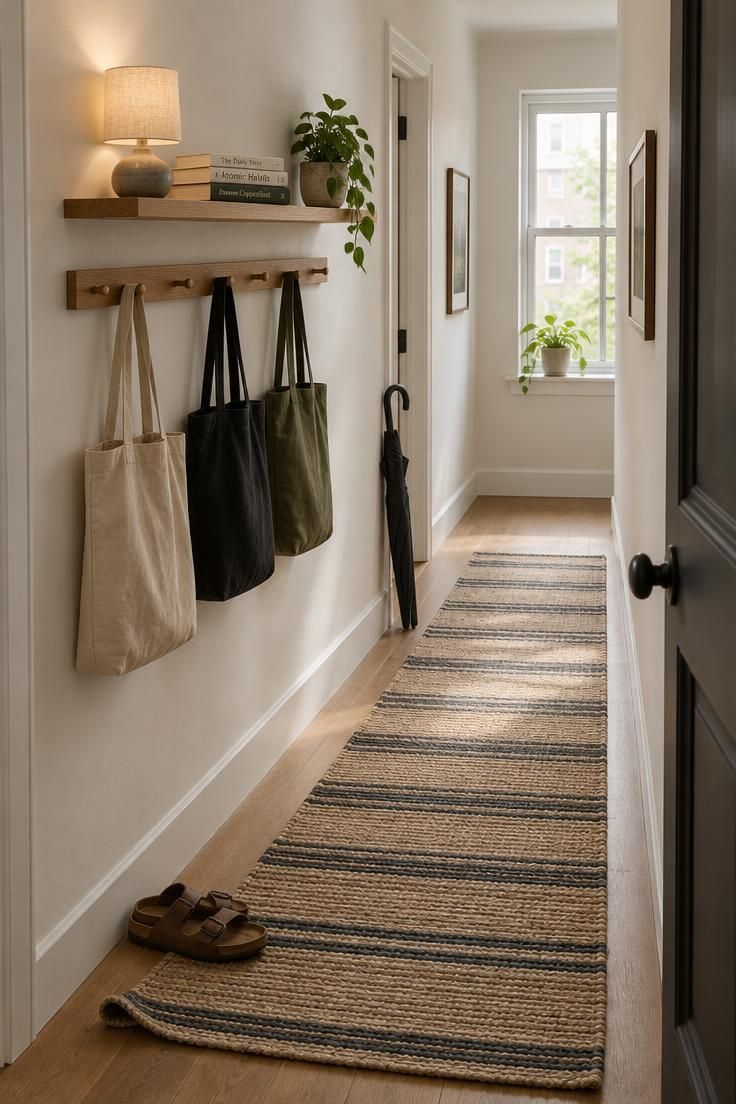
Renters often have the least freedom and the most need for a working entry.
A peg rail and a floating shelf give you hanging space and a landing surface without committing to a full furniture footprint.
Both are shallow, both sit above the floor, and both can be positioned to line up with the runner below to create one ordered composition.
The runner is what defines the entry zone in an open apartment.
It signals where the hall begins and ends, absorbs some of the grit from the door, and stretches the eye down the length of the space.
A flatweave in a simple stripe reads modern where a busy pattern would read traditional.
Coat storage has a built-in failure mode.
Hooks fill up fast, and once a rail holds eight items it stops looking like a design choice and starts looking like a hallway in use.
Capping the rail at four or five pieces keeps the modern look intact.
Rotate heavier coats to a closet when the season turns, and leave the rail for the pieces you reach for daily.
Style Blueprint:
- A slim peg rail in oak or matte black
- A floating shelf above, in a matching finish
- A small table lamp with a linen shade for soft light
- A flatweave runner in a simple stripe or solid
- A limit of four to five hanging pieces at any time
Black Picture-Frame Rail Below a Gallery of Unsigned Drawings
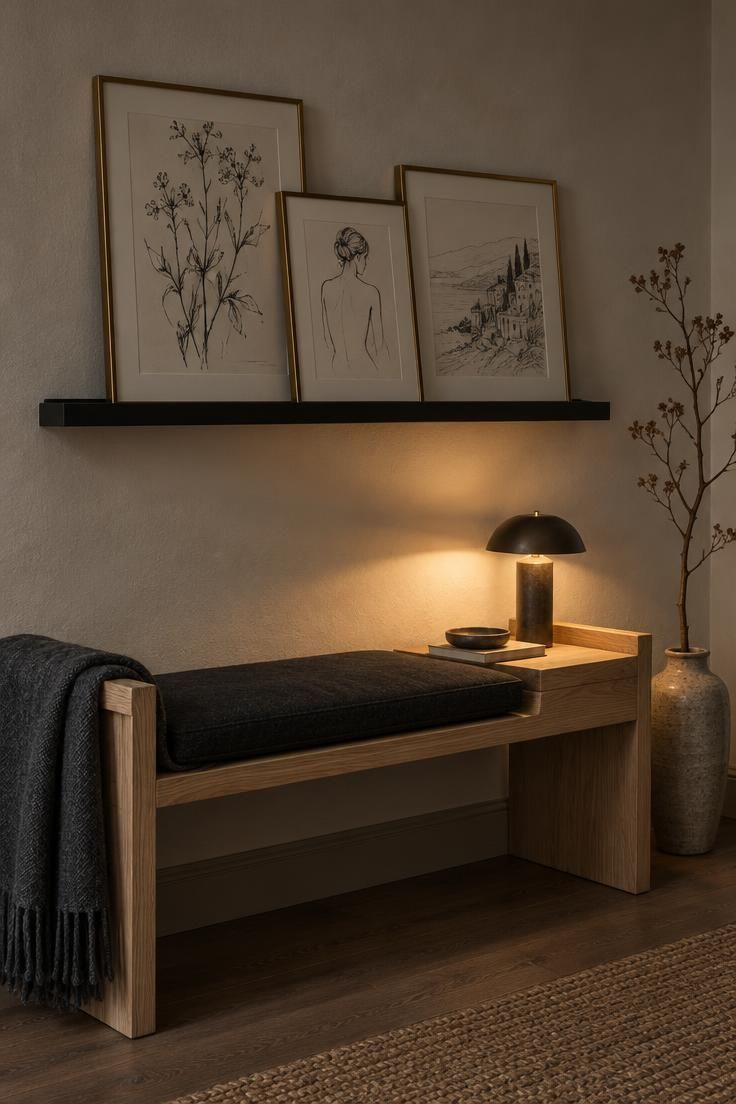
A picture ledge does the job of a gallery wall without the drilling.
Drawings rest on the rail rather than hang from individual hooks, so the arrangement can change whenever you want.
A narrow matte black rail also gives the artwork a strong horizontal line to sit on, which anchors a small collection against a large blank wall.
Rotating the display is part of the appeal.
Charcoal and bone drawings in mismatched frames read as a collection rather than a matched set, and swapping one piece for another keeps the entry from going stale.
The black rail provides contrast that makes pale paper stand out, which matters in a space where light is often uneven.
Keep the bench low and simple so the artwork stays the focus.
A single cushion in a dark tone echoes the rail without competing with it.
The lamp on the bench adds a second layer of light below the artwork and keeps the lower wall from going flat.
Dust is the small tax on a dark rail.
It shows more than a pale one would, so a quick pass with a microfiber cloth every week or two keeps the line crisp.
Frames in mixed metals should stay within one family, brass with brass, so the arrangement reads as deliberate.
Style Blueprint:
- A narrow picture ledge in matte black or dark bronze
- Three to five unframed or thinly framed works on paper
- One consistent metal family across all frames
- A low bench below with a single dark cushion
- A small lamp on the bench for a warm lower glow
Design Pro-Tip: Lean the largest frame at the back and overlap the smaller ones in front by a finger's width, so the ledge reads as a layered stack rather than a row.
Full-Height Travertine-Look Panel with a Brass Coat Hook Pair
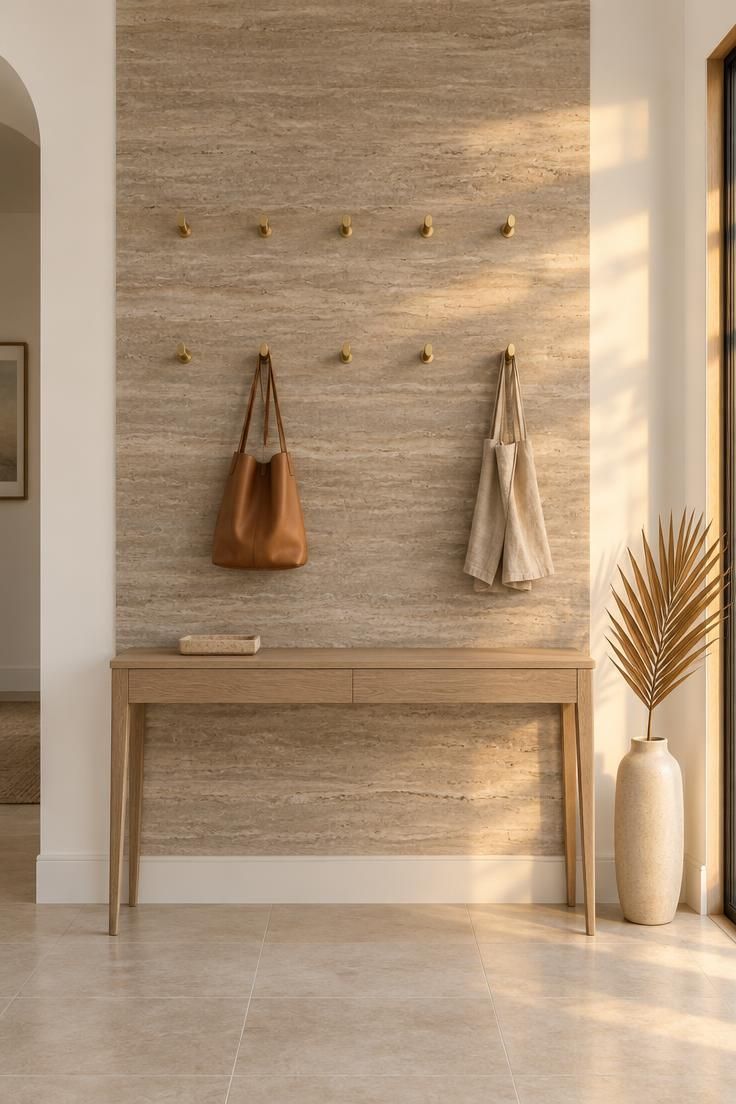
A full-height panel gives a small entry a sense of architecture without walls.
The pale stone-look surface reflects light back into the space, which helps in an entry that has no window of its own.
Extending the panel from floor to ceiling also draws the eye upward, making a low ceiling feel less close.
Brass hooks warm the composition against the cool stone tone.
Two short rows keep the hanging zone organized, and a leather bag on one hook and a linen tote on the other suggest an intentional arrangement rather than a pile.
The slim console below provides the landing surface, so the hooks stay free for outerwear.
The panel surface is easy to live with.
A honed or matte stone-look finish wipes clean and hides small marks better than a glossy one.
Brass is the part that asks for attention: water spots show if damp hands touch the hooks, so a dry cloth nearby and an occasional polish keep the finish even.
Keep the console top nearly bare.
A single stone tray holds keys and nothing more, and one tall dried element at the end of the console adds height without clutter.
Fewer, larger objects are what distinguish this look from a busier arrangement.
Style Blueprint:
- A full-height stone-look panel or limewash panel behind the hooks
- Two short rows of unlacquered brass hooks
- A slim console in white oak or a pale wood
- One stone tray for keys, plus one tall dried element
Single Curved Bench in Bouclé with a Pivoting Sconce
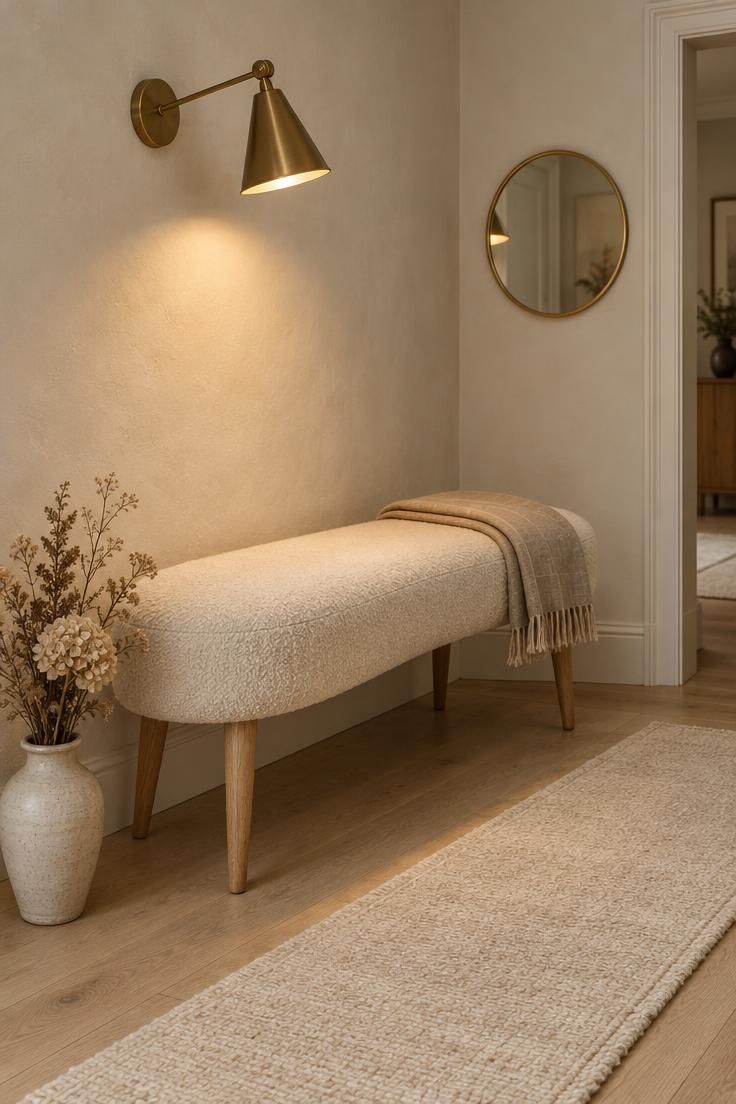
A curved bench in bouclé is the softest single move you can make in a small entry.
The rounded form interrupts the straight lines of the walls and door frame, and the nubby texture adds warmth that a smooth upholstery would not.
Placed against a wall, it reads as sculpture as much as seating.
The pivoting sconce is the practical half of the pairing.
An articulating arm lets you aim light toward the bench for a warm pool at seat level, or angle it up toward an arched mirror entryway for a brighter reflection.
That flexibility matters in an entry where a single fixed overhead light would leave the landing surface dim.
Bouclé comes with a maintenance consideration.
The looped texture collects lint, pet hair, and dust in its crevices, so a quick vacuum with an upholstery attachment or a low-adhesive roller every week or two keeps it looking even.
A cream tone shows soil more than a mid-tone would, which is worth weighing if the bench sits near a frequently used door.
Keep the surrounding pieces simple so the curve stays the focal point.
One sconce, one small mirror, and a single vase are enough.
The bench does the work of softening, seating, and adding texture all at once.
Style Blueprint:
- A curved or rounded bench in a textured bouclé or wool
- Tapered oak or walnut legs for a lighter footprint
- A pivoting or articulating wall sconce in brass
- A small round mirror on the adjacent wall
- One dried or ceramic accent at floor level
Matte Black Hall Tree with a Woven Tote and Umbrella Jar
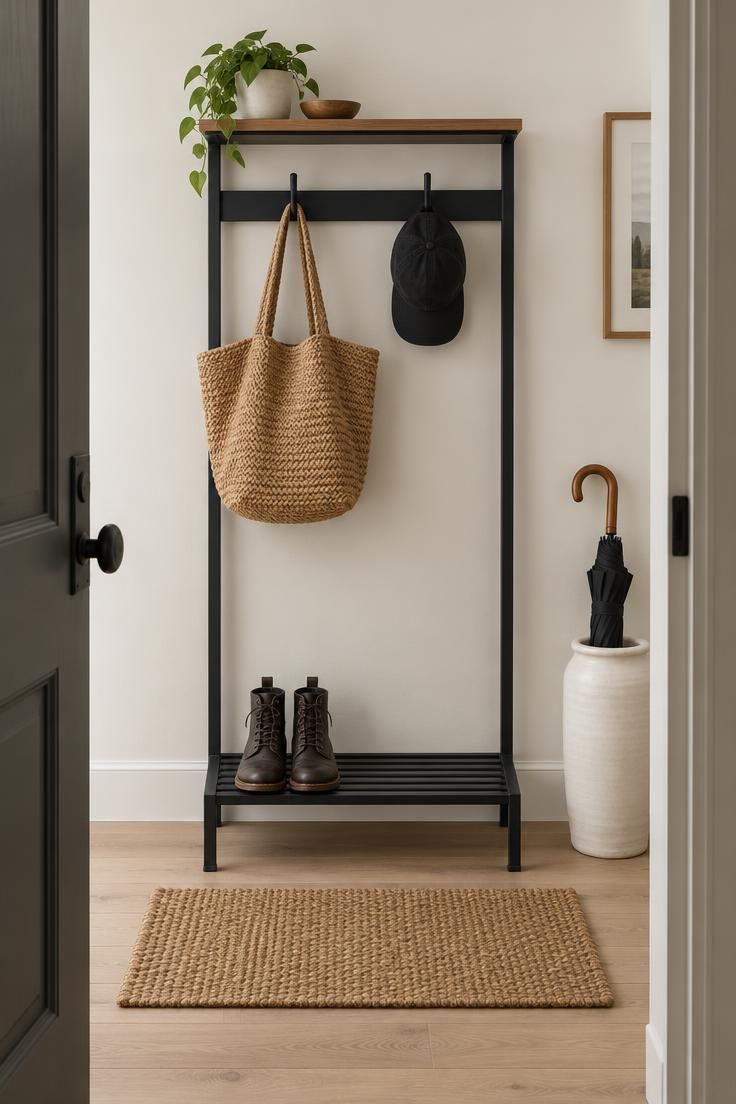
A freestanding hall tree packs three functions into one slim silhouette.
The top shelf is a landing surface, the hooks hold outerwear, and the lower tray keeps shoes off the floor.
Because it is open rather than closed, it keeps the entry feeling airy compared to a full cabinet, which can dominate a narrow space.
The matte black finish is what gives the piece its modern character.
Against pale walls and light floors it reads as a strong graphic line, and the wooden top shelf adds a small warm counterpoint.
A woven tote and a single cap on the hooks suggest daily use without looking careless.
Open storage requires upkeep.
Hooks fill quickly, so a regular edit keeps the arrangement from becoming a pile.
One tote, one cap, and a pair of boots on the tray is a working limit.
The umbrella jar handles the wet days and gives the floor a defined spot for something that would otherwise lean against a wall.
Style Blueprint:
- A freestanding hall tree in matte black with a slim profile
- A wooden top shelf for a landing surface
- Two hooks, kept to two or three hanging items
- A lower slatted tray for shoes
- A ceramic umbrella jar beside it for wet days
Design Pro-Tip: Place the hall tree so the bottom tray sits just clear of the door's swing, then check it again with the door fully open, since a tight clearance is the most common reason this piece feels awkward.
Round Jute Rug and a Low Oak Shoe Bench with Hairpin Legs
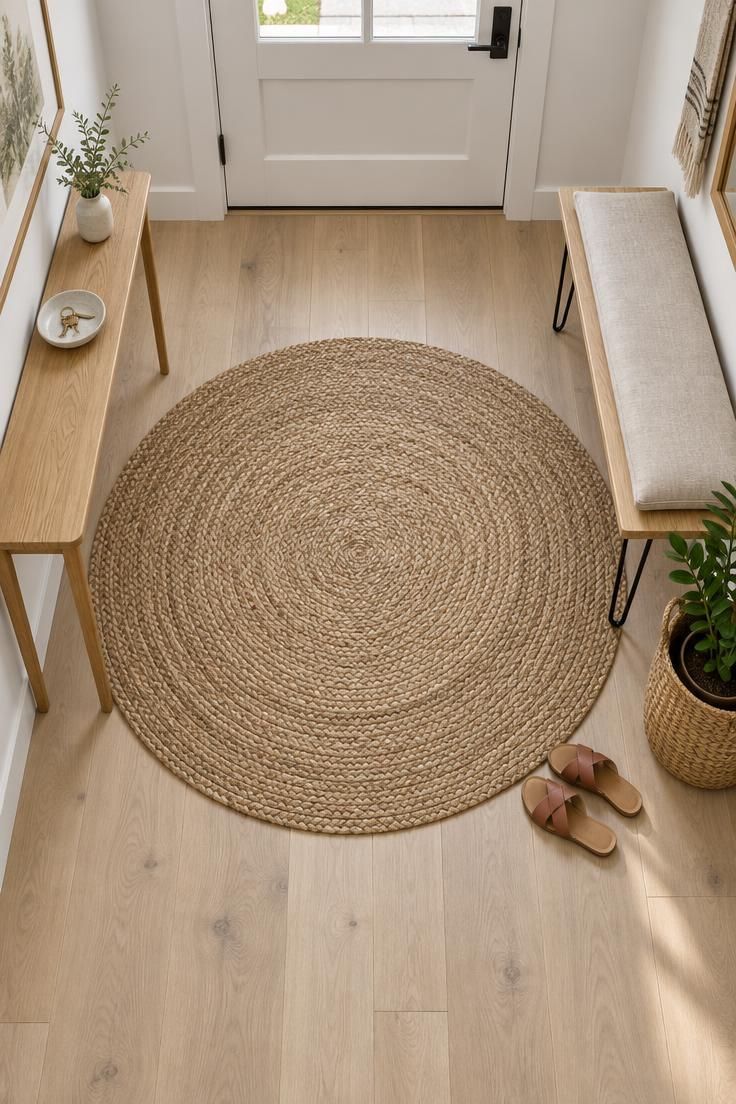
A round jute rug visually enlarges a small floor by removing hard corners.
The circle leads the eye in a continuous loop rather than stopping it at a rectangle, which softens a boxy entry.
Jute adds a natural texture that reads modern when it stays in a single tone, and it holds up to the grit that comes in from the door.
The low bench with hairpin legs solves the shoe problem without adding bulk.
Slim metal legs keep the floor visible beneath the seat, which makes the whole arrangement feel lighter.
A simple linen cushion is enough softness.
For a very tight hall, a slim console table for small entryway use can sit on the opposite wall to hold keys and mail, keeping the seating side free for the bench alone.
Jute has two practical limits.
It sheds lightly at first, so a good shake and a vacuum every week or so for the first month helps.
It also dislikes standing moisture, which makes it a weaker choice in a very wet climate.
A small coir or rubber mat at the door, with the jute further in, handles the worst of the weather.
Place the rug so the bench legs sit fully on it rather than straddling the edge.
That keeps the furniture and the floor plane visually connected, and it prevents the rug from sliding as you step on and off the bench.
Style Blueprint:
- A round natural jute rug in a single tone
- A low oak bench on slim hairpin or tapered legs
- One linen cushion in a neutral tone
- A slim console on the opposite wall for keys and mail
- A small mat at the door to catch grit before it reaches the jute
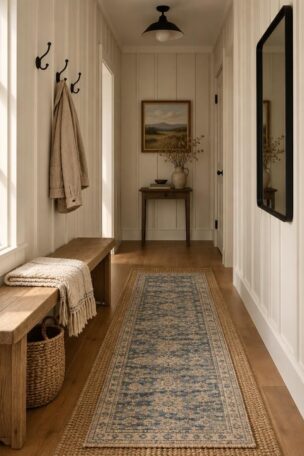
Layered Mat and Runner with a Ceramic Table Lamp on a Slim Console
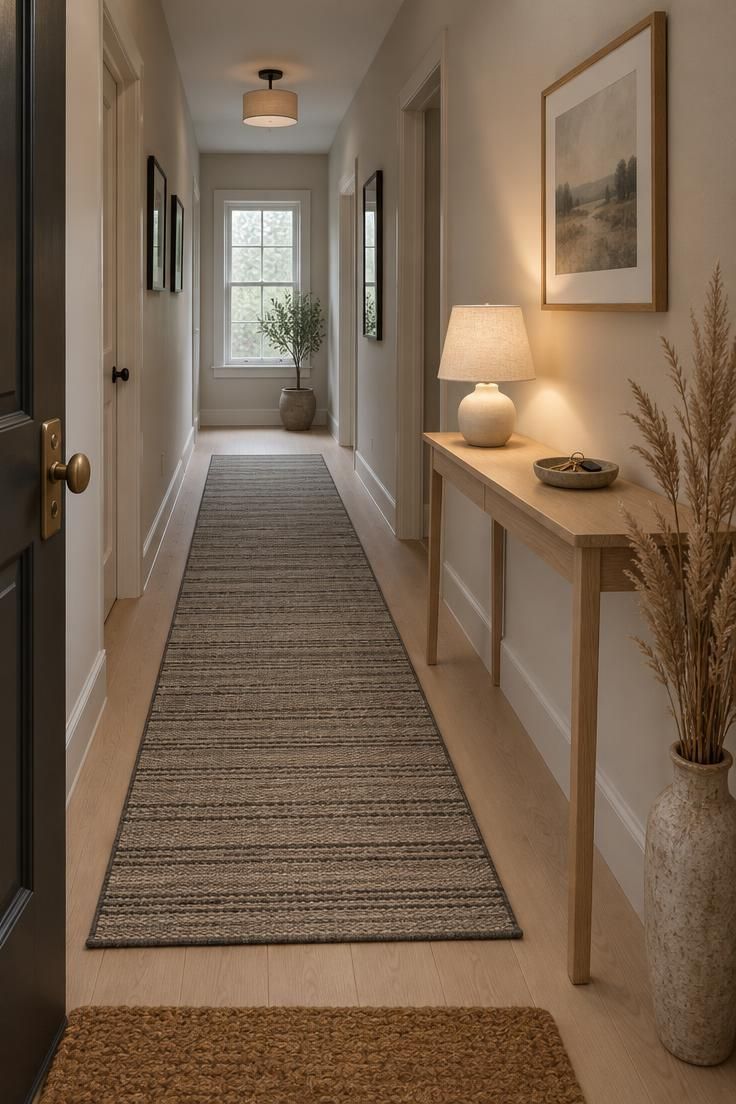
Layered floor textiles widen a narrow hall by dividing the length into stages.
A coir mat at the door catches grit and takes the worst of the weather, while a flatweave wool runner extends past it down the hall.
Together they stretch the eye forward, which makes a short entry feel longer than it is.
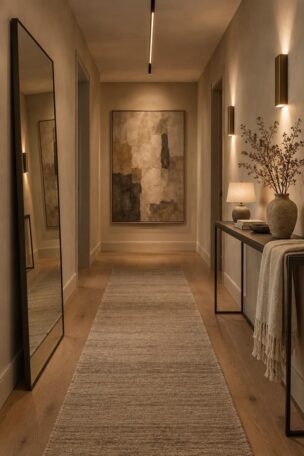
The lamp on the slim console is the other half of the effect.
A single overhead fixture tends to leave the landing surface dim while casting shadows around it.
A small ceramic lamp with a linen shade adds a low, even pool of light exactly where keys and mail land.
Layered entryway lighting like this, with an ambient source above and a small lamp at the console, keeps the space warm rather than clinical.
Warm-white light is the conventional choice for an entry, since it looks welcoming instead of sharp.
A lamp with a low output and a shade that diffuses the bulb avoids glare on a dark evening, and a dimmer or a smart bulb lets you drop the level further when you only need enough light to find your keys.
The floor layering needs upkeep.
A coir mat sheds fibers and holds grit, so it needs shaking out often.
A runner should be vacuumed regularly, and both should be checked for curling edges that could catch a foot in a tight hall.
Style Blueprint:
- A coir or natural fiber mat at the door
- A flatweave wool runner in a simple stripe or solid
- A slim console in white oak or a pale finish
- A small ceramic table lamp with a linen shade
- Warm-white bulbs on a dimmer for evening use
Conclusion
A small entry stays modern and workable when each choice answers how the space is actually used.
A slim landing surface, one or two storage moves, a mirror that catches the light, and a floor that defines the path cover most of what a tight hall needs.
Warm wood or woven texture paired with a single metal family keeps the palette calm, and a layout with room to pass through keeps daily use easy.
Whether the scheme leans minimalist, warm modern, or soft contemporary, the strongest version is the one where every piece earns its place.