This post may contain affiliate links. If you make a purchase through these links, we may earn a commission at no additional cost to you.
The end of a hallway is a small stage viewed from a distance, so every choice there works best when it reads clearly from far away.
Warm finishes, simple silhouettes, and one strong focal point turn a blank terminal wall into a destination without crowding the passage.
The ideas below focus on that single wall and how it is seen from down the corridor, with concrete materials and arrangements that hold up at distance.
Many are shallow or wall-mounted to preserve walking space in tight or busy homes.
Each one gives the terminal wall a job, whether that job is holding light, adding texture, or welcoming someone toward the rooms beyond.
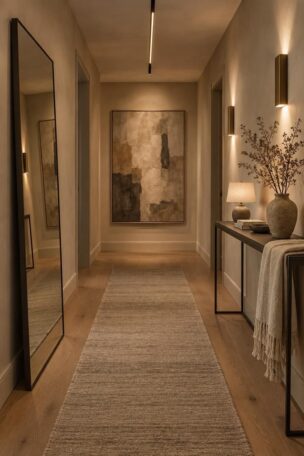
Lean a Wide Plein-Air Landscape With a Brass Picture Light
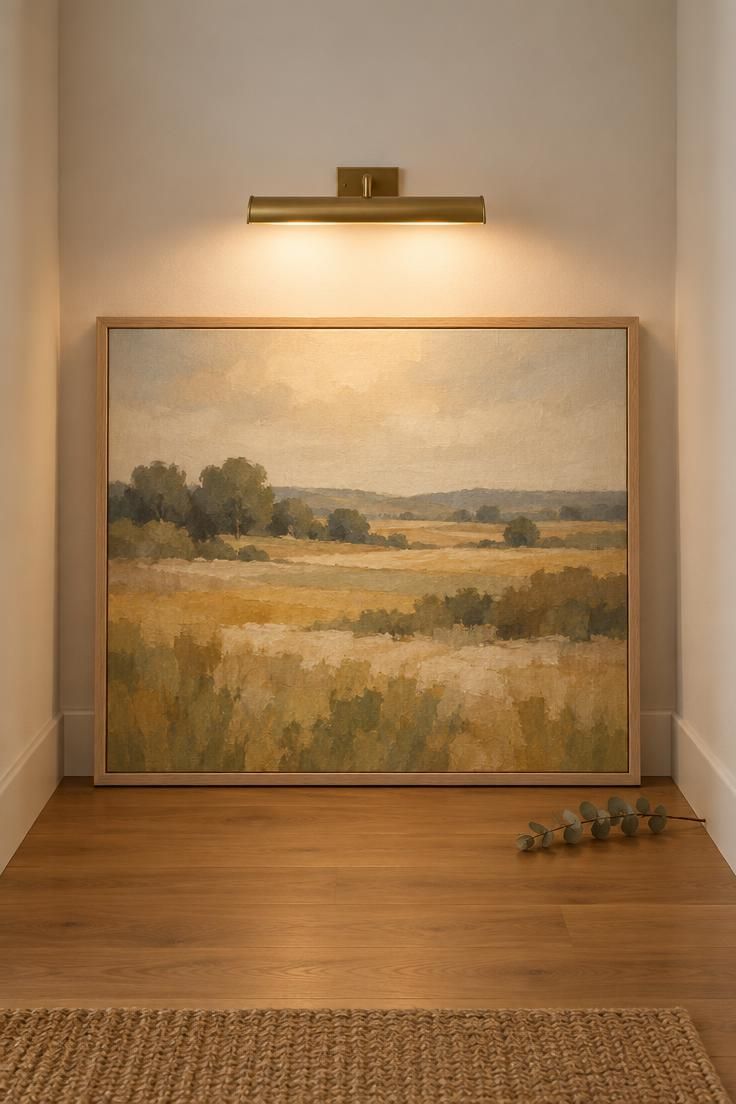
A single large painting leaned against the wall is an end of hallway decor idea that needs almost nothing except floor space at the very end of the corridor.
Its low position keeps the composition grounded, and the slight backward tilt softens the head-on view that a hallway forces.
Broad strokes in ochre, sage, and cream hold up across distance in a way that fine detail cannot.
Warm light from a slim brass fixture above the frame adds a glint that draws the eye down the hall, even when the corridor has no other lighting of its own.
Keeping the wall otherwise bare is what makes the arrangement feel deliberate rather than unfinished.
A leaning canvas is also forgiving.
Nothing needs to be centered to the inch, and the piece can be swapped without patching walls.
The tradeoff is that the bottom edge sits in the path of feet and vacuum cleaners, so a spot a few inches away from the frame helps.
Choose a composition with strong light-and-dark shapes rather than delicate linework, since the far end of a corridor tends to flatten subtlety.
Style Blueprint:
- One wide landscape on canvas, at least half the width of the end wall, in muted earth tones
- A pale oak frame with a visible grain and a simple profile
- A slim brass picture light with a downward-angled shade
- A clear floor margin of several inches in front of the frame so it is not bumped
Mount a Horizontal Slatted Oak Panel Above a Low Floating Shelf
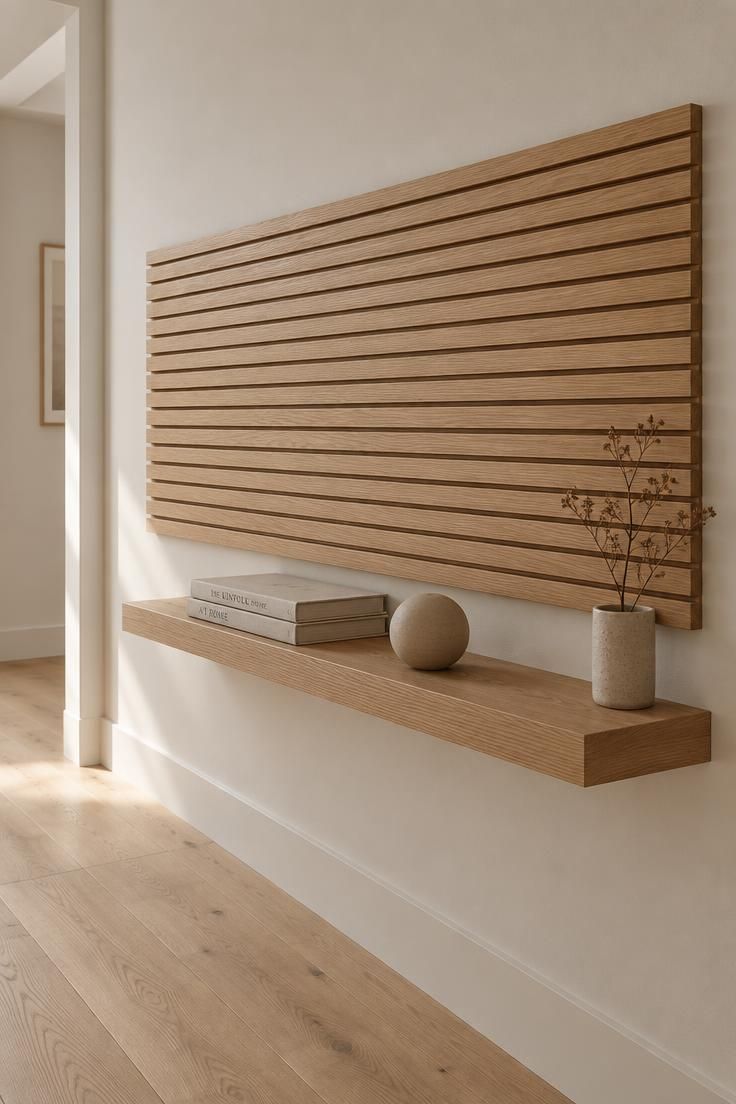
Horizontal wood slats do the work of architecture without any of its commitment.
Spaced slightly off the wall, they throw fine shadow lines that shift as a person walks past, and their warm tone keeps a narrow corridor from feeling like a tunnel.
Because the panel sits flat against the wall, the walking path stays completely open.
A short floating shelf beneath it, in the same oak, gives the wall a base and a place for a small, edited still life.
Restraint matters here.
Two books and one ceramic piece read as a composed moment; five objects read as clutter, especially at the vanishing point.
With natural or matte-sealed wood, hallway end wall ideas like this panel keep glare down under overhead fixtures while the horizontal lines visually widen a narrow terminal wall.
Style Blueprint:
- A wide slatted oak panel with even spacing and a natural or matte finish
- A low floating shelf in matching oak, narrow enough to leave the passage open
- Two linen-wrapped books stacked flat, in a neutral tone
- One matte ceramic sphere or bowl in warm sand
- A single dried branch in a small stoneware cup for a touch of organic shape
Design Pro-Tip: Keep objects on a floating shelf to three pieces or fewer so the silhouette stays legible from the far end of the corridor.
Use a Slim Cane Console to Ground a Tall Framed Abstract
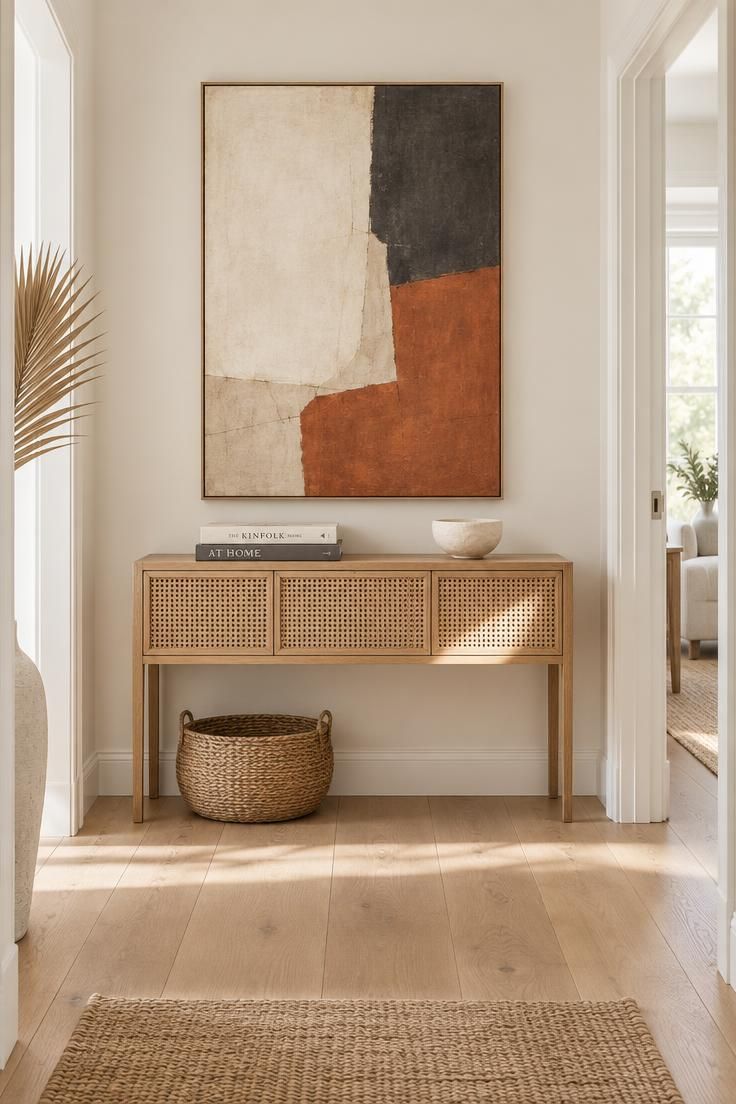
A slim console gives the terminal wall a base and a reason to exist beyond decoration.
Vertical cane texture on the front draws the eye upward toward the painting above, while the light oak top keeps the piece from feeling heavy.
A tall abstract with blocky shapes works better than a detailed scene because its forms stay readable from across the corridor.
Two or three objects on top are enough; beyond that, the console becomes a shelf for stray items rather than a moment.
Depth is the deciding factor.
A shallow console table for hallway use preserves the walkway, which matters in a narrow home, while a deep piece turns the end of the corridor into an obstacle.
If the wall is visible from a living area, the console can also become a quiet drop spot for keys or mail without turning into a full mudroom.
Style Blueprint:
- A slim console with a cane or rattan front and a light wood top
- A tall framed abstract in cream, charcoal, and terracotta
- Two art books stacked flat and one round plaster bowl
- Wide-plank white oak flooring to carry the warm tone through
- A low woven basket beneath the console for soft storage
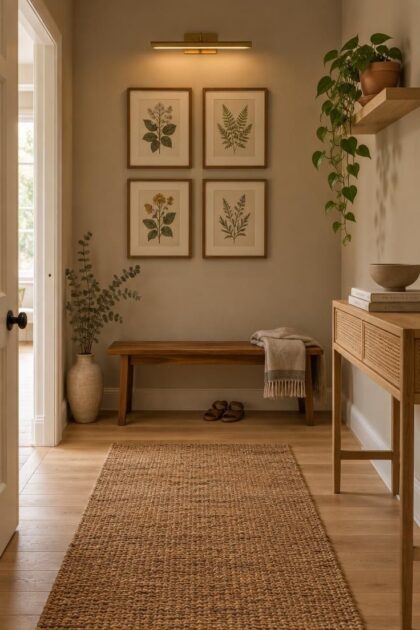
Create a Tight Cluster of Framed Botanicals Over a Low Teak Bench
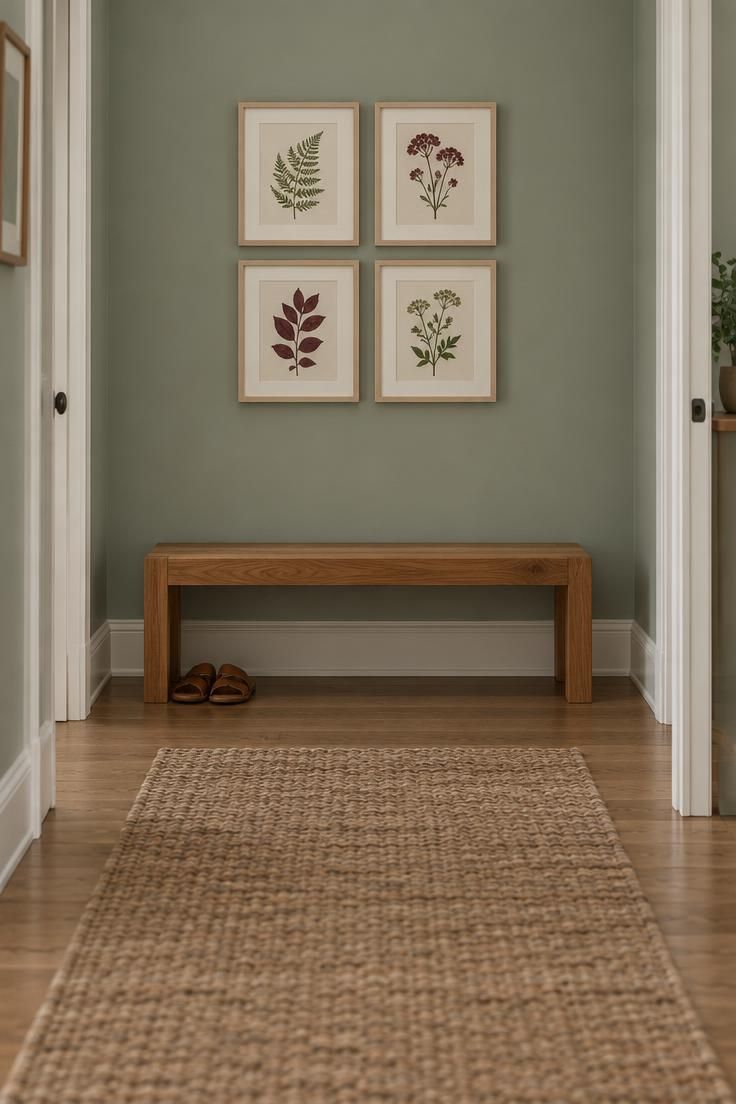
A tight cluster of four prints reads as one rectangle from the far end, which is exactly what the terminal wall needs.
Matching frames and off-white mats keep the group from dissolving into scattered dots, while simple sprig motifs in sage and burgundy stay recognizable in low light.
Spacing the frames a little closer than usual strengthens the block effect.
Below the prints, a low teak bench turns the dead-end into a place to sit and put on shoes.
A backless design keeps the wood silhouette distinct and projects less into the corridor, so the composition stays airy.
Cushions would soften the look but blur the bench’s shape and add another surface to keep clean.
Style Blueprint:
- Four matching botanical prints in pale wood frames with cream mats
- A low backless teak bench with an oiled natural finish
- A sage green wall tone to keep the sprigs and bench in conversation
- A jute runner to warm the corridor floor
- One pair of shoes or a folded throw placed neatly underneath
Paint a Large Terracotta Arch to Frame a Single Wall Hook
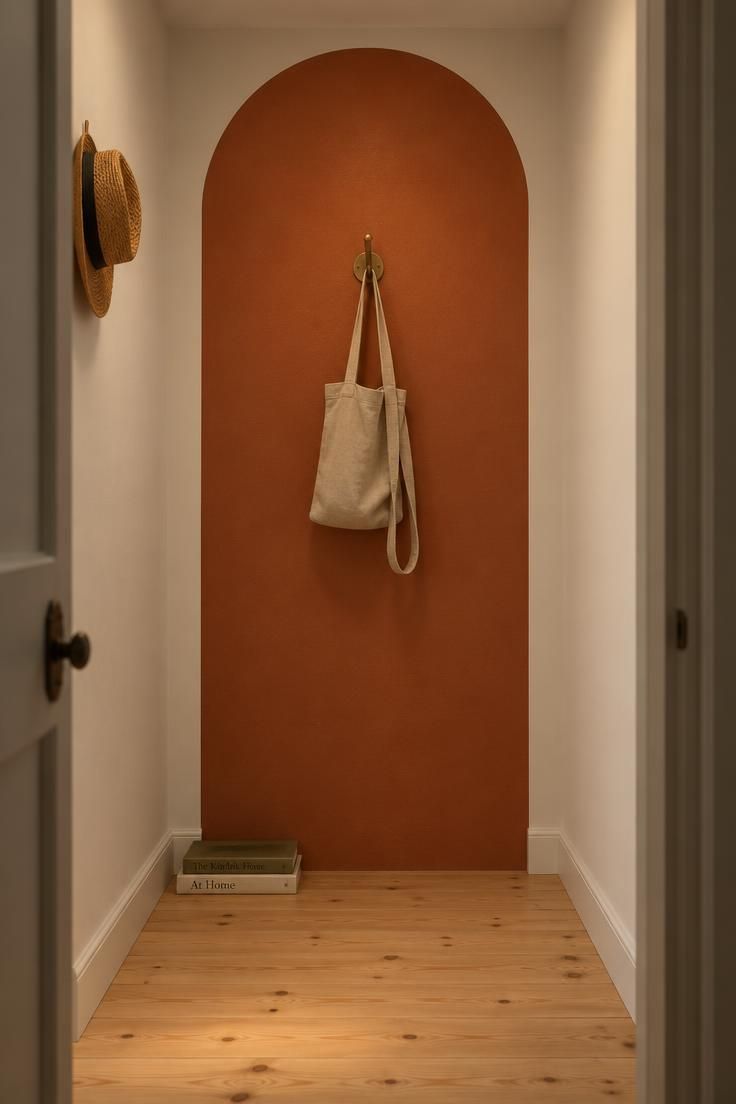
An arch painted on the end wall gives the corridor an architectural moment using only paint and careful taping.
Its curved top breaks the corridor’s insistent verticals and creates a frame within a frame, which plays directly into the vanishing point.
Inside the arch, a single hook holds a tote or a hat, making the painted arch accent wall function as both a visual marker and a practical drop spot.
The trick is to keep the rest of the hallway quiet.
Terracotta is assertive, and a busy corridor can make the arch feel accidental rather than intentional.
Matte paint cuts glare under hallway lighting and lets the color read as a flat shape.
Renters and low-budget projects get the same effect as a bigger remodel, since nothing is added but paint.
Style Blueprint:
- A floor-to-ceiling painted arch in warm terracotta or a similar clay tone
- Painter’s tape and a steady hand for crisp, even edges
- One small brass hook centered inside the arch
- A neutral canvas tote or straw hat to soften the color block
- White side walls to let the arch stay the single focus
Pair a Low Plaster Pedestal With a Single Oversized Ceramic Vase
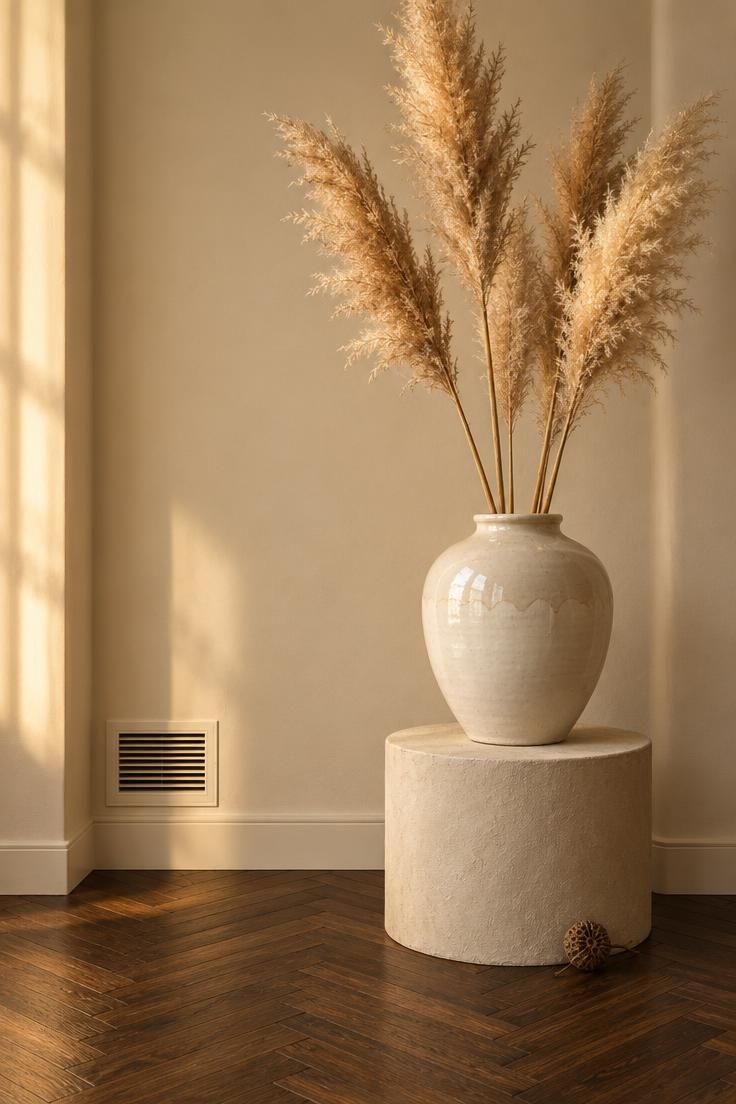
Two objects, one pedestal and one vase, are enough to give an awkward end wall a purpose.
The rounded silhouette reads as a single shape from far away, and dried stems add height and movement without water or weekly care.
Off-centering the pedestal can also answer a fixed wall feature, such as a vent or outlet, that would look worse if covered than if gently balanced.
Keep the arrangement spare.
A second vase or a stack of books starts to look like storage rather than composition.
Dust on dried stems is easy to shake out, but in a busy home with pets or small children, a floor-level pedestal is best placed where it is unlikely to be brushed past.
Style Blueprint:
- A low round pedestal in chalky matte plaster
- One oversized hand-thrown vase in a warm white glaze
- Several tall dried pampas or curly willow stems
- A dark wood floor to ground the pale sculptural group
- A single dried seed pod or small stone at the pedestal’s base
Design Pro-Tip: Choose dried stems with a strong, simple arc rather than dense sprays, since loose, sweeping lines stay visible from across a corridor.
Install a Floating Oak Picture Ledge With Three Rotating Prints
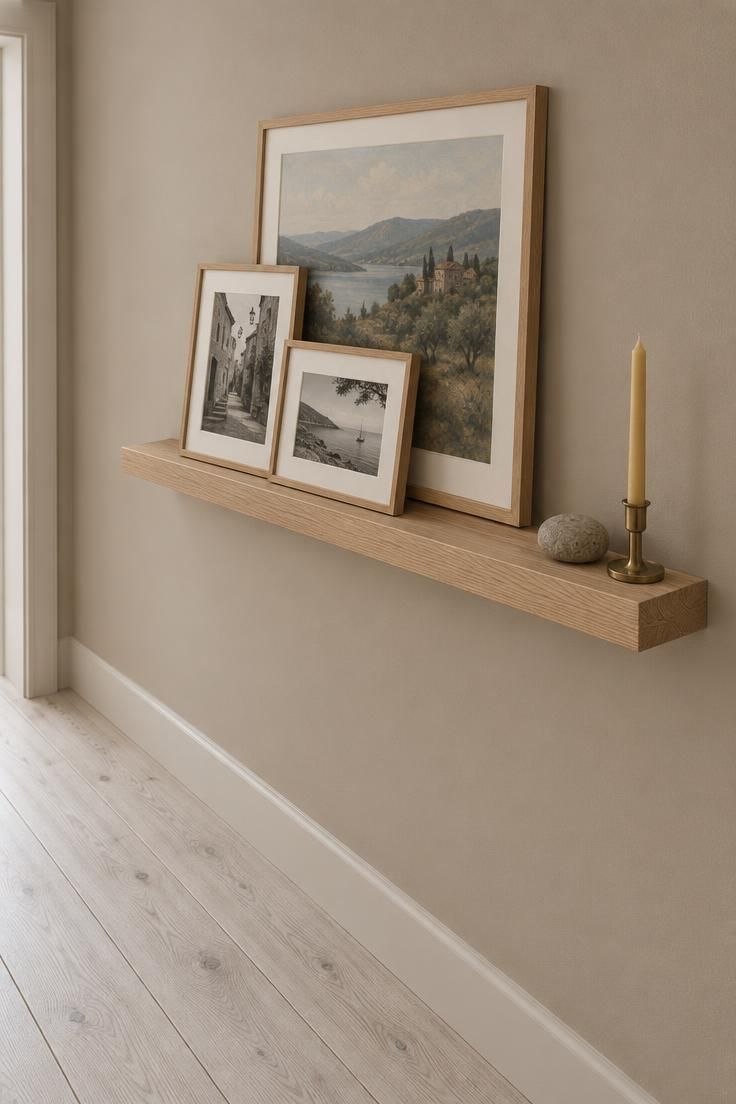
A shallow ledge holds art without eating floor space, which makes it a practical choice for narrow corridors.
Layering a large frame behind a smaller one builds a gentle depth that reads as a single band of art from across the hall.
The pleasure of this arrangement is that pieces can be swapped whenever a new print arrives, with no new holes to patch.
Consistency is what keeps the band legible.
Frames in the same wood tone and mats in one warm white keep the grouping coherent, even as the images change.
The ledge also earns its keep as a temporary home while a larger commitment for the end wall is being decided.
Style Blueprint:
- A floating oak picture ledge in a natural finish
- Three frames in the same light oak for a unified band
- One large landscape at the back with two smaller prints layered in front
- A soft clay wall color to warm the oak
- A small stone and a slim taper in a brass holder to finish the scene
Add a Tall Round Mirror With a Woven Rattan Frame Over a Slim Demilune Table
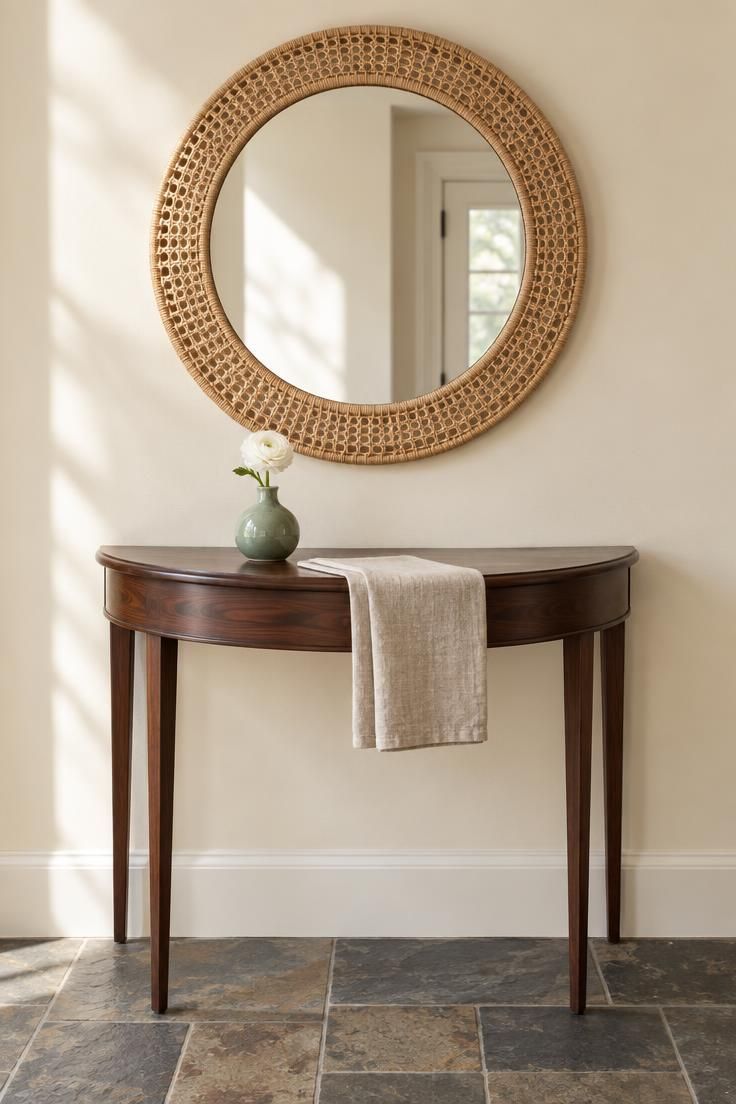
An oversized mirror hallway pairing has a practical side, because the large round silhouette with a woven rattan frame brings texture and reflective light to the terminal wall even in a dim corridor.
The open rattan weave has warmth that art alone cannot supply, and the mirror carries the hallway’s own activity back toward the viewer.
A shallow demilune table beneath it leaves the narrowest possible footprint while giving the composition a base.
Hanging the mirror slightly lower than usual helps it read as one unit with the table rather than two floating shapes, since the curved tabletop and round frame form a loose vertical axis.
What the mirror reflects matters as much as its frame.
Facing a blank stretch of wall, it simply repeats blankness, so positioning it toward a window or a lit doorway makes the reflection do real work.
Style Blueprint:
- A large round mirror with a thick woven rattan frame
- A shallow demilune table in dark walnut with slender legs
- One small bud vase in a muted green with a single white bloom
- A slate or stone floor for cool contrast with the warm rattan
- A folded linen runner draped on the table’s edge
Go Monochrome With a Gallery of Charcoal Landscape Prints
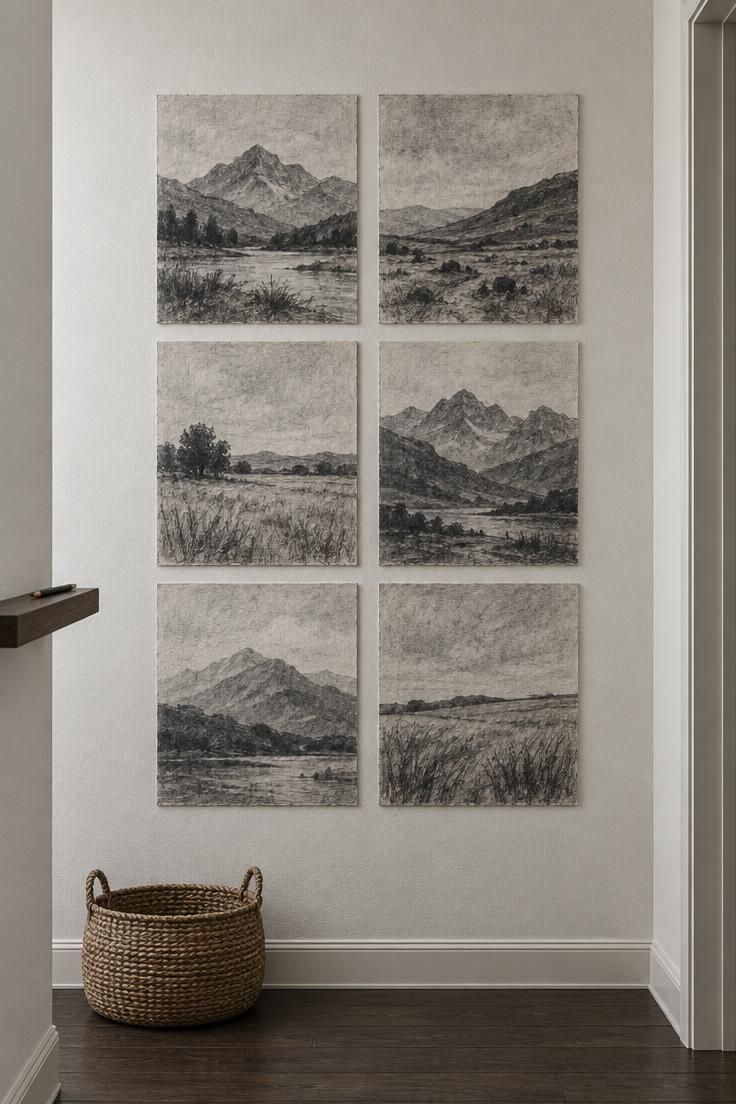
Six small prints in the same size make a quiet gallery wall arrangement that holds attention without shouting.
Mounted unframed and close together, they read as one large rectangle from the far end of the corridor, and the absence of glass means no reflections can wipe the images out under overhead lights.
Soft charcoal grays sit comfortably against nearly any warm neutral wall.
This approach rewards careful measuring.
The whole cluster needs to sit centered on the wall with equal margins around it, and a marked layout keeps the grid from drifting.
Frames would add formality, but they also add weight and cost.
The tradeoff is a wall that suits a calm, gallery-like corridor better than a busy family throughway.
Style Blueprint:
- Six unframed charcoal or graphite prints in one consistent size
- A warm white or cream wall behind them for soft gray contrast
- A marked 2×3 layout with even gaps and equal margins
- A dark wood floor for depth beneath the pale wall
- A low woven basket or stool to soften the gallery feel
Install a Wall-Mounted Cane Room Divider as a Decorative Backdrop
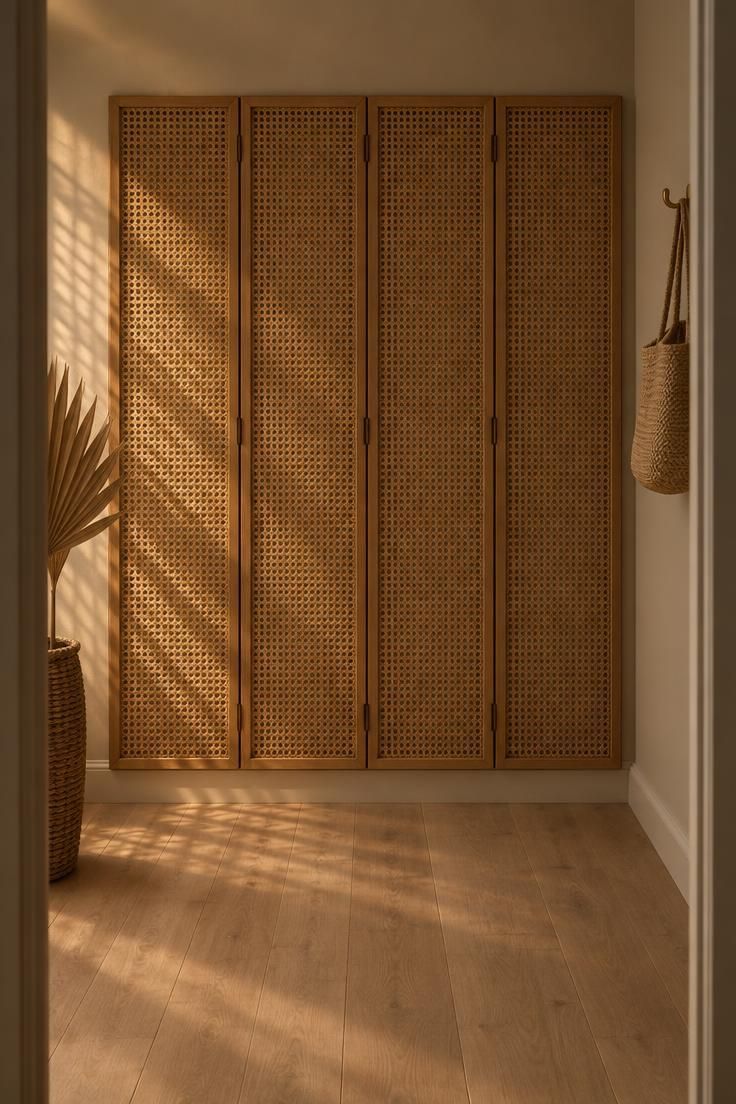
A folding cane divider mounted flat against the terminal wall turns the surface itself into the decoration.
The honey tone and open weave add depth without the upkeep of a plant or the visual noise of many small objects, and because the piece hangs flat, the floor stays entirely open.
Panels can be adjusted to cover the center of the wall or to stretch nearly edge to edge, depending on the wall’s proportions.
The texture does collect dust, and a soft brush pass keeps it looking fresh.
Sizing matters as well: a divider that reaches floor to ceiling feels architectural, while one that stops short reads as a hanging object.
Both can work, but the choice should be deliberate, since the eye will land on the gap.
Style Blueprint:
- A folding cane or rattan room divider with simple framed panels
- A wall-mounted position that leaves the floor entirely clear
- A light sand wall tone to warm the honey rattan
- White oak flooring for a clean base
- One dried palm or woven bag nearby to reinforce the natural palette
Use a Floor-to-Ceiling Board and Batten Treatment With a Single Floating Shelf
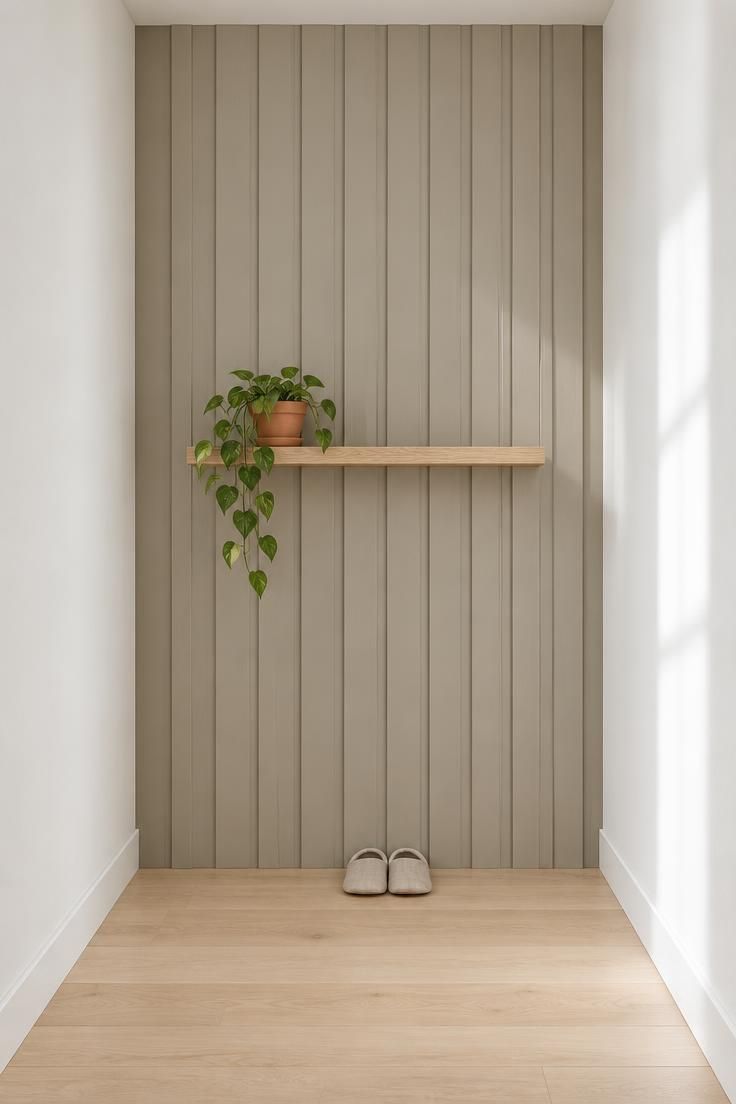
Board and batten gives the terminal wall a built-in look using only thin strips of wood and paint.
Painted in one matte tone from floor to ceiling, the battens read as texture first and color second, which keeps the corridor calm rather than busy.
A single floating shelf in natural oak breaks up the vertical rhythm and gives the eye a resting point in the middle of the wall.
A trailing plant in terracotta adds life without needing floor space, and its soft tendrils interrupt the strict verticals in a way that reads well from the far end.
The narrow shelf sits above head height so it stays out of the way in a busy hallway.
Repeated verticals can make a low ceiling feel taller, which is a useful trick in a compact home.
Style Blueprint:
- Vertical wood battens running the full height of the end wall
- A warm greige paint in a matte finish, applied to battens and wall as one tone
- A slim natural oak floating shelf at eye level
- One small trailing plant in an unglazed terracotta pot
- A light birch or pale wood floor to keep the palette airy
Conclusion
The best end of hallway decor works with the way the wall is actually seen: from a distance, straight on, and often in passing.
A leaning canvas, a slim console, a painted arch, or a single well-placed hook can each carry the whole corridor, as long as the silhouette stays clear and the scale stays confident.
In a narrow passage, wall-mounted or shallow pieces protect the walking path while still giving the terminal wall a clear focal point.
Take these ideas as a starting point and adjust the materials, tones, and proportions to match the rest of your home.