

Picking the wrong rug size is one of the most common decorating mistakes, and one of the easiest to prevent.
This free rug size calculator takes your room dimensions, furniture layout, and style preferences and gives you a clear recommendation in seconds.
Below the calculator, you will find a complete rug size guide with room-by-room advice, standard dimensions, placement rules, and a rug size chart you can reference during your next shopping trip.
Find the Right Rug Size
Advanced Options
Choose a room, layout, unit, and measurements to see a top-down rug placement preview.
How to use
Choose a room and layout, add the main measurements, then calculate. Advanced measurements make the recommendation more accurate for sofas, sectionals, dining tables, beds, and high-traffic areas.
Common starting points
Living rooms often use 5 x 8 ft, 8 x 10 ft, or 9 x 12 ft rugs. Dining rooms need extra chair clearance, bedrooms need side landing, and hallways usually work best with runner sizes.
Common starting points
Living rooms often use 5 x 8 ft, 8 x 10 ft, or 9 x 12 ft rugs. Dining rooms need extra chair clearance, bedrooms need side landing, and hallways usually work best with runner sizes.
How to Measure Your Room for a Rug
Grab a tape measure, a pencil, and a roll of painter’s tape before you start.
Measure wall to wall in two directions: the short side and the long side of the room.
Write down the numbers in feet and inches, then round to the nearest half foot.
These are the dimensions you will enter into the rug size calculator above.
If your room has built-in shelving, a fireplace bump-out, or a radiator along one wall, measure from the face of that obstruction rather than from the wall behind it.
The usable floor space is what matters, not the full architectural footprint.
Check your door swings next. Open every door that enters the room and note where the arc lands.
A rug thicker than a quarter inch can block a door that clears the floor by very little, so mark those zones as off-limits for rug coverage.
Once you have your measurements, lay painter’s tape on the floor in the outline of the rug sizes you are considering.
Live with the tape for a day or two.
Walk around it, sit on the sofa, pull out the dining chairs. The tape test reveals proportion problems that numbers on paper cannot.
For the most accurate calculator results, measure your furniture grouping too.
Record the width and depth of your sofa, the length and width of your dining table, or your bed size.
Entering these details into the advanced options produces a recommendation matched to your actual layout rather than the room’s raw square footage.
Rug Size Guide

A rug that fits well makes the whole room feel intentional.
One that is too small floats awkwardly in the middle of the floor, disconnected from everything around it.
The sections below walk through every room type so you can shop with confidence, whether you use the area rug size calculator above or prefer to measure on your own.
Standard Rug Sizes by Room
Rugs come in a predictable set of standard rug sizes, and knowing these dimensions saves time when you are shopping online or in a showroom.
The most widely available sizes in feet are: 3×5, 4×6, 5×7, 5×8, 6×9, 8×10, 9×12, 10×13, and 12×15.
Runners come in widths of 2 to 3 feet and lengths from 6 to 14 feet.
Round rugs are sold in 4-foot, 6-foot, and 8-foot diameters.
Quick Rug Size Starting Points
- Small living rooms do well with a 5×8 or 6×9.
- Medium to large living rooms look best with an 8×10 or 9×12.
- Under a dining table for six, plan on at least an 8×10.
- A queen bed pairs with a 6×9 or 8×10 placed underneath.
- Hallway runners should be 2 to 2.5 feet wide and at least 6 feet long.
Living Room Rug Size Guide
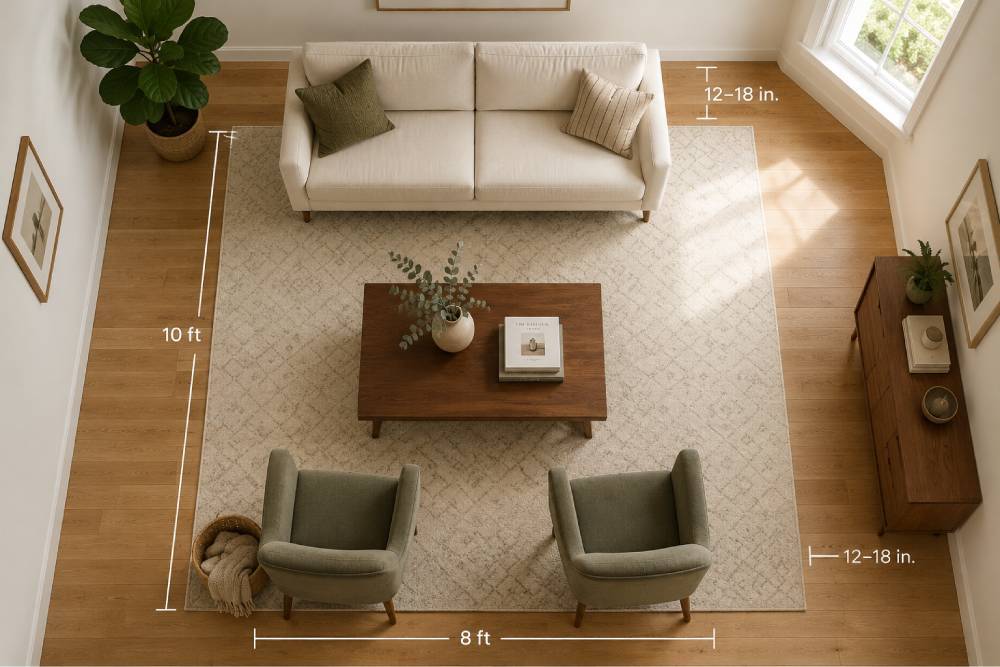
The living room is where rug sizing matters most, because the rug anchors the seating area and defines the conversation zone.
A living room rug size calculator simplifies this, but the underlying rules are straightforward.
Front Legs on the Rug
This is the most popular placement strategy for medium-sized living rooms.
Place the front legs of your sofa and accent chairs on the rug, leaving the back legs on bare floor.
A 5×8 or 6×9 works here if your seating area spans about 7 to 9 feet across.
The rug should extend at least 6 inches past the front edge of each seat so it does not look accidental.
All Legs on the Rug
If the room is large enough, putting every piece of furniture fully on the rug creates a polished, collected look.
An 8×10 or 9×12 is the standard choice here.
Leave 12 to 18 inches of bare floor showing between the rug edge and the walls on all sides.
Small Living Room Rug Layout
In a compact space, a rug that is too large can make the room feel cramped rather than cozy.
A 5×7 centered in front of the sofa, with no furniture legs on it at all, works well when floor space is limited.
Make sure the rug is at least as wide as the sofa so the proportions feel balanced.
Tip: Use painter’s tape to outline rug dimensions on your floor before buying. Living with the outline for a day or two reveals whether the size feels right in the room.
Rug Size for a Sectional Sofa
Sectionals spread across more floor area than a standard sofa-and-chair arrangement, and the rug needs to account for that extra reach.
The L-shape or U-shape of the configuration, not the room’s perimeter, is what determines the correct rug dimensions.
For a mid-sized L-shaped sectional measuring roughly 100 to 110 inches on its longer arm, an 8×10 rug is the minimum.
A 9×12 gives the front legs of every section room to sit on the rug with a visible border past the chaise end.
U-shaped and oversized sectionals call for a 10×14 or larger.
The rug should reach at least 6 inches past the outermost edge of each arm so the piece looks grounded rather than spilling off the sides.
Center the rug on the sectional itself rather than on the room.
The furniture grouping is the anchor point, and aligning the rug to it produces a more collected result than splitting the difference between distant walls.
Dining Room Rug Size Guide
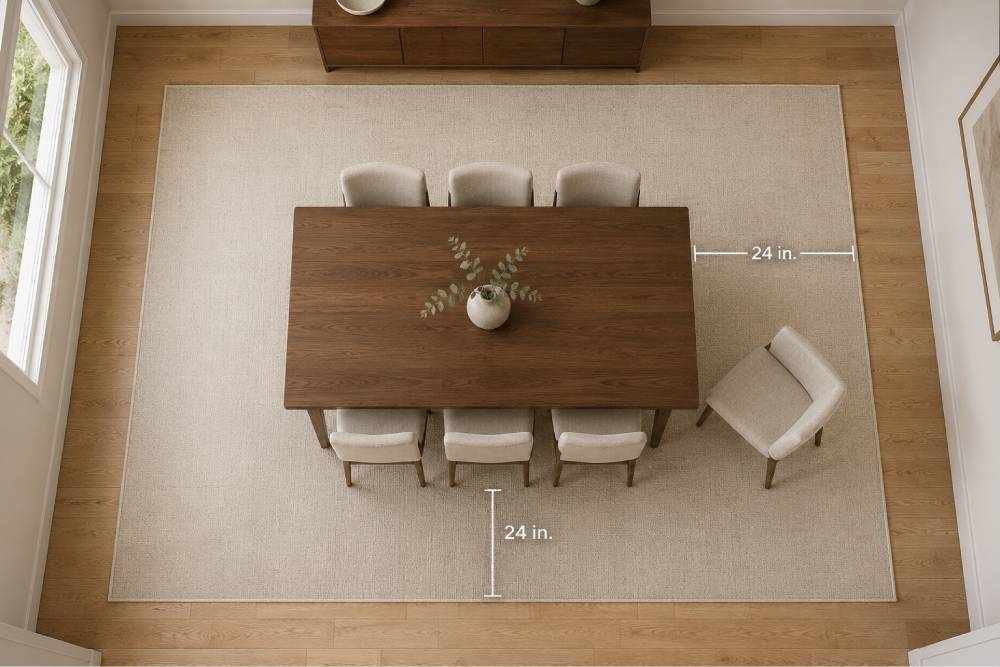
A dining room rug needs to be large enough that chairs stay on the rug even when pulled out from the table.
This single requirement drives every sizing decision in the space, and a dining room rug size calculator builds it in automatically.
How Much Chair Clearance Do You Need?
Add 24 to 30 inches on every side of the table.
That accounts for the chair depth plus the distance someone scoots back when standing up.
A 36-by-60-inch table, once you add 24 inches per side, calls for at least a 7×9, though an 8×10 gives more breathing room.
Round, Rectangular, and Oval Dining Tables
A round table looks best on a round rug, and an 8-foot diameter rug fits tables up to 54 inches across with proper chair clearance.
Rectangular and oval tables pair with rectangular rugs.
If your table seats eight or more, a 9×12 is likely the smallest workable size, and a 10×14 is more comfortable.
Bedroom Rug Size Guide
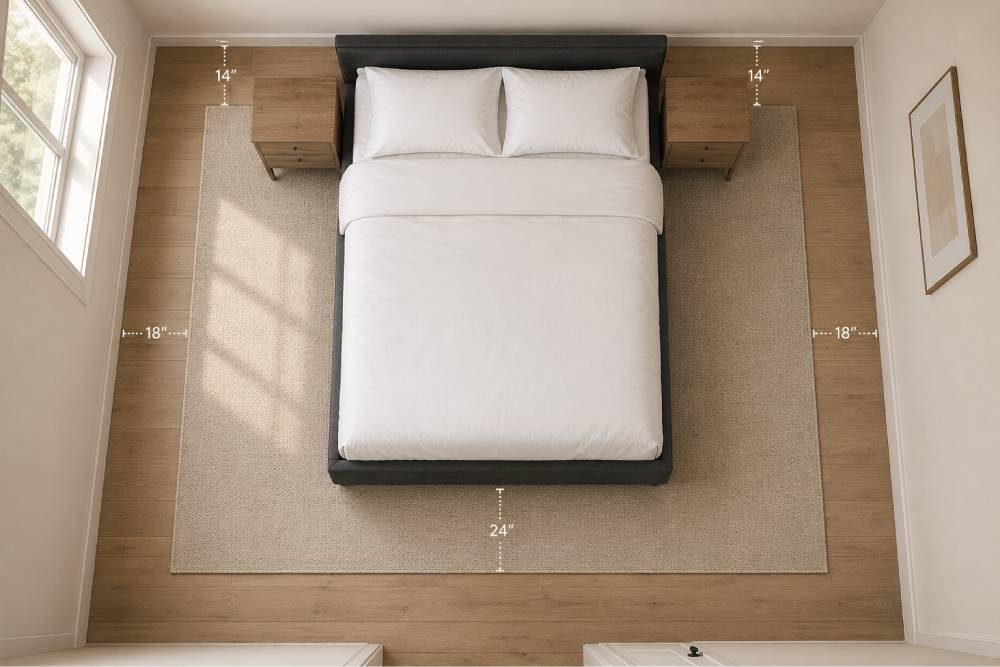
The goal in a bedroom is soft footing when you step out of bed.
A bedroom rug size guide comes down to one question: how far around the bed do you want the rug to extend?
Rug Size for a Queen Bed
A queen mattress is 60 by 80 inches.
An 8×10 rug placed under the lower two-thirds of the bed gives you about 18 inches of rug on each side, enough that your feet land on something soft every morning.
A 6×9 works if the rug sits under just the lower third of the bed, with roughly 12 inches exposed on each side.
Rug Size for a King Bed
A king mattress is 76 by 80 inches.
A 9×12 is the go-to king bed rug size, offering 18 to 20 inches of rug visibility on the sides and a generous border at the foot.
If the room is on the smaller side, an 8×10 still works if positioned under the lower two-thirds of the frame.
Rug Placement Under the Bed
Center the rug side to side under the bed.
Slide it so that approximately one-third of the rug sits under the headboard end of the frame and two-thirds extend toward the foot.
Runners on each side of the bed are a good alternative in narrow rooms where a large area rug will not fit.
Tip: If you have nightstands, the front legs can sit on the rug or off it, but be consistent on each side. Mismatched placement looks unintentional.
Hallway, Entryway, Kitchen, and Outdoor Rug Sizing
These spaces have their own rules because the proportions are so different from a standard room.
Hallway Runner Size
Measure the length of your hallway, then subtract 12 to 16 inches from each end so bare floor shows at the transitions.
Width should be 2 to 2.5 feet for a standard hallway, or up to 3 feet if the hall is wider than 4 feet.
A hallway runner size calculator uses those same formulas, doing the math for you based on your measurements.
Entryway Rug Size
The rug should be wide enough that someone can stand on it with both feet when the front door is open.
For a standard 36-inch door, a 3×5 is the minimum.
A larger foyer with a double door calls for a 4×6 or 5×7.
Kitchen Runner Size
Place a runner in front of the sink or stove, wherever you stand longest.
A 2.5×7 or 2.5×8 covers most galley-style kitchens.
Choose a flatweave or low-pile material so spills wipe up easily and chair legs do not snag.
Outdoor Rug Size
Size outdoor rugs the same way you would indoor ones: all furniture legs on the rug if space allows, front legs only if it does not.
A 5×7 anchors a small patio bistro set, and an 8×10 works under a full outdoor dining arrangement.
Measure any covered porch or deck to make sure the rug will not overhang into uncovered space where it collects rainwater.
Round Rug Size Guide
Round rugs follow different sizing logic than rectangular ones.
You are working with a single diameter instead of two separate dimensions.
The shape softens angular rooms, pairs naturally with round dining tables and pedestal coffee tables, and carves out defined zones inside open layouts without the rigid edges of a rectangle.
Three diameters cover most round rug needs.
- 4-foot round. This is an accent size. Place it inside a small entryway, beside a bed as a landing pad, under a pedestal side table, or in front of a bathroom vanity. A 4-foot round rug works well in any spot where a rectangular accent rug (3×5 or 4×6) would otherwise go but where you want a softer visual shape.
- 6-foot round. The mid-range option. A 6-foot round rug fits under a 36-inch breakfast table with just enough clearance for chairs, anchors a reading nook with a single armchair and floor lamp, or defines a conversation corner where two accent chairs face each other. In a nursery, this size covers the play area around a crib without reaching the walls.
- 8-foot round. The workhorse for dining and living spaces. Under a round dining table, an 8-foot rug accommodates a 48-inch table with the 24 inches of chair clearance on each side that comfortable dining requires. In a living room, it anchors a round coffee table with enough surface for the front legs of surrounding seating to rest on the rug. An 8-foot round rug in a large foyer centered under a pendant light creates a focal point the moment someone walks through the door.
Round rugs are not limited to round tables.
A circular rug layered over a larger rectangular one adds texture in a living room.
Under a square game table, it breaks the expected geometry in a way that draws attention.
Placed at the center of a square room, a round rug counterbalances the boxiness of the walls and makes the space feel less rigid.
Sizing a round rug under a round table
Add 48 inches to your table’s diameter.
That formula accounts for 24 inches of chair pullback space on each side.
A 42-inch table needs a 7.5-foot rug (round up to 8 feet since 7.5 is not a standard size).
A 54-inch table calls for an 8.5-foot rug, which means shopping for a 9-foot round or stepping up to a 10-foot if your room allows it.
When the math lands between two standard sizes, go larger.
A round rug that is slightly too big still reads as intentional, but one that is too small leaves chair legs catching the edge at every meal.
Common Rug Sizing Mistakes to Avoid
Buying too small is the number one mistake, and it happens because a rug looks bigger rolled up in the store than it does unrolled in a living room.
Ignoring furniture placement is a close second: a rug should relate to the furniture grouping, not just the room’s perimeter.
Forgetting about doorways trips people up too. Check that the rug will not block a door swing before you order.
Skipping measurements and eyeballing the size almost always leads to a return.
How to Choose Between Two Rug Sizes
When you are stuck between a smaller and a larger option, go with the bigger one.
A rug that is slightly too large still looks intentional, but one that is slightly too small looks like a mistake.
If budget is the deciding factor, consider whether a less expensive material in the larger size would serve you better than a premium material in the smaller size.
Tape out the dimensions of each option on your floor and live with it for a day before committing.
Rug Size Chart: Common Sizes and Best Uses
| Rug Size (ft) | Best Used In | Notes |
|---|---|---|
| 3×5 | Entryway, small bathroom | Accent size, works by a doorway or vanity |
| 4×6 | Foyer, office desk | Good under a small desk or entry console |
| 5×7 | Small living room, apartment | Front-of-sofa accent in compact seating areas |
| 5×8 | Medium living room, queen bedroom | Fits front legs on the rug in most layouts |
| 6×9 | Living room, dining room for 4 | Popular mid-range size with wide availability |
| 8×10 | Large living room, dining room for 6 | The most common full-room size for open plans |
| 9×12 | Spacious living room, king bedroom | Fits all furniture legs on the rug comfortably |
| 10×13 | Large open-concept room | Anchors oversized sectional sofas |
| 12×15 | Great room, formal dining for 10+ | Largest standard size, often special order |
| 2.5×8 runner | Hallway, kitchen, bedside | Measure hallway length and subtract 2 feet |
| 8 ft round | Round dining table, reading nook | Pairs well with circular or square rooms |
Rug Size by Room Dimensions
If you already know your room measurements, this table gives you a quick starting point.
Each recommendation assumes 12 to 18 inches of bare floor between the rug edge and the walls, which is the range most designers consider well-proportioned.
Rooms with open floor plans or L-shaped layouts may need a larger size than shown here.
Narrow rooms often look better with a rug oriented along the longest wall.
For an exact recommendation based on your furniture and layout, run your measurements through the rug size calculator at the top of this page.
| Room Size (ft) | Recommended Rug Size | Alternate Size | Notes |
|---|---|---|---|
| 8×10 | 5×7 | 5×8 | Tight space; keep furniture legs off the rug or use front-legs-on placement only |
| 9×12 | 6×9 | 8×10 | Common in older apartments; 8×10 works if the furniture grouping is large enough to fill the room |
| 10×10 | 8×8 (square) | 6×9 | A square rug matches the room’s proportions; rectangular works when furniture is pushed toward one wall |
| 10×12 | 8×10 | 6×9 | The most searched room size for rug advice; 8×10 covers the seating area with a comfortable border |
| 10×13 | 8×10 | 6×9 | Standard for mid-sized apartments; orient the rug’s long side along the room’s longer dimension |
| 10×14 | 8×10 | 9×12 | 9×12 fits if the room has a large sectional or dining table for six |
| 11×13 | 8×10 | 9×12 | A common bedroom footprint; 8×10 works under a queen bed, 9×12 under a king |
| 11×14 | 8×10 | 9×12 | A frequent suburban living room size; front-legs-on placement fits with 8×10, all-legs-on calls for 9×12 |
| 12×12 | 9×9 (square) or 8×10 | 9×12 | Square rooms pair well with square or round rugs; a 9×12 oriented with the furniture works too |
| 12×14 | 9×12 | 8×10 | 8×10 leaves more floor showing, which suits rooms with decorative hardwood or tile |
| 12×15 | 9×12 | 10×13 | Large enough for all-legs-on in most living rooms; 10×13 fills the space under a full dining set for eight |
| 12×16 | 9×12 | 10×14 | Spacious living or family room; 10×14 anchors an oversized sectional |
| 12×18 | 10×14 | 9×12 | Open-plan space or formal dining for eight to ten; the rug should define the seating or dining zone, not cover the entire room |
| 14×16 | 10×14 | 9×12 | Two rugs may work better here if the room serves dual purposes like a combined living and dining area |
| 14×18 | 10×14 | 12×15 | Great rooms and large open layouts; 12×15 is special order from most retailers |
| 15×15 | 10×13 or 12×12 | 9×12 | Use the rug to anchor a single furniture grouping rather than trying to fill the floor |
| 15×20 | 12×15 | 10×14 | At this scale, define zones with separate rugs, one under the seating and one under the dining area |
| 16×20 | 12×15 | Two 8×10s | A single rug this large is often impractical; zoning with two rugs reads cleaner in most layouts |
For rooms not listed here, apply the general formula: subtract 3 to 4 feet from your room’s length and width.
That gives you the maximum rug size that still leaves a proper floor border.
Round the result down to the nearest standard rug dimension: 5×7, 5×8, 6×9, 8×10, 9×12, 10×13, 10×14, or 12×15.
Planning your wall layout too? Try our wall art size calculator for the right artwork dimensions.
Frequently Asked Questions
These are the questions we hear most from readers who are shopping for a new rug or second-guessing a size they already picked.
If your specific situation is not covered here, try running your room dimensions through the rug size calculator above for a personalized recommendation.
How do I know what rug size I need?
Measure your room, decide which furniture legs will sit on the rug, and add clearance accordingly.
The rug size calculator at the top of this page walks you through these steps automatically.
If measuring manually, use the room-by-room sections above to match your layout to a recommended size.
Should the rug go under the sofa or in front of it?
Placing the front legs of the sofa on the rug creates a grounded, pulled-together look.
If the rug is too small for that, centering it in front of the sofa with no legs on it is acceptable, as long as the rug is at least as wide as the sofa itself.
How much space should I leave between the rug and the wall?
Plan for 12 to 18 inches of bare floor between the rug edge and the wall.
Going wall to wall with an area rug makes the room feel like it has mismatched carpeting rather than a styled rug placement guide layout.
What size rug works best under a dining table?
Measure your table length and width, then add 48 to 60 inches to each dimension.
That extra space accounts for chairs pushed in and pulled out.
For a standard rug size for dining table seating six, an 8×10 or 9×12 will cover the clearance you need.
What size rug should I use for a queen bed?
An 8×10 placed under the lower two-thirds of the bed is the most popular queen bed rug size.
A 6×9 works if you center it under the bottom half of the bed and accept a narrower border on the sides.
What size rug should I use for a king bed?
A 9×12 gives a king bed balanced proportions, with rug visible on three sides.
An 8×10 is a reasonable king bed rug size if the bedroom is narrow or if you tuck most of the rug under the bed frame.
What if I am between two rug sizes?
Go bigger.
A rug that is a little large looks like a deliberate design choice, but a rug that is a little small reads as a mistake you did not catch.
Tape the outlines of each size on the floor before ordering to see for yourself.
Do I need a rug pad?
Yes, for almost every rug on a hard surface.
A rug pad prevents slipping, reduces wear on the rug’s backing, and adds a layer of cushion underfoot.
Cut the pad about one inch smaller than the rug on all sides so it stays hidden.
What rug material works best in high-traffic spaces?
Wool holds up well in living rooms and hallways because it resists crushing and cleans easily.
Polypropylene and nylon are strong picks for entryways and kitchens where spills are frequent.
Natural jute and sisal add texture but show wear faster, so they work better in lighter-traffic spots like bedrooms or studies.
This rug size calculator is part of our growing collection of free home decor tools designed to help you make confident decorating decisions.
Image note: Some images in this article are AI-generated or AI-assisted design visualizations created to illustrate the concepts discussed. They are not photographs of completed Simple Spaces projects unless explicitly identified otherwise. Learn more about our editorial and visual process in our Editorial Standards.