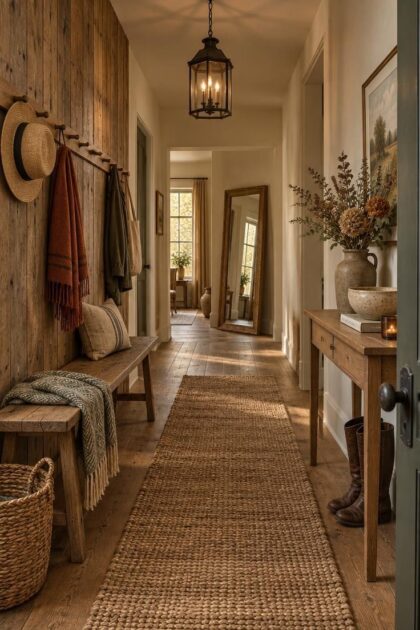
This post may contain affiliate links. If you make a purchase through these links, we may earn a commission at no additional cost to you.
The hallway is the room most homes pass through without ever really looking at it.
Narrow, low on detail, and usually lit by a single overhead fixture, it tends to become a corridor rather than a place.
Rustic styling fits these spaces well because it leans on texture, material, and repetition instead of large furniture or glossy finishes.
The vignettes below move loosely from small-space moves to full-surface treatments, and each one works alone or layered with another.
The aim is simple: a passage that feels settled and warm at the moment you step inside.
A Rough-Hewn Pine Board Wall Behind a Peg Rail
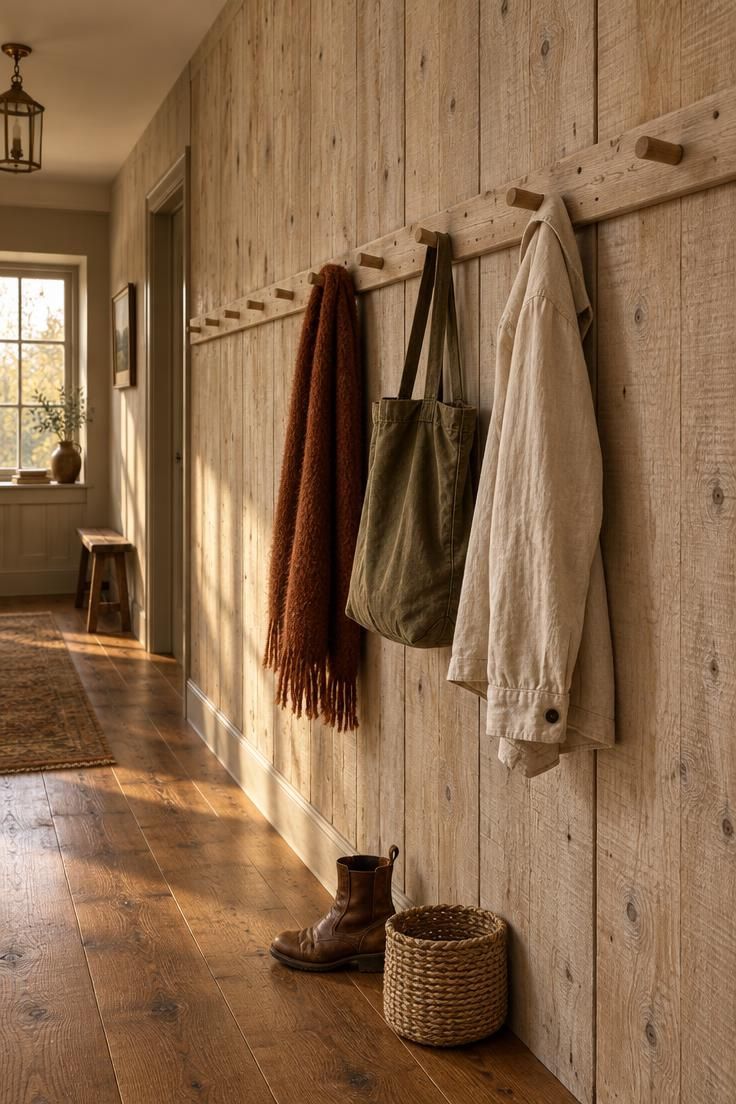
A reclaimed wood hallway often starts with the wall surface itself, and rough-sawn pine is one of the most direct ways to build it.
Vertical boards with knots, saw marks, and small nail holes carry more texture than any paint treatment, particularly when the finish stays matte rather than glossy.
The peg rail does the practical work here, holding two or three coats at a height that lets them hang clear of the floor.
Horizontal rhythm matters as much as the wood tone: one rail at one height reads as a line, while two rails at different heights read as clutter.
Warm mid-brown boards, a warm off-white ceiling, and a single muted accent such as an olive tote or a rust scarf keep the palette restrained.
Rough grain collects dust and resists a wet wipe, so a soft brush along the board faces is the easier upkeep.
A full wall of boards makes a strong statement, while a single panel behind the rail offers a smaller commitment in the rustic hallway and still reads just as clearly in a narrow run.
Style Blueprint:
- Rough-sawn pine in a matte clear or limed finish
- Peg rail in the same wood tone as the boards
- Two or three textiles in muted rust, cream, and olive
Design Pro-Tip: Keep repeated wall elements such as pegs, frames, and baskets at one consistent height so the eye reads a line rather than a scatter.
A Stone Accent Wall Dressed With Two Low Baskets
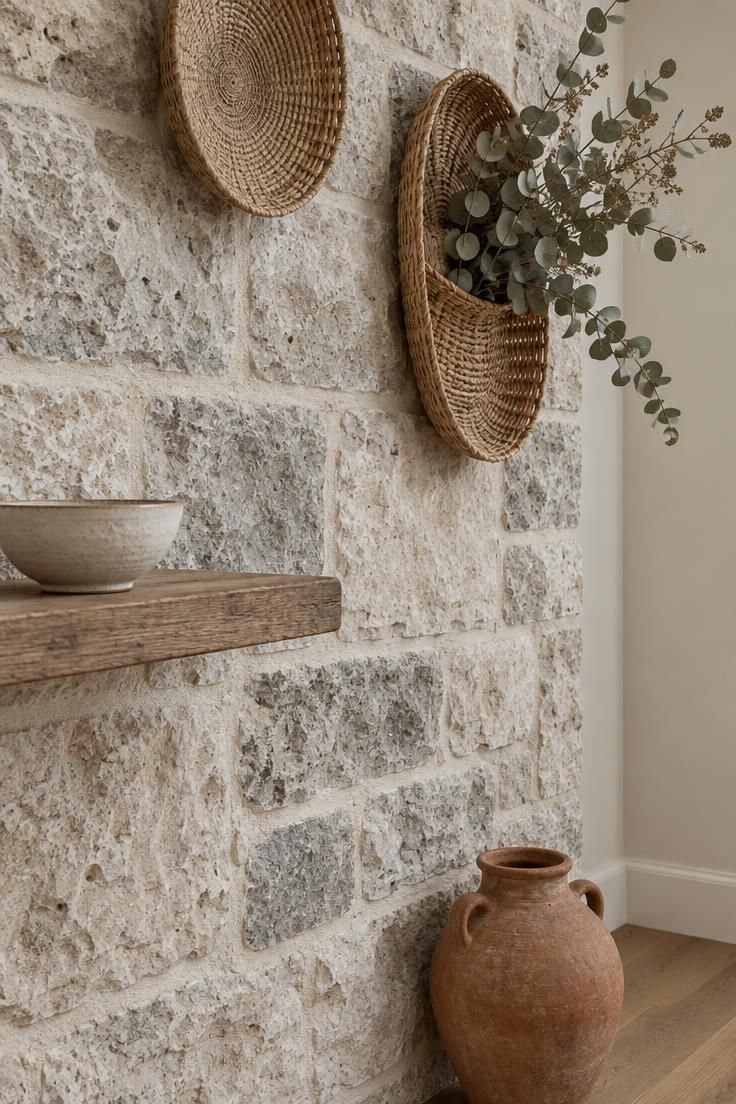
A stone accent wall works best in a hallway when it occupies one panel rather than the whole corridor.
Tumbled limestone or split-face stone with visible mortar reads as a feature when it has a plain field to sit against, and a hallway rarely has room for more than one feature.
Two shallow woven baskets hung at different heights add a natural, handcrafted note without competing with the stone.
A single stoneware bowl on a slim ledge keeps the composition from spreading, and a terracotta object on the floor introduces the one warm accent the palette needs.
Cream and grey stone, warm wood floor, and a muted terracotta note form a restrained three-tone scheme.
Stone traps dust in its pits and crevices, so a soft brush keeps it looking crisp where a wet cloth would dull the surface.
Bringing the stone around a doorway reveal or stopping it at a vertical trim board makes the edge read as intentional rather than abrupt.
A tumbled or split-face finish suits a rustic scheme; polished stone belongs closer to a contemporary look.
Style Blueprint:
- One stone accent panel in a tumbled or split-face finish
- Two woven baskets in different sizes, hung at different heights
- A single stoneware bowl or jug
- One terracotta or rust accent object
A Wide-Plank Ceiling Above a Plain Plaster Wall
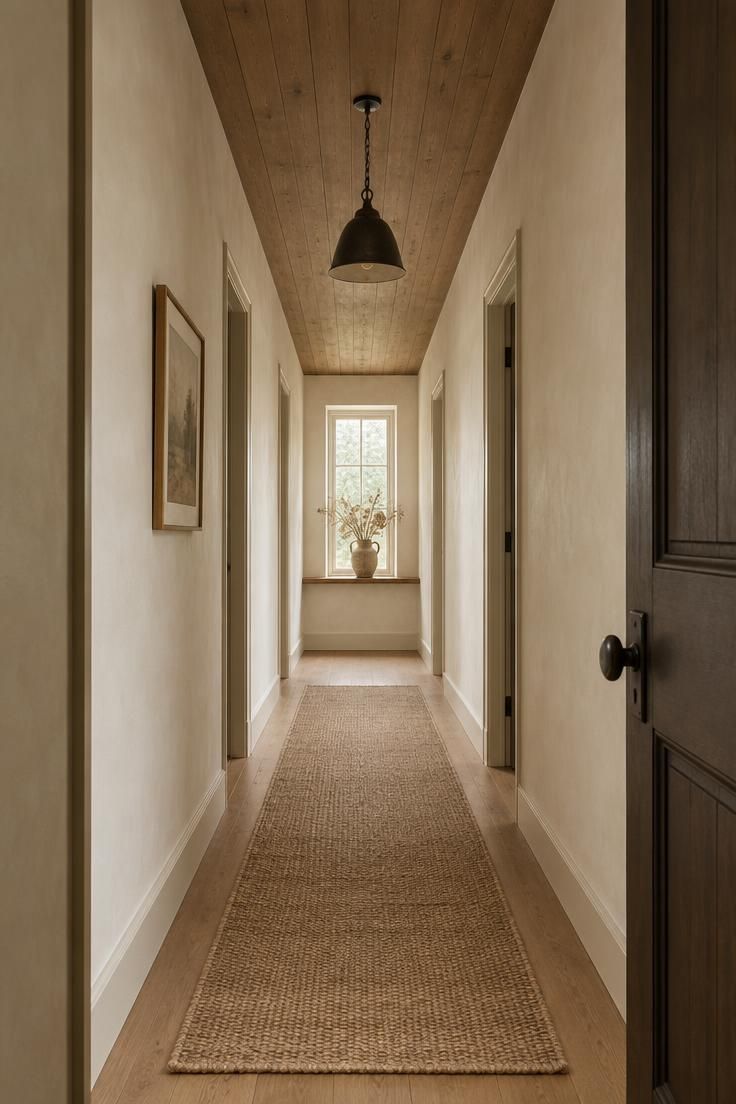
The ceiling is the surface most hallways ignore, and wide planks in a warm mid-tone running the length of the corridor give it a purpose.
Plain matte plaster or limewash walls in warm cream below let the wood above carry the visual weight without a fight for attention.
A planked ceiling also gives a narrow passage a sense of direction, since the boards reinforce the line the eye already follows.
A simple blackened iron pendant centered on the run provides one warm pool of light, and a jute runner underfoot ties the floor plane to the ceiling tone.
Warm cream, mid-brown planks, jute, and a single black accent make up the entire palette.
A wood ceiling reads darker in a low-light corridor, so a lighter plank finish or a limed tone keeps the upper plane from closing in.
Planks running the length reinforce the corridor; planks running across it shorten the visual run considerably.
This is a larger change than a rug or a hook, which makes it a better fit for a hallway already being reworked than for a quick styling refresh.
Style Blueprint:
- Wide planks in a warm mid-tone or limed finish
- Matte limewash or plaster walls in warm cream
- A simple blackened iron pendant on the center line
- A jute or sisal runner underfoot
A Long Wrought Iron Hook Row Above a Boot Tray
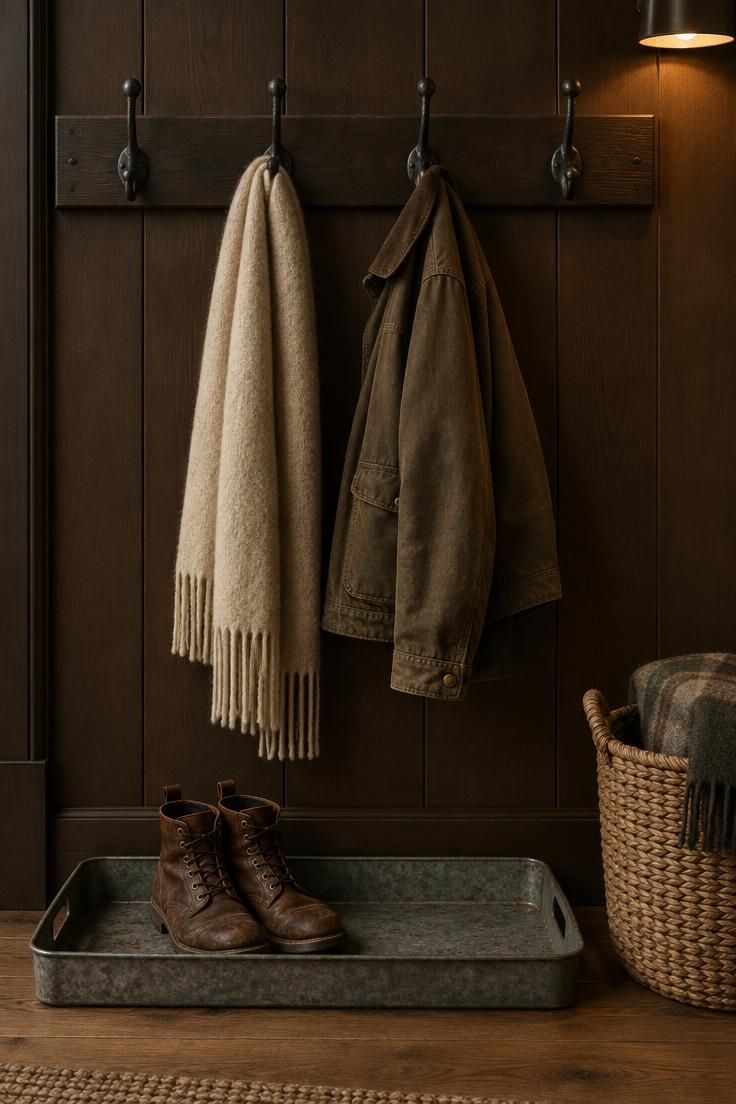
A row of wrought iron hooks on a dark wood backplate gives a hallway a cool, dark note against warmer wood tones.
Forged or blackened iron develops a soft patina that reads as aged rather than new, which suits the rustic palette well.
Below the hooks, a galvanized or aged metal boot tray sized to the household's traffic keeps the floor line tidy in a way that loose shoes never do.
The iron and the galvanized metal share a grey-black family that grounds the warm wood of the backplate and floor.
One cream textile on a hook softens the composition, and a covered woven basket beside the tray absorbs overflow without adding another open surface.
Open hooks and an open tray put daily clutter on display, which is a real tradeoff in a busy home.
Hook spacing should suit the width of the wall, not a fixed number: three hooks on a short wall read calmer than five.
Style Blueprint:
- Blackened or forged iron hooks on a wood backplate
- An aged metal or galvanized boot tray
- One woven basket beside the tray for overflow
A Jute Runner That Stops Short of Every Door
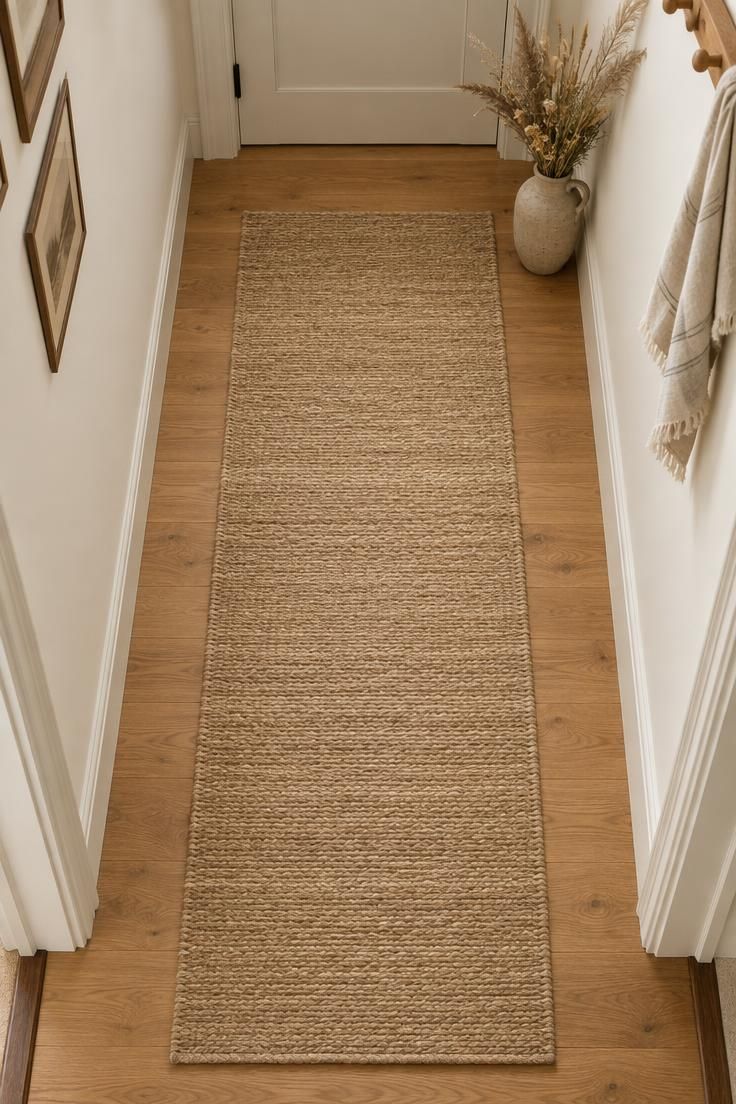
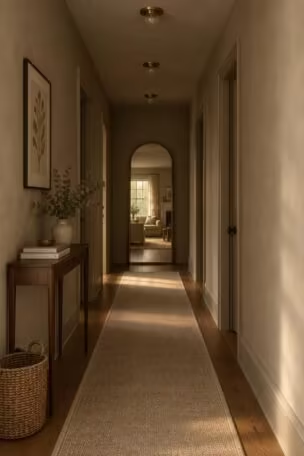
A flatwoven jute runner hallway in a natural undyed tone gives the space a warm neutral floor line that ties wood, stone, and iron together.
Stopping the runner short of each doorway keeps door swings clear and reads more casual than wall-to-wall coverage.
Leaving bare floor visible at both ends of the run also keeps a narrow hallway from looking padded edge to edge.
The runner works best when it frames the walk rather than filling it, with an even margin of bare floor on both sides.
Undyed jute, warm oak at the ends, and cream walls form a low-contrast base that other textures can sit on.
Jute sheds and traps grit, so flatweave wool or cotton shakes out more easily if that matters more than texture.
Rotating the runner periodically keeps the wear line down the center even.
Checking the clear swing of each door before choosing a length avoids the runner catching at thresholds.
A single dried arrangement in a stoneware jug at the far end gives the runner a destination.
Style Blueprint:
- A flatwoven jute or sisal runner in a natural tone
- Bare floor visible at both ends of the run
- A stoneware jug with dried grasses at the far end
- A muted cream or oatmeal textile on a nearby hook
Design Pro-Tip: Combine at least three textures in a rustic hallway, such as rough wood, smooth stoneware, and soft wool, because color contrast is usually low.
A Slim Plank Bench With a Single Cushion
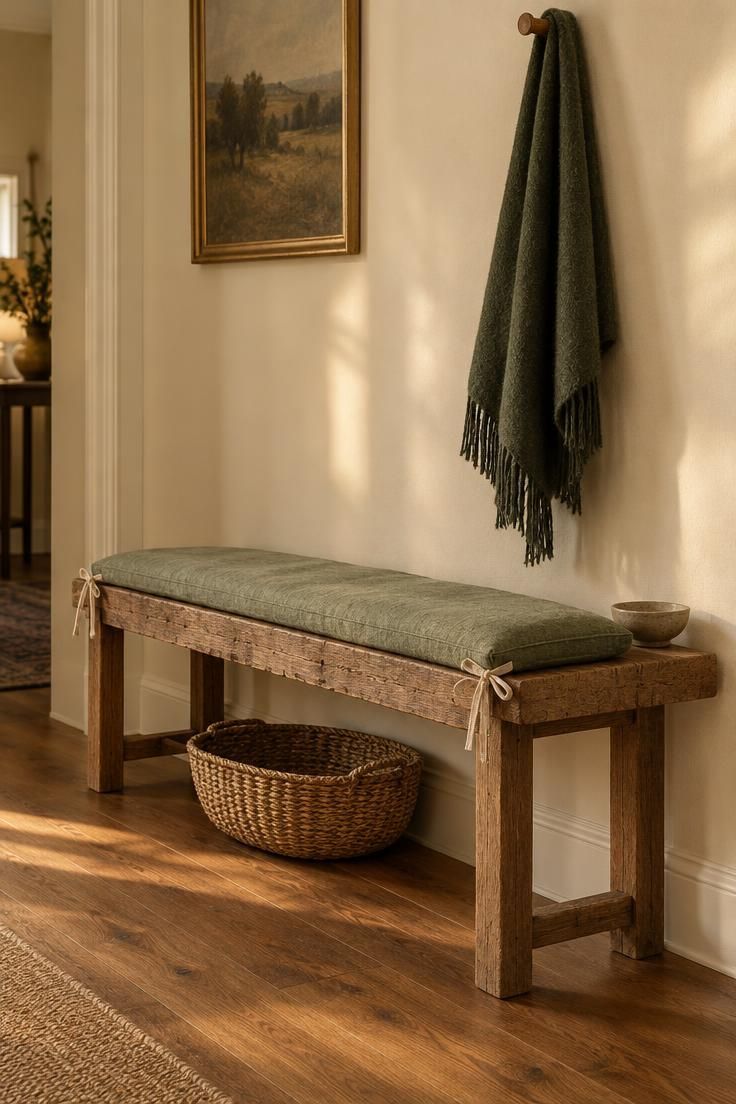
A rustic entryway bench in reclaimed or rough-hewn wood gives a hallway a pause point without demanding much floor space.
Narrow enough to leave the walk clear, the bench reads best when the floor beneath it stays visible.
One linen or canvas cushion in a muted oatmeal or sage, tied rather than upholstered, keeps the look spare.
A stack of cushions would turn the bench into a storage wall, which is the opposite of the restraint this vignette depends on.
Warm mid-brown wood, oatmeal linen, and a single dark green or rust accent underneath hold the palette together.
An open bench invites clutter, so a shallow woven basket slid underneath keeps the floor line readable and gives small objects a home.
Choosing a shallower bench depth rather than a deeper one helps the piece sit lightly in a narrow run.
If the hallway is mainly a pass-through, a slim ledge or a run of wall hooks may serve the space better than a bench.
Style Blueprint:
- A narrow plank bench in reclaimed or rough-hewn wood
- One linen or canvas cushion in oatmeal or sage
- A shallow woven basket tucked underneath
A Leaning Full-Length Mirror in a Simple Wood Frame
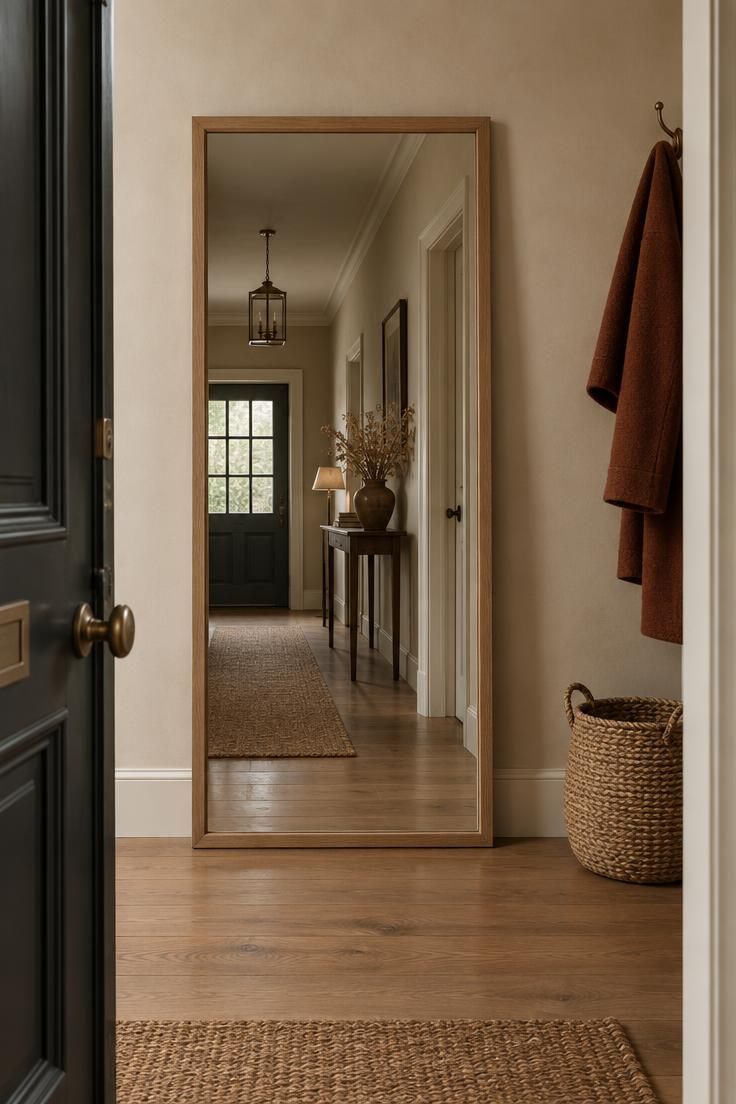
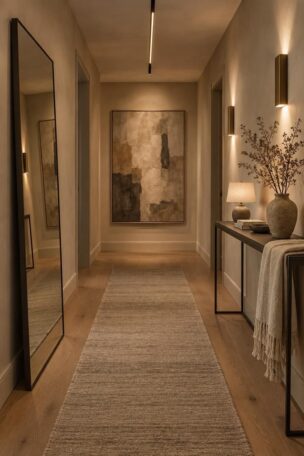
A tall mirror in a plain wood or dark iron frame placed opposite the door carries the reflection back down the corridor rather than stopping the view.
Aged or antiqued glass softens the reflection and suits the rustic palette better than a bright modern surface.
A warm oak or blackened iron frame against a cream wall keeps the piece quiet and lets the reflection do the work.
A leaning mirror needs a stable wall position and clear floor at its base, and the floor margin is part of the composition.
In a hallway that carries heavy foot traffic, a wall-hung mirror keeps the walk free in a way a leaning one may not.
Large mirrors show everyday marks more than small ones, which is a real tradeoff in a busy home.
In a corridor without natural light, placing the mirror to catch the brightest existing source makes it the more useful placement.
Style Blueprint:
- A full-length mirror with a plain wood or iron frame
- Aged or antiqued glass
- A clear floor margin at the base
A Wall of Small Framed Botanical Prints in Matching Frames
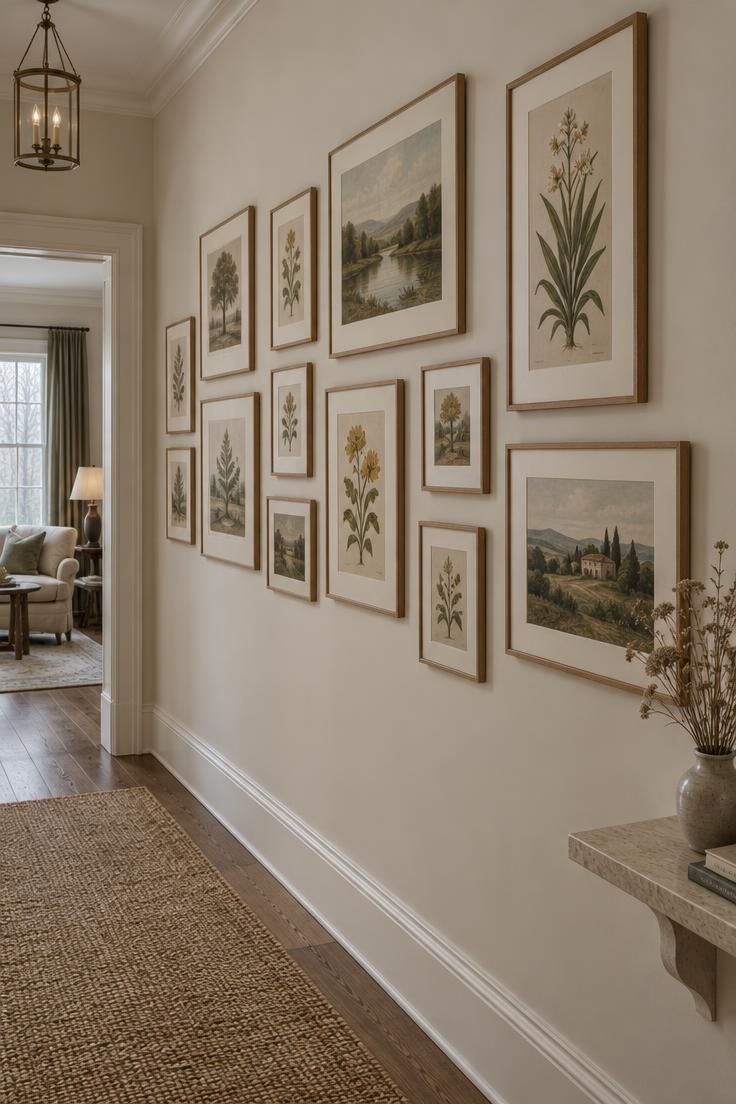
A wall of vintage botanical or landscape prints in matching thin wood frames works as a single composition rather than a collection of separate pieces.
Consistent frames plus varied image sizes give the arrangement order without rigidity, which is the balance rustic styling favors.
Warm cream mats and thin oak or walnut frames sit comfortably against muted greens and ochres in the prints.
Treating the wall as one composition means planning the outer boundary first and filling inward, rather than placing each frame on its own.
On a long uninterrupted wall, a wider grid works; on a wall broken by doorways, a single column between openings stays calmer.
Three frames in one column is the smaller version of the idea and still reads as a collection.
Glass needs occasional dusting, and prints near a door catch more of it, so keeping the lowest row above shoulder height reduces handling.
A full gallery wall is a commitment, which makes it a better fit for a hallway being styled with intention than for a quick refresh.
Style Blueprint:
- Matching thin wood frames in oak or walnut
- Warm cream mats
- Botanical or landscape prints in muted greens and ochres
- A loose grid with varied image sizes
Design Pro-Tip: Limit the palette to two or three base tones plus one accent, and let natural material variation supply the visual interest.
A Slim Oak Console With a Stoneware Bowl and a Dried Arrangement
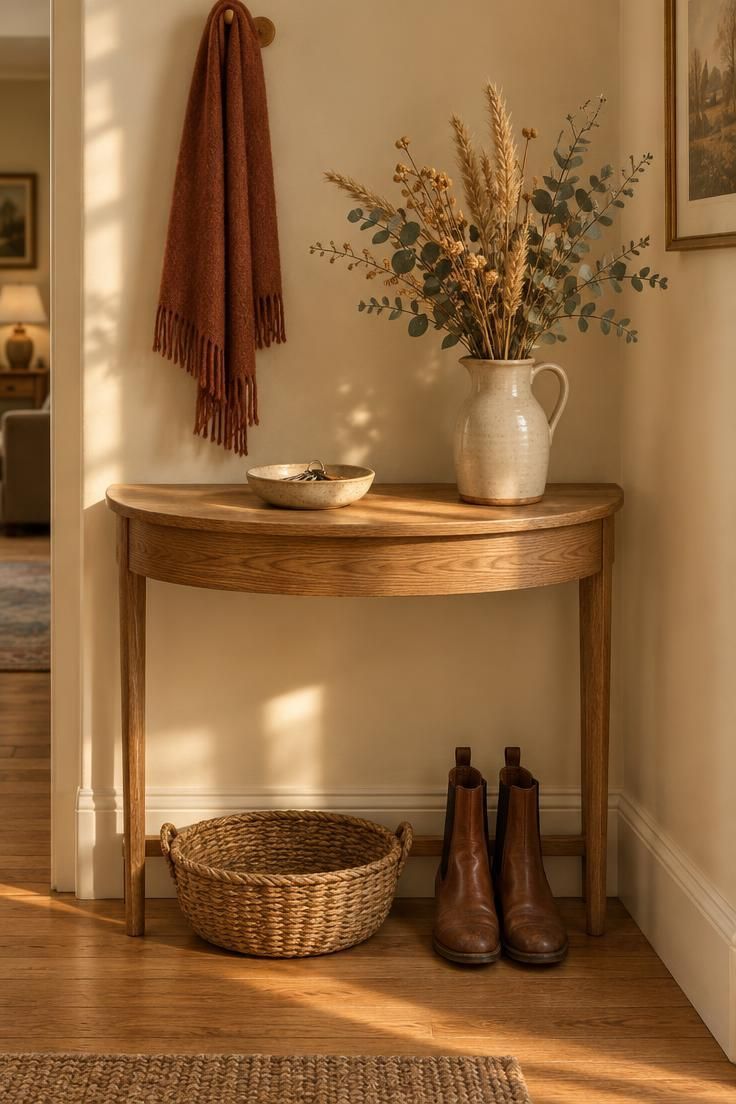
A narrow plank or half-moon table in oak gives a hallway a place for the small objects that accumulate near the door.
Styled with a stoneware bowl for keys and one dried arrangement in a jug, the console top stays legible instead of spreading.
A single shallow woven basket or a pair of boots underneath keeps the under-layer to one item and preserves the floor line.
Warm oak, cream stoneware, and dried wheat or eucalyptus in muted ochre and sage form a calm, low-contrast composition.
Dried arrangements shed, so checking them over the floor rather than over the console top avoids a small mess on the surface below.
A console top collects mail and small objects, and designating one bowl as the catch-all keeps the spread contained.
The console should sit against a wall with enough clearance to walk past without turning sideways, which matters more than the console's own size.
In a corridor under roughly a meter wide, a wall-mounted ledge serves the same styling purpose without the floor footprint.
A single object on the top, such as the jug, prevents the console from reading as a shelf for whatever arrives.
Style Blueprint:
- A narrow oak plank or half-moon console
- One stoneware bowl as the catch-all
- A dried arrangement in a stoneware or ceramic jug
- One shallow basket or a single pair of boots underneath
A Lantern Pendant on the Center Line Above a Wool Runner
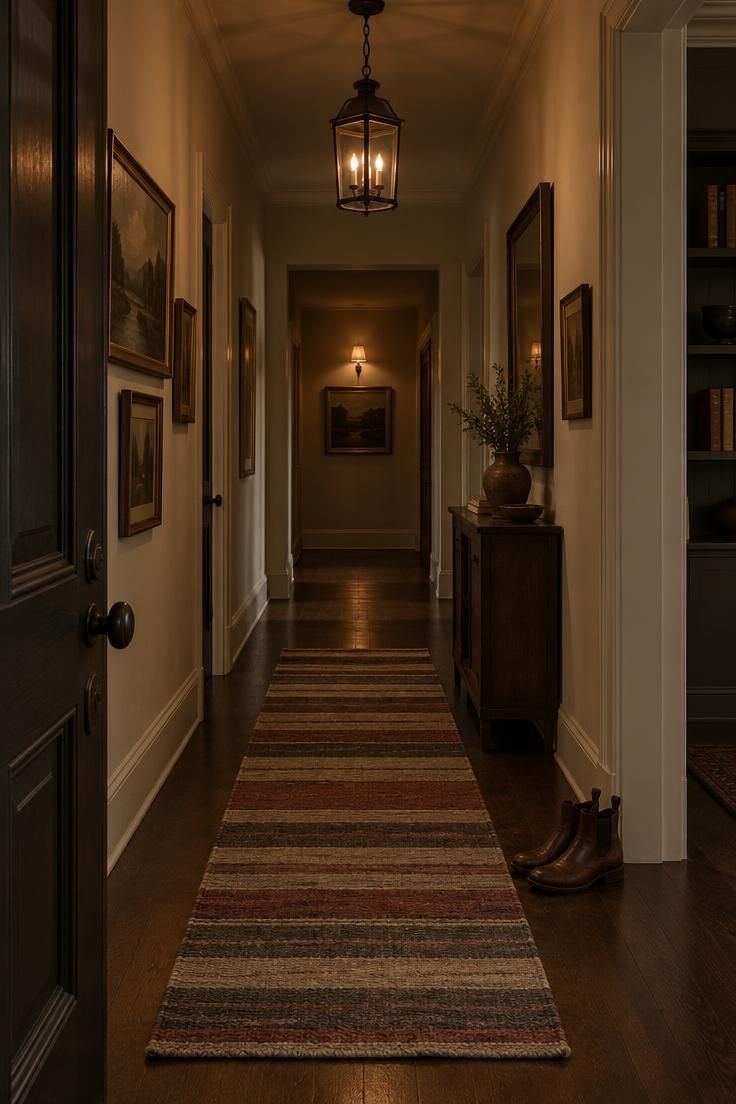
A lantern-style pendant in blackened metal or aged brass hung on the center line gives the corridor one clear pool of warm light.
Below it, a flatweave wool runner in a muted stripe or allover pattern grounds the fixture and softens footfall.
The pairing works because the pendant and the runner share the same axis, which gives a narrow space a spine.
A runner in faded red or oatmeal and charcoal adds pattern without gloss, keeping the palette quiet.
One warm pool of light can leave the ends of a long corridor dim, so a second fixture or a pair of wall lights fills the run visually.
Matching the fixture scale to the corridor width matters: a large lantern overwhelms a tight passage.
A lantern hung low over a narrow runner reads intimate, while one hung high reads more utilitarian.
Style Blueprint:
- A lantern-style pendant in blackened metal or aged brass
- A flatweave wool runner in a muted stripe or allover pattern
- One additional light source at the far end of the run
A Whitewashed Board-and-Batten Lower Wall With a Peg Rail Above
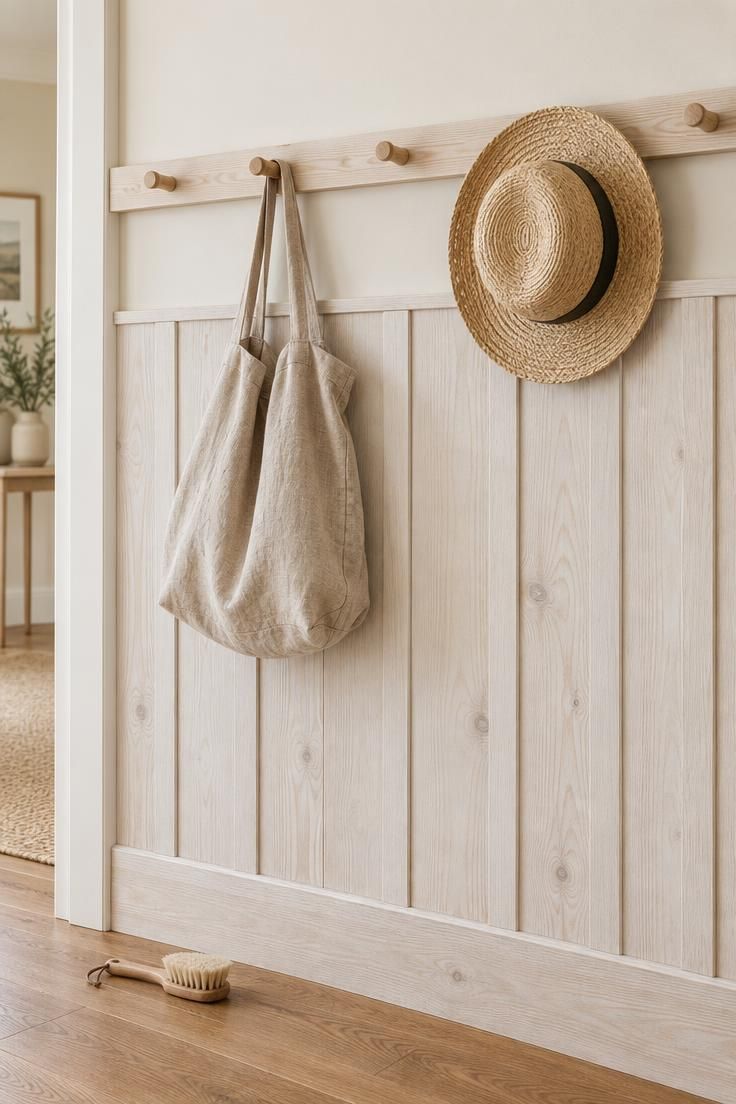
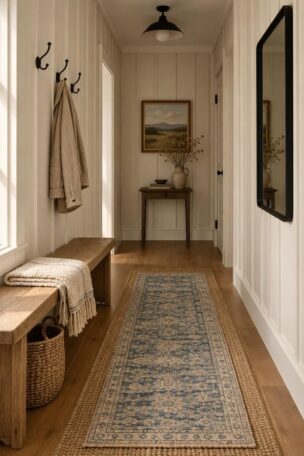
Vertical board-and-batten paneling to the dado line in a whitewash or limed tone adds texture at the level the eye passes closest to.
Finishing the paneling with a whitewash that keeps the grain visible means the lower wall reads as wood rather than paint.
Above the paneling, a plain matte wall in warm cream and a peg rail running the batten line continue the horizontal rhythm the boards establish.
Whitewashed boards, a warm cream upper wall, and a warm oak floor hold a light, low-contrast palette.
This keeps the lower wall from darkening the space in a way a deeper stain would.
Batten joints collect dust along their edges, and a soft brush along the groove keeps them clean without dulling the finish.
Because this is a fixed change rather than a styling move, it suits a hallway being reworked rather than a quick refresh.
Style Blueprint:
- Vertical board-and-batten to the dado line
- A whitewash or limed finish that keeps the grain visible
- A peg rail running along the batten line
Design Pro-Tip: On a long wall, plan the outer boundary of a gallery or hook arrangement first, then fill inward, which keeps the composition from drifting.
A Vintage Umbrella Stand and a Woven Basket at the Door
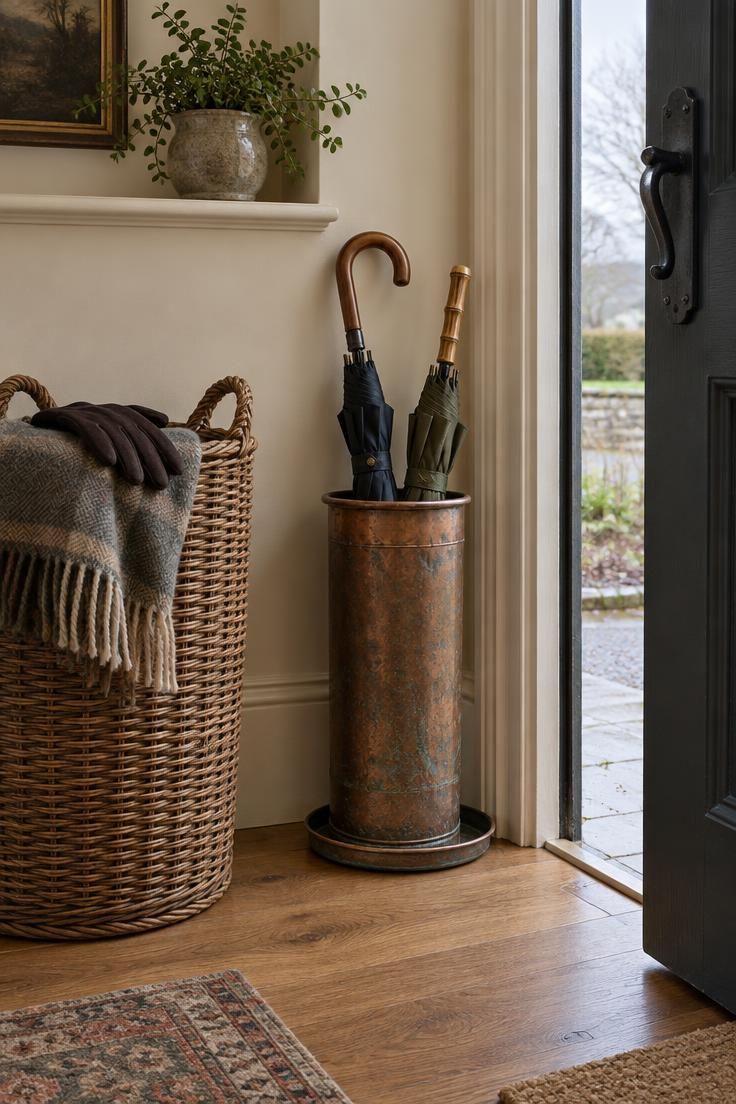
An aged metal or copper umbrella stand beside the door fills a corner with a tall, narrow form that takes little floor width from the walk.
A tall woven basket for hats and gloves next to it gives the entry a second vertical element and a natural texture to balance the metal.
Patinated copper or galvanized grey against natural willow or rattan and a warm wood floor keeps the corner tonal and calm.
An open stand shows wet umbrellas and drips, so a tray or a lined base beneath contains the water.
Wiping metal dry limits further patina if a cleaner look is preferred, though letting the patina develop is part of the appeal.
Keeping both objects to one side of the door makes the entry read as a single moment rather than a scatter.
The stand should be tall enough to hold the longest umbrella in the household without tipping.
Sizing the basket to what it actually holds keeps it from becoming a catch-all that spreads across the floor.
Style Blueprint:
- An aged metal or copper umbrella stand
- A tall woven willow or rattan basket
- A tray or lined base under the stand
A Jute Runner Framed by Two Slatted Mats
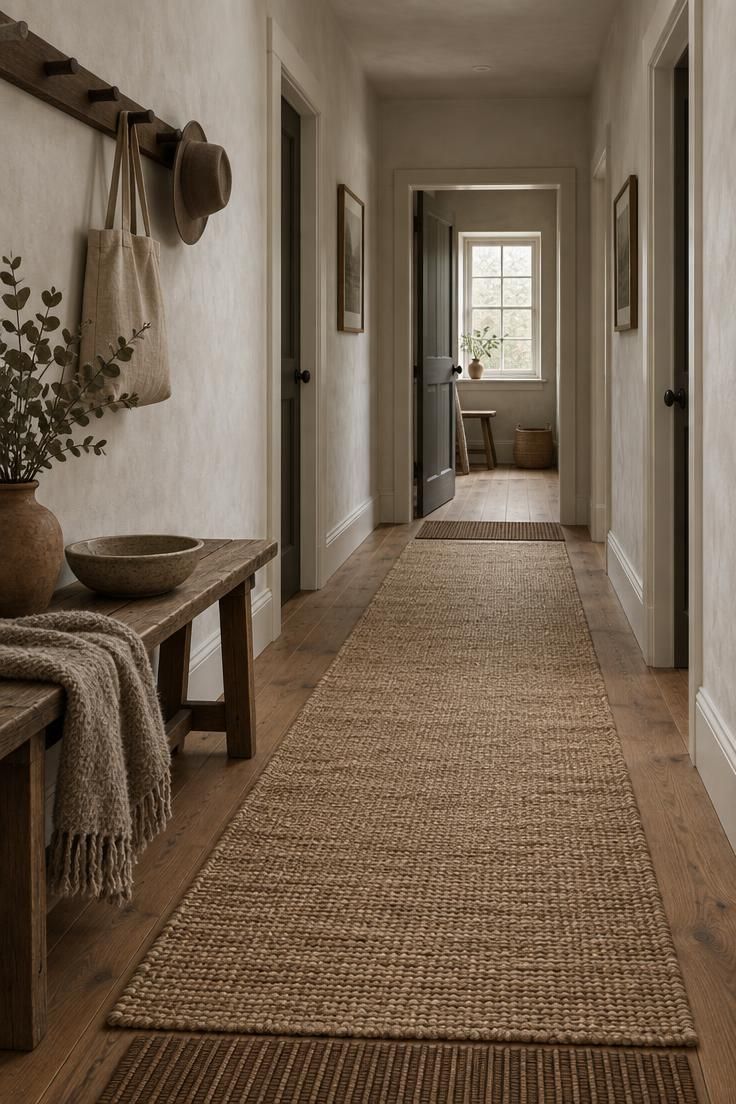
The final take on a jute runner hallway treats the floor as one layered composition rather than a single strip.
A wide jute runner in oat or natural sits as the quiet center, while two narrower slatted mats flank it at the doorways.
Matching the mat tone to the runner's darkest fiber keeps the three pieces in one family, and running the slats crosswise creates a deliberate border instead of three separate rugs.
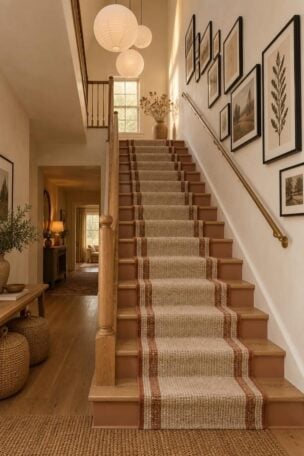
The runner's edges sit in from the baseboards so warm wide-plank flooring shows through as a frame, which prevents the weave from looking pinched against the walls.
Whitewashed or lime-washed walls and a simple dark wood peg rail with a linen tote and a felt hat keep the lower half of the room as the visual anchor.
A low stoneware bowl on a slim bench, dried eucalyptus in a clay vessel, and a wool throw draped loosely add texture without pulling the eye away from the floor line.
Placing the slightly darker slatted mat at the exterior door catches grit before it reaches the woven surface, which gives the heavier mat a practical position in the sequence.
Repeating the same mat at the interior doorway closes the composition on both ends.
Style Blueprint:
- Jute runner in oat or natural, edges held in from the baseboards
- Two slatted mats in a deeper earth tone, slats running crosswise
- Whitewashed or lime-washed walls with wide-plank wood flooring
- Dark wood peg rail with a linen tote and a single felt hat
- A low stoneware bowl and dried eucalyptus for a quiet finishing note
Design Pro-Tip: Treat the jute runner and the slatted mats as one floor composition. Match the mat tone to the runner's darkest fiber, then let the slat direction differ so the eye registers a deliberate border instead of three separate rugs.
Conclusion
A rustic hallway comes together through material and repetition rather than through furniture or glossy finishes.
Choosing one or two ideas from this list and layering their textures usually produces a stronger result than applying all of them at once.
Fixed changes such as paneling, stone, or a planked ceiling suit a planned rework, while rugs, hooks, baskets, and lighting can be layered in immediately.
The hallway is the first thing seen coming home and the last thing seen leaving, which is what makes its texture worth the attention.