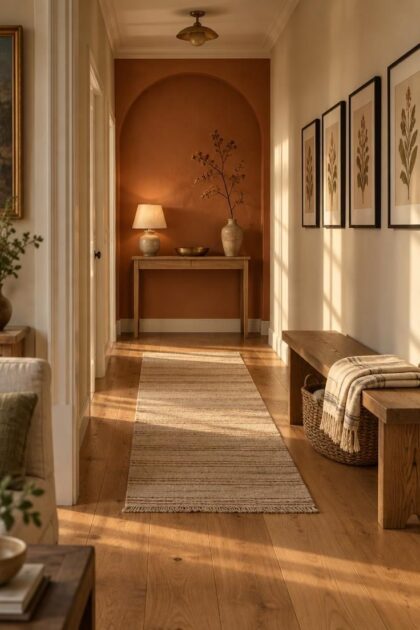
This post may contain affiliate links. If you make a booking or purchase through these links, we may earn a commission at no additional cost to you.
A hallway is often the first interior space visitors see and the one most quickly forgotten.
The right accent wall changes that by giving the corridor a single, deliberate focal point.
This list collects eleven hallway accent wall ideas that range from bold paint to layered texture, each with a clear visual starting point and the practical tradeoffs worth knowing before committing.
The ideas are organized around a simple question: does the accent work better on the end wall, or along one side of the passage?
Vertical Shiplap in Warm White
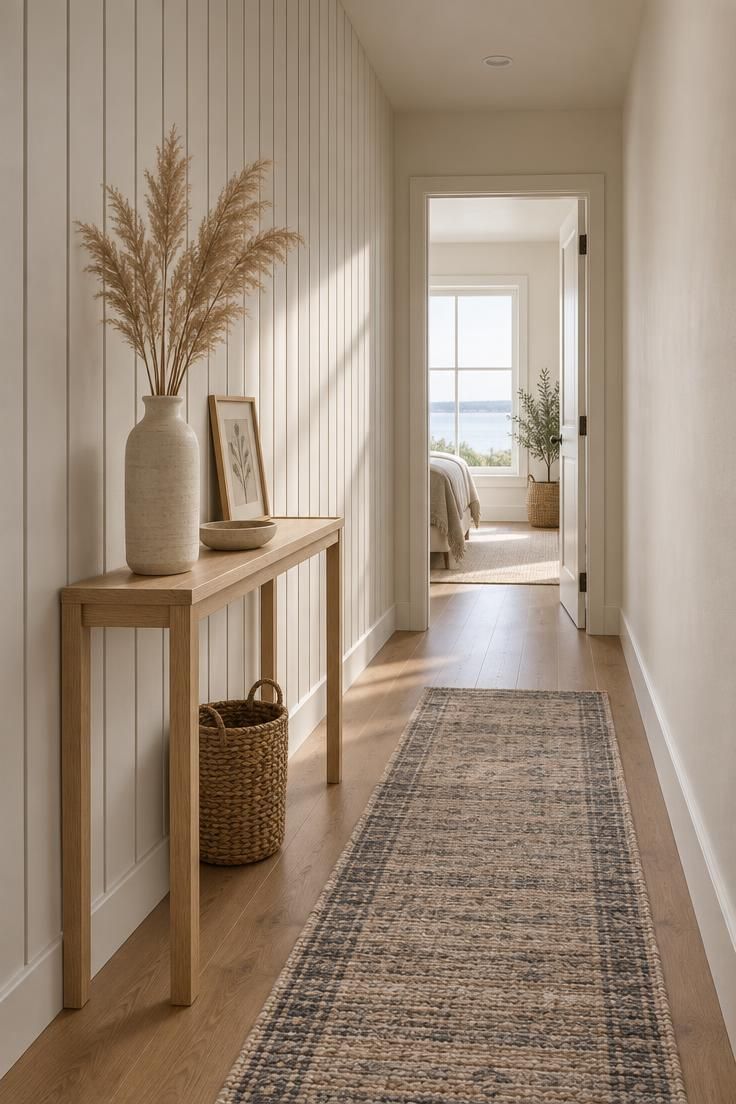
Vertical shiplap draws the eye upward, which helps a low corridor read as taller than its actual height.
The treatment works through repetition rather than contrast, so the shadow lines between boards do most of the visual work while the warm white paint keeps the passage bright.
Choosing vertical boards for this vertical shiplap hallway keeps the emphasis on height, which suits a hall with a standard eight-foot ceiling better than a horizontal layout would.
Dust settles along the grooves and the seam edges, so plan on wiping the boards with a dry cloth every few weeks, and keep the trim profile simple so the paneling stays the dominant texture.
Style Blueprint:
- Floor-to-ceiling vertical shiplap boards in a warm white with a low-sheen finish
- A slim light oak console with open legs so the floor line stays visible
- One tall ceramic vase with dried stems for a narrow silhouette
- A flat woven runner in oatmeal and faded charcoal to soften footfall
End-of-Hallway Mural in Muted Terracotta Shapes
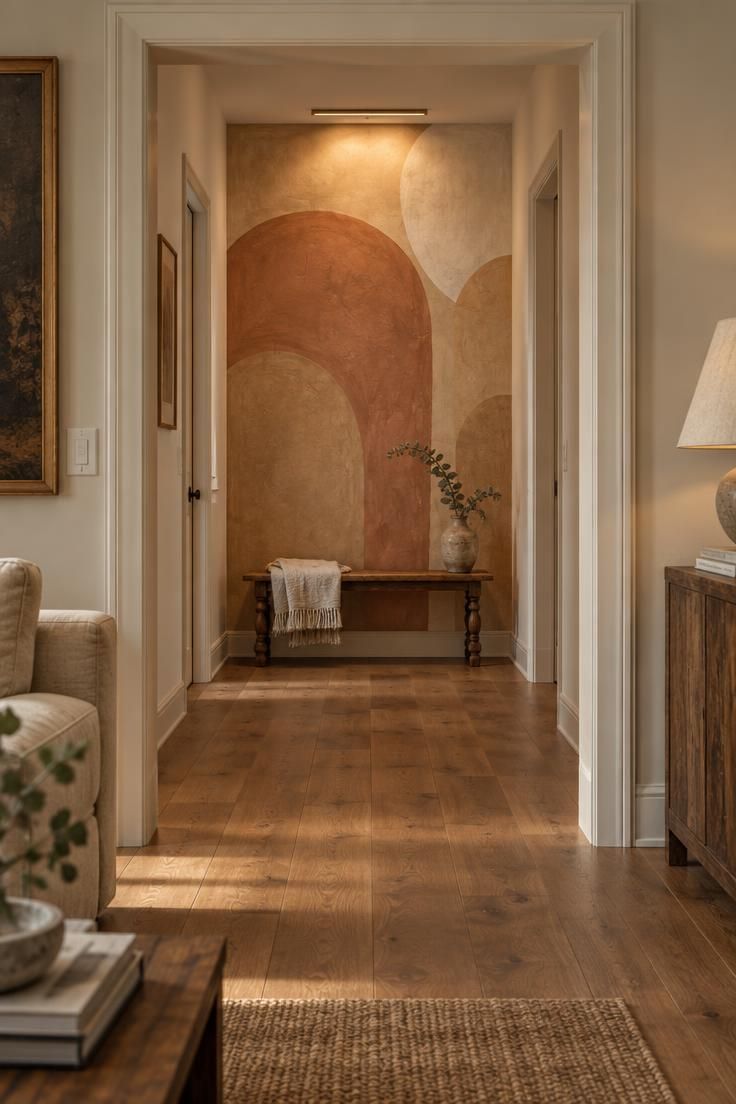
A far wall is seen straight on from the living room, so it can carry a larger motif than a side wall ever could.
Muted terracotta, sand, and chalk white keep a big painted pattern from tipping into busy, especially in a corridor where the viewer stands close to the surface.
Treat the shapes as a backdrop rather than a picture, so the mural frames the bench instead of competing with it.
A mural is a larger commitment than a single paint color, and a highly specific pattern can feel dated once the surrounding palette moves on.
Choosing arches and organic forms rather than literal scenes gives the hallway accent wall longer life, since the shapes read as geometry and color rather than a trend or a story.
Style Blueprint:
- A hand-painted arch composition in terracotta, sand, and chalk white
- A low wooden bench with turned legs to anchor the base of the mural
- A slim linear ceiling light to wash the painted surface evenly
- Warm white side walls and oak flooring so the end wall holds all the color
Tiled Accent Wall in a Small Entry Niche
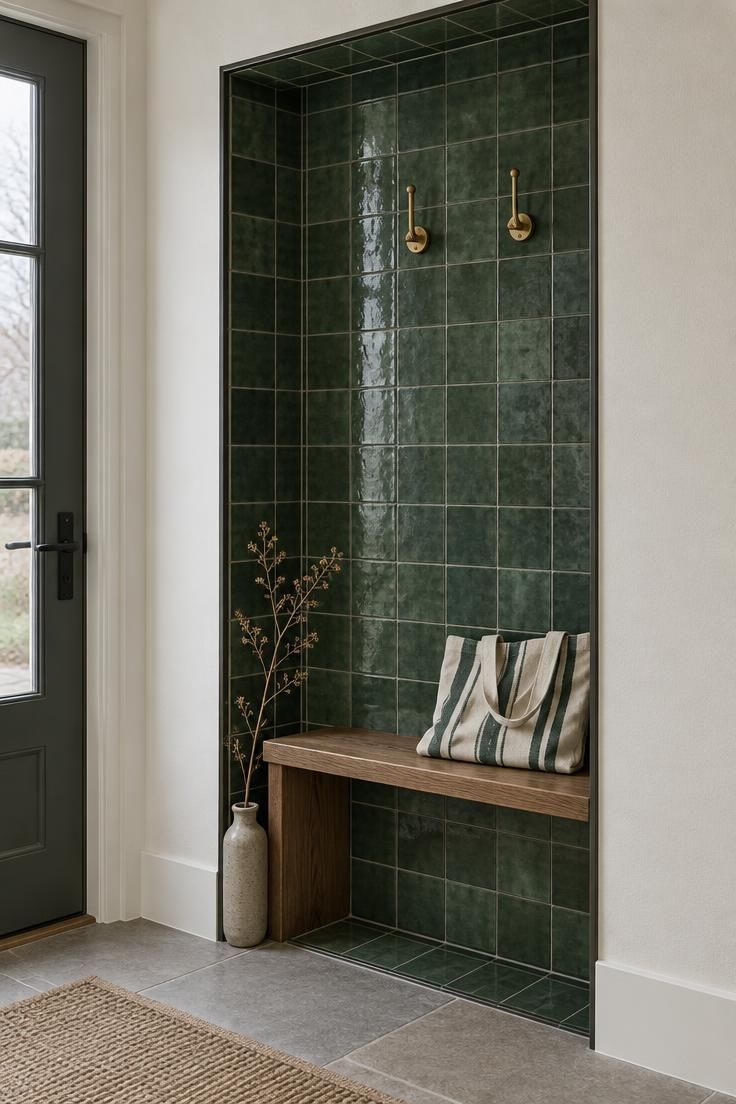
A recess or side return next to the front door is a natural frame for tile, which lets you add a hard, wipeable surface without covering the whole corridor.
A single-color glazed ceramic in deep green or ink blue gives the niche presence, and the slight variation between tiles keeps the surface from reading flat.
Of all the accent wall textures, tile is the most forgiving near a doorway, since splashes, wet bags, and muddy paws wipe off with a damp cloth rather than staining the surface.
The tradeoff is temperature and sound: tile feels cool against the hand and reflects noise, so a jute runner and a wood ledge help balance the hard surface.
Style Blueprint:
- Deep green or ink blue glazed ceramic tiles with visible tonal variation
- A slim pencil trim around the niche opening to finish the edge
- Two simple brass hooks and a narrow wooden bench inside the recess
- A jute or wool runner on the floor to soften the reflected sound
Textured Limewash on the Long Side Wall
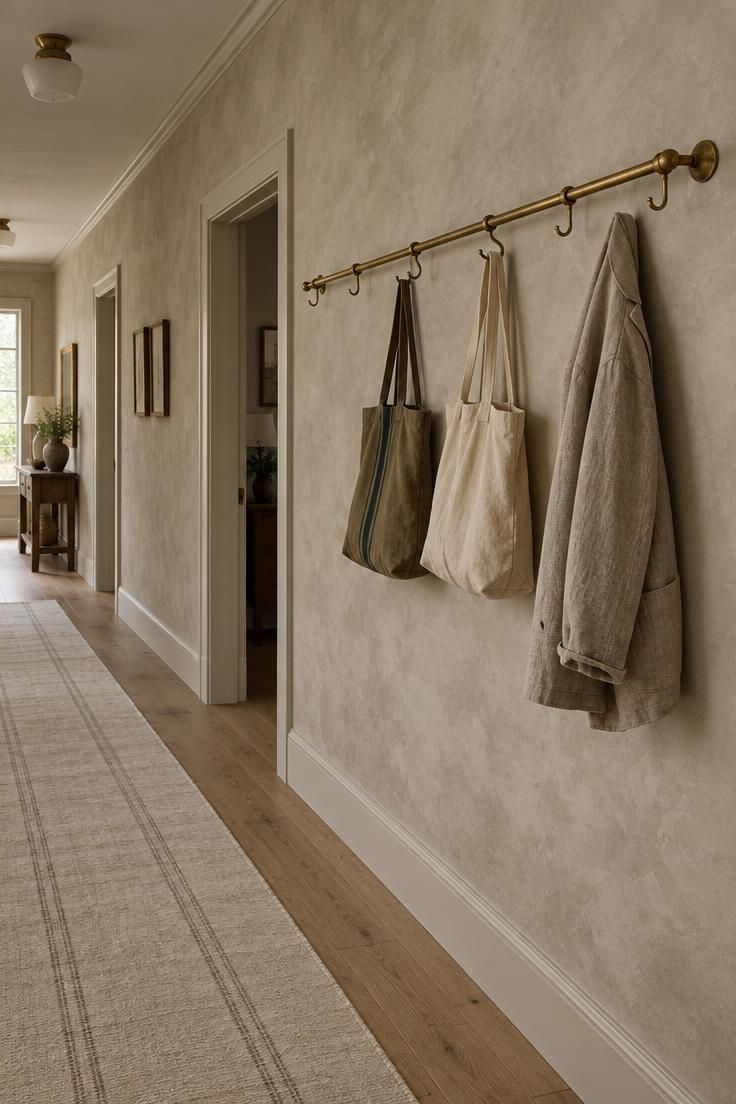
Limewash adds soft movement to a long wall without introducing a printed pattern, which suits a corridor that already has doors, hooks, or a runner carrying visual interest.
The matte, clouded finish shifts with the light across the day, so the same wall can read cooler in the morning and warmer in the late afternoon.
Position this as the quieter alternative to wallpaper, best when the hallway has a lot going on and needs a calm backdrop rather than another layer.
The surface can read dusty in a very dim corridor, and touching up a scuff means reapplying the finish in loose overlapping passes to match the surrounding movement.
Style Blueprint:
- A limewash or mineral paint finish in warm putty or soft stone tones
- An aged brass coat rail mounted along the upper third of the wall
- A pale oatmeal runner with a faint stripe to warm the floor
- Simple painted trim on doorways so the wall texture stays the focus
Gallery Wall in a Narrow Corridor
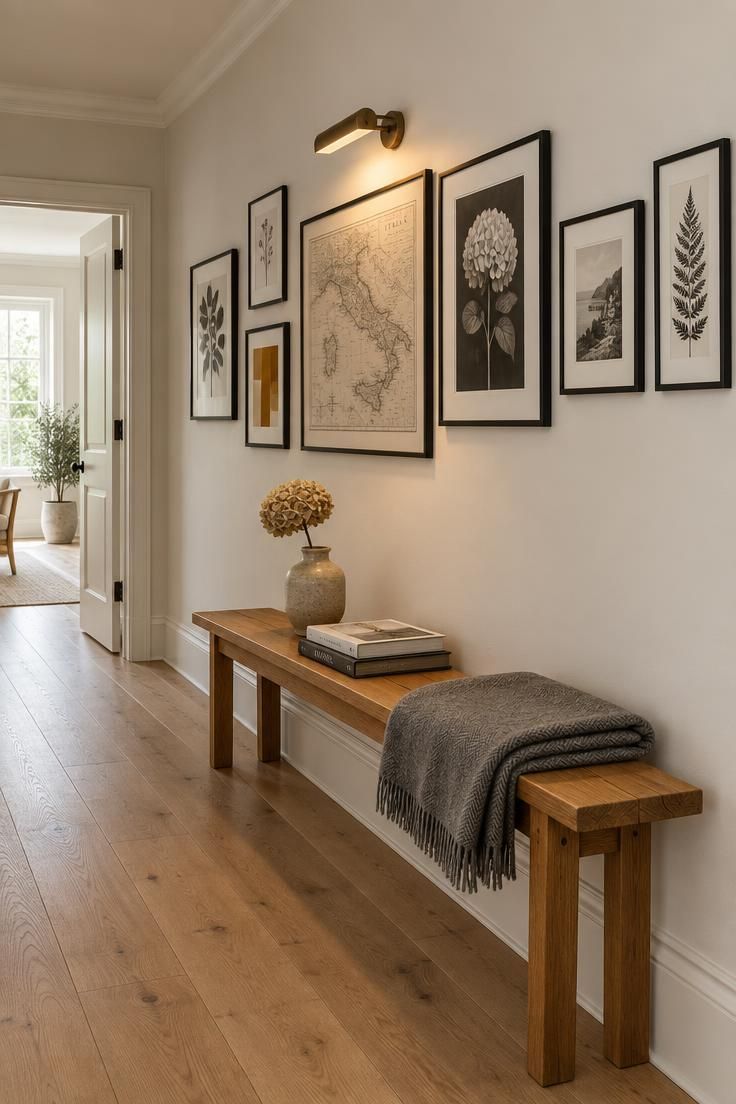
A gallery arrangement creates the accent through display rather than surface, which makes it a flexible option when you want a personal layer without adding physical depth to the corridor.
In a narrow passage, small and medium frames in one finish, like flat black or unlacquered brass, hold together better than mixed metals and mixed sizes.
Unlike a tiled accent wall for entries, a gallery line is easy to expand or rearrange later, which suits renters and anyone still collecting art.
Frames placed at hand height get knocked and gather dust, so keeping the lowest row above shoulder height protects both the glass and the arrangement.
Style Blueprint:
- Small and medium frames in a single finish, hung in a loose horizontal line
- Uniform matting in off-white to tie varied artwork together
- A slim backless bench below the frames for balance and utility
- A low warm sconce centered on the arrangement to lift the middle frames
Design Pro-Tip: Before hanging anything, tape paper templates to the wall and step back to the far end of the hallway, since frames that look perfectly spaced up close often read crowded from the distance visitors actually see.
Vertical Shiplap Hallway in Dried Sage
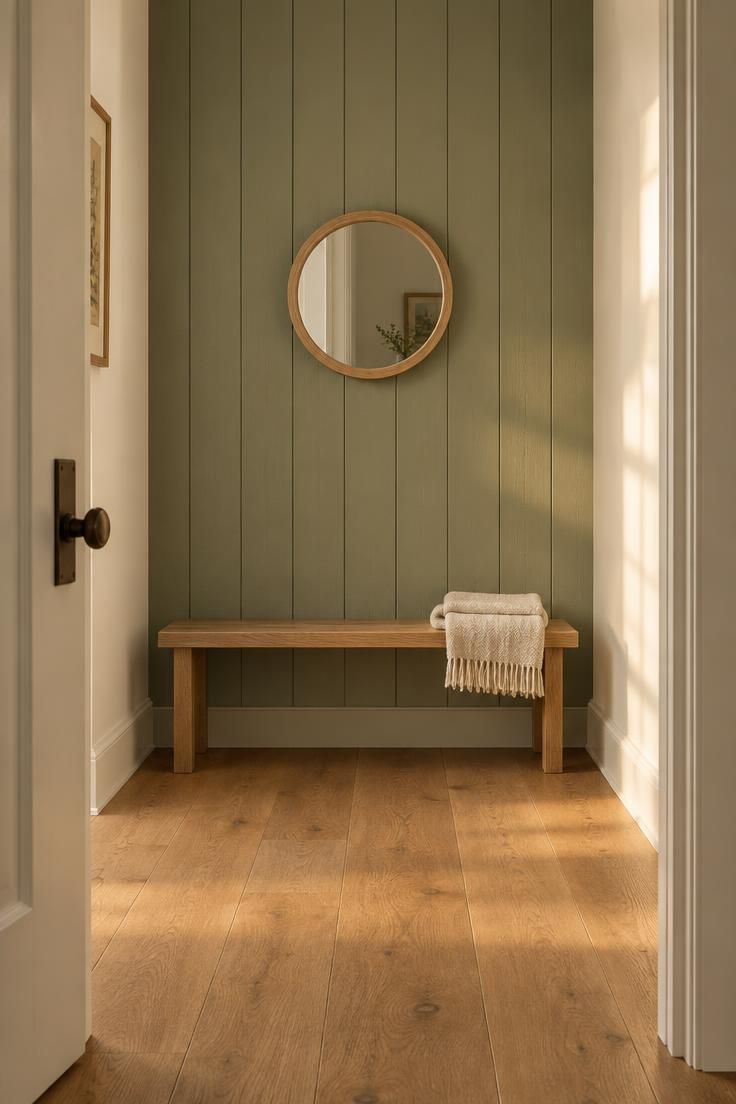
Sage green boards keep the vertical rhythm of shiplap while adding a soft color that reads warmer in the evening and cooler in the morning.
Painting the boards rather than leaving raw wood keeps the corridor from feeling rustic, and it lets the shadow gaps do the textural work instead of grain.
The vertical lines also draw the eye upward, which can make a short or enclosed hallway feel a little taller.
A simple mirror and low bench are enough to give the accent wall a purpose without covering the painted boards.
An end-of-hallway accent wall in a muted green can tie into a nearby living room or garden view, or stand on its own against plain off-white neighbors.
Touching up a scuff on painted seams involves working around the gap rather than wiping a flat surface, so choose a finish that cleans easily if the hall sees heavy traffic.
Style Blueprint:
- Vertical shiplap painted in a soft dried sage green
- Warm white adjacent walls so the green reads as the single event
- A small round mirror in a plain light wood frame at eye level
- A low oak bench with a folded cream throw at the wall's base
Upholstered Wall Panels in a Soft Linen Blend
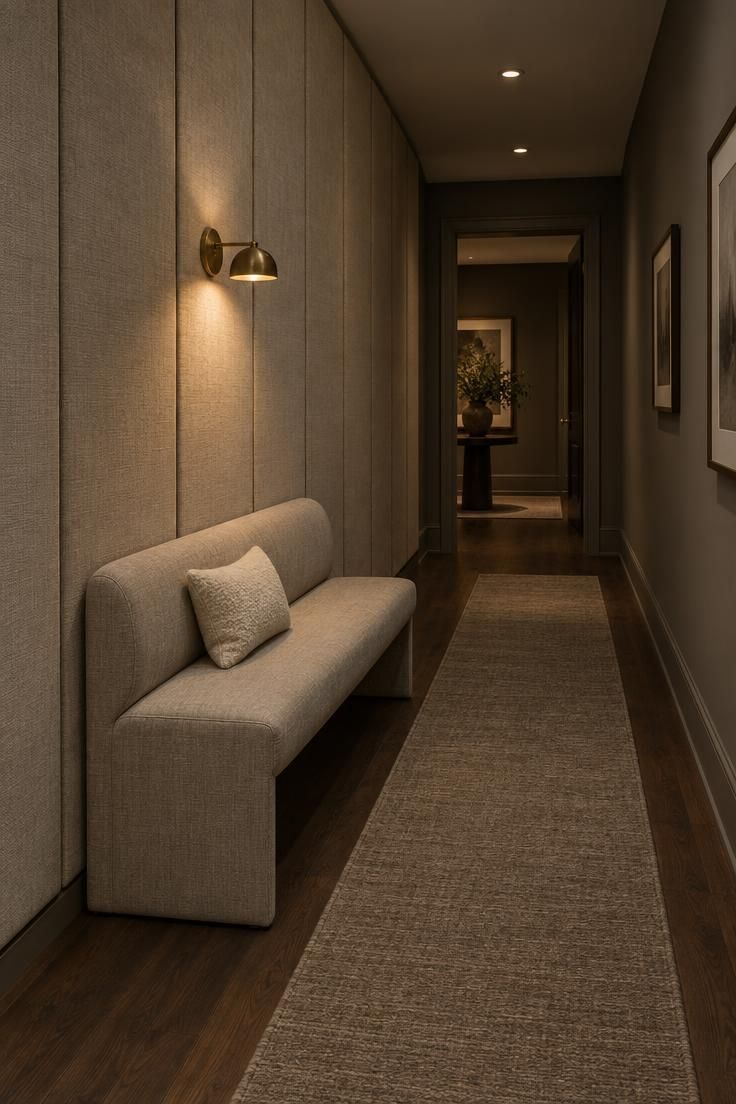
Upholstered panels add softness where a hallway has hard flooring and many bare surfaces, and the fabric absorbs some of the reflected sound that makes a bare corridor feel loud.
Slim sections with recessed gaps between them give the wall a clean, controlled line, while a single tone in a durable linen blend keeps the texture from competing with the architecture.
Position the accent on a long side wall or an end wall where a bench rests, since the eye reads upholstered panels best when there is a piece of furniture or a figure to anchor them.
Fabric holds dust and can be marked by dirty hands or a passing shoulder, so plan on vacuuming the panels with a soft brush attachment and consider placing them above the highest-traffic reach where practical.
Style Blueprint:
- Full-height panels in a durable oat or warm gray linen blend
- Recessed shadow gaps between panels for a controlled line
- A bench upholstered in the same fabric so the wall and furniture read as one gesture
- A warm brass sconce above the bench to reveal the weave and soften the tone
- A narrow wool runner in taupe to ground the floor and quiet footsteps
Framed Cane Wall Panels on One Side
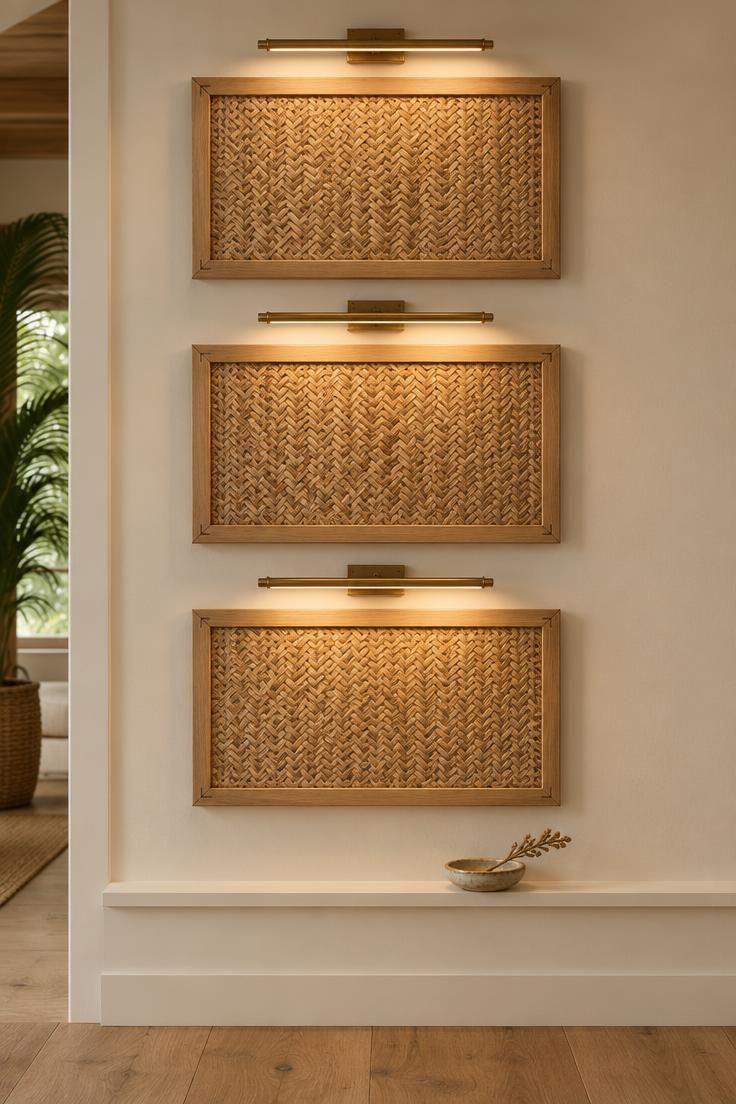
Large wall-mounted cane panels bring woven texture to a hallway without shelving, and the rattan reads warmer and softer than tile or glass would in the same spot.
Set in slim wood frames and arranged in a row or grid, the panels work as an accent on a single wall while keeping the corridor visually light.
Cane is not a scrubbable surface, so placing the panels above hand height or away from the main traffic path protects the weave and keeps the panels looking fresh.
Dust settles in the small openings between strands, and a soft brush or a vacuum on low suction handles it better than a damp cloth, which can leave water marks on the cane.
Style Blueprint:
- Three or four cane panels in matching light oak frames, arranged in a vertical row or grid
- A slim picture light above each panel to wash the weave
- Pale warm-white surrounding walls so the cane carries the warmth
- Panels hung above hand height to protect the woven surface
Painted Arch Behind a Slim Console
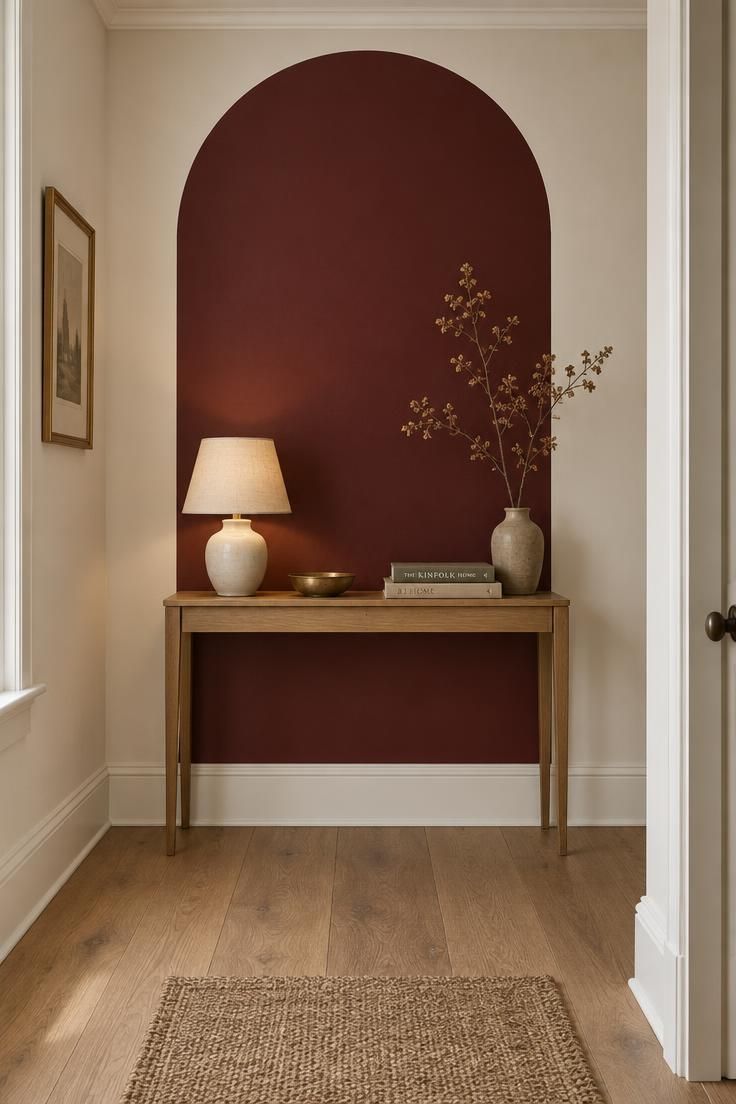
A painted arch carves a focal point on a flat end wall without changing structure, so the effect is graphic rather than architectural.
Deep tones like oxblood or forest green give the arch presence, and the curve softens the hard rectangle of a corridor in a way that straight edges cannot.
Try the shape at a size that relates to the furniture beneath it, so the console sits inside the arch width rather than spilling past its lines.
The painted edge needs careful masking to stay crisp, and an arch shape can feel stylized in a home that leans very modern.
Style Blueprint:
- A tall painted arch in oxblood, forest green, or another deep saturated tone
- Warm white surrounding walls so the arch reads as a single gesture
- A slim oak console that fits entirely within the arch width
- A small ceramic table lamp with a natural linen shade for soft layered light
Design Pro-Tip: Paint a sample patch of any deep color directly onto the hallway wall and check it at three times of day, since oxblood and forest green can read warm or muddy depending on which way the corridor faces.
Horizontal Shiplap on the End Wall
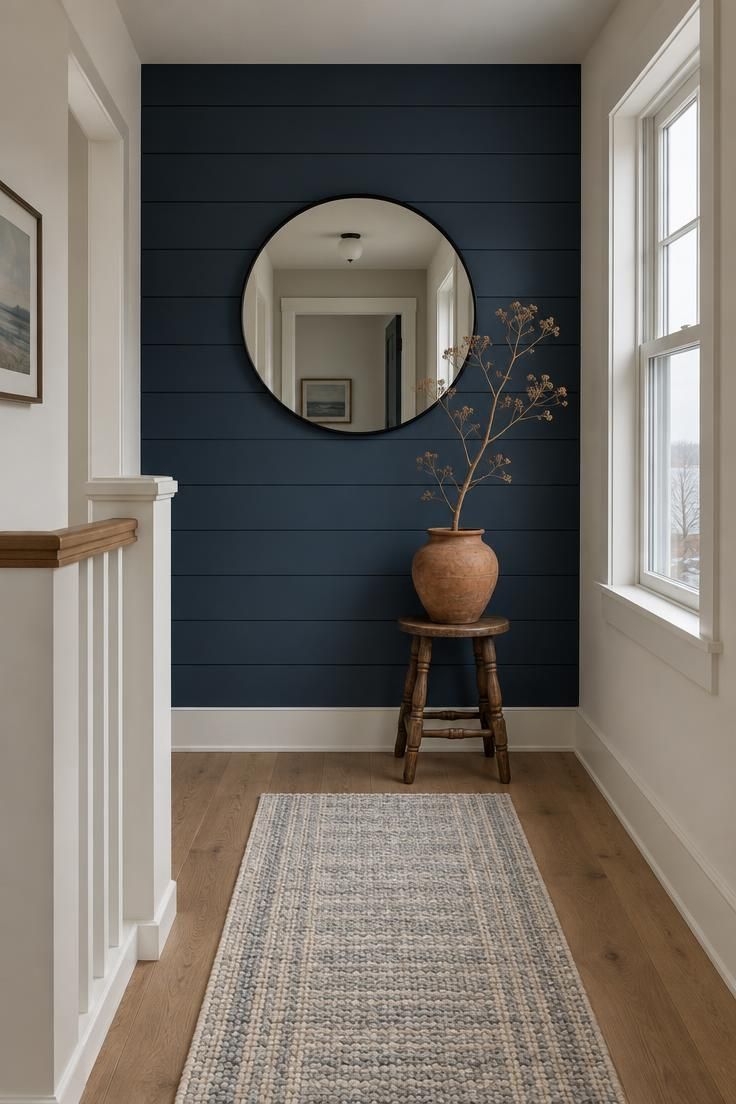
Horizontal shiplap pulls the eye sideways, which can make a short end wall or a compact landing feel wider than its true dimensions.
On an end wall, a single strong color like warm black or deep blue reads as a destination, while pale neighboring walls let the dark boards hold their depth.
The look leans more casual than vertical boards, so it suits a landing, a stair return, a hall with a bench, or a gallery wall in a narrow corridor better than a formal space.
That casual quality also makes the treatment forgiving around a doorway or window when the wall is broken by trim, because the repeating seams do not demand a perfectly uninterrupted surface.
Plan on a soft brush or a vacuum attachment along the boards more often than a flat painted wall would need, since each horizontal seam catches dust on its ledge.
Style Blueprint:
- Horizontal shiplap boards in a deep inky blue or warm black
- A large round mirror with a thin frame to break the strong horizontal lines
- Warm white surrounding walls and trim so the dark boards stay dramatic
- A small stool or ceramic vessel to keep the base of the wall from feeling empty
Fluted Wood Slat Wall Behind a Slim Bench
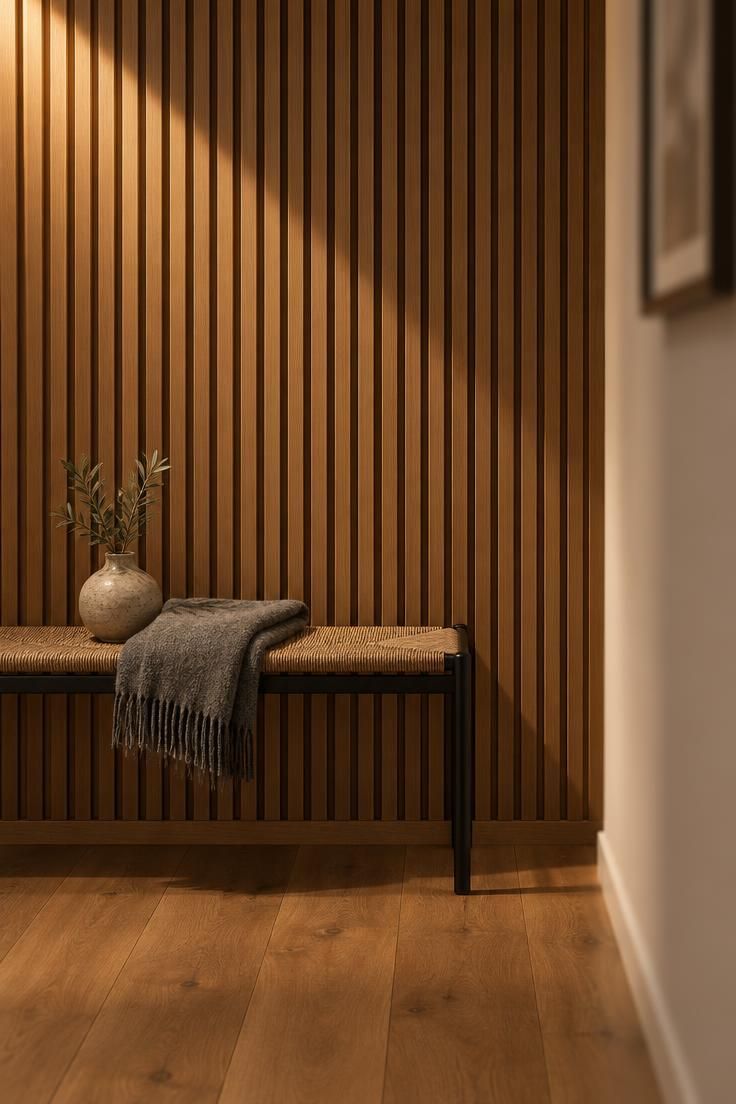
A fluted wood slat wall adds vertical texture and warmth without a printed motif, which makes it a strong option for an end wall or a short return where the light can rake across the grooves.
Narrow slats in a warm mid-tone oak set with small gaps create a shadow pattern that shifts through the day, so the wall reads differently in the morning and at night.
The wood brings warmth to a hallway that might otherwise feel cool, and it pairs well behind a low bench or a single piece of furniture rather than beneath wall hooks or shelving.
Slats are more involved to install than paint or paper, and dust settles between the grooves, so a slim vacuum attachment is worth keeping nearby.
Style Blueprint:
- Vertical fluted oak slats in a warm mid-tone with small gaps between them
- A slim bench in black or dark metal for a strong contrast against the wood
- Warm raking light from above to define the groove shadows
- A single ceramic vessel and one folded throw so the bench stays uncluttered
Conclusion
A hallway accent wall works best when it answers one question: where should the eye land first?
Whether the choice is a painted arch, a textured limewash, or a gallery line, the treatment should match the corridor's actual length, light, and daily use rather than a look borrowed from a photograph.
Think about how the surface will wear near hands and bags, and how often it will need upkeep, before committing to a finish that is hard to clean.
The right accent makes the hallway feel deliberate instead of forgotten, and it sets the tone for every room beyond it.