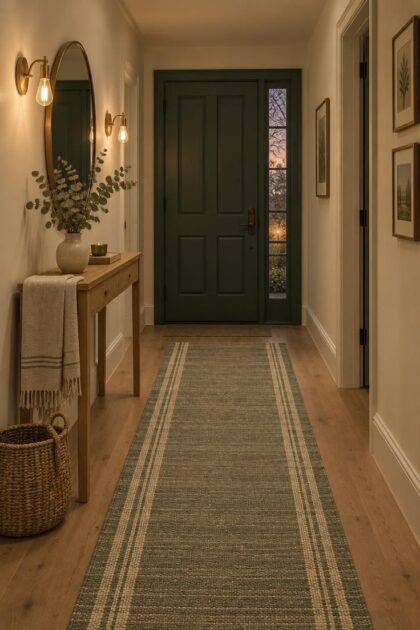
This post may contain affiliate links. If you make a booking or purchase through these links, we may earn a commission at no additional cost to you.
A hallway is the first space guests see and the last one you pass through at night.
It usually gets less natural light than any other room, and its walls are mostly doors, frames, and narrow strips of flat surface.
Green can work with those proportions instead of fighting them.
The ideas below range from a single painted door to full wainscoting, with different levels of commitment and upkeep.
Deep Forest Green Door and Doorframe Against a Quiet Neutrals Hall
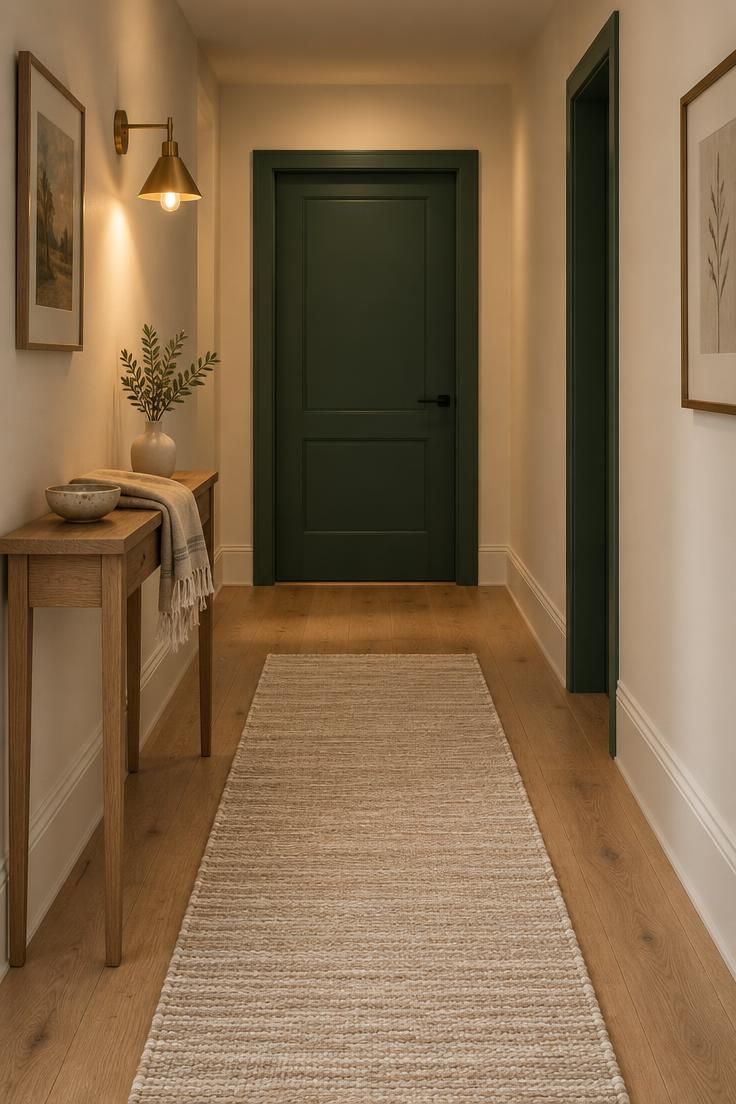
Painting a single interior door and its frame in deep forest green turns the end of a short entry into the visual destination.
The surrounding walls stay a warm off-white, so the contrast does the work rather than a pattern or an object.
A matte or satin finish keeps the pigment reading as color rather than a reflective surface, which matters when the door sits close to where people stand.
Brass hardware and a slim oak console soften the starkness that a dark door can create against pale walls.
One practical note: dark paint on a door that is opened and closed throughout the day shows dust and fingerprints more readily than a light color, so keep a microfiber cloth nearby.
Style Blueprint:
- Deep forest green in a matte or satin finish for the door and frame
- Warm off-white walls with matching off-white baseboards
- Unlacquered brass or matte black lever hardware
- A narrow natural wood console with one or two objects, no clutter
Olive Green Wainscoting Paired With Cream Upper Walls and a Wooden Peg Rail
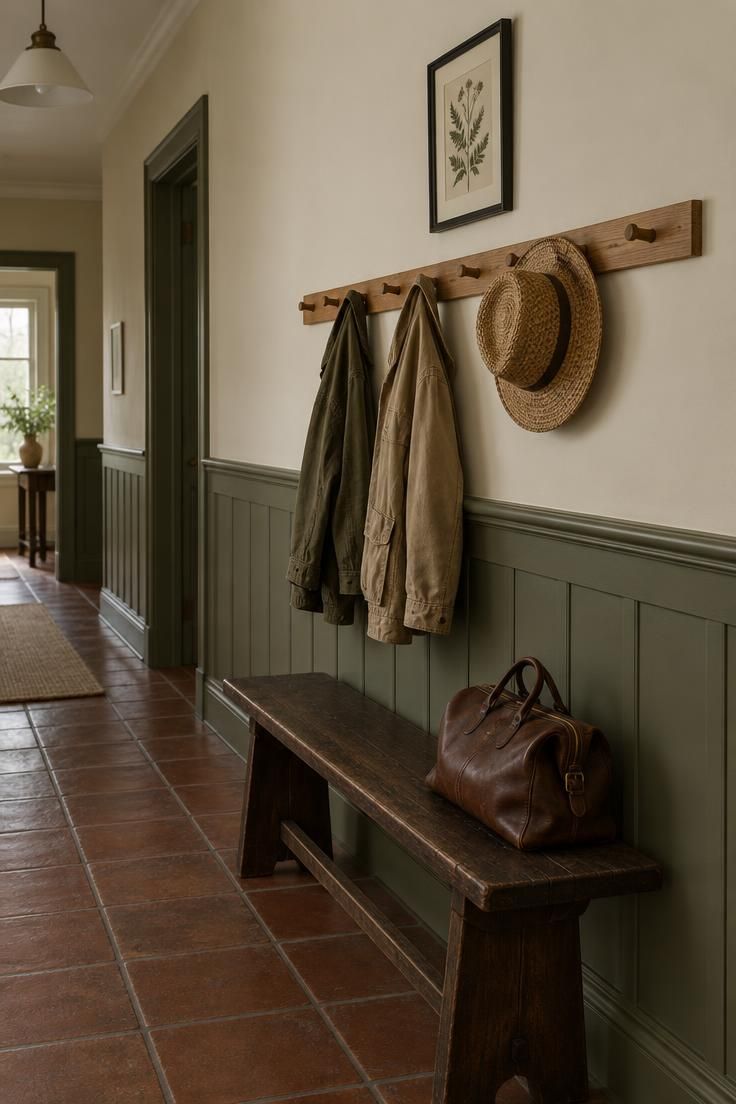
Olive green wainscoting on the lower third of the wall gives a green hallway a durable base that takes the wear of bags, shoes, and wet umbrellas.
Cream above the cap rail keeps the corridor from closing in, and the horizontal break at the rail gives a long, narrow space a visual stop.
A wooden peg rail set at the transition line adds function without introducing a bulky piece of furniture.
The olive tone sits comfortably beside brick or terracotta floors, which is useful when the flooring is fixed and hard to change.
Matte wainscoting shows scuffs near the pegs, so a satin finish on the lower panels is often the more practical choice in a busy entry.
Style Blueprint:
- Olive green satin paint for the wainscot panels and cap rail
- Cream paint on the upper wall, kept flat or eggshell
- A natural wood peg rail with simple turned pegs
- A low bench in dark stained wood
- Two or three woven or canvas items hung at staggered heights
Large-Scale Botanical Wallpaper on One Uninterrupted Hallway Wall
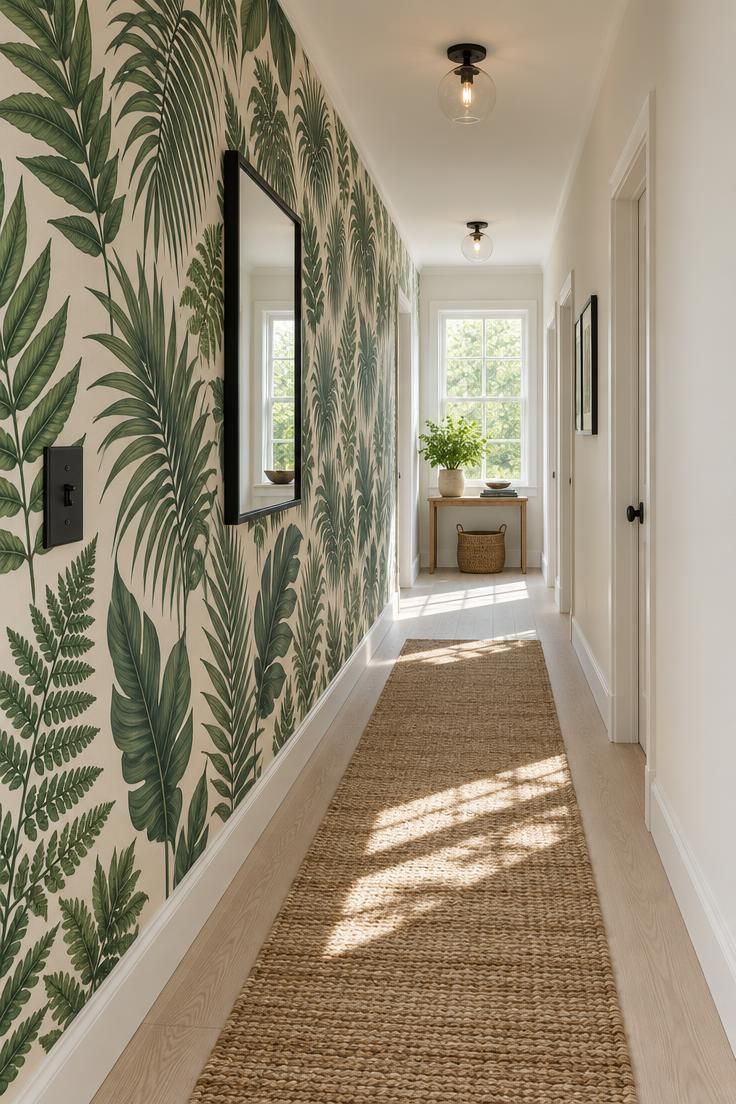
A large-scale botanical pattern deserves the longest uninterrupted wall in the corridor, where the repeat can actually read as a composition.
When the same paper runs into door frames, switches, and return corners, the leaves get chopped and the wall starts to look busy rather than considered.
Choosing a cream or pale background keeps the pattern legible in a hallway that gets limited daylight, since a dark ground with dark leaves can close in fast.
A jute runner and black metal switch plates give the wall two quiet companions instead of competing for attention.
Before committing, measure the wall against the pattern repeat: a large motif looks best when the wall fits at least two full repeats, and a single partial repeat tends to look like an accident.
Style Blueprint:
- Large-scale botanical wallpaper with a pale ground and deep green foliage
- Plain warm white paint on the remaining walls
- A natural jute or flatweave runner in a neutral tone
- Black metal switch plates and picture frames for a crisp accent
Design Pro-Tip: Tape a wallpaper sample to the wall at eye level and leave it there for a full day, checking it in morning light and again under the hall’s evening bulbs before ordering rolls.
Sage Green Painted Ceiling With a Warm White Crown Molding and a Woven Pendant Light
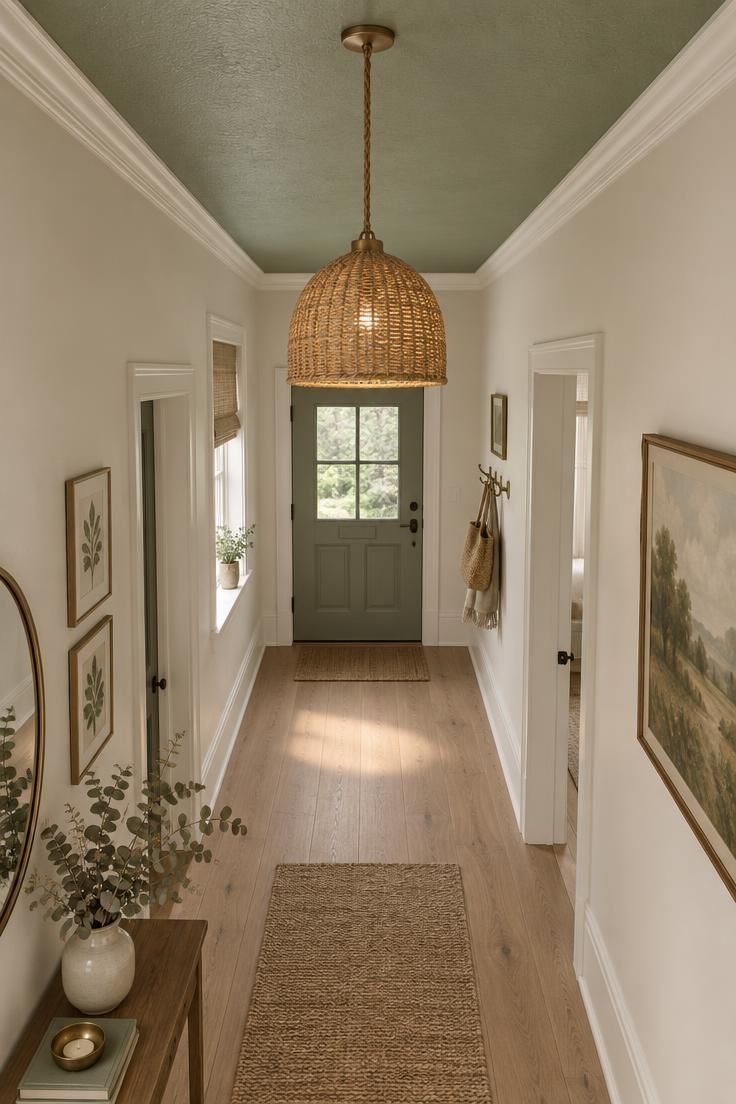
Turning the ceiling sage green reverses the usual formula and gives a tall corridor something to look at above eye level, while a green hallway runner on the floor can ground the color with a soft, woven counterpart.
The crown molding in warm white acts as a clean break, so the green reads as a deliberate plane rather than a paint spill, and a woven rattan pendant draws the eye upward while adding a natural texture that keeps the green from feeling flat.
A colored ceiling reads as lowering the plane above, so this approach suits halls with generous height better than a low corridor, where it can feel pressing.
That same visual effect is worth weighing before painting: stand at both ends of the hall and decide whether the ceiling height can absorb the shift.
Style Blueprint:
- Soft sage green in a flat or matte finish for the ceiling
- Warm white walls with a warm white crown molding
- A woven rattan or bamboo pendant on a fabric cord
- One or two dried botanical stems in a simple vessel below
Green Beadboard Half Wall Below a Warm White Plaster Upper Wall
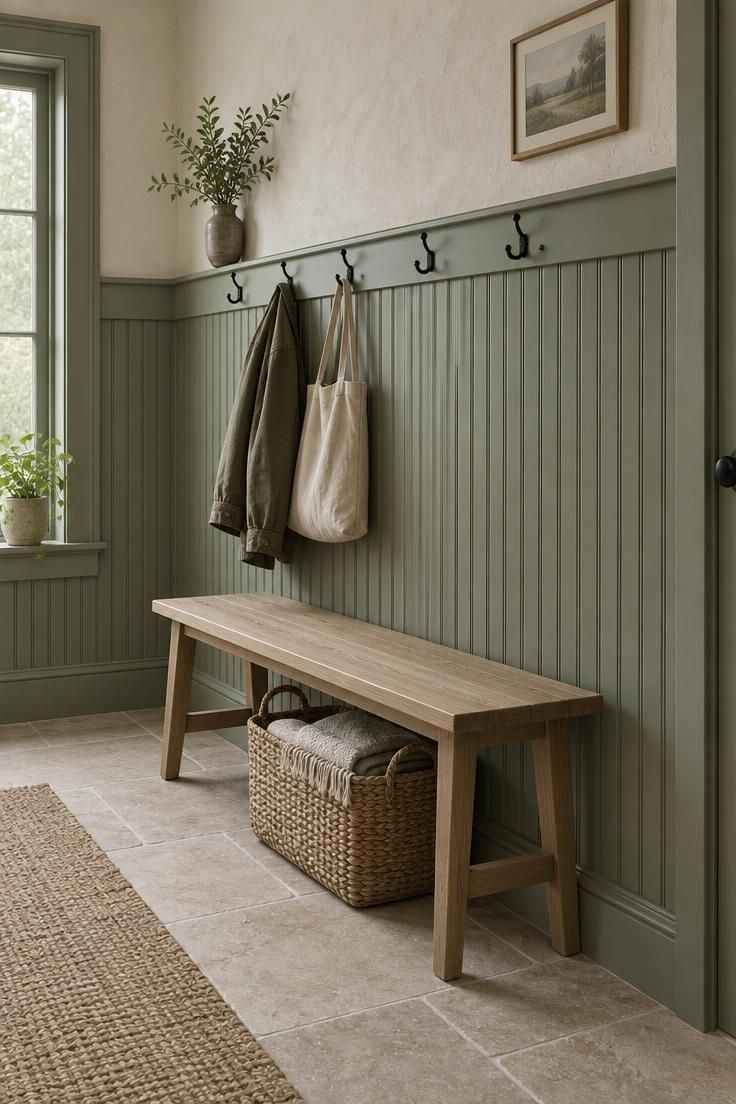
Beadboard on the lower half of a hallway wall protects the surface that takes the most contact while adding a fine vertical texture that catches light differently from flat paint.
A mid-green such as sage or eucalyptus keeps the paneling from competing with the floor, which is often the largest fixed surface in the space.
The warm white plaster above gives the eye a rest and lets the beadboard stand as the single texture moment.
This treatment is harder to reverse than paint alone, so it suits a hall you plan to keep for a while and a wall long enough for one unbroken run.
Interruptions from doors or vents break the rhythm of the grooves, so count the openings before deciding where the paneling starts and stops.
Style Blueprint:
- Sage green beadboard in a satin finish for wipeability
- Warm white plaster or flat paint above the cap rail
- A light wood bench with simple lines
- A woven seagrass or rattan basket for storage
- Small matte black hooks in a single row
Saturated Green Painted Stair Risers Against a Pale Stairwell Wall
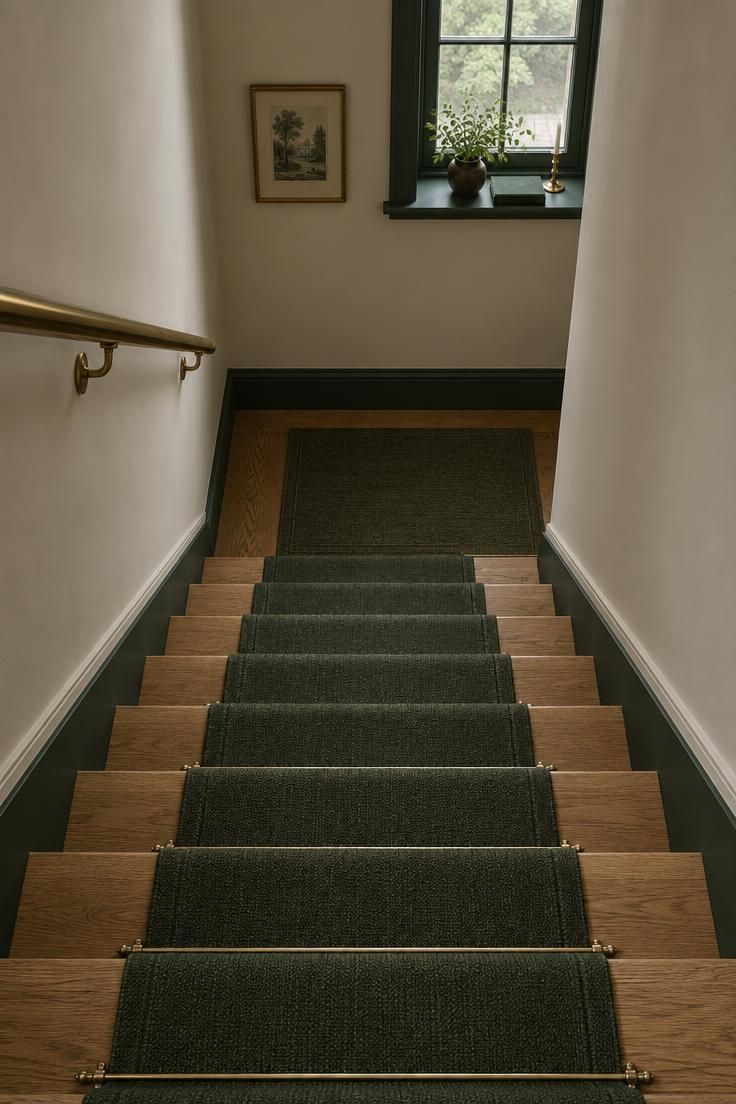
Painting the risers in a rich bottle green while leaving the treads natural wood turns the staircase into a repeated rhythm rather than one large field of color.
The green sits at foot level and carries upward with each step, which links two floors without making the corridor itself heavy.
Because risers face outward and catch light, a glossy finish shows dust and scuffs quickly, and a satin finish is usually easier to keep looking even.
A thin runner down the center adds a second green note and softens the sound of footsteps on bare wood.
This works especially well where the hall connects two floors, since the color continues around the turn and reads as intentional from both directions.
Style Blueprint:
- Bottle green in a satin finish for the risers
- Natural or lightly sealed wood treads
- A thin wool runner in a related green with brass rods
- A brass handrail to warm the green
Rental-Friendly Peel-and-Stick Green Patterned Wallpaper in a Narrow Alcove
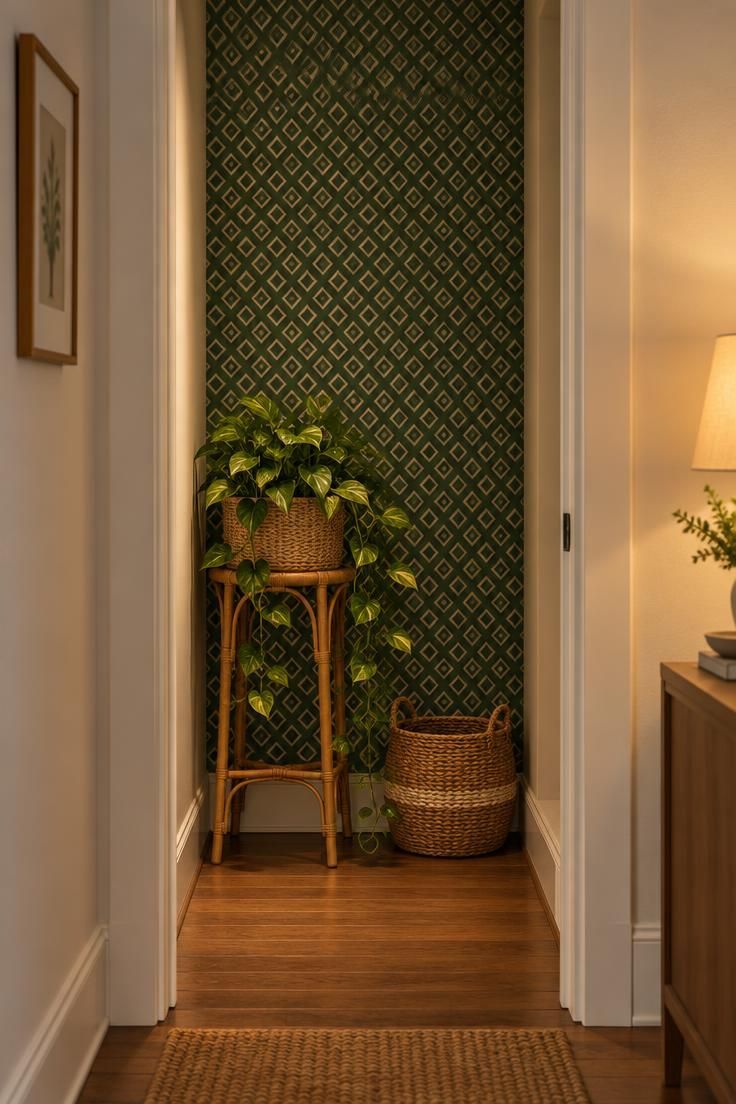
An alcove at the end of a hall makes an ideal place for peel-and-stick green wallpaper, because the contained shape frames the pattern and limits how much wall you have to cover.
Because the paper is removable, this version of a green wallpaper hallway suits rentals and anyone testing a pattern before committing to a full wall.
A small plant stand or low bench below the paper gives the alcove a purpose, so the pattern reads as a deliberate backdrop rather than leftover wall.
Peel-and-stick papers grip best on smooth, clean, dust-free surfaces, and edges can lift in humid spots such as a hall near a bathroom door.
Buy a little extra paper for the alcove: matching a small geometric repeat across a corner takes more trimming than a plain wall.
Style Blueprint:
- Peel-and-stick wallpaper in a small-scale green geometric or botanical print
- Plain warm white paint on the surrounding walls
- A slim rattan or wood plant stand
- One trailing plant in a simple ceramic pot
Built-In Green Storage Column With Open Shelving and a Charging Nook
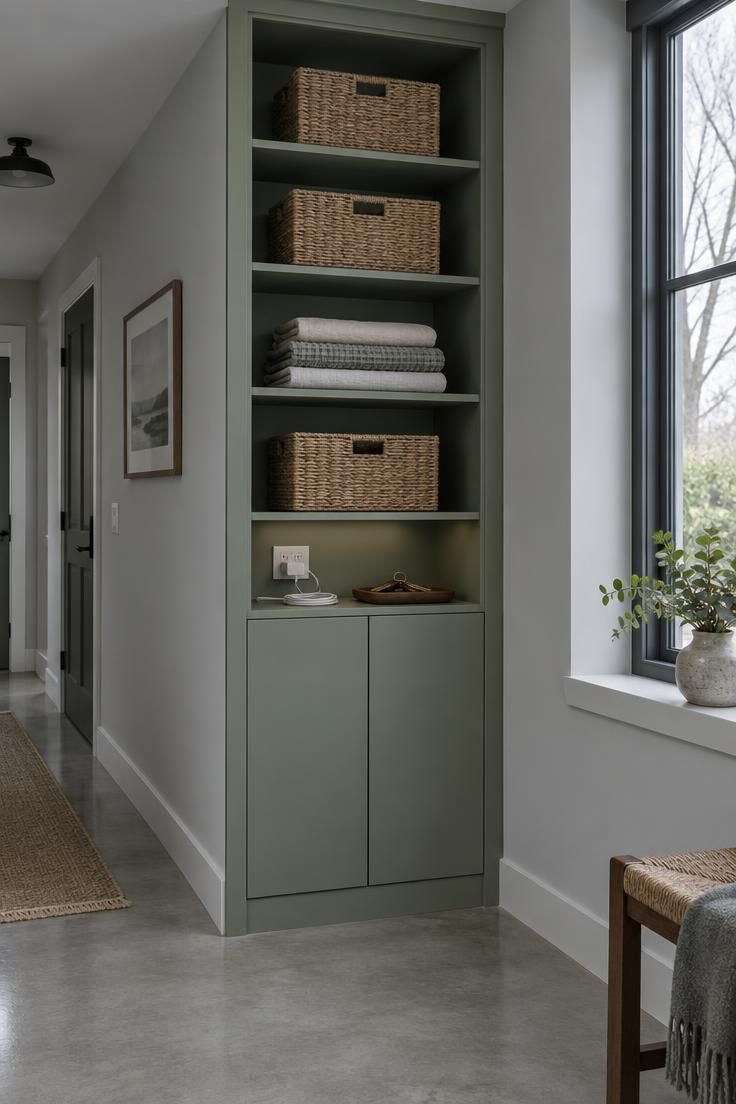
A built-in column painted in muted green gives a dead corner a job and turns the color into something functional rather than purely decorative.
Open shelves above a closed lower cabinet split the column into display and storage, so baskets for gloves and mail sit within reach while bulkier items stay hidden.
A small nook above the cabinet door can hold a charging station for phones or a portable vacuum, the kind of thing that otherwise migrates to the kitchen counter.
This is a more involved project than paint or paper, and in a small green hallway it needs enough wall depth to recess at least a shallow cabinet.
Style Blueprint:
- Muted green paint in a satin finish for the column
- Four or five matching woven baskets for the open shelves
- A closed lower cabinet with simple flat doors
- A small tray and cord organizer for the charging nook
High-Gloss Emerald Green Front Door Inside a Muted Sage Hallway
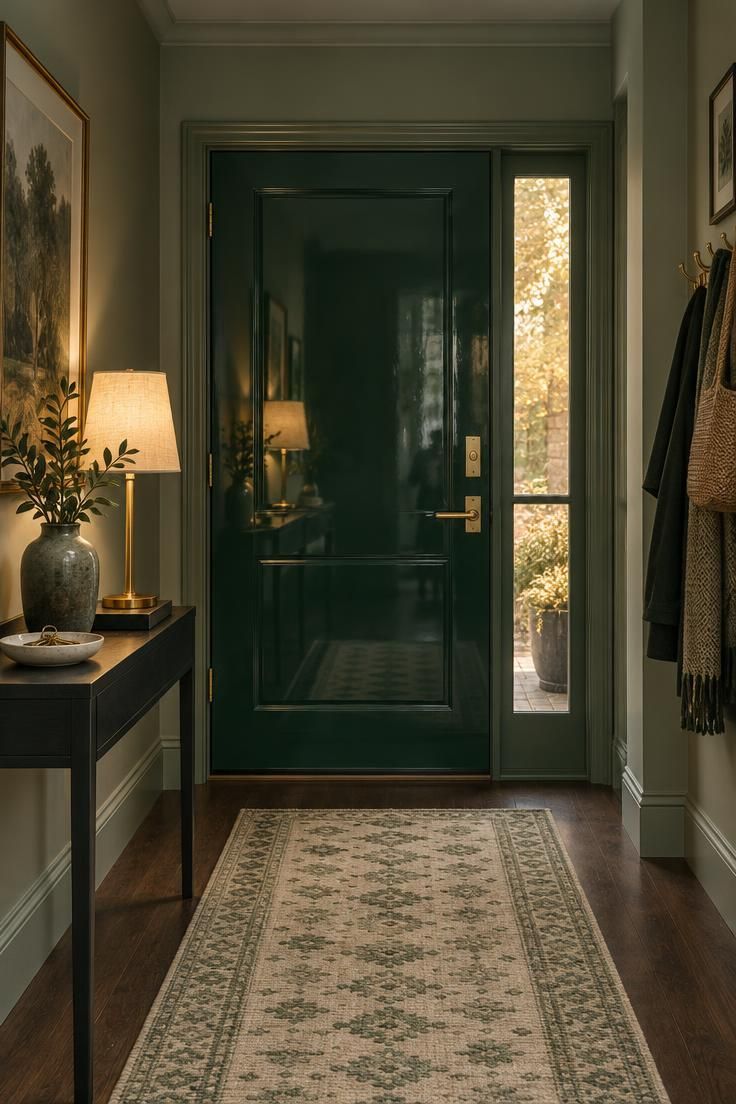
Painting the interior face of the front door in high-gloss emerald while the walls stay muted sage layers two greens from the same family at different depths.
The gloss reflects a small amount of the hall’s light and marks the door as a threshold, which is useful in a dark green hallway that otherwise has few bright moments.
Brass hardware warms the emerald, and a matte black console keeps the composition from tipping toward shiny everywhere.
Gloss highlights fingerprints, smudges, and any imperfection in the surface beneath, so a daily door will need regular wiping and careful prep.
A satin finish in the same emerald gives a similar color impact with less upkeep, and it can be a better fit on a door that gets handled constantly.
Style Blueprint:
- High-gloss or satin emerald green for the door’s interior face
- Muted sage paint on the surrounding walls
- Brass lever hardware and a brass deadbolt plate
- A small console in matte black or dark bronze
Design Pro-Tip: When two greens sit close together, hold the door sample against the wall paint in the actual hallway light and step back a few paces; if the two tones merge at that distance, deepen one of them.
Moss Green Built-In Bench and Coat Hooks Along a Short Hallway Wall
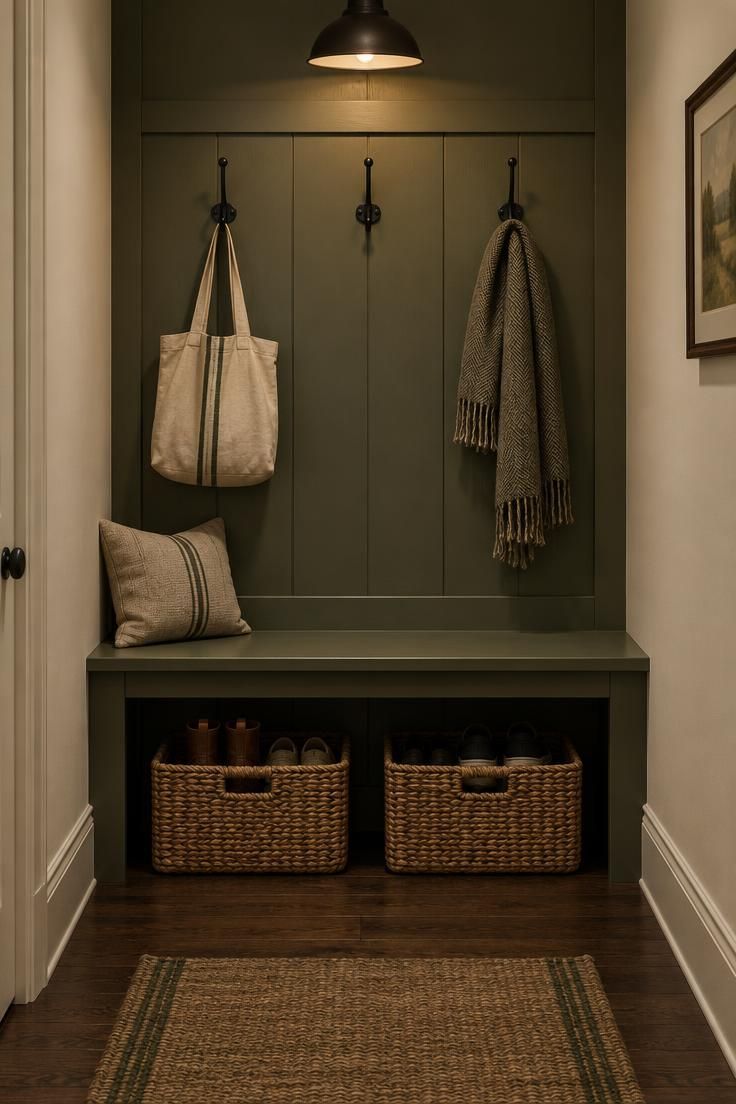
A short wall of built-in bench and hooks creates a landing zone without pushing furniture into the walking path.
Because the bench and hooks sit flush or nearly flush, a narrow corridor stays passable even with bags and shoes in use.
Moss green pairs well with dark wood floors and cream walls, and the earthy tone keeps the built-in from looking like a piece of office furniture.
Two woven baskets under the bench corral shoes and keep the floor clear, which matters more in a hall than in a mudroom.
This is a higher-commitment addition than paint or wallpaper, and it takes planning to match the bench depth to the hall’s proportions.
Style Blueprint:
- Moss green paint in a satin finish for the bench and surround
- Three black metal hooks in a single row
- Two woven baskets sized to slide under the bench
- Cream walls on either side of the built-in
- A dark stained wood floor to anchor the green
Green Tile Border on a Neutral Hallway Floor With a Matching Green Door
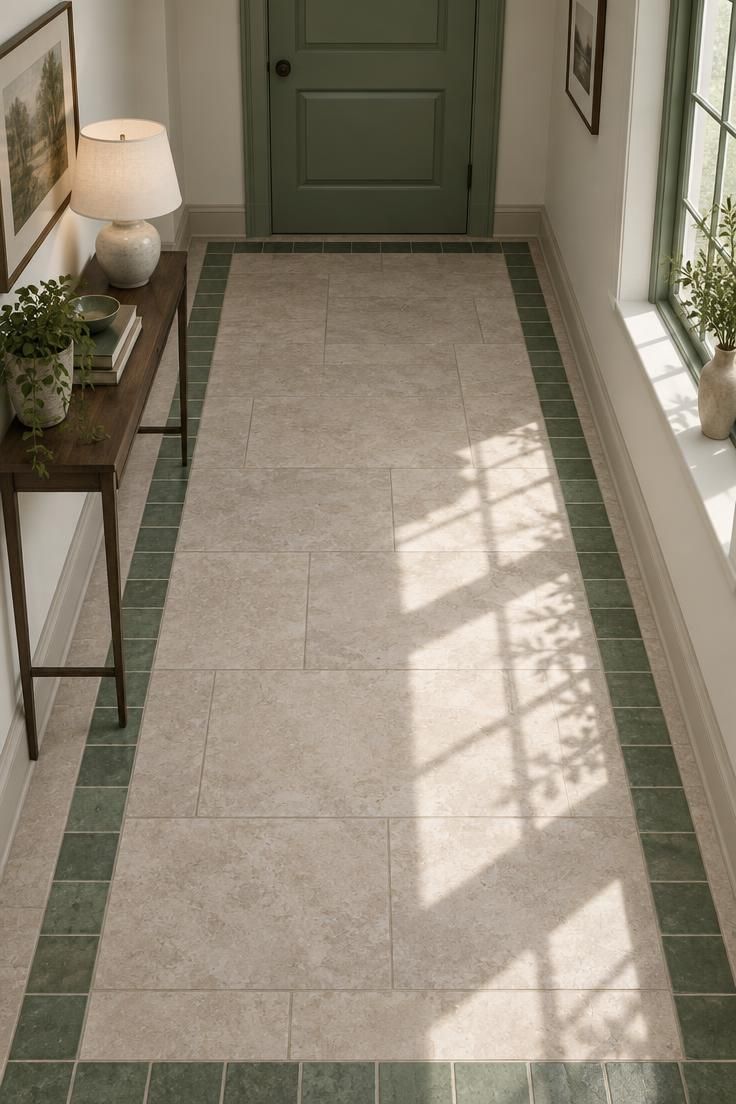
A narrow green tile border around a neutral floor defines the corridor’s edge, but pairing it with a green wainscoting hallway can make the entry feel more layered and connected.
Painting the far door in a matching green links the foot-level accent to the wall, so the two greens read as one decision.
Matte or satin tile with some tonal variation hides scratches and everyday dirt better than a high-gloss uniform tile.
Grout reads as drawn lines between the border and the field, so a mid-tone grout blends more quietly than stark white.
Measure the border width against the total floor width before ordering: too wide and the border eats the field, too narrow and it disappears under furniture.
Style Blueprint:
- A neutral stone or ceramic field tile
- A narrow green ceramic border tile in matte or satin
- Mid-tone grout that blends with both tiles
- A door painted to match the border green
Vertically Striped Green Wallpaper That Reads as a Taller Hallway
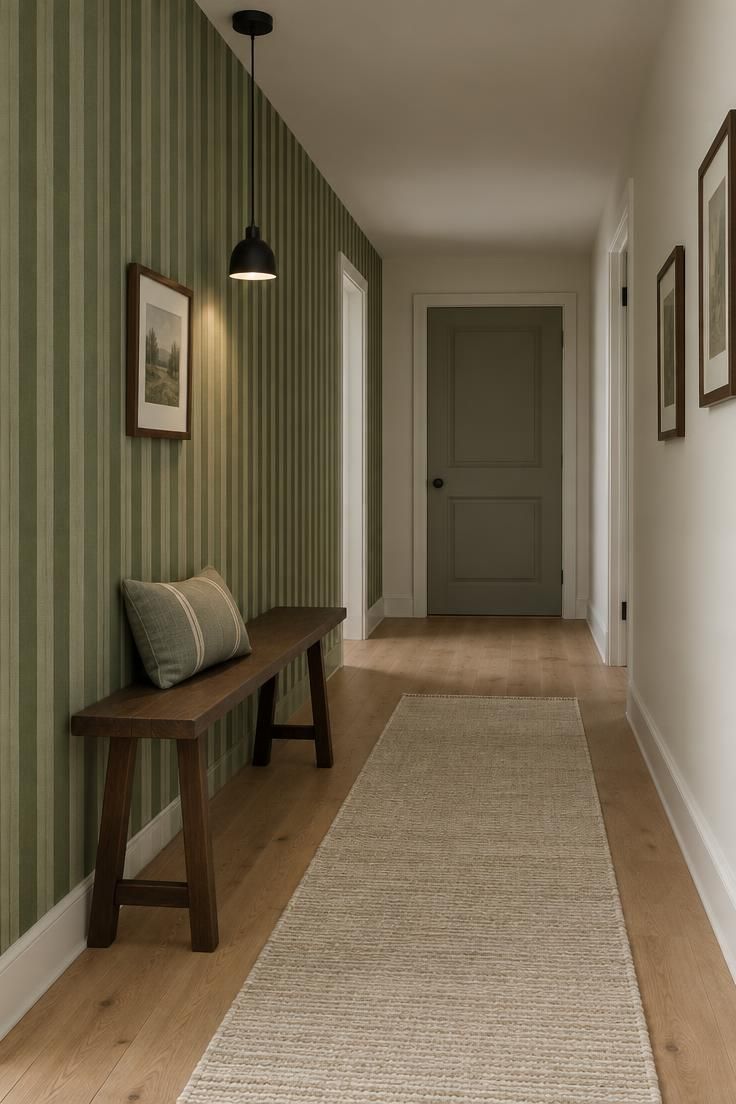
Sage and deeper moss stripes in a soft, narrow repeat draw the eye up and down the wall, which can make a low-ceilinged corridor feel taller without changing the structure.
Keeping the stripes narrow but not hairline avoids the dizzying effect that tight, high-contrast stripes can produce in a tight passage, while the two related greens give contrast without the harshness of green against white.
The papered wall reads best when it is relatively unbroken, since doors, vents, and return corners cut the vertical line and break the effect.
A slim dark bench, a short-drop black pendant, and a flatweave runner keep the lower half of the hall calm so the wall does the talking.
Style Blueprint:
- Vertically striped wallpaper in sage and deeper moss
- Pale warm white paint on the remaining walls
- A slim bench in dark wood with one cushion
- A small black pendant light on a short drop
- A flatweave runner in cream or oatmeal
Floor-to-Ceiling Moss Green Velvet Curtain Dividing a Hallway From a Stair Landing
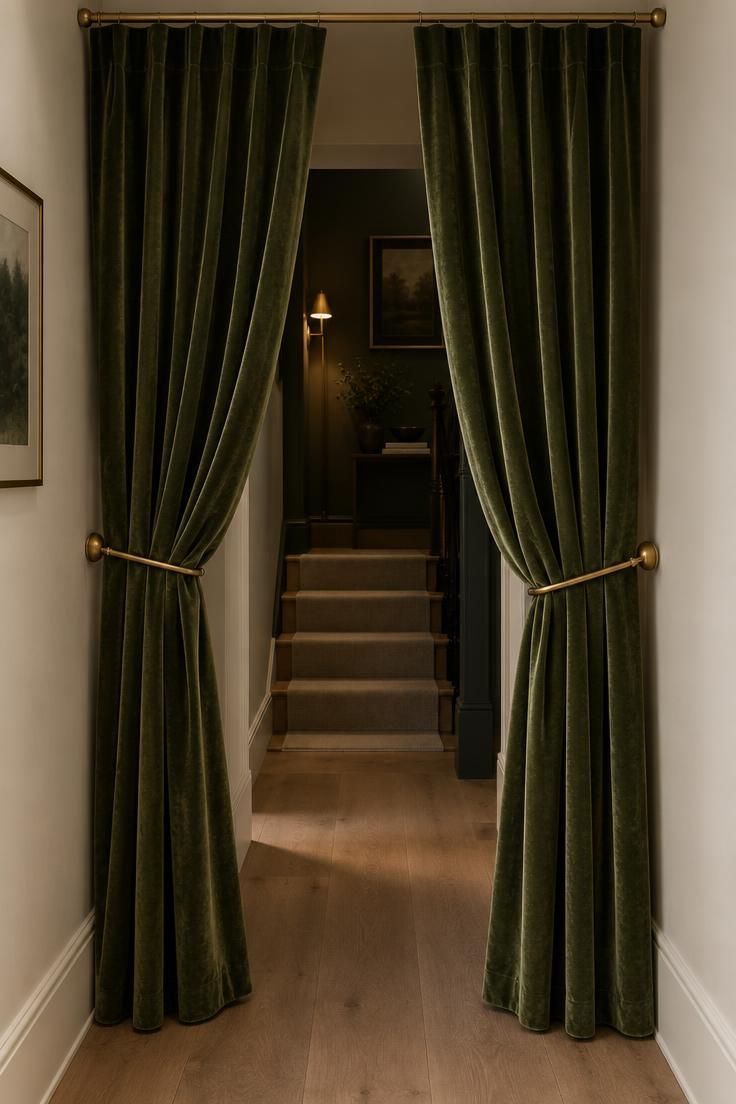
A pair of floor-to-ceiling moss green velvet curtains at the point where a hall meets a stair landing creates a soft partition that can be drawn fully open or closed.
The velvet adds a textural green without committing to paint or wallpaper on the walls, which makes it useful in spaces where the walls are fixed.
A slim brass ceiling rail and a pair of holdbacks let the curtains sit to one side when the opening needs to stay clear.
Velvet collects dust in a busy corridor and needs occasional steaming so the drape stays soft instead of stiffening.
This is the least permanent of the larger green moves, and it can be removed or swapped without touching the walls.
Style Blueprint:
- Moss green velvet panels with a cotton or linen lining
- A slim brass ceiling-mounted rail
- A pair of brass holdbacks
- A curtain length that reaches the floor or just grazes it
- Warm white walls to let the velvet carry the color
Design Pro-Tip: Hang velvet panels slightly wider than the opening they cover so they gather into full folds when closed, and test the draw movement a few times before trimming the length.
Conclusion
A green hallway can be as small as a runner or as committed as full wainscoting and a painted ceiling.
The most useful first step is to test a paint chip, wallpaper sample, or fabric swatch in the corridor’s actual light, since hall light is often the least flattering in the home.
From there, the choice comes down to whether you want one saturated accent or a quieter all-over green that lets the adjacent rooms carry their own color.