This post may contain affiliate links. If you make a purchase through these links, we may earn a commission at no additional cost to you.
A long, wide, double-height, or L-shaped hallway tends to read as leftover square footage rather than a deliberate room.
The tension is real: the walking route must stay clear, yet the space is generous enough to absorb a second function when the arrangement is composed rather than filled.
Across the ideas below, the same visual logic keeps returning: anchor the long run, give it a repeated rhythm, and let the far end do real work.
Run a Single Long Console as the Spine of the Hall
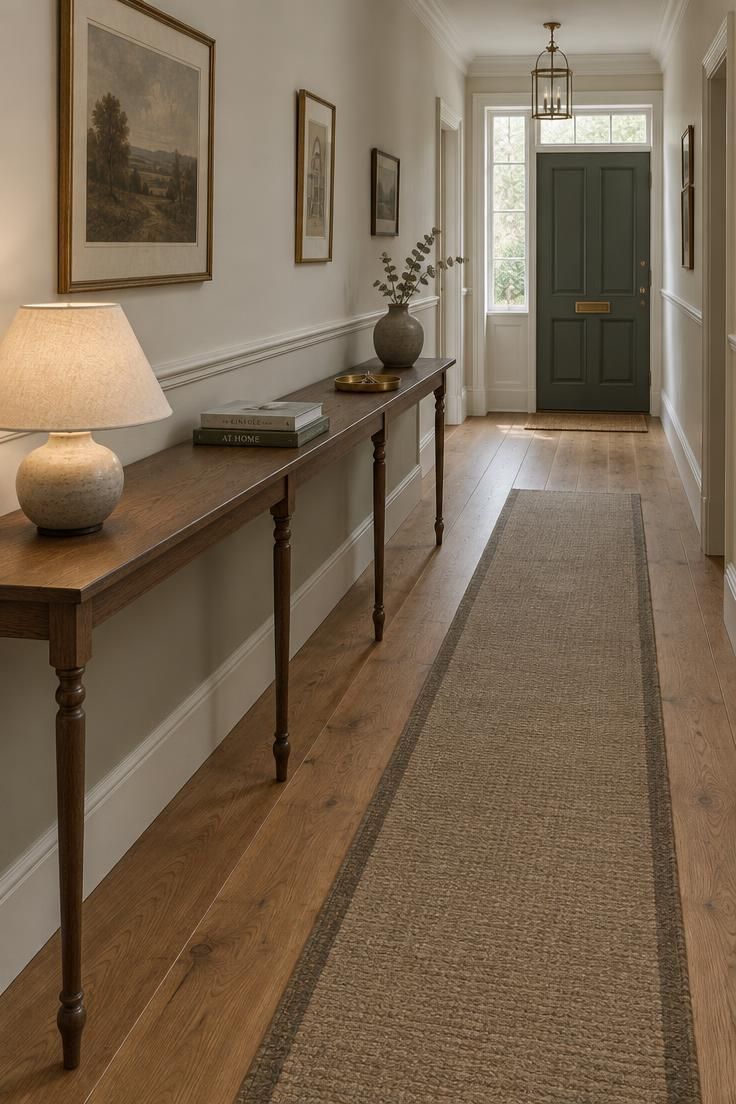
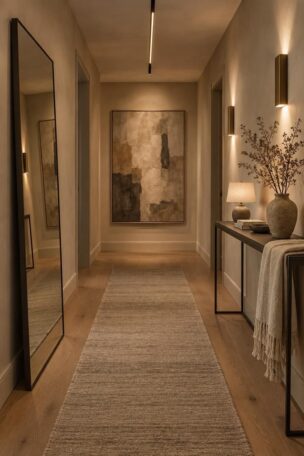
One long hallway console running most of the wall reads as a spine for the whole space, anchoring the run in a way that suits large hallway ideas.
A cluster of short accent tables tends to look apologetic in a hall this size, each one competing for attention without ever holding the line.
The back of the console matters more here than it would in a corner: because the piece is seen in the round while walking past, a finished or painted rear face keeps it looking resolved from both directions.
Cost and commitment are the honest tradeoffs: a longer console can cost more and fixes the wall into one arrangement, while two shorter pieces allow rearrangement at the price of a broken visual line.
Open legs, with the floor visible beneath, keep the long wall from feeling walled in the way a closed cabinet would.
Style Blueprint:
- One wood tone shared across the console top and legs
- A repeated object rhythm, lamp then books then bowl, rather than one dense cluster
- A finished or painted rear face on the console
- A visible border of hard flooring on both sides of any runner
Design Pro-Tip: Pull one object forward on a long console, a single book or a low dish, so the run has a near element as well as a far one.
Plant a Wide Low Bench Where the Entry Needs Somewhere to Land
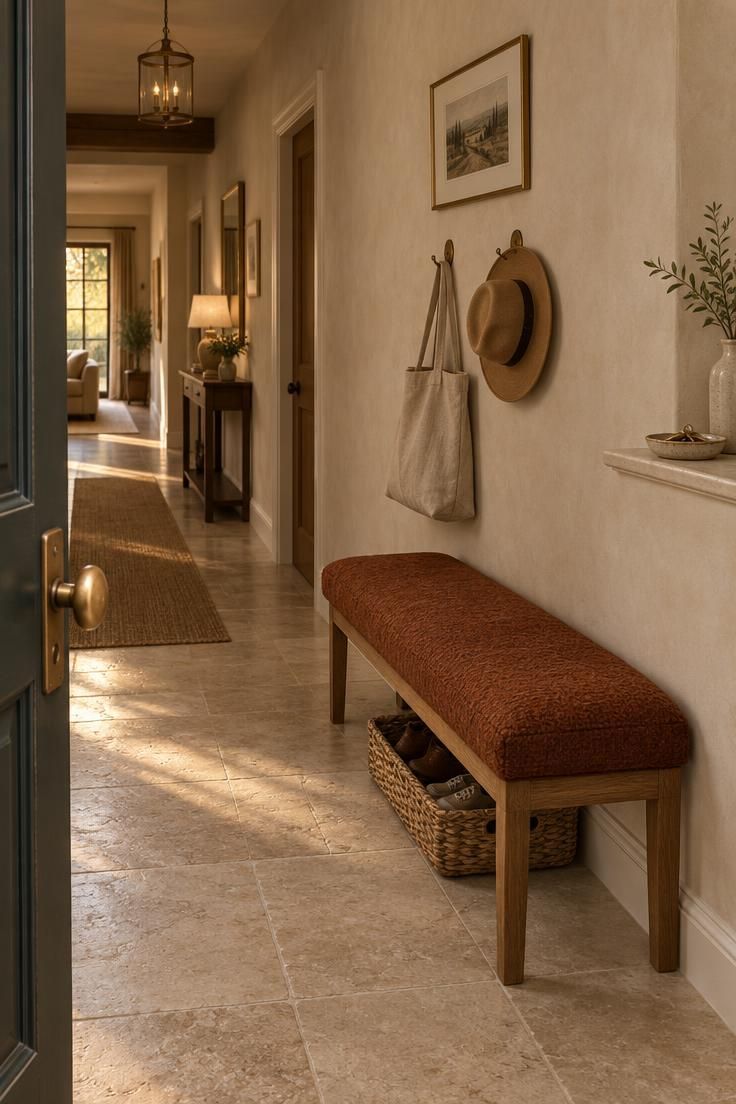
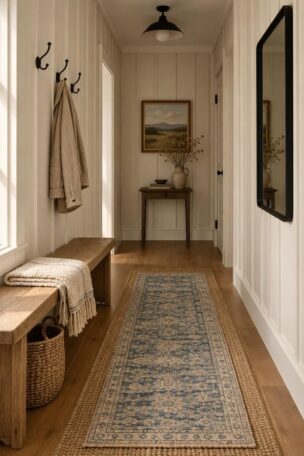
A bench at the entry works as a pause point, a place to sit while pulling on shoes, rather than as a storage wall.
That distinction decides the design: a bench with a slim footprint and visible legs reads as furniture, while a solid boxed bench packed with bins reads as cabinetry and eats the floor.
Wide entrance hall seating earns its keep by leaving a visible strip of floor in front, so the route through never feels pinched.
The entry end usually deserves the most attention because it is the first thing a guest sees, which makes this the natural place to spend the strongest color in the room.
Style Blueprint:
- A bench depth chosen so the walking line stays visibly clear
- A cushion textile carrying the room’s strongest color
- A low tray or basket tucked beneath for shoes
Create a Landing Reading Nook at the Top of the Stair
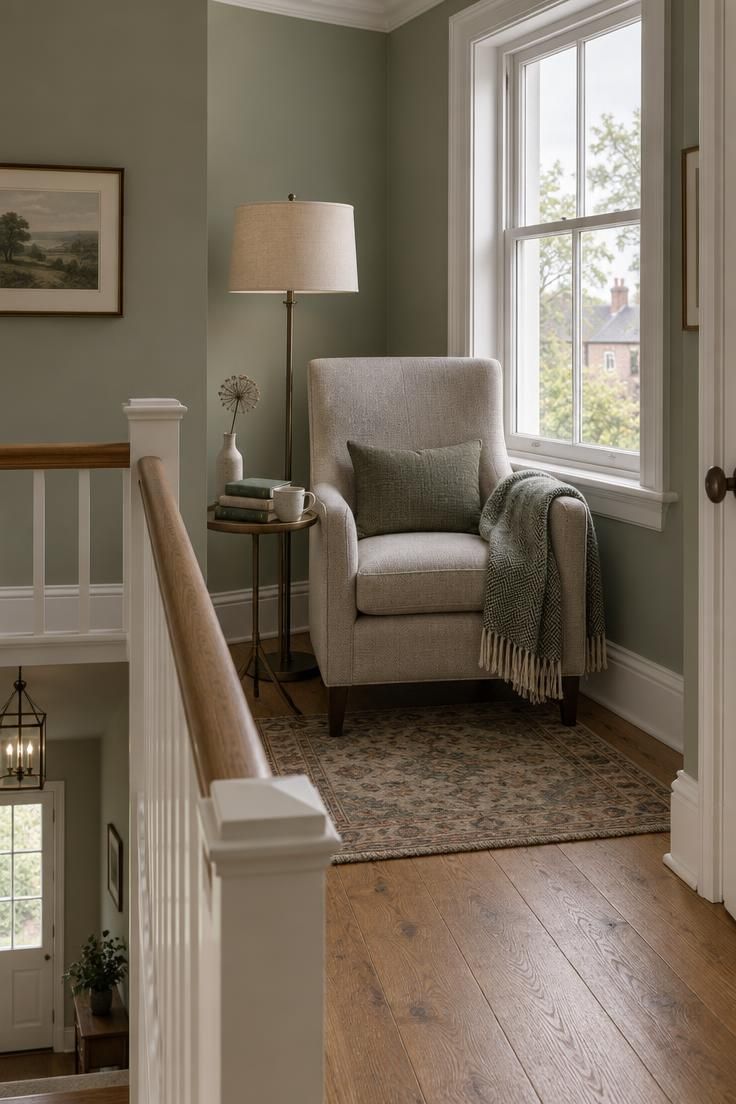
A landing already contains a natural pause point, which is why a chair placed here reads as deliberate rather than stranded.
A landing reading nook suits a household that enjoys the slower walk to the far bedrooms; in a home where everyone crosses the landing at speed, the same chair becomes an obstacle to negotiate.
Depth is the deciding factor: the arrangement works where the landing is wider than the stair run, not at the top of the treads where it would crowd the first step.
A defined chair silhouette holds the corner better than a shapeless armchair, and a shallow side table keeps circulation intact.
Style Blueprint:
- A chair with a defined silhouette rather than a shapeless armchair
- A side table shallow enough to leave circulation past it
- A lamp sized to the chair’s back height
- One textile, a throw or cushion, to soften the hard landing surfaces
- A small rug or mat to mark the nook’s edge
Pace the Long Wall With a Gallery Hang Instead of One Big Piece
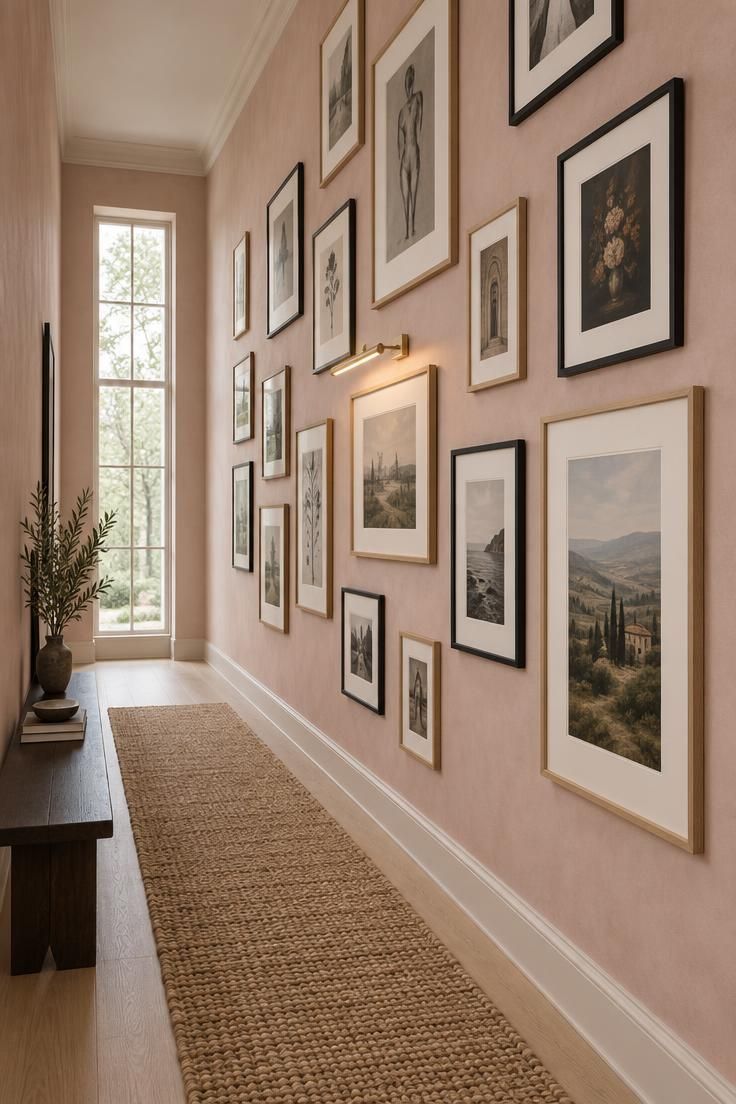
Judging the hang as one sequence, rather than as individual pictures admired one at a time, is what makes gallery wall art work along a long run.
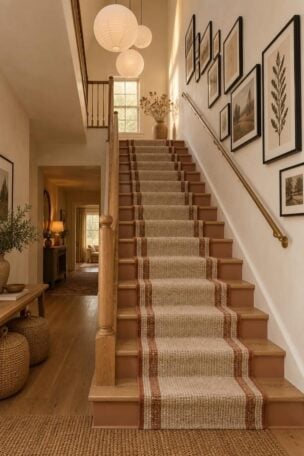
A tall hall rewards stacked or full-height hangs because a single mid-band row leaves most of the wall unused and the room feeling short.
Repeated mat widths and a consistent frame family hold the sequence together even when the image sizes change.
The maintenance reality is worth weighing: art hung high in a tall hall is difficult to reach and change, which favors frames chosen for the long term over a rotating display.
Style Blueprint:
- A consistent frame material or finish
- Mat widths that repeat even when image sizes change
- Hang heights that hold one horizontal line or one deliberate stagger
- A wall color that lets the frames do the work
Use a Long Runner to Give the Eye a Path
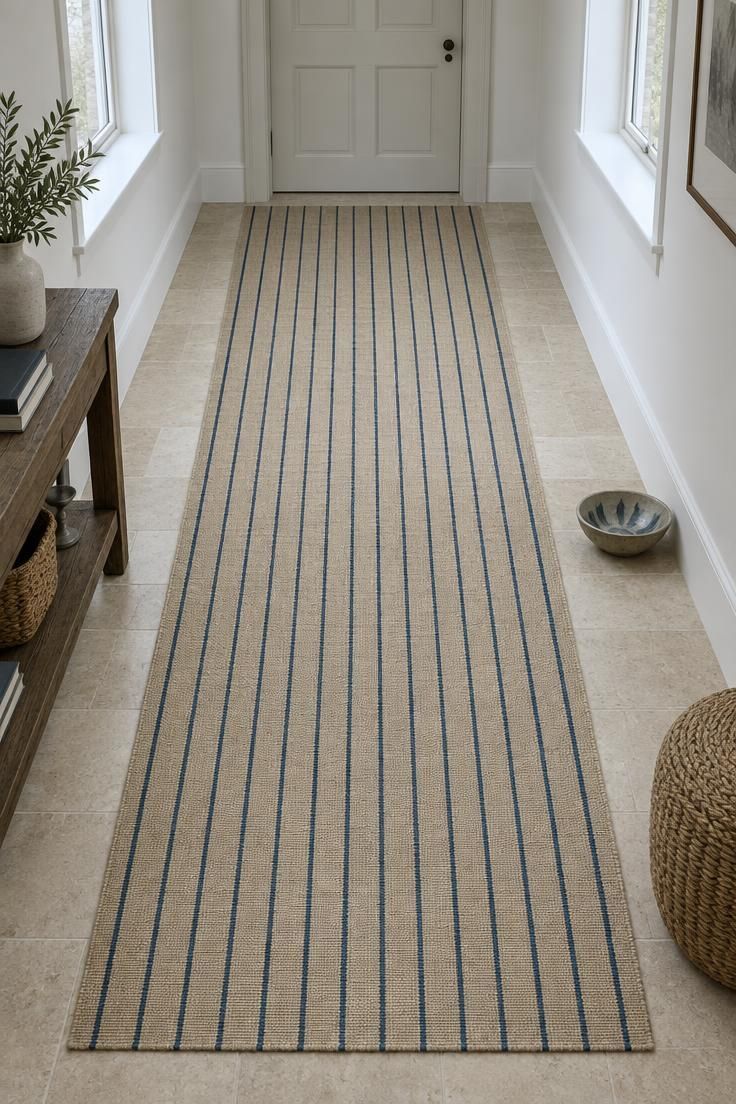
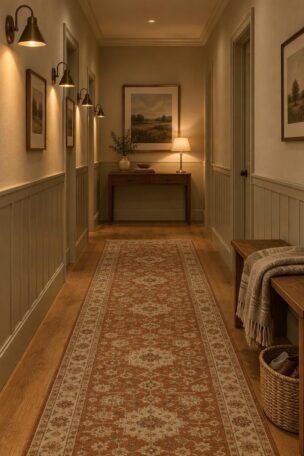
A hallway runner gives the eye a path to follow, which is a different job from simply softening the floor.
Three options suit a generous run: one continuous runner along the full length, two matching runners with a deliberate gap at a turn or doorway, or a rug at one end only to define an entry zone.
Leaving a visible border of hard floor on both sides reads more considered than a runner that nearly touches the walls, and it also makes the runner easier to straighten.
Runners shift on hard floors over time, and a runner that stops short of a door leaf tends to get kicked loose.
Style Blueprint:
- Runner width that leaves visible floor on both sides
- A pattern scale that reads at a distance rather than up close
- A pile or weave height suited to the household’s traffic
Design Pro-Tip: When choosing between a runner and bare floor, pick the option that leaves the walking line itself the clearest thing in the room.
Turn the Far End Into a Destination Rather Than a Dead End
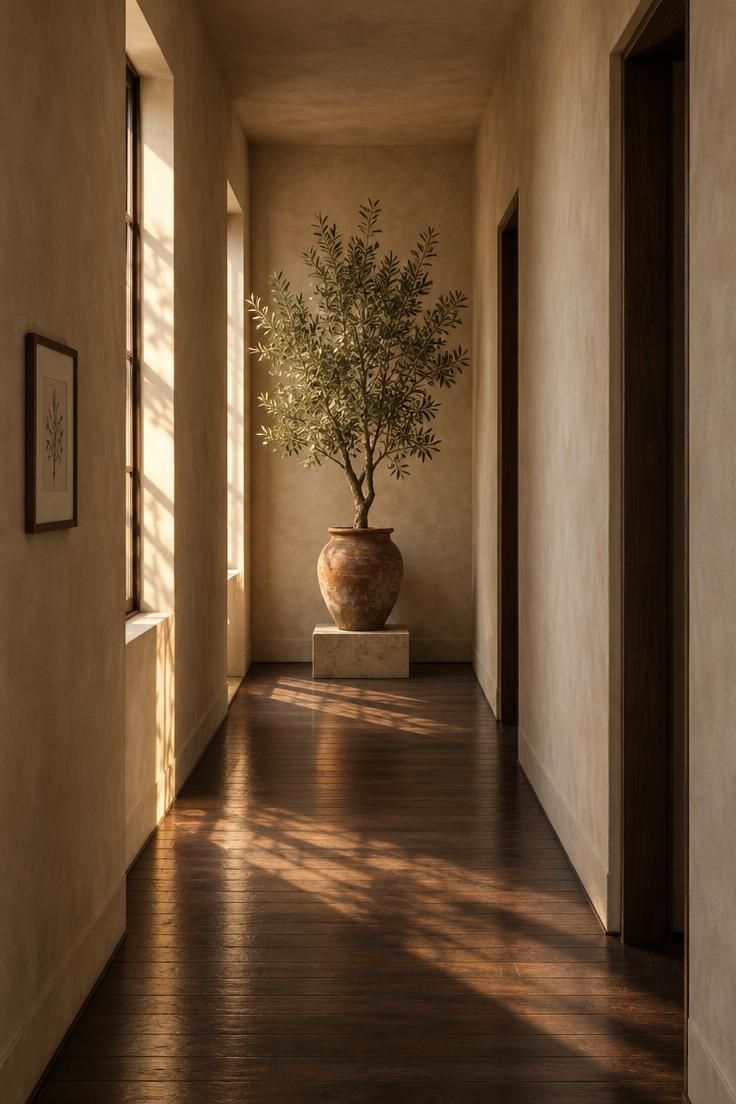
Without something at the far end, the eye shoots down the run and stops at the last door, which is the conveyor-belt problem in its plainest form.
A single tall plant, one oversized canvas, a colored door, or a mirror placed at a turn all give the terminus a job, and each has a different permanence.
The tradeoff is honest: a strong terminus is difficult to remove later without leaving the end wall looking blank, so choosing something changeable keeps the option open.
Storage does not belong at the terminus, because boxes stacked at the end of a run turn the focal point into a shed.
Style Blueprint:
- One focal object rather than a group
- A scale sized to the distance it will be read from
- A surface behind it that does not compete
Build Rhythm With Repeats Down One Wall
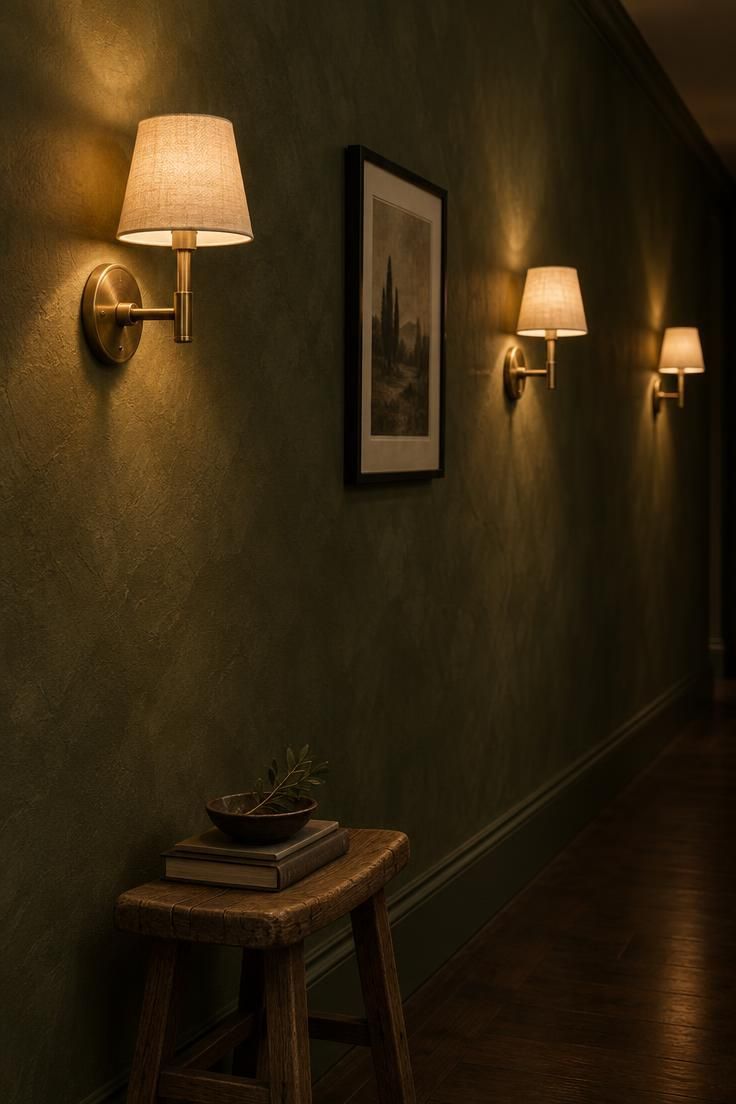
Repetition succeeds on a long uninterrupted wall where variety tends to fail, because the eye can measure the interval and settle into it.
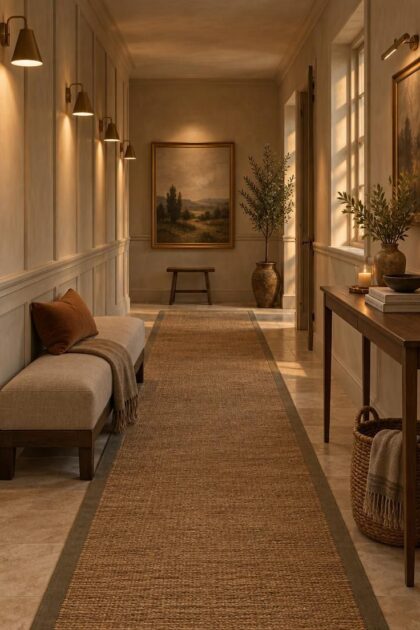
A row of matching wall lights or matching framed pieces gives the walk intermediate events, so the distance between the entry and the far door stops feeling like one long stretch.
Shallow repeats are the practical choice: anything projecting into the walking route gets brushed past daily, and a deep sconce or heavy shelf will show the wear.
Height matters as much as spacing, and a row set at eye level reads differently from one set high on the wall.
Style Blueprint:
- One repeated fixture or frame rather than a mix
- Even spacing that holds at both ends of the run
- A height that sits at eye level rather than high on the wall
- A warm light source rather than a bright one
Split the Run Into Two or Three Zones
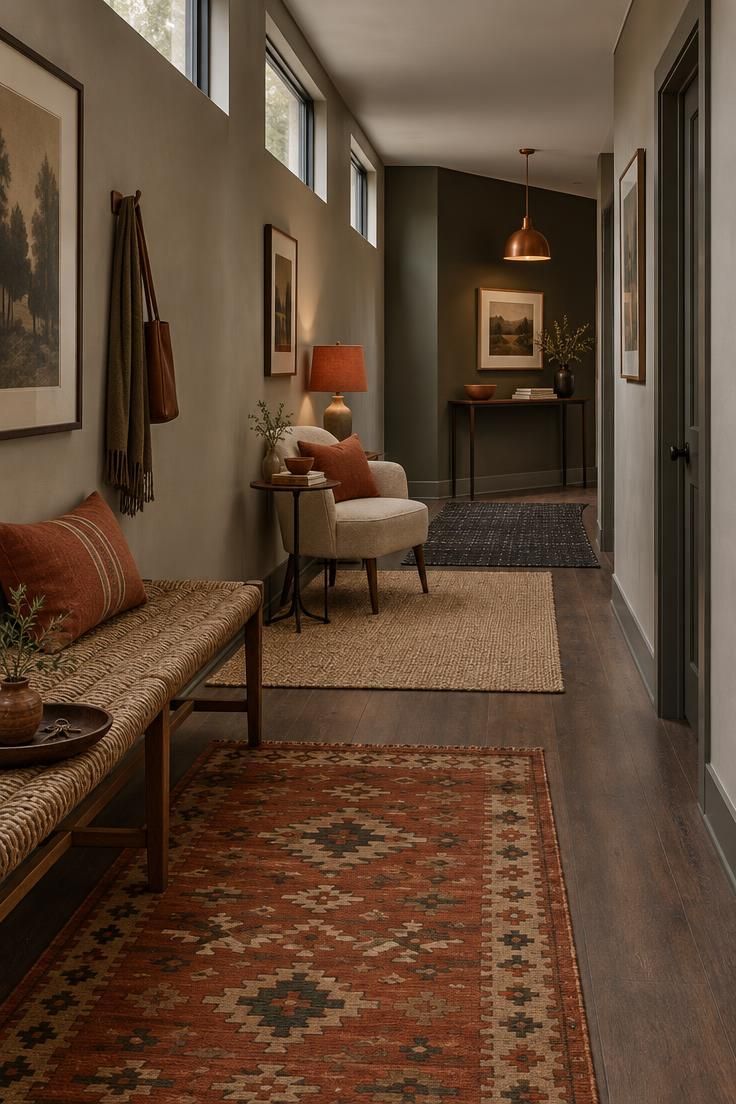
Zone logic, entry then pause then turn, gives a long hall a sequence instead of a single note held from one end to the other.
Hall lighting often runs on one switch for the whole distance, and that flattens any zoning unless lamps or separate circuits are added.
A rug that changes slightly at each zone does more for the sense of transition than moving furniture around.
Zoning slows the walk, which suits a family hall and frustrates a daily sprint to the back door.
Style Blueprint:
- A floor treatment or rug that differs slightly at each zone
- Furniture scale that steps down toward the through-route
- A repeated color or material that ties the zones together
- Lighting that can be switched separately where the run allows
- A deliberate pause at each transition point
Design Pro-Tip: Give each zone one different element, a rug, a lamp, or a chair, and keep everything else repeated so the hall still reads as one space.
Stack the L-Shaped Turn With a Corner Change
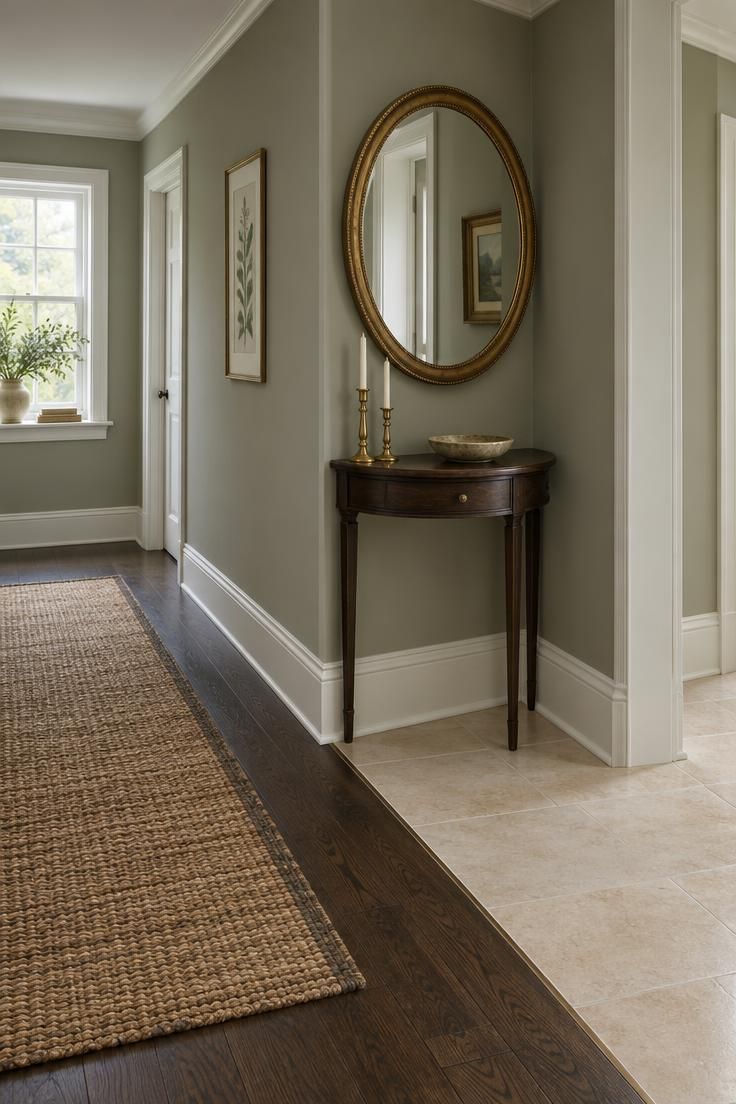
An L-shape is easier to compose than a straight run because the turn gives the eye a natural resting place before the next leg.
Treating the corner as a display moment, with a niche, a console, or a mirror, keeps it from becoming the spot where overflow furniture collects.
A runner that stops deliberately at the turn acknowledges the change of direction, while one that continues through it can look like an afterthought.
Putting a piece of furniture into the turn narrows the walk, which may be fine in a wide hall and awkward in a long single-width one.
Style Blueprint:
- One element positioned to catch the eye before the turn
- A treatment that acknowledges the corner rather than running past it
- A floor or rug that continues or deliberately stops at the turn
- Light at the corner so the pivot reads
Let the Floor Carry the Pattern
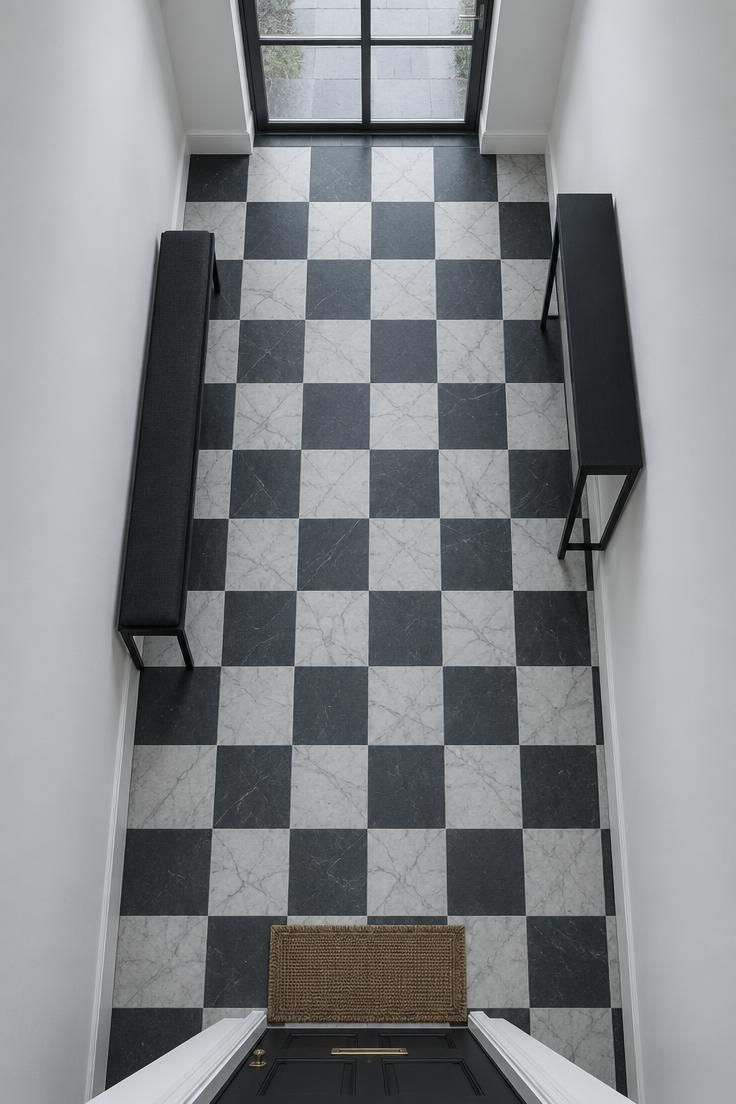
A large hall can carry a floor pattern that a small hall cannot, simply because the repeat has room to register as a pattern rather than a busy surface.
The idea demands discipline: walls, ceiling, and furniture have to step back so the floor is the only element doing graphic work.
Choosing between a runner that matches the floor’s logic and one that clearly departs from it is a real decision, and the second option usually reads as a deliberate accent.
A floor pattern is the hardest element in the hall to change later, which argues for something the household will still want in a decade.
Style Blueprint:
- One strong floor pattern rather than two competing ones
- Wall and ceiling finishes that step back
- A runner or mat that either matches the floor’s logic or clearly departs from it
Go Tall With Paneling or Stacked Art
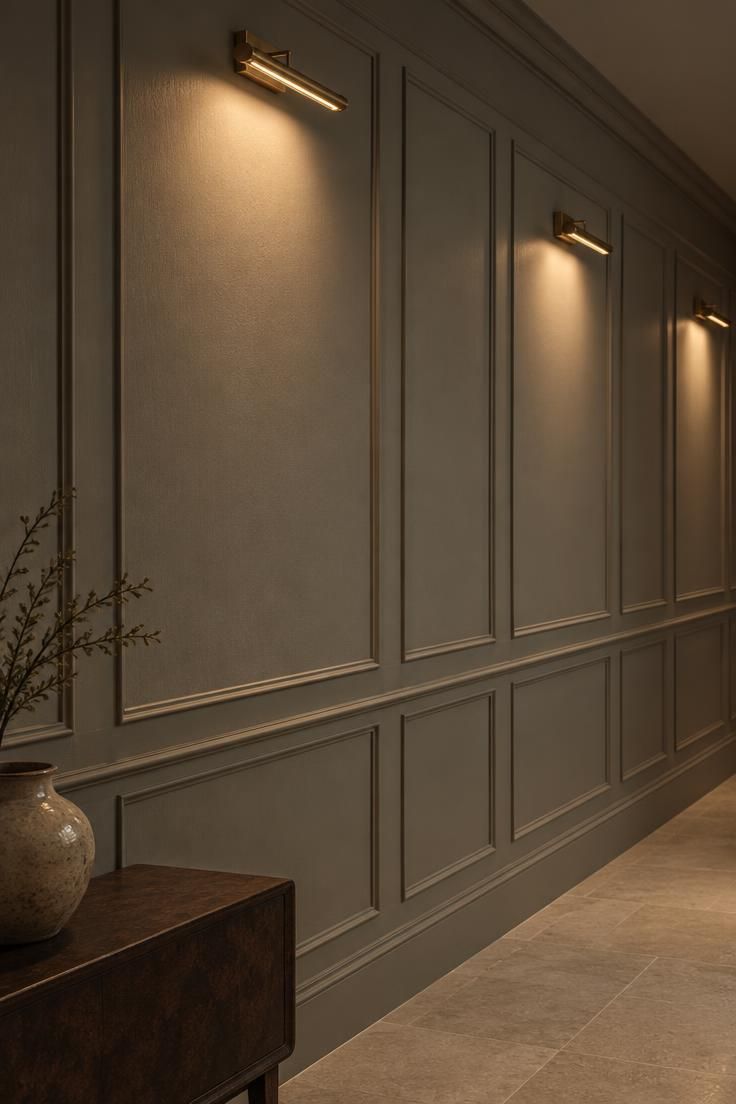
A tall or double-height hall offers vertical space that a mid-band hang leaves unused, which is the opportunity paneling and stacked art both address.
Paneling breaks a long wall into legible units instead of one endless plane, and the repeat gives the eye something to count as it moves.
Access is the honest limitation: anything hung high in a tall hall is difficult to reach and change, so permanence suits this approach better than rotation.
A base or dado element anchors the tall treatment so the wall does not appear to float above the floor.
Style Blueprint:
- A panel or frame proportion that repeats along the wall
- A finish that holds up when seen up close in passing
- Lighting that grazes the surface rather than flattening it
- A decision about where the treatment stops vertically
- A base or dado element that anchors the tall treatment
Give the Ceiling Something to Do
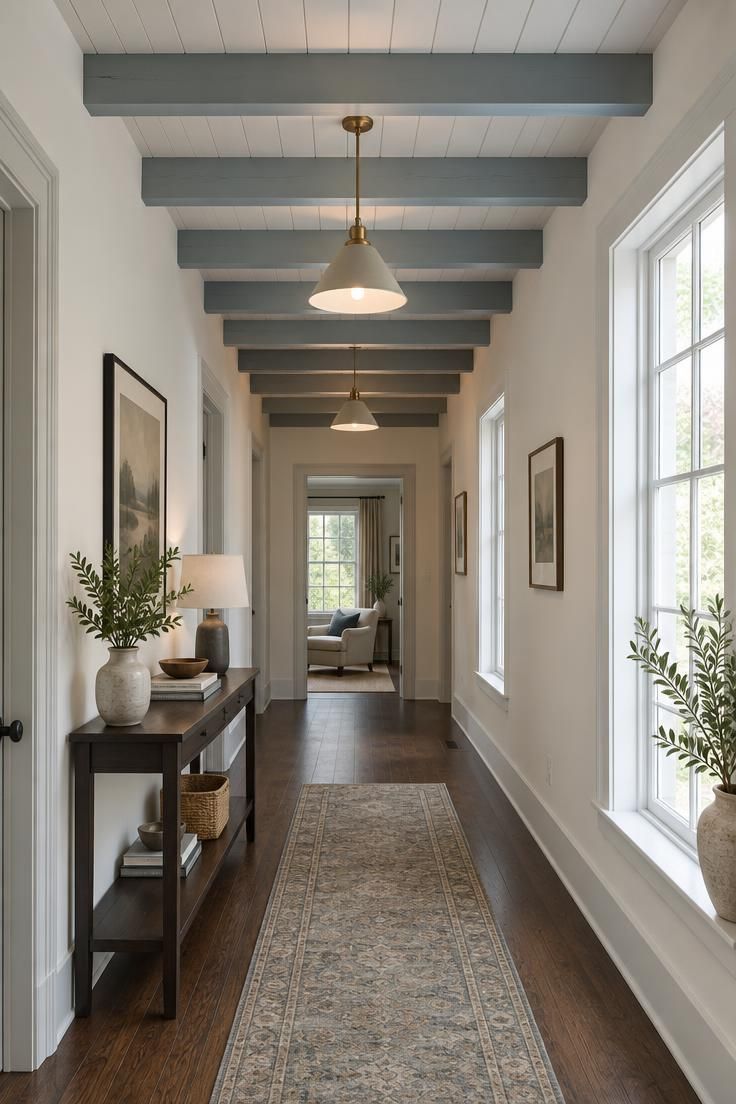
A plain ceiling in the same tone as the floor leaves a long wall with no relief overhead and lets the run feel like a tube.
Ceiling detail gives the long axis a second surface to hold attention, and beams, paneling, or a deeper ceiling tone all follow the length rather than cutting across it.
Reversal is the cost: a ceiling treatment is difficult to undo and interacts with any future lighting changes, so the decision carries weight.
Lighting placement determines whether the treatment reads at all, since a fixture sitting flat against the ceiling flattens the very detail it is meant to show.
Style Blueprint:
- A ceiling treatment whose direction follows the long axis
- A color or finish that either continues the wall or deliberately contrasts
- Lighting positioned to graze the treatment rather than sit flat against it
Design Pro-Tip: Walk the hall at night with the ceiling light off and only the low lamps on, then watch whether the ceiling treatment still reads.
Use a Round Table as a Soft Pause in a Wide Spot
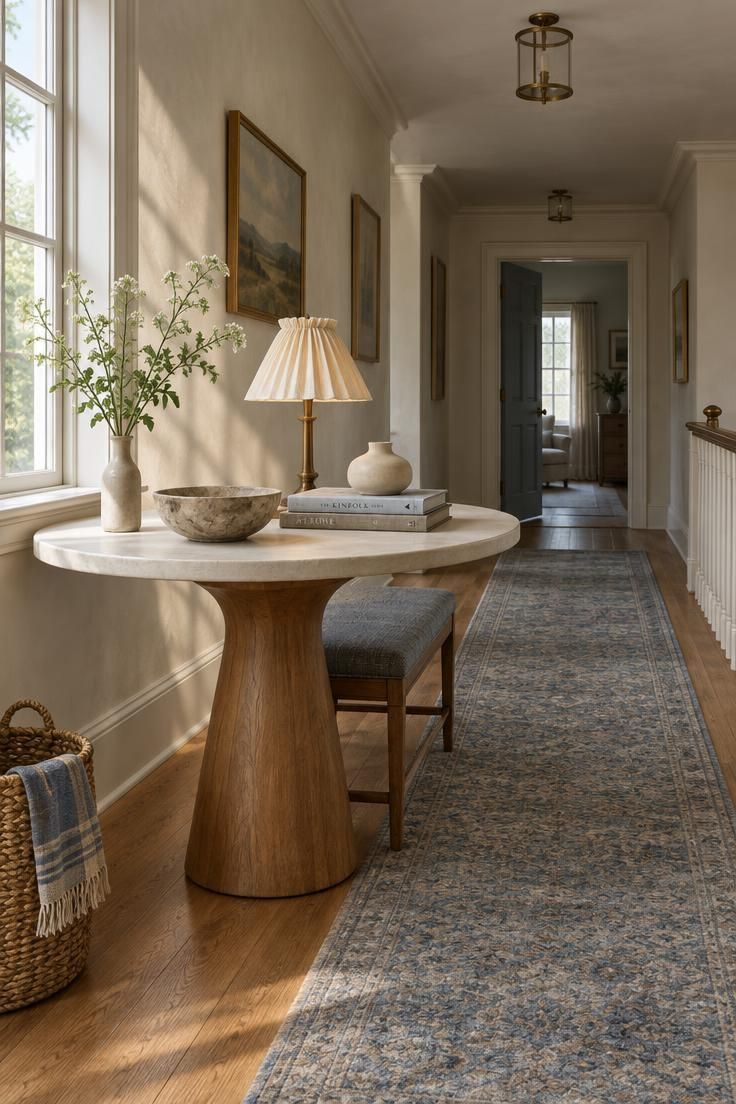
A round table can break the long sightline of a wide hallway without turning the pass-through into a cramped corridor.
Choose a table diameter that leaves comfortable walking room on all sides so the piece feels like furniture rather than a traffic obstacle.
A stone or plaster top reads more grounded than glass, while a simple wood pedestal base adds a furniture moment that does not compete with doorways.
Place the table slightly off-center so the dominant walking route stays open and the table becomes a deliberate pause point.
Top it with a low bowl, a stack of two large books, and a single sculptural object that looks intentional from several angles.
If the hallway has a window nearby, position a small table lamp against the wall edge to create a soft stopping point after dark.
A table that aligns too closely with those functional details can make the hall feel less considered, even when the styling itself works.
Style Blueprint:
- Round table with a stone, plaster, or matte wood top
- Low bowl or catchall near the center
- Stack of one or two large-format books with a small object on top
- Table lamp with a fabric or paper shade if an outlet is nearby
- A narrow bench or pair of stools tucked under the edge for extra landing space
Design Pro-Tip: Check the table height against nearby door hardware and light switches before committing to the piece.
Conclusion
A large hall is not a corridor with extra square footage; it is a room that happens to be walked through.
The strongest arrangements share three things: a clear walking line, a repeated element that gives the run rhythm, and something at the far end for the eye to land on.
Pick one direction, decide which end of the hall deserves the attention, and let the rest of the run stay quiet enough to support it.