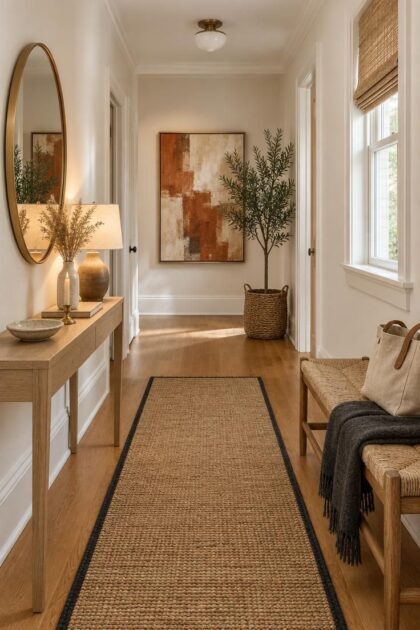
This post may contain affiliate links. If you make a purchase through these links, we may earn a commission at no additional cost to you.
A hallway is a passage with a job: move people through, set the tone for what comes next, and hold up to daily traffic.
White suits that job because pale surfaces bounce available light and stay out of the way of the flooring, doors, and art that give a home its character.
The catch is that an all-white corridor can read as flat or unfinished without something to catch the eye.
The ideas below cover paint, woodwork, flooring, textiles, furniture, and lighting, with notes on what each approach asks of you in return.
Use them as a starting point, then judge each one against the light and proportions of your own space.
White Beadboard Wainscoting Under a Soft Contrast Wall
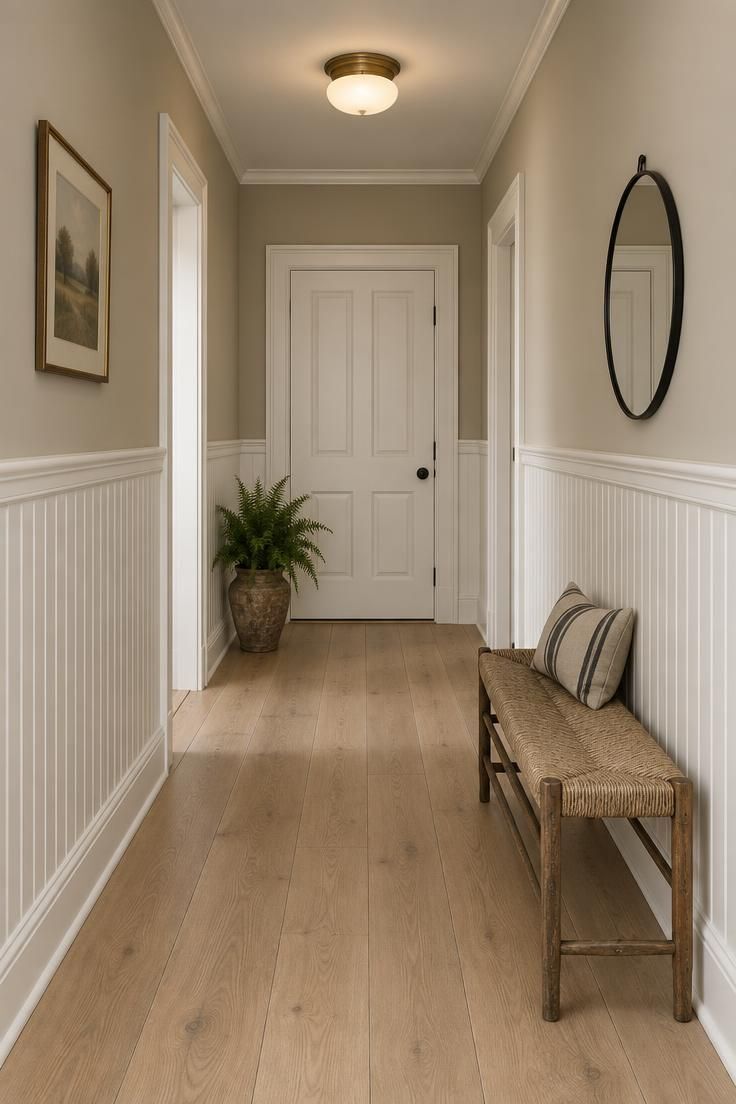
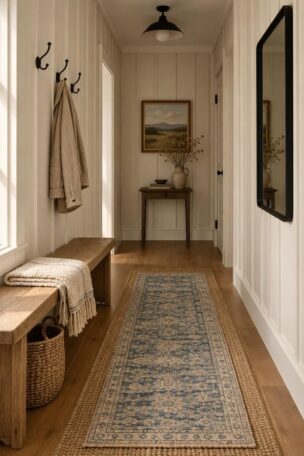
Beadboard wainscoting gives a white hallway its structure without introducing more white-on-white tonal juggling.
The vertical grooves and chair rail break the wall plane at waist height, so the eye reads the space as two deliberate bands rather than one long, undifferentiated corridor, and this hallway wall paneling works as a visual divider even in a compact entry.
Painting the beadboard white and the upper wall a soft greige preserves the hallway's bright, airy feel while giving the architecture a clear horizon line.
The practical benefit is protection.
Beadboard at the lower wall absorbs scuffs from bags, shoes, and hands far better than flat painted drywall, and it wipes clean with less repainting over time.
The chair rail also creates a natural stopping point for art, mirrors, or hooks without marking up the upper wall.
The tradeoff is that beadboard adds visual rhythm.
In a very narrow hallway, deep shadow lines can make the space feel busier than a flat wall.
Choose a narrower bead profile and keep the contrast between the upper wall and white paneling gentle rather than dramatic.
Style Blueprint:
- Crisp white beadboard wainscoting to chair-rail height
- Soft warm greige upper wall paint
- Reclaimed-wood bench with woven seat
- Round mirror with thin black metal frame
- Pale wide-plank oak flooring
Warm Wood Flooring Under a Crisp White Envelope
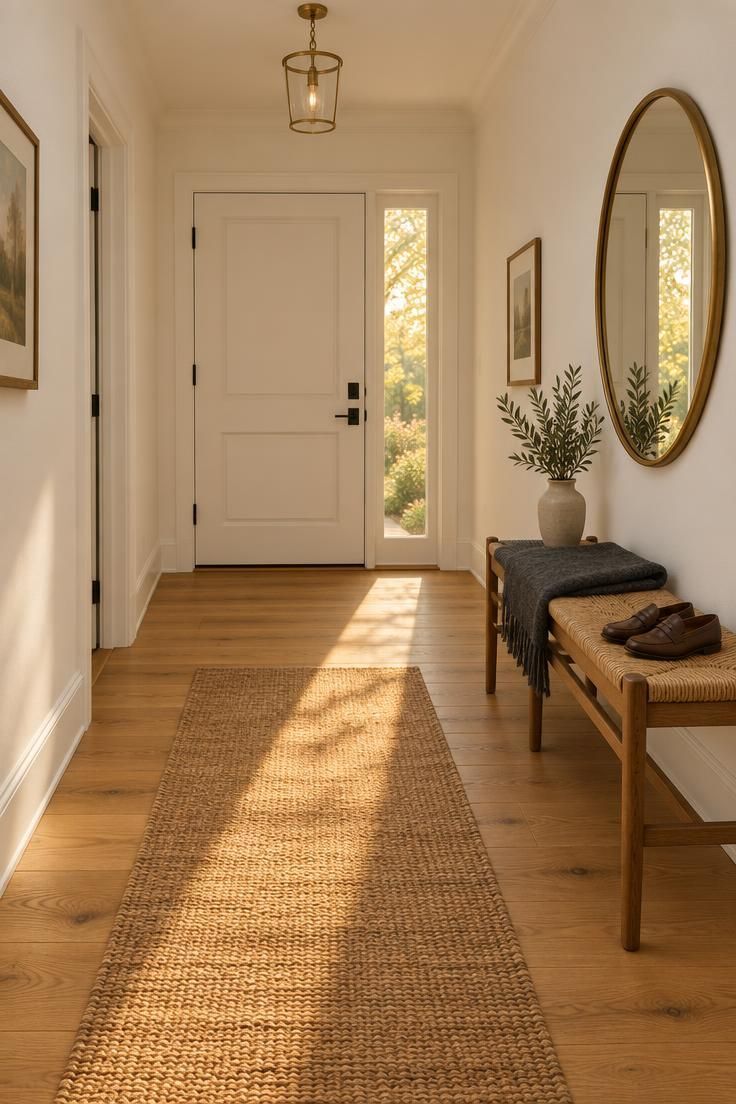
Wood gives a white envelope something to sit on.
A medium-toned oak or walnut floor supplies warmth and a grounding horizontal band that keeps the walls from floating, and boards laid lengthwise draw the eye down the hall in white hallway ideas that feel collected rather than cold.
This approach pairs well with simple, quiet styling because the floor itself carries the visual interest.
Floor tone deserves a second look.
Very light floors under white walls can wash out into one pale blur, while very dark floors tend to advertise every bit of dust and lint between cleanings.
A mid-tone sits in the useful middle, and it also provides a forgiving backdrop for testing hallway paint colors on the walls above without the floor competing for attention.
An open-weave jute runner layered over wood adds texture without hiding the grain.
Choose a runner that leaves a strip of flooring visible on both sides so the wood still reads as the base layer.
Style Blueprint:
- Honey or medium oak plank flooring
- Crisp white wall paint
- Woven rush bench
- Flat-weave jute runner
White Vertical Shiplap Accent Wall With a Recessed Niche Shelf
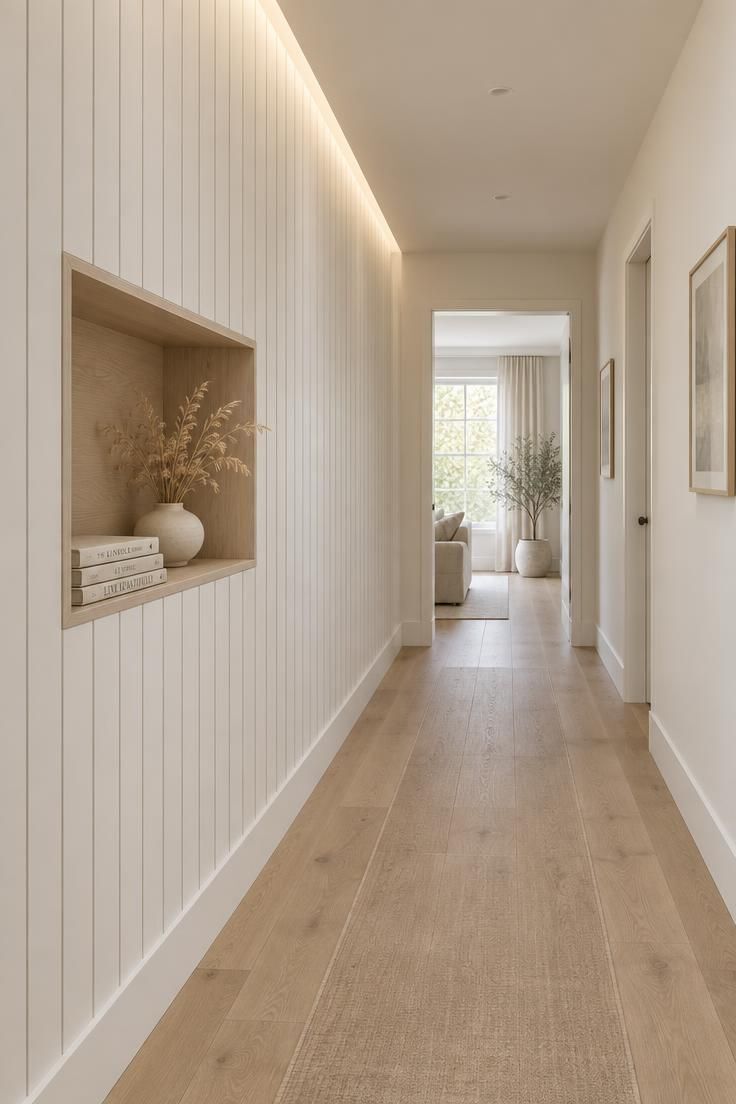
A shiplap accent wall gives a white hallway texture without giving it noise.
Running the planks vertically draws the eye upward and makes a narrow corridor feel taller, while the repeating grooves create a subtle rhythm that keeps a bright space from feeling flat or empty.
The built-in niche is what gives the wall a purpose.
Rather than adding furniture that would crowd a narrow hall, a clean recess introduces display space within the wall itself.
Lining it in pale wood keeps the contrast soft, so the niche reads as part of the wall rather than a heavy frame.
This approach works especially well in hallways with no natural terminus or feature wall, because it gives the eye a place to rest without relying on a door, window, or mirror.
The texture does the work that a dark accent would normally do, but entirely within a tonal palette.
Style Blueprint:
- White vertical shiplap on one long wall
- Warm white paint on remaining walls and ceiling
- Recessed niche with white oak lining
- Linen-bound books and dried botanical accents
Design Pro-Tip:
- Keep the niche depth shallow, about three to four inches, so it never interrupts traffic flow.
- Install a small LED strip inside the niche if the hallway lacks natural side light; it will make the oak glow without adding visible fixtures.
White Plaster Arch Niche With a Sculptural Object
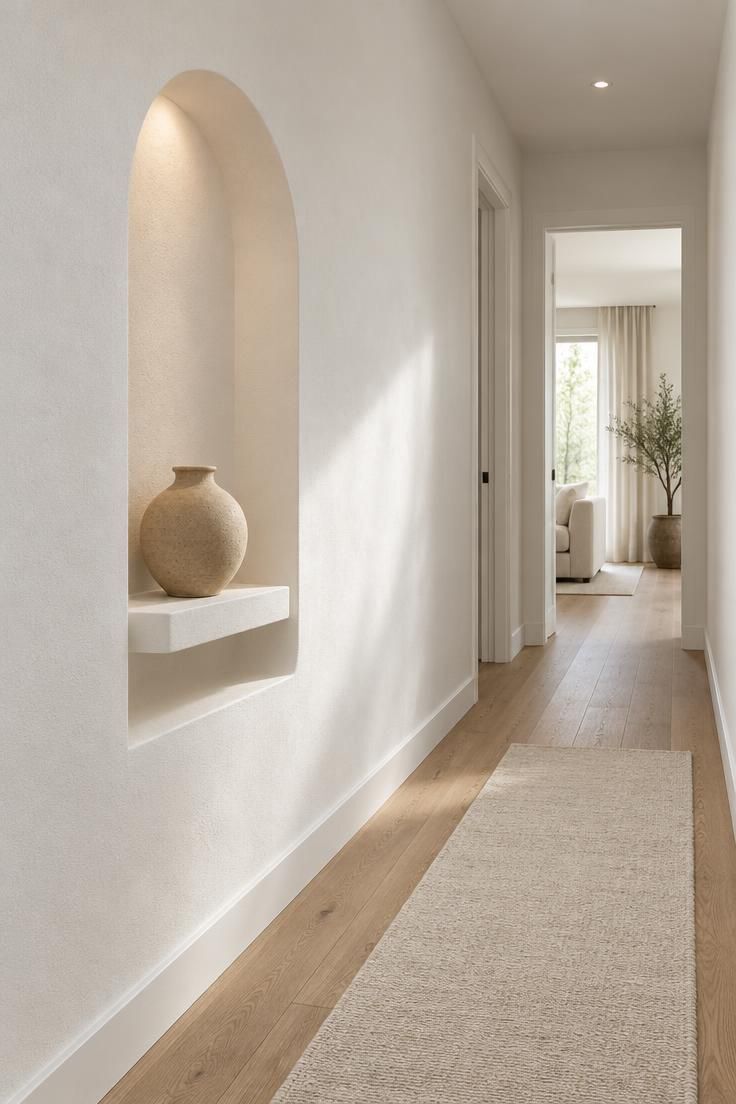
A recessed arch niche replaces the need for applied trim by carving dimension directly into the wall itself.
The plaster edge catches light along its curve, creating a quiet focal point that shifts throughout the day as the hallway's light changes.
Depth and proportion matter more than size.
A niche that is too shallow reads as a flat outline and loses its sculptural feel, while one that is too deep can dominate a narrow hallway.
For typical hall widths, a recess of four to six inches offers enough presence without intruding into the walkway.
Keeping the niche and wall in the same white plaster eliminates visual seams, so the opening feels carved rather than inserted.
The object inside then becomes the single point of contrast, whether it is a vessel, a small stack of books, or a trailing plant in a simple pot.
Style Blueprint:
- Recessed white plaster arch niche
- Floating plaster shelf in matching finish
- Single warm-toned sculptural object
- Smooth white walls without applied paneling
Design Pro-Tip: If cutting a true recessed niche is not feasible, a shallow surface-mounted plaster surround can approximate the look using framing and a curved top, then be blended into the wall with joint compound and painted the same white for an integrated effect.
Textured Hallway Runner Rug in a Neutral Weave
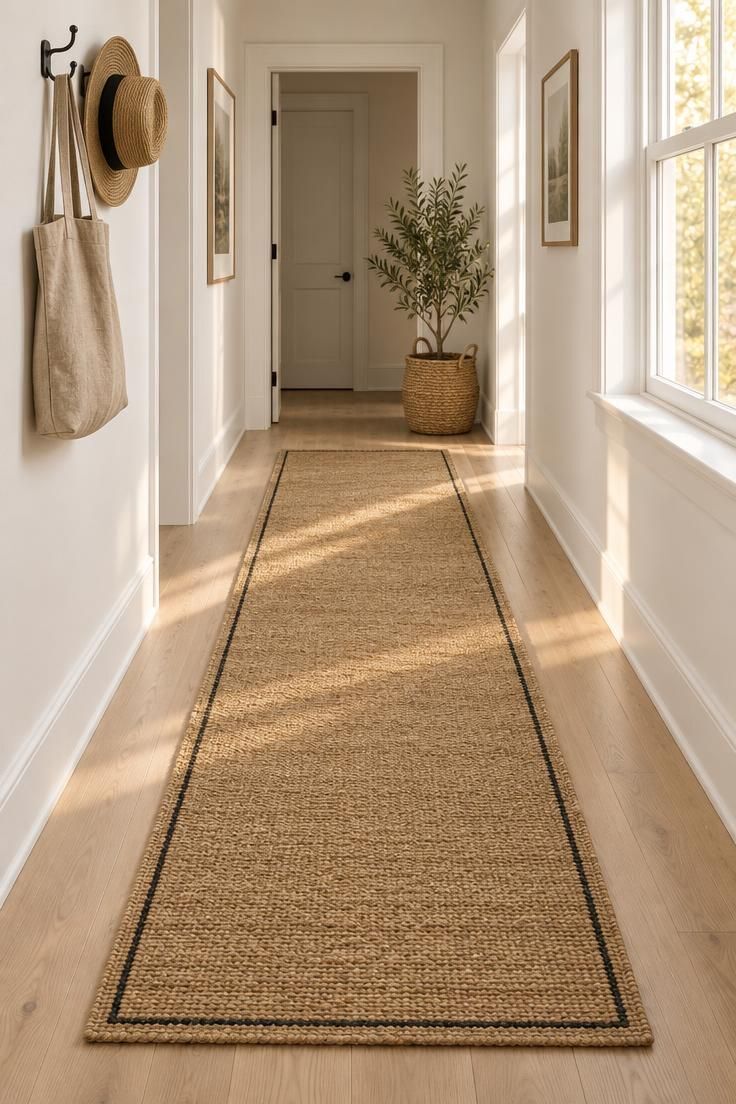
A hallway runner rug with a woven texture brings softness and pattern underfoot while the walls stay quiet.
Jute, sisal, and flatweave wool all handle hallway traffic, and a tonal stripe or simple geometric pattern adds interest without competing with white surfaces.
Proportion decides whether the runner helps or hurts.
Leaving a few inches of floor visible on either side keeps the hall from reading as fully carpeted, and a runner that stops short of both ends tends to make a corridor feel longer than one that runs wall to wall.
Material affects upkeep.
Natural fiber sheds and can feel coarse underfoot at first, while flatweave wool costs more and cleans more easily.
A rug pad underneath keeps the runner from creeping on smooth floors.
Style Blueprint:
- Flatweave jute or wool runner
- Contrasting stitched border
- Nonslip rug pad
- Woven basket planter
- Slim wall hooks in black metal
Vertical Plaster Sconce Ledges With Living Greenery
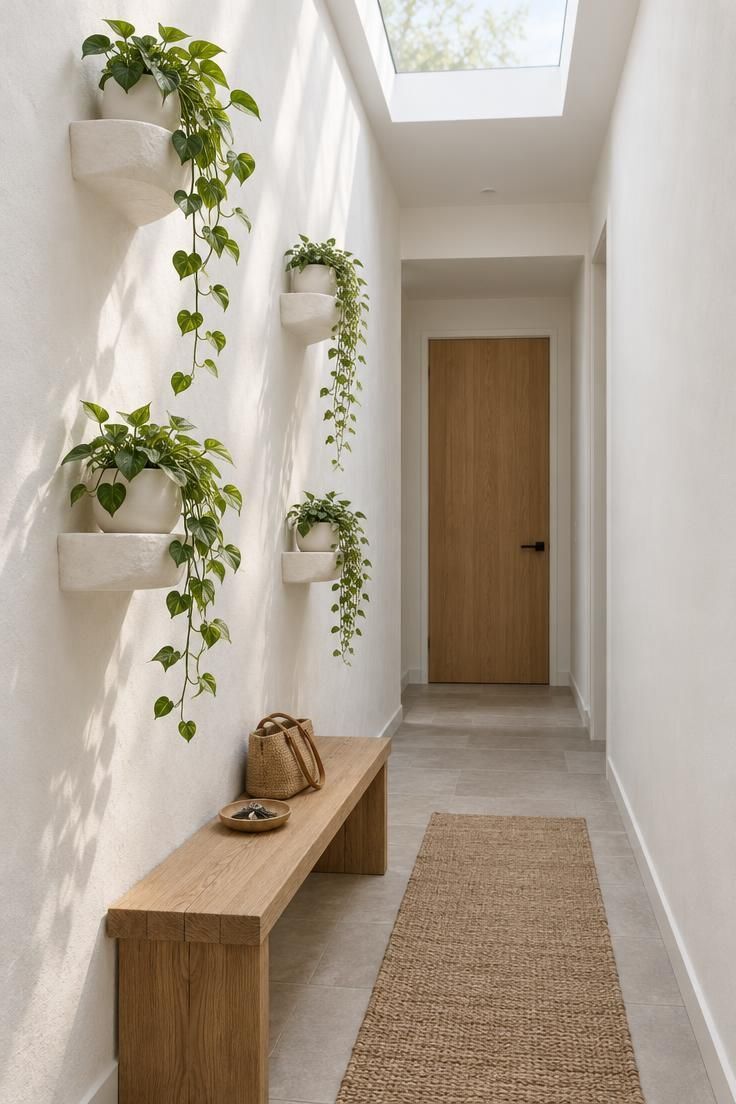
Plaster ledges with trailing greenery bring life and soft dimension to a white hallway without relying on wall art or dark contrast.
The vertical stagger breaks up a long stretch while leaving the floor open and the sightline uncluttered.
Placement determines the rhythm.
Alternating ledge heights draws the eye up and down in a slow, organic cadence rather than locking it into a straight line.
Keeping the pots and ledge material consistent lets the plant forms provide the variety, so the overall look stays cohesive even as the greenery grows and changes shape.
The tradeoff is plant care.
Hallways with less natural light need low-light species like pothos or heartleaf philodendron, and watering means reaching up or taking pots down.
A small step stool and a once-a-week check keep the arrangement full without overcomplicating the routine.
Style Blueprint:
- Matte white plaster ledges
- Trailing plants in matching white pots
- Staggered vertical placement
- Slim natural oak bench below
Reeded Glass Pendants Glowing Above a Narrow Wood Bench
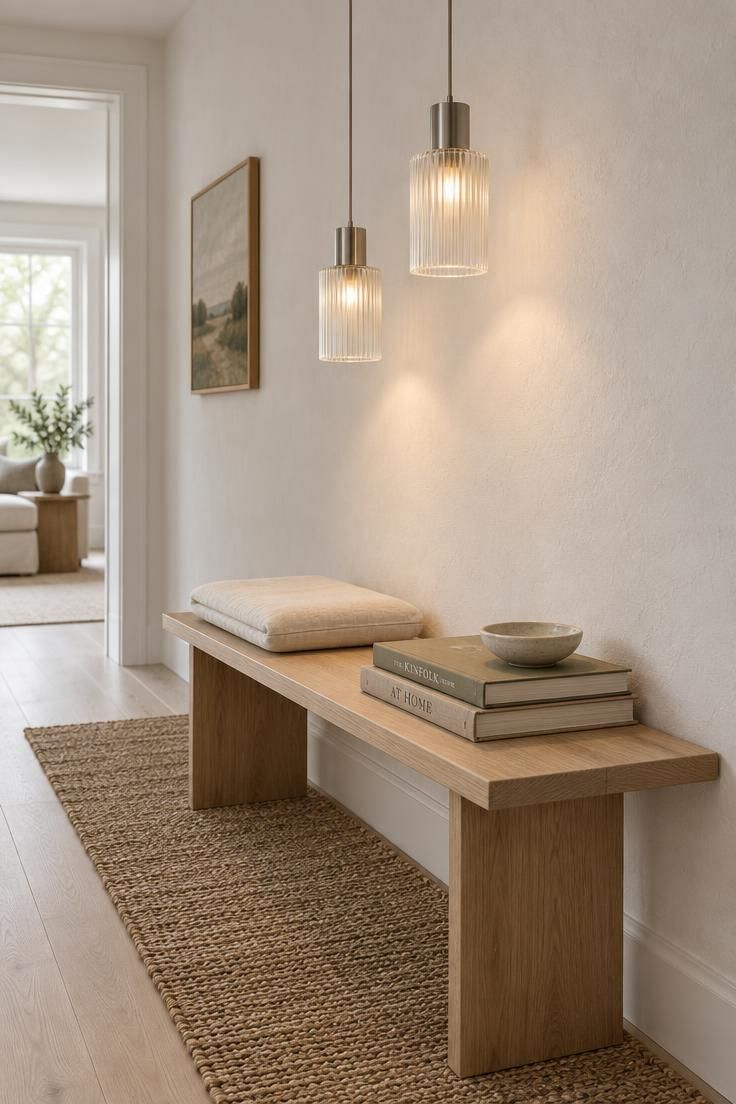
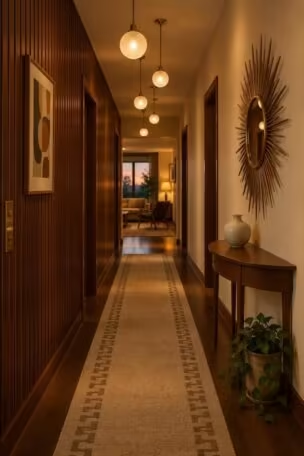
Pendants bring the light source down from the ceiling plane and create a softer, more intimate scale in a corridor that might otherwise feel like a blank passage.
Reeded or ribbed glass diffuses the bulb while still giving the fixture a subtle sculptural quality, and the bench below offers a resting spot for putting on shoes or setting down a bag.
Pay attention to how low the fixtures hang.
Too low makes the hallway feel constricted, while too high loses the sense of intimacy.
A good rule is to keep the bottom of the shade at least seven feet above the floor so tall guests can pass comfortably beneath.
Choose a bench with an open base or slim legs so the floor reads continuously underneath, which prevents the hallway from feeling crowded and keeps the light visually connected to the ground.
Style Blueprint:
- Two reeded glass pendant lights
- Brushed nickel caps and fittings
- Narrow white oak bench
- Folded ivory linen cushion and neutral art books
- Woven jute runner beneath the bench
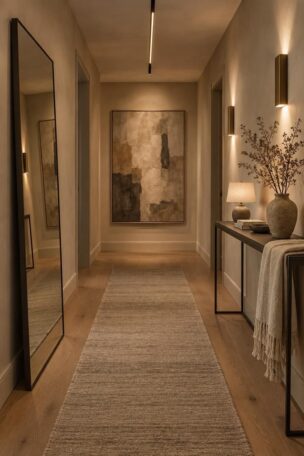
Single Oversized Artwork on the End Wall
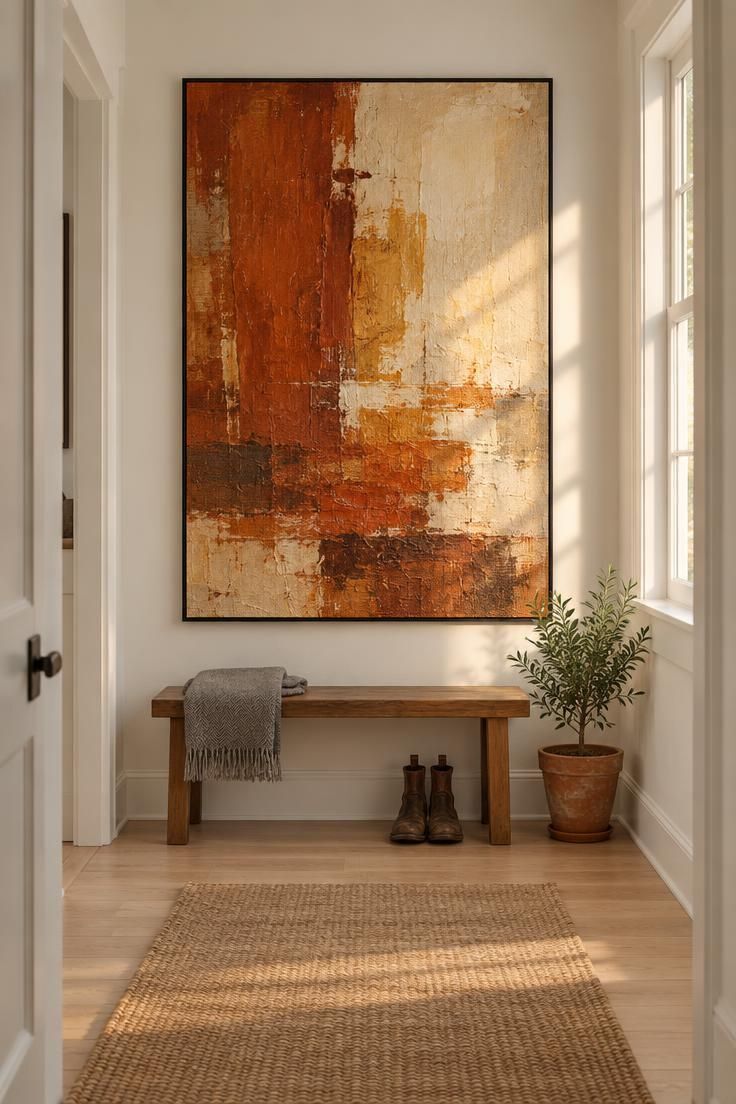
One large piece of art at the end of a corridor gives the eye a clear destination and brings color into a white scheme without adding clutter.
An abstract canvas, a large black-and-white photograph, or a textured fiber wall hanging all work as the single focal point.
Scale is the deciding factor.
The piece should relate to the width of the wall and stay visible from the hallway entrance, so a painting that reads as a stamp from a distance defeats the purpose.
Measuring the wall and taping the outline before hanging helps confirm the proportion.
Keep the rest of the hall quiet.
When one artwork carries the color and personality, additional decor at the same weight dilutes it.
Style Blueprint:
- One oversized abstract or photographic artwork
- Thin black wood frame
- Simple wooden bench beneath
- Single terracotta pot with a plant
Arched Doorway or Mirror to Soften the Hallway's Lines
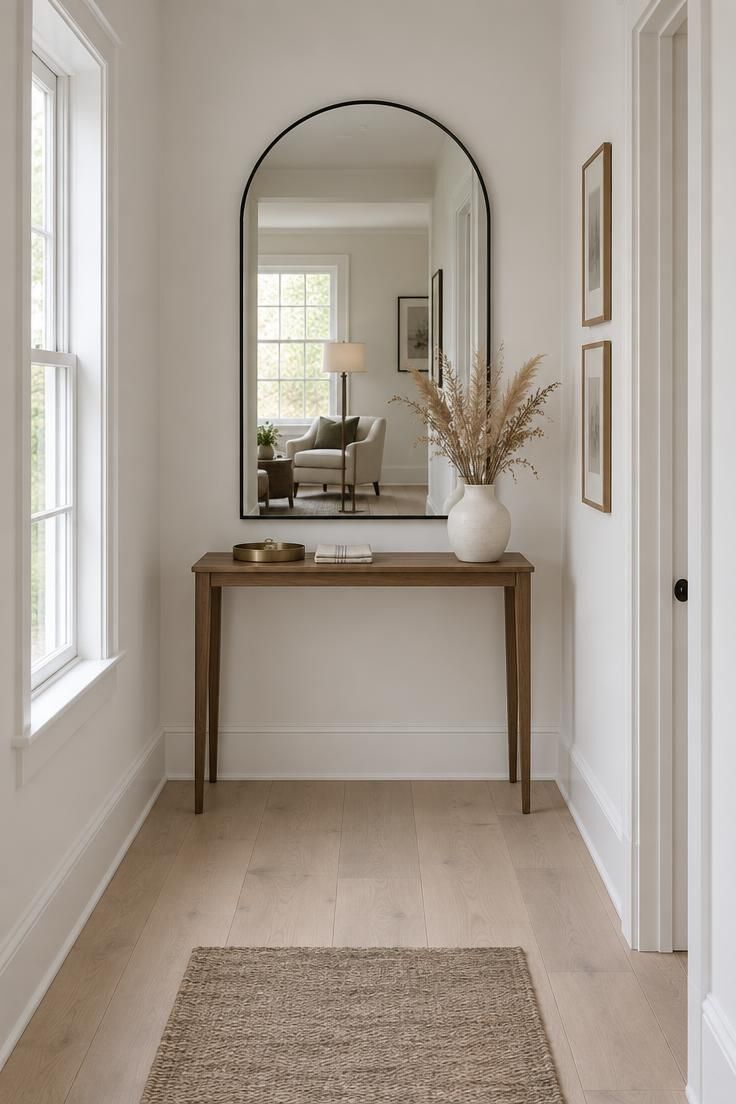
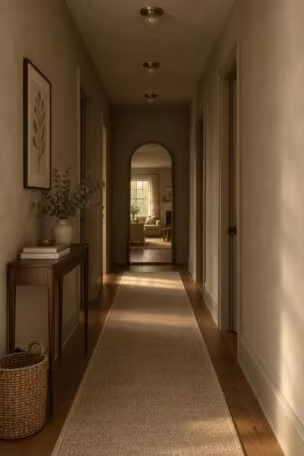
An arch, whether as a doorway, a niche, or a mirror, adds a soft curved contrast to the rectangular geometry of a hallway.
An arched mirror placed at the end of the corridor reflects light back into the space and creates a sense of depth, a practical narrow hallway design move that keeps a long passage from feeling like a tunnel.
What the mirror reflects matters as much as the frame.
Placing it where it catches a window, a lamp, or a piece of furniture gives the reflection something worth seeing; aiming it at a blank wall wastes the effect.
An arched opening can also break up a long, straight run of corridor.
This approach tends to suit hallways with higher ceilings, where the curve has room to breathe.
Style Blueprint:
- Arched mirror with a slim metal frame
- Slim wooden console
- Brass tray and small vase
- Dried grasses or branches
Design Pro-Tip: When hanging a runner or placing a mirror, look down the hallway from the main entry point rather than standing beside the object. The view from that spot reveals whether the focal element lands where the eye naturally travels.
Low Shelving Display Along One Wall
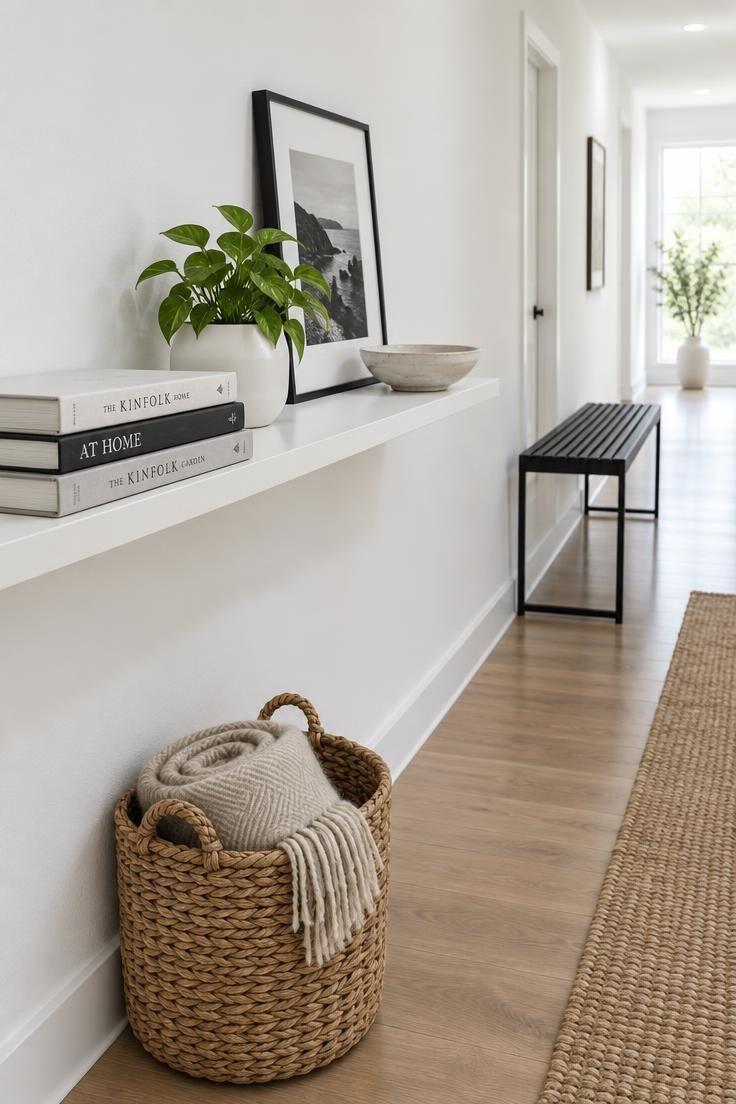
A long, low shelf provides display space without narrowing the walkway, which matters in a corridor where every inch of passage counts.
Styling with a few favorite objects, books, ceramics, a small plant, reads more considered than filling the shelf with many small items.
Depth is the practical limit.
A shallow shelf leaves comfortable room for walking, while a deep one turns a passage into an obstacle course.
Keeping the profile slim also keeps the shelf from dominating the wall it sits on.
The finish changes the effect.
A shelf painted the same white as the wall blends in and lets the objects carry the interest, while a wood or metal shelf adds a contrasting line that draws attention to the storage itself.
Style Blueprint:
- Shallow white floating shelf
- Art books and a ceramic bowl
- Small green plant in a white pot
- Woven basket for throws
Checkerboard Painted Floor in Soft Tones
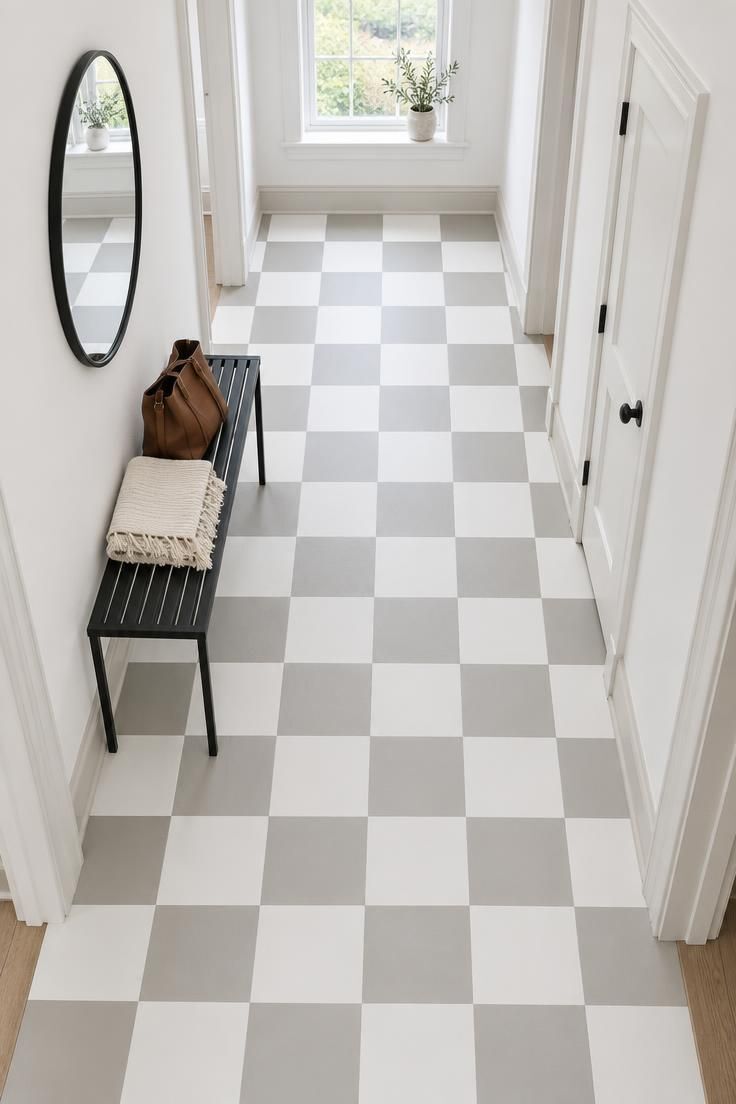
A painted checkerboard floor adds graphic interest while the walls stay white, and the pattern gives a long corridor a sense of rhythm underfoot.
Soft neutrals such as white and pale gray or white and warm beige keep the look bright rather than high-contrast.
Durability deserves honest consideration.
Painted floors take wear along the main walking path and may need touch-ups over time, and a matte sealer can reduce slipperiness on smooth surfaces.
Crisp lines depend on careful masking or a stencil, since freehand edges rarely hold up close.
The pattern also changes how the floor reads.
A small check feels busy in a short hall, while a larger check can make a narrow space feel more generous.
Style Blueprint:
- White and pale gray floor paint
- Matte floor sealer
- Painter's tape or checkerboard stencil
- Slim black metal bench
- Round black-framed mirror
Potted Olive Tree and Woven Basket at the Far End
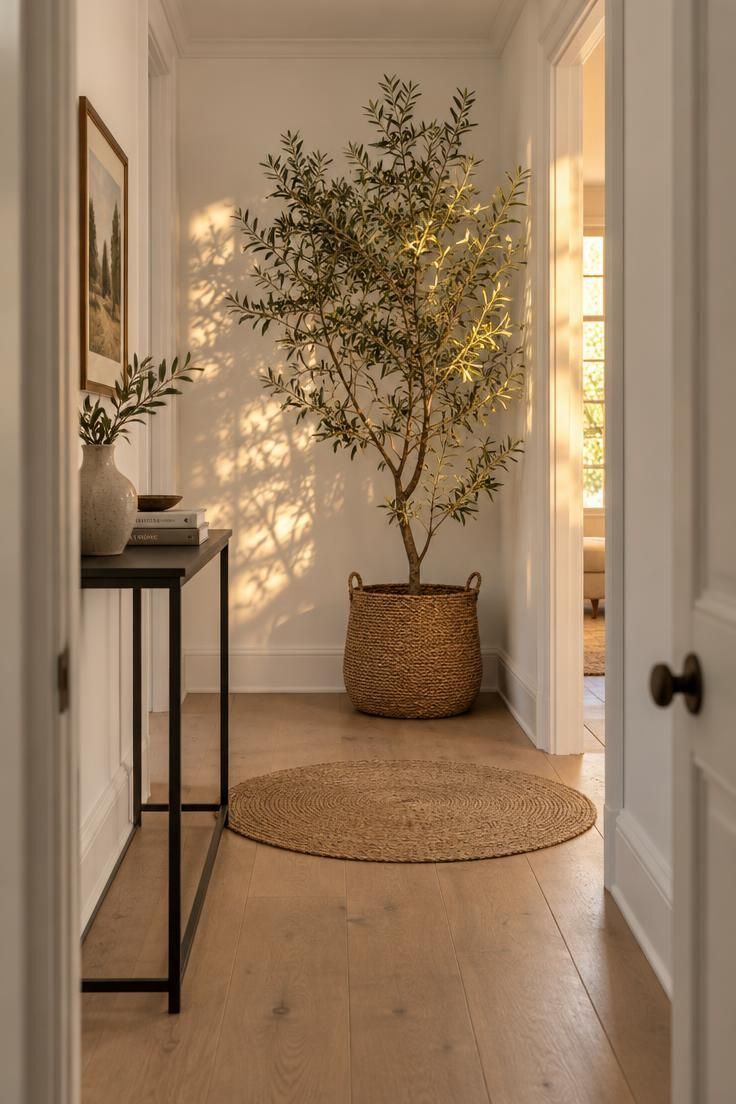
A large potted plant introduces organic texture and a soft green accent that reads as the only strong color in an otherwise white space.
An olive tree, rubber plant, or similar tall specimen placed at the end of the corridor works as a natural focal point, and a woven basket planter adds another layer of texture.
Light is the deciding factor for a living plant.
A windowless hall rarely supports a healthy tree, so a realistic faux option makes sense in those spots.
The plant should be scaled to the height of the hallway and positioned clear of the walking path.
Watering and leaf care are part of the upkeep.
A basket liner protects the floor from drips, and dusting the leaves keeps them from dulling over time.
Style Blueprint:
- Tall olive tree or rubber plant
- Natural woven basket planter
- Small round jute rug
- Narrow black metal console
Conclusion
Start with the light in the hall, the floor beneath it, and the length of the sightline, because those three factors shape which white will work and where an accent belongs.
A warm white tends to be more forgiving in low light, while a brighter white holds up in a well-lit corridor.
Add at least one element of texture or contrast so the scheme doesn't fall flat: a wood floor, a patterned runner, a dark door, paneling, or a single large artwork.
In a narrow hall, keep furniture slim and limit accents to one clear focal point.
Test paint samples and finishes in the actual space, since white shifts noticeably with the light and the colors around it.