This post may contain affiliate links. If you make a purchase through these links, we may earn a commission at no additional cost to you.
A hallway is often the longest stretch of wall and floor in a home, and the last place anyone thinks to decorate.
Vintage style suits that overlooked corridor because it rewards layering rather than large furniture.
A single object, finish, or pattern can carry an entire look against a bare wall.
The ideas below range from Victorian paint schemes to mid-century brass lighting, and each one works in a narrow run, a wide entry, or a stair landing.
Use them as visual starting points, then adapt the details to the width and light of your own space.
Deep Green Walls Divided by a Dado Rail
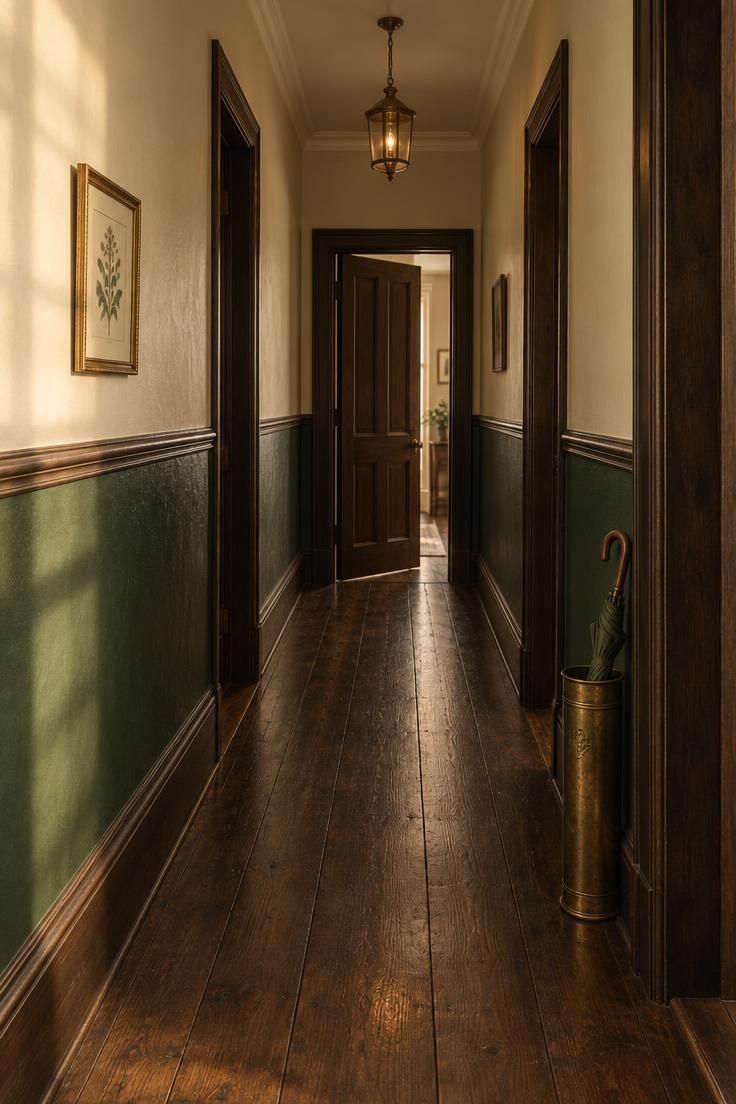
A dado rail splits a tall wall into two horizontal bands, which breaks up the height of a long corridor.
Painting the lower half a deep heritage green and keeping the upper wall pale makes the division read immediately, even from the far end of the hall.
Dark stained woodwork around doors and baseboards ties the two zones together, while an antique mirror can bring another aged finish into the scheme and reflect light through a narrow passage.
The rail is the more permanent part of this scheme, since it requires fitting, while the upper wall stays easy to repaint when you want a change.
In a low-ceilinged vintage hallway, keep the rail closer to the lower third so the green band does not dominate.
Style Blueprint:
- Deep bottle-green or forest-green paint for the lower wall
- Warm cream or off-white paint for the upper wall
- A molded dark wood dado rail with matching baseboard and door trim
- One or two small framed botanical prints with thin gilt frames
- A dark stained or antique brass umbrella stand for the entry point
Dense Floral Wallpaper With a Small Repeat
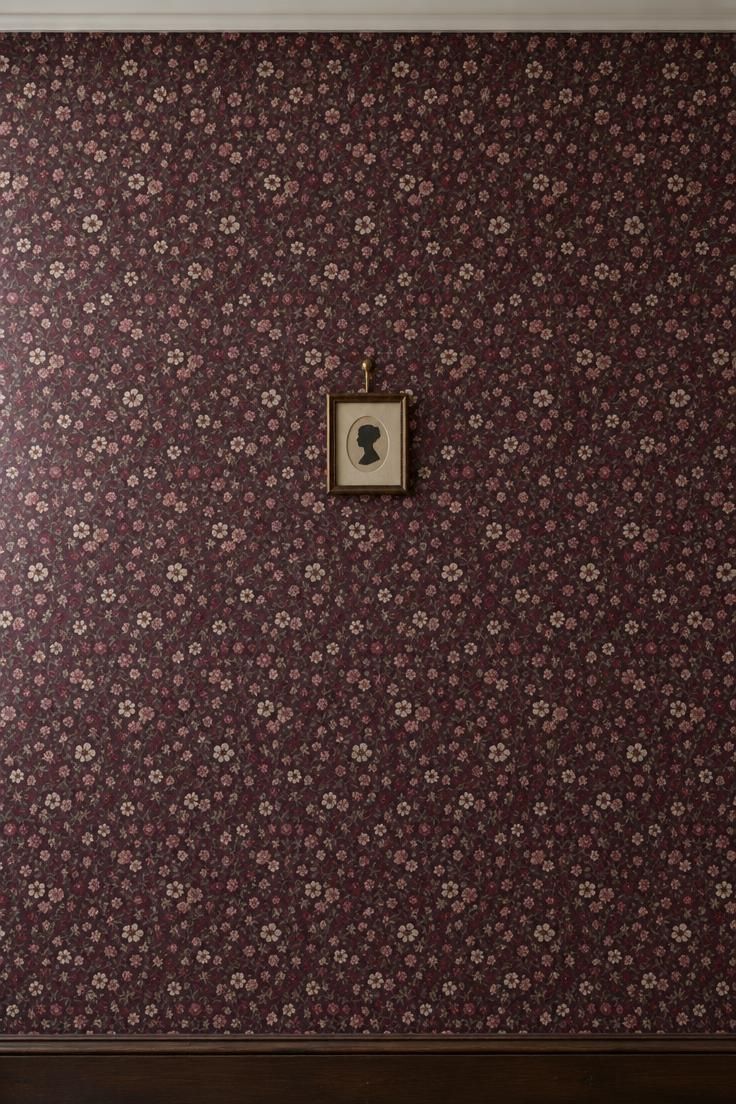
Small repeats read as old, while oversized prints read as contemporary, so scale is the deciding factor in a hallway.
A tight floral or damask motif creates an even texture across the wall rather than a few large statements.
In a narrow corridor, the pattern can go on one wall only, leaving the opposite wall plain so the space does not close in.
Full coverage is a bigger commitment than paint, and hanging wallpaper over a large flat surface takes patience and care with seams.
If the corridor is dim, a mid-tone pattern holds up better than a very dark ground, which can absorb the little light available.
Style Blueprint:
- Dense small-scale floral wallpaper in plum, oxblood, or another deep heritage ground
- A smooth, well-prepped wall surface before hanging
- A slim dark wood baseboard to ground the pattern
- One small framed silhouette or miniature print as a quiet accent
Botanical Morris-Style Wallpaper With Oak Trim
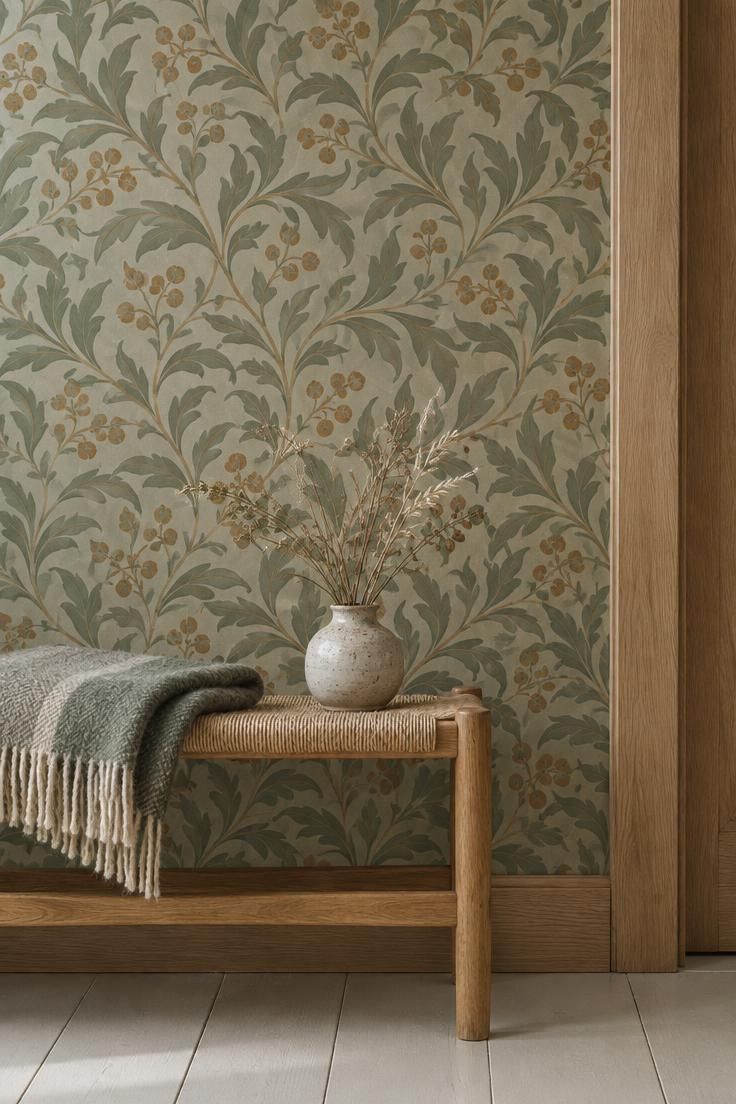
Arts and Crafts wallpapers favor trailing botanicals over tight geometric repeats, and the palette stays muted.
Pairing that paper with plain light oak trim keeps the look crafted rather than ornate.
A simple bench below the wall gives the corridor a stopping point and echoes the wood tone of the casing.
This scheme reads best in a wider corridor or on a stair landing where the pattern has room to breathe.
Oak trim is a longer-term choice than paint, so confirm the tone against the wallpaper before committing to both.
Style Blueprint:
- Sage, ochre, or muted botanical wallpaper in an Arts and Crafts style
- Light oak or pitch pine door casings and baseboards
- A low oak bench with a woven or rush seat
- A wool throw and dried grasses for a quiet, natural finish
Art Deco Geometric Band Above a Plain Wall
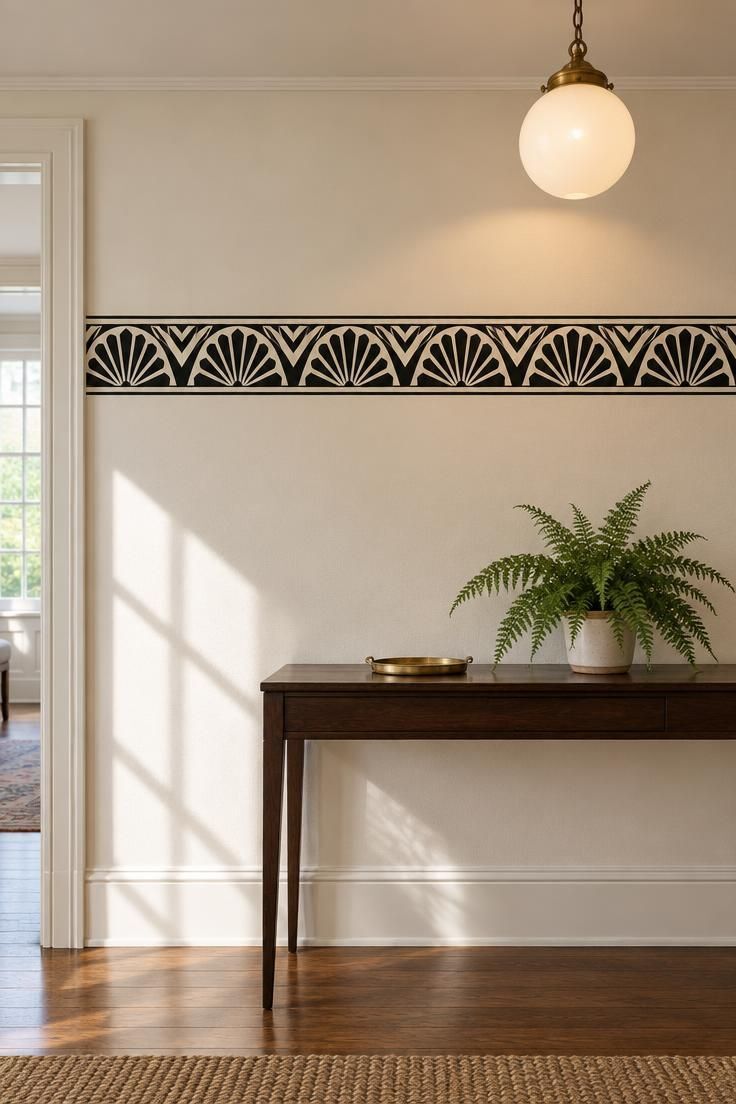
A frieze or painted band at picture-rail height gives a hallway 1930s character without covering the whole wall.
This approach reflects the Art Deco preference for repeated geometric ornament paired with cleaner, more restrained surrounding surfaces.
Strong horizontals suit a narrow corridor because they draw the eye along the length rather than up and down.
Black and cream or green and gold are the classic pairings, and both hold up against a plain ground.
This is a lighter commitment than full wallpaper, since only a strip of wall changes.
Keep the band clear of door frames and switch plates, because interruptions break the line that makes the look work.
Style Blueprint:
- A black-and-cream or green-and-gold geometric frieze at picture-rail height
- Plain warm white or cream paint for the wall below
- A vintage opal globe or brass pendant for period lighting
- A slim console with a brass tray and one green plant
- Painter’s tape and a steady hand for a crisp band edge
Cased Opening With a Turned Spindle Screen
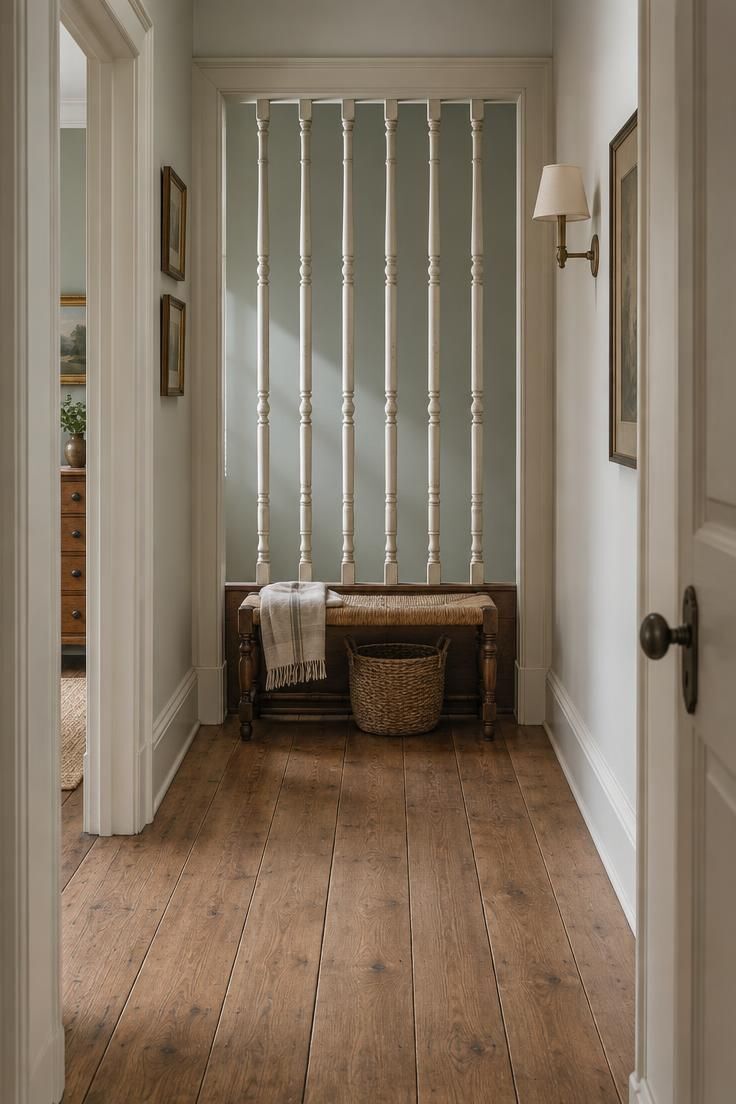
A spindle screen gives the end of a hallway the feeling of a threshold rather than a stop.
The vertical rhythm of turned wood breaks the sightline without blocking airflow or light, so the corridor still breathes.
Painting the spindles a soft off-white keeps the screen light and period-appropriate, while the dark base rail grounds it against pale walls.
A bench in front softens the junction and gives the eye a place to rest before reaching the screen.
Style Blueprint:
- A floor-to-ceiling turned spindle screen in painted or natural wood
- A cased opening framed by simple painted trim
- A rush-seated bench with a folded linen throw
- One woven basket tucked beneath the bench
- Bare wood floorboards running lengthwise toward the screen
Design Pro-Tip: When placing a screen or divider at the end of a hallway, leave at least eighteen inches of clear wall visible on both sides. A screen that runs too wide reads as a wall, while one too narrow looks like leftover millwork.
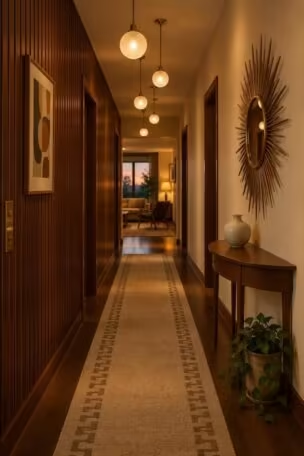
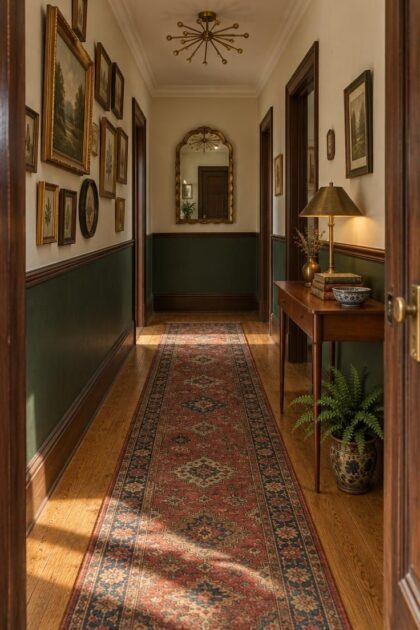
Sputnik Flush Mount Over a Teak Console
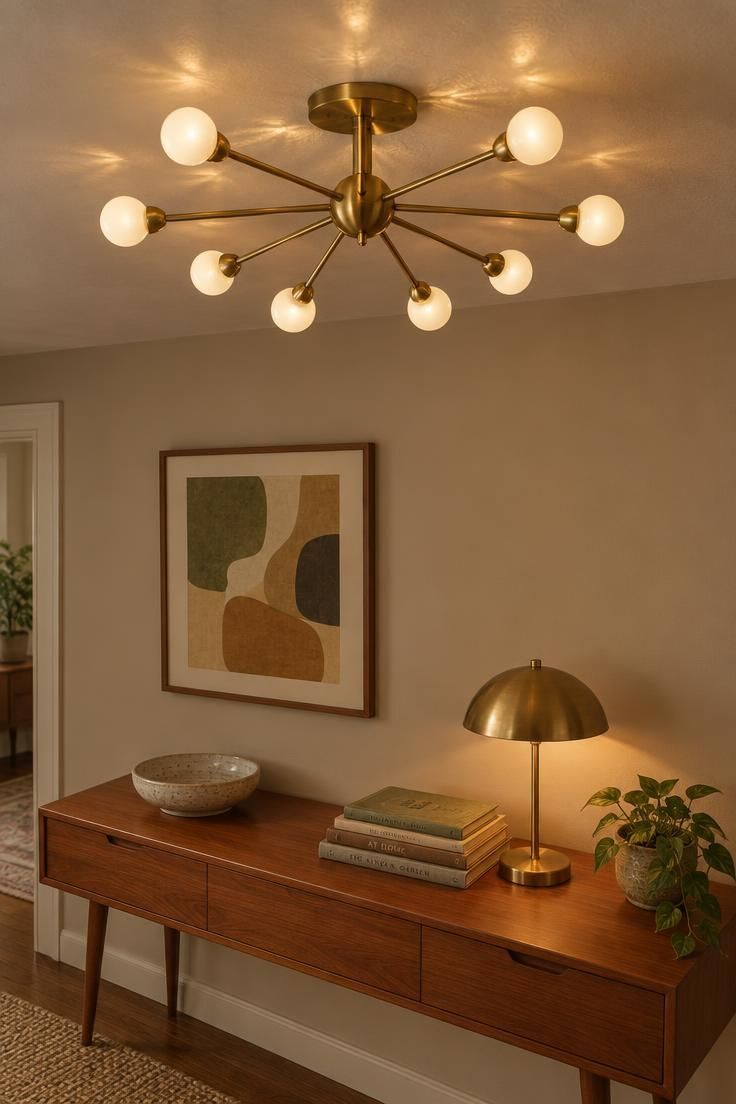
A flush or semi-flush fixture keeps headroom clear in a narrow hall, which matters when the ceiling is low.
Sputnik and globe designs add mid-century character without hanging into the walking path.
Above a slim teak or walnut console, the brass arms and warm wood share a palette that reads cohesive from either end of the corridor.
The console itself should stay shallow so it does not narrow the passage.
Teak and walnut vary in tone, so check the wood against the wall color before buying.
Style Blueprint:
- A mid-century sputnik or globe flush-mount fixture in brass
- A shallow teak or walnut console table
- A low ceramic bowl and a short stack of books
- A small brass table lamp for evening light
- One compact plant or dried arrangement for a touch of green
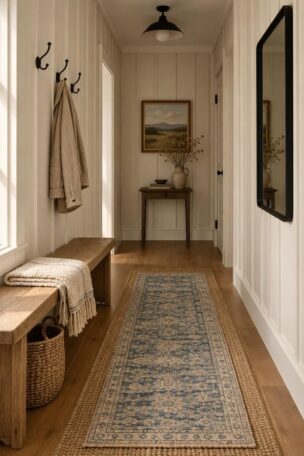
Patterned Runner Layered Over Warm Wood Boards
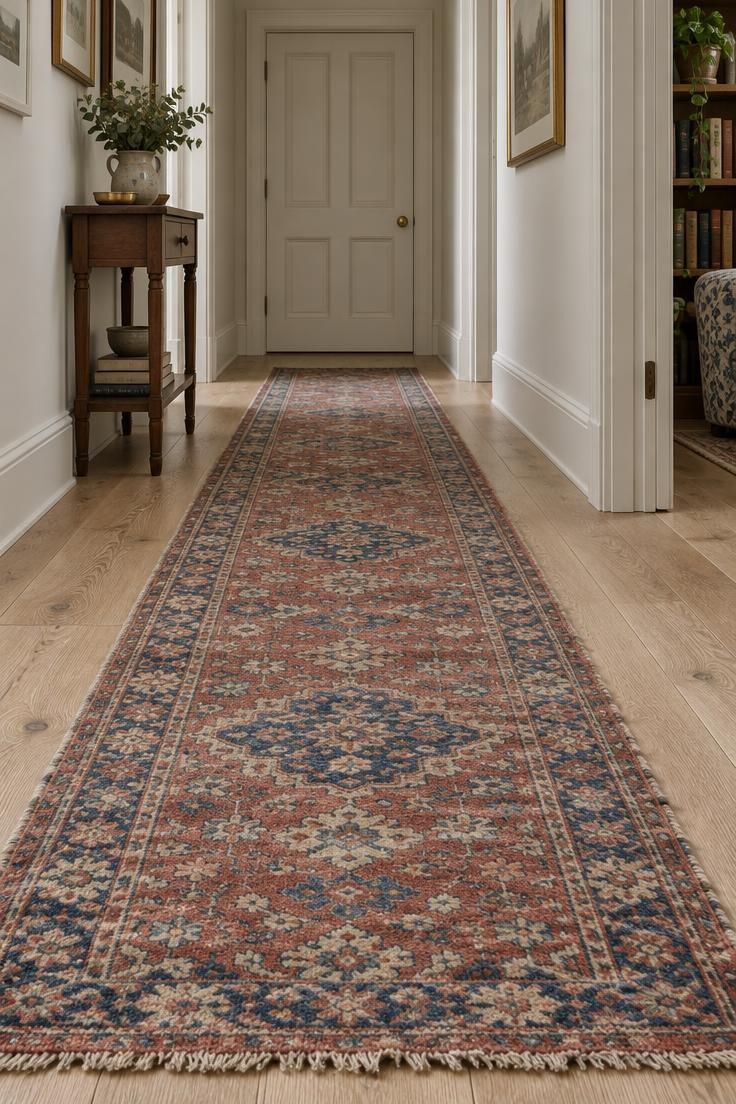
A patterned runner brings pattern, color, and age in one move, often making it the fastest route to a vintage corridor.
Sizing it so a few inches of bare wood stay visible on each side keeps the floor from looking fully covered and lets the boards act as a frame.
A flat-weave or low-pile runner sits closer to the floor and shifts less underfoot than a thick plush rug.
For renters, a runner is one of the easiest updates, since it requires no fixing and can move with you.
Faded or worn rugs are the point here, so do not chase a pristine one.
Style Blueprint:
- A long faded Persian, Turkish, or floral runner in muted reds and blues
- A length that leaves a few inches of bare wood on each side
- A low-pile or flat-weave construction for a hallway
- A nonslip pad or gripper underneath to keep it in place
- Pale oak or pine boards left bare and unlacquered
Framed Vintage Handkerchiefs in a Vertical Line
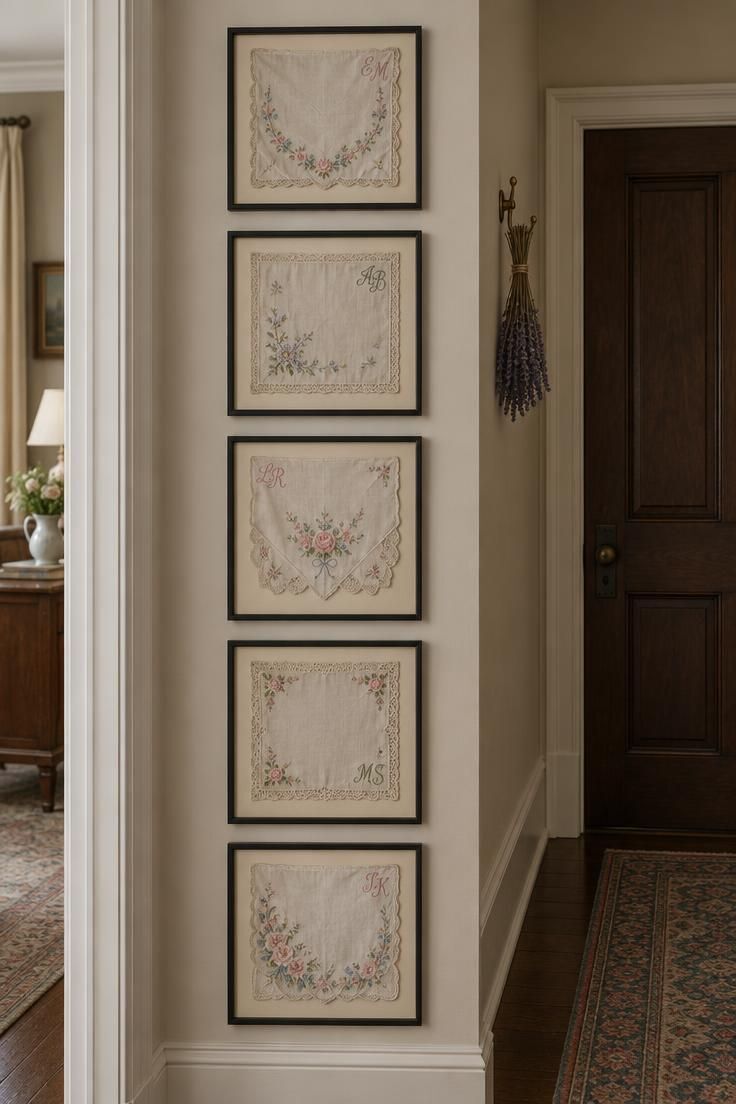
Framing old handkerchiefs creates a hallway display that feels personal and collected without dominating the narrow space.
A vertical line works better than a scattered arrangement in a corridor, because it draws the eye along the length of the wall and toward a doorway or focal point.
Choose handkerchiefs with fine handwork, visible mends, or monograms, since those details read as intimate and gathered over time rather than purely decorative.
Press each piece gently and use acid-free mats to keep the fabric flat and protected from light.
Delicate lace edges and pale thread can vanish in bright daylight, so hang the column on a wall that receives soft or indirect light rather than strong sun.
Style Blueprint:
- Five to seven vintage handkerchiefs with embroidery, lace, or monograms
- Thin black or dark wood frames with cream or off-white mats
- A single vertical column centered on the wall and aligned with a doorway
- One small wall hook holding dried stems or a narrow ribbon beside the frames
- Acid-free backing and UV-filtering glass to preserve the fabric
Framed Vintage Postcards in a Grid Over a Slim Bench
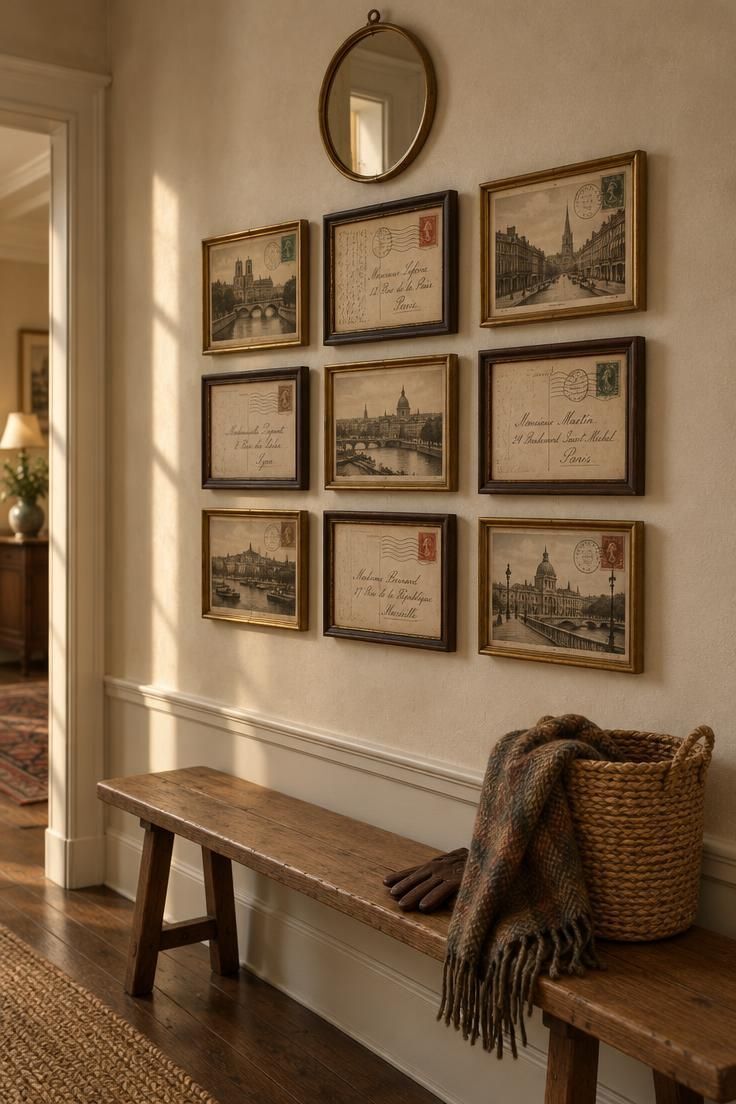
A collectible collection of framed postcards turns a narrow wall into a small gallery without the formality of large artwork.
Because hallways are often viewed while moving through them rather than from a fixed seating position, smaller repeated pieces can create visual interest without making the space feel crowded.
The grid gives order, while mismatched frames keep the display from feeling staged.
A slim bench below doubles as a catch point for scarves, keys, or mail without blocking the walkway.
This layout suits a hall with a long unbroken wall where a single large piece would overwhelm the passage.
Use command strips or small nails at the top corners of each frame to keep the grid level on old plaster.
Style Blueprint:
- Nine vintage postcards in a three-by-three grid
- Mismatched brass and dark wood frames for a collected feel
- A slim bench below for a functional drop zone
- A small round mirror above to reflect light without dominating
- A warm ivory wall color to let the sepia tones read clearly
Rustic Console Table as a Hallway Anchor
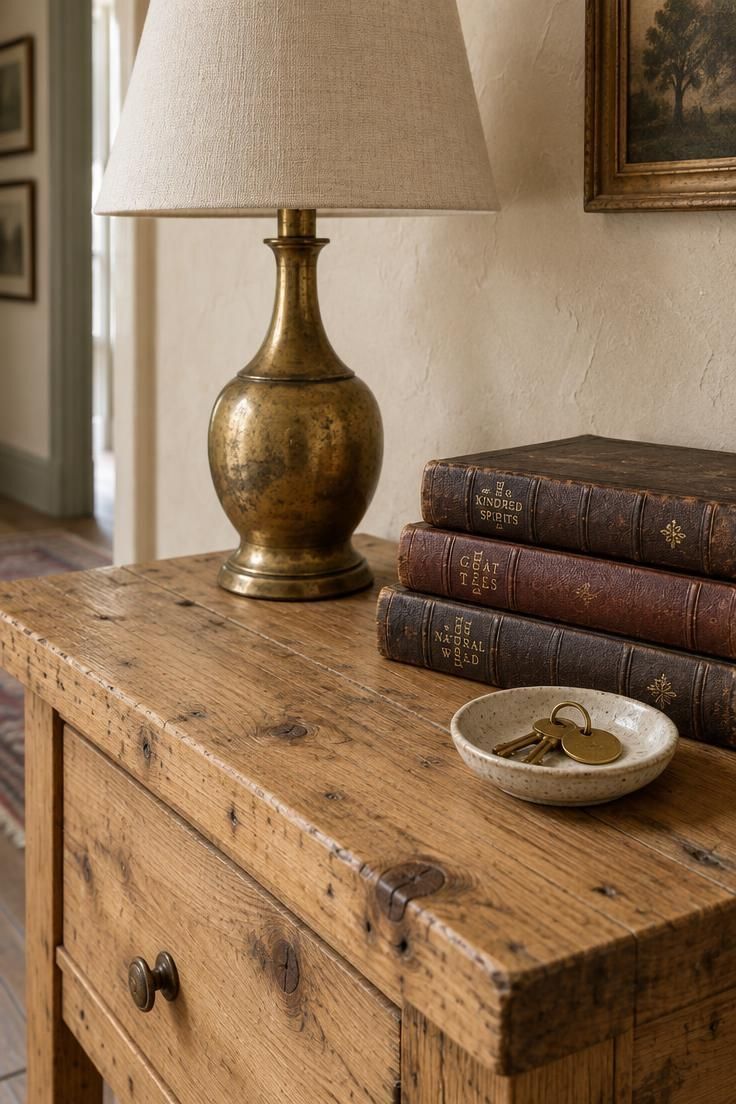
A single rustic console can anchor a wide hallway without filling it, especially when the top is styled sparsely.
Rough-hewn pine or a repurposed trunk makes a vintage console table that can suit the collected look while standing up to daily use at the entry point.
A stoneware bowl, a few old books, and one lamp are usually enough.
This arrangement works best where the corridor is at least three feet wide, since a deeper or wider table will crowd a narrower passage.
The console also creates a natural pause point between the front door and the rooms beyond.
Style Blueprint:
- A rustic reclaimed wood or vintage trunk-style console table
- One tarnished brass or ceramic table lamp with a linen shade
- A stack of old books with worn spines
- A stoneware or ceramic dish for keys and small items
- A pale plaster or limewashed wall behind
Striped Awning-Canvas Bench With a Cane Back
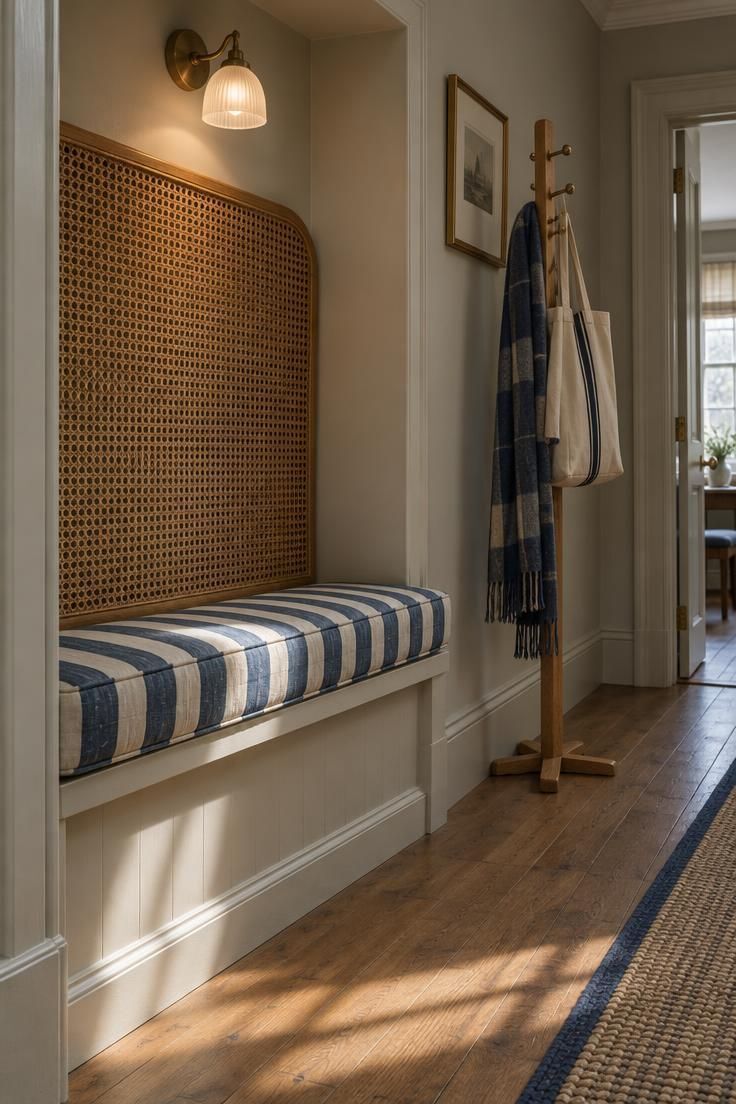
A built-in bench turns a blank hallway wall into a usable stopping point for putting on shoes or dropping a bag.
Awning canvas is durable, has a matte vintage texture, and its stripes nod to old shop awnings without introducing another floor pattern.
A cane back keeps the niche from feeling heavy and adds a woven, aged surface that softens the wall.
This idea trades floor-level pattern for a structural change to the wall itself, so the hallway feels furnished rather than simply decorated.
Style Blueprint:
- A shallow built-in niche or alcove with a bench seat
- A striped awning-canvas cushion in muted navy and cream
- A tall cane back panel set into the niche
- A slim oak coat rack or wall hooks with a scarf and canvas tote
- A small frosted glass sconce for low, practical light
Brass Picture Lights Over a Slim Oak Ledger
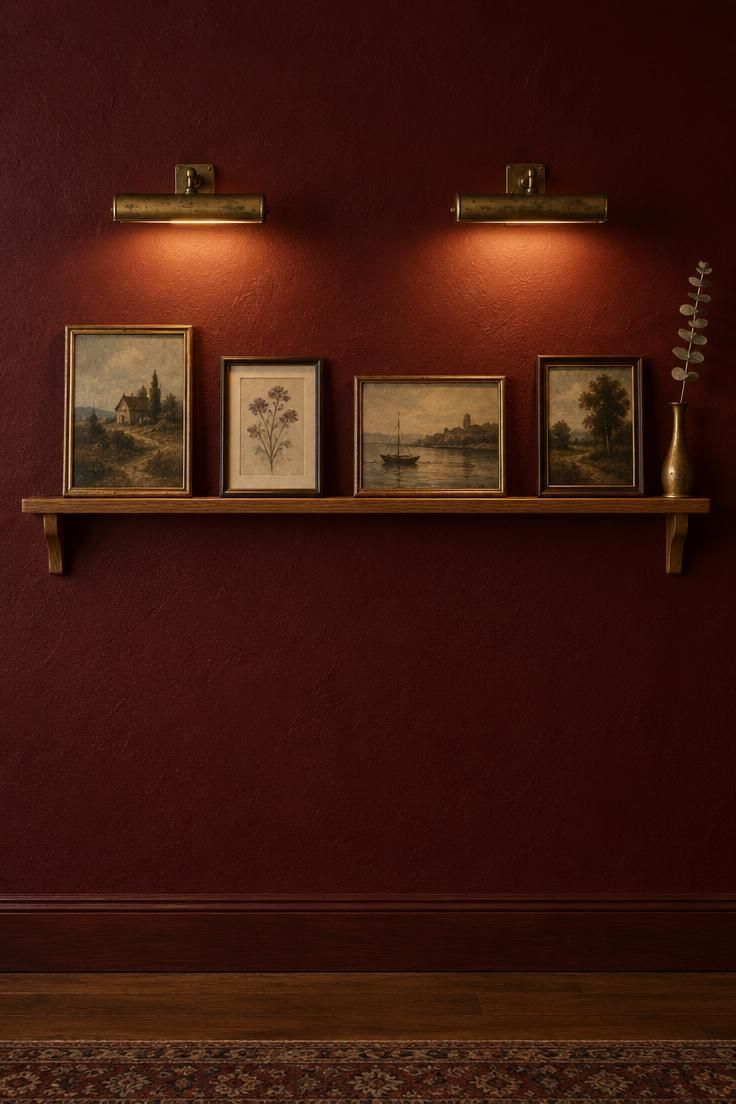
A slim oak ledge lets you display small artwork without making holes for each frame, and it makes swapping pieces easy when you want a change.
Unlacquered brass picture lights develop a soft patina over time, which suits the mid-century and collected-vintage moods.
Keep the frames small so the ledge stays visually light, and group two or three under each light rather than spacing them evenly.
The ledge works on almost any wall height, but a deep wall color behind it helps the small paintings stand out.
This is a renter-friendly alternative to a full gallery wall because the ledge can be fitted with a minimal footprint.
Style Blueprint:
- A slim oak or dark wood picture ledge at chest height
- Two small unlacquered brass picture lights
- Three to four small framed oils or watercolors
- A narrow brass vase with dried eucalyptus or grasses
- A deep warm wall color to make light frames stand out
Blue-Gray Plaster Finish With an Antique Brass Umbrella Stand
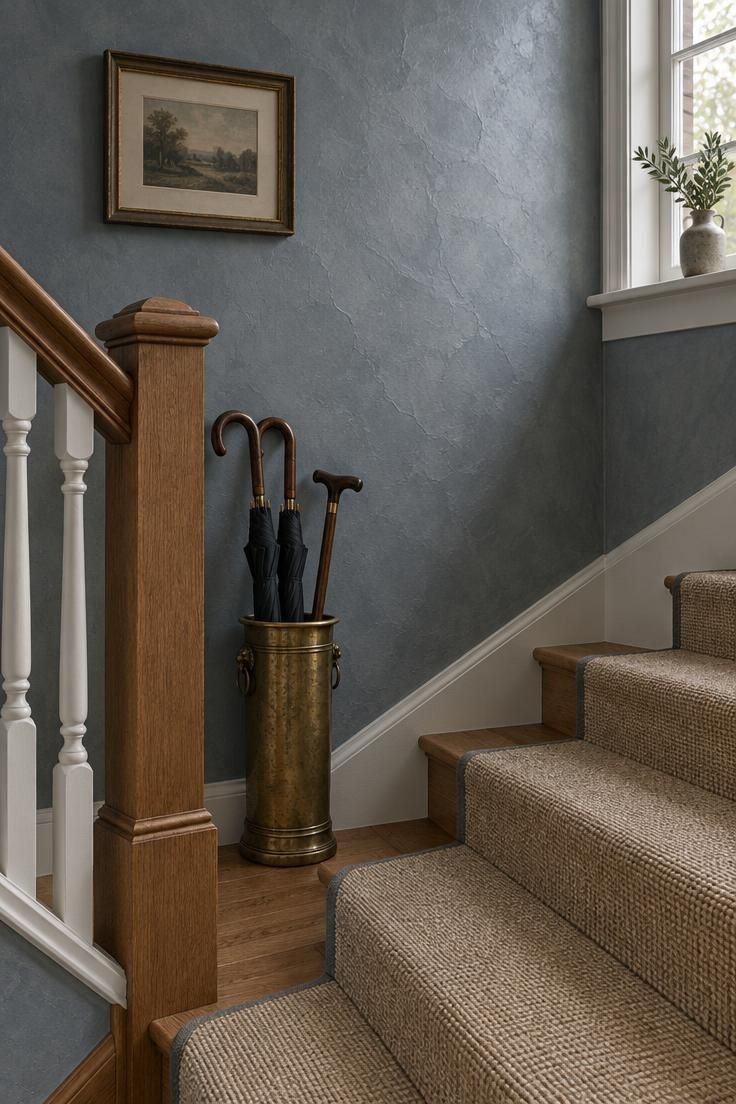
A blue-gray plaster finish gives the stairwell a quiet, slightly European character without the formality of wallpaper or the flatness of standard latex paint.
The matte surface holds trowel marks and faint tonal shifts that change as the light moves across the wall.
An antique brass umbrella stand near the newel post turns a blank lower wall into a useful vignette and adds a warm metallic note against the cool plaster.
Soft raking light from a stair window makes the plaster texture more visible, so the wall reads as a considered surface instead of a painted backdrop.
Keep the stand lightly filled with two or three wooden umbrellas or one slim walking cane so it looks like a design object rather than catch-all storage.
Style Blueprint:
- Blue-gray plaster or matte limewash finish across the full stairwell wall
- Antique brass umbrella stand placed near the oak newel post
- Two or three dark-handled wooden umbrellas or a slim walking cane
- Painted white balusters to keep the staircase visually light
- Natural sisal or plain runner on the treads to quiet the composition
Conclusion
A vintage look holds together best when one element leads and the rest supports it.
Choose a wall treatment, a floor covering, a mirror, or a lighting moment as the anchor, then keep the other details quiet.
Measure the corridor before buying anything large, and pick ideas that suit its width and how much natural light it gets.
A hallway is a good place to test one vintage idea before committing a larger room to the same era.
Start with a runner or a gallery wall if the space is rented, and save the built-in elements for when you are ready for a permanent change.