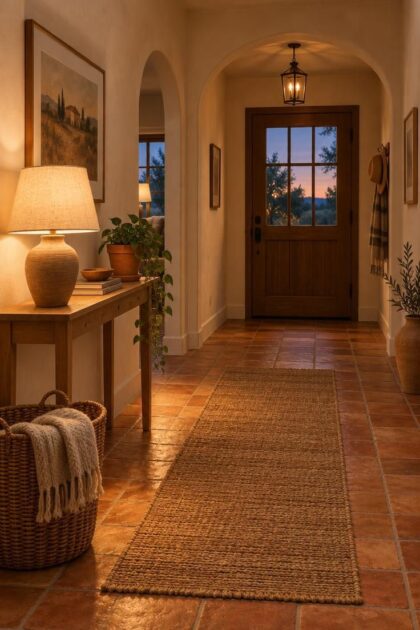
This post may contain affiliate links. If you make a purchase through these links, we may earn a commission at no additional cost to you.
Hallways often end up as the narrowest, dimmest, least-decorated run in a home.
A terracotta hallway gives that run a warm, grounded anchor instead of leaving it as dead space between rooms.
Terracotta can enter an entry in several ways: floor tile, wall or joinery paint, ceramics, planters, and textiles.
Each route sets a different mood, from rustic cottage to pared-back contemporary.
One composition move repeats across the strongest examples.
A single dominant terracotta moment carries the scheme, while a contrasting material such as cream plaster, timber, greenery, or white ceramic keeps the palette legible.
The range that follows runs from renter-friendly accents to full tiled floors.
Upkeep, light level, and restraint matter at every tier, and each idea notes where those tradeoffs land.
Hexagonal Terracotta Floor With Cream Walls in a Cottage Hall
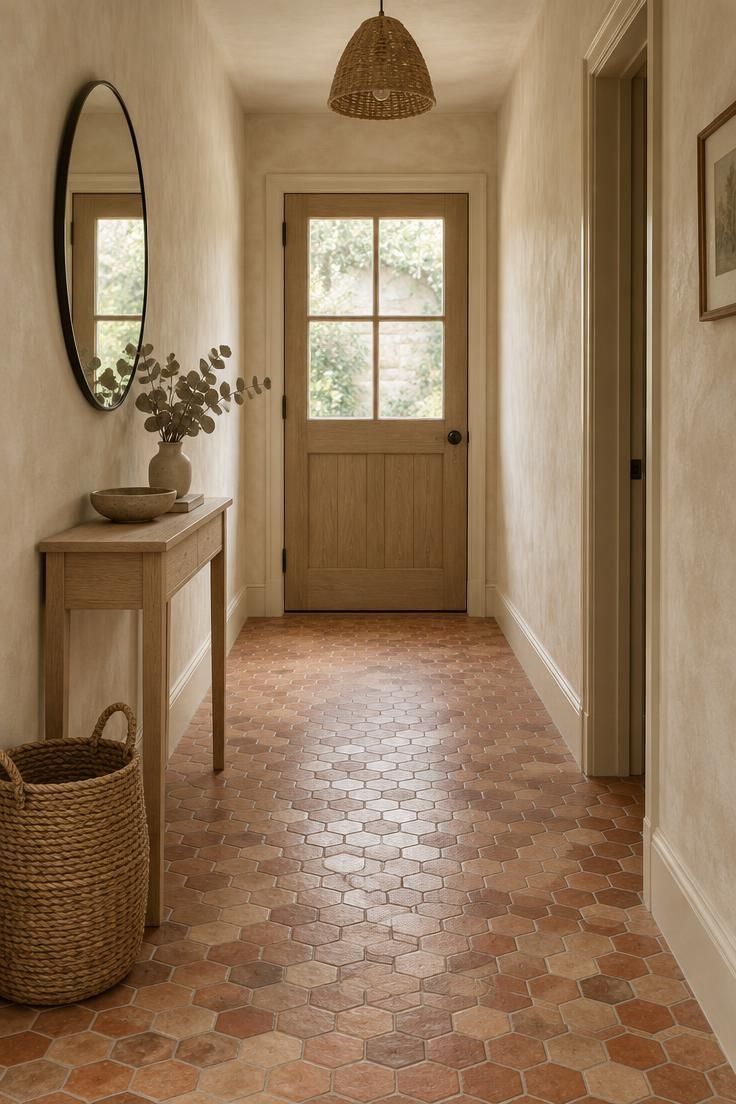
Small hex tiles suit a terracotta hallway because a hexagonal terracotta floor tile softens the long run of a narrow cottage corridor.
The scale stays intimate, and the repeated geometry gives the eye something to follow toward the far door.
Cream plaster walls do more work here than a second terracotta element would.
Keeping the walls pale lets the floor carry the color without the corridor reading heavy or closed in.
Tonal variation across handmade-look tiles is a feature rather than a flaw.
Slight shifts from sand to rust make the floor read as a lived-in surface instead of a flat sheet of color.
A pale timber console and a single woven basket add just enough furniture to suggest daily use.
Both stay low and slim, which preserves walking width in a hall that has little to spare.
Style Blueprint:
- small hex terracotta floor tile
- warm cream or soft plaster walls
- pale timber console
- one woven basket at floor level
A Terracotta-Painted Archway Framing a Console Nook
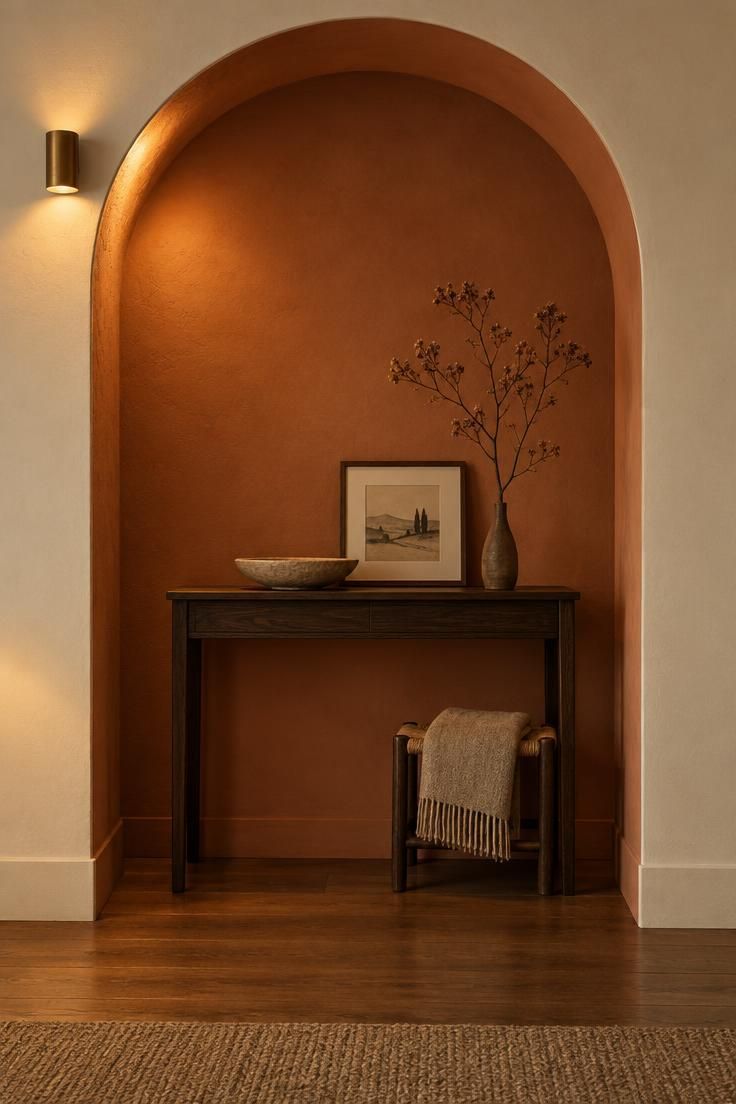
A terracotta painted archway concentrates color into one architectural moment rather than spreading it across the hall.
Shape and tone work together, and the curve becomes the event the rest of the entry answers to.
Plain cream walls on either side let that event read clearly.
Surrounding the arch with more color would flatten the contrast and cost the shape its definition.
Wide archways often benefit from a slightly deeper tone on the reveal so the curve stays legible from a distance.
A pale clay can disappear into cream walls when the arch spans a broad opening.
A slim console tucked inside the arch turns the nook into a working drop zone.
The dark wood grounds the warm paint and gives keys, post, and a bowl a settled place.
Style Blueprint:
- muted terracotta on the arch reveal and inner face
- plain cream walls beyond
- slim dark-wood console
- low-key ceramic styling
Terracotta and Rattan Entry With Mixed Warm Textures
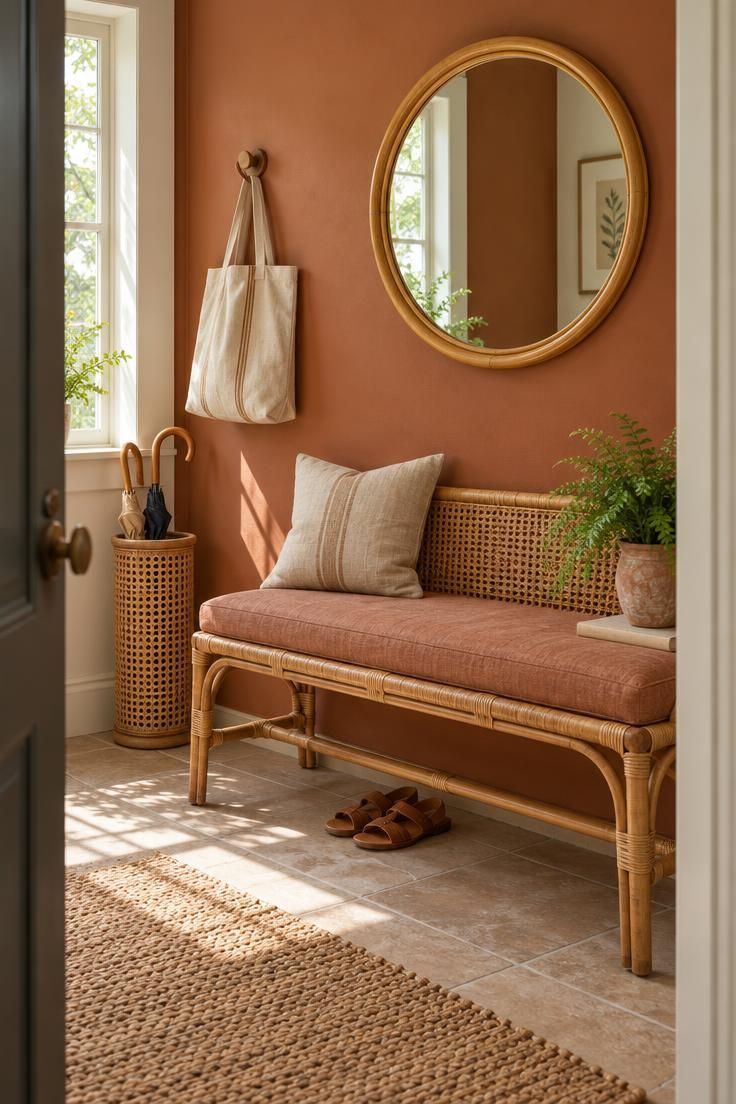
Woven natural fibers and clay color speak the same language here.
Rattan and cane bring a pale honey tone that keeps the scheme from tipping into flat orange.
Spacing the rattan pieces apart reads better than clustering them.
A bench on one side and a stand in the corner give the texture room to register without crowding the entry.
This palette suits small entries because the textures stay light even when the color is warm.
A terracotta and rattan entry gains depth from the weave rather than from added weight.
A linen cushion in a clay tone ties the bench to the wall color without matching it exactly.
The slight shift in value keeps the seating from disappearing into the paint.
One caveat applies to rattan and cane in a working entry: woven fibers collect dust in the joins and can dry out near a strong heat source, so a soft brush and a spot away from radiators keeps the pieces looking their best.
Style Blueprint:
- one terracotta-toned wall
- rattan or cane bench
- linen cushion in a clay tone
- cane or woven umbrella stand
- warm-framed round mirror
Unglazed Quarry-Style Tiles in a Boot Room Side Entry
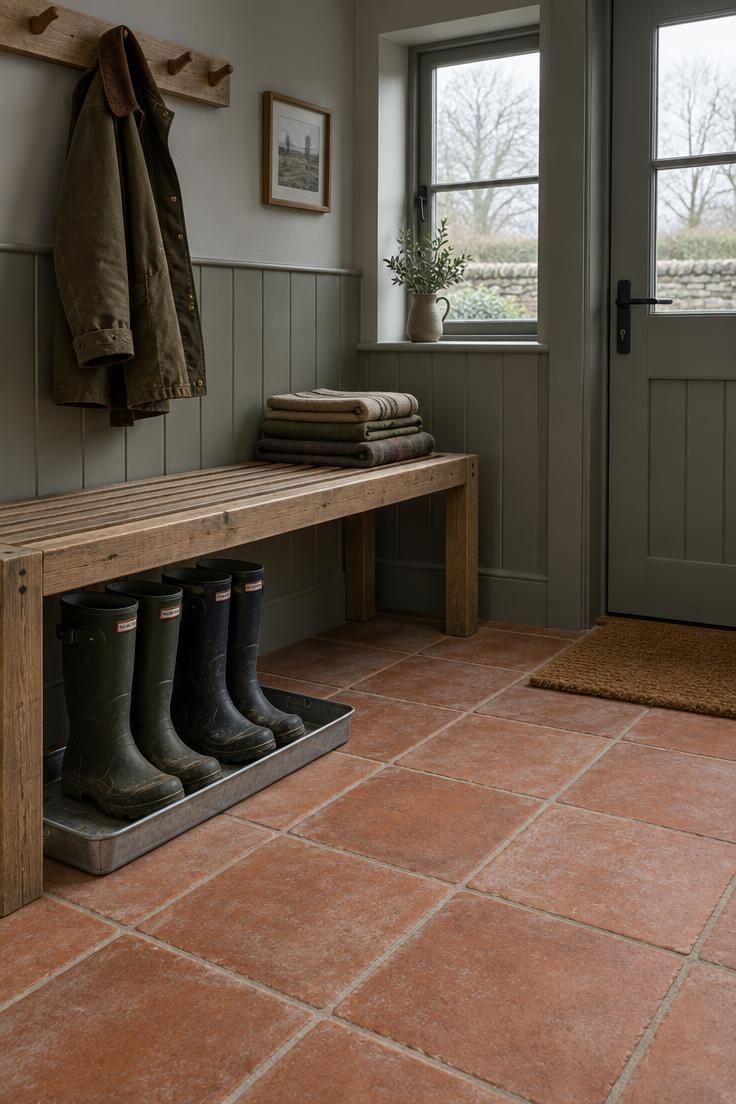
Unglazed tile has a dry, chalky surface that reads very differently from a glazed finish.
Under cool overcast light the rust tone stays earthy rather than bright, which suits a working side entry.
That same surface shows tracked-in grit and damp more readily than glazed tile.
A coir mat at the threshold and a boot tray under the bench do real work in keeping the floor presentable.
The matte finish also means the floor will never look polished, and that is part of its character.
A quick sweep and an occasional damp mop handle most of the upkeep.
A slatted timber bench lifts wet boots off the tile and lets air move underneath.
Keeping the bench shallow preserves the walkway in a room that often doubles as a passage.
Style Blueprint:
- unglazed quarry-style terracotta floor
- slatted timber bench
- boot tray
- coir mat at the threshold
Design Pro-Tip: Choose one dominant terracotta element per hallway, then let cream, timber, jute, green, or white ceramic handle everything else so the warm tone has room to register.
A Single Terracotta Accent Wall Behind a Coat Hook Row
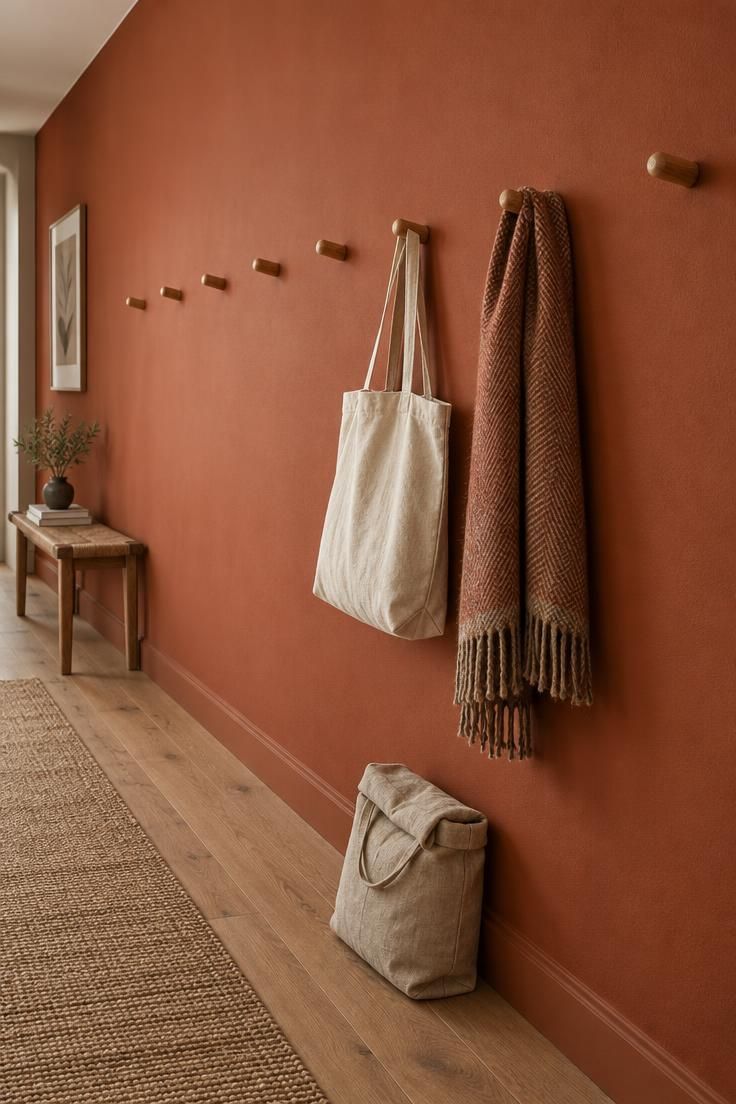
Limiting the color to one wall keeps a narrow hallway from reading closed in.
The opposite wall stays pale, so the corridor retains a sense of width even when the accent is deep.
The hook row becomes a functional line drawn against the color event.
Coats and bags hang directly on the terracotta, which turns storage into part of the composition rather than something to hide.
Neutral and deep-toned outerwear reads clearly against a terracotta accent wall.
A canvas tote in natural flax or a charcoal wool coat both stand out without fighting the color.
Timber hooks in a single tone keep the row tidy.
Mixing hardware finishes along one wall splits attention and muddies the clean line the accent depends on.
Style Blueprint:
- one terracotta accent wall on the long run only
- pale or neutral adjoining walls
- timber hooks in a single tone
Terracotta Floor With a Jute Runner in a Narrow Corridor
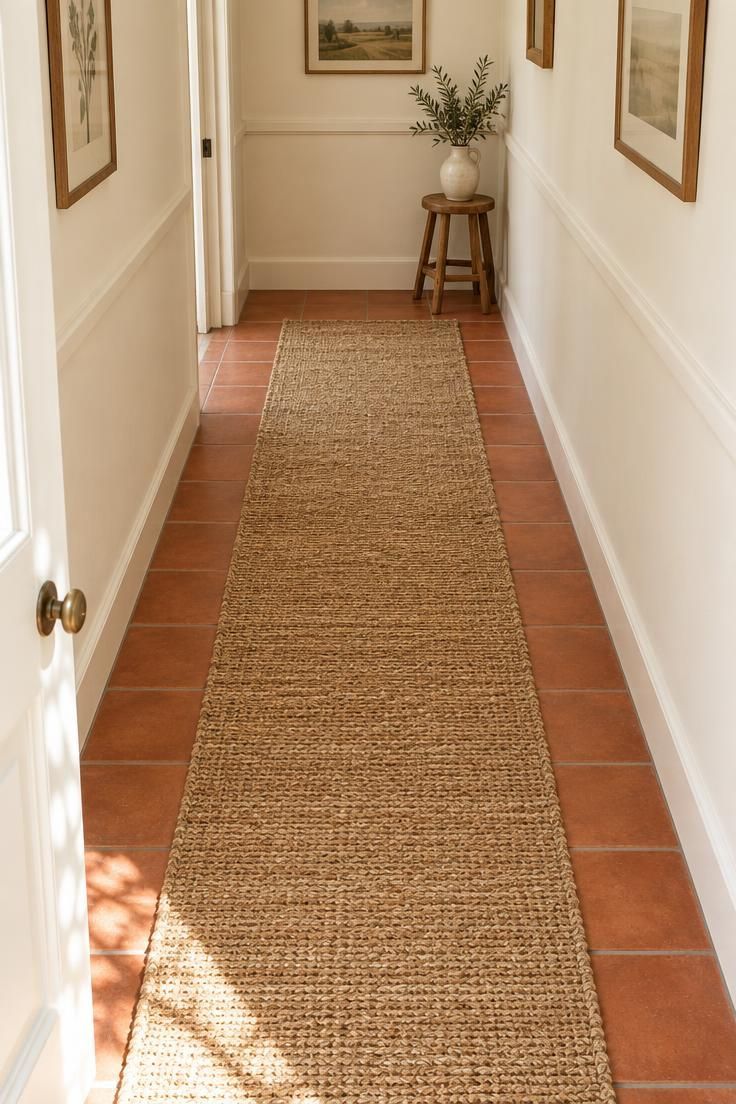
A jute runner narrows the visual width of a corridor while leaving tile visible at the edges.
That exposed border keeps the floor line readable and stops the rug from swallowing the room's proportions.
Jute's natural tan sits close to terracotta in tone, so it calms the floor rather than competing with it.
The two warm neutrals layer quietly instead of creating a second focal point.
Jute sheds, particularly when new, and benefits from a mat at the door to reduce tracked grit.
A quick shake outdoors and an occasional vacuum keep the runner looking tidy.
Placing a small timber stool or planter at the far end gives the eye a destination.
Without it, a long corridor can read as an endless strip of floor and rug.
Sizing matters more than pattern here.
A runner that leaves a hand's width of tile on each side looks intentional, while one that touches both walls flattens the corridor.
Style Blueprint:
- plain terracotta tile floor
- jute runner with a visible border of tile on both sides
- cream or off-white walls
- one small timber stool or planter near the end
Terracotta and Green: Clay Pots of Trailing Plants on a Hallway Ledge
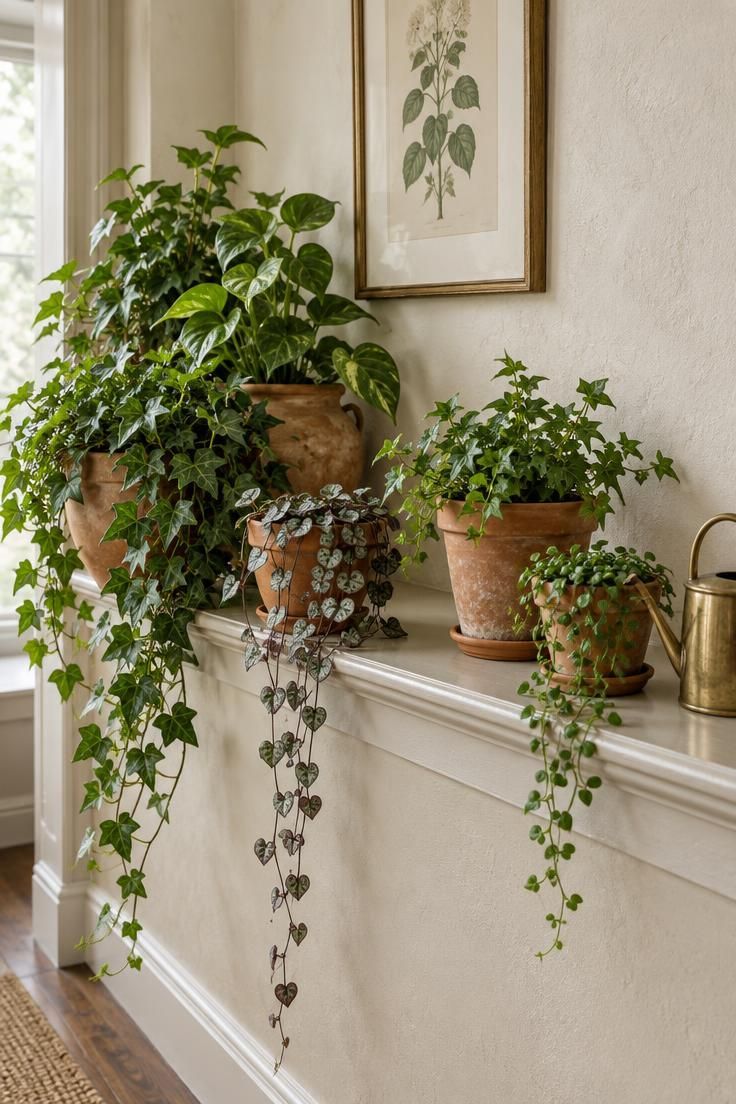
Green against clay is a garden-hallway move that brings the outdoors inside.
The pairing works because the two colors sit on opposite sides of the wheel without either one dominating.
Terracotta pots read best when some are clustered and some are spaced.
A tight group at one end and a single pot further along gives the ledge rhythm instead of an even row.
Trailing plants need a shelf or ledge deep enough to hold the pot, not the plant.
A narrow ledge with long vines will tip, so the pot base should sit fully on the surface with room behind it.
Keep the plant care simple: water when the top of the soil feels dry, and rotate pots occasionally so the trailing growth stays even on both sides.
Style Blueprint:
- a cluster of terracotta clay pots in mixed sizes
- trailing green foliage
- pale plaster or cream wall
- one small framed botanical print
Terracotta-Toned Door and Skirting Against Pale Plaster
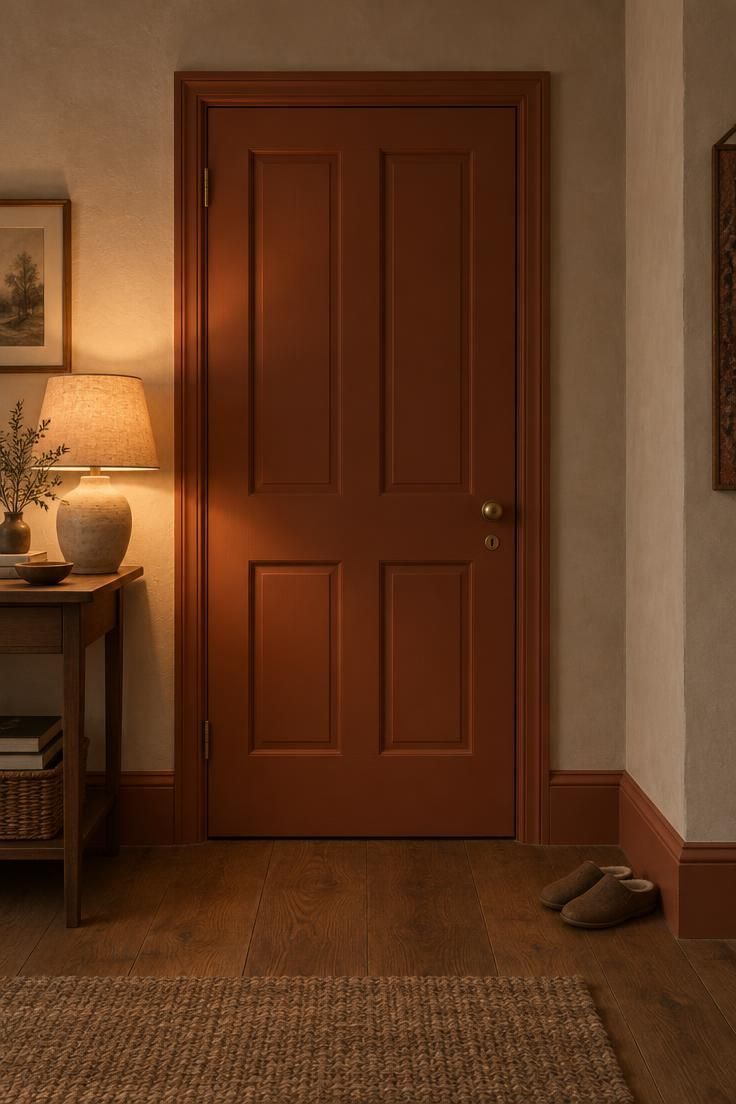
Painting the door and skirting in the same terracotta tone concentrates color at the doorway.
The walls stay quiet, and the eye lands on the transition between rooms rather than on the corridor at large.
This is one of the lower-commitment terracotta treatments.
A removable finish makes it workable in rented spaces, and reversing it later takes far less effort than replacing a floor.
Under low evening light the terracotta deepens noticeably.
A shade that looks muted brick by day can read as burnt sienna after dark, which is worth knowing before committing to a full door and skirting run.
Small brass or dark-metal hardware gives the painted surface a crisp edge.
A single finish across handle, latch, and keyhole keeps the door looking deliberate.
Style Blueprint:
- terracotta-toned paint on door and skirting
- pale plaster or warm off-white walls
- small brass or dark-metal hardware
Terracotta Ceramics as the Only Color in a Minimalist Hall
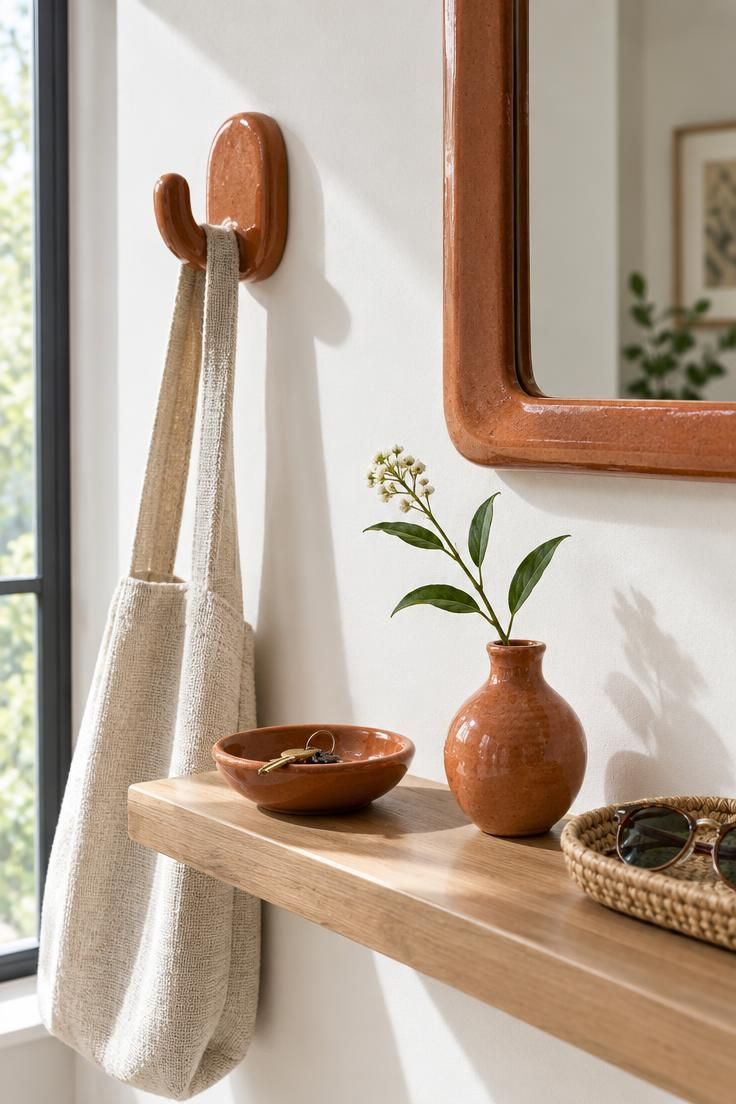
Glazed terracotta ceramics read more polished than unglazed tile, which suits contemporary hallways.
The shine catches light and gives the clay tone a crispness that matte surfaces lack.
Repetition is what makes this approach work.
Three terracotta objects read as intentional, while a single clay hook or bowl on an otherwise cool wall can look stranded.
Ceramics are the easiest terracotta entry point for a rental.
Hooks, a key bowl, and a mirror frame can be swapped or removed without touching the walls.
Keeping the surfaces pale or white behind them lets each object stand on its own.
A busy backdrop would compete with the small scale of the ceramics.
Style Blueprint:
- terracotta ceramic wall hooks
- a shallow terracotta bowl
- a mirror in a clay-toned frame
- one pale or white surface to hold them
Design Pro-Tip: In a hallway with little natural light, lean toward paler terracotta tones or confined accents rather than full walls, since deep clay reads darker in a dim corridor.
Terracotta and Checkerboard for a Graphic Contemporary Hall
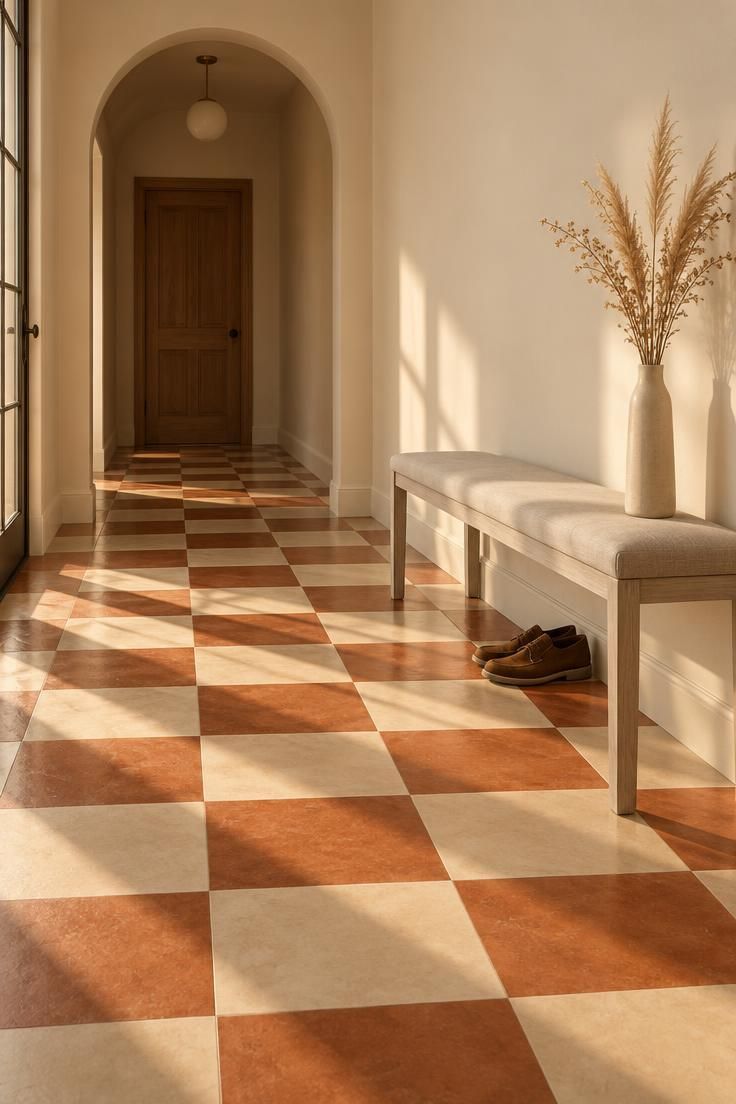
The checkerboard is the color event, and plain walls play a useful role in it.
Any artwork or patterned wallpaper would compete with the grid and turn a graphic floor into visual noise.
Tile scale changes how busy the pattern reads.
A smaller checker in a narrow corridor looks more restless than a larger one, which gives the eye fewer squares to process per step.
The cream squares give the eye somewhere to rest between terracotta ones.
Without that pause, a full run of solid clay tiles would read much heavier along the same corridor.
A slim bench in a neutral tone supplies function without adding a second pattern.
Keeping the bench low and unadorned lets the floor stay the focus.
Style Blueprint:
- checkerboard terracotta-and-cream floor
- plain pale walls
- slim bench in a neutral tone
- minimal wall styling
Terracotta Half-Wall Paneling With a Caramel Ceiling
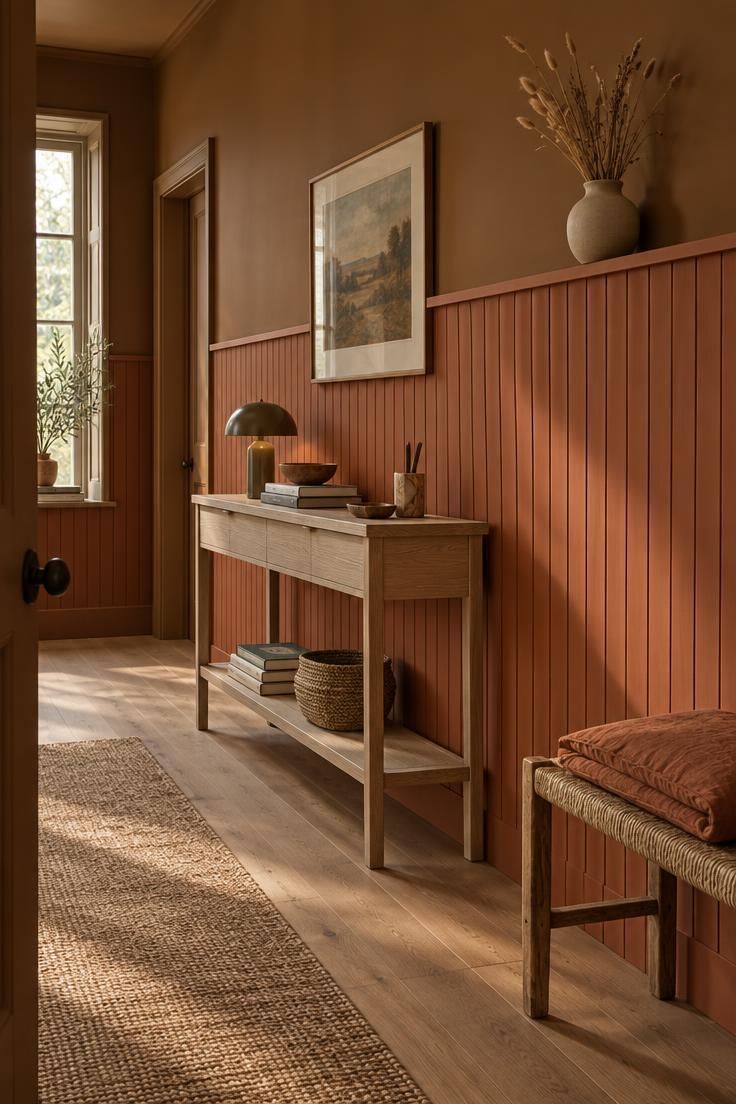
The lower wall becomes the main color source when a hallway needs visual weight without closing in the space.
Vertical slats in a clay tone give the corridor a quiet rhythm while leaving the upper wall and ceiling lighter in feeling.
A narrow ledge running along the top of the paneling offers room for a few small objects without adding shelf brackets.
For a hallway with lower light, a matte finish on the slats keeps the texture readable and avoids a glossy reflection bouncing from nearby doorways.
Design Pro-Tip: Repeat the ceiling color in one soft textile near the floor, such as a runner or bench cushion, to connect the high and low ends of the hall without adding a third strong color.
Style Blueprint:
- Terracotta vertical slat paneling on the lower wall
- Caramel-painted ceiling and upper wall
- Narrow ledge with one matte beige vase of dried grasses
- Pale oak console table
- Woven bench with a rust linen cushion
Conclusion
Terracotta in a hallway works best as one clear moment.
A floor, a wall, a doorway, or a cluster of ceramics each gives the warm tone a defined role rather than scattering it across competing touches.
Light level and hallway width should guide the choice between a full floor, a painted surface, or accents.
A dim, narrow corridor often suits paler clay or a single painted feature better than a deep floor-to-ceiling treatment.
Pairing keeps terracotta from reading heavy.
Cream, timber, jute, green, or white ceramic gives the clay tone something to sit against.
What makes terracotta feel warm rather than uniform is its variation.
Tiles shift in tone across a floor, paint deepens under evening light, and ceramics catch a different sheen entirely.