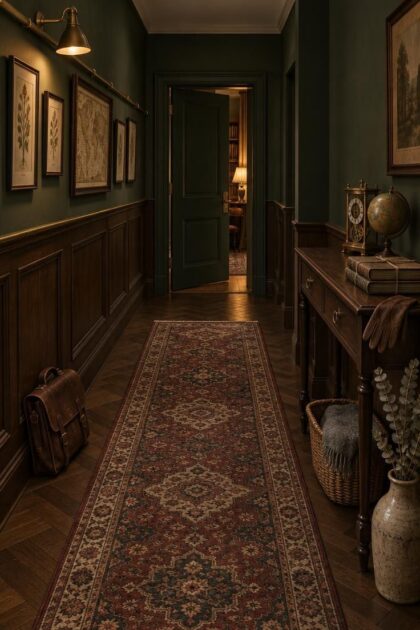
This post may contain affiliate links. If you make a booking or purchase through these links, we may earn a commission at no additional cost to you.
A corridor treated as a passage between studies rather than a route to the next room carries a distinct kind of character.
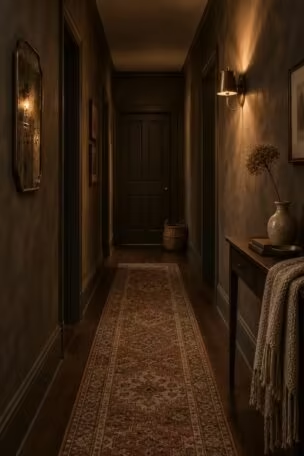
Dark academia styling leans on deep wall colors, antique wood, brass details, and low warm light to give a narrow space a settled, scholarly feel.
Because hallways are used in passing, they can hold moodier treatments than rooms that need to stay bright all day.
What follows are concrete materials, furniture profiles, and lighting arrangements that fit real corridor widths and daily use.
Walnut Picture-Rail Gallery With Framed Botanicals and a Brass Sconce
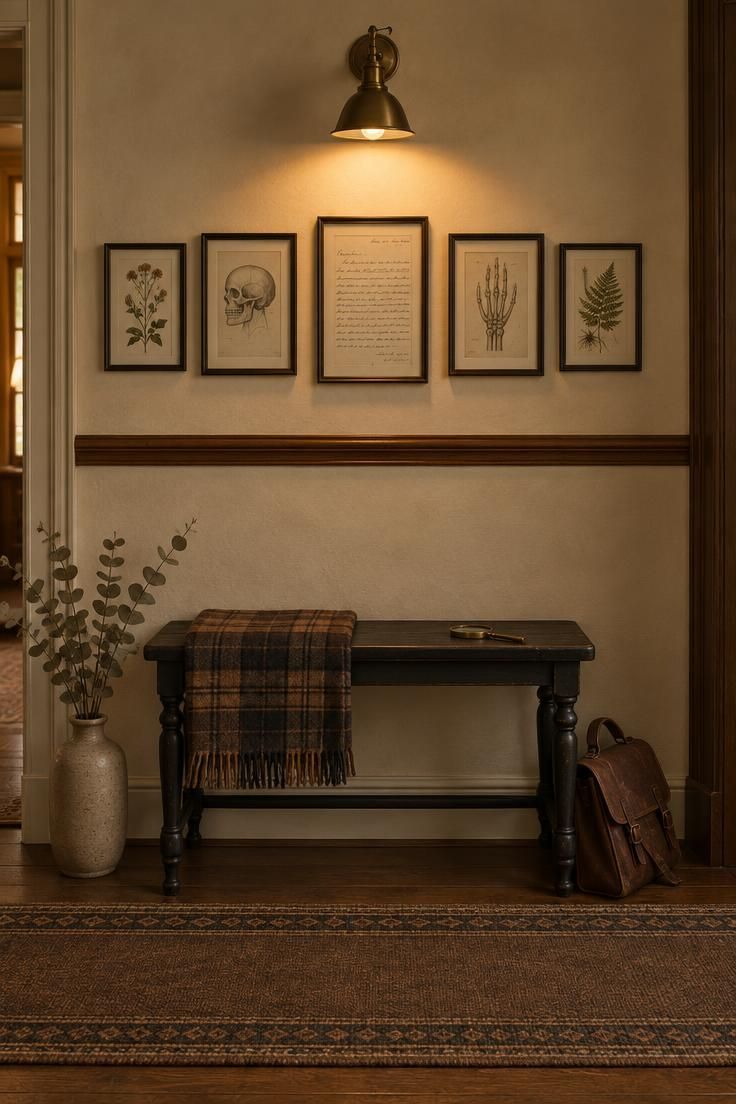
A long hallway wall can carry a scholarly display without any furniture depth.
Mount the rail at chest height, then hang small frames close to the wall so nothing intrudes into the walking path.
Botanical prints, anatomical studies, and handwritten letters all suit the arrangement.
Symmetrical placement reads more formal, while a staggered layout feels collected over time.
Either approach works, but the frames should share a narrow profile so the grouping stays visually calm against dark walls.
Keep the rail shallow for the same reason.
A single brass sconce above the rail pools light over the frames rather than washing the whole corridor, which suits a hallway with no windows.
Warm amber light also flatters aged paper and dark wood, while cool white light tends to flatten both.
A low bench or a floor runner in muted tartan anchors the composition at the base of the wall.
Both options add texture without adding the depth a console table would require, which matters in a corridor where two people need to pass.
Style Blueprint:
- Slim walnut picture rail mounted at chest height
- Five small framed prints in matching narrow black or dark wood frames
- One aged brass wall sconce centered above the rail
- Low bench or muted tartan runner to anchor the base of the wall
Oxblood Wainscoting With Herringbone Floor and a Worn Leather Bench
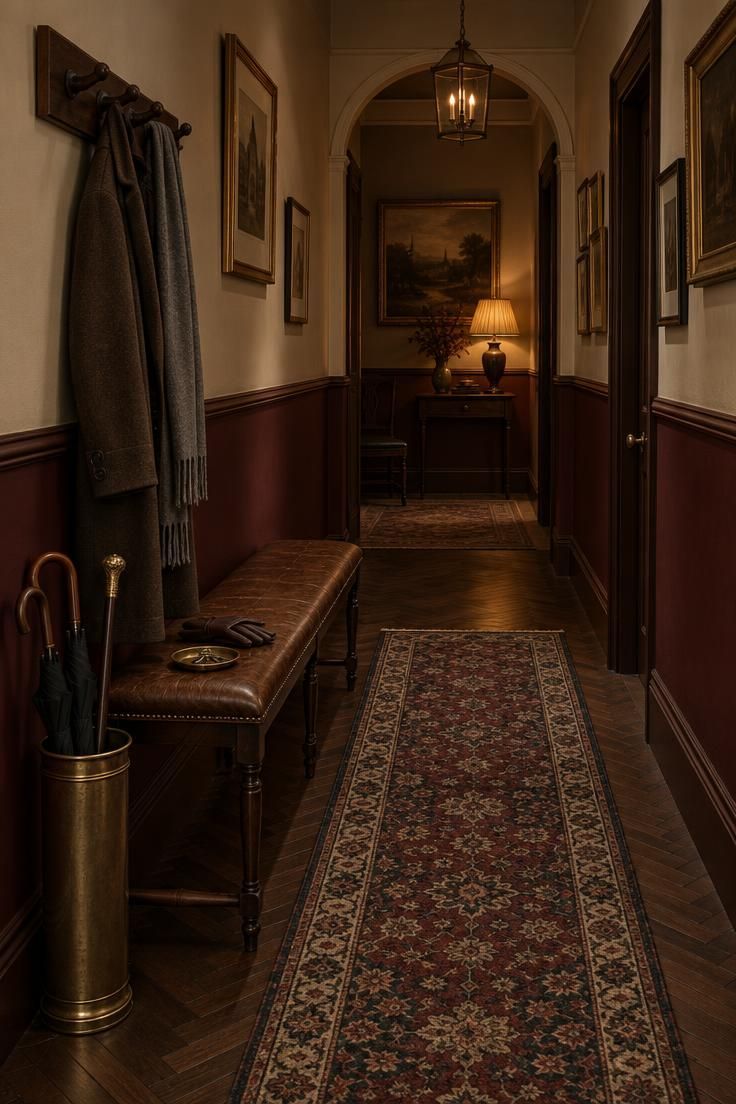
A two-tone treatment works well when the corridor needs defined horizontals.
Deep oxblood below a chair rail and parchment above gives the wall visual weight at the base without making the whole space feel closed.
The division also protects the lower wall from scuffs in a high-traffic passage.
Carrying the dark tone into the floor with a herringbone stain ties the vertical surfaces to the walking path.
A narrow bench with worn leather upholstery gives the dark academia hallway a place to set a bag, and a seat depth under fourteen inches keeps the corridor passable.
Entry functions need a home, so a brass umbrella stand and a peg board with dark wood pegs make a practical cluster near the door.
Grouping them together prevents gear from spreading down the hall.
A faded Persian-style runner layers pattern and color over the herringbone without hiding it completely.
Leave a border of exposed wood on each side so the floor pattern stays visible.
Style Blueprint:
- Oxblood paint on lower walls, parchment above a chair rail
- Dark stained herringbone wood floor
- Narrow leather-upholstered bench with shallow seat depth
Arched Alcove With a Plaster Bust and Library-Style Wall Light
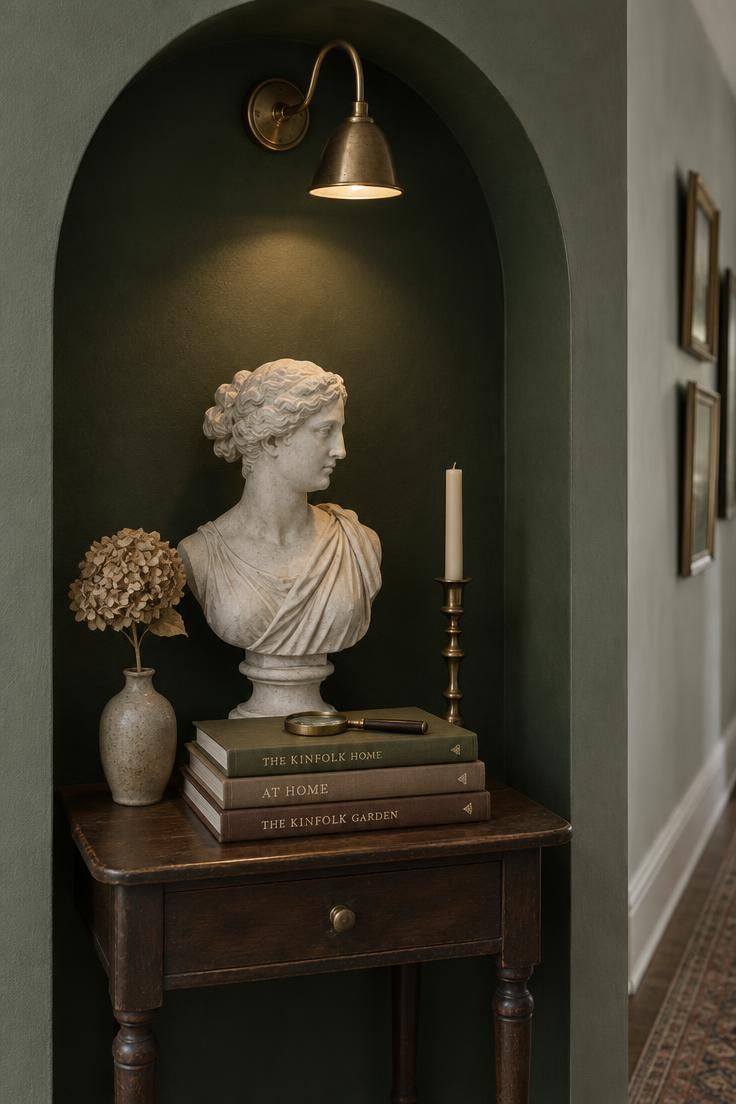
A recessed niche already offers a natural frame, and an arched surround softens the rectangle into something older.
Painting the alcove background a shade darker than the surrounding hall makes the objects inside step forward while the cavity recedes.
Inside, a small table or wall-mounted shelf holds a plaster bust, a short stack of cloth-bound books, and a brass candlestick.
Three objects of differing heights keep the grouping interesting without crowding the limited surface.
Mounting a small gooseneck lamp or shaded sconce above the arch puts light directly on the display instead of the corridor floor.
The effect matters most in windowless halls, where an unlit niche can read as a dark hole.
An oval mirror on the opposite wall can catch the lit alcove and suggest more depth than the corridor has.
Placement matters: the mirror should face the niche at a slight angle rather than sit directly across.
Style Blueprint:
- Shallow plaster arch surround fitted to an existing recess
- Small dark wood table or wall shelf inside the niche
- Plaster bust, cloth-bound books, and a brass candlestick
- Brass gooseneck or shaded sconce mounted above the arch
- Small oval mirror on the opposite wall to catch the lit niche
Design Pro-Tip: Choose a frame finish that matches the picture rail or the sconce, not both, so the hardware reads as one deliberate choice rather than a collection of competing metals.
Encaustic-Look Hallway Tile With a Dark Wood Console and Ornate Mirror
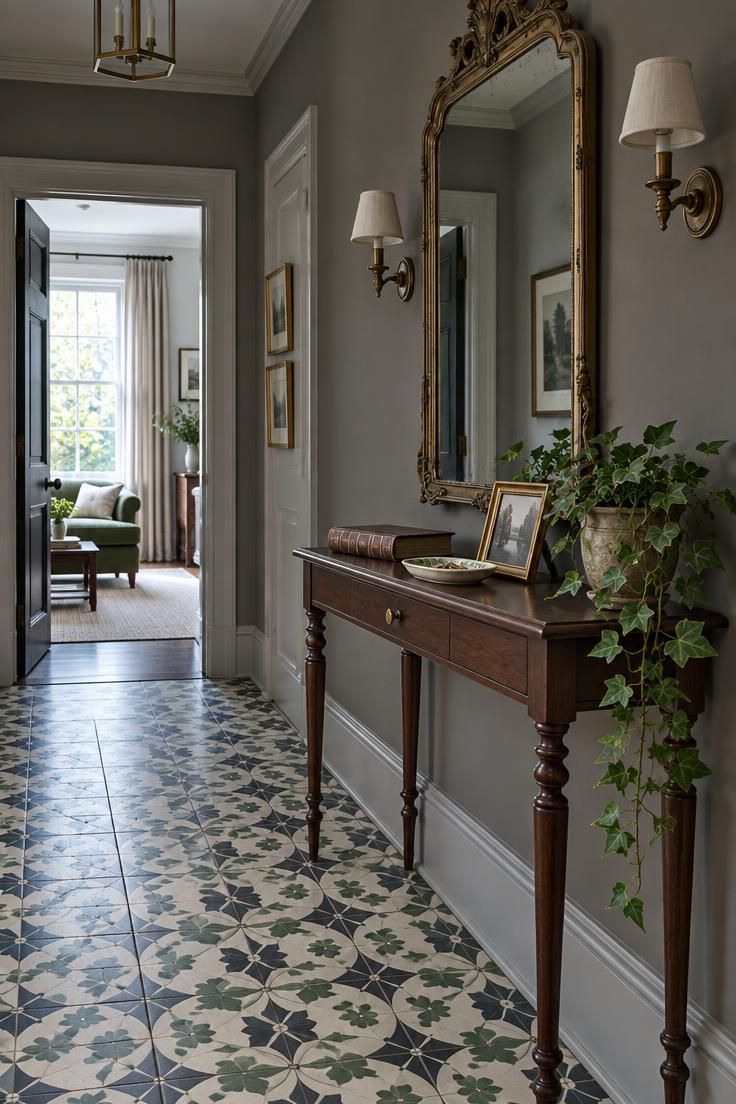
Patterned tile can carry a corridor when the wall palette stays quiet.
Charcoal, cream, and faded bottle green in a repeating motif give the floor a decorative role while the console and mirror provide the furniture.
Pattern scale matters more in a narrow hall than in a wide one.
A smaller repeat with lower contrast feels calmer underfoot, while a bold border or high-contrast motif can overwhelm a tight corridor.
Choose the tile first, then let the wall color pick up one of its tones.
An antique console hallway choice under twelve inches deep keeps the walkway clear, and slender legs let light pass beneath.
Above it, a tall mirror in a tarnished brass or ebony frame bounces daylight from a nearby doorway into the darker end of the hall.
Keep the console surface close to bare.
One ceramic dish, a single book, and perhaps a potted ivy do more than a crowded arrangement of small decor, especially when keys and mail land there daily.
Style Blueprint:
- Encaustic-look porcelain tile in charcoal, cream, and bottle green
- Dark wood console under twelve inches deep with slender legs
- Tall ornate mirror in tarnished brass or ebony
- Single ceramic dish for keys and one small potted plant
Layered Runner Stack Over Wide Oak Planks in a Moody Hallway
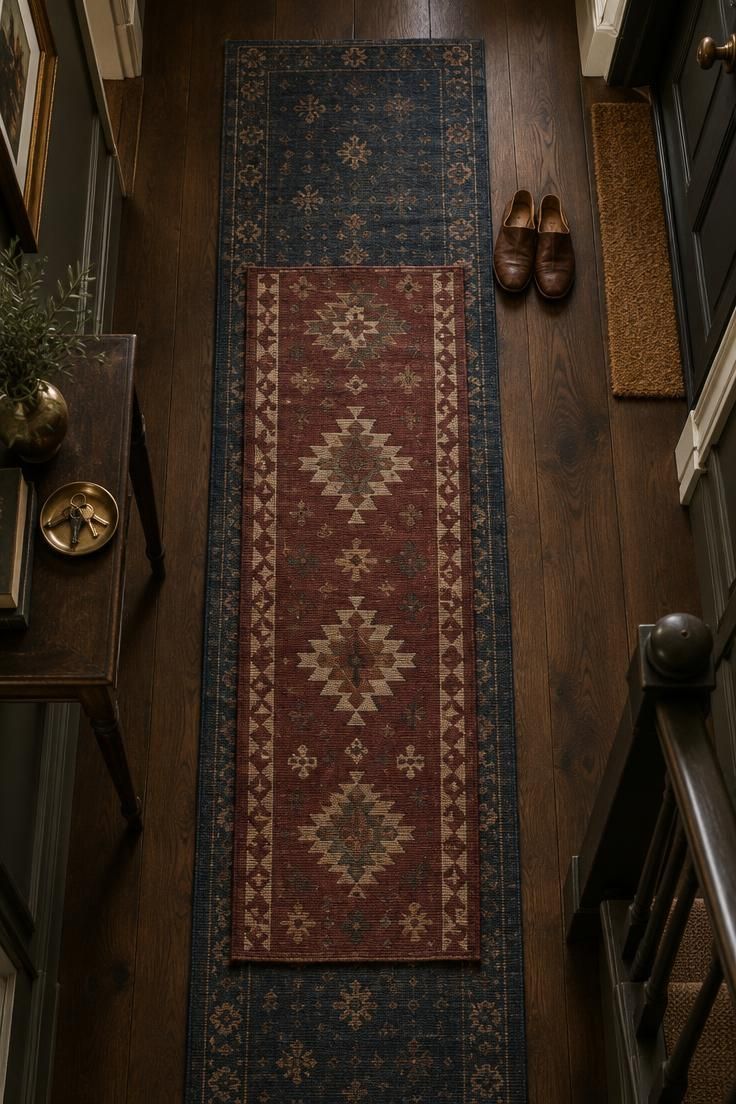
Layering two runners over wide plank flooring gives a corridor a collected, old-house feel without wall-to-wall carpet, and it fits a moody hallway where darker finishes set the stage.
Start with the wood: a dark walnut stain on wide oak sets the base tone, and the runners add pattern where feet actually travel.
A longer base runner in faded navy or charcoal can run nearly the full length of the hall.
A shorter top runner in tartan or kilim adds contrast and takes the wear in the center walkway.
Select low-pile weaves so the layers do not crease underfoot and the edges stay flat.
Where the two runners overlap, a slight offset keeps the arrangement from looking like one rug on top of another.
A slim coir mat just inside the entry door finishes the stack and handles wet shoes.
This approach costs far less than fitted carpet and can be changed seasonally.
It also lets a renter shift the floor’s character without altering the planks.
Style Blueprint:
- Wide oak planks in a dark walnut stain
- Long low-pile runner in faded navy or charcoal
- Shorter flatweave runner in tartan or kilim
- Natural coir mat at the entry
Brass Picture Rail With a Rotating Miniature Print Series and a Low Book Stack
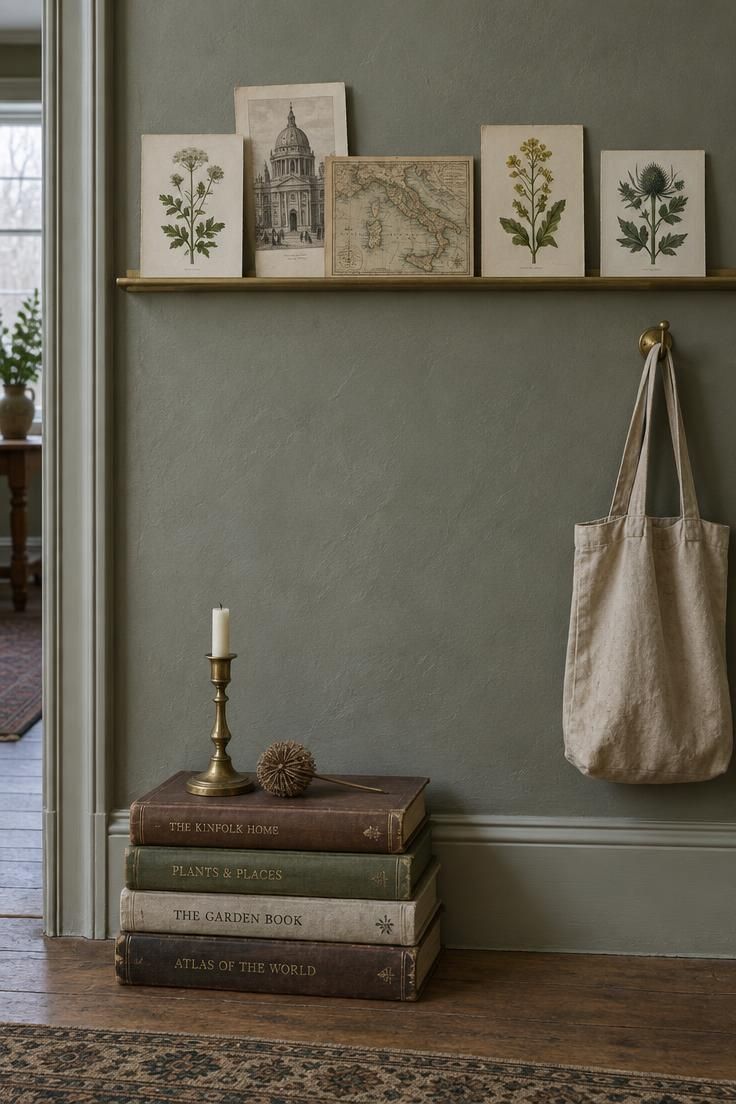
A brass picture rail with a slim ledge lets small unframed prints rest rather than hang, which keeps the arrangement flexible.
Rotating the selection by season or subject, botanical drawings in one stretch, maps and architectural etchings in another, keeps the wall from feeling stale.
Leaning one or two prints behind the front row adds depth and shows the collection is handled rather than sealed away.
Standard print sizes fit most rails without trimming, which simplifies the rotation.
Below the rail, a low stack of three or four large format books against the wall uses spines for color and texture without furniture.
Cloth-bound volumes in brown, green, and cream read warmer than glossy jackets.
A single brass candlestick on top of the stack anchors the corner.
This setup suits renters because the prints are lightweight and the books need no mounting.
Style Blueprint:
- Narrow brass picture rail with a slim display ledge
- Five small unframed prints in standard sizes, rotated seasonally
- Stack of three or four large cloth-bound books on the floor
- Single brass candlestick to anchor the stack
Antique Console Hallway With a Skeleton Clock, Globe, and Stacked Folios
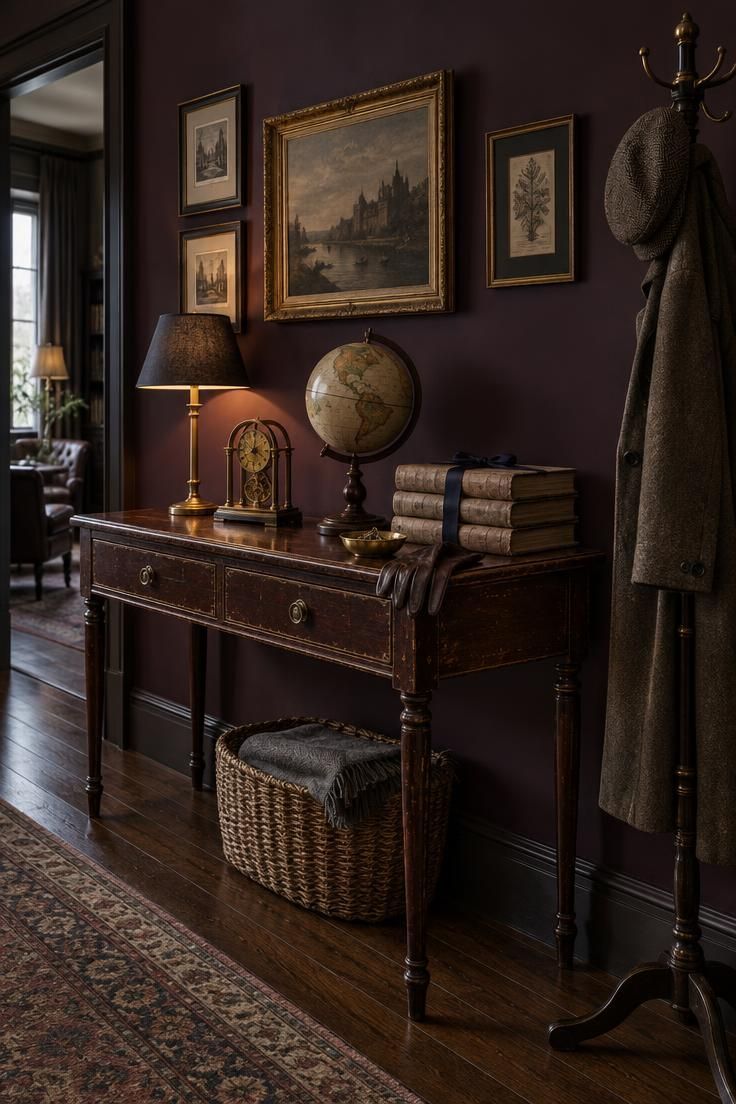
One well-chosen antique console can serve as both the functional and decorative center of a vintage hallway.
A marble-top or dark wood piece with shallow depth keeps the walkway open while giving keys, mail, and gloves a landing surface.
On the surface, arrange three objects of differing heights so the eye moves across the arrangement.
A skeleton clock, a globe on a brass stand, and a short stack of folios tied with twine or cloth tape each read as scholarly without shouting.
Beneath the console, a low lidded chest or two narrow baskets handle shoes, scarves, or mail.
This is where the piece earns its keep in daily use, since open console legs otherwise leave the space underused.
A narrow coat stand nearby keeps outerwear off the wall and off the console.
Leave at least thirty inches of clear walking width so the hall still moves freely when a coat is on the stand and bags are on the floor.
Style Blueprint:
- Antique mahogany console under fourteen inches deep
- Brass skeleton clock, globe on a stand, and tied folios as the surface trio
- Low woven basket or lidded chest beneath the console
- Narrow coat stand placed to preserve walking width
Design Pro-Tip: Keep the lowest object on an antique console slightly taller than the basket below it so the vignette reads as one balanced column from floor to tabletop.
Floor-to-Ceiling Bookshelf in a Recess With a Library Ladder Rail
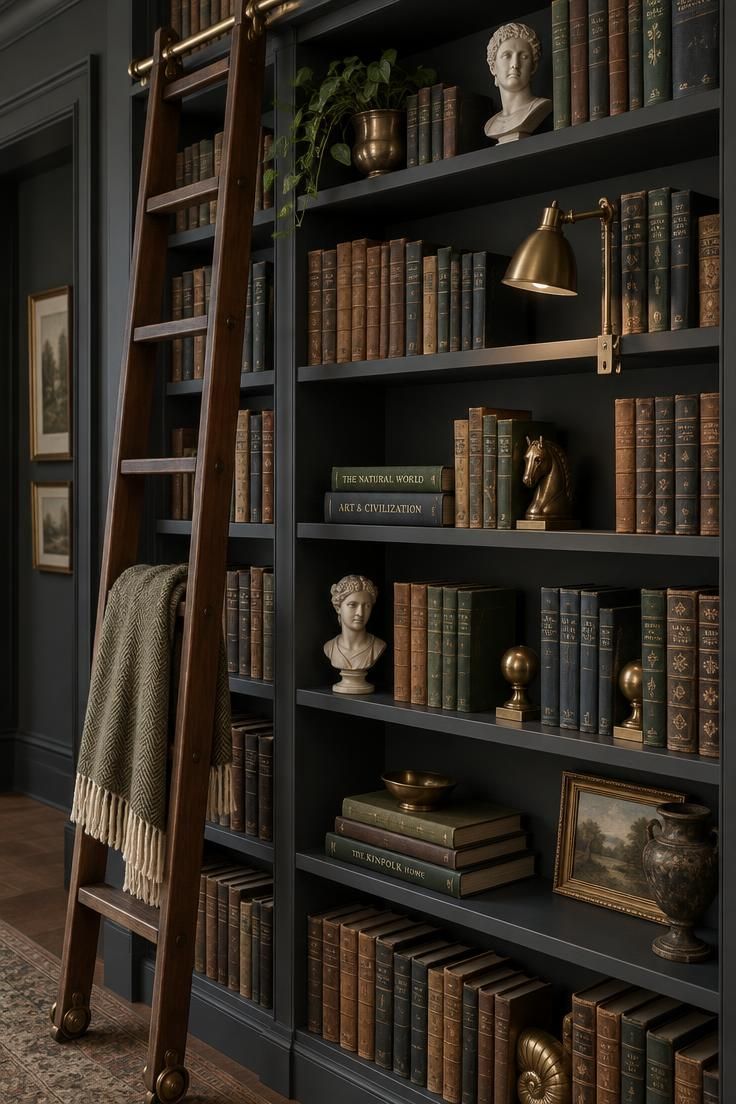
A deep hallway recess can become a shallow bookshelf wall without consuming floor space.
Building adjustable shelves into the alcove and painting the boxes the same deep color as the hallway walls lets the unit read as architecture rather than furniture.
Shelf depth under nine inches keeps books close to the wall and the walkway clear.
Fill the shelves with old hardbacks, small plaster busts, globe-shaped bookends, and a few framed photographs tucked between rows so the arrangement looks handled rather than styled to a single color.
If the hall has high ceilings, a slim rolling ladder on a fixed rail makes upper shelves accessible and adds a distinctly scholarly note.
The rail itself also forms a horizontal line that breaks up the tall vertical mass.
Real books in mixed condition do more for this look than matched decorative volumes.
Worn cloth spines and slight variation in height contribute more than uniform jackets.
Style Blueprint:
- Adjustable shelving fitted into a deep hallway recess
- Shelf boxes painted the same color as the hallway walls
- Mixed vintage hardbacks with plaster busts and brass bookends
- Slim rolling ladder on a fixed rail for upper shelves
Gothic Hallway With Tracery Wall Stencil, Iron Sconce, and Dark Runner
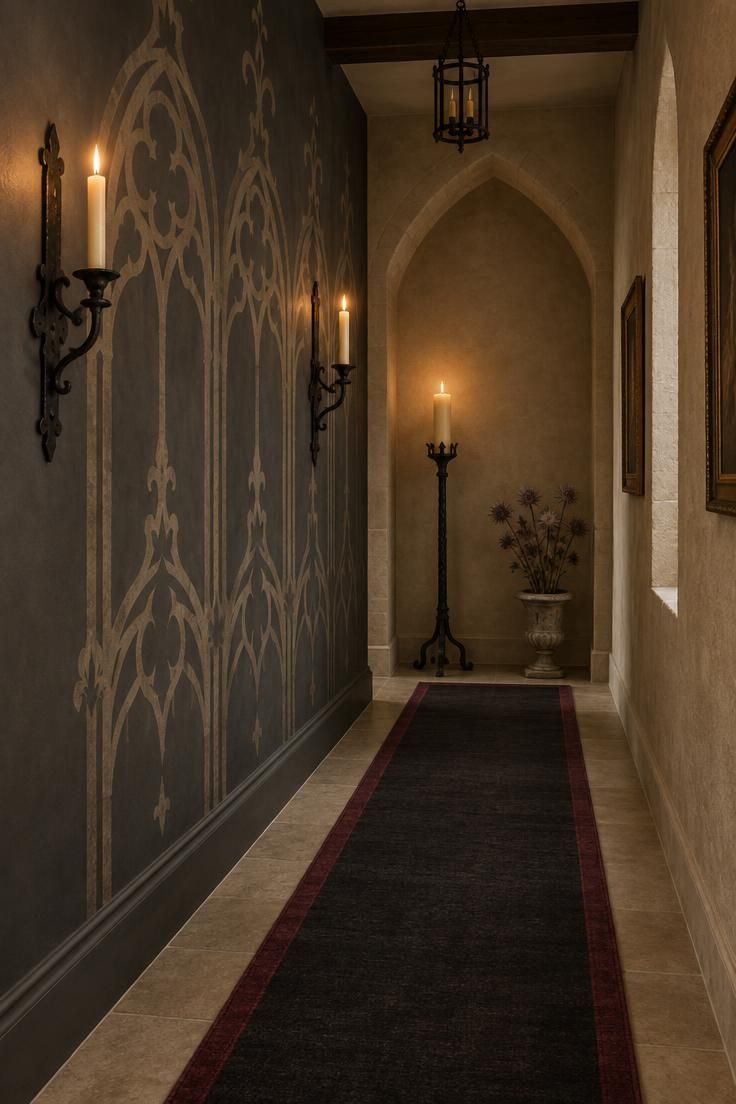
A large-scale stencil brings a gothic note without touching the building’s architecture.
Choose a wall color in deep iron gray, then stencil a tracery or quatrefoil motif in a slightly lighter tone or a matte metallic bronze so it reads as a shadowed pattern rather than a painted graphic in a gothic hallway.
Scale matters here.
A single large motif across a wall section feels like carving, while a small all-over repeat can read as wallpaper.
Flanking the pattern with one or two wrought-iron candle sconces pushes the mood toward a medieval study.
Keep the other walls in a warm stone color so the patterned wall stays the focal point.
Lay a dark runner with a subtle oxblood or black border to define the walking path and absorb footfall in a high-traffic corridor.
Sconces placed at a consistent height on both sides of the motif give the wall balance.
If the corridor has low light, keep the stencil tone closer to the wall color so the pattern emerges gradually rather than reading as a graphic statement.
Style Blueprint:
- Deep iron gray wall paint with a large-scale tracery or quatrefoil stencil
- One or two wrought-iron candle sconces flanking the pattern
- Warm stone tone on the opposite wall
- Dark runner with a thin oxblood or black border
Vintage Hallway With a Dark Wainscot, Peg Rail, and Umbrella Stand
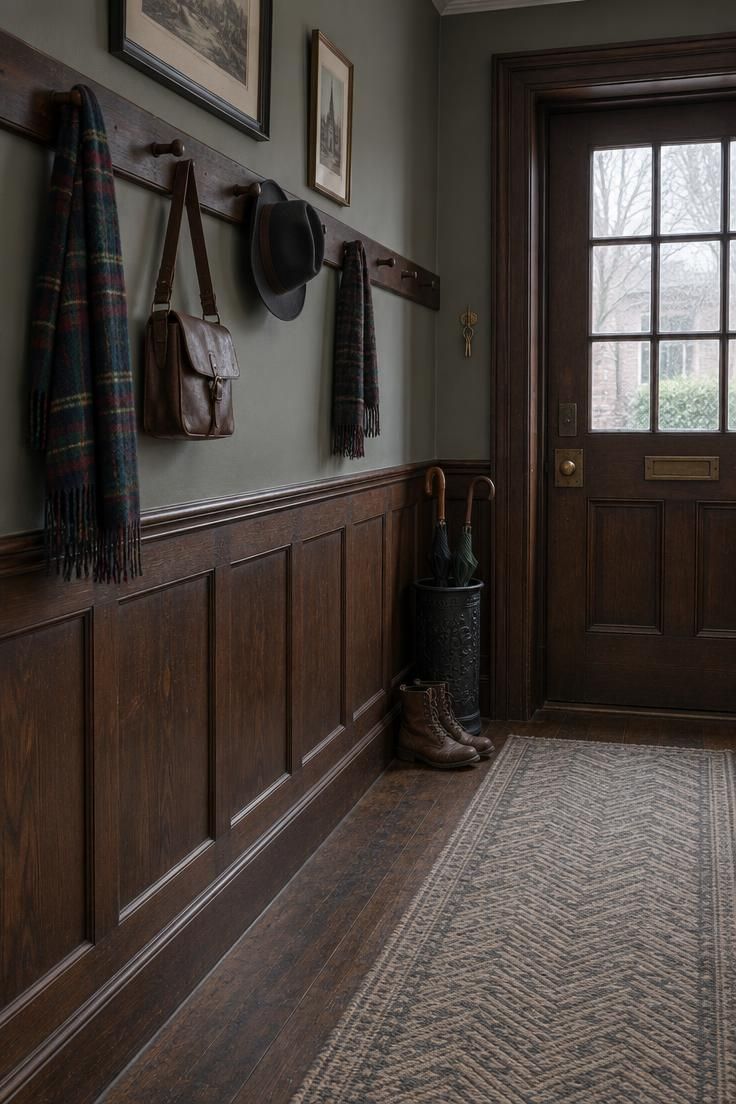
Dark wainscoting to chair-rail height gives a plain hall the feel of an old academic building.
Flat panels with a narrow top rail keep the profile restrained, and a dark stain sets the lower wall apart from the upper in a way that reads as age rather than paint drama.
Above the wainscot, paint the upper wall in a quiet gray-green or faded putty, then run a wide wooden peg rail along the full length at shoulder height.
Grouping scarves, a satchel, and a wide-brimmed felt hat in small sets avoids the clutter that comes from spreading items evenly.
A dark umbrella stand near the door handles wet gear without drawing attention.
A cast-iron or ceramic piece with a worn finish sits naturally in this scheme, and it keeps umbrellas off the runner.
A single runner in muted herringbone completes the corridor and protects the floor under the umbrella stand.
It also adds pattern to a scheme that otherwise relies on wood and paint.
Style Blueprint:
- Dark-stained wainscoting with flat panels to chair-rail height
- Upper wall painted quiet gray-green or faded putty
- Wide wooden peg rail at shoulder height
- Cast-iron or ceramic umbrella stand near the door
- Muted herringbone runner along the full corridor
Design Pro-Tip: When grouping items on a peg rail, hang the shortest piece at the center of the set and the tallest at the outer edges so the cluster reads as one shape from down the hall.
Hallway Gallery Wall in Mixed Brass Frames With a Slim Credenza
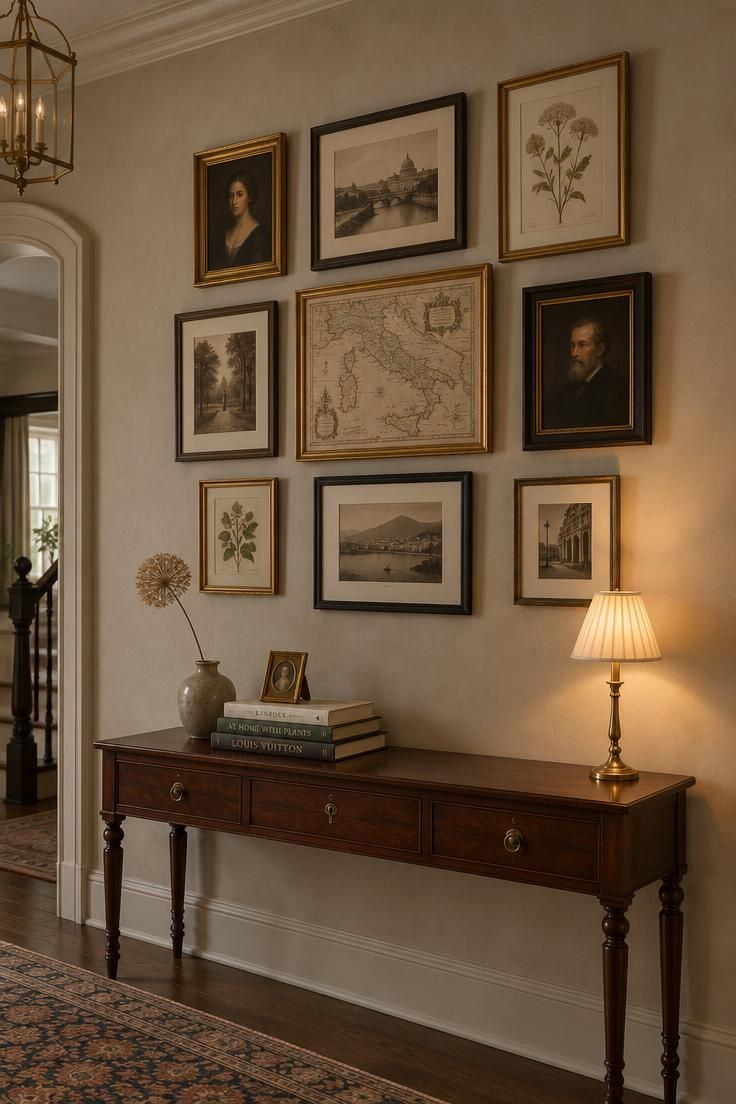
A single long wall can support a sizable picture collection when the arrangement for a hallway gallery wall is planned around a rectangle.
Mix small oil portraits, sepia photographs, botanical prints, and an antique map, but keep a consistent palette of gold, brass, and black frames so the mix feels deliberate.
Mixing sizes within that rectangle gives the wall rhythm without turning it into a jumble.
Center the composition at standing eye height, roughly fifty-seven inches from the floor, so the grouping relates to the people who pass it.
Below the gallery, a slim credenza with a dark stain and shallow depth holds a few stacked books and a single candlestick lamp.
The lamp should sit below the lowest frame line so it lights the wall without competing with the artwork.
Leave at least three inches of clearance between the lowest frame and the credenza top.
That gap keeps the wall from feeling crowded and protects the bottom row from objects placed on the surface.
Style Blueprint:
- Nine framed works in gold, brass, and black frames
- Loose rectangular grid centered at standing eye height
- Slim dark wood credenza with shallow depth
- Single candlestick lamp below the lowest frame line
Conclusion
A dark academia hallway works best when each element has a clear role.
Wall color, floor pattern, furniture profile, and lighting all contribute without clutter, and none of them needs to do more than its share.
Start with one change that matches the actual width and light level of the corridor, whether that is a runner, a picture rail, or a deeper tone on the lower walls.
Test proportions with a temporary arrangement of books, frames, and a small lamp before committing to larger pieces.
The result should feel collected rather than decorated, with practical clearance preserved for daily passage.