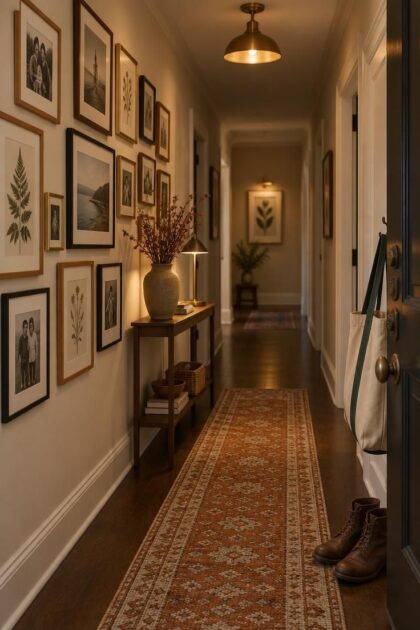
This post may contain affiliate links. If you make a purchase through these links, we may earn a commission at no additional cost to you.
Hallways are the rooms people walk through rather than sit in, and that changes how a gallery wall behaves.
Standing only a few feet from the wall, a person passing through sees frames as a sequence instead of separate objects.
Warmth in a hallway composition comes from repetition, a held palette, and subject matter that belongs to the household.
The ideas below cover layout systems, frame choices, and the practical obstacles worth planning around, with a focus on visual composition rather than installation guidance.
Frame the Corridor With a Warm Wood Gallery Ladder
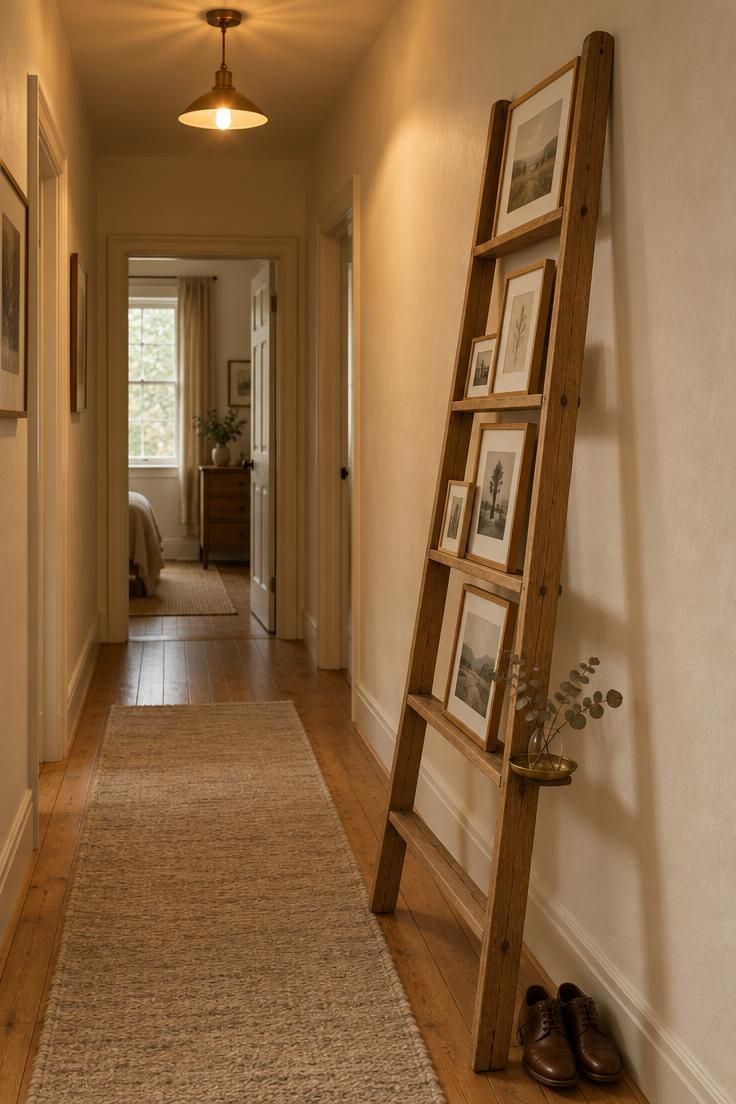
A leaning wooden ladder becomes the spine of the composition, and the frames simply ride its rungs.
The ladder's diagonal gives the eye a direction to follow from one end of the corridor to the other.
Thin oak or walnut frames suit the warm wood tone, and small to medium prints keep the column feeling like one rhythmic line rather than a stack of separate pictures.
A wool or jute runner in a muted tone anchors the base so the ladder does not appear to float.
Swapping a print means lifting it off a rung, which makes this one of the more revisable arrangements.
A leaning ladder occupies floor space, so a narrow hallway benefits from a shallow footprint.
Low rungs sit in the bump-and-brush zone, which makes the upper rungs a better home for anything precious, and dust collects on rung tops and frame edges between cleanings.
Style Blueprint:
- Leaning wooden gallery ladder as the composition spine
- Thin oak or walnut frames with warm paper mats
- Small-to-medium print sizes so the ladder reads as one rhythmic column
- A wool or jute runner in a muted tone to anchor the base
Line a Top-Aligned Row Above a Slim Painted Console
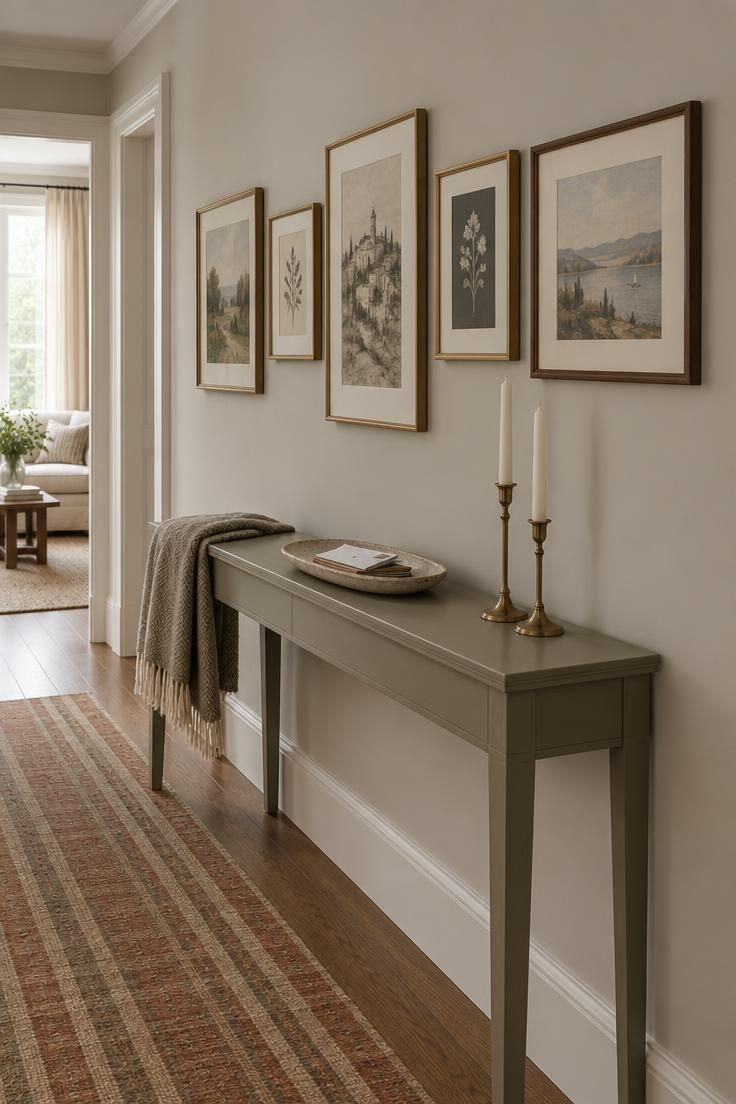
Top alignment lets mixed frame sizes read as a single horizontal band, which suits a corridor where the eye travels lengthwise.
The band guides attention down the hall rather than letting each frame become an isolated island.
It is one of the more forgiving layouts for a mix of portrait and landscape pieces because size variation matters less than the shared top edge.
Objects on the console need breathing room from the frames above, so styling should stay low and horizontal.
A shallow console preserves walkable width in a narrow hall, and that depth matters more than the console's length.
Wide gaps between frames undo the aligned effect, while tighter spacing keeps the group reading as one unit.
A long row takes a few more minutes to dust than a small cluster, and too-tall objects on the console break the band's clean line.
Style Blueprint:
- Mixed frame sizes, all sharing one strong top line
- A slim painted console beneath, keeping the lower wall visually quiet
- Neutral mats in cream or off-white to unify varied artwork
- A tray and one or two small objects on the console, nothing tall enough to compete with the frames
- A folded textile or runner to soften the hard edges of the console
Set a Picture Ledge Where the Family Photos Change With the Season
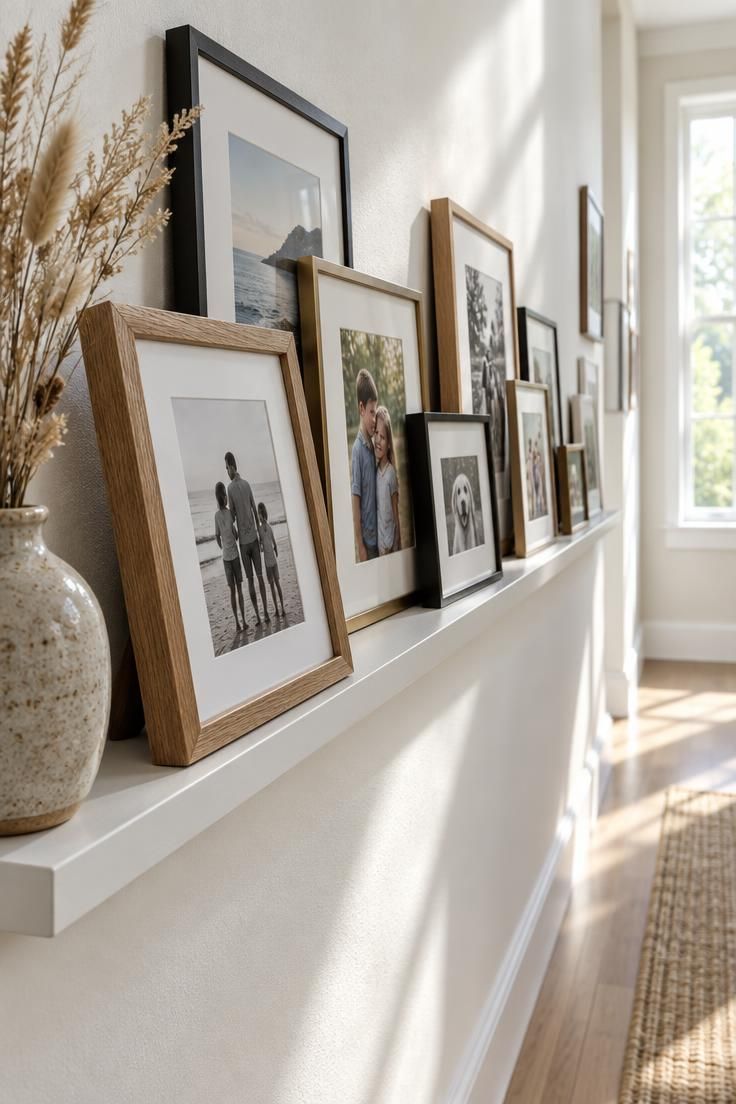
A picture ledge turns a hallway wall into a family photo wall that can be rearranged whenever the photos change.
The horizontal ledge reinforces the corridor's long axis, and the frames can be layered rather than spaced apart.
No rehanging is needed when the arrangement evolves, which suits a household with growing children.
Frames on a low ledge sit in the bump zone, so taller or heavier pieces read best toward the back row.
A ledge and its frames sit proud of the wall by design, which means a shallow profile serves a narrow hallway better than a deep shelf.
Ledge edges and frame tops collect dust and reward a regular pass with a soft cloth.
Overlapping frames in a narrow hallway picture wall let one ledge do the work of several small clusters, so the corridor keeps its walking room.
Long hallway picture ledges also use repetition to carry the eye toward the far end of the space, with photos changed out season by season as children grow.
An end wall art composition anchors the view from the opposite end of the corridor, so the far side of the ledge holds the tightest cluster of matching frames.
When floor space is tight, a small hallway art arrangement on a nearby side wall keeps the ledge from carrying every piece and lets the seasons rotate through two spots.
Style Blueprint:
- A shallow picture ledge running the length of one solid wall
- Frames in a consistent wood or white finish, or a deliberate mix
- Overlapping frames of mixed sizes for a layered, lived-in look
- The most recent family photos placed where they catch the light
Design Pro-Tip: Lean a few frames forward at slight angles in the front row; the layered depth reads warmer than perfectly upright rows.
Repeat a Botanical Print Grid in Matching Frames Down One Long Wall
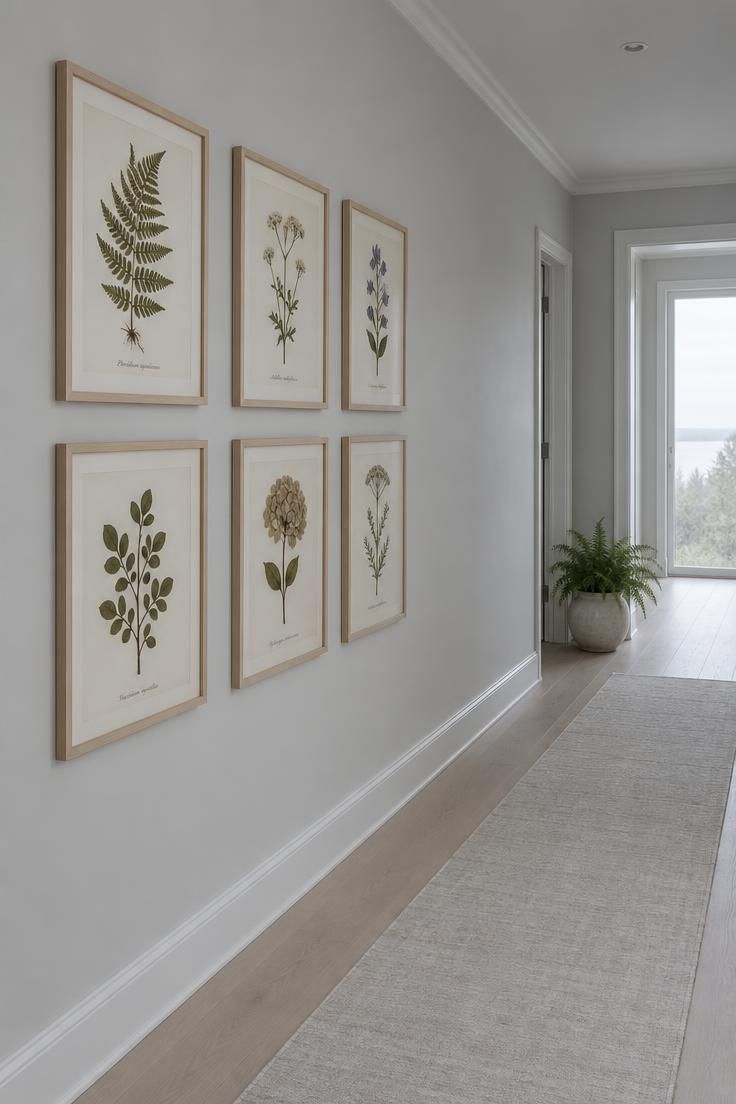
A botanical print wall works when one subject carries every piece, so variety comes from the plants rather than the frames.
Matching pale wood or thin black frames with identical mats turn the grid into a single calm unit.
The green and grey palette sits quietly against most wall colors, and the grid's repetition supports the hallway's directional walk.
A true grid depends on equal spacing and shared alignment, since small drifts read as accidental rather than relaxed.
Portrait prints stacked in columns suit tall walls, while landscape prints suit a wider band.
Diagonal viewing from across the corridor is where the grid reveals its discipline, and that angle is the one worth checking before settling the arrangement.
A grid tolerates little variation, and one odd frame or off-spacing piece disrupts the set.
Botanicals can feel cool and reserved if the hallway has no other warm material nearby.
Swapping content means reframing or accepting a mismatch in the set.
Style Blueprint:
- One botanical subject across all pieces, so variety comes from the plants, not the frame
- Matching pale wood or thin black frames with identical mats
- Even spacing that reads as one calm grid
- A cool, restraint-focused palette: green prints, pale walls, muted runner
Center a Cluster on the Hallway's End Wall
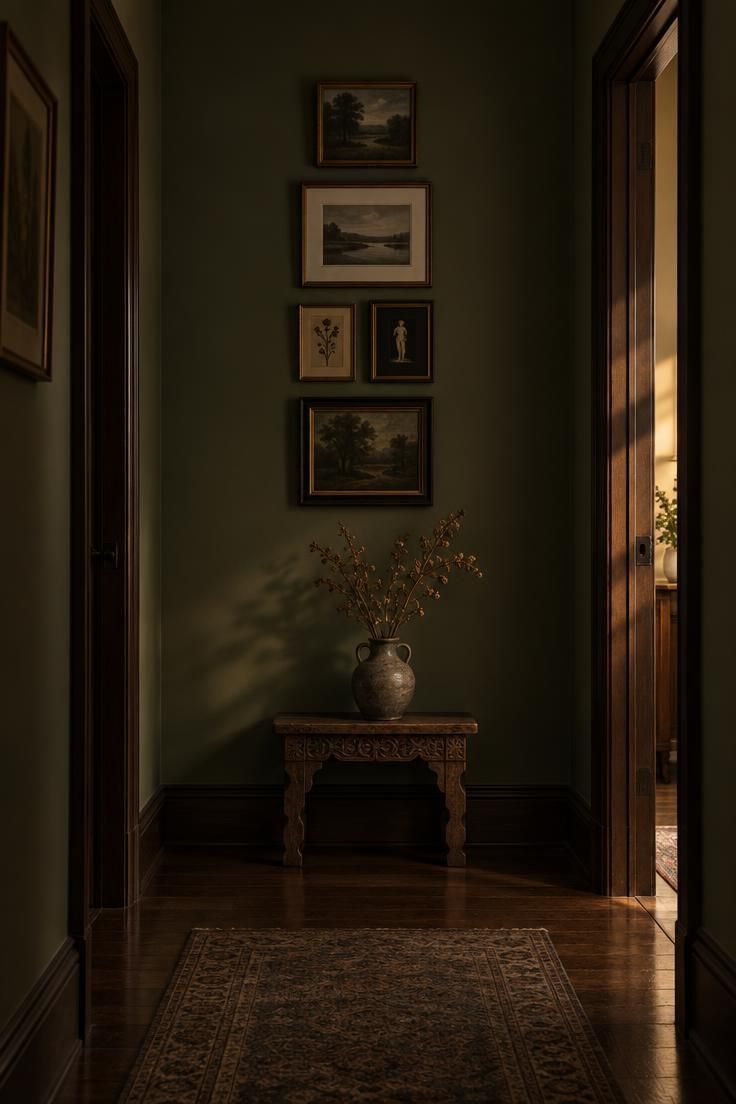
The end wall is visible from a distance and rewards a single composed unit instead of a scattered row.
A cluster centered on the vertical axis reads as an intentional statement, and deep-toned frames hold their own in dim light.
Moody low light turns deeper frames into quiet silhouettes rather than a muddle of dark shapes.
A small bench or stoneware vessel below grounds the lower wall so the cluster does not appear to hover.
In a dark hallway, frames and glass can read as one murky mass, which makes the mat and artwork values worth choosing carefully.
The layout depends on the end wall being free of doors and switches, and rearranging a centered cluster often means starting the layout over.
Style Blueprint:
- A tight cluster centered on the end wall's vertical axis
- A small bench or stoneware vessel below to ground the lower wall
- Deep-toned frames that hold their own in dim light
- Warm wall color behind the frames to keep the mood cohesive
Build a Mixed Frame Salon Wall Grounded by a Narrow Hall Console
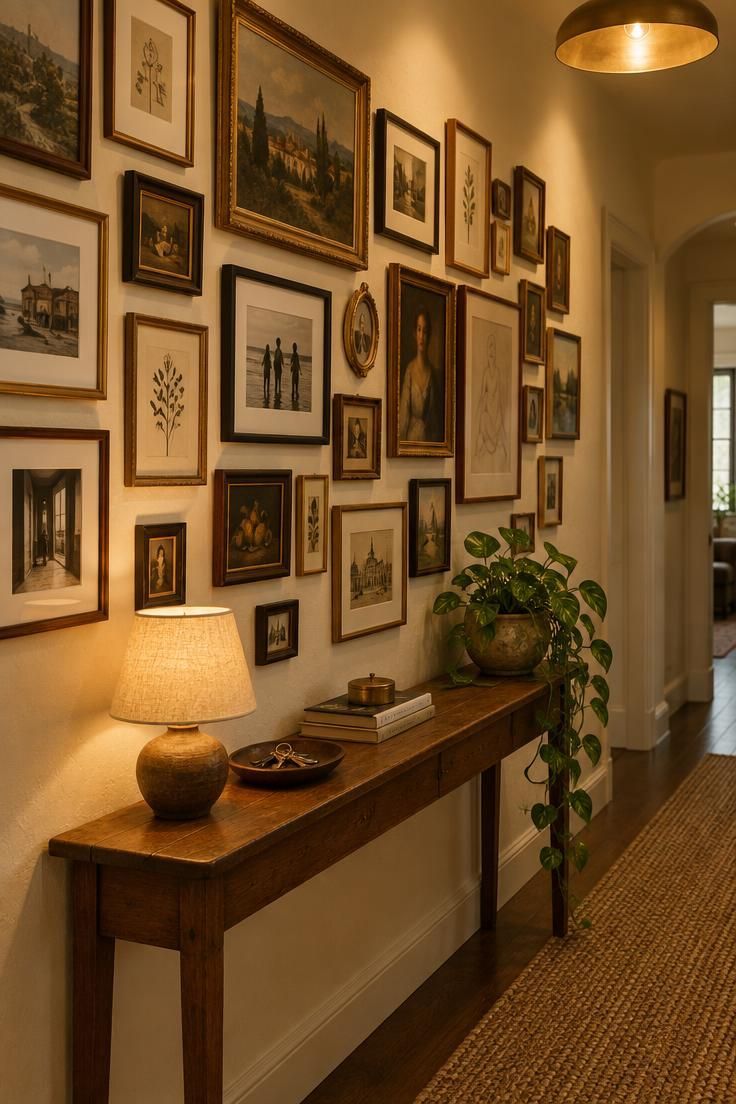
A dense salon arrangement rewards the short viewing distance in a corridor because the eye takes in the whole unit rather than individual frames.
A unified mat color or accent palette keeps an eclectic mix from reading as visual noise.
Tighter spacing keeps the arrangement feeling like one composition, and the console below gives the wall a functional anchor for keys and mail.
The console's styling should leave vertical space between the surface and the lowest frames, and a shallow console preserves walking width.
A tray or dish corrals everyday items so the wall below stays calm.
In a dark hallway, a dense salon wall can read as a dark mass, and a warm lamp on the console changes how the cluster presents itself.
A salon wall is not quickly revised, since changes ripple through the whole cluster, and dusting around many frames takes more time than a simple grid.
Style Blueprint:
- Mixed frames and varied artwork arranged in a dense salon composition
- A unifying rule: one mat color, one accent palette, or one subject thread
- A narrow wooden console beneath to catch keys and mail
- A single small lamp or low object on the console that does not compete with the frames above
Design Pro-Tip: Lay the full salon arrangement on the floor first and photograph it from a low angle to preview how it reads at hallway walking distance.
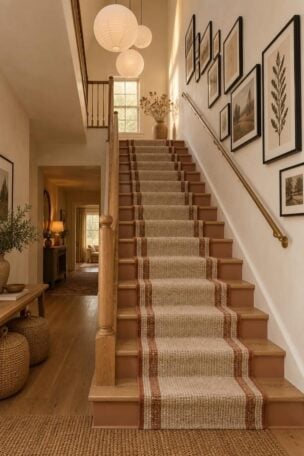
Step a Stairwell Gallery Wall Along the Ascent
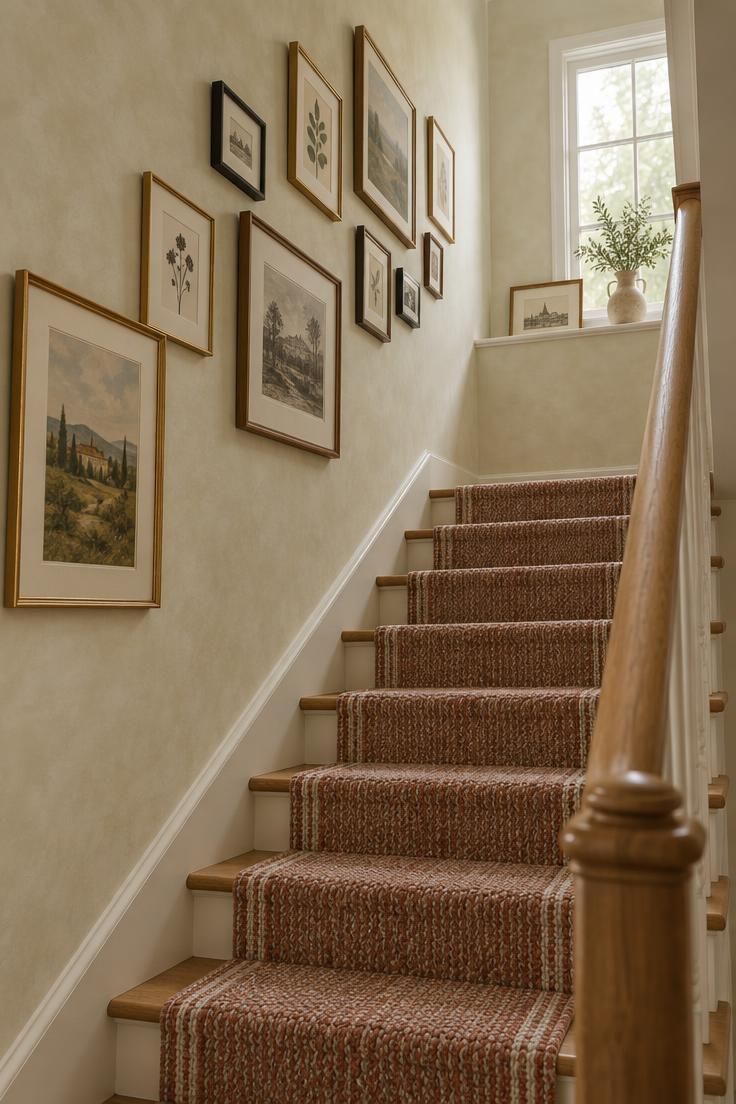
A stairwell gallery wall rides the stair's diagonal rather than fighting it, and that gives the composition its own logic.
Viewing happens at varying heights as a person climbs, so smaller pieces stay legible along the way.
A consistent frame finish or mat color holds the ascent together, while a mix of portraits and small landscapes lets the step read as rhythm.
The rake set by the stairs, not by the wall, guides the arrangement.
Frames in the lower flight sit closer to passersby and are brushed more often than those higher up, and frames should clear the handrail line so the rail reads clean.
A stepped arrangement is harder to revise than a grid because each frame depends on its neighbors, and glare from a landing window can wash out glass-fronted pieces.
Style Blueprint:
- Frames arranged in a stepped line that tracks the stair's diagonal
- A consistent frame finish or mat color to hold the ascent together
- A mix of portraits and small landscapes so the step reads as rhythm
- A warm wood handrail or newel as a visual companion to the frame tones
Display Kids Art on a Painted Band With Identical Clip Frames
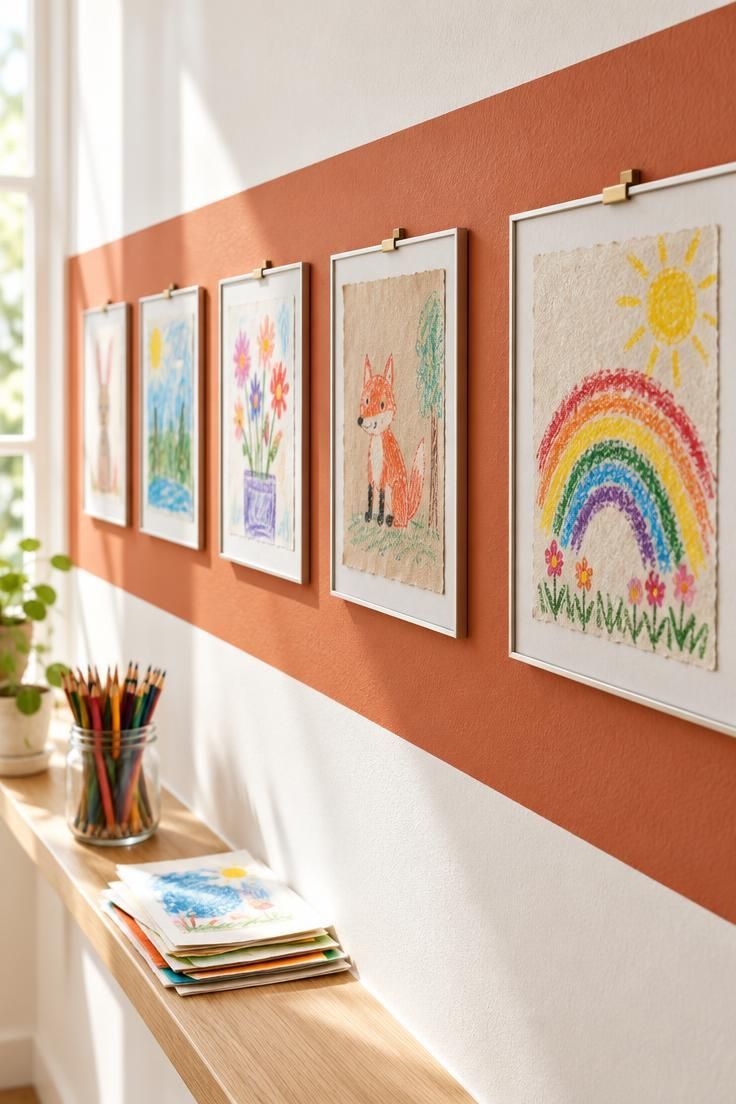
A painted band does the visual work on a kids art display wall, and the frames simply sit inside it.
Clip frames swap drawings in seconds, which suits art that changes weekly.
The band's horizontal line reinforces the hallway's length, and its top and bottom edges act as guides the frames can align to.
The band's color should relate to the hallway's main palette rather than fight it.
A low ledge below the band keeps spare drawings accessible without adding visual weight above.
Clip frames have exposed edges that catch dust and fingerprints, and drawings on colored paper and in mixed media vary widely, which the band helps calm.
Children who use the hallway daily may brush low frames, so keeping pieces inside the band's higher zone suits a busy corridor.
Style Blueprint:
- A horizontal painted band in a warm neutral or soft accent color as the wall's backbone
- Identical slim clip frames holding kids' drawings of all sizes
- Frames aligned to the band's top and bottom edges for a tidy row
- A shallow ledge below the band for rotating or resting extra pieces
Design Pro-Tip: Choose a band color a shade deeper than the wall; the contrast is enough to hold the row without needing a heavier frame line.
Unify a Black-and-White Photo Wall With One Mat Color
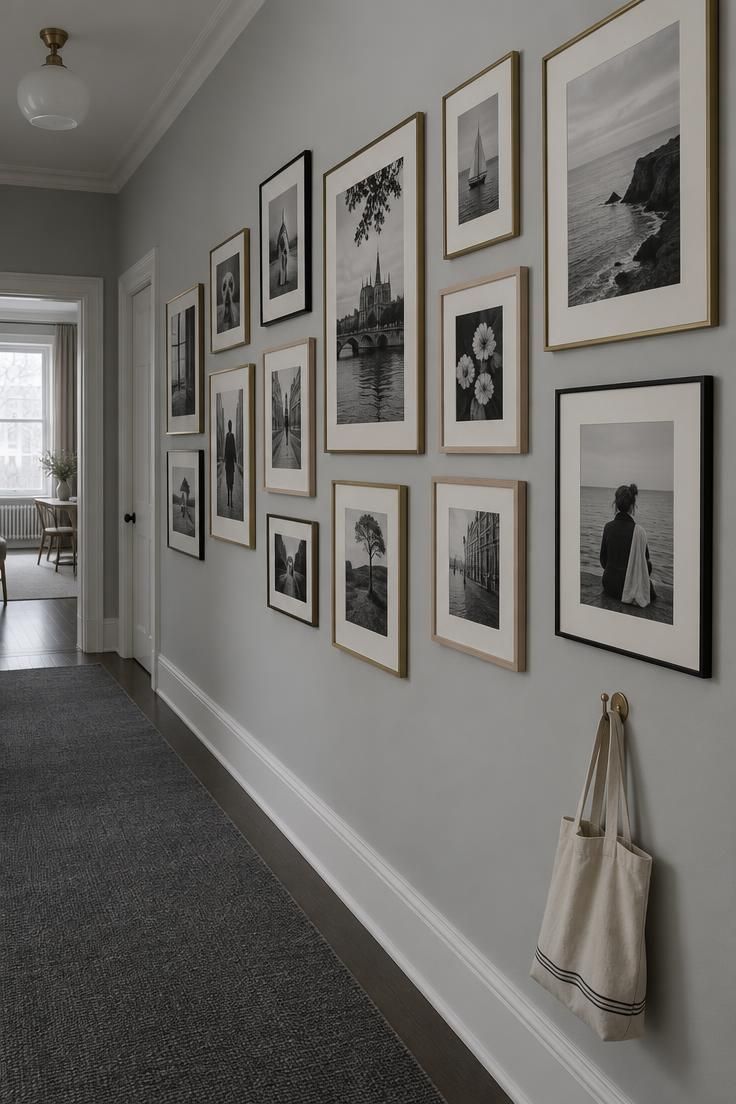
A black and white photo wall holds together when one mat color creates a consistent border around every image regardless of frame finish.
Black-and-white photography reads as one family even when decades or subjects differ.
Varied frames then add texture without asking the eye to sort through colors.
Glass in a dim hallway catches reflections, and matte glazing or unglazed prints reduce that glare.
Frames brushed by coats and bags sit in the bump zone, and glass edges low in the hallway take the most contact.
Rearranging is fiddly because each frame's position is unique.
Style Blueprint:
- A single subject thread: black-and-white photography across all pieces
- Mismatched frame finishes in thin profiles
- One mat color, cream or off-white, as the unifying rule
- A neutral wall and muted runner that let the photographs carry the palette
Hold a Monochrome Palette Across Metal and Painted Frames
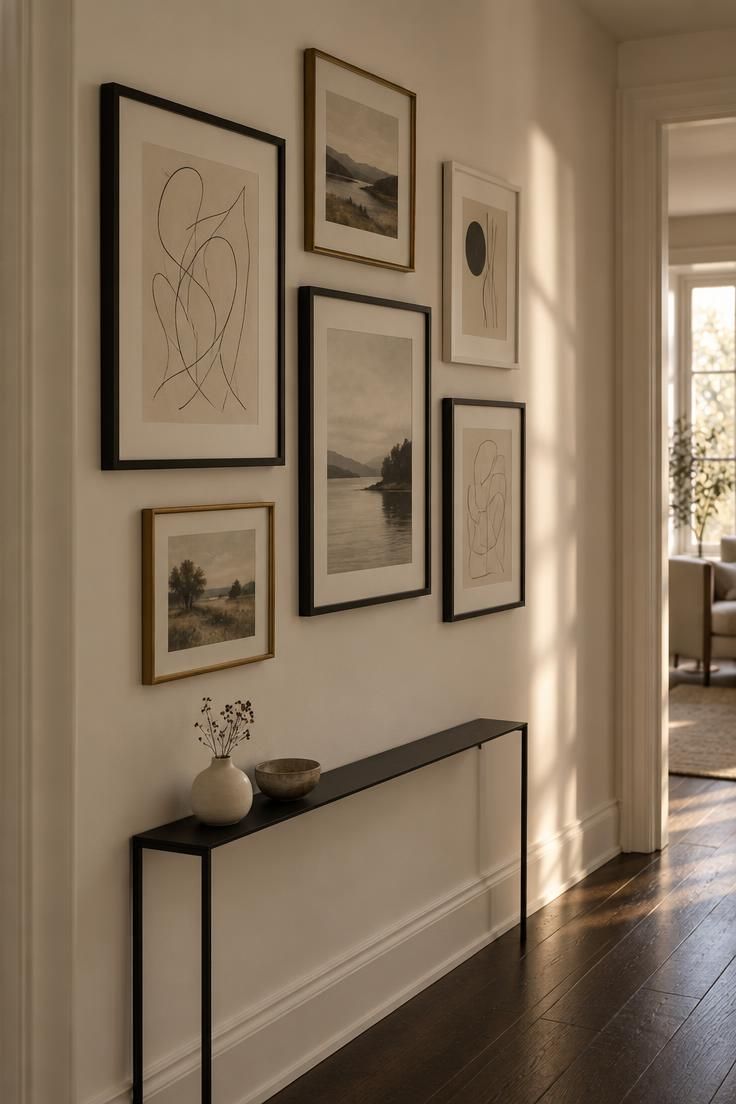
In a monochrome palette, the finish rather than the subject ties the group together, which allows unrelated artwork to share a wall.
Matte black, antique brass, and chalk white frames can sit side by side when the artwork stays within the same restrained color range.
An asymmetric organic cluster requires more trial placement than a grid, and the payoff is a wall that looks less rigid.
A slim shelf below gives the lower wall a horizontal anchor and a place for a small object or two.
Mixed metal finishes need one repeated tone to read as intentional rather than accidental, and that repeated tone is usually the one closest to the wall color.
Loose clusters are the hardest arrangement to adjust incrementally, since moving one frame shifts the balance of the whole group.
Style Blueprint:
- One restrained palette across every frame finish and every piece of artwork
- Matte black, antique brass, and chalk white frames in a loose cluster
- Artwork limited to line drawings or quiet landscape prints
- A slim shelf below for one or two small objects
- A repeated neutral tone in the mats to tie the finishes together
Conclusion
Hallway gallery wall ideas work best when the composition respects short viewing distance, corridor sightlines, and the doors, switches, and vents that interrupt a wall.
Warmth comes from repeated materials, a held palette, and subject matter that means something to the household, not from any single frame.
Revisable systems such as ledges, clip frames, and leaning ladders suit hallways whose content changes with the seasons or the school year.
The strongest arrangement is the one that fits the walk.