This post may contain affiliate links. If you make a booking or purchase through these links, we may earn a commission at no additional cost to you.
A Victorian hallway sets the tone for the whole house, and it usually has to work harder than any other room.
It handles wet coats, school bags, muddy shoes, and the first impression guests receive, all within a footprint that is often long and narrow.
The period vocabulary is generous: encaustic tiles, deep dados, picture rails, turned balusters, and lantern lights.
What follows is a set of visual directions rather than a restoration manual, each one built around a single surface, material, or piece of furniture you can evaluate against your own entrance.
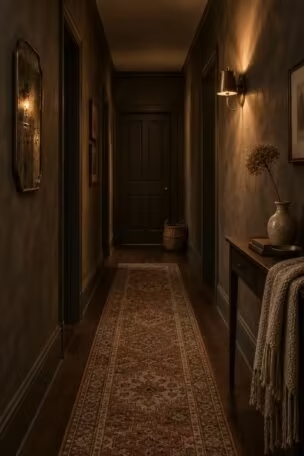
Full-height patterned wallpaper with a plain runner
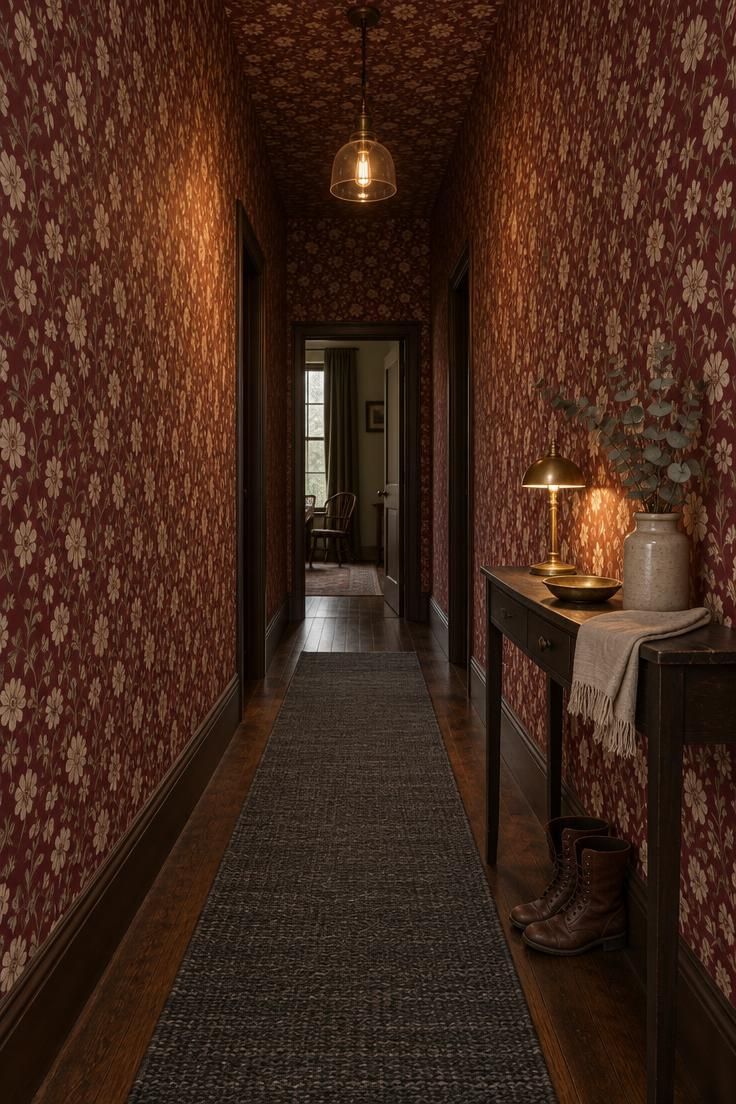
Wallpaper that runs the full height without a rail turns the wall into one continuous decorated surface, which suits a hall with good ceiling height and no awkward breaks for doors or meters.
A plain runner underneath does the balancing work, since the eye needs somewhere neutral to land when every vertical plane is patterned.
Pattern scale is the first decision.
A small repeating motif holds together in a corridor under about four feet wide, while a large floral needs a wider hall or it will be cropped constantly by door frames and corners.
Commitment is the second.
Once the paper is up, every later choice, from the mirror frame to the stair paint, has to answer to it.
Because the wall is doing all the talking, this suits a household willing to treat the paper as the permanent feature and keep everything else quiet.
Style Blueprint:
- Medium-scale floral or damask wallpaper in a deep ground color
- Solid wool runner in charcoal or another dark neutral
- Slim console with a small lamp for a warm pool of light
- Glass-shaded pendant with a simple metal fitting
- Dried stems in a stoneware jar rather than fresh flowers
Design Pro-Tip: Look at wallpaper samples under the actual hallway lighting at the hour you use the hall most, because a paper that reads rich in daylight can turn muddy under a warm bulb.
Three-band wall treatment with dark dado
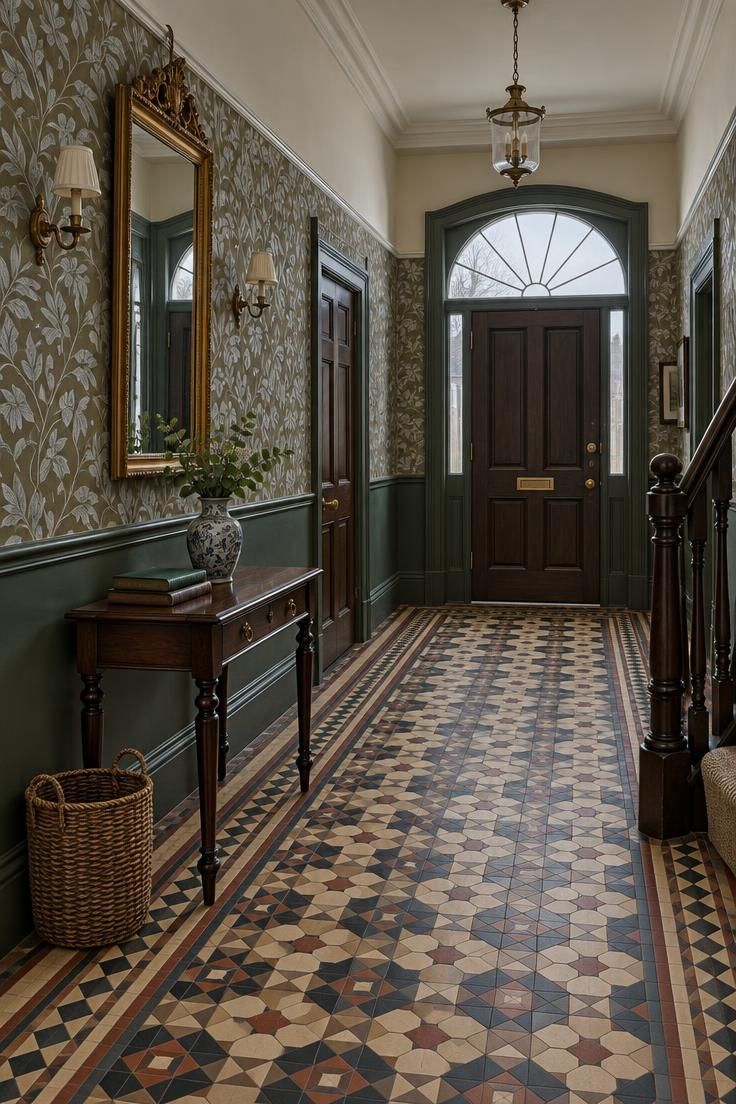
Splitting the wall into dado, field, and frieze is the structural move that gives most Victorian halls their layered character, and it also hands you three separate decisions instead of one.
A dark dado grounds the room and takes the scuffs that entrance halls collect, while the lighter field keeps the space from closing in overhead.
This dado rail hallway wall treatment compresses a very tall hall and lends scale to a narrow one, because the darker lower band reads as a base the walls sit on.
Paint on the lower wall will need touching up more often than paper above it, which is the honest tradeoff for the durability.
Before fixing the rail height, check your ceiling measurement, since a rail set too high leaves a thin strip of paper that can look like an afterthought.
If the staircase is visible from the door, repeating the dado color on the stair stringer ties the two elements into a single scheme.
Style Blueprint:
- Dado rail set at a height that leaves a generous main field
- Near-black or deep green paint on the dado and skirtings
- Small-pattern wallpaper in the field instead of a large floral
- Plain cream or off-white frieze above the picture rail
- Repeat the dado shade on the stair stringer or a side table
Charcoal and sand Victorian hallway tile floor patterns
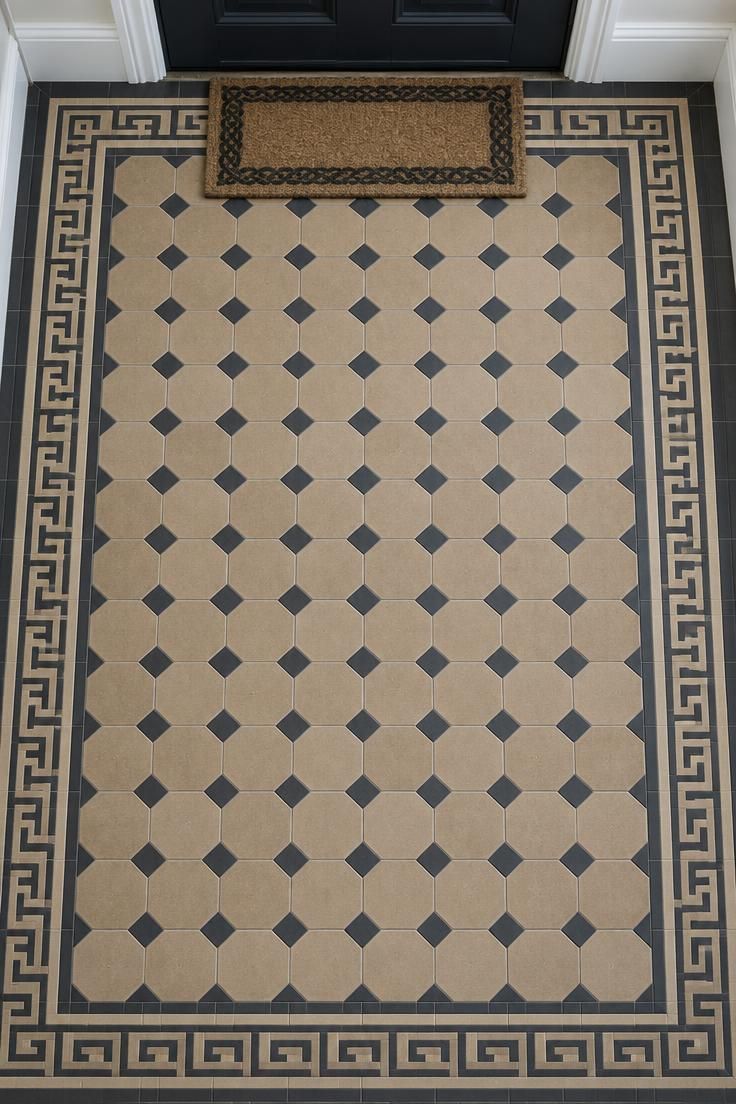
Geometric and encaustic Victorian hallway tile floor patterns are among the most recognizable features of a period entrance, but the classic black-and-white scheme can read severe in a small space.
A charcoal-and-sand pairing lowers that contrast and is more forgiving of street grit tracked in from the pavement.
The pattern carries the visual weight, so walls and woodwork above it usually work better when they stay relatively plain.
Tiles handle heavy foot traffic and wet shoes better than timber or carpet at an entry point, which is the practical argument for the commitment.
The discomfort is temperature: a long tiled hall feels cool underfoot in winter, and a washable runner laid over part of the pattern solves that without hiding the border.
Pattern size is the decision that matters most here, because a dense repeat can look restless while an oversized motif can overwhelm a short hall.
Style Blueprint:
- Octagon-and-dot or diagonal chequer in three muted tones
- A defined border in a Greek key or simple band
- Coir mat sized to sit inside the border rather than over it
- Wall colors kept quiet so the floor leads
Arched alcove with a small built-in bench
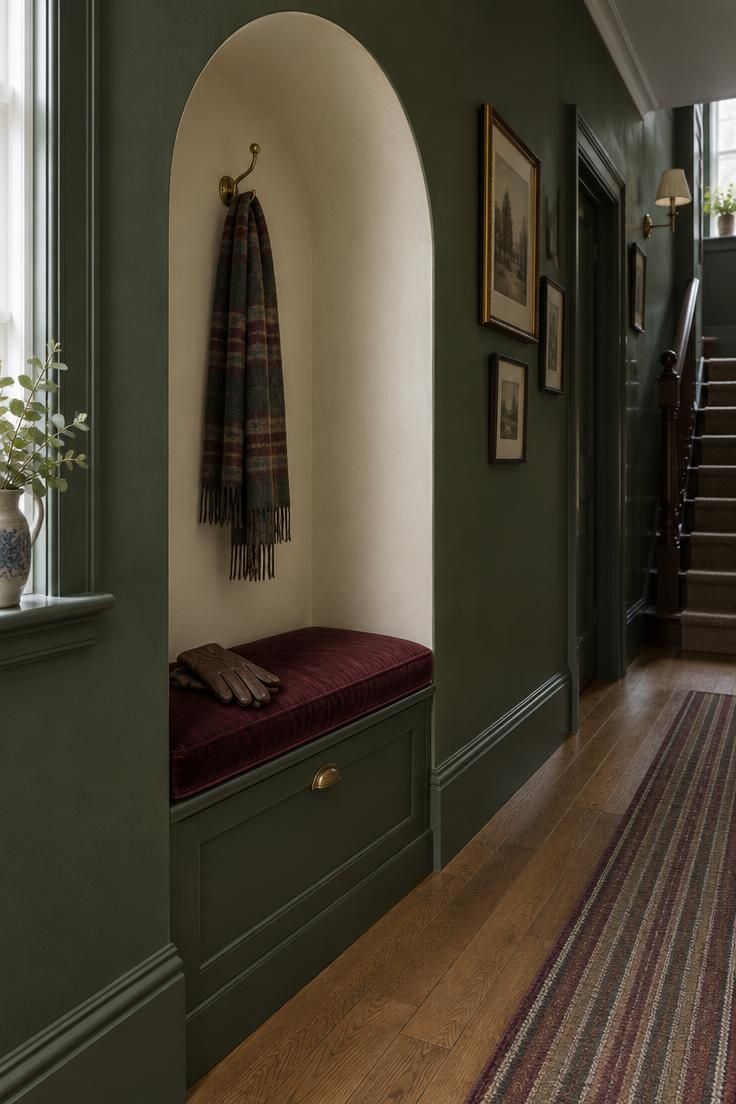
A shallow arch or recessed niche turns an awkward stretch of wall between doors into a seat with a frame around it.
The arch does two jobs at once: it gives the bench a clear visual boundary and it makes a dead corner feel deliberate rather than leftover.
Storage under a lift-up lid makes the seat genuinely useful in a hall without a closet, since gloves, polish, and a spare umbrella can live out of sight.
Depth is the limiting factor.
The recess needs enough room to sit on comfortably without narrowing the route past it toward the stairs.
Painting the inside of the arch a shade lighter than the surrounding wall keeps the recess reading as a pause in the wall rather than a dark hole.
Style Blueprint:
- Shallow arch proportioned to the bench seat
- Pale interior shade one or two steps lighter than the hall walls
- Lift-up seat with a discreet brass pull
- Single velvet or dark floral cushion, no scatter pile
Design Pro-Tip: Add one small hook inside the arch so a single hat or scarf has a home that does not spill onto the bench seat.
Encaustic tile entrance hall flooring with narrow border
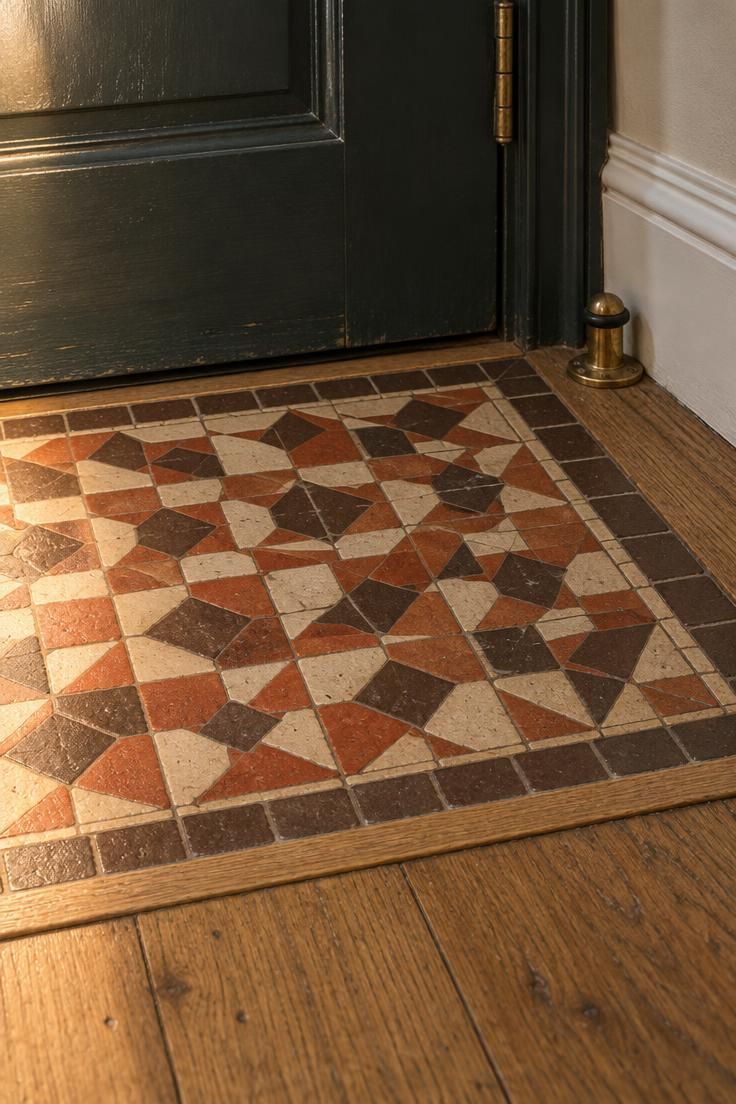
Encaustic tile entrance hall flooring does not need to cover the whole corridor to make its point.
A narrow band or inset mat placed directly inside the front door gives you the threshold effect of an original Victorian entrance while leaving the rest of the floor as timber or stone.
Cost and pattern stay concentrated where feet actually land, and hard tile at a wet entry point is easier to wipe than wood or carpet.
The visible meeting line between tile and timber is the detail to get right, since a clean threshold strip is what makes the inset look intentional.
Limit the tile to two or three colors in a narrow band, because a busy multi-color pattern needs a large field to read properly.
Style Blueprint:
- Small geometric tile field in three colors at most
- Single border row framing the inset
- Slim threshold strip between tile and timber
- One accent color from the tile repeated on the front door
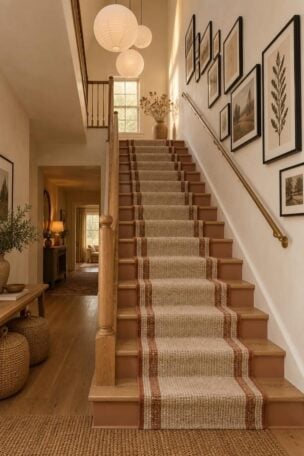
Victorian stair runner and balustrade styling with brass stair rods
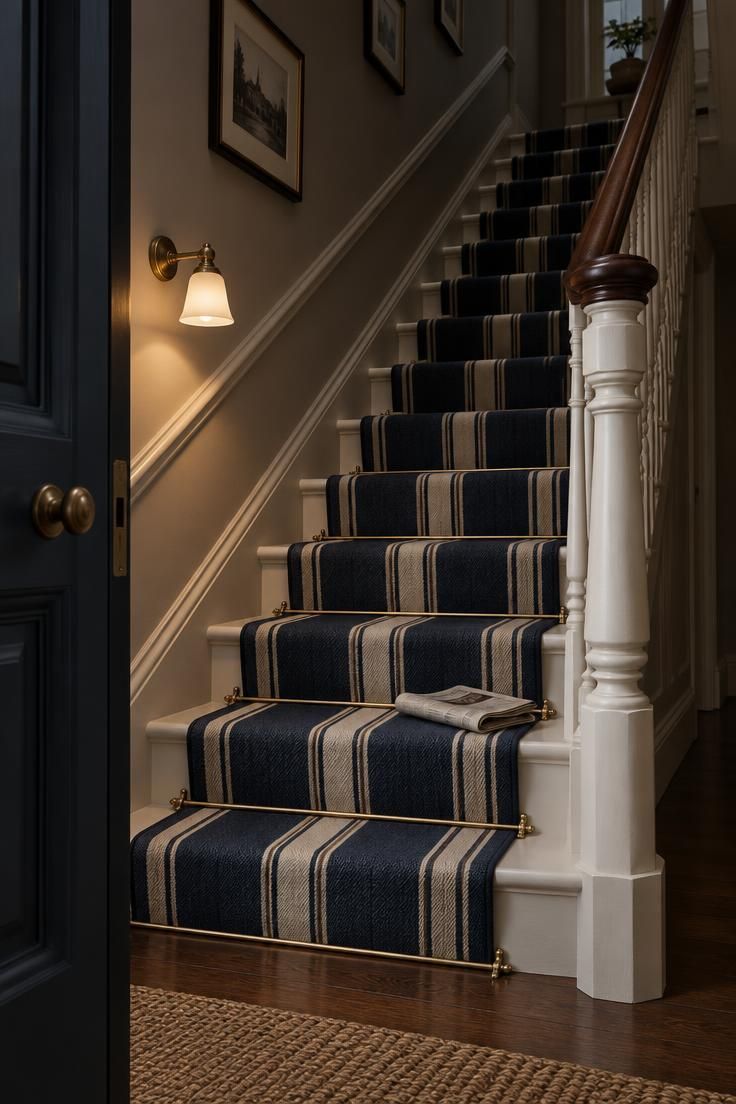
A Victorian stair can carry a lot of pattern on its own, so this approach treats the staircase as the hall's main event rather than a route to somewhere else.
The runner adds color and protection underfoot, while the rods create a measured rhythm up the flight that reads clearly from the front door, and this Victorian stair runner and balustrade styling works especially well in narrow halls where the staircase occupies most of the view.
Keeping the balustrade in a trim color and leaving a dark hardwood handrail bare gives the stair two tones without extra ornament, which matters in a hall that is already busy.
Care is the tradeoff.
A runner needs careful vacuuming and occasional lifting for deep cleaning, and it will show wear along the center line before the edges.
Pair a patterned runner with a quiet floor, since two strong patterns competing at the same eye level rarely resolve well.
Style Blueprint:
- Striped or small-motif runner in two tones
- Brass stair rods spaced evenly at the back of each tread
- Spindles and stringer painted in a single trim color
- Handrail left in dark stained timber
- One sconce lighting the bottom few treads
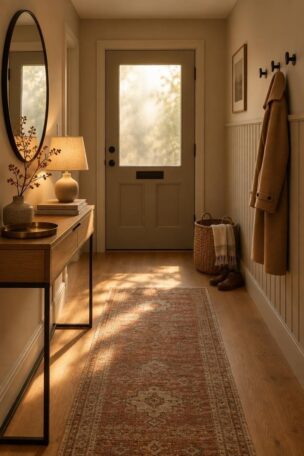
Narrow Victorian hallway console table with smart storage
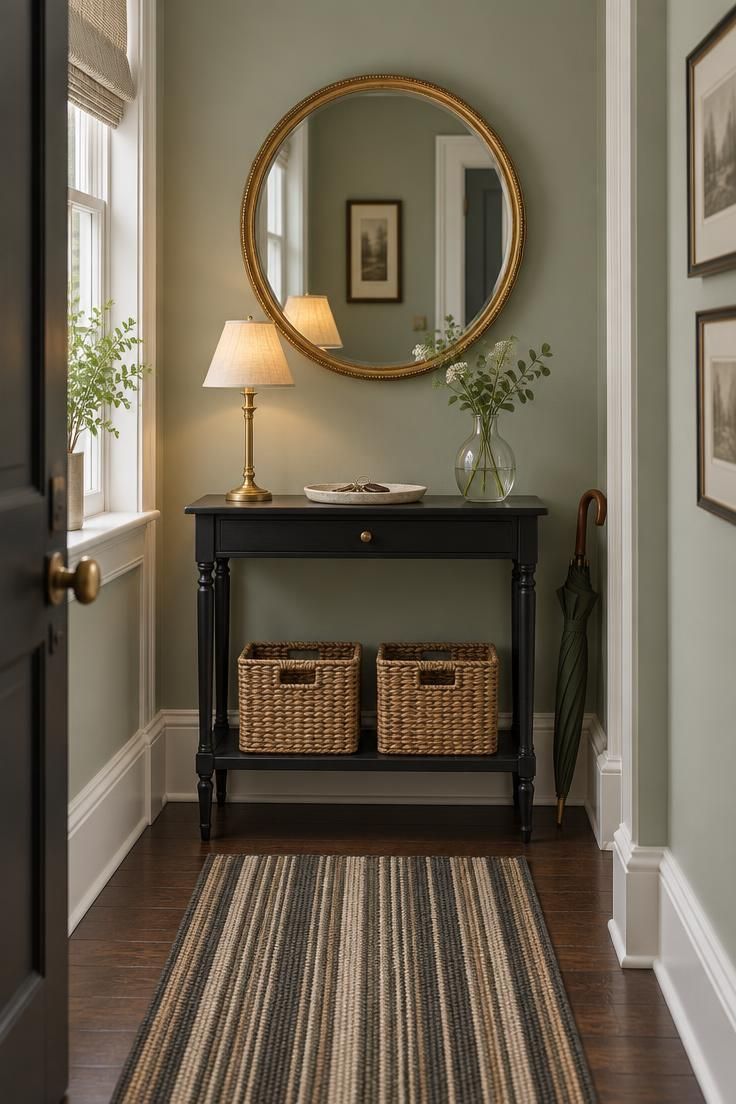
Most Victorian halls cannot absorb a wide piece of furniture, so narrow Victorian hallway console table ideas often start with a shallow console that can claim a stretch of wall without interrupting the path from door to stair.
Depth is the number that decides whether this works.
Around twelve to fourteen inches keeps the piece slim enough to pass comfortably while still holding a lamp and a tray.
Baskets underneath give the surface a job beyond display, catching mail, gloves, and small bags that would otherwise land on the tabletop.
The discipline this setup demands is weekly editing, because anything left on the surface or the floor quickly turns a considered arrangement into clutter.
A table with legs that do not flare widely lets the baskets sit flush, and this approach suits a rental hall where wall or floor changes are not possible.
Style Blueprint:
- Console no deeper than roughly twelve to fourteen inches
- Straight legs so baskets can sit flush underneath
- Two woven baskets for mail and small items
- Round mirror hung low enough to catch the tabletop
- One small lamp for a second light source
Dark plum panelling below the dado
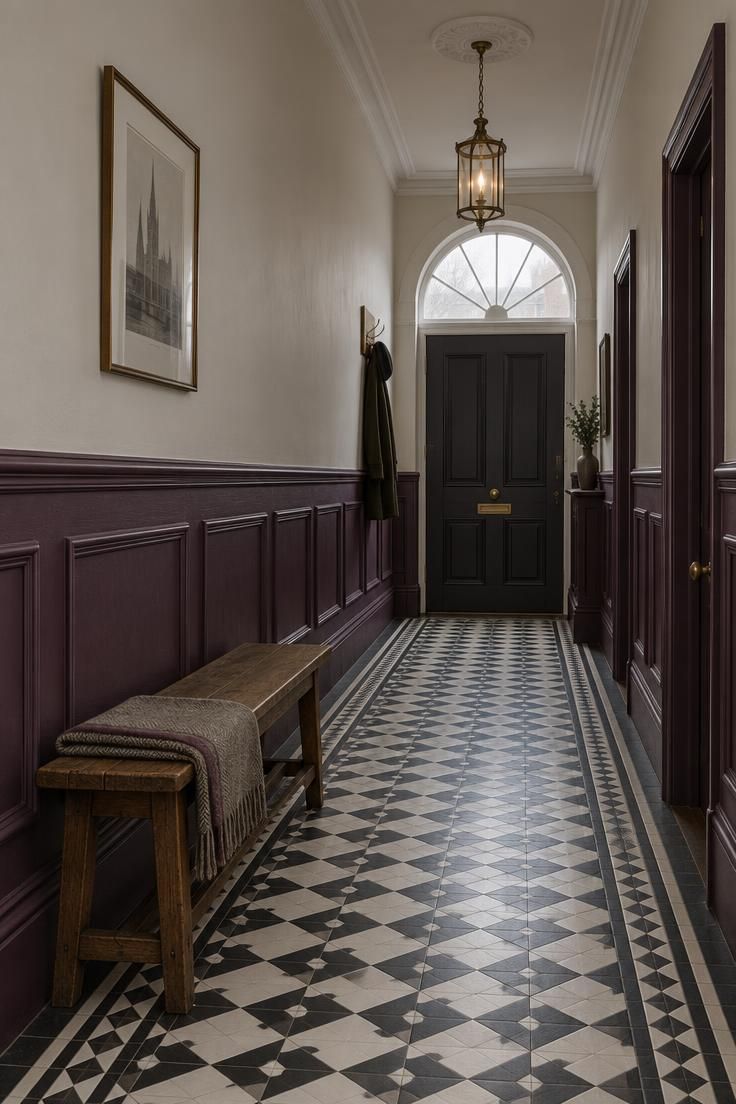
Panelling below the dado gives a hall its familiar layered structure even when the upper wall is plain paint rather than paper.
Painting the recessed panels dark while the raised mouldings stay slightly lighter keeps the lower band from flattening into one heavy block.
The practical case is cleaning, since a painted lower wall can be wiped where paper would stain.
Layout is the constraint.
Panelling reads best along a clear horizontal run, and interruptions from built-in furniture or meters break that line.
Something on the recessed paint will still need occasional touch-up in a busy entrance, so keep a small pot of the color on hand.
Style Blueprint:
- Recessed panel moulding in a consistent rectangle
- Dark plum or aubergine paint on the recesses
- Slightly lighter tone on the raised mouldings
- Off-white or pale stone above the dado
- Art hung above the panelling, not across it
Design Pro-Tip: Carry the panel color under the stair stringer as a painted skirting line so the lower band appears to continue past the staircase.
Stair gallery wall of botanical prints
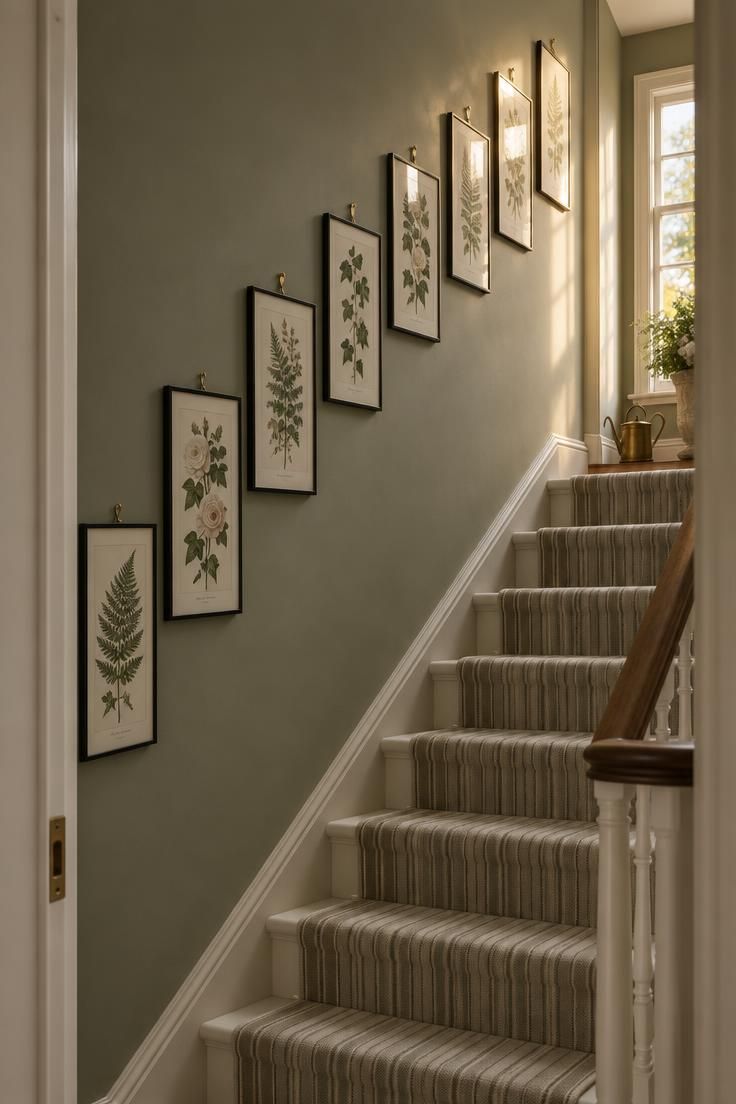
A run of framed botanical prints climbing the stairwell gives a Victorian association without any permanent change to the surface.
The arrangement should follow the pitch of the stair rather than sitting level, which is easiest to plan by tracing the stair line with a length of string before anything goes on the wall.
Unifying the frames in one dark wood or black lacquer keeps a mixed set of species from looking scattered.
The common failure is over-filling, so leaving at least one blank frame width between prints lets each one register.
Because these hang along a stair, check them before moving furniture or cleaning the treads, and let the gallery grow over time rather than buying everything at once.
Style Blueprint:
- One frame color across the whole run
- Prints laid out along the stair pitch, not level
- Consistent spacing of roughly one frame width
- Muted greens and creams rather than bright color
- A landing object to anchor the top of the run
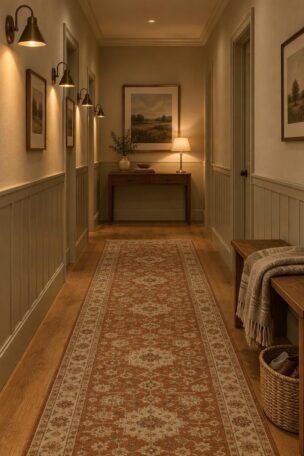
Lantern-style ceiling light with wall sconces
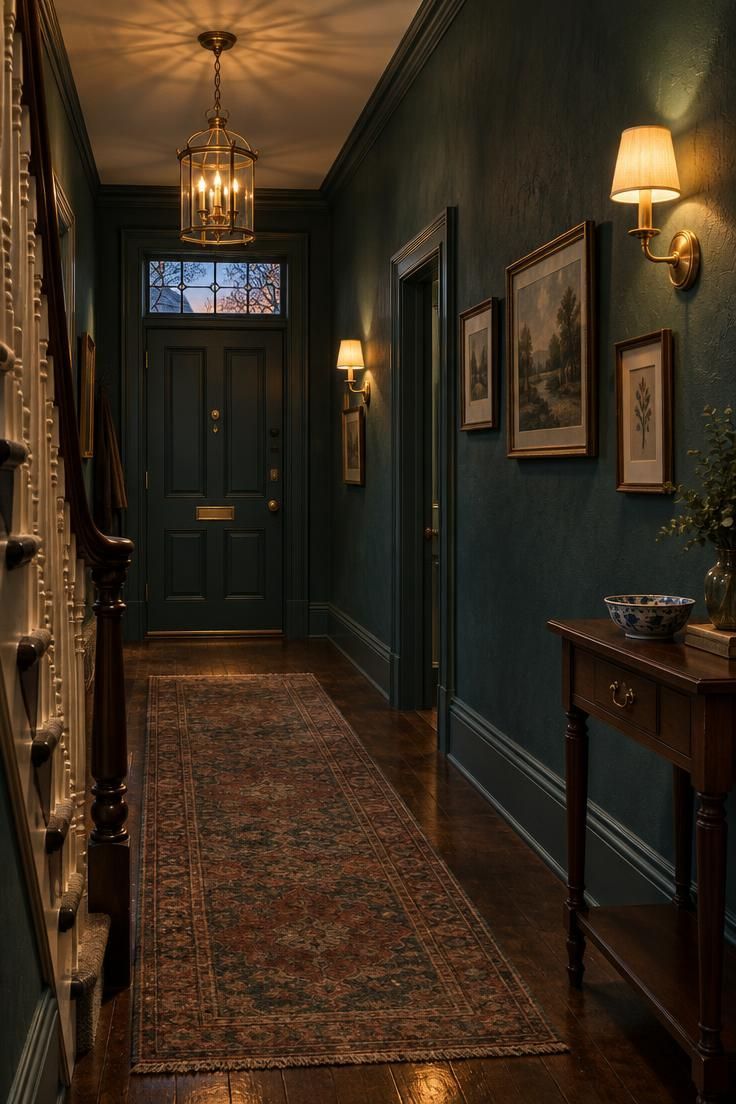
Several small light sources usually serve a Victorian hall better than one bright ceiling fitting, because a long narrow space reads as a series of pools rather than a single wash.
A low-hung lantern over the front door draws the eye where the welcome begins, and matching sconces carry that light toward the stair.
The ceiling fixture becomes one element in a sequence instead of the only thing lighting the room, which helps in halls with no window of their own.
Wiring is the tradeoff, since sconces need a supply or a carefully chosen plug-in fitting, and that limits where they can go.
Keep the metalwork simple rather than heavily scrolled, because the size of the hall decides how much visual weight a fitting can carry.
Bulbs should match in color temperature across all fixtures, or the hall will look patchy even when the fixture shapes match.
Style Blueprint:
- Brass or dark metal lantern with a glass shade
- Two matching sconces along the route to the stair
- Identical bulb color temperature in every fitting
- Deep wall color so the light pools read as contrast
- Simple silhouettes rather than ornate scrollwork
Dark-stained newel post with painted spindles
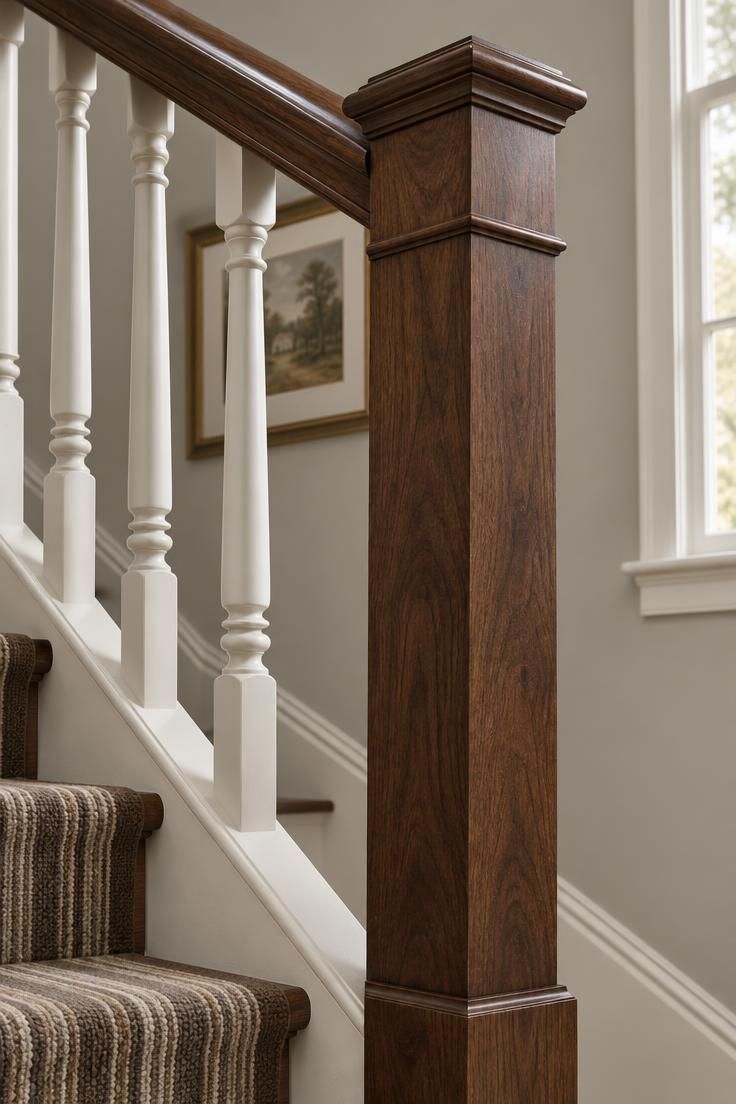
The balustrade can be restyled without touching the wider hall, which makes this one of the lower-commitment moves available.
Keeping the newel post dark while the spindles and stringer are painted gives the stair a clear anchor at the bottom and a lighter rhythm above it.
This split finish is also forgiving.
Scuffs on painted spindles can be touched up, while a dark post hides handprints.
The constraint is neatness at the break, because the dividing line where post meets spindle needs to be clean and straight.
If the handrail matches the newel, the scheme reads more traditional; painting the rail to match the spindles shifts it lighter and more modern.
Wall color above the handrail is worth keeping pale so a dark post does not feel stranded.
Style Blueprint:
- Dark stained newel post and handrail
- Off-white or cream spindles and stringer
- A runner in muted tones rather than a bold stripe
- Pale wall above the handrail
Design Pro-Tip: Echo the newel post tone in one console leg or a single picture frame so the dark timber appears more than once in the hall.
Practical Victorian hall coat stand with bench
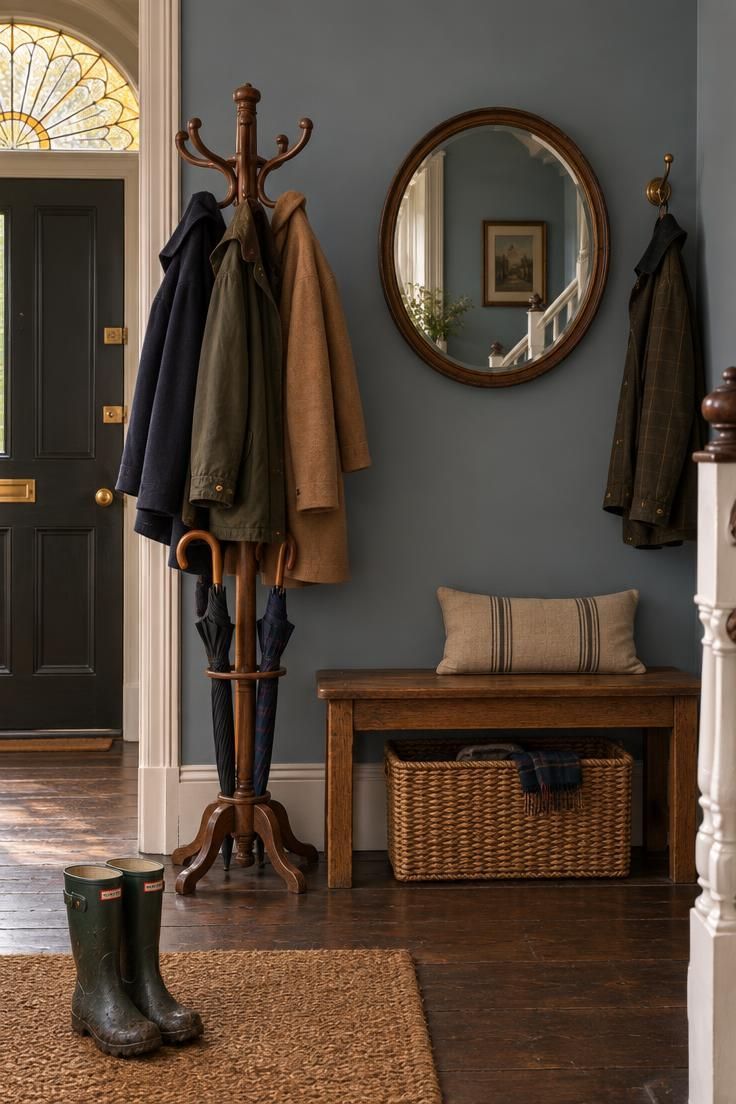
Many halls in period homes were built without a closet, so a freestanding stand paired with a low bench handles the entry routine without any built-in work.
The stand needs enough pegs for the coats actually in daily use plus a drip tray for wet umbrellas, while the bench gives somewhere to sit and pull off shoes.
Width is the deciding factor, because both pieces have to leave a clear route through the hall.
A coat stand reads as furniture rather than decoration, so its finish should relate to the woodwork or the stair handrail.
Coats will be visible at all times with this setup, which suits a household with a small daily rotation rather than a large seasonal collection.
This is one of the more practical victorian hallway ideas to start with, since both pieces can be moved or replaced without touching the walls.
Style Blueprint:
- Coat stand with a drip tray and enough pegs for daily coats
- Low bench with a shelf or space for a basket
- Basket for shoes and small bags
- Finish matching the stair handrail or hall woodwork
- One extra wall hook for a guest coat
Victorian-influenced two-color stair risers
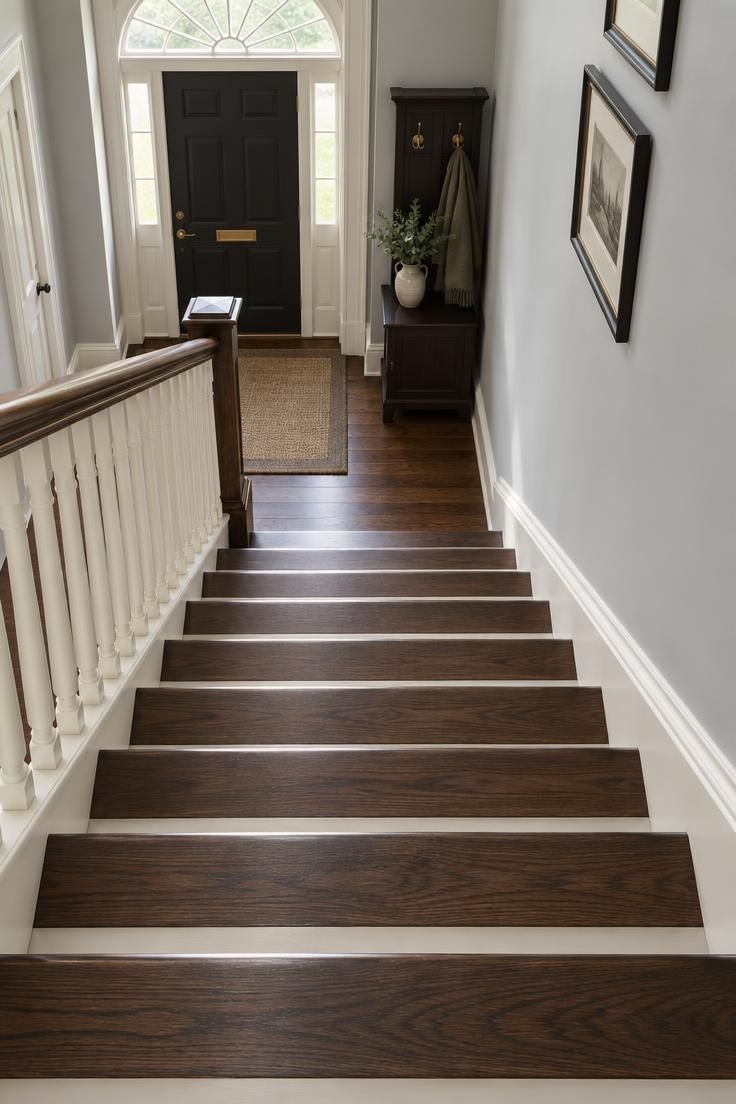
Painting the risers a different color from the treads is a lower-commitment way to bring Victorian rhythm into a hall.
Cream or putty risers against dark stained treads give the stair a crisp horizontal line, and a runner can still sit where feet land if you want one later.
The appeal is reversibility, since repainting a riser is straightforward and the treads stay timber.
Wear is the risk, because shoes scuff the riser more than the tread, so a washable finish matters here.
The effect works best on a straight run where the alternation is visible from the front door, and less well on a winding stair where the line breaks.
Keeping the two colors related to the wall and trim scheme pulls the stair into the hall rather than leaving it as an isolated feature.
Style Blueprint:
- Dark stained treads left as timber
- Washable cream or putty paint on the risers
- Stringer painted to match the trim
- No runner, or a plain one that leaves the risers visible
- Test the color on the bottom riser first
Conclusion
These directions all draw on the same period vocabulary, but they ask for very different levels of commitment.
A tile inset or a painted riser can be tried and undone, while full-height wallpaper or a three-band wall treatment places the hall on a longer course.
Walking the space with a tape measure is the useful first step, noting one vertical surface, one floor treatment, and one stair element that already carry the room.
Two or three Victorian devices are usually enough in a single hall, and the same two can look entirely different in a wide, tall entrance compared with a narrow terrace corridor.
Trading a busy wallpaper for a patterned runner, or a dark dado for a dark newel post, shifts the character without changing the footprint.