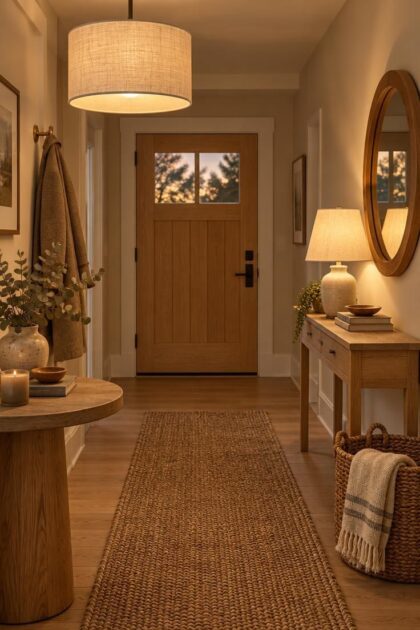
This post may contain affiliate links. If you make a purchase through these links, we may earn a commission at no additional cost to you.
The first few feet inside a home carry a lot of weight.
Entryway lighting greets guests before anyone speaks, and it tells them where to look, where to pause, and where to set down a bag.
A single well-chosen fixture can make a compact foyer feel composed, while a scattered approach leaves a narrow hallway feeling dim and unresolved.
The ideas below focus on composition, finish, and placement in real household entries, from tight apartments to stair-adjacent landings.
Each one pairs practical visibility with a glow that feels warm rather than clinical.
Flush Mount Ceiling Light in Opal Glass
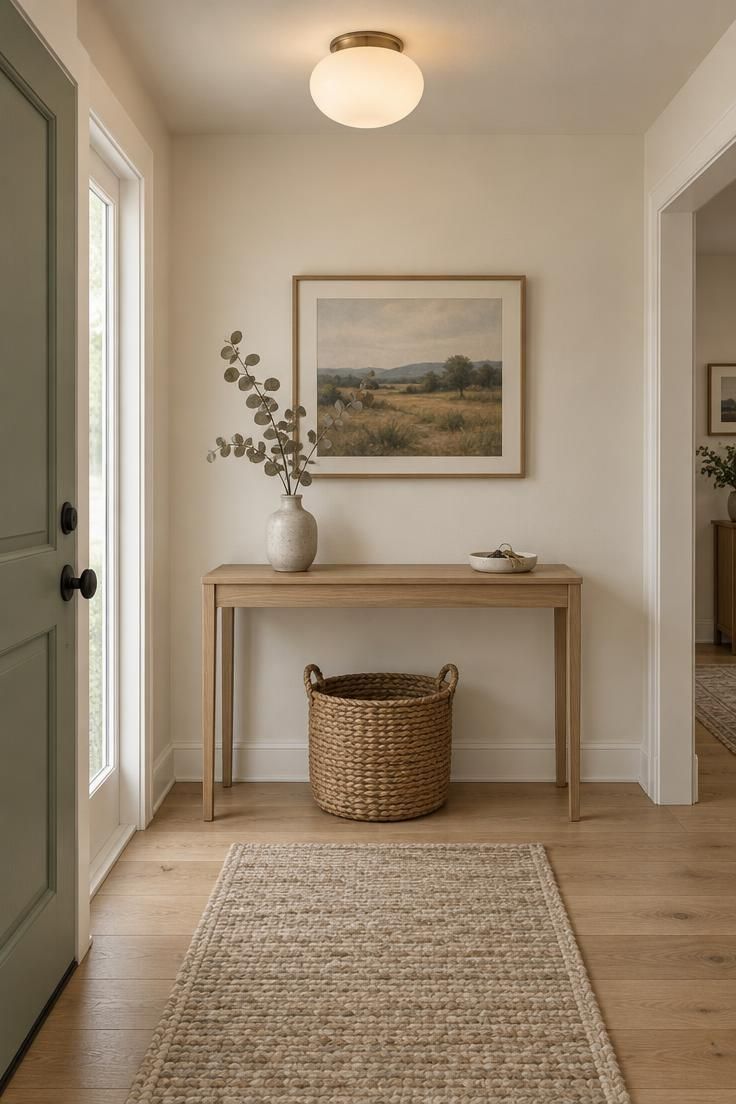
A rounded opal glass fixture sits close to the ceiling and keeps the view from the door clean and open.
The milky glass spreads light evenly instead of throwing a sharp pool on the floor, which suits a foyer where the ceiling height is modest and every inch of sightline counts.
In a narrow entry, this kind of flush mount ceiling light reads as a quiet disc rather than an obstacle.
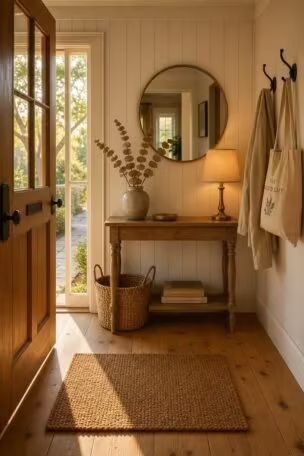
For a console table lamp, below the fixture, a slim console in pale oak creates a clean vertical line from floor to ceiling.
The pairing works because the light washes across the ceiling plane and lets the table do the grounding, with a woven basket tucked underneath for shoes or umbrellas.
A small ceramic bowl for keys gives the surface a purpose without clutter.
Scale is the main decision here.
A fixture that is too small can look lost in a wide foyer, while an oversized globe crowds a tight one; aim for a shade that leaves visible ceiling around its edge.
Low ceilings favor this approach over anything that hangs into view.
Cleaning is straightforward with smooth glass, though the outside of an opal shade shows dust and fingerprints more than a textured finish would.
A quick wipe with a soft cloth keeps it looking crisp.
The tradeoff is personality: this is a supporting player, not a statement piece.
Style Blueprint:
- Rounded opal glass flush mount in a soft white or cream finish
- Slim light-oak console with a lower shelf
- Woven basket for shoes and a small ceramic key bowl
- Warm white wall paint with a matte finish
Foyer Pendant Light with a Linen Drum Shade
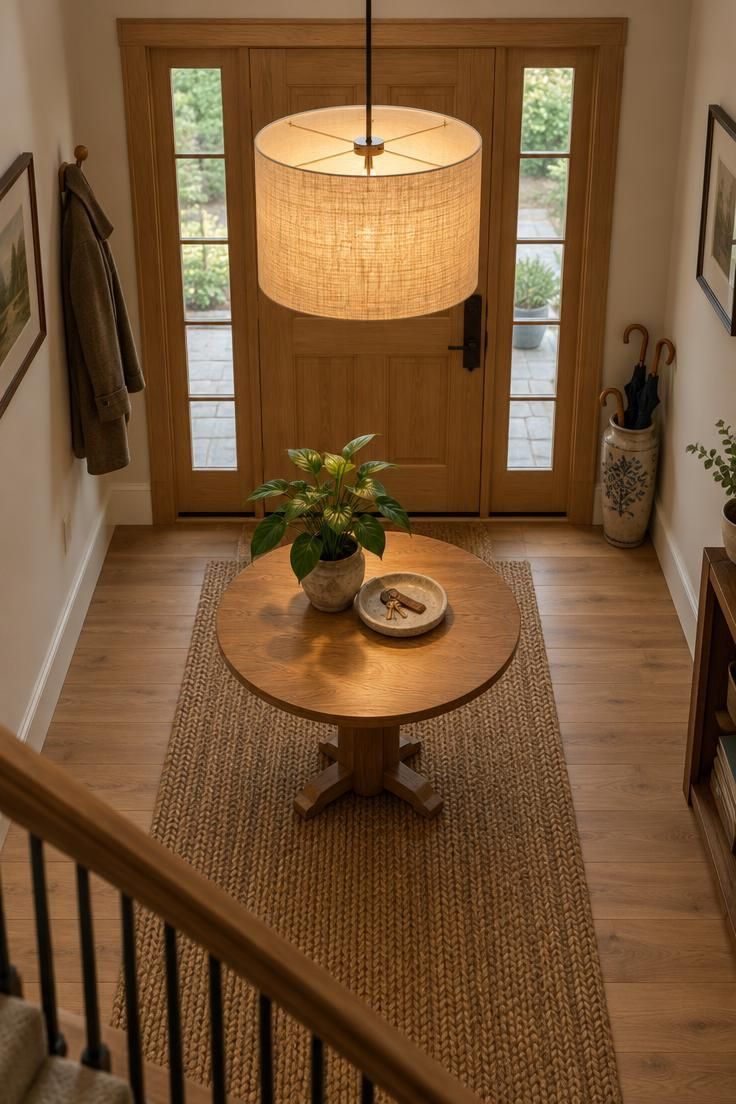
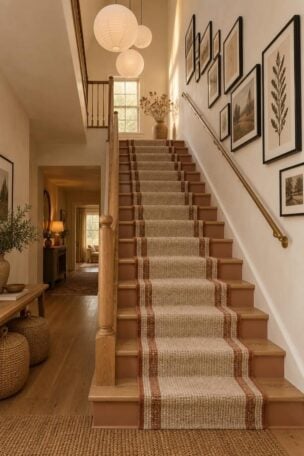
A linen drum shade brings a soft, residential quality to a foyer that has enough ceiling height to carry it.
The fabric filters light downward, so a gentle pool forms near the door rather than a hard glare overhead.
Centering the foyer pendant light on the front door makes the shade read as a deliberate focal point instead of an afterthought.
Texture does much of the work here.
Natural linen pairs well with warm wood trim, a braided jute runner, and a round wood side table beneath the fixture.
The shade’s drum shape holds a tall space without feeling heavy, and its woven surface gives the eye something to rest on at the top of the room.
Sizing follows the room rather than a fixed rule: a taller foyer can carry a larger drum, while a modest one needs a shade that leaves breathing room around it.
In a high-ceiling entry, the fixture can sit fairly low in the frame and still feel proportionate because the fabric softens its visual weight.
Consider upkeep before committing.
Fabric shades collect dust and can be awkward to clean, so a shade that can be removed for a gentle vacuum or lint roller is easier to live with.
Open drum shapes also let more light escape than a fully enclosed design.
The view from the doorway matters most.
Standing at the open front door, the shade should sit in the frame as a rounded, warm presence above the table, with the runner leading the eye inward.
That symmetry is what makes the entry feel intentional.
Style Blueprint:
- Natural linen drum pendant with a simple metal stem
- Round wood side table or pedestal beneath
- Braided jute runner in warm neutral tones
- Light oak door frame and trim
- Small potted plant for a touch of green
Hallway Wall Sconces in a Matte Black Pair
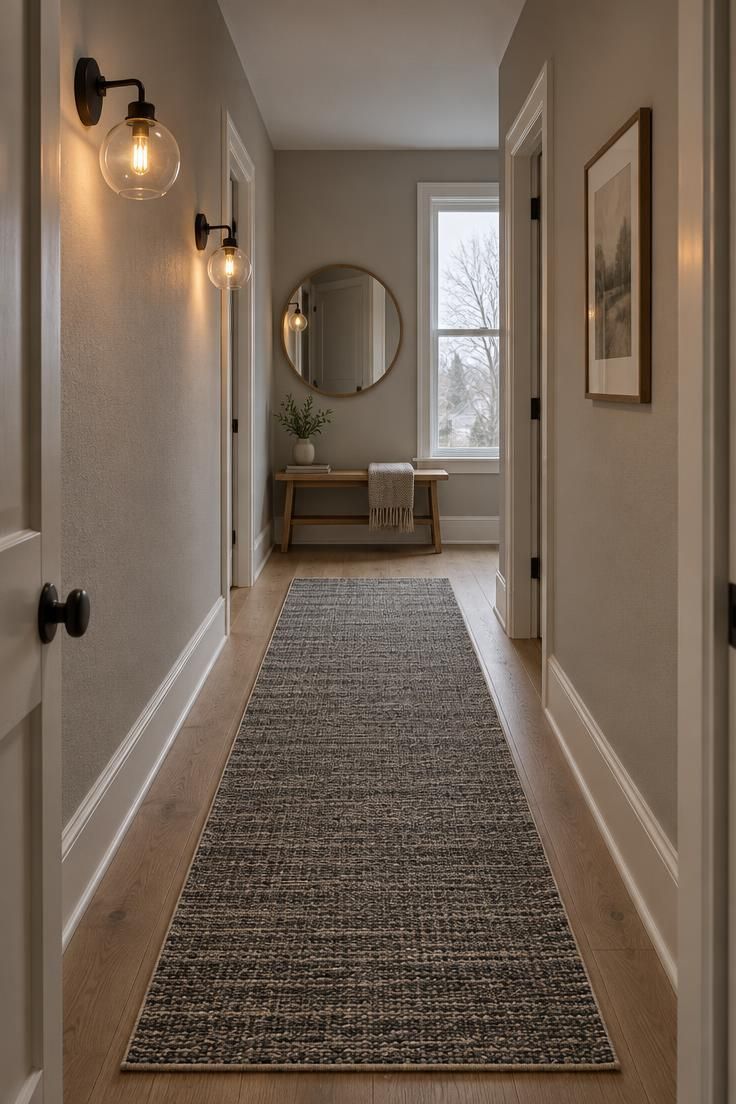
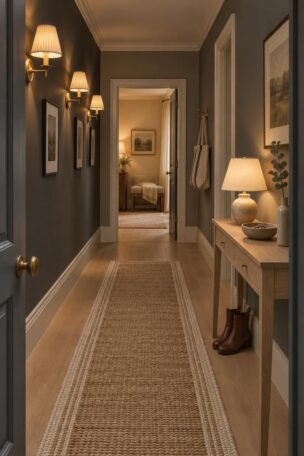
Two matte black sconces at even intervals turn a corridor into a sequence.
Each holds a clear globe shade, so the bulb reads as a small warm point against the wall, and the repetition draws the eye toward the rooms beyond.
In a narrow passage, hallway wall sconces add light without consuming any floor space.
The visual logic is rhythm rather than a single focal point.
Spacing the pair at consistent intervals defines the walking path and gives the wall a measured cadence, especially when the finish echoes other black accents like a door handle or a picture frame.
A flat-weave runner in muted tones reinforces the forward pull.
Pairing the sconces with a small bench and round mirror at the end of the hall gives the corridor a destination.
The mirror catches one of the globes and doubles its glow, which makes the far end feel less like a dead stop.
Globe shades in clear glass show dust and smudges readily, so they need more frequent attention than frosted or fabric options.
The payoff is a crisp, open look that keeps the fixture visually light.
An exposed bulb is also simple to change when it burns out.
Cool, overcast daylight through a nearby window keeps the black finish from reading too stark during the day, while warm bulbs take over in the evening.
The contrast between dark metal and glowing glass is the whole appeal.
Style Blueprint:
- Two matte black sconces with clear glass globe shades
- Soft warm gray wall paint
- Flat-weave runner in muted charcoal and oat tones
- Small wooden bench and round mirror at the hall’s end
Built-In Bench Nook with a Low Warm Step Light
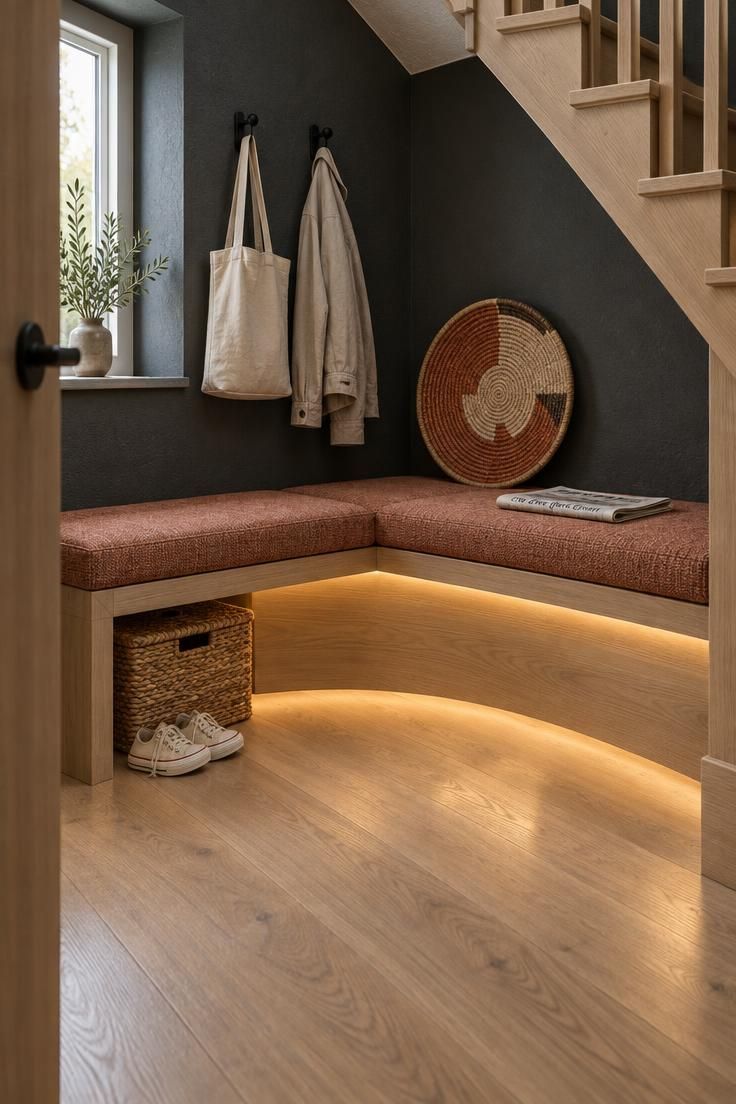
A recessed bench under a stair turn or beside a coat wall creates a small landing place for removing shoes and sorting bags.
Low step lighting tucked beneath the bench front traces the floor edge and gives the entry a soft, grounded glow without requiring an overhead fixture.
This idea suits a compact entry where the floor plane itself becomes the warm visual layer.
The light should read as an invitation, not a night-light.
A warm white LED strip set behind a shallow wood fascia keeps the source hidden and the beam directed downward across the floorboards.
The surrounding floor reflects a broad, even pool of light that outlines the bench base and makes the step down feel more intentional.
A built-in bench seat in white oak with a slim upholstered cushion in a dusty terracotta weave keeps the alcove from feeling too wooden.
Two low hooks above the bench hold a canvas tote and a lightweight jacket, while a flat basket below catches shoes without hiding the light line.
The upholstery adds surface relief, and the basket introduces a practical boundary for the drop zone.
Scale and placement shape the effect.
The light strip should sit slightly behind the front face of the bench so the glow grazes the flooring rather than shining straight outward.
A strip that ends a few inches before each bench side keeps the line from looking like a commercial aisle marker.
A deep charcoal wall behind the bench makes the warm floor light more visible during evening hours, while a round woven wall hanging in oat and clay tones softens the upper wall.
The floor, a pale brushed oak, carries the reflected glow toward the door and draws the eye through the entry.
Style Blueprint:
- Recessed white oak bench with a dusty terracotta woven cushion
- Hidden warm white LED strip behind a shallow wood fascia
- Two low wall hooks in matte black above the bench
- Flat woven shoe basket tucked beneath one bench end
- Deep charcoal alcove wall with a round oat and clay wall hanging
Semi-Flush Mount with a Brass Ring and Alabaster Shade
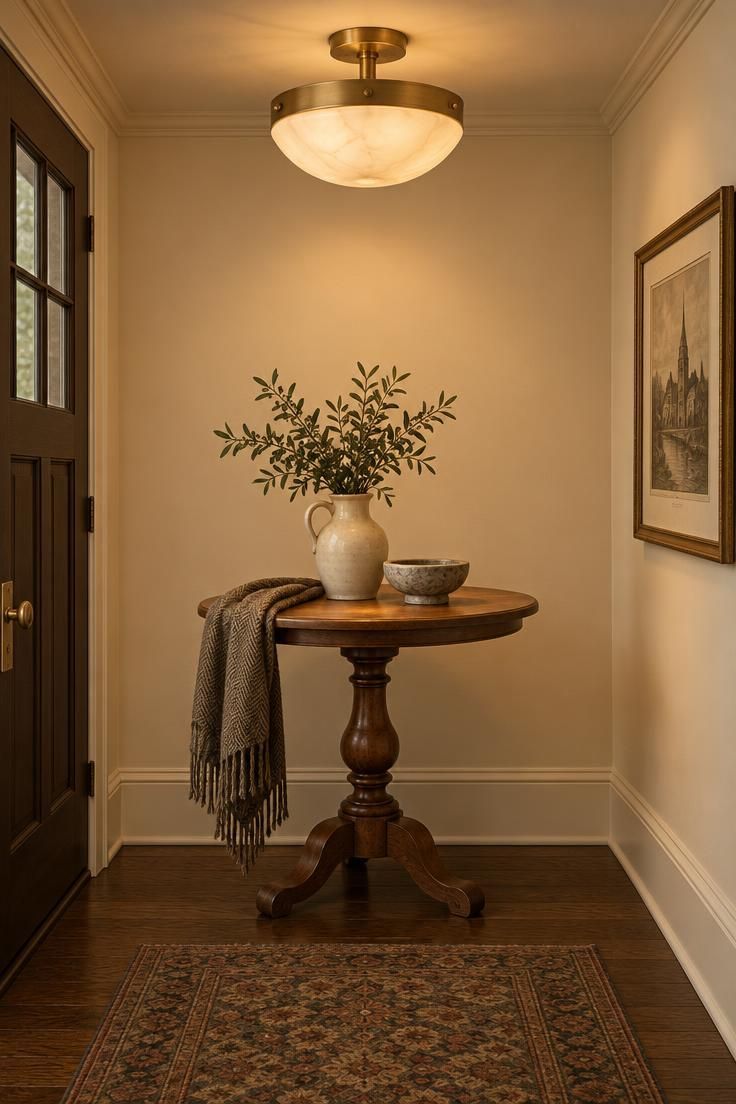
A semi-flush fixture with a warm brass ring and a smooth alabaster shade splits the difference between a flush mount and a pendant.
The shade sits near the ceiling but leaves a short stem visible, adding a touch of formality without taking much headroom.
In a compact traditional entry, this fixture can stand alone above a small pedestal table or umbrella stand.
The materials carry the look.
Alabaster has a soft, stone-like translucence that spreads light evenly, while the brass ring catches warmth at the fixture’s edge.
Together they read as an object worth noticing, not just a source of illumination.
Placement is simple when the entry is small and square: center the fixture over the table and let the floor and walls stay quiet.
A turned-wood pedestal table with a ceramic jug and a small bowl gives the light something to fall on, and dark stained oak flooring grounds the pale shade.
The combination of cool alabaster and warm brass works with both pale and mid-tone wall colors, which makes it adaptable across different paint choices.
Warm ivory walls keep the entry bright without competing with the fixture.
Upkeep favors smooth surfaces: alabaster wipes clean easily, though the brass ring will develop a patina over time unless polished.
Some households prefer that aged look, and others want the shine kept bright.
Either way, the fixture’s simple geometry makes dusting quick.
Style Blueprint:
- Semi-flush fixture with a brass ring and alabaster dome
- Turned-wood pedestal table in a dark finish
- Warm ivory wall paint
- Dark stained oak flooring
- Ceramic jug and small bowl as tabletop props
Entryway Mirror Lighting with Integrated LED Frame
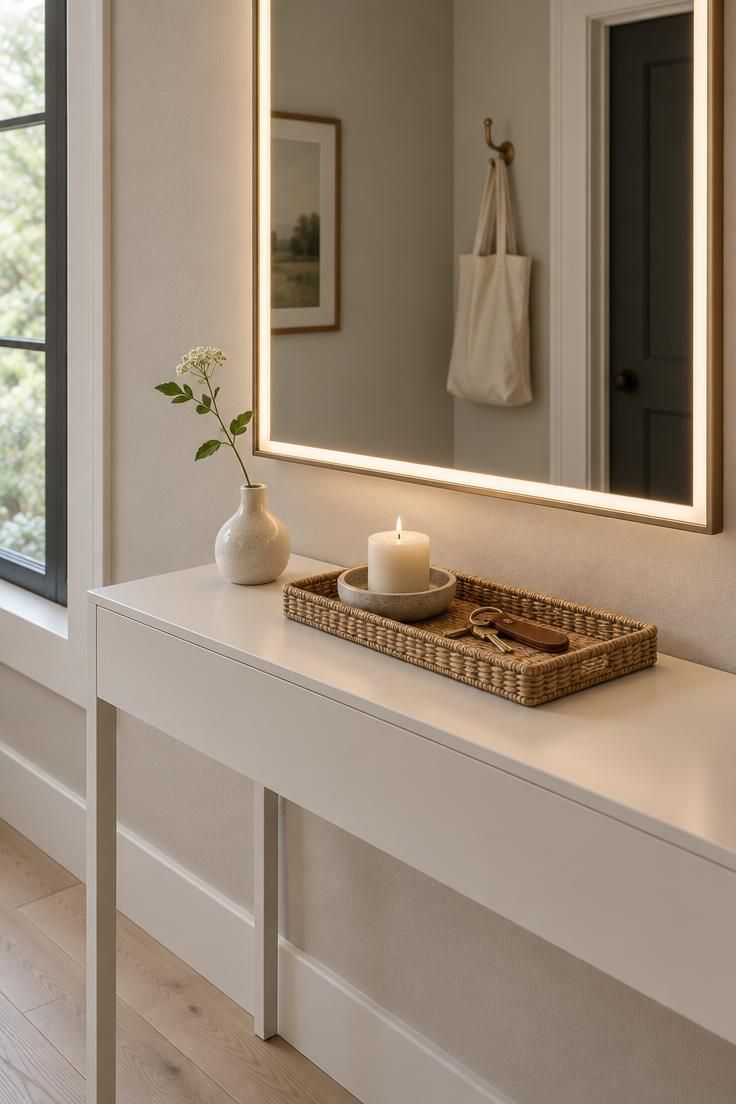
A mirror with a slim integrated light frame does two jobs at once: it reflects the room and provides an even glow without a separate fixture.
A round or rectangular mirror with a backlit edge casts light onto the wall behind it, so the piece reads as a floating panel rather than a framed object.
In a hallway or foyer, this approach to entryway lighting keeps the wall uncluttered because the source is concealed.
Proportion is the key decision.
Aim for a mirror roughly two-thirds the width of the console below so the arrangement feels balanced, and let the backlight create a soft halo against the wall.
A shallow white console, a woven tray, and a leather key fob complete the vignette without pulling focus.
This option suits rentals or entries where wall sconces are not practical, since the frame replaces a separate fixture and keeps the composition spare.
The glow is even and diffuse, which flatters the reflection and the wall finish.
Maintenance is limited to cleaning the mirror surface and occasionally dusting the frame’s edge.
Integrated light means there is no bulb to change, though the whole unit would need replacement if the light fails, which is a long-term consideration worth weighing against the clean look.
Pale wide-plank oak floors and a softly lit wall reflected in the glass extend the sense of depth.
A single coat hook visible in the reflection suggests the entry is used daily, not just styled for display.
Style Blueprint:
- Rectangular mirror with a thin integrated light border
- Shallow white console table beneath
- Woven tray with a candle and a leather key fob
- Pale wide-plank oak flooring
- Soft white or warm gray wall paint
Picture Light Over a Framed Artwork Above a Bench
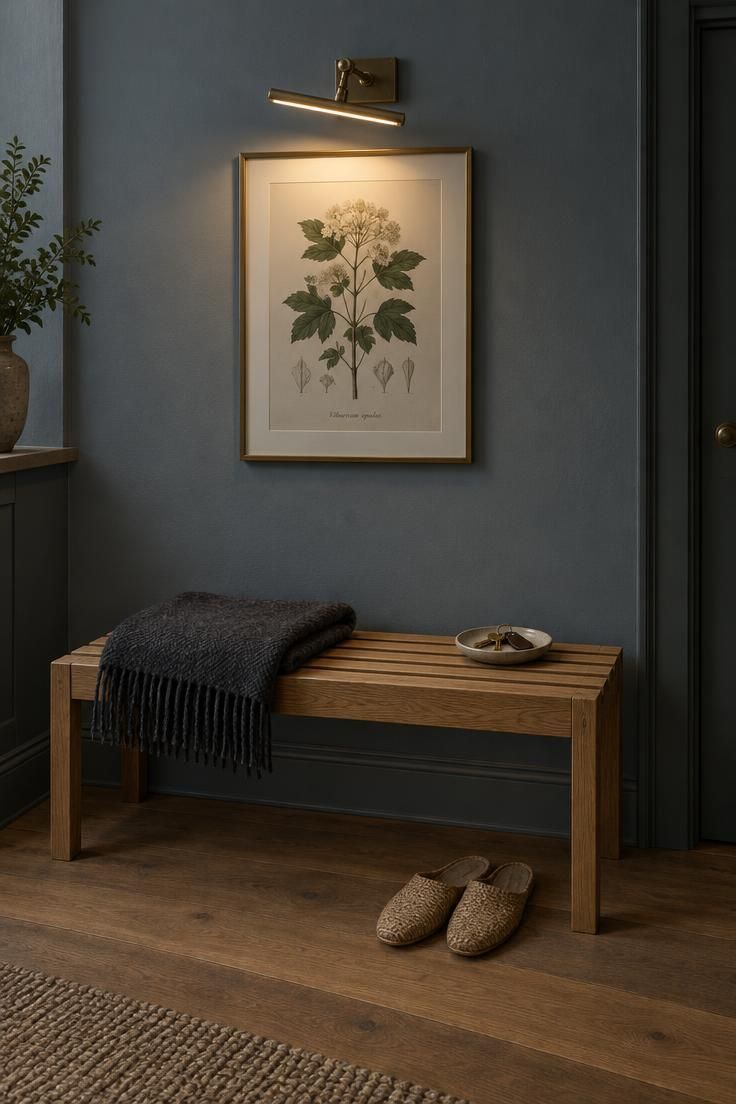
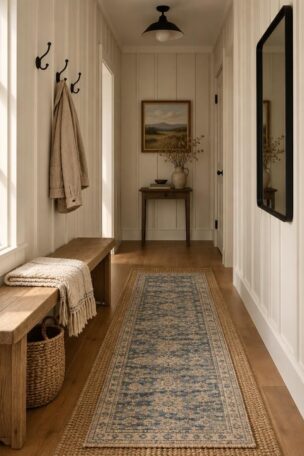
A slim picture light above a framed print turns a bench area into a small gallery.
The light throws a narrow band across the art, drawing attention to the wall rather than the fixture itself, which suits a narrow entry without room for a console.
A low oak slat bench, a folded wool throw, and a pair of woven slippers make the spot feel like a genuine pause point.
Adjustability does the heavy lifting.
A picture light with a pivoting head lets the beam land on the center of the frame instead of washing the wall unevenly, and that control matters when the art is the only decoration in the entry.
Cool blue-gray walls deepen the contrast between the lit artwork and its surroundings, and a brass finish on the light adds a warm counterpoint.
The overall effect is moody and low, with the art holding the brightest zone in the frame.
Think about the art’s size before choosing the light: a fixture that spans most of the frame’s width gives even coverage, while a shorter one creates a tighter spotlight.
The bench below should sit close enough that someone can perch while pulling on shoes.
Dust on the fixture and the frame is easy to overlook because both sit above eye level for shorter household members.
A quick pass with a microfiber cloth keeps the art and light crisp.
The tradeoff is that this layer illuminates a small zone rather than the whole entry, so it works best alongside other light sources.
Style Blueprint:
- Low oak slat bench with a woven seat
- Framed botanical print in a simple wood or metal frame
- Slim brass picture light with a pivoting head
- Soft blue-gray wall paint
- Folded wool throw and woven slippers
Recessed Downlights with a Single Decorative Sconce
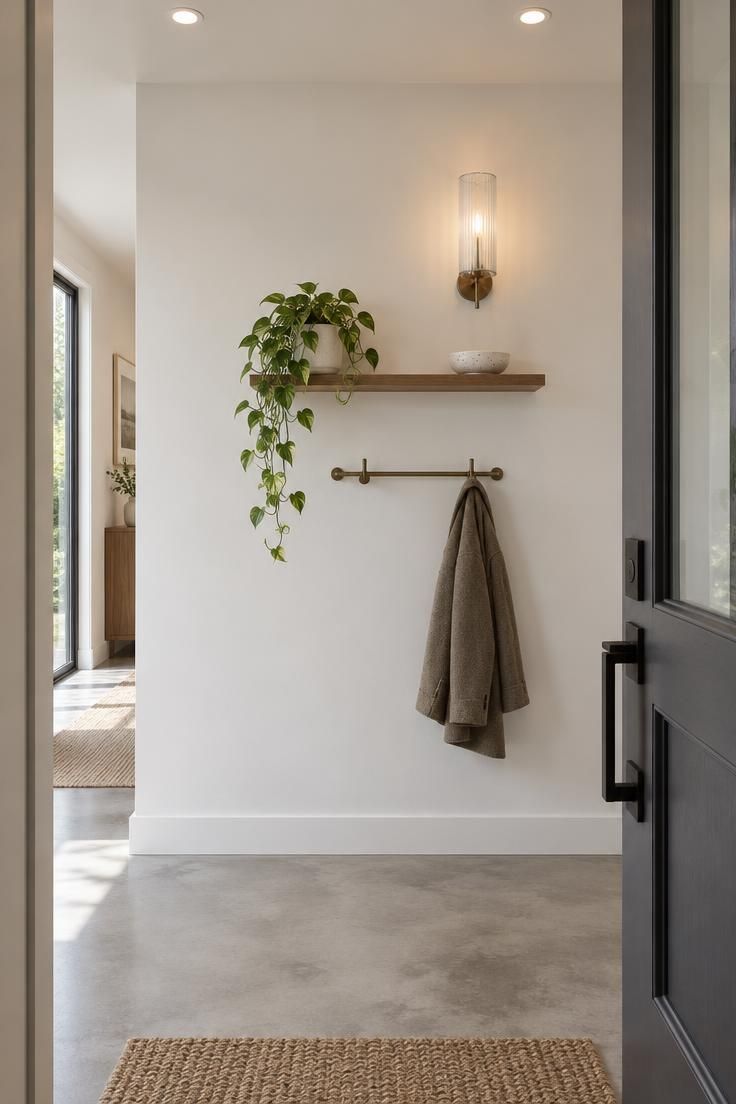
Recessed downlights give a modern entry a clean base layer, and a single decorative sconce adds personality at one focal point.
Two or three recessed fixtures wash the ceiling and floor without visual clutter, while the sconce anchors a small shelf or coat-hook zone.
This combination works best when the sconce sits off-center, so it reads as an intentional accent rather than competing for symmetry.
Material choice makes the sconce the star.
A ribbed glass cylinder shade or a matte stone finish gives the wall fixture texture that the flush downlights lack, and placing it above a small floating shelf with a plant and a ceramic dish gives it a reason to be there.
White walls and polished concrete floors keep the palette cool and minimal, letting the sconce’s texture carry the warmth.
Bright midday light through a window adds fill, and the recessed fixtures contribute a steady baseline when daylight fades.
The practical advantage is even coverage across the whole entry rather than one bright pool.
The limitation is atmosphere: recessed lighting alone can feel flat, which is why the decorative sconce earns its place as the visible source that draws the eye.
Recessed fixtures are largely maintenance-free from below, though the sconce’s ribbed glass needs occasional dusting to keep its texture crisp.
Keep the two layers on separate switches so the mood can shift between bright and intimate without adjusting every fixture.
Style Blueprint:
- Two or three flush recessed downlights in a white ceiling
- One ribbed glass cylinder sconce in a matte finish
- Small floating shelf with a plant and ceramic dish
- White walls and polished concrete floor
Linear Bar Pendant Above a Wide Bench
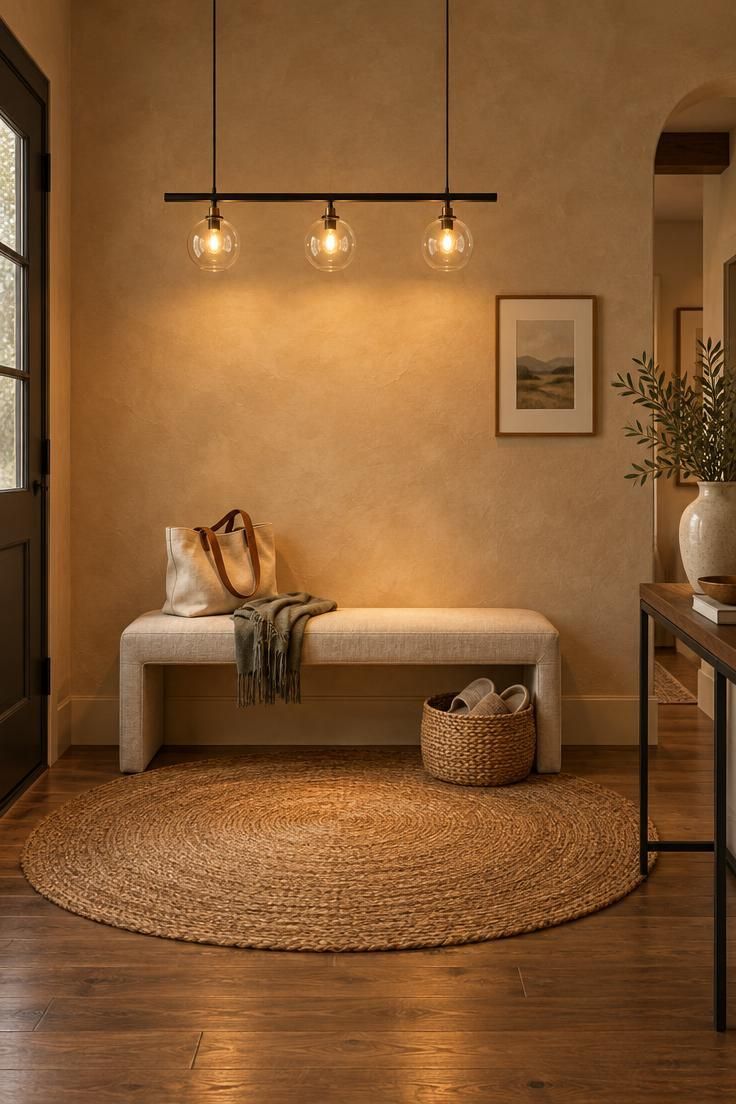
A linear pendant works over a long bench or a row of shoe storage, spreading even light across a wide horizontal surface.
Its slim profile keeps the ceiling from feeling heavy, while its length visually connects the door to the far wall.
In a wide, shallow entry, this fixture anchors the seating zone without competing with the front door for attention.
The shape does specific work.
A black metal frame with three small clear globe shades gives the linear form a light, open feel, and the round globes break up the straight line.
Below, a low upholstered bench against a warm plaster wall and a round jute rug pull the composition together.
Placement follows the bench rather than the room’s center.
Hanging the bar so its light spreads across the seat and the floor beneath, instead of pooling in one spot, makes the bench genuinely useful for sitting down to remove shoes.
A woven basket of slippers nearby completes the drop-zone function.
Wide entries can swallow a small round fixture, which is why the linear proportion matters: the fixture’s length should relate to the bench’s width so the two read as a set.
A pendant that is too short leaves the ends of the bench in shadow.
Clear globe shades show dust readily, and the open frame means each one is easy to reach and clean.
Warm golden light through the globes gives the plaster wall a soft glow in the evening, while daylight keeps the space bright during the day.
Style Blueprint:
- Black linear bar pendant with three clear globe shades
- Low upholstered bench in a neutral fabric
- Warm plaster wall finish
- Round jute rug beneath the bench
- Woven basket for slippers
Cluster Pendant with Three Rattan Shades
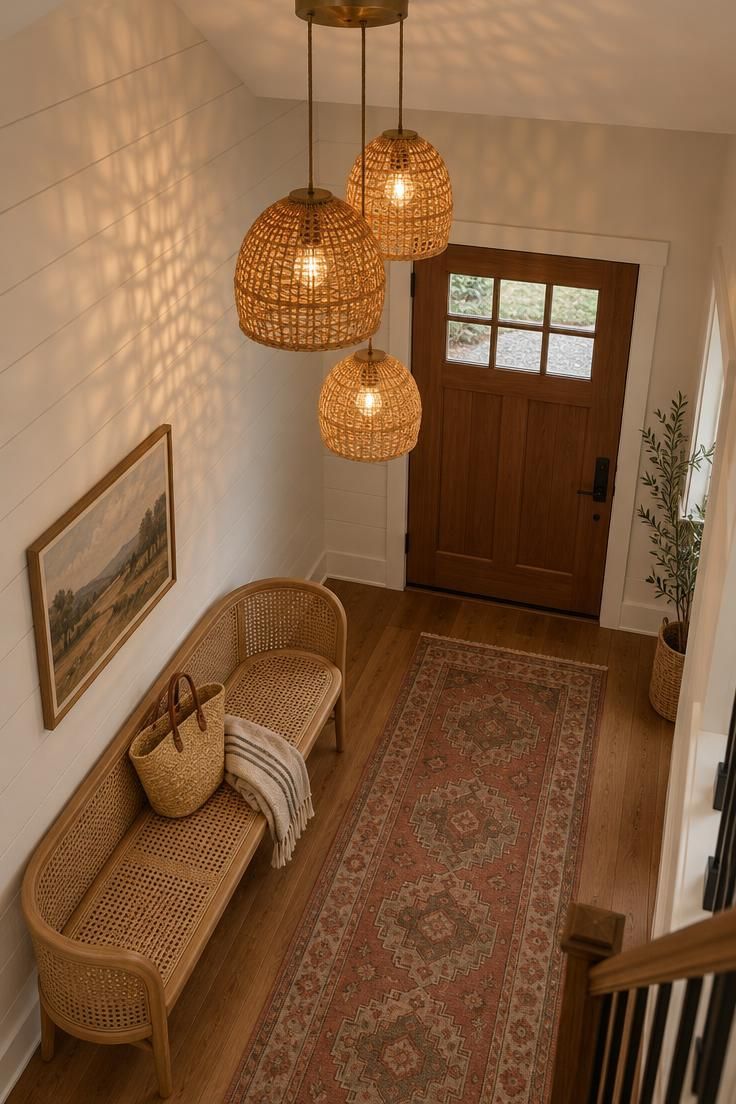
A cluster of three small rattan shades creates a textured focal point in a taller entry or a stair-adjacent space.
The woven material casts scattered shadow patterns on the walls, and hanging the shades at slightly different heights gives the group a gathered, organic feel.
This works best where the ceiling is high enough that the cluster stays clear of the door swing and foot traffic.
The cluster reads as a single sculptural unit, so it holds a tall entry without needing additional decoration.
Below it, a curved cane bench against a white shiplap wall keeps the lower half quiet, and a wool runner in a muted terracotta pattern leads the eye toward the front door.
Texture is the deciding factor.
Natural or lightly stained rattan keeps the look soft and pairs well with white walls and warm wood.
A darker stain would tilt the cluster toward a heavier, more traditional feel, which may suit a home with darker trim.
Woven shades collect dust in their gaps, so a soft brush or vacuum attachment is part of the upkeep.
The open weave also lets more light escape than a solid shade, creating that dappled effect on the surrounding walls.
Sizing the cluster to the entry is a judgment call.
Three shades suit a tall, narrow stairwell; a wider entry might carry a fourth.
The goal is a group that feels gathered rather than crowded, with each shade visible from the doorway and the first few stairs.
Style Blueprint:
- Three rattan or woven pendant shades hung at staggered heights from one canopy
- Curved cane bench in a natural finish
- White shiplap wall treatment
- Wool runner in muted terracotta tones
- Warm wood door and trim
Plaster Cove Light Above a Curved Alcove
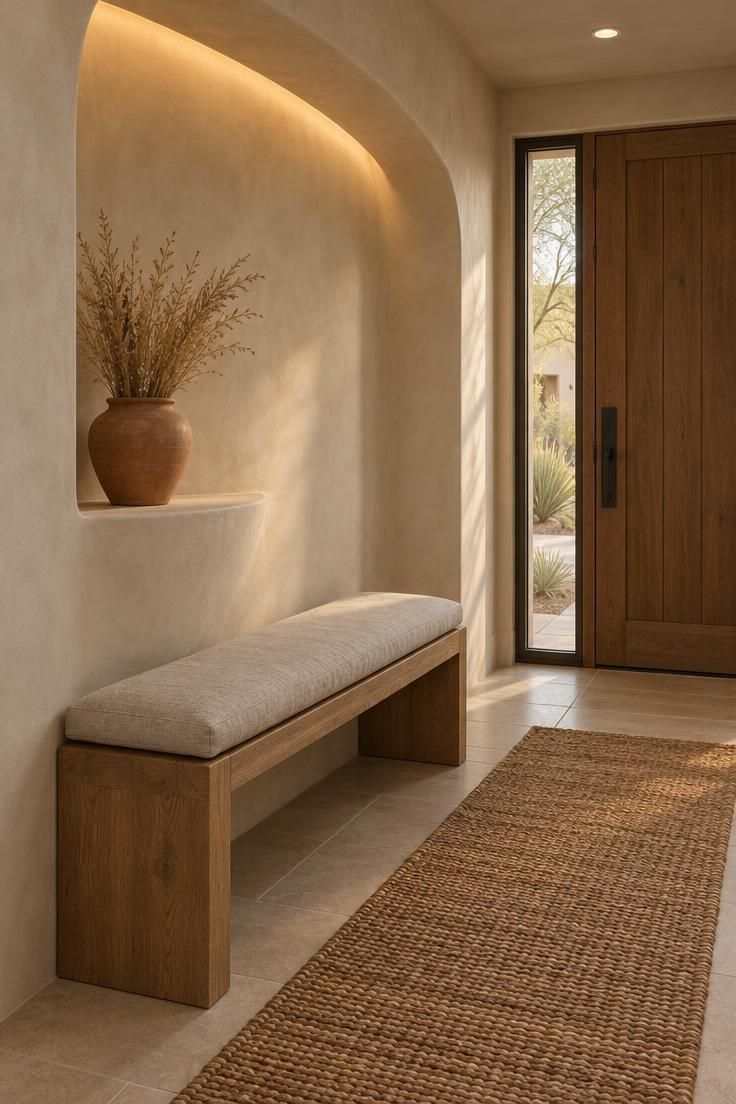
A soft plaster cove light above a curved entry alcove turns the ceiling itself into a warm, indirect source.
The fixture is hidden inside a shallow architectural ledge, so the eye notices the glow before it notices any hardware.
This idea works especially well in southwestern, Spanish revival, or soft modern homes where limewash walls and rounded corners already feel natural.
The indirect beam washes down the wall above a small bench or a low side table.
Because the light source stays concealed, the entry avoids the visual clutter of a hanging fixture and leaves more room for a sculptural object, a stack of books, or a single large ceramic vessel.
A warm white limewash wall behind the alcove picks up the glow and gives the plaster a subtle depth that changes across the day.
A low oak bench with a linen cushion sits below the alcove, paired with a jute runner that runs toward the door.
A rounded plaster shelf holds a small terracotta pot with dried grass, keeping the composition simple and grounded.
This setup can be paired with a dimmer switch so household members can raise the light for finding shoes and bags or lower it for a quieter arrival after dark.
The absence of visible hardware means the fixture needs almost no dusting, though the plaster ledge should be wiped occasionally like any nearby shelf.
Daylight from a nearby sidelight or transom window softens the effect further, but the cove glows well on its own in the evening.
The result is an entry that feels calm and composed without relying on a decorative fixture to carry the room.
Style Blueprint:
- Hidden cove light set into a shallow plaster ceiling ledge
- Curved alcove with warm white limewash walls
- Low oak bench with a natural linen cushion
- Jute runner and a rounded plaster wall shelf
- Terracotta pot with dried grass as the lone accent
Plug-In Wall Sconce in Brass with a Swinging Arm
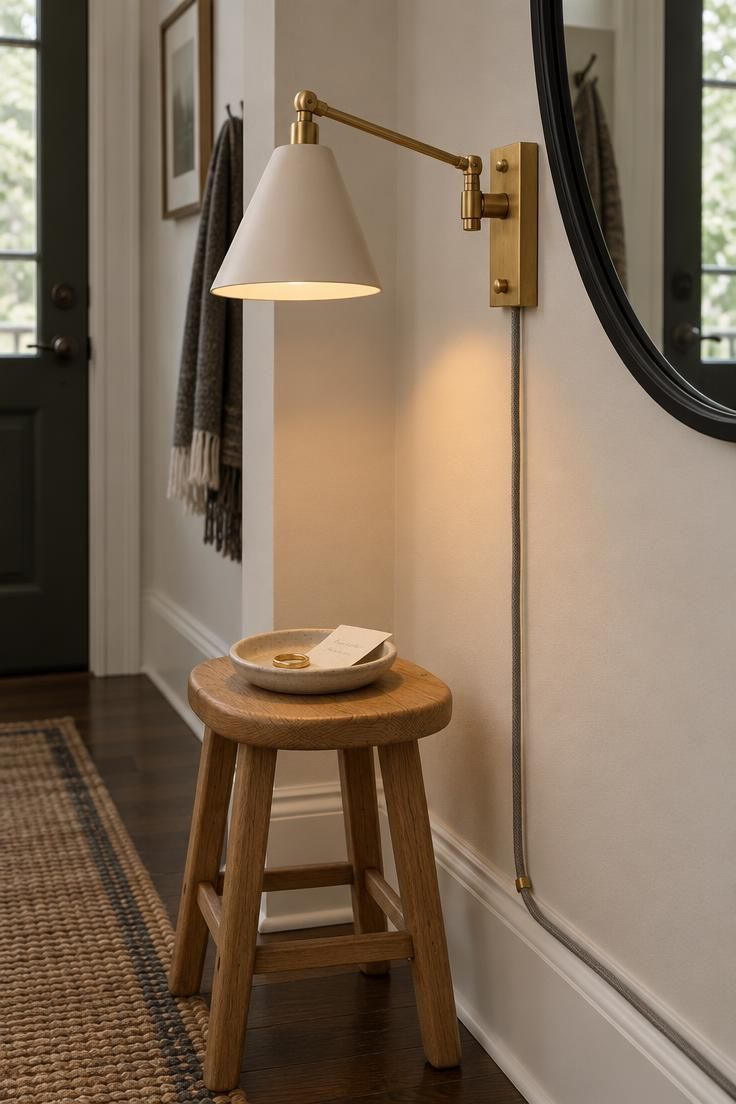
A plug-in wall sconce with a brass finish and a swinging arm gives flexibility in entries without ceiling fixtures or hardwired wall boxes.
The sconce plugs into a standard outlet and can be positioned beside a mirror, shelf, or small bench at a comfortable height.
The articulating arm lets the shade swing toward the wall for ambient glow or downward for task light.
For rental households, this is a reversible update that leaves no wiring behind and can move to the next home.
Pair it with a round black-framed mirror and a small oak stool, and the entry gains entryway mirror lighting without a separate fixture above the glass.
Cord management is the main styling consideration.
Routing the cord along the baseboard or behind a piece of furniture keeps it out of sight, and a fabric-wrapped cord in a muted gray blends with the wall.
Choosing a sconce with a cone shade in matte ivory keeps the brass arm as the visual accent.
The arm’s swing is a practical feature, not just a decorative one: it lets the same fixture serve as reading light beside a bench or as a soft wash against the wall.
Adjusting it takes a moment, so the entry can shift between bright and relaxed without changing fixtures.
Clean the cone shade and brass arm periodically, since the open shape collects dust along its inner curve.
The plug-in design also means the sconce’s placement depends on an outlet’s location, which may push the fixture slightly off the ideal spot beside the mirror.
Style Blueprint:
- Brass plug-in sconce with an articulating swinging arm
- Matte ivory cone shade
- Round black-framed mirror
- Small oak stool beneath the sconce
- Fabric-wrapped cord in muted gray along the baseboard
Design Pro-Tip: Decide where the eye should land first, at the door, the mirror, or the bench, then let one light source carry that focal point while the others support it quietly.
Conclusion
The right entryway light comes down to matching the fixture to the space’s proportions and the moment it needs to serve.
A small flush mount can feel as intentional as a sculptural cluster when the scale, finish, and direction of light suit the entry.
Consider the view from the front door, the ceiling height, and whether a bench, console, or mirror already defines the zone.
A light source works best when it supports those pieces without competing, leaving guests with a clear sense of where to pause, where to set down keys, and where to step next.