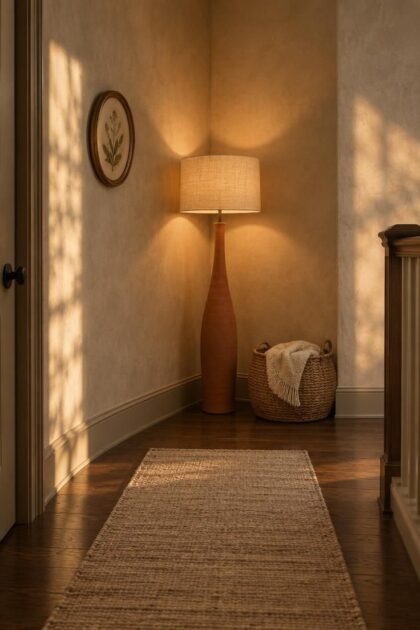
This post may contain affiliate links. If you make a purchase through these links, we may earn a commission at no additional cost to you.
Hallway corners collect the things no other room wants: a spare umbrella, a bag waiting for tomorrow, a plant that never found its spot.
The bend where two walls meet is also the place a corridor most often feels unfinished, because the angle is hard to dress and easy to ignore.
The ideas below treat that crease as the starting point rather than an obstacle.
Each approach below works with one of the corner's three planes: the two adjoining walls and the floor beneath them.
Some run with the crease, some cross it, and some soften it.
Choose by how the corner sits in the sightline and how much walking room the hall needs to keep clear.
Slim Terracotta Floor Lamp Beside a Pale Wall
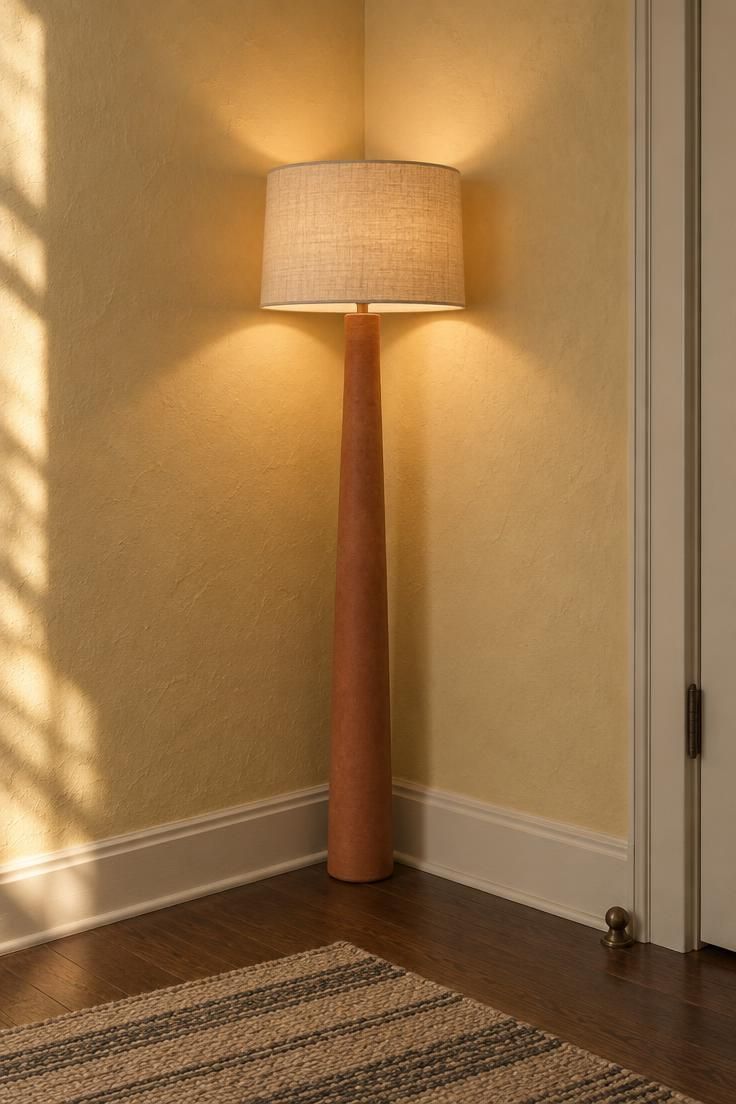
A tall, narrow floor lamp placed right on the crease gives a turning corner a vertical anchor without eating floor depth.
The narrow hallway corner ideas that hold up over time tend to be the ones that respect the walking line, and a lamp with a slim base does exactly that.
Its stem runs parallel to the corner's vertical edge, so the lamp reads as part of the architecture rather than an object dropped into it.
Terracotta and pale plaster make a warm pairing, especially against dark wood trim that grounds the base.
Linen shades soften the light into a glow that reveals the texture of both walls at once, which helps a dim bend feel considered rather than forgotten.
A slim floor lamp with a weighted base and a shade wide enough to pool light but narrow enough to stay visually light will serve this corner better than a bulky fixture.
Keep the lamp close to the crease and clear of the walking route so the forward sightline stays open.
Style Blueprint:
- A slim ceramic or metal floor lamp with a narrow cylindrical base
- A natural linen drum shade in cream or oatmeal
- Pale putty, chalk white, or warm plaster walls
- Dark stained wood flooring with a low-contrast flatweave runner
Design Pro-Tip: Choose a slim floor lamp with a weighted base and a shade wide enough to cast a warm pool of light but narrow enough to stay visually light.
Curved Oak Bench Tucked Into the Widening Turn
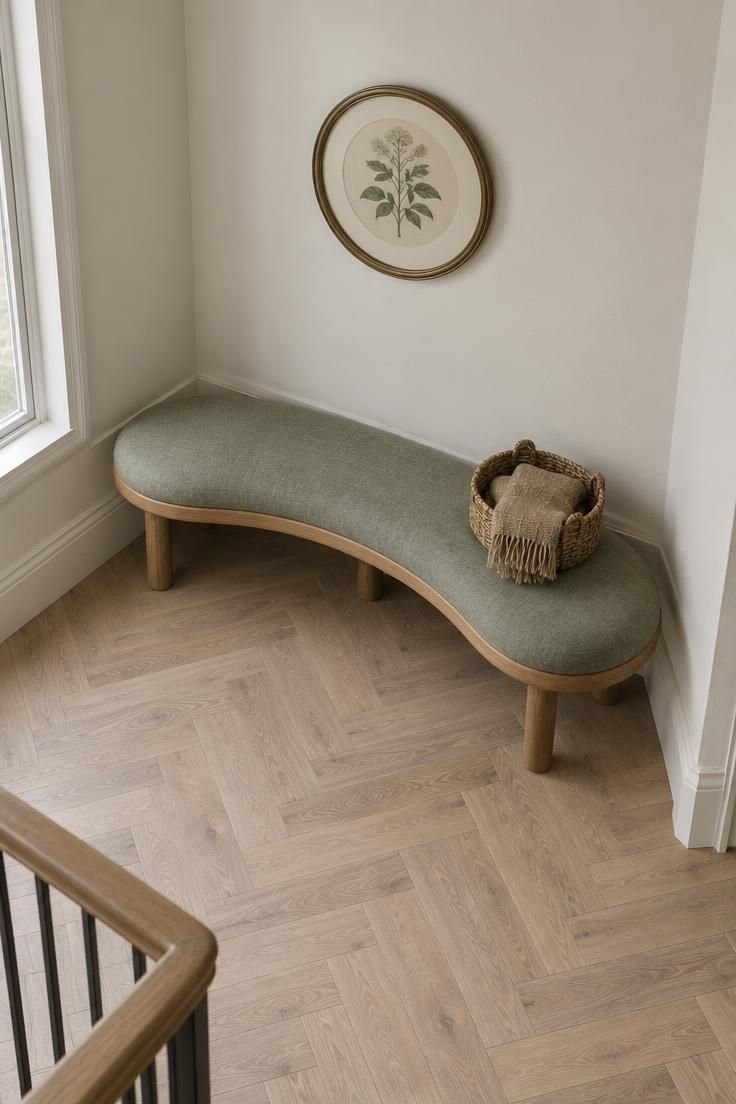
A curved bench with no sharp corners softens the intersection where a hallway opens into a landing or the base of a stair.
The rounded seat edge interrupts the hard 90-degree line instead of echoing it, and the low legs let light pass underneath so the piece feels lifted rather than planted.
This is corner hallway decor that works with the architecture rather than against it.
Oak or white oak keeps the frame warm against pale walls, and a dusty blue or sage linen cushion adds color without competing with the wood.
The curve should follow the inside of the turn, leaving clear walking space on the outer side.
Measure the corner's floor depth before committing.
A compact bench needs enough room to sit without blocking the route, and the visual weight should stay light even when the frame is solid.
Style Blueprint:
- A curved oak or white oak bench with rounded ends and low legs
- Sage green or dusty blue linen upholstery
- A single round framed print centered above the seat
- A woven basket with a folded throw on top
- Pale oak flooring with a soft, low-sheen finish
Tall Dried Grass Stalks in a Wide Ceramic Vase
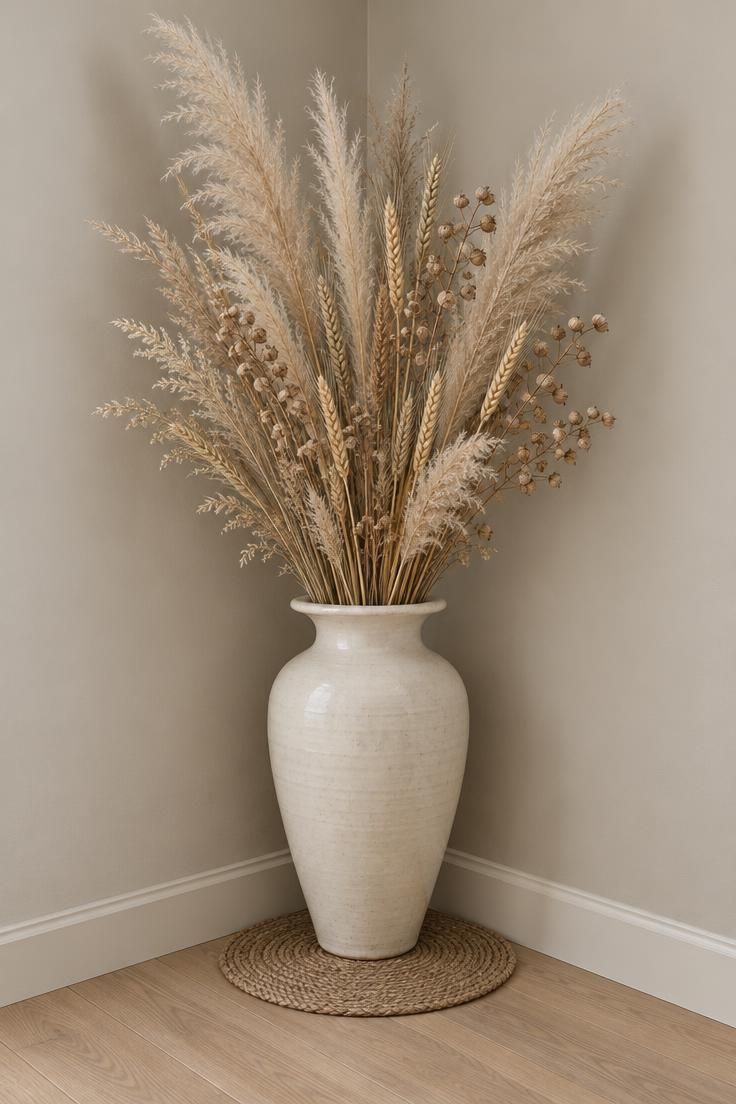
A dead-end corner frames the view at the end of a corridor, which makes it the right spot for a floor arrangement with real height.
A rounded ceramic vase straddling the crease, with dried grasses rising above a standard plant's reach, gives a low-ceiling hall the vertical accent it lacks.
The arrangement reads as silhouette and texture rather than color.
Oat, beige, and pale bronze grasses sit easily against matte sand-tone walls and oak floors.
Because the stalks are dried, the arrangement needs nothing from the corner's light, which suits a corridor terminus where daylight rarely reaches.
For anyone weighing a hallway plant stand against a floor vase, the vase wins in dark spots where living plants would struggle.
Choose a vase with enough visual weight to anchor the height, and set the base close to both walls so the composition hugs the corner instead of floating in the middle of the floor.
Style Blueprint:
- A wide ceramic vase in off-white or sand tone
- Dried pampas, wheat, or seed heads in oat and pale bronze
- A small round jute or sisal mat under the base
Angled Oak Corner Shelves With Staggered Displays
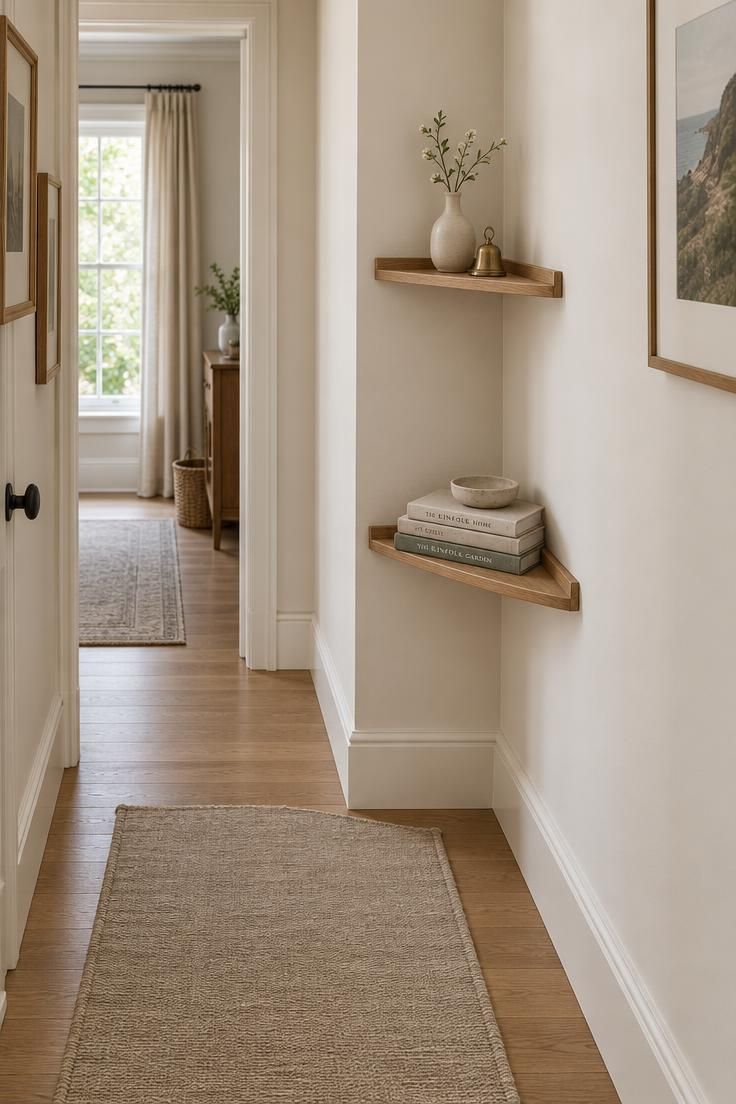
Two or three slim oak corner shelves meeting at the turn put the dead volume above head height to work, where nothing else can go.
Shallow triangular tops follow the angle instead of projecting into the passage, and a small raised lip keeps objects from sliding forward.
Staggering the shelves vertically keeps the corner from reading as one stacked tower.
Corner shelf styling works best with a small, edited group: a round ceramic vase, a tiny bowl, a stack of two linen-bound books, a small brass object.
The warm oak finish ties the shelves to the floor, while the staggered rhythm gives the eye somewhere to travel.
Keep only lightweight display items on these shelves, since their triangular shape lets them sit within the corner rather than jut into the walkway, which matters in a hallway where every inch of clearance counts.
Style Blueprint:
- Two or three slim oak corner shelves with triangular tops
- A small raised lip on each shelf
- A curated group of four or fewer display objects
- A warm white or soft cream wall color
Woven Rope and Cane Room Divider Slanted Across the Crease
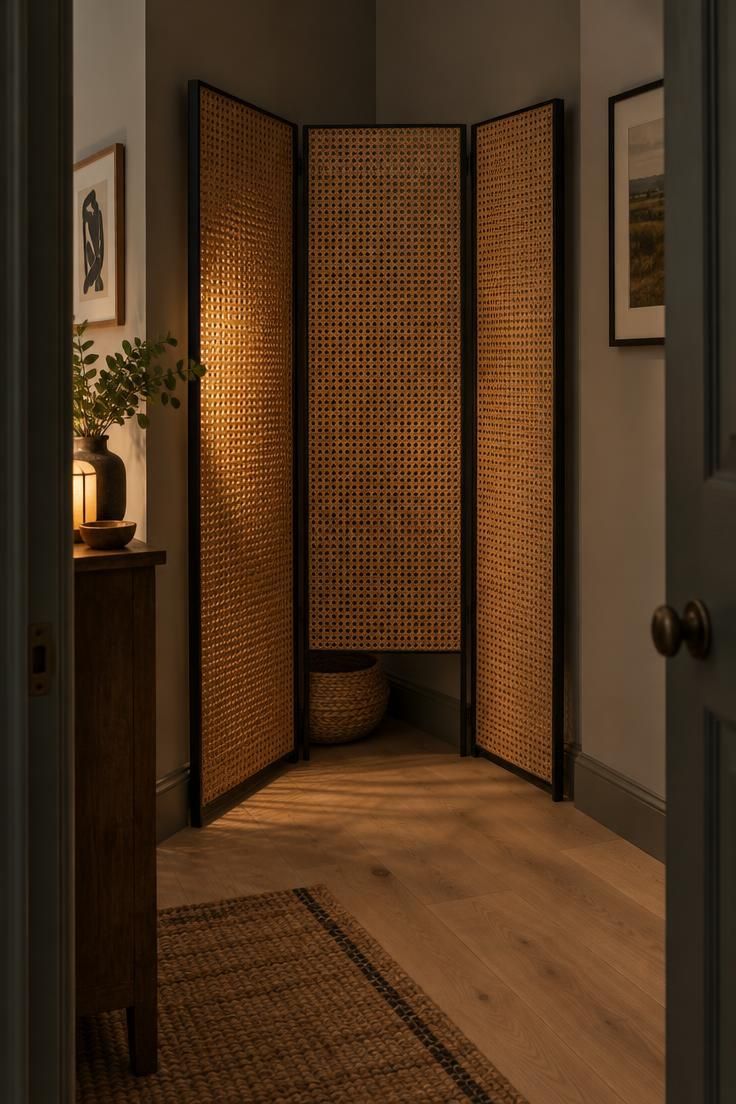
A slim folding screen with woven rope or cane panels, angled across a hallway corner, turns a dead bend into a partial divider and a soft backdrop.
The open weave filters what shows through instead of blocking it outright, and the standing height gives an empty corner structure.
Two outer panels rest near each wall, leaving a triangular pocket behind for a small basket or a pair of slippers.
A folding screen is freestanding and can be repositioned without touching the walls, which suits a rental.
It needs a corner wide enough that the panels do not encroach on the walking route, and the frame should stay light so its height reads as a soft boundary rather than a solid wall.
Style Blueprint:
- A three-panel folding screen in woven cane or rope
- A light metal or natural wood frame
- A flat woven basket for the pocket behind
- Pale oak or light wood flooring
Design Pro-Tip: Select a screen with a light frame so its height feels like a soft boundary rather than a solid wall.
Woven Jute Floor Basket in a Quiet Bend
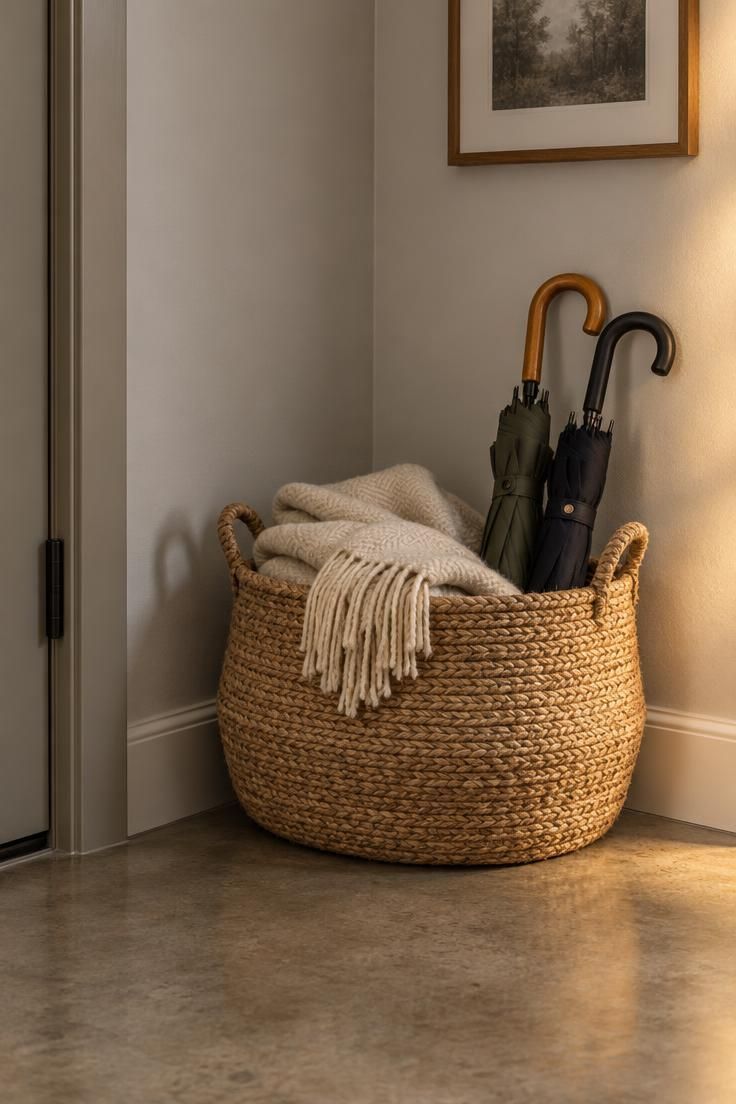
A single oversized woven jute or seagrass basket gives a narrow mid-run corner a soft drop zone where furniture will not fit.
Its round profile breaks the hard angle without adding visual busyness, and the top edge at about knee height keeps it out of the sightline.
Rolled throws, extra slippers, or an umbrella stand all suit the interior.
Choose a wide, low basket so it reads as a soft cylinder resting against the corner.
The fibers hide dirt well in a busy hall, though they also trap dust, so seasonal swaps of the contents make it easier to lift out and clean the floor beneath.
Style Blueprint:
- One oversized round basket in natural jute or seagrass
- A wide, low profile that sits below knee height
- A cream wool throw or similar soft contents
Small Wall Sconce and a Round Traffic Mirror
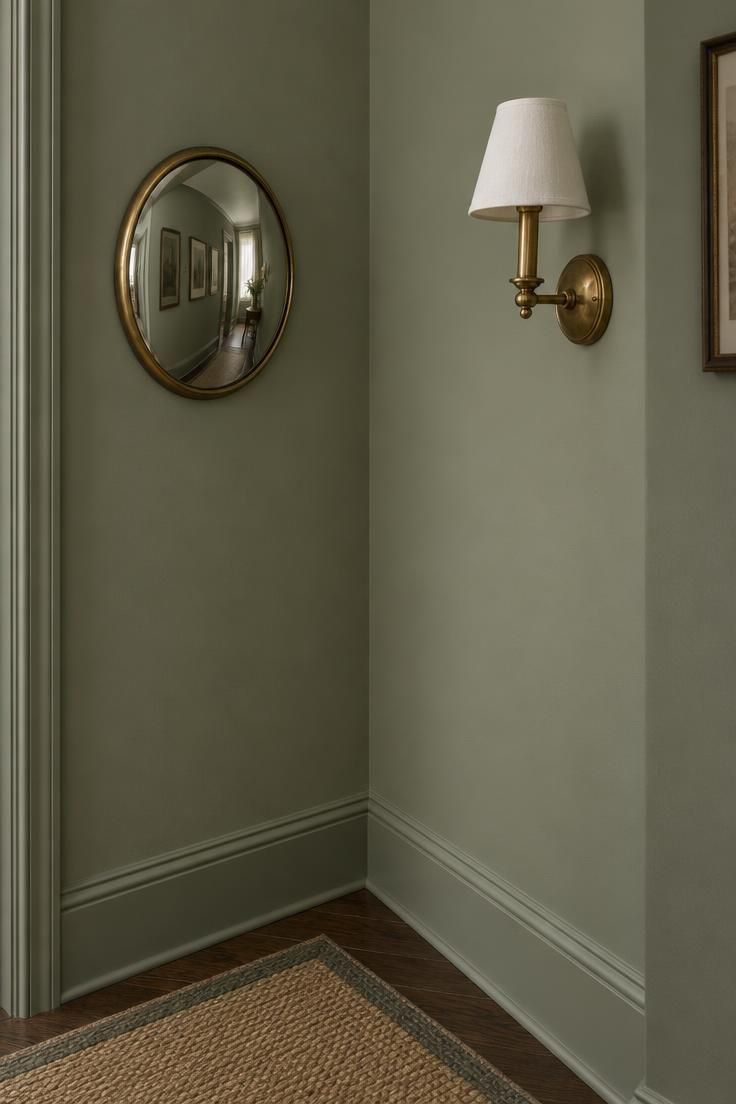
A small plug-in wall sconce and a round convex traffic mirror can work together at a tight L-turn where the hallway changes direction.
The sconce, with a linen shade, sits just above eye level and lights the turn.
The mirror hangs slightly higher or lower on the adjacent wall so the two pieces never align, and its convex surface catches a wide slice of the opposite hall, which makes the tight bend easier to read.
Hallway mirror placement matters here because a mirror at eye level in a tight turn shows an angled reflection that can feel disorienting.
Higher or lower placements read differently, so test the height against how the corner is approached.
Both pieces are surface-mounted and visually light, which keeps a corner that must stay clear for walking from feeling crowded.
Style Blueprint:
- A small sconce with a linen shade, placed above eye level
- A round convex mirror with a thin metal rim
- Offset heights so the two pieces never align
- Antique brass or warm metal finishes on both
- A woven runner in a neutral tone
Design Pro-Tip: Pair warm metal finishes, such as an antique brass sconce with a brass-rimmed mirror, to keep the two pieces feeling related.
Layered Sisal Rugs With a Curved Edge
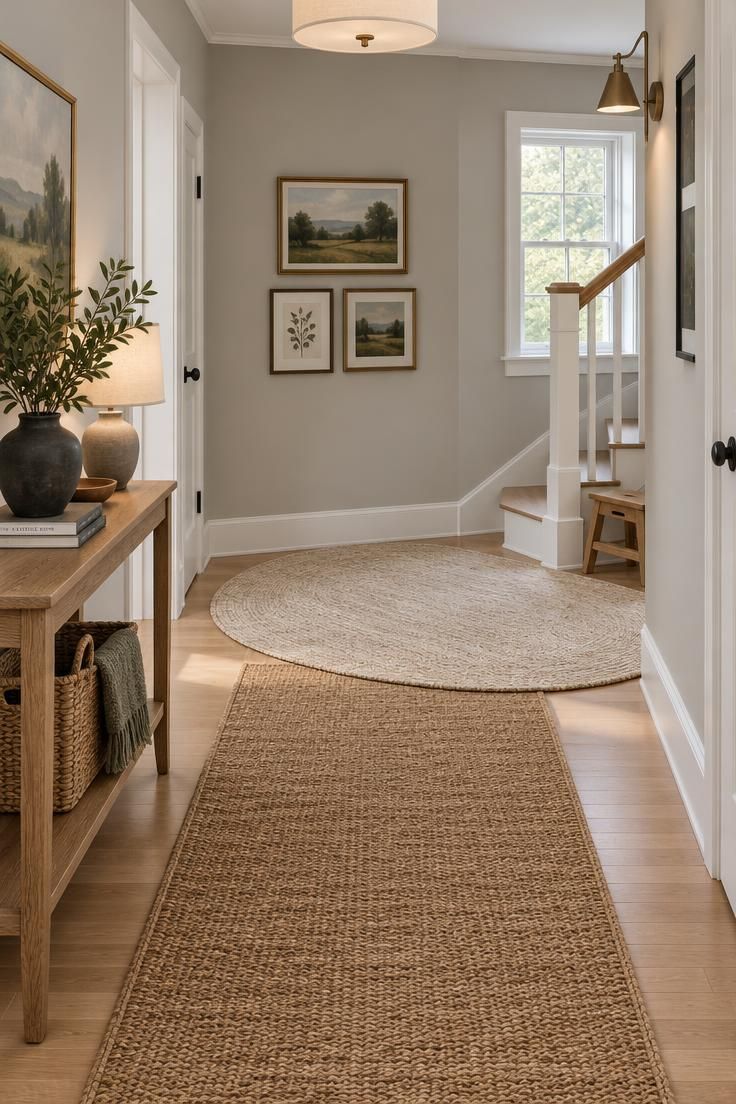
Two flatwoven sisal or jute rugs, one large and one small, can define a wide hallway corner that opens into a stair landing.
Set the larger rug parallel to the hall's long axis, then place a smaller oval or round mat in the corner on top, tucked close to the walls.
The curved edges soften the 90-degree angle and give the floor pattern without a bold color.
Layering only works where the hall is wide enough that the rugs do not create a trip hazard along the walking path.
The smaller rug should not extend beyond the corner's usable floor area, and natural fibers hide dirt in high-traffic spots but trap dust, so occasional shaking is part of the routine.
A small hallway floor lamp placed just past the layered rugs can extend the corner's light into the landing beyond.
Style Blueprint:
- A large sisal runner in tan or natural
- A smaller oval or round jute rug layered on top
- A curved edge tucked close to both walls
- A low oak step stool or similar small accent nearby
Dusty Blue Half-Wall Paint in a Corner Niche
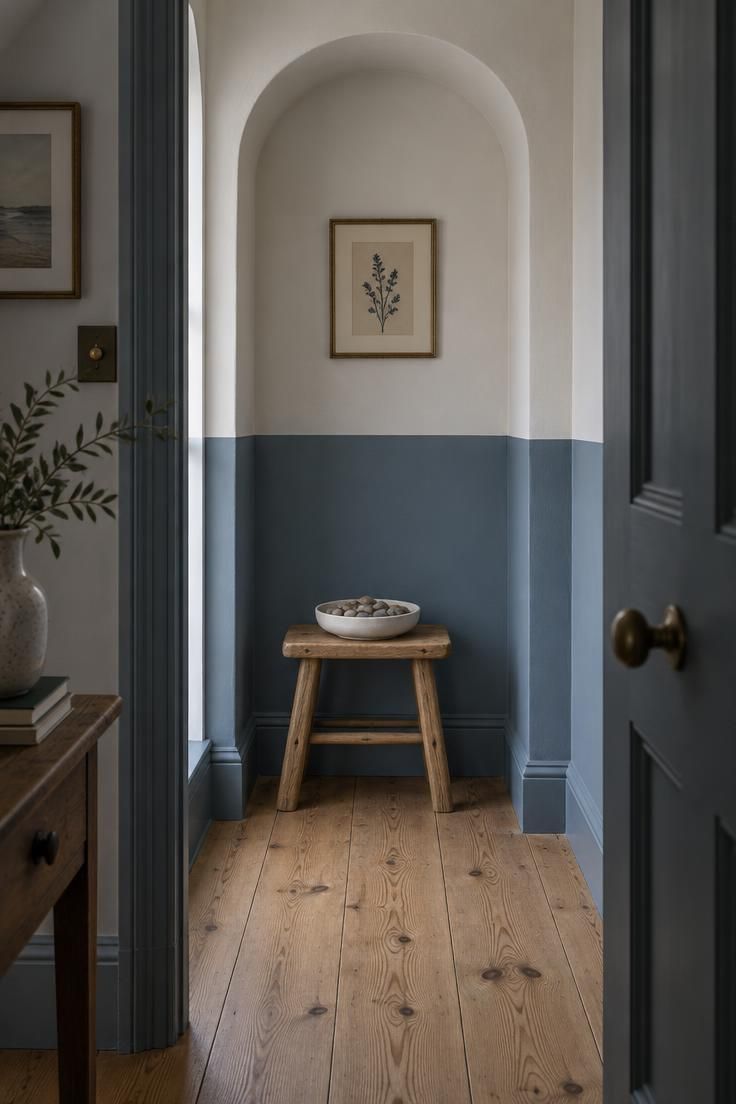
Painting only the lower half of a small recessed corner niche, about chair-rail height, in a soft dusty blue while the upper walls stay warm white creates a contained panel.
The color block gives the corner a defined base, and the blue recedes so the niche reads as deeper than it is.
Add a low wooden stool in the same corner, painted or stained to match the wall below, and top it with a round ceramic bowl or a small stack of books.
This works best where the niche has a clear top edge such as a chair rail or a plaster shadow line.
Painting just the corner is a low-cost way to add color without committing the whole hallway, and the two-tone division does the visual work that furniture alone often cannot in a shallow recess.
Style Blueprint:
- A dusty blue paint in the lower half of the niche
- Warm white on the upper walls
- A low raw oak stool sized to the niche
- A round ceramic dish or small book stack on top
- Wide pine or light wood flooring
Brass Floor Lantern on a Marble Tile Corner
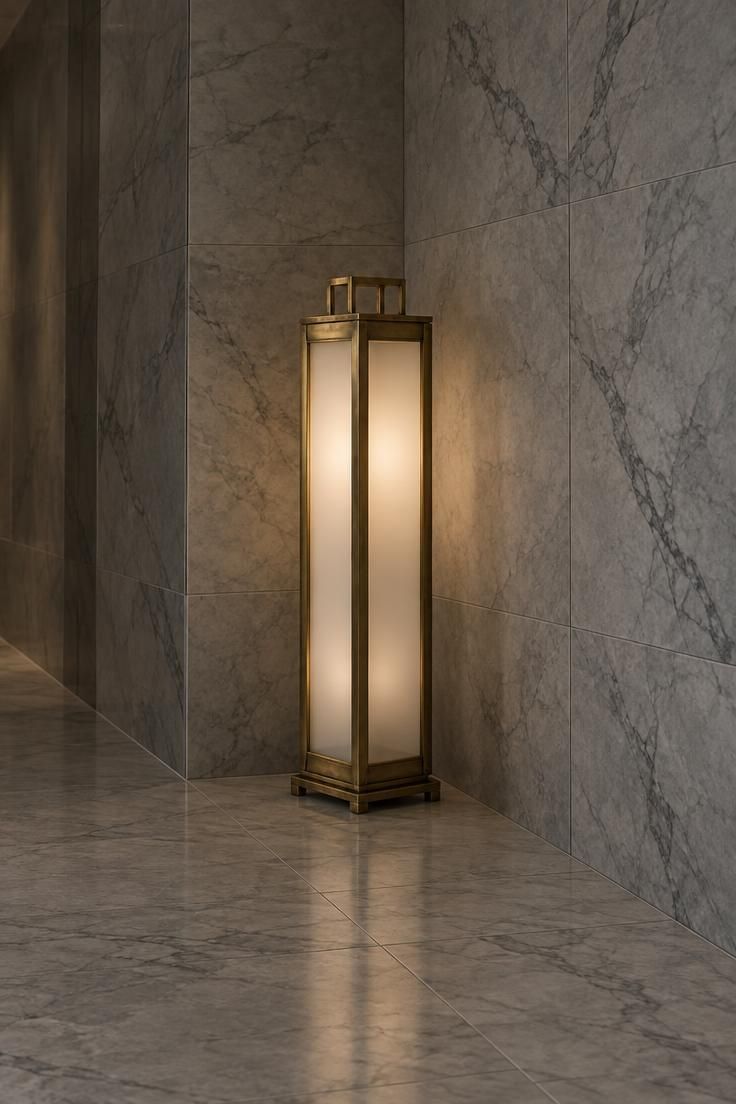
A tall brass floor lantern with a frosted glass insert can light a corner at the end of a marble-tiled hall where floor-level interest is minimal.
Set on a diagonal in the corner, its slim brass frame echoes the height of the door trim and draws the eye upward.
Treated as a sculptural object, it holds the corner even when unlit, and when lit, the frosted glass gives a soft glow that brightens the crease without glare.
Choose a corner that is not near a door swing or a coat hook, and pick a lantern heavy enough that it stays put if brushed.
Brass pairs well with warm stone or wood floors, and tarnishing is a natural part of how the material ages over time.
Style Blueprint:
- A tall brass floor lantern with frosted glass panels
- A diagonal placement across the corner crease
- Marble tile or pale stone walls and floor
Low Black Oak Stool With a Folded Wool Throw
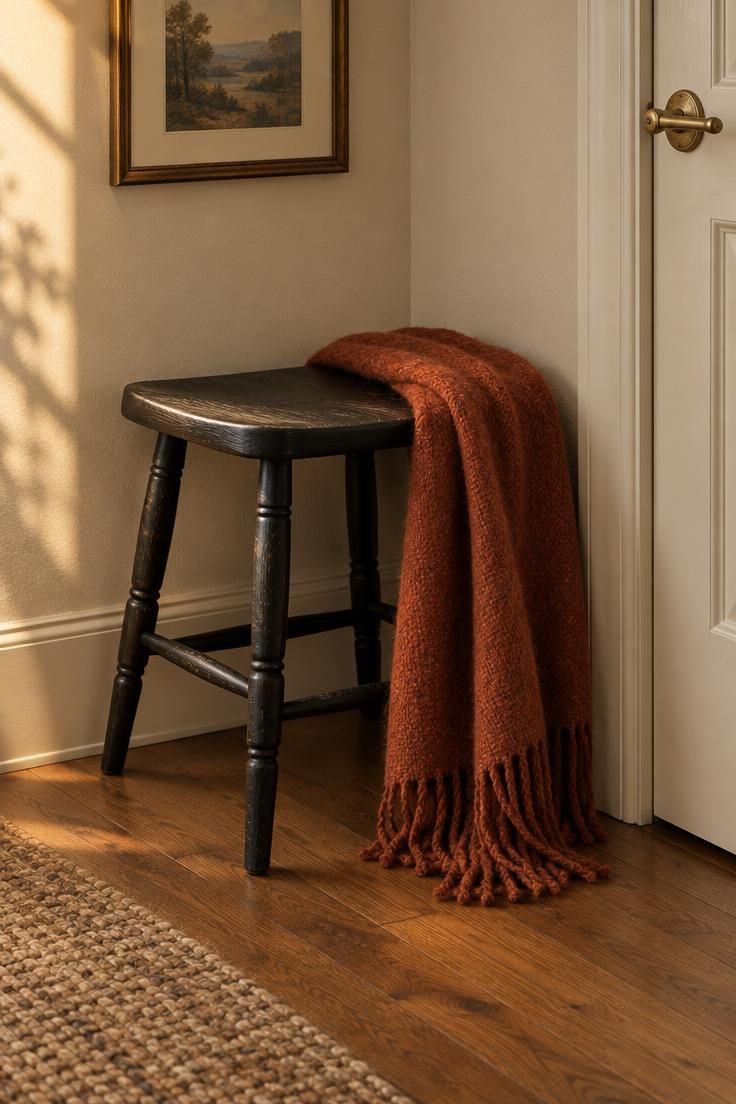
A single low, backless stool in matte black oak or ebonized ash gives a corner near the entry door a furniture-like presence without taking much floor area.
The slightly curved seat and turned legs make it feel intentional rather than utilitarian.
Draped with a folded wool or lambswool throw in warm mustard or rust, the stool carries a soft color accent exactly at the crease, and one corner of the throw can hang to the floor.
The stool can serve as a temporary perch for a bag or a place to change shoes, which is often what an entry-adjacent corner needs.
Place it with its back to the corner and make sure all four legs sit fully on the floor so it does not wobble at the junction.
The contrast between black wood and warm rust wool gives the corner its punctuation.
Style Blueprint:
- A low backless stool in matte black oak or ebonized ash
- A folded wool or lambswool throw in mustard or rust
- A curved seat and turned legs for a furniture feel
- A corner position with all four legs fully on the floor
Conclusion
A hallway corner becomes useful when the decor responds to its geometry instead of fighting it.
Slim vertical pieces suit narrow turns, soft curved forms work in wider landings, and reflective surfaces give dead-end corners a more deliberate look.
Layering works where there is width to spare, and a single strong object often does more than a cluster of small ones.
Before choosing any approach, consider where the corner sits in the sightline, how much floor depth it offers, and what kind of upkeep the piece will need.
Small moves, such as one floor lamp, one basket, or one layered rug, can turn an awkward bend into a quiet focal point that the rest of the hallway can lean on.