This post may contain affiliate links. If you make a purchase through these links, we may earn a commission at no additional cost to you.
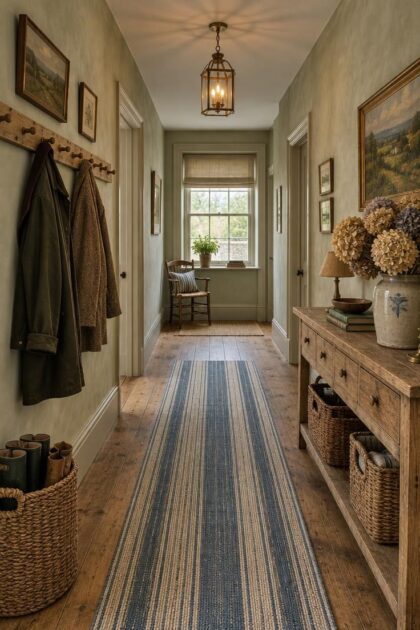
A hallway asks for restraint even when the rest of the house leans collected and full.
Country style answers that tension with honest materials, low-key pattern, and storage that earns its place near the door.
The ideas below work through a narrow passage one decision at a time: what hangs on the wall, what sits underfoot, and what stays empty so boots and coats can move through.
Warmth here comes from texture and patina rather than clutter.
Peg Rail Built From a Weathered Ledge
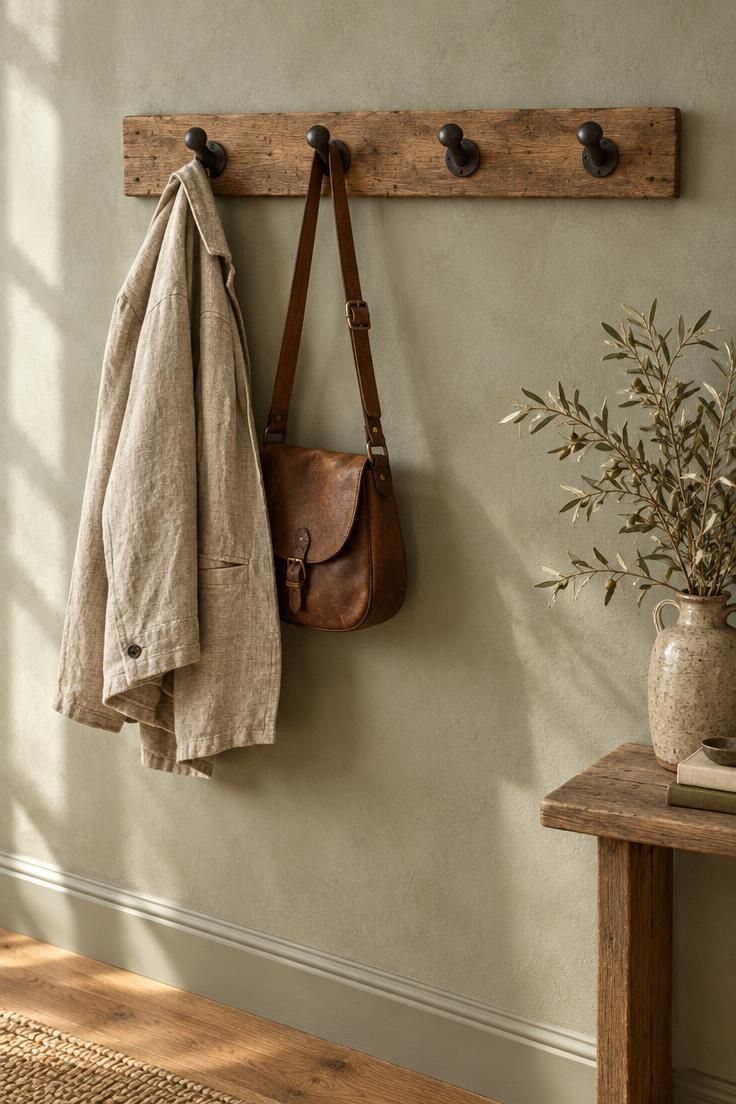
A peg rail is the most direct piece of country vocabulary you can put in a passage.
Mount a horizontal wood rail at a height that lets coats fall clear of the floor, and the wall starts working without taking up a single inch of walking space.
Placement matters more than the rail itself.
Set it on the widest stretch of wall, away from the door swing and away from the point where two people pass, so the rail never narrows an already tight corridor.
A slim console or low bench set beneath it can hold a tray, a jug, or a pair of gloves, but keep that lower piece shallow enough that the passage still reads as a passage.
In a farmhouse hallway the rail usually does the heavy lifting while the floor stays open.
The clutter risk is real.
A rail with six hooks invites six bags, and a wall of hanging items in a narrow hall reads as storage rather than design.
Leave one or two hooks empty on purpose, or rotate which coats live there by season.
Style Blueprint:
- Weathered oak or reclaimed pine rail with simple iron pegs
- Pale sage, cream, or warm white limewash behind it
- One or two everyday items on display, remaining pegs empty
- A shallow lower piece: slim console, low stool, or nothing at all
Design Pro-Tip: Let only one or two hooks carry everyday items and keep the rest empty, so the rail reads as a wall detail rather than a coat pile.
Wall-Mounted Boot Shelf With a Brass Rod
Tall boots take up floor space no hallway can spare.
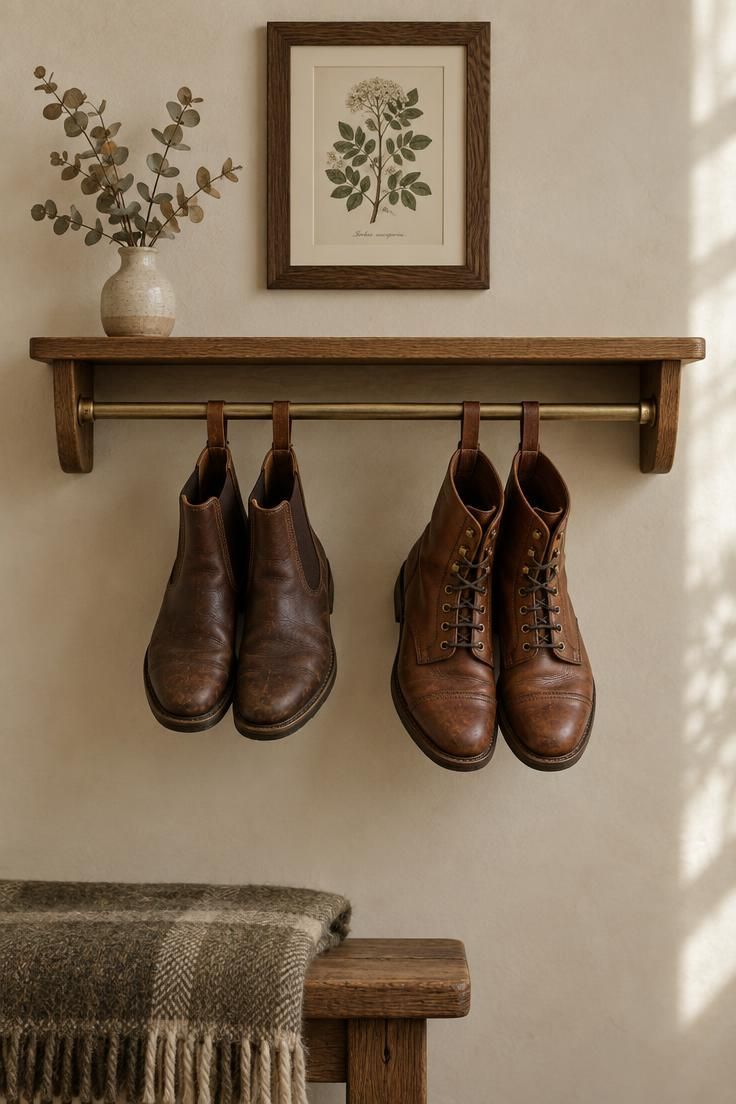
A narrow shelf with a low brass rod lets them hang upside down, which keeps the soles off the floor and frees the run below for a basket or a runner.
The shelf claims the vertical band between a low bench and the ceiling, a zone most corridors leave bare.
Hanging boots create a repeated vertical rhythm on the wall, and two pairs read as a deliberate arrangement where a stack on the floor reads as mess.
Keep the rod close to the wall so boots hang nearly flat against it and do not brush anyone walking past.
This is a good candidate for a cottage hallway because it swaps one bulky piece of furniture for a shallow plane of storage.
The tradeoff is that wet soles drip downward, so a boot tray or a washable mat beneath the shelf saves the floor.
Rotate boots off the rod in humid weather so leather can dry in open air.
Style Blueprint:
- Shallow oak or painted shelf with a slim brass or blackened rod
- Two pairs of boots maximum, hung by pull loops
- Framed botanical or small landscape centered above
- Tray or mat below to catch drips
- A low bench or basket keeping the floor line useful
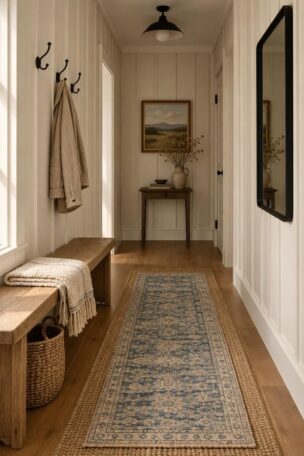
Ticking Stripe Runner Over Reclaimed Boards
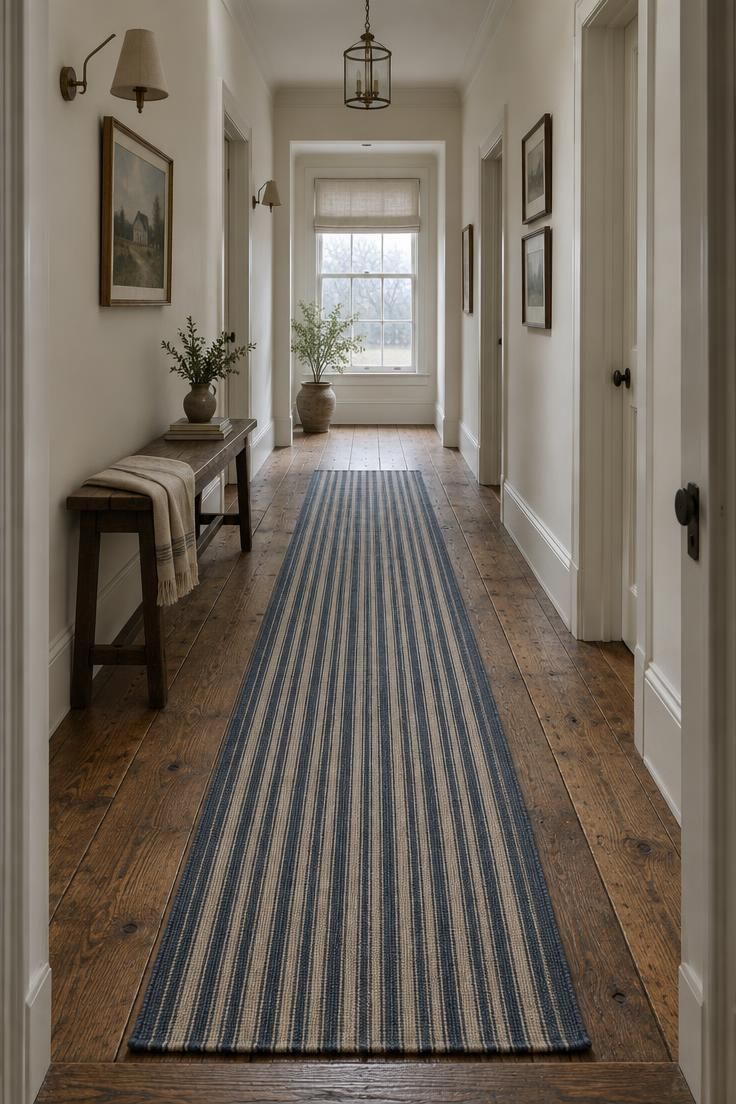
A ticking stripe runner gives a plain corridor pattern and a faded color without turning the floor into a feature.
The stripe scale should suit the corridor length: fine stripes read as texture over a long run, while wide stripes chop a short hall into segments.
The runner also sets up a useful relationship with the floor.
Wide reclaimed boards left bare on either side frame the runner as a deliberate band, and the wood grain stays visible where traffic is lightest.
If a door opens into the hallway, check the swing before choosing runner length, because a runner that rucks at a threshold will never lie flat again.
Flat-weave and low-pile runners handle a busy passage better than thick pile, which catches on doors and holds grit.
Cream-heavy stripes show dirt faster, so a deeper blue or faded red ground buys more time between cleanings.
A narrow hallway bench placed along the wall, clear of the runner, gives shoes a place to land without breaking the stripe.
Style Blueprint:
- Cotton or linen ticking runner in blue, faded red, or charcoal
- Low profile weave suited to doors and foot traffic
- Wide-plank or reclaimed-look floor left bare at the edges
- A narrow bench set off the runner, not across it
Sage Green Wall With a Dark Ledge Shelf
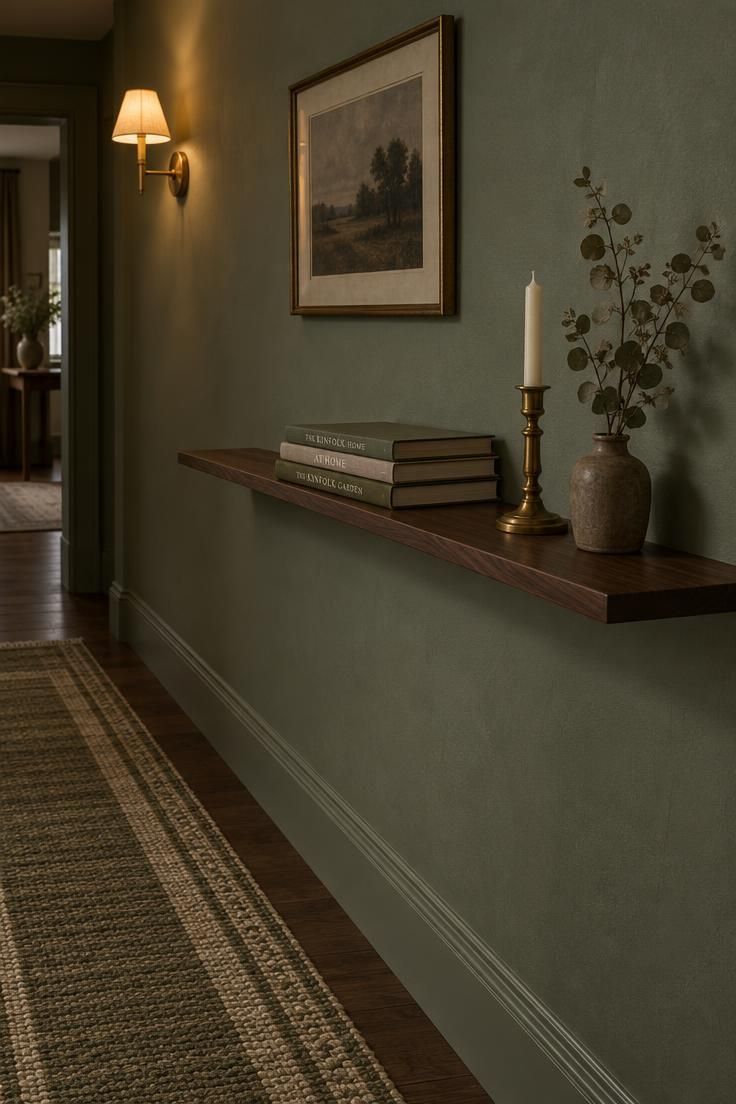
Matte sage holds light better than a brown or tan wall in a hallway with no window.
The chalky finish scatters what light there is and keeps the corridor from closing in, while the green stays rural rather than sweet.
A dark wood ledge at picture height interrupts that flat plane and gives the eye one place to stop.
Stage it with three or four objects at most, and vary their heights so the group does not read as a row of equal things.
Two books laid flat, one upright, a single stem: that is enough.
Trim and ceiling color decide whether the green feels calm or heavy.
A warm white ceiling and off-white trim keep the wall from dominating, while cool white trim can turn the sage gray.
The tradeoff with matte paint is that it marks more easily in a corridor than a wipeable finish, so reserve the wall below hip height for something more forgiving if traffic is constant.
Style Blueprint:
- Chalky matte sage, olive, or muted green paint
- Narrow dark walnut or blackened wood ledge shelf
- Three or four objects, varied in height and shape
- Warm white ceiling and off-white trim
- A wall sconce or small lamp providing the low light
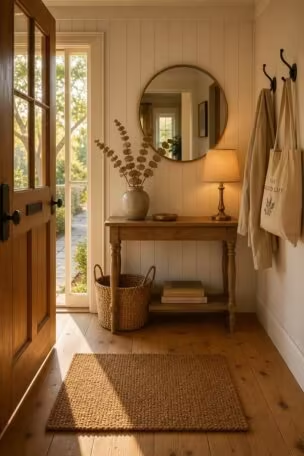
Woven Basket Tray Turned Boot Catch
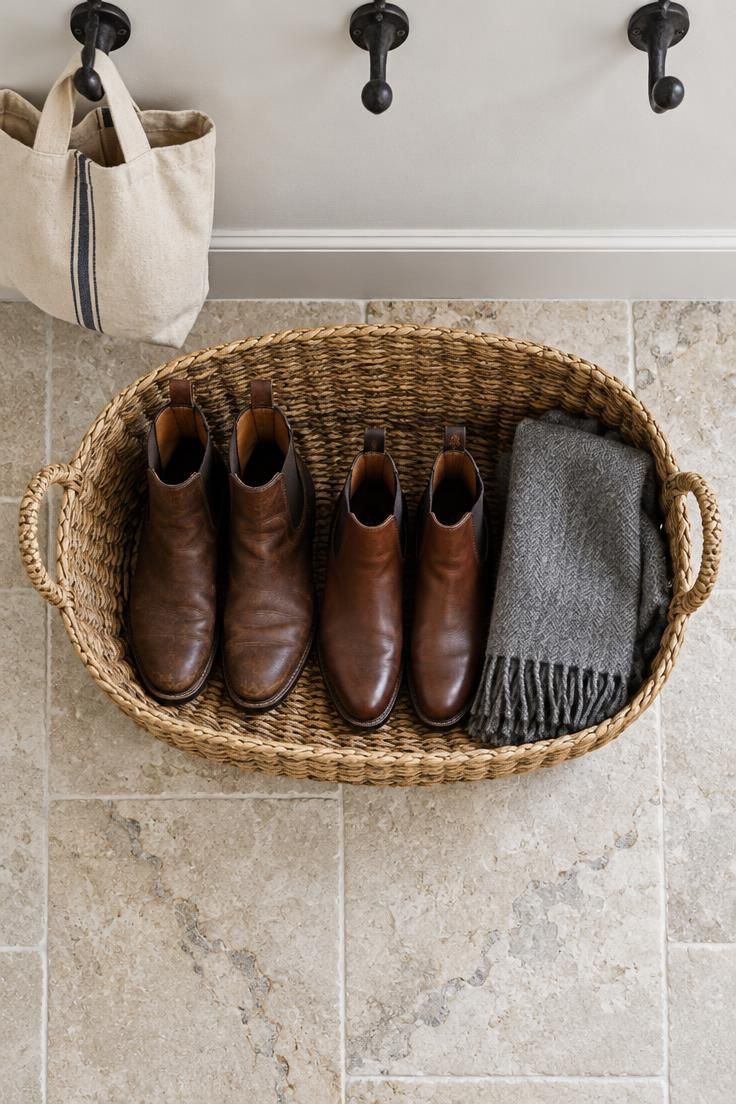
A low woven tray under a row of hooks catches wet boots and grit before either spreads down the hall.
Its flat profile is the point: a tall hamper blocks the sightline and eats floor space, while a shallow basket stays underfoot without dominating.
Scale the basket to the boots, and set it directly below the hooks so the drop zone and the catch zone line up.
An oval wide enough for two pairs side by side keeps them from tumbling, and the open form lets air reach damp leather.
Natural rush, seagrass, and painted wicker each shift the look.
Rush and seagrass bring a warm honey tone that suits wood floors, while painted wicker in a faded gray or white keeps the palette cooler.
Any of them will shed small fibers over time, so a basket with a solid base holds up better on tile and stone.
Style Blueprint:
- Wide, shallow oval basket in seagrass, rush, or painted wicker
- Positioned directly beneath the wall hooks
- Lined base to contain grit and drips
- Neutral contents: boots, scarves, one folded throw
Painted Brick Wall With a Reclaimed Wood Console
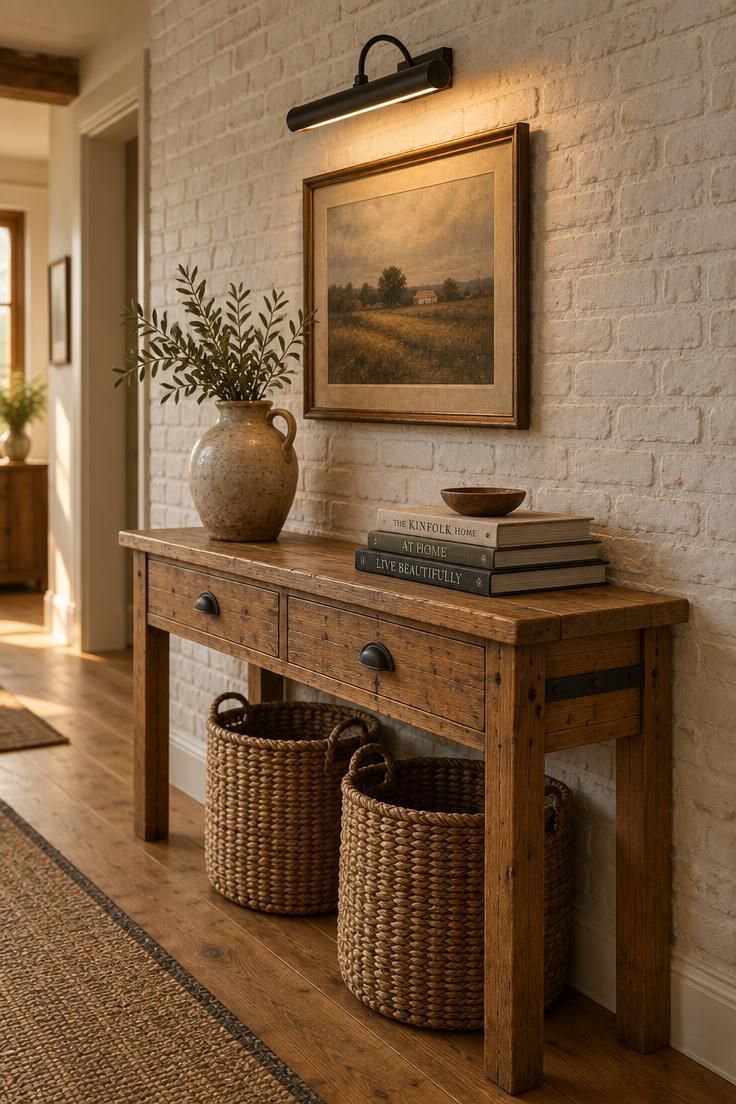
An exposed brick wall brings texture a flat plaster surface cannot, and painting it in a warm off-white keeps that texture from going dark.
The paint settles into the mortar and leaves the brick profile readable, which suits a rustic hallway better than a fully sealed, glossy finish.
A slim reclaimed wood console balances the irregular wall behind it.
Keep the piece quiet in shape and let the brick carry the visual weight, then use the space beneath for two baskets that hide gloves, leads, and loose bits.
The console depth should leave clear walking width in front of it.
Where that wall sits matters.
A console on the longest continuous stretch reads as furniture; the same console wedged beside a door swing reads as an obstacle.
If the hallway is a through-route rather than a destination, a single narrow console with open floor on both sides keeps passage easy.
Style Blueprint:
- Whitewashed or warm off-white painted brick
- Low reclaimed pine console, simple in form
- Two woven baskets underneath for loose items
- Iron picture light or similar small fixture above
- A ceramic jug, books, and one natural element on top
Lantern-Style Ceiling Light and Warm Oak Door
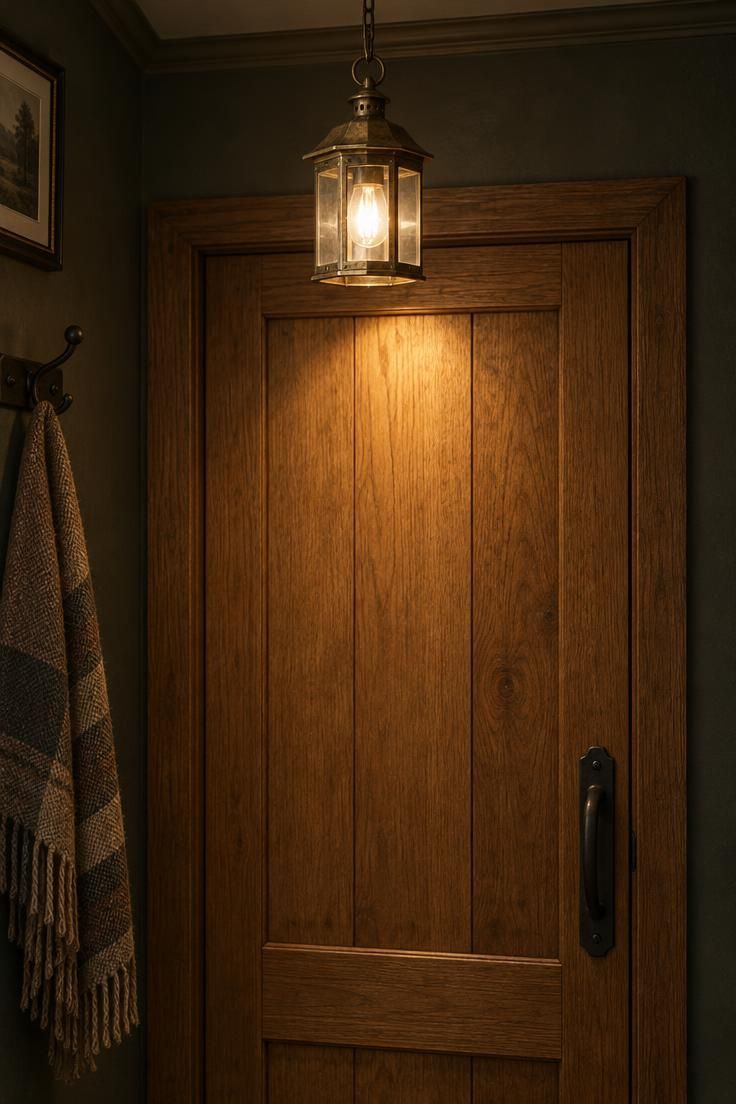
A lantern-shaped fixture in aged brass gives a windowless corridor a warm, layered source of light that reads as country rather than utility.
Its shape suits a hallway because the glass panes throw light sideways as well as down, which softens the wall and door surfaces instead of leaving them in shadow.
Coordinate the fixture with the wood it illuminates.
Warm brass flatters oak, pine, and chestnut, while blackened iron or nickel can leave warm wood looking dull.
A warm white bulb behind simple glass keeps the mood gentle and avoids a hard white glare at eye level when you walk through.
Centering the fixture over a door or a bench gives the hallway a focal point, and offsetting it can suit a corridor that turns.
A rod or short chain lowers a small pendant without making the ceiling feel busy, though a low ceiling may call for a flush mount instead.
This is where a country style hallway gains a sense of arrival rather than feeling like leftover space between rooms.
Style Blueprint:
- Small lantern pendant or flush mount in aged brass
- Warm white bulb behind clear or lightly seeded glass
- Centered above a door, bench, or console as the focal point
- Rod or chain only where ceiling height allows
Blue-Gray Ticking and Limewashed Lower Wall
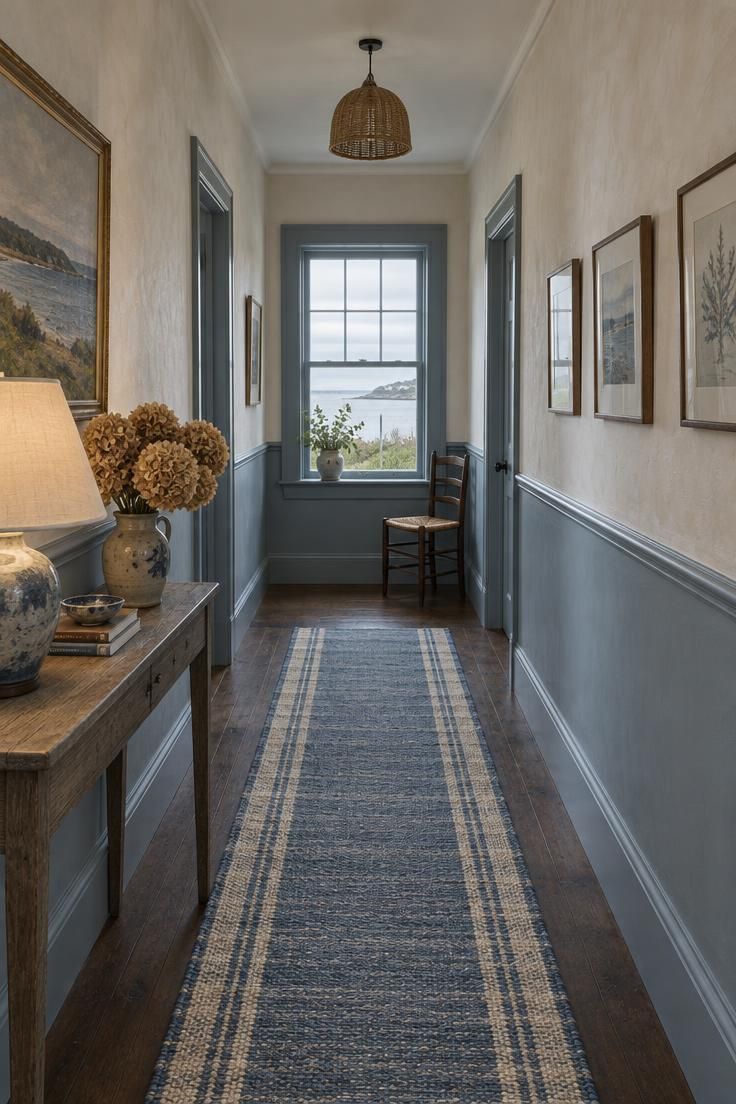
Dividing the wall into a light upper portion and a blue-gray lower portion gives a cottage feel without the cost and commitment of full paneling.
The horizontal line changes how tall the corridor reads, and a simple chair rail or painted edge marks the transition cleanly.
Choose a blue-gray that stays muted.
A grayed, dusty blue or a soft slate keeps the scheme in the country range, while a saturated blue leans coastal-modern and can fight warm wood tones.
Limewash above the rail brings a soft, uneven finish that flat paint cannot imitate.
The rail does more than divide color.
It protects the lower wall from scuffs in a busy passage, and it creates a natural height for a shelf, a small picture, or a hook strip.
If the ceiling is low, lift the division line slightly to keep the room from feeling pinched.
This pairing of limewash and blue-gray is one of the most flexible approaches to country hallway decorating, since both surfaces can be repainted without changing the furniture.
Style Blueprint:
- Warm white limewash on the upper wall
- Muted blue-gray paint or simple paneling below
- Painted wood chair rail marking the division
- Flat-weave runner in blue and cream to tie the tones
- Stoneware and dried stems as the only color accents
Umbrella Stand With a Galvanized Bucket Insert
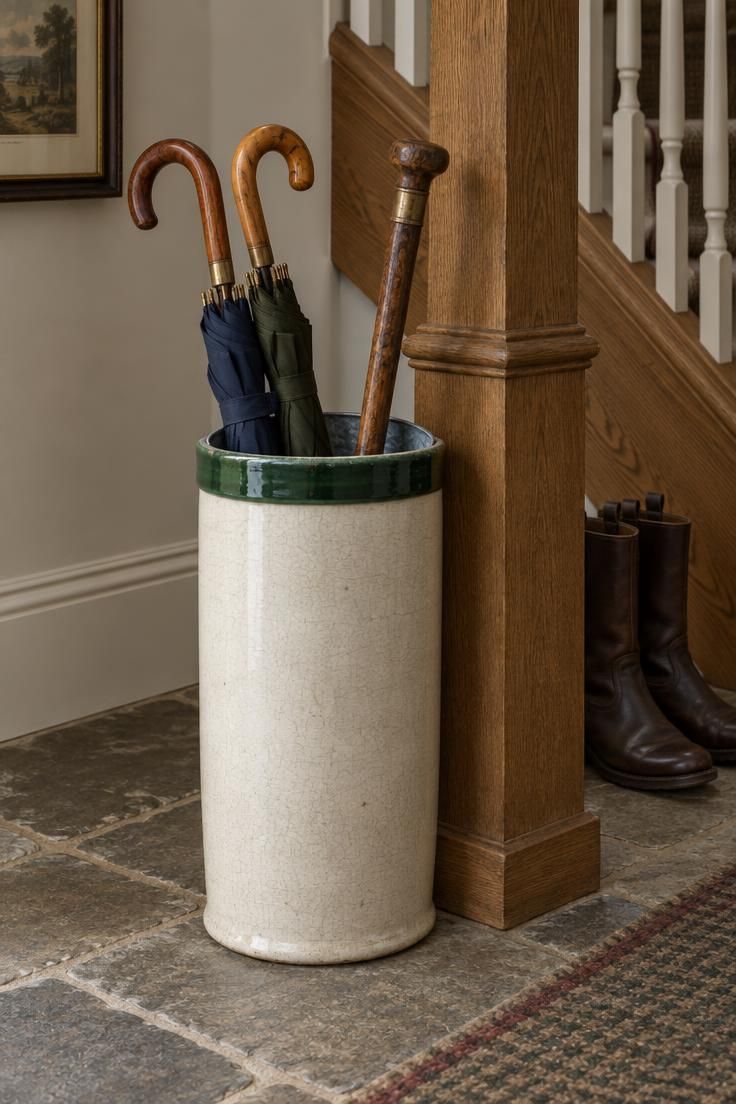
A single upright object gives a long hallway a vertical anchor, and an umbrella stand does that job while holding something you actually use.
Cream ceramic with a hand-painted rim reads traditional; cast iron reads heavier and darker, which suits a hall with more shadow.
Choosing a height that stays below the hand is the practical test.
A stand that tops out near the hip keeps umbrellas from swinging into traffic, and a narrower footprint makes it easier to tuck beside a door or a newel post.
Contents will keep changing the silhouette, since three umbrellas look nothing like one, and a walking stick adds a diagonal line that reads well against a plain wall.
Natural rush, seagrass, and glazed ceramic each bring a different surface, but the interior liner is what makes the piece work on wet days.
A galvanized bucket inside a ceramic or wicker shell catches drips and can be lifted out and emptied.
Choose the shell and liner together so the bucket’s lip sits just below the rim rather than announcing itself.
Style Blueprint:
- Tall ceramic, cast-iron, or woven stand with a narrow footprint
- Galvanized or enamel liner that lifts out
- Position beside a door or stair post, not mid-passage
- Two or three umbrellas and a walking stick for a varied silhouette
Architectural Salvage Hook Board Above a Slim Coat Shelf
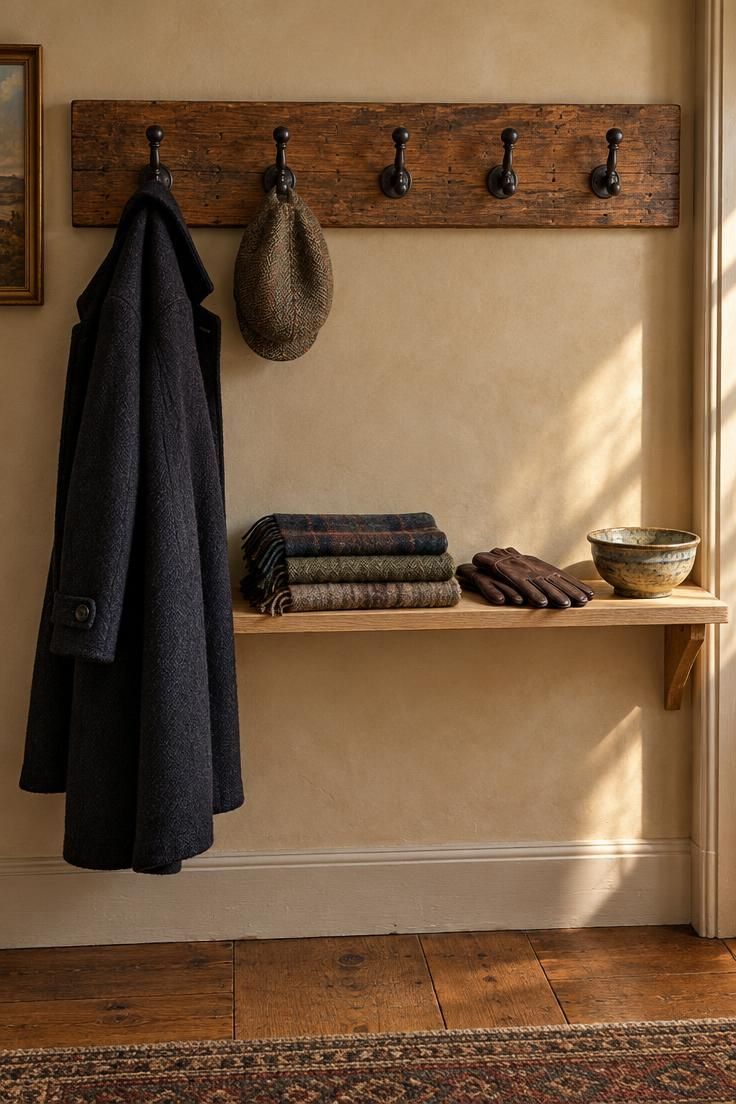
An old board fitted with large turned hooks gives coat storage a sculptural presence, especially when the wood is left unpainted.
The aged surface carries the color and history, and the turned hooks add a curved profile that flat hardware lacks.
Scale the board to the wall it occupies.
A board that reaches most of the way across a short wall reads as built-in and intentional, while a small board on a long wall looks stranded.
The lower shelf beneath it catches bags, gloves, and hats, so the hooks can stay dedicated to coats and the shelf can carry everything that would otherwise pile on the floor.
Density is the thing to watch.
Five hooks filled with five heavy coats will crowd the wall and push into the passage, so limit what hangs at any one time and let the empty hooks show.
The tradeoff with open storage is that the look depends on daily discipline, and a closed bench elsewhere in the hall can absorb the overflow on busy weeks.
Style Blueprint:
- Wide reclaimed chestnut, pine, or oak board, left unpainted
- Four or five large turned hooks in dark wood or iron
- Narrow shelf below for scarves, gloves, and a bowl
- Two or three coats hung at once, remaining hooks empty
Rustic Window Seat at a Hallway Turn
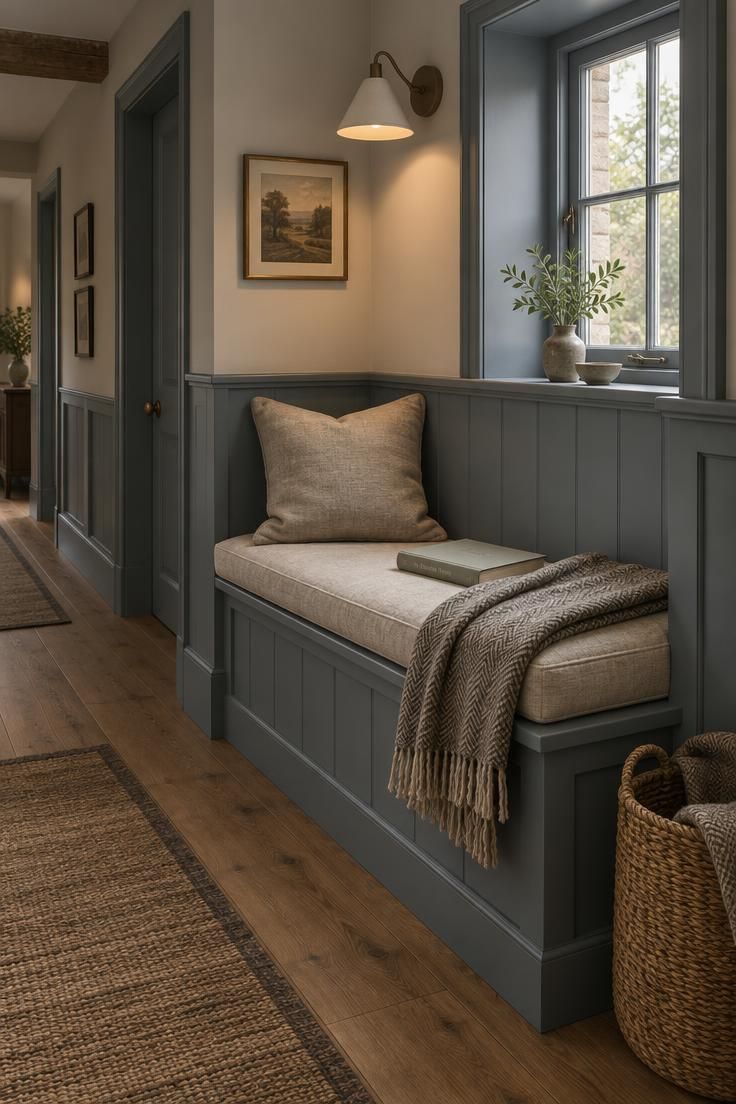
Where a hallway widens or turns, a low window seat makes the corner useful without blocking the route.
Painting it the same color as the surrounding wall lets it read as part of the architecture rather than a piece of furniture dropped into the space.
Depth is the deciding measure.
A seat deep enough to sit on comfortably but shallow enough to leave clear passage in front of it will serve the corner, while a deeper seat turns the turn into a bottleneck.
A hinged top lets the seat hold out-of-season items, though that trades the airy look of an open base for hidden storage.
Most country hallways will get more use from a deep seat cushion and a basket beside it than from a lid that never gets lifted.
The corner benefits from a small light and one piece of art.
A wall light above the seat, with a picture or a small mirror on the adjacent wall, gives the turn a sense of arrival and draws the eye around the bend.
Seasonal rotation keeps the seat current: a different throw in winter, a lighter linen in summer, a branch of dried stems on the sill.
Style Blueprint:
- Low seat built or fitted into a hallway turn or widening
- Painted to match the surrounding wall, or one shade deeper
- Loose linen cushion in oatmeal, gray, or faded stripe
- Small wall light or picture above the seat
- Basket or tray at one end for shoes and throws
Design Pro-Tip: At a corner seat, keep the cushion loose and washable, and let the paint color match the wall so the seat disappears into the architecture.
Conclusion
A country style hallway rarely needs a matched set of furniture or a wall crowded with objects.
The strongest versions pick a few warm, slightly worn pieces, give the eye one or two places to rest, and leave enough open wall and floor for coats and boots to move through.
A runner, a hook board, a lantern, and a basket will carry the whole look if the proportions are right and the clutter is kept in check.
As the seasons shift, a different runner, a new branch of dried stems, or a swapped-out coat can refresh the space without adding anything more.
That easy flexibility is what keeps the country approach working in a room most homes treat as an afterthought.