This post may contain affiliate links. If you make a purchase through these links, we may earn a commission at no additional cost to you.
A small front yard does not need a sprawling lot to leave a lasting impression on every person who passes by.
The right combination of hardscape, plantings, and lighting can turn even the narrowest strip between sidewalk and porch into something worth stopping for.
These 17 small front yard landscaping ideas each focus on a single material, plant, or detail that you can adapt to your own space, your own climate, and your own budget.
These ideas range from simple planting and lighting changes to projects that may require utility checks, professional installation, structural design, drainage planning, permits, or other site-specific work.
Use as planning inspiration and match the installation method to the conditions on your property.
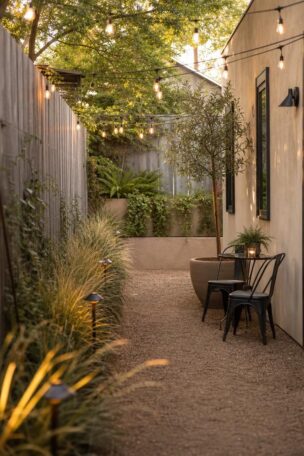
A Slate Chip Pathway With Cast Bronze Solar Stake Lights
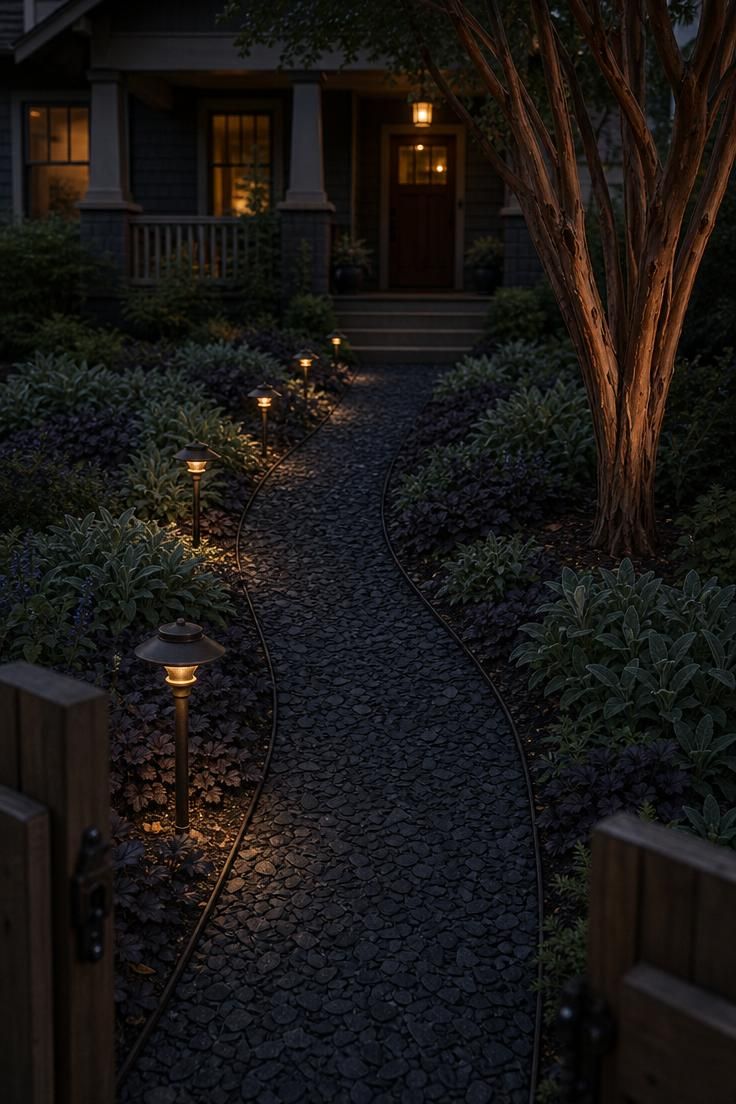
Dark slate chips underfoot give a pathway weight and texture that poured concrete simply cannot match.
The irregular edges of each chip catch light differently, creating a surface that shifts in tone from charcoal to pewter depending on the hour.
Cast bronze stake lights along one side of the path do double duty, marking the walkway for safety and casting small pools of amber that make the yard feel inhabited after sundown.
Spacing the lights every four feet keeps the glow consistent without crowding the path edge, and solar-powered models mean zero wiring through your planting beds.
The contained width of a slate chip path, usually 30 to 36 inches, suits small front yards perfectly because it leaves maximum room for planting on both sides.
Steel landscape edging holds the chips in place and creates a crisp line between path and bed that reads as intentional from the street.
This is one of those walkway design details that costs less than flagstone but photographs just as well, especially once the yard lighting kicks on at dusk.
Style Blueprint:
- Dark charcoal slate chips, 3/4-inch size, 2 to 3 inches deep
- Cast bronze solar stake lights spaced every 4 feet
- Steel landscape edging in matte black finish
- Low silver-green groundcover (lamb’s ear or dusty miller) along the path edge
- A single specimen tree as a vertical anchor near the midpoint
Dwarf Italian Cypress in Tall Zinc Cylinder Planters
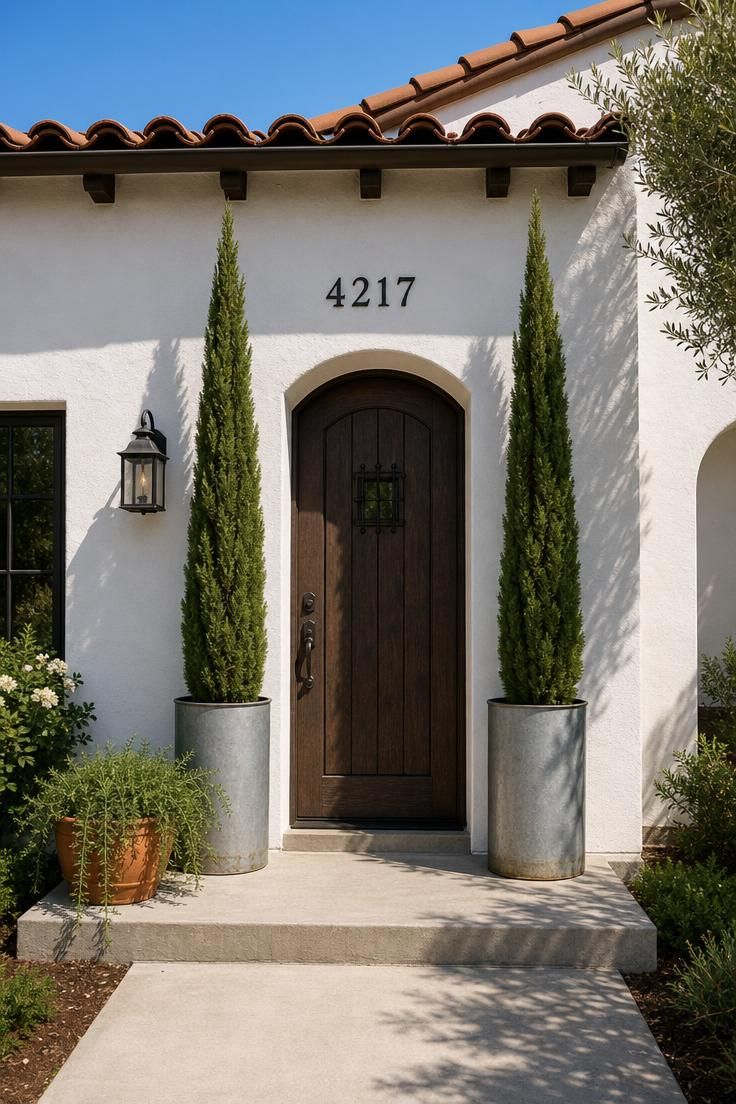
Tall, narrow planters with columnar evergreens are the fastest way to frame a front door and add vertical drama to a flat facade.
Dwarf Italian cypress stays tight and columnar without shearing, which means you get that formal pencil shape with almost no pruning.
Zinc cylinder planters develop a soft gray patina over the first year that reads more sophisticated than raw metal, and the cylindrical form keeps the eye moving upward.
Pair these planters with a low terracotta pot of trailing herbs at the base to soften the composition and add a second scale.
This combination works on lots as narrow as 15 feet because the planters take up less than two square feet of floor space each.
The front porch landscaping impact is immediate and photogenic from the street, the sidewalk, and the doorstep itself.
Style Blueprint:
- Tall zinc cylinder planters, 14 inches wide by 36 inches tall
- Dwarf Italian cypress (Cupressus sempervirens ‘Tiny Tower’ or similar)
- Terracotta accent pot with trailing rosemary or thyme
- Matte black house numbers mounted at eye level
- Broom-finished concrete stoop
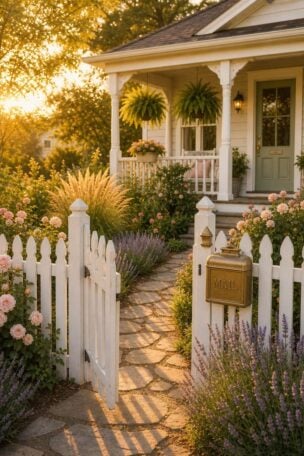
Lavender Rows Along a Brushed Aggregate Concrete Walk
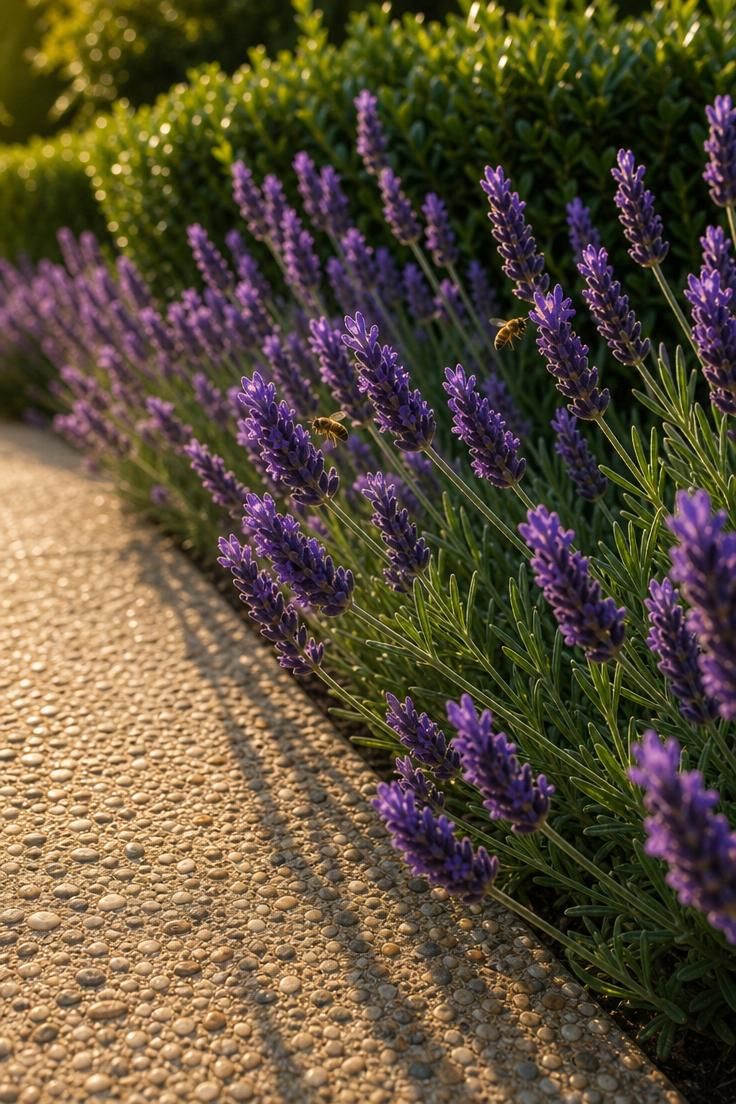
Lavender planted in rows along a walkway creates a living border that smells as good as it looks, and it does it on almost no water once established.
French lavender (Lavandula dentata) or English lavender (Lavandula angustifolia ‘Hidcote’) both hold a compact form that stays tidy against a hard edge.
The brushed aggregate finish on the concrete walk adds just enough texture to keep the surface from reading as plain, and the warm pebble tones complement lavender’s silvery foliage.
Planting three rows deep on each side, shortest at the walk edge, tallest at the back, gives the border a layered fullness that a single row cannot achieve.
This is a strong choice among flower bed ideas because lavender checks so many boxes: drought tolerant plants that need no supplemental irrigation after the first summer, pollinator-friendly blooms from late spring through fall, and a tidy shape that does not flop onto the concrete.
Prune each plant by one-third after the first flush of blooms to keep the shape tight and encourage a second round of flowers.
Cut a few stems for the kitchen table every week, and the bed stays groomed without any additional effort.
The color combination of purple blooms, silver-green leaves, and warm tan aggregate is one of those palettes that photographs well in any season.
Style Blueprint:
- French or English lavender planted in staggered triple rows
- Brushed aggregate concrete walkway in warm tan pebble tones
- Low boxwood hedge as a dark green backdrop
- Steel or aluminum edging between lavender bed and walkway
- Drip irrigation line for the first year only
A Weathered Oak Arbor Gate With Star Jasmine Canopy
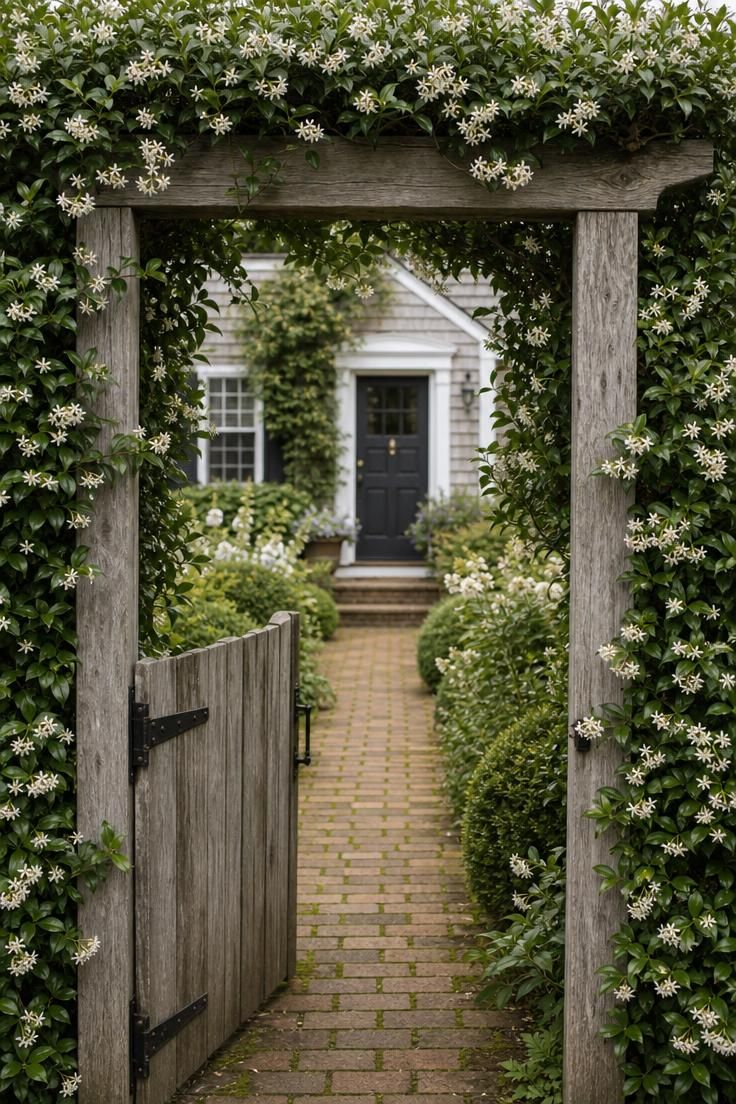
Walking through a planted arbor changes the entire experience of approaching a front door, turning a simple path into a threshold between the street and your private space.
Rough-sawn oak weathers to a silvery gray within two seasons without any stain or sealant, and that natural aging gives the structure a settled, permanent look.
Star jasmine is one of the most reliable climbers for an arbor because it stays evergreen, produces waves of fragrant white blooms, and does not strangle the wood the way some vines do.
Train the jasmine by tying new growth to the arbor frame with jute twine during the first two growing seasons, and it will grip on its own after that.
Matte black hardware on the gate, strap hinges and a simple thumb latch, keeps the tone grounded and prevents the structure from reading as overly precious.
This kind of front yard curb appeal is hard to beat because it adds fragrance, structure, and a sense of arrival all at once.
Style Blueprint:
- Rough-sawn oak arbor, naturally weathered to silver gray
- Star jasmine (Trachelospermum jasminoides) trained over the top and sides
- Simple plank gate with matte black strap hinges
- Old brick path in running bond pattern beneath the arbor
- Jute twine for initial vine training
Design Pro-Tip: When adding vertical structures like arbors or trellises to a small front yard, keep the footprint under 4 feet wide and 3 feet deep. Anything larger will overpower a compact lot and block sightlines from the porch to the street. The goal is a frame, not a wall.
Stacked Pennsylvania Bluestone Retaining Wall With Sedum Cap
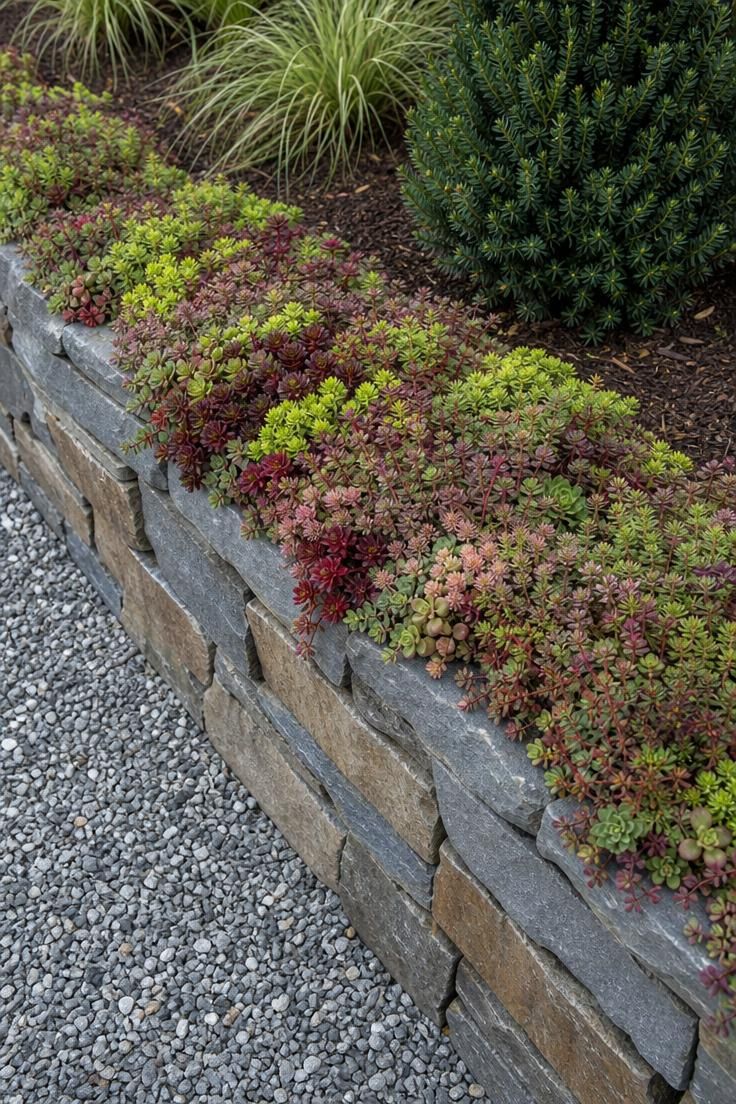
A low retaining wall solves the most common small front yard problem, a grade change between the sidewalk and the house, and it does it with a material that ages beautifully.
Pennsylvania bluestone comes in irregular cleft pieces that stack without mortar, and the natural variation in thickness and color gives each wall a one-of-a-kind character.
Capping the wall with a thick mat of mixed sedum turns the top edge into a living surface that changes color through the seasons, from chartreuse in spring to dusty pink and burgundy by fall.
Sedum needs almost no soil depth to establish on a wall cap, making it one of the best drought tolerant plants for this specific application.
Behind the wall, a gravel backfill layer handles drainage and prevents hydrostatic pressure from pushing the stones out over time.
Keep the wall height under 24 inches to avoid engineering requirements in most municipalities, and angle the face back slightly (about 1 inch of setback per 6 inches of height) for stability.
The combination of blue-gray stone and multi-toned sedum is a garden edging approach that reads as both structural and organic at the same time.
Style Blueprint:
- Pennsylvania bluestone, natural cleft, dry-stacked without mortar
- Mixed sedum cap (Dragon’s Blood, Angelina, Autumn Joy varieties)
- Gravel backfill behind the wall for drainage
- Wall height under 24 inches with slight backward lean
- Low ornamental grasses or dwarf yew in the bed above
Liriope Border Framing a Charcoal Exposed-Aggregate Driveway
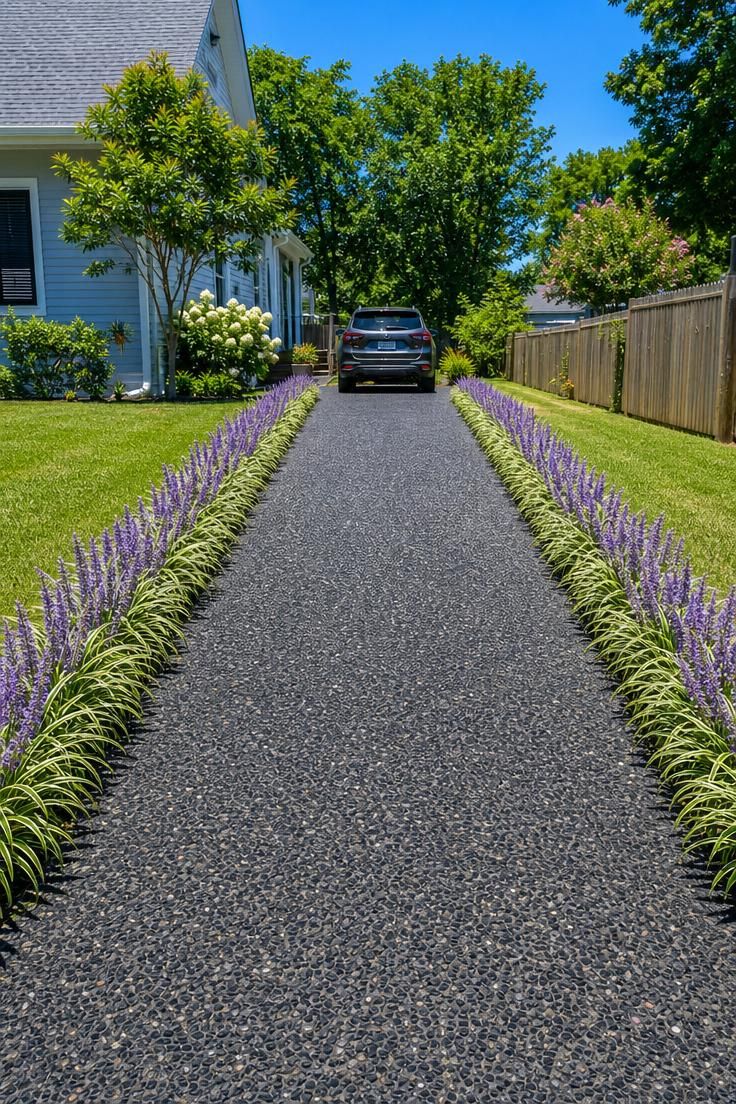
A driveway does not have to be a dead zone of plain concrete, and a liriope border is the lowest-effort way to prove it.
Variegated liriope (Liriope muscari ‘Variegata’) forms dense, arching clumps of green and white striped foliage that stay attractive year-round in zones 5 through 10.
The purple flower spikes that appear in late summer add a second layer of color that lasts four to six weeks, and the blue-black berries that follow feed birds through fall.
Charcoal-toned exposed aggregate on the driveway surface gives the hardscape a richer look than standard gray concrete, and the dark pebbles contrast sharply with the liriope’s light-striped leaves.
Spacing clumps 8 inches apart fills in to a continuous border within two growing seasons, and dividing established clumps every three to four years keeps them vigorous.
This is low maintenance landscaping at its best because liriope tolerates drought, shade, foot traffic, and poor soil without complaint.
Mow the entire border to 3 inches in late February before new growth emerges, and it resets itself completely by mid-spring.
The linear rhythm of identical clumps along a straight driveway edge creates a sense of order that makes the whole front yard feel polished.
Style Blueprint:
- Variegated liriope (Liriope muscari ‘Variegata’) planted 8 inches apart
- Charcoal exposed-aggregate driveway surface
- Steel edging between liriope bed and driveway
- Late-February mow-down for annual reset
- 4-inch gravel sub-base under the aggregate for drainage
A White Gravel Courtyard With Potted Fiddle Leaf Fig Trees
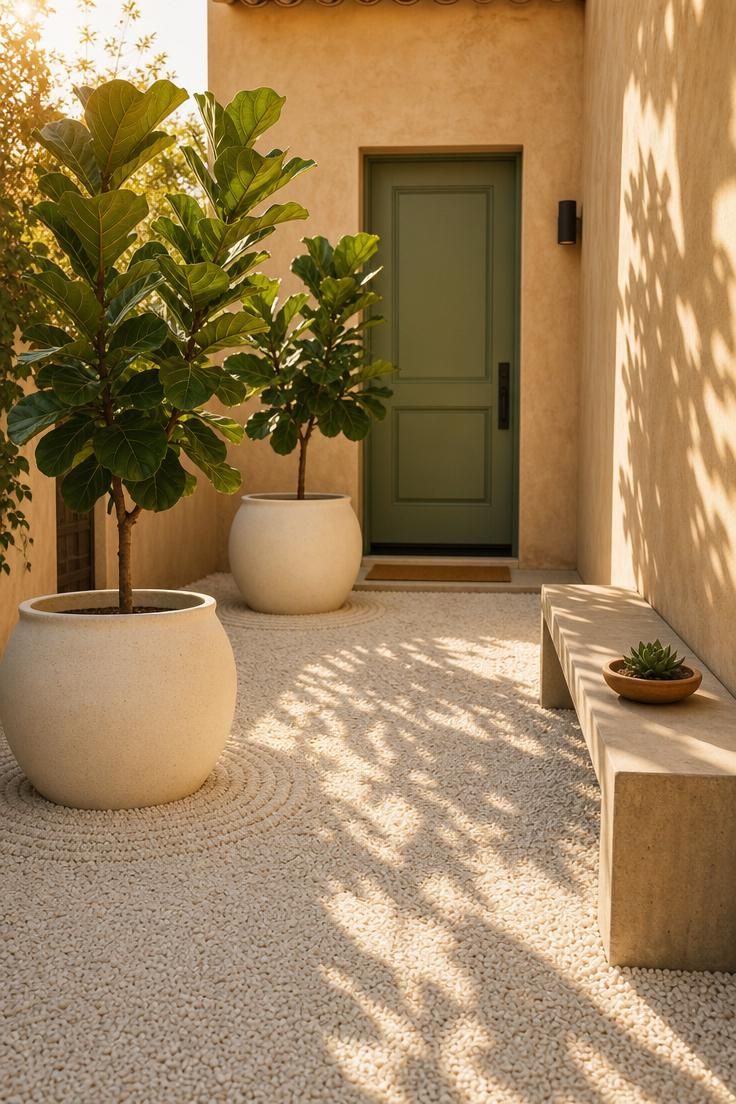
White marble chip gravel as a ground plane turns a small front courtyard into something that feels almost gallery-like in its simplicity.
The uniform white surface amplifies light, reflects heat away from the house, and creates a clean canvas for shadow play from any tree or tall plant placed within it.
Fiddle leaf figs in large matte ceramic pots bring the indoor-outdoor trend to the front yard, and their broad, sculptural leaves cast the most dramatic shadows of almost any container plant.
In zones 10 and above, fiddle leaf figs can stay outdoors year-round, while cooler climates can swap them for potted olive trees or bay laurel for the same effect.
The gravel surface needs no mowing, no irrigation, and no fertilizer, making it a strong choice for small front yard landscaping in drought-prone regions.
A low concrete bench against a side wall gives the courtyard a reason to pause and sit, which is something most front yards completely overlook.
Style Blueprint:
- White marble chip gravel, 3/8-inch size, 2 inches deep over landscape fabric
- Large matte white ceramic pots, 18 to 24 inches in diameter
- Fiddle leaf fig trees (or olive/bay laurel in cooler zones)
- Low concrete bench or stone block seat against a wall
- Sage green or muted blue front door as a color anchor
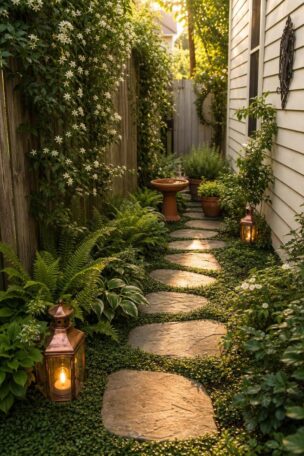
Creeping Red Thyme Carpet Between Irregular Sandstone Pavers

Filling paver joints with a living plant instead of polymeric sand creates a walkway that looks better every year instead of worse.
Creeping red thyme (Thymus praecox ‘Coccineus’) stays under 2 inches tall, tolerates moderate foot traffic, and explodes into deep magenta bloom in early summer.
The color against warm sandstone is striking, a bright living grout line that no manufactured product can replicate.
Irregular sandstone pavers with 2-inch joints give the thyme enough root space to establish a dense mat within one growing season.
Set the pavers on a compacted gravel base with a thin layer of sandy loam in the joints, and plant thyme plugs every 4 inches along each joint line.
By the second spring, the plugs merge into a continuous carpet that suppresses weeds naturally and releases a burst of fragrance when stepped on.
This is one of the most photogenic flower bed ideas for a front walkway because the scale is so intimate, every close-up shot rewards the viewer with new detail.
Red thyme goes dormant in winter but holds its form, and the woody stems add a fine-textured winter interest that plain sand joints cannot match.
The combination of natural stone and living joints reads as both rustic and refined, which is a balance that suits cottage, craftsman, and modern farmhouse styles equally well.
Style Blueprint:
- Irregular buff sandstone pavers on compacted gravel base
- Creeping red thyme (Thymus praecox ‘Coccineus’) plugs planted every 4 inches in joints
- 2-inch joint width minimum for healthy root establishment
- Sandy loam soil mix in joints
- No polymeric sand or chemical weed barrier in planted joints
Design Pro-Tip: When planting between pavers, set the thyme plugs slightly below the paver surface so foot traffic passes over the crowns rather than crushing them. A 1/4-inch recess gives the plants room to grow flush with the stone over time without getting sheared off by shoes.
Matte Black Steel Raised Beds With Purple Fountain Grass
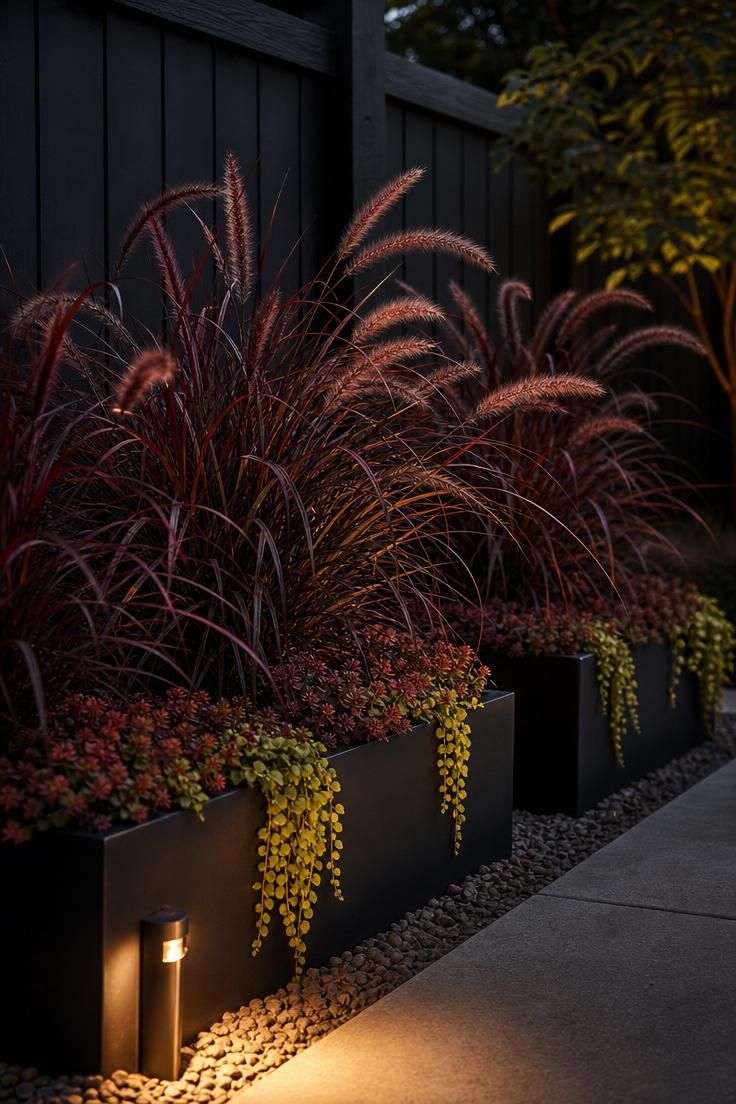
Steel raised beds bring an architectural edge to a front yard that wood beds simply cannot, and the matte black powder coat holds up for a decade without rust or rot.
Purple fountain grass fills the bed with movement because every breeze sends the feathery plumes swaying, and the burgundy-red foliage holds its color from late spring through the first hard frost.
The contrast between the rigid, geometric steel frame and the soft, arching grass is what makes this combination work so well.
Bed height at 18 inches lifts the planting above the ground plane, which creates a sense of intentional placement that a ground-level bed misses.
Low sedum or creeping jenny at the base softens the hard steel edge and ties the raised bed back to the ground.
This setup counts as low maintenance landscaping because fountain grass needs only a single late-winter cutback, and sedum asks for nothing at all.
The whole composition, steel, grass, sedum, reads as modern and considered without needing a single flower to sell it.
Style Blueprint:
- Matte black powder-coated steel raised beds, 18 inches tall
- Purple fountain grass (Pennisetum setaceum ‘Rubrum’)
- Low sedum or creeping jenny along the base
- Dark charcoal fence or wall as backdrop
- Single warm-toned path light for evening accent
A Rain Chain Downspout Landing in a Polished Stone Basin
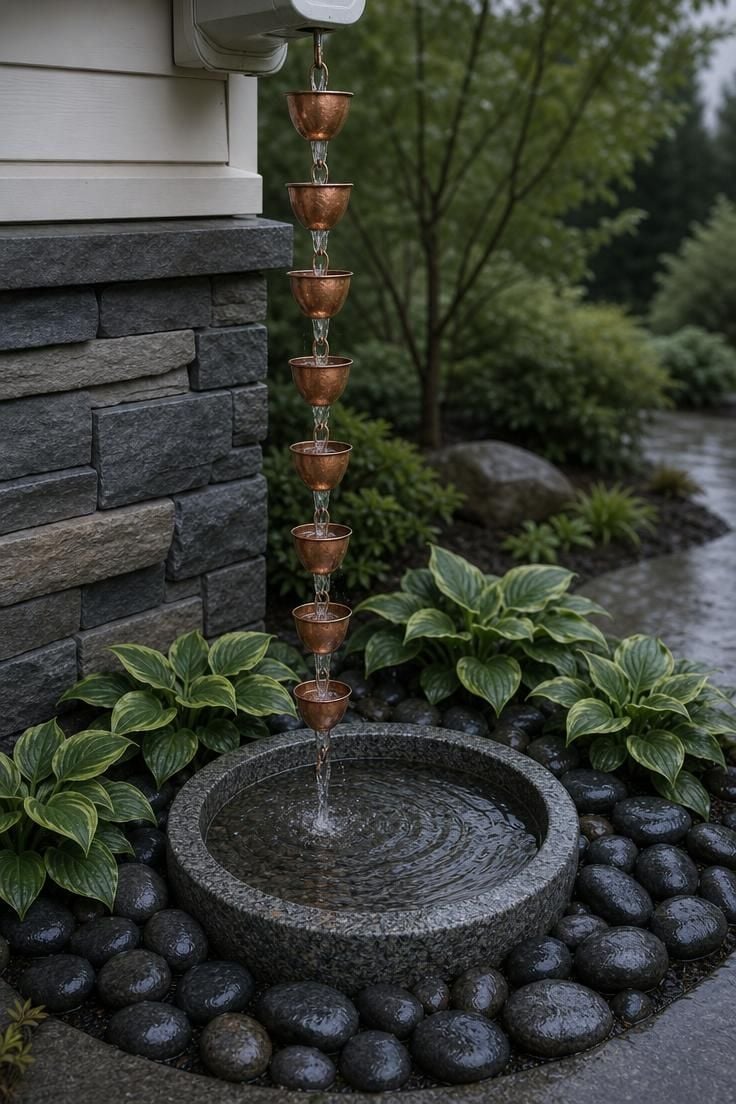
A rain chain turns a purely functional downspout into a piece of front yard sculpture that performs best on the days most landscapes look their worst.
Copper chains develop a green verdigris patina over time that gets more attractive with every season, and the sound of water moving through each link is calming in a way that a closed pipe never will be.
The polished granite basin at the base serves as both a visual anchor and a splash guard, collecting water and directing it into a subsurface dry well.
Surrounding the basin with smooth dark river rocks hides the dry well inlet and creates a textural transition between the hard stone and the surrounding planting bed.
Dwarf hostas around the outer edge of the rock surround grow well in the slightly damp microclimate that the rain chain creates, filling in with lush foliage that complements the stone.
This is a detail that most front yards lack entirely, a purposeful treatment of rainwater that turns a utility element into an ornamental feature.
Position the rain chain on the most visible downspout, usually the one nearest the front door, for maximum impact.
The copper, granite, and river rock palette ties together naturally and works with nearly any house color or architectural style.
Style Blueprint:
- Copper rain chain with cup-style links
- Polished granite basin, 18 inches diameter, set flush with grade
- Smooth dark river rocks surrounding the basin
- Subsurface dry well connected to basin drain
- Dwarf hostas or ferns planted around the rock surround
Ornamental Kale and Coral Bells Along a Poured Concrete Edge
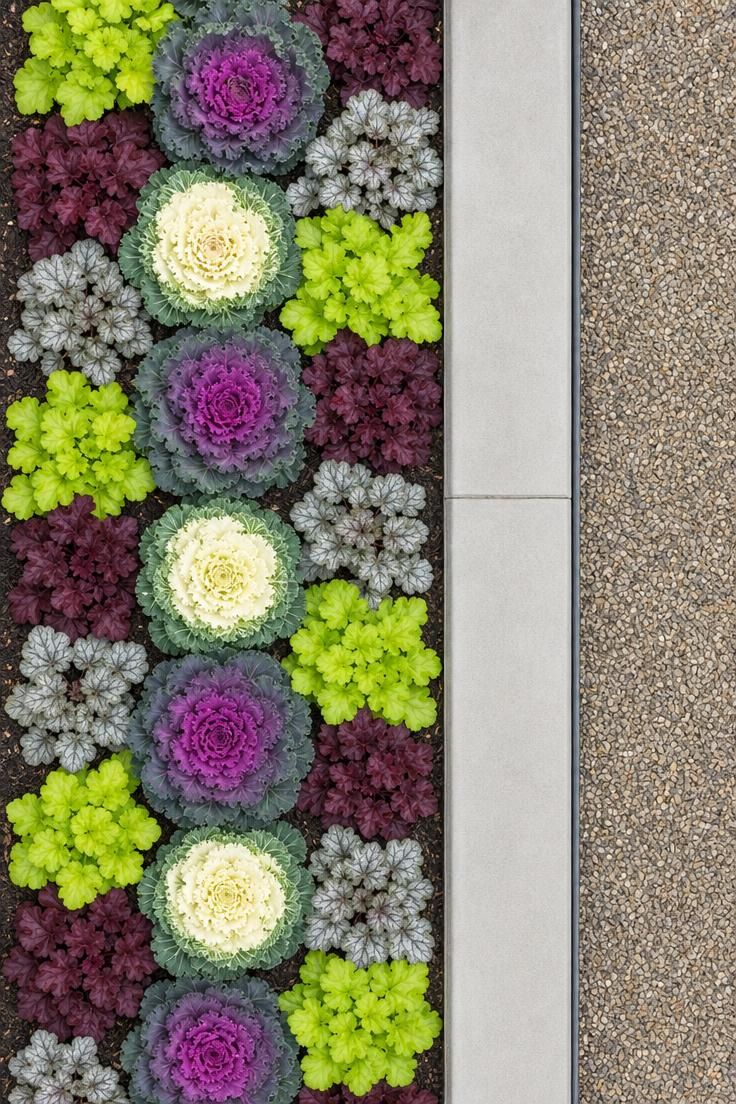
Ornamental kale and coral bells are an underused pairing that delivers bold foliage color without relying on flowers at all.
The large rosette forms of ornamental kale (purple, white, and dusty pink) create a cabbage-like texture that reads as sculptural from above.
Coral bells fill the gaps between kale rosettes with mounding foliage in lime green, deep burgundy, and silver, and the color holds from spring through hard frost.
Planting them in alternating clusters along a concrete curb edge turns the bed into a graphic color pattern that looks intentional and designed rather than random.
Both plants tolerate partial shade, which makes this combination ideal for north-facing front yards or lots shaded by street trees.
This flower bed idea works on the smallest budget because both plants are widely available at garden centers and fill a bed quickly with just 4-inch pots.
Style Blueprint:
- Ornamental kale varieties (Nagoya, Osaka, or Crane series)
- Coral bells (Heuchera ‘Lime Rickey,’ ‘Obsidian,’ and ‘Silver Scrolls’)
- Poured concrete curb with smooth troweled finish
- Thin steel edging strip between bed and adjacent path
- 6-inch spacing for dense, gapless coverage
Wisteria Trained on a Painted White Trellis Archway
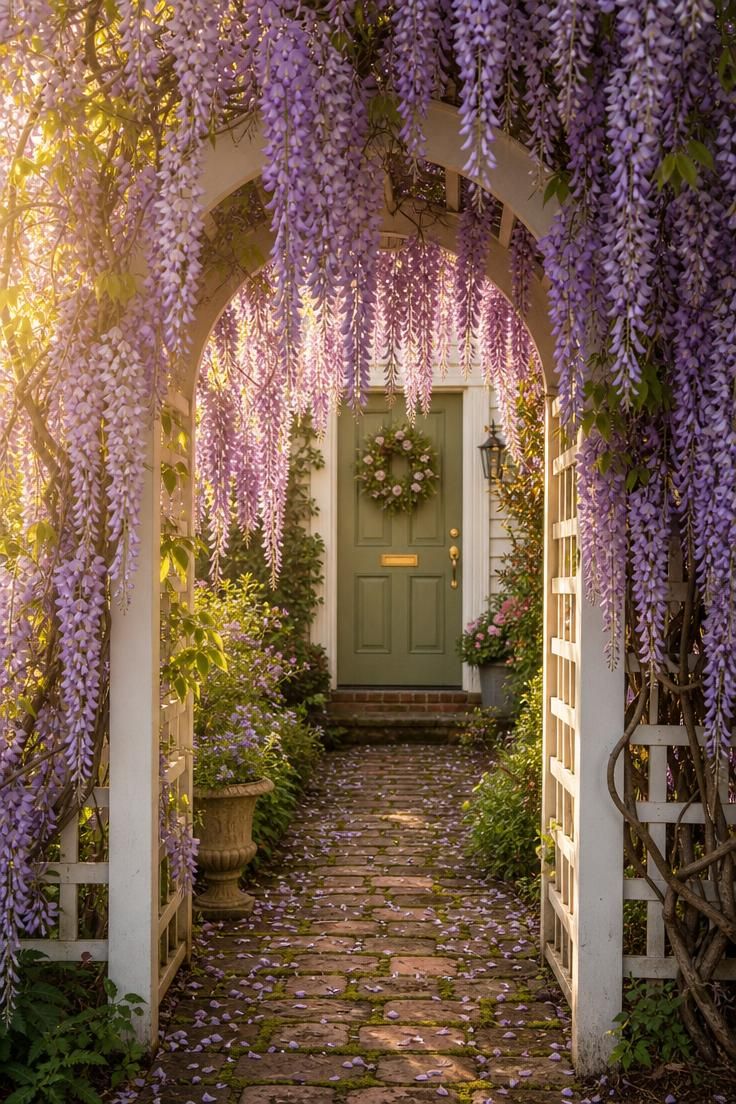
A wisteria archway in full bloom is one of those front yard moments that stops foot traffic on the sidewalk, and in a small yard, it becomes the single defining feature.
American wisteria (Wisteria frutescens) is the better choice for residential settings because it blooms reliably, stays manageable with annual pruning, and is less aggressive than its Asian relatives.
A painted white trellis provides the clean contrast that lets the lavender blooms stand out, and pine construction keeps the cost accessible.
Train the main leader up one side and across the top during the first two years, removing all lateral shoots that try to escape the frame.
Once the framework is established, prune twice a year, once in late winter and once in midsummer, to control size and force bloom buds on short spurs.
The three-week bloom period in late spring fills the entire front yard with a fragrance that carries 20 feet in still air.
After the blooms fade, the dense leafy canopy provides shade over the path for the rest of the season, adding practical value to the ornamental structure.
Style Blueprint:
- American wisteria (Wisteria frutescens) for controlled growth
- Painted white pine trellis archway with simple lattice pattern
- Brick path beneath the archway with moss-filled mortar joints
- Matte black or oil-rubbed bronze hardware on any gate elements
- Annual two-prune schedule (late winter and midsummer)
Design Pro-Tip: If you are adding wisteria or any heavy vine to a front yard trellis, oversize the structural posts. Use 4×4 posts minimum, not 2×2, and sink them 24 inches into concrete footings. A mature wisteria vine can weigh several hundred pounds, and a collapsed trellis in the front yard is the opposite of curb appeal.
A Zinc Garden Obelisk With Climbing Clematis at the Walkway Bend
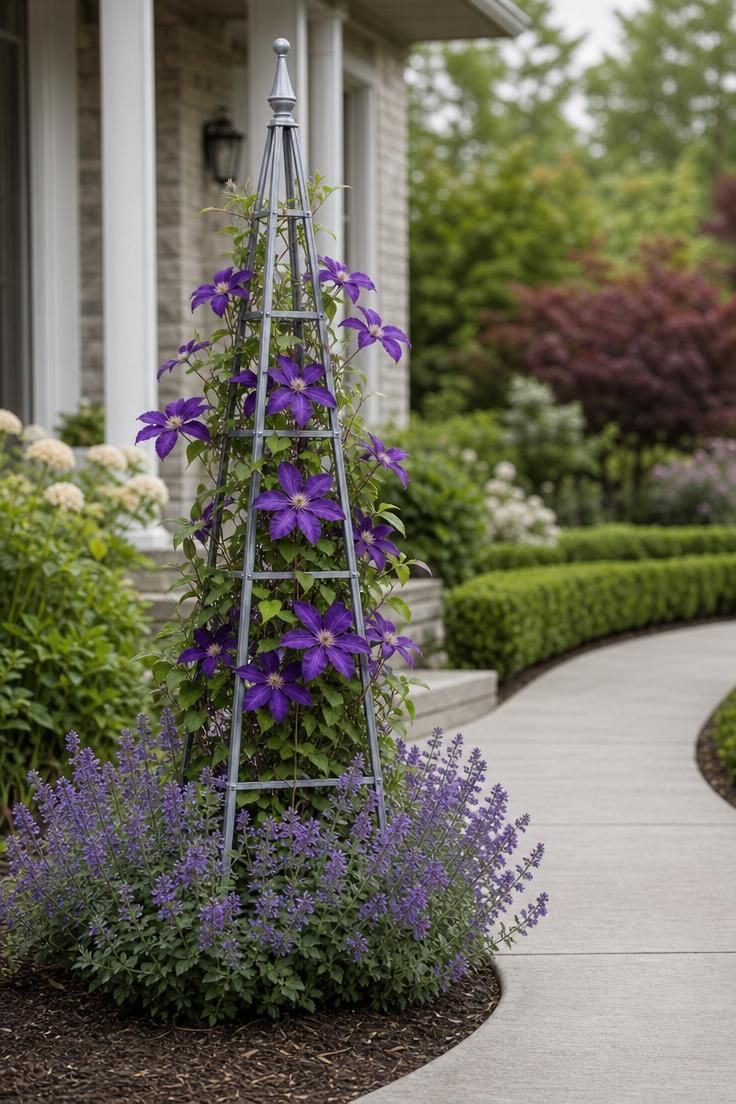
A garden obelisk placed at a walkway curve gives the eye a reason to follow the path and creates a vertical accent in a landscape that might otherwise read as entirely horizontal.
Zinc ages to a soft silver-gray that harmonizes with both warm and cool house colors, and the open framework of an obelisk lets light pass through rather than blocking sightlines.
Clematis ‘Jackmanii’ is the workhorse choice for obelisks because its large purple blooms cover the structure from mid-June through August, and it prunes back to 12 inches each spring for a fresh start.
The old gardener’s rule for clematis, “head in the sun, feet in the shade,” applies here: plant catmint or low evergreen shrubs around the base to keep the root zone cool and shaded.
Catmint at the base does more than shade the roots, it adds a second layer of blue-purple bloom that extends the color season by six weeks on either side of the clematis peak.
The whole composition, obelisk, clematis, catmint, and clipped boxwood along the walk, functions as a three-season focal point with a total footprint of about 3 square feet.
Position the obelisk at the outside of the walkway curve, not the inside, so it does not block the walking path or force visitors to duck around it.
The zinc and purple palette suits nearly any house style, from colonial to contemporary, which is why this combination appears in both formal and casual front yards.
Style Blueprint:
- Zinc garden obelisk, 5 feet tall with an open lattice framework
- Clematis ‘Jackmanii’ trained up the obelisk with jute ties
- Low catmint (Nepeta ‘Walker’s Low’) planted around the base
- Clipped boxwood hedge along the opposite side of the walkway
- 3-foot clearance from the obelisk to the walkway edge
Blue Fescue Mounds Flanking a Smooth Concrete Entry Pad
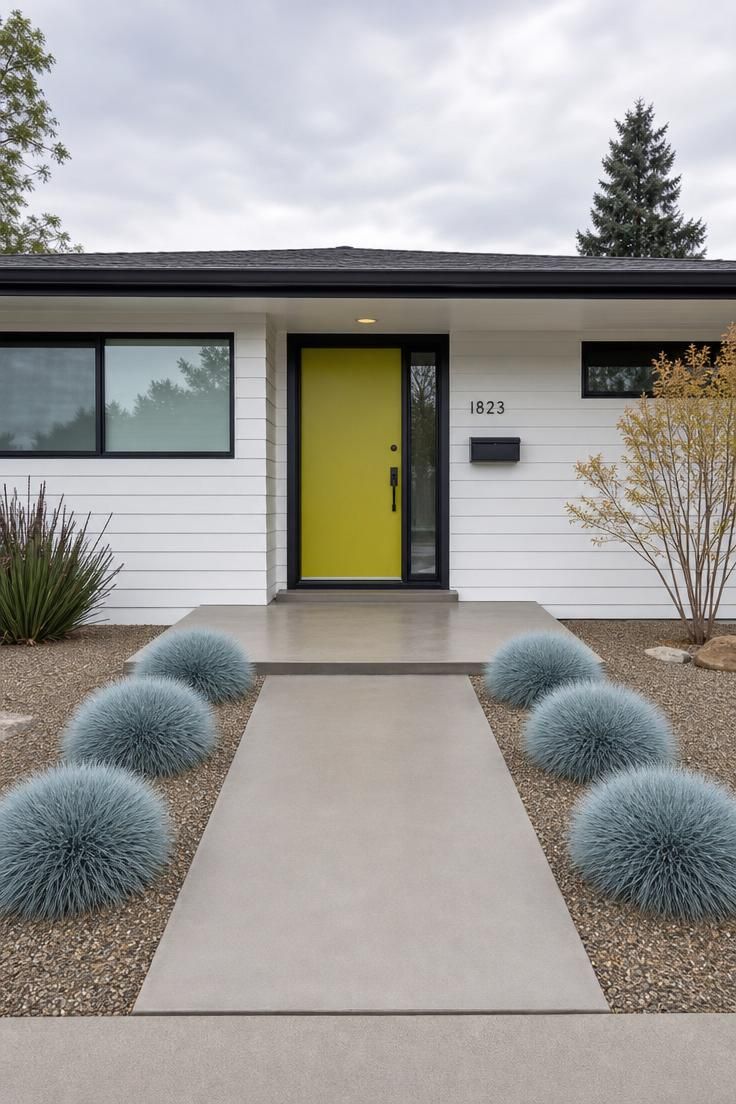
Blue fescue planted in symmetrical rows is a minimalist approach that delivers maximum graphic impact with just six plants and zero ongoing maintenance beyond a spring combing.
Each mound grows to a tidy 10-inch hemisphere of fine silver-blue needles, and the color holds year-round in zones 4 through 9.
The spherical form creates a rhythmic pattern that reads as deliberately designed from the street, which is exactly the kind of front yard curb appeal that catches a buyer’s eye.
Pair the mounds with a smooth, poured concrete entry pad rather than textured aggregate to keep the composition clean and modern.
Blue fescue is one of the most reliable ornamental grasses for small front yards because it never flops, never seeds aggressively, and never needs division.
Style Blueprint:
- Blue fescue (Festuca glauca ‘Elijah Blue’) planted in symmetrical rows
- Smooth poured concrete entry pad in warm gray tone
- 12-inch spacing between mound centers for visual separation
- Gravel or decomposed granite mulch between mounds
- Annual spring combing to remove dead foliage from the center
Tall White Pampas Grass Anchoring a Corner Gravel Bed
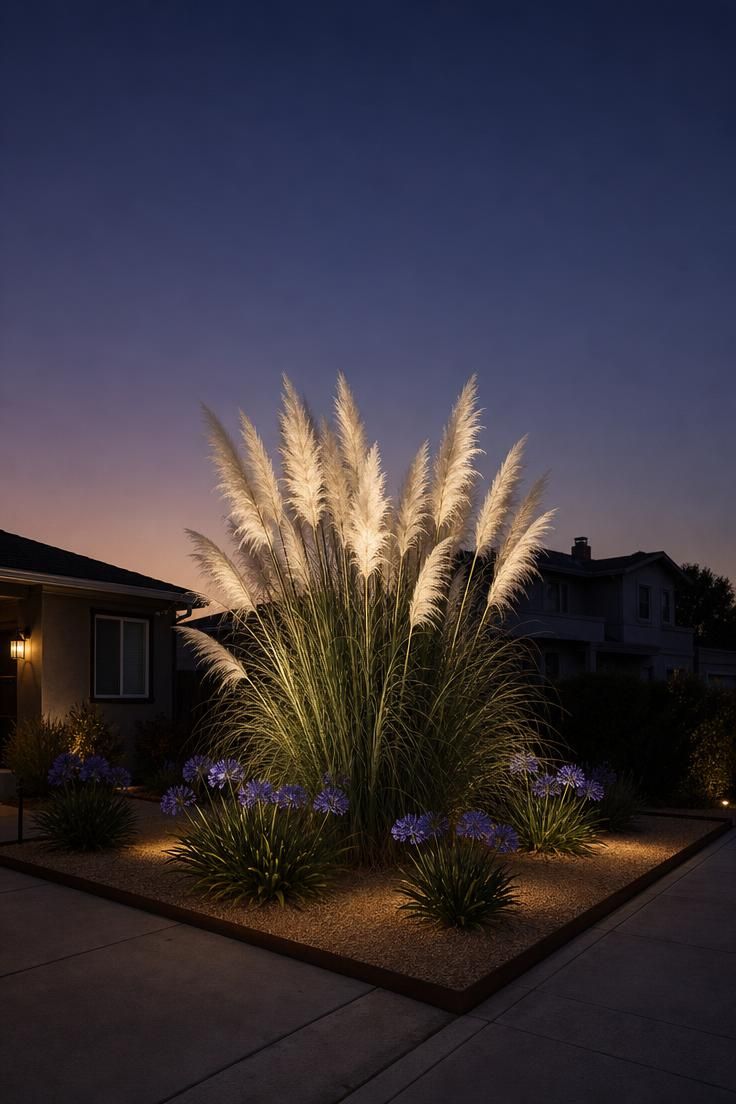
A single large pampas grass clump at a front yard corner creates a natural landmark that marks your property from a block away.
The plumes reach peak volume in late summer and hold their shape through winter, giving the yard a dramatic vertical accent during the months when most other plants have retreated.
Decomposed granite around the base keeps the look clean and prevents the kind of bare soil ring that forms around large grasses when turf cannot compete for moisture.
Blue agapanthus planted in a low ring around the pampas adds a cool-toned counterpoint to the warm plumes and extends the bloom season into midsummer.
This combination works especially well on corner lots where two sidewalks meet because the pampas grass is visible from both streets.
Steel landscape edging at the sidewalk border keeps the gravel contained and prevents it from migrating onto the concrete, which is a detail that separates a polished installation from a sloppy one.
Pampas grass needs a hard cutback to 12 inches in late February, and wearing heavy gloves for that job is not optional because the leaf blades are razor-sharp.
Style Blueprint:
- White pampas grass (Cortaderia selloana), single large clump
- Warm-toned decomposed granite gravel, 2 inches deep
- Blue agapanthus (Agapanthus ‘Storm Cloud’ or similar) in a low ring
- Steel landscape edging at sidewalk border
- Late-February cutback with heavy leather gloves
A River Birch Cluster With Moss Rock Ground Cover
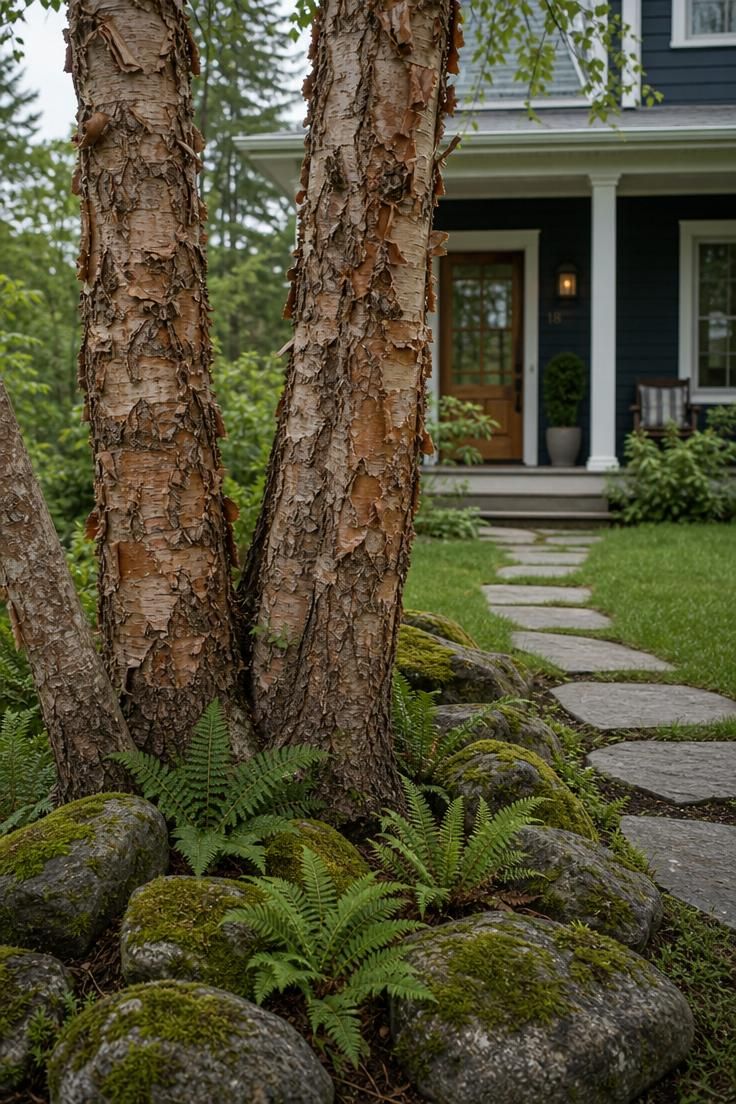
A cluster of three river birches creates a miniature grove effect that makes a small front yard feel like it has been there for decades, even if you planted it last spring.
Multi-stem river birch (Betula nigra ‘Heritage’) is the variety to choose because its bark peels in dramatic sheets of cinnamon, cream, and salmon that provide year-round interest.
Moss-covered rocks at the base eliminate the need for mulch and give the grove a settled, naturalistic look that reads as forest floor rather than suburban planting bed.
Christmas ferns (Polystichum acrostichoides) in the gaps between rocks are evergreen, deer-resistant, and perfectly scaled for the understory of a small tree cluster.
This is the kind of planting that supports good small front yard landscaping because the birch canopy provides filtered shade for the house while the open, airy trunk structure keeps the yard feeling spacious.
A no-mow fine fescue lawn around the grove ties everything together with minimal effort and eliminates the need for weekly mowing.
Style Blueprint:
- Three multi-stem river birch (Betula nigra ‘Heritage’) planted 4 feet apart
- Moss-covered rocks in varying sizes at the base
- Christmas ferns (Polystichum acrostichoides) between rocks
- Fine fescue no-mow lawn blend surrounding the grove
- Concrete stepping stones winding past the grove
Design Pro-Tip: When planting a tree cluster in a front yard, stagger the trunks in a loose triangle rather than a straight line. A triangular arrangement looks natural from every angle, while a row reads as a fence. Offset the middle tree by 2 to 3 feet from the line of the other two for the most organic effect.
Matte Brass Step Lights Set Into a Stacked Stone Entry Wall
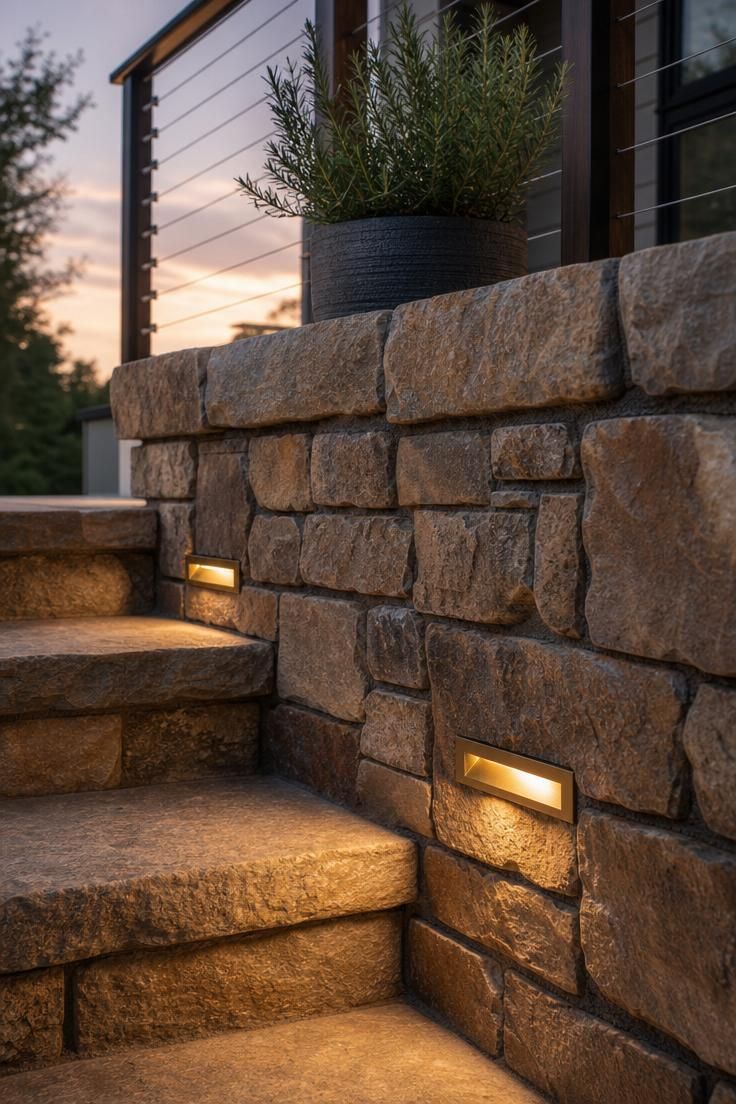
Recessed step lights in a stacked stone wall solve the most overlooked front yard problem: finding your way up porch steps after dark without a glaring overhead fixture.
Matte brass fixtures age to a warm patina that suits natural stone far better than stainless steel or chrome, and the recessed mounting keeps the light source hidden.
Positioning the lights at stair-tread height means the beam washes downward across each step, illuminating the walking surface without creating glare at eye level.
Low-voltage LED fixtures in warm white (2700K) produce a glow that reads as welcoming rather than clinical, and they draw so little power that a single transformer can run six or more fixtures.
Running the wiring behind the stone wall during construction is the ideal approach, but retrofit kits with surface-mounted conduit painted to match the mortar color work for existing walls.
This yard lighting detail is the kind of finishing touch that separates a house that looks designed from one that merely looks decorated.
The combination of natural fieldstone, warm brass, and soft downlight creates an entry experience that feels both safe and considered.
Pairing the step lights with a potted herb on the wall cap, rosemary or thyme, adds fragrance to the approach and ties the hardscape back to the planting.
Style Blueprint:
- Matte brass recessed step lights in warm white (2700K) LED
- Stacked natural fieldstone wall with mortar joints
- Low-voltage transformer sized for the total fixture count
- Wiring run behind the wall or in painted surface conduit
- Potted rosemary or thyme on the wall cap for fragrance
Conclusion
A small front yard is not a limitation, it is an invitation to be precise about every single choice you make.
The 17 ideas above prove that one specific material, one well-chosen plant, or one intentional detail can do more for a front yard than a full landscape overhaul.
Pick the idea that matches your climate, your house style, and your tolerance for weekend projects, and start with just that one.
A slate chip pathway, a liriope border, a single pampas grass clump at the corner, any of these changes can shift the entire feel of your home from the street.
The best small front yard landscaping does not try to do everything at once.
It picks one strong move and commits to it completely.