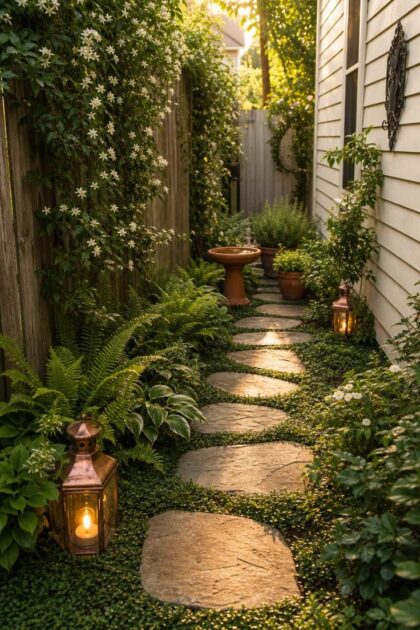
This post may contain affiliate links. If you make a purchase through these links, we may earn a commission at no additional cost to you.
The side yard is the stretch of ground everyone walks through but nobody stops to consider.
It sits between the front porch and the back gate, handling foot traffic, garden hoses, and garbage bins without complaint.
Most homeowners treat it as a corridor to get through, not a space to design.
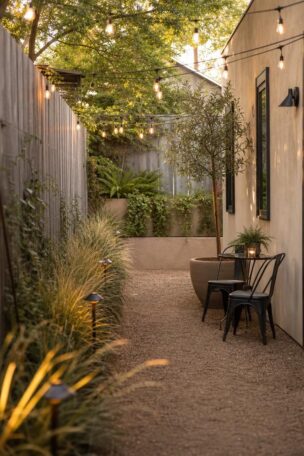
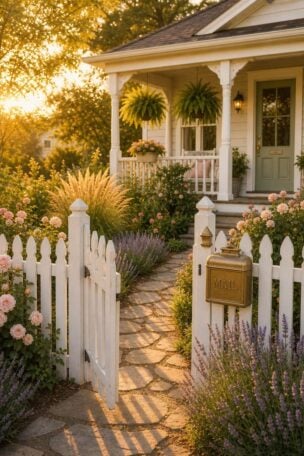
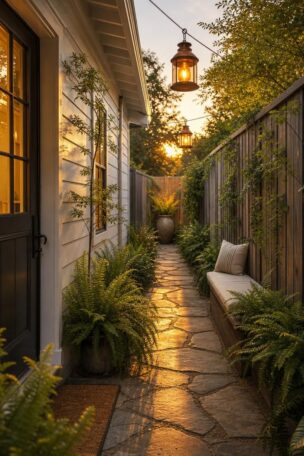
These 13 side yard pathway ideas prove that even the narrowest strip beside your house can become a walk you look forward to, with materials and plantings that reward a slower pace.
Irregular Bluestone Slabs Set in Decomposed Granite
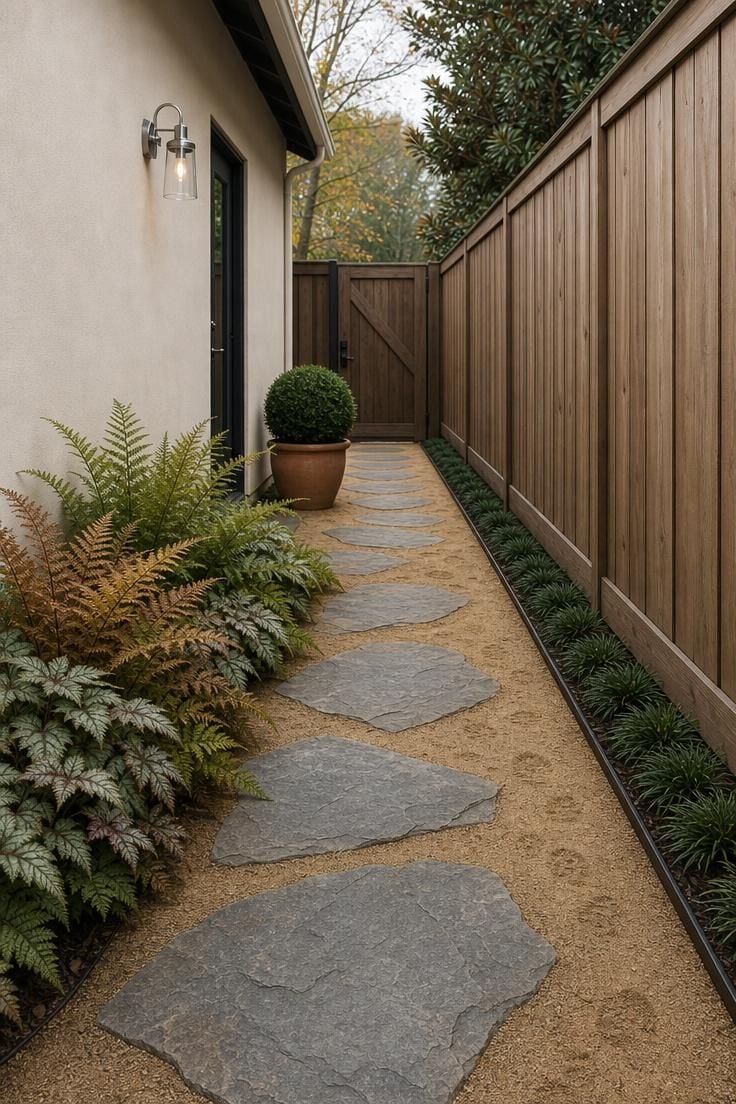
Bluestone works in a side yard the way a good wool rug works in a hallway, grounding the space without demanding attention.
The natural cleft texture on each slab creates subtle variation underfoot, and the irregular edges make the path feel discovered rather than manufactured.
Decomposed granite fills the gaps between stones with a warm, sandy color that softens the cool blue-gray tones of the rock.
This combination drains well, which matters in a side yard where water tends to pool against the foundation.
Ferns planted along one edge bring vertical softness without eating into the walking width, since their fronds arch upward and outward rather than spreading at ground level.
The steel edging does double duty here, keeping the DG contained and giving the path a clean, finished line that reads as intentional side yard landscaping rather than a construction afterthought.
A single pot at the midpoint gives you a reason to pause, turning the corridor into a destination instead of just a route.
Style Blueprint:
- Large-format irregular bluestone slabs with natural cleft face
- Warm tan decomposed granite fill with compacted base
- Matte black steel landscape edging
- Shade-tolerant ferns (autumn fern or Japanese painted fern)
- One accent container at the pathway midpoint
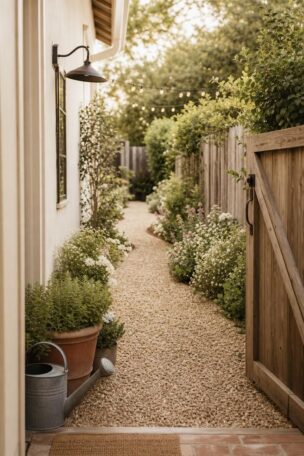
Pea Gravel Corridor With Weathered Cedar Raised Bed Borders
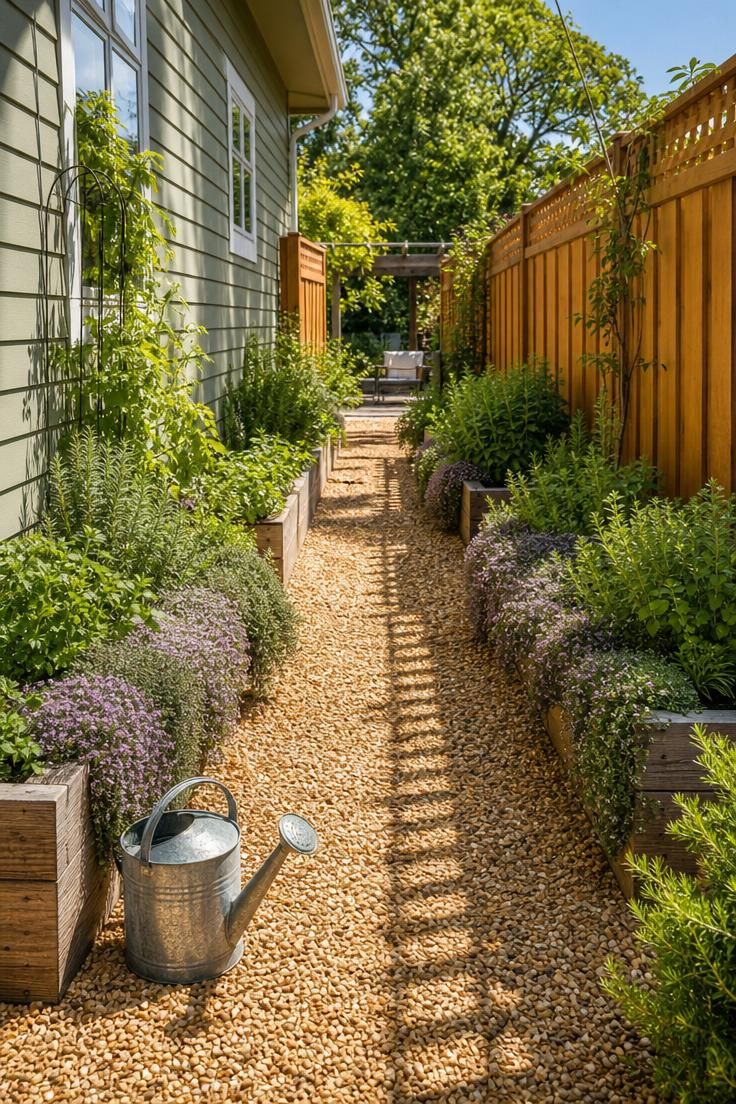
A pea gravel walkway is one of the most forgiving surfaces you can lay in a narrow side yard.
The rounded stones shift and crunch underfoot, giving the path an audible character that concrete and stone cannot offer.
Cedar raised bed borders contain the gravel and pull double duty as growing space for low herbs that spill over their edges.
Thyme and oregano are perfect here because they tolerate foot traffic along their margins and release fragrance when brushed.
This garden pathway approach turns a utilitarian strip into something that smells as good as it looks, especially in the warm months when the herbs are at their fullest.
The material cost sits at the low end of the spectrum, making this one of the most accessible side yard pathway ideas on this list.
Style Blueprint:
- Honey-toned pea gravel, 2-3 inches deep over landscape fabric
- Weathered cedar 2×6 raised bed frames as borders
- Trailing herbs (creeping thyme, oregano, prostrate rosemary)
- Galvanized steel garden accents
- Warm-stained privacy fence to echo the gravel palette
Stacked Slate Steppers Through a Moss Ground Cover
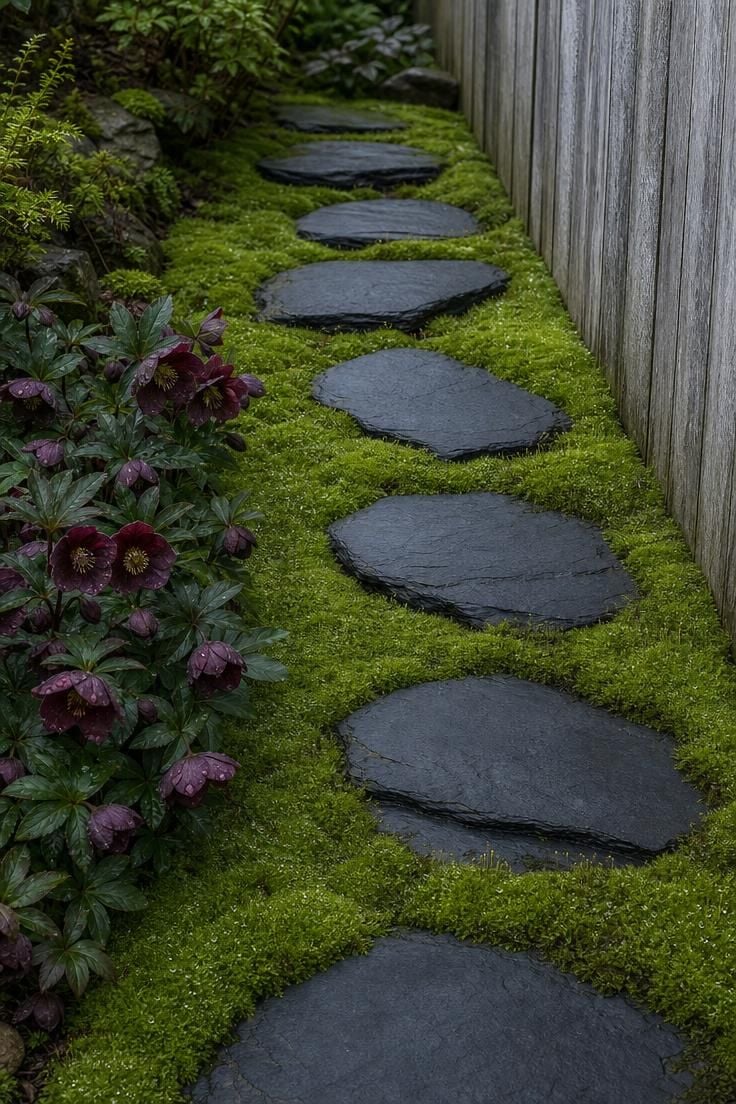
Moss does something no other ground cover can do in a shaded side yard, creating a continuous green surface that looks like it has been there for decades even when it is only a season old.
The contrast between dark slate and bright moss is almost theatrical, giving a narrow corridor the visual depth of a much larger garden.
Thick-cut slate matters here because the stacked layers along each edge create a shadow line that adds dimension to the stones.
Moisture is the key ingredient for this stepping stone path, and most shaded side yards already have it in abundance.
Irish moss (Sagina subulata) stays low and dense, rarely exceeding two inches in height, so it never competes with the walking surface.
The lack of direct sun keeps the moss from browning out in summer, making this one of the lowest-maintenance options for a side yard that sits between tall structures.
Hellebores along the border bloom in late winter when everything else is dormant, giving this path seasonal interest even during the coldest months.
A side yard like this rewards the kind of slow, quiet walking that most outdoor spaces never inspire.
Style Blueprint:
- Thick-cut charcoal slate stepping stones, 18-24 inch diameter
- Irish moss (Sagina subulata) as continuous ground cover
- Hellebores for winter bloom along the border
- Weathered silver-gray fence as a neutral backdrop
- No direct lighting needed, relies on ambient glow
Exposed Aggregate Concrete Ribbon With Bronze Path Lights
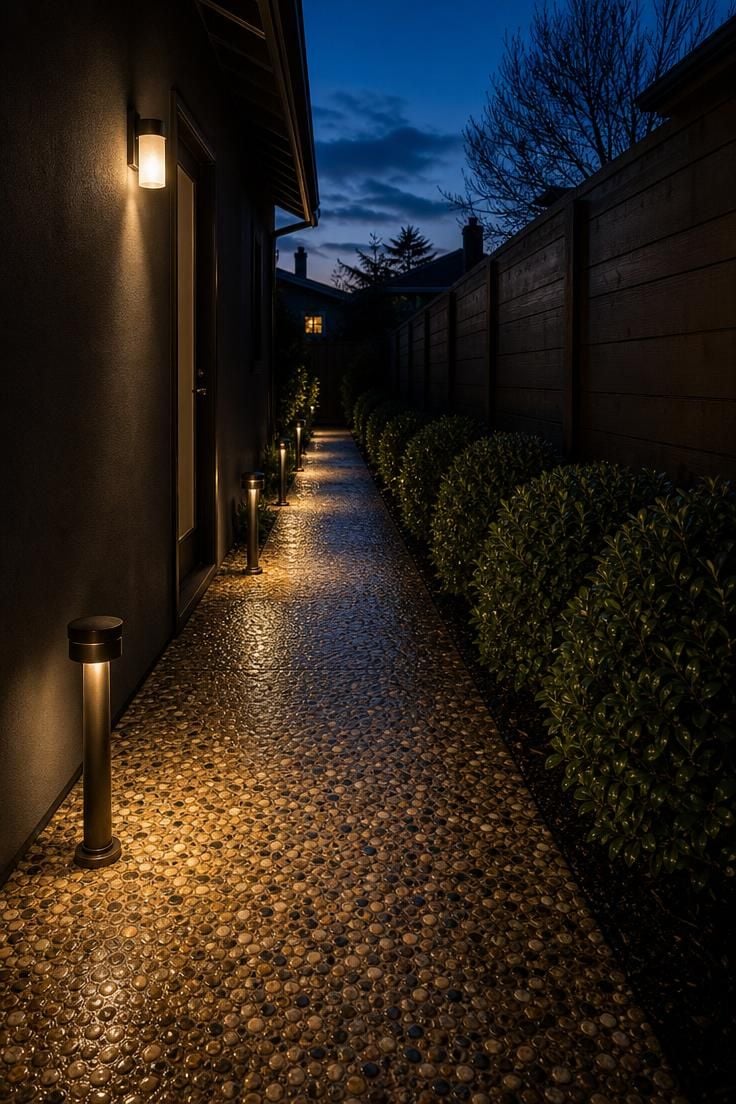
A single ribbon of poured concrete might sound utilitarian, but the exposed aggregate finish changes everything.
River pebbles embedded in the surface catch light and create texture that standard brushed concrete never achieves.
The narrow format works perfectly in a tight side yard design because the path fills the full width, eliminating awkward strips of bare soil on either side.
Bronze path lights are the detail that shifts this from functional to considered, and outdoor pathway lighting in warm amber tones makes the side yard feel safe and inviting after dark.
Spacing the fixtures every six feet creates overlapping pools of light that prevent dark gaps without over-illuminating the corridor.
Japanese holly pruned into soft mounds adds greenery that never needs the width a spreading shrub demands.
Style Blueprint:
- Poured concrete with exposed river pebble aggregate finish
- Bronze or oil-rubbed low-voltage path lights at 6-foot intervals
- Dark-stained cedar fence as a backdrop
- Compact Japanese holly (Ilex crenata) in soft mound form
- Charcoal or dark gray house siding for contrast
Design Pro-Tip: In a narrow side yard, one material wall-to-wall reads better than two materials side by side. A single poured concrete ribbon or a full gravel fill looks intentional, whereas a narrow path flanked by thin dirt strips looks like the budget ran out. Fill the ground plane completely and let the vertical surfaces (fence, house wall, plantings) provide the visual variety.
Salvaged Brick Runners Laid in a Basket Weave Pattern
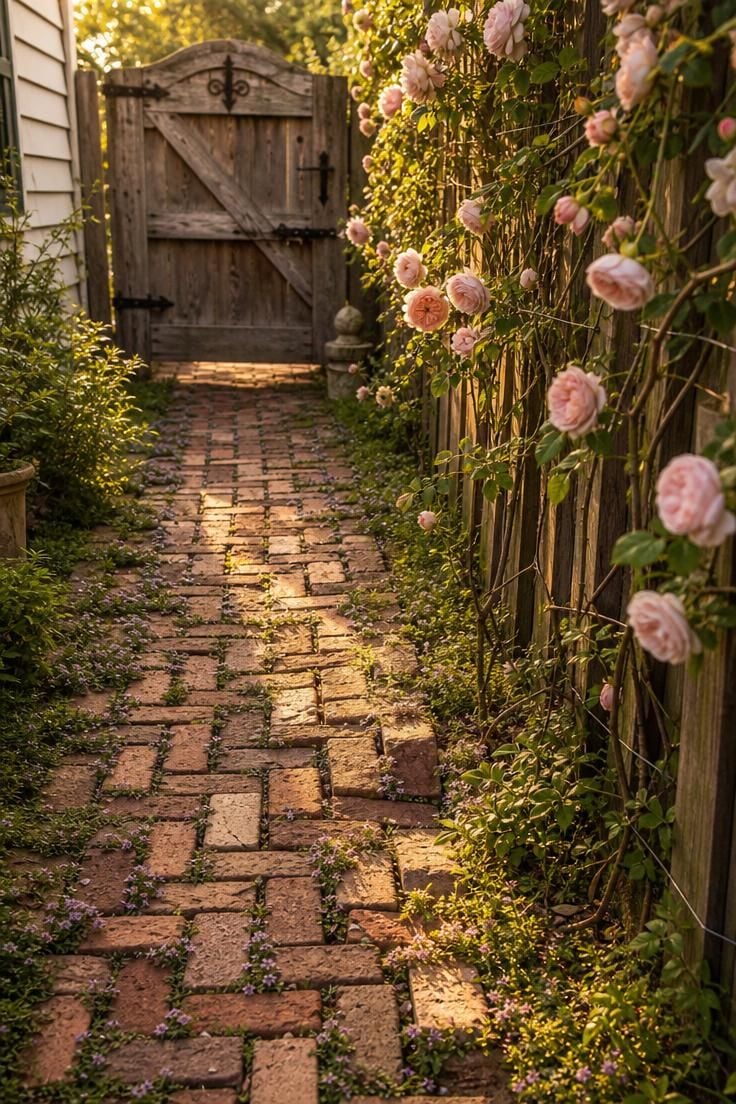
Salvaged brick carries a quality that new materials cannot replicate, a surface history written in chips, color shifts, and mortar stains.
The basket weave pattern creates visual movement without curves, which suits the straight geometry of a typical side yard walkway.
Each pair of bricks alternates direction, horizontal then vertical, producing a woven texture that the eye follows down the length of the corridor.
Woolly thyme in the joints adds a living layer that softens the masonry and releases a faint herbal scent when stepped on.
The low cost of reclaimed brick makes this approach surprisingly affordable, especially if you source from local demolition salvage yards.
Color variation between bricks is the entire point, so resist the urge to sort them by shade before laying.
A wooden gate at the terminus gives the side yard walkway a sense of arrival, framing the backyard as a separate room you enter rather than drift into.
Style Blueprint:
- Salvaged clay brick in varied earth tones, laid in basket weave bond
- Woolly thyme (Thymus pseudolanuginosus) between joints
- Wrought iron gate hardware as an accent
- Simple wire support for a climbing rose on the fence
- Sand-set installation over a compacted gravel base
White Limestone Pavers With Ornamental Bunch Grasses
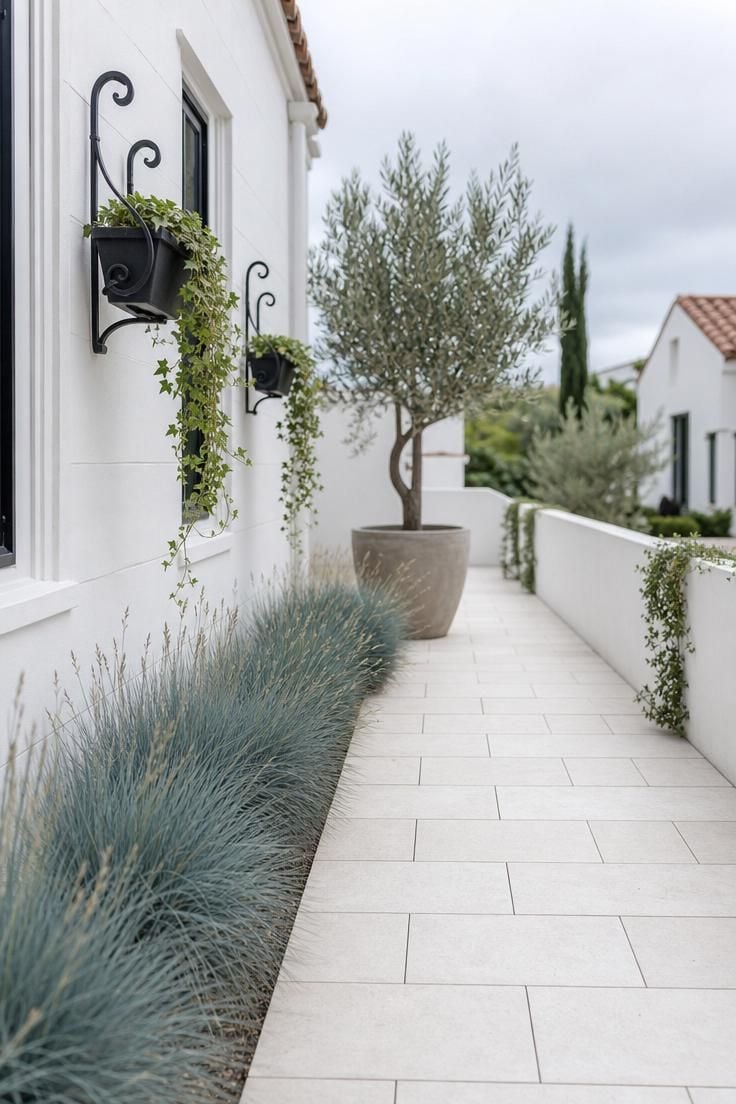
White limestone reads as generous even in a small side yard because the pale surface reflects available light back into the corridor.
This material works especially well in a narrow side yard that sits between two tall structures, where shade is a constant condition and lighter surfaces prevent the space from feeling like a canyon.
Blue fescue planted in rhythmic clusters adds color and movement without spreading beyond its tidy mound habit, maintaining clean lines along the path edge.
The silvery blue-green foliage against white stone creates a two-tone palette that feels curated without being fussy.
A running bond layout with tight joints gives the path a clean, contemporary look that suits modern and Mediterranean architecture equally.
An olive tree in a tapered planter at the midpoint acts as a living column, reinforcing the idea that this side yard landscaping is a designed space rather than a neglected one.
Honed limestone needs periodic sealing to prevent staining, but the low porosity of quality stone makes upkeep lighter than most homeowners expect.
The restraint in the plant palette is what makes this path feel special, proving that two or three species repeated well can outperform a dozen scattered choices.
Style Blueprint:
- Honed white limestone rectangular pavers in running bond
- Blue fescue (Festuca glauca) in rhythmic clusters
- Large tapered concrete planter with a single olive tree
- Black iron wall-mounted planters with trailing ivy
- White or light-colored walls for maximum reflected light
Charcoal Porcelain Plank Tiles Over a Concrete Base
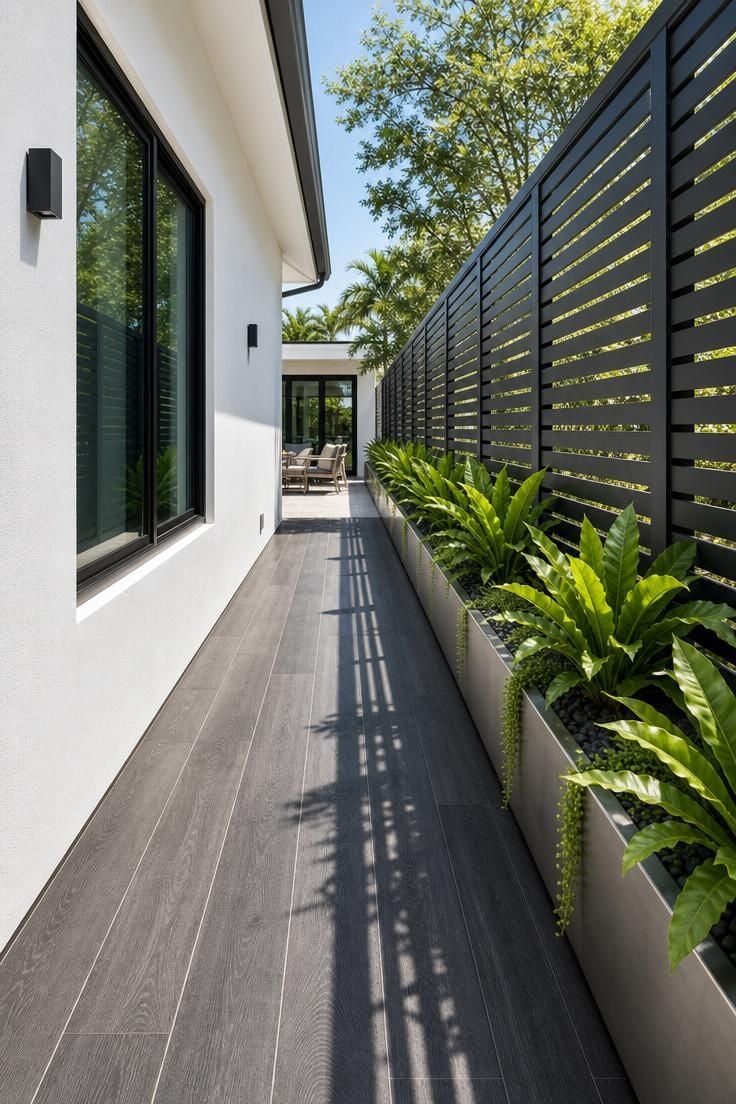
Porcelain plank tiles deliver the warmth of wood without any of the maintenance concerns that come with real timber in a side yard.
The charcoal tone absorbs light rather than reflecting it, which creates a grounding anchor in a corridor flanked by lighter surfaces.
Laying the planks lengthwise emphasizes the side yard’s depth and draws the eye toward the backyard, making the walk feel purposeful.
A slip-rated surface is worth specifying because side yards collect morning dew and irrigation overspray that make smooth tiles hazardous.
The linear planter in brushed steel is a narrow-profile detail that adds green without stealing walkway width, a recurring concern in any small side yard.
Bird’s Nest ferns and string of pearls both tolerate the reflected heat that bounces off stucco walls in warmer months.
Style Blueprint:
- Charcoal wood-look porcelain plank tiles (6×36 inch, slip-rated)
- Brushed stainless steel linear planter along the fence
- Bird’s Nest ferns and string of pearls for low-profile greenery
- Modern horizontal-slat aluminum fence
- Thin-set installation over a leveled concrete slab
Sandstone Rounds Floating in a Black River Rock Bed
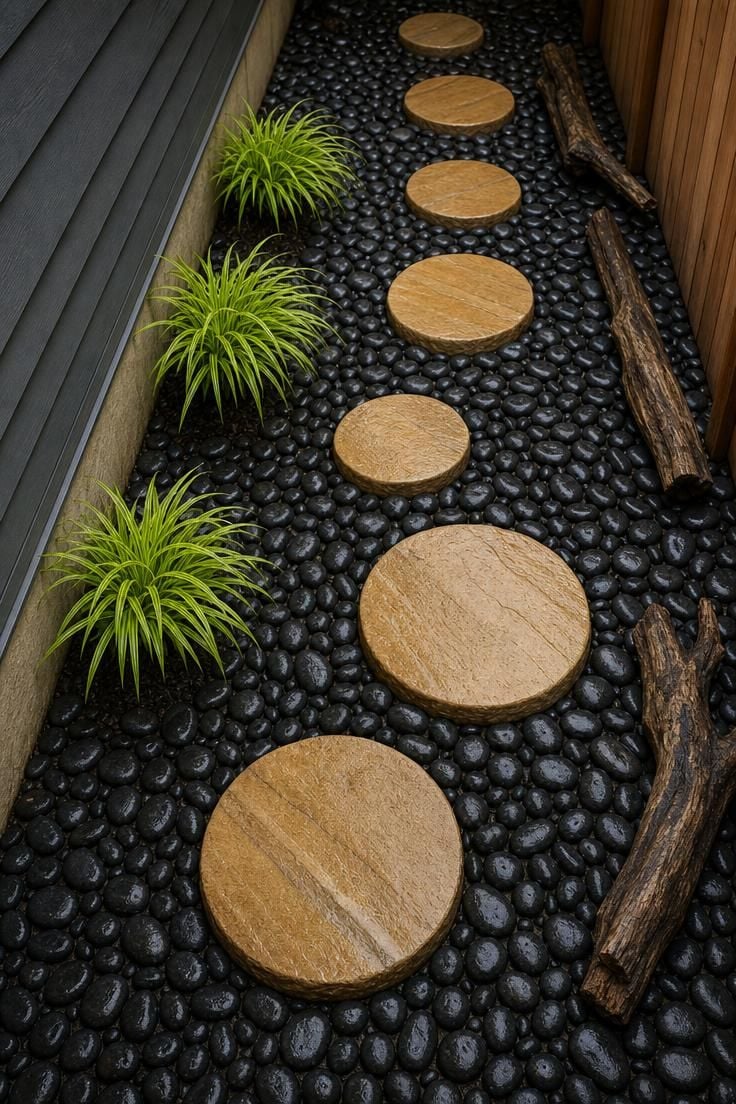
Round shapes in a rectangular corridor create a tension that makes the eye pay attention.
The circular sandstone discs break the side yard’s linear geometry without fighting it, sitting like golden islands in a dark sea of polished river rock.
This is a garden pathway that asks you to be deliberate about where you place your feet, which naturally slows you down and turns a walk into a small ritual.
Black river rock amplifies the golden color of the sandstone through contrast, making each stepping disc appear warmer and more luminous than it would against a neutral background.
Japanese forest grass in chartreuse adds a third color note that prevents the palette from becoming a simple two-tone exercise.
The driftwood scattered on the rock bed is a styling detail that suggests a found landscape rather than a purchased one.
Polished river rock stays in place better than rough-edged gravel and requires no edging when laid in a contained corridor between two walls.
Style Blueprint:
- Round-cut golden sandstone stepping discs, 18-24 inches in diameter
- Polished black river rock as fill material
- Japanese forest grass (Hakonechloa macra) in chartreuse
- Driftwood accent pieces on the rock bed
- No edging needed when corridor walls contain the fill
Design Pro-Tip: When combining stepping stones with a loose fill material, set the stones at least one inch above the fill surface. Flush stones disappear visually and lose the “floating” effect that makes the path interesting. The slight elevation also keeps the walking surface cleaner and provides a tactile cue underfoot.
Acid-Stained Concrete Path With Recessed LED Ground Lights
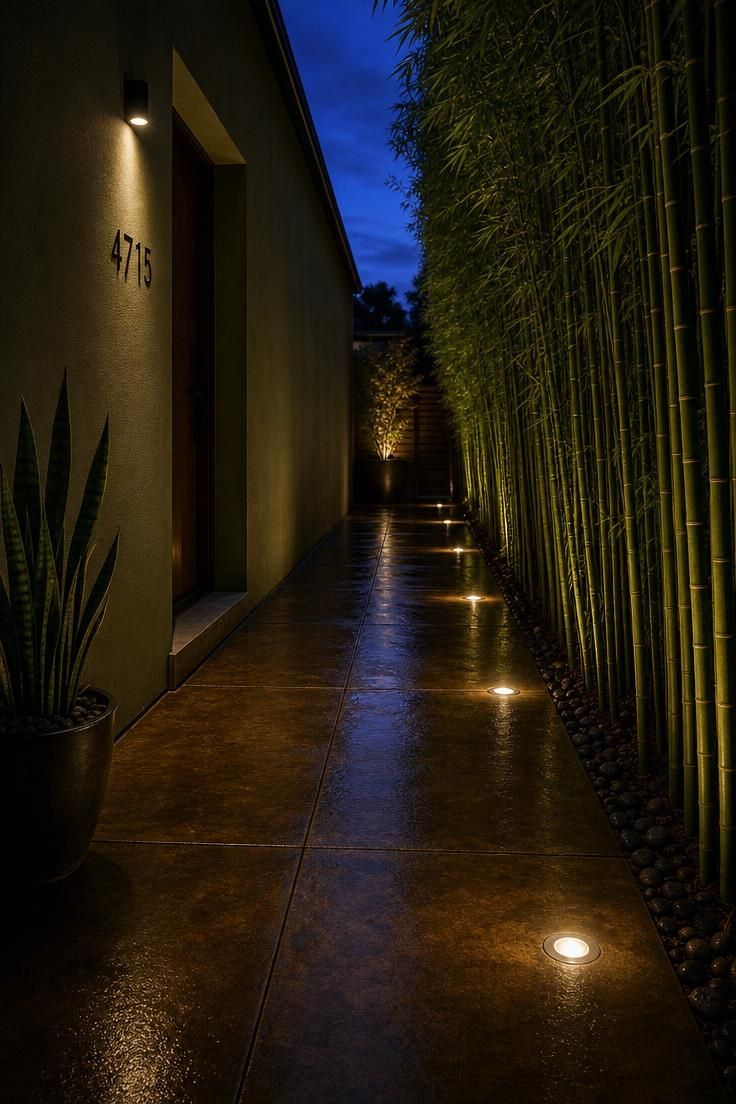
Acid stain on concrete is an underrated finish for side yards because it produces color variation that looks more like leather or stained wood than like a typical slab.
The chemical reaction between the stain and the concrete’s mineral content means no two applications look identical, giving each path a one-of-a-kind surface character.
Scored control joints become part of the design here, dividing the path into a grid that gives the eye regular intervals to track as you walk.
Recessed LED ground lights at alternating intersections create a rhythm of light and dark that draws you forward along the corridor.
The flush installation keeps the walking surface smooth and prevents the trip hazard that post-mounted fixtures can create in a narrow side yard.
Bamboo screening on the fence side provides privacy and vertical texture without any root invasion when planted in a contained raised bed or using clumping varieties.
A dark house wall amplifies the drama of the ground lights, letting each small circle of warm white stand out against a deep background.
This is a side yard design that performs best at night, turning the daily walk from the car to the back door into something that feels deliberate and private.
The wet-look sheen that concrete develops after rain makes the acid stain colors deepen, so the path actually improves in bad weather.
Style Blueprint:
- Poured concrete with acid stain in walnut or amber tones
- Scored control joints in a 24-inch grid pattern
- Recessed round LED ground lights (warm white, flush-mount)
- Clumping bamboo screen on the fence side
- Dark olive or charcoal house wall for contrast
Terra Cotta Saltillo Tile Walkway Under a Wire Trellis
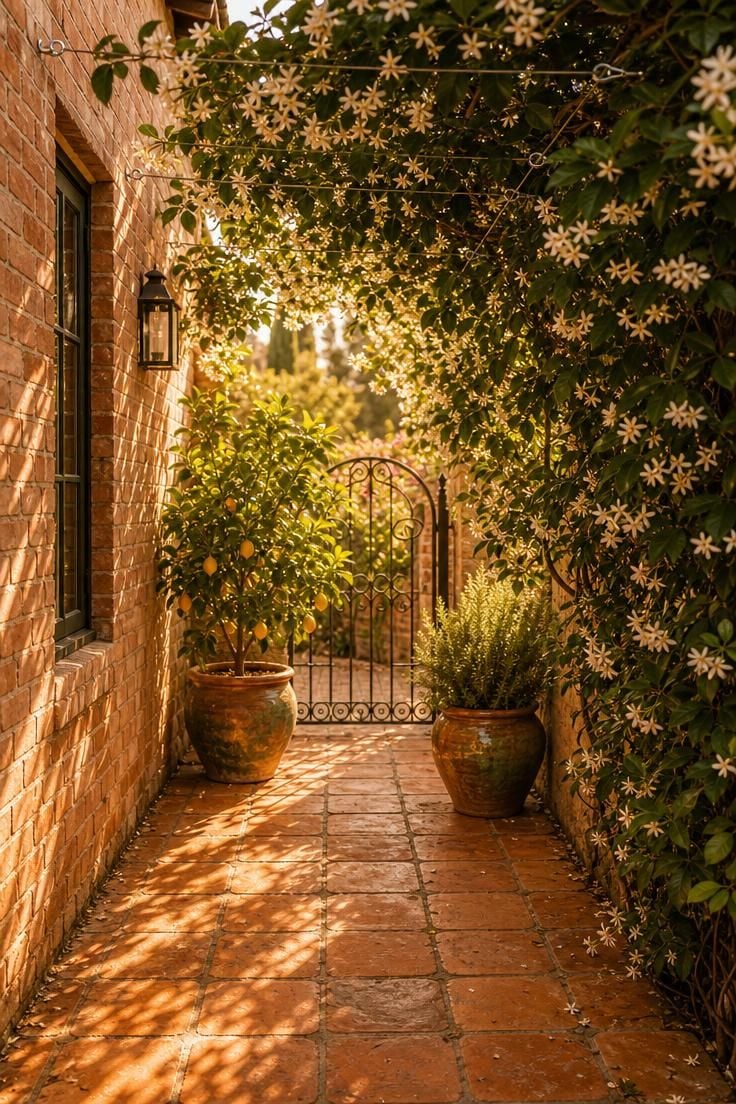
Saltillo tiles carry their origin in their surface, with thumbprints, color variations, and slight warps that no factory product can imitate.
The warm orange and rust tones create a side yard that feels sun-soaked even on cooler days, bringing Mediterranean warmth to climates that rarely see the Mediterranean sun.
An overhead wire trellis is one of the most effective ways to change how a side yard feels, converting an open-air corridor into a sheltered passage with the help of a single vigorous vine.
Star jasmine is the ideal candidate because it is evergreen, fragrant in spring, and manageable enough to keep trimmed along the wire without becoming unruly.
The dappled light that filters through the canopy creates a constantly shifting pattern on the tile surface, an effect that keeps the path visually alive throughout the day.
A wrought iron gate at the end provides a clear threshold between the side yard and the backyard, framing what comes next like a doorway between rooms.
Style Blueprint:
- Handmade Saltillo terra cotta tiles in orange and rust tones
- Galvanized steel cable trellis with eye bolt hardware
- Star jasmine (Trachelospermum jasminoides) as a canopy vine
- Hand-thrown ceramic pots with a Meyer lemon and rosemary
- Wrought iron garden gate as a terminus focal point
Gray Concrete Hexagon Pavers With Creeping Ground Cover
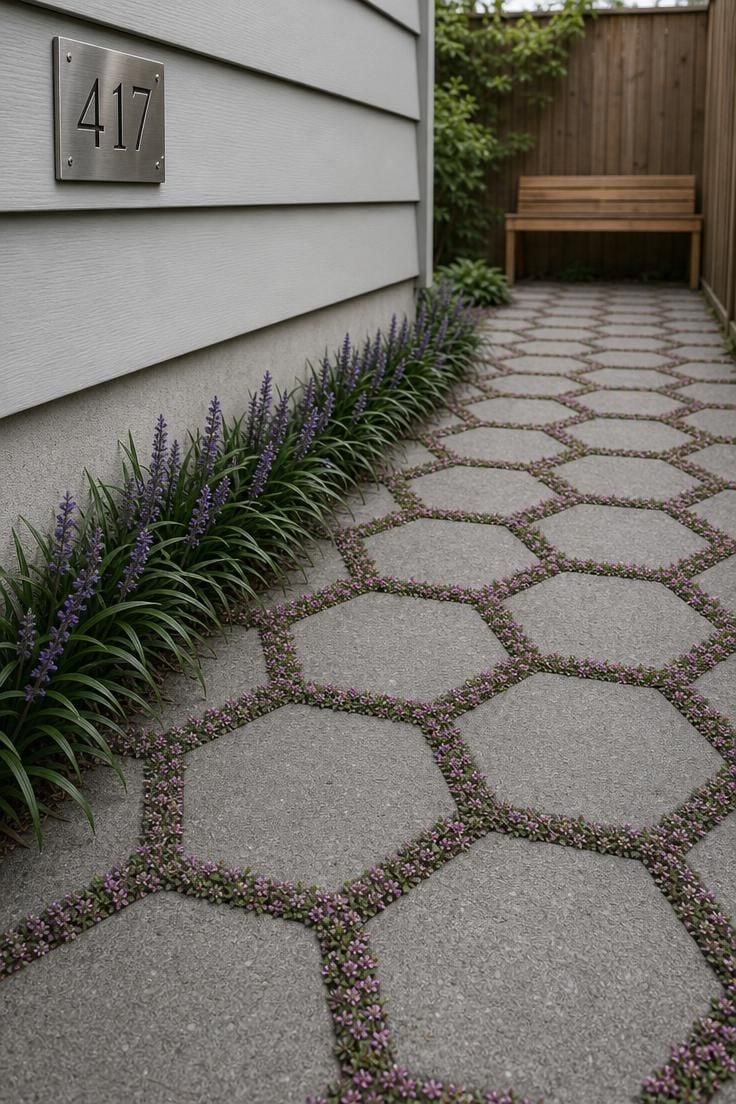
Hexagonal pavers bring geometry to a space that is usually defined by nothing but parallel lines.
The six-sided shape creates a honeycomb pattern that reads as both modern and organic, a combination that makes the path feel considered without being severe.
Elfin thyme in the joints is a ground cover that stays under half an inch tall, flat enough that the pavers remain the dominant walking surface.
The tiny pink flowers that appear in late spring add a seasonal color accent that disappears on its own, requiring no deadheading or cleanup.
This flagstone path alternative suits homeowners who want the natural joint look of irregular stone but prefer the consistency and affordability of cast concrete.
Liriope along the foundation border is a tough, shade-tolerant perennial that produces purple flower spikes in late summer, adding vertical interest without any spreading habit that would crowd the path.
A simple wooden bench at the end of the side yard turns the corridor into a seated destination, a change in function that most narrow side yard layouts overlook entirely.
The gravel walkway look gets all the attention in magazine spreads, but this hexagonal approach delivers more visual interest per square foot with less ongoing maintenance.
Style Blueprint:
- Medium gray concrete hexagonal pavers in honeycomb layout
- Elfin thyme (Thymus serpyllum ‘Elfin’) between joints
- Liriope muscari along the house foundation border
- Simple wooden bench as a terminus seating element
- Stainless steel house number plaque on the adjacent wall
Design Pro-Tip: When planting ground cover between pavers, water the joints daily for the first two weeks after planting to help roots establish before foot traffic compresses the soil. Once rooted, most creeping ground covers handle moderate walking without thinning out, but that initial establishment window is what separates a lush carpet from patchy, struggling plugs.
Crushed Oyster Shell Path With Driftwood Edging
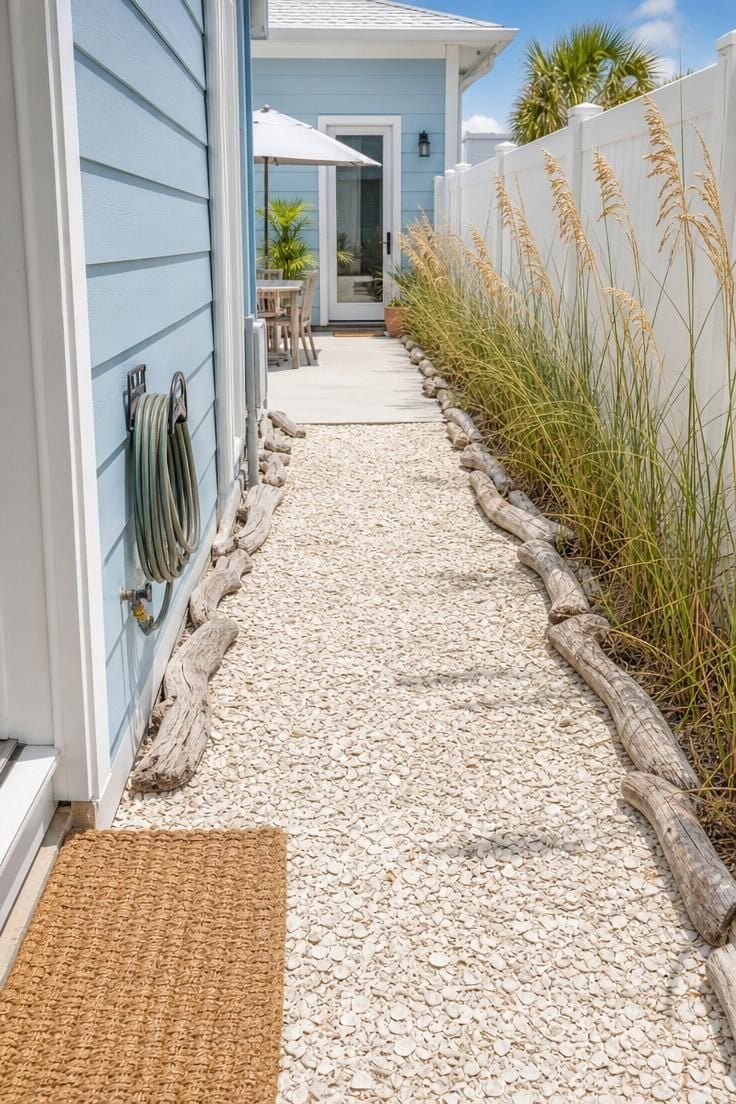
Crushed oyster shell is the kind of material that places you somewhere specific the moment you see it.
The pale, chalky surface and irregular shell fragments read as coastal without a single nautical prop in sight.
Driftwood edging is free if you collect it and affordable if you buy it, and the silvery gray weathering that happens over time only makes each piece look more fitting in its role.
The material compacts slightly underfoot but never fully solidifies, keeping a loose, beachy texture that feels relaxed and appropriate for a casual gravel walkway approach.
Sea oats along the fence line bring height and movement with their golden seed heads swaying in any breeze, a plant that is both drought-tolerant and visually tied to sand and shore.
Pale house siding amplifies the brightness of the shell surface, making this side yard feel open and airy even though the corridor walls are close together.
This is a side yard pathway idea that costs less than most options on this list and installs in a single afternoon with no cutting, mixing, or curing.
Style Blueprint:
- Crushed oyster shell aggregate, 2-3 inches deep
- Weathered driftwood pieces as irregular natural edging
- Sea oats (Uniola paniculata) along the fence for vertical movement
- Pale blue or white house siding for maximum brightness
- Woven jute doormat at the patio transition
Tumbled Marble Mosaic Inlay on a Brushed Concrete Walk
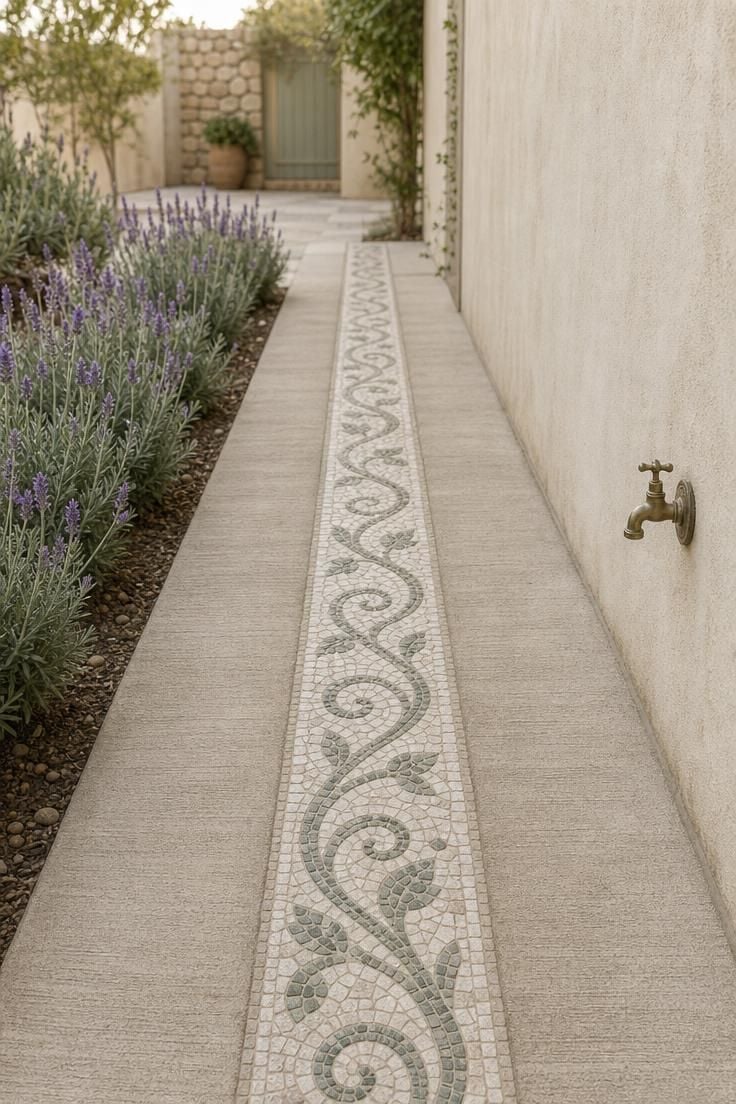
A mosaic inlay does something no other path treatment can do, it rewards the person who looks down.
Most side yard surfaces are designed to be walked over without a thought, but a scrolling vine pattern in tumbled marble turns the ground plane into a piece of craft.
The tumbled finish on each marble chip removes sharp edges and creates a matte surface that catches light differently than polished stone, giving the mosaic a soft, aged quality even when freshly installed.
Cream, gray, and sage green together form a palette that reads as natural and restrained, avoiding the busy multicolor effect that mosaic work sometimes falls into.
Lavender along the planting strip ties the color story together with gray-green foliage that echoes the sage marble, and the fragrance adds another sensory layer to the walk.
This is the most labor-intensive option on this list, but the result is a side yard that stops visitors in their tracks and gives the homeowner something to be proud of every time they take out the recycling.
Style Blueprint:
- Brushed concrete base with light broom finish
- Tumbled marble mosaic inlay in cream, dove gray, and pale sage
- Scrolling vine or geometric border pattern
- Compact lavender (Lavandula angustifolia) along one edge
- Smooth plastered garden wall in warm ivory
Conclusion
The best side yard pathway ideas start with a single honest question: how wide is the space, and how much light does it get?
Those two answers narrow the material choices to a handful that will actually perform well, and from there the decision is about character, not engineering.
A gravel walkway suits the homeowner who wants something quick and forgiving.
A flagstone path or bluestone slab approach fits the person willing to invest in a surface that ages with grace.
Porcelain tiles and poured concrete serve the modernist who values clean geometry and low upkeep.
Whatever material you choose, commit to filling the ground plane completely and letting the vertical elements, the fence, the house wall, the plantings, provide the contrast and softness.
A side yard treated with that kind of intention stops being a corridor and starts being the favorite walk of the day.