This post may contain affiliate links. If you make a purchase through these links, we may earn a commission at no additional cost to you.
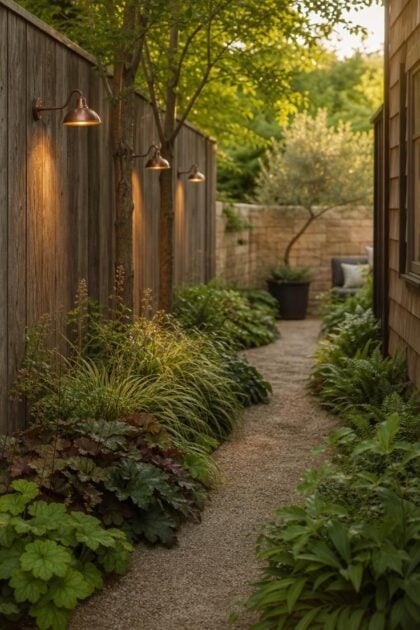
That slim corridor between your house and the fence is probably the most overlooked square footage on your entire property.
Most homeowners treat it as a pass-through for trash cans, garden hoses, and the occasional forgotten bag of mulch.
But the right combination of path material, plantings, and lighting can turn that neglected strip into a space that feels like a private garden passage.
These 11 narrow side yard ideas cover everything from stone paths and shade plantings to pocket courtyards and rain gardens, each one designed for corridors as slim as four feet wide.
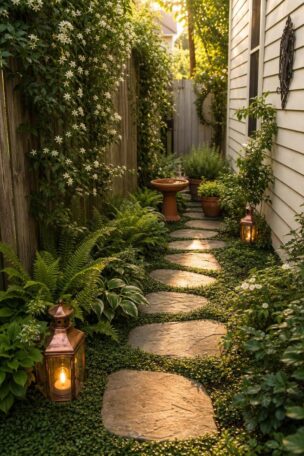
A Sandstone Stepping Path Flanked by Japanese Forest Grass
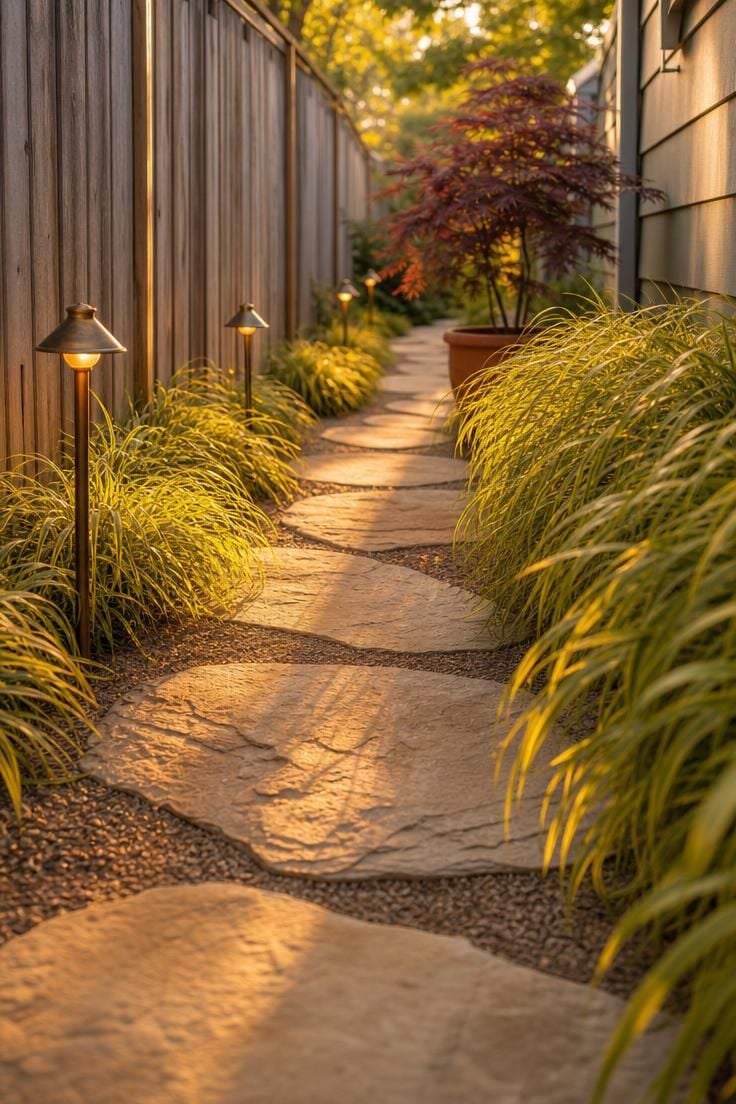
There is something about an irregular stone path that makes you slow down, and in a narrow side yard, that pause is the whole point.
Golden buff sandstone reads warm even on overcast days, pulling light into a corridor that might otherwise feel like a shadowy afterthought.
The Japanese forest grass does double duty here, softening the hard edges of the path and creating movement every time a breeze passes through.
Leaving 3-inch gaps between the slabs lets the ground plane breathe and gives low groundcover room to colonize the joints over a single growing season.
Brass stake lights at regular intervals keep the path safe after dark without adding visual clutter during the day.
This kind of narrow garden path works best when the stones are laid slightly off-center, so the planting beds on each side feel uneven and natural rather than mirrored.
The burgundy Japanese maple at the bend acts as a full stop, giving your eye a destination instead of letting it slide straight to the back fence.
Style Blueprint:
- Golden buff irregular sandstone slabs (1.5 to 2 inches thick)
- Hakonechloa macra ‘Aureola’ planted 10 inches from path edge on both sides
- Fine decomposed granite fill between stepping stones
- Patinated brass solar stake lights every 6 feet
- One compact Japanese maple in a glazed terra cotta pot at a path bend
Weathered Copper Sconces on a Dark Green Painted Fence
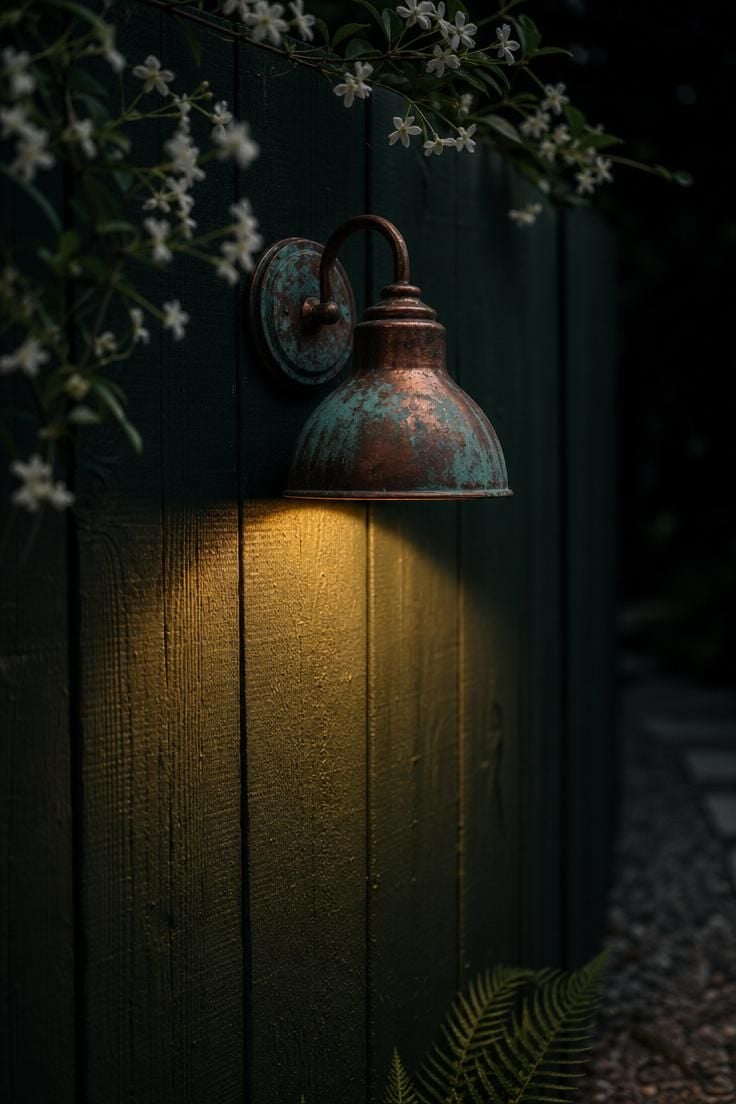
A dark-painted side yard fence is one of the simplest ways to make a narrow space feel deeper than it actually is.
Deep greens and charcoals recede visually, pushing the boundary back and giving the eye more room to travel.
Mounting copper sconces directly on the fence boards turns a plain barrier into a feature wall, and the patina only improves with age and weather.
Staggering the sconces at slightly different heights keeps the side yard lighting from feeling like a hotel hallway.
The warm amber glow of a 2700K bulb is key here, because cooler white light would flatten the paint color and kill the moody atmosphere.
This approach works on any side yard fence material, from cedar planks to composite boards, as long as the paint adhesion is solid.
Style Blueprint:
- Exterior-grade fence paint in deep forest green or near-black green
- Weathered copper or brass wall sconces rated for outdoor wet locations
- 2700K LED bulbs (40-watt equivalent, dimmable if wired)
- Star jasmine or confederate jasmine vine planted at the fence base
- Fine gravel or decomposed granite path surface below
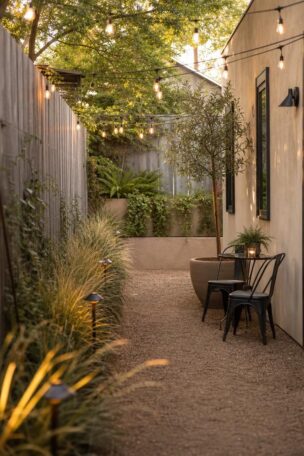
A Slim Gravel Courtyard With a Cast Iron Water Bowl
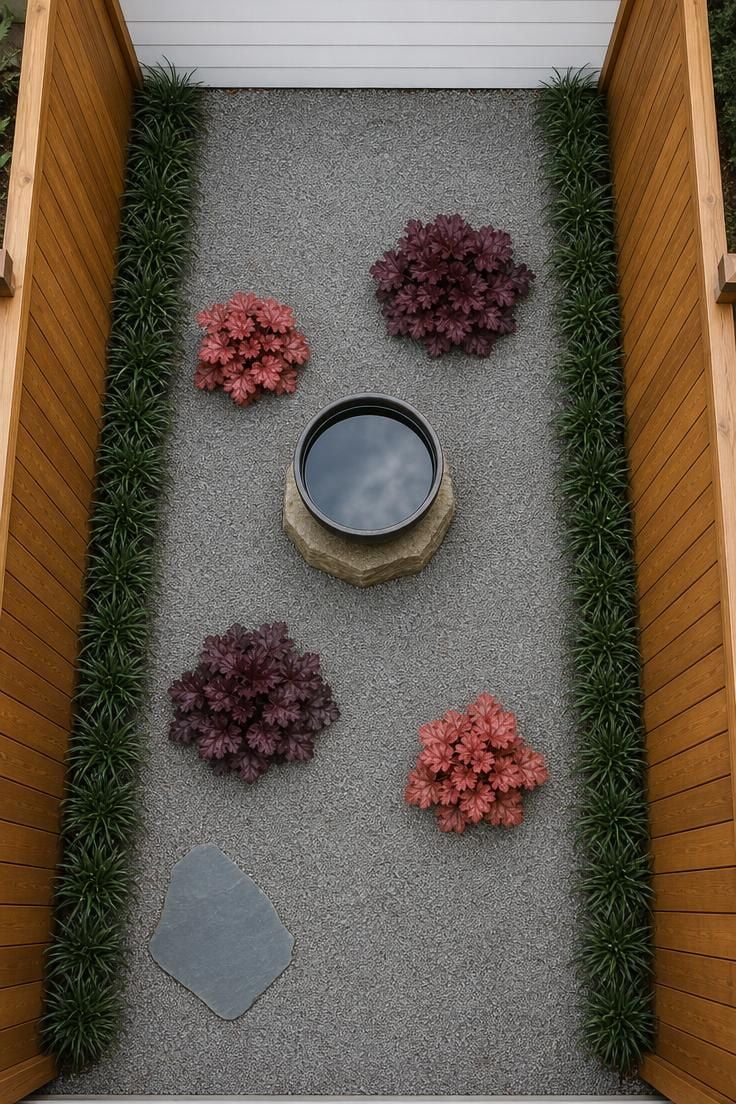
Widening even a small section of your side yard walkway creates a moment of arrival, a place where the corridor opens and you can finally stand still.
A cast iron water bowl is the right scale for this kind of pocket courtyard because it sits low and does not compete with the fence walls for attention.
The sound of water recirculating through a small pump fills the enclosed corridor, and the fence walls carry it into something that feels like a hidden spring.
Crushed gravel in a silver-gray tone keeps the palette cool and lets the plum and coral heuchera leaves pop without any competition from warm-toned stone.
Raking the gravel smooth once a week takes about three minutes and gives the space a finished, maintained look that loose river rock cannot match.
Liriope along both edges is almost indestructible in shade, which matters because this spot will get filtered light at best.
A single stepping stone of contrasting blue-gray slate gives the eye a secondary anchor and breaks the gravel plane just enough to feel intentional.
The overcast light in this photograph is honest about the conditions most side yards actually have, which makes it a more useful reference than a sun-drenched image.
Style Blueprint:
- Fine crushed silver-gray gravel (quarter-inch minus, compacted)
- Cast iron water bowl (18-20 inch diameter) on a rough-cut limestone block
- Small recirculating pump rated for outdoor basins
- Heuchera in plum and coral varieties (3-4 plants, asymmetric placement)
- Dark green liriope border along both long edges
Maidenhair Fern Pockets in a Stacked Sandstone Retaining Edge
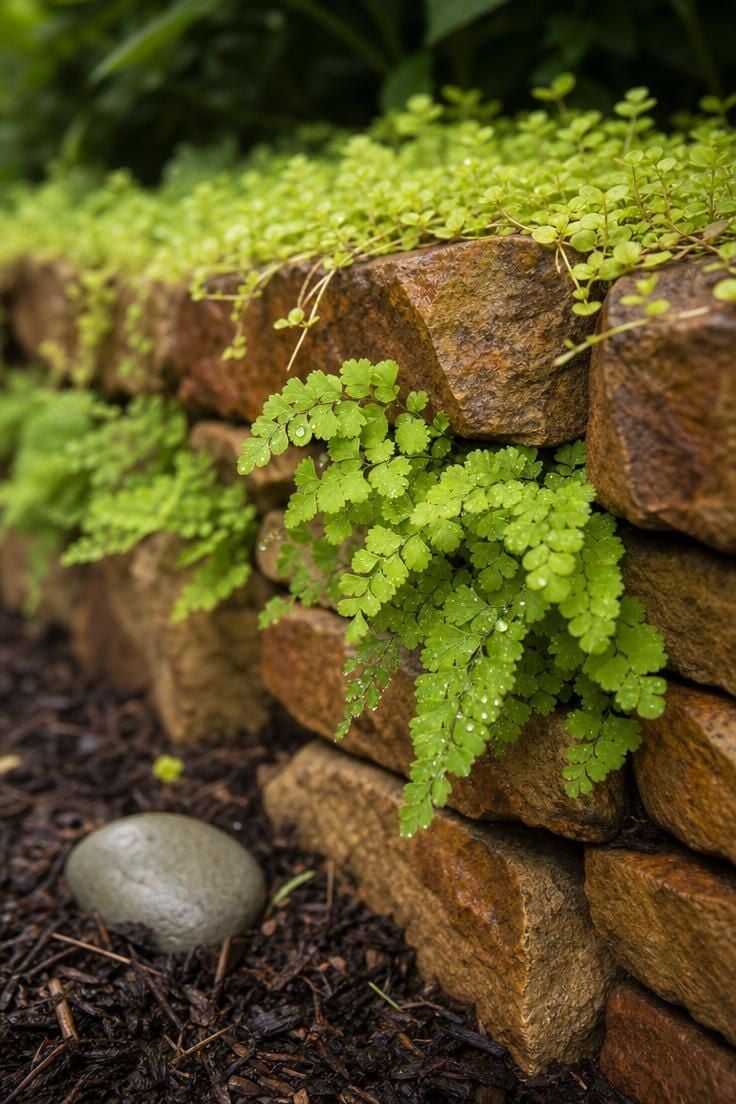
Shade garden plants rarely get a setting this theatrical, but a sandstone retaining edge gives ferns a warm, textured backdrop and creates planting pockets along the boundary.
Maidenhair ferns look impossibly delicate, yet they can settle naturally around stone when their roots have access to consistent moisture and suitable growing conditions.
The honey and rust tones of sandstone create a warm backdrop that makes the bright green fronds almost glow by contrast, even in the low light of a north-facing corridor.
Leaving visible joints and irregular gaps between stones gives the wall a looser, more natural appearance and creates visual pockets where small ferns can appear to emerge directly from the stonework.
A discreet irrigation or misting line can help maintain moisture around plants that prefer consistently damp conditions, with the system selected and adjusted for the specific site and planting requirements.
Creeping Jenny trailing over the top edge of the wall adds a second texture and a shift in green, from the silver-green of the fern to a bold chartreuse.
This is side yard landscaping at its most restrained, letting two or three plants and one honest material do all the work.
Style Blueprint:
- Rough-cut sandstone in honey and rust tones
- Low sandstone landscape wall with visible joints and an informal, layered appearance
- Maidenhair ferns positioned close to the stonework
- Creeping Jenny (Lysimachia nummularia ‘Aurea’) spilling over the upper edge
- Discreet irrigation or misting line where appropriate for the planting conditions
Design Pro-Tip: In a narrow side yard, one material running the full length of the corridor creates a sense of continuity that makes the space feel longer and more intentional. Mixing too many materials, such as switching repeatedly between gravel, pavers, and brick in a short stretch, can visually divide the space into smaller sections.
Installation note: Low landscape walls, overhead structures, cantilevered benches, and attached screens should be sized and built for the actual soil loads, drainage, wind exposure, wall or foundation construction, setbacks, egress requirements, and applicable local rules. Treat dimensions shown in a Style Blueprint as visual examples rather than universal construction specifications. The intended materials, proportions, and appearance can guide the design, but wall height, assembly method, structural spans, and connection details should be determined for the specific site.
A Narrow Pergola of Black Steel and Rough-Sawn Cedar
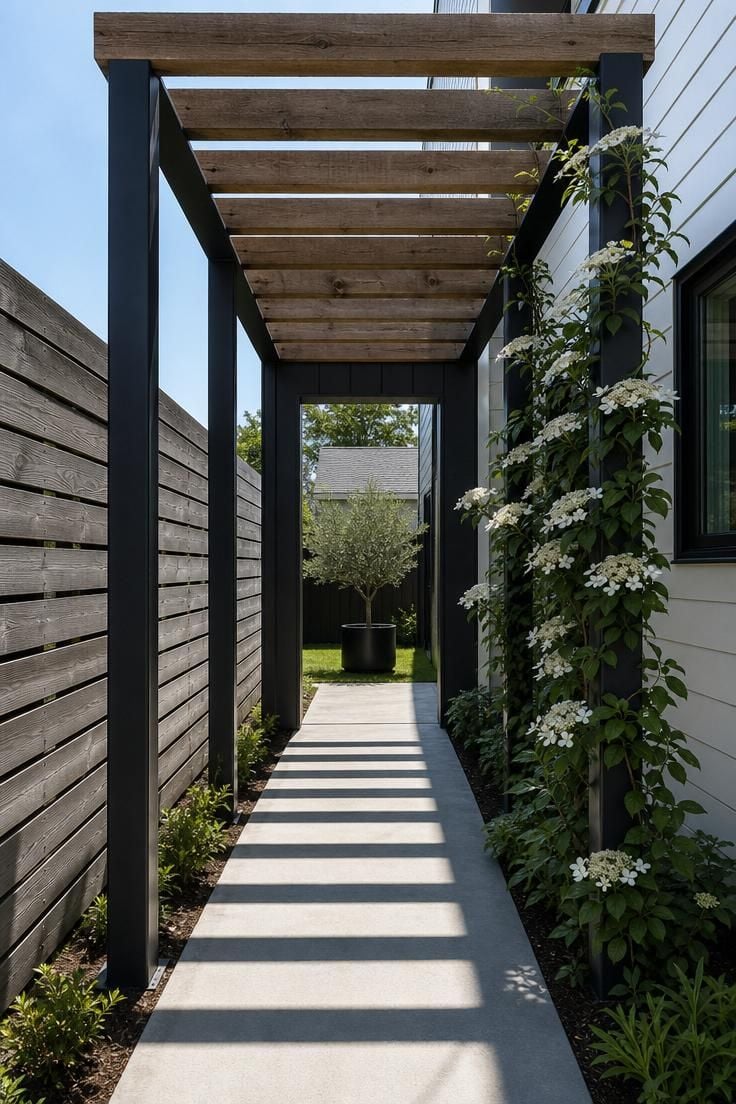
A pergola in a small side yard sounds like it would crowd the space, but a four-foot-wide structure with open sides actually makes the corridor feel more like a room and less like a leftover.
The black steel uprights almost disappear against a dark fence, so the rough-sawn cedar crossbeams appear to float overhead.
Spacing the cedar slats with 3-inch gaps lets enough light through to keep shade garden plants happy on either side without creating a dark tunnel.
The striped shadows on the path change throughout the day, giving the space a kinetic quality that a plain corridor never has.
Planting a climbing vine on only one side keeps the structure from feeling overgrown and preserves sightlines through the pergola to whatever waits at the far end.
A matte black planter holding an olive tree at the terminus pulls your eye down the full length of the space and rewards you for walking through.
Style Blueprint:
- Matte black powder-coated steel uprights (2-inch square tube)
- Rough-sawn cedar crossbeams (2×4, spaced 3 inches apart)
- Smooth poured concrete path beneath the pergola
- One climbing hydrangea on a single upright
- Matte black cylinder planter with a dwarf olive tree at the far end
Terraced Corten Steel Planters With Ornamental Thyme and Sage
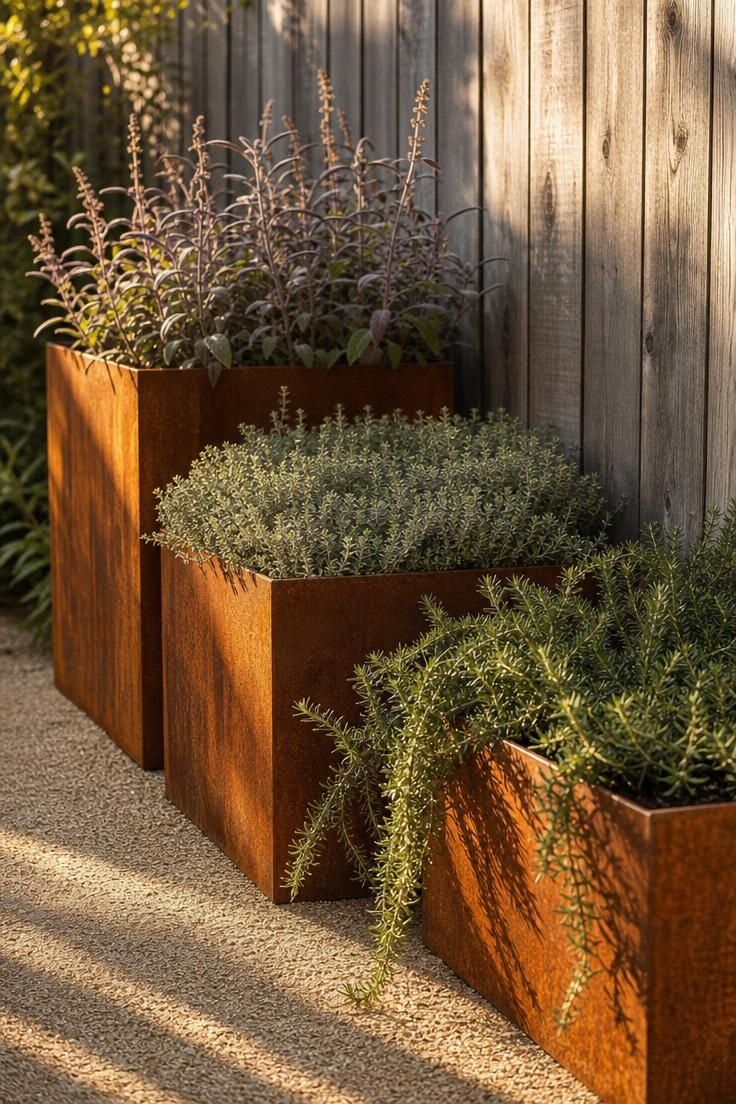
Corten steel planters age on purpose, and in a narrow corridor where you pass the same surfaces every day, that slow shift from bright orange to deep chocolate brown gives you something new to notice each month.
Staggering three boxes at different heights turns a flat fence line into a layered composition that reads as intentional even before the plants fill in.
Purple sage, woolly thyme, and trailing rosemary are all drought-tolerant and fragrant, so brushing past them on a side yard walkway releases scent without any effort.
The crushed limestone path ties into the warm palette of the rusted steel without competing for attention.
Keeping the planters on only one side of the corridor leaves the opposite side open for foot traffic and prevents the space from feeling cluttered.
These herbs also happen to be among the most forgiving plants for narrow corridors that get partial sun, needing only four hours of direct light to stay compact and productive.
Late afternoon light is the best moment for this arrangement because the low angle catches every ridge and drip line on the corten surface.
A vertical garden wall on the opposite fence could complement this setup, but the restraint of leaving that side empty is what makes the planter arrangement feel like a gallery display.
Style Blueprint:
- Three corten steel planter boxes (12, 18, and 24 inches tall)
- Purple sage, woolly thyme, and trailing rosemary
- Fine crushed limestone path (warm buff tone)
- Weathered cedar fence as backdrop (natural silver finish)
- 6- to 8-inch spacing between planter boxes for shadow gaps
A Polished Concrete Bench Built Into a Whitewashed Masonry Wall
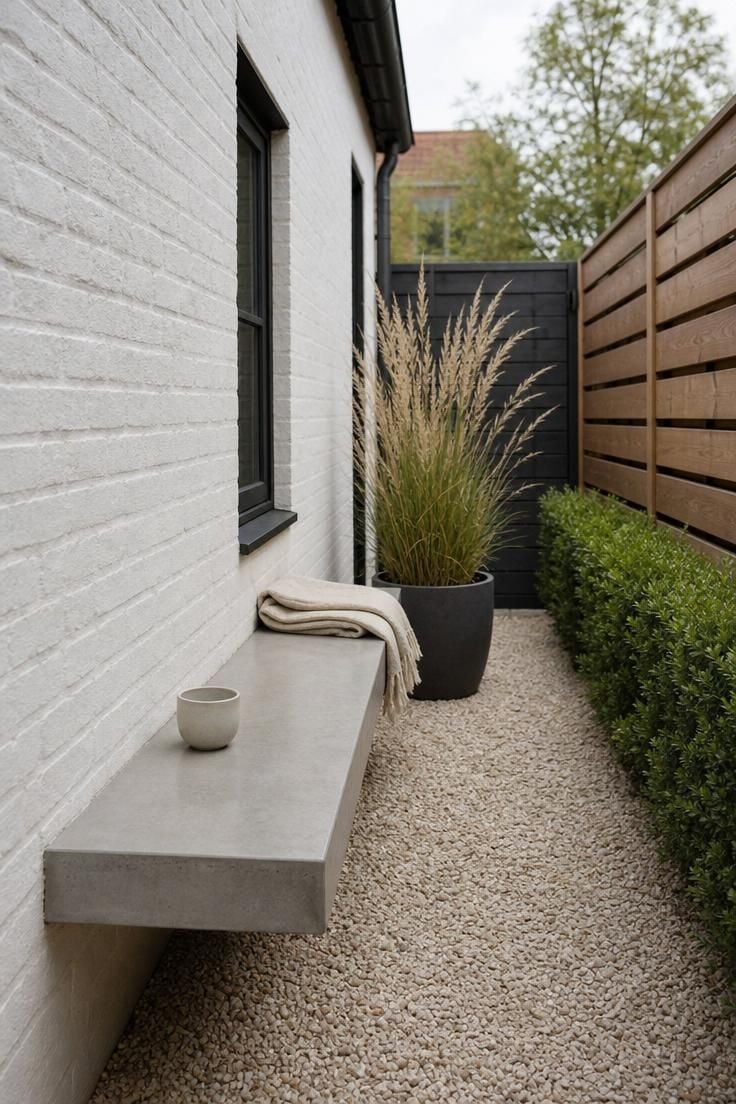
A floating bench with no legs gives a narrow corridor something most side yards never have, which is a reason to sit down and stay.
The cantilevered design keeps the ground plane completely clear, so the gravel pathway reads as one continuous surface from entrance to exit.
Whitewashed brick behind the bench reflects whatever ambient light the corridor gets, pushing brightness back into a space that tends to absorb it.
The single pot of feather reed grass is tall enough to create a soft vertical line beside the bench without blocking the walkway.
Cool overcast light is actually flattering for this kind of monochrome composition because there are no harsh shadows to break up the calm, even surface tones.
A folded linen throw suggests that someone uses this bench regularly, which is the difference between outdoor furniture and a place that feels lived in.
This is the kind of small side yard addition that costs less than a patio set but changes how you move through your property every day.
Style Blueprint:
- Polished concrete bench slab (12 inches deep, 48 inches wide, 3 inches thick)
- Whitewashed brick or masonry wall for structural support
- Concealed steel bracket system rated for 400 pounds
- One tall ceramic pot (matte charcoal) with Karl Foerster feather reed grass
- Pale crushed gravel ground surface beneath
Design Pro-Tip: If your side yard is narrower than five feet, an outdoor privacy screen works better than a solid fence because it lets air and filtered light pass through. Horizontal slat screens in cedar or composite board create a sense of enclosure without the boxed-in feeling of a full-height solid panel.
Reclaimed Timber Fence Panels With Integrated Shelf Planters
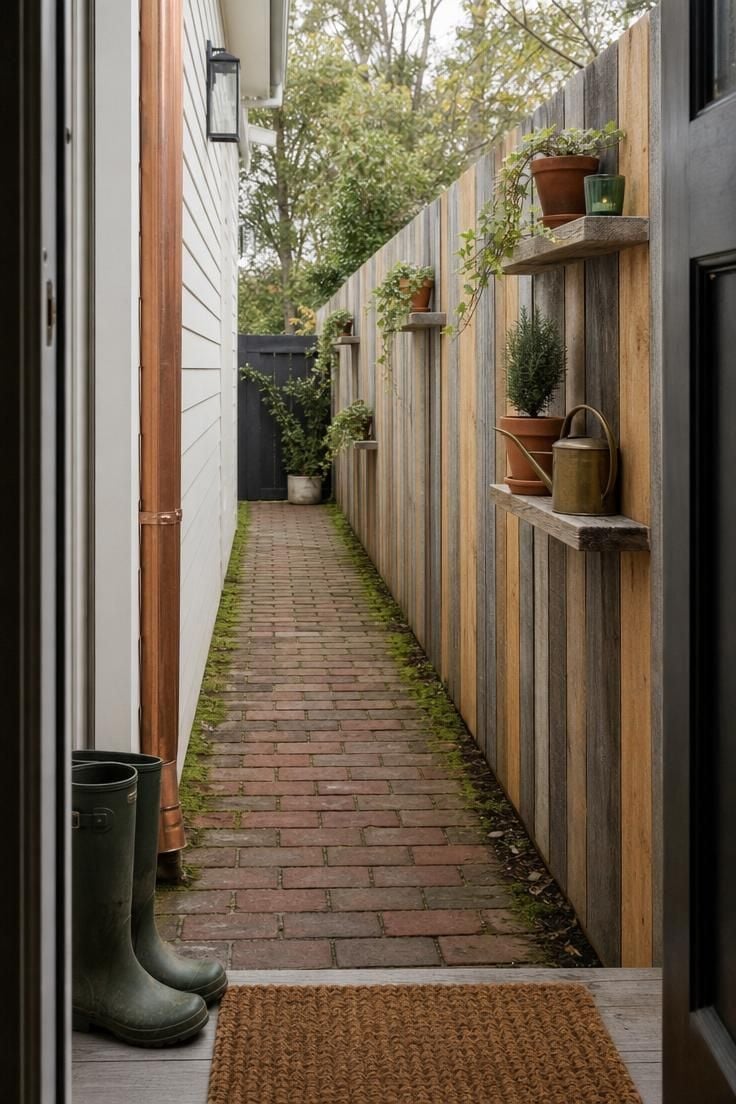
A fence that doubles as shelving solves one of the biggest problems in a narrow side yard, which is having no floor space for anything decorative.
Extending every fourth plank outward by six inches creates a ledge deep enough for a 4-inch pot without stealing meaningful width from the corridor.
The mixed tones of reclaimed timber give the fence a patchwork character that makes even a simple shelf arrangement look collected and personal.
Terra cotta, green glass, and worn brass are materials that look better with age and weather, which matters in an outdoor setting where everything gets rained on.
A narrow red brick path is a good match for this rustic palette because it adds warmth underfoot without introducing a competing modern material.
Soft diffused light is the honest condition for most side yards, and styling the shelves for that light means choosing objects with texture rather than color to hold attention.
Style Blueprint:
- Reclaimed timber fence planks in mixed natural tones (gray, honey, weathered brown)
- Every fourth plank extended 6 inches outward as a shelf
- Small terra cotta pots (4-inch), green glass votives, and brass accents
- Narrow red brick path in running bond pattern
- Trailing ivy and miniature rosemary topiary on alternating shelves
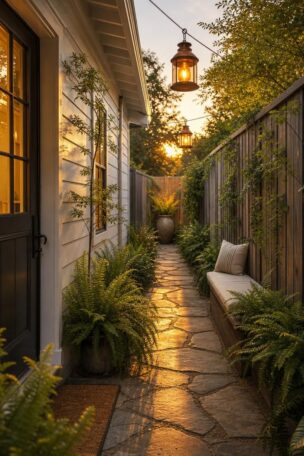
Low Sandstone Pillars With Solar Lanterns Along a Fern Corridor
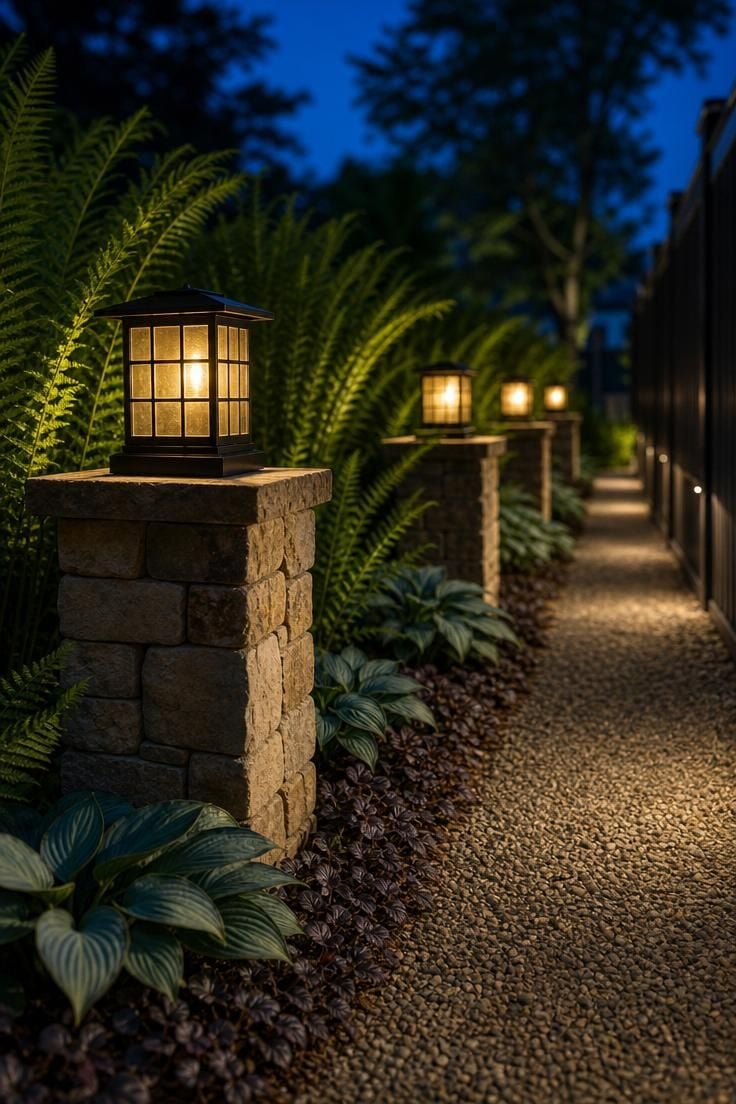
A row of low pillars turns a side yard into something that feels ceremonial, like a procession route through a private garden rather than a shortcut to the back gate.
The two-foot height is deliberate because anything taller would crowd the corridor, and anything shorter would disappear behind the ferns.
Solar lanterns are the most practical choice for side yard lighting in a space like this because running electrical conduit along a fence line is expensive and messy.
Sword ferns and hostas are the backbone of this planting plan, both tolerant of deep shade and both able to fill a bed completely within two growing seasons.
Ajuga groundcover in bronze-purple ties the darker tones of the fern fronds to the warm sandstone, creating a color bridge between the vertical and horizontal planes.
The gravel pathway running between the pillar line and the opposite fence should be at least 30 inches wide to feel comfortable for walking, even if the overall corridor is only five feet across.
Dusk is when this arrangement comes alive, because the lanterns create alternating pools of warm light and cool shadow that make the corridor feel twice as long.
The charcoal-painted fence on the opposite side works here because it vanishes in low light, letting the pillar-and-fern composition hold all the attention.
Style Blueprint:
- Squat sandstone pillars (24 inches tall, 10-inch square base)
- Glass-and-iron solar lanterns (warm amber LED, auto-on at dusk)
- Sword ferns and blue-gray hostas between pillars
- Ajuga reptans ‘Chocolate Chip’ as ground cover beneath ferns
- Fine gray-and-tan aggregate gravel path (30+ inches wide)
Design Pro-Tip: When choosing a gravel pathway material for a side yard, stick with angular crushed stone rather than round pea gravel. Angular gravel compacts into a firm surface that stays put underfoot, while round stones shift and scatter with every step, eventually migrating into your planting beds.
A Narrow Rain Garden Bed With River Stone and Native Sedges
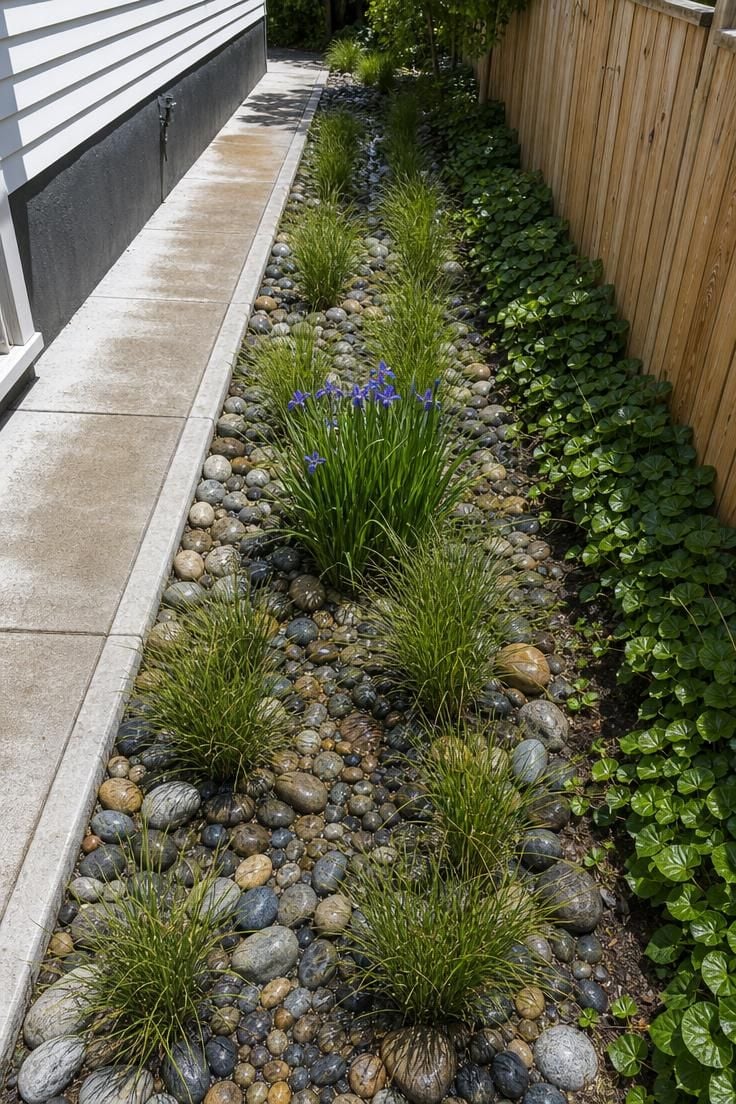
A rain garden in a side yard is one of those rare projects where the functional solution is also the most attractive one.
Most narrow corridors between a house and a fence channel water straight to the lowest point of the lot, eroding soil and pooling against the foundation.
A shallow swale lined with river stone catches that runoff, slows it down, and lets it percolate into the soil through the root systems of native sedges and iris.
Blue flag iris is a strong choice because it handles both the wet feet of a storm event and the dry periods between rains without sulking or going dormant.
The mixed gray and tan river stones look like they belong in a creek bed, which is exactly the visual you want, a feature that reads as natural rather than engineered.
Separating the rain garden from the walking path with a clean concrete curb keeps the stones from migrating and gives the edge a finished look.
Native wild ginger at the fence base is a low-maintenance shade lover that spreads slowly and fills in bare soil without any attention.
Style Blueprint:
- Shallow swale (8-12 inches deep, 18-24 inches wide)
- Smooth river stone in mixed gray, tan, and blue-gray tones
- Native sedges (Carex pensylvanica) in tufts between stones
- Blue flag iris and cardinal flower for seasonal color
- Concrete curb edge separating rain garden from walking path
Hanging Terra Cotta Pots on a Weathered Teak Slat Screen
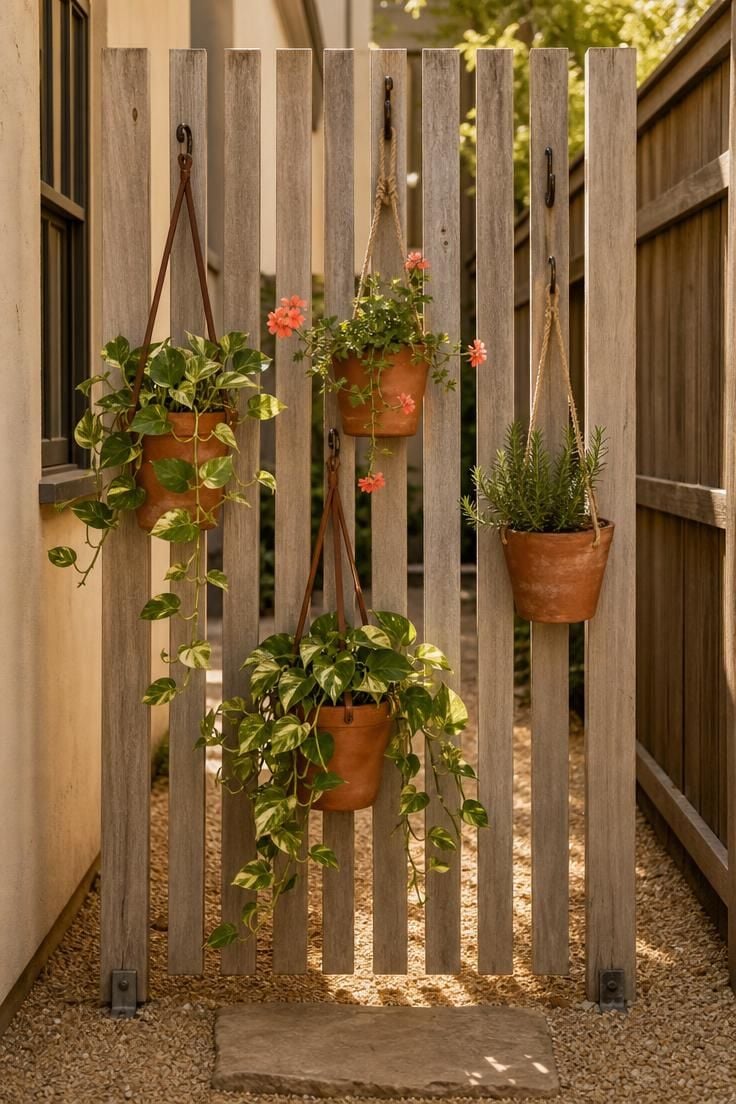
A slat screen at the entrance of a side yard works as both an outdoor privacy screen and a vertical planting surface, solving two problems with one structure.
The vertical teak slats filter light and sightlines without blocking airflow, which keeps the corridor behind from feeling stagnant on warm days.
Hanging pots at staggered heights turns the screen into a living display that changes with the seasons as you swap plants in and out.
Leather straps and thick cotton rope age naturally alongside the teak, so the whole assembly looks more cohesive after a year of weather than it does on the day you build it.
Trailing pothos and geraniums are both forgiving of inconsistent watering, which matters for pots that hang above head height and are easy to forget.
Leaving a few empty hooks on the screen is a small styling detail that makes the arrangement feel casual and unfinished in the best sense, like a collection still in progress.
Style Blueprint:
- Weathered teak slat screen (vertical slats, 2 inches wide, 1-inch gaps)
- Assorted terra cotta pots (4- to 6-inch diameter) in natural orange tones
- Leather straps and thick cotton rope for hanging hardware
- Trailing pothos, coral geranium, and compact rosemary
- Flat sandstone step at the screen base, fine buff gravel path beyond
Conclusion
Every narrow side yard ideas list comes down to the same realization, which is that you have more space than you think.
A single well-chosen path material, a few shade-tolerant plants, and one good light source can turn a corridor you avoid into one you walk through on purpose.
Start with whichever idea matches your corridor’s width and light conditions, whether that is a sandstone stepping path for a sunny strip or a fern-and-lantern arrangement for a shaded one.
The best side yard projects tend to be the ones you can finish in a weekend and then refine over the following months as plants fill in and materials weather into place.