This post may contain affiliate links. If you make a purchase through these links, we may earn a commission at no additional cost to you.
A bare patio wall or an empty porch corner is just wasted square footage waiting for the right shelf.
Outdoor plant shelves do more than hold pots: they stack color, texture, and greenery upward so even a small balcony feels like a proper garden.
The right outdoor plant shelf ideas can turn a concrete slab into a place you actually want to sit and stay a while.
These 11 ideas cover materials from raw cedar to powder-coated steel, and styles from leaning ladders to wall-mounted floating ledges, each one built for a specific look and a specific spot.
A Weathered Cedar A-Frame Ladder With Terracotta Herb Pots
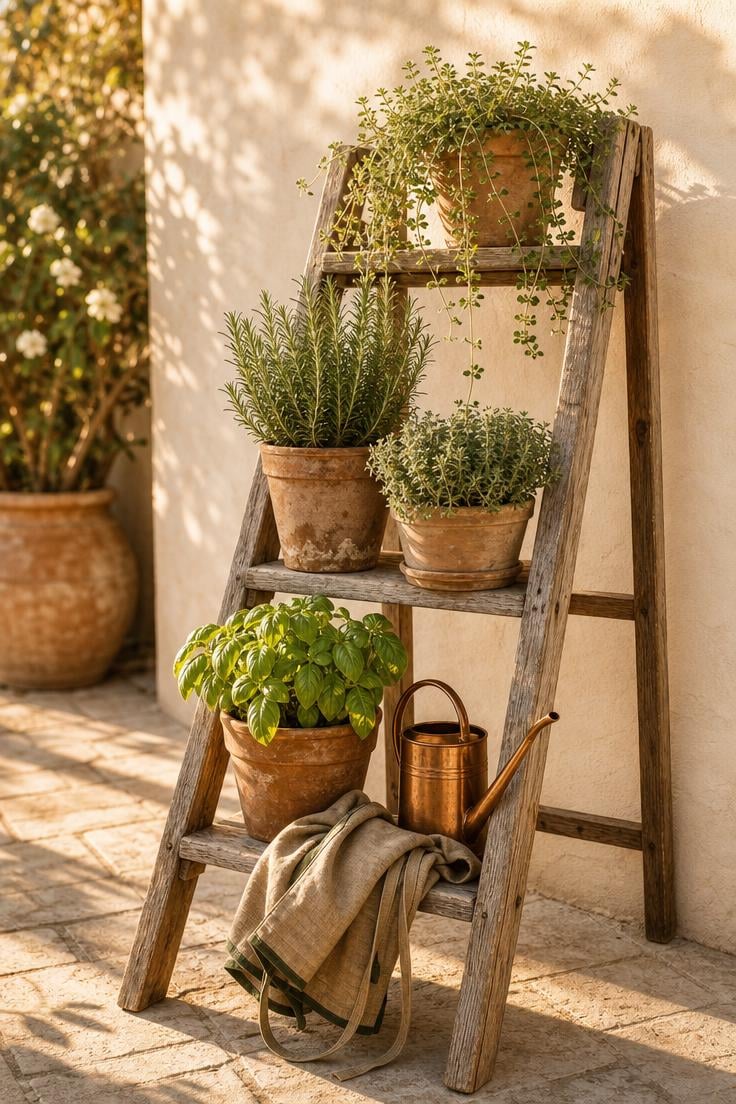
There is something deeply satisfying about a ladder plant stand that leans against nothing, holding its own weight and yours too.
Cedar is one of the few woods that actually looks better the longer it sits outside, its grain turning from golden to a soft pewter gray over seasons of rain and sun.
Terracotta pots let the soil breathe, which herbs like rosemary and thyme actually prefer because their roots hate sitting in moisture.
Setting the tallest herbs on the top rung and trailing varieties like oregano along the edges gives the whole shelf a loose, cascading shape that feels alive rather than arranged.
A coat of raw linseed oil once a year keeps the cedar from splitting without changing its natural color.
The warm golden light at this time of day pulls out every shade of green differently, making even a small herb collection look rich and layered.
If you have a south-facing wall with a few feet of spare floor space, this is one of the simplest outdoor plant shelf ideas to start with.
Style Blueprint:
- Unfinished cedar A-frame ladder shelf (three to four rungs)
- Aged terracotta pots in mixed sizes (4-inch to 8-inch)
- Trailing oregano or creeping thyme for the top shelf
- Copper or brass watering can as a styling prop
- Raw linseed oil for annual wood maintenance
Powder-Coated Black Steel Tiered Stand on a Gravel Patio
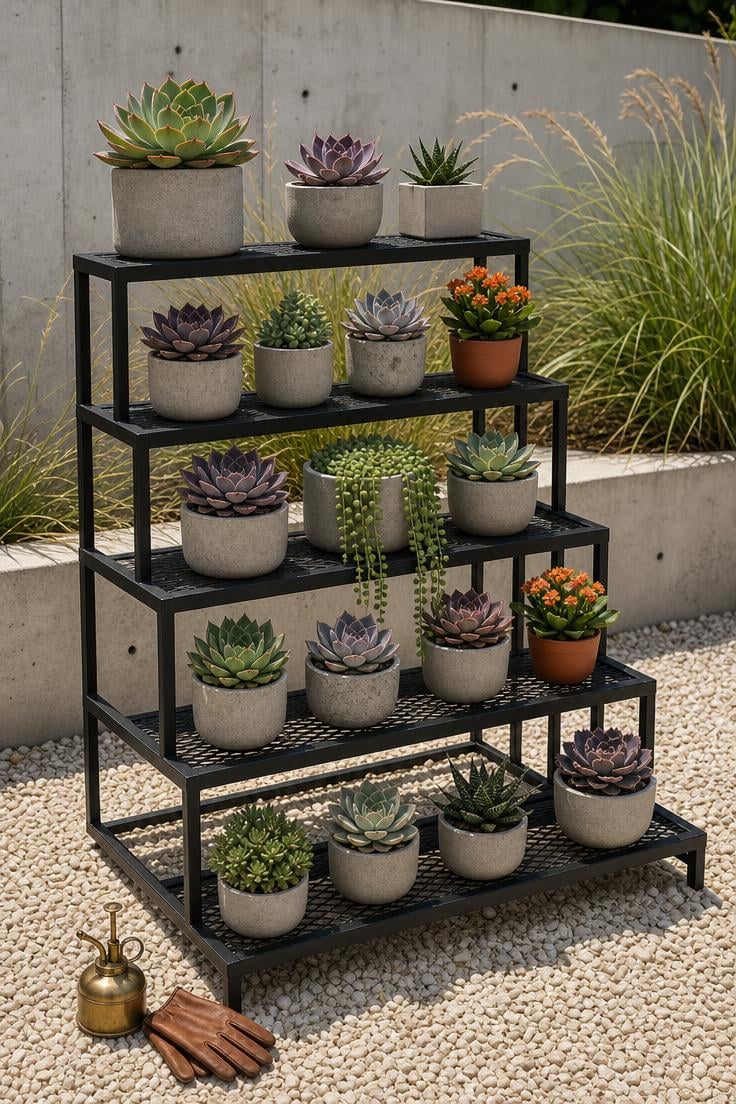
A tiered plant stand in matte black steel draws a vertical line through your patio that pulls the eye upward, which makes the whole space feel taller.
Powder coating protects the metal from rust for years, even in coastal air, so this is one shelf you can leave outside through every season without worry.
The gravel beneath acts as a natural drainage surface, catching runoff from watering without creating puddles that breed mosquitoes.
Mixing succulent shapes matters more than most people realize: pairing tight rosettes with spiky upright varieties and trailing strings of pearls gives each tier its own character.
Burnt orange or dusty rose pots against black steel create a warm contrast that softens the industrial frame.
The sharp midday shadows that fall through the tiers become part of the display, drawing geometric lines across the gravel that shift as the sun moves.
Weight distribution is worth thinking about here, with heavier concrete planters on the bottom two tiers and lighter plastic or resin pots up top.
This kind of patio plant shelf works best on a flat, level surface where the stand can sit without wobbling.
Style Blueprint:
- Five-tier matte black powder-coated steel plant stand
- Concrete planters in light gray or white (mixed sizes)
- Succulent mix including rosettes, trailing, and upright varieties
- Pale crushed gravel base (pea gravel or decomposed granite)
- Brass plant mister for detail and function
Reclaimed Pallet Shelves Mounted to a Whitewashed Fence
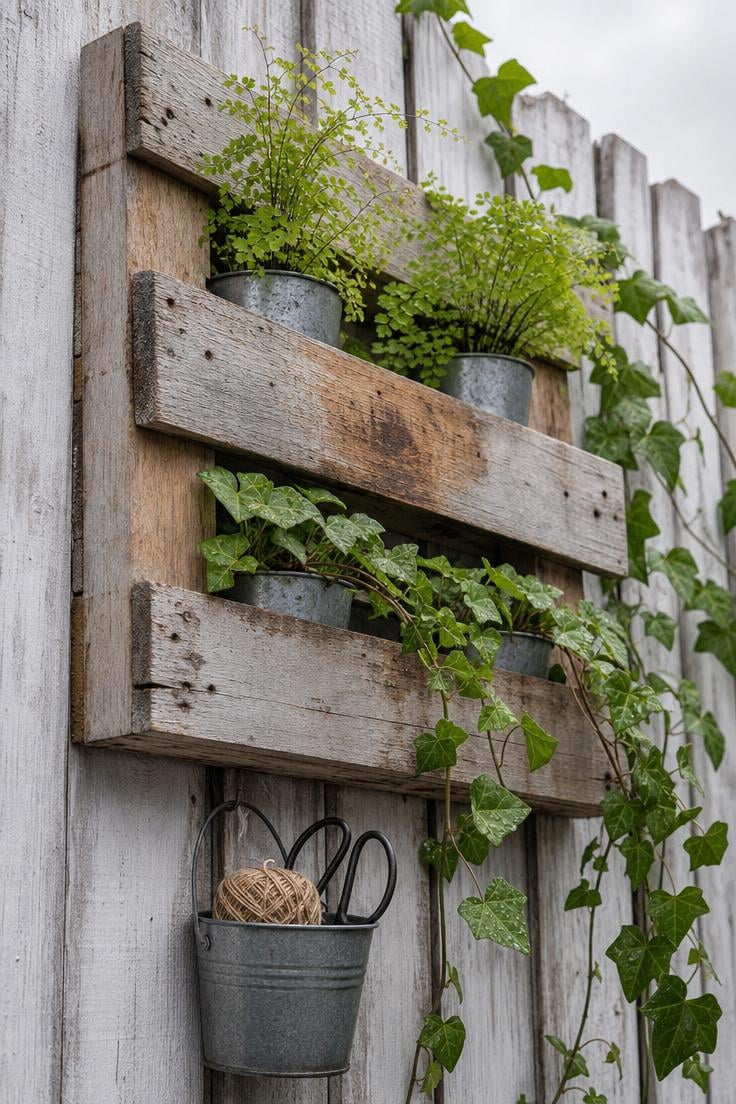
Mounting a pallet directly to a fence creates instant planting pockets without building anything from scratch.
The rough texture of reclaimed wood against clean whitewashed boards sets up a contrast that feels collected rather than designed.
Zinc planters resist corrosion and develop a soft patina over time that pairs well with the gray tones in aged pallet wood.
Ferns and ivy are good choices for this kind of setup because fence-mounted shelves usually sit in partial shade where the fence blocks direct sun.
Sanding the pallet lightly removes splinters without erasing the character of the wood, and a coat of clear exterior sealant keeps moisture from rotting the boards.
Cool overcast light is actually the best condition for photographing green plants because it removes harsh shadows and lets every leaf read clearly.
Style Blueprint:
- Reclaimed wooden pallet (sanded, sealed with exterior poly)
- Small zinc or galvanized planters that fit pallet slat spacing
- Shade-tolerant plants: maidenhair fern, English ivy, pothos
- Exterior wood screws and L-brackets for fence mounting
- Galvanized bucket for tool storage below the shelf
Hanging Macrame Shelves Beneath a Pergola Crossbeam
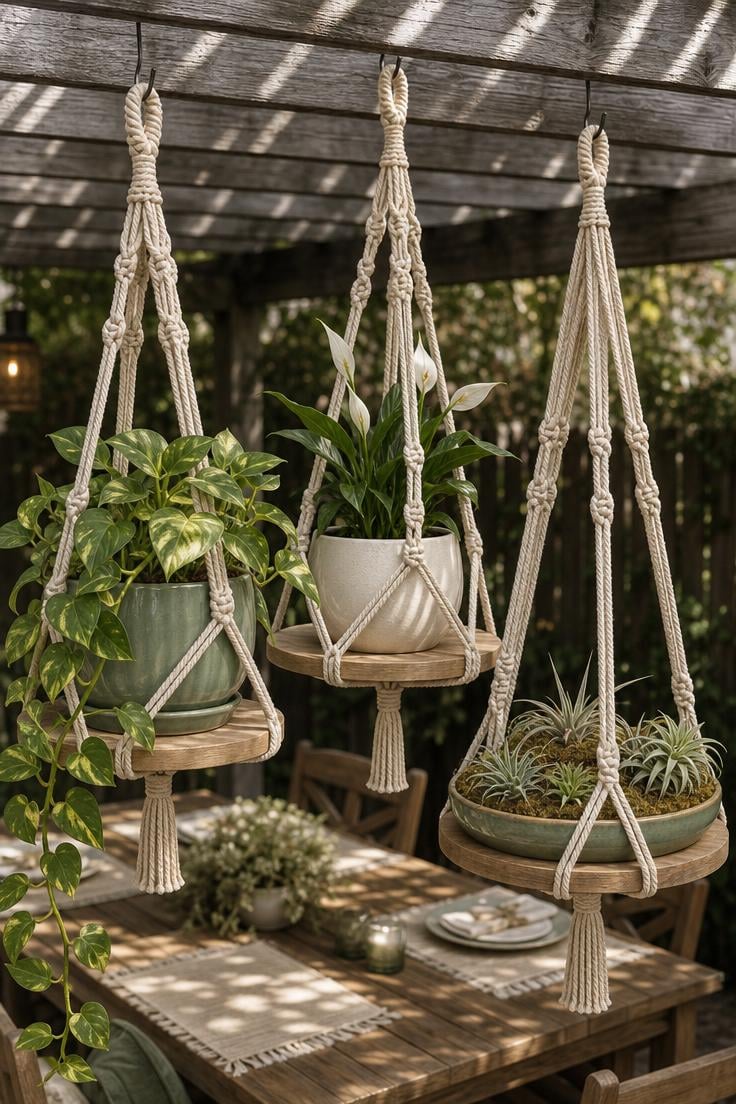
A hanging plant shelf removes the need for floor space entirely, which changes the math on what fits in a small outdoor area.
Cotton macrame cord in a square knot pattern holds more weight than it looks like it should, supporting medium pots up to about eight pounds per platform comfortably.
The circular wooden platforms give each pot a stable, flat base that prevents the shelf from swaying and tipping in light wind.
Glazed ceramic pots in sage and cream hold moisture longer than terracotta, so hanging plants that are harder to reach for watering stay hydrated longer between sessions.
Trailing pothos is almost purpose-built for this kind of vertical garden shelf because it sends vines downward in long arcs that fill the vertical space between shelves.
The dappled light that filters through pergola slats creates a shifting pattern across the pots throughout the day, which means the display never looks exactly the same twice.
Securing the hooks into the pergola beam with heavy-duty lag screws rather than cup hooks prevents any chance of the shelf pulling free.
Jute cord works too but breaks down faster in direct rain, so cotton is the better choice for uncovered or partially covered pergolas.
If you already have a pergola and have not considered it as a mounting point for plant shelf decor, this idea alone might justify the structure.
Style Blueprint:
- Natural cotton macrame cord (6mm thickness for durability)
- Circular wooden shelf platforms (10-inch to 12-inch diameter)
- Glazed ceramic pots in sage green and warm cream
- Heavy-duty lag screws with washers for pergola beam mounting
- Trailing plants: pothos, string of hearts, or creeping fig
Design Pro-Tip: When hanging multiple shelves from the same beam, stagger them at different heights rather than lining them up evenly. A 6-inch to 10-inch variation between shelf levels creates visual rhythm and gives trailing plants room to grow downward without tangling into the pot below.
Cinder Block and Plank Shelving Along a Concrete Walkway
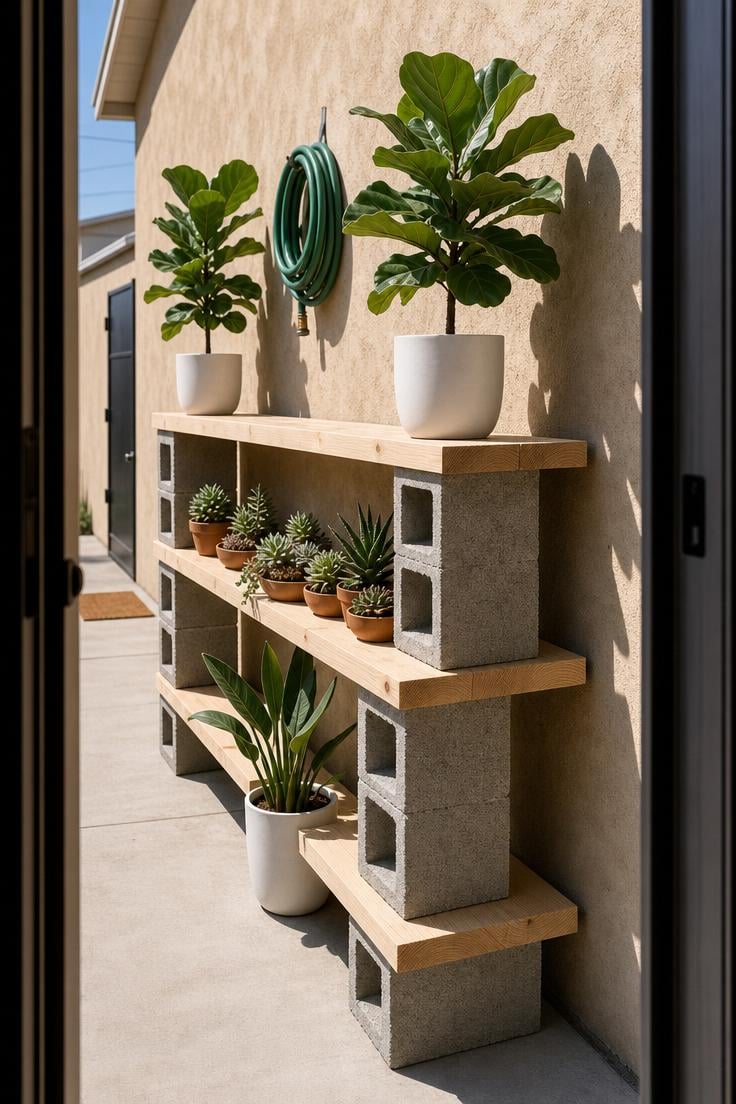
Cinder block shelving is the outdoor plant display that costs almost nothing and takes ten minutes to build.
You stack blocks, lay planks, stack more blocks, and you are done.
The raw concrete texture reads as intentional when the rest of the space is clean and simple, which is why this works best against a plain stucco or painted wall.
Wide pine planks flex slightly under heavy pots, so keeping the span between block supports under 36 inches prevents any noticeable sag.
The walkway placement turns a passthrough space into something worth pausing in, which changes how people move through your outdoor area.
Painting the cinder blocks in matte white or charcoal gray softens the industrial feel if the raw look feels too rough for your taste.
Drainage trays under each pot protect the pine from water stains and rot, adding months or years to the plank life.
Style Blueprint:
- Standard gray cinder blocks (8x8x16 inches)
- Unstained or lightly sanded pine planks (2×12 boards)
- Large statement plants: fiddle-leaf fig, bird of paradise
- White ceramic pots and matching terra cotta succulent dishes
- Clear plastic drainage trays under each pot
Narrow Bamboo Corner Shelf on a Small Apartment Balcony
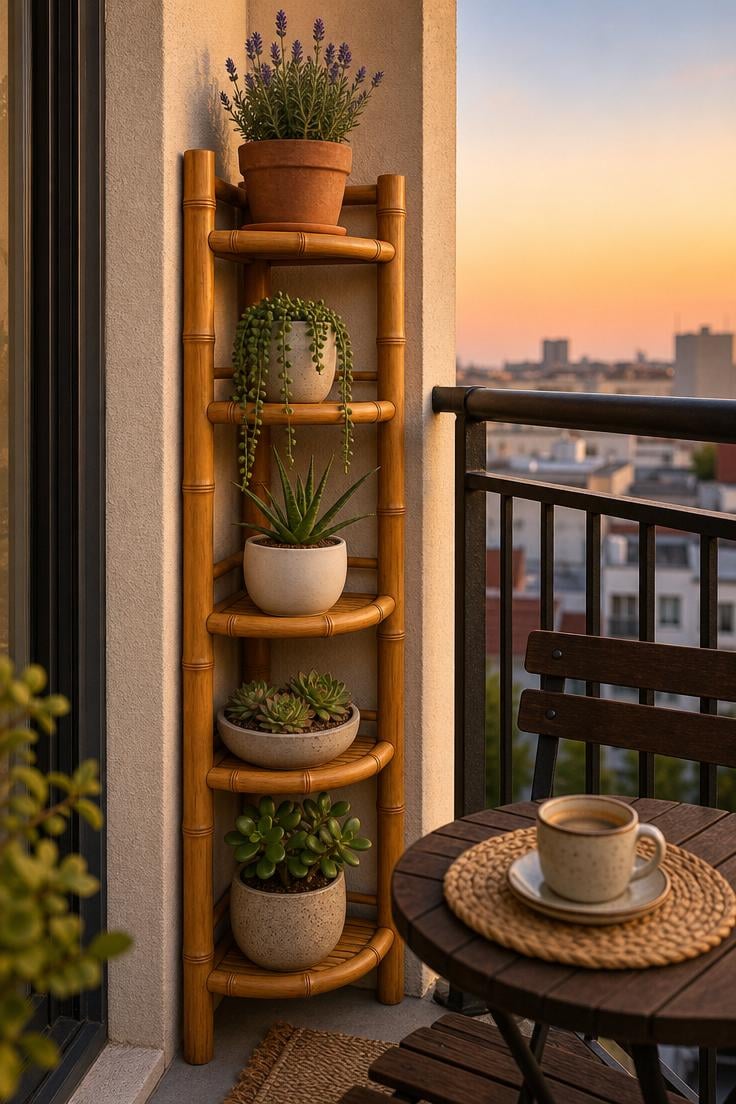
A balcony plant shelf needs to be light enough that the balcony itself can handle the load, which makes bamboo a smart pick over wood or metal.
Most apartment balconies have at least one 90-degree corner that collects nothing but dust and dead leaves, and a narrow corner unit claims that space without blocking the walkway.
Bamboo’s honey tone warms up against black metal railings, creating a color pairing that looks considered without trying too hard.
Marine-grade sealant brushed onto the bamboo every spring prevents cracking and splitting from rain exposure, adding years to a material that would otherwise degrade in a single wet season.
Choosing compact plants that stay small, like hen-and-chicks, baby jade, and miniature aloe, means the shelves never look overcrowded or top-heavy.
The warm sunset light at this hour turns the bamboo almost orange, which is one of those details that makes a simple shelf look like something from a magazine.
Style Blueprint:
- Five-tier narrow bamboo corner shelf (12-inch to 14-inch wide)
- Compact plants: jade, hen-and-chicks, small aloe, miniature lavender
- Marine-grade exterior sealant for bamboo protection
- Shallow ceramic and concrete dishes for succulents
- Small woven mat or tray for the bottom shelf
Floating Stained Oak Ledges on an Exterior Brick Wall
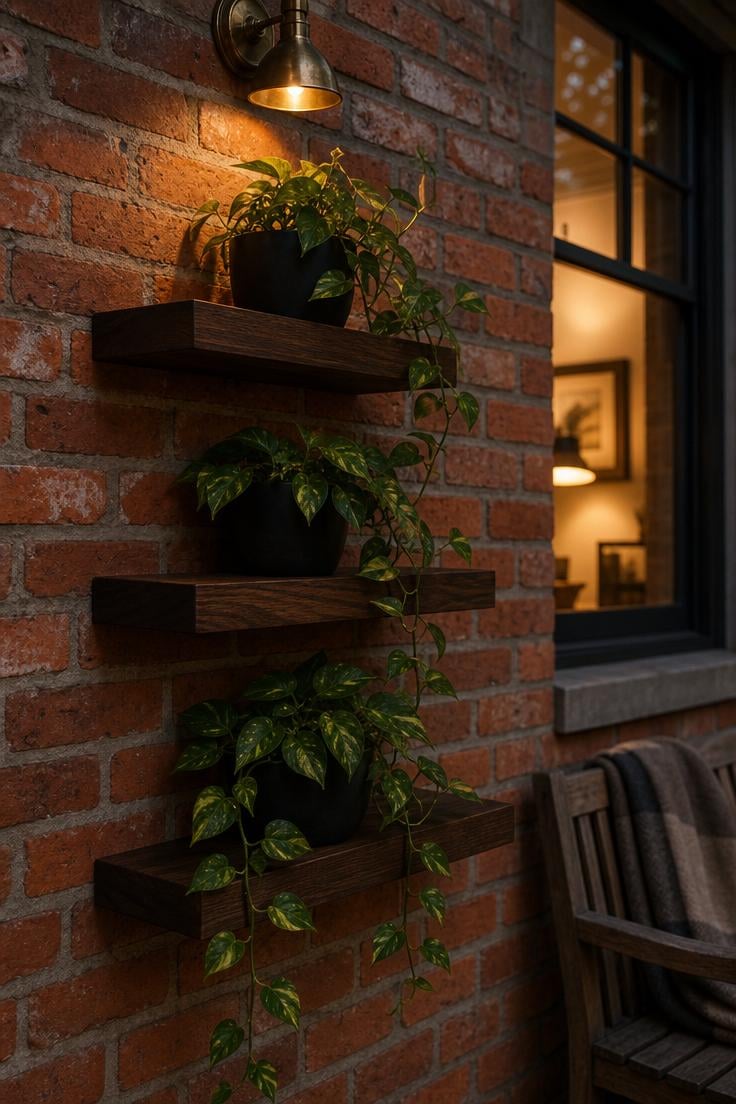
Floating shelves on an exterior wall remove every visible bracket and support, leaving nothing but the ledge, the pot, and the plant.
That clean line is what makes this approach feel more like architecture than decoration.
Dark walnut stain on oak creates enough contrast against red brick that the shelves stand out without competing with the wall’s texture.
Masonry anchors rated for at least 50 pounds per point handle the weight of a medium ceramic pot with soil and plant without any risk of pulling free.
Staggering the three ledges at different heights rather than lining them up creates a visual path that the eye follows naturally, from one level to the next.
Golden pothos is almost impossible to kill outdoors in temperate climates, and its trailing habit fills the vertical gaps between shelves with living green curtains.
The dusk light from a nearby window or wall sconce turns this into an evening display that looks completely different from its daytime version.
Keeping the shelf depth to about six inches prevents pots from extending too far from the wall, which protects them from wind and keeps the profile sleek.
Style Blueprint:
- Solid oak floating shelf ledges (6-inch depth, 24-inch length)
- Dark walnut exterior wood stain with UV-protective topcoat
- Matte black ceramic pots (4-inch to 6-inch diameter)
- Heavy-duty masonry anchors rated for 50+ pounds
- Trailing golden pothos or devil’s ivy
Repurposed Wooden Window Shutter With Pocket Planters
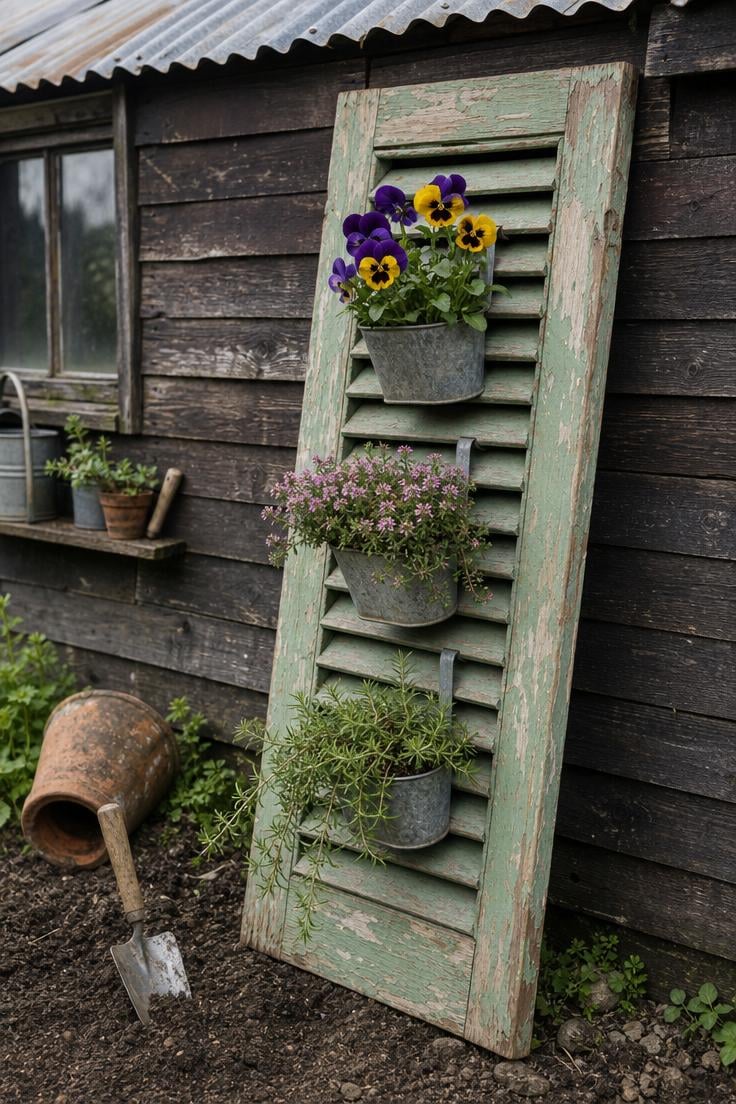
An old window shutter already has the slats built in, so hanging pocket planters from them is as simple as bending an S-hook over the edge.
Salvage yards and architectural reclaim shops sell these for a few dollars, and the more paint is chipping off, the better it tends to look.
The uneven color of old paint, where layers of green or blue show through white or cream, gives the whole piece a history that new wood cannot replicate.
Zinc pocket planters are sized to fit standard shutter slat spacing and hold just enough soil for shallow-rooted flowers and trailing herbs.
Pansies are one of the best choices for this kind of display because they bloom in cool weather, which extends the season of this outdoor garden shelf well into fall and early spring.
Milk paint or chalk paint with a polyurethane topcoat gives a similar aged look on newer shutters for anyone who cannot find a salvaged one.
Rotating the flowers by season, with pansies in spring and fall, trailing petunias in summer, and small ornamental kale in winter, keeps this shelf looking fresh year-round.
Style Blueprint:
- Salvaged wooden window shutter (tall format, louvered slats)
- Zinc or galvanized metal pocket planters with S-hooks
- Seasonal flowers: pansies, trailing petunias, ornamental kale
- Trowel and clay pot as ground-level styling props
- Chalk paint with exterior polyurethane for refreshing old paint
Design Pro-Tip: When leaning a shutter or ladder shelf against a wall, tilt it at about a 15-degree angle rather than standing it straight up. That slight lean creates a visual sense of relaxation and prevents the piece from looking rigid or formal. It also keeps pots from sliding off the back edge.
Galvanized Pipe and Reclaimed Wood Industrial Shelf Unit
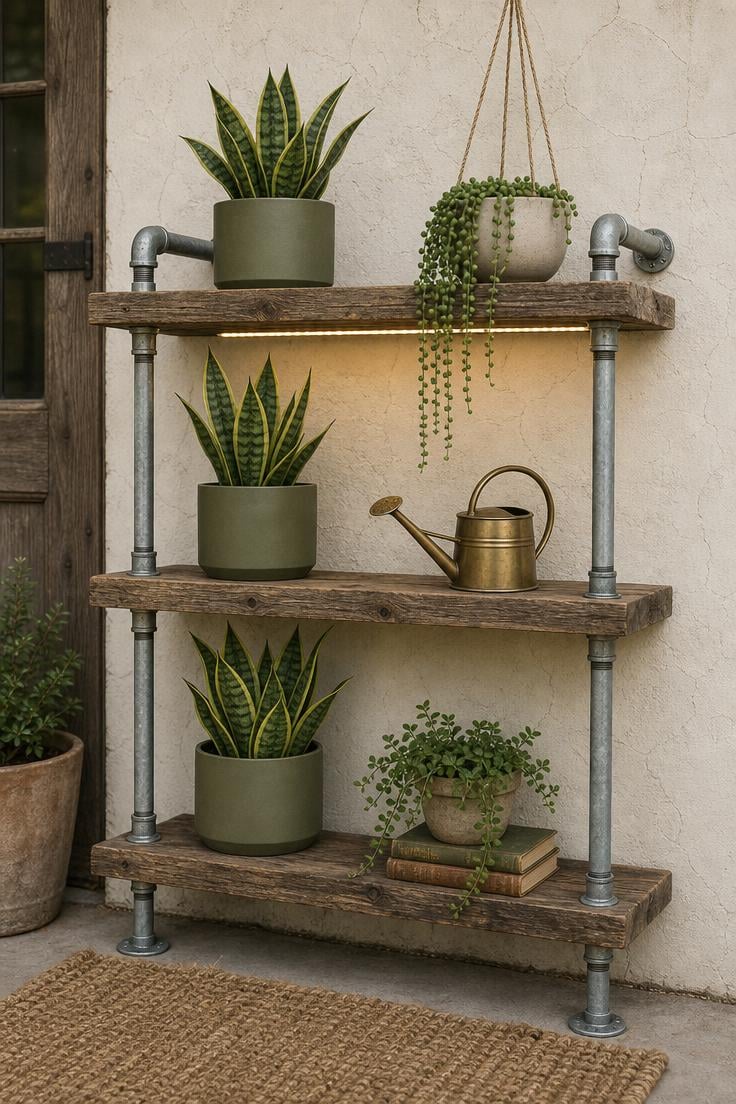
Galvanized pipe fittings screw together like an adult building set, with floor flanges anchoring the frame to the wall and elbow joints creating right angles at every corner.
The threading on each joint stays visible after assembly, and that raw mechanical detail is part of the appeal.
Reclaimed barn wood adds warmth that balances the cold metal, softening what would otherwise feel like a warehouse fixture.
Snake plants are a strong match for this kind of wooden plant shelf because their stiff, upright leaves echo the vertical lines of the pipe frame.
Adding a solar LED strip along the underside of the top shelf turns the unit into an evening display without any wiring or electrical work.
The strip charges during the day and runs for about six to eight hours after dark, which covers the entire evening window.
String of pearls trailing from a middle shelf fills the vertical gap between tiers and introduces a softer, rounder shape against all the straight lines.
Anchoring the frame to the wall with at least two floor flanges prevents any chance of the unit tipping forward under the weight of full pots.
Style Blueprint:
- Galvanized pipe fittings: floor flanges, elbows, nipples, tees
- Reclaimed barn wood planks (2-inch thick, 10-inch depth)
- Matte olive or charcoal ceramic planters
- Solar LED light strip (warm white, adhesive-backed)
- Snake plants, string of pearls, and one trailing variety
Woven Rattan Shelf Cart on a Covered Veranda
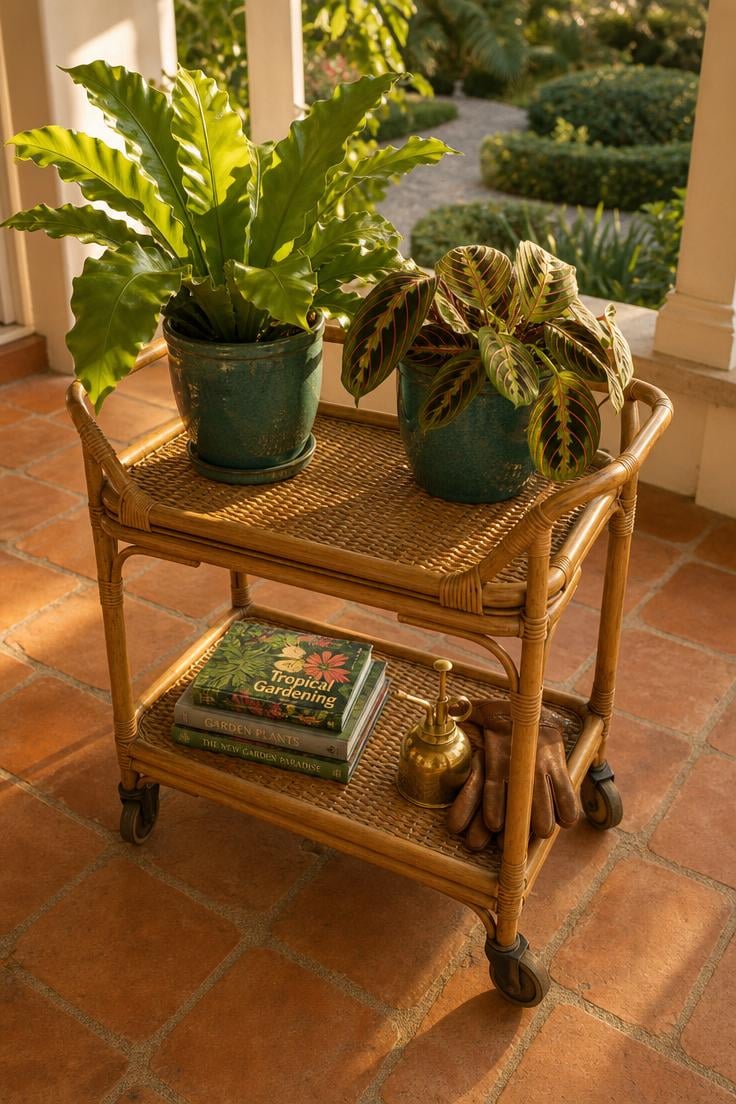
A rattan cart on wheels solves the problem of permanent placement because you can roll it to follow the sun, or pull it inside when a storm rolls through.
The woven texture of rattan catches light in a way that flat surfaces cannot, creating tiny shadows in every weave that give the whole cart a sense of depth.
Teal glazed pots against honey-toned rattan set up a color contrast that feels tropical without any actual tropical decoration beyond the plants themselves.
Bird’s nest fern and prayer plant both do well in the indirect light of a covered veranda, where they receive brightness without the scorching direct sun that burns their leaves.
Using the lower tier for books, tools, and supplies keeps everything you need within arm’s reach while the plants get the top-shelf position they deserve.
Rattan does best under a roof or awning because prolonged direct rain loosens the weave over time, so a covered veranda is the ideal home for this piece.
Style Blueprint:
- Two-tier woven rattan cart with large caster wheels
- Glazed ceramic pots in teal or deep turquoise
- Tropical foliage: bird’s nest fern, prayer plant, calathea
- Brass spray bottle and leather gardening gloves as props
- Covered veranda or porch placement for rattan longevity
Concrete Step Shelf Built Into a Raised Garden Bed Wall
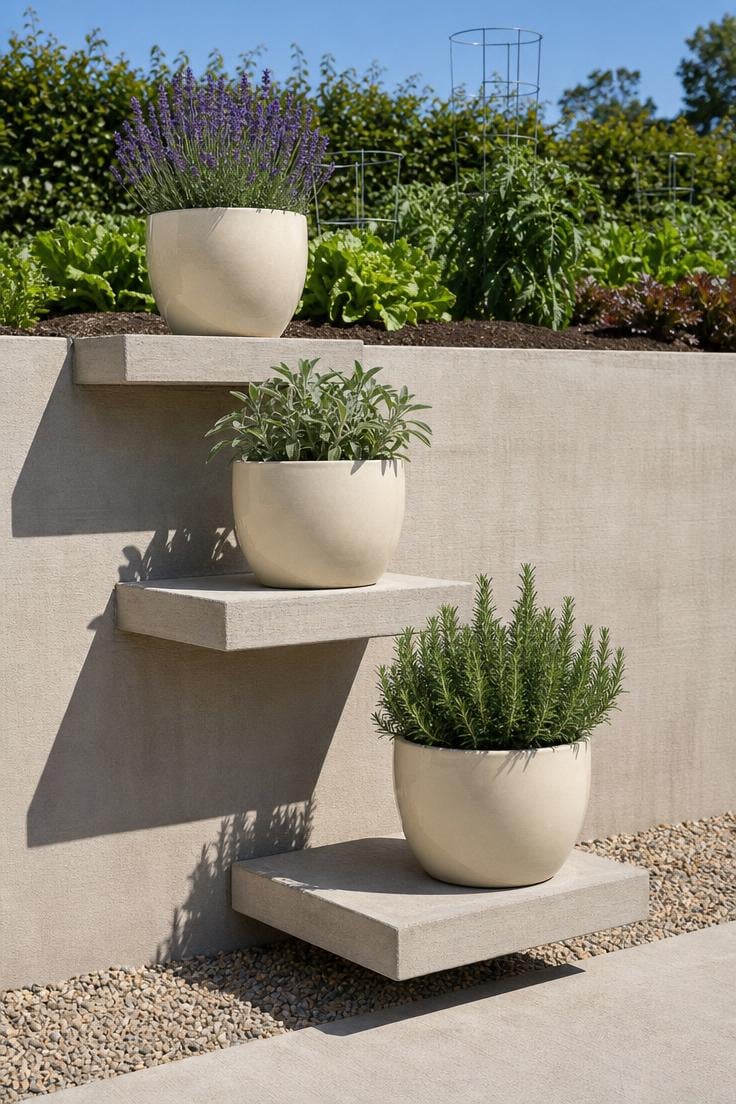
A concrete step shelf built into a retaining wall is the most permanent version of an outdoor plant shelf, and that permanence is what gives it such a grounded, architectural presence.
Unlike freestanding units that can wobble or blow over, this shelf is literally part of the wall, poured at the same time and cured into a single structure.
The broom-finish texture on the concrete surface prevents pots from sliding and gives the material a softer appearance than a polished or raw finish would.
Lavender and sage are well suited for these sunny, exposed ledges because they prefer dry conditions and full light, which a south-facing retaining wall provides all day.
The geometric shadow lines that appear beneath each step in midday light become a design feature on their own, shifting as the hours pass and disappearing entirely on overcast days.
Building the forms for step shelves during the retaining wall pour adds minimal cost and material to the project but creates display space that lasts for decades.
This is the kind of shelf that makes a garden feel like it was planned by a landscape architect rather than improvised on a Saturday afternoon.
Style Blueprint:
- Poured concrete retaining wall with integrated step ledges
- Broom-finish concrete surface for grip and texture
- Large glazed planters in warm ivory or cream
- Mediterranean herbs: lavender, sage, rosemary
- Gravel border along the base for clean drainage
Design Pro-Tip: Match your pot color to the lightest tone already present in your outdoor space. If your concrete is pale gray, choose light gray or white pots. If your wood shelf is honey-toned, pick cream or sand-colored ceramics. This one move ties the entire display together without making it look overly coordinated or forced.
Conclusion
Every outdoor space has at least one corner, wall, or beam that could hold a shelf, and most of those spots are sitting empty right now.
The ladder plant stand on your patio, the hanging plant shelf under your pergola, or the bamboo corner unit on your balcony plant shelf setup can take a space from bare to full in a single afternoon.
What makes these outdoor plant shelf ideas work is the pairing of the right material with the right location: cedar for sun, rattan for covered areas, concrete for permanence, and bamboo for lightweight balconies.
Start with the spot you want to fill, pick the shelf that fits, and let the plants do the rest.