This post may contain affiliate links. If you make a booking or purchase through these links, we may earn a commission at no additional cost to you.
A small backyard asks you to make choices, and that is exactly what makes it interesting.
Every plant, paver, and piece of furniture has to earn its spot, so nothing feels accidental.
The fifteen ideas here cover a range of budgets, climates, and skill levels, from a weekend gravel pad to a full patio redesign.
Each one focuses on a specific scene you can picture, build, and sit in when the work is done.
Stacked Limestone Terraces With Creeping Woolly Thyme
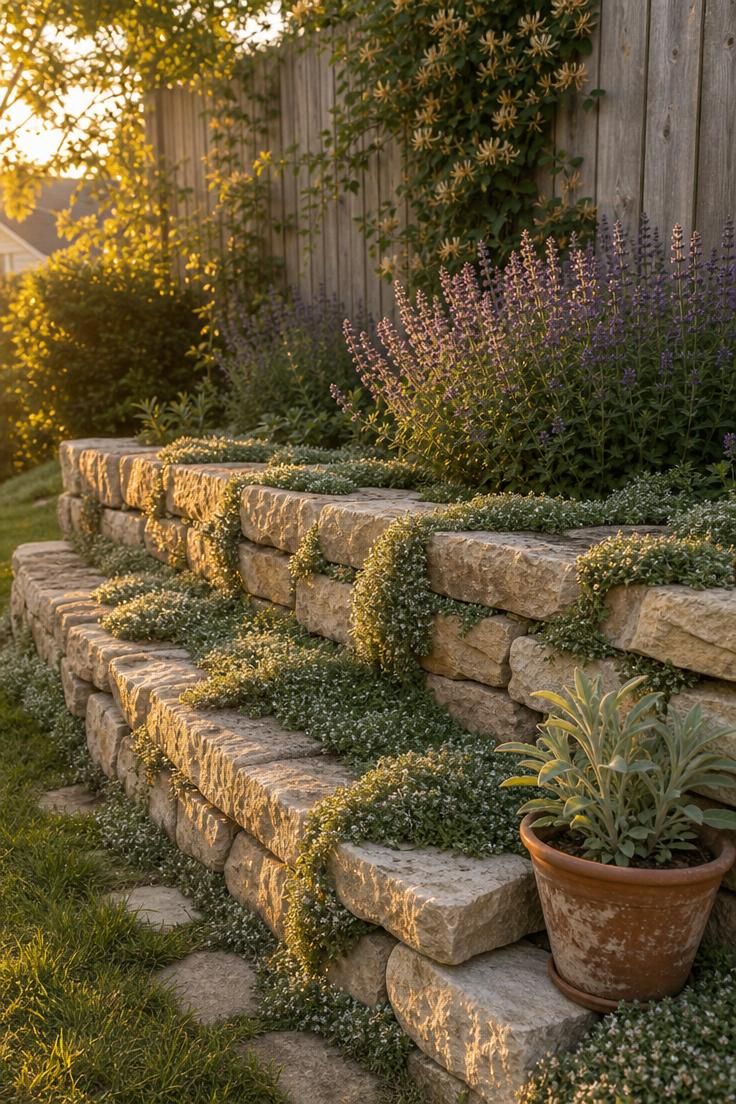
Two low terraces do more work than you might expect in a tight yard.
The step down between them breaks the ground plane, and your eye reads that level change as more space than a single flat surface could offer.
Woolly thyme fills the gaps between stones with a carpet of soft, silvery foliage that releases a faint herbal scent when you brush it with your foot.
The plant stays low, rarely topping two inches, so it never competes with the stonework for attention.
Limestone weathers gracefully over the years, picking up a patina that makes the terraces look like they belong to the land rather than sitting on top of it.
Pair the thyme with a few mounds of dwarf catmint at the upper edge for a purple haze that floats above the silver green below.
This kind of small backyard landscaping rewards patience, because it only gets better with each season.
Style Blueprint:
- Rough-cut limestone blocks, 6 to 8 inches tall per terrace
- Creeping woolly thyme plugs planted 6 inches apart in stone joints
- Dwarf catmint (Walker’s Low variety) at the upper terrace border
- A single weathered terra cotta pot with silver sage as an accent
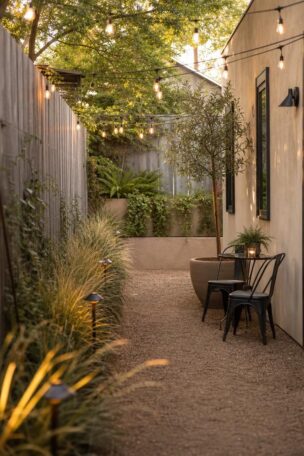
A Narrow Gravel Courtyard With a Single Olive Tree
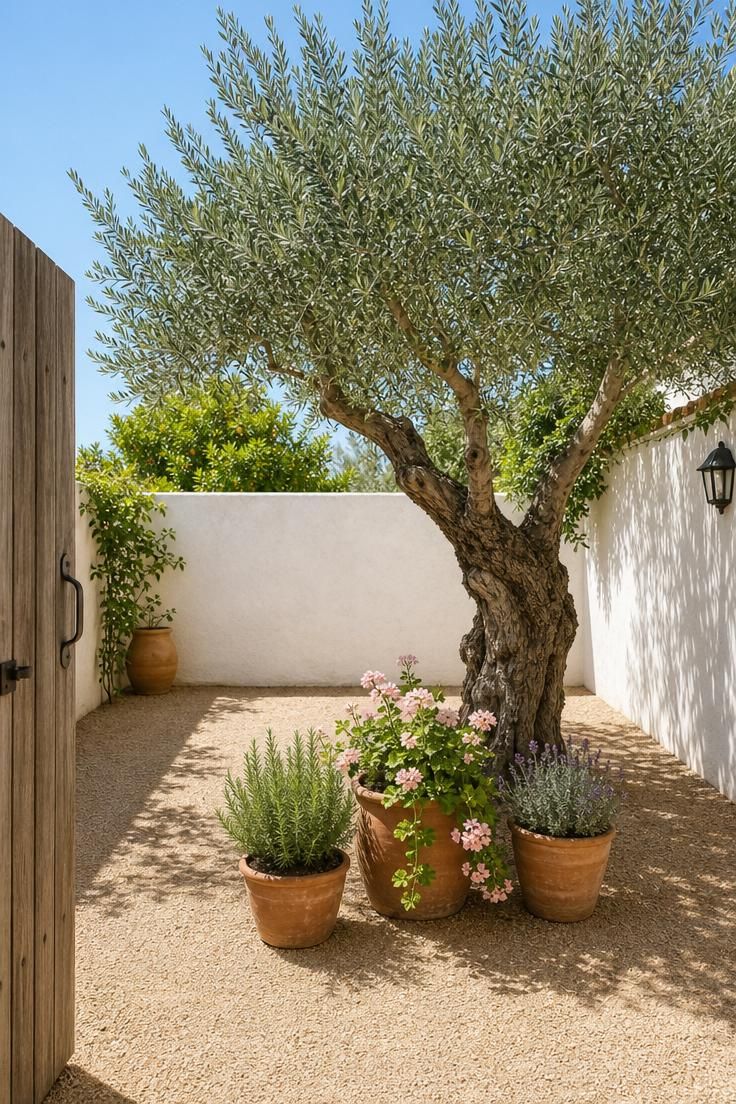
One tree can anchor an entire yard if you choose the right one.
An olive tree brings a sculptural trunk, year-round silver-green foliage, and a Mediterranean character that makes a simple gravel pad feel intentional.
Decomposed granite underneath keeps the ground permeable and low maintenance, requiring only an occasional rake to stay neat.
The terracotta pots clustered near the base add color at the lower level without cluttering the open floor.
This patio landscaping approach works especially well in hot, dry climates where water-hungry lawns struggle.
You spend less time watering and more time sitting under a canopy that filters light into soft, shifting patterns on the ground.
Style Blueprint:
- Decomposed granite in a warm tan or gold tone, 3 inches deep over compacted base
- A single-trunk olive tree (Arbequina or Swan Hill for low-pollen varieties)
- Three terracotta pots in graduated sizes with rosemary, trailing geranium, and lavender
- Low white stucco or plastered block perimeter wall
Vertical Cedar Planter Columns Flanking a Doorway

Tall, narrow planters on either side of a door create a sense of arrival that a doormat alone cannot match.
The vertical lines pull your attention upward, making a low porch or patio entrance feel taller and more defined.
Cedar is the right material here because it resists rot naturally without chemical treatment, and it ages to a handsome silver if you leave it unsealed.
The planting combination matters: sweet potato vine cascades down to soften the box edges, lemongrass shoots up for height and movement in a breeze, and marigolds fill the mid-level with warm orange that pops against the green.
Line the inside of each box with landscape fabric so the soil stays contained and drainage flows through the bottom.
Building these yourself takes a Saturday afternoon with basic tools, a miter saw, and a box of stainless steel screws.
This is a vertical garden project that costs under fifty dollars per column and immediately changes how your back entrance feels.
The sweet potato vine grows fast in summer, so expect the columns to look lush within three or four weeks of planting.
Style Blueprint:
- Untreated cedar boards (1×6 or 1×8), assembled into 12-inch square columns, 4 feet tall
- Interior landscape fabric liner with drainage holes at the bottom
- Sweet potato vine (Ipomoea batatas ‘Margarita’) for cascading chartreuse foliage
- Upright lemongrass and compact French marigolds for height and color contrast
A Bluestone Paver Diagonal Laid Across a Square Lot
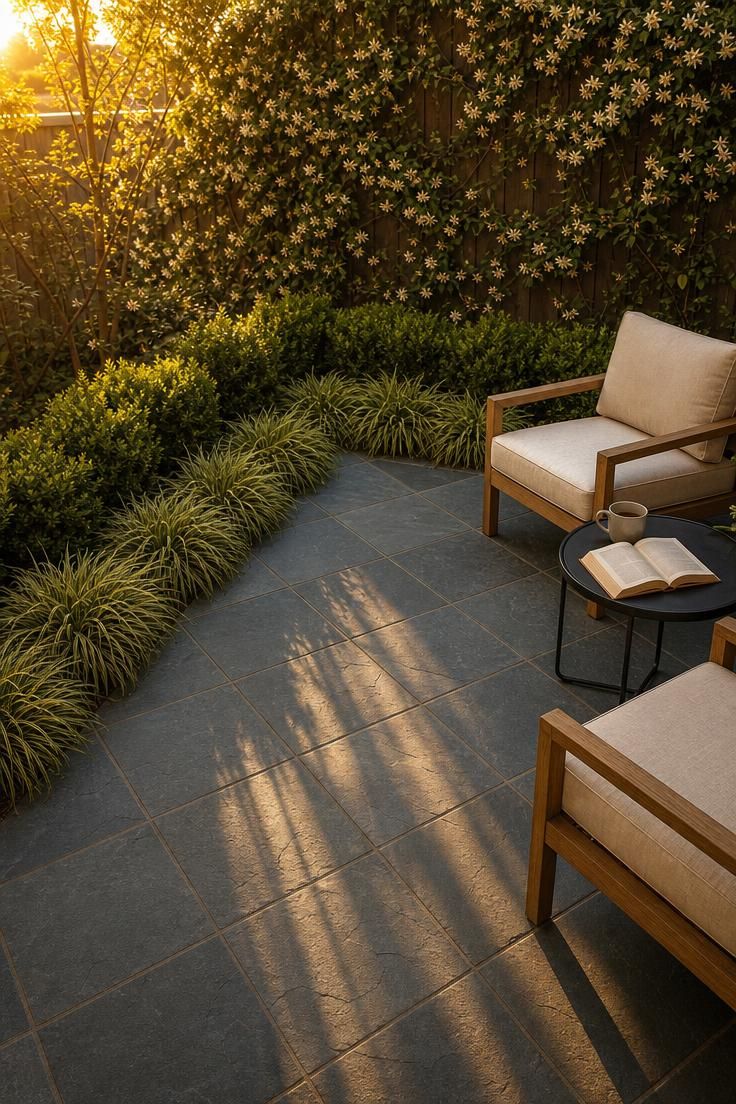
Rotating your pavers 45 degrees costs nothing extra, but it changes how the entire yard reads.
The diagonal line is the longest possible axis across any rectangle, so the eye follows it from corner to corner and registers the space as larger than it is.
Large-format bluestone, 24 inches square or bigger, reduces the number of grout lines and keeps the surface looking clean and expansive.
A dwarf boxwood border along two sides adds structure without stealing floor area from the patio.
Japanese forest grass, with its arching lime-green blades, softens the transition between stone and soil and moves gently in any breeze.
This backyard garden design trick is borrowed from interior designers who lay hardwood flooring on the diagonal in narrow rooms for the same optical effect.
Style Blueprint:
- Large-format natural bluestone pavers (24×24 inches minimum) set at 45 degrees
- Polymeric sand in the joints for a stable, weed-resistant finish
- Dwarf English boxwood (Buxus sempervirens ‘Suffruticosa’) as a low formal edge
- Japanese forest grass (Hakonechloa macra ‘Aureola’) as a loose, arching border plant
Design Pro-Tip: When laying any paver on a diagonal in a small yard, start with the center line from corner to corner and work outward. Cut pieces at the perimeter will be small triangles, so choose a material that cuts cleanly without chipping, like natural bluestone or porcelain. Avoid tumbled pavers for diagonal layouts because their irregular edges make precise angle cuts difficult.
Espaliered Fig Tree Against a White Stucco Wall
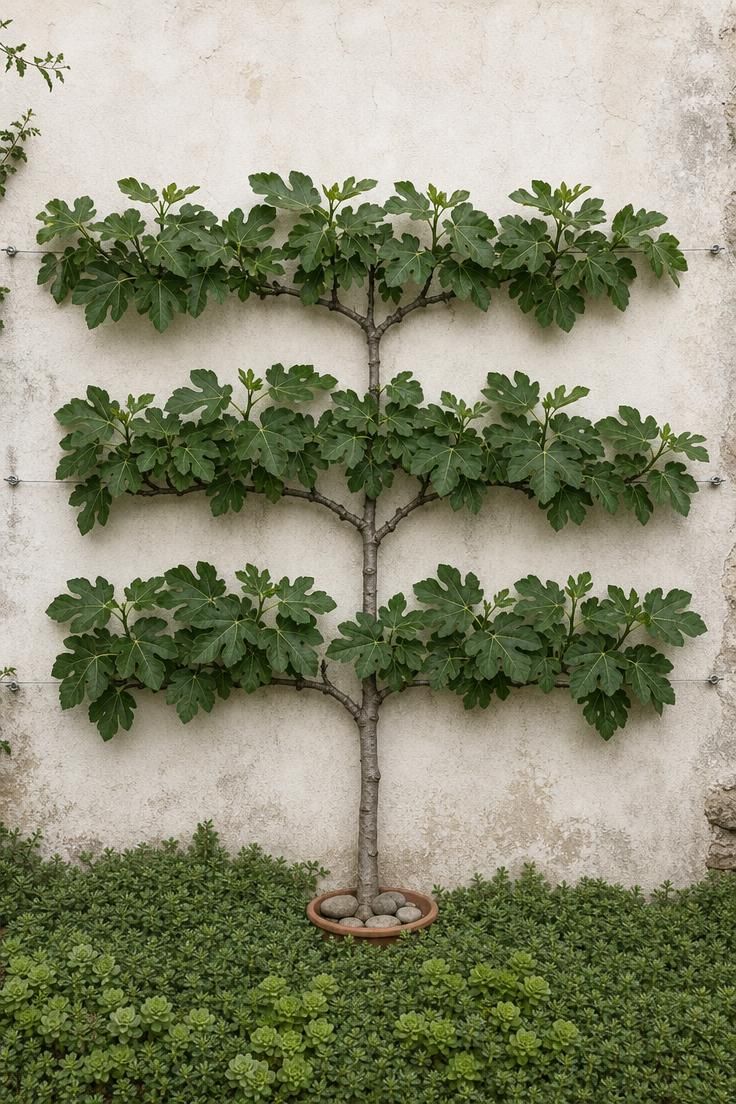
An espaliered fruit tree is a living piece of wall art that also feeds you.
The horizontal cordon pattern, where branches are trained to grow sideways along wires, takes up less than 18 inches of depth from the wall, leaving the rest of the yard completely open.
Figs are ideal candidates because their large, architectural leaves look sculptural even before the fruit appears.
A south-facing or west-facing wall provides the reflected warmth that figs need, acting as a thermal mass that extends the growing season by a few weeks on each end.
The underplanting of creeping oregano serves a practical purpose too: it suppresses weeds, attracts pollinators when it blooms, and releases fragrance when you brush past on the way to pick fruit.
Training the tree takes two to three years of patient pruning, but once the framework is set, annual maintenance is just a few clips in late winter.
This is small backyard landscaping that gives back more than it asks for, turning a blank wall into a productive garden surface.
Style Blueprint:
- A fig tree variety suited to your zone (Brown Turkey for cold climates, Black Mission for warm)
- Galvanized steel wire and vine eyes anchored into the wall for training supports
- Creeping oregano and low sedum groundcover beneath the tree
- Bypass pruners and soft plant ties for annual winter training sessions
A Raised Cedar Bed With Integrated Bench Seating
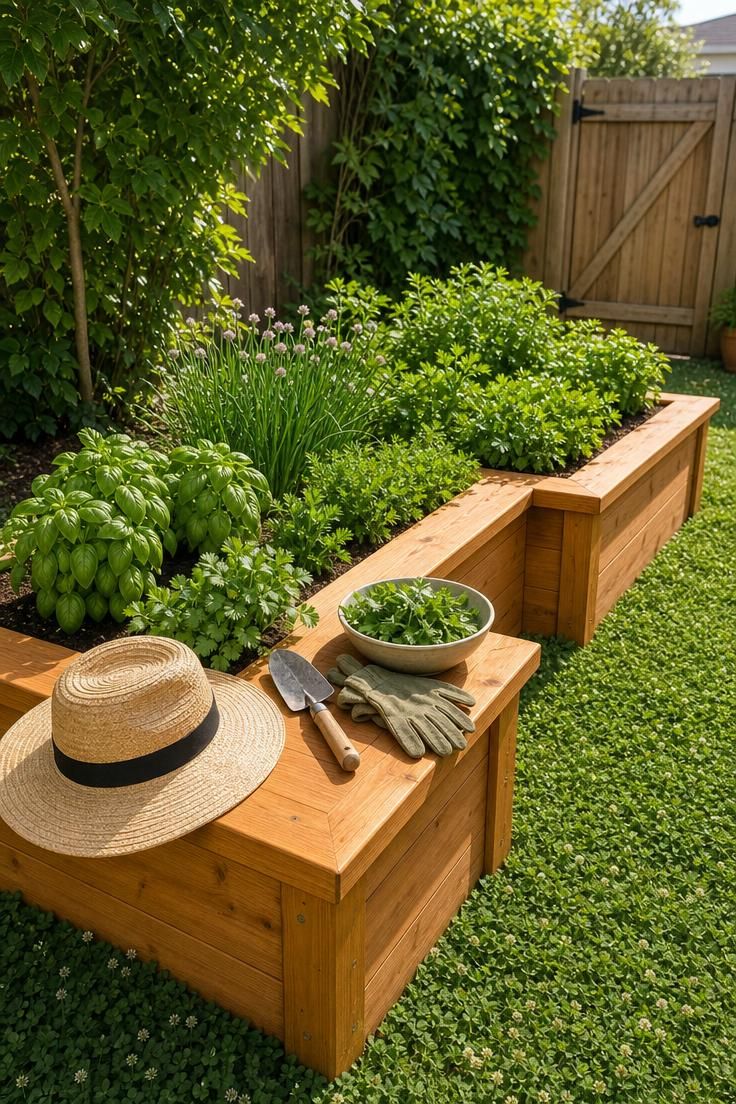
Seating and growing space are the two things a small yard needs most, and this raised garden bed delivers both in a single structure.
The cap rail, a flat board topping the bed wall, should be at least 3.5 inches wide to sit on comfortably.
Cedar is the standard choice for raised beds because it handles soil contact and moisture without pressure treatment, and it looks warm and clean for years.
Planting herbs instead of flowers makes the bed earn its keep at dinner too, giving you basil, cilantro, and parsley steps from the kitchen door.
The L-shape tucks into a corner of the yard, creating an implied room within the larger space.
Guests sit on the cap rail, lean back against the fence, and the herb garden becomes the centerpiece of conversation rather than an afterthought along the perimeter.
A raised garden bed at this height, 18 inches, is also easier on your knees and back than ground-level planting.
The construction is straightforward: stacked 2×6 cedar boards, galvanized corner brackets, and a ripped 2×6 cap rail screwed on top.
Style Blueprint:
- Untreated cedar 2×6 boards stacked three high (18 inches total)
- Galvanized steel corner brackets and structural screws
- A flat 2×6 cap rail, sanded smooth, secured with countersunk screws
- Herb starts: Genovese basil, slow-bolt cilantro, common chives, flat-leaf parsley
Cor-Ten Steel Edging Around a Pocket Moss Garden

Moss asks for almost nothing: no mowing, no fertilizing, no direct sun.
In a shaded corner that defeats every other planting attempt, moss is not a compromise but a deliberate design choice that makes the space feel older and more settled than it is.
The Cor-Ten steel edging, rusted to a warm orange-brown, draws a precise boundary around the green, giving the moss bed the same visual weight as a formal planting.
Layering three moss varieties creates texture that you notice more the closer you look, from the smooth carpet of sheet moss to the mounded cushions of mood moss to the feathery fronds of fern moss.
A single large stone placed off-center follows the Japanese garden principle of asymmetry, where the focal point sits at roughly a third of the bed rather than dead center.
This is a small yard makeover that works in the most challenging conditions, turning deep shade and damp soil from problems into advantages.
Style Blueprint:
- Cor-Ten weathering steel landscape edging, 4 inches tall, bent to shape
- Sheet moss, mood moss, and fern moss sourced from a specialty nursery or online
- A single large river stone (12 to 18 inches) placed at an asymmetric focal point
- Acidic, moisture-retentive soil mix beneath the moss layer
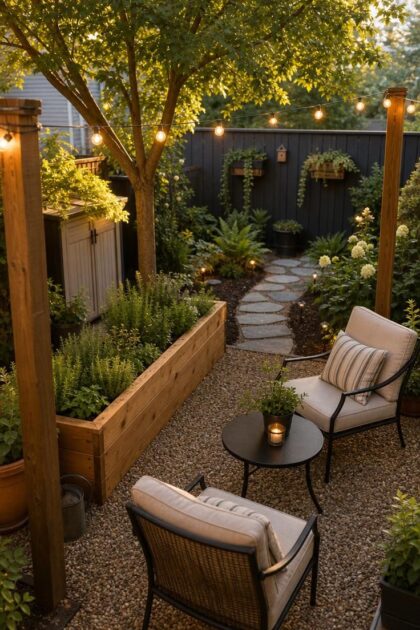
String Lights on Black Iron Poles Over a Pea Gravel Pad
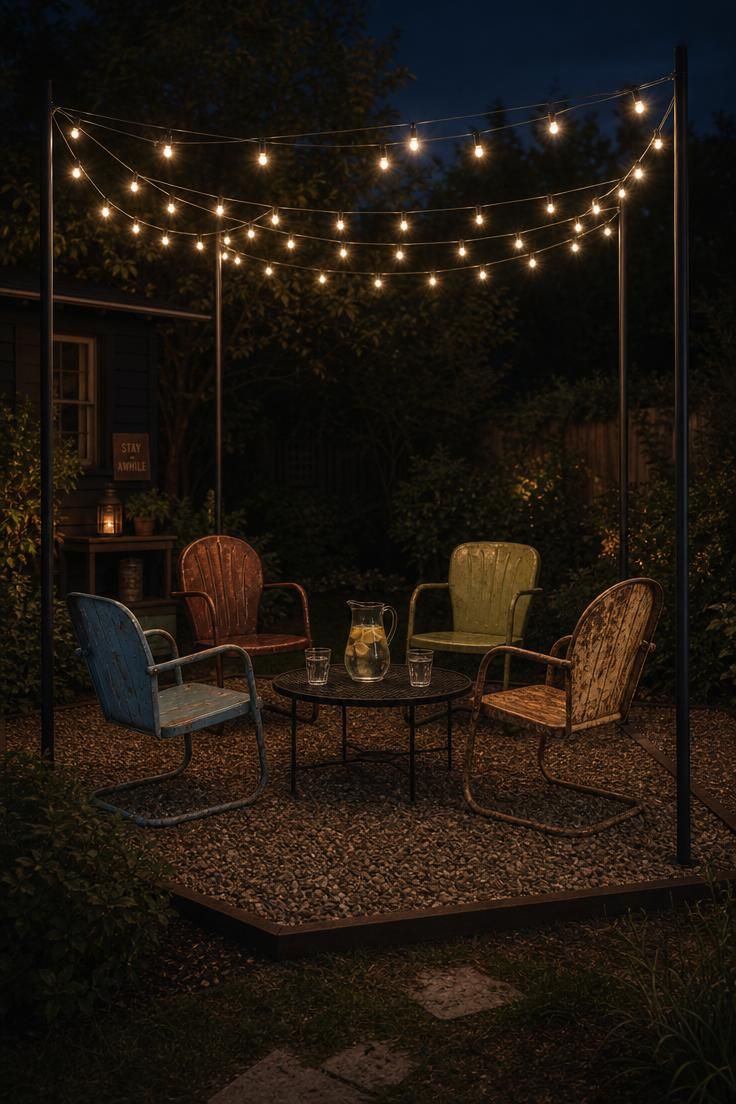
A grid of string lights overhead does what a ceiling does indoors: it defines the edges of a room.
Without walls or a roof, the lights create a glowing rectangle that your brain reads as a contained space, separate from the dark yard around it.
Black iron poles disappear against the night sky, so the lights appear to float, which keeps the installation feeling light rather than heavy.
Pea gravel is the fastest and cheapest ground surface for a gathering area, needing only a tamped base, landscape fabric, and a few inches of stone.
The mismatched chairs are intentional, not an afterthought, because a curated set of four identical chairs can feel stiff in a casual setting.
Vintage metal chairs in different colors and patinas feel collected over time, and they handle rain and dew without cushion drama.
This is landscape lighting at its most social, turning an empty corner into a place people actually want to sit after dark.
Style Blueprint:
- Four black iron poles (1.5-inch diameter, 10 feet tall) set in concrete footings
- Commercial-grade warm-white LED string lights (2700K color temperature)
- Pea gravel, 3 inches deep, over compacted base and landscape fabric
- Mismatched vintage metal bistro chairs and a low round side table
Design Pro-Tip: When hanging string lights across a small outdoor space, resist the urge to drape them in swooping curves. A taut, level grid looks more intentional and casts even light across the entire area below. Use turnbuckles at each pole to tension the wire and prevent sag after the first rain.
A Dry-Stack Fieldstone Path Winding Through Dwarf Mondo Grass
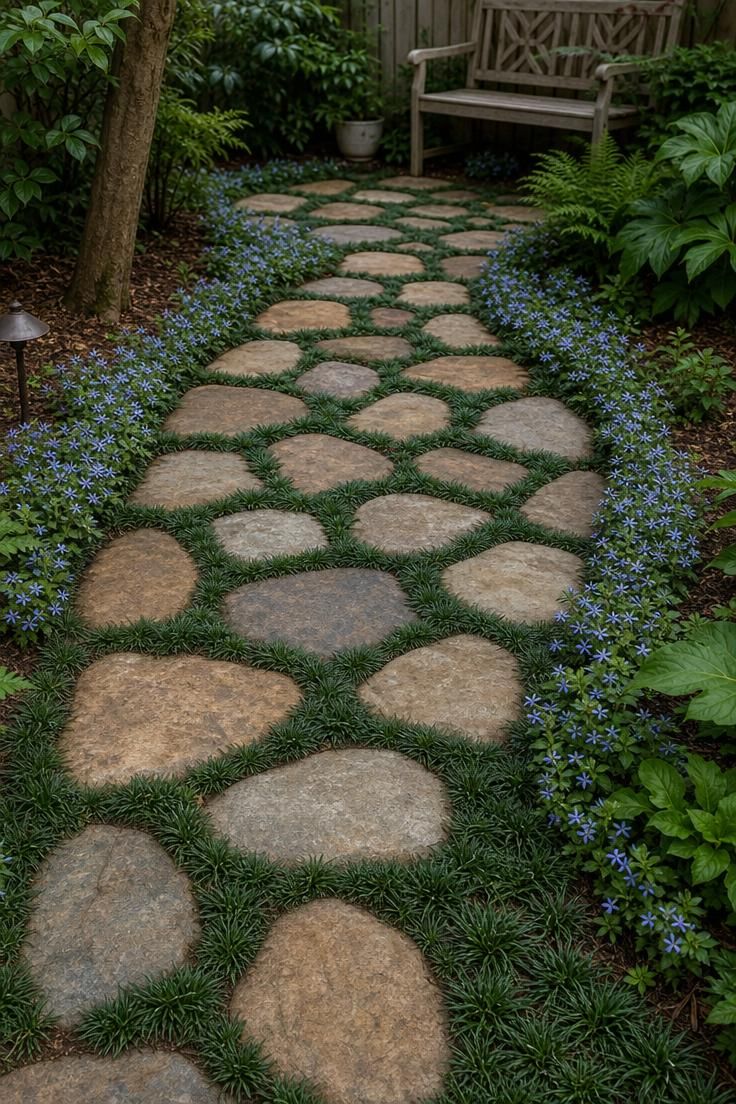
A straight path tells you exactly how far you have to go, and in a small yard, that distance is disappointing.
A curved garden pathway hides its destination, making you walk a longer route and experience the yard as a series of unfolding views rather than a single glance.
Dwarf mondo grass between the stones stays under two inches tall, never needs mowing, and holds a deep green color through most of the year.
The dark green tufts soften the stone edges and create a living grout line that looks better than any poured filler.
Setting fieldstone on a compacted gravel base keeps the stones stable underfoot without the permanence or cost of mortar.
Blue star creeper at the outer edges adds a delicate carpet of pale blue flowers in spring and early summer, spreading slowly to fill any bare spots.
The path does not need to lead to anything grand: a simple bench, a pot arrangement, or even a fence corner gives you a reason to walk it.
This approach to a garden pathway turns a purely functional surface into the most visually interesting part of the yard.
Style Blueprint:
- Irregular fieldstone pieces, 2 to 3 inches thick, in mixed earth tones
- Compacted 3/4-inch crushed gravel base, 4 inches deep, for stability
- Dwarf mondo grass (Ophiopogon japonicus ‘Nana’) plugs planted in stone gaps
- Blue star creeper (Isotoma fluviatilis) as a flowering edge groundcover
A Stock Tank Fountain Surrounded by River Birch Saplings

The sound of moving water changes how a space feels more than almost any visual element.
A stock tank fountain, using a simple recirculating pump, produces that gentle bubbling sound without any permanent plumbing or a pond to maintain.
The galvanized steel ages with character, developing a dull patina that looks better each year against green foliage.
River birch saplings behind the tank provide height, and their peeling bark adds a cinnamon-colored texture that pairs with the silver steel.
Container gardening principles apply here: the tank sits on any surface, plugs into a standard outdoor outlet, and can be drained and moved if you redesign the yard later.
This is an outdoor living space feature that masks neighborhood noise with something worth listening to instead.
Style Blueprint:
- Galvanized round stock tank (2 or 3 feet in diameter)
- Submersible recirculating fountain pump (100-200 GPH) with a simple bubbler head
- Three river birch saplings (Betula nigra ‘Heritage’) planted 3 feet behind the tank
- Smooth river stones arranged around the tank base on a gravel pad
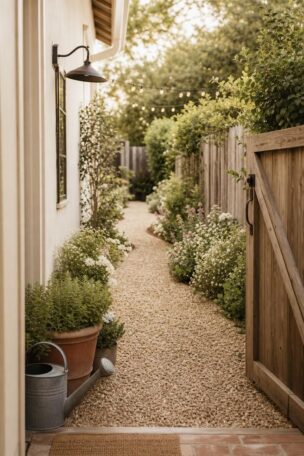
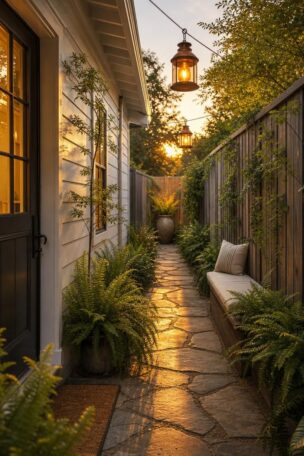
A Narrow Side Yard Converted Into a Fern-Lined Passage

The side yard is the most wasted space on most properties, a forgotten corridor used for trash cans and hose storage.
Converting it into a planted passage turns dead footage into a garden experience that connects the front and back of the house.
Ferns are the natural choice here because most side yards are shaded for most of the day, and ferns do not just tolerate shade, they prefer it.
Mixing species creates variety without visual chaos: autumn fern brings warm copper tones to new growth, Japanese painted fern offers silvery blue-green fronds, and holly fern stays upright and dense enough to serve as a screen at the end of the passage.
Decomposed granite is the ideal walkway surface because it drains fast, compacts to a stable footing, and glows a warm tan even in low light.
Solar path lights need only a few hours of indirect sun to charge, making them practical even in a narrow corridor between buildings.
A single hanging planter on the fence adds one more layer of green above eye level, reinforcing the tunnel-like feeling that makes the passage feel intentional rather than leftover.
Style Blueprint:
- Autumn fern (Dryopteris erythrosora), Japanese painted fern (Athyrium niponicum), and holly fern (Cyrtomium falcatum)
- Decomposed granite walkway, 30 to 36 inches wide, edged with steel or stone
- Solar-powered bronze path lights spaced every 4 to 5 feet
- A trailing pothos or string-of-pearls in a hanging planter mounted to the fence
A Compact Fire Bowl Set Into a Poured Concrete Bench

A fire feature does not need to dominate a small yard to make it usable at night and in cooler months.
A 24-inch gas fire bowl recessed into a concrete seat wall keeps the flame at tabletop height, where it warms hands and faces without blocking sightlines across the yard.
The curved bench wraps around the bowl, creating an intimate semicircle that seats four or five without any freestanding chairs cluttering the space.
Poured concrete is the most durable material for this kind of built-in seating, and its smooth surface doubles as a table for drinks and plates.
The low profile of the entire structure, bench and fire bowl together standing under 20 inches tall, keeps the yard feeling open during the day.
At night, the fire becomes the only light source, pulling people in and making the surrounding darkness feel like privacy rather than emptiness.
Style Blueprint:
- A 24-inch propane or natural gas fire bowl with a weather cover for daytime use
- Poured concrete seat wall, curved, with a smooth steel-troweled finish
- Wool blankets in neutral tones stored on the bench for cool evenings
- Pea gravel or decomposed granite ground surface around the bench perimeter
Design Pro-Tip: If you are choosing between a wood-burning and gas fire feature for a small backyard, go with gas. Wood-burning fires produce smoke that drifts unpredictably in a confined space, and your neighbors will notice. A gas fire bowl lights with a switch, produces no smoke, and turns off instantly when you head inside. The initial cost is higher, but the experience in a tight yard is dramatically better.
Painted Fence Panels With Mounted Copper Planters

A fence is the largest vertical surface in most backyards, and leaving it bare is like ignoring an entire wall inside your house.
Painting it a deep charcoal or forest green creates a rich backdrop that makes the colors of mounted planters pop forward.
Copper planters develop a blue-green patina over time that looks beautiful against a dark fence, and they never rust through like thin steel or tin alternatives.
Staggering the planters at different heights creates a composition rather than a uniform row, keeping the eye moving up and down along the fence line.
Nasturtium is the easiest trailing plant for a sunny fence: it blooms prolifically in orange and yellow, the flowers are edible, and it grows from seed in a few weeks.
Silver falls dichondra adds a completely different texture with its long, silvery threads, contrasting the bold nasturtium blooms above.
This vertical garden approach adds color, herbs, and visual depth to the yard without taking a single square inch of floor space.
Style Blueprint:
- Exterior-grade matte paint in charcoal (e.g., Benjamin Moore Wrought Iron) or deep forest green
- Half-round copper wall planters with pre-drilled mounting holes
- Trailing nasturtium, silver falls dichondra, compact basil, and trailing rosemary
- Stainless steel bolts and wall anchors rated for the fence material (wood, composite, or vinyl)
A Checkerboard of Concrete Pavers and Low Chamomile
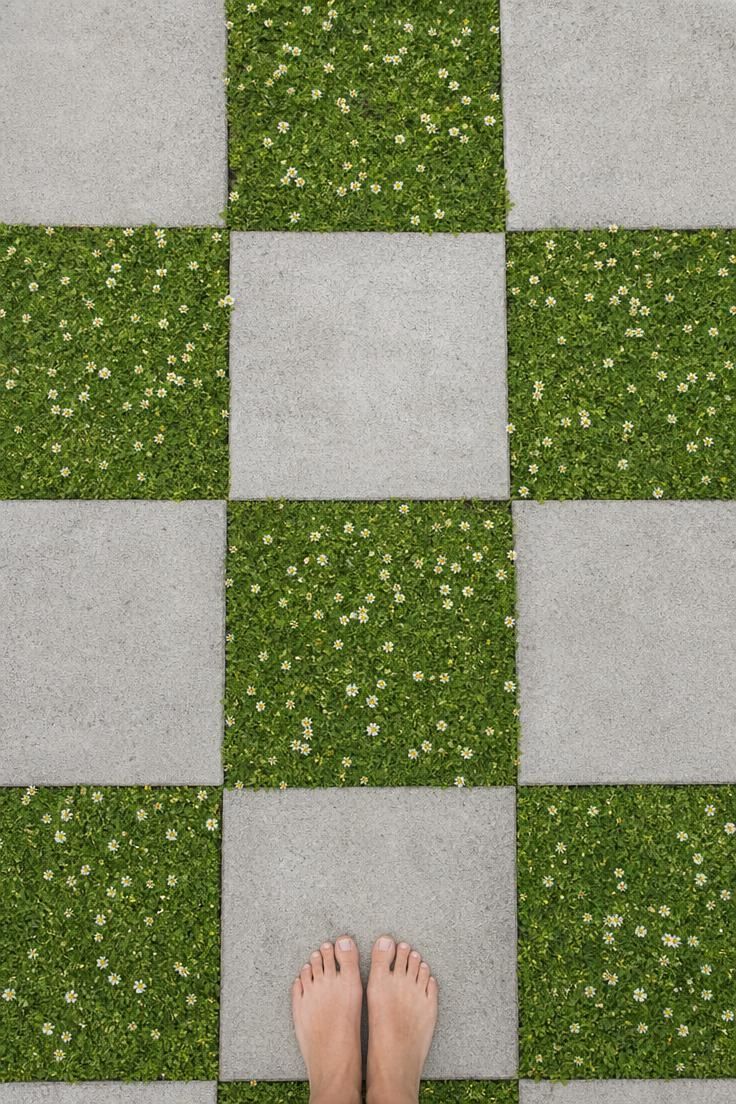
Walking across this surface releases a wave of apple-scented fragrance from the chamomile, turning a simple patio into a sensory experience.
The alternating grid of hard and soft squares reads as a unified surface rather than separate planting beds and paving, which is why it works in a small yard where you need every inch to function as floor.
Roman chamomile is the correct species here, not German chamomile, because it stays low, spreads by runners, and tolerates light foot traffic.
Mowing the chamomile squares once a month with a rotary mower set high keeps them dense and flat, preventing the leggy, weedy look that unmanaged groundcover develops.
The concrete squares provide stable footing for furniture legs and foot traffic, so you get the practicality of a paved patio combined with the softness and scent of a planted one.
A 12-inch grid is large enough that the pattern reads clearly from standing height and small enough that you can plant and maintain each chamomile square individually.
This backyard garden design replaces a traditional lawn entirely, giving you green coverage with a fraction of the water and none of the weekend mowing.
Over time, the chamomile fills in thicker, and the concrete squares develop a slight moss edge that softens the grid further.
Style Blueprint:
- 12×12-inch concrete pavers in a pale gray or natural concrete tone
- Roman chamomile (Chamaemelum nobile) plugs planted in alternating open squares
- Compacted gravel sub-base for both paver and plant squares
- A rotary mower set to 2 inches for monthly chamomile maintenance
A Reclaimed Wood Arbor With Potted Citrus and a Hanging Chair

An arbor creates a threshold, a moment where you pass from one part of the yard into another, and that sense of transition makes a compact space feel like it has distinct rooms.
Reclaimed wood beams bring texture and history that new lumber cannot replicate, with nail holes, saw marks, and weathering that tell a story before you even sit down.
The hanging egg chair is the destination that pulls you through the arbor, offering a cocoon-like seat that faces back toward the garden and frames the view.
Dwarf Meyer lemon trees in glazed pots provide year-round glossy green foliage, fragrant spring blossoms, and actual fruit, making them one of the hardest-working container plants available.
Marine-grade chain and a heavy-duty eye bolt rated for swinging loads are non-negotiable for hanging a chair safely from a beam.
This outdoor living space feature combines structure, seating, greenery, and food production in a footprint that measures roughly six feet by four feet.
The whole arrangement can be disassembled and moved if you are renting, since nothing is anchored permanently into the ground.
Style Blueprint:
- Rough-sawn reclaimed wood beams (6×6 or 8×8 posts, 4×8 or 6×8 crossbeam)
- A rattan hanging egg chair with a marine-grade stainless steel chain and swivel hook
- Two large glazed ceramic pots (18 to 24 inches diameter) with dwarf Meyer lemon trees
- Decomposed granite and irregular stepping stones beneath the arbor
Conclusion
A small backyard becomes something worth spending time in once you stop trying to fit everything and start choosing what matters most to you.
One or two ideas from this list, combined and adapted to your climate and budget, will change how your yard feels more than a dozen half-measures spread across the whole space.
Start with the project that solves your biggest frustration, whether that is a lack of seating, no shade, or a bare fence that makes you feel exposed.
The best small backyard landscaping is the kind that makes you forget you are in a small yard at all.