This post may contain affiliate links. If you make a purchase through these links, we may earn a commission at no additional cost to you.
A calm holiday room often comes from what is left out.
A restrained palette, fewer objects, and one clear focal point can make a small home feel more open without losing seasonal warmth.
The ideas below focus on one material, one repeated gesture, or one placed silhouette at a time.
Each entry pairs a single visual idea with a short note on where it works best and what to expect from it.
Layered Cedar and Eucalyptus Mantel Scarf
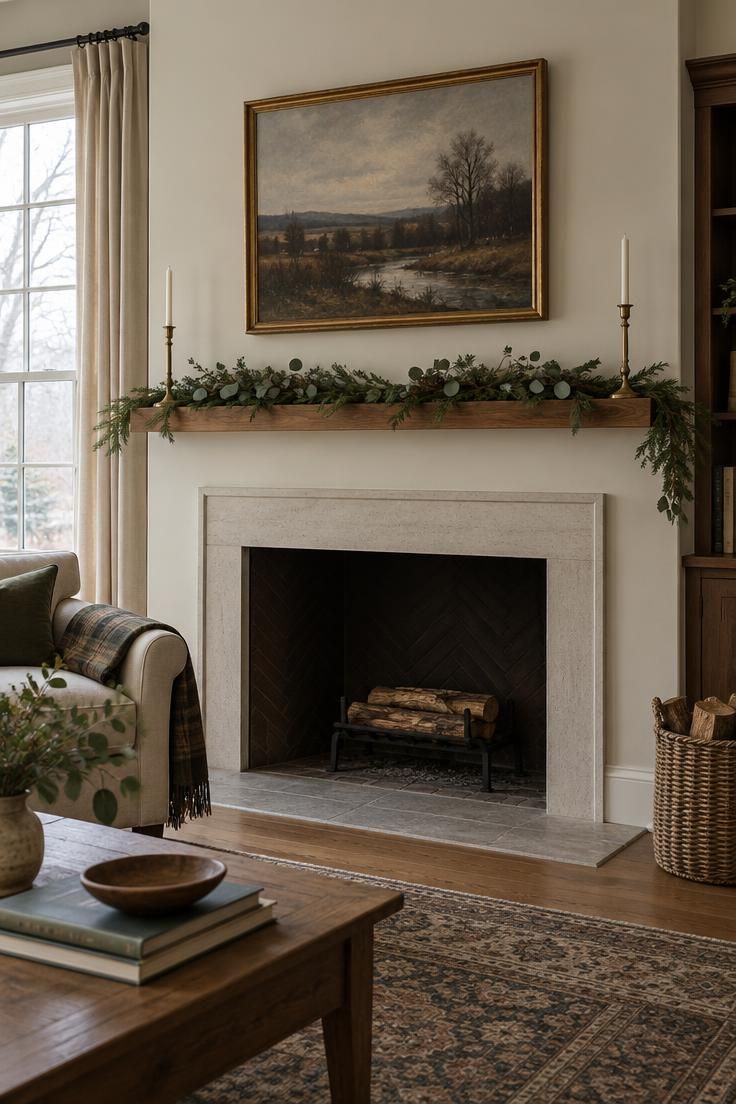
A long, low garland of mixed cedar and eucalyptus reads as a single horizontal gesture rather than a collection of objects.
Keeping the branches sparse where they meet the wall lets the greenery look draped rather than glued down, and a few sprigs extending past the mantel edge soften the shelf’s hard line.
This approach suits a mantel with at least eight inches of clear depth so the greenery does not crowd framed art or a mirror above.
Fresh branches shed lightly and fade after roughly two weeks, while a high-quality faux version holds its shape with an occasional dusting.
That tradeoff matters when the mantel sits in a busy room where needles would collect on upholstery or a rug.
A sparse mantel scarf also asks more of the eye: every branch is visible, so proportion between the garland length, the shelf, and the wall above carries the composition.
Minimalist mantel decorating works best when nothing competes with the line of greenery.
One pair of simple candlesticks at each end, or no other objects at all, keeps the shelf from turning into a display surface.
The horizontal shape echoes the mantel itself, which is why the arrangement feels settled rather than fussy.
Faux greenery earns its keep here because the arrangement can go up early and stay until the season ends.
Real cedar carries a stronger scent for the first days, then quiet.
Either way, the cleaner the mantel surface, the calmer the result.
Style Blueprint:
- A mixed cedar and eucalyptus garland, kept sparse where it meets the wall
- A narrow wooden mantel kept free of small collectibles
- Two plain brass candlesticks, one at each end
- A warm cream or off-white wall behind the arrangement
Design Pro-Tip: Lay the garland before adding anything else, then step back and check that the greenery does not rise more than a few inches above the mantel line so the wall above stays open.
Eucalyptus Bundle in a Stoneware Vase
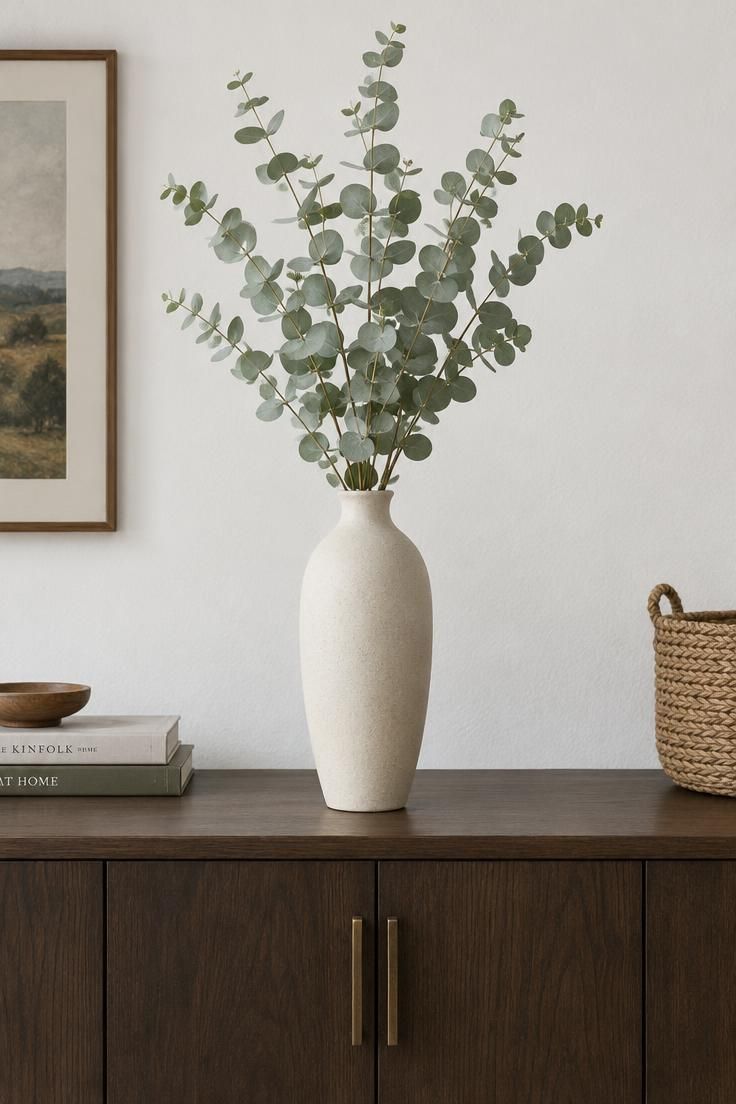
A tall stoneware vase filled with three or four long eucalyptus stems is a low-effort centerpiece for a sideboard or entry table.
The silvery green leaves soften a blank corner without adding pattern, and the narrow neck holds the stems upright without a grid or filler.
Centering the vase and leaving clear space on both sides of the sideboard gives the arrangement room to read as one quiet moment.
Eucalyptus tends to dry in place and become more muted, which means the arrangement can stay through the season without much tending.
The tradeoff is that dried leaves can look dusty by late December, and the stems become brittle enough to snap if handled often.
A narrow-necked vessel gives the display its shape, so choosing one with a heavy base helps it stay put when a table gets bumped.
A simple holiday table centerpiece can take this same idea at a lower height.
A shorter vase with two or three stems fits a dining table without blocking sightlines across it, which matters in a small dining room where guests sit close together.
Because the footprint is small, this arrangement adapts easily when furniture moves for a holiday gathering.
Shifting the vase to a shelf or a small table takes a moment and leaves the sideboard open for serving or gifts.
Style Blueprint:
- A tall matte cream stoneware vase with a narrow neck
- Three or four long eucalyptus stems, left loose
- A clear span of sideboard surface on either side of the vase
- A woven basket or similar natural texture in the background
Neutral-Toned Tree with Woven Ornaments
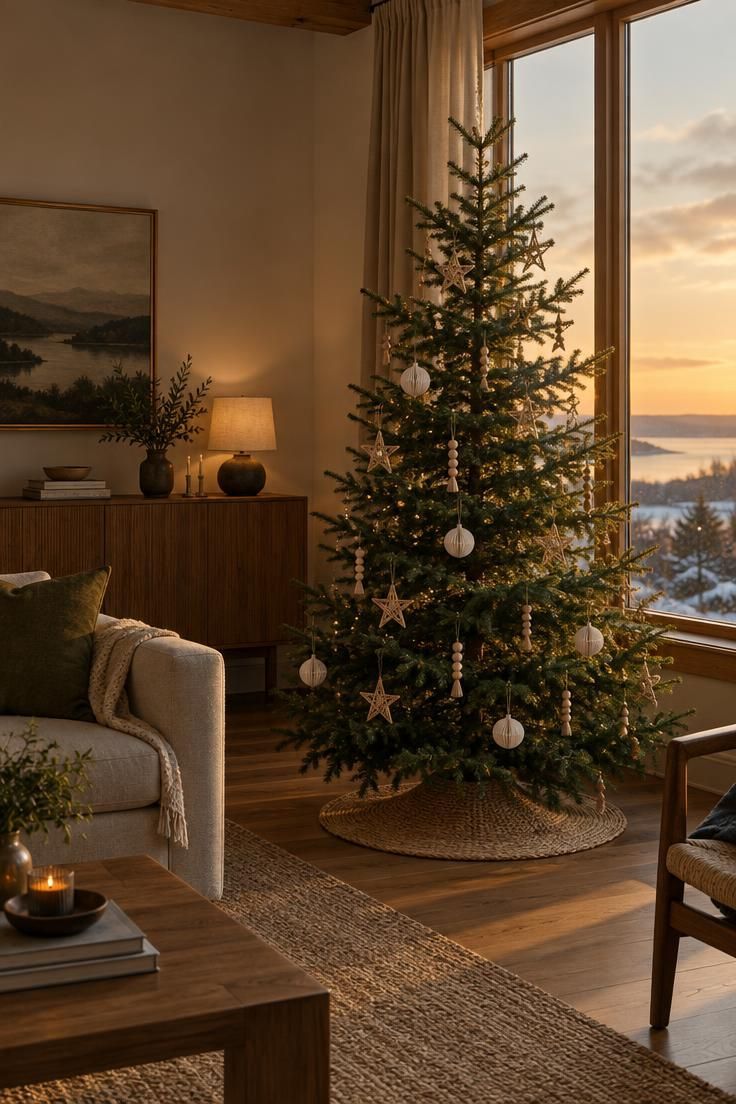
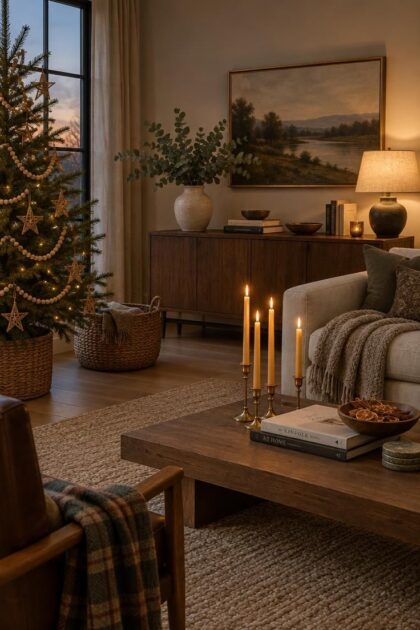
A tree decorated with only wooden beads, rattan stars, and cream paper shapes keeps the tree’s own silhouette prominent.
The ornaments repeat in two or three shapes rather than filling every branch, which leaves gaps where the tree shape shows through.
Placed near a window or against a light wall, the neutral ornaments catch a little shadow and read as texture rather than color.
For natural christmas greenery arrangements, neutral christmas tree styling depends more on restraint than on quantity.
Choosing a slim or open-branch tree if the room is narrow keeps the proportions balanced, and skipping ribbon and garland lets the repetition of simple shapes carry the texture.
That planning has a practical side: buying one paper, one star shape, and one bead type in quantity is visually smoother but requires deciding the scheme before shopping.
The tradeoff is that a restricted ornament palette limits variety.
Households with collections of colorful ornaments may find the tree feels repetitive, and children often want familiar ornaments on the tree.
One workable approach is a small tabletop tree in the neutral palette alongside a family tree elsewhere.
Open branches also show their gaps more than dense trees, which is part of the look but can feel unfinished at first.
Fewer ornaments mean the tree takes less time to put up and less time to pack away, and the woven skirt adds a soft edge where the tree meets the floor.
Style Blueprint:
- A slim or open-branch tree with visible gaps
- Repeated wooden bead strands in natural wood tone
- Flat rattan stars in one shape
- A handful of folded cream paper circles
- A plain woven tree skirt
Cedar Bough Sash on a Staircase Newel Post
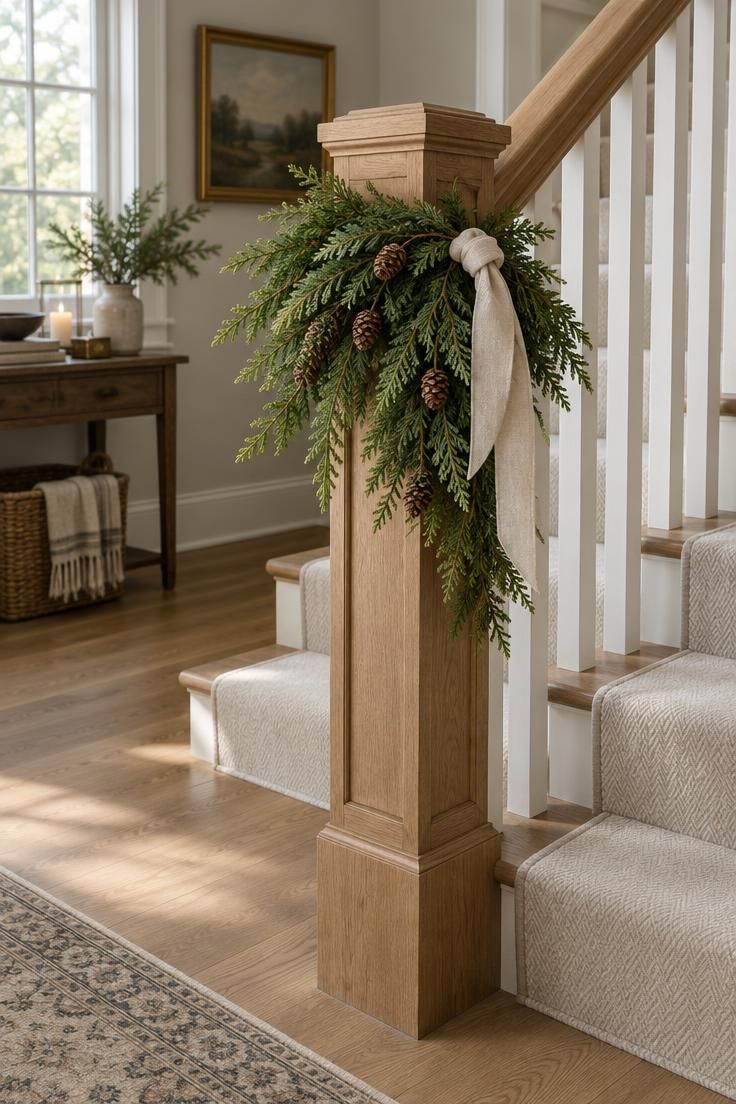
Wrapping a cedar bough around a staircase newel post brings holiday material onto a surface that hallway wreaths often miss.
The horizontal placement follows the shape of the post rather than competing with the balusters.
On a landing or lower post, the bough becomes a soft transition between the entry and the upper floor without adding another wall object.
Cedar works well here because its flattened branch structure lays close against the post.
Fresh cedar releases a light resinous scent when brushed by a sleeve or hand, while a faux cedar bough holds a fluffier outline season after season.
A single linen ribbon knot keeps the wrap in place and gives the post a finished edge without turning the staircase into a garland display.
For a thinner baluster line, the bough can stay shorter and sit on the post cap only.
On a wider square newel, a longer bough can travel partway down the post side before the ribbon pulls it snug.
This allows the same idea to fit different stair profiles without changing the core arrangement.
The surrounding staircase should stay plain so the cedar remains the only seasonal gesture.
A small stack of two cloth-covered books or one folded throw on a nearby step can ground the look without adding clutter.
Style Blueprint:
- A cedar bough tied horizontally across the newel post top
- A cream linen ribbon knot set slightly off center
- Small brown cones left within the natural branch
- White balusters and a neutral stair runner as the backdrop
- No additional garland on the handrail or lower stairs
Dried Apple and Bay Leaf Garland on a Blanket Ladder
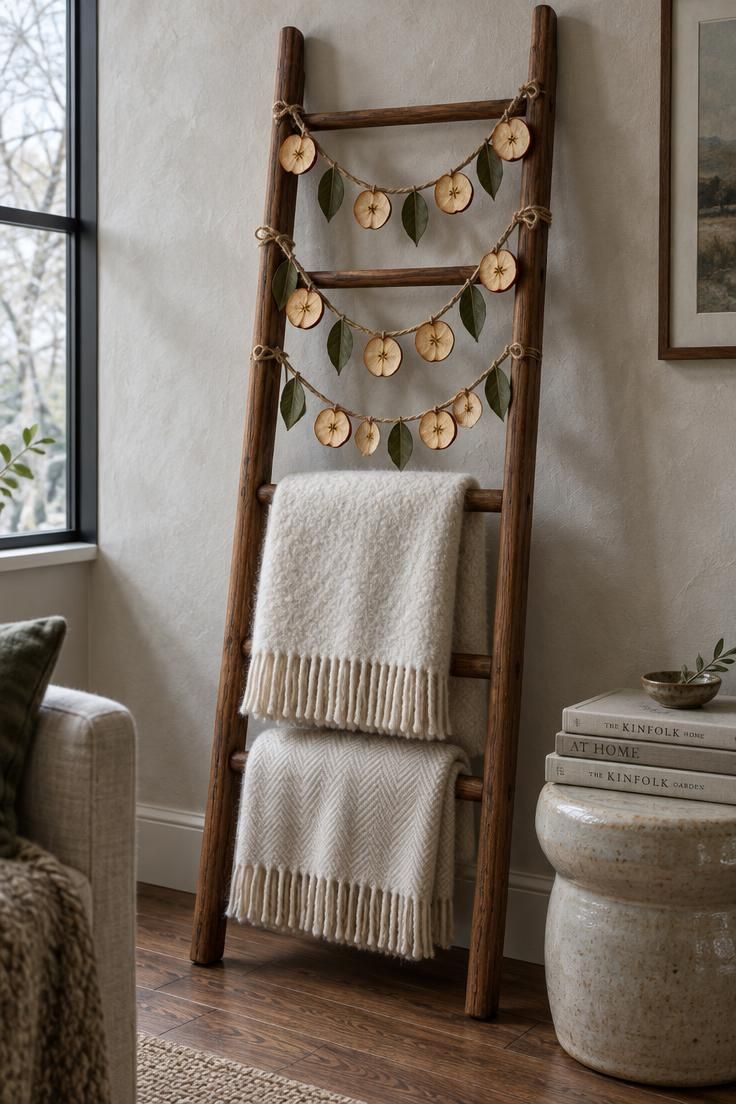
For a warm candlelight christmas display, a blanket ladder in a quiet corner becomes a simple christmas decor surface when a dried fruit garland replaces the usual quilt display.
The garland weaves across three upper rungs in soft swags, while folded wool blankets remain on the lower bars.
That split keeps the ladder useful without letting the seasonal addition take over the whole piece.
Dried apple slices threaded with whole bay leaves give the garland a muted red-brown and olive tone that reads clearly against pale plaster.
This arrangement suits a home where floor space is limited or a fireplace mantel already has other decorations.
The ladder can stay in an entryway, a reading corner, or next to a bedroom chair.
Because the garland is lightweight and narrow, it does not cover much of the ladder, and the household can still reach the blankets below.
Dried fruit and bay leaves hold their color for several weeks indoors, though the garland may become brittle and should be handled gently when it is moved or packed away after the season.
The composition works best with restrained color nearby.
Cream or undyed wool blankets, light wood, and a plain wall let the dried apple slices provide the warm accent.
A dark blanket ladder would deepen the contrast, while a pale birch or beech ladder keeps the corner feeling soft.
Adding a small stack of everyday books or a low stool nearby gives the vignette a lived-in rhythm without crowding the ladder.
This idea avoids the common mantel candle grouping and still brings natural, handmade texture into the room.
The dried fruit garland can hang on a wall hook, a headboard, or across a wide door frame as an alternative if a blanket ladder is unavailable.
Style Blueprint:
- Narrow wooden blanket ladder in light or medium wood
- Handmade garland with dried apple slices, whole bay leaves, and jute twine
- Two or three folded cream or undyed wool blankets on lower rungs
- Plain plaster or matte painted wall behind
- One low stool, book stack, or woven basket nearby for balance
Paper Star Mobile Over a Stairwell
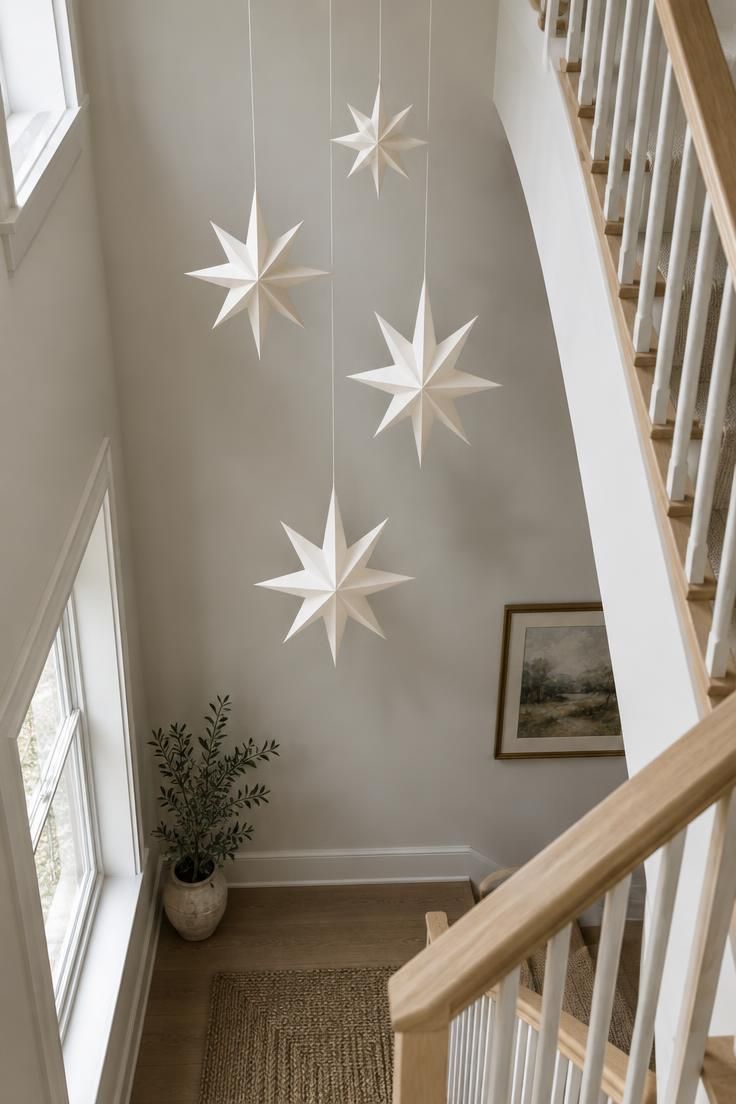
A grouping of three to five white paper stars suspended at staggered heights adds a light graphic layer to a tall stairwell or hallway ceiling.
The stars are lightweight and move slightly with air currents, which keeps the display from feeling static.
Choosing all-white or all-cream paper keeps the shapes reading as one repeated motif rather than a color story, and the pale wall behind lets the star edges stay crisp.
This is a strong small-space option because it uses vertical volume without taking up floor or shelf space.
Staggering the drop heights means the visible shape changes from every viewpoint on the stairs, so the arrangement keeps some interest through the season.
Paper stars store flat, which suits a household with limited holiday storage.
The main upkeep is occasional dusting, and the stars belong where a tall person is unlikely to bump them.
A stairwell with a low ceiling would crowd the longest drops, so adjusting heights to the available space keeps the display airy.
Because paper dries and can fade in strong sunlight, a spot away from direct window glare keeps the white crisp.
The mobile needs no other decoration nearby.
A bare wall around the stars gives the light shapes their contrast.
Style Blueprint:
- Four or five simple white paper stars
- Staggered hanging heights with the lowest well above head level
- A pale wall and light wood trim as the background
- A stairwell or high hallway ceiling with clear vertical space
Stacked Birch Logs Beside a Woven Trunk
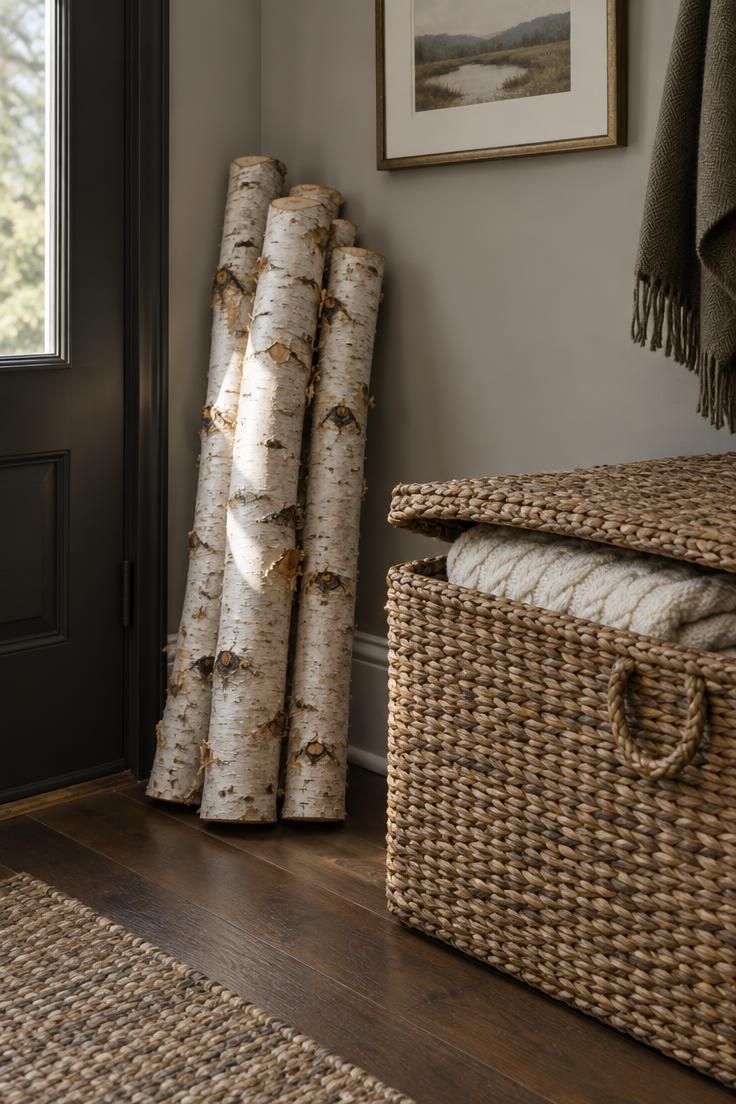
A small stack of birch logs placed beside a woven trunk brings winter texture into an entry or hallway without greenery, garlands, or anything that drops needles on the floor.
The papery white bark contrasts against the woven trunk, and both pieces stay visually quiet enough for a narrow wall.
This arrangement works well in a home that already has plenty of cedar or eucalyptus elsewhere and needs a different natural material to balance the season.
The logs lean at a slight angle rather than standing upright, which keeps the arrangement from looking like a firewood delivery brought indoors.
A short stack, roughly knee height, feels like an intentional decorative object rather than a utility pile.
The trunk gives the grouping a practical purpose because it can hold an extra throw, seasonal mittens, or a pair of slippers near the door.
The corner placement keeps the logs from becoming a tripping obstacle in a busy walkway, and the trunk lid hides whatever gets stored inside.
A pale or lightly whitewashed wall lets the birch bark read clearly, while a darker floor grounds the arrangement so it does not float in the space.
The throw peeking from beneath the trunk lid softens the edges and adds a warm ivory tone.
Maintenance stays simple: occasional dusting of the trunk and a quick wipe of any loose bark are enough, and the logs can stay out through early spring before being moved or repurposed.
Style Blueprint:
- Paper-white birch logs in a short angled stack
- A lidded woven seagrass trunk beside the logs
- An ivory cable-knit throw folded over the trunk edge
- A soft greige wall and quiet corner placement
- One visible natural material contrast without the need for fresh greens
Pine and Juniper Tray with Brass Candle Holders
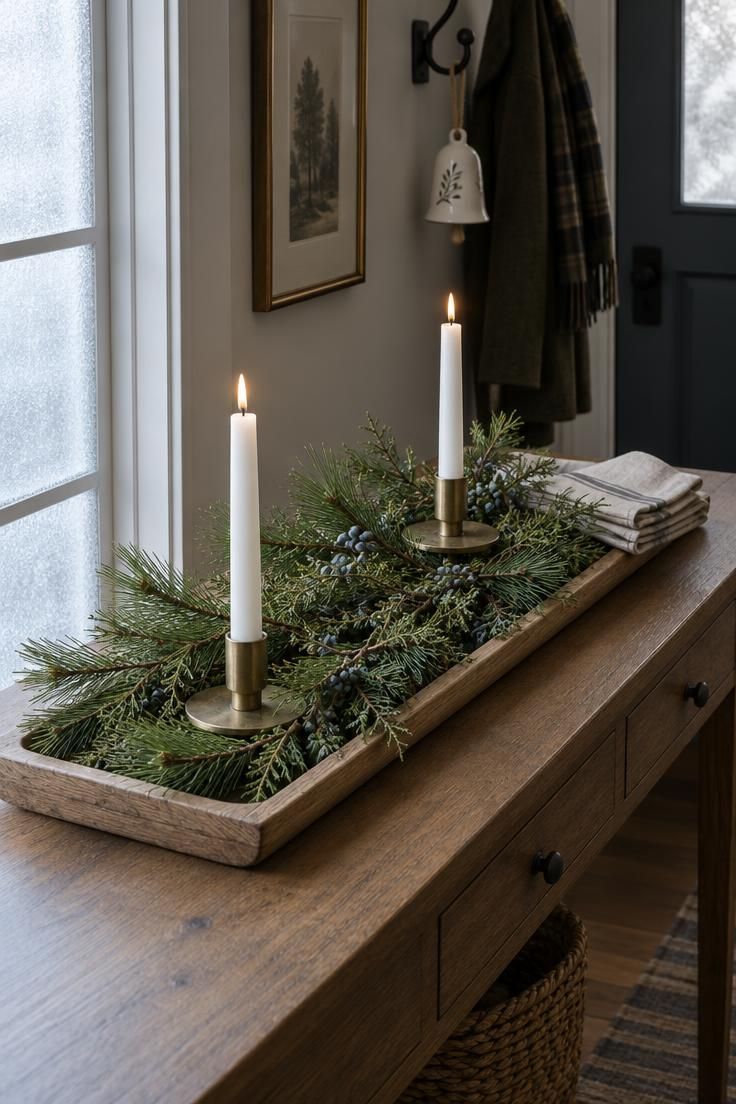
A long wooden tray can turn a narrow entry console into a quiet holiday moment without competing with coats, keys, or mail.
Pine sprigs and juniper stems rest loosely across the tray, and two low brass candle holders anchor the composition at either end.
The mixed greens bring two different textures together, with pine needles reading soft and juniper appearing slightly more compact.
This arrangement works for simple christmas decor because the tray keeps the greenery contained and easy to move.
A household can lift the whole tray to clear the console before guests arrive, then return it without rearranging each stem.
The brass holders add a warm metallic note that stands out against the oak without making the entry feel formal.
Junipers drop a fair amount of fine debris as they dry, so this idea works best with stems replaced weekly or moved somewhere with a tray that catches the bits.
Pine sprigs hold their shape longer, which means the mix can lean on pine as the sturdier base.
Placing the tray away from the door swing prevents the arrangement from getting knocked by bags and coats.
The same formula adapts well to a dining buffet or a low bookshelf where a long horizontal surface already exists.
Adding a small stack of linen napkins at one end makes the tray feel purposeful in an entry hall where people often pause to set things down.
Style Blueprint:
- A long rectangular oak or walnut tray with a low rim
- Loose pine sprigs and juniper stems with healthy color
- Two low brass candle holders placed at opposite ends
- One small textile stack, such as linen napkins, tucked at an edge
- A console table or shelf where the tray can stay clear of daily traffic
Natural Greenery in a Woven Basket by the Hearth
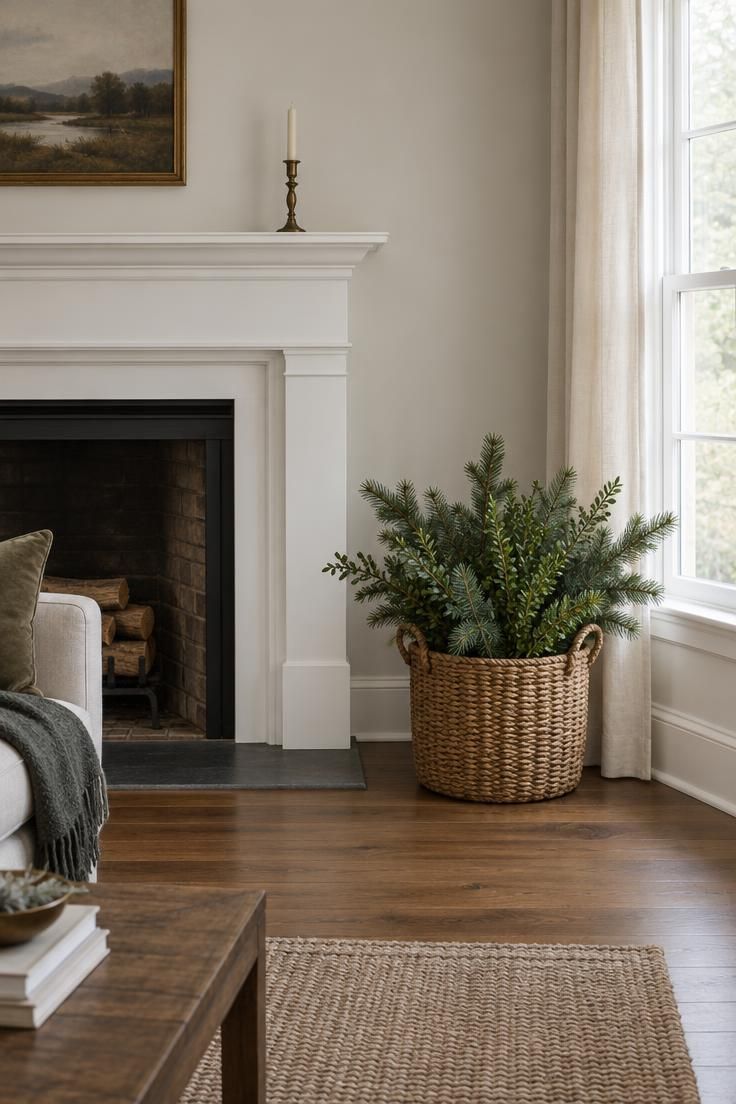
A woven basket holding a loose arrangement of fir, cedar, or boxwood branches can read as both storage and decor when placed beside a fireplace.
The basket texture contrasts with the green foliage, and the arrangement does not have to be symmetrical.
Refreshing the water if using a liner, or choosing faux branches for a placement that will not drop needles, are the two basic paths to keeping it looking tidy.
A lower visual anchor adds weight to the floor beside the hearth without competing for the mantel’s shelf space.
This works especially well in a room that already has a mantel display, because the eye moves from the horizontal line of the mantel down to the green mass on the floor.
The basket’s round or oval shape softens the fireplace surround’s straight edges.
The choice between fresh and faux comes down to upkeep.
Fresh branches need water and will shed, so a liner that keeps water off the basket and the floor is worth planning for.
Faux branches ask for a dusting before they go into storage and hold their shape from year to year.
Keeping the basket loose, with branches leaning rather than packed, preserves the casual character.
A tightly packed basket starts to look like a bundle of product rather than part of the room.
Style Blueprint:
- A round woven basket in a natural fiber tone
- Loose fir and boxwood branches leaning rather than packed
- A water liner if using fresh branches
- A bare or nearly bare mantel above
Minimalist Gift Wrap Stack in Kraft Paper
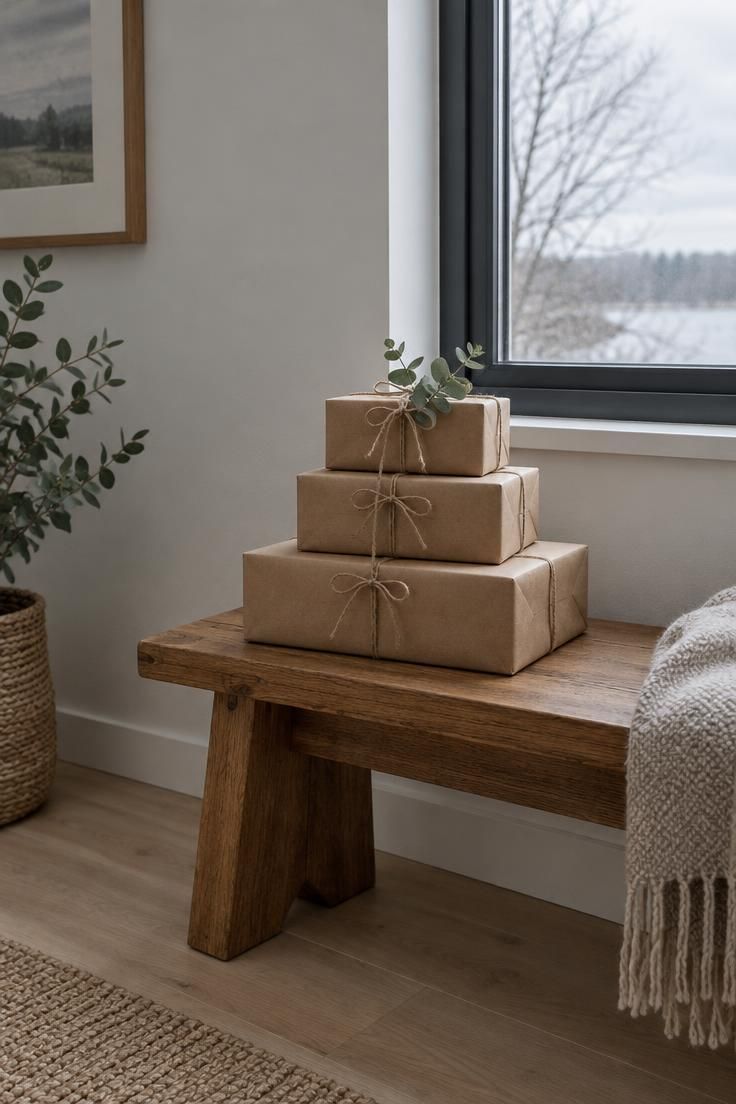
A stack of three or four gifts wrapped in kraft paper with the same cotton twine bow becomes a deliberate visual element under a tree or on a console.
Using one paper, one twine color, and the same wrapping method for all boxes is what makes the stack read as decor rather than a pile.
This is a practical way to make gift storage part of the room instead of hiding it in a closet.
The stack looks best when the boxes vary slightly in size but share a common largest dimension so they sit evenly.
A narrow box on a wide box can tip or look unsteady, so keeping the footprint similar from layer to layer gives the stack its settled shape.
A single sprig of rosemary or eucalyptus under one bow adds a small green note without turning the wraps into decorated objects.
Consistency has a planning cost.
Choosing paper, twine, and a tag style before shopping means every gift can join the stack later without breaking the palette.
Households that like variety in wrapping may find the uniform look too limited, and wrapping odd-shaped gifts in kraft paper may take more practice than a printed paper with a busy pattern that hides creases.
A bench or console beneath a window suits the stack because daylight shows the paper’s matte texture.
Moving the stack to the floor beneath a tree is the other natural spot.
Style Blueprint:
- One roll of kraft paper for all boxes
- Natural cotton twine in a single color
- Three or four boxes in graduated sizes
- One small rosemary or eucalyptus sprig
Bare Branch Display in a Heavy Ceramic Vase
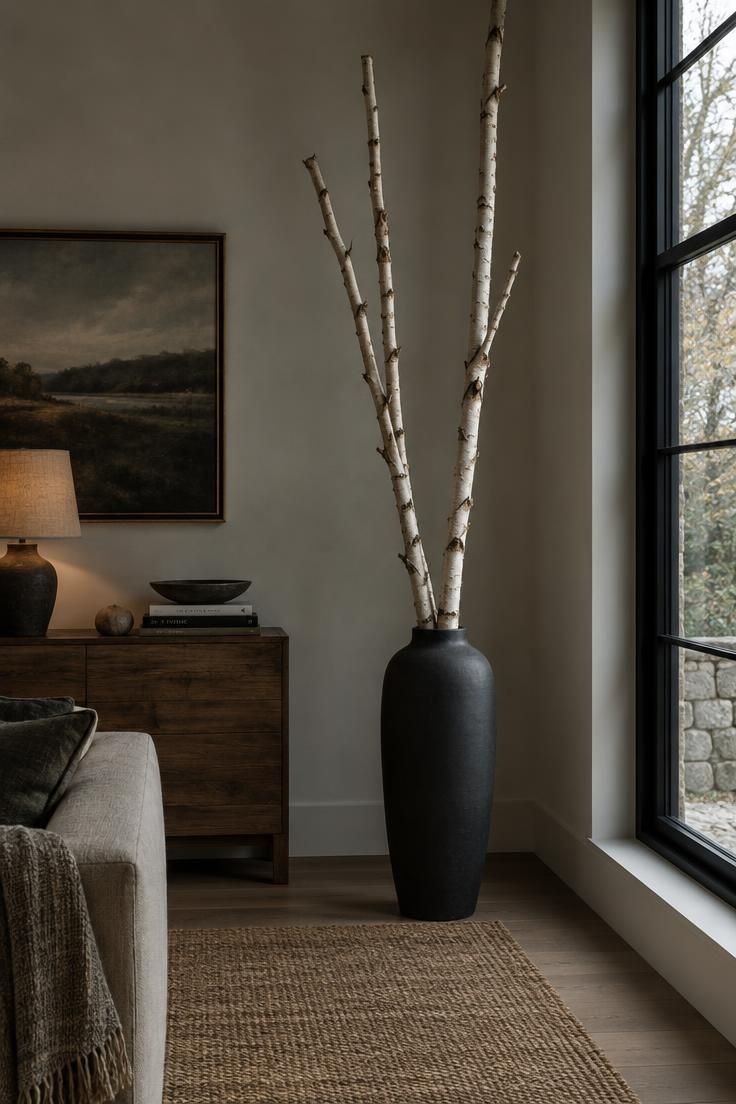
A heavy ceramic vase holding two or three bare branches, such as birch or manzanita, gives a sculptural winter arrangement without greenery or flowers.
The branches should be cut to a height that clears the ceiling by at least a foot so they do not feel top-heavy.
This is a good option for a room where live greenery would conflict with existing dried botanicals or where needle drop is a nuisance.
The vase and branches need no maintenance through the season, and the branches can be reused from year to year.
Weight in the base matters more than height here: a slender tall vase under long branches can look unstable, while a heavy ceramic form anchors the vertical lines.
A jute or wool rug under the vase softens the contact between ceramic and floor and continues the natural material story.
Irregular branches carry more character than perfectly straight ones, and choosing stems with a slight lean or fork gives the arrangement a drawing-like quality against a pale wall.
Turning the vase until the best profile shows takes only a minute.
Because the arrangement stays up for the whole season, its scale should suit the room.
Branches that dwarf a small room can feel cramped, while a low arrangement in a tall room may disappear against the wall, so matching branch height to the wall it stands before keeps the silhouette readable from where people sit.
Style Blueprint:
- A heavy matte black ceramic vase with a wide base
- Two or three irregular bare birch branches
- Branches cut to clear the ceiling with room to spare
- A jute or wool rug beneath the vase
Window Ledge Candle Trio with Evergreen Sprigs
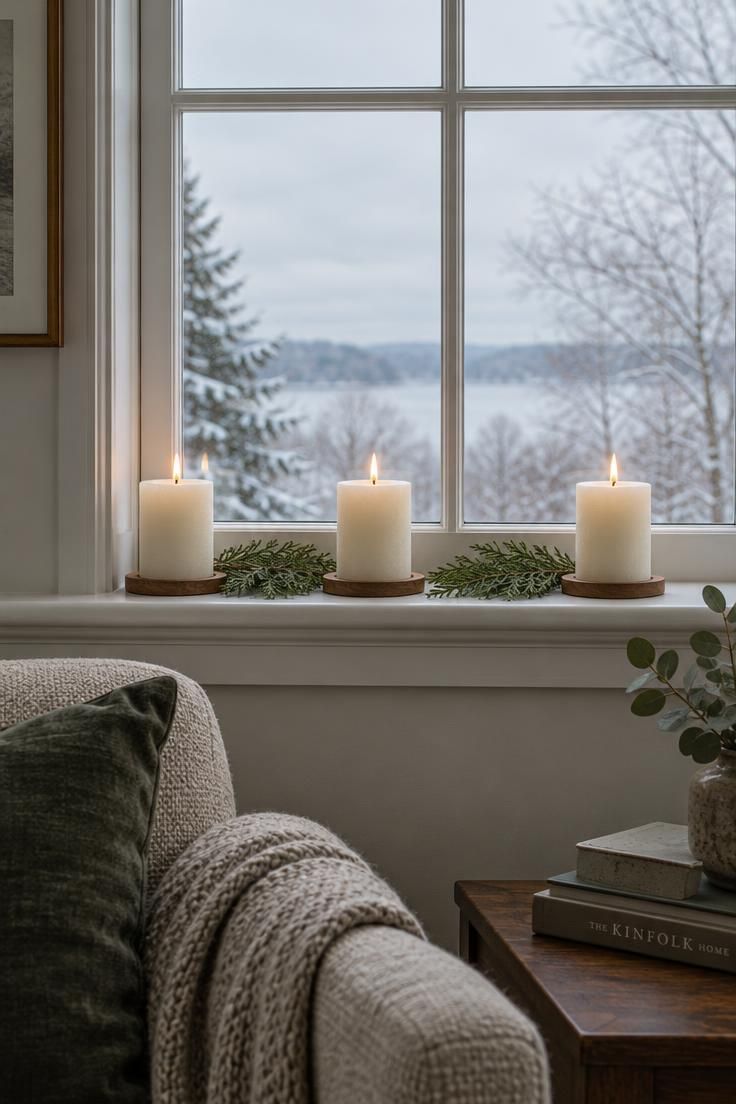
A deep window ledge can hold a short row of three pillar candles of the same height, each on a small stone or wood coaster, with a few evergreen sprigs laid flat between them.
This turns a sill into a small seasonal display without blocking natural light.
The sprigs should be cut so they do not hang over the edge into the room, and the ledge stays otherwise empty for the arrangement to read clearly.
Keeping all three candles the same height gives the row a level rhythm, and the coasters protect the painted ledge from wax drips or the rings warm wax can leave.
Uncolored wax pillars in cream or white let the green sprigs supply the only contrast.
This is a simple alternative to hanging a garland or wreath in the window, and it suits a room where the sill is deep enough to hold the candles safely back from the glass.
Fresh sprigs will dry within a couple of weeks, and dried sprigs can look spent, so replacing them partway through the season keeps the ledge looking cared for.
Faux cedar holds its color but asks for a light dusting.
Candles need replacing as they burn down, and a set of three in the same height and shade keeps the row even.
The arrangement takes up little space and leaves the window view clear.
It also adapts to a wider sill, where four or five candles can spread the row along the ledge.
Style Blueprint:
- Three cream or white pillar candles in one height
- Small round wooden or stone coasters
- Flat cedar sprigs cut short
- A deep, otherwise bare window ledge
Hanging Dried Grass Wreath with a Linen Bow
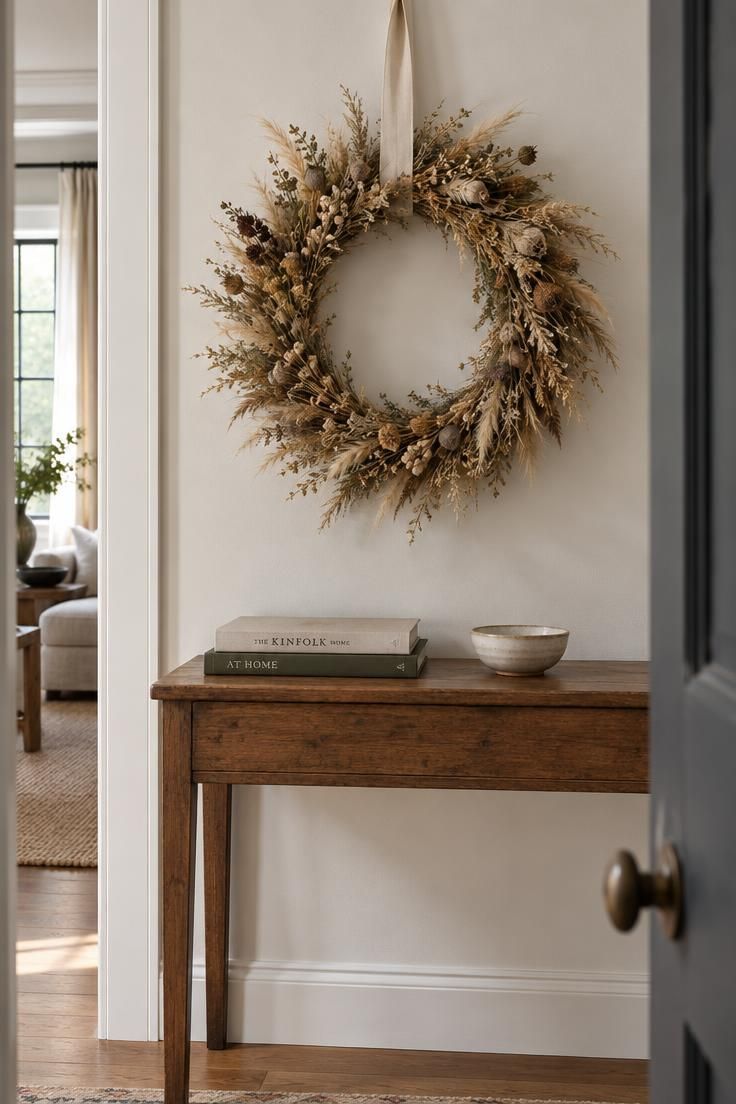
A round wreath made of dried grasses and seed heads, held by a simple loop of linen ribbon, brings winter texture to an interior wall without green foliage.
The pale straw color works with light walls and wood trim, and the wreath can stay up well beyond Christmas.
One narrow linen or cotton ribbon in cream or oat gives the top a finished anchor.
Simple christmas decor often depends on materials that carry the season without the usual cues.
Dried grasses hold their shape and color for months, so this wreath bridges the holiday and the rest of winter without a swap.
Because dried grasses are brittle, the wreath belongs in a spot where coats and bags will not brush against it.
A stairway niche or the wall above a console keeps it out of the traffic path.
The wreath’s flat face means it shows texture rather than depth, so it reads clearly on a plain wall.
A seed head wreath with slight color variation between stems looks more natural than a uniformly dyed one, and turning the wreath until the fuller side sits at the bottom gives it a balanced shape.
An interior wall keeps the wreath out of weather, and a dry spot away from steam helps it last.
A bathroom wall or a spot above a kitchen sink would shorten its life, so a hallway or living room wall suits it better.
Style Blueprint:
- A dried grass and seed head wreath in pale straw tones
- A single cream or oat linen ribbon loop
- A plain warm white wall behind it
- A narrow console or stairway niche below
Pinecone Cluster in a Wide Glass Apothecary Jar
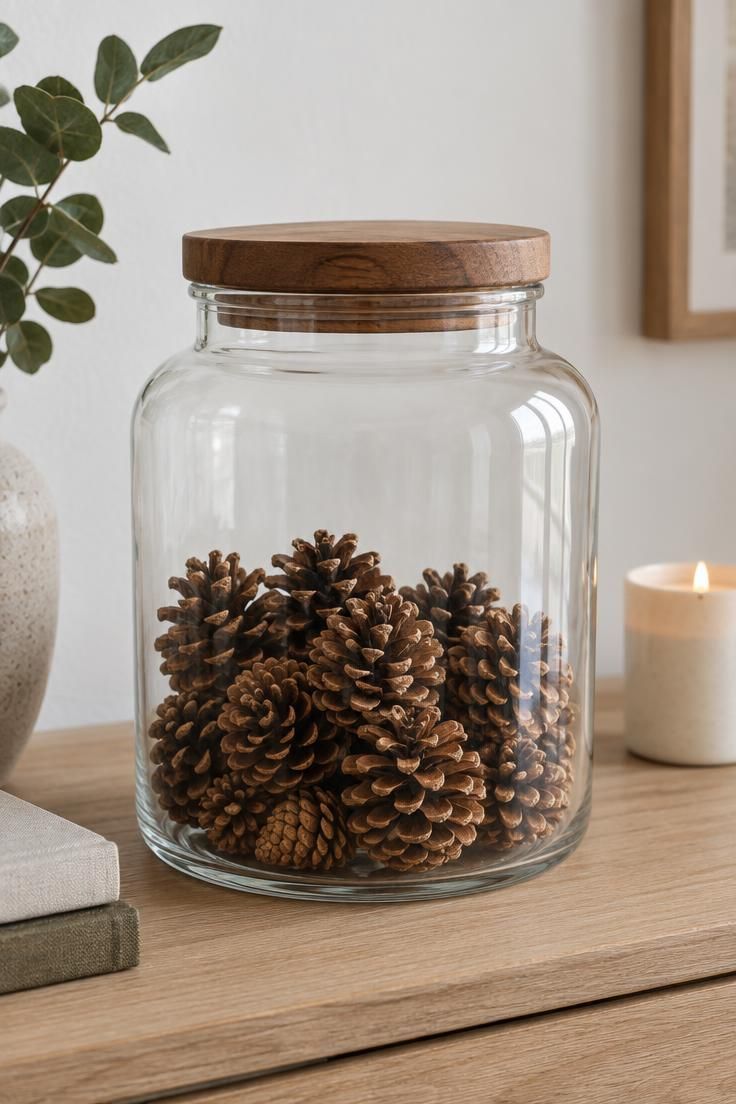
A wide glass apothecary jar filled with a single layer of pinecones is a low, contained way to bring a natural element to a side table or bathroom shelf.
The jar keeps dust off the pinecones and prevents them from scattering, which is helpful in a household with pets or curious hands.
Pinecones of roughly the same size settle into an even layer rather than piling into a mound.
Choosing pinecones from one source keeps the scale consistent, and a jar filled about one-third full leaves room for the shapes to read.
The wooden lid adds a warm finish and makes the display feel intentional when the jar sits next to a small candle or a folded cloth.
No other seasonal object is needed for the display to read as seasonal.
The lid has a practical side: pinecones can shed small scales and dust, and a closed jar keeps both inside.
Glass shows fingerprints and dust, so a quick wipe with the rest of the week’s cleaning keeps the display clear.
Pinecones stored in a dry spot hold their shape for years and can be returned to the jar each season.
The jar’s low profile fits on narrow shelves and side tables where a vase would feel tall.
Because it needs nothing added, it is a good choice for a room that already has a tree or mantel moment and needs one small quiet note elsewhere.
Style Blueprint:
- A wide clear glass apothecary jar with a wooden lid
- Similar-sized brown pinecones in a shallow layer
- A small folded cloth or candle beside the jar
- A light wood side table and plain wall
Asymmetrical Porch Greenery with One Lantern
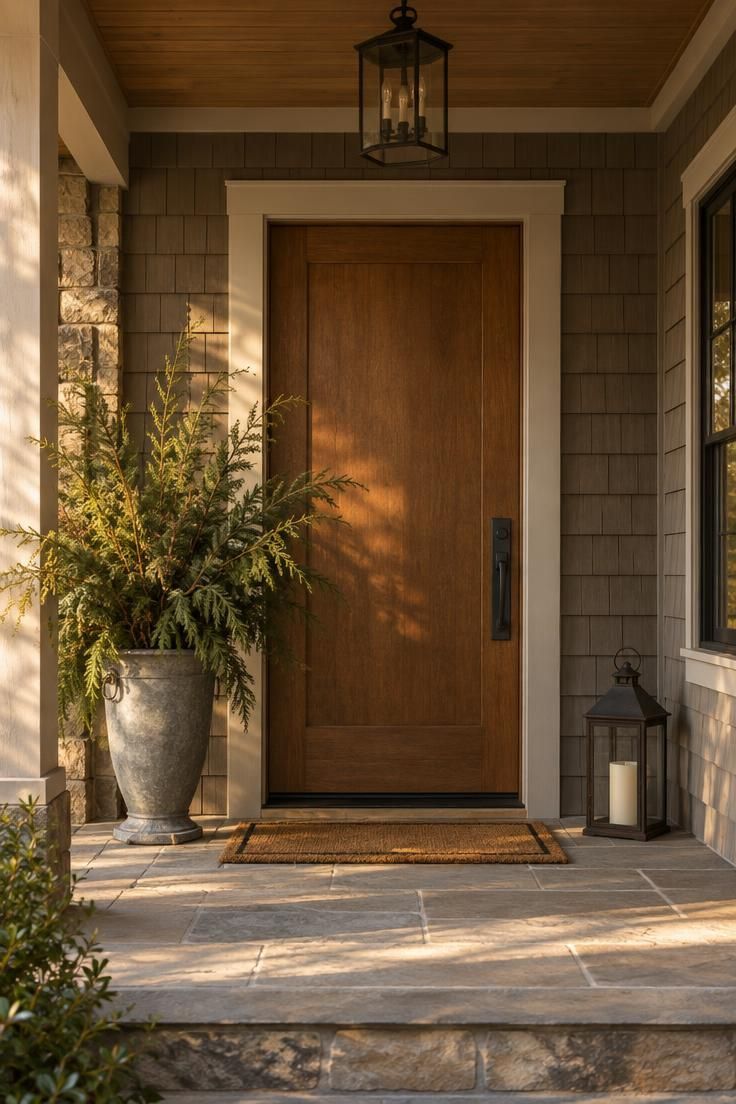
A covered entry can hold one tall bundle of mixed evergreens placed to one side of the door, balanced by a simple lantern on the other.
The mismatch is intentional, and it keeps the porch from reading like a paired set.
Use a heavy stone or metal urn for the greenery, and choose a lantern with a pillar candle or a small LED flame.
The combination works well instead of two identical potted trees, especially when the entry is narrow or a wreath already hangs on the door.
The urn’s weight helps hold the bundle steady in wind, while the lantern gives the opposite side a quiet counterweight without repeating the foliage.
Cedar and fir lean naturally in a loose bundle, which softens the tall shape.
Fresh branches at an entry are exposed to weather, so they may dry faster than indoor greenery and could need replacing partway through the season.
An unlit lantern can be lit when someone is home to tend it, and an LED flame offers a visual glow without an open flame.
The doormat should sit clear of the lantern so the path into the house stays easy to use.
A tall urn beside a low lantern can look lopsided if the urn is much wider, so choosing elements of similar visual mass keeps the arrangement settled.
Style Blueprint:
- A tall galvanized or stone urn in a natural finish
- A loose bundle of mixed cedar and fir branches
- One dark metal lantern with a pillar candle or LED flame
- A plain coir doormat centered before the door
Conclusion
A calm holiday room does not require a long list of objects.
The calm comes from repetition, empty space, and a clear hierarchy of one or two seasonal moments per room.
Fresh greenery and dried natural materials bring the most seasonal texture, but they also ask for the most upkeep, so mixing in a few permanent pieces such as paper stars, bare branches, or a stoneware vase can keep the routine easy.
The strongest rooms are often the ones where the decor could be removed in a few minutes and the space would still feel complete.