This post may contain affiliate links. If you make a purchase through these links, we may earn a commission at no additional cost to you.
A red and gold tree can feel traditional without looking like a repeat of last year.
The difference usually comes down to composition: how much red you use, which finishes carry the shine, and where the gold sits in the branches.
This collection focuses on the decisions that change a tree’s character, from ribbon geometry to the way light moves across velvet and glass.
Each idea starts with a clear visual rule, so you can shop your existing ornament bins before buying anything new.
Whether your tree is wide and full or narrow and tall, there is a direction here that fits the room and the decorations you already own.
Gold-Dominant Base with Red Clustered at Eye Level
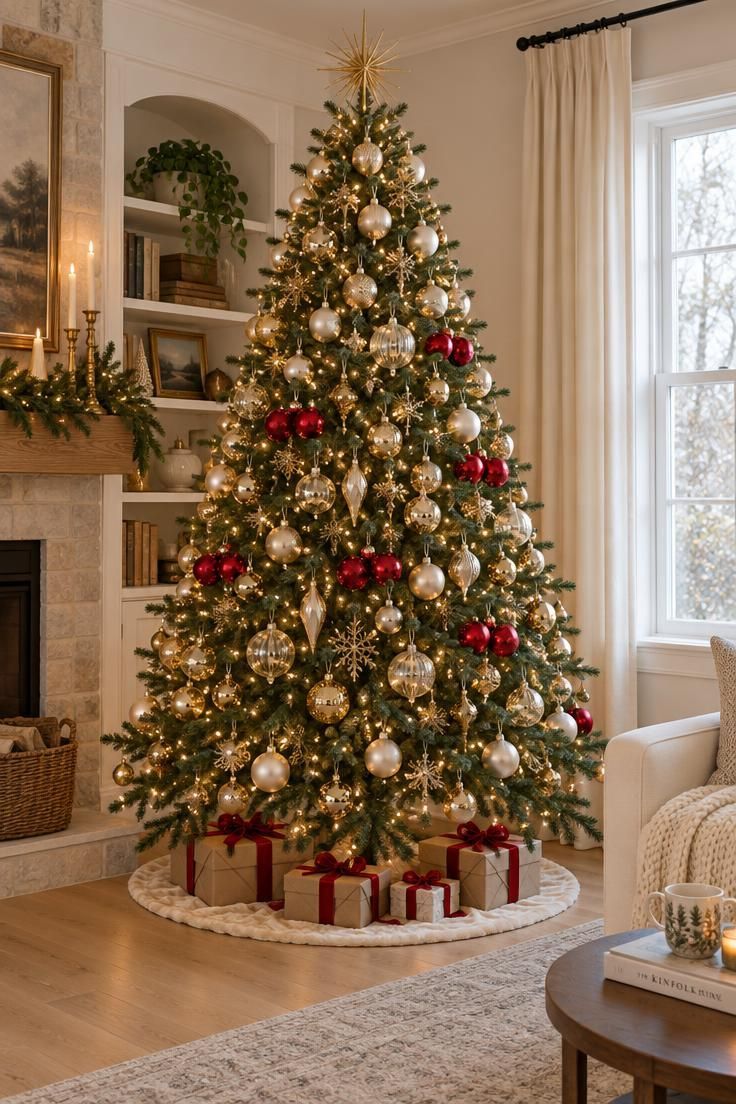
Building the tree around mostly gold ornaments lets a small red collection do real work.
Groups of red balls in threes and fives around the middle band become focal points rather than scattered dots, and the eye finds them quickly against the bright metal and glass.
Keeping the lowest branches slightly sparser serves two purposes.
The tree skirt stays visible, and gifts stacked beneath the tree read as part of the composition instead of disappearing into a wall of ornaments.
Ribbon handling matters here.
Wire-ribbon bows spaced at intervals are easier to adjust than a continuous spiral, because each bow can be repositioned without undressing the tree.
A red and gold christmas tree built this way stays balanced even when a few pieces get moved around during the season.
Finish variety within the gold layer keeps the look from going flat.
Mixing matte, champagne, and bright metallic gold gives the branches depth, so the red clusters have something textured to sit against.
This direction suits households with a modest red stash and plenty of gold.
A bright, elegant tree results without needing dozens of matching red pieces.
Style Blueprint:
- Gold ornaments in mixed matte, champagne, and bright metallic finishes
- Red ball ornaments grouped in threes and fives around the middle band
- Cream velvet tree skirt
- Kraft paper gifts tied with red ribbon
- Wire-ribbon bows spaced at intervals
Design Pro-Tip: Group red ornaments in odd numbers and vary their heights just enough to create rhythm without clutter.
Matte Red Velvet Ornaments with Antique Gold Bells
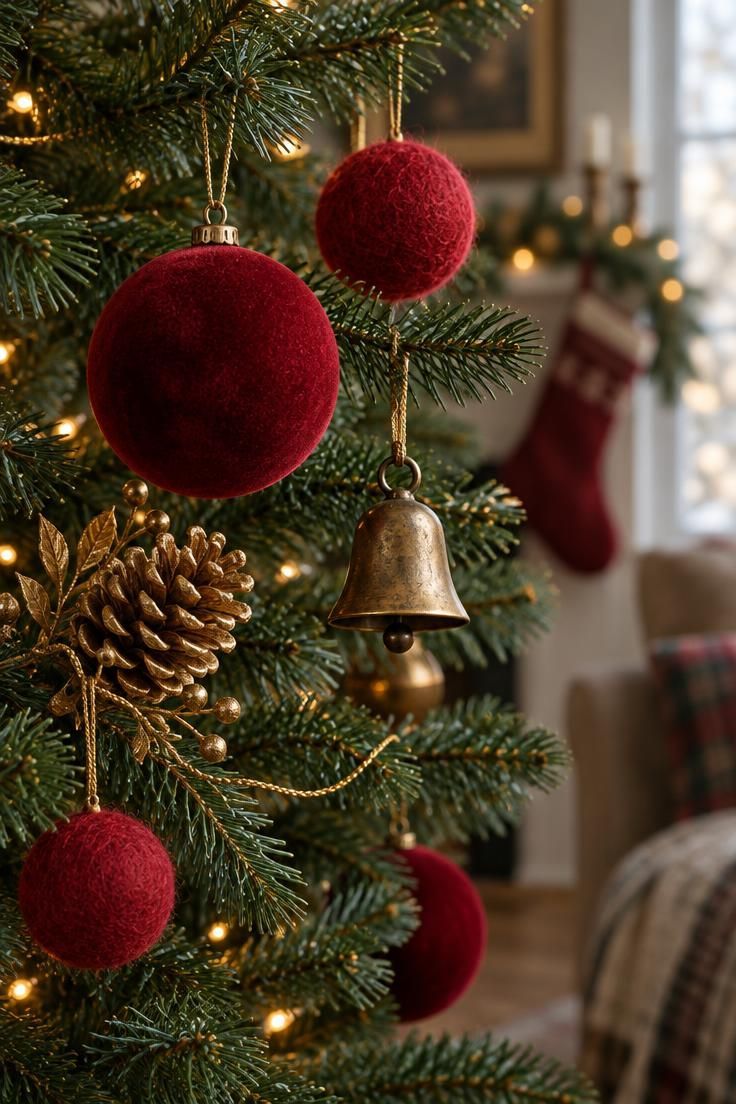
Shifting the finish mix toward matte red velvet and felt changes how the whole tree reads.
Flat red absorbs light and looks dense and soft, which lets small gold accents act as warm highlights instead of competing shine.
Antique brass bells and gilded pinecone picks add texture without glare.
The bells sit well toward branch tips, where they sway slightly when the tree is touched, and the pinecones bring a natural shape into an otherwise round-ornament scheme.
This finish family has practical advantages.
Matte and velvet surfaces hide dust and handling marks better than mirror glass, which matters in households with children or pets.
Room context decides whether the look lands.
Warm wood tones and soft upholstery flatter velvet and antique brass, while stark white or cool-gray settings can make the same ornaments feel muted.
For gold ornaments for a Christmas tree, the finish you choose does as much work as the color.
Style Blueprint:
- Matte red velvet and felt ball ornaments
- Small antique-brass bells placed near branch tips
- Gilded pinecone picks
- Thin gold cord for hanging
- Warm wood and soft upholstery nearby
Horizontal Bands of Wide Red Velvet Ribbon Over Gold Ornaments
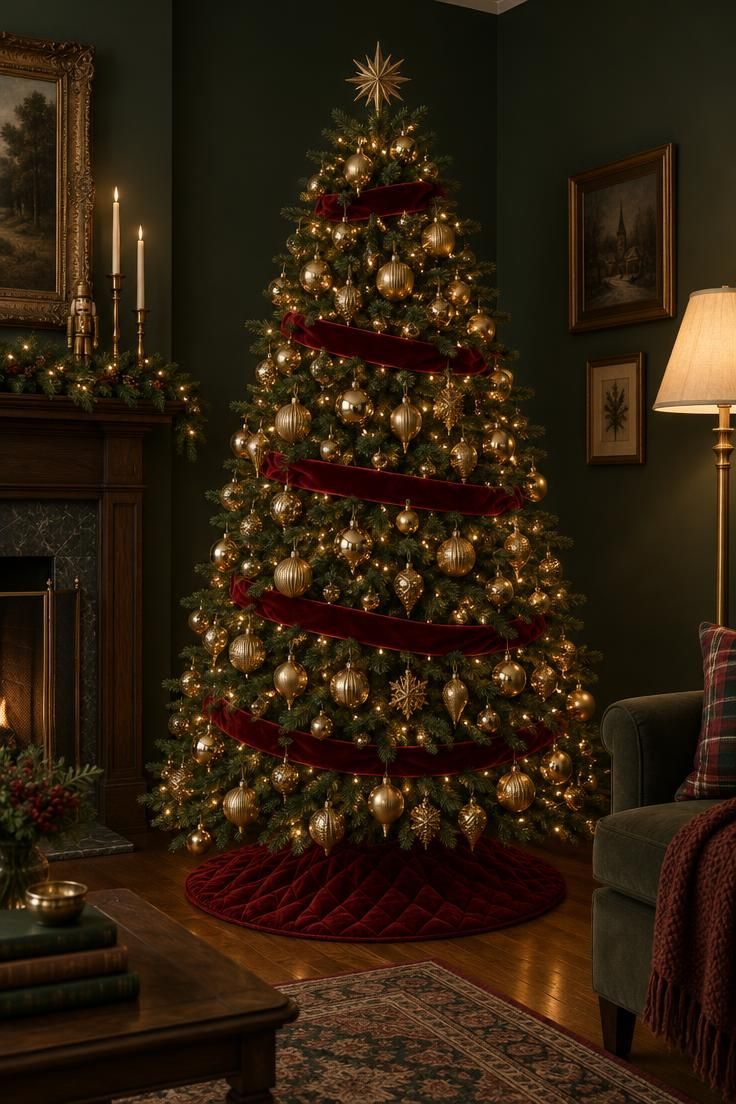
Horizontal banding is a geometry decision as much as a color one.
Three or four wide bands of red velvet ribbon cross a fully gold tree like stripes, and the ribbon ends tuck into the branches instead of tying bows.
The result reads as structure, not decoration.
This approach suits wide, full tree silhouettes, where horizontal lines have room to travel.
It also stretches a ribbon spool further than a spiral wrap, since each band is a single measured strip.
Measuring and cutting the strips before wrapping saves adjustment later.
Wired ribbon holds the band shape better than soft ribbon, which tends to sag between branches.
Among red and gold tree ribbon ideas, banding is the one that changes the tree’s architecture.
Leaving narrow gaps between bands lets lights and gold ornaments show through, so the tree stays luminous instead of striped solid.
The look is traditional and orderly, built mostly from ribbon and existing gold baubles.
Style Blueprint:
- Wide wired red velvet ribbon cut into measured horizontal strips
- Fully gold-ornamented tree as the base layer
- Narrow gaps between bands for light and shine
- Quilted red tree skirt
Red Glass Icicles Dripping from Gold-Ribboned Branches
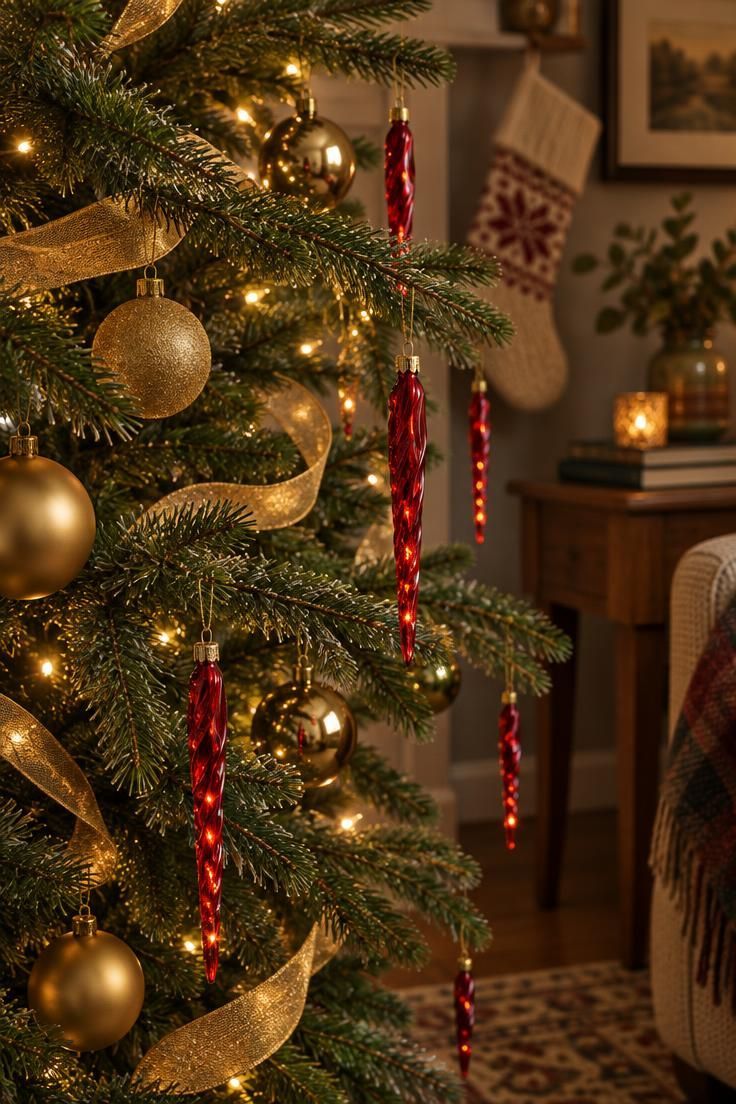
Icicle shapes create a dripped, jewel-like contrast that round ornaments cannot.
Gold balls and one soft gold ribbon garland form the base, and red glass icicles hang at varying depths near the outer branch tips, where they catch the warm lights.
Spacing the icicles in small groups rather than a strict row keeps the look organic and prevents a striped effect.
Reserving the longest icicles for the lowest third lets the red appear to descend toward the gifts and the tree skirt below.
This idea works on full and medium-width trees without demanding a spiral wrap or a narrow silhouette.
Readers hunting for slim Christmas tree decorating ideas can borrow the same logic in miniature: fewer, longer red pieces hung vertically give a narrow tree a column of color.
Visibility from across the room is the payoff.
Glass catches light at a distance, so the red stays present even when the gold dominates up close.
Style Blueprint:
- Gold ball ornaments as the base layer
- One soft gold ribbon garland in loose loops
- Red glass icicles hung in small groups at varying depths
- Longest icicles reserved for the lower third
Red Glass Finial Branches Moving from Scrollwork to a Gold Berry Crown
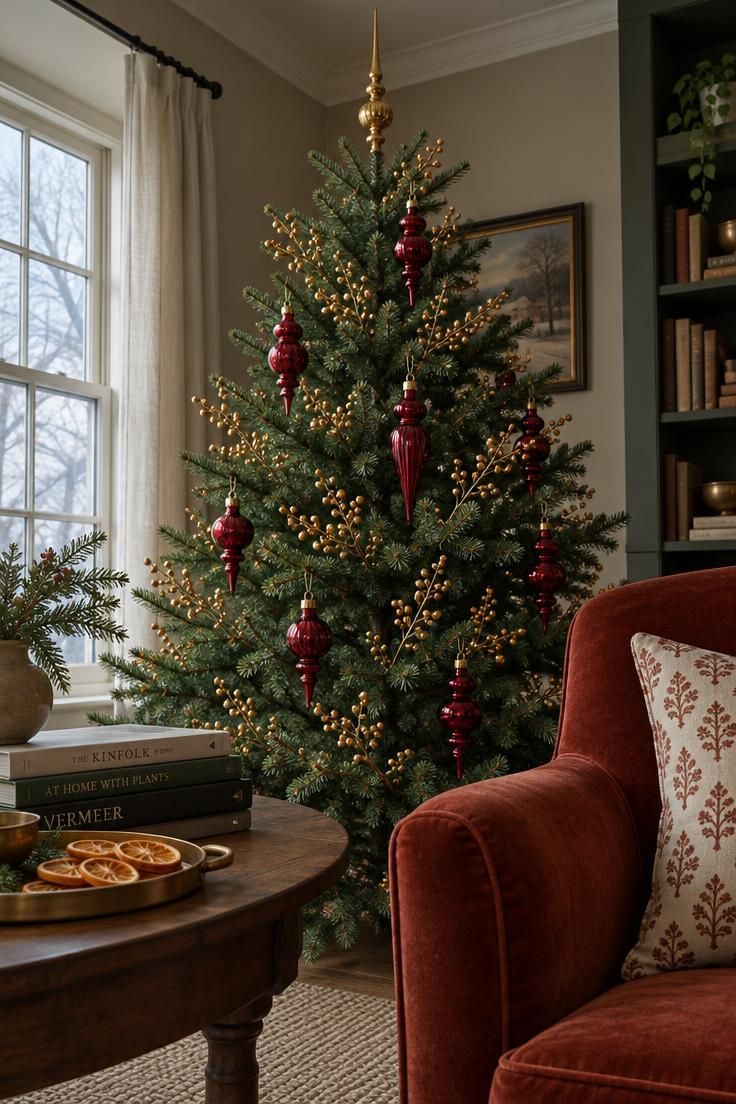
A tree can move the eye upward without changing the red-and-gold balance.
Deep red glass finials with turned profiles read almost like jewelry when placed below a band of gold berry stems, and the shape change slows the movement from ornament to crown.
Using two related forms creates a more collected look than repeating one ornament shape across the whole tree.
The red finials stay in the lower and middle areas, while the gold berries gather near the top so each material keeps its own zone instead of competing branch by branch.
This arrangement works well in a room where viewing height is lower than the full tree.
A chair or side table naturally crops the base from many angles, which makes the upper portion the part that needs the clearest color story.
Daylight from a window can catch red glass without washing out the deeper branches.
Soft directional light gives the finials enough shine to stay visible while the gold berries read as a quieter, textural layer.
Style Blueprint:
- Deep red glass finial ornaments placed in the lower and middle zones
- Gold berry stems concentrated near the crown
- A restrained repeat of red in nearby upholstery or table decor
- Soft angled daylight to keep the glass highlights readable
Cranberry Berry Picks and Gold Bead Garlands with Deep Red Ball Accents
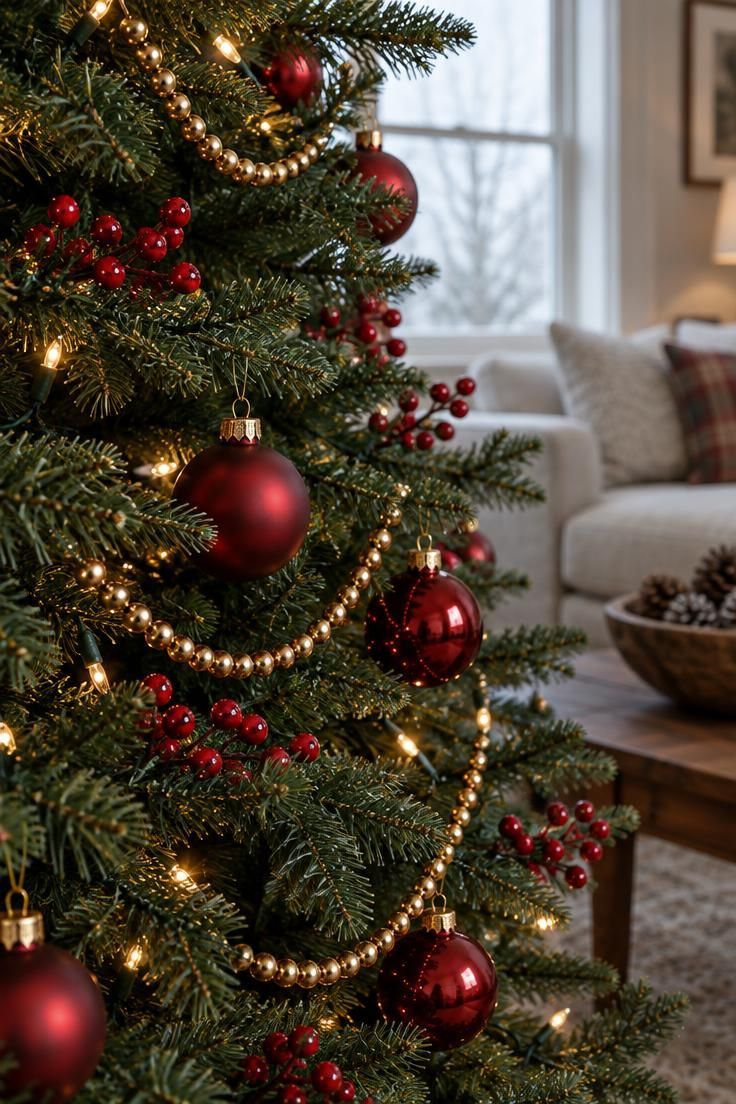
Faux cranberry picks supply the warm red layer here, and a gold bead garland drapes in loose loops rather than tight wraps.
Small clusters of red berries read as texture against the smooth beads, so the two materials contrast instead of repeating each other.
Tucking berry picks along the garland path, or grouping them around larger deep red balls, ties the layers together.
Placing picks at slightly different depths makes the red appear layered through the branches rather than resting only on the surface.
Faux berries keep their color for multiple seasons, unlike fresh or dried options that can fade or darken.
That durability matters for a look meant to be rebuilt each year from the same bin.
The overall effect is gathered and slightly old-fashioned, in the best sense.
It works with real or artificial trees and flatters both daylight and evening light.
Style Blueprint:
- Faux cranberry berry picks in small clusters
- Gold bead garland draped in loose loops
- Deep red ball ornaments grouped along the garland path
- Picks placed at varied depths
- Wooden bowl of pinecones nearby
Design Pro-Tip: Drape bead garlands in uneven loops and adjust the sag after the tree is lit, since bead shine changes once the lights come on.
Gilded Red and Gold Floral Picks as Filler Between Ornaments
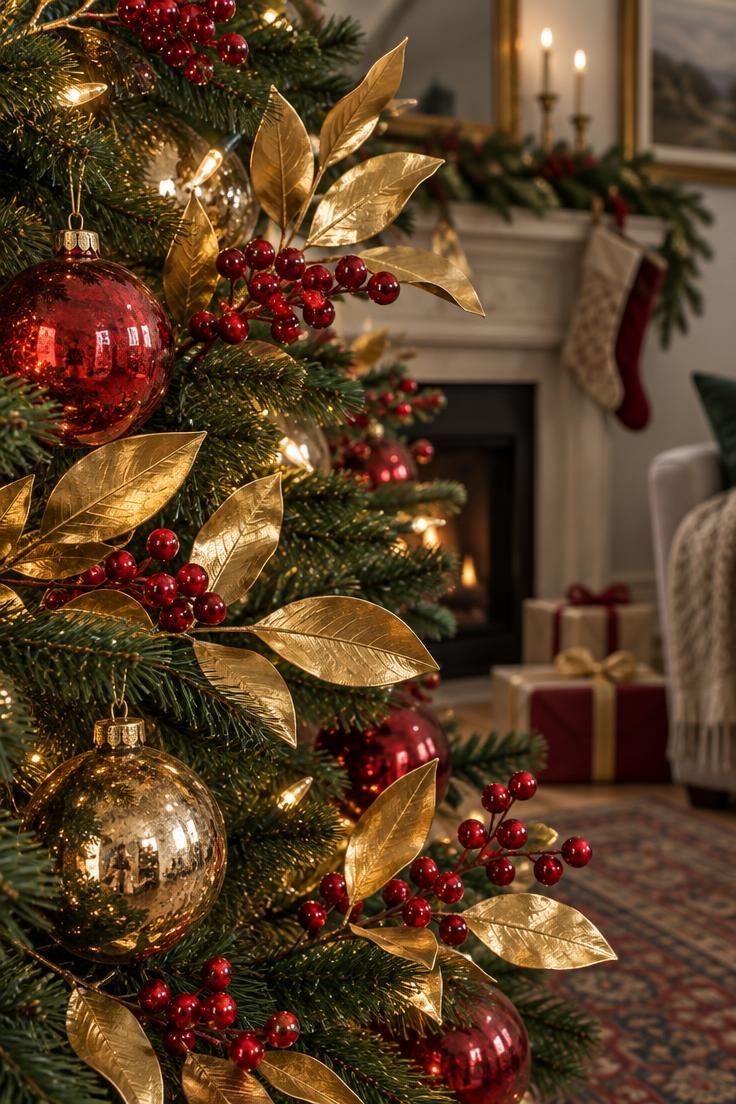
Picks are the fastest way to fill holes after the tree is lit, and they can be moved without dismantling the whole design.
With a moderate base of ornaments, faux floral picks with gold-painted leaves and small red berries slot into the gaps around branch tips and give the tree a designed appearance.
Distribution matters more than quantity, since clusters of three picks at different depths, some pointing outward and some slightly upward, create a layered look rather than a spiky one.
Metallic gold leaves catch light especially well near warm white bulbs, so the filler glows in a way plain ornaments do not.
This idea suits readers who already own plenty of basic ornaments and want a more finished result from the same collection.
Picks also let the red layer shift between seasons, because a few berry stems pulled or added change the balance without touching the ornament placement.
Style Blueprint:
- Faux floral picks with gold-painted leaves
- Small red berry stems
- Picks clustered in threes at different depths
- Warm white bulbs placed behind the picks
Velvet Quilted Tree Skirt as the Grounding Red Base
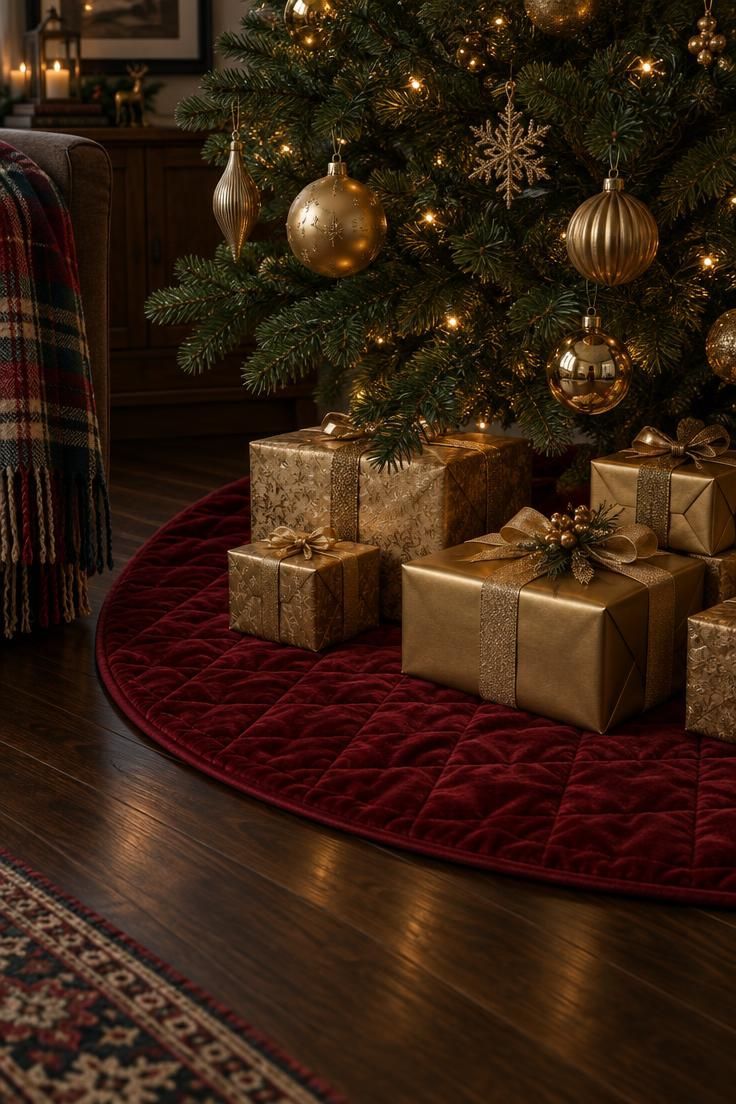
The base is where a mostly gold tree gains its red anchor.
A large velvet quilted tree skirt in deep red grounds the color story at floor level, and a few low-hanging ornaments on the bottom branches echo it upward.
Quilted velvet and smooth satin skirts behave differently.
Quilting adds visual weight and texture that suits a traditional tree, while satin reflects more light and reads dressier.
A slightly oversized skirt covers the stand more completely than one that barely reaches the edges.
There is a tradeoff.
A quilted velvet Christmas tree skirt adds bulk and may need smoothing after gifts are stacked on it, and heavy stacking can press creases into the nap.
Gold-wrapped presents in a few heights bridge the floor and the lowest branches, so the eye travels from skirt to tree in one continuous red-and-gold line.
Style Blueprint:
- Deep red quilted velvet tree skirt
- Gold-wrapped gifts in varied heights
- A few low-hanging gold ornaments on bottom branches
- Dark wood floor or neutral rug beneath
Gold Spire Topper with Red Ribbon Tails Falling from the Crown
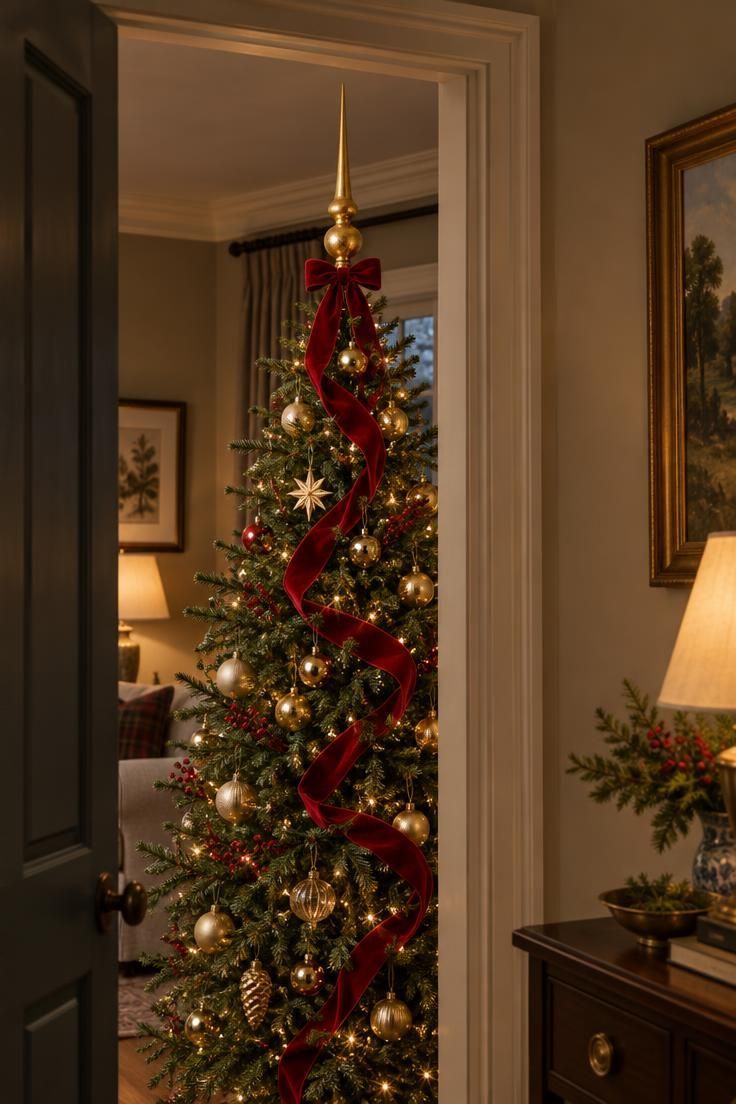
A tall gold spire sets the tree’s final tone, and wired red ribbon tails carry that tone down through the top third.
Loose curls or gentle serpentine folds give the crown movement without turning the whole tree red.
Topper and ribbon become the main statement while the rest of the tree stays mostly neutral or gold with sparse red accents.
The tails should be long enough to overlap the first few ornament layers but not so long that they tangle with lower branch clusters.
Tree shape guides the choice.
A spire works well on slim and medium-width trees, while a wide star may sit better on a full silhouette.
For anyone comparing red and gold tree topper options, the silhouette test settles the decision quickly.
This idea also serves as a quick refresh when the tree is already decorated.
Swapping the topper and adding ribbon tails changes the crown without touching a single ornament.
Style Blueprint:
- Tall gold spire topper
- Wired red ribbon tails in serpentine folds
- Sparse red accents in the upper branches
- Mostly neutral and gold ornaments below
Red Ornament Monogram Clusters Against Gold Mesh Ribbon Nets
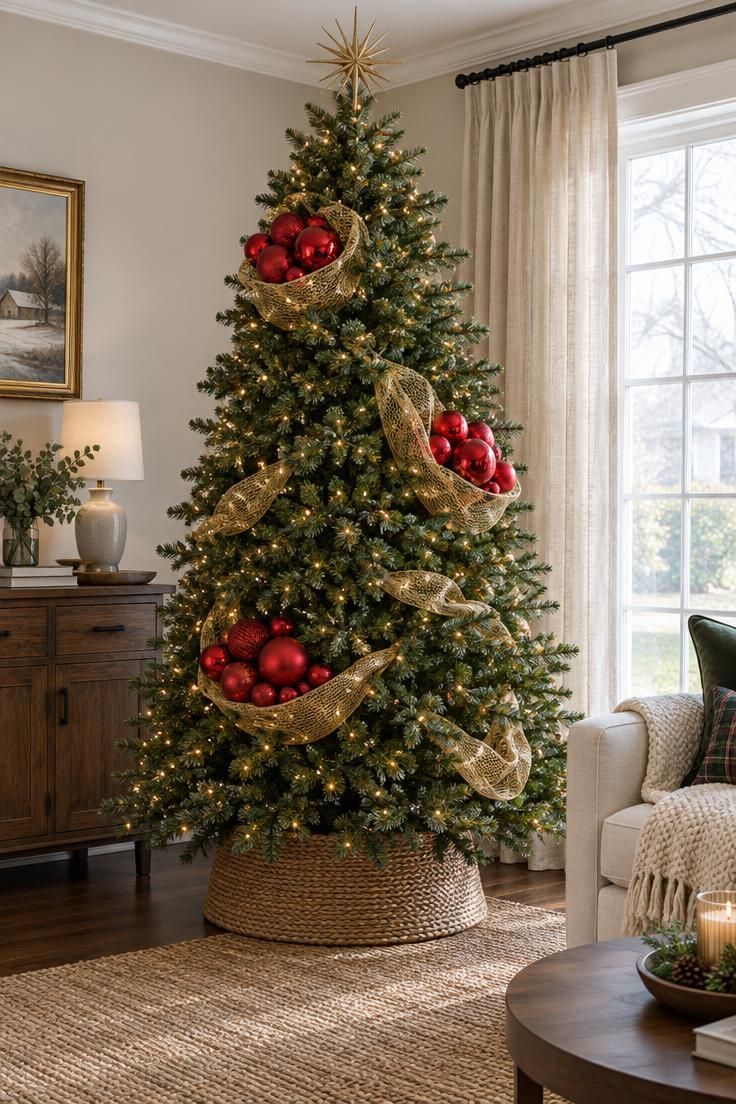
Wide gold mesh ribbon tucked into the tree at intervals creates soft nets, and each pocket holds a cluster of red ornaments in different sizes.
The mesh catches light and gives an airy, modern texture unlike solid satin or velvet.
Placement follows the tree’s visual thirds rather than even spacing, so the eye moves around the tree instead of scanning rows.
Each cluster reads as an intentional set, which makes the red layer look collected rather than scattered.
This approach uses more red ornaments than a sprinkle placement, but it also organizes them.
A reader with a deep red stash gets a balanced look without covering every branch in ribbon.
The mesh nets also allow adjustment.
Ornaments can be swapped inside a pocket, and the ribbon can be re-tucked, without redoing the whole tree.
Style Blueprint:
- Wide gold mesh ribbon tucked into soft pockets
- Red ornaments in mixed sizes clustered inside each net
- Clusters placed at the tree’s visual thirds
- Neutral room tones to let the mesh and red stand out
- Bright daylight or warm white lights
Design Pro-Tip: Build the mesh pockets before adding the final ornaments, so each cluster can be weighted and balanced as the tree fills in.
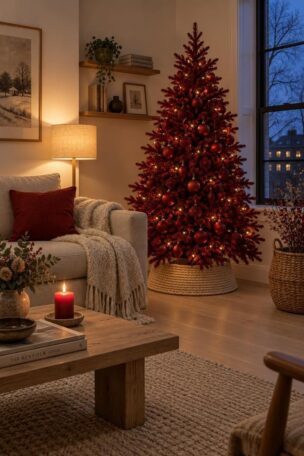
Bright Red Ornament Overload with Gold Accents Only at Branch Tips
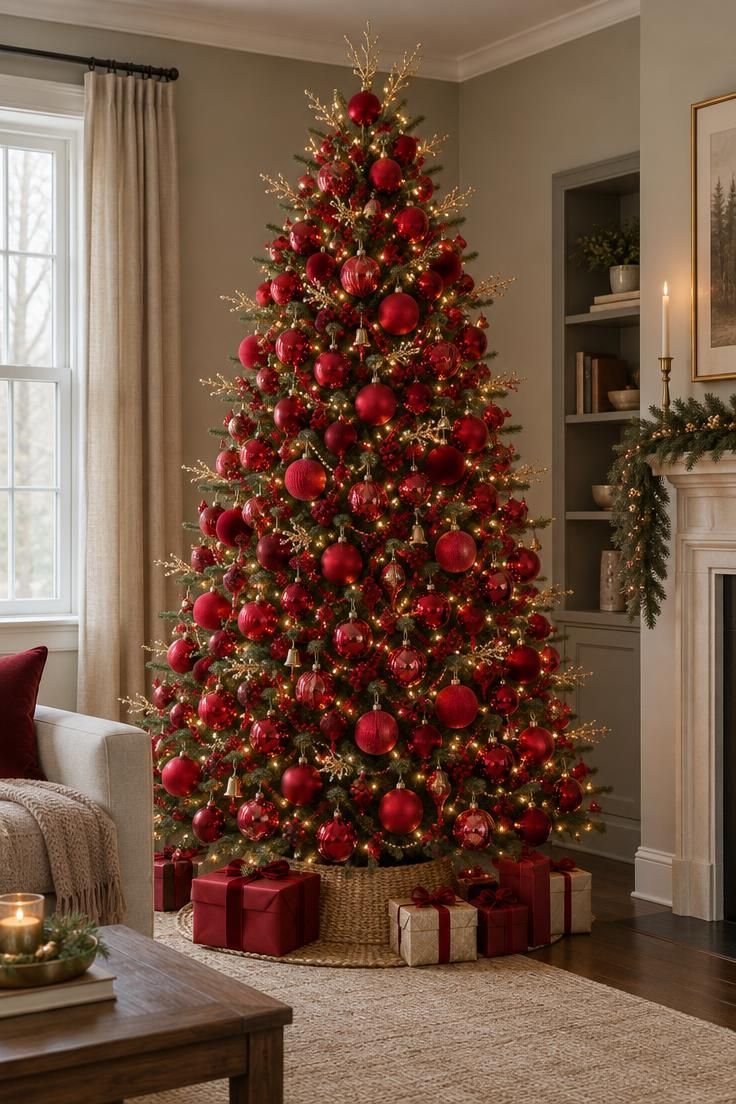
Reversing the usual ratio gives this tree its personality.
Red ornaments in matte, glossy, and even flocked finishes cover the branches, while small gold accents appear only at the outermost branch tips.
Spreading the gold at the tips makes it glimmer at the tree’s silhouette without competing with the red mass.
The gold pieces can be smaller and fewer than expected, since placement does the work.
Dense warm lights keep the red from looking heavy.
Without enough light, a saturated red tree can read dark, so the glow is what makes the candy-apple effect work.
This idea suits a reader with a large red ornament stash who wants something more original than a half-red, half-gold tree.
Finish variety within the red layer keeps it from turning into a flat block of color.
Style Blueprint:
- Red ornaments in matte, glossy, and flocked finishes
- Small gold accents, such as bead strings or tiny bells, at branch tips
- Densely wrapped warm white lights
- Neutral wall and rug tones
Conclusion
The most useful red and gold tree is one built from what already sits in storage, with one or two new accents to shift the overall tone.
Every idea here makes a clear decision about where the red and gold live, how much of each color the eye sees, and what the light does to the finished surface.
Starting from the tree shape, wide or slim, and the existing ornament finish mix prevents the common trap of buying another box of mixed balls that will not move the design forward.
Choose one composition rule, keep the base and topper aligned with that same logic, and adjust ribbon and filler after the tree is lit.