This post may contain affiliate links. If you make a purchase through these links, we may earn a commission at no additional cost to you.
A white Christmas tree behaves differently from green foliage: it reflects light and acts as a neutral backdrop, so ornaments, ribbons, and finishes carry the visual weight.
That quality makes white trees a natural fit for calm holiday decorating, where restraint and texture matter more than bright color.
The ideas below treat the tree as a design canvas, with each look tied to a specific material or technique.
Room settings, scale, contrast, and upkeep appear where they shape the final result, so each direction can be judged on how it fits a real home.
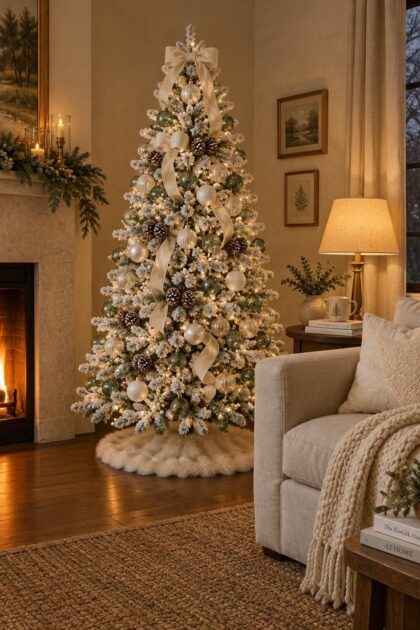
Flocked Tree with Birch Branches and Wooden Ornaments
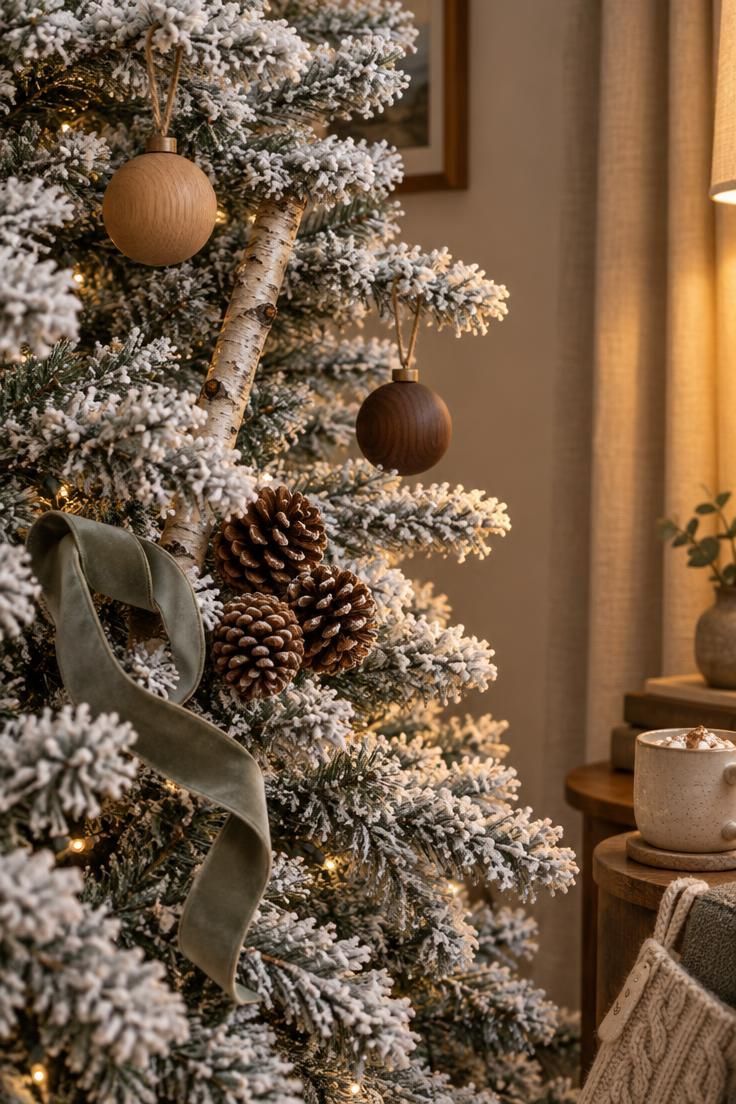
A flocked finish gives the tree a soft, snow-dusted surface that adds visual depth without any color at all.
Birch branches slipped between the branches create height changes and a few slender diagonal lines, so the composition does not read as one even mass.
Matte wood and rough pinecone scales supply the contrast that keeps the flocking from looking uniformly soft.
Flocked christmas tree decorations work best here when the extra pieces share the same quiet palette: natural wood, bare birch, pinecones, and a ribbon in sage or muted green rather than a saturated evergreen.
Group pinecones in small clusters of two or three instead of spreading them evenly, so the eye travels between tree and room.
Choose slim wooden ornaments for the outer branches, since lighter pieces sit more comfortably at the tips than dense ones.
Texture mixing carries this look.
A little gloss, perhaps one or two glass baubles hidden deeper in the branches, keeps the matte wood and flocking from feeling flat.
Keep the room nearby simple: cream walls, a wool throw, and one ceramic object are enough.
Flocking sheds, and white surfaces show handling marks more than green needles do, so keep a soft brush nearby during setup and pack the tree carefully at the end of the season.
Style Blueprint:
- Flocked white tree with a light, uneven snow finish
- Two or three birch branch segments tucked at different heights
- Matte wooden ornaments in oak, walnut, and natural birch
- Small pinecone clusters grouped rather than scattered
- Sage or muted green velvet ribbon looped loosely through the branches
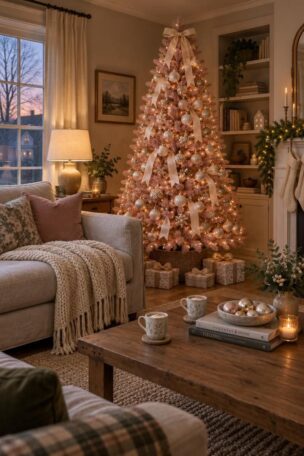
All-White Tonal Tree with Velvet Ribbon and Faux Fur Skirt
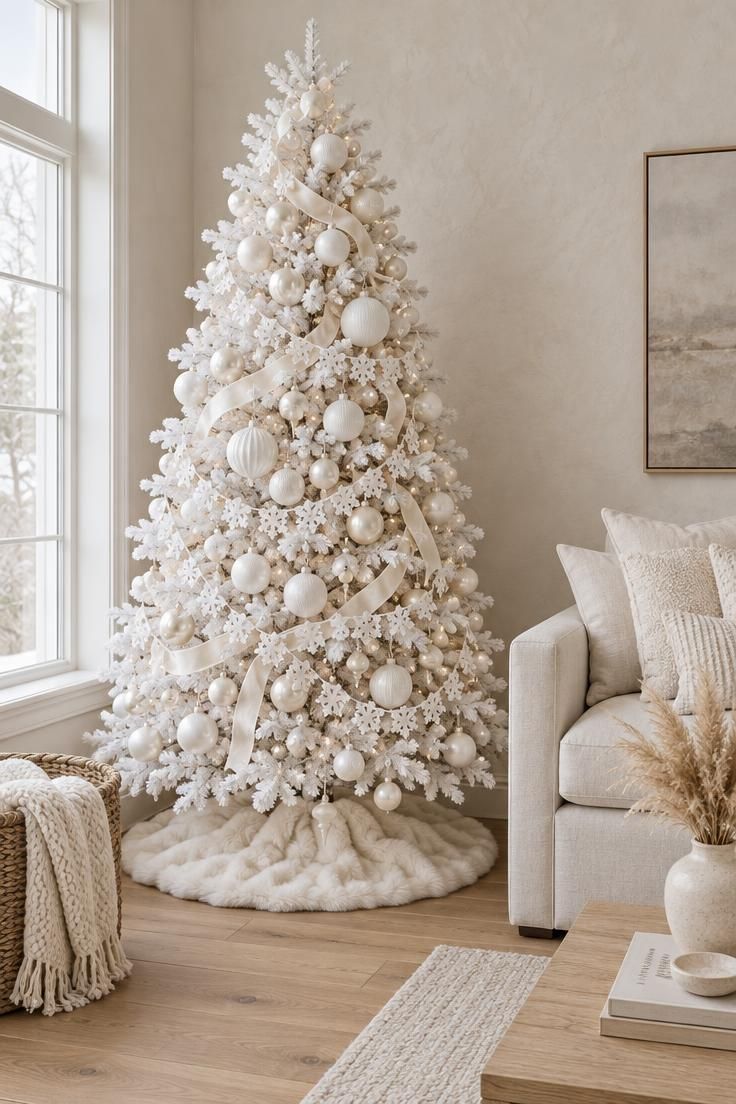
A monochrome scheme succeeds or fails on texture.
Two or three shades of white and cream, from bright white glass to warm ivory velvet, create depth without introducing color, and the eye reads the differences in finish rather than hue.
Vary ornaments between matte, satin, pearl, and gloss so the tree has light-catching and light-absorbing surfaces side by side.
These white christmas tree ideas depend on a room that supports them.
Warm neutral walls and light wood floors let the tonal layers feel connected; against cool gray or heavily saturated walls, an all-white tree can look disconnected from its surroundings.
A paper snowflake garland adds one more handmade texture without breaking the palette.
The faux fur skirt softens the base and gives the tree a grounded, generous footprint.
If floor space is tight, a quilted cotton skirt in the same ivory family works nearly as well and stores flatter.
Keep the ornament count moderate.
A tonal tree needs enough pieces to read as layered, yet too many white baubles merge into a single pale mass.
Mixed sizes do more for the composition than a higher count.
Style Blueprint:
- White tree with a mix of matte, satin, pearl, and gloss ornaments
- Ivory velvet ribbon in wide loops rather than tight spirals
- Paper snowflake garland for a handmade texture layer
- Faux fur tree skirt in cream or ivory
- Warm neutral wall color and light wood tones nearby
Design Pro-Tip: Photograph nothing, but do stand back a few paces while decorating an all-white tree. From across the room, ornaments that look distinct up close can merge into one pale mass, and the view from the sofa is the one that matters.
Black and White Graphic Tree with Buffalo Check Ribbon
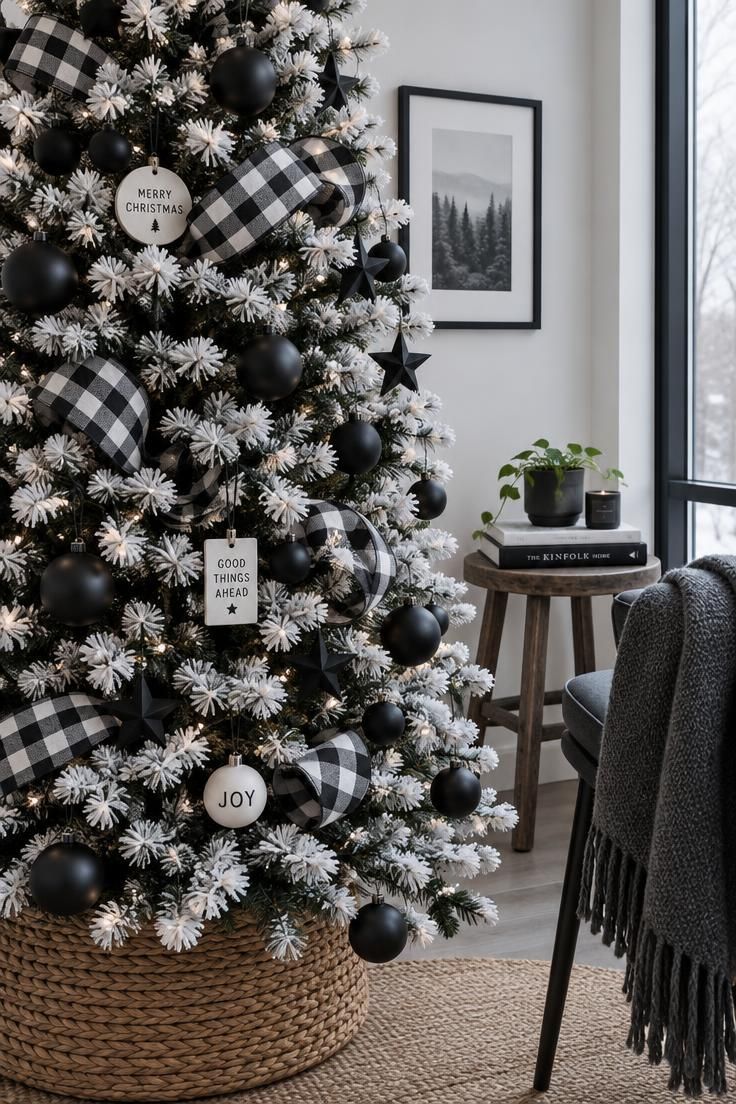
An all-white christmas tree theme turns graphic when the palette narrows to two values.
Matte black ornaments repeat one shape and one finish, buffalo check ribbon supplies a repeating pattern, and nothing else enters the scheme.
Restraint is the entire mechanism: two ornament shapes, one ribbon style, no accent color.
Typography ornaments and simple black stars give the tree a few readable motifs without adding visual noise.
Space them at different depths rather than lining them along the outer tips, so the black shapes appear to sit inside the white branches rather than float on the surface.
This look is easy to break.
Even a single stray colored decoration disrupts the graphic effect, so plan the palette before hanging anything and set aside gifts or ornaments that do not fit.
Glossy black ornaments show dust and fingerprints faster than matte finishes, which is worth knowing if the tree sits in a busy part of the house.
The surrounding room should stay quiet.
A plain wall, one black frame, and a woven basket at the base keep attention on the tree's contrast instead of competing with it.
Style Blueprint:
- White tree with matte black spherical ornaments
- Buffalo check ribbon in black and white, looped in wide structured bows
- One or two additional black motif shapes, such as stars
- A plain wall and minimal black accents nearby
- Seagrass or woven basket at the base instead of a fabric skirt
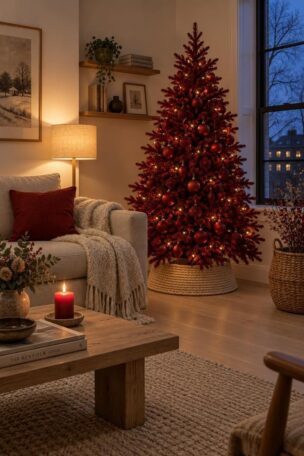
White Tree with Red Ornaments and Plaid Ribbon
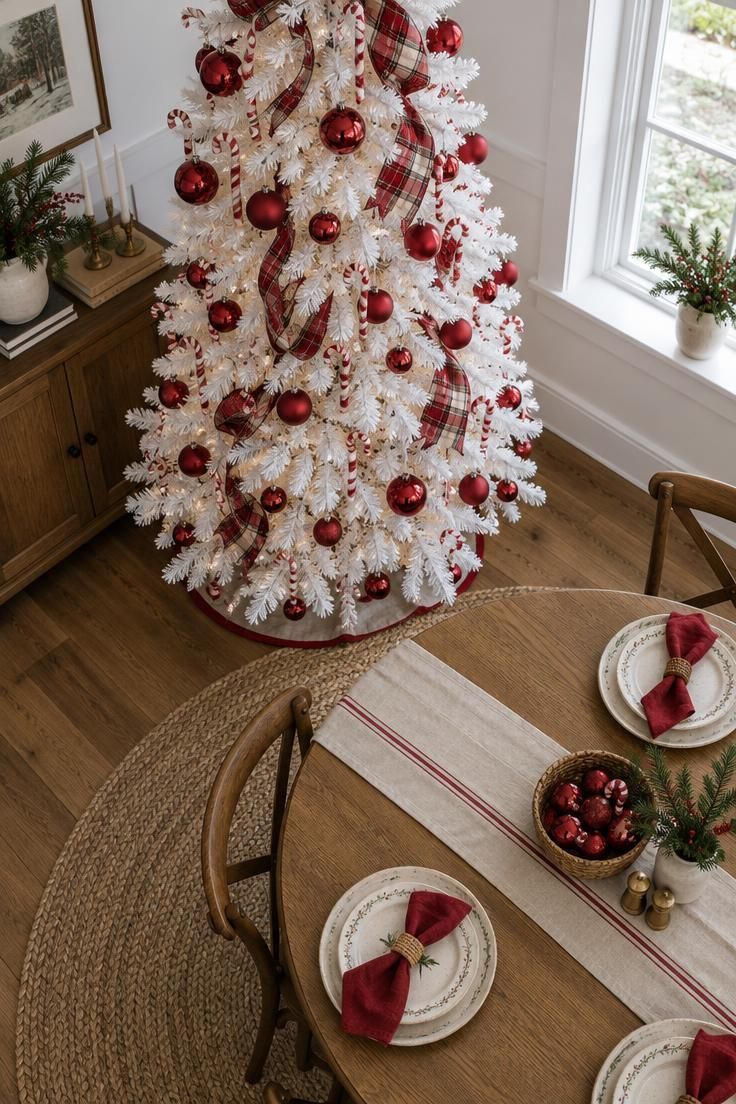
Red against white holds its clarity because the tree never competes with the color.
The white surface keeps red ornaments from feeling heavy, so a larger bauble reads as a deliberate accent rather than an overwhelming one.
Mix matte and glossy red finishes so the color has both a soft and a reflective version.
Candy-cane stripes and plaid ribbon add pattern in the same red family, which keeps the scheme cohesive.
Place ornaments at varying depths in the branches instead of only on the tips; red pieces set slightly inside the white needles create shadow and dimension.
A white tree with red ornaments suits a family room or dining area where red already appears in textiles, such as a linen runner, a woven throw, or a rug.
When red lives elsewhere in the room, the tree feels like part of the household's existing palette rather than a separate display.
Plaid ribbon holds a structured bow well.
Wide loops read from across the room, while narrow ribbon disappears into the branches, so choose the width based on how far the tree will usually be viewed from.
Style Blueprint:
- White tree with red baubles in mixed matte and glossy finishes
- Candy-cane striped ornaments for a second red pattern
- Red and cream plaid ribbon tied in wide loops
- Red echoed in nearby linens or a rug
- Round dining table or family room seating nearby
Small White Tree for an Apartment with Paper Ornaments
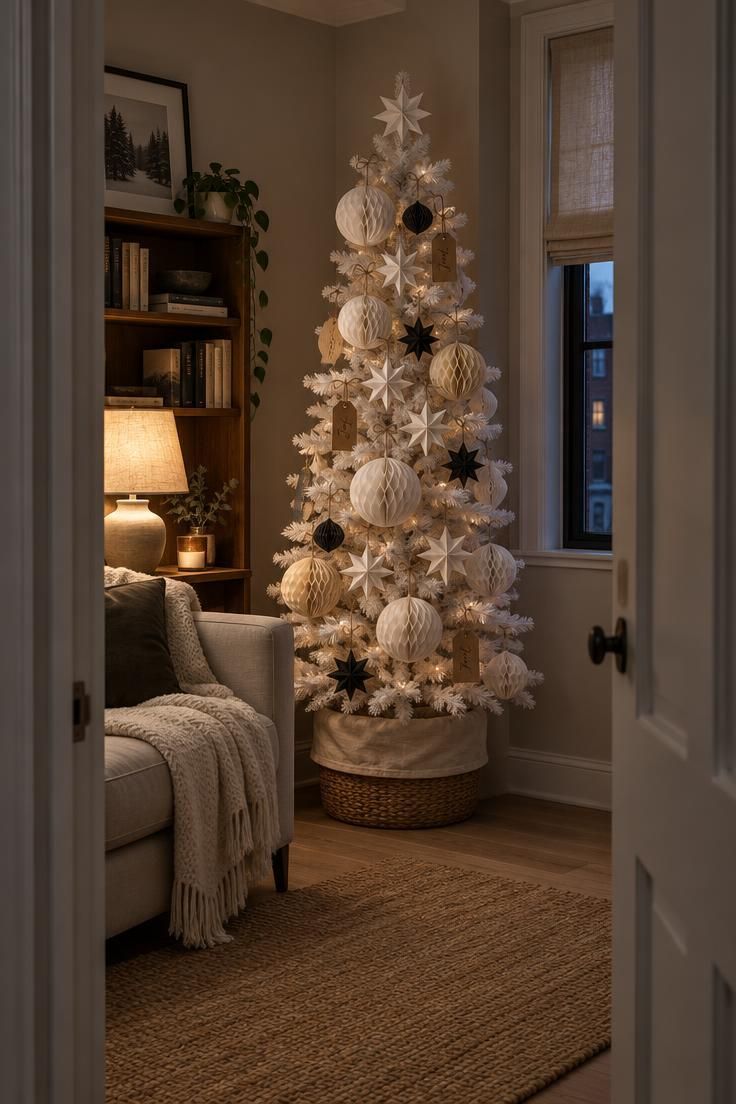
A small white christmas tree for apartments works best when the decorations match its scale in an unexpected way: oversized paper shapes give a slim tree presence without needing much width.
Honeycomb spheres, folded stars, and kraft tags are light, so they sit easily on a narrow tree and store flat between seasons.
Choosing a plain basket or a wrapped base keeps the floor area visually light, which matters in a compact room.
Measure the intended corner before buying so the tree does not block a walkway or sit against a radiator.
The paper pieces also bring warm brown and off-white into the scheme.
A few black paper stars mixed into the arrangement create a loose black and white christmas tree effect while keeping the overall look soft and small-scale.
Paper ornaments flatten easily for storage, but humid spaces can make them curl.
A dry closet shelf and a flat box protect their shape from year to year.
Style Blueprint:
- Slim or tabletop white tree sized to the corner
- Large paper honeycomb ornaments in white and cream
- Folded paper stars, including a few black ones
- Kraft gift tags tied with twine
- Plain woven basket or wrapped base
Metallic Glam Tree with Mercury Glass and Beaded Garlands
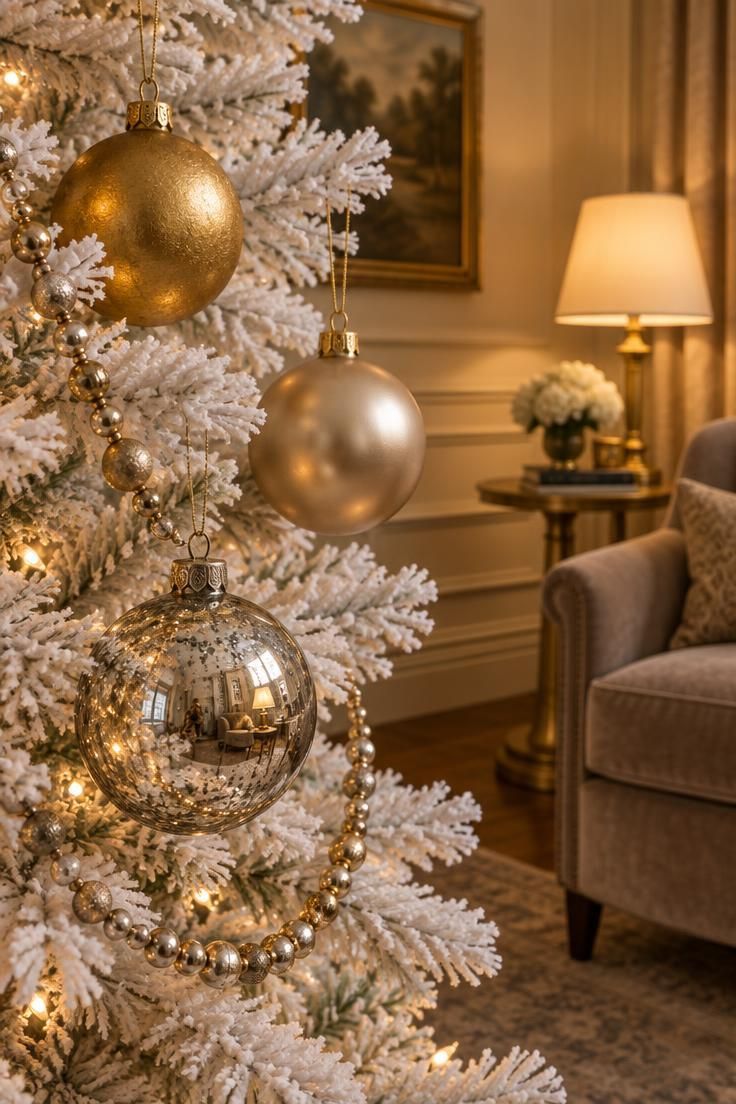
Mixed metals read as one coherent group against a white tree because the neutral backdrop lets each finish register separately.
Gold, champagne, and silver sit together without competing the way they might against green needles, where the foliage adds a strong color of its own.
Two metal finishes usually feel more collected than three.
Choose a dominant metal, then add a second as an accent, and let mercury glass bridge the two with its reflective surface.
Beaded garlands add a linear texture that contrasts with round baubles.
Warm fairy lights keep the scene from looking icy.
A small white christmas tree for apartments can carry this metallic approach too, since the finishes concentrate visual interest in a small footprint and the look needs fewer ornaments to feel complete.
Mercury glass and beaded garlands need careful handling when packing.
Wrap each mercury piece individually and coil garlands loosely so the strands do not kink.
Style Blueprint:
- White tree with gold and champagne or silver as the second metal
- Mercury glass ornaments for a reflective bridge
- Beaded garland in a matching metal tone
- Warm-white fairy lights
- Brass or metallic accents in the surrounding room
Design Pro-Tip: Hang metallic ornaments in small odd-numbered groups of three or five at different depths instead of spacing them one at a time. Mixed metals look intentional in clusters and scattered in singles.
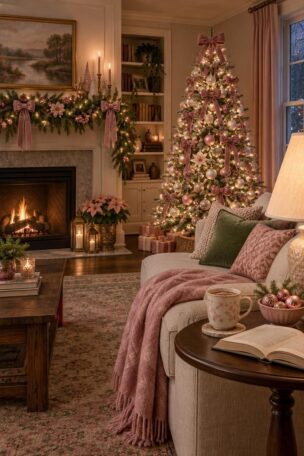
Frosted Pastel Tree with Iridescent Baubles
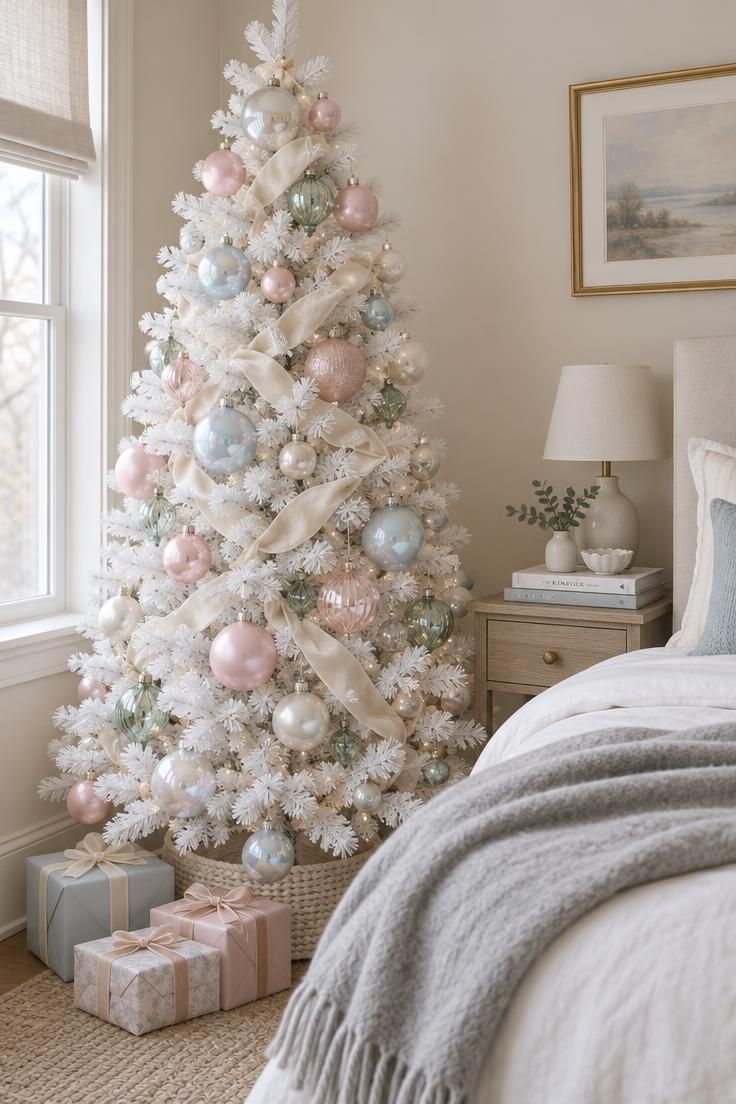
A white tree keeps soft pastels from looking washed out, because the branch color is already light and the ornaments can hold their own tint.
Limit the palette to two pastel colors plus white, and let the third color appear only in small pieces, so the tree reads as composed rather than confectionary.
Iridescent and pearl finishes give pastel baubles a shifting quality that plain color lacks.
Pale pink glass ornaments, mint or pale blue spheres, and a cream velvet ribbon cover most of the surface without needing many additional materials.
The setting matters as much as the palette.
A bedroom or small reading nook suits this look because the gentle color range does not compete with the room's quieter function.
White linen and a soft gray throw nearby keep the pastel tree from feeling isolated.
Velvet ribbon in cream rather than a pastel shade ties the scheme back to the tree and stops the colors from floating loose.
Style Blueprint:
- White tree with blush and pale blue as the primary pastels
- Iridescent and pearl-finish baubles
- A third pastel such as mint used sparingly
- Cream velvet ribbon woven through the branches
- White and gray linens nearby
Fruit and Botanical Tree with Dried Citrus and Eucalyptus
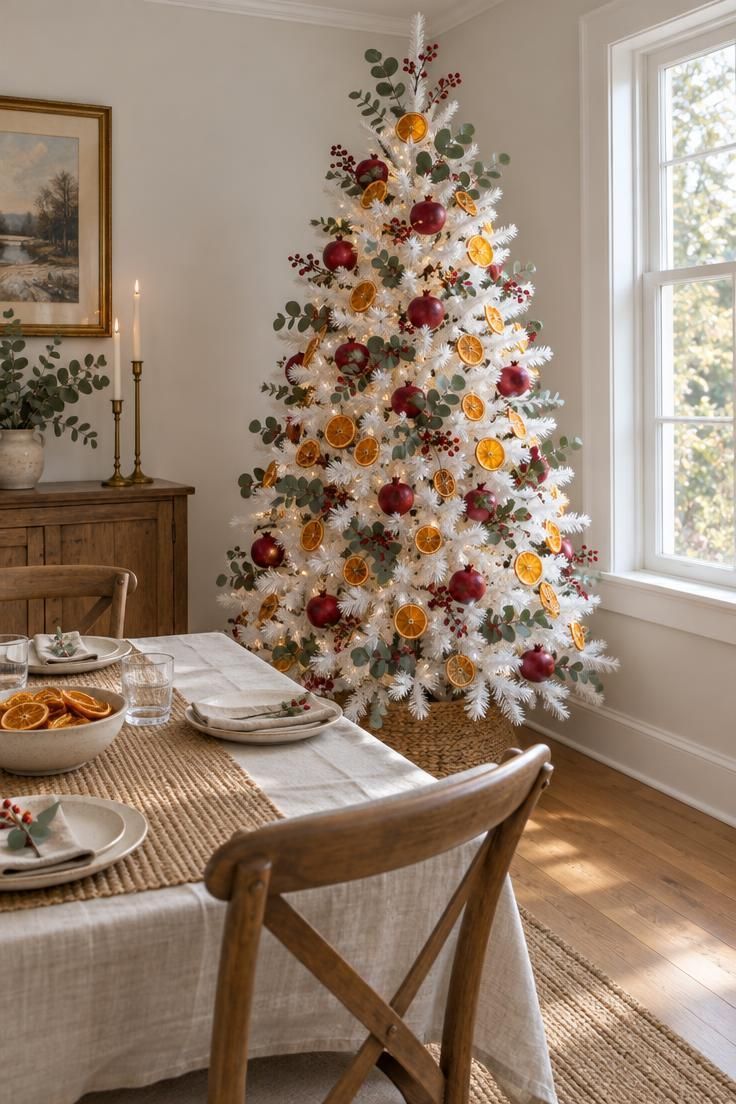
Dried citrus adds warm color spots without turning the palette saturated.
The orange slices read as small, glowing accents against the white branches, while eucalyptus lends a muted gray-green that keeps the scheme grounded.
Faux pomegranates and berry picks add a deeper red in small doses.
Place eucalyptus in the inner branches where the white needles provide contrast; outer branches fill quickly, and the gray-green foliage reads better when set slightly back.
Faux berries are a practical choice over real ones near a heat source, since they hold their color and shape through the season.
Natural pieces may crumble or fade after one winter.
Store dried citrus and eucalyptus flat in a cool, dry box, and check the fruit for softness before packing it away.
This look suits a dining area, where botanical elements echo the table's linens and ceramics.
A woven runner and a bowl of dried oranges on the table tie the tree to the room without extra decoration.
Style Blueprint:
- Dried orange slices as warm color accents
- Eucalyptus sprigs set in the inner branches
- Faux pomegranates and small berry picks
- A woven runner or table linen nearby
- A bowl of dried citrus on the dining table
Paper Snowflake and Kraft Tag Tree for a Craft-Led Look
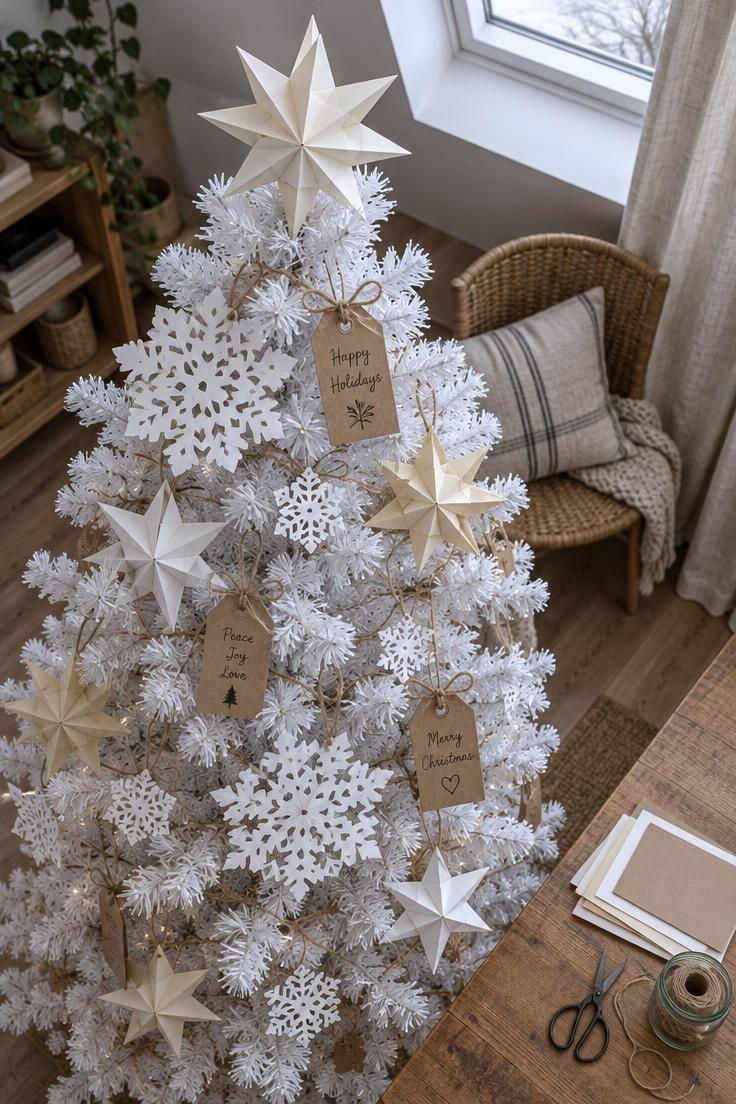
Paper decorations turn the white tree into a neutral gallery for handmade work.
Snowflakes in two sizes create a rhythm of large and small shapes, and folded origami stars add dimension without color.
Kraft gift tags bring a warm brown contrast that keeps the white scheme from feeling too cool.
Make snowflakes from heavier card stock so they hold their shape instead of drooping on the branch.
A small dab of glue at the fold points helps the largest ones keep their structure through the season.
Paper ornaments flatten easily for storage, but they may curl if kept in a humid space.
A flat box in a dry closet protects them, and any curl usually relaxes once the pieces are hung.
The craft-led look works well in a room where making and displaying belong together.
A wooden table, a jar of twine, and a stack of card stock nearby suggest the decorations grew out of the space itself.
Style Blueprint:
- White tree with paper snowflakes in two sizes
- Folded origami stars in white and cream
- Kraft gift tags tied with natural twine
- Heavy card stock for the largest snowflakes
- A flat storage box for dry, cool keeping
Vintage Glass and Tinsel Tree with Mismatched Ornaments
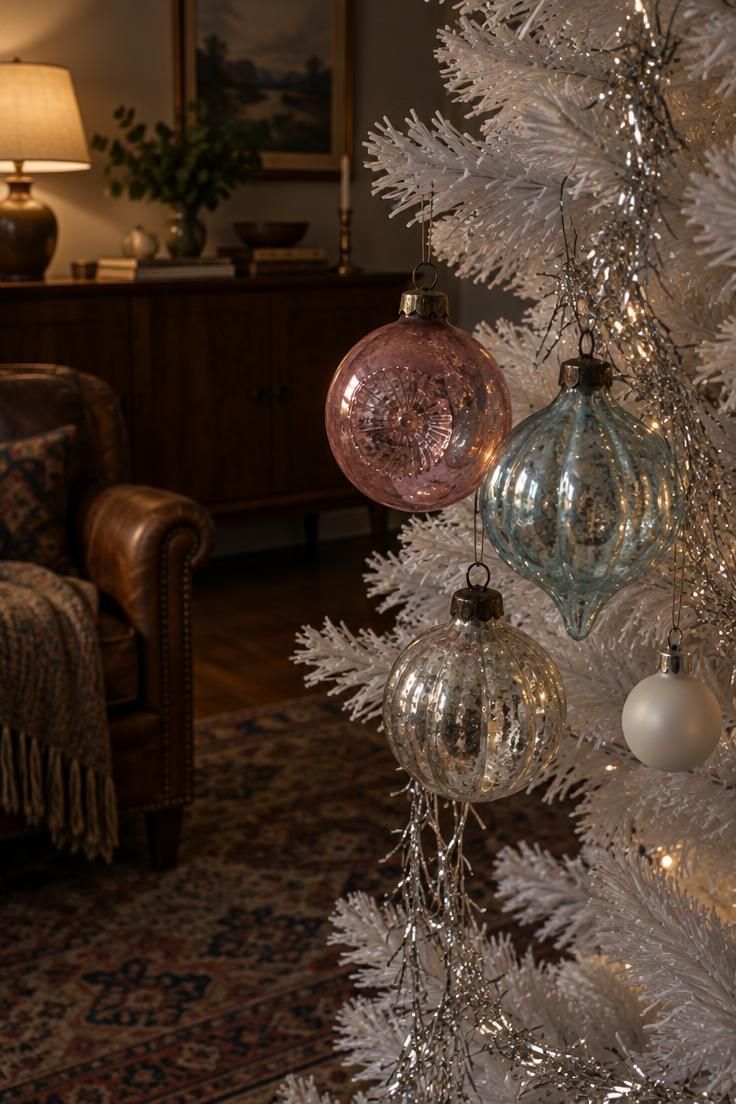
A white tree lets each collected ornament read as an individual piece, similar to a display case where the background disappears and the objects carry the story.
Mismatched glass baubles in faded pastels and silver, combined with a line of tinsel, give the tree a layered, gathered quality that a uniform set cannot match.
Combine shiny tinsel with matte white baubles to avoid one-note sparkle.
The matte pieces absorb light and give the eye somewhere to rest between the reflective surfaces.
Thinner or older glass ornaments are fragile.
Reserve them for higher branches where they are less likely to be bumped, and hang heavier pieces where they will not swing into one another.
Store each piece wrapped and labeled if the collection matters to the household.
This approach best suits a living room where the tree is a focal point rather than a background.
Around a dark wood sideboard and a worn leather armchair, the white tree and its varied glass pieces hold the room's center of attention.
Style Blueprint:
- White tree with mismatched vintage-style glass baubles
- Faded pastels in pink, blue, and silver
- A thin strand or two of silver tinsel
- Matte white baubles to balance the shine
- Higher placement for fragile pieces
White Pine and Brass Bell Tree for a Quiet Living Room Corner
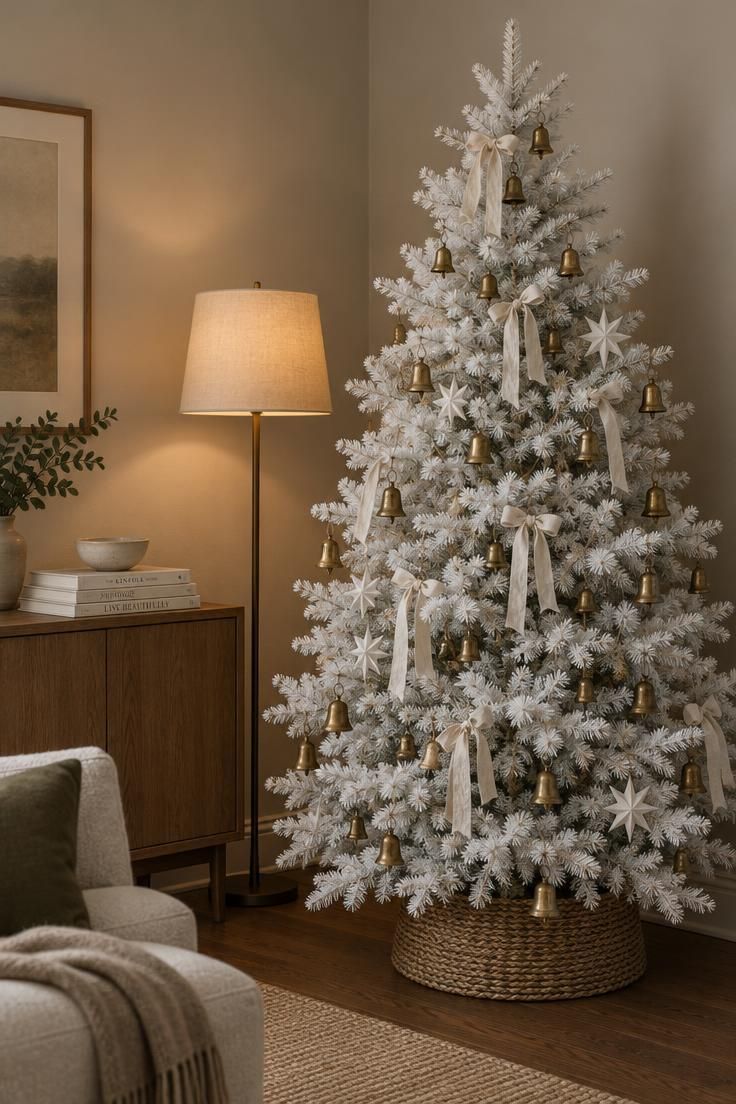
A white pine tree takes on a quieter character when the decoration leans toward small metal pieces with a dull finish rather than shiny or glossy ornaments.
Small unpolished brass bells tied in pairs or singles with short cream linen ribbon add a muted gleam that catches the eye only when someone moves past the tree.
Place the bells deeper in the tree, not just on the branch tips.
That placement creates small flashes of metal among the white needles and gives the tree a more collected look than a row of ornaments hung around the outer edge.
This idea suits a compact living room corner where the tree needs to feel present without becoming the loudest object in the room.
The soft contrast between white pine and dull brass also coordinates naturally with tan leather, oatmeal upholstery, or warm wood furniture.
A few white paper stars folded from heavy card stock can fill the gaps between bells without adding more color.
Vary the bell sizes slightly so the eye moves around the tree rather than landing on one repeated shape.
Style Blueprint:
- White pine tree in a quiet living room corner
- Small unpolished brass bells in two or three sizes
- Short cream linen ribbon ties for each bell
- White paper stars tucked near inner branches
- Side lamp light to reveal texture and depth
Design Pro-Tip: Hang brass bells in small clusters of two or three at varying depths. A cluster reads as one considered moment, while a single bell spaced evenly around the tree tends to disappear into the white branches.
Conclusion
A white Christmas tree is a flexible base for very different holiday looks, from high-contrast black and red to soft pastels and natural botanicals.
Choosing one clear material direction and repeating it with slight variation keeps the tree feeling intentional rather than decorated piece by piece.
Texture carries more weight on a white surface, so ribbon, finish, and natural elements do more of the work than color count.
The right direction comes down to the room's existing palette, the floor space available, and how much upkeep each finish asks for.