This post may contain affiliate links. If you make a purchase through these links, we may earn a commission at no additional cost to you.
A red tree changes the temperature of a living room before a single gift appears.
The color can come from needles, ribbon, florals, or ornaments, and each source asks something different of the surrounding furnishings.
This guide separates those approaches so the tree suits the room rather than fighting it.
Some ideas commit hard to red, others borrow a small amount and let the rest of the decor stay quiet.
Solid Red Tree with Matte and Metallic Ornaments
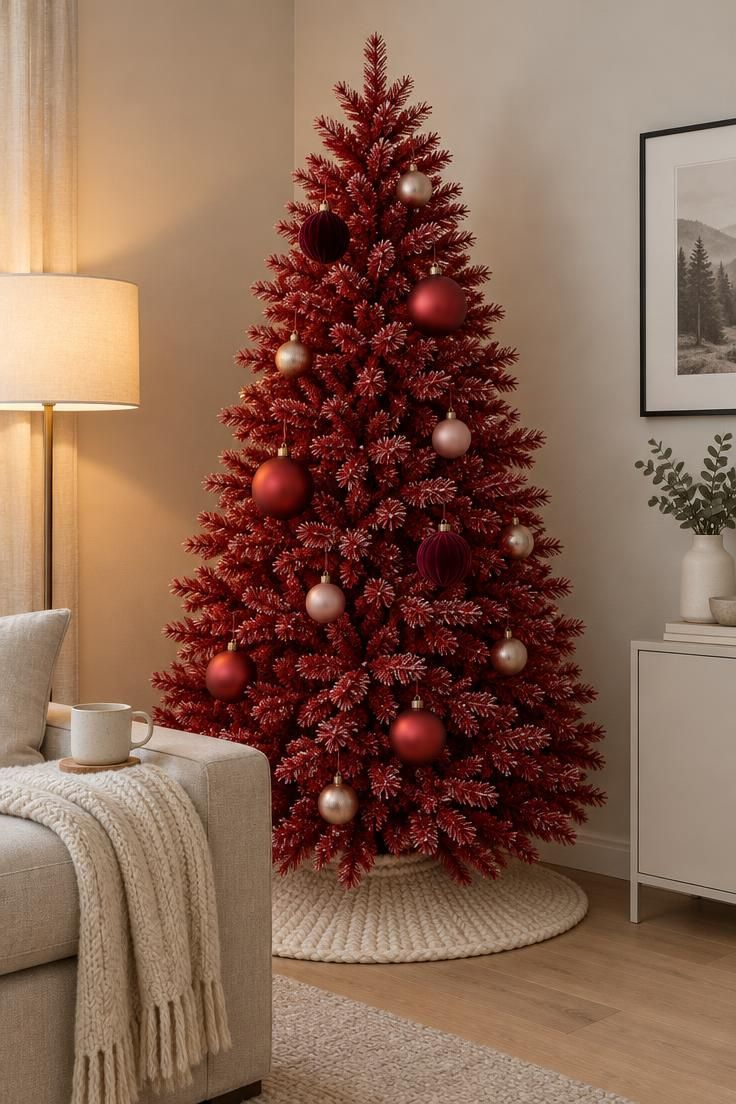
A solid red tree already carries visual weight, so the decorating job is about depth rather than color.
Mixing matte, metallic, and velvet finishes in nearby reds gives the eye something to separate, and blush tones keep the palette from turning into one flat block.
Fewer, larger red christmas tree ornaments often work better here than dense small pieces, because each one has room to register against the needles.
Placement of the largest ornaments matters more than their number.
Setting the biggest metallic spheres low and toward the outer branches lets them catch light near eye level, while smaller velvet pieces sit deeper in the tree.
A cream or woven skirt keeps the base from adding another red note.
Commitment is the real cost of this approach.
A solid red tree is harder to restyle year to year than a green one, since the color locks in the palette.
Finish choice matters too: a very glossy red can look artificial under bright light, while a matte or lightly frosted surface reads more subdued.
Style Blueprint:
- A solid red artificial tree with a matte or lightly frosted finish
- Red, burgundy, and blush ornaments in matte, metallic, and velvet finishes
- A cream woven tree skirt to neutralize the base
- White and greige furnishings around the tree to keep red as the focal color
Red Tree with White and Cream High-Contrast Ornaments
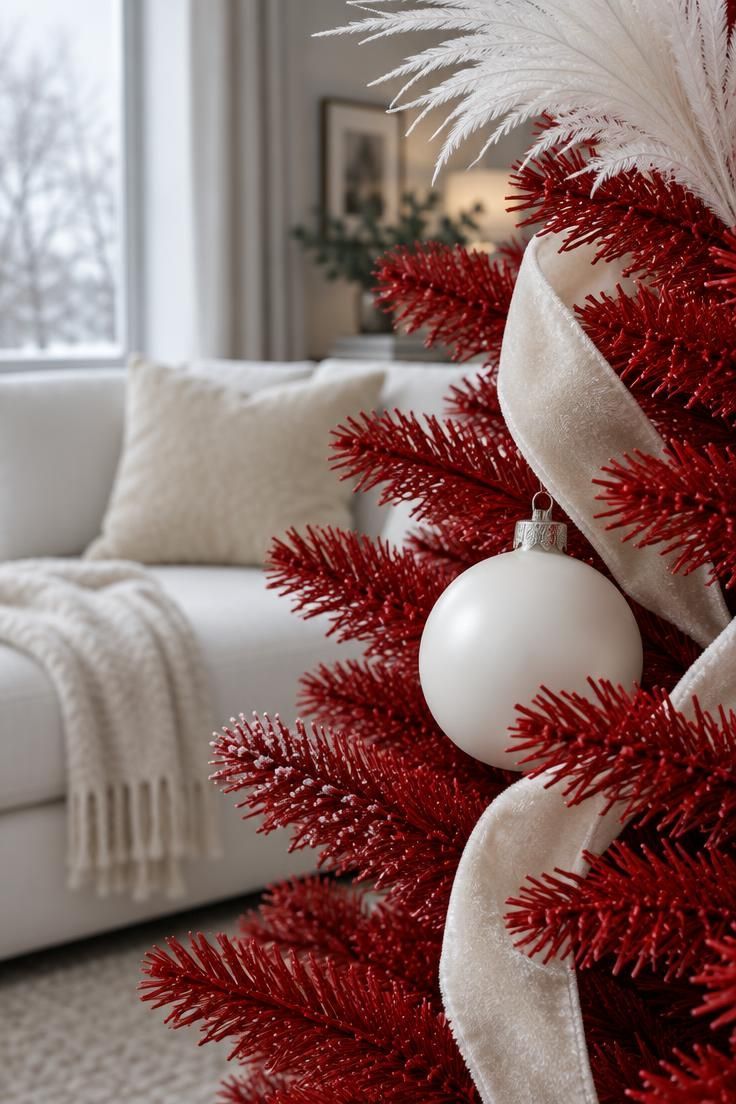
White and cream ornaments against red needles produce a contrast that makes both colors read more clearly.
The red looks brighter, the white looks cleaner, and the tree acquires a crisp graphic quality that suits a bright living room.
Even spacing matters more than quantity here, since a cluster of white ornaments pulls the eye to one spot and leaves the rest of the tree looking unfinished.
Wide cream satin ribbon gives the white palette a continuous line through the branches, and a few white feather picks add softness at the tips.
Keeping the ribbon and ornaments in the same cream family stops the tree from splitting into two competing whites.
Light temperature affects how the red appears.
Warm-white tree lights can push red toward orange, so cooler bulbs or simply switching off warm overhead lamps helps the red stay truer, particularly in photographs.
This is a matter of color rendering, not a rule about which bulbs to buy.
The palette does carry a risk of drifting toward a candy-cane look.
That may be exactly the mood a household wants, and it may not.
If the goal is a more restrained room, limiting the white to ornaments and one ribbon while skipping striped accents keeps the contrast from becoming literal.
Style Blueprint:
- A red artificial tree with clear, saturated needles
- White and cream ball ornaments, evenly spaced rather than clustered
- Wide cream satin ribbon woven through the branches
- Two or three white feather picks at the branch tips
- Cooler light sources near the tree to keep the red reading true
Flocked Red Christmas Tree with Woodland Accents
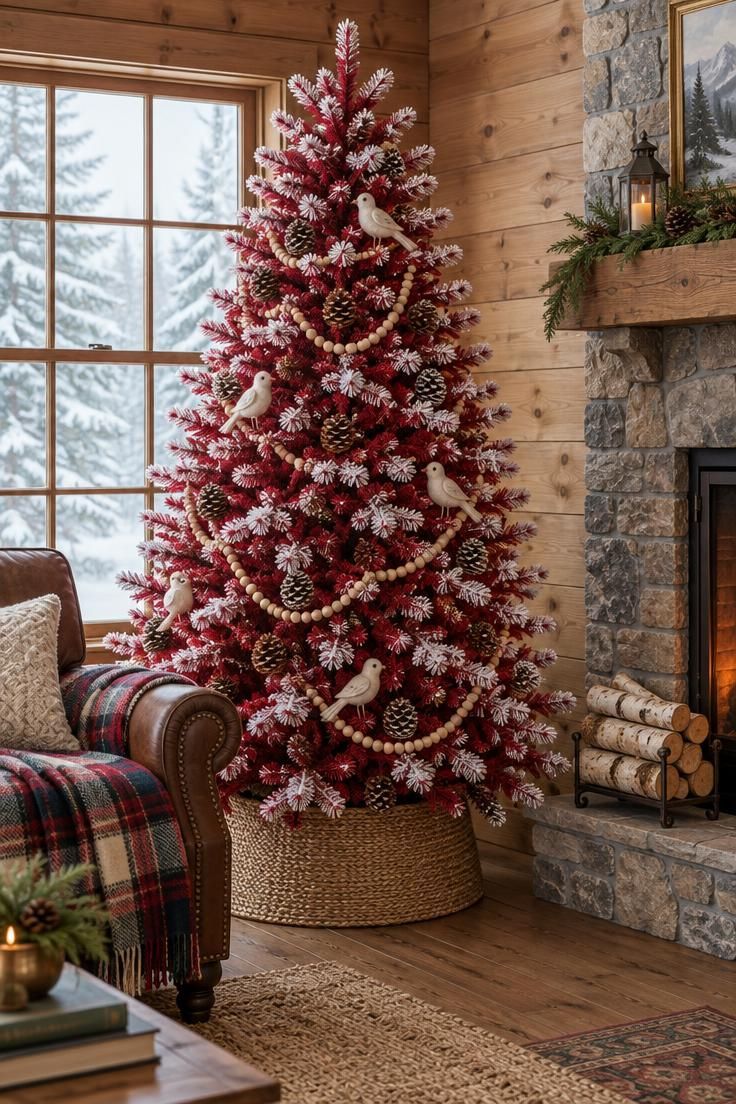
Flocking changes the character of a red tree by breaking up the solid color with white tips.
The silhouette softens, the tree reads as a winter piece rather than a bold statement, and the overall effect leans woodland.
Natural materials continue that direction: pinecones, wooden beads, and small cream felt animals sit comfortably against frosted red where shiny metallics would feel out of place.
The white flocking also makes the tree easier to place in a room that already holds some red.
A red rug or a red-and-cream textile nearby no longer competes, because the tree’s own white tips create separation.
That flexibility is useful in a living room with existing warm tones.
Flocked trees shed, particularly while branches are being spread during setup and packed away afterward.
Handling the branches gently and working over a drop cloth reduces the mess.
The flocking itself shows handling marks, so pressing or bending the tips should stay minimal.
Style Blueprint:
- A flocked red tree with white-tipped branches
- Pinecones and a wooden bead garland
- Cream felt bird or animal ornaments on outer branches
- A natural woven tree collar instead of a fabric skirt
- Wool plaid and birch logs nearby to reinforce the cabin mood
Red Ornament Cluster Tree with Bare Green Branches Between
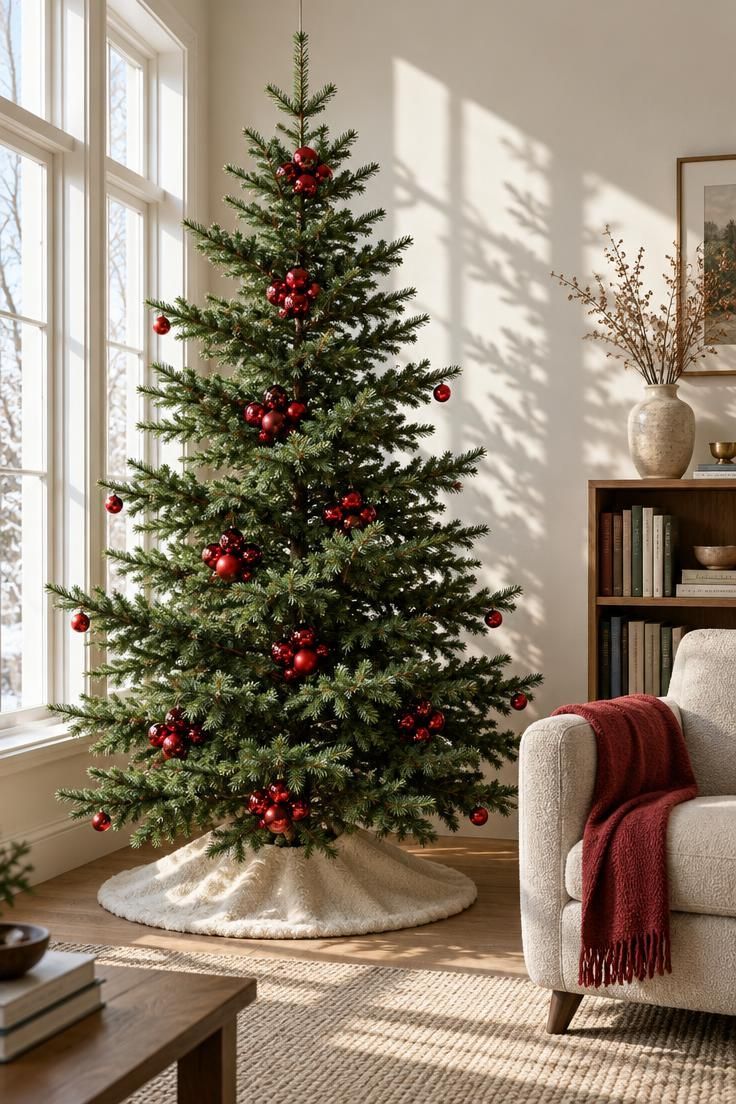
Leaving parts of a green tree bare is a deliberate composition choice, not an unfinished one.
Concentrated groups of red ornaments read as small vignettes, and the exposed green between them gives the eye a place to rest.
The result feels more edited than a uniformly covered tree, which suits a living room with clean lines and limited pattern.
Cluster size and height do most of the work.
Grouping a few ornaments together at varying depths, then repeating that grouping at different heights, creates movement around the tree.
Evenly spaced clusters at identical heights flatten the effect, and clusters that are too small can make the tree look underdecorated rather than intentional.
This approach uses fewer ornaments overall, which helps when the ornament budget is modest.
A handful of larger red pieces in strong clusters delivers more presence than a full covering of small ones would.
Style Blueprint:
- A green tree with branches left deliberately bare between groupings
- Red ornaments clustered in small groups at varying depths and heights
- A neutral cream tree skirt
- A red throw on nearby seating to echo the tree’s accents
- Bright daylight to show the gloss and shadow of each cluster
Red Velvet Ribbon Garland as the Red Source
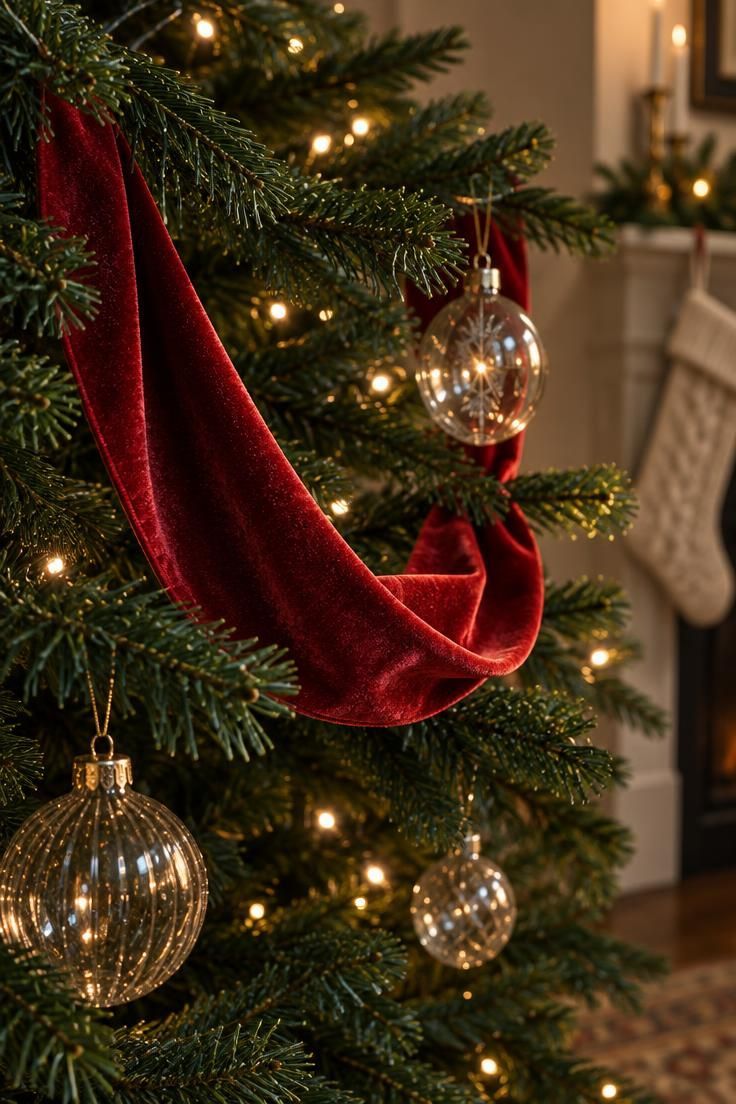
Ribbon can carry the red for a whole tree without a single red ornament.
Wide velvet strips woven through green branches give the tree a rich, continuous red line, and neutral ornaments in cream, gold, or clear glass let the ribbon remain the story.
This is a lower-commitment route than a solid red tree, since the ribbon can be swapped or removed in later years.
Ribbon width should follow tree size.
Wider ribbon suits larger, fuller trees where narrow strips would disappear into the branches.
Narrow ribbon reads better on slim or tabletop trees, where a wide strip would overwhelm the shape.
Looping rather than pulling the ribbon tight lets the velvet drape and show its texture.
Velvet holds creases if it is folded and stacked for storage.
Loosely coiling each length after the season keeps the pile smooth, so the ribbon hangs better the following year.
The limitation is distance.
On a green tree, ribbon alone may not read as boldly red from across a large room, since much of the green stays visible.
A red skirt or a few red ornaments near the top can strengthen the impression without turning the tree into a red-only scheme.
A flocked red christmas tree base, even lightly flocked, pushes the red further forward if that is the goal.
Style Blueprint:
- Wide red velvet ribbon woven in loose loops through green branches
- Cream, gold, or clear glass ornaments kept secondary
- Warm white fairy lights that reveal the velvet texture
- Ribbon width scaled to the tree’s fullness
Red Floral Tree with Amaryllis and Berry Picks
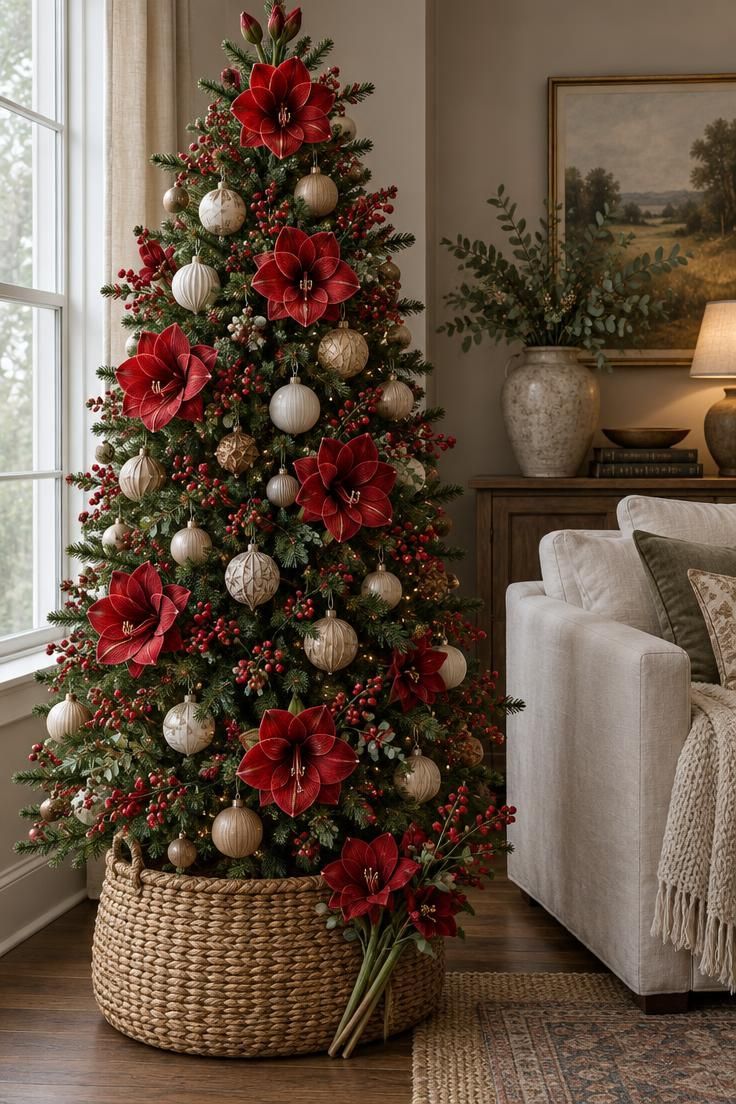
Using flowers as the red element gives a tree more texture than ornaments alone can supply.
For a red decorated green tree, faux amaryllis blooms bring size and structure, berry picks fill the spaces between them, and a green tree base lets the red florals stand out against foliage.
The result reads as arranged rather than decorated.
Balance keeps the tree from turning top-heavy.
Large blooms deserve space around them, so smaller berry clusters belong between and below, not stacked above.
Spacing the biggest flowers at different heights and angles gives the tree a natural, growing quality.
Faux florals collect dust through the year, and a gentle shake or light dusting before decorating removes most of it.
Stems that look tired after several seasons can be refreshed by reshaping the petals with fingers.
The style can drift toward formal or even spring-like if the supporting pieces are too delicate.
Wintery companions such as pinecones, wood tones, or a wool skirt pull it back toward the season.
In a room with classic furniture, the floral density may feel right at home; in a very modern room, fewer blooms and more bare branch might suit better.
Style Blueprint:
- Large faux amaryllis blooms as the primary red element
- Berry picks to fill gaps between the larger flowers
- Cream and tan ornaments as quiet support
- A green tree base so the red florals pop
- A woven basket at the base holding spare stems
Sculptural Painted Red Branch Tree
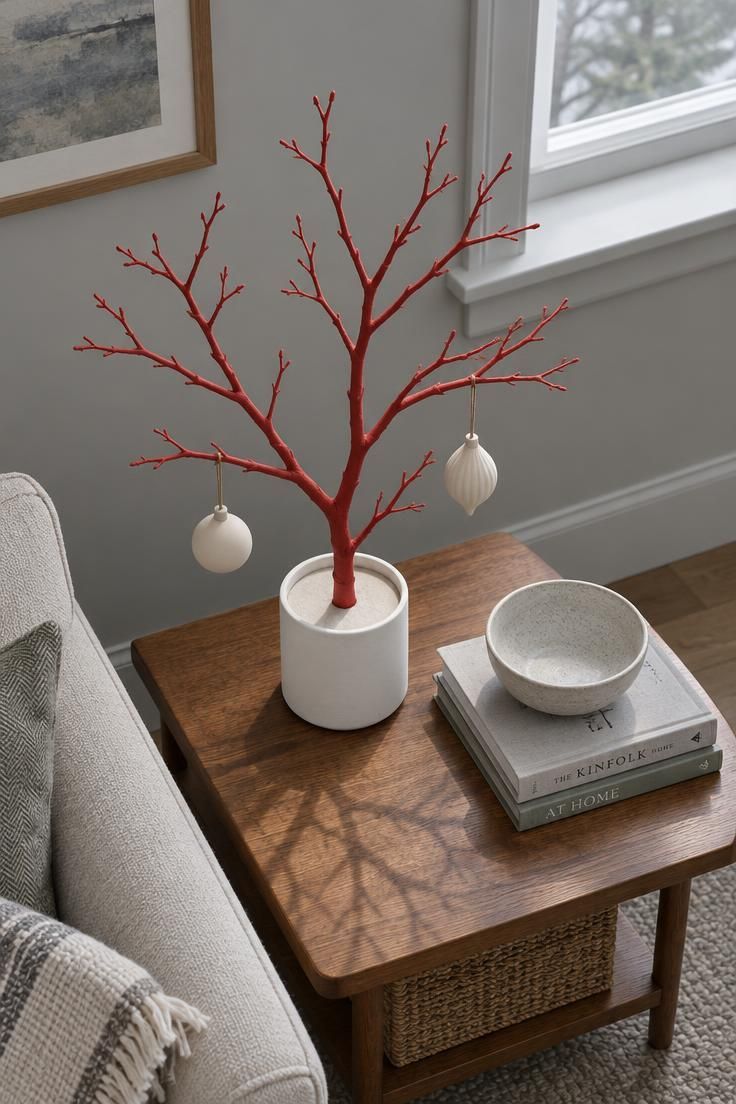
A sparse branch tree painted red trades holiday fullness for shape.
The red lives in the branches themselves, so ornaments stay few and chosen for form.
A couple of matte black or cream ceramic pieces hung low are enough, and the branches remain the main event.
This is decoration as object rather than as spectacle.
Scale suits this idea to a side table, console, or the corner of a larger surface.
The sculpture quality works best when the tree has room around it, so a crowded shelf or a busy mantel undercuts the effect.
Pairing it with a simple planter or urn lets the red branches draw the eye without competition.
Painted branches read as modern rather than traditional.
In a room with classic holiday decor, the tree may feel out of step, while a minimalist or contemporary living room gives it a natural home.
The finish can chip with handling, so padding during storage and care when rearranging the ornaments keep the paint intact.
Style Blueprint:
- A sparse branch tree with matte red painted branches
- Two or three matte cream or black ceramic ornaments
- A simple white or stone planter as the base
- A clear side table with breathing room around the tree
- Cool daylight that lets the branch shadows fall softly across the table
Tabletop Red Christmas Tree in a Neutral Nook
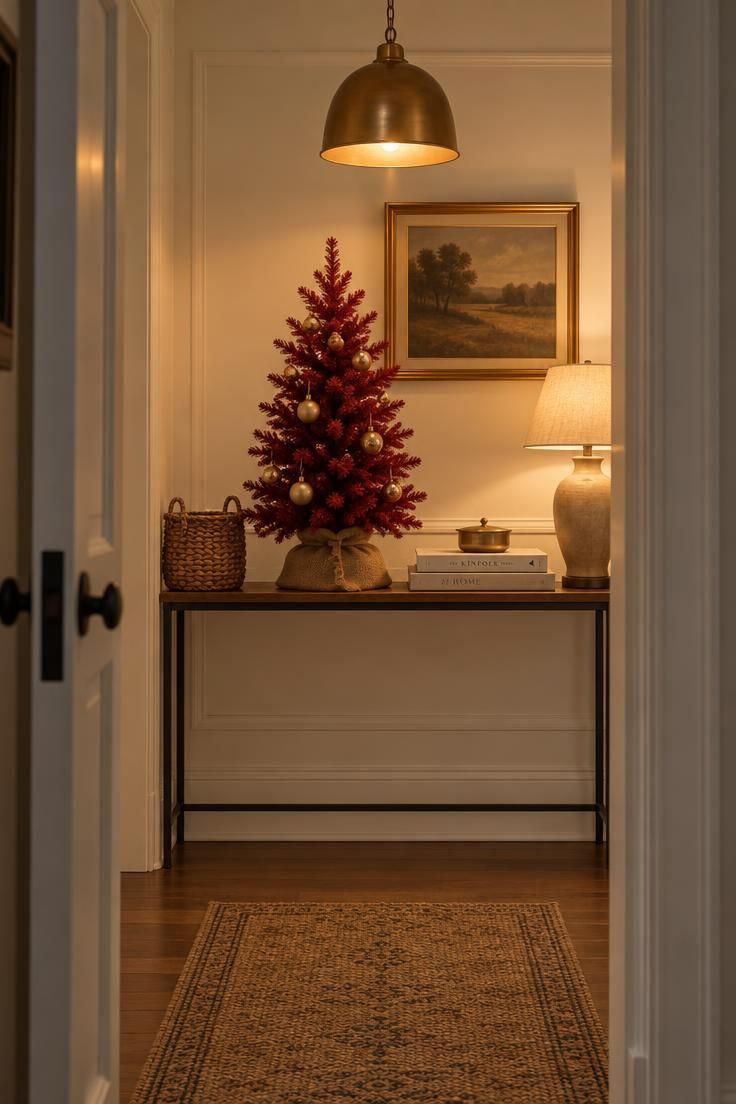
For a tabletop red christmas tree, a tabletop red tree works as a secondary accent rather than the room’s main event.
On an entry console or a bedroom dresser, it delivers the color without demanding floor space or a full decorating session.
The small scale also invites a simpler ornament plan: one finish, such as all matte or all glossy, keeps the tree from looking cluttered.
The base deserves attention at this size.
A small burlap collar or a wrapped fabric around the pot finishes the bottom without the bulk of a full skirt.
A basket or a stack of books beside the tree extends the vignette and makes the arrangement feel settled.
Ornament capacity is limited on a tabletop tree, and overdecorating makes it look sparse rather than full.
Two or three larger ornaments placed with space between them usually read better than a scattering of small pieces.
Placement matters too: setting the tree on a stable, level surface keeps it upright in a household with pets or young children, and keeping it back from the edge of the console reduces the chance of a knock.
Style Blueprint:
- A tabletop red Christmas tree sized to its console or dresser
- A single ornament finish, such as all gold or all matte
- A small burlap collar or wrapped fabric at the base
- A woven basket and stacked books beside it to complete the vignette
- A stable, level surface away from the edge
Red Tree as the Single Saturated Focal Point
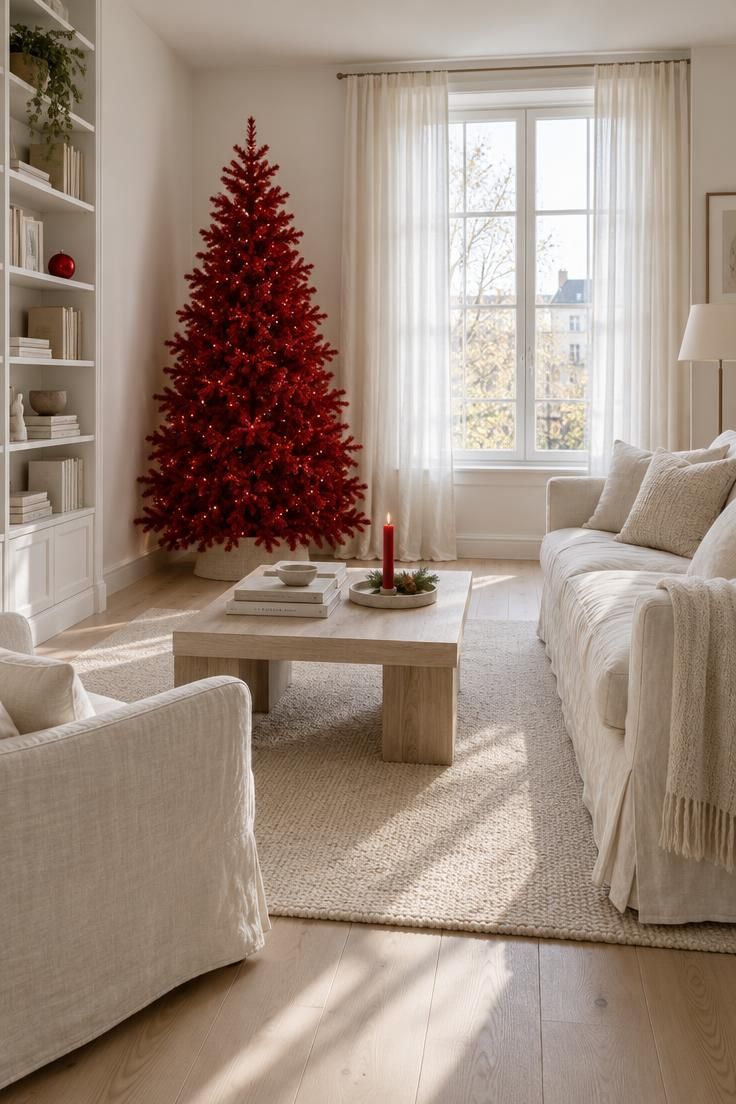
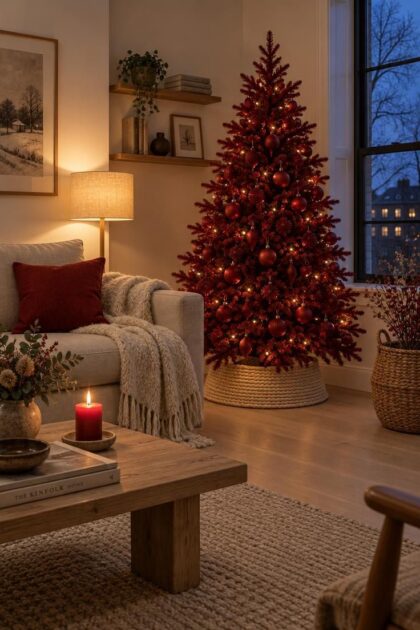
In an all-neutral room, a red tree becomes the one saturated element and organizes the whole space around itself.
White walls, cream upholstery, and pale wood let the tree carry the holiday mood without additional decor.
The approach suits minimalists who want a festive room without layering themed accessories on every surface.
Position matters for this effect.
A full tree placed where it is visible on entering the room works harder than one tucked into a corner behind furniture.
Repeating a small amount of red elsewhere, such as one ornament on a shelf or a single red candle on the coffee table, keeps the tree connected to the room rather than stranded as an isolated object.
The arrangement does create a future problem.
If the household later shifts to a different holiday palette, the red tree may clash with the new scheme.
That is the price of a strong focal color.
For a household committed to red for several seasons, the simplicity is hard to beat.
Style Blueprint:
- A solid red or red-flocked tree as the room’s only bold color
- White walls and cream upholstery around it
- Pale wood floors to keep the room light
- One small red accent elsewhere, such as a candle or a single ornament
- Tree placed where it is visible on entering the room
Red and Burgundy Tonal Tree for a Soft Palette
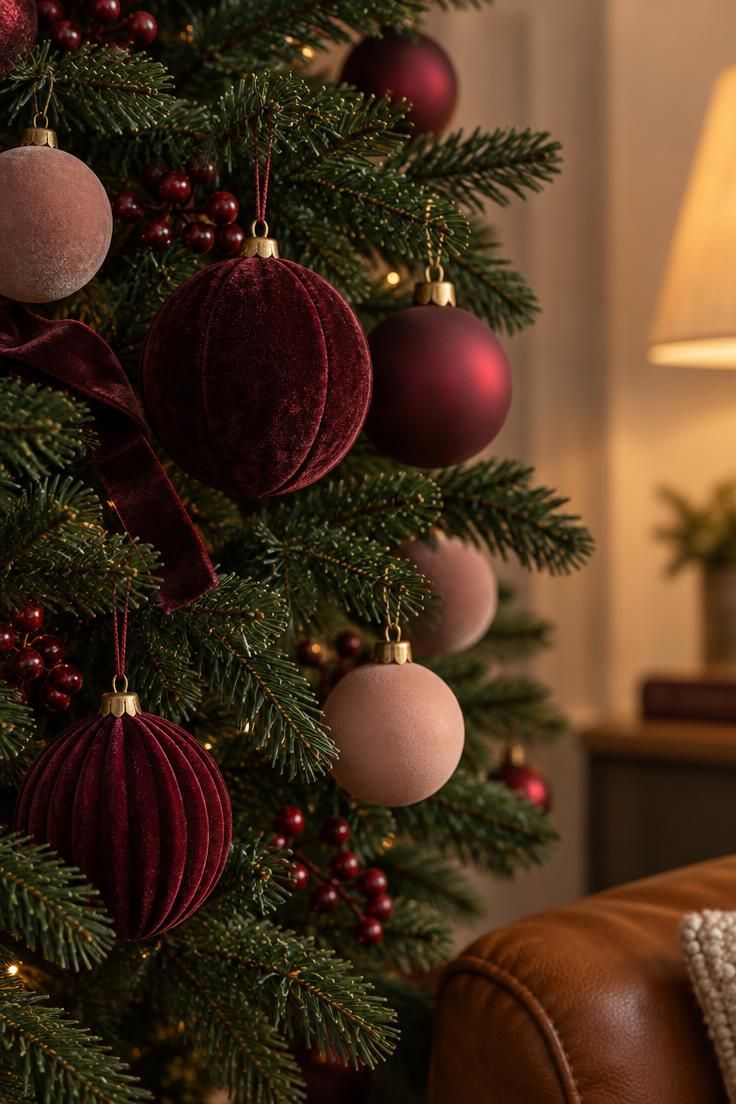
A tonal red palette builds depth from closely related colors rather than contrast.
Wine, berry, and blush sit near each other on the color wheel, so the tree reads as a single warm family with subtle variation.
Matte and velvet finishes suit this approach better than glossy ones, since shine would introduce a different kind of contrast.
Range keeps the palette from going flat.
If every ornament is nearly the same red, the tree loses dimension, so a few lighter blush pieces and a few deep wine pieces give the eye somewhere to travel.
Alternating those values across the tree distributes the range evenly.
This approach harmonizes with warm materials in a living room.
Cognac leather, walnut furniture, and cream textiles let the deeper reds feel settled rather than loud.
The mood leans sophisticated and less playful, which may suit a formal living room and may feel too quiet in a room built for color.
Style Blueprint:
- Ornaments in wine, berry, and blush shades
- Matte and velvet finishes over glossy
- A few lighter and darker pieces for tonal range
- Warm wood, leather, and cream textiles nearby
- Low, warm lamplight to bring out the velvet texture
Red Ribbon-Weave Tree with Buffalo Check Accents
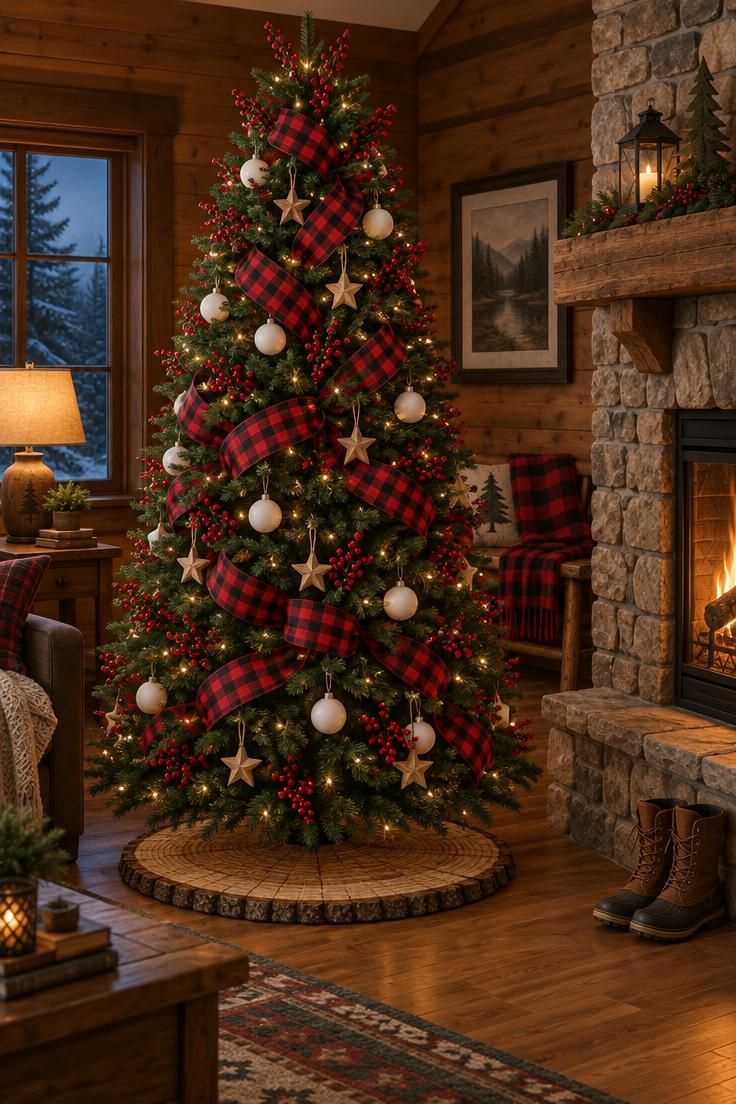
Buffalo check brings a casual, homey pattern to a red tree.
The ribbon does the heavy lifting for color, and its grid adds a graphic rhythm that plain velvet cannot provide.
Keeping the ornaments to red, white, and natural wood lets the check remain the main pattern instead of competing with it.
Draping the ribbon is the working part of this style.
Buffalo check tends to be stiffer than velvet, so cutting lengths generous enough to tuck and loop without tension makes the weaving easier.
Loops that sit loosely on the branches look intentional; pulled-tight ribbon looks strained.
Red berry picks add a small natural note, and wooden stars bring in the cabin feel.
A wood slice skirt at the base ties the arrangement together.
The style leans heavily rustic, and in a sleek modern room the check may feel out of place.
A red velvet ribbon garland woven alongside the check softens the pattern and adds a second texture to the branches.
Style Blueprint:
- Red buffalo check ribbon woven in loose loops through a green tree
- Red berry picks and white ball ornaments
- Small wooden star or snowflake ornaments
- A wood slice tree skirt
- Rustic furniture and a fireplace nearby
Conclusion
The red in a red tree can come from needles, ribbon, florals, ornaments, or textiles, and each source asks for a different level of commitment.
A solid tree locks in the palette but delivers the boldest presence, while ribbon and ornament-led approaches leave room to restyle later.
Scale and placement decide how much of the room the tree commands, from a tabletop accent on a console to a single saturated focal point in an all-neutral space.
Weighing finish, ribbon width, and red value against the furnishings already in the living room turns the choice into a design decision rather than a color gamble.