This post may contain affiliate links. If you make a purchase through these links, we may earn a commission at no additional cost to you.
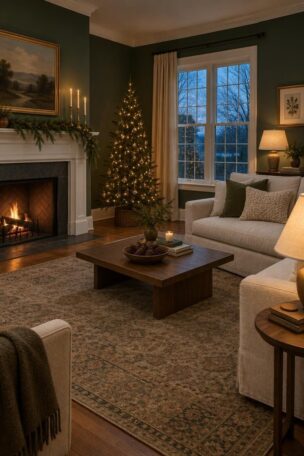
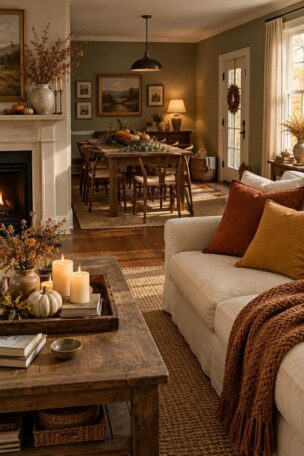
A classic Christmas aesthetic begins with color discipline: deep reds, forest greens, cream, warm gold, and the brown of natural wood repeated from room to room.
Familiar materials do most of the work, from tartan wool and aged brass to mixed evergreens and simple paper.
The look reads as collected rather than purchased because a few motifs carry across the tree, the mantel, the windows, and the tables.
A home decorated this way feels layered and warm without tipping into visual noise.
Each idea below centers on one clear visual moment that can stand alone or connect to the rest of the house.
Flocked Christmas Tree Styling in a Reading Corner
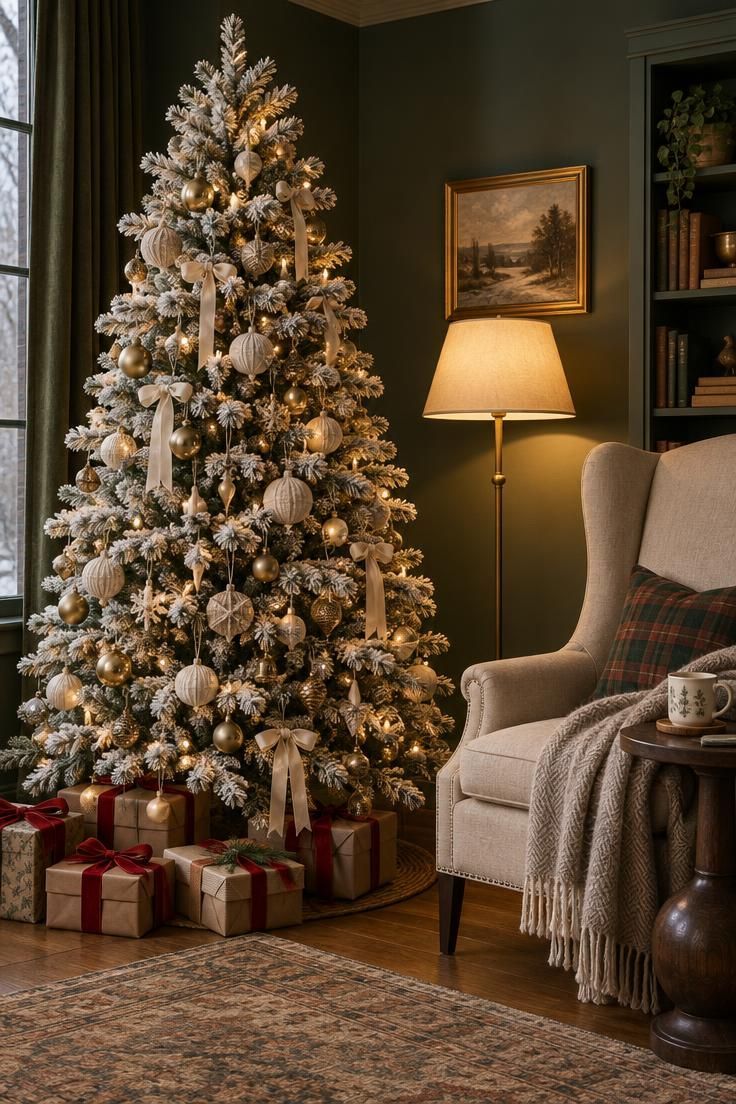
A flocked tree earns its place in a reading corner by softening the dark wood and deep green that often surround a favorite chair.
The pale branch tips catch warm light and read almost like snow against the richer tones nearby, which gives a small corner real depth.
Ornament choice matters here: a tight palette of brass and cream keeps the pale tree from looking washed out.
Layer in a few textured fabric ornaments and simple satin ribbon loops so the tree has something to catch the eye at close range.
Because the flocked surface is the whole point, branches need to be opened and separated before decorating.
Real-touch faux branches respond well to patient fluffing, and spreading them wide lets light reach the flocking instead of sitting flat on the surface.
One practical tradeoff: flocked trees hide bare patches and fallen needles better than plain green trees, yet the coating can drift onto the floor when the tree is moved or repositioned.
Planning the tree’s spot once and leaving it in place through the season keeps the corner tidy.
Style Blueprint:
- A flocked tree with warm-white string lights wound through the interior branches
- Brass and cream ornaments in mixed finishes, plus two or three fabric ornaments
- Satin ribbon loops tucked into the branches rather than tied at the outer edges
- A high-backed chair, wool throw, and dark wood side table to anchor the corner
Design Pro-Tip: Fluff and separate the real-touch faux branches before adding any ornaments so the flocked surface catches light evenly across the whole tree.
Tartan Ribbon Tree Decor on a Staircase Landing
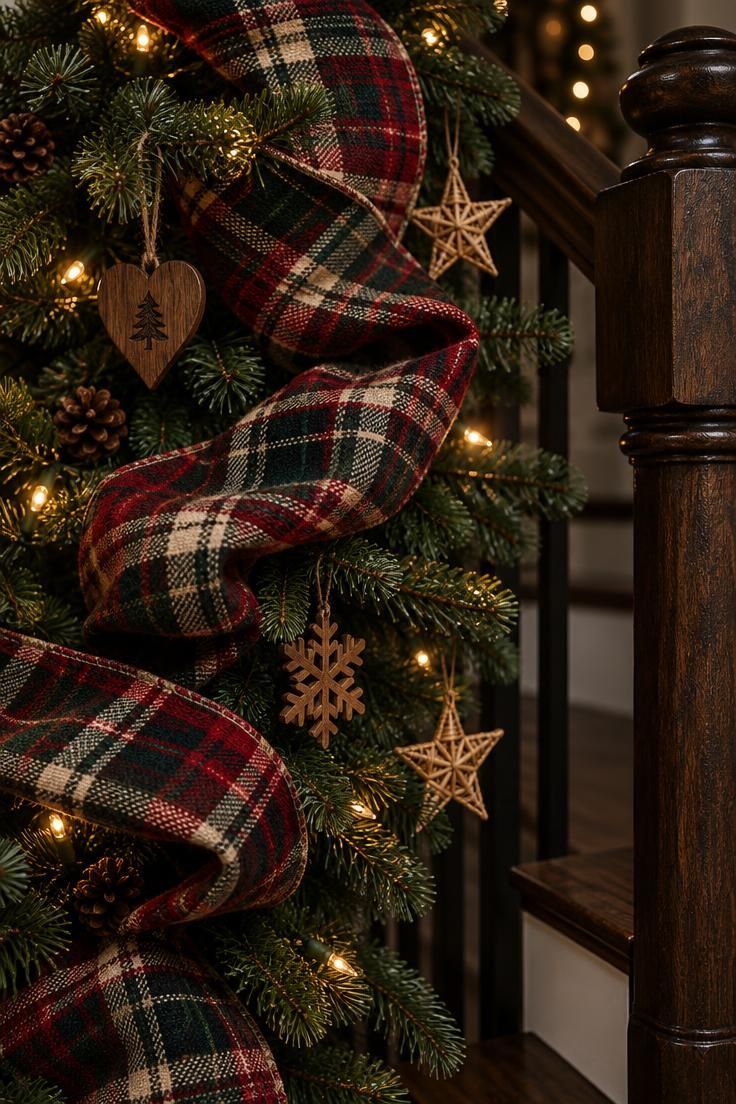
Tartan ribbon tree decor works by turning one pattern into the tree’s organizing line.
Woven through the branches in loose loops and simple bows, the plaid carries red, green, and cream at once, so the tree needs fewer ornaments to feel finished.
Woven and wooden ornaments sit comfortably beside it because their matte surfaces let the ribbon stay the star.
Placement separates a full tree from a hollow one.
Ribbon pushed only onto the outer edge leaves the middle looking empty from an angle, so tucking some loops deeper into the branches fills the silhouette.
A wired grosgrain ribbon holds its bow shape far better than satin, which slumps and creases over a season.
The landing setting adds a second benefit: the tree is visible from the stairs and the room below, so the ribbon repeat reads at a distance.
Keeping the ornament count low also keeps the pattern from competing with itself.
Style Blueprint:
- Wired tartan grosgrain ribbon in red, green, and cream
- Wooden and woven ornaments in natural tones
- Warm-white string lights set behind the ribbon loops
- A landing tree sized to the stair width so the ribbon reads from below
Mantel Garland with Warm Lights and Wooden Beads
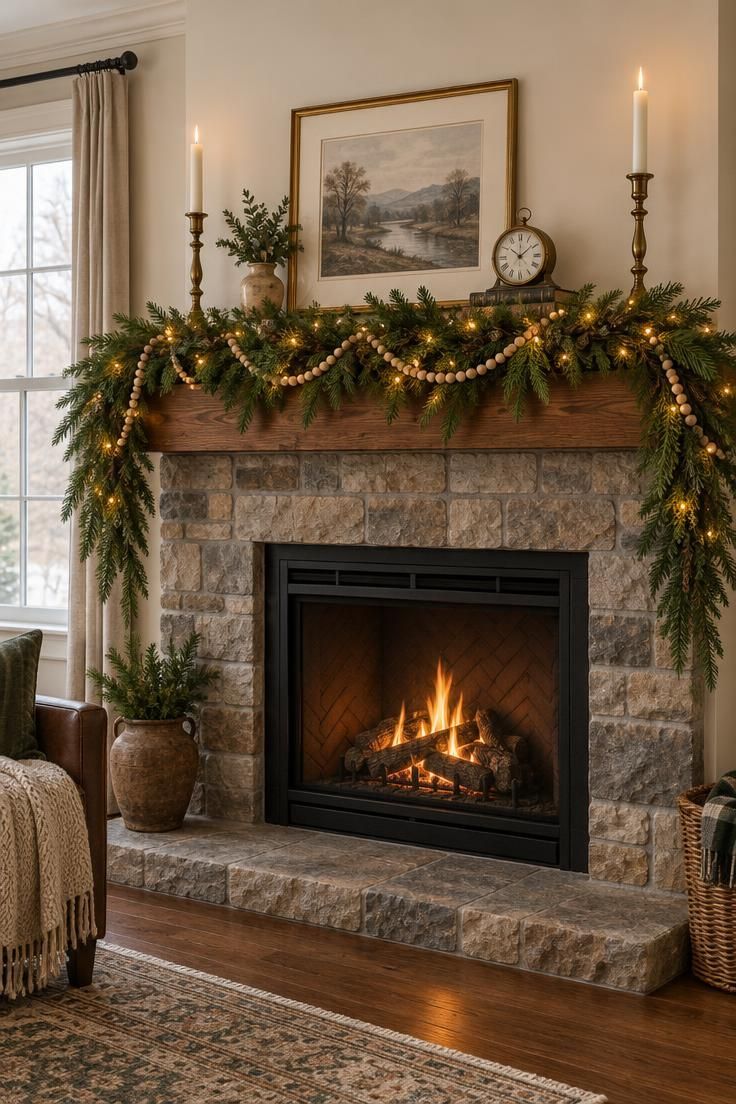
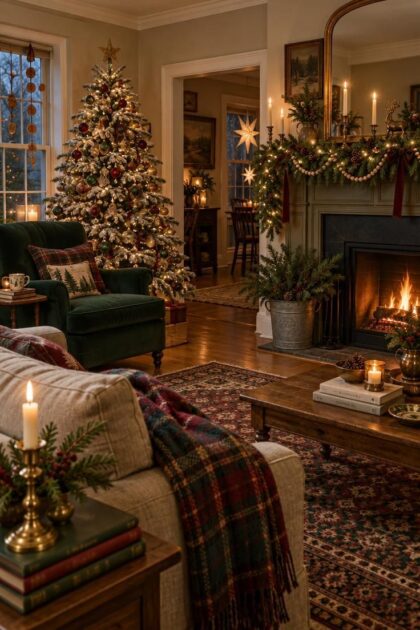
A mantel garland with warm lights gives the fireplace a composed center even when the room is otherwise simple.
The wooden bead strand is the quiet connector: its brown tones echo candlesticks, picture frames, and the mantel wood itself, so the garland feels built into the room rather than added on top.
Line matters as much as fullness.
A garland that dips slightly at the ends and swells in the middle looks arranged by hand, while an evenly thick line can read as stiff.
Mixing fir, cedar, and pine adds varied needle length, which keeps the swag from flattening into one texture.
For bead size, compare the strand to the mantel width: a narrow mantel suits small beads that read as a fine detail, while a long mantel carries larger beads that stay visible from across the room.
Placing the lights inside the garland before it goes up hides the cords and lets the glow come from within the greenery.
Style Blueprint:
- A mixed evergreen garland of fir, cedar, and pine
- Warm-white string lights wound through the interior
- A wooden bead strand in a scale suited to the mantel width
- Tall brass candlesticks and one framed piece for height variation
- A slight dip at each end rather than a rigid, even line
Design Pro-Tip: Wind the string lights through the garland before hanging it so the cord disappears into the evergreens and the glow sits inside the arrangement.
Brass Candlestick Display on a Sideboard
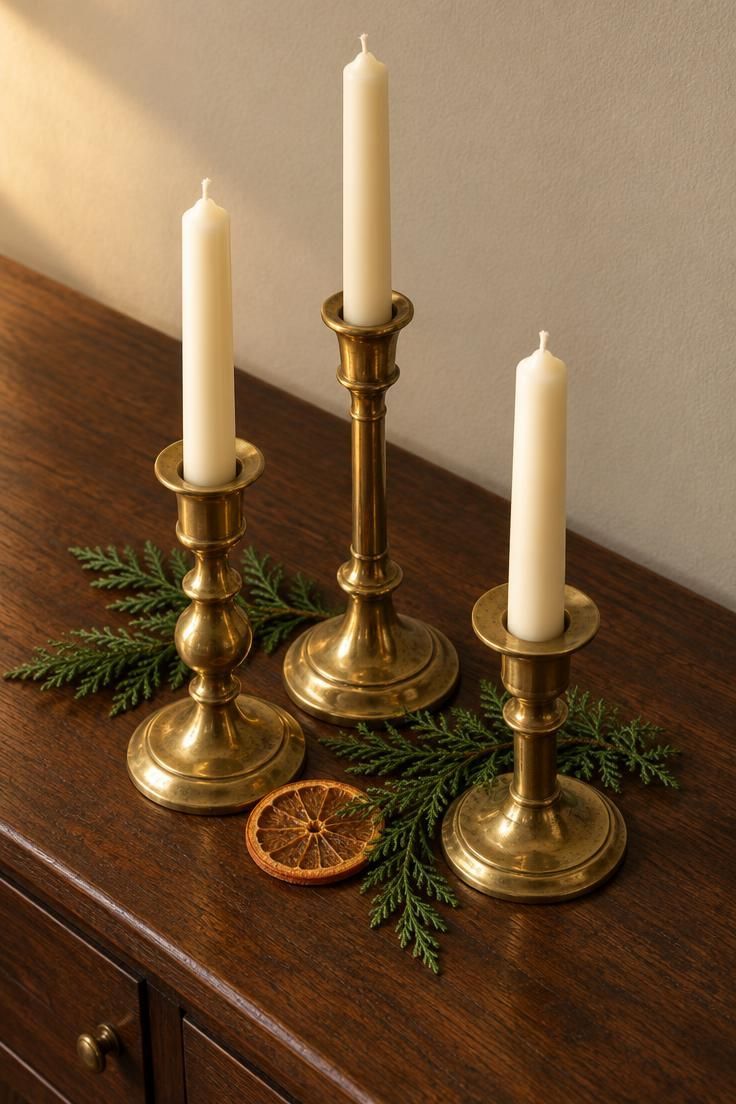
A brass candlestick display brings metal warmth to a sideboard without adding color noise.
Against dark wood and a cream wall, aged brass reads as a small pool of gold, and the height differences among the sticks create a natural rhythm that a matched set cannot.
Clustering in odd numbers keeps the group from looking like a pair of bookends.
Some tarnish is worth keeping.
A lightly patinated surface softens the reflections and fits the classic Christmas aesthetic better than a polished mirror finish, which can look sharp against wool and wood.
Cedar sprigs tucked between the bases tie the metal group to the greenery elsewhere in the room.
Unlit cream tapers suit daytime display, while battery-operated tapers give evening glow without an open flame.
For real candles, keep the greenery clear of the flame zone and place the group away from anything that could catch a draft.
Style Blueprint:
- Three brass candlesticks in varied heights and profiles
- Cream taper candles, unlit by day, battery-operated or real for evening
- Cedar sprigs and a dried orange slice between the bases
- A dark wood sideboard and cream wall as the backdrop
Dried Orange Slice Ornaments in a Kitchen Window
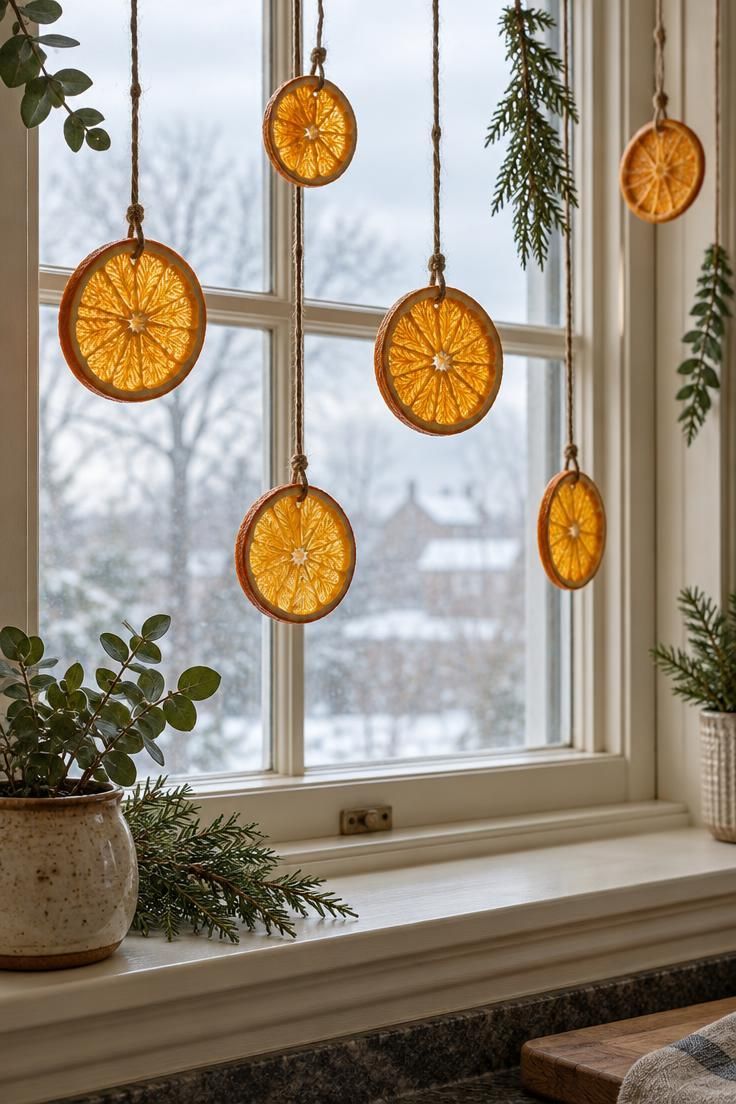
Dried orange slice ornaments bring a warm accent to a kitchen window with no electricity at all.
Backlit by daylight, the segments turn translucent and glow like small amber rounds, and the effect is strongest on overcast days when the light is even.
Mixing sizes and hanging the slices at different heights keeps the window from looking like a row of identical discs.
Making them is a simple home project: slice thin, dry flat, and blot away excess moisture so the rounds dry evenly rather than curling.
Even well-dried slices can darken further over a season, and some will curl at the edges.
Replacing a few each year is normal and keeps the window looking fresh.
Twine loops suit the natural finish, though narrow ribbon works when the window needs a touch more red.
A handful of slices paired with cedar sprigs on the sill ties the kitchen into the greenery used elsewhere.
Style Blueprint:
- Hand-dried orange slices in mixed sizes
- Simple twine loops for hanging
- A few cedar or fir sprigs on the sill
- A cream-painted window frame to set off the amber tones
Design Pro-Tip: Dry the orange slices flat and blot excess moisture before hanging so they stay round and hold their color longer.
Evergreen Wreath with Velvet Bow on an Interior Door
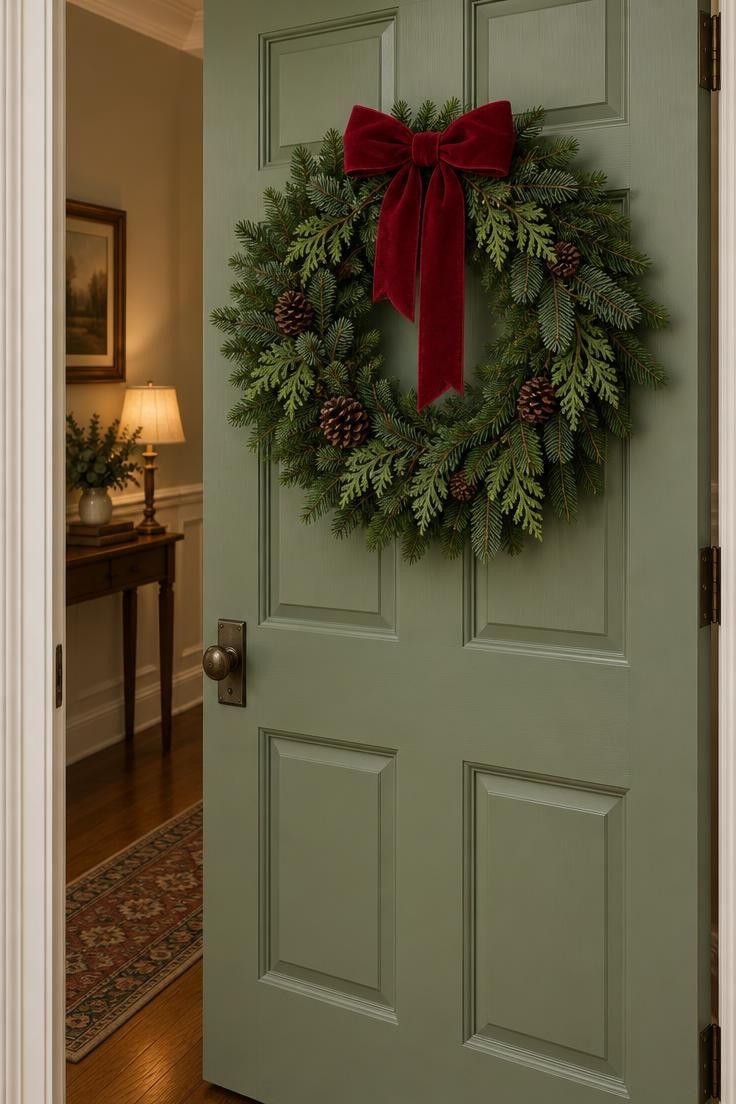
An interior door wreath introduces the classic palette without taking up floor space, which makes it a practical choice for apartments and narrow hallways.
A mixed evergreen base with layered fir and cedar gives the wreath enough density to hold its shape, and the deep red velvet bow supplies the single strong color note.
Clipping the bow on rather than tying it permanently lets the wreath change character from year to year.
Proportion decides whether the wreath feels generous or lost.
A ring that is too small disappears against a wide door, while a fuller wreath centered at eye height anchors the whole panel.
Hanging the door slightly ajar, if the household prefers, shows the wreath from both sides and adds a welcoming line of sight from the hallway.
A removable hook protects the door surface and makes seasonal swaps simple.
If the door is a favorite surface, checking the hook’s finish against the paint before hanging avoids marks.
Style Blueprint:
- A full mixed evergreen wreath with fir, cedar, and a few pinecones
- A deep red velvet bow on a clip for easy reuse
- A removable hook sized to the door
- A wreath scale that fills the door panel without crowding the edges
Tartan Wool Blanket and Textile Layer on a Sofa
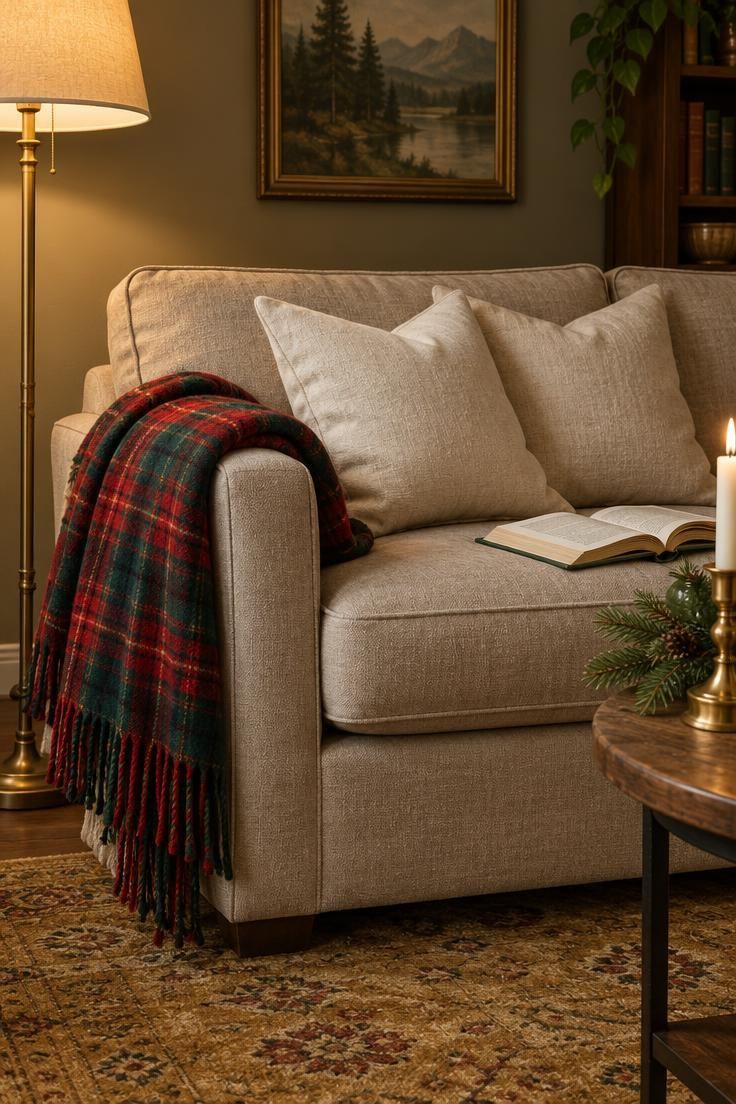
The sofa is the easiest place to start a textile layer, and a tartan wool blanket does most of the work on its own.
Folded over one arm with the fringe hanging free, the blanket adds pattern, color, and texture in a single move while staying easy to pull across a lap.
Cream linen pillows give the eye a place to rest between the busy plaid, and repetition is what makes the tartan feel intentional.
When the same pattern appears on a runner, a pillow, or a ribbon elsewhere in the room, the sofa stops looking like a lone accent and starts reading as part of a scheme.
Keeping the second and third appearances smaller than the blanket avoids a plaid-heavy room.
Wool blends are the practical middle ground: they keep the classic lines of real tartan while feeling softer against skin.
A fringe that hangs naturally rather than being tucked keeps the blanket from looking too styled for daily use.
Style Blueprint:
- A red-and-green tartan wool or wool-blend blanket
- Two cream linen pillows
- A warm-toned rug beneath the sofa
- One smaller tartan repeat elsewhere in the room
- A brass or evergreen accent on a nearby side table
Mixed Greenery Garland Over a Wide Window
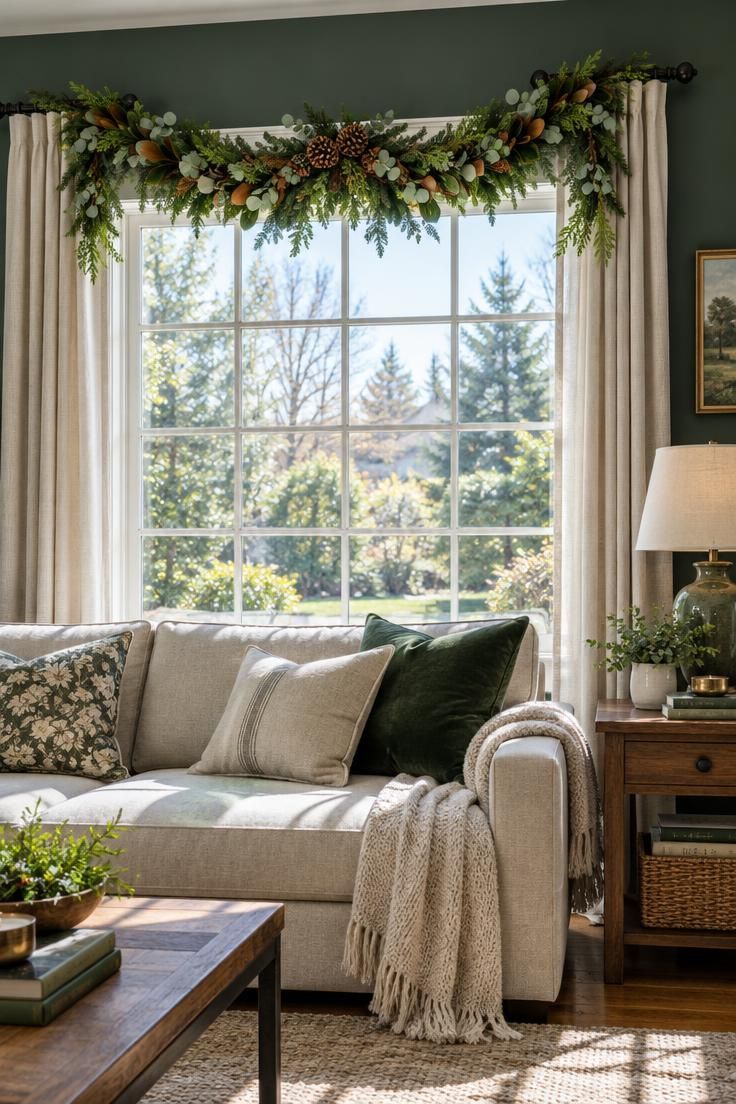
Mixed greenery over a wide window carries the scheme across a large surface without needing ornaments.
Fir and cedar give the garland its base structure, eucalyptus adds cool silver-green, and magnolia leaves bring a broad, glossy leaf that catches light differently.
The result is textural interest even when the swag stays unadorned.
Hanging the garland slightly above the window frame keeps daylight unobstructed and lets the greenery frame the view instead of cutting into it.
Whether to add pinecones comes down to the room’s existing density: a space with a full tree and a busy mantel may suit a plainer swag, while a quieter room can carry a few large pinecones for weight.
Layering the garland from both sides before it goes up prevents a flat center.
Working from each end toward the middle also helps the swag keep a natural, slightly uneven line.
Style Blueprint:
- A mixed garland of fir, cedar, eucalyptus, and magnolia
- A swag hung just above the window frame
- A few large pinecones only if the room’s ornament density allows
- Neutral curtains and a deep-toned wall to frame the greenery
Design Pro-Tip: Build the garland from both ends toward the center so the swag keeps depth along its whole length instead of flattening in the middle.
Wooden Nutcracker and Red Berry Arrangement on an Entry Table
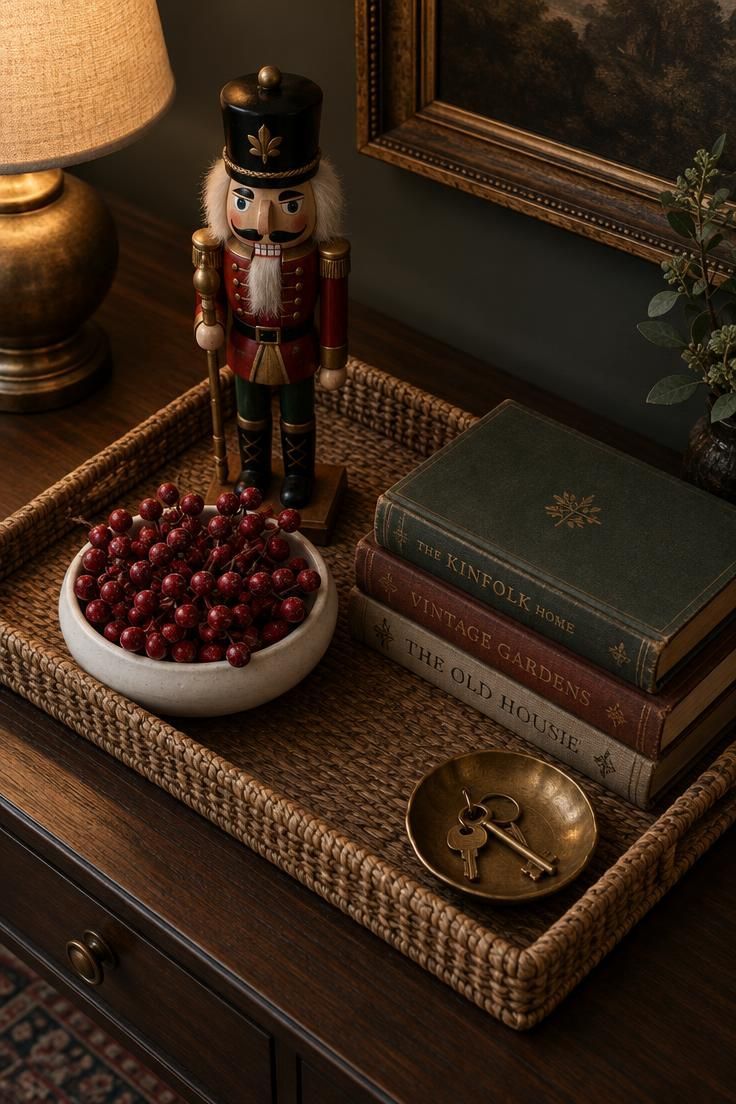
An entry table sets the tone for the whole house, and a wooden nutcracker gives it a classic figure with real height.
Placed beside a low bowl of red faux berries and a small stack of books, the three groups create a step down in height that keeps the table from reading as a flat shelf of objects.
The berries add the red note without a perishable commitment.
Containing the arrangement on a tray turns scattered items into one scene.
Small objects like a key dish or a sprig of greenery stay put, and the tray edge gives the group a boundary that makes editing easier.
Three object groups is a comfortable target for a narrow entry table.
More than that starts to crowd the keys, mail, and gloves that actually use the surface.
Faux berries earn their keep here because they hold color through the season without dropping.
Style Blueprint:
- A medium wooden nutcracker as the height anchor
- A low bowl of red faux berries
- A small stack of vintage-style books
- A woven tray to contain the composition
Paper Star and Twine Display Above a Dining Table
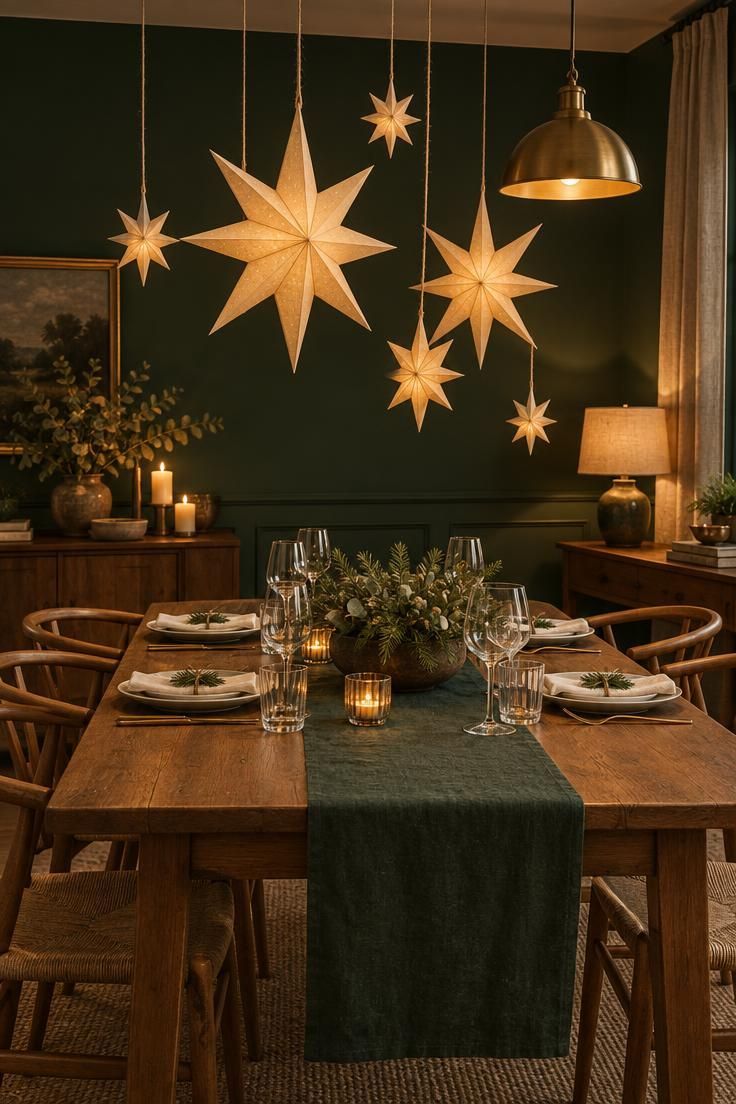
Paper stars hung above a dining table add a handmade note that fits the classic look without competing with the table setting.
The warm paper tone sits comfortably against a deep green wall or runner, and keeping the stars one color while varying their size creates depth without visual noise.
Hanging them at different heights lets the cluster feel airy rather than fixed.
Support disappears when the stars are hung on neutral twine or clear thread, which keeps attention on the shapes.
A pendant above the table can share the space as long as the stars hang clear of its light path.
Storage decides whether paper stars survive to next year.
A dry, flat box with tissue between the layers prevents creasing, and keeping them away from damp storage protects the folds.
They are light enough to hang with a single loop, which makes the display easy to change each season.
Style Blueprint:
- Warm paper stars in one color and several sizes
- Neutral twine or clear thread for hanging
- A deep green table runner and white dishes
- A flat, dry storage box with tissue between layers
Design Pro-Tip: Hang the stars on neutral twine or clear thread and vary the drop lengths so the supports disappear and the cluster feels suspended.
Brass Bell Garland on a Stair Rail
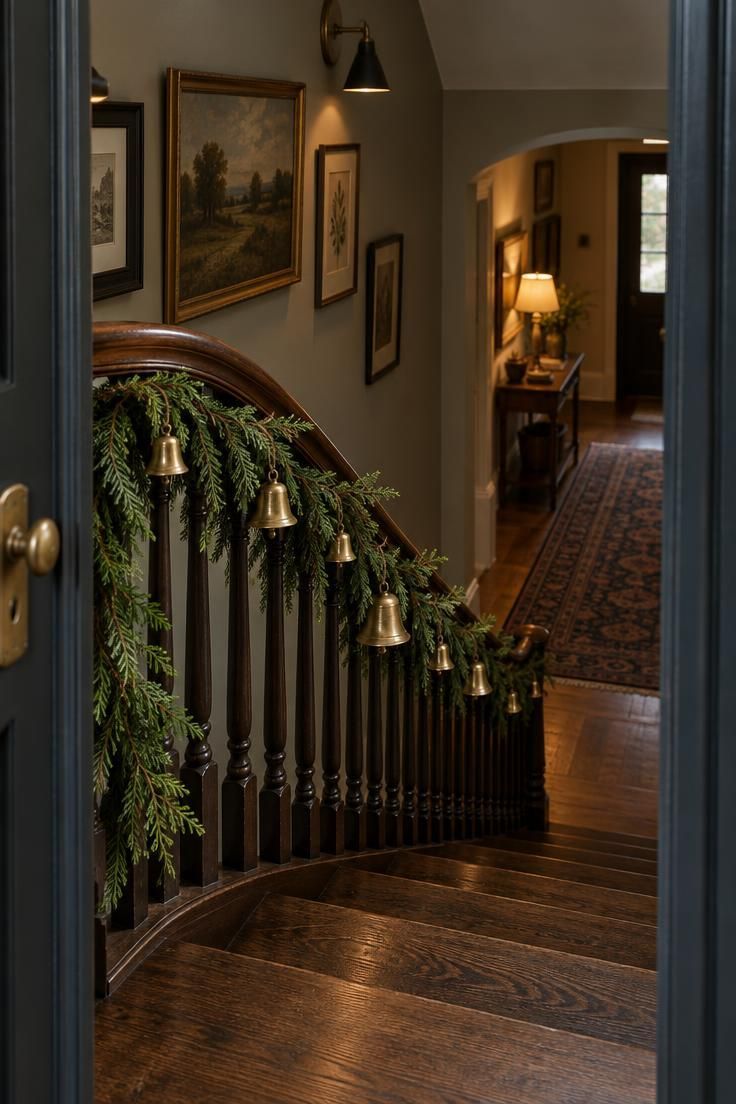
A brass bell garland on a stair rail turns a transition space into part of the decorating scheme.
The metal reads bright against dark stained wood, and a thin evergreen garland underneath gives the bells a soft green bed.
Alternating bell sizes creates a rhythm along the rail that matched bells cannot produce.
The garland follows the rail’s curve, so a thin base suits better than a heavy swag; too much greenery hides the wood that makes the brass stand out.
Unlit bells feel quieter during the day, while a small battery-lit strand adds an evening glow for households that want the rail to stay visible after dark.
Securing the garland keeps it from sliding along the rail over the season.
A few discreet ties at intervals hold the line in place while leaving the bells free to hang.
Style Blueprint:
- Small brass bells in alternating sizes
- A thin evergreen garland as the base
- Discreet ties at intervals to hold the line
- An optional battery-lit strand for evening glow
Fir Branches and Pinecones in a Galvanized Bucket by the Fireplace
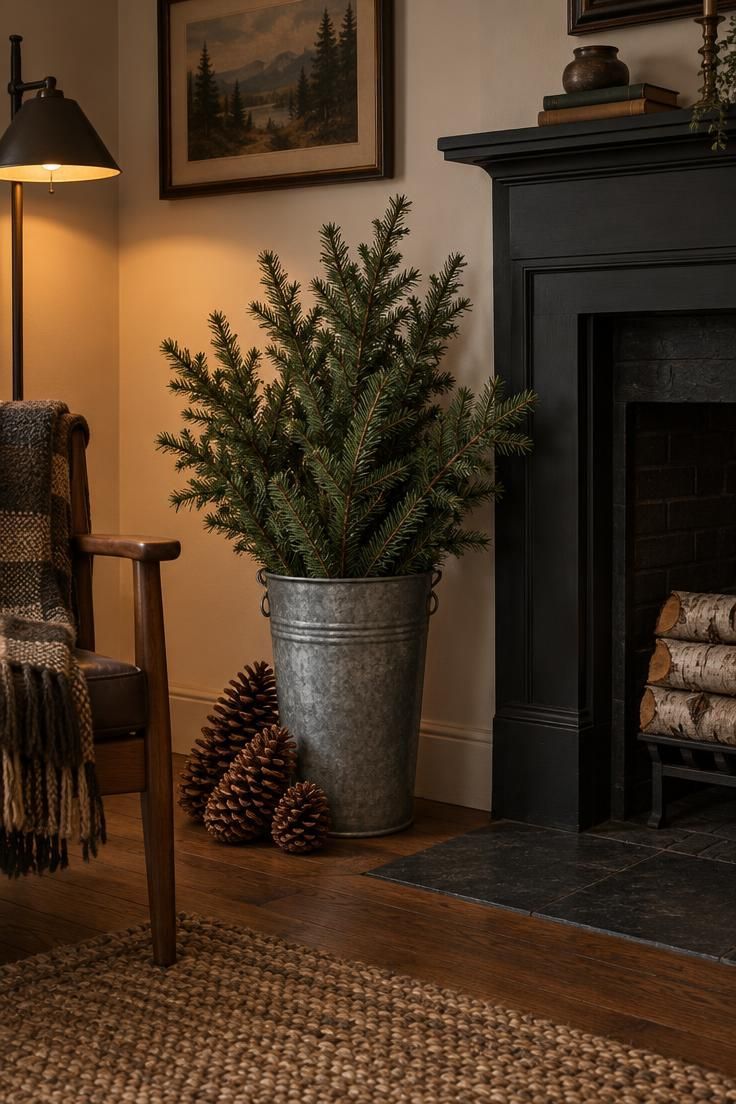
A galvanized bucket of fir branches brings greenery to floor level, an area a tree and mantel rarely reach.
The bucket’s cool metal tone makes a small counterpoint to a mostly warm room, and its tall branches add vertical interest beside a dark fireplace.
Large pinecones at the base fill the gap between the bucket rim and the floor.
This arrangement suits a fireplace setting because it keeps greenery at a distance from the hearth line, with the bucket placed to the side rather than in front.
If the branches shed, swapping in a fresh bundle is quick, and faux branches suit households that prefer no cleanup.
The bucket needs internal support to keep the stems upright.
Packing the base with floral foam or a similar filler holds the branches in a natural fan rather than a lean.
Style Blueprint:
- A galvanized metal bucket in a tall, simple shape
- Upright fir branches with a natural fan
- Large pinecones at the base
- A small woven rug and a chair to soften the corner
Design Pro-Tip: Pack the base of the bucket with floral foam so the fir branches stand upright in a fan instead of leaning against one side.
Glass Ornament Bowl with Greenery on a Coffee Table
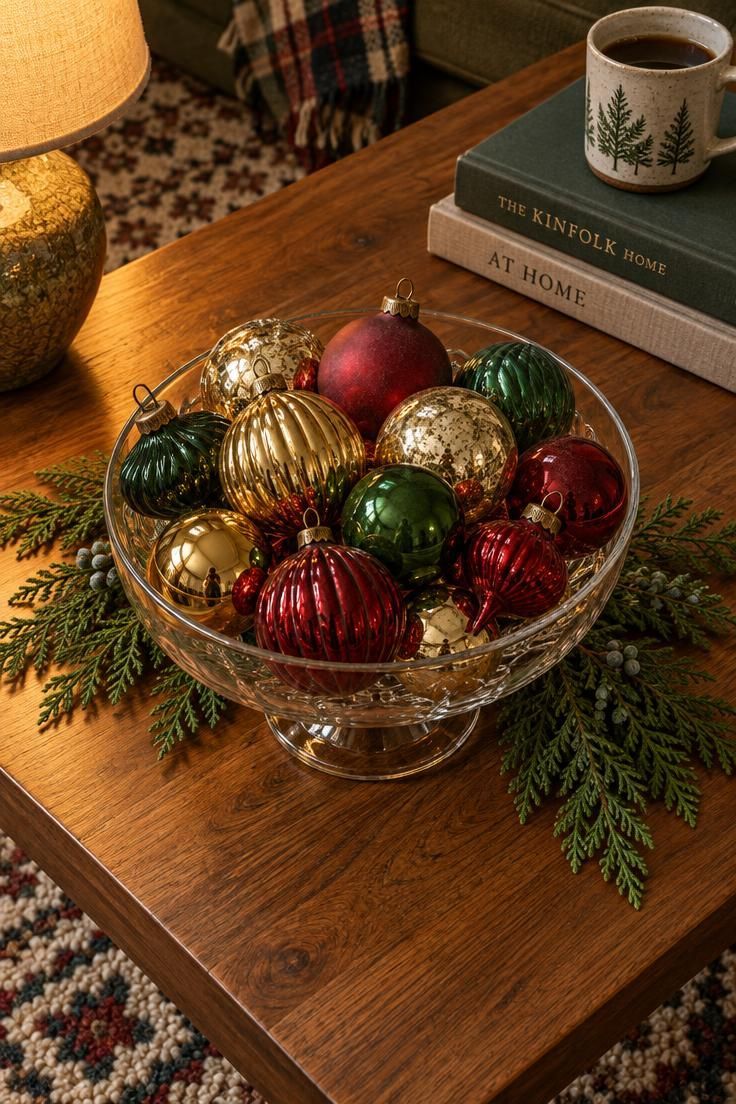
A bowl of glass ornaments gives a coffee table sparkle without committing to a tree, and it works as a compact nod to flocked Christmas tree styling for a room that has none.
Mixing shiny, matte, and mercury glass finishes within the gold, deep red, and green palette adds depth, because each surface reflects light differently.
Cedar sprigs around the base tie the bowl to the greenery used elsewhere.
The bowl itself stays low so sightlines across the table remain open.
A footed glass bowl keeps the ornaments slightly lifted and lets the table wood show beneath, which is warmer than a solid opaque vessel.
Dust is the one recurring chore: glass ornaments in an open bowl collect it quickly and need a regular wipe with a soft cloth.
Storing them back in their tissue wrap at the end of the season protects the finishes for next year.
Style Blueprint:
- A low footed glass bowl
- Gold, deep red, and green glass ornaments in shiny, matte, and mercury finishes
- Cedar sprigs tucked around the base
- A soft cloth and tissue wrap for dusting and storage
Conclusion
The classic Christmas aesthetic holds together because a small set of colors and materials repeats with discipline across each surface of a home.
A flocked tree, a tartan-wrapped staircase, a lit mantel, and a bowl of ornaments can each stand alone, and they speak the same visual language when they share a palette.
Starting with one focal point, whether the tree, the mantel, or a doorway wreath, gives the rest of the room a reference to follow.
From there, the same warm reds, greens, creams, and brass can spread to windows, tables, and textiles at a pace that suits the household.
A compact apartment can borrow the same ideas at a smaller scale, and a larger house can carry them further without changing the underlying scheme.