
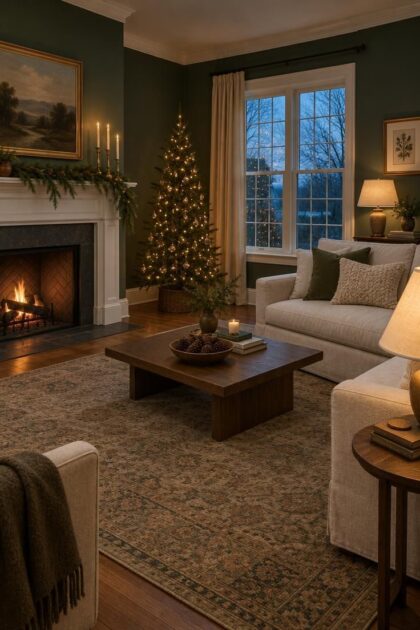
This post may contain affiliate links. If you make a purchase through these links, we may earn a commission at no additional cost to you.
By the second week of December, many living rooms have quietly turned into holding areas for decorations rather than places to sit and breathe.
The tree, the garland, the tabletop village, the pillow that says something festive: each addition seemed reasonable on its own.
Together they can crowd out the very comfort the season is meant to supply.
The aim here is not fewer decorations for their own sake, but a room where every festive piece has a clear job and the everyday life of the household still fits around it.
Room Inventory First
Before a single box comes down from the closet, name what the room actually does.
A television lounge shared by four people every evening has different demands than a dining room used twice in December.
That distinction sets the decoration budget in practical terms: which surfaces can hold something seasonal without taking away workspace, seating, or a clear path through the room.
The living room is often a focal point of home styling.
According to the National Association of Realtors’ 2025 Profile of Home Staging, 91% of sellers’ agents who staged homes included the living room, compared with 69% for dining rooms and 68% for kitchens.
That popularity is also why the living room usually needs the firmest edit.
When one room absorbs the tree, the mantel, the shelves, and the coffee table, the result is density without much visual rest.
Walk through the space at the time of day you use it most.
Note where bags land, where laptops open, where a drink gets set down.
Those spots are spoken for.
Decoration that claims them will be moved aside within a week, and a pile of displaced ornaments looks worse than an empty surface.
The remaining surfaces form your working list.
In most homes that means two or three zones per room: a mantel, a console, one shelf.
Treating the list as closed keeps the scheme from creeping across every flat plane in the house.
Design Pro-Tip: Stand in the doorway of the finished room and remove one object from every decorated surface. The room will still read as festive, and the remaining pieces will look chosen rather than placed.
How to Place Your Christmas Tree Without Losing the Room

Tree placement is the single decision that shapes everything else.
A corner position tucks the tree into architecture that already exists, leaving the center of the room for seating and movement.
A central position turns the tree into the room’s focal point, which can be lovely in a space with generous square footage and awkward in one where the sofa already hugs the wall.
Designer Sara Hillery describes a “thread” that links rooms through shared tonal weight and a unifying element, so pieces feel related without every room matching.
A tree benefits from the same thinking.
It should pick up the room’s existing palette rather than introduce a separate one, which keeps it reading as part of the space instead of a display dropped into it.
Width matters as much as height when floor area is limited.
A slim tree, or one modeled on a sparse silver tip pine, leaves visible gaps between branches so ornaments can hang free rather than pile against one another.
Fewer ornaments read more clearly on a narrow tree, and the tree itself takes less of the walking path.
For anyone working out how to decorate your room for christmas with limited floor space, the tree’s footprint is the constraint to solve first.
Moving a chair, shifting a side table, or choosing a narrower profile solves more crowding than any amount of ornament editing afterward.
Ornament density follows the same logic as the tree’s width.
A handful of larger pieces placed with space around them will register from across the room; dozens of small ornaments on a narrow tree blur into a single mass.
Test the placement by walking the route you take through the room at night, preferably in low light.
If the tree blocks a doorway swing or forces a detour around the sofa, it is in the wrong spot regardless of how well it is dressed.
Christmas Mantel Garland Ideas That Earn Their Place
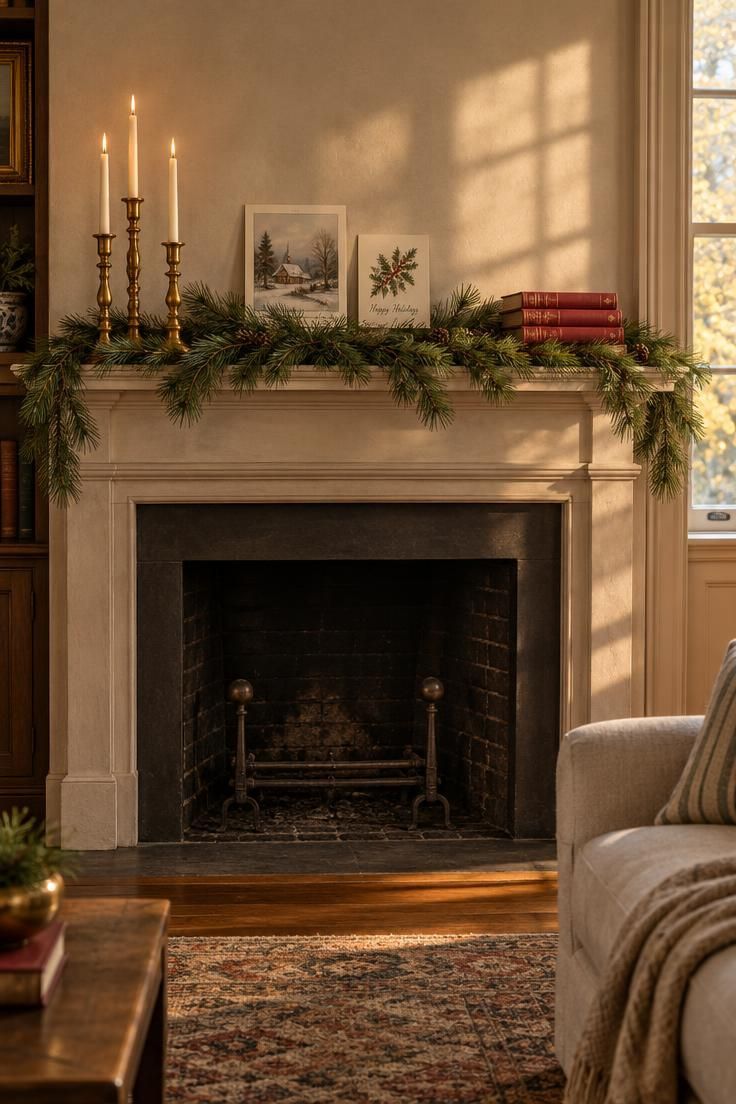
A mantel is the most tempting surface in the house and the easiest to overload.
The arrangement that holds up over a whole season is usually built on one strong element with a small supporting cast, rather than a full scene assembled from every available object.
Start with a single garland as the base and let it define the horizontal line.
Everything else sits in relation to it: a pair of candlesticks at one end, a small stack of books, a few cards tucked into the greenery.
Designer Sara Hillery mentions using ribbon and Christmas cards on the mantel, which is a useful reminder that the personal, slightly imperfect pieces often carry more warmth than a perfectly symmetrical display.
Among Christmas mantel garland ideas, the quieter versions tend to age better through December.
A garland with a visible rhythm of greenery, unlit or softly lit, gives the eye somewhere to rest, while densely woven garlands with multiple ribbon types and ornament clusters compete with whatever hangs above the fireplace.
Height is worth considering.
A garland that drapes just below the mantel shelf keeps the wall above free for artwork or a mirror, so the composition reads as two layers rather than one crowded band.
Cards and small ornaments can lean against the wall behind the garland for a third, softer layer.
Leave one section of the mantel deliberately bare.
Negative space on a shelf or mantel works the way a pause works in speech: it makes the surrounding elements legible.
A fully occupied mantel gives the eye nowhere to land.
Small Living Room Christmas Tree Placement That Keeps Circulation Open
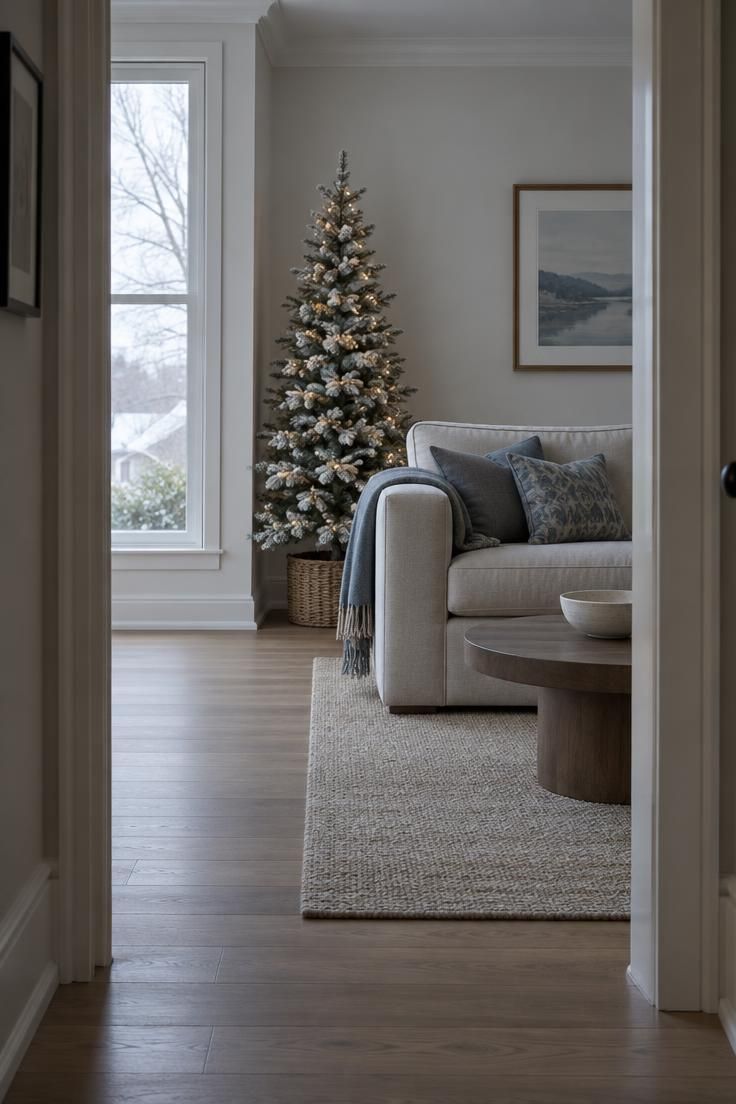
In a compact living room, the tree’s position determines whether the space feels festive or cramped.
A slim tree set into a corner, or placed beside a window where furniture already stops, frees the central floor for walking and seating.
The corner placement is the conventional move because it uses architecture the room has already accounted for.
A fuller tree placed centrally can work, but only when there is enough square footage for people to move around it comfortably.
In a smaller room, a central tree tends to push seating against the walls and turn the coffee table into an obstacle course.
Small living room Christmas tree placement benefits from thinking vertically.
A tabletop tree lifted onto a side table or stool brings the decoration up to eye level without consuming floor area, and it can sit where a full tree never would.
Contrast the two approaches honestly.
A corner tree asks less of the room but reads as background; a central tree commands attention but demands space.
Choosing between them is really a question of whether the room is for gathering around the tree or for living alongside it.
Design Pro-Tip: Lift a tabletop tree onto a sturdy side table or stool so its decorated section sits near eye level. The tree reads as a full arrangement from a seated position, and the floor beneath it stays clear.
Layered Christmas Decorating With Texture Instead of More Objects
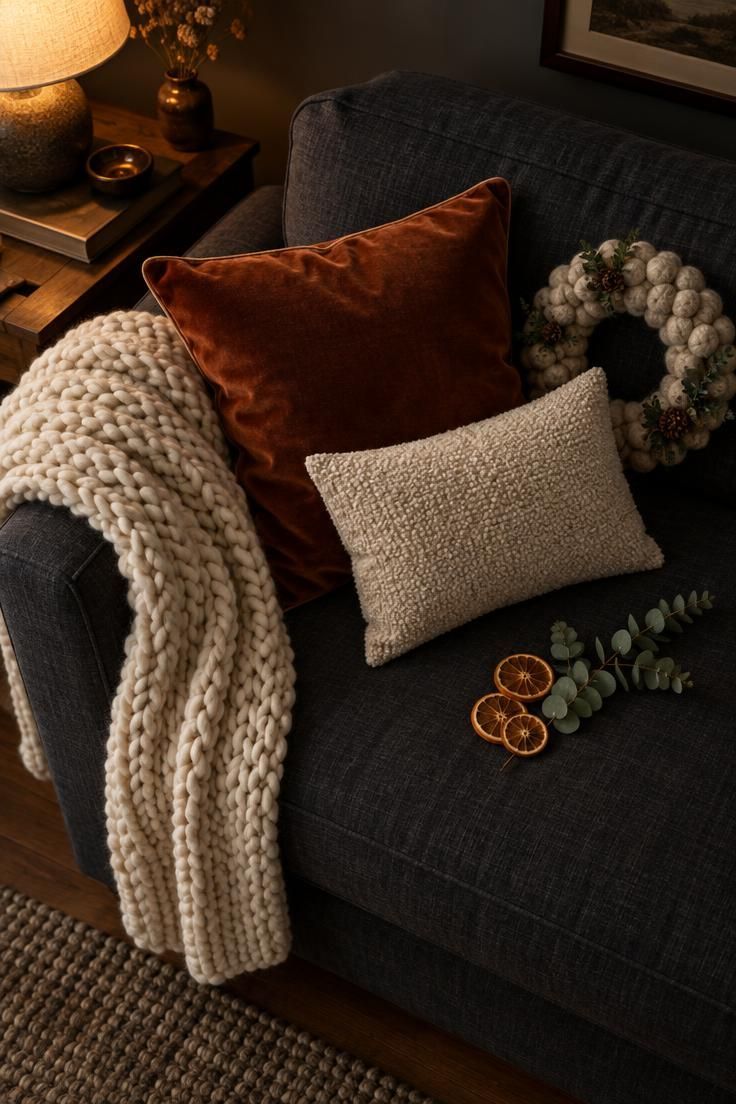
Texture does the visual work that additional objects would otherwise do.
A controlled color range of three tones or fewer lets velvet, chunky knit, smooth glass, and natural greenery sit together without the eye registering chaos, because the palette holds them as a family.
Designers often describe this as repeating a color in different materials rather than introducing new colors.
A rust tone appears in a velvet pillow, a wool throw, and a few dried orange slices; the eye reads them as related, and the room gains depth without gaining clutter.
Layered Christmas decorating with texture is especially useful in rooms that already feel full.
Swapping one pillow cover or draping a different throw changes the seasonal read of a sofa with almost no added volume.
The room looks decorated because the surfaces have changed character, not because more items arrived.
Natural materials carry texture cheaply in visual terms: a rattan ornament, a wicker basket, a linen ribbon, a bowl of pinecones.
Each brings a distinct surface without competing for attention the way a bright new color would.
Keep the number of textures in view at once to roughly four.
Beyond that, the eye stops distinguishing between them and the arrangement flattens into noise, which is the opposite of what layering is meant to achieve.
Festive Table Runner and Candle Arrangement for a Usable Dining Table
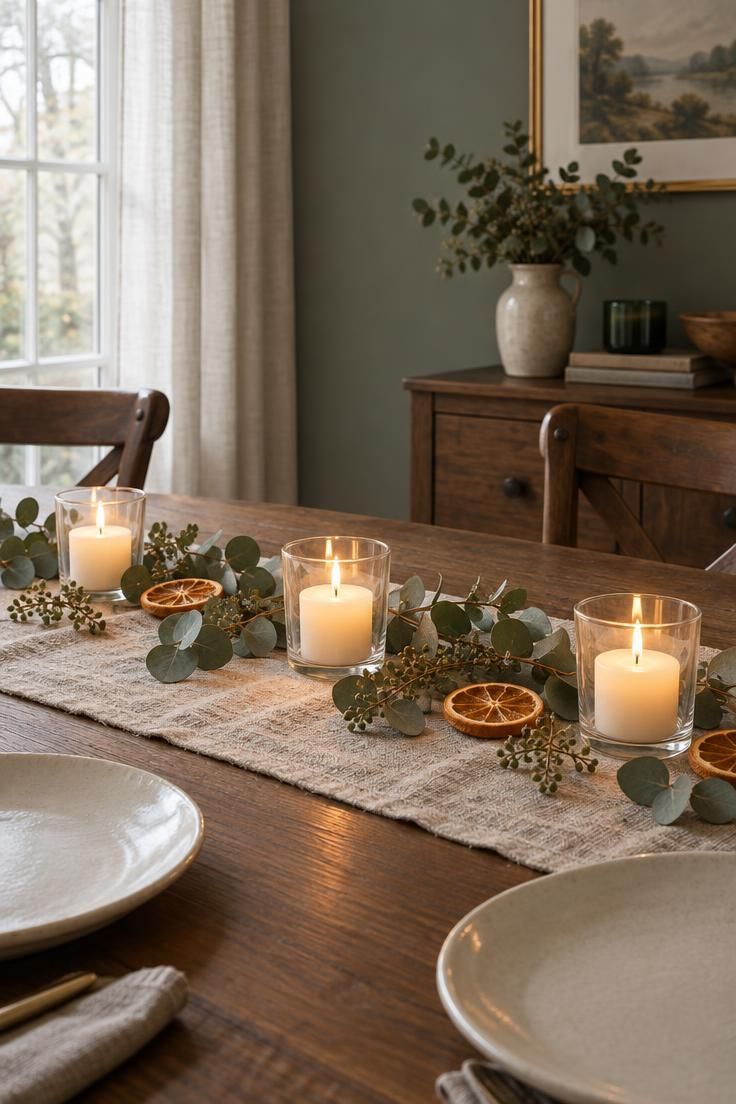
A dining table has to work as a table.
Keep the tablescape simple and understated, combining natural-looking greenery, candles, and a few carefully chosen accents.
Leave enough open space for the arrangement to feel elegant without overwhelming the table.
That guidance translates into a centerpiece low enough to see over and narrow enough to leave place settings clear.
A festive table runner and candle arrangement can follow the table’s long axis rather than spreading outward.
A linen runner down the center, a line of small glass votives, and scattered eucalyptus or dried orange slices create a composed band that leaves both sides of the table usable.
Sightlines matter more than ornament count.
A centerpiece tall enough to block the view across the table turns a convivial dinner into a series of leaned-over conversations.
Low candles and a flat runner keep everyone in the same visual plane.
For a lower-volume alternative, lay a wreath flat in the center of the table and set a hurricane vase or a wide bowl in its hollow.
The greenery frames the center without rising into the conversation, and the arrangement can be lifted off in one piece when the table needs to become a workspace again.
Candle height can vary, but keeping the tallest element below eye level when seated preserves the open feel.
A cluster of three votives at slightly different heights gives visual interest without the vertical interruption of tall tapers.
Leave the runner short of the table’s edges.
A runner that stops a hand’s width from each end keeps the dining chairs clear and prevents the fabric from bunching when someone pulls a chair in.
Entryway Wreath and Garland Ideas That Do Not Block the Door
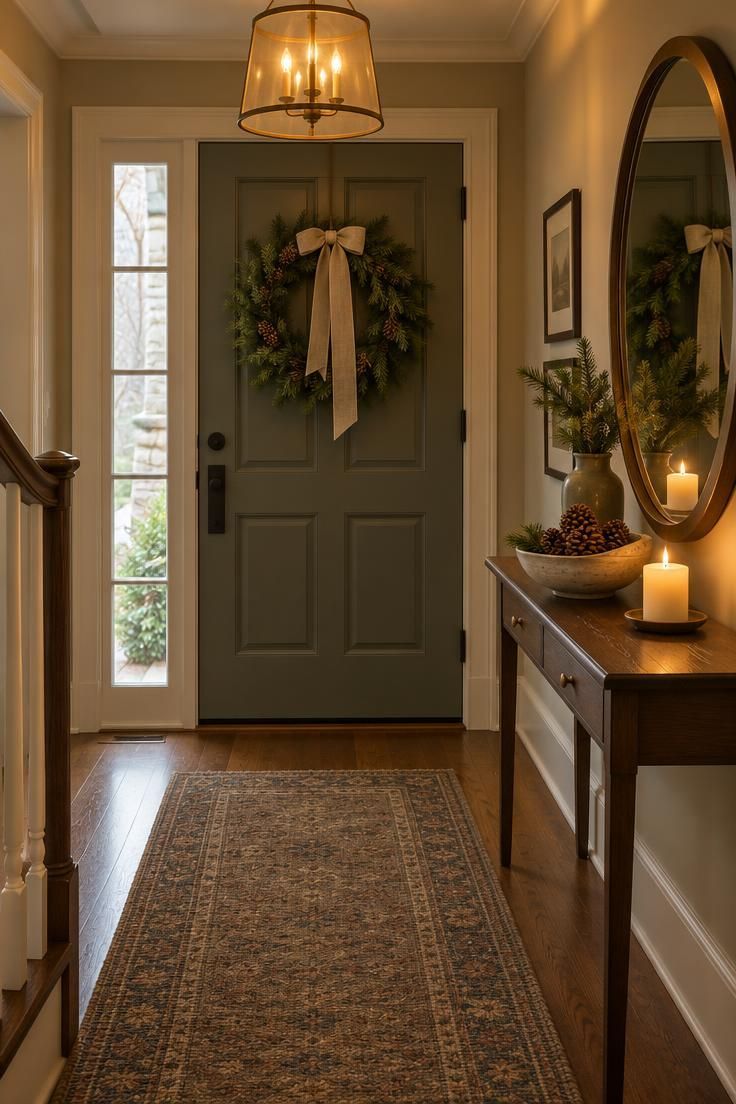
The entryway takes a beating in December.
It handles wet boots, delivered packages, and the daily rush of coming and going, which makes it the wrong place for decoration that needs careful navigation.
A wreath or garland here has to survive contact with real life.
Survey data from Thumbtack found that entryways are the most common spot for a seasonal swap, with wreaths, garlands, and door decor leading the list.
That popularity makes sense, since the entry is the first thing a household sees and the last thing guests pass on their way out.
Among entryway wreath and garland ideas, the practical choices are the ones that stay close to the wall.
A small wreath hung flat against the inside of the front door, a narrow garland along a side wall, or a shallow bowl of pinecones on a console all add seasonal presence without reaching into the walking path.
Avoid the full staircase wrap in a tight entry.
A garland that loops along a railing can catch on bags and coats, and it tends to need constant readjustment through the season.
A single swag above a doorway or across a console achieves a similar effect with less maintenance.
Indoor wreaths work on main walls and laid flat on tables, which is useful for homes without a good exterior door or for apartments where the entry is a hallway rather than a porch.
The wreath does not need to be on a door to do its job.
Design Pro-Tip: Place a mirror behind a small console arrangement so candlelight reflects back into the entry. The mirror doubles the visual warmth without adding another object to the shelf.
The Cut List: What Not to Put Out This Year
Editing is a design skill, and it improves with practice.
Designer Sara Hillery describes an “onion” method: pin up everything you love, then remove layers until a harmonious balance remains.
The principle is that abundance reads as intentional when it has been shaped by subtraction, and as clutter when it has not.
Apply the method with a simple criterion.
Designers often frame it as letting every item earn its place.
If a piece has no story, no visual role, and no connection to the room’s palette, it is a candidate for the box rather than the shelf.
Abundance that reads as nurtured has a rhythm: clusters of related objects, breathing room between groups, and a clear focal point on each surface.
Abundance that reads as clutter has no hierarchy, so every object competes with every other one.
The difference is composition, not quantity.
Resist the single large haul.
A collection of ornaments built up over years, with at least one new piece added annually, tends to look more personal than a full themed set bought in one trip.
Nina Campbell has described buying at least one new ornament a year, a slow-build philosophy that quietly argues against the seasonal shopping spree.
Everything that comes out in December has to go back in January.
Campbell advises factoring in storage space when decorating, and it is a point worth taking seriously: decorations with nowhere to live become a January problem, and a scheme that is hard to dismantle carries a hidden cost.
Set a limit before you start.
Three decorated surfaces per room, four textures in view, three colors in the palette.
Limits are not restrictions on festivity; they are the structure that makes festivity legible.
Leave one room almost untouched.
A bedroom or a study that stays quiet through December gives the household somewhere to retreat from the seasonal density, and it makes the decorated rooms feel more deliberate by contrast.
Conclusion
There is no correct amount of Christmas decoration, only the amount that lets a room stay usable and restful for the people who live in it.
That amount varies by household, by room, and by year, and it is worth adjusting as the season goes on rather than setting once and leaving it.
Start by choosing three surfaces or zones per room and decorating only those.
Work within a limited palette, let texture carry the visual weight, and rely on warm light to tie the pieces together.
Add the personal objects that carry meaning, and leave the filler in the box.
Then walk through the room as a visitor would and remove anything that does not feel intentional.
The first thing to try is the doorway test: stand at the threshold, look across the room, and take away one object from each decorated surface.
What remains is usually the room you actually wanted.


