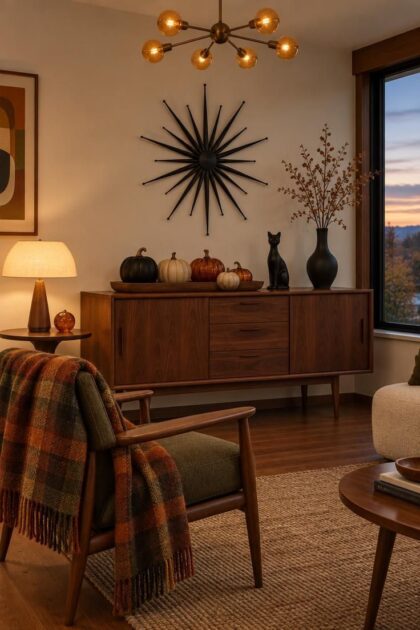
This post may contain affiliate links. If you make a purchase through these links, we may earn a commission at no additional cost to you.
Halloween decorating often leans toward neon orange, crowded surfaces, and plastic props that fight the calm lines of a mid-century room.
The era's own vocabulary offers a better route: starbursts, tapered legs, walnut tones, matte ceramics, and warm low light already carry a faintly eerie charm.
Treating mid-century modern as a filter rather than a costume keeps the season present without turning the house into a theme park.
Each idea below starts with one surface, one silhouette, or one material and builds outward from there.
Atomic Starburst Spider Wall Display
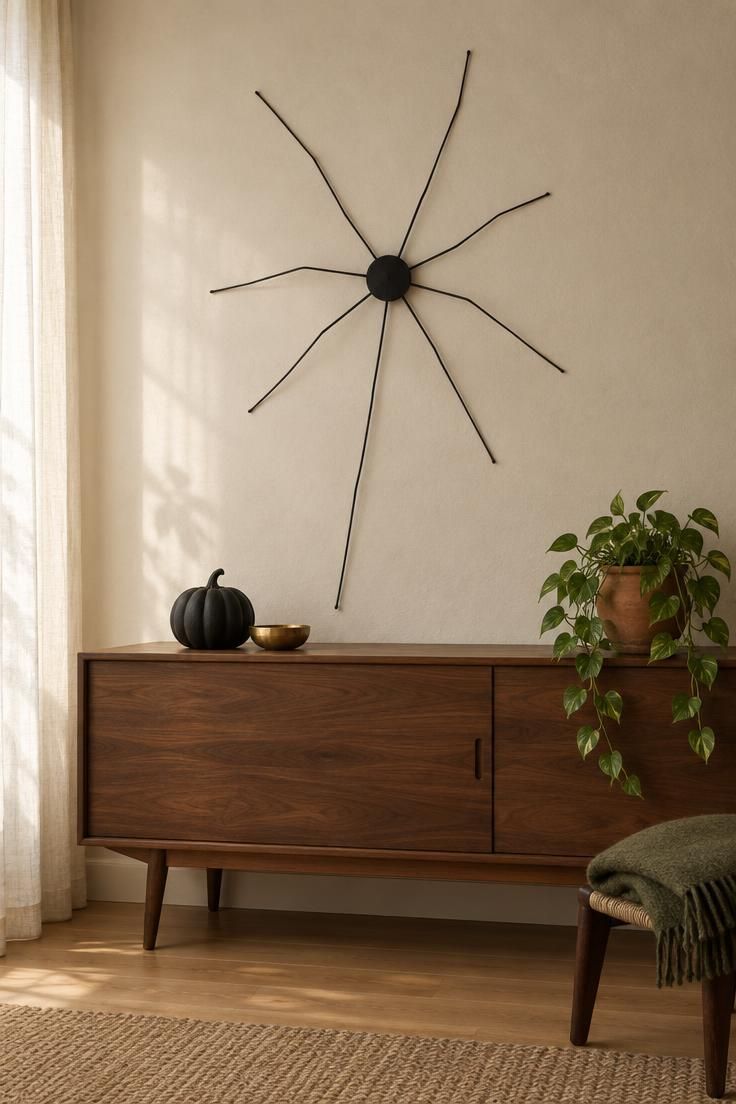
The starburst clock is one of the most recognizable shapes of the era, and it converts into a spider with very little adjustment.
A small black disk at the center with legs radiating outward at uneven lengths gives the wall a focal point that reads as both atomic and slightly uncanny.
Hanging it above a low credenza keeps the composition horizontal and lets the empty wall do the staging work.
Matte black card stock and thin wire keep the silhouette crisp from across a room.
A center disk that stays small relative to the leg span matters more than any added detail, since the shape needs to read at a glance.
One such motif carries the display.
Adding paper bats or extra cutouts nearby dilutes the era reference and muddies the composition.
This approach suits an entry or hallway where a bare wall already exists.
The tradeoff is that a single wall piece leaves the rest of the room undecorated, which can feel thin for readers who want a fuller holiday look.
Pairing it with one small ceramic object on the credenza below, such as a matte black pumpkin or a vintage Halloween decorations piece in muted tones, balances restraint with seasonal presence without crowding the surface.
For a reader building a collected display, a mid-century modern black cat figurine placed at the opposite end of the credenza extends the vignette while keeping the palette tight.
Two objects, one wall motif, and a bare wall between them create more visual pull than a dense arrangement.
Style Blueprint:
- Matte black card stock starburst with a small center disk and uneven wire legs
- Low walnut credenza with tapered or splayed legs as the stage
- One matte black ceramic pumpkin or small black cat figurine below the motif
- Cream or off-white wall left mostly bare around the shape
- Warm side light from a single window or small lamp
Sputnik-Style Light with Amber Bulbs
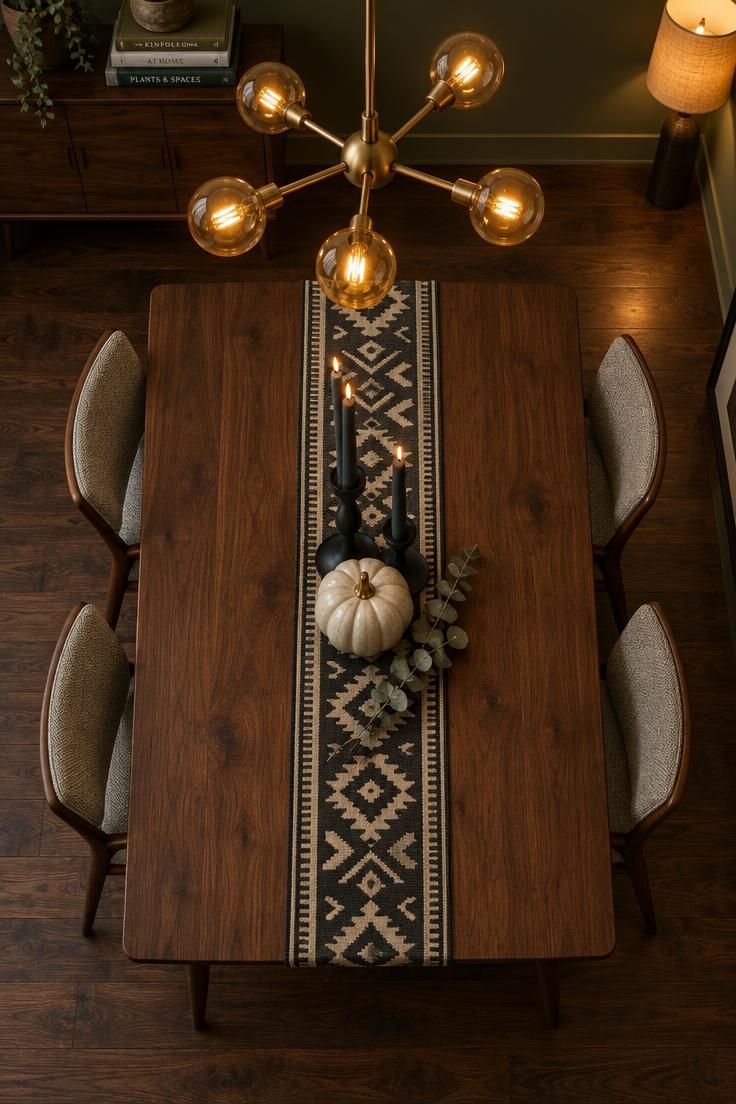
A Sputnik fixture with warm amber or orange bulbs turns a dining nook or reading corner into the centerpiece of the season without a single hanging prop.
The spiky arms suggest a starburst in daylight and cast moody, low light after dark, which suits the quieter side of Halloween.
Choosing muted orange bulbs rather than a harsh red keeps the palette in step with walnut and olive tones.
The fixture does the work on its own, so the rest of the room can stay simple.
A walnut table, two matte black candlesticks, and one cream ceramic pumpkin are enough.
Keeping the overhead light as the only fixture in the room reinforces the mood, since a second bright source flattens the spiky silhouette.
Reaching for the era's own objects, the retro Sputnik light fixture reads as both period piece and seasonal statement.
A permanent hardwired fixture is one route, but a tabletop version with a similar silhouette delivers the same effect in a rental or apartment.
The tradeoff is that amber bulbs cast a narrow pool of light, so a dining table may need a supplementary lamp for practical tasks like reading.
A mix of vintage Halloween decorations in paper and ceramic can sit on the sideboard nearby, but the restraint that makes the room work comes from leaving the walls and ceiling mostly bare.
One strong light, one table setting, and one quiet corner lamp carry the whole space.
Style Blueprint:
- Sputnik-style chandelier with six or more arms and round amber bulbs
- Walnut dining table with tapered-leg chairs
- Black-and-cream geometric runner in a muted pattern
- Two matte black candlesticks and a cream ceramic pumpkin as the centerpiece
- One warm corner lamp for fill light
Design Pro-Tip: When swapping bulbs for the season, keep the wattage and base type the fixture was made for and choose amber or muted orange rather than deep red, which reads dark and swallows the warm glow.
Geometric Ghost Forms in Cream Fabric
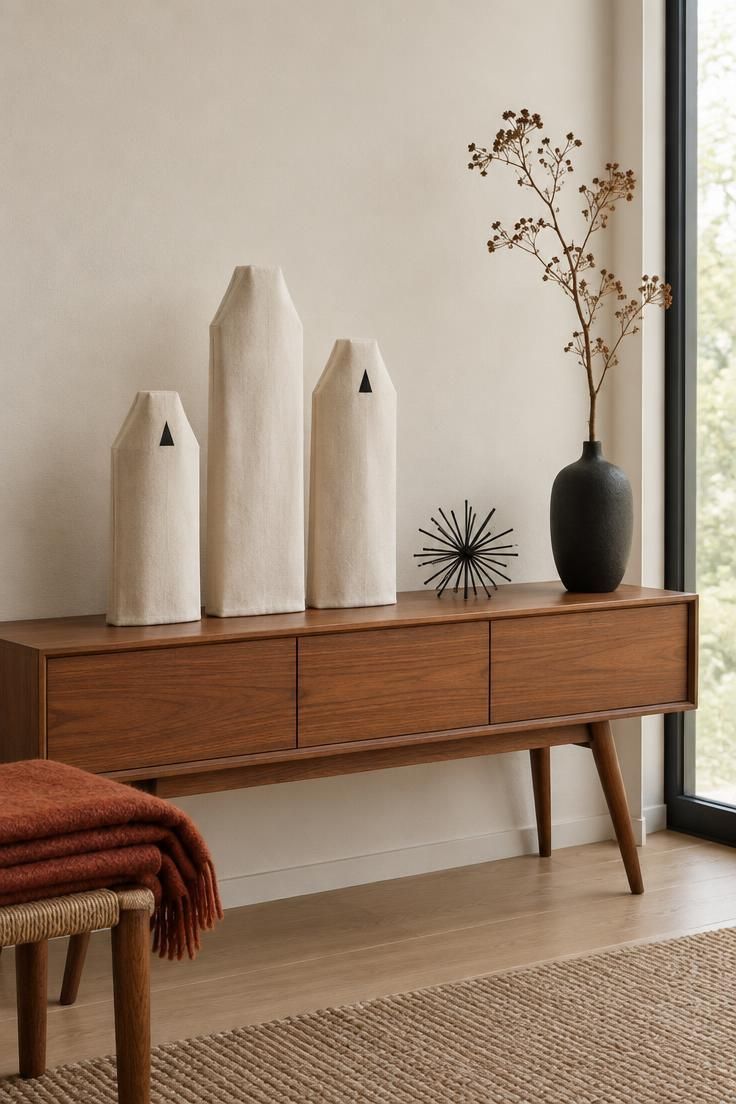
Ghosts in mid-century style are not flowing sheets but clean, upright shapes with flat bottoms and sharp angles.
Stretching cream or off-white fabric over simple wood or wire frames produces two or three forms that stand on a console like abstract sculptures.
The result sits somewhere between a Halloween prop and a piece of modern art, which is exactly the tension the era handles well.
Faces stay either blank or reduced to single black dots or triangles.
Cartoon eyes and open mouths undercut the look, since the period's graphics favored flat, simple marks over expressive detail.
A group of three in varying heights adds rhythm to the console without crowding it.
Cotton canvas or matte linen reads more period-correct than glossy polyester, and the fabric texture catches soft daylight in a way plastic never does.
The practical benefit is that the forms can become a winter white display by removing the minimal face marks.
That extendability justifies the effort of building or sourcing them.
The limitation is that fabric forms need a stable base to stand upright, and a room with strong cross breezes will knock them over, so keeping them on a protected console or shelf matters.
A single small black wire starburst beside the group keeps the era reference present without competing for attention.
The bare wall behind the console lets the shapes carry the composition.
Style Blueprint:
- Cream or off-white cotton canvas over simple upright frames
- Flat-bottom, sharp-shouldered silhouettes rather than flowing sheets
- Single small black dot or triangular eye mark, or no mark at all
- Group of three in varying heights on a teak or walnut console
- One small black wire starburst as a companion object
Paper Bats in a Drifting Asymmetric Flock
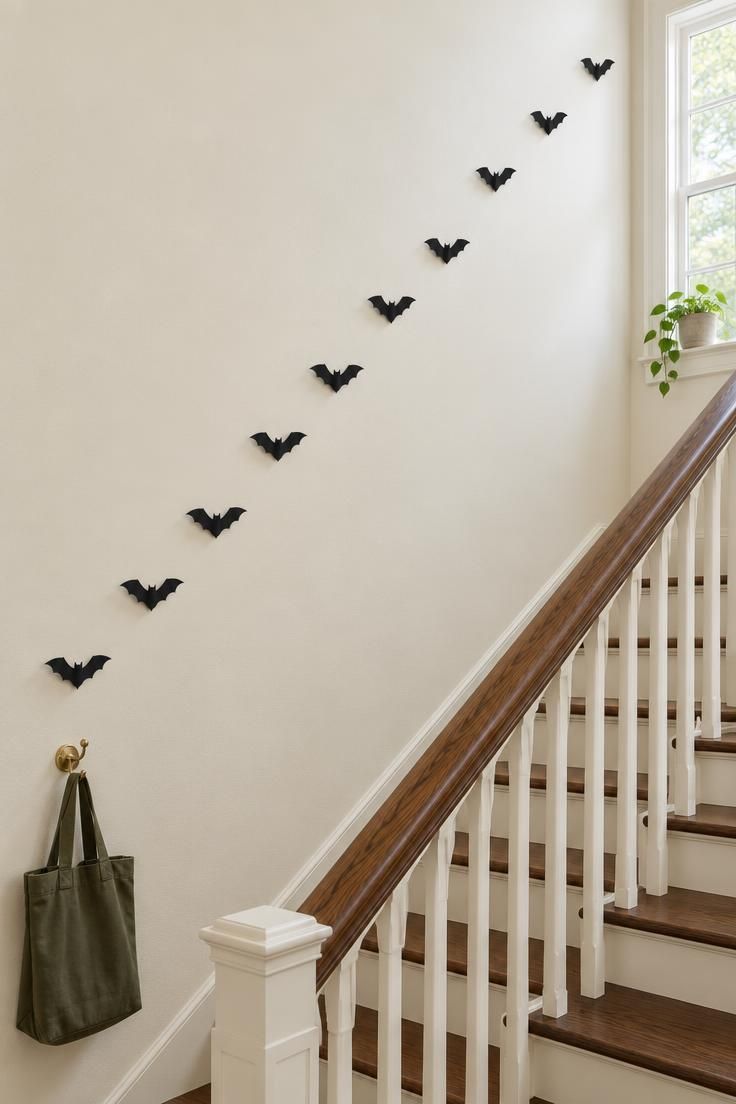
Flat black paper bats carry a stair wall or the space above a sofa back when they are evenly spaced and all oriented the same direction.
The mid-century reading comes from regular silhouettes with simple wing shapes, no scalloped edges, plus an asymmetric drift rather than a dense swarm.
The empty wall between each shape does as much work as the bats themselves.
Matte black card stock holds its shape better than thin construction paper, and a template keeps every bat identical.
Spacing them widely along a diagonal gives the composition direction without turning the wall into a solid mass.
Ten to twelve bats suit most stair walls, and the drift angle should follow the natural line of the stairs or the room's main sightline.
This is a one-season decoration, so paper is a reasonable choice, though it will not survive storage as well as ceramic or wood.
Keeping the flock indoors away from humid rooms and direct window light extends its life.
The tradeoff for a reader who wants decor that lasts is that the paper bats may need replacing every year or two.
After Halloween, the wall returns to blank, which is the advantage of a low-commitment display.
Nothing needs to be repainted or patched, and the next season can start fresh.
Style Blueprint:
- Matte black card stock with a simple wing silhouette, no scalloped edges
- Ten to twelve identical bats in a consistent orientation
- Diagonal drift that follows the stairs or room sightline
- Wide spacing with visible bare wall between shapes
- Indoor placement away from humidity and direct light
Design Pro-Tip: Fold a small paper tab behind each bat and use a removable adhesive dot on the tab rather than the bat itself, which keeps the card stock flat and the wall clean when the flock comes down.
Cabinet of Curiosities: Amber Glass and Specimen Jars
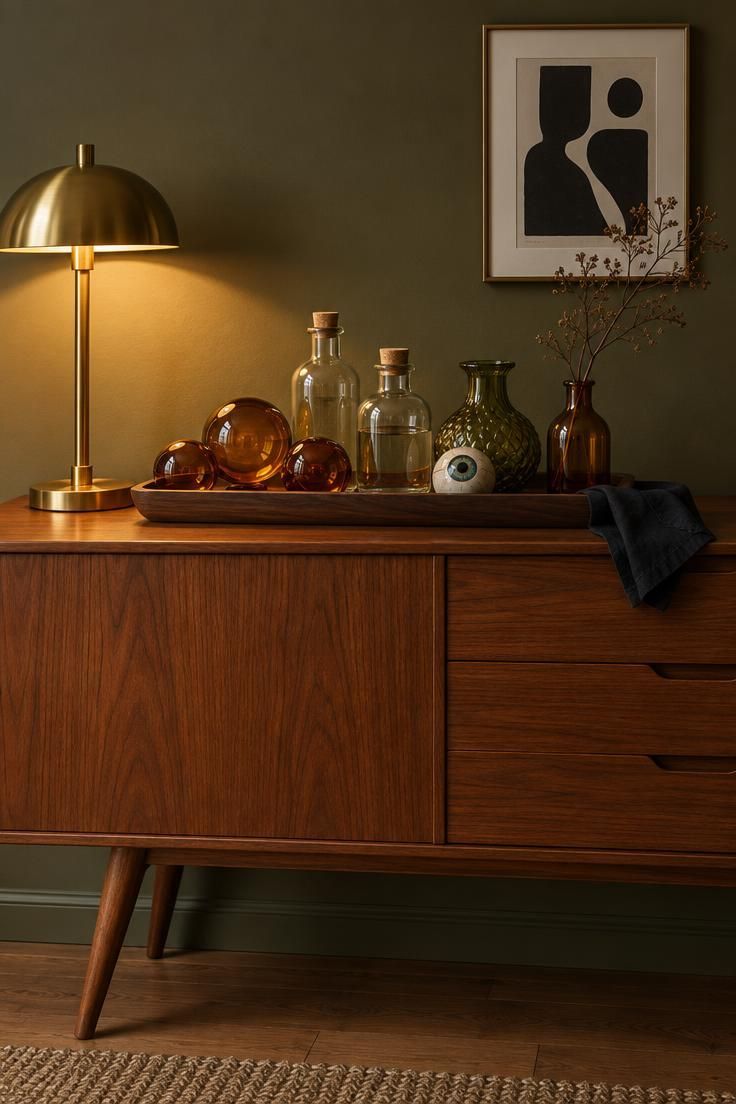
Mid-century novelty glass suits the odd-specimen urge that Halloween invites.
Amber, olive, and smoked glass orbs and small corked bottles grouped on a walnut tray read like a science table, witty and slightly clinical rather than frightful.
One or two pieces with an eyeball motif, such as a round vessel with a painted iris or a small ceramic sphere with a pupil, add the seasonal wink without tipping into gore.
Grouping everything on a low tray keeps the arrangement horizontal and prevents the sideboard from becoming a scattered collection.
The splay-leg base anchors the display, and the tray gives the pieces a boundary that makes the composition feel deliberate.
A single warm table lamp at one end creates a soft gradient across the glass, which is where amber and olive tones look their best.
The investment in good glass pays off after Halloween, when the eye pieces come out and the grouping remains a valid bar or living room vignette.
That extendability is a real advantage over conventional props that live in a box for eleven months.
The limitation is cost: pressed glass and ceramic eyeball pieces are not inexpensive, and building the grouping gradually over several seasons is a common route.
Keep the tray low and horizontal.
A tall stack of objects would erode the horizontal line that makes the sideboard read as mid-century.
Style Blueprint:
- Long walnut tray to group and contain the arrangement
- Amber, olive, and smoked glass orbs and corked bottles
- One or two eyeball-motif pieces in glass or ceramic
- Splayed-leg teak or walnut sideboard as the stage
- Single warm table lamp for a soft gradient across the glass
Retro Sputnik Light Fixture on a Minimal Porch
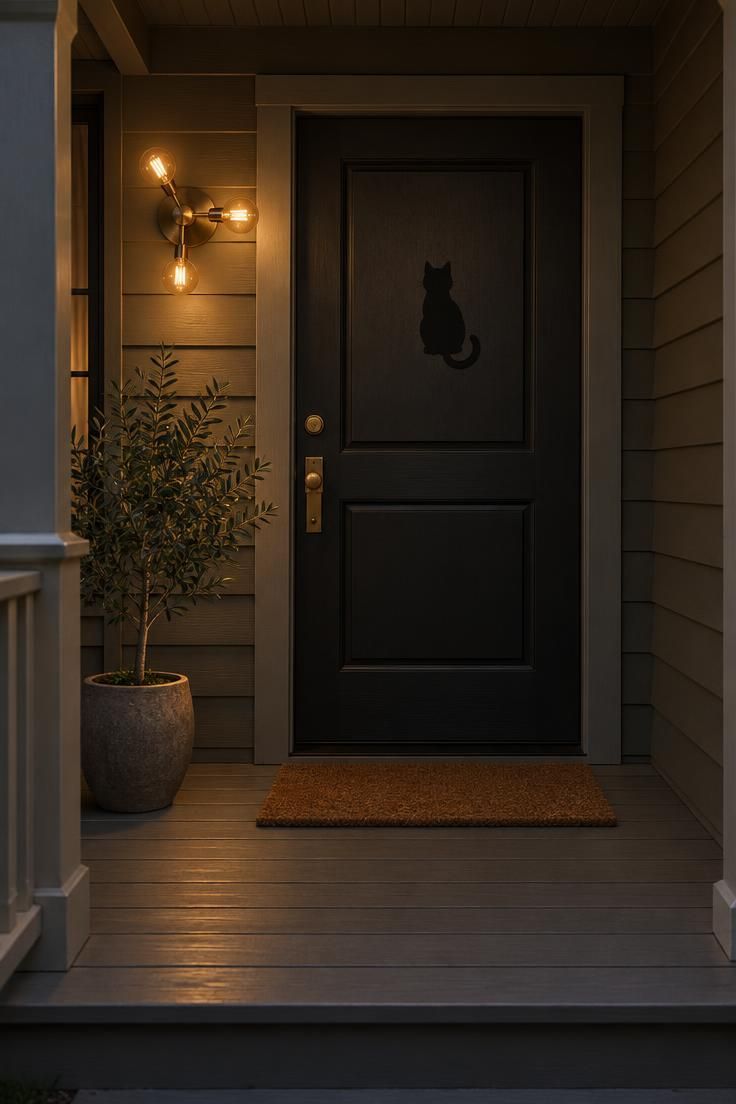
A front porch can mark the season with one strong element rather than a garland.
A Sputnik-style fixture with soft orange or amber bulbs near the door pairs with a plain matte black door and a single flat paper cutout to signal Halloween without clutter.
The light alone does most of the work, especially in early evening when it becomes the only bright point on the facade.
The paper cat silhouette on the door should stay flat and simple, with clean edges and no cartoon features.
Mounting it at the center of the door keeps the composition calm and graphic.
One silhouette plus one light is a complete moment; a row of fake cobwebs or a garland would push the porch toward conventional Halloween and away from the era reference.
Placement matters here.
The fixture should be sheltered from rain and wind, so a covered porch or an existing electrical point under an eave is the natural home for it.
Where those conditions do not exist, a weather-tolerant sculptural piece in the same spiky silhouette can stand in.
The porch remains uncluttered, and the restraint reads as intentional rather than unfinished.
The advantage is clear: two elements, minimal effort, and a facade that still looks like the rest of the year's house.
The limitation is that a bare porch may feel too subtle for readers who want a fuller display, in which case adding one more paper cutout at a different height is a reasonable step before reaching for garland.
Style Blueprint:
- Sputnik-style fixture with three or more amber bulbs
- Matte black door with clean hardware
- One flat black paper cat or bat silhouette, centered
- Plain coir mat and a single potted olive tree or evergreen
- Sheltered placement away from direct rain and wind
Design Pro-Tip: Choose a paper silhouette with a plate hanger or removable tab rather than direct adhesive on a painted door, which keeps the finish intact and lets the shape come down in one piece.
Mid-Century Mantel Decor with Black Cat and Tapered Candles
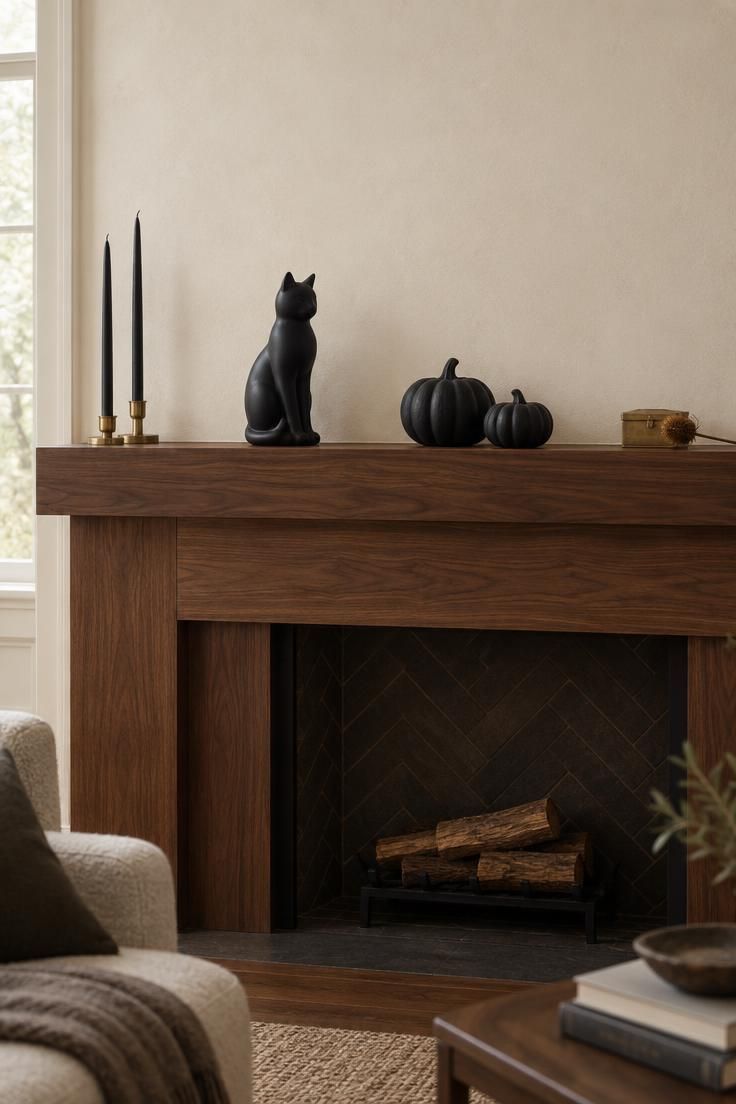
The mantel is a natural stage for mid-century restraint.
Three matte black ceramic pumpkins, a small black cat figurine with clean curves, and two black tapered candles in low brass holders make a complete arrangement without garland or string lights.
Keeping everything below the mantel's sightline and slightly off-center gives the composition a horizontal line and a clear focal point.
This mid-century modern halloween decor approach depends on the cat's silhouette more than its surface detail.
Clean curves and a matte finish read as period-correct, while a glossy or cartoonish figure undercuts the era reference.
The pumpkins stay in a row rather than a pyramid, since tall stacking erodes the horizontal profile.
When the mantel surround is walnut or teak, the dark objects sit against the wood grain with strong contrast.
The practical advantage is that the ceramics store well across seasons and the cat can stay on the mantel all year.
Only the pumpkins need to come down, which makes the display cheap to repeat and easy to maintain.
The limitation is that black objects on a dark wood mantel can lose separation in low light, so a nearby lamp or a lighter wall behind them keeps the shapes readable.
Exact measurements depend on the mantel's length and the objects' scale, so treat the arrangement as a matter of visual judgment.
Three to five pieces is a reasonable working range for most mantels, with the cat sitting slightly off-center as the anchor.
Style Blueprint:
- One small matte black ceramic cat figurine with clean curves
- Two or three matte black ceramic pumpkins in an uneven row
- Two thin black taper candles in low brass holders
- Walnut or teak mantel surround as a warm backdrop
- Off-center placement with everything below the sightline
Muted Plaid and Houndstooth Textiles for Quiet Halloween
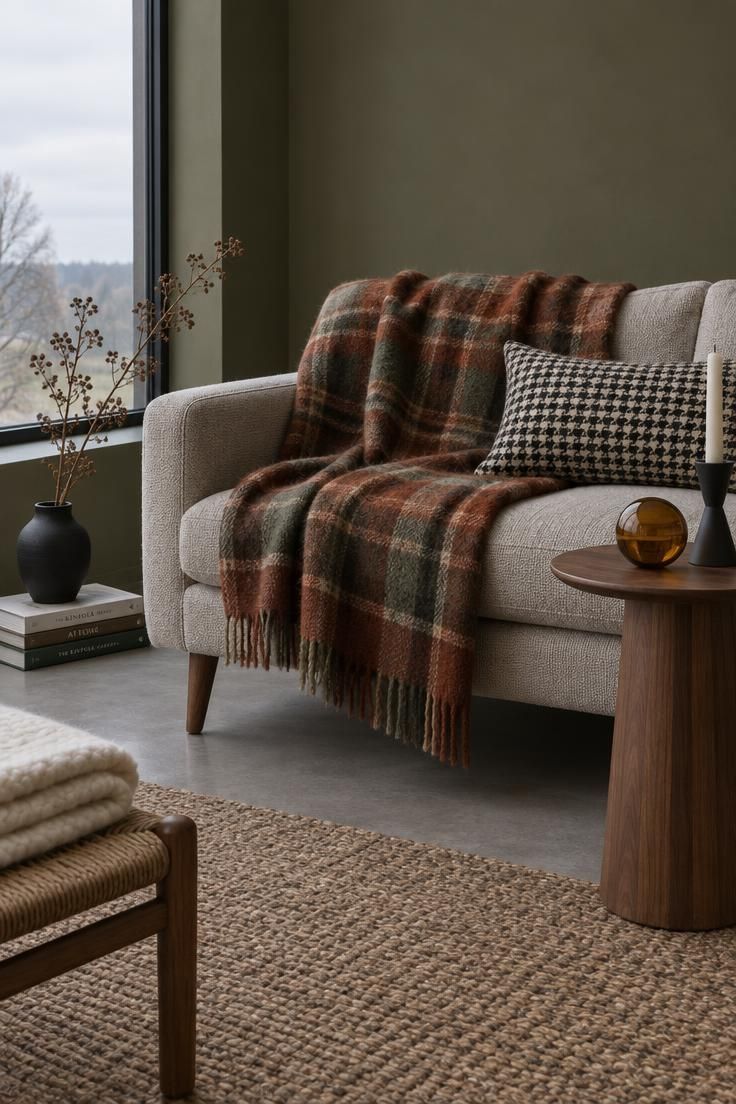
A sofa or reading chair can enter the season without a single prop.
Wool or cotton throws and one lumbar pillow in rust, olive, cream, and black, patterned in muted plaid or small houndstooth, give an autumn cue through fabric alone.
The palette matches the era's scheme, so the textile reads as part of the room rather than a seasonal overlay.
Natural fibers with a visible weave suit this approach better than glossy knits.
One throw plus one pillow is enough; a second pattern starts to compete and pulls the eye away from the room's lines.
A single amber glass orb on the side table carries the palette onto the furniture without adding visual weight.
This is the most livable entry point for a reader who dislikes novelty decor, and the textile can remain through November.
It is also the easiest item to store and rotate.
A mid-century mantel decor approach elsewhere in the room can then be lighter or heavier to balance the sofa's quiet role.
The tradeoff is subtlety: for a full holiday house, fabric alone may feel too understated, and one or two seasonal objects on a nearby surface will do more to signal the season.
For readers who want a room that works for months rather than weeks, this is the most efficient choice.
The textiles do the work, the room stays functional, and nothing needs to be packed away in early November.
Style Blueprint:
- One wool or cotton throw in muted plaid or rust and olive tones
- One houndstooth or small-geometric lumbar pillow in black and cream
- Natural fibers with visible weave rather than glossy knits
- Single amber glass orb or matte black candlestick on a side table
- Tapered-leg sofa or chair to reinforce the era lines
Design Pro-Tip: Rotate a wool throw by folding it in thirds lengthwise and laying it across the seat rather than draping it over the back, which keeps the sofa's low profile visible and the pattern easy to read.
Pressed-Glass and Ceramic Pumpkin Collection on a Low Bench
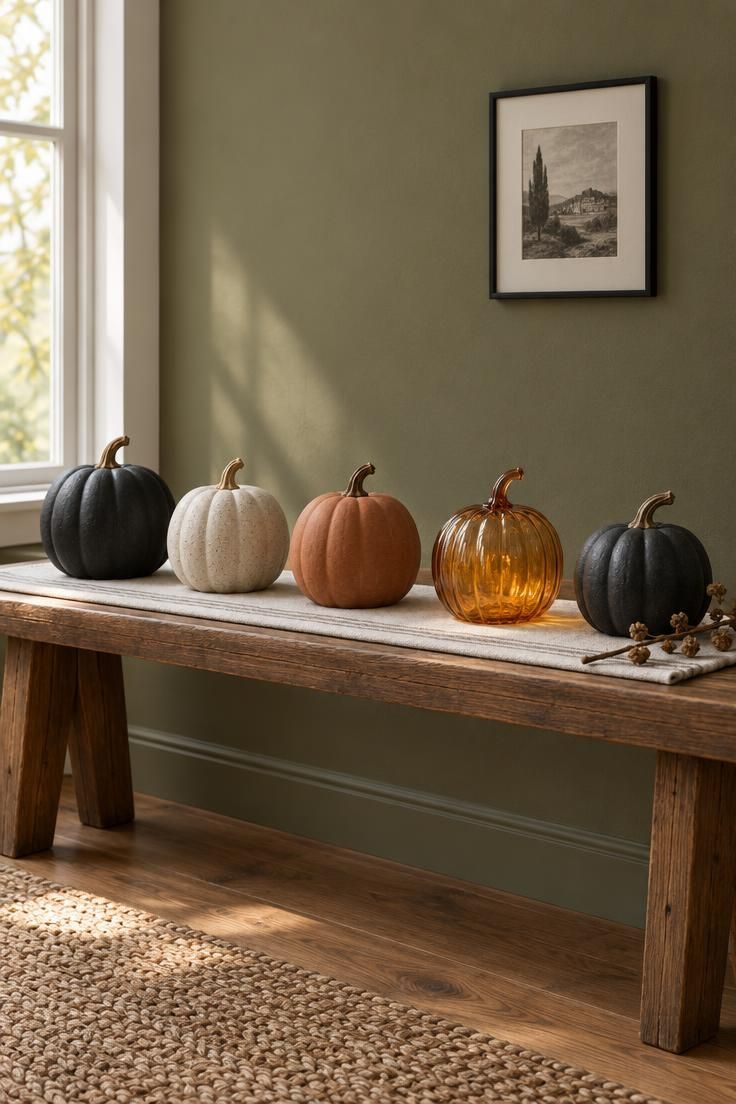
Instead of a single pumpkin shape, gather five or six in different materials and muted colors.
Matte black ceramic, cream stoneware, terracotta, and one amber pressed glass pumpkin set in an uneven row show how palette and material can vary within the same silhouette.
That variation is one of the clearest mid-century lessons: shape stays constant while finish and tone shift.
The glass piece acts as a bright spot, while the ceramic forms ground the group.
Keeping the row on a low teak bench holds the arrangement horizontally and lets the wall above stay mostly bare.
A folded linen runner beneath the row softens the transition between the wood and the objects.
Building the collection around matte black ceramic pumpkins gives the group a consistent weight, since the dark tones anchor the palette and make the cream and terracotta pieces read as accents.
Adding a second glass piece would dilute the single bright moment, so one is enough.
After Halloween, removing any jack-o'-lantern pieces leaves the tonal pumpkins as autumn accents that carry into November.
The ceramics store well and the glass needs only gentle handling.
A collection built gradually over seasons costs more upfront than a single ceramic, but each piece earns its place across multiple years.
Style Blueprint:
- Five or six pumpkins in an uneven row on a low teak bench
- Two matte black ceramic pumpkins as the palette anchor
- One cream stoneware, one terracotta, and one amber pressed glass
- Folded cream linen runner beneath the row
- Muted olive or cream wall left mostly bare behind
Tapered-Leg End Table with a Single Honeycomb Pumpkin
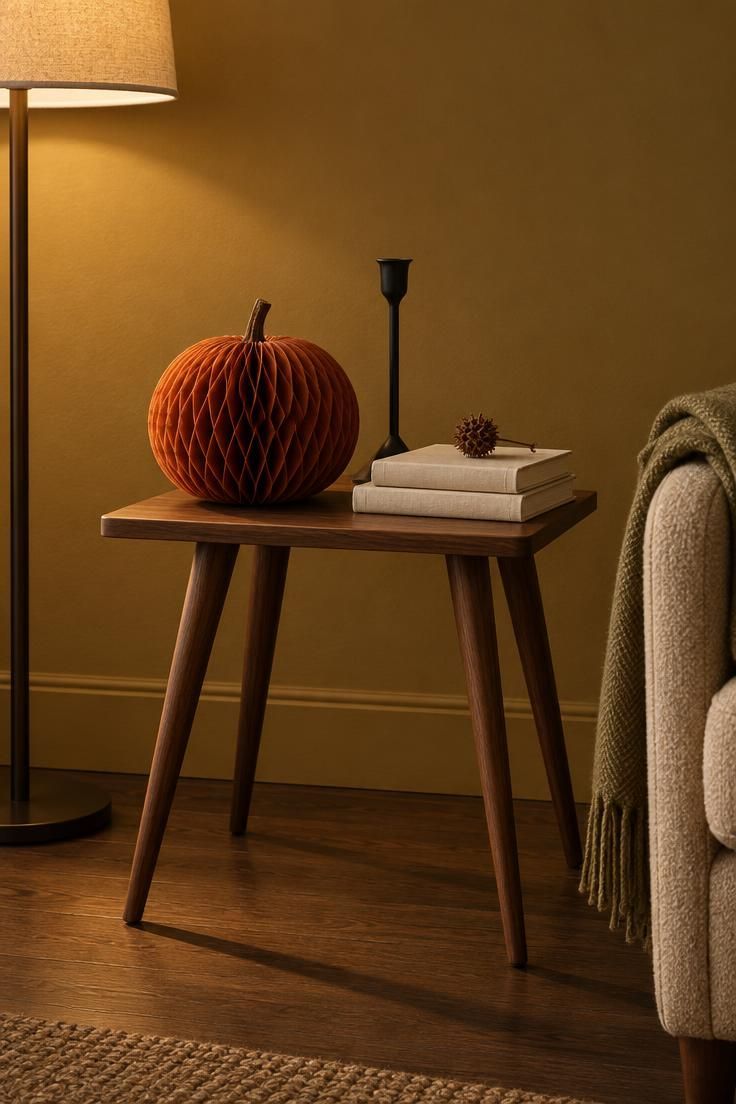
A lone honeycomb paper pumpkin can carry a whole corner of a room when it sits on a small end table with tapered legs.
Choose one in rust or burnt orange, open it fully, and place it slightly off-center beside a matte black candlestick and a slim stack of clothbound books.
The table's clean lines and the pumpkin's crisp pleats share the same geometric character, so the pairing feels intentional rather than spare.
Keeping the wall behind bare lets the table cast a long, low shadow under a nearby lamp.
That shadow adds depth to the corner without any additional objects.
The composition works as a quiet counterpoint to a busier mantel or console elsewhere in the room, and the contrast between the two zones keeps the house from reading as uniformly decorated.
Honeycomb paper is fragile, so keeping the display out of door swings, open windows, and humid rooms preserves the pleats and the shape.
Once the pumpkin loses its crease definition, the geometric quality that makes the pairing work is gone.
For a reader who wants the look to last multiple seasons, a pressed-glass or ceramic pumpkin in a similar color can substitute, though it loses the crisp pleated texture.
Books in cream cloth covers and a single dried seed pod complete the corner with minimal effort.
Two or three objects on a small table is the right count; a fourth starts to crowd the surface and blurs the focal point.
Style Blueprint:
- One fully opened honeycomb paper pumpkin in rust or burnt orange
- Small square end table with splayed or tapered walnut legs
- Thin matte black candlestick and two cream clothbound books
- Bare mustard, olive, or cream wall left undecorated
- Warm lamp light from the side to cast a long low shadow
Entry Console with a Single Sputnik-Style Shadow Box
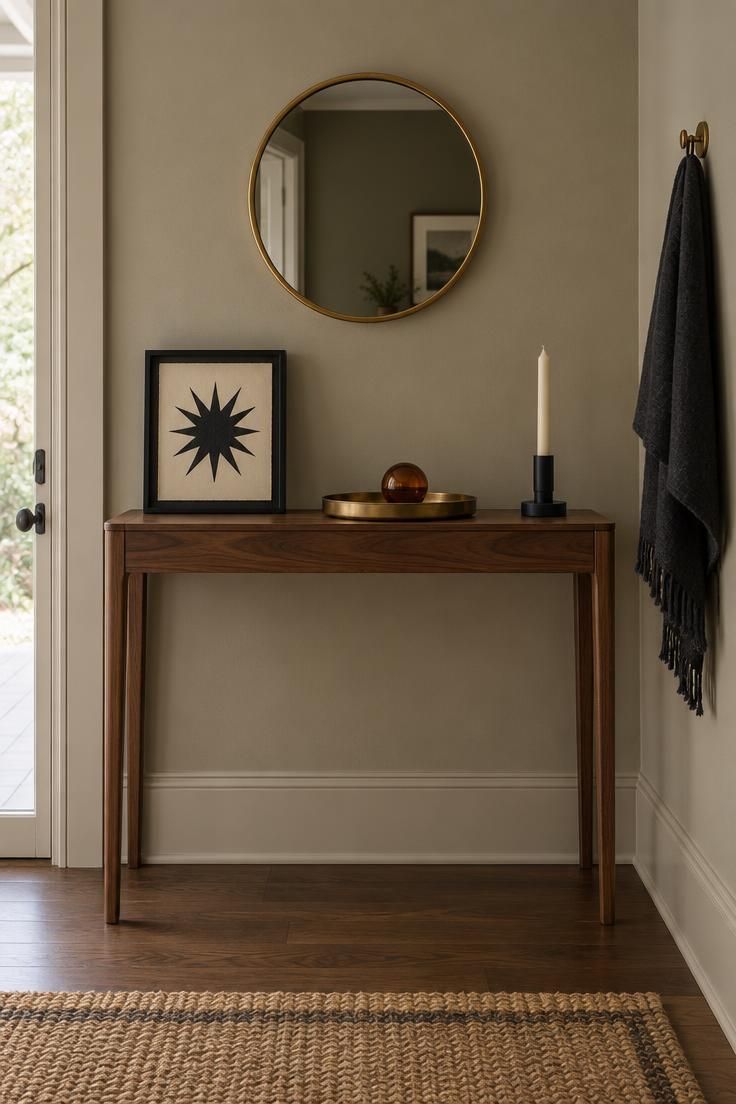
A small entry console can become a complete Halloween moment with one framed piece.
A shadow box or shallow frame holding a flat black Sputnik shape or atomic starburst cut from matte card stock against a cream background gives the entry a contained, gallery-like focal point.
Placing the frame on the console rather than hanging it keeps the arrangement flexible and lets the display shift with the season.
The frame protects the paper from curling and dust, which extends its life beyond a single October.
That protection matters for a paper decoration, since unprotected card stock can warp within a season in a drafty entry.
A small matte black candleholder at the other end of the console balances the frame's visual weight, and a single amber glass orb between them carries the palette across the surface.
The advantage is that the frame can be swapped after Halloween, leaving a neutral piece to fill with a print or another seasonal item.
The console then returns to its everyday role without any repainting or patching.
This suits apartments or short entries where a full vignette would block movement.
The limitation is scale.
A narrow console needs a frame that does not overhang the edges, and the surrounding wall should stay mostly bare so the frame reads as the focal point.
Adding a second frame or a garland would crowd the composition and dilute the gallery effect.
Style Blueprint:
- Black-framed shadow box with a matte black starburst on cream paper
- Narrow walnut console with tapered legs
- Matte black candleholder with one cream taper
- Small amber glass orb on a shallow brass tray
- Bare wall with a single small round mirror above
Design Pro-Tip: Cut the starburst arms slightly shorter than the frame's inner edge so the shape sits fully within the mat and the paper has room to shift without touching the glass.
Conclusion
Mid-century modern Halloween succeeds by choosing a few objects that pass the silhouette test: black cats, starbursts, muted pumpkins, and amber glass.
The restraint is what makes the result feel intentional rather than sparse, and the palette's overlap with autumn means the decor can linger into November without looking out of place.
Starting with one low surface and three to five pieces lets the era's shapes carry the season on their own.