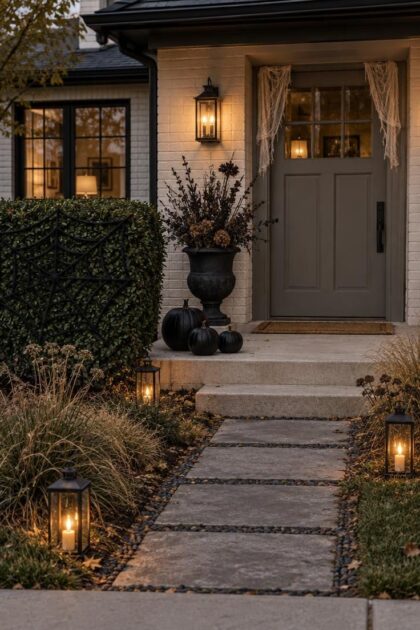
This post may contain affiliate links. If you make a purchase through these links, we may earn a commission at no additional cost to you.
Modern outdoor Halloween decor often trades cartoonish color and clutter for restrained palettes, sculptural forms, and negative space.
The ideas below treat the porch, yard, doorway, and garden as one composed scene rather than a collection of separate props.
Each entry pairs a distinct material or visual strategy with a placement that works with the home instead of against it.
Some lean on silhouette and shadow, others on dried stems, matte finishes, or a single graphic gesture.
The result is a Halloween look that feels considered, current, and at home in a contemporary setting.
Matte Black Pumpkin Grouping on a Bone-Colored Step
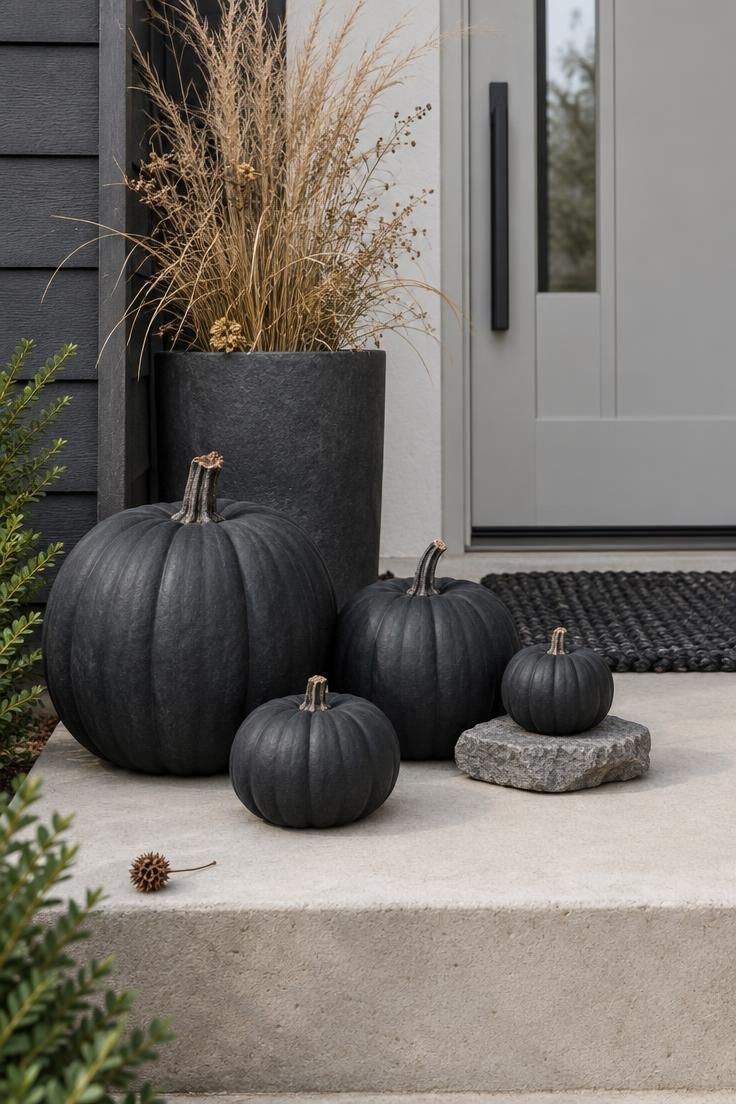
Three to five pumpkins in different sizes, clustered off-center rather than lined up, give a front step a composition that reads as deliberate.
The flat, non-reflective finish is what separates the arrangement from traditional orange produce: light settles on the surface instead of bouncing off it, so each pumpkin holds its shape as a solid dark mass.
Balancing that dark mass matters more than the count.
A pale step, a light door, or a bone-colored wall gives the black shapes something to sit against, and the contrast does most of the visual work.
If the surrounding surfaces are dark too, the grouping tends to disappear into the entry, so a lighter riser, a pale mat, or a stone beneath one pumpkin can restore the separation.
Uneven placement keeps the arrangement from looking like a store display.
A straight row of same-size pumpkins reads as inventory; a cluster with one raised slightly on a flat stone and one turned at an angle reads as a still life.
Painted pumpkins treated this way function as sculptural matte black pumpkin arrangements rather than seasonal produce.
Weather affects how the finish ages.
Under a covered porch, painted surfaces are less likely to collect condensation marks or streaking from rain, which keeps the matte look consistent through the season.
Reusing the same pumpkins next year is one practical advantage of the painted approach over fresh ones.
Design Pro-Tip: Raise one pumpkin on a flat stone or low riser to break the line of the grouping, and keep the tallest pumpkin slightly off center so the eye moves across the arrangement instead of stopping at the middle.
Style Blueprint:
- Five pumpkins in graduated sizes, painted in a single matte black
- A bone or pale gray step, mat or riser as the contrasting base
- One dark planter with dried tan grasses behind the cluster
- A flat stone or low riser under a single pumpkin for height variation
- Minimal props beyond the pumpkins so the grouping stays the focal point
Backlit Silhouette Panel of Twisted Branches Beside the Door
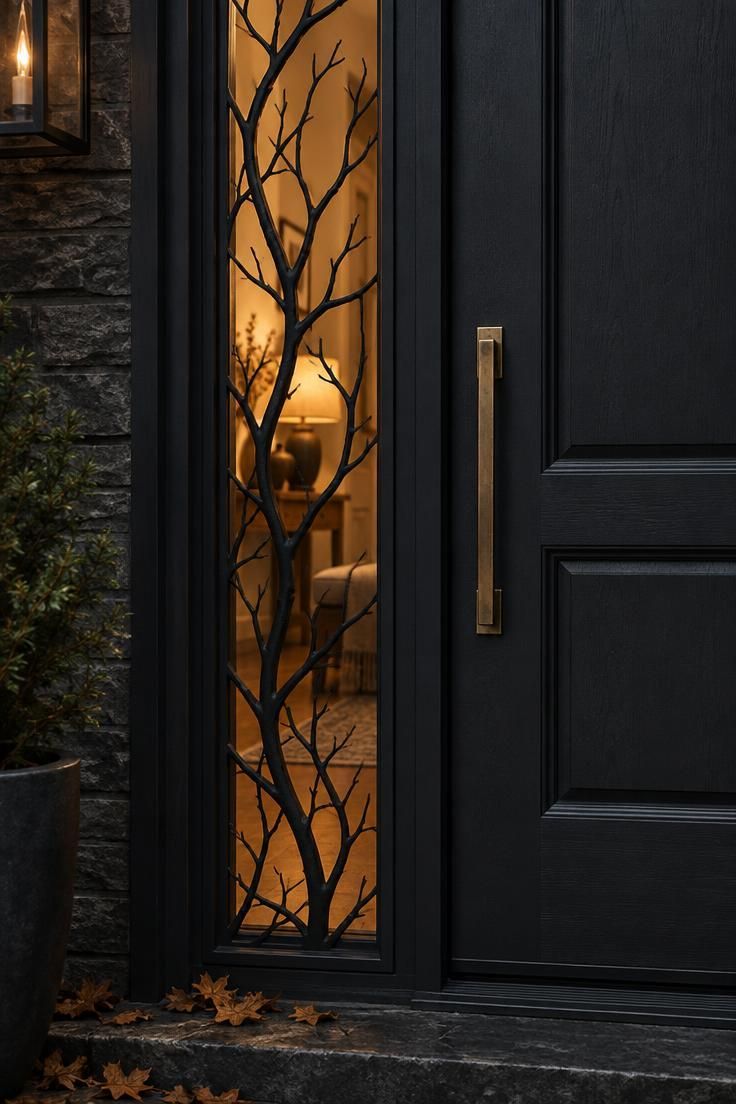
A single flat black cutout placed against a glowing window turns the light itself into the decoration.
Backlit Halloween silhouettes work because the shape is read as a shadow rather than as an object, and that reversal is what makes the effect feel graphic instead of crafty.
One bold motif carries further than several small shapes.
A tangle of bare branches filling a tall sidelight gives the eye a single image to read, while a scatter of bats, cats, and spiders in the same window splits attention and reads as clutter.
The same idea scales up for a garage-side window or down for a small transom above a door.
Placement relative to the approach path decides whether anyone notices.
A silhouette beside the door, at the height of a standing visitor's gaze, is visible from the walkway; one tucked behind a planter or below a railing may only appear once someone is already on the step.
Paper and thin wood cutouts are light enough that wind can shift them, so a recessed corner or a spot shielded by the door frame holds position better than an exposed pane.
Flat shapes pressed against glass also avoid the depth problem that makes three-dimensional props read as props.
Style Blueprint:
- One flat matte black cutout with a single bold motif
- A narrow window, sidelight, or transom with a warm interior glow behind it
- A protected corner or recessed placement to limit wind movement
- A dark door color for contrast with the glowing pane
- A few dried leaves at the threshold to tie the entry together
Dried Botanical Halloween Planter with Dark Seed Heads
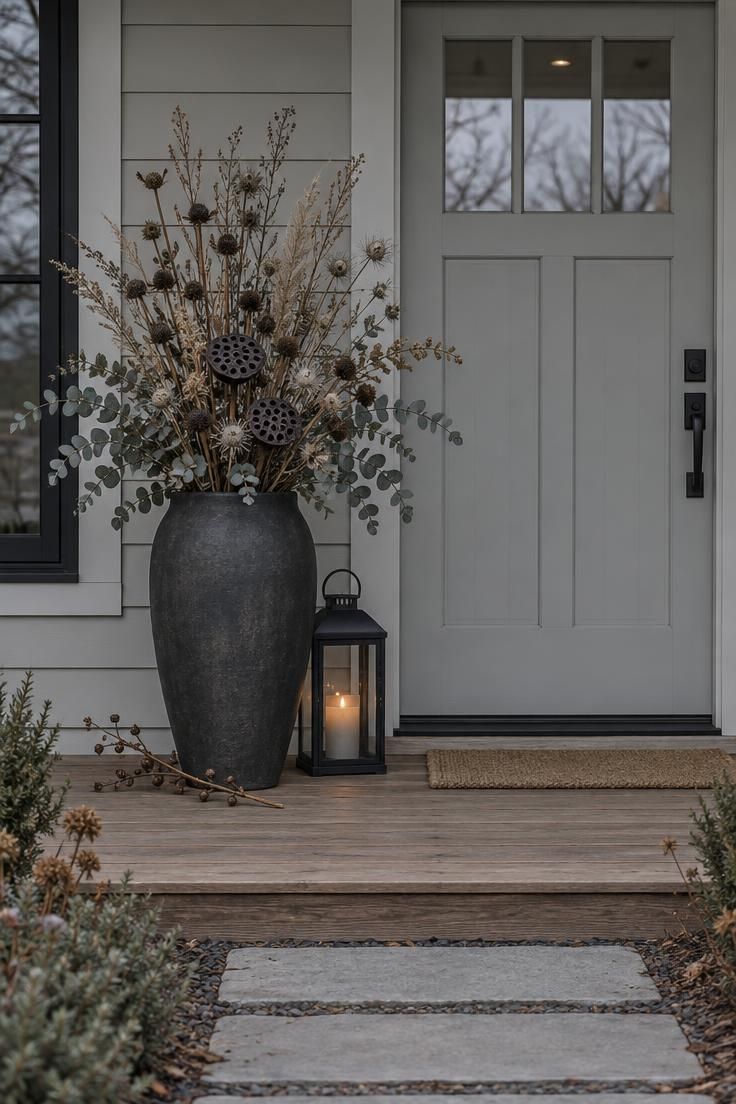
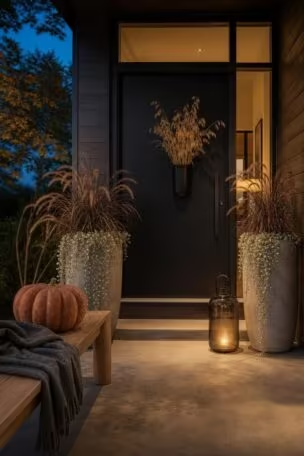
A tall urn packed with dark seed heads and dried stems anchors a modern porch in a way that carries into late autumn, long after carved pumpkins have softened.
Lotus pods, nigella, eucalyptus, and dried grasses bring structure and muted color rather than bright seasonal color.
Choosing materials that hold their shape when dry makes the difference between an arrangement that looks intentional in October and one that looks tired by the second week.
Structural stems with visible seed heads keep their silhouette; soft fillers collapse into a shapeless mass.
Sparse placement, with air between the stems, suits a modern entry better than a dense, rounded bouquet.
Sun exposure is the main tradeoff.
Dried botanicals can become brittle and fade when they sit in direct light for weeks, so a corner that receives filtered light or a covered porch keeps them looking closer to how they started.
The urn itself can be moved indoors or repurposed once the season ends.
Position matters as much as content.
A corner spot beside the door, visible from the walkway but clear of the path, gives the planter presence without turning it into an obstacle.
Slightly off-center placement reads more naturally than a perfectly symmetrical pair of urns.
Style Blueprint:
- A tall charcoal or concrete urn as the base
- Dark dried stems: lotus pods, nigella, eucalyptus, dried grasses
- Sparse, structural placement with visible gaps between stems
- A covered or filtered-light corner position
- One matte black lantern beside the urn for a low warm glow
Design Pro-Tip: Choose three or four stem types with clearly different shapes, such as round pods, feathery grasses, and thin seed spikes, then arrange them in separate clusters rather than mixing every stem together.
Gauze Draped Doorway with a Single Dark Lantern
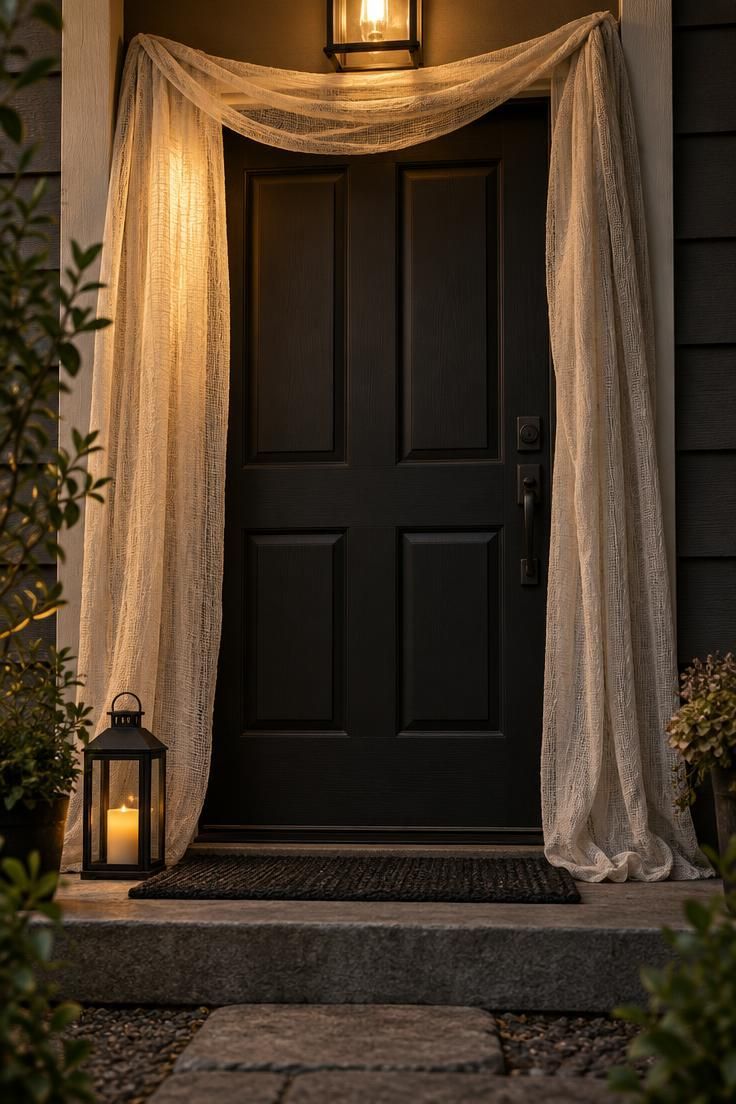
Lightweight gauze or muslin draped across the top of a doorway and falling in soft folds brings a textile layer to an entry without the density of faux cobwebs.
The fabric moves in a breeze, so the doorway shifts slightly through the evening rather than sitting static.
Keeping the fabric light is the point.
A few yards draped at the top corners and allowed to hang in loose vertical folds reads as a quiet gesture; wrapping the entire frame or layering multiple fabrics turns it into a decoration that competes with the door.
Semi-sheer material catches porch light and shows its weave, which gives the folds some texture at night.
Practical details decide whether the idea works.
The door handle and keyhole need to stay clear so the door opens without catching, and fabric that trails across the threshold will collect grit.
A quick check before guests arrive handles dust and any small tears at the fold edges.
Color contrast changes the effect.
Against a dark door, off-white gauze reads clearly; on a pale door, the same fabric becomes softer and more subtle, which may call for a darker lantern or a stronger shadow to keep the doorway legible from the sidewalk.
Removal after the holiday takes only a few minutes, which suits a look that is meant to be temporary and leaves room for pairing the doorway with dried botanical Halloween planters in muted fall tones.
Style Blueprint:
- Off-white gauze or muslin in a loose, semi-sheer weight
- Fabric limited to the top corners and sides of the door frame
- A dark door color for clear contrast
- One matte black lantern with a warm LED candle on the step
- Clear door handle and threshold so the door operates normally
Sculptural White Ghost Forms Rising in the Front Bed
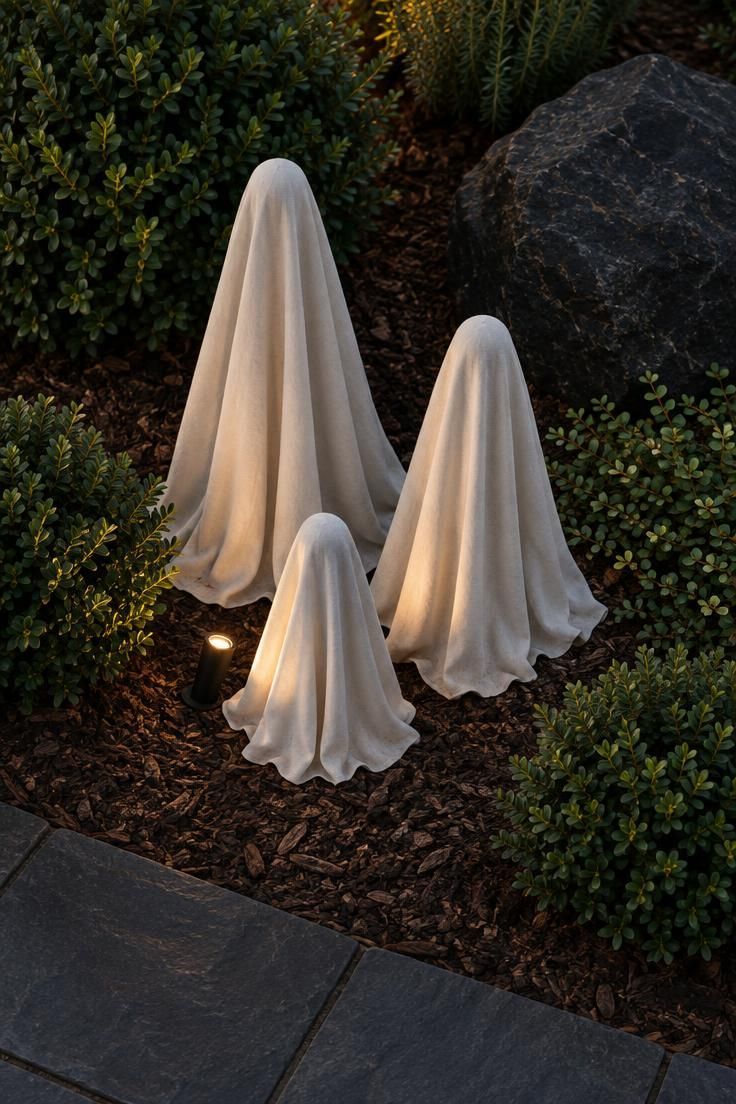
Abstract draped forms read as minimalist shapes when the finish is matte and the silhouette is simple.
A soft cone of bone-colored fabric over a light frame avoids the face paint, sheet hem, and floating posture that make a ghost read as a costume, and lets the shape itself carry the Halloween reference.
Grouping three forms in varied heights gives the bed a rhythm without crowding it.
Spacing them so shadows fall between the forms adds separation, especially when a low light sits behind the group.
The contrast between soft white fabric and dark mulch or a black stone beside them sharpens the outline.
Fabric forms and rain do not mix well.
A draped shape can slump and hold water, so a covered bed or bringing the forms in during heavy weather keeps them in shape.
This is a placement decision rather than a material claim, and it applies to any soft sculpture left outdoors for a season.
A low light behind the group makes the forms read more clearly at dusk, when the white fabric catches the light and the shadow between forms deepens.
Even at that hour, keeping the light warm and low preserves the quiet mood rather than flattening the bed into a bright patch.
Style Blueprint:
- Three ghost forms in graduated heights, finished in matte bone fabric
- A mulched bed with low evergreen shrubs as the backdrop
- One large black stone for tonal contrast
- A low warm light placed behind the group
- A covered or sheltered bed position, with the forms brought in during heavy rain
Oversized Spiderweb of Black Rope Across the Front Hedge
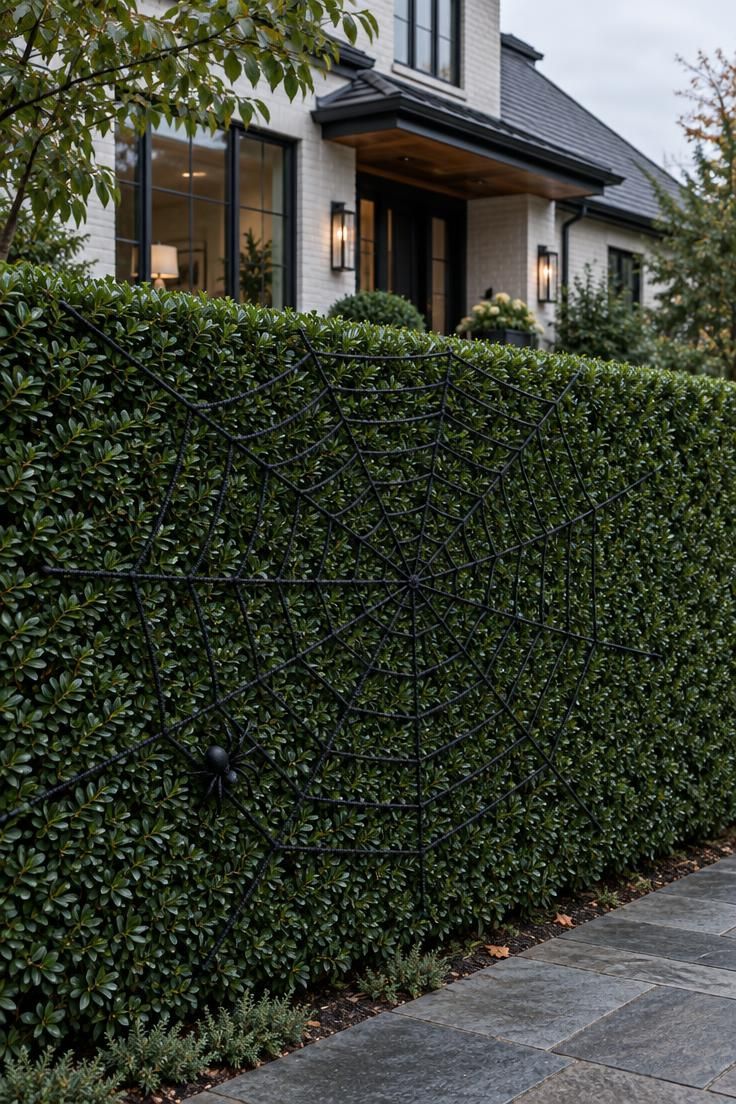
Repetition and scale turn a familiar Halloween motif into a graphic line drawing.
A web made from black rope or heavy cord across a large hedge reads as an overlay of straight lines rather than a prop, and the geometric regularity is what keeps it modern.
Symmetry matters here.
Radial lines that meet at a shared center and cross threads spaced at even intervals produce a clean shape; a web that sags or drifts out of alignment looks accidental.
Checking the shape every few days and adjusting the tension keeps the geometry crisp through the season.
Wind moves rope, and the web will shift slightly over time.
The idea suits a wide uncluttered hedge or a pair of porch posts with a long span between them where the web has room to sit as a single element, making it a natural fit for modern Halloween porch decor on a broad front entry.
On a narrow facade or a small planting bed, the same web compresses and reads as clutter.
A single small black spider placed off center adds a focal point without turning the web into a scene.
Keeping the spider small relative to the web preserves the graphic effect and prevents the whole arrangement from tipping toward novelty.
Style Blueprint:
- Matte black rope or heavy cord in a consistent weight
- Symmetrical radial lines with evenly spaced cross threads
- A wide hedge, open wall, or pair of porch posts as the span
- One small black spider placed off center
- Regular adjustment to keep the web's geometry aligned
Design Pro-Tip: Sketch the web's radial lines on paper before stringing the rope so the center point and thread spacing stay consistent across the full span.
Reflective Acrylic Ghost Shapes Along the Front Walk
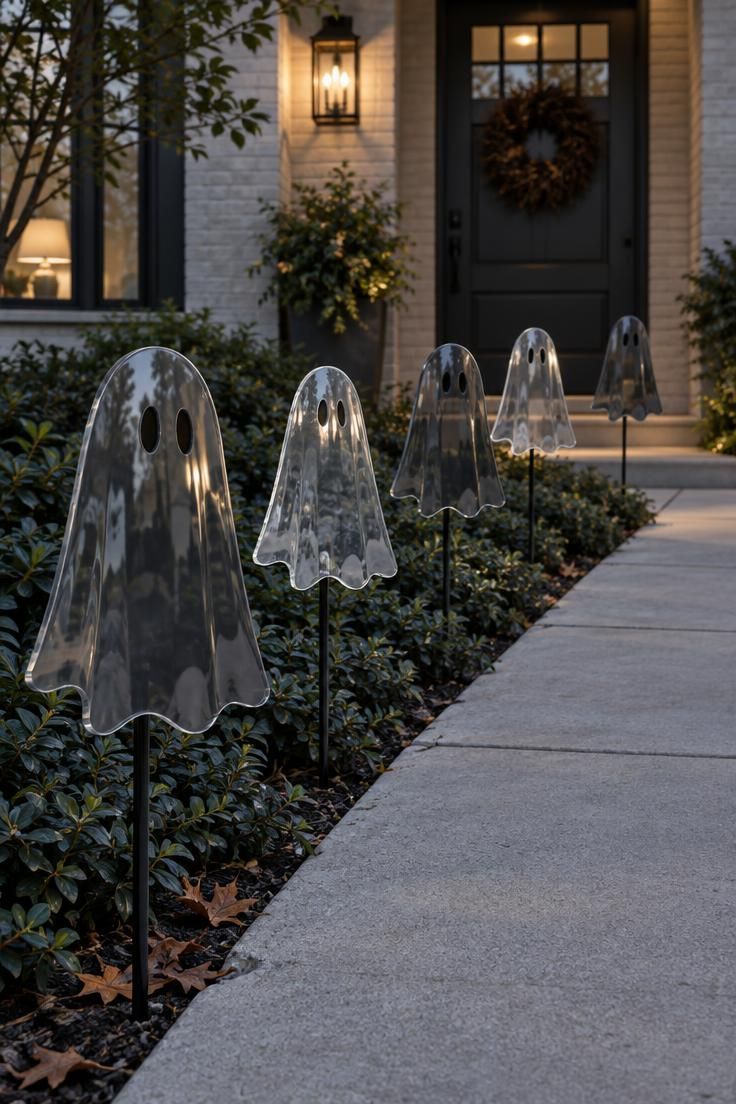
Flat cutouts can still hold depth when the material itself catches and returns light, which makes them a natural fit for contemporary Halloween yard decor.
Thin acrylic panels in smoke, clear, or bone tones read as modern objects rather than craft decorations, and the polished edges give the profile a quiet glow after dark.
Lining just one side of the walk creates a clear arrival path without turning the yard into a crowded scene.
Varying the height of the stakes and the size of the ghost shapes prevents the row from feeling like a repetitive fence.
A slight forward tilt on each panel helps catch light from a porch fixture or a low landscape light.
The palette stays compatible with a black-and-bone Halloween scheme.
Clear acrylic nearly disappears in daylight, while smoked panels hold their outline against pale concrete or gray stone.
Because the shapes are lightweight, a gusty evening may send them rocking, so spacing them away from foot traffic and pressing the stakes firmly into soft ground keeps the arrangement steady through trick-or-treat hours.
Style Blueprint:
- Translucent acrylic ghost shapes in clear, smoke, or bone tones
- Slim black stakes at staggered heights along one edge of the walk
- Cool ambient light from the porch or low landscape fixtures
- Uneven spacing and varied panel sizes to avoid a static row
- Placement offset from the walking path to limit bumps and wind wobble
Aged Brass Lantern Trio on a Charcoal Front Porch
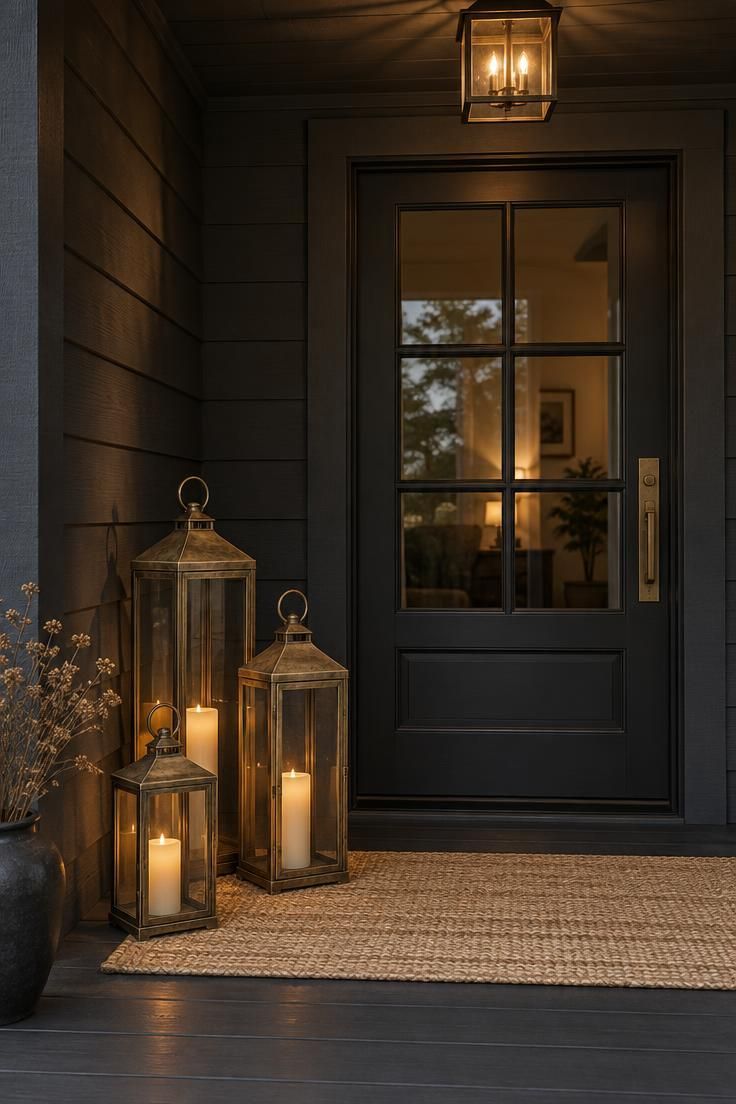
Aged brass and bronze bring a warm metallic counterpoint to black or charcoal architecture without breaking a restrained palette.
Three lanterns in the same finish but different proportions create a repeating rhythm along a porch, especially when their heights step up or down rather than sitting level.
The metal tone does the work, so the lanterns can stay simple.
Elaborate scrollwork or mixed finishes compete with the warm glow; plain frames let the light and the patina carry the arrangement.
Grouping the lanterns on one side of the porch, rather than spacing them evenly across the full width, keeps the composition from feeling symmetrical and static.
Outdoor lanterns collect debris, dust, and water spots between uses.
Wiping the frames and clearing the interiors before each evening keeps the glow even, and aged brass hides fingerprints and small weather marks better than polished finishes do.
Real candles should never be left unattended on a porch.
Battery candles or enclosed flame units give the same warm point of light without the open flame, and they hold a steady glow through a windy evening.
Style Blueprint:
- Three lanterns in aged brass or bronze, matching finish
- Varied heights and proportions for a stepped rhythm
- One side of the porch rather than an even spread
- Warm LED candles or enclosed flame units
- A pale woven mat or low anchor at the base
Weathered Concrete Skull on a Low Bronze Pedestal
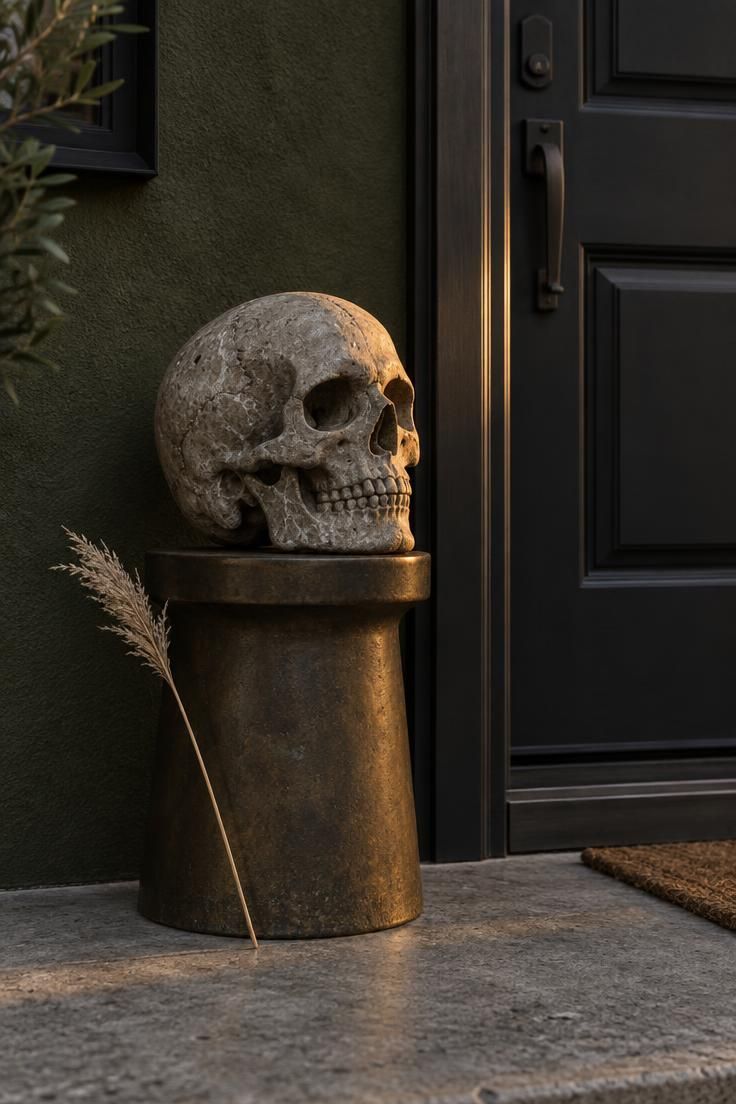
A single sculptural skull placed at a low height changes the mood of an entry without turning it into a costume shop window.
The weathered concrete surface gives the piece an aged, stone-like appearance that reads as a permanent garden object, while the bronze pedestal adds a quieter metallic note that separates the skull from the front step.
Placement matters more than size.
A low position beside the door keeps the skull from becoming the loudest object on the facade, and it draws the eye downward before a visitor reaches the entrance.
Raising the same form to eye level would create a more theatrical effect, which may not suit a restrained modern porch.
Pair the skull with one natural element rather than a cluster.
A lean dried grass stem, a single dark fern frond, or a bare twig works better than a full pot of seasonal plants because the contrast stays spare and controlled.
A dark door or deep neutral wall gives the concrete its most readable silhouette, while a pale wall can flatten the pale gray tone.
Style Blueprint:
- A weathered concrete skull with visible pits and mineral streaks
- A low bronze or dark metal pedestal with simple proportions
- One pale dried grass stem or bare twig resting at the base
- Placement beside the door rather than centered on the step
- A dark olive, charcoal, or matte black wall for contrast
Design Pro-Tip: Position the skull slightly off-center on the pedestal and lean the stem against the base on the opposite side so the two elements read as one asymmetric composition instead of a matched pairing.
Spectral Porch Columns in Gradient Gray Mesh
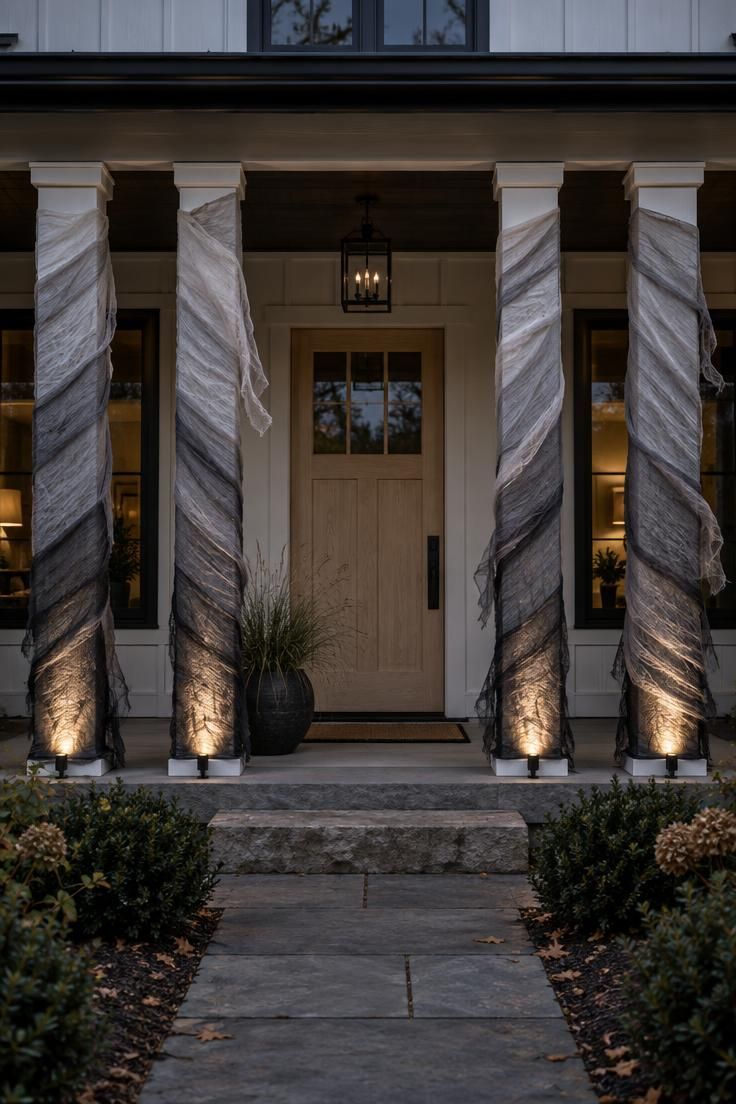
Instead of attaching a graphic to a flat surface, this idea turns the porch structure itself into the display.
Open-weave gray mesh wraps each column in layered folds, and the material shifts toward silver as it rises, giving the facade a foggy, veiled look without covering the architecture completely.
The spacing between columns does part of the work.
A visitor sees four vertical forms with slightly different wrap angles, so the porch reads as a series of quiet sentinels rather than a single decorated panel.
Soft landscape lighting from below pushes shadows through the open weave and avoids the harsh spotlight effect that flattens textured fabric.
This works best when the surrounding siding stays pale and uncluttered.
One or two supporting pieces, such as a dark pot beside the step, are enough; additional props on the porch narrow the path and compete with the columns.
Because mesh is forgiving to shape, the wraps can be removed and stored flat after the season.
On an exposed porch, choose a weave that is open enough to let air pass through but dense enough to hold its folds.
Style Blueprint:
- Four square porch columns wrapped in gray open-weave mesh
- Darker fabric near the base fading to a lighter silver at the top
- Low landscape uplights aimed through the mesh for soft shadow motion
- Pale siding and a mostly empty porch for contrast
- Minimal supporting decor such as a single dark planter or grass
Bare Branch Obelisk Rising from a Cement Urn
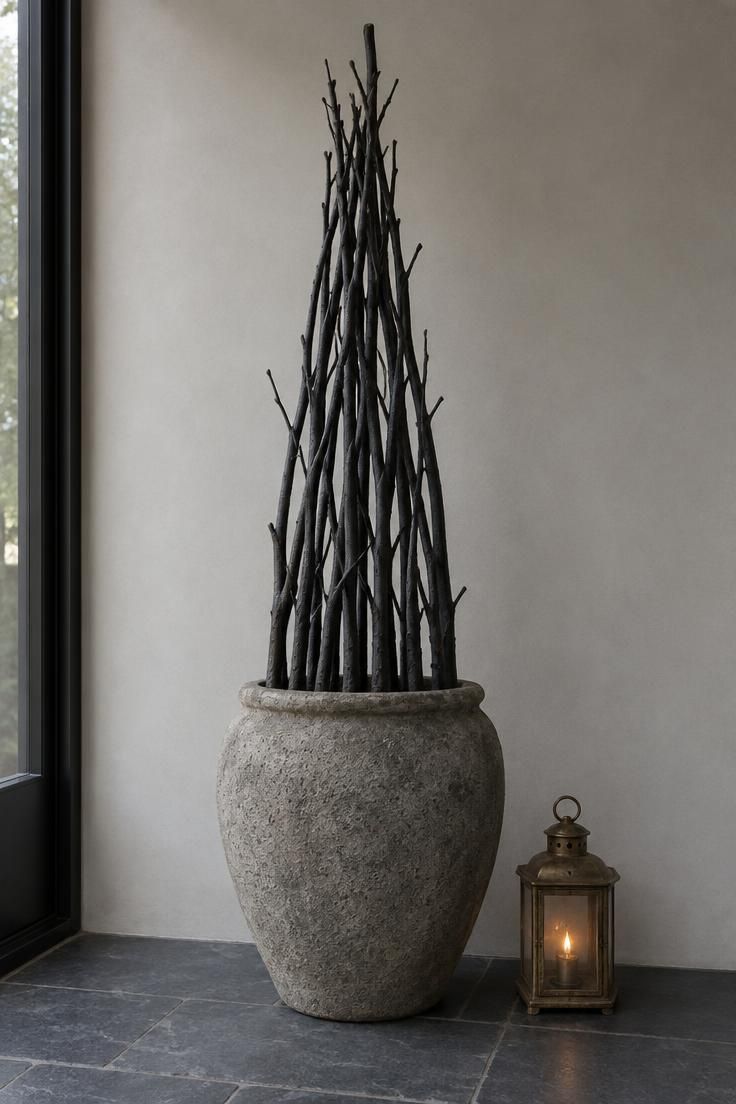
A bundle of bare branches gathered into a tapered vertical form gives an entry height without adding many objects.
The upward line draws the eye, and the contrast between rough organic stems and a solid geometric urn keeps the arrangement from reading as rustic.
Placement beside a doorway or at the edge of a walkway lets the height act as a focal point.
Branches can be brittle, and a spot out of the traffic path reduces the chance of a stem snapping when someone brushes past.
A corner position also keeps the bundle upright without being bumped.
Unifying the stems with a single paint finish in charcoal or bone smooths the varied bark textures into one shape.
A small lantern at the base adds a soft glow at the foot of the arrangement, which grounds the tall form and keeps it from floating visually against a dark porch.
Style Blueprint:
- A wide cement or concrete urn with a simple profile
- Bare branches bundled into a narrow tapered obelisk
- A single paint finish in charcoal or bone to unify the stems
- A corner or walkway-edge location clear of foot traffic
- One small lantern at the base for a low warm glow
Frosted Acrylic Orb Path Markers with Internal LED Glow
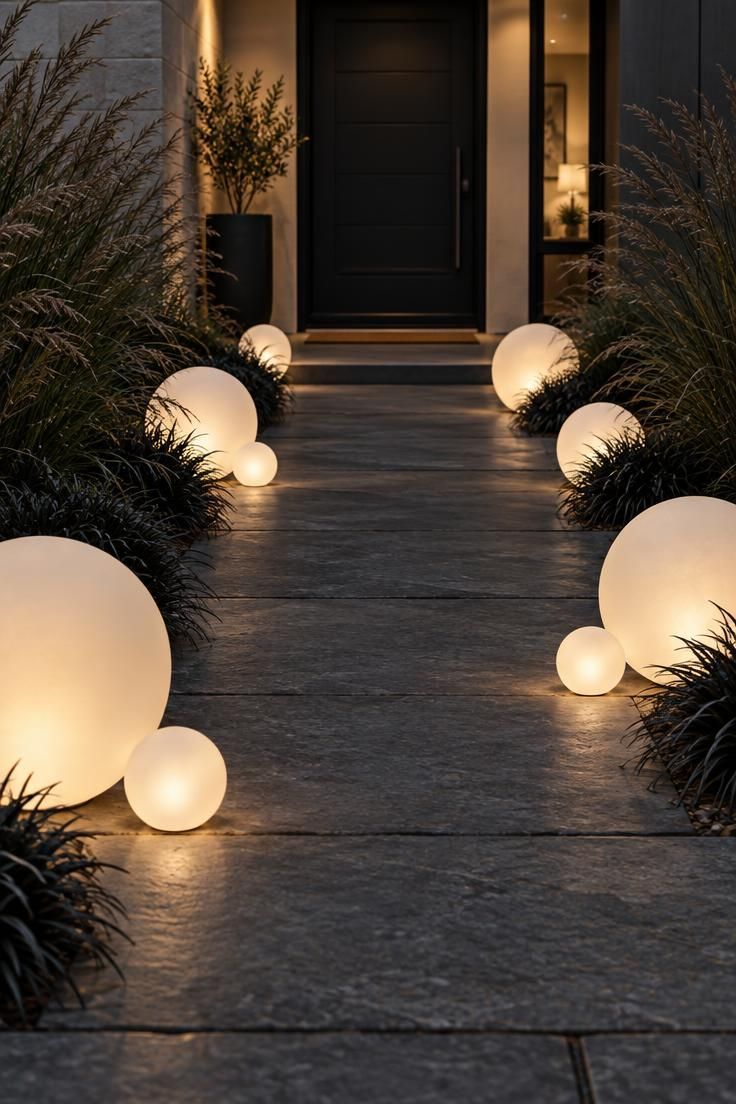
Frosted acrylic orbs offer a way to define the front walk without relying on carved pumpkins or hanging string lights.
The translucent surface softens the light source, so each orb reads as a calm glow rather than a bright fixture.
Varying the orb sizes keeps the arrangement from turning into a neat row of identical objects.
A cluster of three on one side and a single larger piece on the other creates a rhythm that guides the eye toward the door while still feeling loose and intentional.
The cool gray tone of the acrylic works with black grasses, charcoal stone, and darker exterior finishes.
Warm white LED light inside each piece keeps the overall scene inviting, but the frosted surface prevents the glow from becoming a harsh point of light.
These markers need no tabletop or shelf, which makes them useful for a narrow walk where a planter would block the path.
Stones, pavers, or low ground cover give each orb a stable visual base, and the surrounding dark foliage helps the round silhouettes stand out.
Style Blueprint:
- Frosted acrylic orbs in three or four sizes
- Warm white LED light inside each orb
- Charcoal stone pavers as a simple ground plane
- Dark ornamental grasses behind the orbs
- Loose clusters rather than evenly spaced rows
Design Pro-Tip: Place the largest orb nearest the door and graduate the sizes outward so the walk feels pulled toward the entry rather than evenly dotted.
Graphic Black Bat Silhouette Fence Line
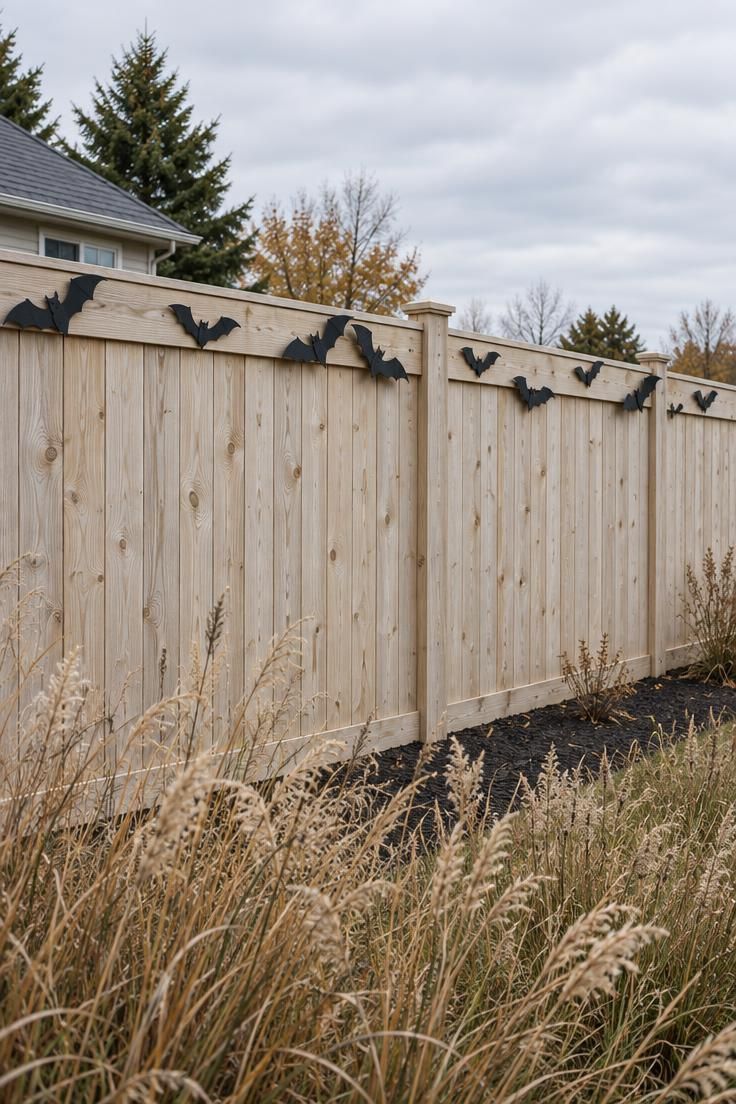
A line of black bat shapes along a fence top turns a plain boundary into a quiet shadow theater.
Silhouettes against a pale fence or an evening sky suggest movement without any animation, and the shapes frame a walkway or property line in a way that a wall or hedge alone cannot.
Irregular spacing carries the effect.
An odd number of bats with varied gaps reads as a passing flock; even spacing reads as a pattern and loses the sense of flight.
Slight overlaps between a few shapes add depth along the line.
Weather affects lightweight materials over a season.
Shapes can warp or curl with repeated moisture, so a covered porch or a recessed fence line needs less attention than an exposed span.
Placing the flock at eye level keeps it visible from the street without blocking sightlines across the yard.
Style Blueprint:
- Thin black bat shapes in a consistent material
- An odd count with varied gaps along the rail
- A pale fence or open sky as the light background
- Slight overlaps between a few shapes for depth
- Eye-level placement that keeps sightlines clear
Conclusion
The ideas in this collection share one approach: a single strong visual strategy, whether a palette, a silhouette, a material, or a light effect, does the work that several smaller props would otherwise share.
Choosing one or two ideas for each outdoor zone keeps the porch, yard, and entry reading as one composition rather than a scatter of separate decorations.
Modern outdoor Halloween decor holds up best when the restraint is consistent, from the step to the fence line, so the display stays legible from the street and comfortable to live with for the rest of the season.