This post may contain affiliate links. If you make a purchase through these links, we may earn a commission at no additional cost to you.
A front yard seen from the sidewalk at dusk reads nothing like the same props seen up close.
The goal is a display that lands in the first three seconds a passerby looks at it.
This list is built around silhouette, contrast, and layered placement rather than a shopping list.
Each concept leans playful instead of genuinely frightening, the kind of front yard halloween display that makes a street feel like it is in on the joke.
Two variables shape every choice: where the display gets viewed from, whether that is the curb, the sidewalk, the driveway, or the doorway, and how much weather each prop must survive.
Every entry notes materials, viewing angle, and what the idea costs in effort and storage.
A Shadow-Theater Fence of Flat Black Plywood Silhouettes
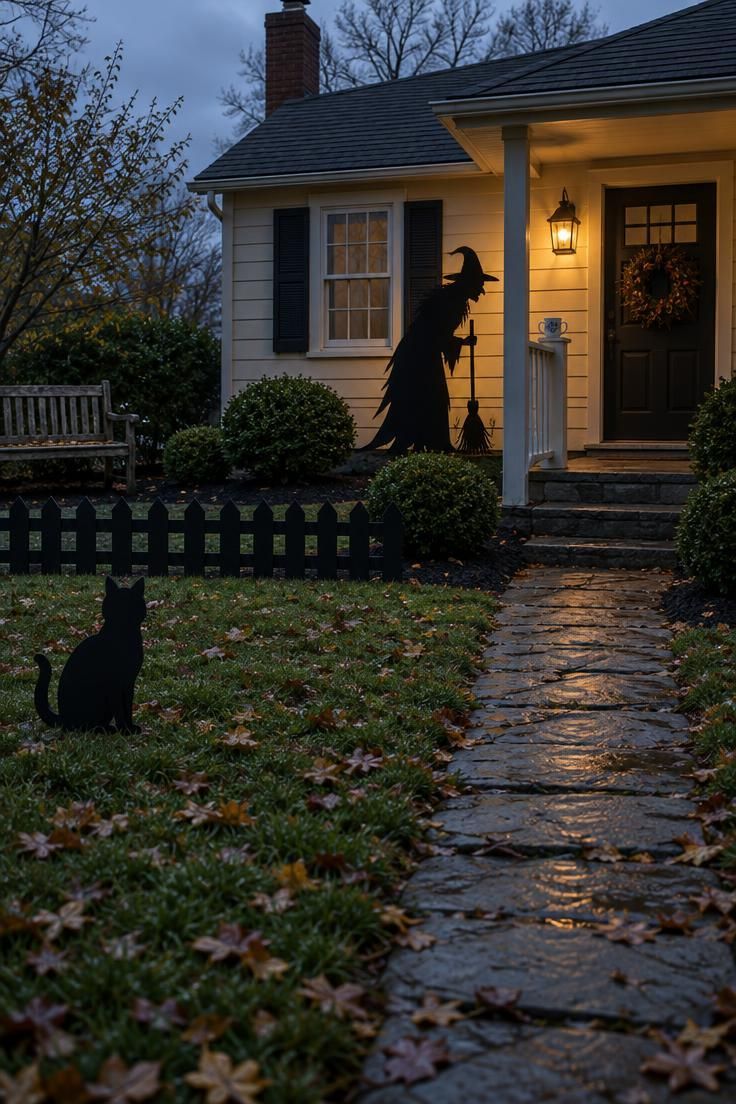
Matte black plywood cutouts turn a lawn into a shadow play, and the effect comes from depth rather than detail.
Chunky outlines hold up from the curb, which is why lace trim and thin fingers tend to disappear at that distance.
Three planes matter more than three pieces: something close to the sidewalk, something out on open lawn, and something pushed back near the house wall.
A lit surface behind the black shapes does most of the work, so the backdrop deserves as much planning as the cutouts themselves.
Exterior-grade plywood resists wind far better than fabric props, though it takes longer to cut, seal, and repaint.
Storage is simple because flat pieces stack like poster board.
Expect touch-up painting between seasons, since matte black shows scuffs and moisture marks over time.
Style Blueprint:
- Exterior-grade plywood cutouts finished in flat matte black paint
- A second set of low-sheen cutouts placed further back to test silhouette depth
- Foreground near the sidewalk, midground on open lawn, background against the house wall
- One scale of cutout repeated, or three clearly different scales instead of a matched row
Design Pro-Tip: Photograph the finished silhouettes from the curb at the hour guests will actually see them, since a cutout that reads perfectly in daylight can vanish into a dark hedge after dusk.
Backlit Gravestone Cluster with a Mulch Mound Base
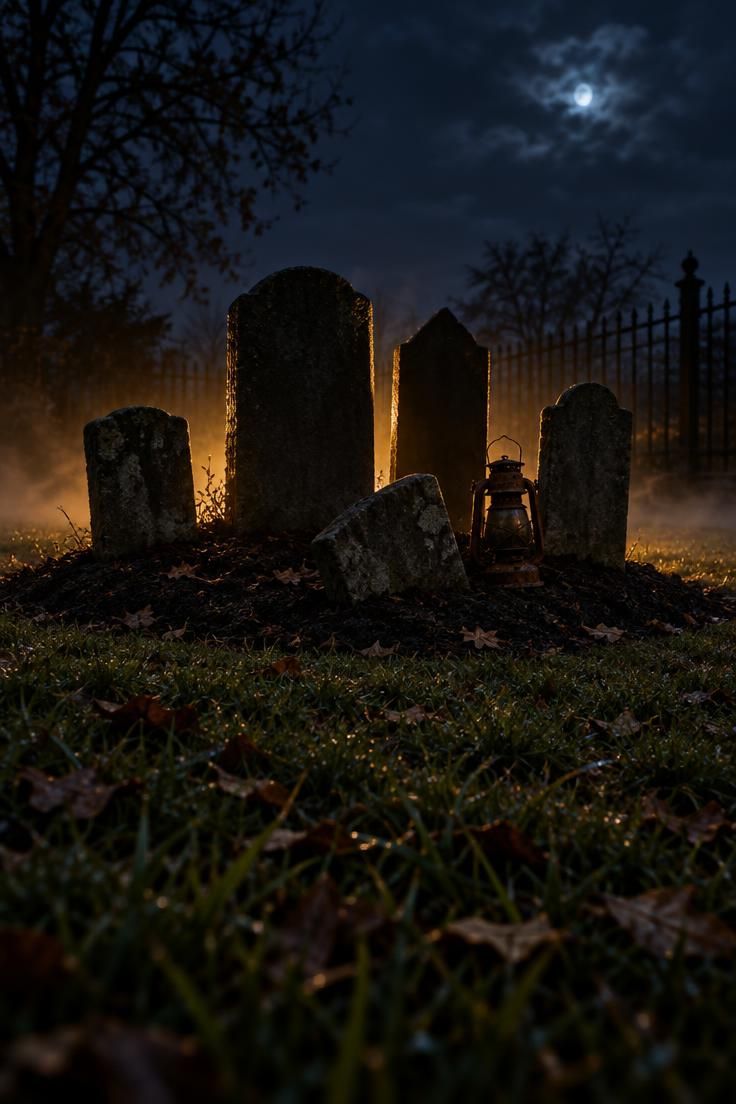
Varying heights and tilts does more for a graveyard than any amount of carved surface detail.
Painted foam or resin markers in three heights, with one tipped sideways, break the row enough to suggest age.
A chalky matte gray with dry-brushed darker edges reads as stone, while uniform factory gray looks like a single sheet of plastic from across the street.
Warm light hidden behind the markers turns the front faces into dark shapes against a glow, which is a different effect from lighting the stones directly.
A shaped mulch or soil mound under the cluster ties the markers to the ground instead of letting them float on turf.
The base treatment also reads as intentional during daylight hours, before anything gets switched on.
Flat markers store easily, while thick resin pieces demand real shelf space, so check the off-season storage before buying a set of ten.
Stone-look props cost more than cardboard versions but survive a windy week without being reset.
Style Blueprint:
- Painted foam or resin stone-look markers in three heights
- A chalky matte gray finish with dry-brushed darker edges
- A shaped mulch or soil mound under the cluster
- One marker tipped at a visible angle to break the row
A Hanging Ghost Choir Suspended in a Front Tree
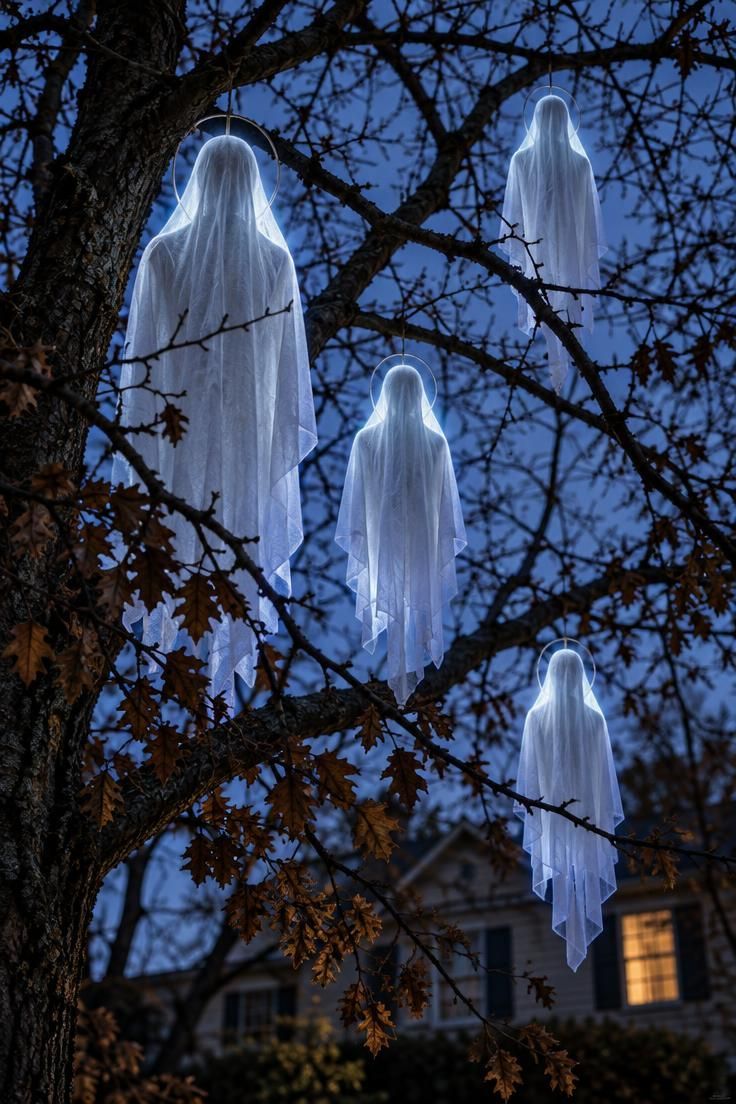
Stiffened cheesecloth or light cotton over a wire or hoop form holds a shaped drape instead of collapsing into a limp sack.
Off-white and bone tones with deliberately uneven staining keep the group from looking like laundry on a line, which bright white fabric at this scale tends to do.
Four figures at clearly different heights read as a choir, while an even row reads as a garland.
Movement is part of the appeal, so position the group where a breeze will be visible from the sidewalk.
Face the figures toward the primary viewing angle, since the backs of these forms are usually the least interesting side.
This is the strongest option for a yard with mature trees and no open lawn.
Fabric props are the most weather-sensitive category here, and they will need to come in during storms.
Style Blueprint:
- Stiffened cheesecloth or light cotton over a wire or hoop form
- Off-white and bone tones with uneven staining
- Four figures at clearly different heights
- Positioning that faces the group toward the main viewing angle
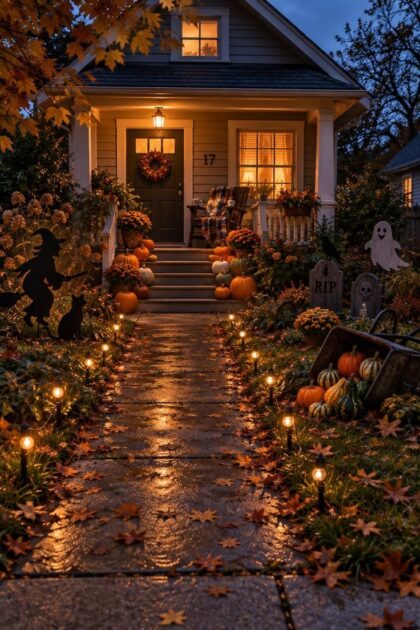
A Pumpkin Staircase with a Mixed Real-and-Artificial Run
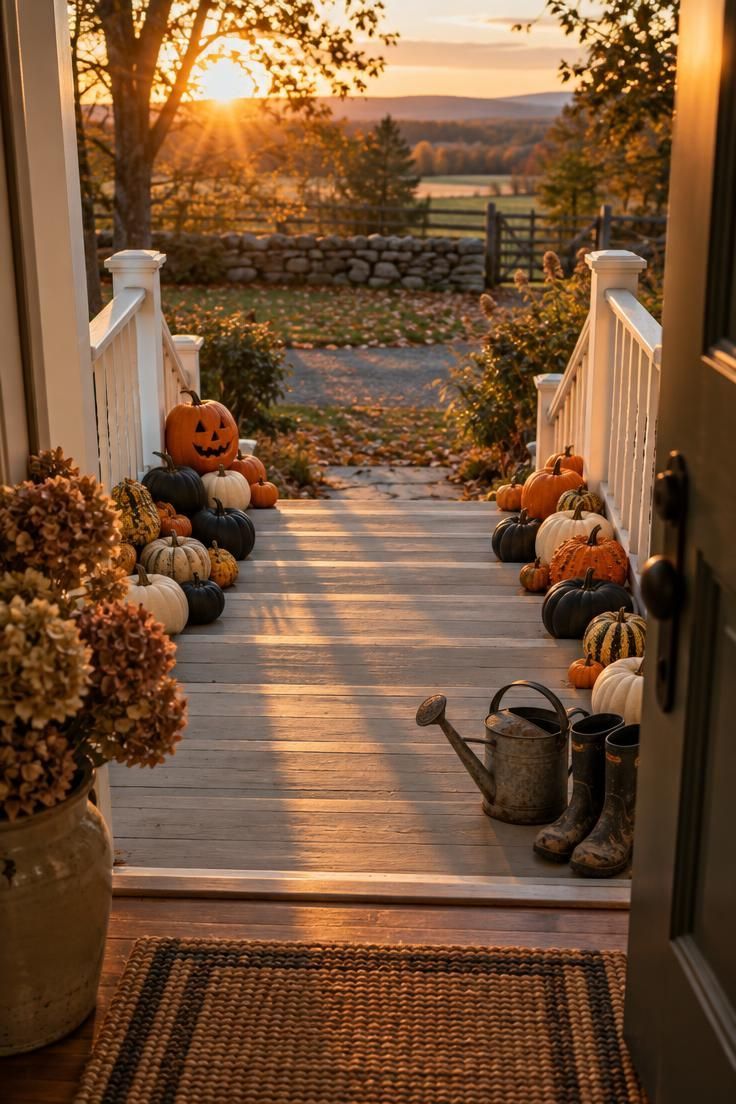
Real pumpkins supply the best surface texture and scent, while artificial ones carry the pieces that must last the full season.
Pairing matte black and bone-white painted pumpkins with natural orange keeps the palette from going flat.
Grouping in twos and threes along the step edges looks collected rather than distributed, and it leaves a clear walking line down the middle.
Mixed sizes do more than mixed colors to prevent the lineup from resembling a supermarket display.
Real pumpkins shift with weather and pests over the season, so plan for how they will look in week three rather than week one.
Hollow artificial pumpkins and flat gourds store compactly and return for multiple seasons.
This staircase is the busiest path in the whole display, so the walking line stays obvious at every stage of the arrangement.
Style Blueprint:
- Real pumpkins for texture and artificial ones for staying power
- Matte black and bone-white painted pumpkins paired with natural orange
- Grouping in twos and threes along the step edges
- A clear walking line down the center
Design Pro-Tip: When mixing real and artificial pumpkins, put the artificial ones where the display gets the most sun and foot traffic, since the real ones hold up better in shaded, undisturbed spots.
A Porch Threshold Arch of Twisted Branches and Tattered Cloth
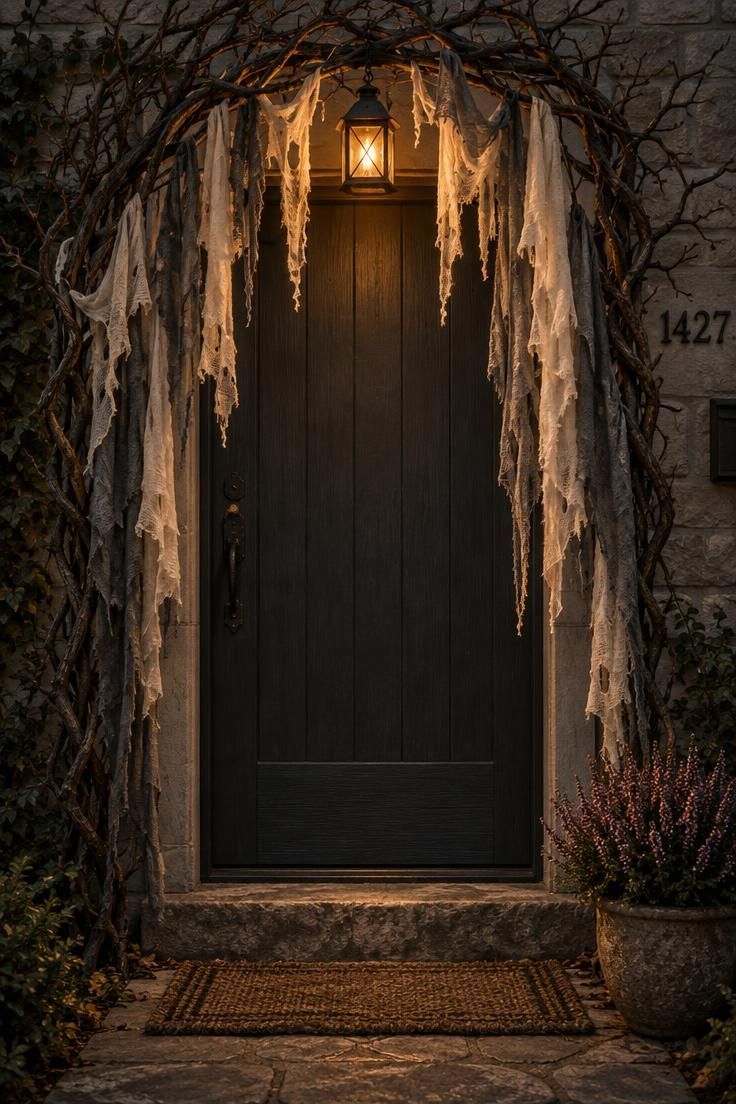
The doorway is the highest-value spot in any display because it frames every visitor's approach.
An arch concentrates effort in one place instead of spreading props thin across the whole yard.
Bare branches with visible twist and knuckle give the structure more character than straight dowels or foam forms.
Frayed edges on the fabric read as age, while clean hems read as a craft project.
One central hanging element, whether a lantern or a small sign, gives the eye somewhere to land among the strips.
Check that the hanging fabric does not obscure the house number or interfere with the door swing.
Fabric at a doorway takes rain and wind directly, so treat it as a one-season material.
Style Blueprint:
- Bare branches with visible twist and knuckle
- Torn strips of gauze or muslin in gray and aged cream
- Frayed fabric edges rather than clean hems
- One central hanging element as the focal point
A Skeleton Crew Arranged in Everyday Absurd Situations
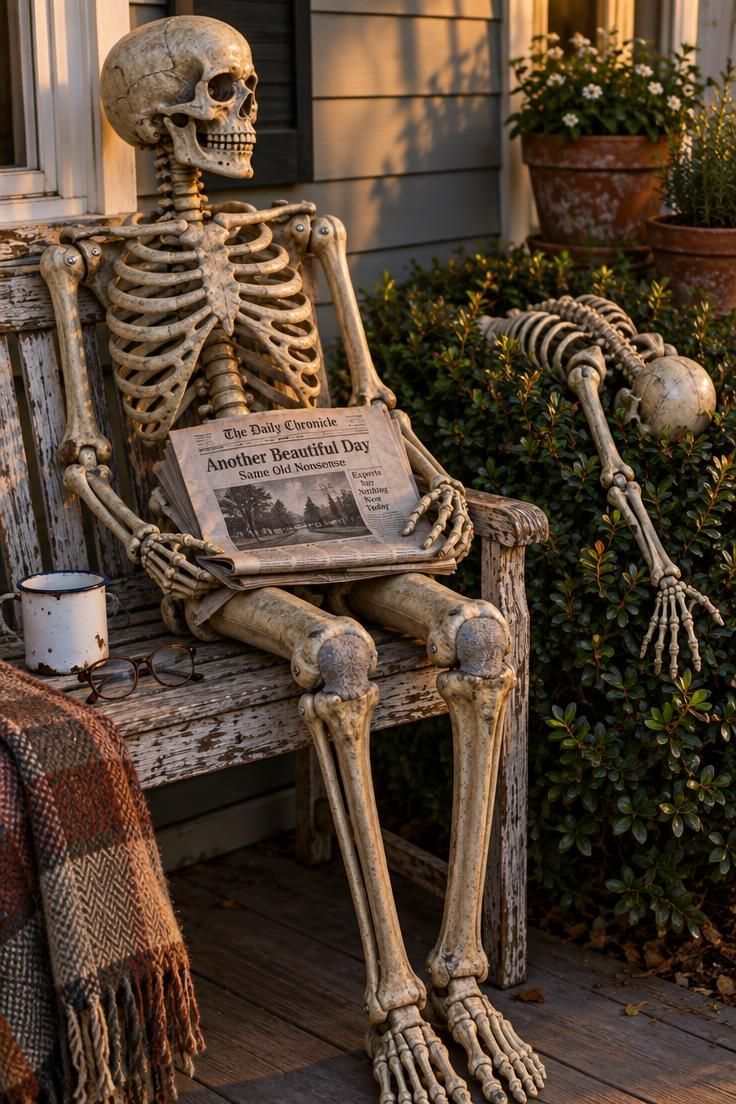
Full-size posable skeletons with visible joints can hold a seated or reclining pose, which is what makes the humor work.
An aged bone tone with a light gray dusting at the joints reads better than bright white, especially under warm porch light.
Give each skeleton a task or a prop, whether that means reading a newspaper, tipping a wheelbarrow, or watering a dead plant.
A bare skeleton standing in the lawn is just a skeleton, while a skeleton mid-task is a joke.
The concept scales well, since two figures make a vignette and six make an event.
Posable skeletons cost more per figure than flat props, and each one takes up genuine storage space in the off-season.
Style Blueprint:
- Full-size posable skeleton figures with visible joints
- An aged bone finish with soft gray at the joints
- One prop or task per figure to sell the pose
- A grouping of two to six figures rather than a single one
An Oversized Spider and Webbing Anchor Point at the Porch Corner
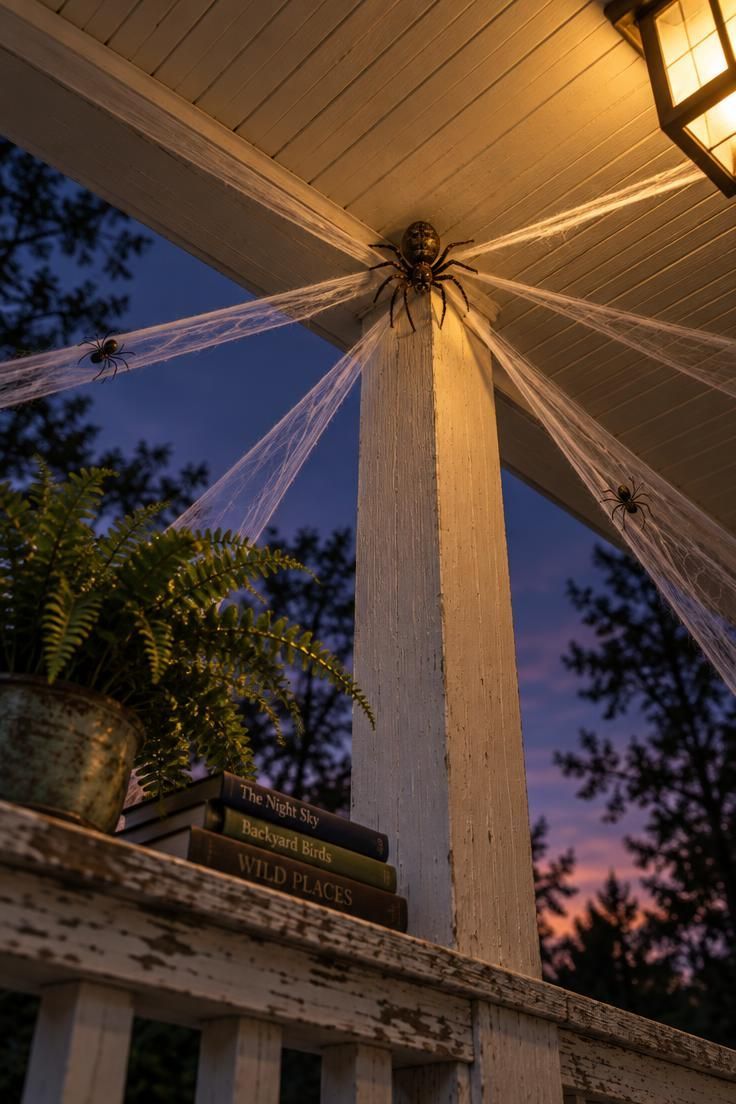
Stretchable synthetic webbing holds its shape far better than loose cotton, which sags and mats after damp weather.
Semi-translucent white webbing picks up nearby light instead of reading as a gray lint clump.
Strands that converge on one visible point give the web a believable structure, and the largest spider belongs at that convergence.
Play the scale one oversized spider against two smaller ones, because a group of same-size spiders competes instead of building.
This is a detail-scale idea rather than a whole-yard one, and it reads as texture rather than as a scene.
Check that webbing does not block a light fixture, a sensor, or the door path.
It costs little and goes up fast, but it tangles on removal and generally lasts a single season.
Style Blueprint:
- Stretchable synthetic webbing rather than loose cotton
- Semi-translucent white webbing that catches nearby light
- Strands converging on one visible anchor point
- One oversized spider plus two smaller ones for scale contrast
Design Pro-Tip: Pull webbing taut in a few long runs rather than bunching it into a clump, because long radiating strands read as a web while a bundle reads as a dropped cotton ball.
A Wheelbarrow Harvest Spill of Gourds onto the Lawn

This is the most forgiving concept for anyone who wants a harvest feel that still fits a Halloween palette.
An aged or dark-painted wheelbarrow in weathered wood and rust tones carries the arrangement without looking new.
The spill shape matters as much as the halloween yard props themselves, since a wide uneven arc that thins toward its edges reads as motion while a dense blob reads as a pile.
Dried corn stalks give vertical structure to an otherwise low, ground-hugging arrangement.
Placing this at the lawn's midpoint gives the eye a second resting point beyond the graveyard or the doorway.
Because it stays low, the piece does not compete with taller props for attention.
Gourds and corn are the most pest- and moisture-sensitive items in any display, so expect to refresh them partway through the season.
A tarp or cardboard layer under the pile makes end-of-season cleanup dramatically faster.
Organic materials give unmatched texture but will not return next year.
Style Blueprint:
- An aged or dark-painted wheelbarrow
- A mix of gourds and small pumpkins
- Dried corn stalks for vertical structure
- A wide uneven spill arc that thins toward the edges
A Garage-Door Projection of Static or Slowly Drifting Imagery
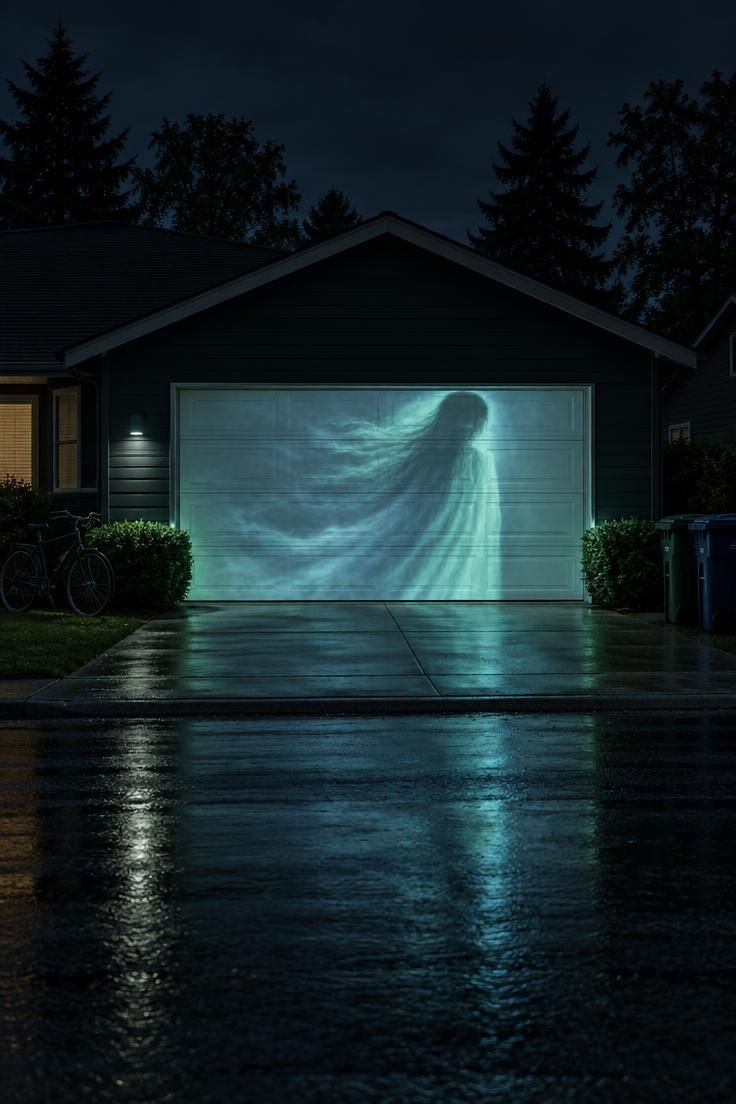
A flat, light-colored, unbroken plane gives the imagery something clean to play across, whether that is a garage door, a fence panel, or a stretched sheet.
High-contrast simple shapes hold together on a projected surface at distance, while fine detail turns to mush.
Cool greens and pale blues against darker surroundings suit a classic eerie look, and warm amber tones soften the same setup.
Slow drift or a subtle fade reads better from across the street than fast or flickering footage.
Position the projection so it stays legible from the primary viewing direction rather than at a sharp side angle.
The approach delivers large-scale visual impact with minimal physical clutter, and a projector stores compactly.
It contributes nothing during daylight hours and depends entirely on darkness and a clear wall free of other props.
Style Blueprint:
- A flat, light-colored, unbroken projection surface
- High-contrast imagery with simple shapes
- Cool greens and pale blues, or warm amber for a softer read
- Slow drift or subtle fade rather than fast motion
- An angle aimed at the primary viewing direction
A Monochrome White Ghost Yard Against a Dark Hedge
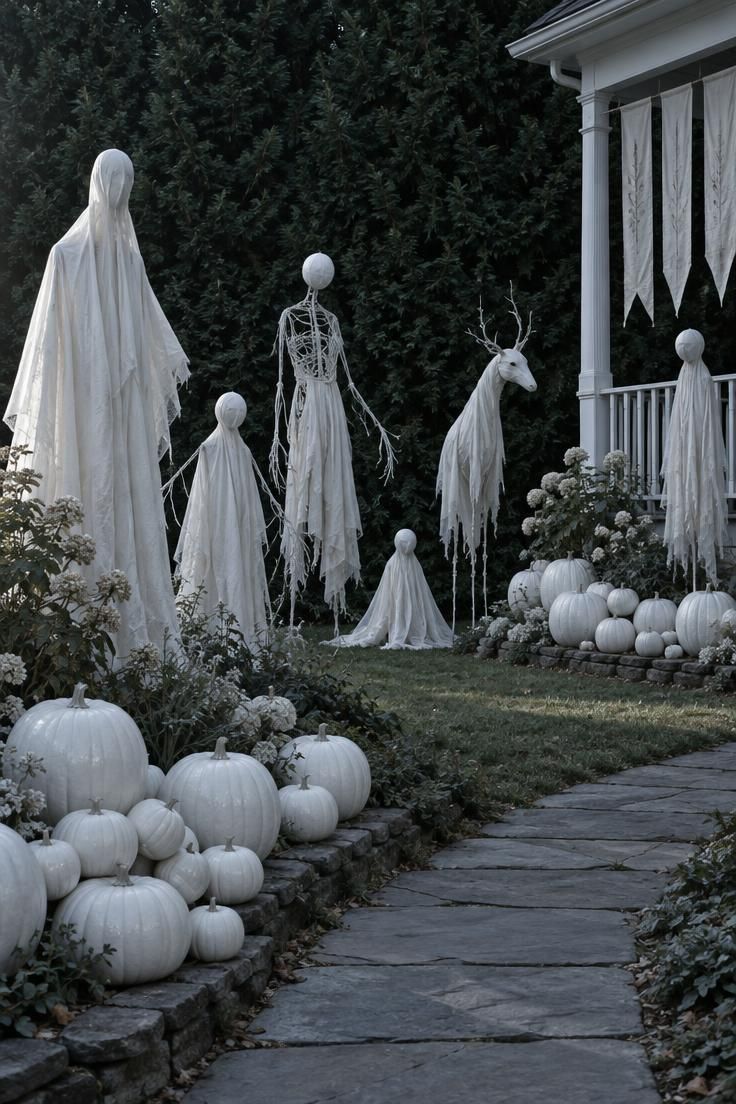
Restraint reads as intentional, while a yard with a little of everything tends to read as clutter.
White sheets, wire-and-fabric figures, white-painted pumpkins, and pale banners all sit in the same narrow tonal range.
Mixing matte fabric with slightly glossy painted forms keeps an all-white palette from flattening out.
A dark hedge, a dark fence, or an unlit house wall supplies the contrast that the entire effect depends on.
Ruthlessly exclude anything orange, black, or green, because a monochrome yard only works when it is truly monochrome.
Costs land lower than they appear, since sheets, paint, and wire forms are inexpensive materials.
A white display against a light wall will not register at all, so the backdrop decides whether this concept works.
Style Blueprint:
- White sheets, wire-and-fabric figures, and painted pumpkins
- Matte fabric mixed with slightly glossy painted forms
- A dark hedge, dark fence, or unlit wall as the backdrop
- Strict exclusion of orange, black, and green props
Design Pro-Tip: Before buying anything new for a monochrome display, lay out every piece you already own on the lawn and photograph it in grayscale, because off-palette items will jump out immediately.
Halloween Yard Signs Staged as a Crooked Approach Path
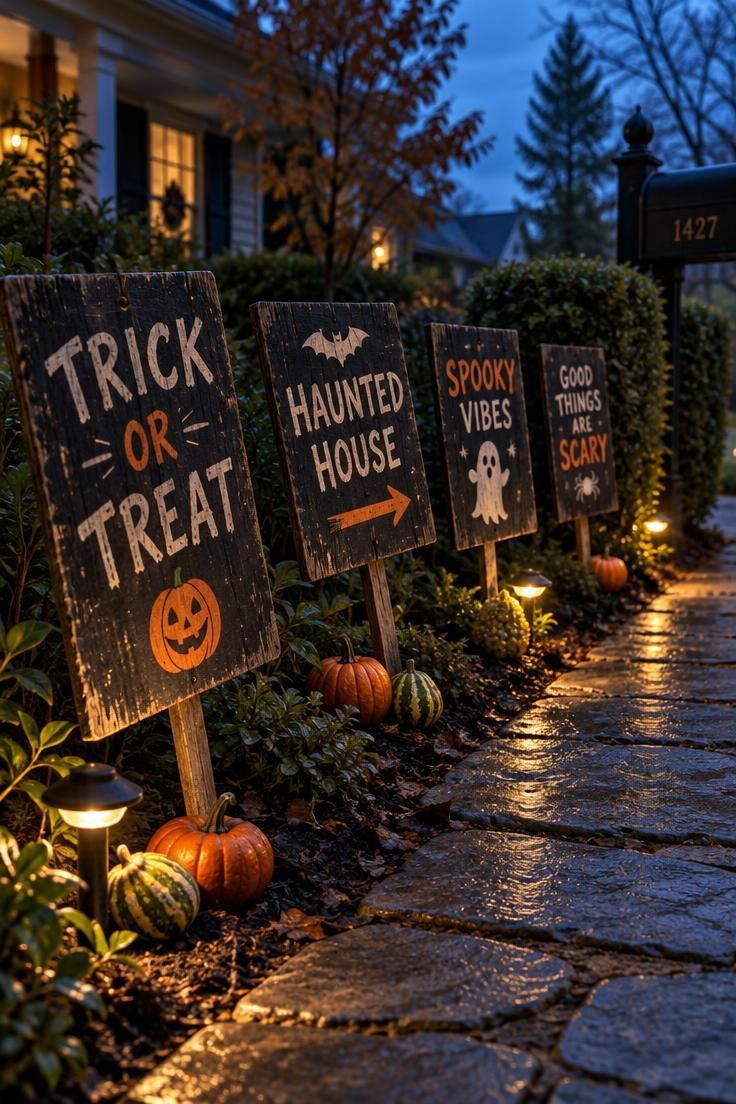
Signs work as a sequence rather than a single statement, so a run of them along the approach path carries a visitor from the sidewalk to the door.
Weathered board in dark tones with bone white and orange lettering holds up against a dark lawn better than a bright printed panel.
Leaning each stake at a slightly different angle keeps the line from looking regimented.
Painted lettering weathers and can be touched up, while printed vinyl panels tend to crack and fade after a season or two.
Keeping the boards low means they do not block the view of taller props behind them.
Route the run along the walk rather than across it, so the path stays clear for visitors and delivery drivers.
Small gourds at the base of each stake tie the signs to the ground and hide the hardware.
Low wash lights along the path turn the signs into part of the halloween yard lighting scheme after dark, which makes the approach feel continuous rather than staked at random.
Halloween yards read best when signs step down the path in a loose, staggered line, with each stake tilted a few degrees off vertical.
A weathered board sign in charcoal, bone white, and pumpkin orange fits that crooked rhythm without competing with the rest of the entry.
Style Blueprint:
- Weathered wooden boards in dark tones
- Bone white and orange painted lettering
- Short stakes leaning at slightly different angles
- Small gourds tucked at the base of each stake
Conclusion
Each concept here works because it decides what the display looks like from a specific viewing point at a specific hour, then builds materials, contrast, and layering around that decision.
The two recurring filters are where the display gets seen from and how much weather exposure each material can take, and those two questions narrow the list faster than any style preference.
Combining two or three of these ideas usually reads better than attempting all of them, since a cohesive front yard halloween display needs breathing room between its focal points.
Layering a low harvest spill near the lawn with a taller silhouette fence behind it and one lit anchor at the door gives a street the sense of a scene rather than a collection.
Front yard halloween displays like these work because their outdoor halloween decorations stay subordinate to one clear viewing angle.
A yard that simply gathers every prop it owns rarely produces the same halloween curb appeal as one that knows where the eye should land first.
Pick the pieces that suit the yard's actual sightlines, storage space, and tolerance for seasonal upkeep, then let the rest of the block fill in around it.