This post may contain affiliate links. If you make a purchase through these links, we may earn a commission at no additional cost to you.
Halloween decorating tends to arrive all at once: saturated orange, plastic props, and every surface claimed.
That approach sits awkwardly in a home built around warm wood, quiet textiles, and open space.
This article takes the opposite route, treating Halloween as a short seasonal overlay rather than a takeover.
A few well-chosen objects can mark the season while the room keeps the composition it had in September.
The underlying logic is one focal point per surface, generous negative space, matte finishes, and earth tones or black used with restraint.
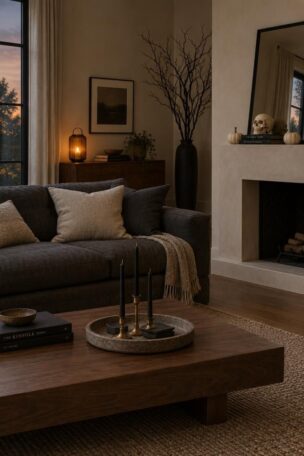
A Single Matte Black Taper in a Bone Ceramic Holder
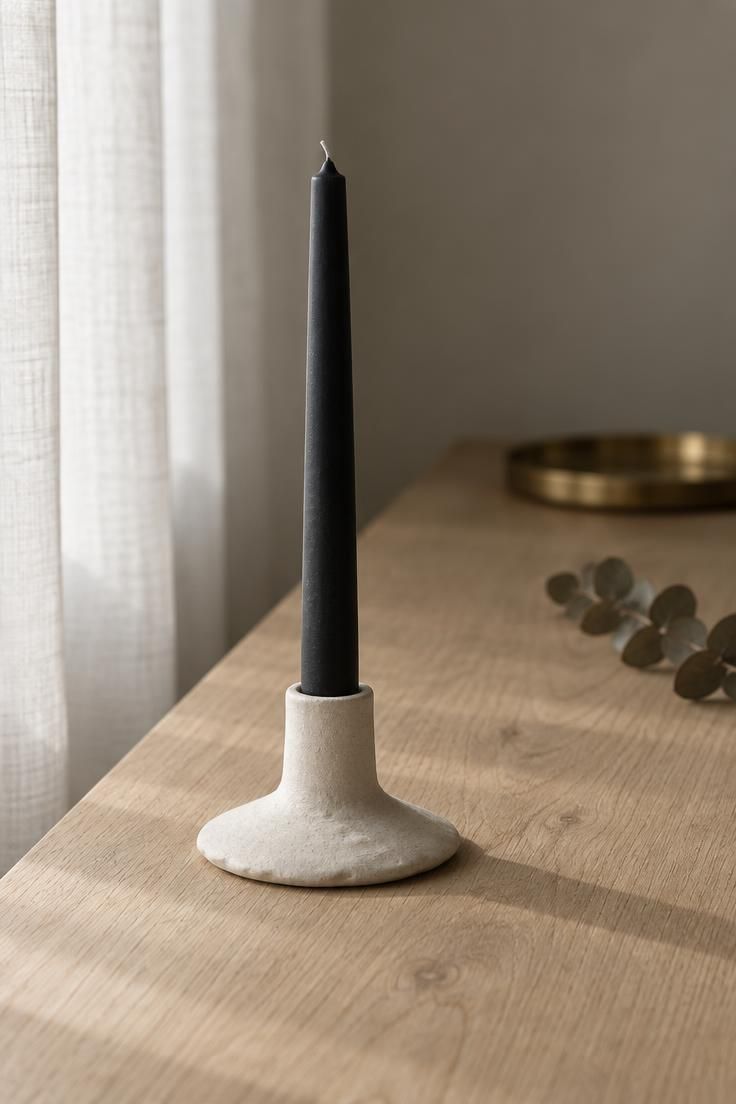
A vertical black line against pale glaze does most of the work in this minimalist halloween composition.
The holder needs enough width at the foot to read as a chosen object rather than a leftover, and the surface around it should stay bare.
Black supplies the seasonal reference; the warm ceramic keeps it from turning cold.
Position the taper toward one end of a console or near a doorway so it is seen in profile rather than centered like an altar.
A single candle on a crowded surface disappears into the clutter, which is why the empty space matters as much as the candle.
Real flame near anything dry is a fire risk, so battery tapers in the same holder preserve the arrangement on surfaces where flame is not wanted.
Black tapers show dust and wax drips more than ivory ones, and a burned-down taper changes the proportion of the whole composition.
Style Blueprint:
- One slim matte black taper candle
- An unglazed bone or chalk-white ceramic holder with a wide foot
- A bare wood, stone, or plaster surface kept completely empty
- A single dried stem laid flat nearby if the surface feels too severe
Design Pro-Tip: Choose a holder one shade lighter or darker than the surface beneath it. The near-match keeps the eye on the candle’s silhouette instead of the object.
Three Pale Heirloom Pumpkins on a Raw Linen Runner
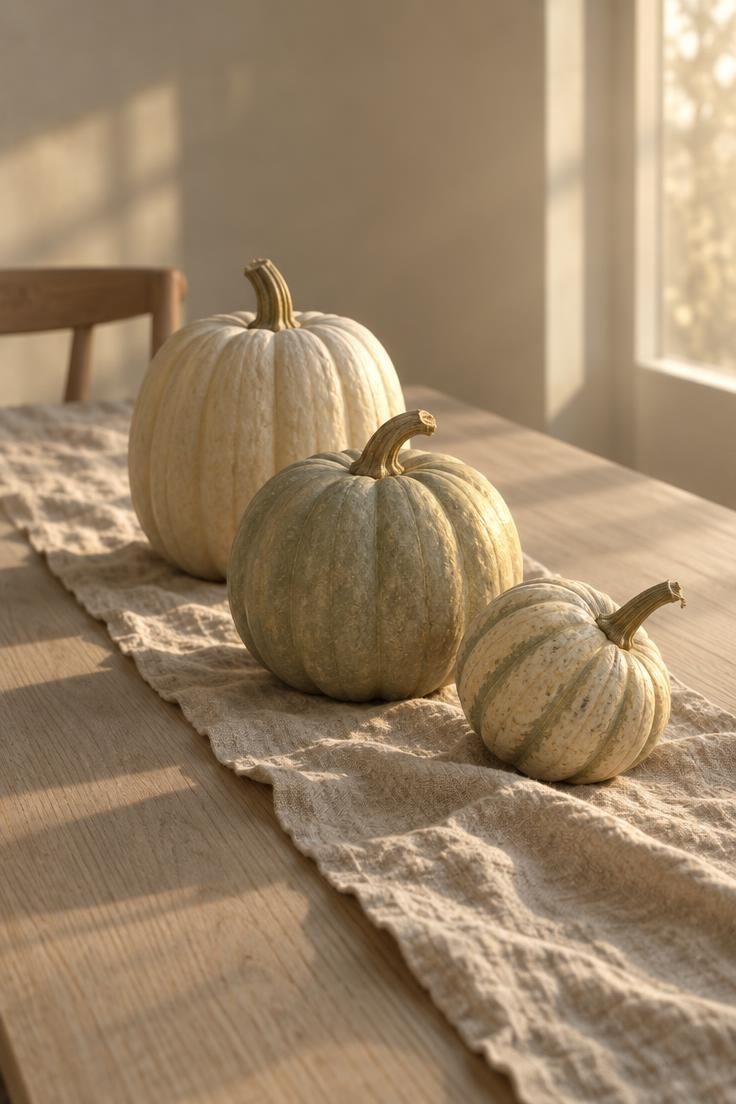
Three forms in the same pale family read as one object rather than three.
Height progression is what prevents the group from looking monotonous: variation in silhouette, not in color.
Choose flat-lobed heirloom varieties with muted skin tones, and leave glossy orange and painted finishes out of the minimalist halloween decorations.
Two or three pumpkins is usually the limit before the sightline across a dining table starts to close, and a low group beats a tall one at a table people actually eat at.
Natural pumpkins soften indoors over weeks, which limits how early a table can be set, while faux versions last but take up storage space and cannot be composted.
Check the undersides for soft spots, and lift rather than slide the pumpkins so the linen is not marked.
On a narrow table, drop to two and shift the third to a sideboard.
Style Blueprint:
- Three heirloom pumpkins in cream, sage, or pale blush tones
- A washed oatmeal linen runner with visible wrinkles
- One pumpkin positioned off-center for asymmetry
- A bare wood table with no centerpiece competing for attention
- A low overall height so guests can see across the table
Design Pro-Tip: Turn the smallest pumpkin so its stem points a different direction than the other two. The irregular angle is what keeps a symmetric row from looking like a shelf display.
Dried Bittersweet Trailing from a Stoneware Vessel
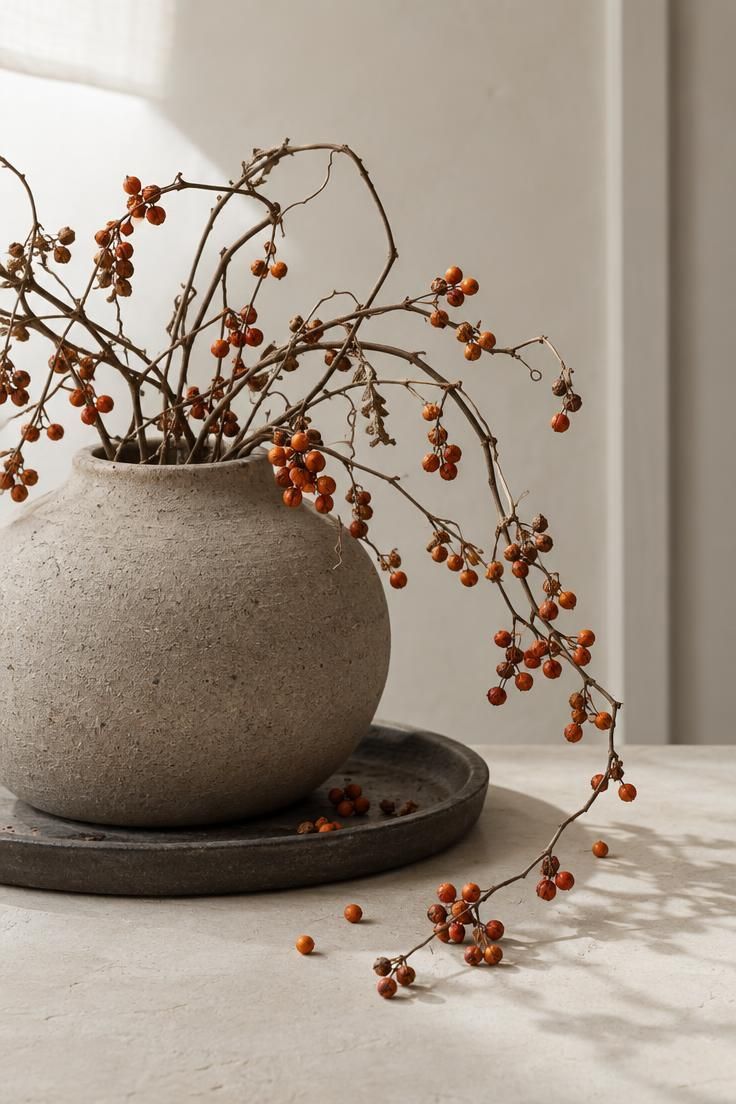
An unglazed vessel kept low lets the vine read as a line drawing rather than a bouquet.
The vessel’s matte finish absorbs warm room light and keeps the composition quiet, where a glossy glaze would compete with the berries.
Keep the pot roughly a third the height of the overall spill so the plant material, not the container, holds attention.
A sparse vine shows the wall and gap behind it, and that negative space is what carries the seasonal read.
Dried material sheds small pieces, so a shallow tray under the vessel contains the fallout on light textiles.
Dried stems fade and become brittle over the season and are best retired rather than handled repeatedly.
No ribbon, no orange filler, and no berry spray: the single plant material is the entire simple halloween decor gesture.
Move the same vessel to a shelf in another room next week and the arrangement works again with nothing new purchased.
Style Blueprint:
- One low unglazed stoneware or clay vessel in putty or warm gray
- Loose dried bittersweet, or dried vines with small berries
- A shallow tray beneath the vessel for fallen pieces
- An empty wall or open gap behind the trailing stems
- No filler, ribbon, or secondary plant material
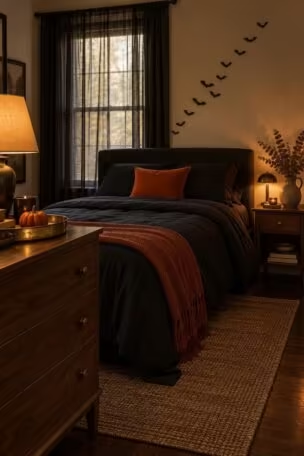
A Single Paper Bat Silhouette on a Bare Wall
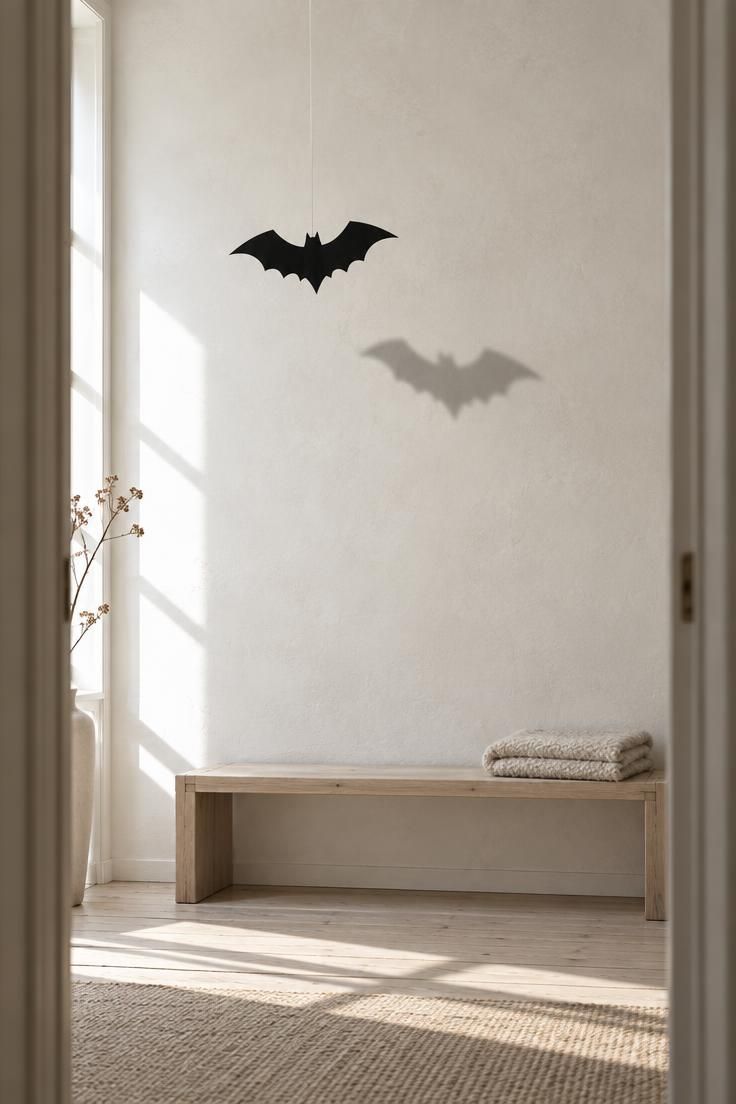
One black paper shape against a wide empty wall, with the doorway frame acting as the border.
With no color or detail to rely on, the outline does all the work, so the cut edge needs to be clean and the shape scaled to the wall rather than to the real animal.
Hang it high enough that the wall below stays empty, offset from center, and within the sightline from the room’s main seating.
Black cardstock holds a crisper edge than tissue or crepe paper.
A single flat shape can read as unfinished to some eyes; if that happens, the fix is a second shape in the same scale family, not a change of palette.
Paper silhouettes need flat, dry storage between seasons or they curl and the edge softens.
Style Blueprint:
- One bat, cat, or moon shape cut from black cardstock
- A length of fine thread or monofilament for hanging
- A large, mostly empty wall as the backdrop
- An offset position, never centered
- Flat, dry storage between seasons
Design Pro-Tip: Look at the wall from where you actually sit before deciding the shape’s position. A silhouette that looks well placed from the doorway can land at eye level from the sofa.
A Clear Glass Cloche Over One Small Skull Form
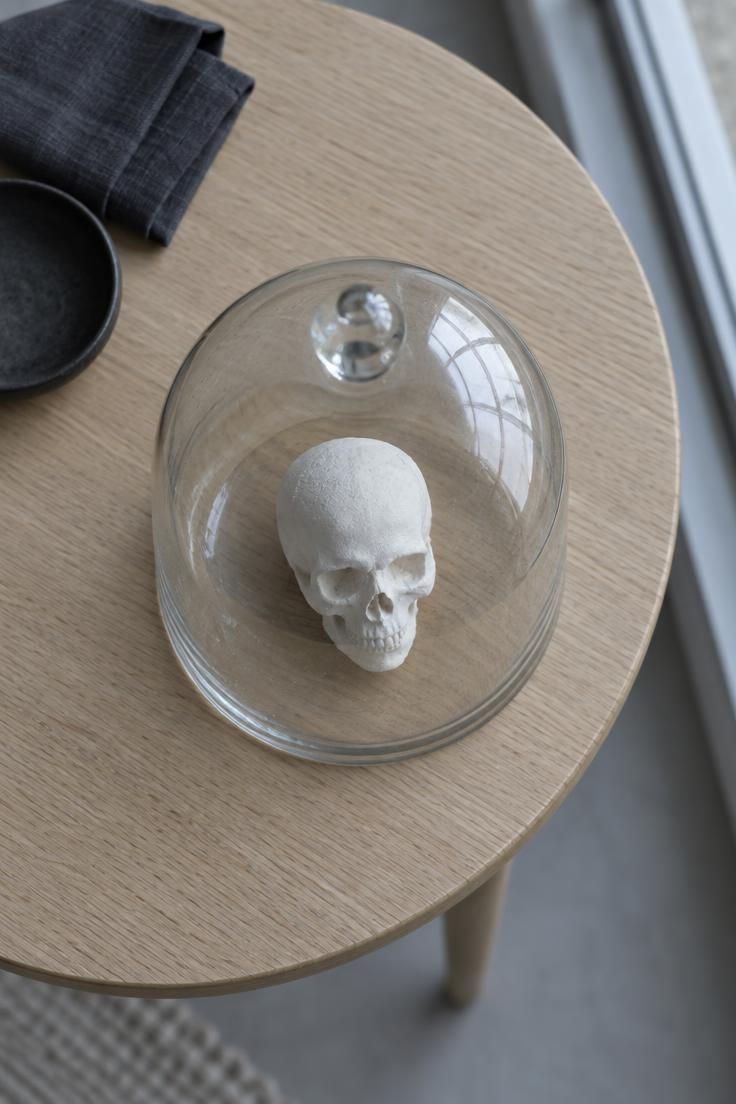
The cloche frames the object and adds a glass curve to a scene made otherwise of matte surfaces, which keeps the vignette from reading flat.
The object under the glass should sit well inside with visible air around it, so the frame reads as a frame and not a lid.
Matte plaster or unglazed ceramic in bone or chalk white keeps the reference legible without gloss or color.
A bare tabletop or a single light linen runner is all the surface needs.
A side table beside a chair lets the vignette be seen from above, while a console shows it in elevation, which makes the cloche profile matter more than the object’s top.
Glass shows dust and fingerprints, so this is a vignette that asks for a wipe-down rather than a display you can ignore for a month.
Alternatives in the same visual family include a single black bird form, a small aged-metal key, or a plain skull-shaped paperweight.
Filling the cloche with several small items turns a restrained vignette into a curiosity cabinet.
Glass cloches also store awkwardly, so if storage space is tight, this is the idea to skip.
Style Blueprint:
- One clear glass cloche with a simple base
- A single matte plaster or unglazed ceramic form in bone white
- A bare tabletop or one light linen runner
- A table positioned where the vignette is seen from above or in profile
- A soft cloth on hand for glass maintenance
Design Pro-Tip: Raise the cloche a few millimeters on its own base or a thin coaster so daylight passes under the rim. The object stops looking pressed against the table.
Black Flatware and a Charcoal Runner on a Neutral Table
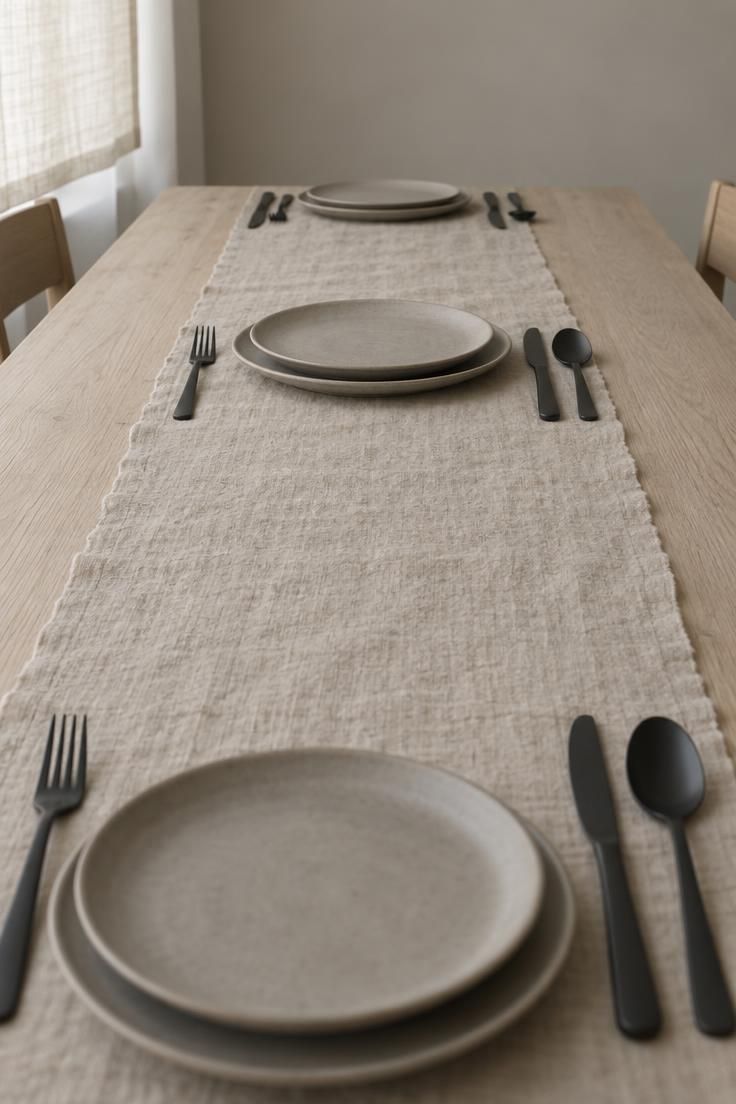
Black flatware becomes the seasonal signal, and the table’s restraint does the rest.
A runner rather than a full cloth keeps the wood visible and gives the black a warm ground to sit against.
Matte black over oat, bone, or greige reads graphic but warm, while glossy or colored flatware pulls the table toward a themed party.
Nothing else belongs on the surface: no orange napkins, no printed place cards, no centerpiece competing with the setting.
If the table is used daily, the runner and flatware can stay set for weeks with only candles or a small gourd added at the weekend.
Matte black flatware shows water spots and needs hand drying, which is the price of the finish that makes the look work.
Black flatware is not for everyone’s everyday meal, so treat this as a styling layer for one or two dinners rather than a full replacement.
Style Blueprint:
- One matte black flatware setting per person
- An oatmeal or charcoal linen runner, not a full tablecloth
- Simple stoneware plates in warm gray or bone
- No centerpiece, no themed napkins, no printed cards
- A soft cloth for hand drying the flatware
A Single Matte Black Ceramic Vessel with Bare Twigs
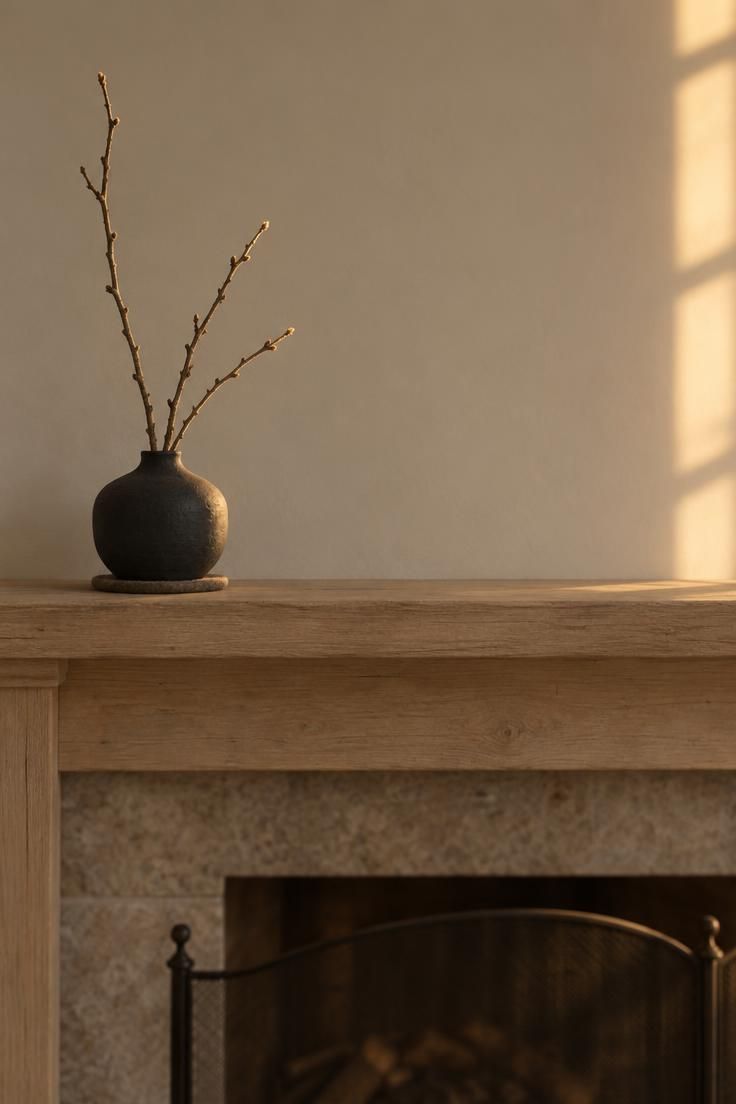
A low matte black ceramic vessel anchors the mantel.
Above it, vertical lines come from three bare twigs and nothing else.
Three stems, not a bundle, and the spacing between stems matters more than the number.
Matching matte black ceramic with a warm wall and a wood mantel holds the composition in autumn territory rather than letting it tip toward stark.
An asymmetrical position along the mantel reads more deliberate than dead center, and leaving both ends bare preserves the negative space.
For a calm take on minimalist halloween, this pairing keeps the seasonal cue in the silhouette instead of the surface.
Bare twigs shed more than most natural elements, so a shallow tray or a felt pad under the vessel limits the fallout on light surfaces.
Check the twigs weekly for softness in a humid room, and retire the arrangement when it starts dropping.
Where the palette leans cooler, charcoal-glazed stoneware in place of the black vessel reads the same at a glance but warms less.
If the mantel also carries a mirror or artwork, drop to one or two twigs rather than three.
Style Blueprint:
- One low matte black ceramic vase
- Three bare twigs cut to visibly different lengths
- A shallow felt pad or tray under the vessel
- An asymmetrical position on a mostly empty mantel
- No foliage, berries, or ribbon on the stems
Design Pro-Tip: Cut twigs to three different lengths before arranging them. The stepped silhouette is what stops a three-stem grouping from looking accidental.
A Narrow Ledge with Three Amber Glass Apothecary Bottles
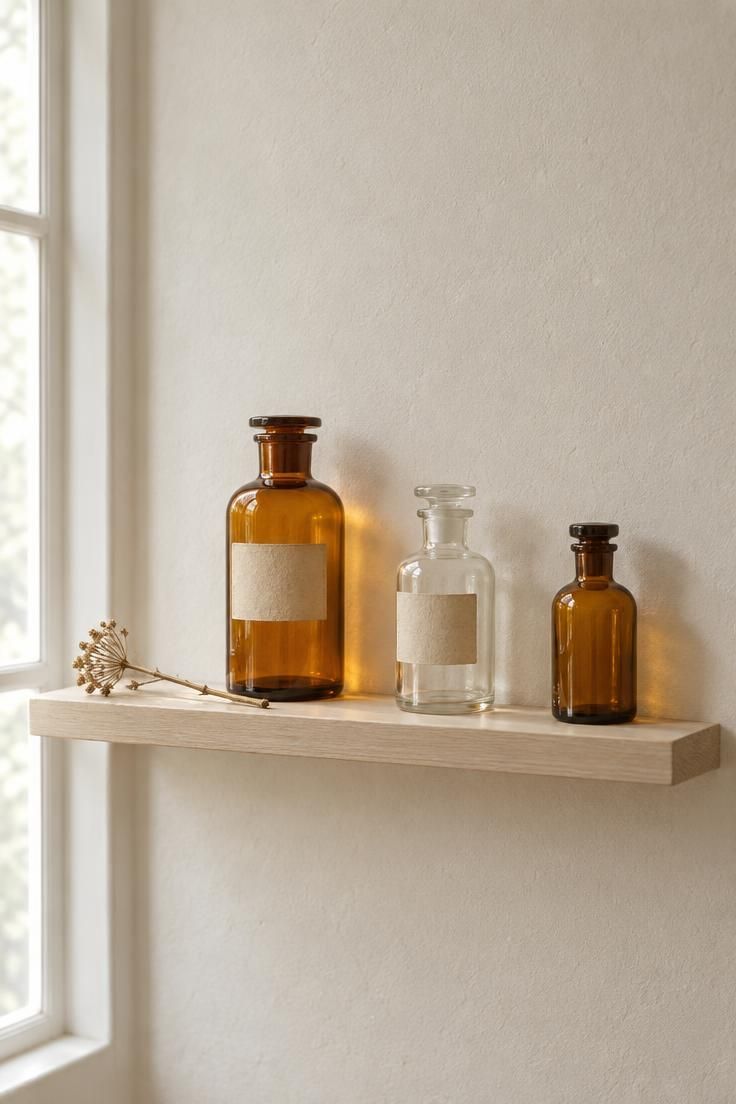
Transparent amber and clear glass, minimal labels, and a long empty ledge make three small objects look intentional.
Three bottles of one height read as a product display, while three different heights read as a composition.
Glass lets the wall color show through, which keeps a small collection light rather than solid.
The palette leans on amber, clear glass, and warm white rather than orange, which suits minimalist Halloween decor and lets the bottles work alongside everyday objects on the same wall.
No dried filler inside the bottles, no corks with printed labels, no cobweb draping: the glass itself is the visual interest.
This works best on a ledge that is not directly above a heat source or a working surface, and reads best at eye level rather than high on a wall.
Style Blueprint:
- Three apothecary-style bottles in amber and clear glass
- Staggered heights across the group
- Minimal or blank labels
- A slim ledge with generous empty space on both ends
- One dried stem lying flat as a quiet counterpoint
Design Pro-Tip: Keep the ledge surface otherwise clear and let the amber glass carry the seasonal reference, so the grouping reads as modern Halloween decor without a single pumpkin in sight.
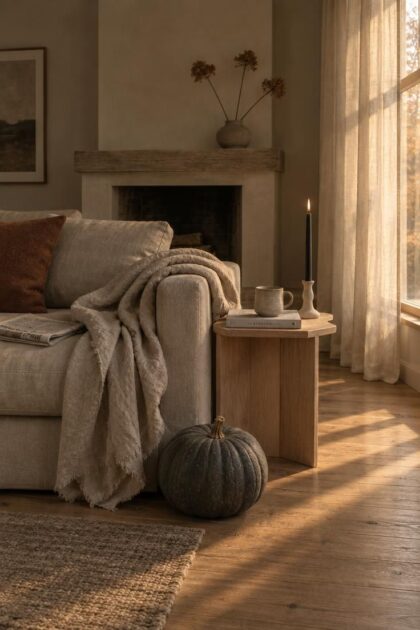
A Single Large Charcoal Pumpkin at Floor Level
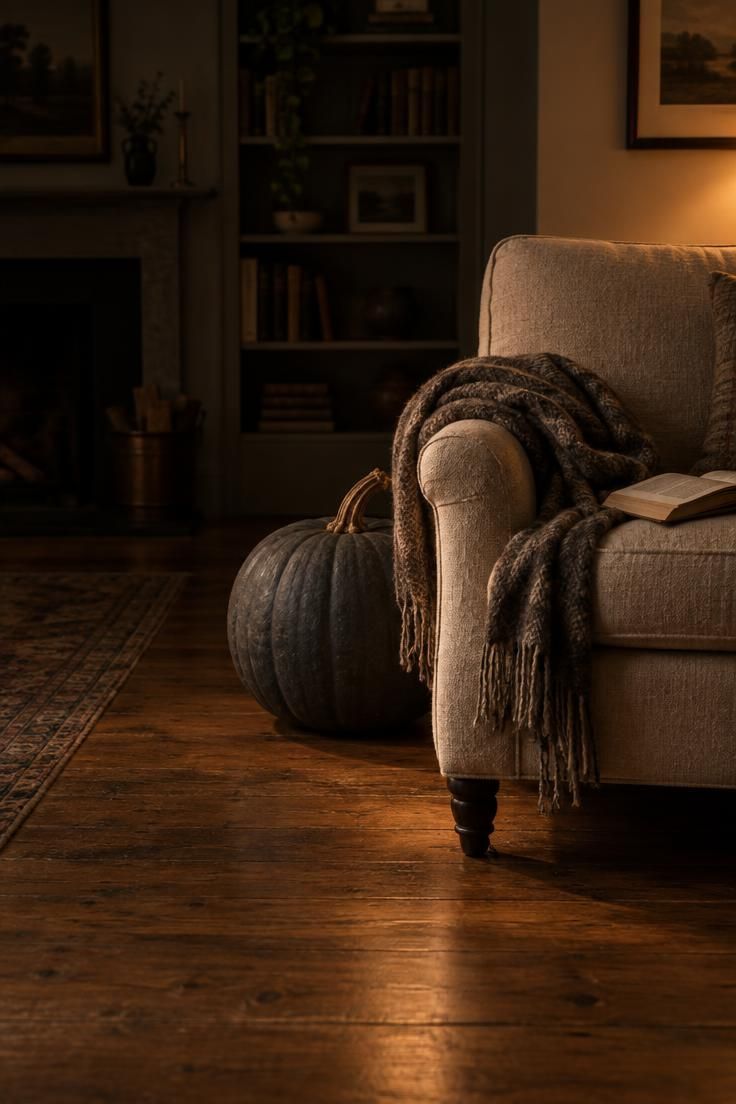
One oversized form on the floor satisfies the seasonal gesture for an entire room without any tabletop styling.
The floor object needs to be large enough to hold its own against furniture, which is why a small gourd on the floor reads as dropped rather than placed.
Charcoal or a deep desaturated gray keeps the form graphic, while a warm neutral floor pumpkin is the softer alternative in rooms with more wood tone.
Treated as minimalist fall decor, the piece earns its keep by carrying an entire room on a single object rather than a spread of small ones.
Choose one location: beside a chair, at the end of a sofa, or in the corner nearest the room’s entry sightline.
A floor object is the first thing small children and pets reach, and natural pumpkins in a warm room soften sooner than expected on the underside.
A faux charcoal pumpkin solves the perishability issue at the cost of storage space and compostability.
Style Blueprint:
- One large pumpkin in charcoal or deep desaturated gray
- A bare wood or stone floor with nothing else on it
- A single location beside existing seating
- A warm lampshade nearby as the light source
- Partial overlap with the furniture line
Design Pro-Tip: Let the floor object sit slightly behind the furniture line rather than in front of it. The partial occlusion makes it feel like part of the room.
A Small Framed Moon-Phase Print Swapped In for the Season
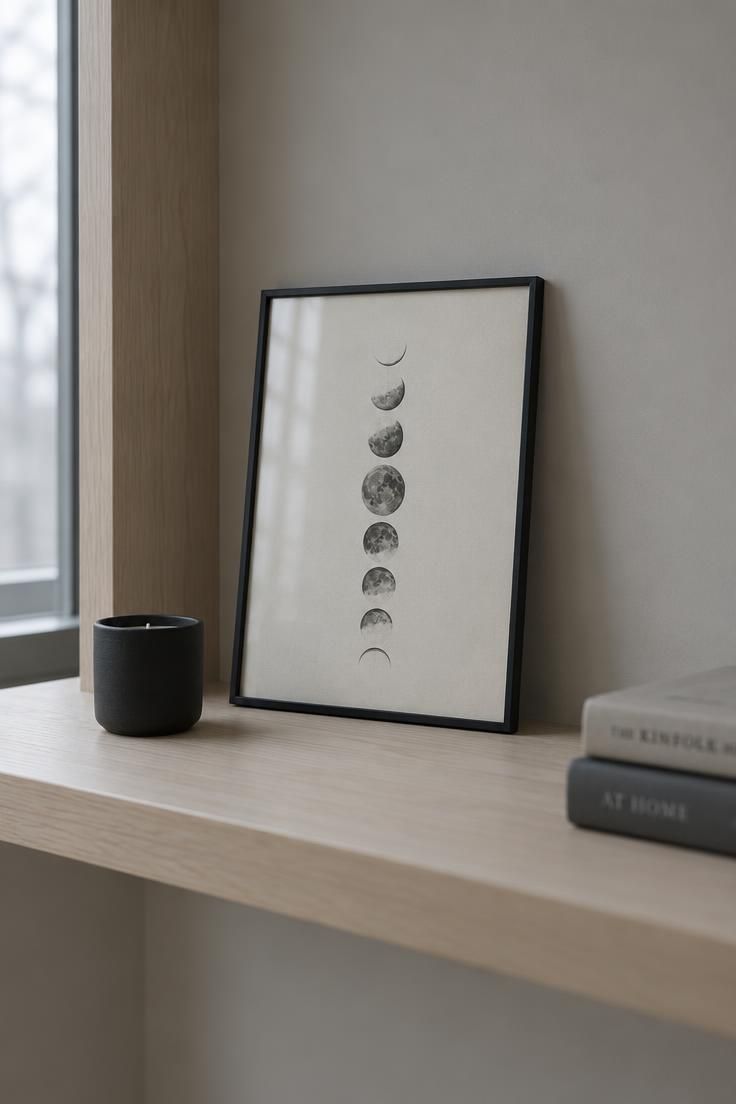
One small graphic print in a black frame can do the seasonal work that a wall arrangement would do in a busier scheme.
Replacing one existing framed piece for a few weeks keeps the wall composition unchanged while changing its reference.
A small print on a large wall only works when the surrounding emptiness is treated as deliberate; if the wall already has art, add the print to the existing arrangement rather than hanging it alone.
Pair it with one votive or one small object beside it, not a symmetrical pair.
Where a swap is impractical, lean the print on a shelf instead of hanging it, which gives the same visual read with no permanent change.
Moon-phase and silhouette prints are widely available and can look generic, so choosing a single line drawing or a letterpress-style numeral narrows the field.
A few flat prints store easily and cost little, which makes this one of the more flexible minimal halloween ideas.
No banner, no garland, and no seasonal lettering: the print is the entire wall statement.
In a rental or a single-room apartment, this is often the only wall treatment needed.
Style Blueprint:
- One small print in a thin black frame
- A moon-phase, silhouette, or single line drawing
- A leaning position on a shelf or a swap into existing wall art
- One small matte black votive or object beside it
- Flat, dry storage for the print between seasons
Design Pro-Tip: Print the artwork on matte paper rather than glossy stock. Matte paper absorbs room light and keeps small prints from flashing under a window.
A Basket of Pale Gourds Under a Bench
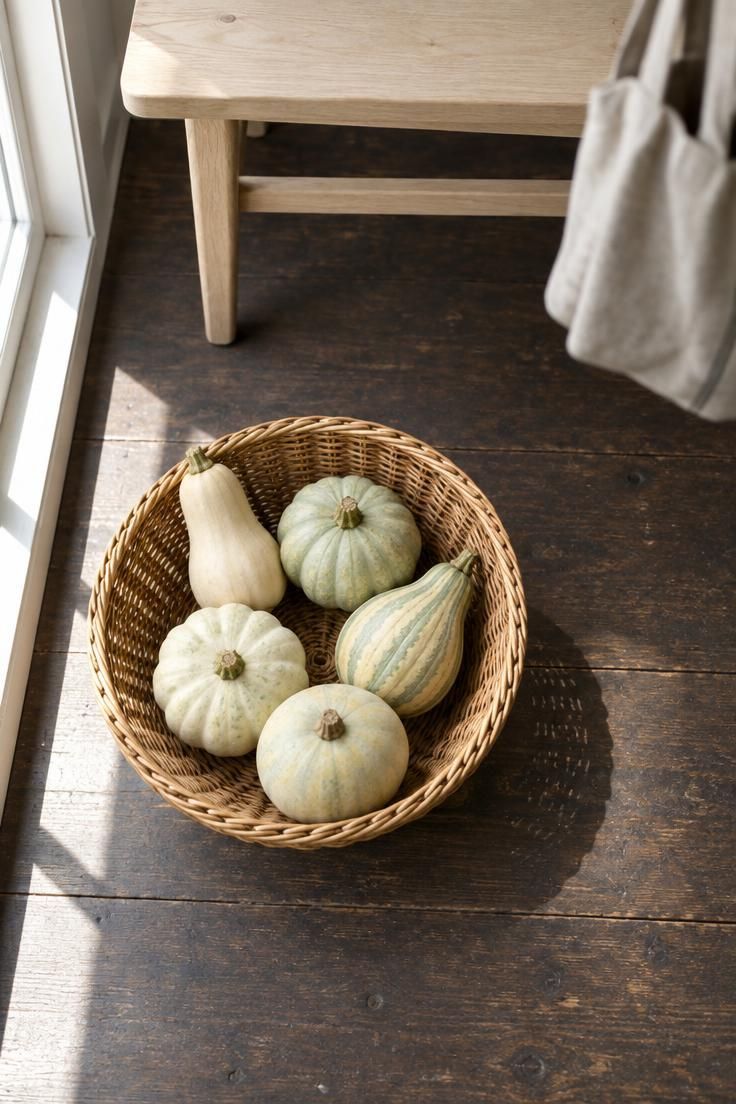
The basket consolidates several small objects into one visual unit, which is the technique that keeps a low scene from reading as clutter.
An unstained willow or seagrass basket supplies warm texture where a metal or painted container would add noise.
Inside the basket, pile the gourds so their tops vary in height, with one out of line rather than a neat grid.
Under a bench, beside a console, or at the base of a stair where the basket is seen from above all work as placements.
Gourds in a basket are hard to inspect for soft spots, so lifting them out periodically is the maintenance this idea asks for.
On a bare floor without furniture, a single low bowl instead of a basket reads smaller and more graphic.
The basket takes less width than three separate floor objects and can be lifted away entirely when the room needs to reset.
Adding a second basket elsewhere in the room turns one deliberate gesture into a collection.
Style Blueprint:
- One shallow willow or seagrass basket, unstained
- Five pale gourds with varied heights
- A spot beneath a bench, console, or stair
- One gourd placed out of line for asymmetry
- A plain low bowl as the alternative on bare floors
Design Pro-Tip: Keep the basket’s rim visible rather than mounding gourds above it. The rim is what signals the group is contained rather than spilled.
A Loose Cheesecloth Runner Down a Mantel Edge
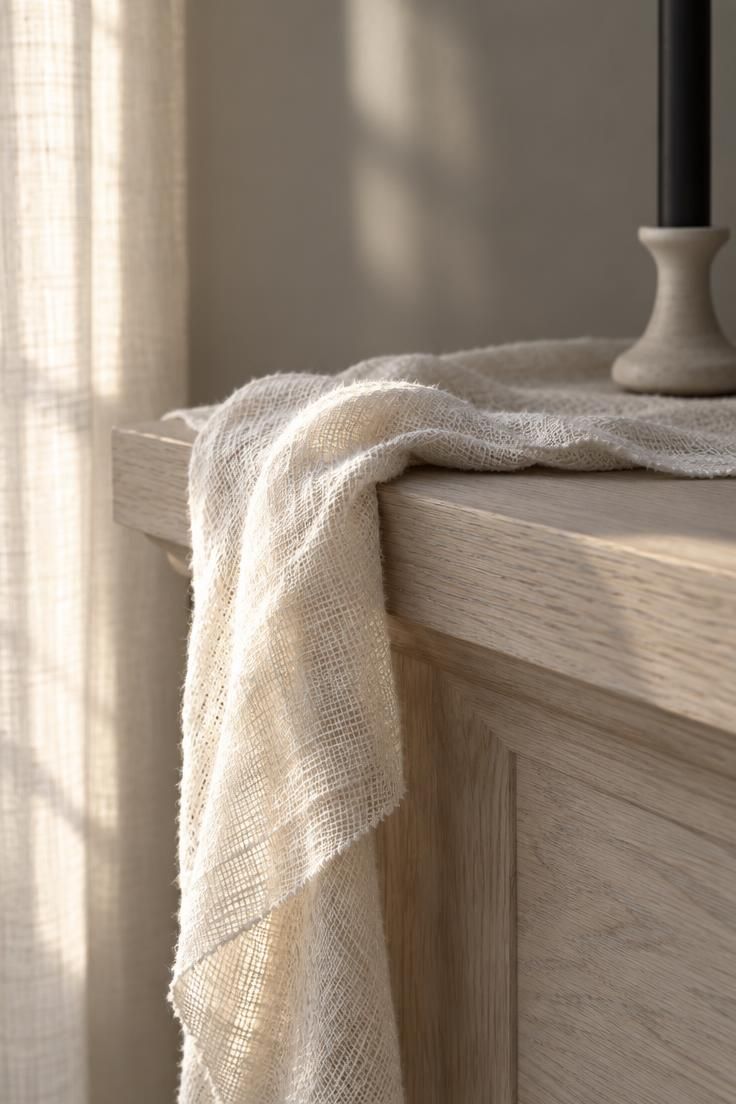
A single length of off-white cheesecloth draped unevenly over a pale wood mantel brings an understated Halloween decor gesture that reads as textile, not costume.
Let the cloth fall in one soft line past the corner, keeping the weave loose enough that light passes through and the pale wood still shows beneath.
Restraint separates draping from a cobweb effect: fewer folds, one visible fabric edge, and no layering of multiple textiles.
For a minimalist Halloween look, leave the surface mostly bare so the drape is the only soft element against wood, and let a matte black candlestick supply the single dark accent.
Unbleached or off-white cheesecloth keeps the palette warm, where bright white pulls the same composition toward winter.
Pair the drape with one black candlestick or one small object beside it, not both a lit taper and a pumpkin.
If the room already carries neutral Halloween decor on other surfaces, this mantel can stay entirely plain, with the cloth alone doing the seasonal work.
The loose fabric carries a real fire risk near an open flame, so set a battery candle in the holder instead of a lit taper, and keep the trailing corner clear of edges that get handled often.
Cheesecloth wrinkles and collects dust, so it can be shaken out or rinsed and air-dried between uses, and it folds flat for storage during the rest of the year.
Design Pro-Tip: Let the fabric edge show rather than tucking it under, and leave one corner lower than the other so the drape keeps the slightly undone line that distinguishes it from a pressed runner.
Style Blueprint:
- One length of unbleached or off-white cheesecloth
- A draped, uneven, single-layer placement with a visible edge
- One matte black candlestick beside the fabric
- A battery candle rather than a lit taper
- A pale wood or stone mantel as the base
Halloween Silhouettes Framed in Thin Black Frames
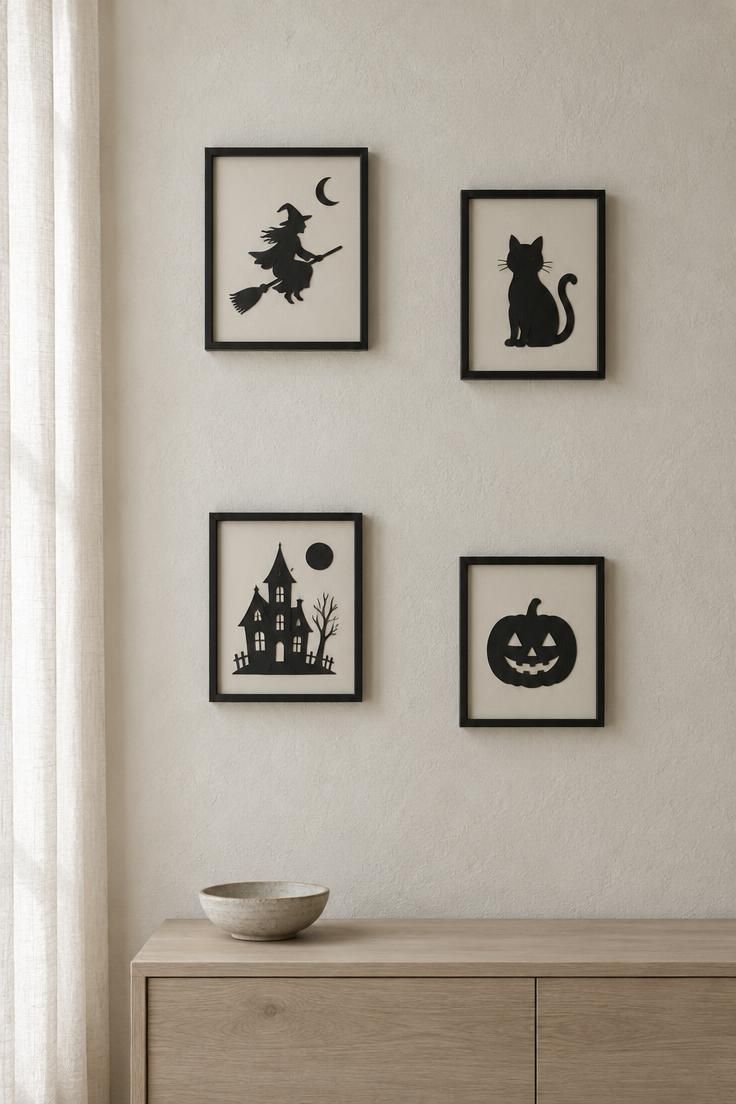
Halloween silhouettes can move beyond a single cut shape into a small framed series without losing the quiet mood.
The key difference is containment: thin black frames keep each outline as a deliberate graphic object, not a decoration taped to the wall.
This is where black and white Halloween decorating works best, because the frames supply the only visual weight while the wall keeps the arrangement airy.
Scale the frames to the wall rather than to each other, so the group reads as one composition rather than four separate decisions.
A loose grid with uneven spacing feels more collected than a perfectly measured row, and it leaves room to add or subtract pieces season by season.
This approach also works well for neutral Halloween decor in rooms where hanging several single silhouettes would feel scattered.
For understated Halloween decor that disappears into a rented wall or a small entry, two or three frames in a vertical line beside a doorway is often enough.
Style Blueprint:
- Two to four thin black frames, all in the same scale family
- Black paper halloween silhouettes in bat, cat, raven, or moon shapes
- A bare plaster or drywall wall in off-white
- A loose grid or vertical stack with slightly uneven spacing
- A low console or hook rail below as the only nearby object
Conclusion
The logic that holds these ideas together is simple: one focal point per surface, generous empty space, matte finishes, and a palette drawn from what the room already contains.
That same logic makes minimalist halloween feel calm rather than costumed, and it carries across every idea here: a taper, a basket of gourds, or a few quiet Halloween silhouettes.
minimalist Halloween decor works because the palette stays close to what the room already holds.
Two or three ideas across the whole home preserve the restraint that defines the approach.
Adding a fourth or fifth turns an understated Halloween decor scheme back into a conventional display.
Anyone weighing minimalist Halloween decorations against simple Halloween decor will notice the difference comes down to count, not to cost.
Neutral Halloween decor, minimalist fall decor, and modern Halloween decor all follow the same rule about empty space.
If black and white Halloween is the direction, the restraint matters even more, since the contrast carries the seasonal read on its own.
Understated Halloween decor also fits a home that never fully clears its everyday objects.
Several tradeoffs recur across the list.
Natural pumpkins and gourds perish indoors over weeks.
Dried branches and vines shed.
Open flame near anything that can catch is a fire risk.
Paper and glass pieces need flat, dry storage between seasons.
What makes this approach work is that it is temporary by design.
A few small objects go out in early October and come down at the start of November.
The room returns to the composition it had before.
That short window is what keeps a few minimal Halloween ideas from hardening into a permanent scheme.