This post may contain affiliate links. If you make a purchase through these links, we may earn a commission at no additional cost to you.
The front of a house is really three separate stages: the approach from the street, the steps or porch, and the door itself.
Each stage can carry one clear focal point, and crowding all three at once usually flattens the effect.
Outdoor Halloween decor has to work twice, once in flat afternoon light for anyone passing by and again after dark, when lamps and glowing objects redraw the whole composition.
The ideas below move through those zones with lighting running across all of them, and each one notes the materials, finish, and seasonal behavior that shape how it holds up outside.
Pitch-Black Bat Swarm Drifting Up a Pale Facade Wall
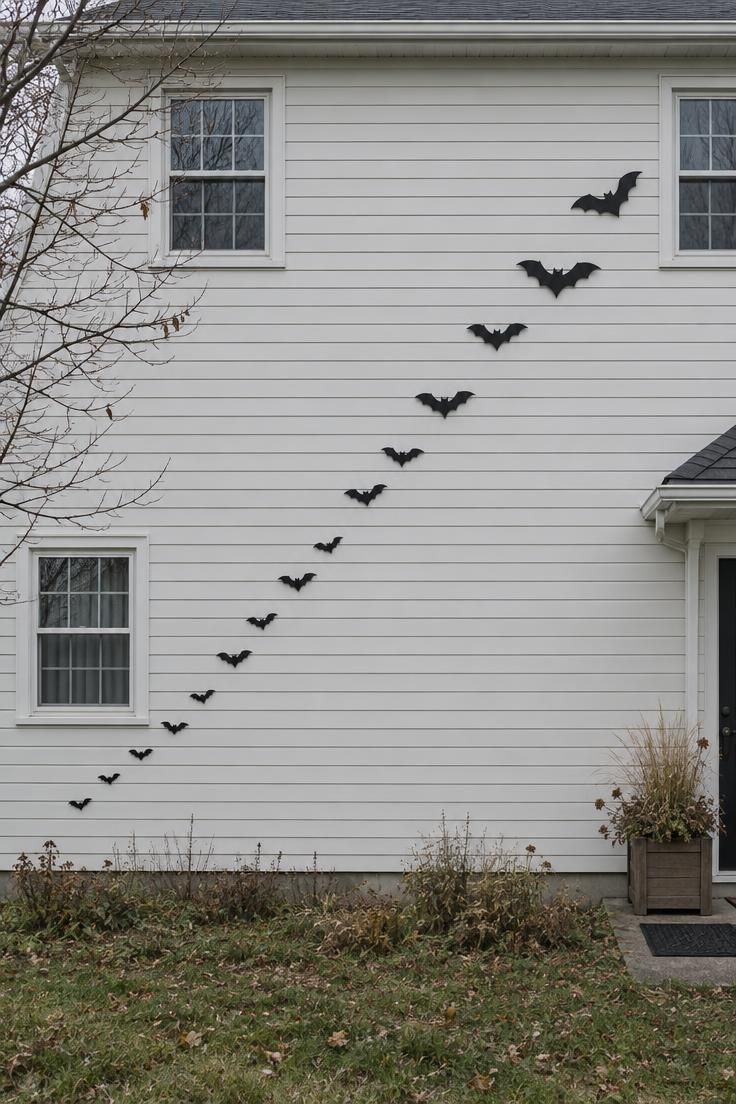
Flat cutout silhouettes in matte black resin work best when they are cut in two or three graduated sizes and arranged in a loose rising line rather than a tidy grid.
Varying the spacing between shapes is what makes the swarm look like movement; even gaps read as a pattern, while tight-to-wide gaps read as a drift.
Matte black against pale siding or brick gives maximum graphic contrast, and the same bats on dark siding nearly disappear.
The daytime read carries the facade, but after dark the silhouettes only register where a light source grazes the wall behind them.
Flat shapes are low-storage but their edges collect dust and cobweb strands, so a wipe-down before packing them away keeps them reusable.
Mounting a large number of individual shapes takes more time than it looks, and pre-planning the layout on paper cuts that time considerably.
Style Blueprint:
- Graduated shapes in three sizes
- Matte black finish only
- Loose diagonal path rather than a grid
- Pale wall as the canvas
- No other black objects on the same wall
Design Pro-Tip: Sketch the wall first and mark your shape spacing on that reference, since a swarm that looks balanced on paper almost always reads better once the real wall is in front of you.
A Row of Uncarved Cream Pumpkins on Weathered Wood Steps
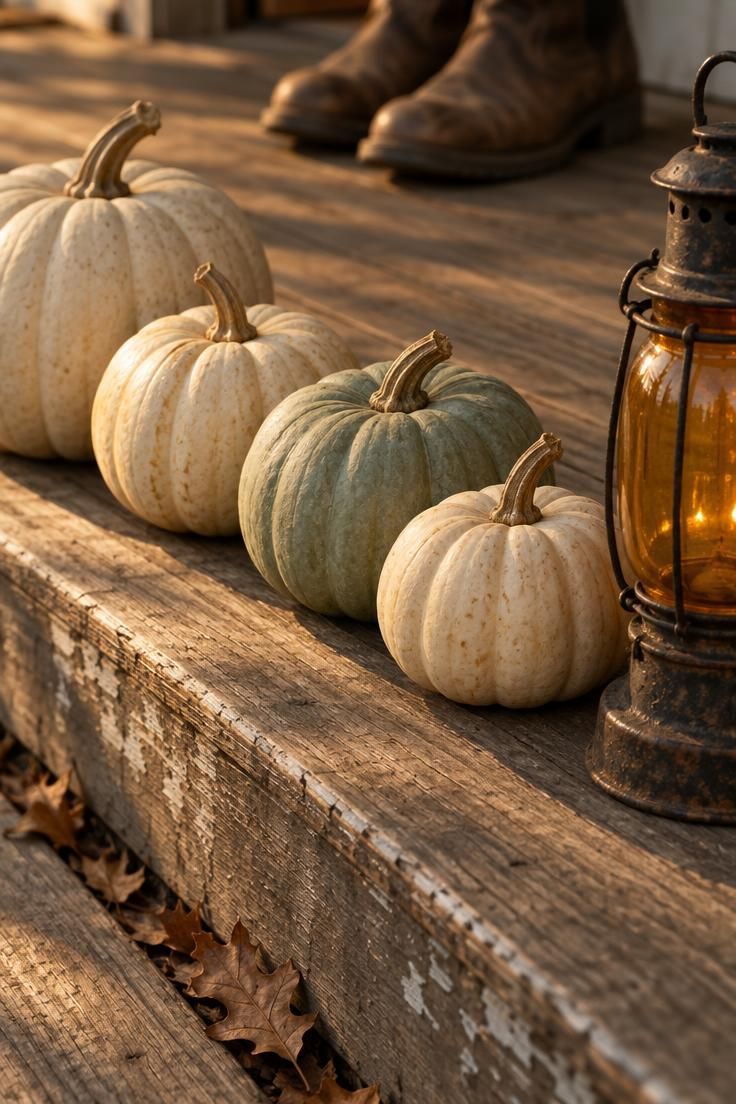
Heirloom varieties in cream, sage, and blush move the arrangement away from standard orange, and the finish is matte and chalky rather than glossy.
Line them along one step rather than clustering them, so the eye travels across the width of the stairs instead of stopping at a pile.
A single amber lantern at the end of the row gives the composition a terminus and introduces the only warm light source in the frame.
Pumpkins with real stems read as taller and more sculptural than stemless ones, so mixing heights across the row creates rhythm.
The cream palette is at its best in late-afternoon light, and after dark the lantern does the work.
Uncarved pumpkins on outdoor steps draw moisture at the base, so lifting them onto a small square of cork or slate helps them last longer through the season.
Heirloom pumpkins often cost more than standard field pumpkins, which makes this a scheme worth storing carefully rather than replacing each year.
Style Blueprint:
- Uncarved heirloom pumpkins
- Matte chalky finish
- One row on one step
- Single amber lantern
- Weathered wood as the backdrop
A Tattered Gauze Swag Draped Across a Black Twig Wreath
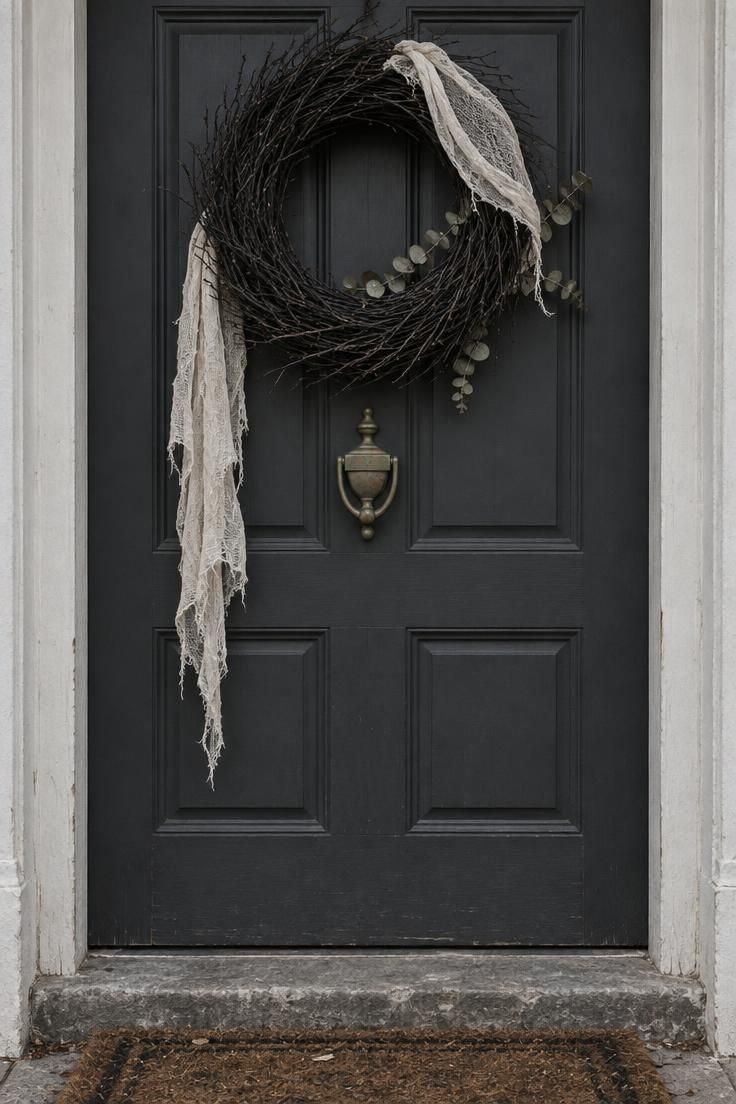
The wreath is a dense circle of thin black twigs, the gauze is loose and semi-sheer, and the contrast between structured twig and drifting fabric is the whole point.
Drape the gauze asymmetrically rather than centering it, since an off-center swag looks deliberate while a centered one reads like a bow.
Loose gauze catches even light wind and changes silhouette, which is atmospheric in a light breeze and irritating in a gust.
A tattered or frayed edge finish on the gauze sells the abandoned-house read, while clean-cut fabric reads as craft-fair instead.
Daytime is texture-focused, all twig and weave and edge, and the evening read depends entirely on the door light behind it.
A longer swag that reaches the door handle side of the wreath gives a strong vertical line, and a short swag reads as a decorative cap.
Gauze and twig both shed and fray, so a light rinse and full air-dry before storage keeps the fabric from mildewing in a closed bin.
A Halloween wreath for front door placement reads best when the twig circle hangs at eye level against a solid door color, letting the gauze swag fall past the frame.
Hanging this swag beside simple Halloween porch decor ideas keeps the entryway composition focused on one tattered texture against bare twigs.
For evening impact, pair the wreath with Halloween lighting ideas such as a warm lantern below and a restrained purple glow behind the gauze.
Hanging the wreath beside a porch light turns plain gauze into a soft silhouette against the railing, which makes the entry read as part of a wider scheme of front porch Halloween decorations.
Pair the wreath with other spooky outdoor decorations along the porch, such as matte black crows perched on the railing.
Halloween yard decorations often lean on repetition for effect, so a second gauze swag on a gate post helps the whole entry read as one idea.
Consider this wreath a simple piece of DIY outdoor Halloween decor, since the materials stay basic and the effect comes from loose drape and contrast.
For a coordinated entry, pair the wreath with Halloween silhouettes for yard settings, such as flat black cat or bat shapes placed against a porch wall or fence.
Style Blueprint:
- Black twig wreath
- Tattered gauze swag, hung off-center
- One frayed edge finish
- Painted front door as the ground
- No added ribbon or bow
A Vintage-Suitcase and Lantern Still Life on a Porch Bench

Grouped objects on a bench suggest someone recently left, which is more unsettling than a single isolated prop.
Leather and brass for the suitcase, raw wood for the crate, and aged metal for the candlestick lantern all sit in matte finishes with no gloss.
Layer the bench with the suitcase flat on the seat, the crate on the floor beside it, the lantern on the crate lid, and a small ceramic object on the suitcase for three distinct heights.
The palette should sit in browns, blacks, and one muted accent in bone, brass, or dusty green so the grouping reads as deliberate rather than as storage.
The objects are strongest in soft overcast light where their surfaces show, and after dark they need a single close light source to keep any detail visible.
Leather, brass, and wood are durable outdoors but heavier to set out and harder to lift for storage than flat silhouettes.
Style Blueprint:
- One vintage suitcase
- One raw wood crate
- One candlestick lantern
- One small ceramic prop
- Monochrome brown-and-black palette
A Column of Painted Matte Black Pumpkins Stacked on a Porch Railing
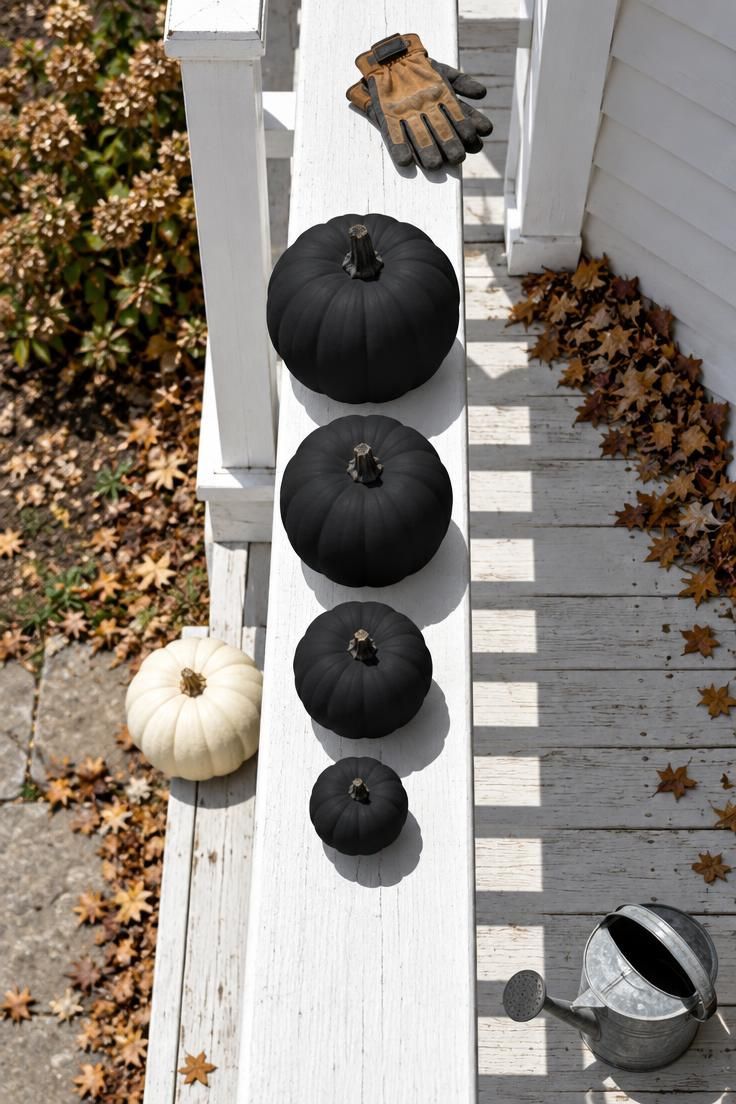
Matte black paint turns ordinary field pumpkins into a graphic, almost sculptural form, and the finish should be flat rather than satin to avoid shine.
Stacking works because the column becomes a vertical rhythm against the horizontal rail, so the eye follows the height rather than scanning the porch.
A single bone-white or cream pumpkin placed beside the base of the column supplies contrast and stops the arrangement from reading as a black blob.
Scale progression matters, with the largest at the bottom and the smallest at the top and roughly even size steps between them.
Daytime is the strongest read for this idea, bright and high-contrast and graphically clear from the street.
Evening is the weakest read, since matte black absorbs light, and unless a lamp is placed near the column the whole stack disappears into shadow.
Painted pumpkins are decorative, not preserved, so they still spoil and this setup is usually built for a two-to-three-week window.
A can of matte black spray paint plus a matte clear coat holds up better against handling, and the finish shows almost no dust.
The column leans or shifts when pumpkins settle unevenly, so checking the stack after a windy night is part of keeping the look intact.
Style Blueprint:
- Matte black only
- Flat finish, no gloss
- Four-step size column
- Single bone-white accent
- One horizontal surface, one vertical stack
Cornstalks and Hay Bales Flanking a Walkway with Mums in Rust and Cream
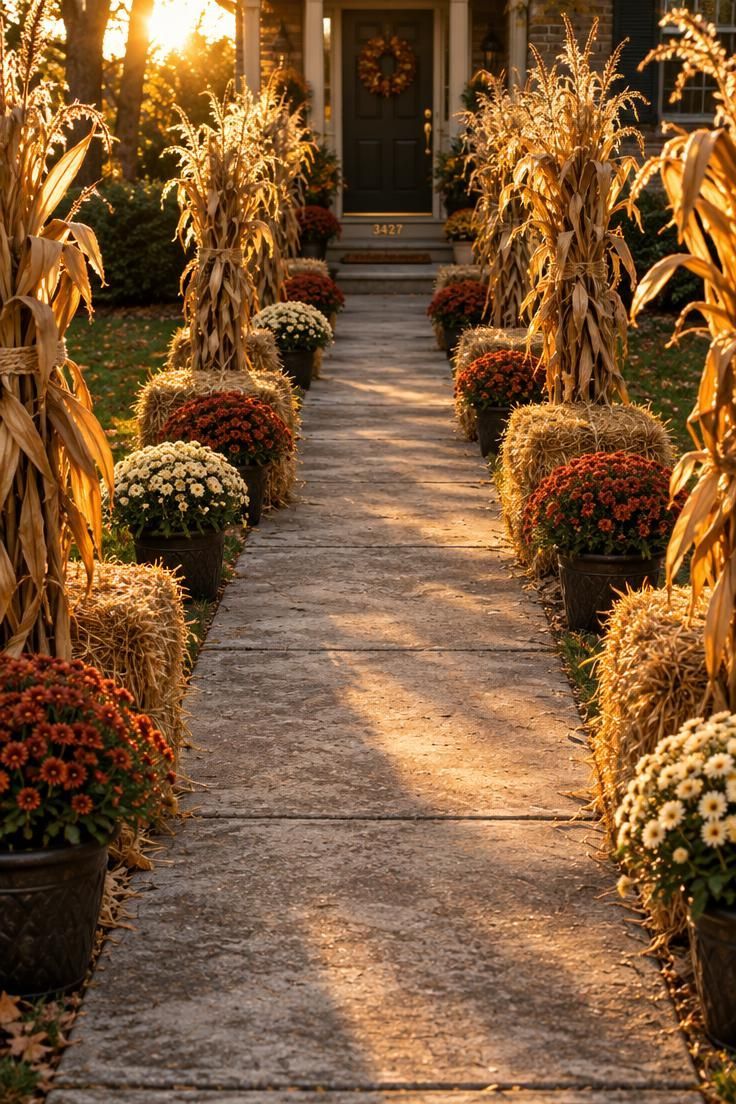
This is the easiest scheme for anyone who wants decoration that bridges from late September straight through Thanksgiving without being overtly Halloween.
The botanical palette of dried corn tassels, straw, rust mums, and cream mums sits well against almost any house color, especially brick, cream, and metal roofing.
Frame the walkway rather than blocking it, setting cornstalks and hay at the outer edge of the path so the route to the door stays obvious.
Bunched cornstalks read best as an upright vertical element about the height of a typical railing, while hay bales stay low and horizontal.
The daytime read is the primary one, and this scheme changes very little at night unless a warm light is added among the mums.
Hay, straw, and dried corn shed, so expect to sweep the walkway more often, and a low tray or mat under the bales contains some of the mess.
Take pumpkin decorating ideas beyond the porch by setting a single painted or chalk-finished pumpkin among the rust and cream mums, where its color picks up the dried corn tassels and straw rather than competing with them.
Larger pumpkins belong at the base of the bales and cornstalks, leaving the walkway center clear.
Style Blueprint:
- Bundled cornstalks at the outer edge
- Low hay bales
- Mums in rust and cream
- No orange pumpkins
- Visible path to the door
Design Pro-Tip: Place mums in their nursery pots inside a slightly larger cachepot rather than planting them into the ground, so the pots lift out cleanly at the end of the season.
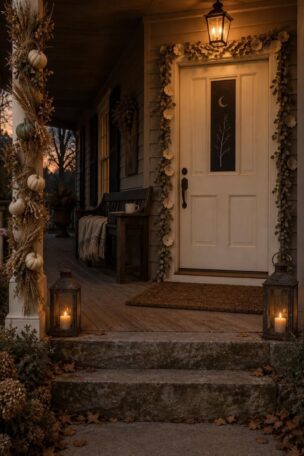
A Line of Identical Black Lanterns Along a Porch Railing After Dark
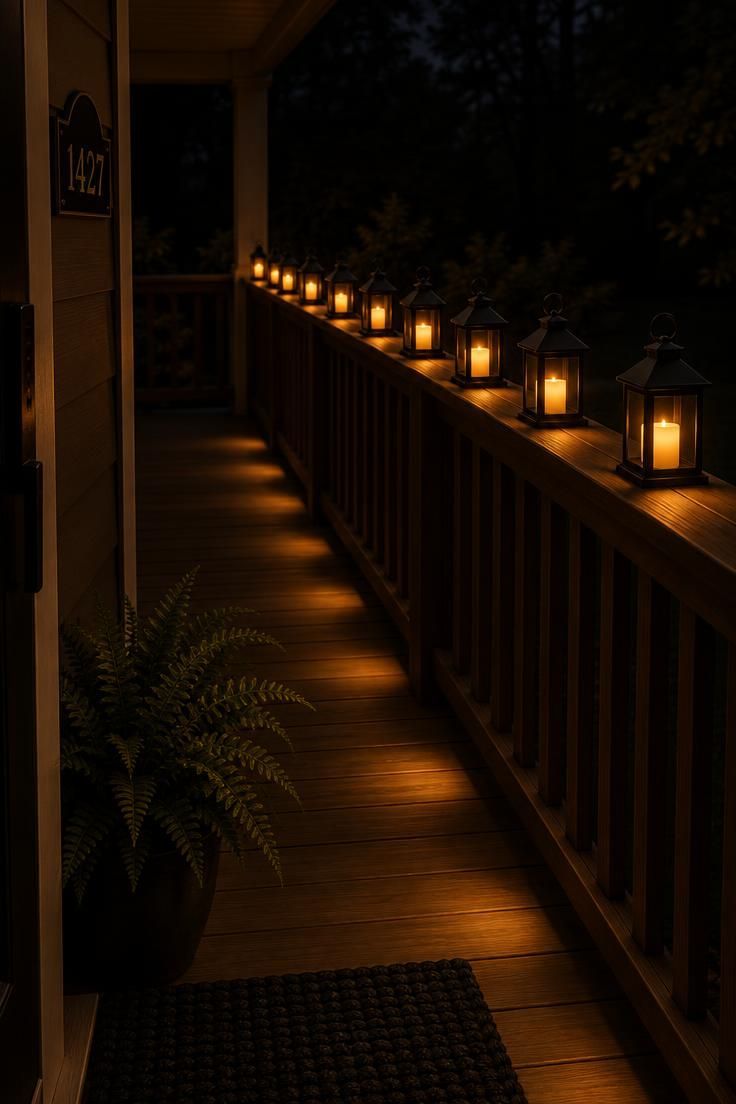
The design principle is repetition, with identical lanterns, identical spacing, and identical light temperature all along one line.
Simple matte black metal boxes or tapered lantern forms with punched or clear glass panes let the light out evenly.
LED candle-style lights with an amber or warm-white tint read as atmospheric, and cooler tones read as utility lighting.
Even spacing along a rail reads as a composition, and uneven spacing reads as clutter.
Evening is the primary read for this idea, and in daylight the lanterns are quiet and matte and nearly invisible, which suits anyone who prefers understated day and dramatic night.
Multiple lit lanterns on a porch typically use battery or rechargeable LED candles, since a long run of lit fixtures usually needs a nearby power source.
Black metal lanterns left outdoors collect moisture and leaf litter in their bases, so emptying and drying them before storage keeps hinges and finishes intact.
Buying nine matching lanterns is a bigger upfront cost than mixing what you already own, so this idea rewards committing to one style.
Style Blueprint:
- Identical matte black lanterns
- Amber LED candles
- Even spacing along one rail
- No color variation
- Quiet by day, strong at night
A Single Oversized Matte Black Spider Clinging to a Front Yard Tree
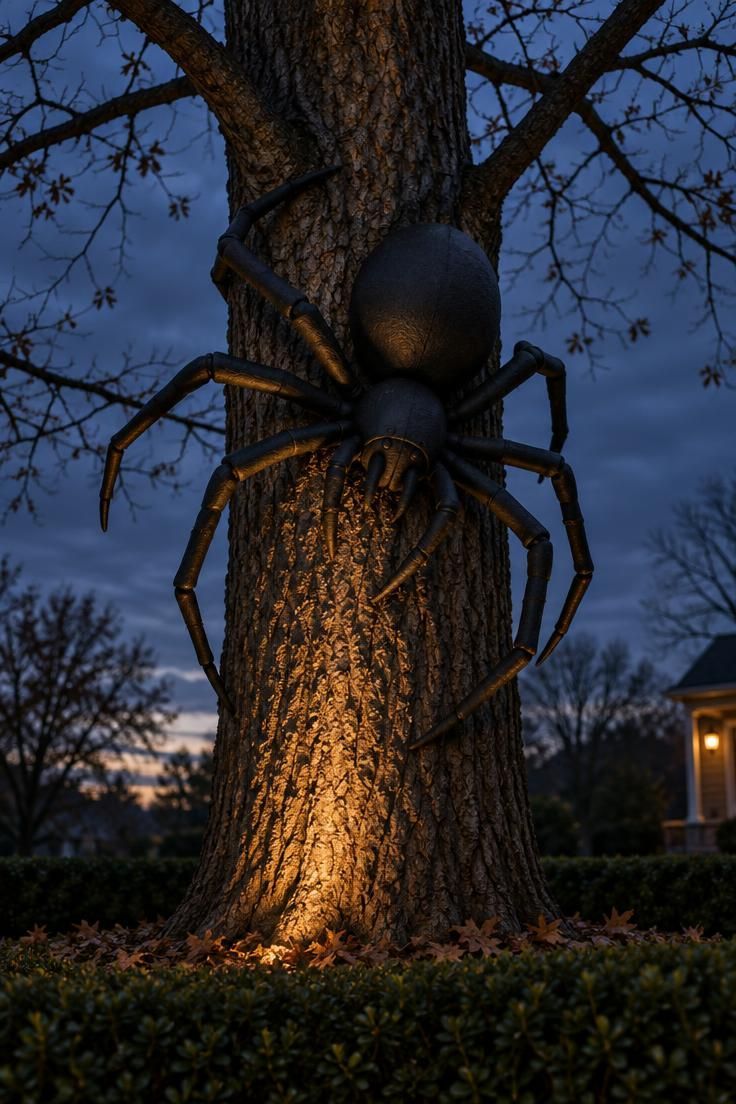
The scaling strategy is one giant object rather than many small ones, so a single oversized shape on a tree reads from the street and stays readable from the sidewalk.
The finish should be matte black with visible joint articulation on the legs, since glossy plastic versions read as toys rather than silhouettes.
Choose a tree with clear trunk space and open branches so the shape is set against the sky or wall rather than lost in leaves.
Choosing a pale background, whether white siding, an open sky, or a light-colored garage, makes the silhouette stronger.
Yard-scale pieces are the most storage-intensive category of outdoor decor, and a large soft or jointed form needs a flat spot to store without crushing.
Style Blueprint:
- One oversized matte black spider
- Visible joint articulation
- Tree with clear trunk space
- Pale background behind the shape
- One low warm light source
Design Pro-Tip: Position the oversized shape so it is silhouetted against the palest surface available, whether siding, an open sky, or a lit garage wall, and the same object will read twice as large.
A Grimy Gauntlet of Weathered Tombstones Rising from a Mulch Bed

Realism comes from the finish, where gray-tan foam with visible edge chips, dry-brush streaks, and a slightly uneven shape reads as aged while flat uniform gray reads as new.
Vary the shapes and heights across the group so a rounded tablet, a cross, and a slab in three sizes reads as a small plot rather than a product line.
Set them into mulch or leaf litter rather than onto bare ground so the bases look embedded rather than placed.
Group them in an asymmetrical cluster with one tombstone at a slight lean, since perfectly upright stones look staged.
The overcast, evenly lit daytime read is the strongest one here, because weathered texture is exactly what soft light reveals.
Foam and painted finishes degrade noticeably in long sun exposure, so tombstones facing direct afternoon sun usually need a re-paint or touch-up between seasons.
Style Blueprint:
- Gray-tan foam tombstones
- Three or more varied shapes
- Dry-brush weathering
- Mulch-and-leaf base
- Asymmetric cluster, one leaning
A Vintage Window Frame Propped with Candle-Style Lanterns Behind It
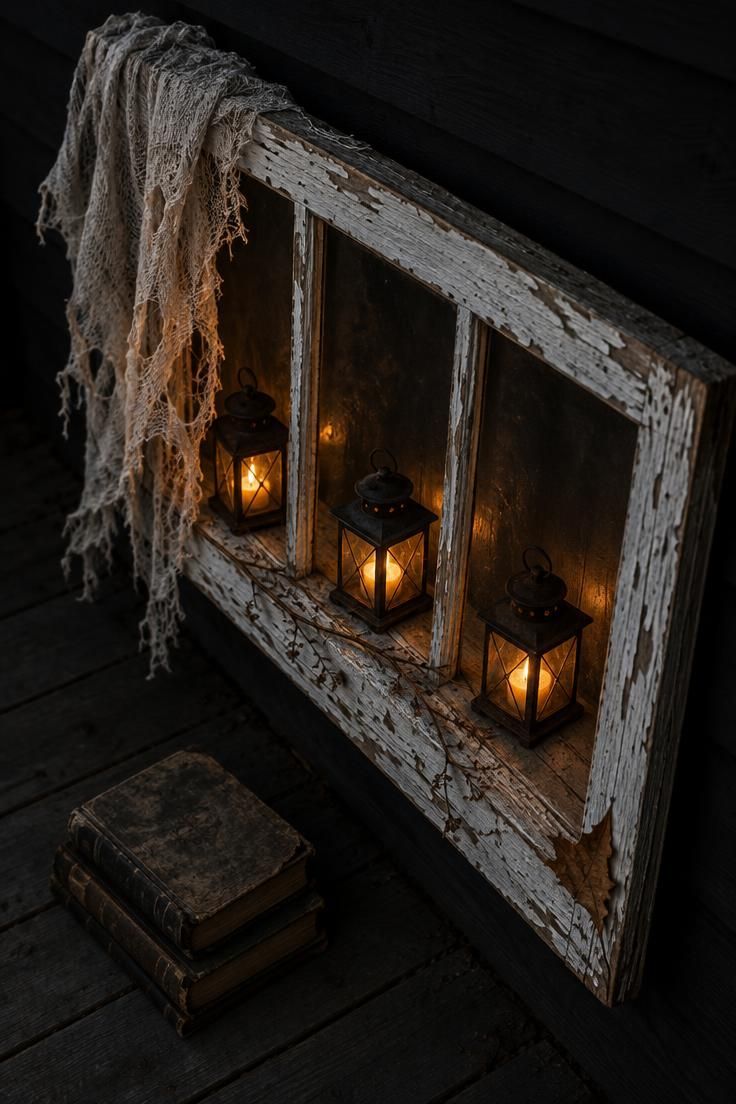
The window frame becomes a natural picture frame for whatever sits behind or inside it, whether lanterns, a gauze curtain, or a stacked arrangement of small objects.
A worn white-painted frame against a dark porch wall gives the composition a strong pale rectangle to anchor the eye in an otherwise dark scene.
The cheesecloth corner drape is the aging cue, and keeping it to one corner only keeps the frame itself legible.
Candle-style lanterns inside the frame should be small, since the frame is a vignette rather than a shelf and three small lights read better than one large one.
Daytime reads as architectural, all frame and peeling paint and cloth, while nighttime is the small pools of light inside the frame.
Painted wood frames weather well, and old glazing-free frames are more forgiving than glazed ones because they do not trap moisture behind glass.
This is a small, quick setup of one frame, three lanterns, and one length of cloth, useful for anyone who wants a strong evening vignette without a full porch overhaul.
A single flat frame takes very little space to store, and wrapping the cloth and boxing the lanterns alongside it keeps everything together.
The frame does need a stable lean against a wall, and a frame that tips in wind takes the lanterns with it, so checking it after storms is worthwhile.
Style Blueprint:
- One glazing-free weathered frame
- Amber candle lanterns inside
- One cheesecloth corner drape
- Matte white or black frame finish
- Porch wall as the backdrop
A Dense Bed of Illuminated Mason Jar Glow-Lights Along a Garden Path
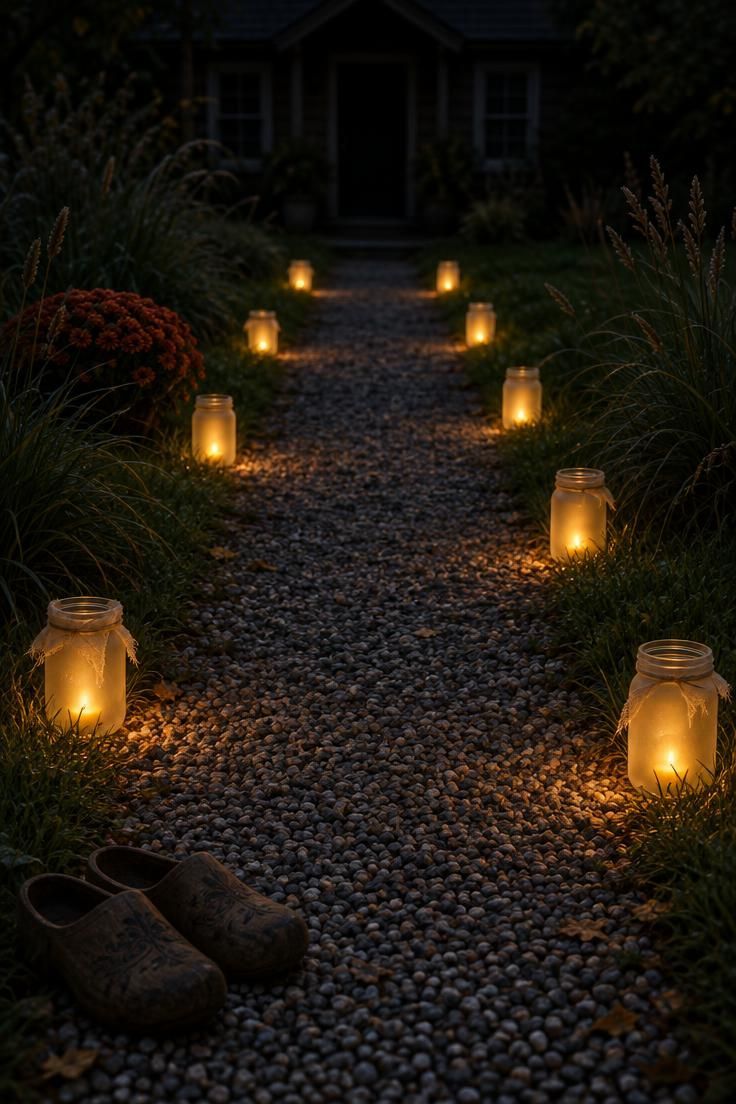
Path-edge lighting changes how the approach to the house reads at night, drawing a lit route and making the house itself feel farther away than it is.
Frosted glass from a spray-on etching product or a specialty paint photographs well, and hand-dipped wax with gauze wrapped at the neck gives a similar effect.
Warm light temperature matters here, since cool white LEDs read as utility path lights and warm LEDs read as candle flame.
Spacing and quantity matter more than individual jar quality, and a larger number of consistent jars reads better than a few elaborate ones.
Open-flame candles on a path are unreliable in wind, and small LED tea lights or puck lights give the same look without the problem.
Glass jars chipped and filled with water or debris need draining and drying before storage, and the wax finish on dipped jars softens in warm weather.
Style Blueprint:
- Frosted or wax-dipped glass jars
- Warm LED lights only
- Even spacing along both path edges
- Low set height
- Visible route to the door
Design Pro-Tip: Test the LED color temperature at night before committing to a full path of jars, since the same fixture can look amber in one brand and clinical white in another.
Conclusion
The three-zone approach holds up best when each stage gets one strong idea rather than a stack of competing props on the same patch of porch.
The schemes that tend to satisfy most are the ones that commit to a single palette, whether black-and-bone, rust-and-cream, or monochrome amber, and to one focal scale, either one oversized object or a quiet repetition of identical pieces.
Outdoor decor also competes with weather, fading, wind, and storage, so choosing pieces that clean up easily and pack flat is a real part of the design decision rather than an afterthought.
A few outdoor Halloween props, spaced apart and varied in height, can carry the same mood as a crowded porch without the clutter.