This post may contain affiliate links. If you make a purchase through these links, we may earn a commission at no additional cost to you.
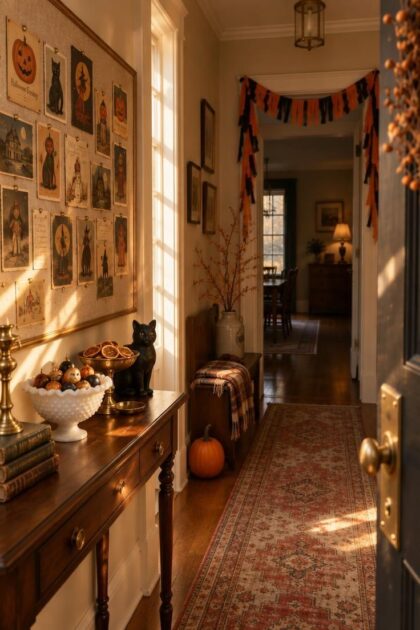
A doorway seen at an angle tells the story before anyone steps through: aged paper, warm amber light, and matte finishes rather than glossy seasonal merchandise.
This look draws on early twentieth-century printed goods and mid-century paper novelties, though the displays that hold together best usually commit to one register instead of stacking every era at once.
Ahead is a walk through specific arrangements, materials, and sourcing tradeoffs, with images leading and text supporting.
Original pieces bring real patina while reproductions make volume possible, and both can share a single shelf or wall.
Pressed-Glass Compote of Faded Paper Fans and Chenille Cats
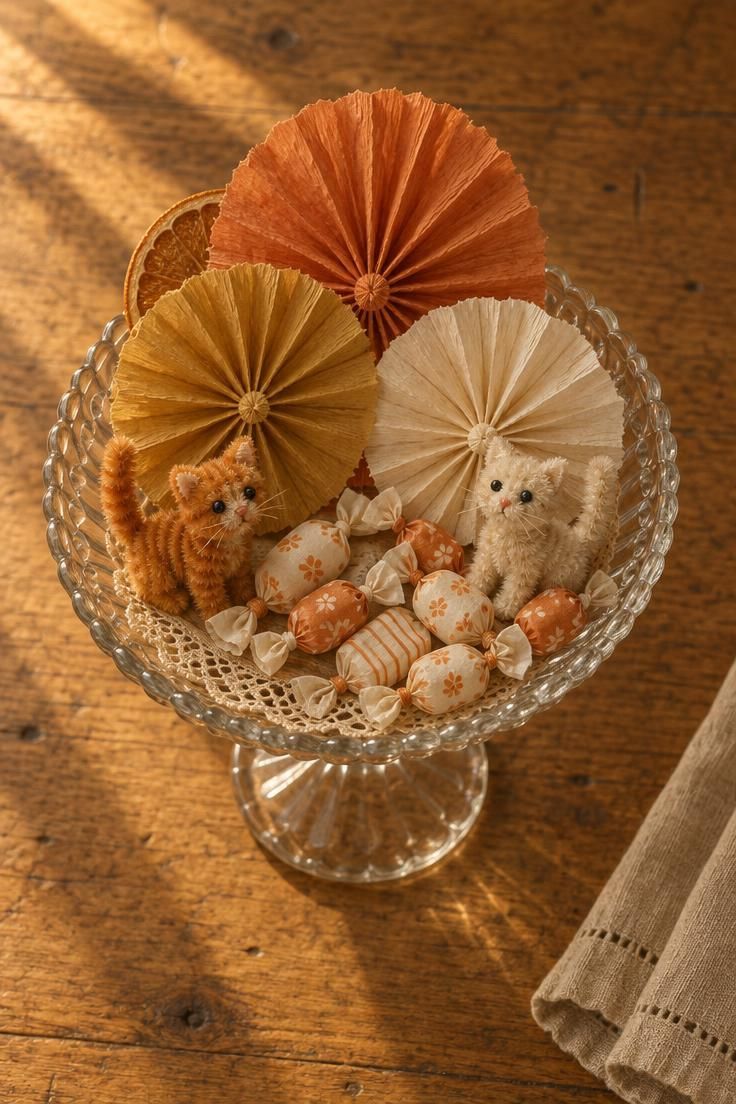
A compote works as a stage because it lifts flat paper pieces so they read as sculpture rather than scraps.
Mixing three fan sizes gives height without a tall centerpiece blocking sightlines across a table.
Chenille cats and rosettes share a soft matte finish, which is central to the vintage halloween look.
Keep the arrangement shallow enough that guests can still see over it and reach across the table during a meal.
Fans in a compote tend to hold their shape across several seasons if they are stored flat and kept out of direct sun.
Crepe paper sits at the fragile end of the material range, so the pieces most likely to crush belong on top of the stack rather than under it.
Five to seven wrapped candies offer enough color without burying the paper shapes.
For a narrower table, drop to two fans and one cat rather than crowding the bowl.
Vintage Halloween decorations like faded fans and chenille cats sit easily on a compote because their soft colors and worn textures suit a low arrangement.
An old-fashioned Halloween party often relied on a single raised centerpiece to anchor the table, so a pressed-glass compote continues that habit in miniature.
Retro Halloween decor often pairs candy-colored crepe with white chenille, a combination that softens the bolder oranges and blacks of the season.
Style Blueprint:
- Pedestal compote or cake stand with a wide, shallow bowl
- Three to five crepe-paper fans in orange, gold, and cream
- One or two chenille cats or jointed paper figures
- Small handful of wrapped candies in cream-and-orange foil
- A narrow strip of lace trim tucked under the tallest fan
Salon Grid of Reproduction Postcards Pinned to a Cream Linen Board
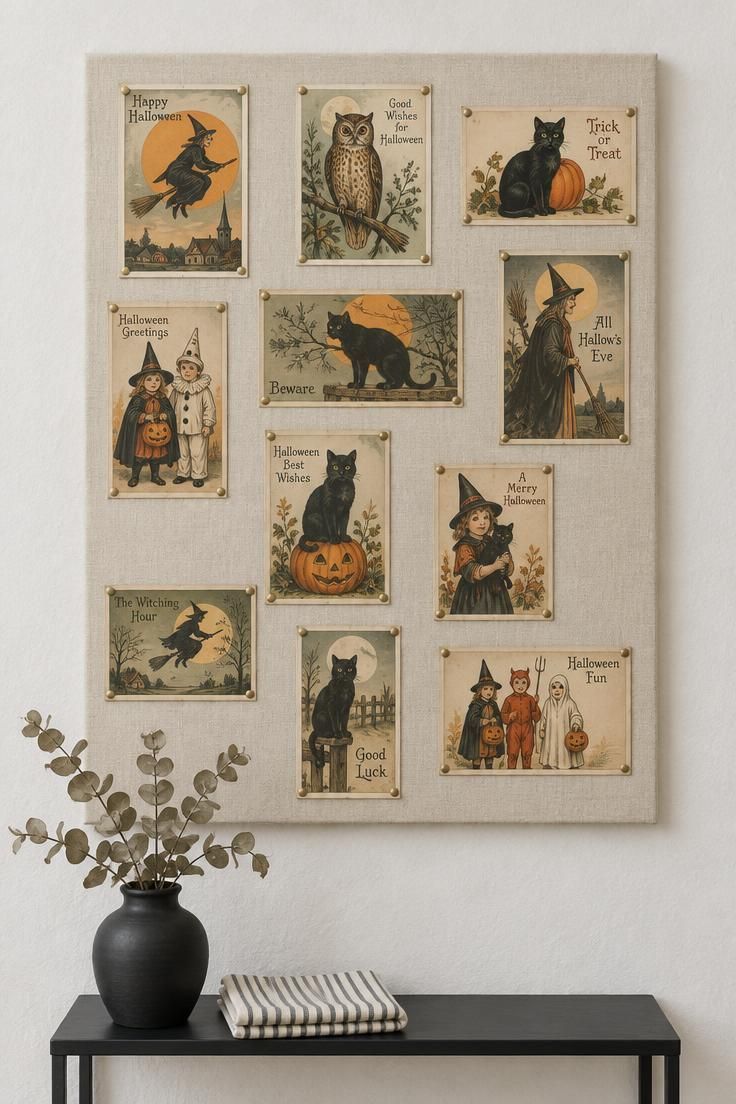
Pinning rather than framing keeps the arrangement casual and lets pieces be swapped or added as a collection grows.
An irregular grid, closer to a salon hang than a rigid matrix, keeps the eye moving across the small illustrations.
Cream linen gives the dense cluster a defined backing so individual cards do not disappear against a painted wall.
Reproductions make a larger display practical because a full grid of originals would be difficult to assemble and risky to handle.
Placing two or three originals among the reproductions gives the board focal points without exposing an entire collection to light and air.
Flat brass tacks read as period detail, though any small flat head will do.
Boards wider than about a meter can be heavy to reposition each season, so a narrower panel above a side table stays manageable.
Style Blueprint:
- Linen- or canvas-wrapped board sized to the wall space above a side table
- Eight to fifteen postcard reproductions in mixed sizes
- Flat brass or black tacks instead of thumbtacks for a period look
- One or two originals placed as focal points among reproductions
- A single gold or cream thread tying the mixed palettes together
Honeycomb Pumpkin Trio Suspended at Uneven Heights
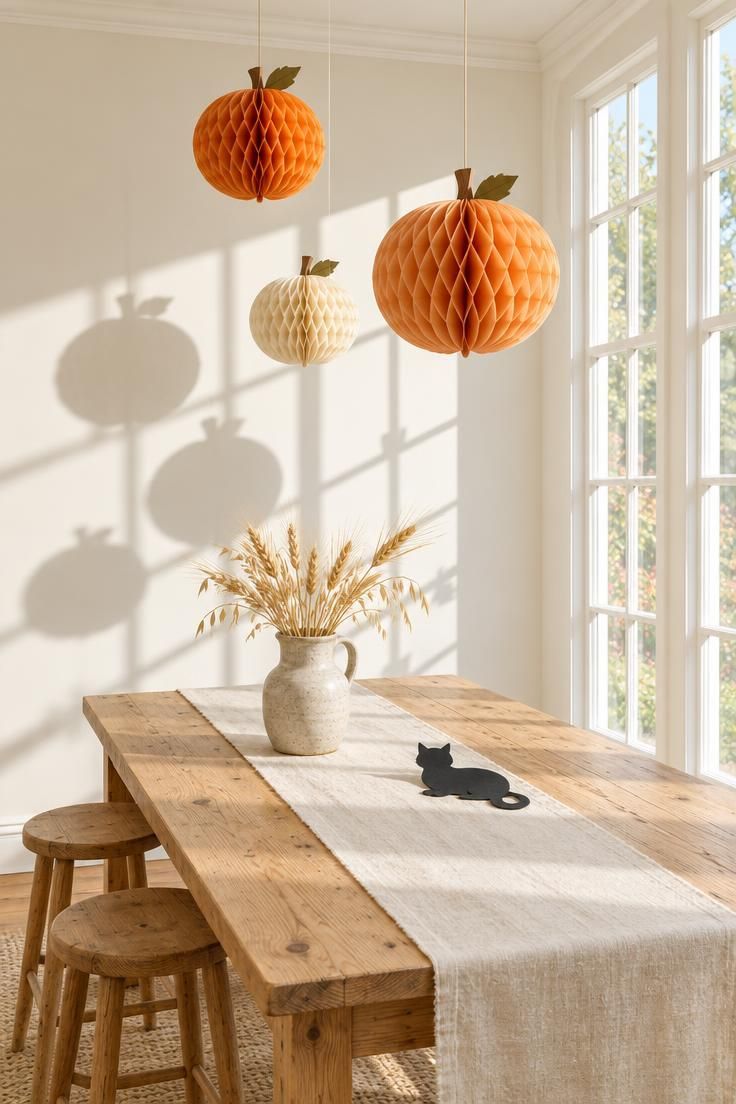
Honeycomb tissue unfolds into a rounded volume that reads very differently from a flat cutout, which is why it suits suspension over a table.
Uneven heights keep the trio from looking like a chandelier and let each pumpkin hold its own space in the room.
Pale orange and cream honeycomb against a bright wall gives the arrangement a light, papery feel rather than a heavy one.
Dropping all three to the same depth flattens the composition; varying them by noticeable increments keeps the eye climbing.
Ribbon in cream or tobacco brown blends with the paper tones, while thin twine disappears almost entirely.
Honeycomb shapes hold up best when they are collapsed and stored flat between seasons.
A dining area with a low ceiling calls for two pumpkins rather than three, since the lowest piece needs clear headroom above the table.
Style Blueprint:
- Three honeycomb pumpkins in graduating sizes and slightly different oranges
- Ribbon or twine in cream or tobacco brown for the suspension
- Staggered drop lengths rather than a uniform line
- Neutral ceiling and wall so the paper shapes carry the color
- A simple wood or linen-covered table below to catch the shadows
Design Pro-Tip: When clustering small paper pieces, pick one shared color, cream, gold, or black, and let every other color vary; the repetition holds the composition together without making it look uniform.
Grain-Sack Runner with Dried Orange Slices and a Single Brass Compote
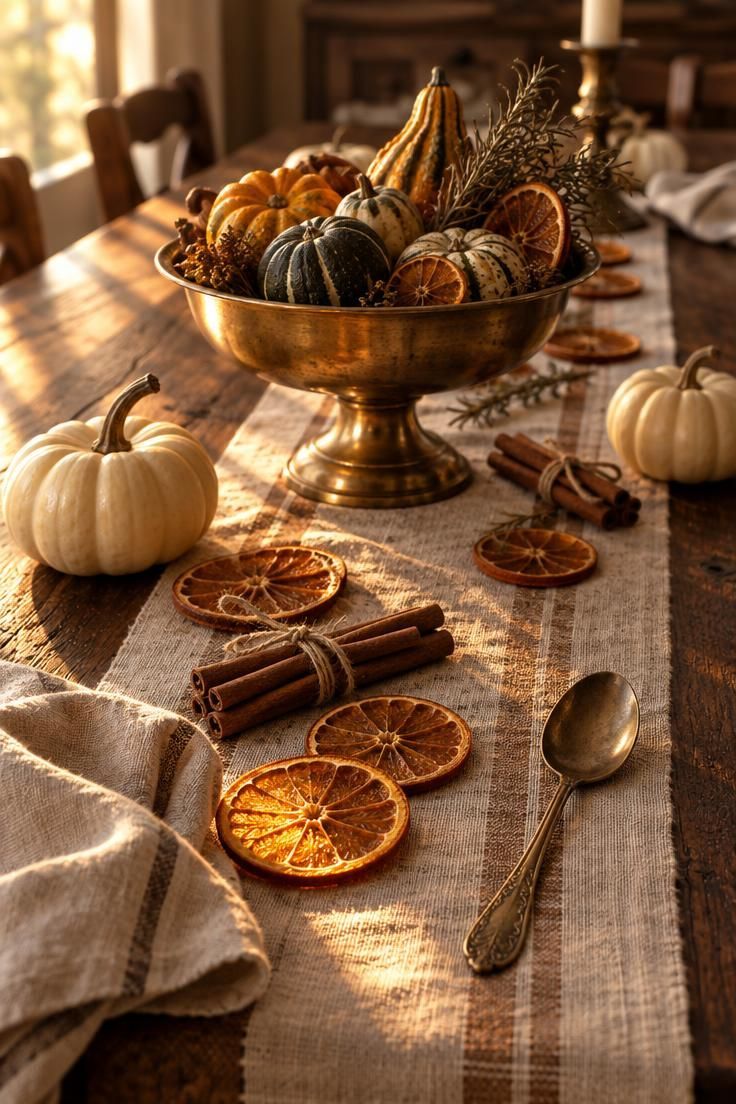
A runner rather than a full tablecloth keeps the wood visible and lets the vintage halloween palette sit against natural grain.
Dried orange slices read as both a color cue and a homemade material, which supports the folk-craft register.
One brass compote provides a metallic accent without competing with the paper and fabric pieces around it.
Dried citrus loses its scent over weeks, so refresh the slices when the display starts to look tired.
Cinnamon sticks and dried rosemary give the arrangement a warm, kitchen-adjacent note that suits a dining table.
Keep edible pieces in their own bowls and the dried botanicals to the sides; paper and textile items should not sit against food-contact surfaces.
A runner narrower than the table width leaves generous room for plates at either side.
Tuck a few antique Halloween postcards under the compote so their faded greetings peek out from the edge of the runner.
Folk art Halloween crafts belong here too, so a hand-painted paper cat or a carved turnip can sit beside the brass and feel at home.
Style Blueprint:
- Grain-sack or ticking-stripe runner in cream and tan
- Dried orange slices scattered in small, uneven groups
- Cinnamon sticks bundled with twine as low fillers
- A single brass or copper compote for height
- Small cream pumpkins on alternating sides for rhythm
Tarnished Silver Tray Holding Chalkware Cats and Candy Corn
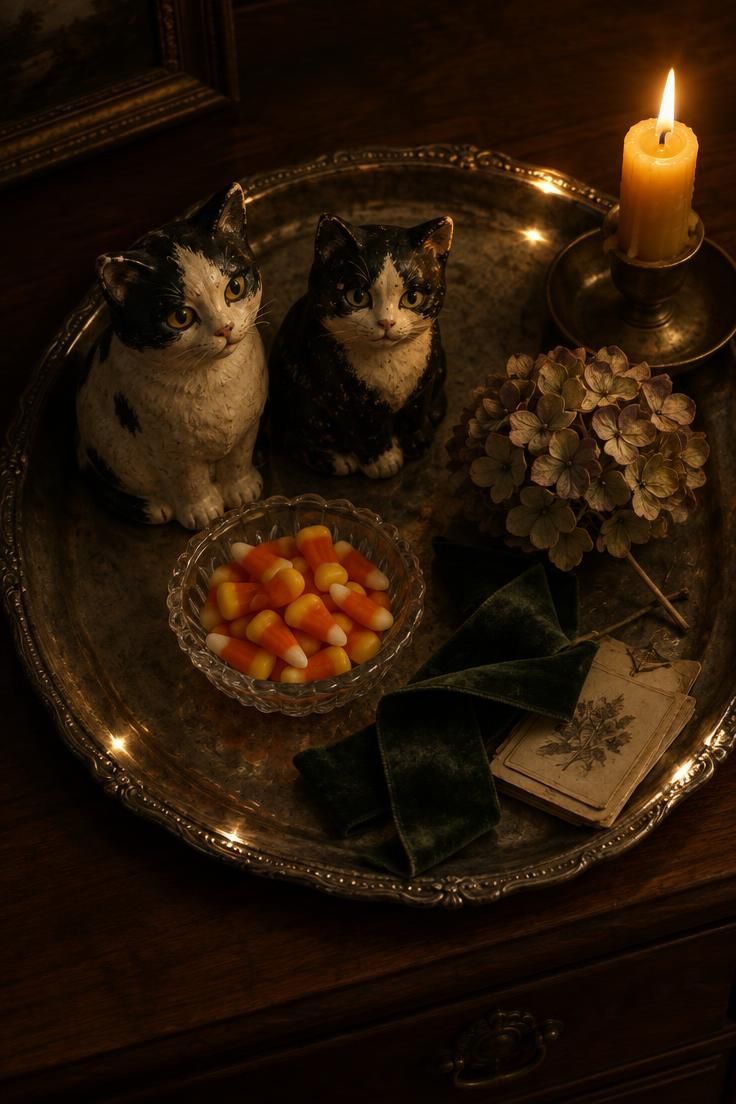
The tray's tarnish is a feature, giving the palette a soft grey-gold note that matte orange and cream sit against well.
Two chalkware cats with hand-painted faces carry more visual weight than a larger paper arrangement, so fewer pieces are needed; a single glass dish keeps the grouping functional for guests without turning the display into a serving station.
Chalkware chips along the edges when it is handled roughly, so placing the figures at the back of the tray limits contact.
Silver darkens unevenly, and some collectors prefer the patina while others polish it back; either choice changes how warm the tray reads.
Wrapped candies in a glass dish are easier to keep clean than loose sweets sitting directly on metal.
An oval tray suits a narrow sideboard better than a round one because it uses the full run of the surface.
Style Blueprint:
- Oval or rectangular silver tray with visible patina
- Two or three chalkware or papier-mâché cats in cream, black, or orange
- Small glass or milk-glass dish for candy
- One short pillar candle in a cream or beeswax tone
- A dark wood surface so the tray's edge reads clearly
Doorway Threshold with Overlapping Crepe-Paper Fringe in Orange and Black
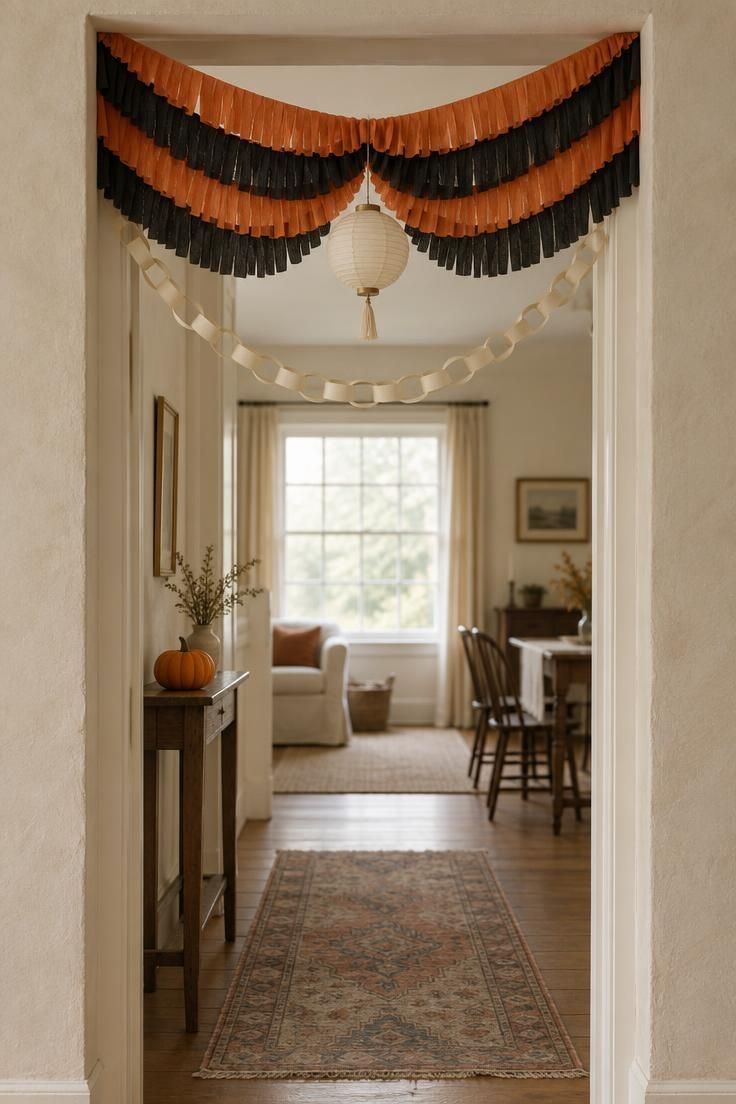
A fringe swag signals the holiday at a threshold without changing any permanent fixture, which makes it a good fit for a rental or a room that hosts everyday life.
Layering two fringe depths, a longer under-layer and a shorter top layer, gives the doorway a dimensional edge rather than a flat band.
A single centered lantern anchors the composition and draws the eye through the opening.
Crepe paper crushes easily, so the fringe is best attached with a light touch and taken down carefully after the season.
Two layers in contrasting colors read more strongly than three, which can look muddled at the top of a doorway.
A pale wall behind the swag keeps the orange and black crisp rather than heavy.
Paper fringe is not a material to place near open flame, and the lantern is best kept purely decorative.
Style Blueprint:
- Two crepe-paper fringe layers in orange and black
- One small paper lantern in cream or pale orange
- Twine or narrow ribbon to tie the swag to the top of the opening
- A plain, light-colored wall so the fringe reads sharply
- Optional cream paper chain draped loosely beneath the fringe
Chalkware Pumpkin Row on a Kitchen Windowsill
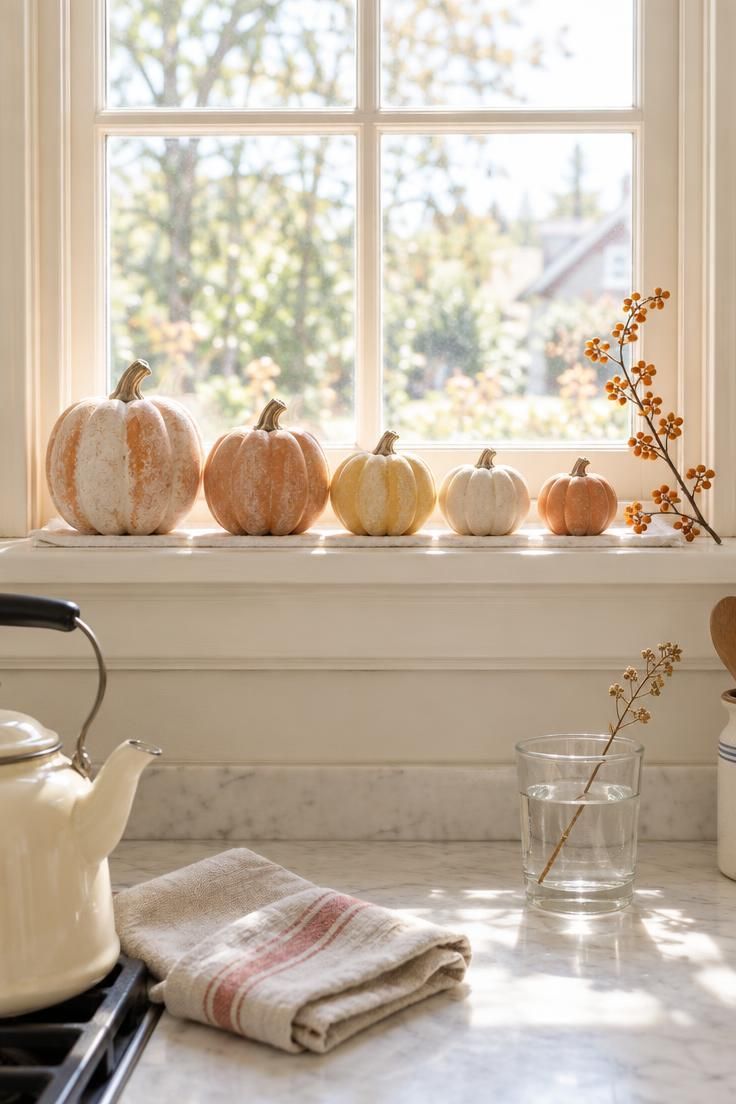
A windowsill row uses an existing ledge, takes almost no floor or counter space, and calls for no hanging hardware or new shelf.
Five pumpkins of graduated size create rhythm across a wide sill; two or three look sparse along the same length.
A single botanical accent breaks the repetition and links the display to the harvest register.
Strong direct sun fades painted finishes over a season, so rotating the row toward an interior windowsill preserves color longer.
Chalkware is heavier than paper, which keeps the row stable when a window is opened or a curtain is pulled past it.
Small pumpkins with hand-painted faces sit comfortably alongside plain ones and keep the arrangement from looking factory-made.
A narrow muslin strip under the row softens the hard sill edge and hides small water rings.
Style Blueprint:
- Five to seven chalkware or papier-mâché pumpkins in cream, orange, and faded gold
- One dried bittersweet or eucalyptus sprig at one end
- A narrow strip of muslin or lace as a base layer
- Cream or ivory walls and trim to keep the palette warm
- Small cream votive in a clear glass holder for evening
Frame Cluster of Vintage Cats and Owls in Thrifted Gold Frames
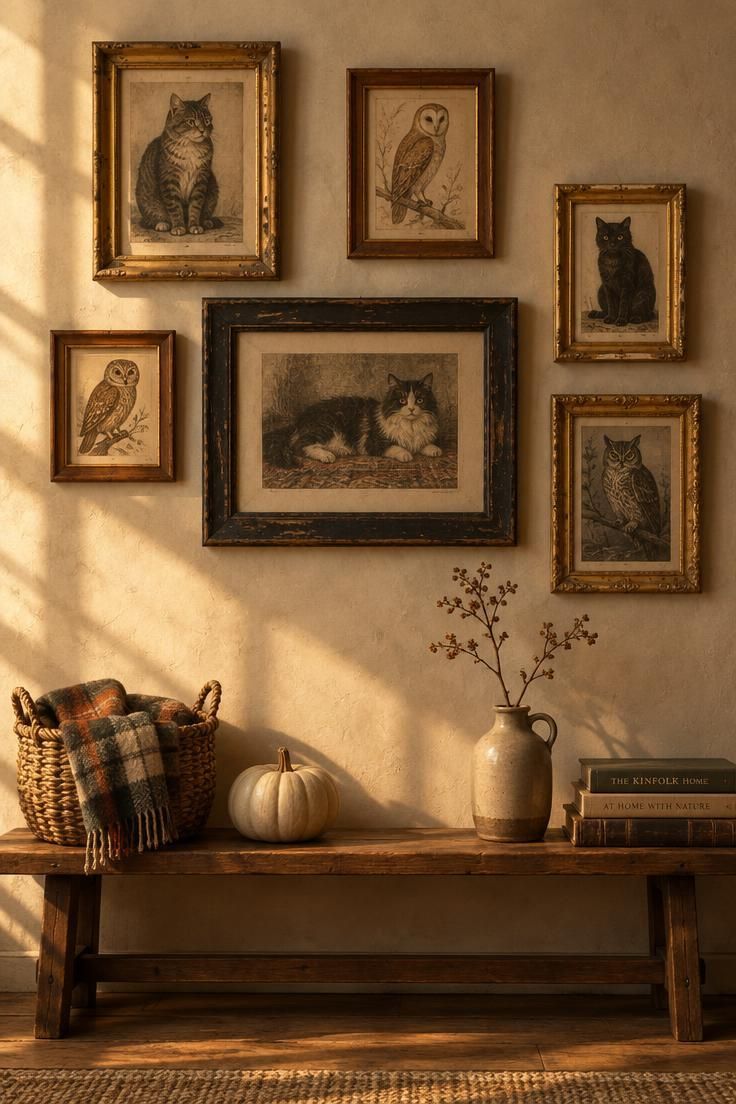
Mismatched frames with a shared gold or warm-wood tone read as collected rather than purchased as a set.
Cats and owls repeat two motifs instead of scattering many, which is what keeps a vintage halloween wall legible from across a room.
A low bench beneath the cluster gives the arrangement a functional base and a place for a single object.
Thrifted frames often arrive with worn gilding and small chips, and those irregularities support the theme better than a uniform finish.
Cream or linen matting unifies frames of different widths without requiring new frames.
A cluster of six to nine pieces covers a moderate wall; going beyond that starts to feel like an entire wall treatment rather than a grouping.
Hanging a cluster with a mix of sizes takes more planning than a straight row, so laying the arrangement out on the floor first saves rework.
Nostalgic Halloween display themes often gain cohesion from limiting the animal motifs to two recognizable silhouettes.
Style Blueprint:
- Six to nine thrifted frames in gold, warm wood, or cream
- Cat and owl prints in a consistent muted palette
- One wider frame as the visual anchor near the center
- A low bench or narrow console beneath for a single object
- Cream or linen matting to unify mismatched frame widths
Design Pro-Tip: Let one frame in a cluster be noticeably larger or darker than the rest; the eye needs an anchor, and a completely even set of frames reads as a store display rather than a collection.
Jointed Paper Skeletons Dangling from a Stair Rail
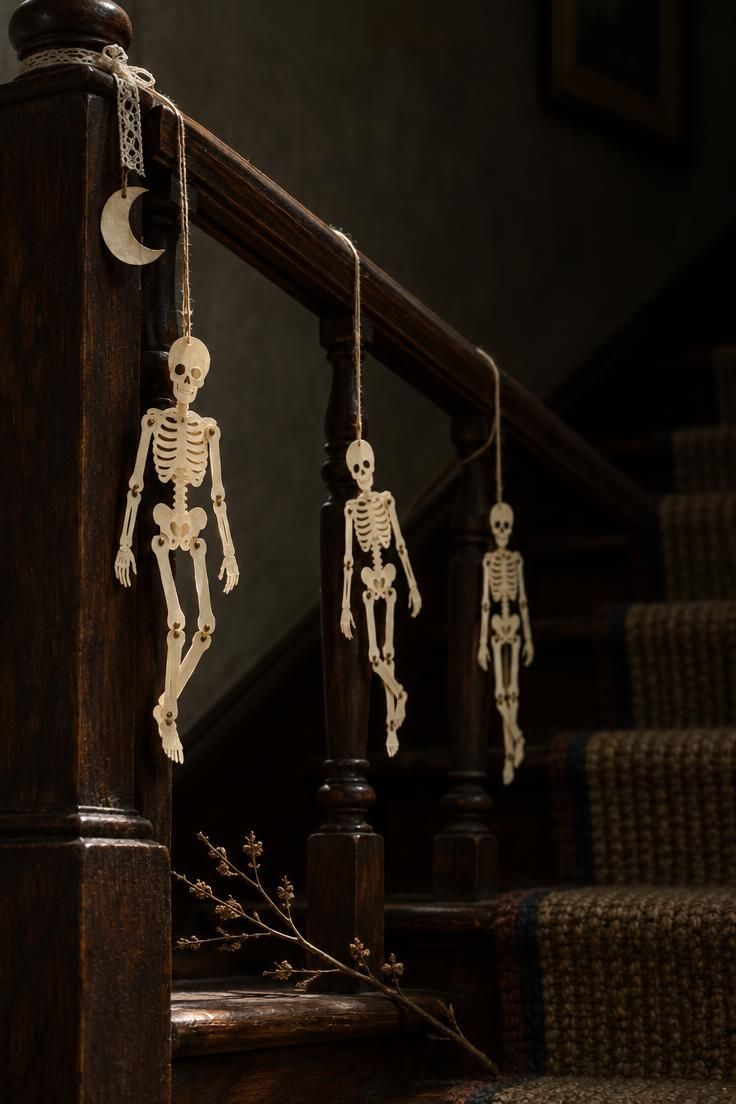
Jointed paper figures move slightly when air passes, which adds a quiet sense of life to a still arrangement; Three figures at uneven intervals fill the length of a rail without crowding it.
Dark wood under low light lets the cream paper figures read as the brightest element in the frame.
Thin cotton twine disappears against a dim wall, so the figures seem to float rather than hang.
Jointed paper is among the most fragile items in this style; pieces with visible creases tend to tear along the joints over repeated seasons.
A rail that sees daily use needs the figures placed where hands and bags will not brush them.
If the rail is short, two figures read better than three, since the spacing matters more than the count.
Style Blueprint:
- Three to five jointed paper skeletons or bats in cream or aged white
- Thin cotton twine in a natural tone
- Uneven spacing along the rail
- A dark or mid-tone wall behind for contrast
- Optional small paper moon hung at the top of the rail as an anchor
Bittersweet and Dried Corn Husks in a Stoneware Crock
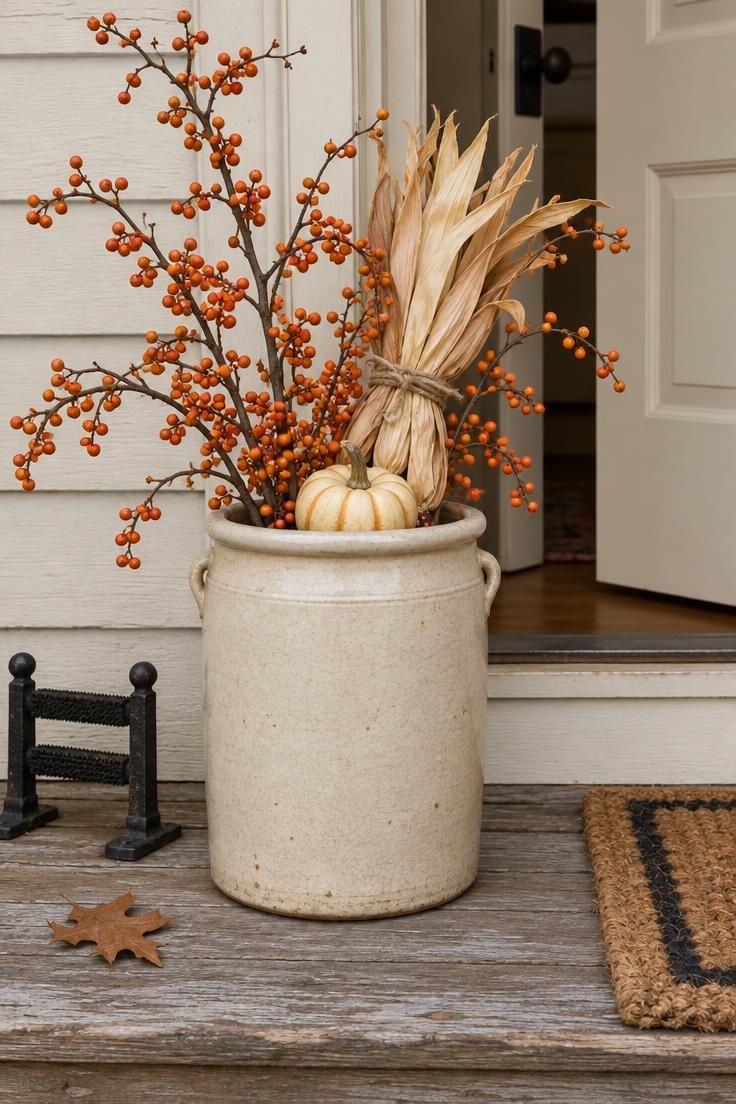
A crock is heavy enough visually to anchor tall dried branches without needing a wide base.
Bittersweet's orange berries and the husks' pale tan give two distinct warm tones that read as vintage rather than fresh.
The single pale pumpkin at the base softens the vertical arrangement and links it to the harvest register.
Dried husks become brittle over time and shed small pieces, so a spot outdoors or on a porch keeps the mess contained.
Bittersweet berries can drop as they dry, and a crock placed on a porch step rather than indoors avoids staining a floor.
The composition works at roughly a 2:1 ratio of greenery to container, with the crock low enough that the branches do not block a doorway.
A crock with a visible glaze crack or two fits the theme better than a flawless one.
Style Blueprint:
- Stoneware or ironstone crock in cream, grey, or tan
- Three to five bittersweet branches at varying heights
- Dried corn husks tied at the base with twine
- One small cream or pale orange pumpkin
- A simple step or plank surface rather than a formal table
Die-Cut Paper Garland Swagged Across a Living Room Bookcase
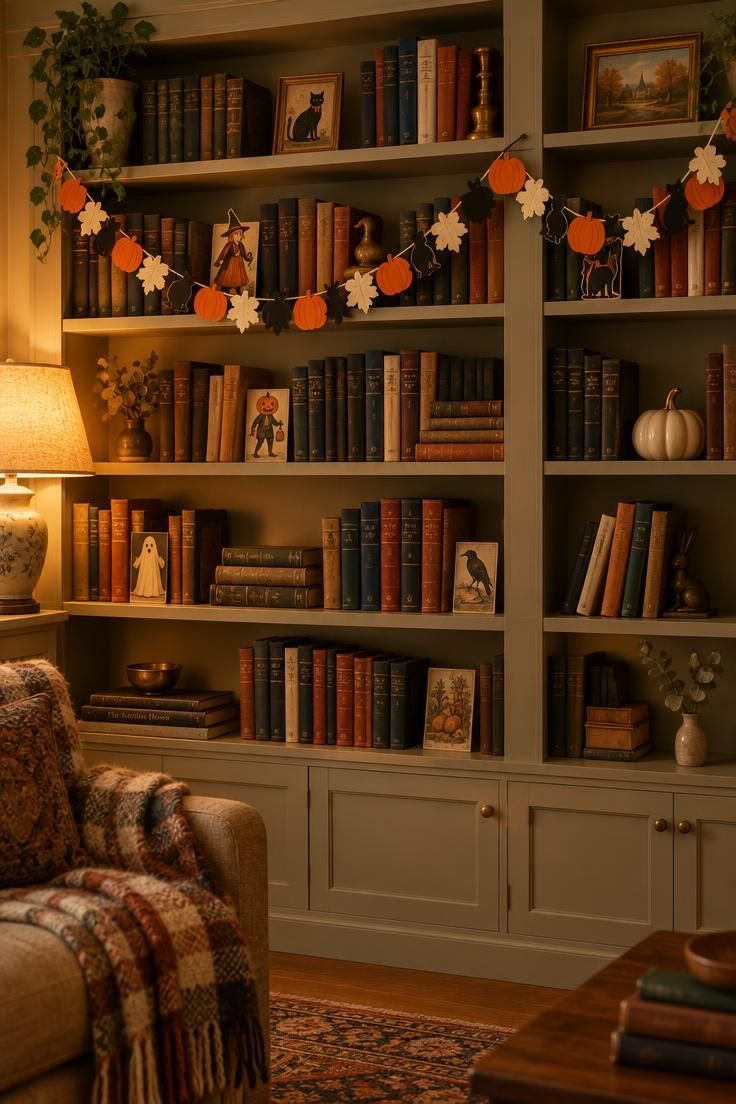
A bookcase front is often overlooked, and a garland there uses existing architecture rather than adding a new display surface.
Three shallow drops rather than one deep swag tailor the garland to the shelf width and keep books visible.
Small printed figures tucked among the books tie the shelf contents to the seasonal arrangement.
Die-cut paper garland is light enough to rest across the front of a bookcase without altering the shelves themselves.
Printed figures leaned against books are easy to reposition when a shelf is reorganized, which suits a collection that keeps growing.
Warm lamp light at one end gives the paper cutouts more dimension in the evening than overhead light alone.
If the bookcase is wide, four drop points space the garland more evenly than three.
Store-bought or hand-cut die-cut paper decorations share the same flat silhouette that lets a garland sit close to the shelf edge.
Style Blueprint:
- Die-cut paper garland in orange, black, and cream
- Three shallow swag points across the width
- Four to six small printed figures tucked between books
- One or two cream pumpkins set on a shelf end
- Warm lamp light at one end of the bookcase for evening
Lace-Trimmed Cream Cloth Panel Behind a Cluster of Small Prints
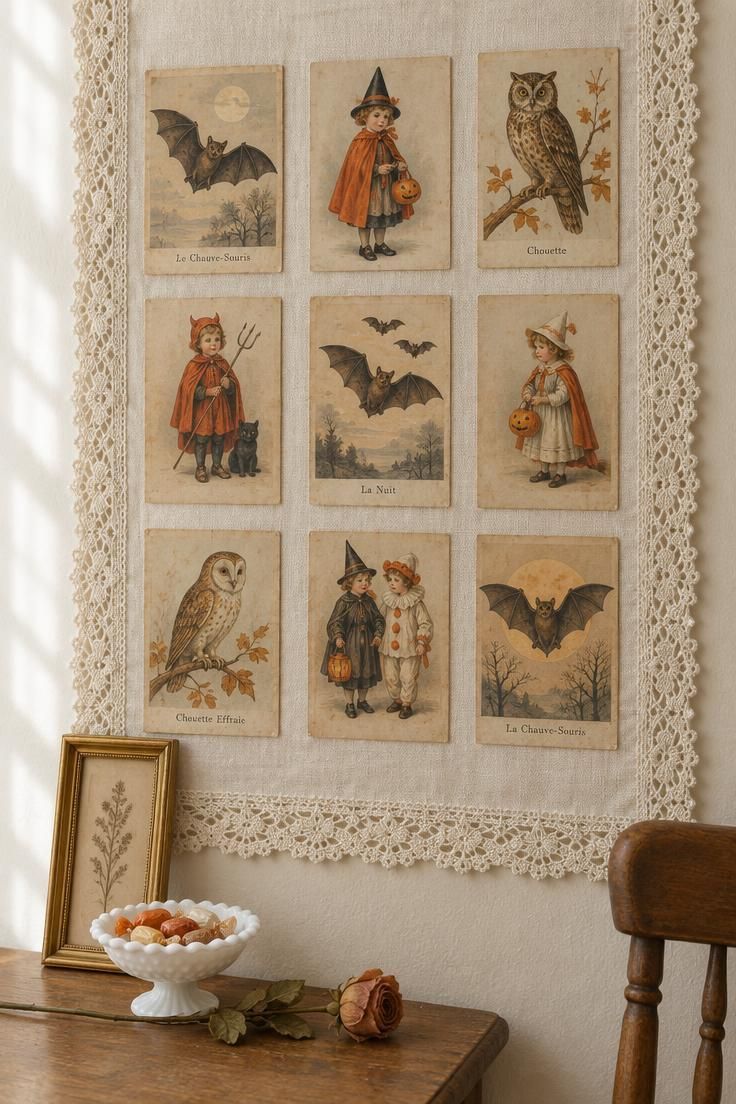
A cloth panel gives small prints the scale they need in a large room without requiring a full wall of frames.
Lace trim along the panel edge reads as a Victorian cue without pushing the whole display into mourning-adjacent territory.
A tight grid of small prints feels denser and more deliberate than a loose scatter at this scale.
Cloth panels soften sound and add a warm textile layer, though they also collect dust and benefit from a gentle vacuum or a light brush each season.
Lace trim shows wear quickly, so panels placed in high-traffic corridors need a firmer stitch along the edge.
Reproductions work especially well in a dense grid because consistent sizing keeps the pattern clean, while one original in the center gives the group a focal point.
A panel sized to the wall space between two pieces of furniture reads better than one that nearly touches the ceiling.
Style Blueprint:
- Cream or ivory cloth panel sized to the wall space
- Lace trim sewn or pinned along the panel edge
- Nine to twelve small postcard prints in a tight grid
- One original piece centered as a focal point
- A narrow leaning frame or small dish at the base for texture
Design Pro-Tip: When small paper pieces look sparse, give them a backing; a cloth panel or a framed board supplies the visual scale that the pieces themselves cannot.
Milk-Glass Bowl of Vintage Halloween Ornaments and Beaded Garlands
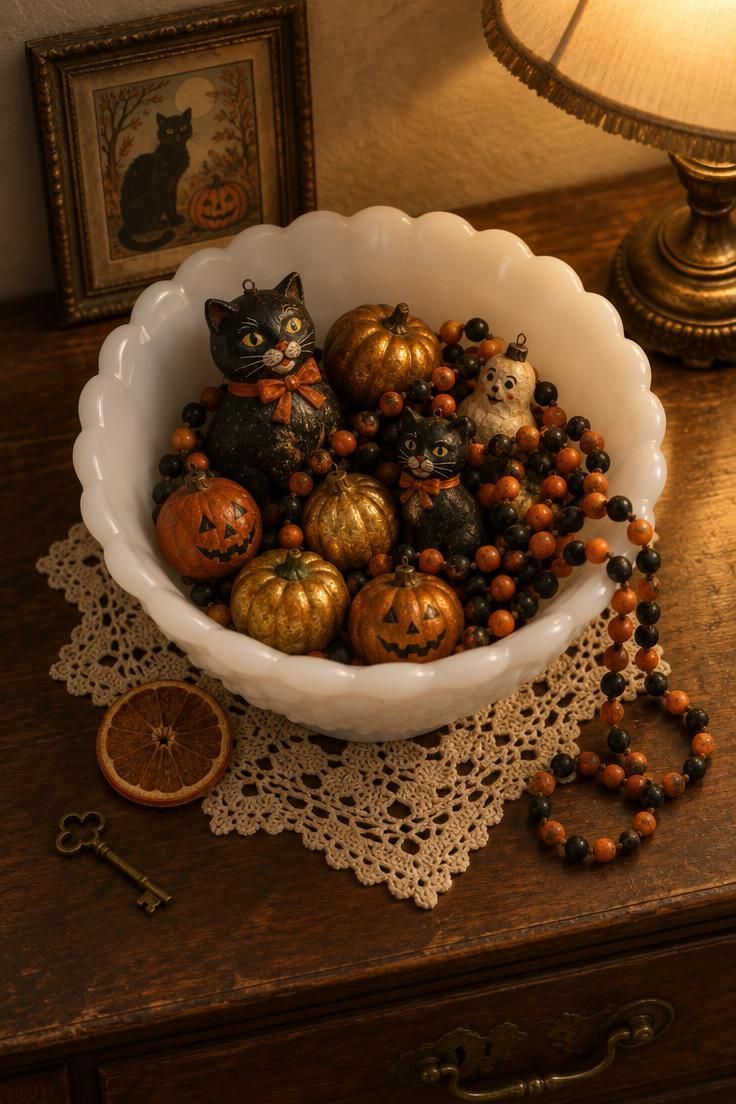
A bowl of small ornaments turns a scattered collection into a single legible object and keeps tiny pieces from drifting across a dresser.
Milk glass provides a soft, translucent base that flatters warm oranges and creams better than clear glass or dark ceramic; Beaded garland spilling over the rim adds a loose, gathered quality that keeps the arrangement from looking overly tidy.
Vintage ornaments vary in fragility, so a shallow bowl suits painted pieces better than a deep vase where items would settle against one another.
Papier-mâché and painted finishes benefit from a spot away from direct sun, since color loss shows first on small surfaces.
A crocheted doily beneath the bowl softens the transition between glass and wood.
If the collection is mostly small beaded pieces, a narrower bowl at the same depth reads more clearly than a wide shallow one.
Style Blueprint:
- Wide shallow milk-glass bowl or compote
- Six to ten small vintage Halloween ornaments in mixed materials
- One strand of beaded garland in faded orange and black
- A crocheted doily or lace mat beneath the bowl
- A small framed print or brass object beside it for balance
Conclusion
The displays that hold up best tend to commit to one register, whether that is antique paper, mid-century kitsch, or folk craft, and then add only one or two accents from the others.
Two threads run through nearly every arrangement here: give small paper pieces a defined backing, and repeat one motif rather than scattering many.
Choosing between originals and reproductions comes down to how the collection will be stored, since flat boxes protect paper and honeycomb while open shelves invite fading and dust.
Paper and crepe-paper items ask for seasonal rotation, and a spot away from harsh light keeps their muted tones intact across years.
Starting with a single surface, a threshold, a windowsill, or one shelf lets the look build gradually, which is how collected displays tend to read best.
Keeping those older pieces company, mid-century Halloween decorations can fill the same room without crowding the paper goods you already love.