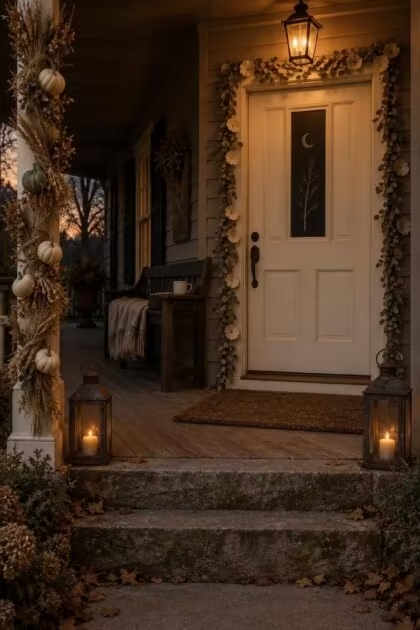
This post may contain affiliate links. If you make a purchase through these links, we may earn a commission at no additional cost to you.
A halloween porch is seen from the street, in the dark, and often from a passing car.
Silhouette, contrast, and the order of layers matter far more than fine detail.
Treat the porch as a composed exterior scene built from planes: walkway edge, step risers, landing, door surround, and door.
Each idea below pairs a distinct visual direction with the materials, finishes, and light quality that make it legible after dark.
Camera angles, palettes, and image directions appear throughout so every concept can be pictured clearly before anything is bought or built.
All scenes are design visualizations rather than documentation of finished projects.
Dialed-Up Doorway Drama with Matte Black Lanterns and a Bone-Ball Garland
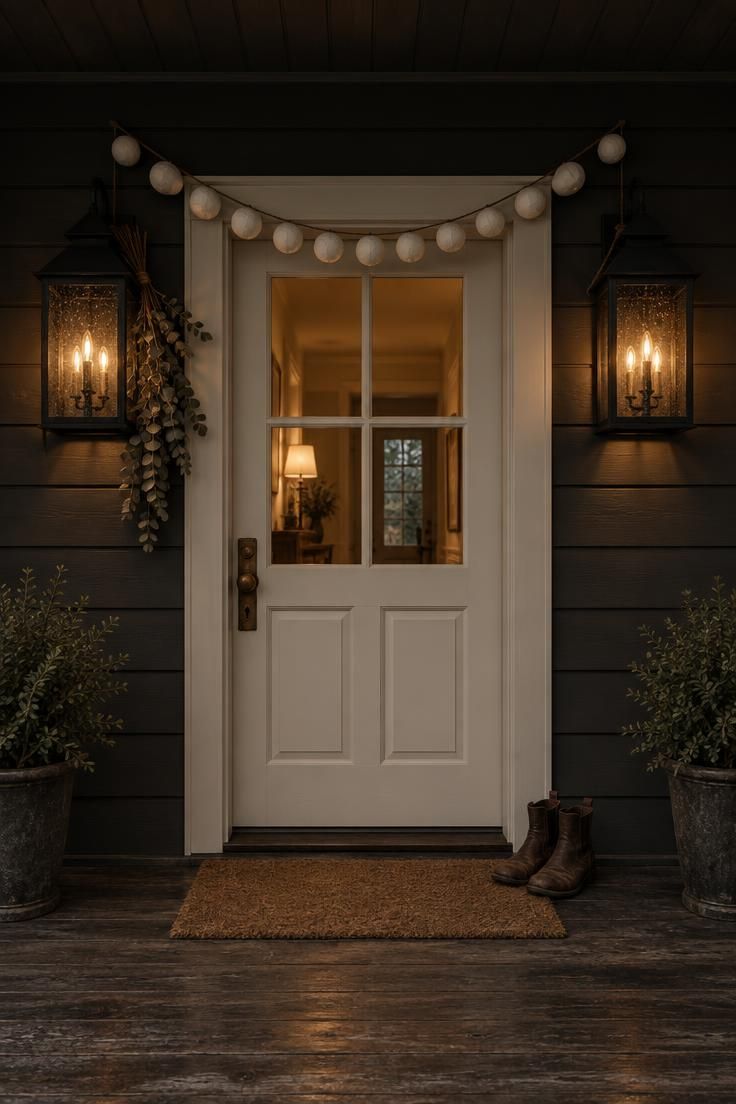
Two oversized matte black lanterns stand at shoulder height on either side of the door.
Each holds a warm amber bulb behind seeded glass.
Above head height, a garland of bone-white spherical forms arcs across the door surround on dark twine.
The lantern pair creates two dark vertical anchors against the lit glass behind, and the pale ball garland adds a single horizontal counter-line.
Black and bone is a hard contrast that survives distance and dim light.
Seeded or bubble glass scatters the bulb rather than producing a hot point.
Papier-mâché balls read flat and chalky, while foam balls read smoother and catch more light.
This suits a covered landing or deep front porch where the door surround is wide enough for two lanterns without crowding the sidelights.
Two oversized matte black lanterns and a bone-ball garland turn simple Halloween porch decorations into a balanced composition with clear vertical and horizontal lines.
For front porch Halloween styling, keep the palette tight: matte black, bone white, and one warm amber glow behind seeded glass.
Outdoor halloween decor gains a bold graphic edge when matte black lanterns flank the door at shoulder height and a bone-white ball garland arcs between them overhead.
Porch decorating for halloween often leans on pumpkins alone, yet this pairing of dark vertical anchors and a pale horizontal line gives the entry a clearer composition than a cluster of props on the steps.
For Halloween porch lighting that feels deliberate rather than busy, let the lantern pair carry the glow while the garland stays unlit.
The rest of the halloween door decor then reads as one composition: dark vertical lanterns, a pale arc overhead, and nothing competing between them.
Dark lanterns against the glow turn passersby into halloween porch silhouettes that shift with every step along the walk.
Style Blueprint:
- Matte black metal lanterns with seeded glass, two matched and oversized
- Bone-white papier-mâché or foam spheres on dark jute twine
- Warm amber bulbs, one color temperature across the door
- Dark bronze or black door hardware left as-is
- Unlit porch ceiling above the garland to preserve shadow
A Single Oversized Twig Obelisk on the Step Landing, Left of Center
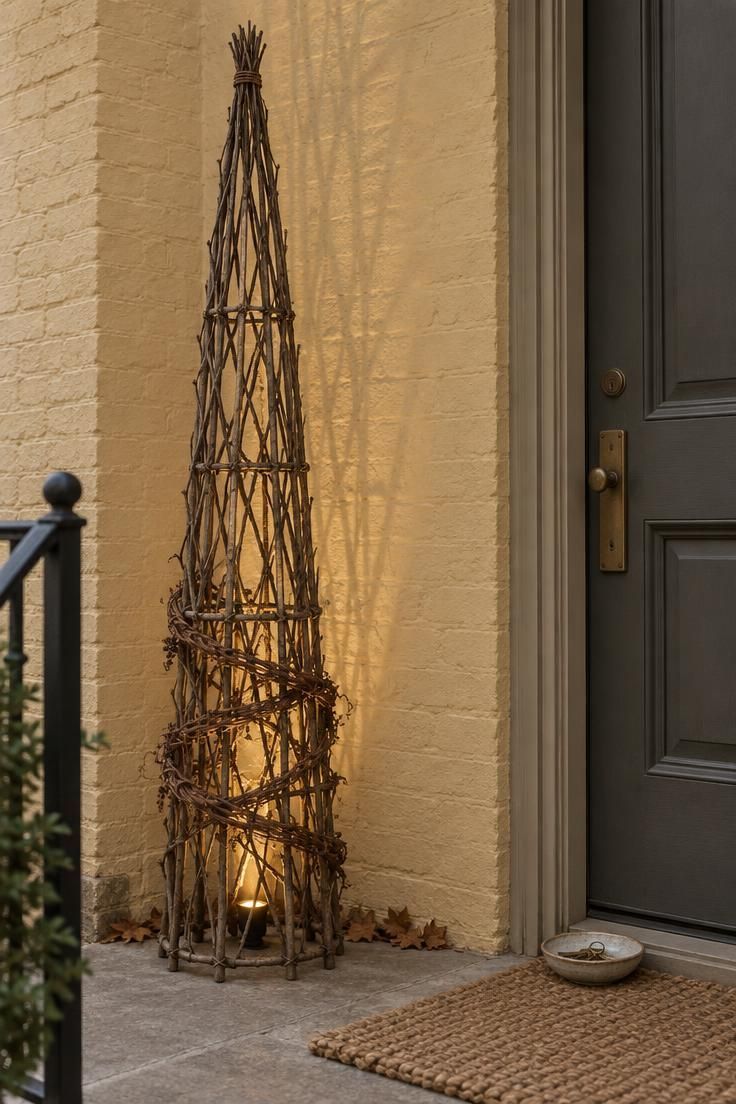
One tall, narrow twig obelisk stands on the landing to the left of the door, wrapped loosely in dried grapevine and left mostly bare.
A concealed warm uplight at its base throws light upward through the twig lattice.
Nothing else occupies the landing except a shoe mat.
A tall, thin vertical against a lit wall gives the eye a shape to follow upward, and the restraint makes the single object feel deliberate rather than sparse.
Dried twigs shed small fragments and turn brittle after a season, so plan to replace the outer bundle rather than store it intact.
This suits a narrow stoop or townhouse entry where floor space is limited and one vertical is the only viable move.
Style Blueprint:
- One twig or willow obelisk, roughly six to seven feet tall
- Hidden warm uplight at the base, aimed up into the twigs
- Dried grapevine wound loosely around the lower third
- Bare landing floor with only a mat
- Door left plain to give the obelisk full attention
Porch Ceiling Suspension: Gauze Panels and Paper Lanterns Hanging Above Eye Level
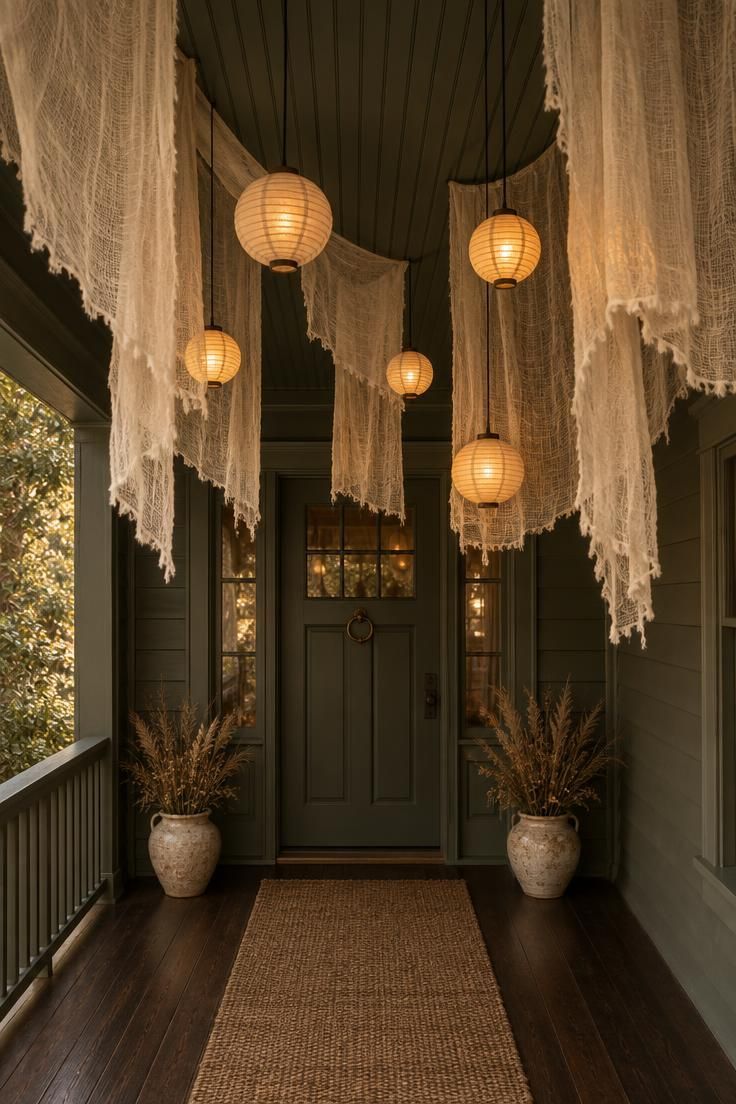
Loose panels of aged white gauze hang from the porch ceiling at staggered lengths, some grazing the top of the door frame.
Between them, five or six small warm-glow paper lanterns hang on thin dark cord at slightly different heights, the lowest still well above head height.
The porch floor stays clear below.
Suspended forms create a soft, layered canopy that a visitor walks under and a passerby sees from outside the porch line.
The ceiling plane is the least-used surface on any porch, so the effect is unexpected without adding floor clutter.
Cheesecloth drapes and moves, and it also catches wind, so this composition wants a covered ceiling.
Hanging elements are the least storable format, which makes this a build-and-replace idea rather than a reusable one.
Style Blueprint:
- Aged white cheesecloth or gauze cut into long panels with raw edges
- Five to six small ribbed paper lanterns on thin dark cord
- Warm amber bulbs with no contrast color introduced
- Staggered heights rather than a straight row
- Dark cord or wire visible and intentional
Design Pro-Tip: Aim the strongest light at the wall behind your hero object rather than at the object itself. The shadow line it produces is what carries a porch composition from the sidewalk.
Graphic Paper Bat Cloud Fixed Directly to a Pale Door and Sidelights
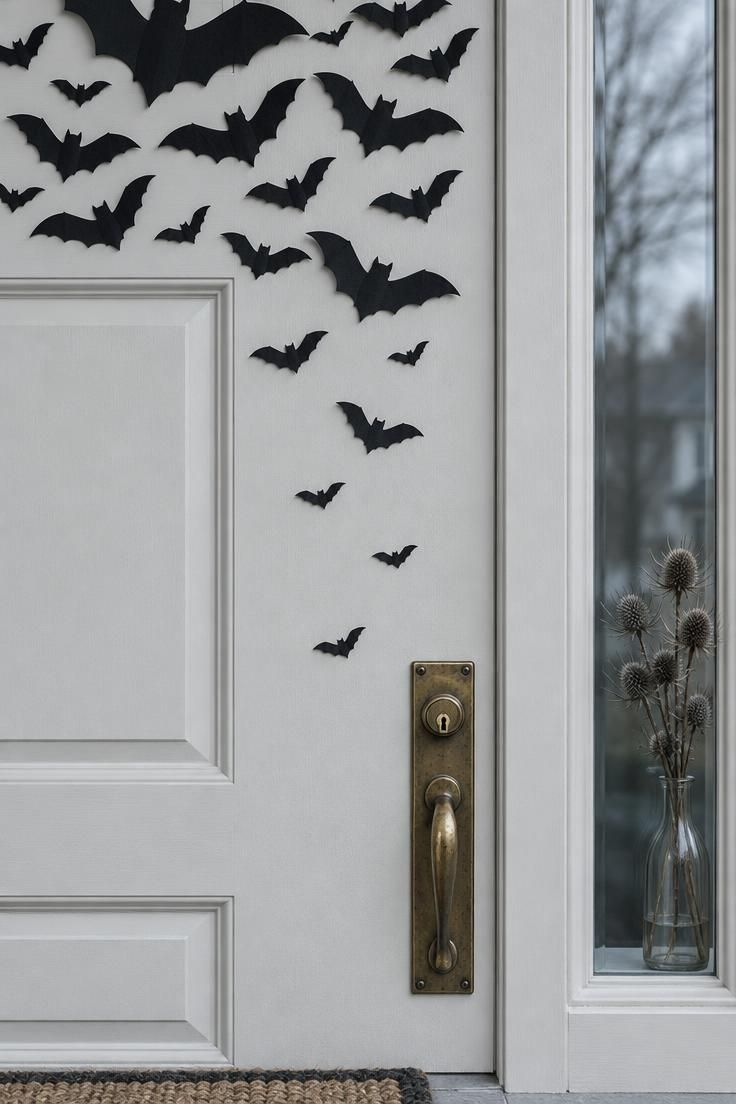
Twenty to thirty flat paper or cardstock bats in graduated sizes are fixed flat to a pale painted door and across the sidelights, arranged densely at the top and thinning toward the handle.
The palette stays deep black on bone or pale gray, with no garland, string, or hardware added.
Flat black shapes on a light ground hold contrast better than dimensional props at distance, and the cluster pattern gives motion without any element actually moving.
Heavy cardstock holds a crisp edge while thin paper curls, and reusable adhesive putty lets the arrangement be adjusted.
This is a two-dimensional treatment, so it depends entirely on a light-colored door.
Silhouettes on glass also occupy no floor area at all, which makes them the strongest option for a shared entry or apartment door.
Style Blueprint:
- Black cardstock bats in three or four graduated sizes
- Reusable adhesive putty with no tape residue
- Pale door and sidelights as the light ground
- Bats clustered at the top third, thinning downward
- Door handle and hardware left completely bare
Iron Urn Silhouette: A Single Weathered Urn Framed by Backlight on the Step
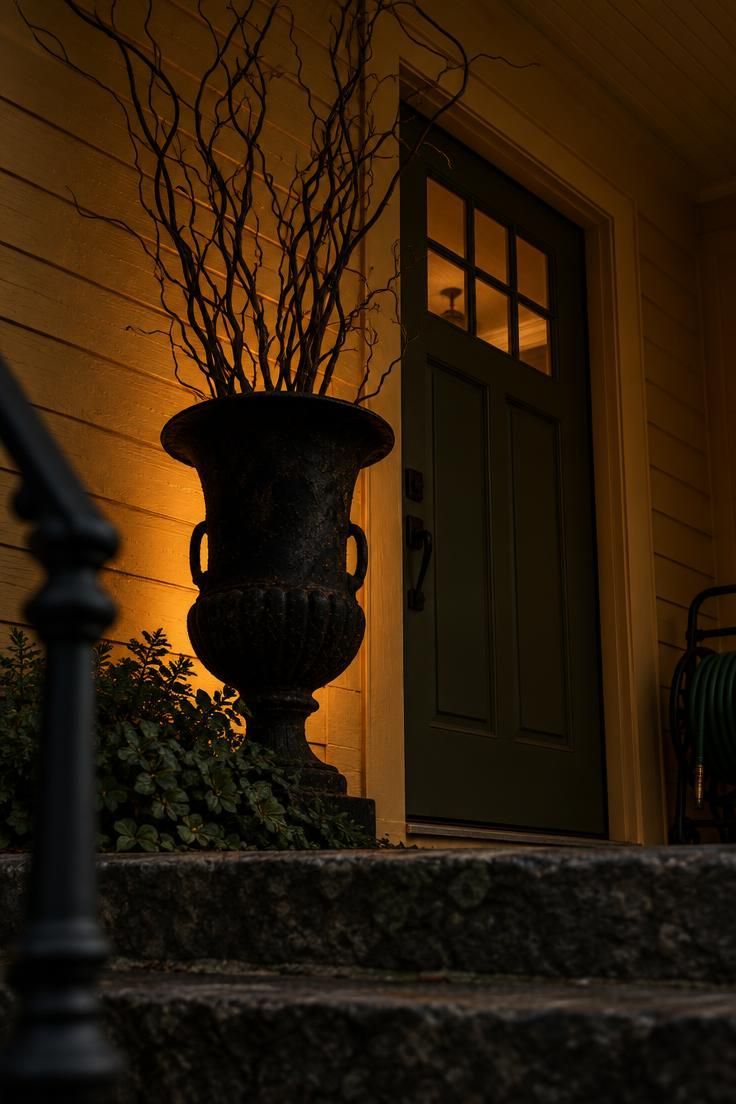
A tall weathered iron or cast-resin urn sits on the landing to one side of the door, holding bare twisted branches that reach above door height.
A warm source behind the urn turns the urn and branches into a black silhouette against lit paint.
Backlighting is the single most efficient way to make an ordinary object look dramatic, since the urn and branches become a shape rather than a thing, and shape reads at any distance.
Cast resin mimics iron at lower weight but reads smoother under strong light, while true weathered iron has a pitted surface that breaks the light.
Backlighting requires a hidden source with a clear line to the wall, and a very shallow porch may not offer enough distance for a clean shadow, so test the placement at night before committing.
Aiming the source at the wall rather than outward keeps the glow on the porch and avoids washing the facade or reaching a neighboring window.
Style Blueprint:
- One tall weathered iron or cast-resin urn
- Twisted willow or bittersweet branches, bare and irregular
- Warm source hidden between urn and wall, aimed at the wall
- Low green foliage tucked at the urn base for grounding
- Everything else on the landing left dark
Retro Die-Cut Yard Card Set Zipped to the Railing Spindles
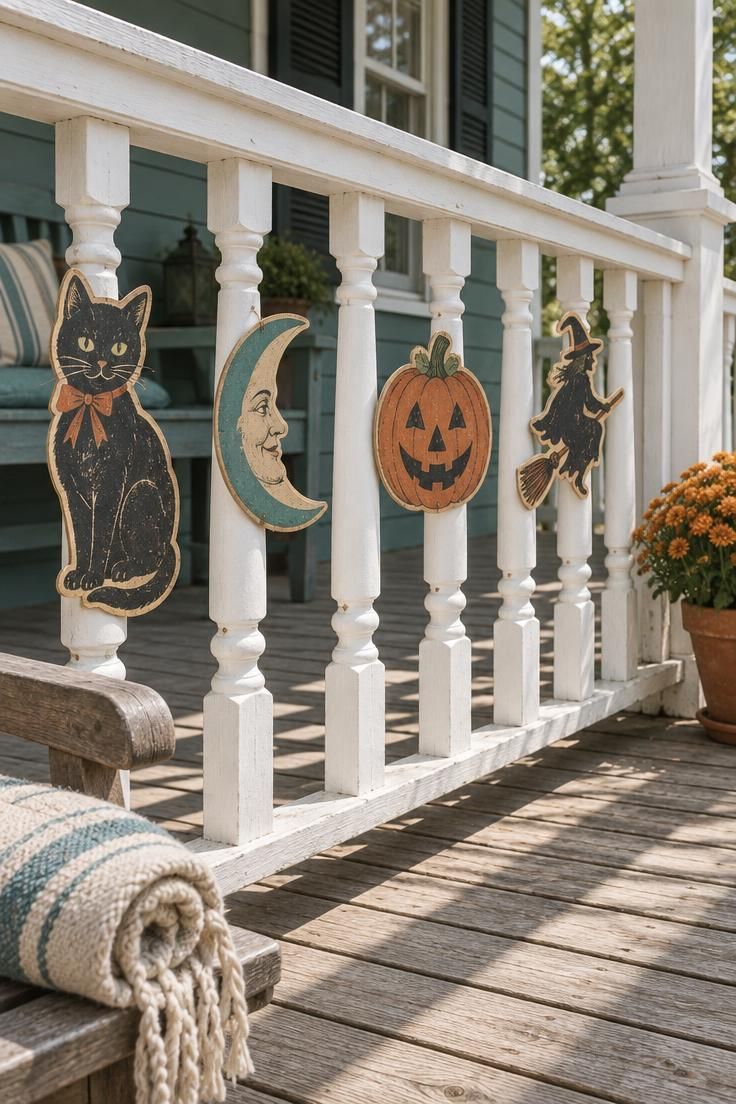
Vintage-style printed die-cut shapes, including a black cat, a crescent moon, a grinning pumpkin, and a witch silhouette, are attached singly to alternating railing spindles at a consistent height along the porch rail.
The palette runs aged orange, ivory, muted teal, and black, all printed with a slightly faded retro finish.
A repeated element at even intervals along a railing creates rhythm, and rhythm draws the eye along the full width of the porch rather than stopping at the door.
Heavy coated card or thin painted wood holds up better than plain paper, and printing in a slightly desaturated palette is what produces the retro effect.
Railings are the highest-wind zone on a porch and flat cutouts catch air, so use them on sheltered rails or accept that they may shift.
Three or four cutouts at most suit a short stoop, while a wide porch can carry a longer run with spacing wider than the shapes.
Style Blueprint:
- Five to seven retro-printed die-cuts in mixed motifs
- Desaturated vintage palette of orange, ivory, teal, and black
- Attached at one consistent height along the rail
- Spacing wider than the cutouts so negative space shows
- No garland, no ribbon, no additional layering
Vertical Harvest Column: A Wrapped Post with Dried Grasses and Small Gourds
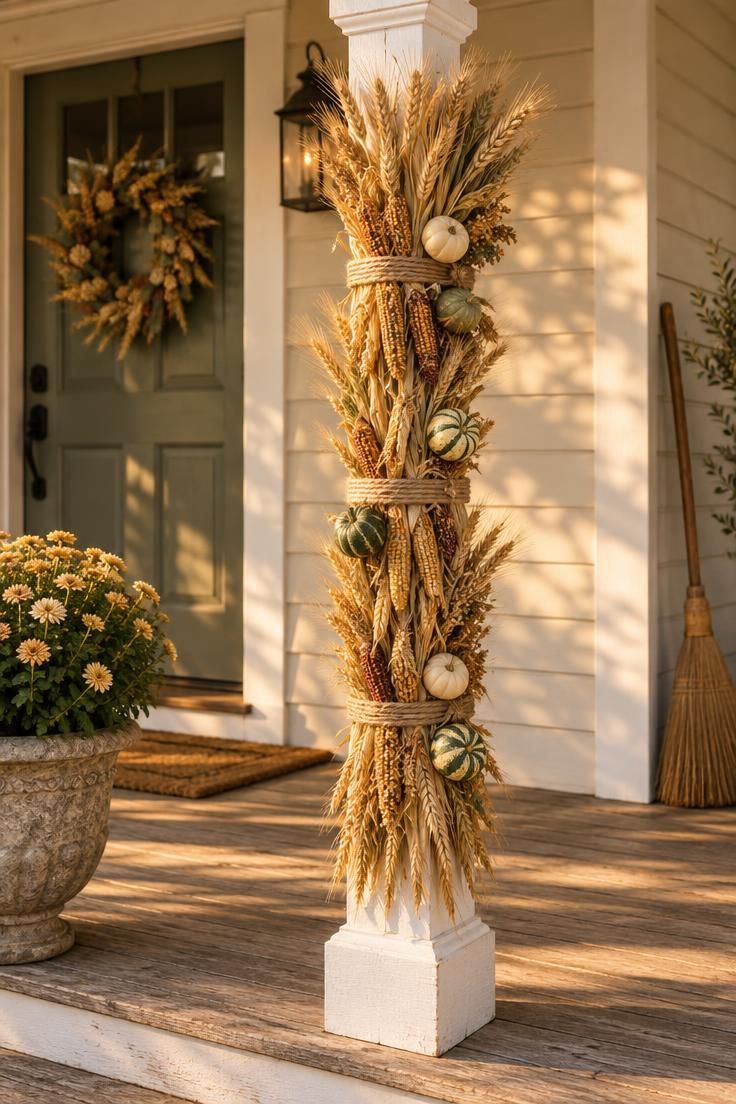
One porch column or post is wrapped from about knee height to just below the capital with dried broom corn and wheat sheaves, bound at three points with natural jute.
Small gourds in cream, sage, and striped green are tucked into the binding at uneven intervals.
Wrapping a vertical element turns the architecture itself into the display, so the decoration takes the porch's own scale instead of competing with it, and uneven gourd placement prevents the wrap from reading as a uniform sleeve.
Broom corn and dried wheat give a fine, bristly texture that catches low light differently than straw bales, and real gourds age visibly while sealed faux gourds hold color across the season.
Dried grains shed constantly and wind strips loose strands, so expect to sweep the landing every few days and to replace the bundle each year.
Pair the wrapped column with a few quiet touches of spooky porch decor, such as bare branches or a single raven silhouette, so the harvest texture stays the focus.
Swapping small pumpkins or berry clusters along the binding keeps your fall porch decor looking considered rather than fixed in place all season.
Style Blueprint:
- Dried broom corn and wheat sheaves, one bundle per post
- Three jute bind points at base, middle, and upper third
- Cream, sage, and striped green gourds tucked at uneven spacing
- No ribbon, no bow, and no additional color
- Post left visible at the capital so the architecture still reads
Design Pro-Tip: Compose the porch so the brightest point is the door and every other light is dimmer. One clear destination reads better from the street than an evenly lit facade.
Understated Minimal: Two Bones-White Pumpkins on Bare Step Risers
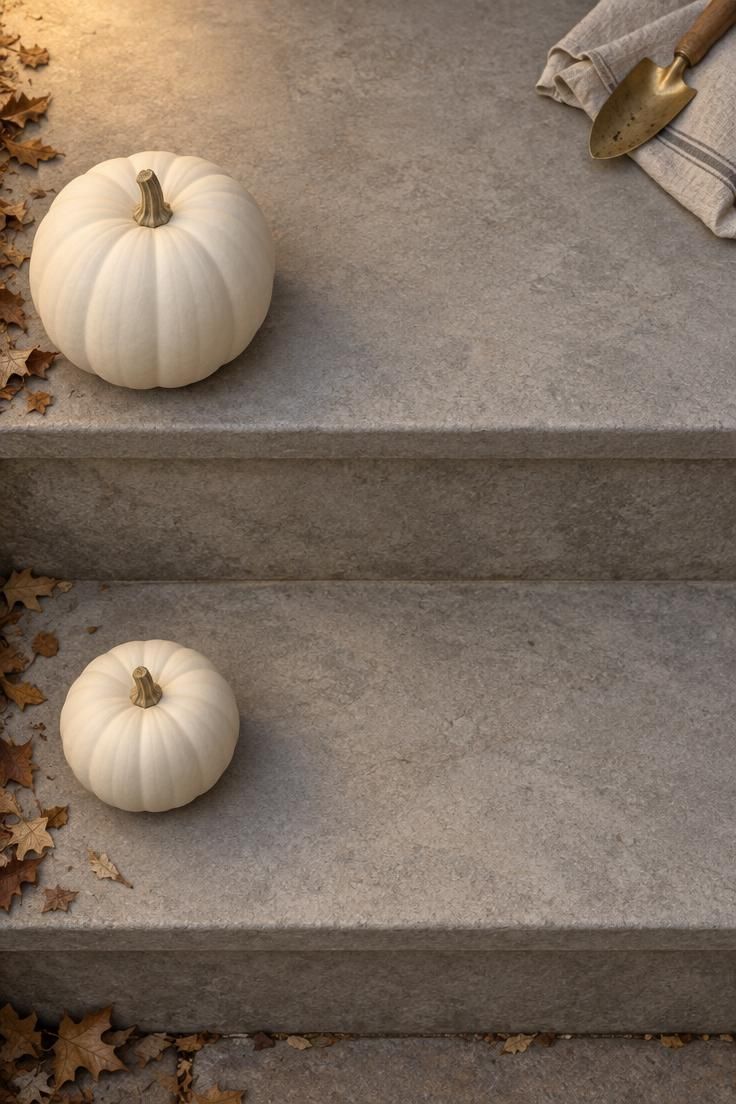
Two smooth bones-white pumpkins, one slightly larger, sit alone on the lowest two step risers, one per step, offset to the same side, with nothing else on the steps.
A single small warm light source sits outside the frame.
Two objects on two steps create a diagonal that the eye completes automatically, and the near-white surface against darker stone gives high contrast with almost no visual content.
Heirloom white pumpkins have a chalky matte skin that reads as sculpture, while glossy painted faux versions reflect light and flatten the effect.
Minimal arrangements fail if the palette drifts, and a single bright orange or glossy item added later breaks the whole composition.
Two objects on two steps require almost no width, which makes this a strong fit for narrow stoops and shared entries where floor space is contested.
Style Blueprint:
- Two bones-white pumpkins in slightly different sizes
- Both offset to the same side, one per riser
- No mixed colors, no other props, no garland
- Warm single source left out of frame
- Steps swept and otherwise bare
Chalk-Drawn Storybook Door: Hand-Lettered Motifs on a Slate Panel
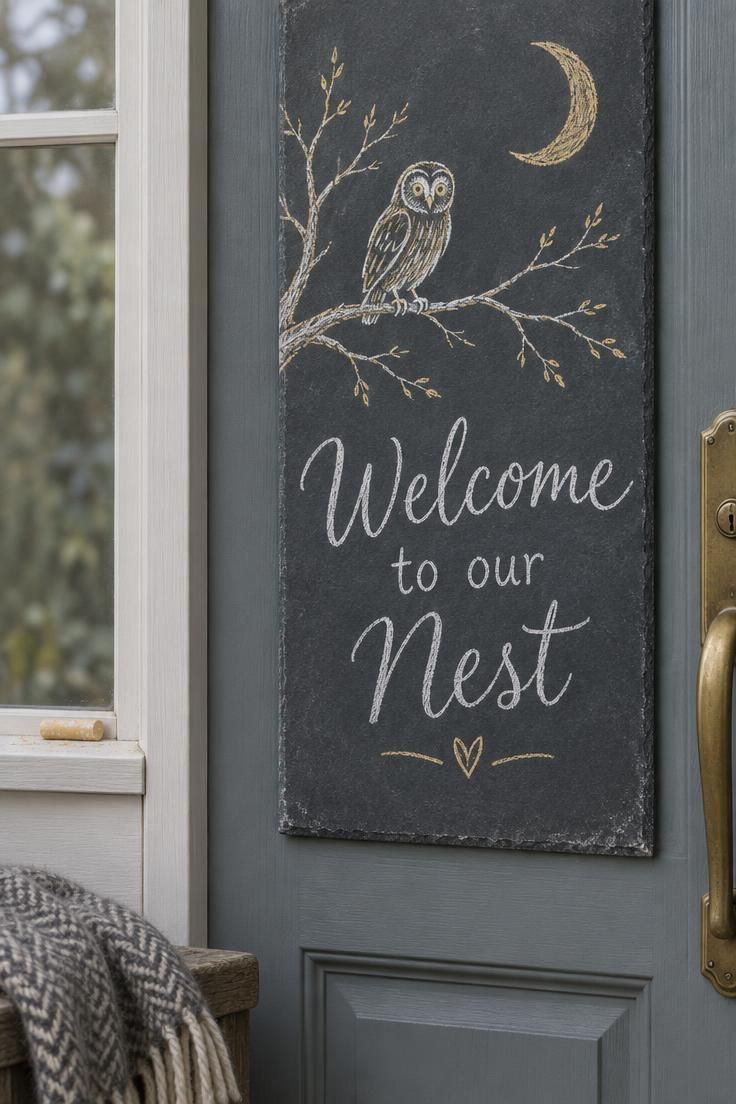
A flat slate-gray chalkboard panel, roughly door-panel sized, hangs flat against the door.
On it, drawn in white and pale ochre chalk, are a bare branch, a small owl, a crescent moon, and a hand-lettered greeting, with no props around it.
Hand-drawn line work at large scale gives a folk, made-on-the-porch quality that printed props cannot match, and white on slate is a clean high-contrast pair.
Slate or chalkboard-painted hardboard holds chalk better than coated paper, and chalk is fully reworkable, which makes this the most adaptable idea on the list.
Chalk smears and fades, especially on a damp porch, so the panel needs cover and the drawing needs refreshing.
Drawing well at door scale takes practice, so sketching on paper first is worth the extra step.
Style Blueprint:
- Slate or chalkboard-painted panel sized to the door
- White and pale ochre chalk only
- One motif cluster plus one hand-lettered line
- Bare branch drawing as the framing element
- No props around the panel, since the drawing is the whole idea
Theatrical Side-Light: Raked Amber Across an Empty Chair and Draped Form
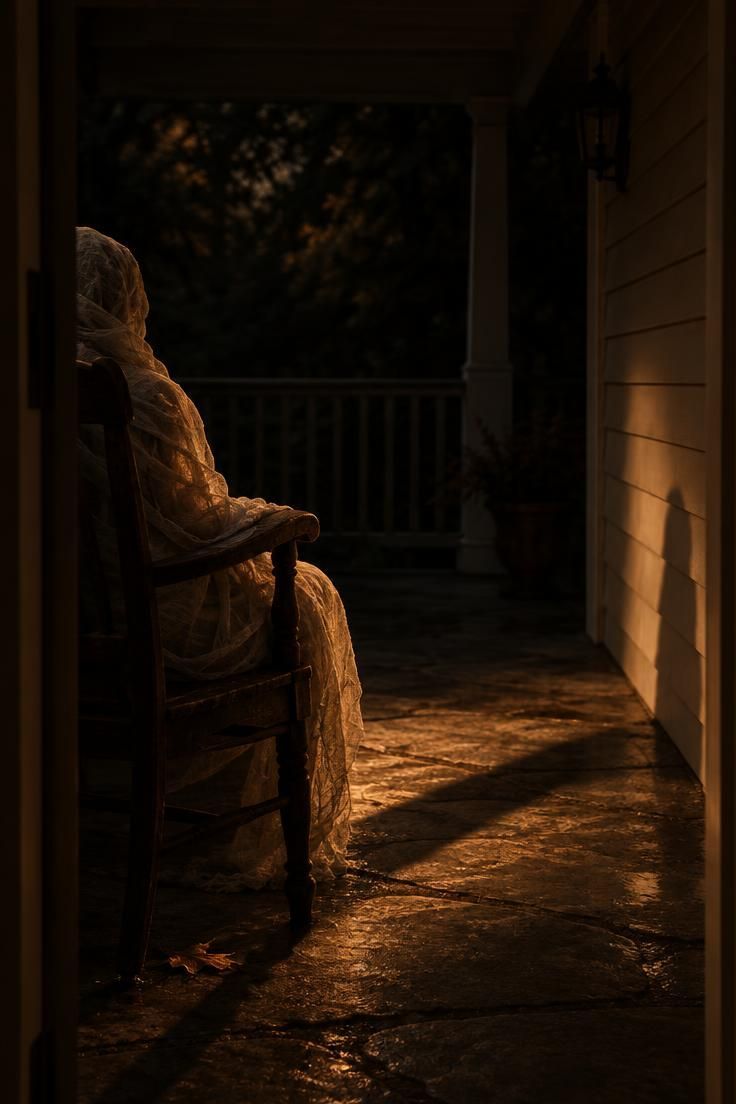
A single dark wooden chair sits on the landing to one side, holding a draped form, a gauze-wrapped bundle that suggests a seated figure without resolving into one.
A warm amber source set low and to the side rakes across the landing and throws a long shadow toward the opposite wall, while the rest of the porch stays dark.
Side light produces long, legible shadows, and unresolved shapes hold attention longer than clearly readable props.
Gauze over a wire or foam core holds a soft silhouette, and dark wood furniture disappears into shadow and leaves only the lit form visible.
Theatrical lighting works only after dark, and in full daylight the arrangement can look like a covered chair, so this is a night-only idea.
Aim the raking source across the porch floor rather than toward the street, since wide outward-facing light washes out the shadow.
Style Blueprint:
- One dark wood chair, weathered and matte
- Gauze draped over a wire or foam core form
- Single raking amber source set low and to the side
- Long unlit run of porch left deliberately dark
- No additional props and no second light
Design Pro-Tip: Before finalizing a porch arrangement, look at it from the sidewalk at night rather than from the landing. The view most people will actually have is the one that matters.
Foraged Wall Line: Mossy Branch and Mushroom Grouping on a Bare Porch Wall
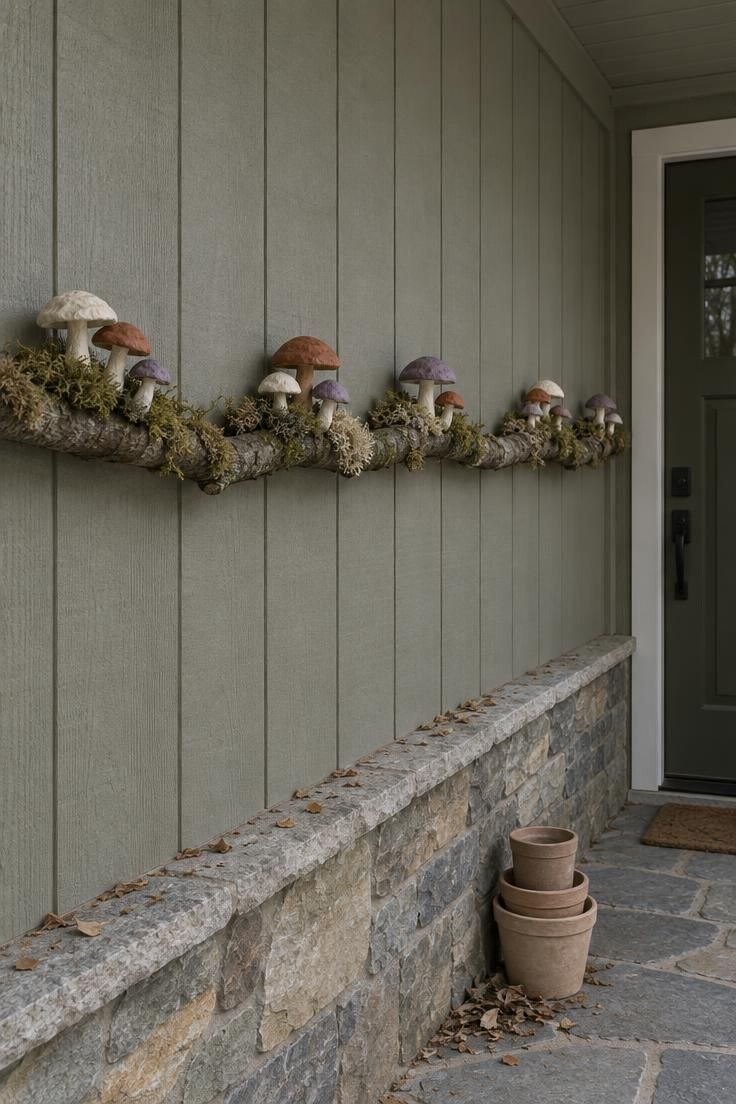
A single mossy horizontal branch is set along a bare porch wall at roughly chest height, and small clusters of paper or clay mushrooms in cream, russet, and dusty violet sit along it at irregular intervals.
Bits of dried moss fill the gaps.
A horizontal line at chest height gives the wall a compositional anchor and pulls attention sideways along the porch rather than straight to the door, while irregular spacing and small scale reward a closer look.
Real moss holds moisture and darkens, and dried preserved moss keeps its color and can be reused; Paper-clay mushrooms read as matte and light, while painted foam reads smoother and slightly glossier under a porch light.
Foraged arrangements are the most weather-sensitive on this list, so a covered wall is strongly preferred, and small mushroom clusters are easy to dislodge after a windy night.
Style Blueprint:
- One mossy horizontal branch, roughly four to five feet long
- Eight to twelve small mushroom forms in mixed sizes
- Dried preserved moss tucked into the gaps between clusters
- Cream, russet, and dusty violet only
- Wall otherwise bare, with no other props on this plane
Conclusion
The porch is an exterior, night-viewed, distance-read space, and each idea above has been organized around that fact rather than around daylight styling.
Silhouette, contrast, layer order, and the single brightest point at the door do most of the work, and materials and props support those decisions.
Choose by porch type and cover first, since a wide covered porch supports hanging and suspended treatments that a narrow open stoop cannot.
Then choose by maintenance appetite: foraged and dried materials are richest in texture and shortest-lived, while durable metal, glass, and resin core pieces carry across seasons.
Judge the finished arrangement from the sidewalk, at night, in your own porch light.