This post may contain affiliate links. If you make a purchase through these links, we may earn a commission at no additional cost to you.
A small tree brings the shape and ritual of a decorated evergreen into a home without claiming the floor space or storage room of a full-size one.
The styling is where these displays earn their character, since every ornament and container carries more visual weight at a modest scale.
Surfaces, pots, baskets, and quiet corners all become part of the arrangement.
Treat the ideas ahead as starting points, then bend them toward the furniture and palette a room already holds.
Tray-Styled Tabletop Tree on a Dining Table
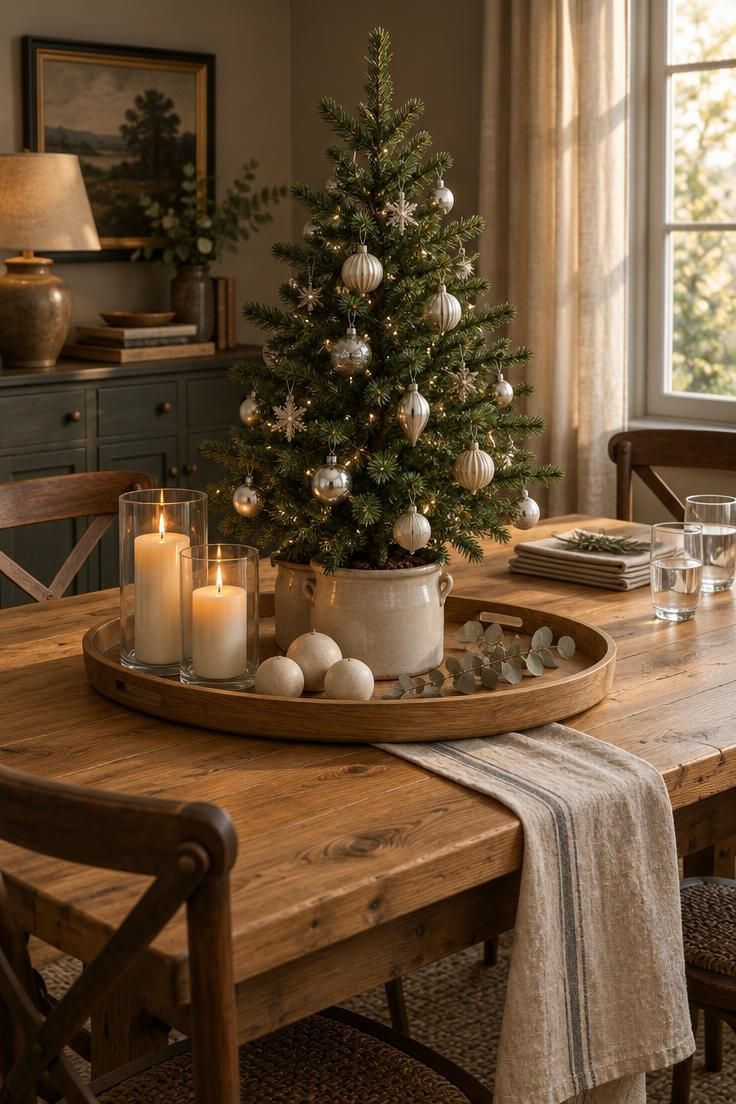
A tray turns a small christmas tree into a defined centerpiece instead of one more object adrift on a long dining table.
The raised edge draws a boundary around the tree, the candles, and the loose ornaments, so the grouping reads as a single composition from across the room.
Proportion decides whether the arrangement feels generous or crowded.
A tree that leaves open tray surface around its base keeps the display airy, while a tree that fills the tray edge to edge compresses it.
Keep the whole grouping low enough that diners can see across the table.
The supporting objects matter as much as the tree.
Two glass-sleeved candles, a short stack of linen napkins, and three matte ornaments give the tray three different textures without adding visual noise.
Loose ornaments look best when they rest in a small cluster rather than scattered to the corners.
Upkeep is simple but regular, since candle sleeves and tray surfaces collect dust in a room used for meals.
Lifting the tree out for a weekly wipe keeps the wood clean, and a tray with a low lip holds the ornaments in place during the lift.
Style Blueprint:
- Wide oval oak tray with a low raised lip
- Three-foot tabletop evergreen in a small ceramic crock
- Two pillar candles in clear glass sleeves
- Three matte ceramic ornaments in silver and ivory
- Natural linen runner folded over the table edge
Potted Evergreen on a Sideboard with Low Greenery
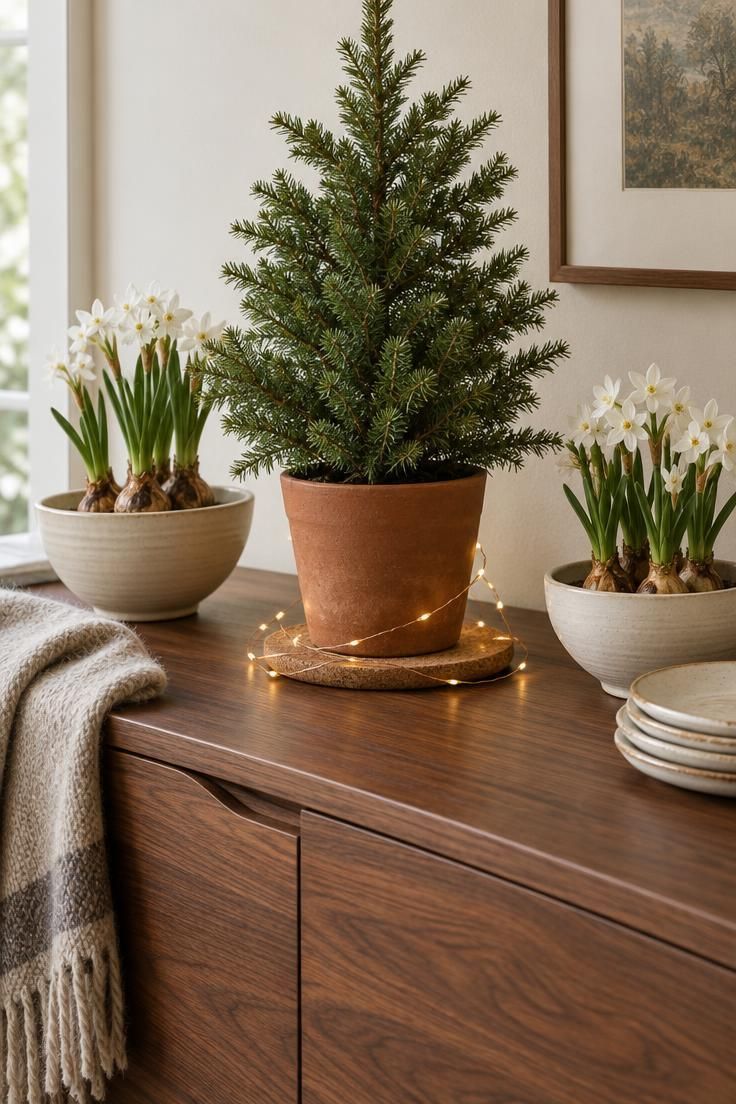
A potted evergreen christmas tree shifts the holiday display toward the plant-forward register that suits neutral, greenery-filled rooms.
Terra-cotta and walnut sit comfortably together, and the paperwhite bulbs repeat the idea of something growing rather than something stored.
The container does visible work here.
A matte pot with a cork trivet underneath keeps the wood surface protected from watering drips, and the trivet reads as a deliberate material choice rather than a hidden practical layer.
Keeping the soil moist is the routine this idea asks for, and a potted evergreen will gradually outgrow its display role over several seasons.
Readers who already tend indoor plants will find the rhythm familiar; others may prefer a faux tree in the same setting.
Low bowls of bulbs rather than tall arrangements keep the sideboard’s sightline open, so the tree stays the tallest element without dominating the wall behind it.
A loosely coiled strand of warm lights adds a soft glow at the pot rim without competing with the bulbs.
This direction rewards patience and a tolerance for change, since the planting will look different from one winter to the next.
That shifting quality is part of its charm in a room built around living things.
Style Blueprint:
- Matte terracotta pot with a round cork trivet
- Dwarf potted evergreen as the centerpiece
- Two cream ceramic bowls of paperwhite bulbs
- Thin warm white wire light strand coiled at the pot base
String-Light Twig Tree in a Galvanized Tub by the Door
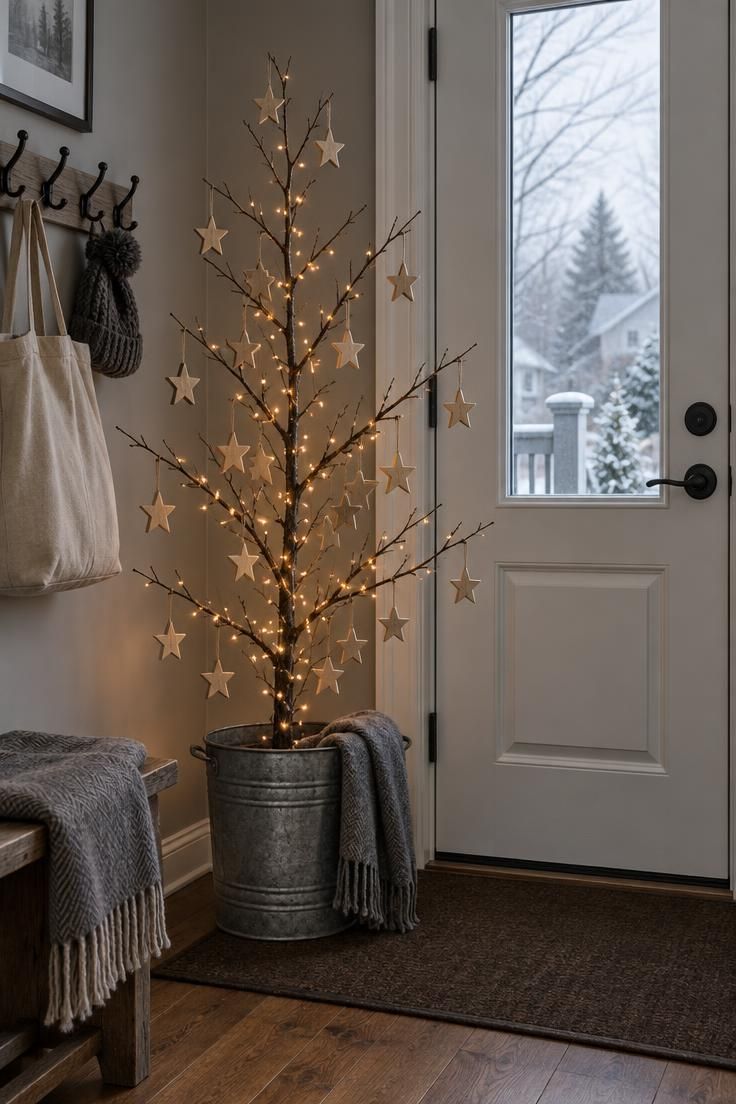
Twig trees offer one of the easiest full-size silhouettes for a compact entry.
The tub anchors the display, while the scarf softens the metal rim and connects the tree to the bench, the knit hat, and the other textiles nearby.
An entry tree sees the house from its most practical angle, so the arrangement must leave room for a swinging door, a dropped bag, and the usual coming and going.
A rubber-backed mat under the tub catches moisture from the entry floor and keeps the metal from marking the wood.
The bare branch structure also means the whole display breaks down without effort.
Twig trees can be taken apart or laid flat in a closet after the season, and the lights coil into a small box.
The tub returns to its regular job holding gloves, mail, or a folded blanket until next winter.
Style Blueprint:
- Round galvanized metal tub as the base
- Four-foot twig tree with bare branches
- Warm white string lights wrapped loosely
- Twelve small unpainted wooden stars
- Gray wool scarf folded over the tub rim
Mini Ornament Display on a Nightstand
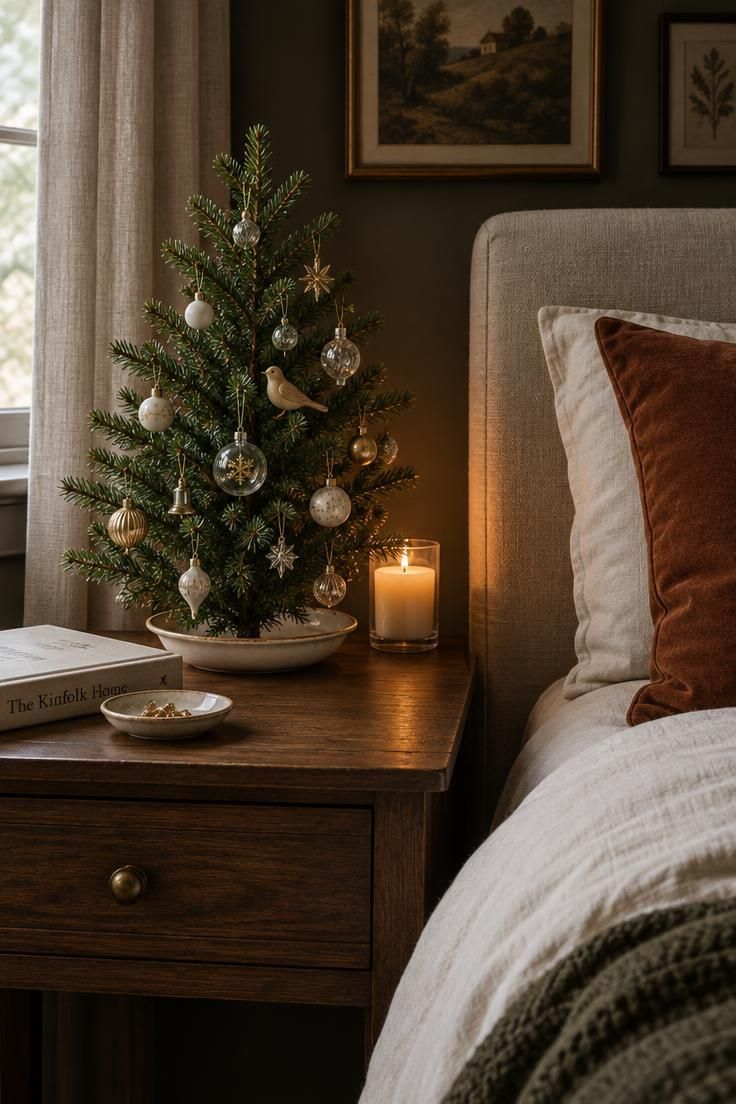
A nightstand tree works as a personal ornament gallery, where a dozen collected pieces get close-up attention they would lose on a full-size evergreen.
Open branch spacing lets each glass ball and the tiny wooden bird read as an individual object.
The bedroom setting calls for a quieter palette than a living room display.
White, soft gold, and a single note of red keep the grouping calm against a cream duvet and a rust pillow.
A small ceramic saucer stands in for a tree skirt, giving the base a finished look at eye level.
Mini christmas tree ornaments benefit from a simple candle behind the tree, which adds a warm point of light without crowding the collection.
Faux branches suit this spot because they drop no needles onto bedding, though the ornaments themselves need occasional dusting.
A tree near a sleeping area is easier on the eyes with steady warm lights rather than blinking ones, which is why an unlit or softly lit display often suits a guest room or a child’s room better.
Scale is the deciding factor.
A tree that rises well above the nightstand’s lamp line will feel cramped, while one that sits just above the tabletop leaves room for the candle and a book.
Style Blueprint:
- Small faux tree with open branch spacing
- White and gold glass ornaments plus one wooden bird figure
- Ceramic saucer as a base
- Candle in a clear glass holder placed behind the tree
Pastel Tinsel Cone Trees on a Round Coffee Table
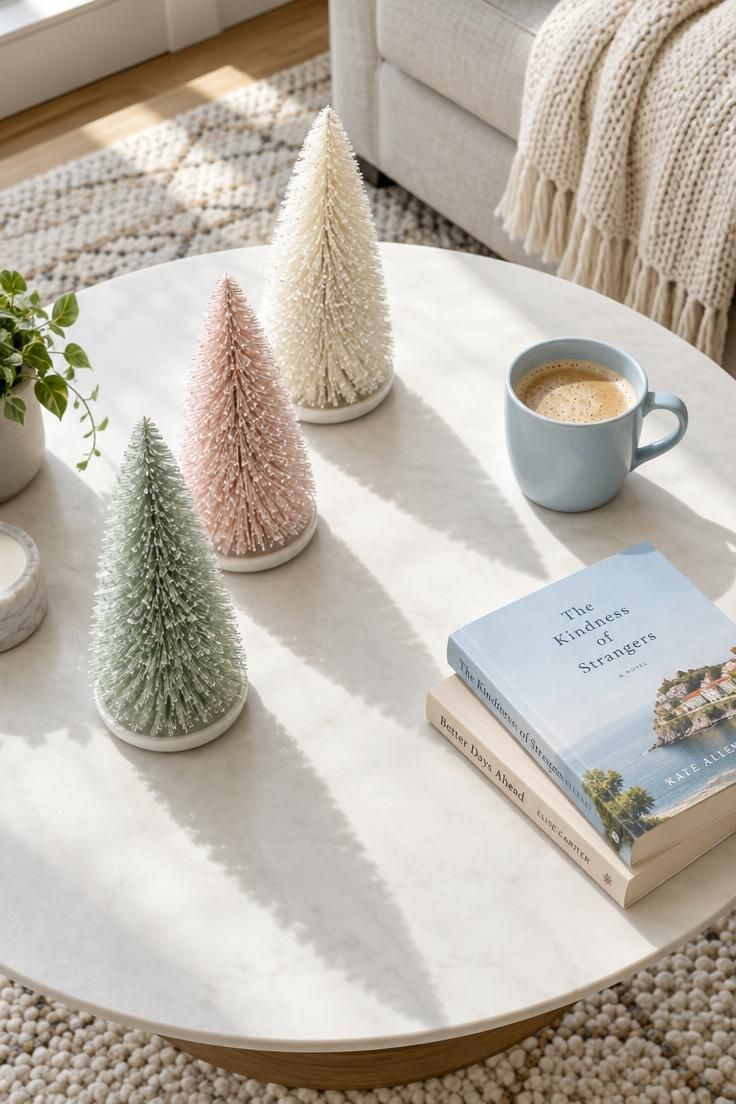
Cone-shaped tinsel trees take the holiday display in a playful direction, and pastel tones keep the grouping light rather than traditional.
Graduated heights arranged on small saucers prevent shedding onto the table and give each cone a finished footing.
Composition keeps the trio from taking over the table.
Clustering them on one side leaves room for a mug, a remote, or a short stack of books, so the coffee table still functions as a coffee table.
Tinsel asks for gentle handling.
Shedding is the main limitation, which the saucers mostly contain.
A dry cloth lifts dust quickly, but stacking the cones in storage can crush their shape, so wrapping each in tissue before packing protects them for another year.
This direction suits a living room where the holiday decor already leans toward whimsy or soft color.
In a room built on deep greens and brass, the pastel trio may read as out of place.
Style Blueprint:
- Three tinsel cone trees in mint, blush, and cream
- Small white ceramic saucers under each
- Graduated heights arranged in a loose diagonal
- Pale blue mug and two paperback books for scale
Window-Sill Winter Forest with Mini Felt Trees
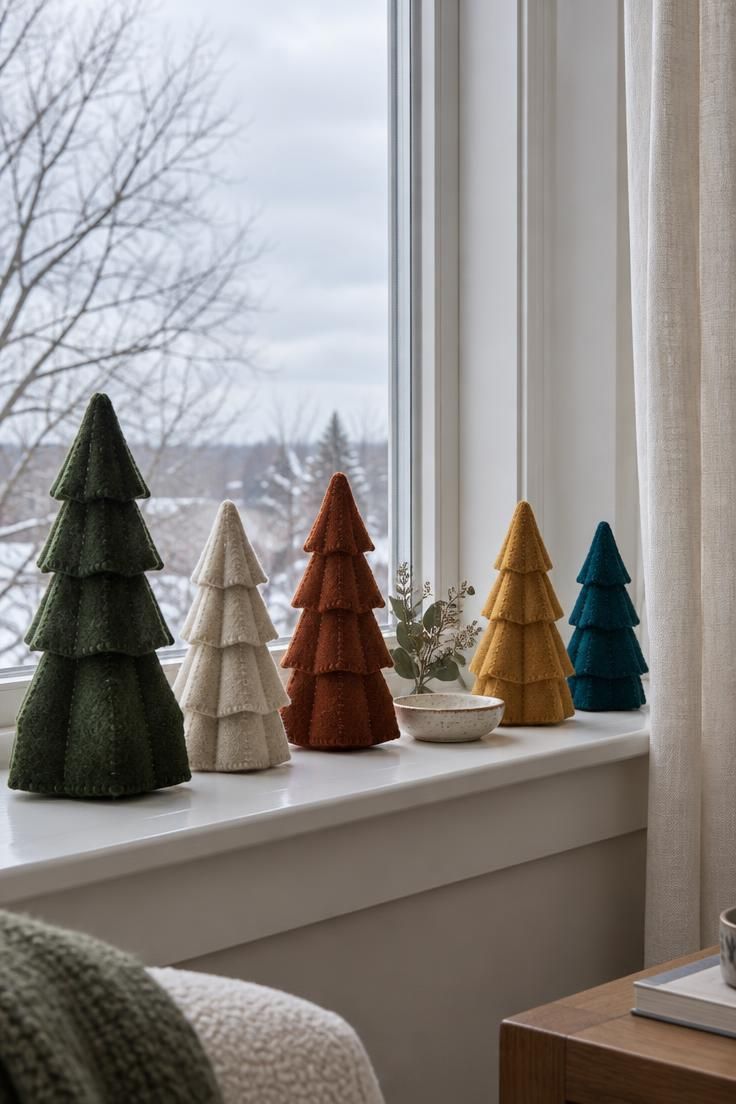
A row of mini felt trees turns a windowsill into a small winter forest, and the soft material reads as cozy against bare glass.
Five heights and five muted colors give the line rhythm without any lights at all.
The sill works as a shelf, so the arrangement needs to stay below the window’s lower rail to keep the sash clear.
A small ceramic dish and a sprig of dried greenery break up the even spacing between trees.
Felt gathers less dust than bottle-brush styles but still benefits from a monthly pass with a lint roller.
Storage is the practical win, since all five trees fit into a single shoebox.
Kitchens and bedrooms with a wide window suit this idea best, particularly where an unlit display is preferable to cords and plugs.
The colors can follow the room’s existing textiles for a display that feels native to the space.
Style Blueprint:
- Five mini felt trees in mixed muted colors
- Heights ranging from short to medium along the sill
- Small ceramic dish and dried greenery as accents
- Simple linen curtain at one edge
Bookcase Niche with a Folded Paper Tree Sculpture
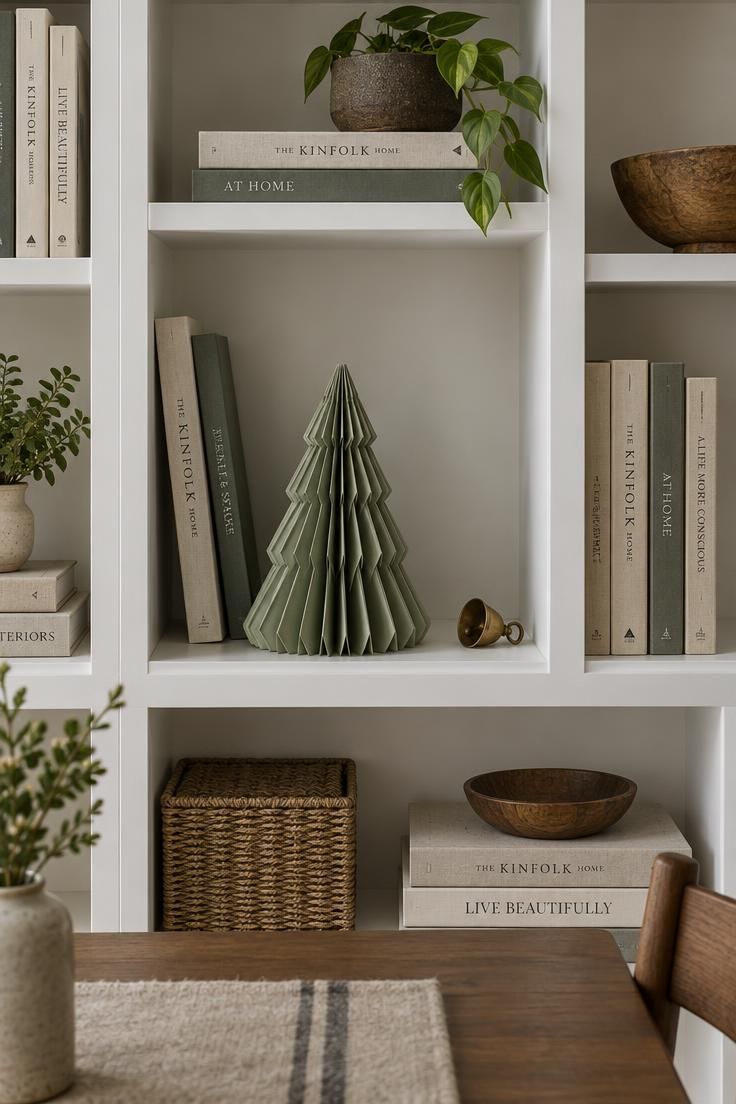
A folded paper tree gives one bookcase niche a sculptural focal point without lights or glass.
Geometric creases catch shadows and change through the day, so the object stays interesting at close range.
Restraint is the point of this display.
Two leaning books behind the tree and a single brass bell beside it are enough; extra ornaments would compete with the paper’s faceted surface.
Light weight makes the piece easy to handle and flat to store between seasons.
Paper does react to humidity and dust, so a bedroom or living room shelf suits it better than a kitchen or bathroom, and a dry cloth passed lightly along the folds keeps it clean.
Placement matters where pets or small children can reach.
Moving the display to a higher cubby protects the paper’s crisp edges without changing the composition.
Style Blueprint:
- Folded paper tree sculpture in muted sage
- One cubby kept otherwise sparse
- Two books leaning behind the tree
- Single brass bell beside the base
Dining Hutch Topper with a Sparse Wooden Tree
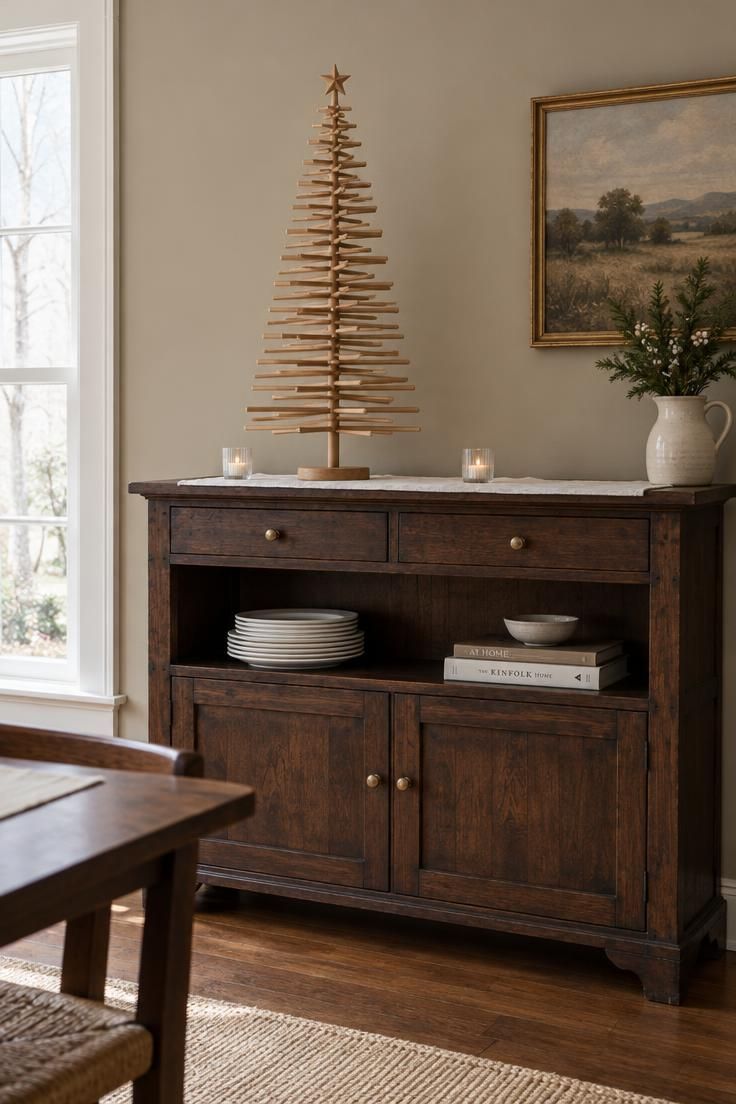
A sparse wooden dowel tree is a surprising answer for a pencil christmas tree for small spaces, since its open branches let the wall color show through and keep a hutch topper from looking crowded.
Height is the real gain here, since the tree draws the eye upward without using any floor space.
The base treatment stays minimal: a linen runner folded into thirds with two small glass votives on either side.
The open structure also makes the display easier to maintain than a dense topper, and the light wood construction keeps the piece simple to take down and store flat between seasons.
A bumped hutch can shift the tree’s footing, so checking that the base sits level after cleaning becomes a small useful habit.
This direction works best in a dining area where the hutch anchors the main wall.
In a room with a lower ceiling, a shorter dowel tree preserves the same idea without making the silhouette feel top-heavy.
Style Blueprint:
- Tall wooden dowel tree with sparse branches
- White linen runner folded into thirds
- Two small clear glass votives
- Dark wood hutch as the display surface
- Warm greige wall behind the topper
Crate-Style Tabletop Tree with Gift Wrap Scraps
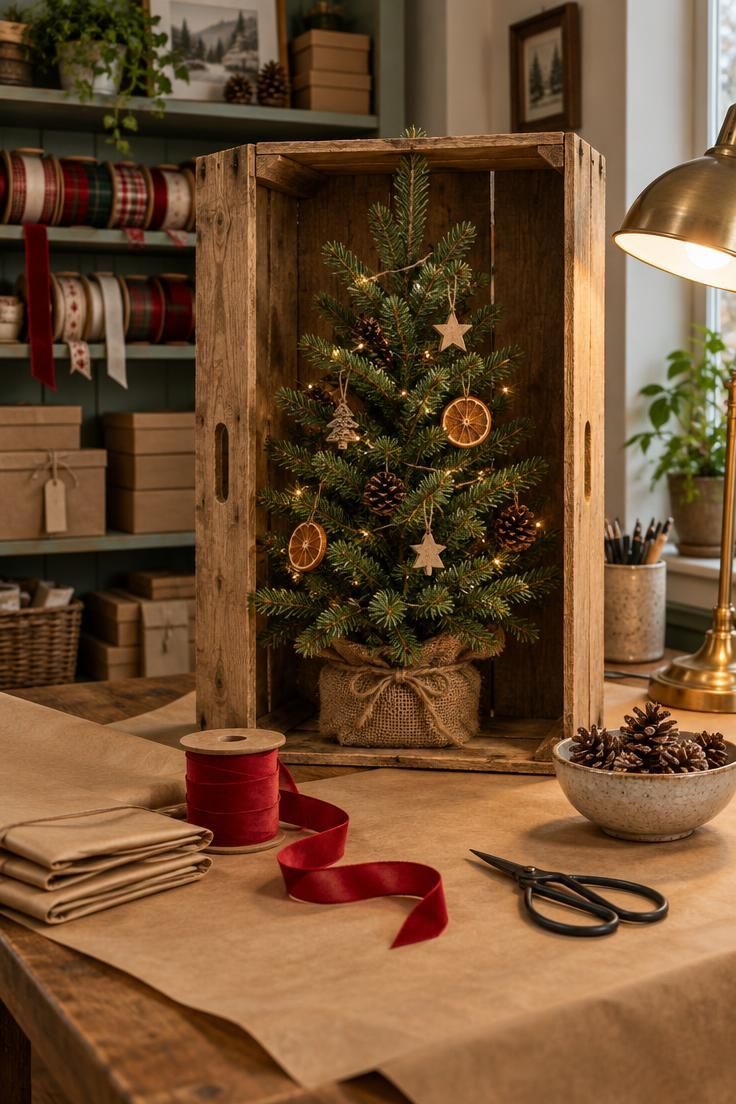
A crate turned on its side does double duty as planter and shadow box, giving a tabletop christmas tree a framed setting.
Tucking wrapping paper, scissors, and twine beside it turns the display into part of an active wrapping station.
The kraft paper spread underneath catches glitter and paper bits, which keeps the surrounding table easier to tidy.
An open-sided crate with the tree inside reads as a deliberate composition rather than storage left out.
A faux tree suits this spot because wrapping supplies add their own dust and paper fibers.
The crate’s depth also hides the pot from view, so the tree appears to grow from the wood.
This direction fits a craft room, a home office, or a living room corner where gifts get wrapped.
In a formal dining room, the working-table quality may feel out of step, and the tray approach from earlier would read more polished.
Style Blueprint:
- Small wooden crate turned on its side
- Two-foot faux evergreen inside the crate
- Folded kraft paper and a red ribbon spool
- Bowl of pinecones and a pair of scissors
- Large kraft sheet spread underneath
Stair Landing Nook with a Tree in a Fabric Wrap
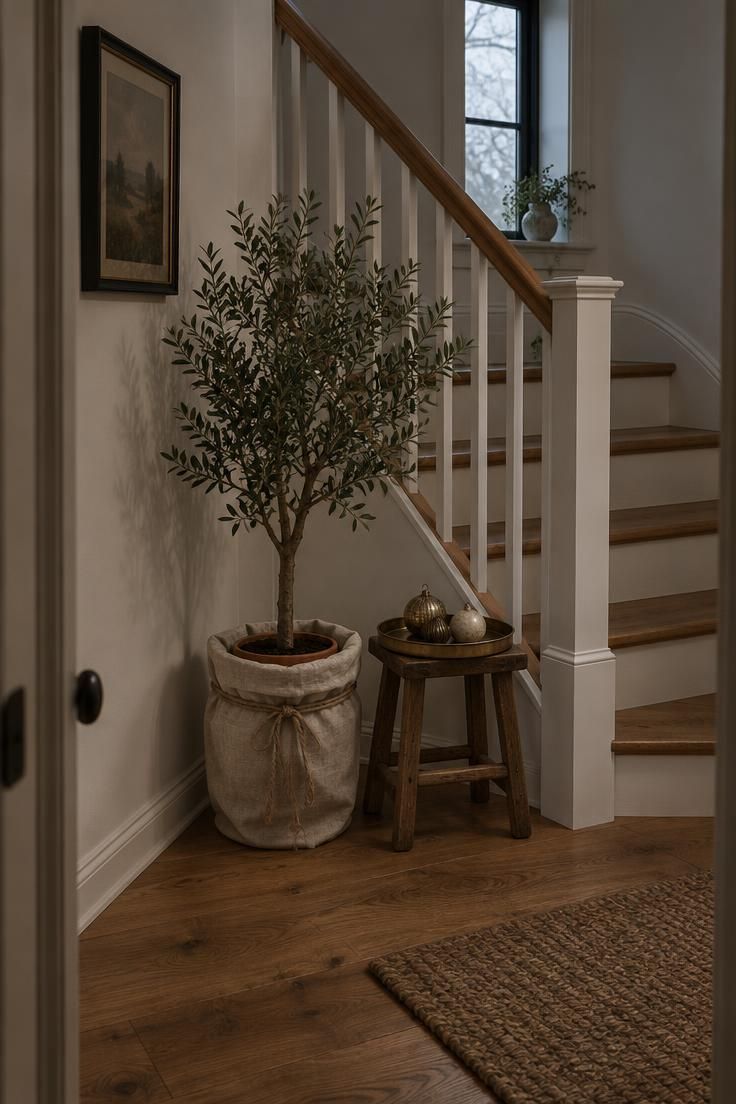
An awkward landing can become a holiday pause spot with a small tree wrapped in fabric.
Wrapping the pot in a linen napkin or canvas cloth and tying it with twine makes the base read as part of the room’s textiles rather than a plain container.
Placement against the wall at the turn keeps the path clear, and a single stool beside the tree gives the tray of ornaments a resting place.
The stool also makes the corner useful beyond the holiday: a place to set a basket while climbing the stairs or to hold a small stack of books.
Landings often receive less light than the rooms around them, which makes an unlit tree or a strand of warm static lights the better choice.
Keeping the tree below the sightline of the handrail preserves the open feel of the stairway without making the display feel tucked away.
The fabric wrap is the flexible part: swapping linen for a plaid wool in a different year changes the register without a new tree.
The look stays tied to the house’s existing textiles rather than to a seasonal palette.
Style Blueprint:
- Two-and-a-half-foot tree in a terracotta pot
- Oatmeal linen wrap tied with jute twine
- Small wooden stool beside the tree
- Round brass tray holding three ornaments
Basket-Collared Tree on a Console Table
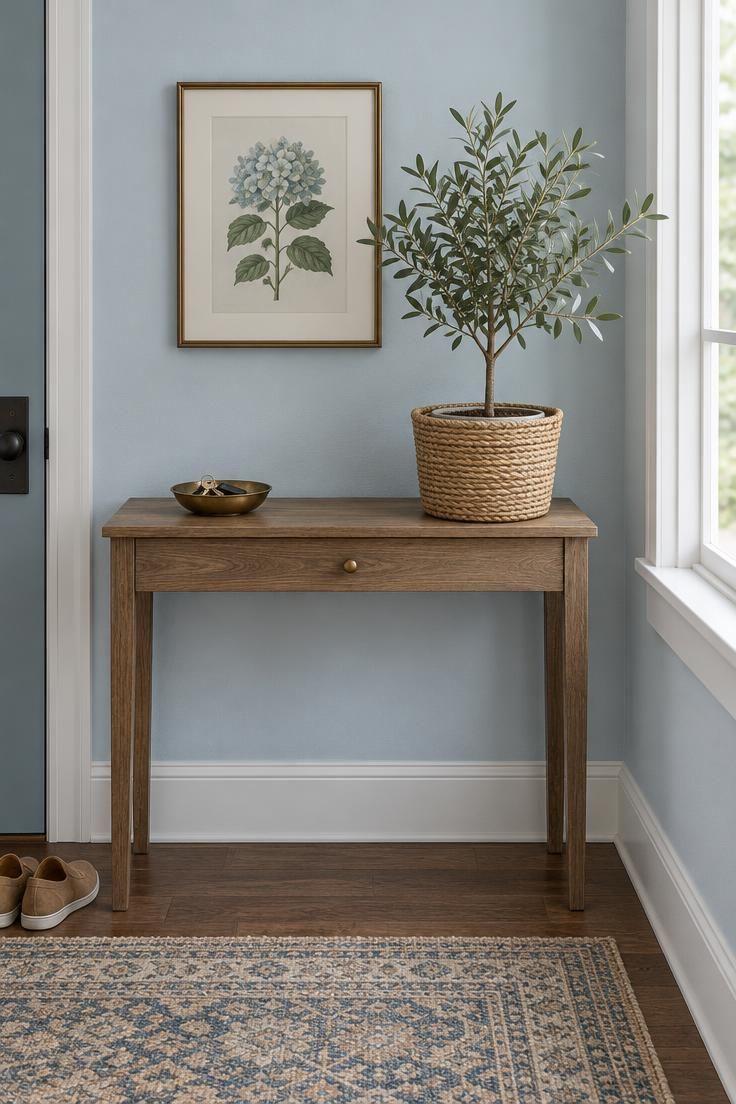
Nesting the pot inside a wider woven basket turns a plain tree into a christmas tree in a basket, with the rim rising above the pot as a visible collar.
The seagrass weave hides the plain nursery pot and adds texture at tabletop height.
A console in an entry or hallway suits this arrangement, where the surface can hold a small brass bowl for keys alongside the tree.
Choosing a basket only slightly wider than the pot keeps the tree from wobbling inside its collar.
The console itself needs enough width that the basket stays fully on the surface rather than overhanging the edge.
A narrow table with a deep basket defeats the tidy look the collar is meant to create.
This base trades a traditional tree skirt for something sturdier and easier to move: lifting the pot out of the basket handles both watering and storage.
Swapping baskets between seasons changes the register from coastal to rustic without touching the tree.
Style Blueprint:
- Narrow console table in an entry
- Natural seagrass basket with the rim above the pot
- Tabletop tree in a plain pot nested inside
- Small brass bowl for keys
- Framed botanical print above
Conclusion
Small trees ask for a lighter hand than their full-size counterparts, and that restraint is often what makes them read well.
Fewer ornaments, a considered base, and a defined surface arrangement tend to carry more character than an attempt to match a large tree’s abundance.
Choose the direction that fits the furniture and palette already in place, whether that means a tray on the dining table, a basket on the console, or a quiet row of felt trees on a sill.
The tree that gets decorated without becoming a storage or cleanup burden is the one worth keeping season after season.