This post may contain affiliate links. If you make a purchase through these links, we may earn a commission at no additional cost to you.
A warm modern traditional Christmas takes the familiar cues of the season and edits them with a quieter hand.
Evergreen stays, red stays, plaid and brass stay, but the quantity and finish change so a room can breathe.
The starting point is usually subtraction rather than shopping: pull the multicolor ornaments and tinsel into storage, then rebuild the season from what already fits a narrower story.
Every idea below works on a flat surface, a door, or a tree, which means a studio apartment and a large living room can draw from the same playbook.
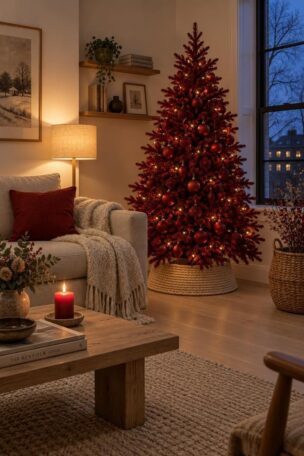
Evergreen and Red Palette with Limed Oak Furniture
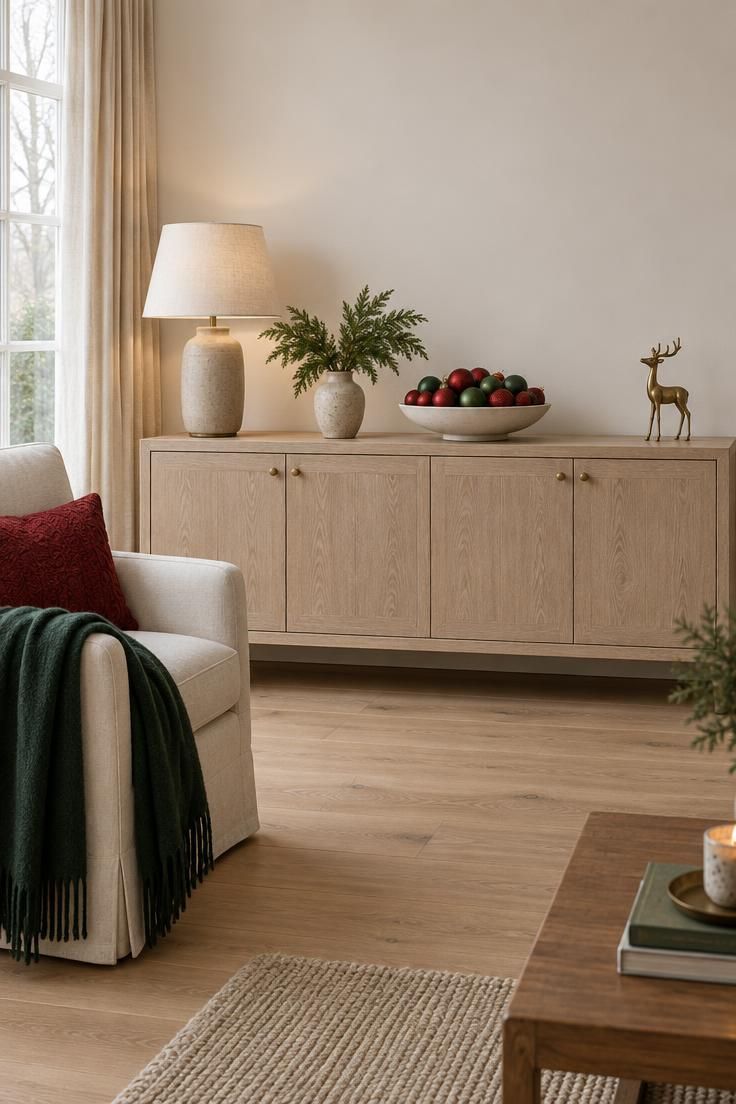
The largest surfaces set the tone before any ornament appears.
Warm white walls and a limed oak sideboard give the room a pale, quiet base, and the evergreen arrives as a wool throw rather than a garland run.
Red enters through a low bowl of glass baubles and one knit pillow, which is enough to register the holiday without covering every soft surface.
Three principals carry the evergreen and red Christmas palette: deep green, true red, and warm white.
Pale oak and cream upholstery sit underneath as supporting tones, so the colors read as a decision rather than an accumulation.
Anyone with an existing collection of red and green pieces can test the method by pulling everything out, choosing two colors, and returning only what matches.
Editing down is often more work than buying new.
The tradeoff is that a pared scheme shows every object clearly, so a chipped ornament or a mismatched red stands out where it once disappeared into clutter.
Fewer pieces also means each one needs to earn its place through shape or texture, not just color.
One sculptural accent finishes the vignette.
A small brass reindeer on the sideboard gives the eye a single metallic note and keeps the arrangement airy, since nothing else competes at that height.
Leave the wall above mostly bare and the oak surface partly open.
Style Blueprint:
- Limed oak sideboard or console with a matte finish
- Shallow white ceramic bowl of red and green glass baubles
- Deep evergreen wool throw folded over a cream chair
- One small brass figure as the only metallic accent
Mercury Glass Christmas Village on a Sideboard
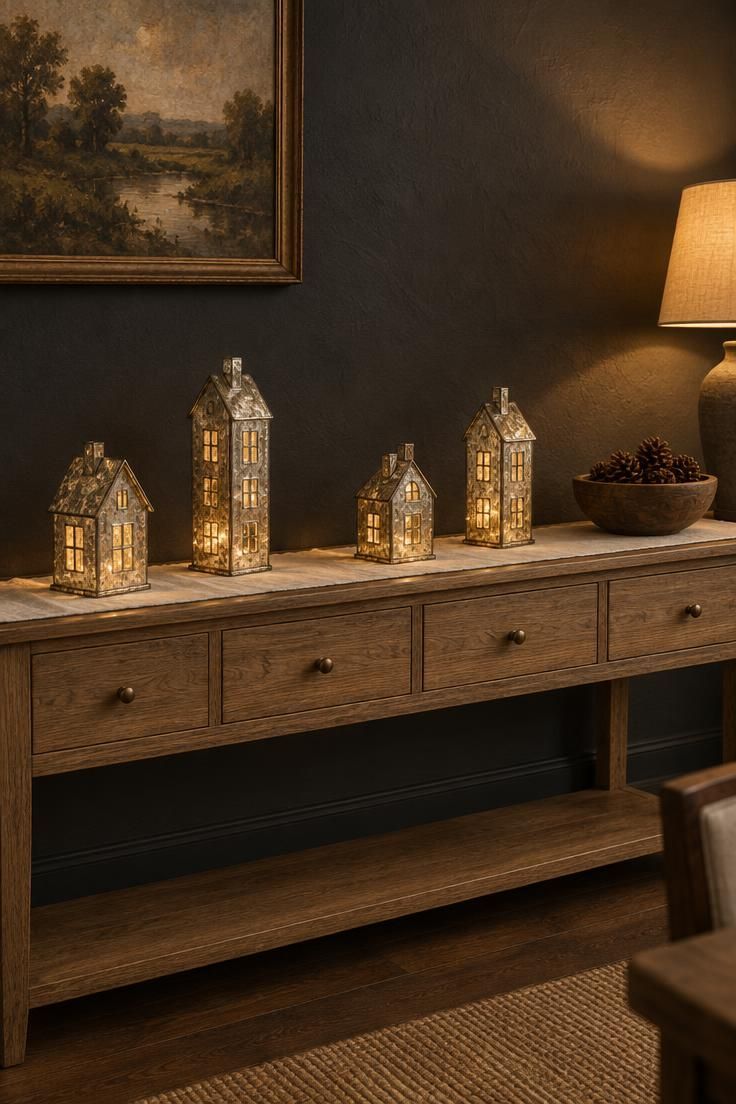
A mantel is the expected home for a holiday village, but a dining room sideboard gives the same grouping more room to spread out.
Four mercury glass houses in varied heights create a gentle skyline across a linen runner, and the silvered finish reads as a quieter update to brightly painted ceramic pieces.
Limiting the village to one material keeps it from looking like a collection that took over the furniture.
Light placement matters as much as the houses themselves.
A single strand of warm white mini lights woven behind the group sends glow through the glass instead of glaring in front, which suits brass Christmas mantel styling as well if the village moves to a fireplace.
On a sideboard the effect is the same: the houses appear lit from within.
Spacing is where most villages fail.
Push the houses together and the arrangement becomes a single dense block; spread them too far and the skyline breaks apart.
A gap roughly the width of one house between each piece keeps the row reading as a set while leaving the runner visible.
Height variation does the rest of the work.
Put the tallest house slightly off center, step down through the middle sizes, and let the smallest sit at one end.
The uneven profile is what makes four objects feel composed rather than lined up.
Storage deserves a plan before the season ends.
Wrap each house in plain paper and store it upright in a shallow box so the glass edges do not chip against one another, and keep the light strand coiled separately so the wire does not press against the glass.
The tradeoff is fragility.
Mercury glass shows fingerprints and picks up dust in its reflective surface, so a soft cloth pass every week or two keeps the finish clear.
Houses placed at the back of a low sideboard stay out of the way of daily traffic.
Style Blueprint:
- Four mercury glass houses in graduated heights
- Cream linen runner to unify the row
- One warm white mini light strand placed behind the houses
- A shallow storage box with plain paper wraps
Plaid Christmas Throw Pillows on a Neutral Sectional
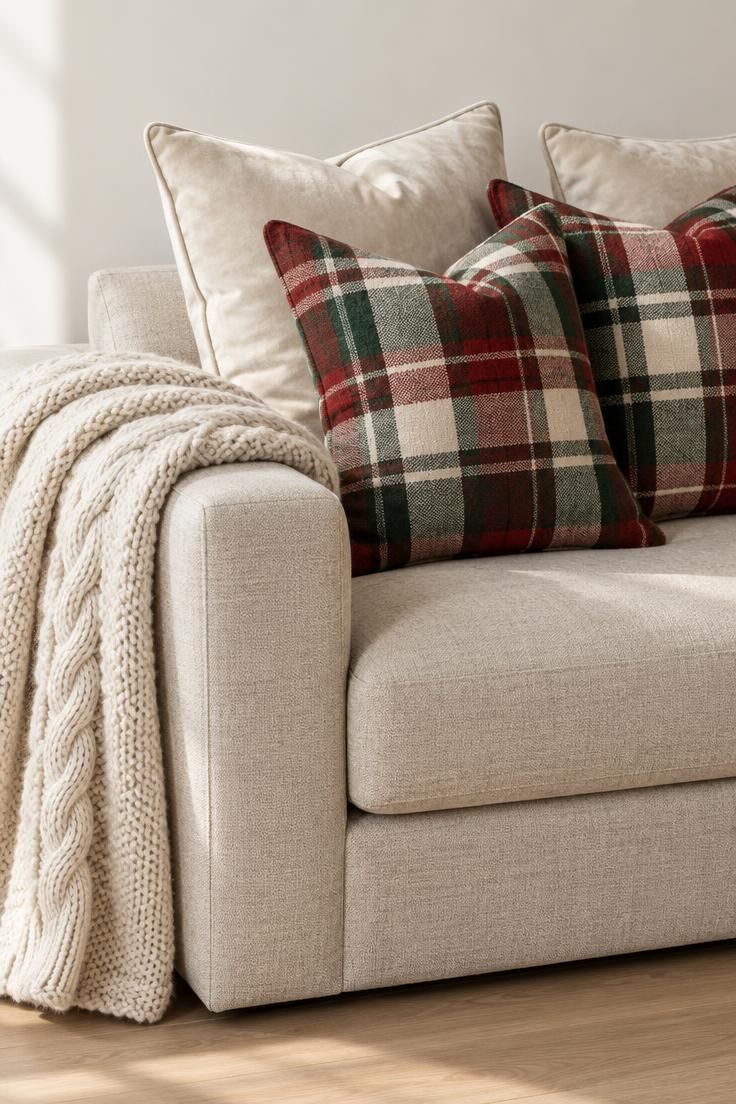
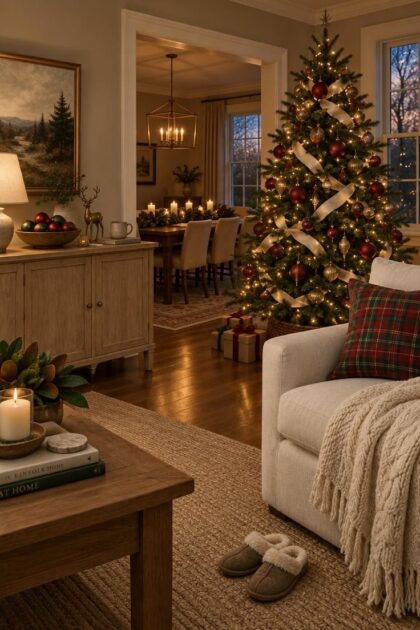
Plaid is the most reliable traditional signal in a modern traditional christmas decor scheme, and it works best in small doses.
Two tartan cushions on an oatmeal sectional carry the pattern while solid velvet pillows in forest green and cream absorb it.
The result reads as holiday without turning the furniture into a quilt.
Scale decides the mood.
A large-scale tartan with open lines feels current and graphic, while a small busy check leans country-cottage.
Hold a swatch against the cushion from a few feet back to judge how the pattern reads at seating distance rather than up close.
Busyness needs a boundary.
Plaid Christmas throw pillows work when they occupy one side of the sectional, leaving the other end in solids so the eye has somewhere to rest.
Spreading the pattern across every seat flattens the contrast that makes it look deliberate.
Texture can vary without adding color.
A chunky knit throw in cream or a plain linen one brings a second surface next to the velvet and wool, which keeps the arrangement from feeling flat.
Drape it over the arm rather than folding it into a neat square.
Households with pets should think about cleaning before the cushions arrive.
Wool and linen covers can be spot-cleaned, but removable covers are easier to manage when muddy paws and shedding fur are part of daily life.
Washable covers also make it simpler to rotate the plaid out after the season.
Style Blueprint:
- Two large-scale tartan pillows in red, green, and cream
- Solid velvet pillows in forest green and cream as the base layer
- A cream knit or linen throw over the sectional arm
Tabletop Christmas Tree for Apartments with a Woven Collar
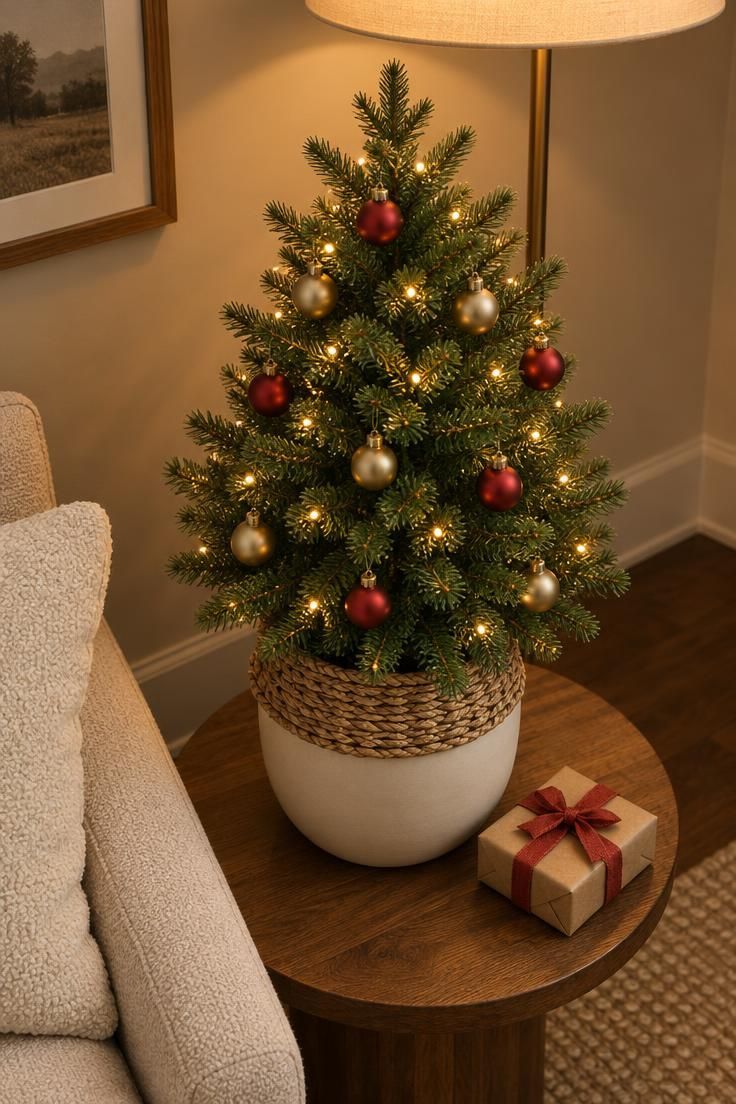
A tabletop Christmas tree for apartments proves how well the hybrid style scales down.
A three-foot evergreen in a simple ceramic pot can serve as the room's only holiday piece, dressed with warm white lights and a few matte red and brass ornaments.
Skipping tinsel keeps the small silhouette clean.
The base deserves the same editing as the branches.
A woven basket or a wrapped linen collar replaces the shiny tree skirt and keeps the bottom of the tree quiet.
The woven texture also connects the tree to the natural materials used elsewhere in the room.
Working in miniature means choosing one ornament story and repeating it.
Red plus brass, carried through a dozen pieces, reads more composed than a small tree hung with every sentimental ornament from years past.
Households with a deep collection can rotate a different pairing each year rather than displaying everything at once.
Renters who cannot drill have a simple option: set the pot on a low stool or side table to gain height without touching the walls.
The tree then stands closer to eye level in a small room, which makes it read as a taller, more layered piece than its footprint alone would suggest.
Live trees need attention in a way faux ones do not.
A live evergreen drops needles and needs regular watering, so it suits a shorter display window better than a full season.
A realistic faux tree holds its shape for weeks and needs only a dusting before it goes back into storage.
Plaid Christmas throw pillows can sit on the sofa nearby if the room wants a second textile note, though a small apartment often looks better with the tree standing alone.
Let the tree carry the color and keep the seating neutral.
Position matters in a compact layout.
Place the table so the tree is visible from the main seating spot but not in the path between the kitchen and the door.
A corner or the end of a sofa run usually gives the tree a clear backdrop.
Style Blueprint:
- Three-foot live or realistic faux evergreen
- Matte cream ceramic pot with a woven seagrass collar
- Warm white lights on a thin wire
- A dozen matte red and brass ball ornaments in two sizes
Design Pro-Tip: When a small tree carries the whole room, keep ornament sizes consistent and space them evenly so the eye reads pattern rather than clutter.
Linen Ribbon Tree Decorations with a Clear Glass Finial
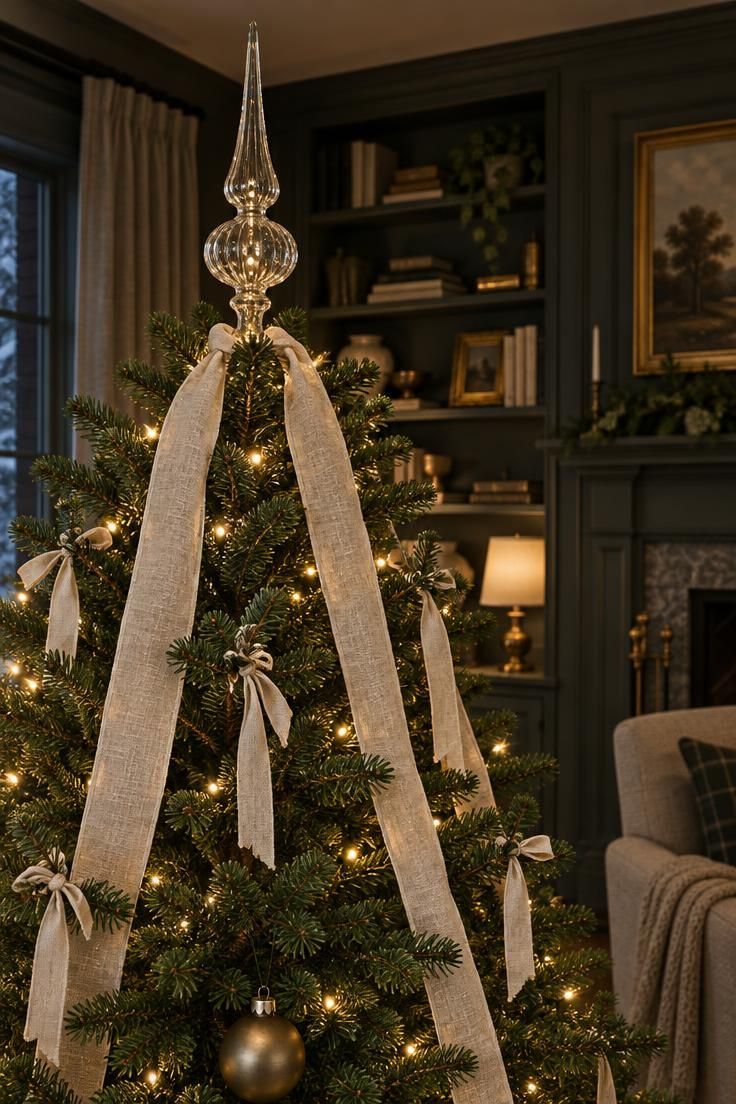
Ribbon takes the place of garland on a tree dressed with linen ribbon tree decorations.
Cream or soft red washed linen cascades in loose vertical folds rather than wrapping in tight spiral rows, which is the modern move away from shiny tinsel.
The matte weave absorbs light instead of reflecting it, so the tree keeps its green depth.
Proportion keeps the arrangement from turning fussy.
One wide ribbon down the front does most of the work, and narrow ribbon tails tied to a few branch tips add movement without repeating the same gesture everywhere.
Ties placed at random heights look more natural than a measured row.
The top of the tree is an easy place to update.
A clear glass finial replaces the traditional star and keeps the crown light, letting the ribbon lead the eye upward without a competing shape.
Glass also picks up the tree lights in a soft way that a solid topper cannot.
Storage protects the investment.
Keep ribbon ties flat in a shallow box so the linen does not crease between years, and roll the long lengths around a cardboard tube rather than folding them.
Creases in linen are stubborn once they set.
Color should repeat somewhere beyond the tree.
If the ribbon is cream, carry that tone onto a pillow or a wrapped gift; if it is soft red, let a napkin or a small bowl of baubles echo it.
The repeat ties the scheme together without adding a new color.
Style Blueprint:
- Washed linen ribbon in cream or soft red, one wide width
- Narrow ribbon lengths for branch-tip ties
- Clear glass finial
- A flat storage box for keeping ties uncreased
Paper Star Lantern Clusters Above the Tree
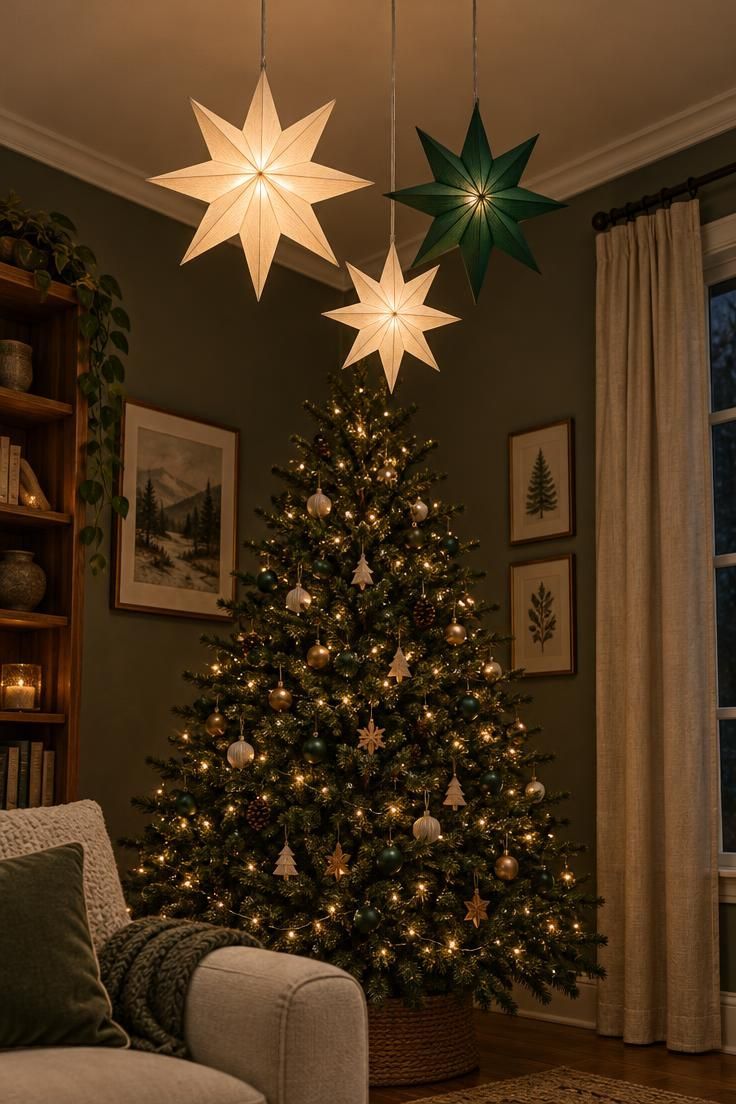
The wall above a tree is a design surface, and paper star lanterns use it without adding another garland.
Three folded stars in flat cream and deep evergreen hang at slightly different heights over a full tree in a living room corner.
The paper texture reads soft and handmade, and the two-color palette keeps the cluster calm.
Proportion decides whether the arrangement looks intentional.
The stars should span roughly the same width as the tree beneath, so the cluster and the tree read as one composition.
Stars that drift wider than the tree or bunch to one side look accidental.
Light quality inside each star matters.
Warm white bulbs glow evenly through the paper, while colored bulbs would fight the tree lights and break the palette.
The paper diffuses the source into a soft shape rather than a bright point.
Renters have options that leave walls untouched.
The stars can hang from small cup hooks or tension rod anchors already in place, and the same pieces work displayed flat against a wall with taped cord.
Either way, the arrangement stays lightweight and reversible.
Storage for folded paper is straightforward.
A shallow box under a bed keeps the stars flat and protected from crushing, and each one can sit in its own paper sleeve so the folds hold their shape.
Style Blueprint:
- Three folded paper star lanterns in cream and deep evergreen
- Warm white bulbs sized for each star
- Clear cord in varied lengths
Entryway Console with a Small Evergreen Topiary and Woven Runner
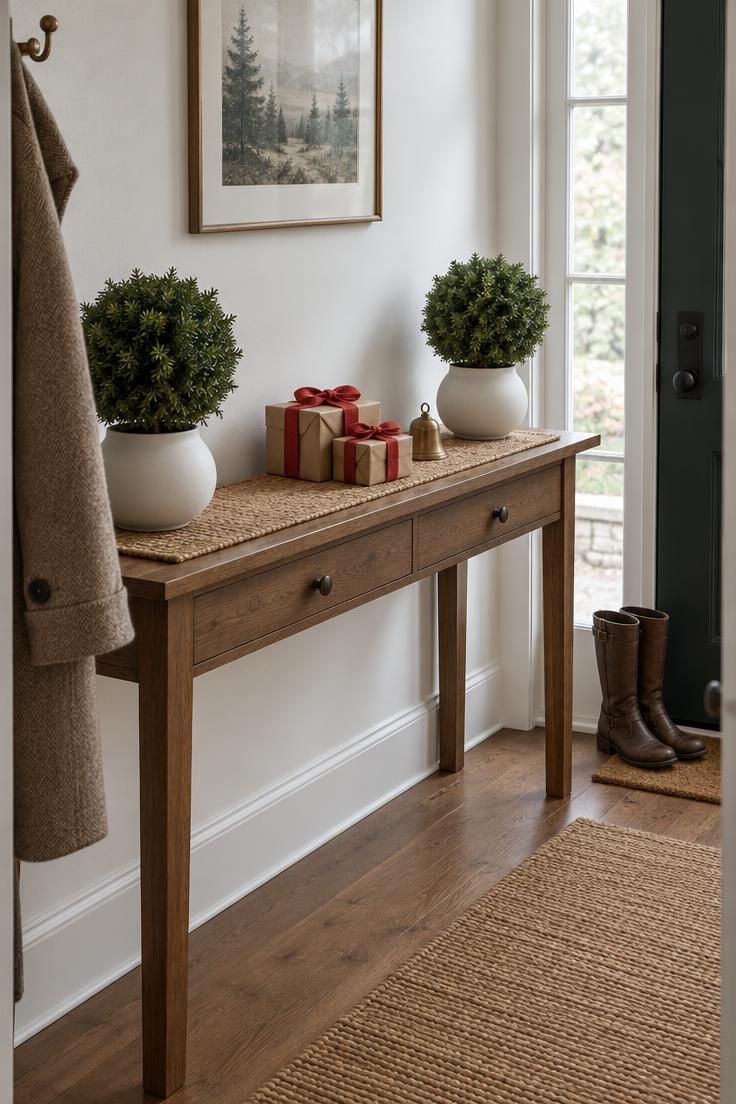
An entry console in a narrow hallway is the best place to test the hybrid at small scale.
A pair of evergreen topiaries in simple ceramic pots anchors each end, and a natural woven runner runs between them.
The greenery says Christmas at the door, while the limited object count keeps a tight space from feeling crowded.
The surface should stay mostly empty.
Two wrapped gifts in kraft paper and a small brass bell are enough to finish the vignette, leaving visible runner between them.
Crowding the console with bowls, candles, and figures undoes the restraint the rest of the scheme depends on.
Renters get an easy win here, since everything sits on the console and no wall holes are needed.
A mirror or a wreath can lean against the wall rather than hang.
The arrangement stays portable if the household moves.
Maintenance splits by material.
Faux topiaries need only a dusting now and then, while live mini trees want regular water and may drop leaves near the door where drafts are common.
In a hallway with a lot of foot traffic, faux is the lower-effort choice.
After dark, a small battery-operated candle in a glass holder gives a warm pool of light on the console without cords.
Set it beside the gifts rather than at the center, so the flame shape repeats the vertical line of the topiaries.
Style Blueprint:
- Two round evergreen topiaries in matte white pots
- Natural jute table runner
- Kraft paper gifts tied with red linen ribbon
- Small brass bell
- Battery-operated candle in a glass holder
Dining Table Centerpiece with a Low Magnolia Garland and Cream Candles
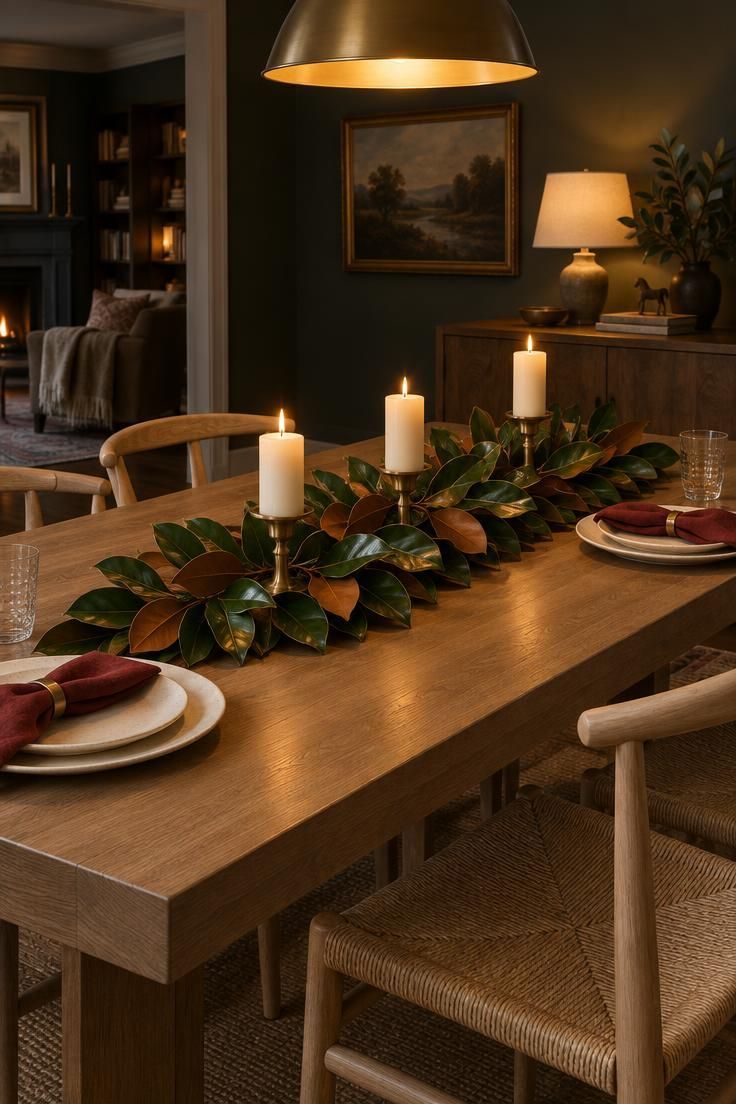
A dining table can be holiday-ready without blocking conversation across it.
A low magnolia garland runs along the center with three cream pillar candles in simple brass holders placed inside the greenery.
The height stays below eye level when people sit, so the table still works for a meal.
The modern traditional edit is mostly about what stays out.
No towering arrangement, no multiple colors: deep green leaves, warm white wax, and brass.
That restraint keeps the table looking composed even with plates and glassware added around the edges.
Real magnolia leaves dry and curl over a season, while a faux garland holds its shape from the first dinner to the last.
Households that want the look for several weeks often choose faux for the garland and keep the candles real or battery-operated.
A red note can come from small ornaments tucked into the greenery if the room needs it.
Keep them few and evenly spaced, and let the napkins carry most of the red through narrow linen ribbon ties that match the palette.
Style Blueprint:
- Low magnolia garland, real or faux
- Three cream pillar candles in brass holders
- Cream stoneware plates with red linen napkins
Stacked Birch Logs with Copper Accents Beside the Hearth
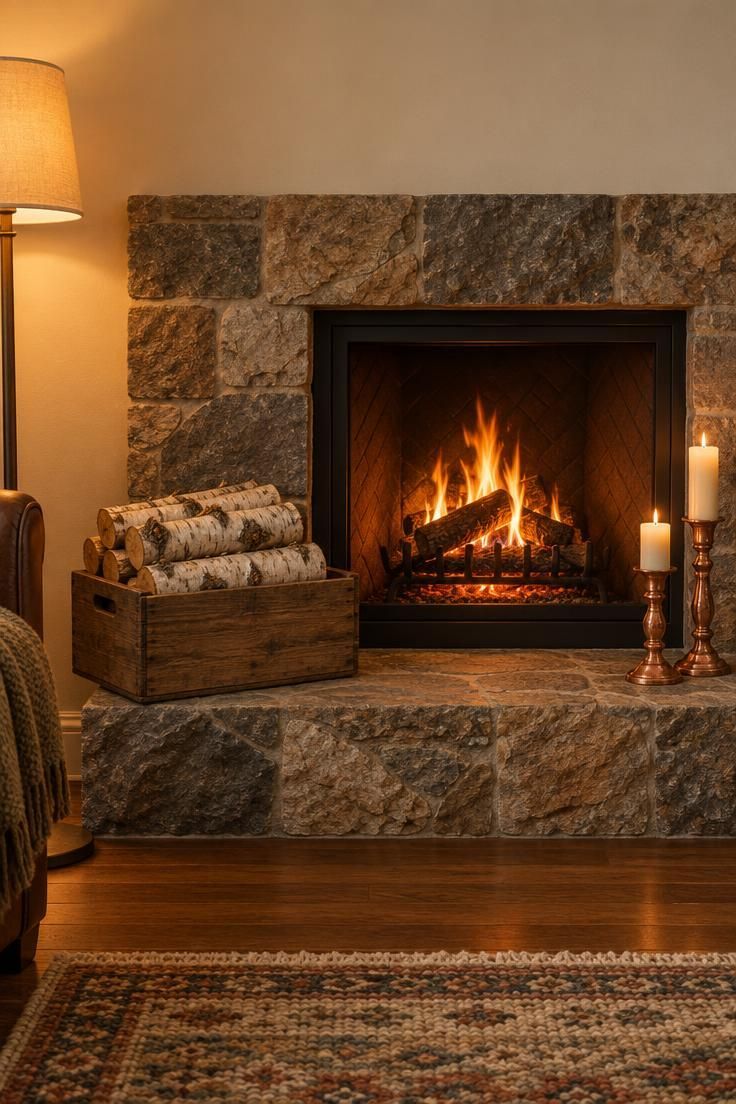
A hearth can carry holiday weight through material rather than ornament.
Split birch logs stacked bark-side out in a low woven basket or open wooden crate read brighter than standard firewood, and the pale papery surface draws the eye even when the fireplace is not in use.
A few copper candlesticks or a small copper tray nearby complete the arrangement.
Copper gives the warm-metal note a more subdued tone than brass.
In a room where brass already appears, copper adds depth without repeating the same finish; used alone, it keeps the hearth from looking bright and new.
The patina also suits the rustic texture of the birch.
Proportion keeps the fireplace the focal point.
The log stack should stay below the hearth opening so the firebox remains visible above it.
A stack that rises past the opening competes with the fire instead of framing it.
Where the fireplace is decorative only, the same look works without burning anything.
Fill the firebox with loose birch discs and a few pillar candles, and keep the crate of logs beside it.
The arrangement delivers the texture without a working fire.
Loose bark is part of the charm and part of the cleanup.
Brush stray pieces from the basket before bringing it indoors for the season, and give the hearth a quick sweep when the logs are restacked.
Style Blueprint:
- Low open wooden crate or woven basket
- Split birch logs stacked bark-side out
- Two copper candlesticks with cream candles
- Birch discs for a decorative firebox
Wreath Pair Flanking a Round Mirror with Linen Bows
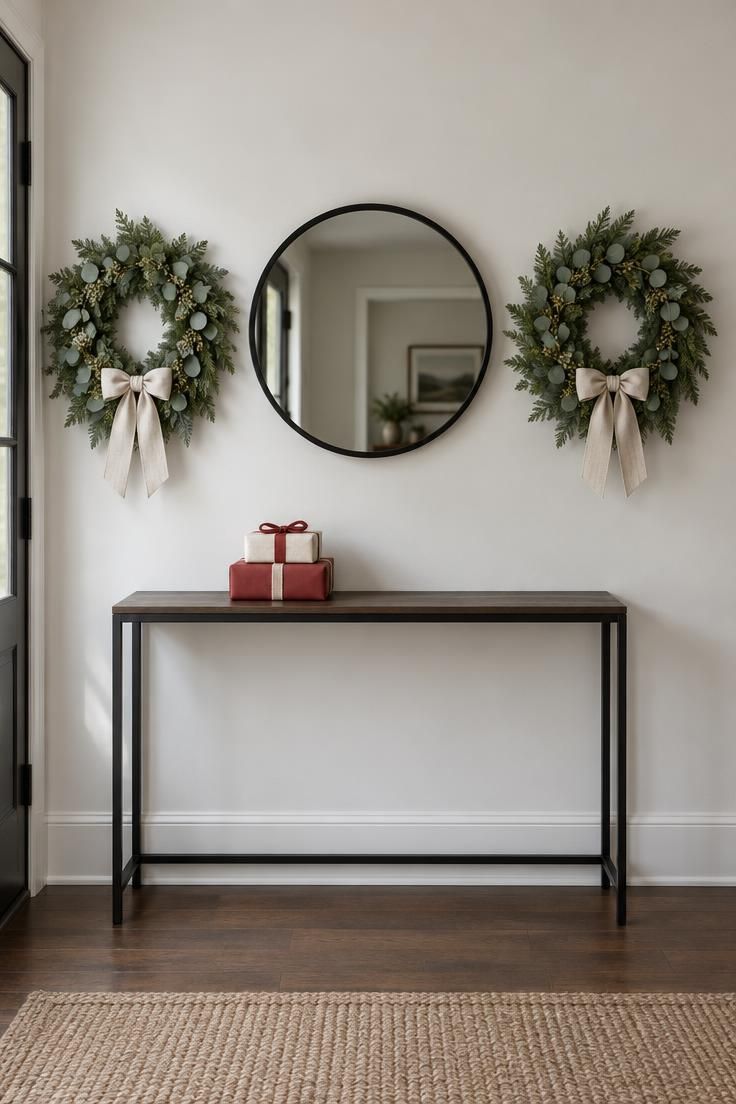
Symmetry at larger scale gives a wall a modern traditional statement without a lot of pieces.
Two matching evergreen wreaths with simple linen bows hang on either side of a round black-framed mirror in an entry or living room.
Cedar or fir with a little seeded eucalyptus mixed in adds a gray-green cast that reads current.
The negative space between the wreaths and the mirror is part of the design, not emptiness.
Wreaths pushed close to the frame crowd the composition, while a clear gap on each side lets the mirror stay the center.
Treat the open wall as a material in its own right.
Proportion is the decision to make before hanging anything.
Wreaths roughly two-thirds the height of the mirror keep the arrangement balanced, so neither the greenery nor the frame dominates.
Oversized wreaths next to a small mirror look accidental.
Renters have alternatives to wall holes.
The wreaths can lean against the wall on the floor below the mirror, or hang on hooks already in place.
Laid on a console as flat rings, they still read as greenery without any mounting at all.
Faux wreaths collect dust in the needles and the bow folds.
A pass with a hairdryer on the cool setting lifts loose dust between seasons, and a soft brush handles the eucalyptus stems.
Style Blueprint:
- Two matching evergreen wreaths with seeded eucalyptus
- Cream linen bows
- Round black-framed mirror
Amber Glass Ornament Bowl on a Coffee Table
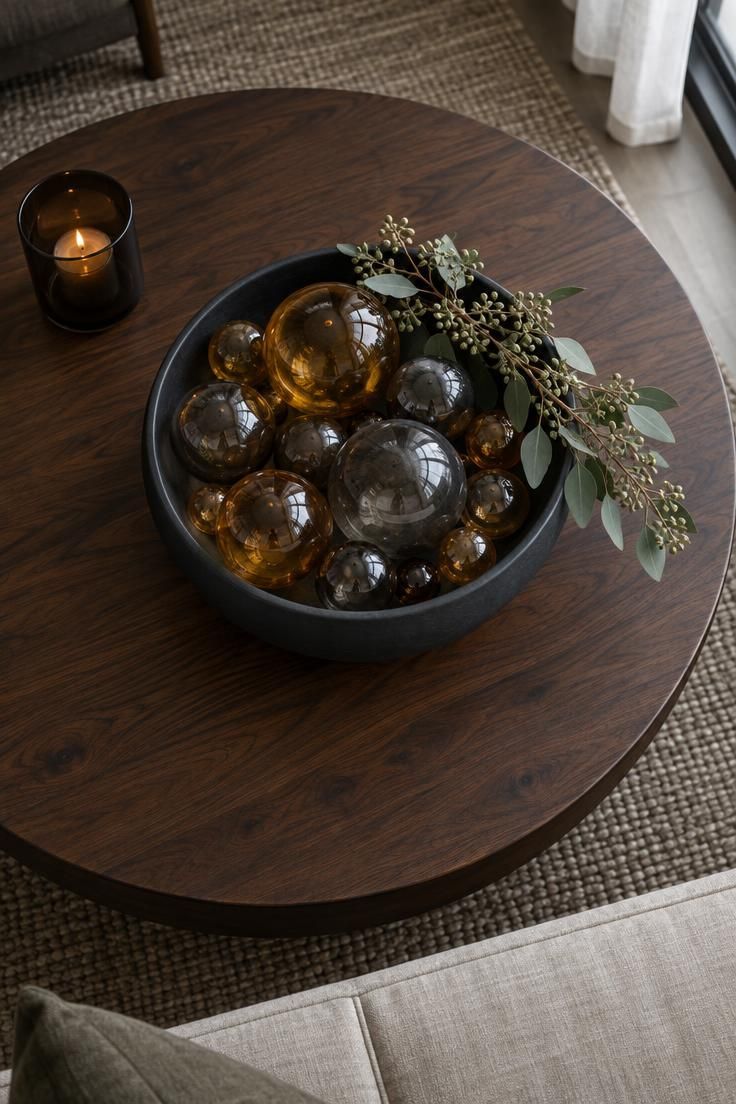
A coffee table can hold one sculptural moment instead of a spread of small objects.
An oversized bowl of amber and smoked-glass ornaments gives the surface a focal point, and the amber tones pick up both brass and wood finishes in a way clear glass does not.
Depth of color does most of the work here.
The bowl itself should stay quiet.
A wide, low-profile vessel in matte black or dark brown ceramic makes the ornaments feel gathered rather than displayed in a reflective holder.
A single sprig of seeded eucalyptus on the rim adds a small green note without building a full centerpiece.
Scale is the deciding factor.
Choose enough ornaments to fill the bowl with a gentle overflow, then clear the surrounding table so nothing else competes.
A linen coaster stack or one candle in a dark glass holder can sit nearby, and that is the limit.
This arrangement suits a living room that already has a tree, since the bowl echoes the ornament color without repeating the same shapes.
In a room without a tree, the bowl often works as the main holiday note on its own.
Style Blueprint:
- Wide matte black or dark brown ceramic bowl
- Amber and smoke glass ornaments in mixed sizes
- One seeded eucalyptus sprig
- A single dark glass candle holder nearby
Design Pro-Tip: Fill an ornament bowl until the top layer sits just above the rim, then stop; a mound that spills onto the table loses the gathered look.
Conclusion
Modern traditional Christmas decor comes down to selective inheritance.
Keep the evergreen, red, plaid, brass, and candlelight that make the season recognizable, then edit the volume, finish, and placement so the room stays calm.
The ideas here share one method: limit the palette, favor natural materials, choose one or two large statements over many small ones, and leave space for the eye to rest.
For a household working with an existing collection, the first step is usually subtraction.
Pull the multicolor ornaments, tinsel, and novelty pieces into storage, then build the season from what already fits a narrower story.
A large living room and a studio apartment can both follow the same logic, since the hybrid needs only a flat surface, a door, or a tree to anchor it.