This post may contain affiliate links. If you make a purchase through these links, we may earn a commission at no additional cost to you.
A winter wreath can carry an entry past the holidays when its palette and materials are chosen for the long stretch from late December into February.
Some designs lean on holiday cues and come down in early January, while others read as cold-season decor and stay up for months.
The difference usually comes down to color, silhouette, and how well the materials hold up.
Choosing a look starts with the door itself: its color, its trim, and how much weather it faces.
From there, the decision is about storage, upkeep, and how long the wreath should remain.
The ideas below range from full evergreen rings to open twig forms, frosted white designs, and a few non-botanical options, each anchored in one clear visual concept.
Dense Evergreen Ring with Rust Ticking Ribbon
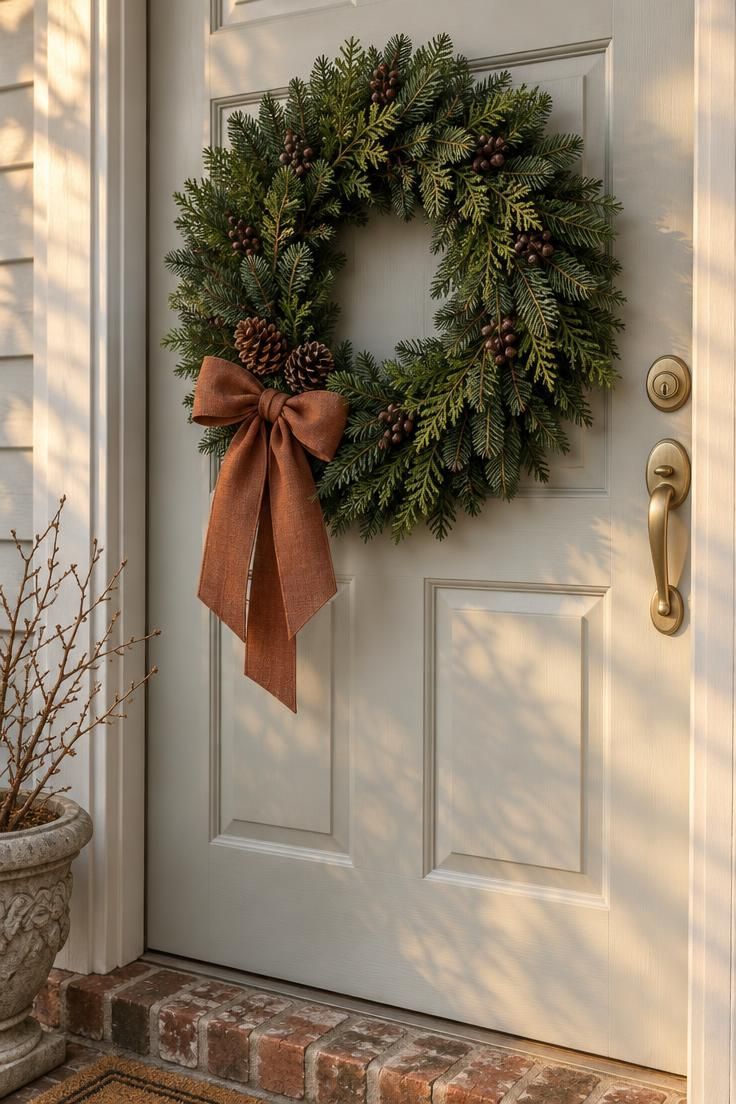
A full ring of faux fir or cedar, packed tightly enough to read as a solid band from the street, is the most familiar form a winter wreath takes.
The defining choice here is the ribbon: a wide rust or brick ticking stripe pulls the palette away from red-and-green holiday territory and toward a muted late-winter mood.
Deep green holds its shape against a pale door as easily as a dark one, though on a mid-tone wood door the rust band is what keeps the whole composition legible from a distance.
Looping the bow at the lower left, with two shorter tails falling toward the bottom, keeps the arrangement from feeling symmetrical and static.
A small pinecone cluster beside the bow adds a woody note that supports the rust tone without competing with it.
The full silhouette suits traditional and transitional entries, and it can feel heavy against a very modern door.
Swapping the ribbon for cream, taupe, or an icy blue band quiets the look once the holidays pass, which stretches the display into February.
Storage is the honest tradeoff: a dense ring needs a wide bag and more shelf space than a hoop or twig form, and the foliage wants occasional re-shaping after time in a box.
Style Blueprint:
- Dense faux fir and cedar ring base
- Wide rust ticking-stripe linen ribbon
- Small pinecone cluster near the bow
- Matte deep brown berry picks
Flocked White Wreath with Pearl Berry Clusters
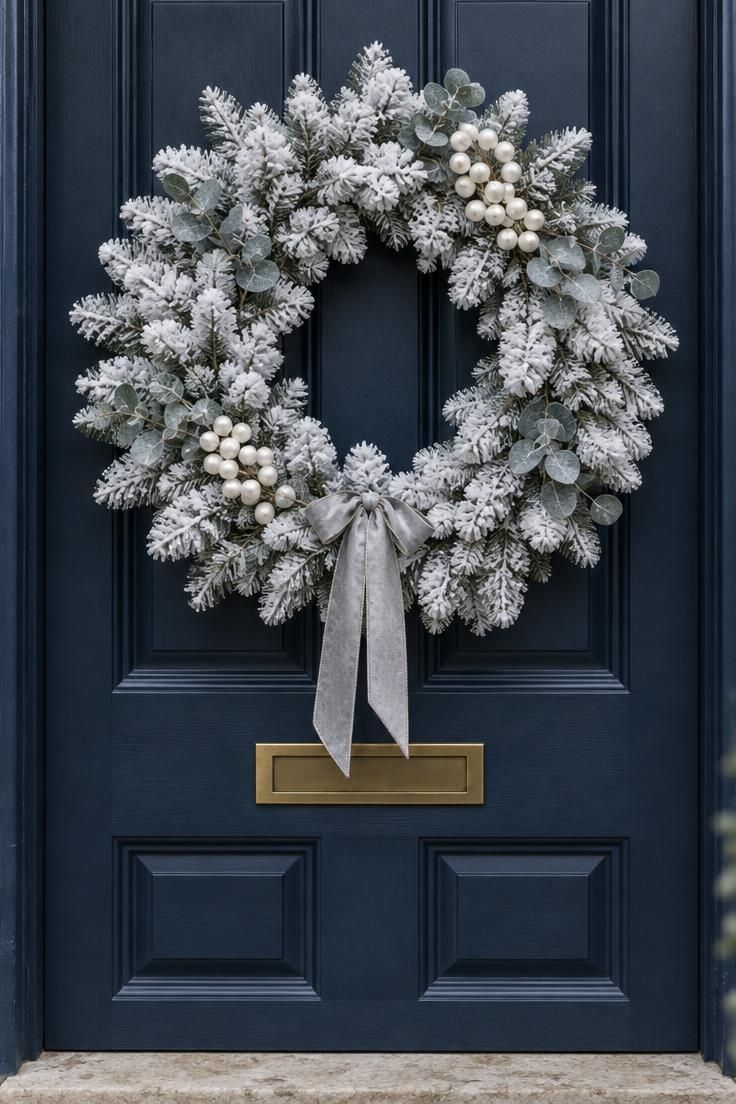
A flocked base covered in a light dusting of white reads as snow settled on branches, and the effect softens every edge of the ring.
Small clusters of pearl-white berries tucked into the foliage keep the palette in white, cream, and pale green, which feels cold-season rather than festive.
For winter wreath ideas, the flocked tips blur the branch structure and give the surface a cottony quality that catches low winter light.
Placement decides whether this look works.
Against deep charcoal or navy, the white reads clearly from the sidewalk; on a white door, the wreath flattens into the background.
The pearl berries distinguish the design from a standard flocked evergreen, and pale frosted eucalyptus sprigs add a second, thinner leaf shape for contrast.
Flocked material can shed fine dust if brushed, so a sheltered spot or an interior wall above a mantel suits it best.
Indoors, weather exposure is no longer a factor, and the wreath can stay up well into the season.
A faux base also stores in a bag and returns for multiple winters, though the flocking benefits from gentle handling between seasons.
Style Blueprint:
- Flocked faux pine ring base
- Pearl-white berry picks
- Thin silver-wired ribbon tails
- Pale frosted eucalyptus sprigs
Asymmetric Crescent with Trailing Cedar and Linen
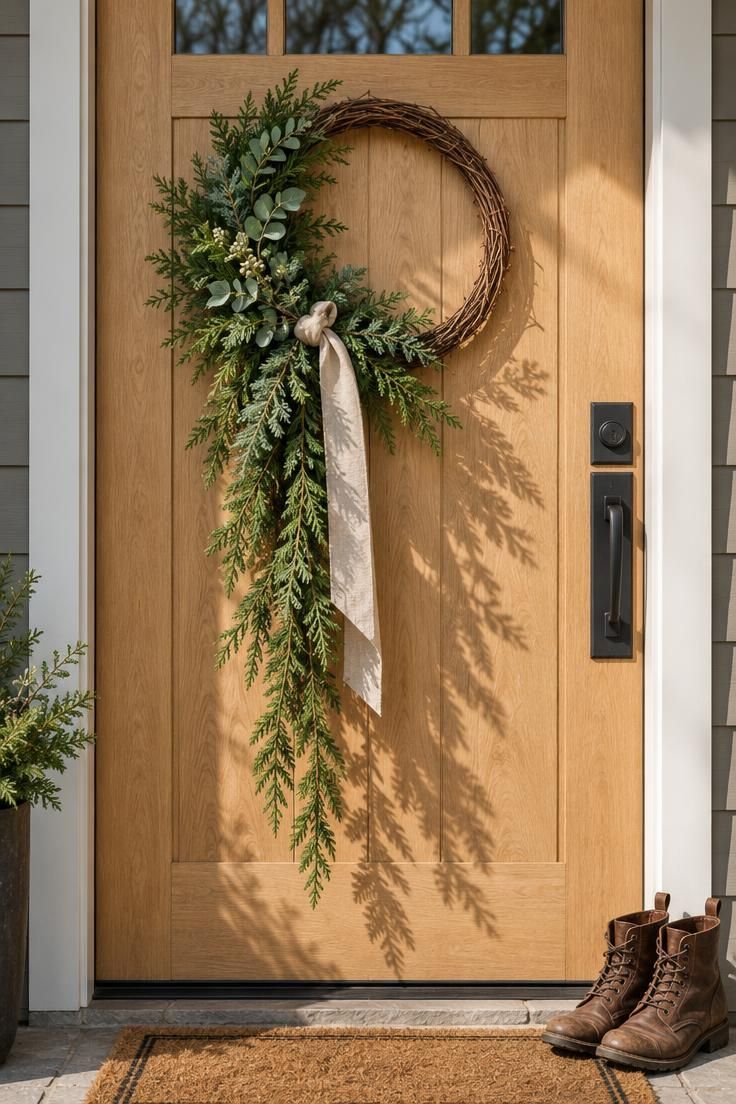
Concentrating foliage along the lower left arc of a grapevine or wire form, with a few longer cedar stems reaching past the edge, turns the wreath into a crescent rather than a centered circle.
The asymmetry reads modern and relaxed, and it leaves much of the door surface visible, so the entry itself becomes part of the composition.
On a warm wood door, the bare twig structure works with the grain instead of covering it.
A natural linen ribbon knotted at the point where the greenery is thickest, with one long tail dropping vertically, reinforces the tall line of the door.
Trailing stems add movement, though they are the most delicate part of the design and want care when the wreath is moved or stored.
This shape tends to sit best on a wider door, where the open side has room to breathe.
A narrow entry can make the crescent look lopsided rather than intentional.
For a wreath above a mantel, built on a wire base, the form is reusable, and the cedar can be reshaped each season; hung above a mantel indoors, the same crescent works as a softer alternative to a full ring.
Style Blueprint:
- Grapevine crescent base
- Faux cedar stems concentrated low
- Natural linen ribbon with a long tail
- Small bronze bell or dried orange slice accent
Twig Wreath with Sparse Copper Bells
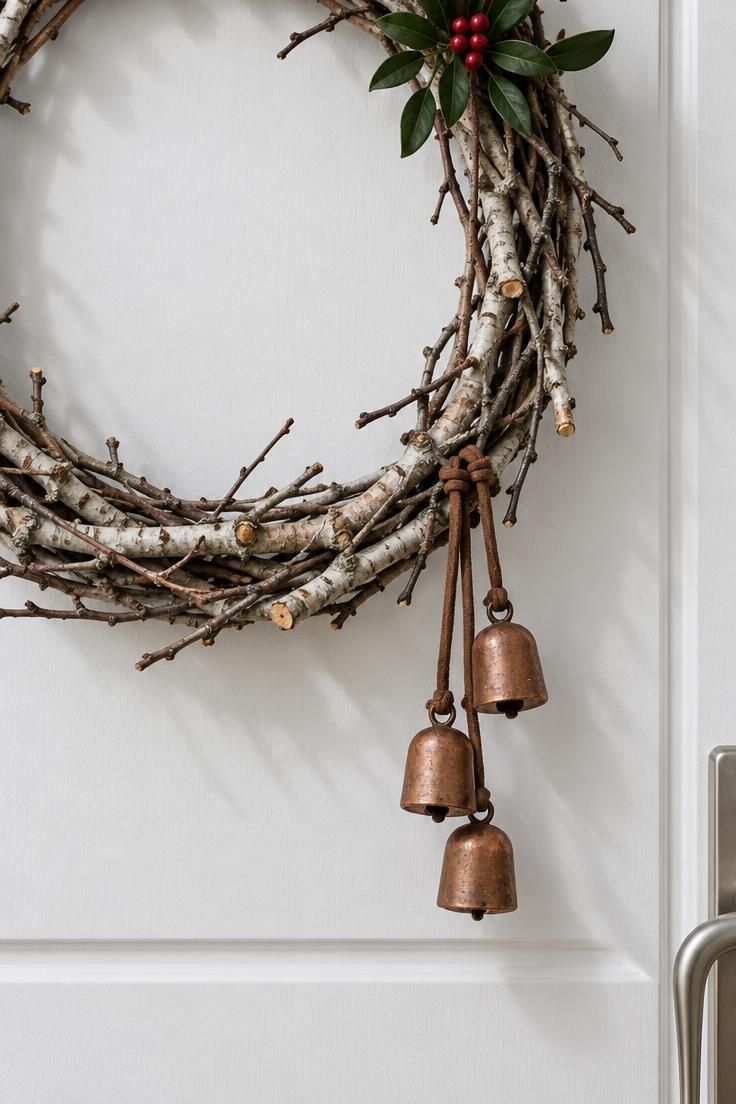
A bare branch wreath made from birch or willow twigs makes the branches themselves the material, not a base for something else.
The open, airy circle lets the door color show through nearly everywhere, and a small cluster of three or four copper bells tied near the inner edge supplies the only ornament.
The result sits closer to a winter sculpture than to a traditional wreath.
Against a pale door, the brown twigs read as graphic lines and their shadows add a second layer of pattern.
On a dark door, the twigs nearly disappear, and the bells become the warm flash that keeps the shape readable.
Irregular branch ends are part of the appeal, so a store-bought uniformity works against the look.
This is the easiest form to live with across a long season.
There is no foliage to shed, the wreath stores nearly flat, and it can move between an exterior door and an interior wall without harm.
The bare look can read as unfinished beside fuller designs, and it has less visual weight, which suits a narrow entry but may feel slight on a broad, formal door.
A single sprig of dried winterberry adds one point of color without changing the character.
Style Blueprint:
- Natural birch twig wreath
- Three copper bell accents
- Thin jute hanging loop
- Optional sprig of dried winterberry
Grapevine Wreath with Single Velvet Bow
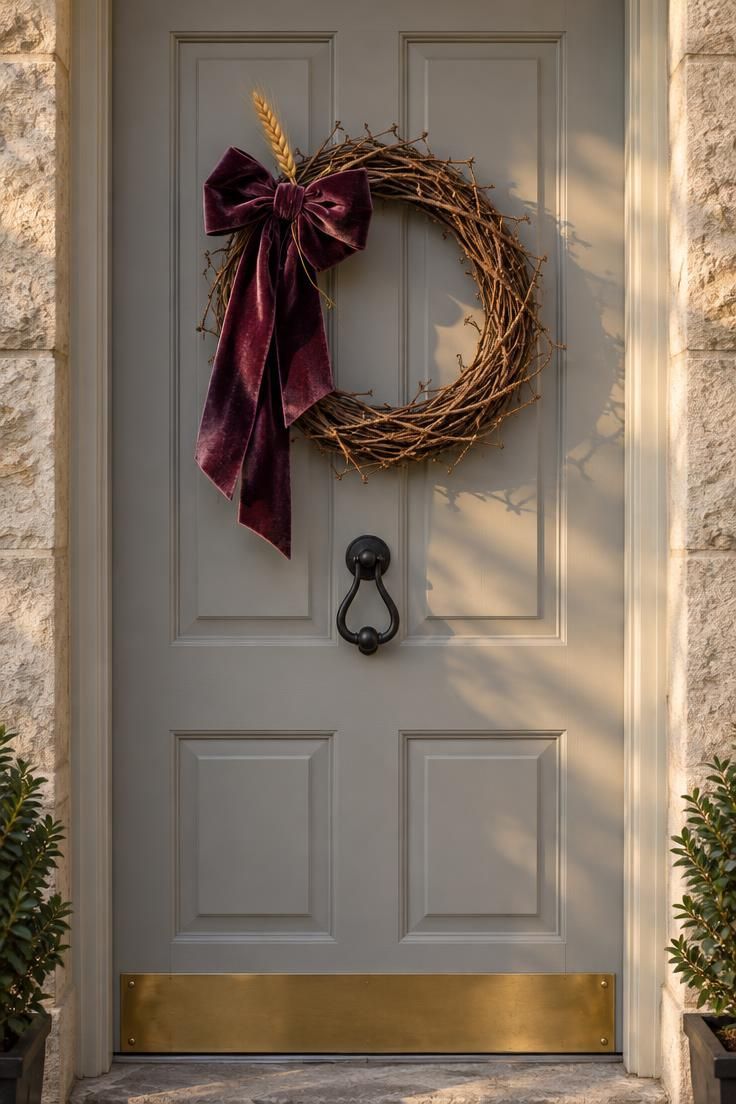
A classic grapevine wreath with one high-contrast velvet bow and almost nothing else depends on the tension between the rough, twisty brown vine and the soft, saturated fabric.
The pairing suits rustic, farmhouse, and transitional entries, and the bare vine keeps the door visible beneath the ring.
Plum, forest green, or matte black all work; the point is one strong shape rather than a cluster of accents.
Position matters more than size here.
Based at the top or upper left, the bow lets the eye climb and makes the wreath feel anchored to the door rather than weighed down.
A single dried wheat stem tucked behind the bow adds a quiet natural note, though the vine reads well with no additions at all.
Grapevine is sturdy enough to stay up through the colder months, while the ribbon may fade in direct sun and is better removed for storage or swapped between seasons.
The design asks very little beyond that: the vine needs no shaping, and the main decision is ribbon width, with wider bows reading formal and narrower ones casual.
A wreath for a front door in this style also transitions indoors above a mantel in February, and the same base can carry a lighter linen bow when early spring arrives.
Style Blueprint:
- Natural grapevine wreath
- Single wide plum velvet ribbon bow
- Thin gold wire accent behind the bow
- Optional dried wheat stem
Winterberry Wreath with Deep Burgundy Accents
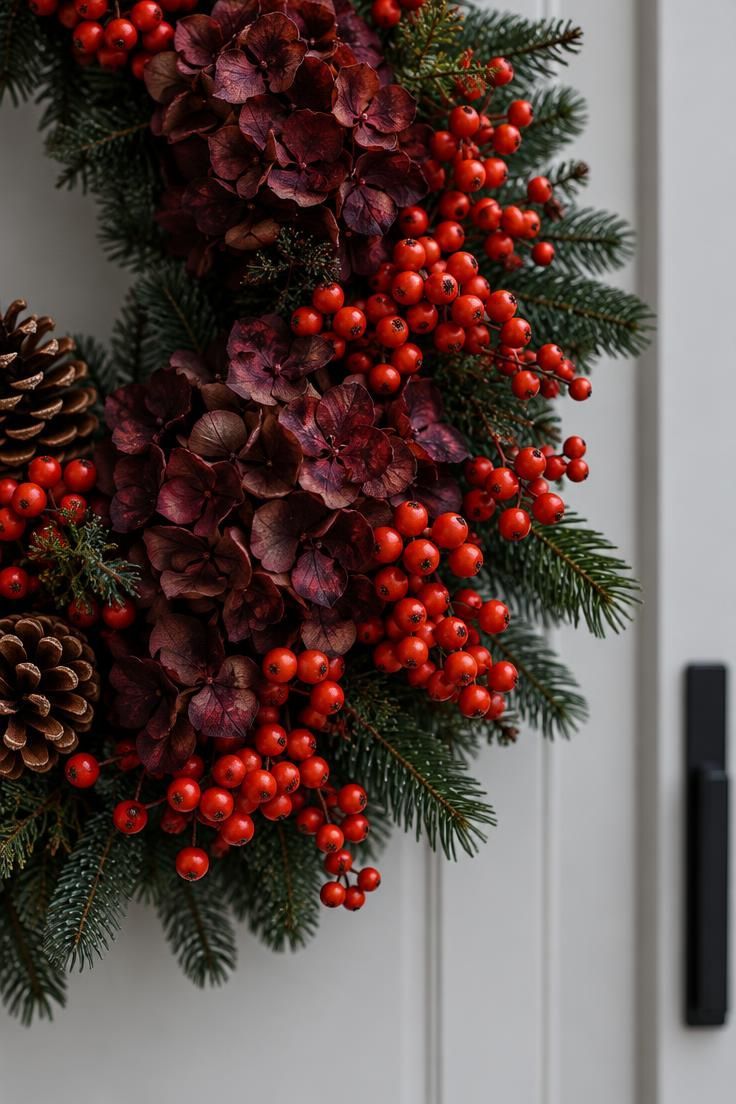
Color takes the foreground in this design: a base of mixed faux evergreens carries dense clusters of faux winterberry in a warm red-orange, with deep burgundy hydrangea or dried eucalyptus stems behind them.
The red is not the bright holiday scarlet; it is warmer and slightly browned, closer to winter fruit, which lets an evergreen wreath carry into the colder months without reading as December-specific.
Distribution keeps the ring from becoming a solid band of red.
Clustering the berries at the lower right and upper left, with pinecones filling the opposite arcs, gives the eye places to rest.
On a neutral door in white, gray, or natural wood, the berry color dominates; on a red door, the berries vanish into the background.
Faux winterberry is durable but its texture matters enormously, and stems with flat, glossy surfaces can look artificial up close.
Real winterberry is short-lived and poorly suited to a long display.
The design is also holiday-flexible: reduce the berry clusters after December and the base becomes a straightforward evergreen wreath for the rest of the season.
Style Blueprint:
- Faux fir ring base
- Winterberry picks concentrated on one side
- Dried burgundy hydrangea stems
- Small pinecone accents on the opposite arc
- Matte brown ribbon tucked at the inner edge
Mixed-Texture Ring with Dried Grasses and Pinecones
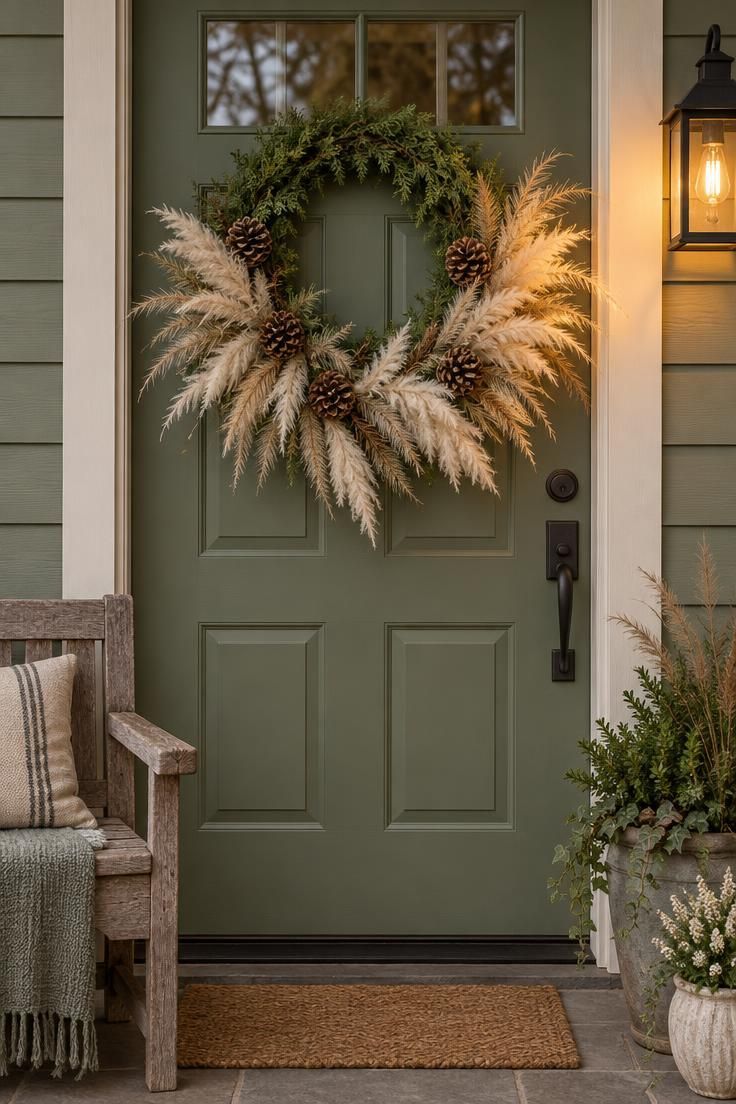
Three textures carry this design in deliberate contrast: a base of dark faux cedar, a middle layer of pale dried fountain or pampas grass plumes, and a scatter of natural pinecones with their scales open.
The plumes create a soft halo that catches side light, while the pinecones supply dense, woody points of focus that keep the wreath from floating.
Placement is what keeps the mix from turning chaotic.
Grasses tucked into three or four bursts across the lower two-thirds, pinecones spaced irregularly between them, and some bare cedar left at the top give the ring a direction and a lighter edge.
The overall effect reads natural and undecorated, at home on a cabin, farmhouse, or any entry where texture matters more than color.
Dried plumes are brittle and shed small pieces when bumped, so a sheltered door or an interior hall suits this wreath better than an exposed one.
It also tends to look rumpled after a few months and is not built for storage into the next season.
The visual idea still travels well: the same grass-and-pinecone arrangement can be rebuilt each year on a reusable cedar base.
Style Blueprint:
- Faux cedar ring base
- Dried pampas or fountain grass plumes
- Natural pinecones in three sizes
- Thin raffia ties
Felt Leaf Wreath in Oatmeal and Charcoal
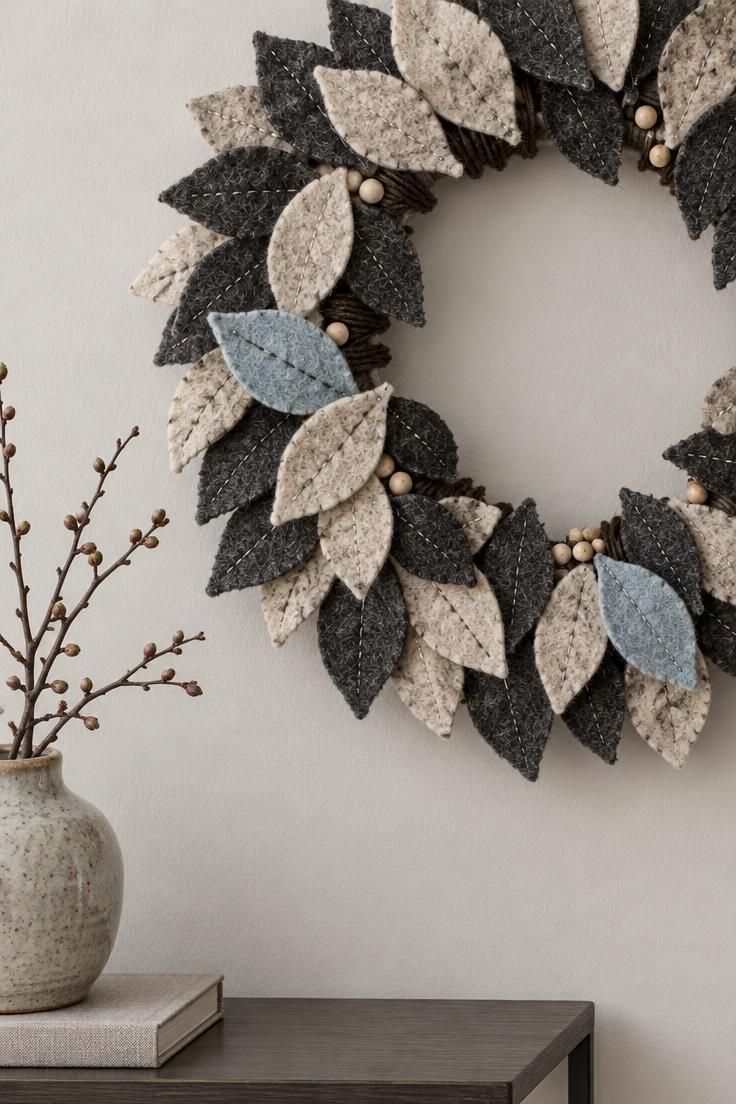
Dozens of hand-cut felt leaves in two neutral tones, oatmeal and charcoal, with an occasional pale blue leaf worked in, make a wreath with no foliage at all.
The felt has a matte surface that absorbs light rather than reflecting it, so the ring reads soft and dense, more like a quilted textile than a plant.
Leaves sewn or pinned onto a foam or straw base hold a clean circular shape.
The monochrome palette keeps the look quiet and modern, and the texture is the main event.
Slight differences in leaf size matter: perfectly uniform leaves can make the wreath look manufactured, while hand-cut variation gives it the quality of a handmade object.
Small wooden beads near the inner ring add a warm accent without breaking the palette.
Felt holds up indoors and on a sheltered exterior door, though it collects dust in humid air and wants spot cleaning now and then.
The wreath is lightweight, packs nearly flat, and returns for many seasons, which makes it one of the more practical options for a small home with limited storage.
Style Blueprint:
- Hand-cut wool felt leaves in oatmeal and charcoal
- Two or three pale dusty blue felt leaves
- Dark twine-wrapped base
- Small wooden bead accents
Dried Botanical Wreath with Cotton and Seed Pods
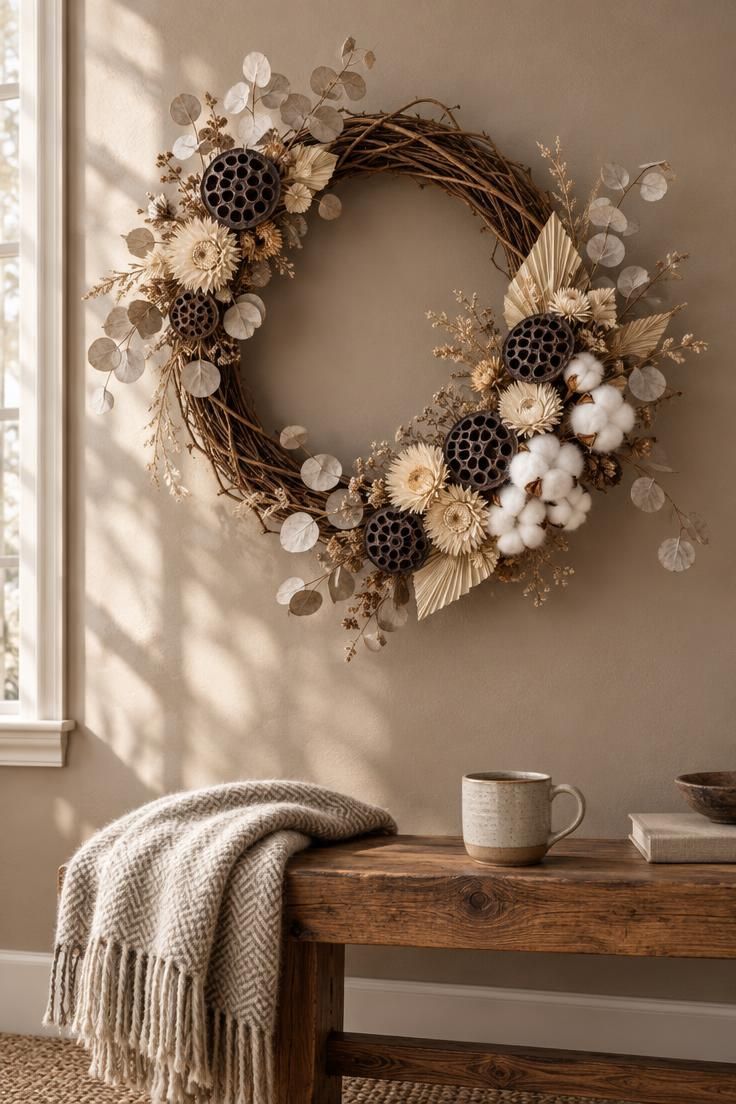
An all-dried wreath built from cotton bolls, seed pods, straw flowers, and a few sprigs of dried eucalyptus or fern carries no green at all, which sets it apart from every evergreen look.
The palette stays in cream, tan, and soft brown, and the rough grapevine base shows between the clusters rather than being covered.
Dried botanicals in this arrangement read as deep winter and can stay up through February.
Texture does the work of color here: cotton bolls add soft white shapes, seed pods add dark spiky points, and eucalyptus adds thin curved lines, so the eye moves between three distinct surfaces.
Clustering the elements rather than spreading them evenly keeps the wreath from looking like a sampler.
Wind and rain shatter dried pods, so a covered porch or an interior wall above a mantel is the better home for this design, where it can remain until early spring.
The materials will fade over time, especially in direct sun, and the wreath is single-season by nature: the vine base can be reused, but the dried pieces cannot.
Style Blueprint:
- Rough grapevine base
- Cotton boll clusters on the lower right
- Dried lotus seed pods
- Pale dried straw flowers
- Silver dollar eucalyptus sprigs
Minimal Gold Hoop with Single Cedar Sprig
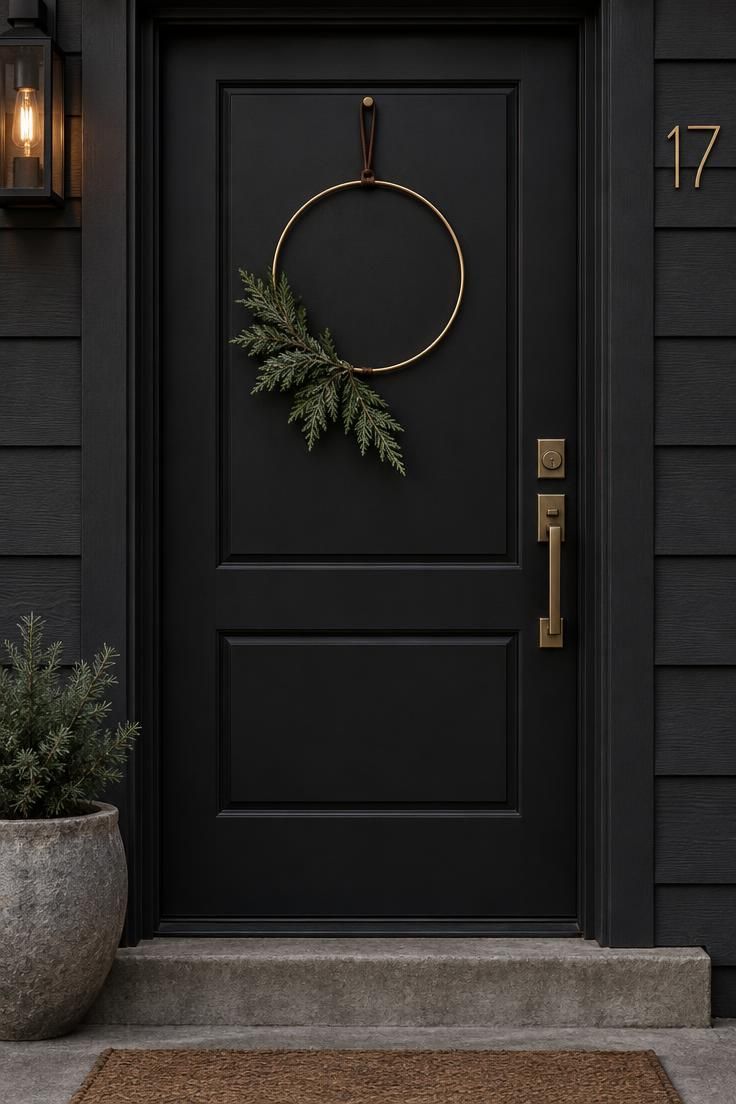
A thin metal hoop in matte gold or brass, with one or two faux cedar sprigs attached at the lower left and a short leather cord as the hanger, is the most restrained option on this list.
It works less as a traditional wreath and more as a sculptural wall hanging that refers to one.
The gold catches light and draws a bright line against a dark door, while the cedar grounds the shape and adds a small measure of color.
The sprig should extend past the hoop’s edge by a few inches, which breaks the perfect circle and keeps the composition from feeling mechanical.
A hoop in the range of roughly 12 to 18 inches across suits most entry doors; larger starts to compete with a full wreath, smaller can get lost.
This idea fits a modern or minimalist entry, and it suits an apartment door where a full ring would overwhelm the hallway.
The hoop stores flat, needs only occasional dusting, and can be re-dressed with a different stem in another season.
It does read as a deliberate, spare choice, and it can feel incomplete beside a traditional evergreen design unless the surrounding decor is equally quiet.
Style Blueprint:
- Matte gold metal hoop
- Single faux cedar sprig at the lower left
- Dark leather cord hanger
- Optional tiny brass bell
Oversized Statement Wreath with Paperwhite Blooms
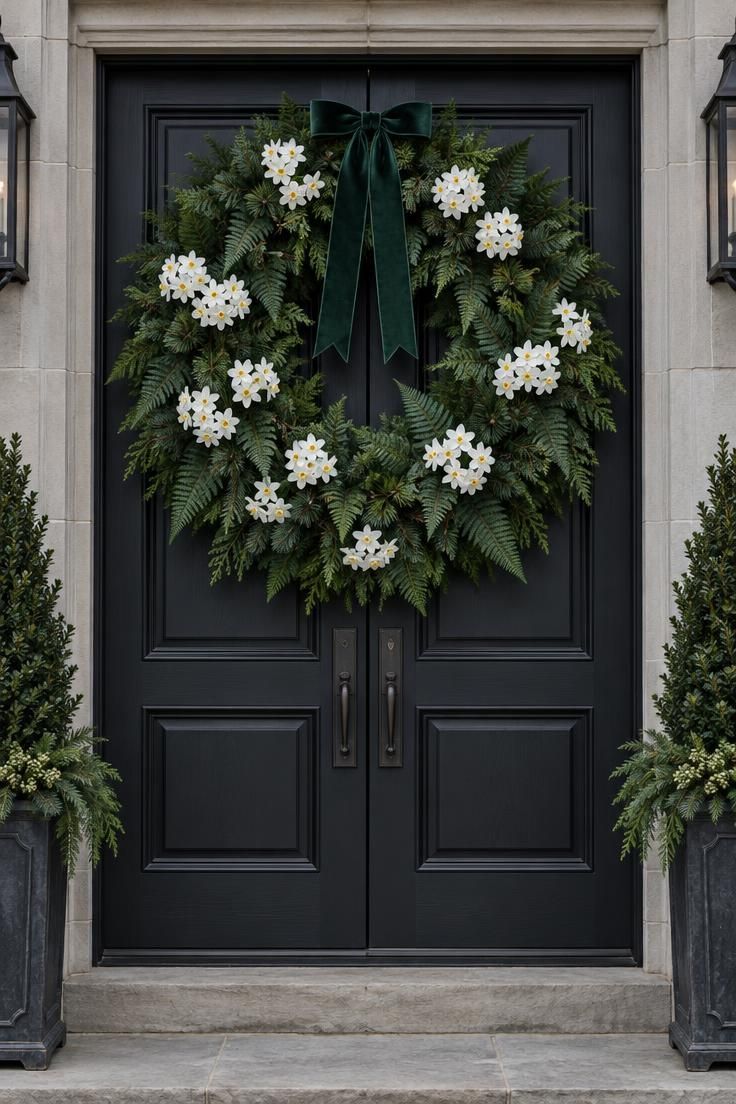
An oversized wreath, roughly 30 inches across or more, uses full faux evergreen volume as its foundation and adds paperwhite narcissus blooms as the surprise.
The white flowers with small yellow cups are wired into the greenery in clusters of three or four, closer to a floral arrangement than a traditional wreath.
On a tall or double door, the size lets the wreath carry the entire visual weight of the entry, so other decorations can stay minimal.
Proportion is the design decision.
On a standard single door, foliage that extends well past the door’s width creates a lush, slightly overgrown effect; on a wide double door, the wreath can sit centered without nearing the edges.
The paperwhites bring an early-blooming flower note that reads as winter without any holiday red.
A wreath this large needs careful storage between seasons, and the faux blooms carry the look: stems with realistic petal texture hold up, while flat, shiny flowers can undermine the whole arrangement.
The design can stay up into late winter, though the bright white flowers may feel springlike by March.
Style Blueprint:
- Oversized faux fir and pine base
- Paperwhite narcissus stems in small clusters
- Deep green velvet ribbon at the top
- Dark green fern fronds
Design Pro-Tip: Photograph or sketch the wreath in place before committing to a ribbon change, since the door color, the trim, and nearby planters all shift how a new tone reads from a few steps back.
Conclusion
A winter wreath lasts longer than a Christmas wreath when the palette, silhouette, and materials are chosen for the colder months rather than for one week in December.
The deciding questions are practical: how sheltered the door is, how much storage the home allows, how much upkeep feels reasonable, and whether the look should carry into late winter or stop after the holidays.
The designs here span that range, from an evergreen ring with a changeable ribbon to a felt leaf wreath that stores flat.
A wreath can also move from the front door to a spot above a mantel or an interior wall to change its role mid-season.
The most welcoming choice tends to be the one that matches the entry itself, its door color, surrounding trim, nearby planters, and available light, rather than whichever design is currently most shared.