
This post may contain affiliate links. If you make a purchase through these links, we may earn a commission at no additional cost to you.
A house can hold a dozen beautiful decorations and still feel like several holidays happening at once.
The usual instinct is to buy a matching set, then another, until every room has its own small collection.
A connected home works the other way: a few decisions get made once, then repeated at different scales from the front door to the top of the stairs.
What Makes a Whole-Home Christmas Scheme Feel Connected
Connected rooms rarely come from matching sets.
They come from a handful of repeated signals that the eye can follow, and the strongest of those signals are palette, material, and light quality.
Palette does most of the work.
When the same two or three colors appear at the door, on the tree, and along the mantel, the rooms read as chapters of one story rather than separate displays.
The colors do not need to appear in equal amounts; a ribbon here and a cushion there can carry the thread.
Material provides the second signal.
One repeated material, such as wool, velvet, brass, or matte greenery, gives the scheme a tactile identity that survives a change of color from room to room.
Restraint of this kind keeps small spaces calmer, since fewer competing finishes mean less visual noise in a tight sightline.
Light quality is the quiet third lever.
Warm-white strands on the tree, a warm lamp on the console, and a low accent light behind greenery all share a tone, and that shared tone ties zones together even when the objects differ.
A useful test takes seconds.
Stand in a doorway and look from one decorated zone toward the next; the eye should land on a shared color, a shared texture, or a shared quality of light.
If nothing repeats, the rooms are decorated but not connected.
The distinction between cohesion through matching and cohesion through repetition matters because matching is expensive and rigid, while repetition is cheap and forgiving.
Matching means buying the same motif in every room.
Repetition means carrying one ribbon color, one metal, or one knit texture through rooms that otherwise keep their own character.
Thoughtful christmas entryway decorating starts with this same logic: the door announces a theme that the rest of the house continues rather than copies.
Editing before adding is the practical heart of the method.
Most homes already own more decorations than any single scheme can absorb, and the fastest route to a connected look is to remove what fights the palette before buying anything new.
A smaller, more deliberate collection almost always reads better than a larger, mixed one.
Choose a Lead Decoration and Pull a Christmas Color Palette From It
The most reliable way to build a palette is to let one object supply it.
A lead decoration, whether a plaid throw, a single vintage ornament, a patterned ribbon, or a favorite container, already contains a working color combination chosen by someone else.
Pull two or three colors from it, add one metallic, and repeat those hues in ribbons, soft goods, and small accents.
A plaid throw is a good example because it usually holds three or four colors in fixed proportion: a deep ground, a mid-tone, and a thin accent line.
Those proportions can guide the whole house, with the ground color doing the heavy lifting, the mid-tone appearing on the tree, and the accent line reserved for small moments like napkins or a bowl of ornaments.
A single vintage ornament works the same way at a smaller scale.
Its worn finish and particular shade become the reference point, and everything added afterward either echoes that shade or steps back to let it lead.
This approach resolves a christmas decorating color palette faster than browsing swatches in a store, because the decision has already been made by the object in hand.
Test candidate colors against the wall and wood finishes in the room's normal evening light before committing.
A burgundy that looks rich by day can go flat under warm lamps, and a green that reads as forest in daylight can turn nearly black at night.
A small palette feels calmer and more intentional, and that calm comes at a cost: fewer colors mean less natural variety, so texture and light have to carry the warmth.
A limited scheme with only flat finishes can look thin.
Knit, velvet, wool, and a mix of matte and shimmer surfaces restore depth without adding colors.
Start at the Door: Christmas Entryway Decorating That Sets One Expectation
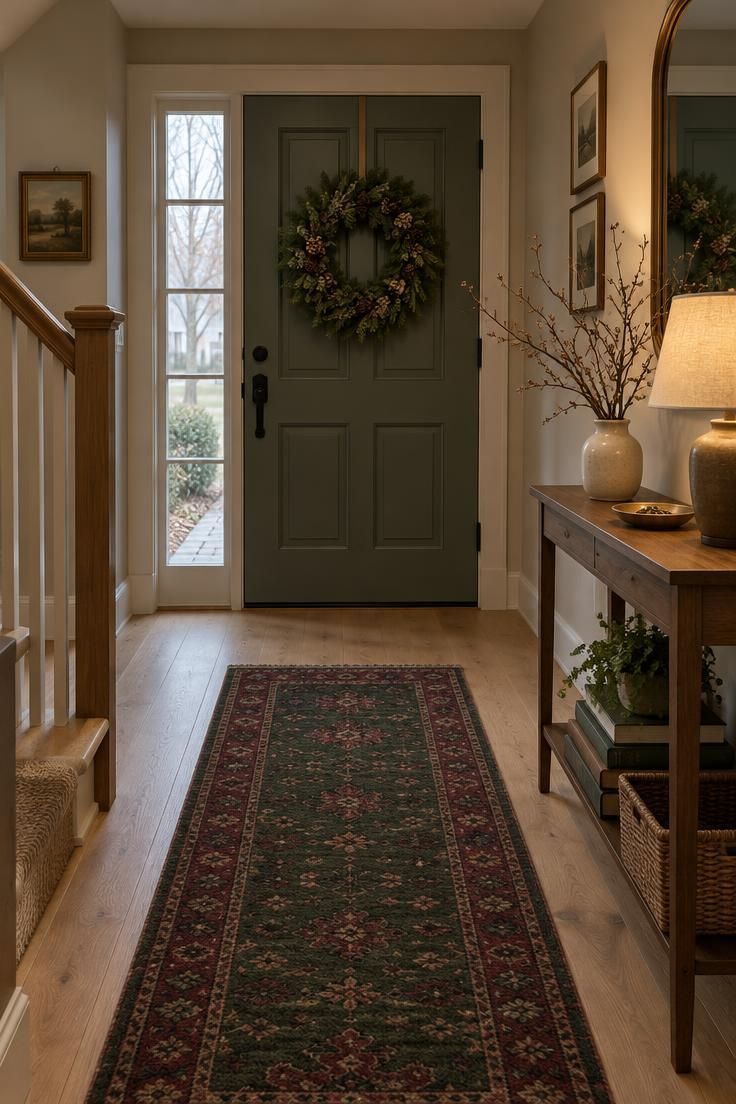
The entry is the first place a repeated signal can land, and it is worth treating as the anchor for everything behind it.
A wreath sets the expectation, and the colors and materials in that wreath can be echoed again on the tree or the mantel.
Wreath proportion is a matter of design judgment rather than rule.
Roughly one-third of the door-leaf width reads well, centered near eye level, because it leaves visible door surface on every side.
A wreath that spans most of the door can look heavy, and one that is too small can disappear.
Three material routes give the door distinct characters.
Fresh evergreen offers a natural silhouette and scent, dried naturals bring a softer, longer-lasting palette, and a minimal ring with a single asymmetrical bunch reads modern and spare.
Each has its own upkeep, from watering to careful storage.
Moving indoors, a console with one low arrangement, a catchall dish, and one warm light is enough.
The goal is an echo of the door rather than a second performance.
Good christmas entryway decorating treats the threshold and the inside surface as one composition seen from two positions.
If only one surface in the entry can be decorated, choose the door.
It carries the greeting for every visitor and household member who walks in, and it does more work than a crowded console ever could.
Anyone learning how to decorate for christmas can begin here with a single decision that the rest of the house will follow.
Christmas Mantel Arrangement Ideas That Work as One Horizontal Composition

A mantel reads best as one line rather than a collection of objects.
The eye should travel along the shelf and find a rhythm, not stop at five unrelated focal points.
Start with a base run of greenery or a simple cloth that spans the shelf and gives the composition a floor.
A low garland keeps the line horizontal and leaves room above it for the vertical element that follows.
Candles at varied heights create a cluster rather than a row, and the differences in height do more for visual interest than differences in color.
Three heights grouped together read as one gesture.
One vertical interruption, such as a mirror, a framed print, or a tall branch, breaks the horizontal and gives the arrangement a center of gravity.
More than one competing vertical usually splits attention.
Two approaches cover most rooms.
A dense layered mantel stacks greenery, candles, and small ornaments along the full shelf for a full, traditional look.
A sparse single-gesture mantel uses one run of greenery, one candle cluster, and one vertical element, leaving visible gaps that let the shelf itself show.
Above a working fireplace, fresh greenery dries out quickly and drops needles near the hearth.
Matte faux greenery is a reasonable substitute in that position, and its finish reads convincingly at a distance.
The tradeoff is focus.
A mantel holds together when it has one hero piece instead of three competing focal points, and most of the christmas mantel arrangement ideas that work over time are versions of that single-hero logic.
Tabletop Christmas Trees That Give Compact Rooms a Focal Point Without Claiming Floor Space
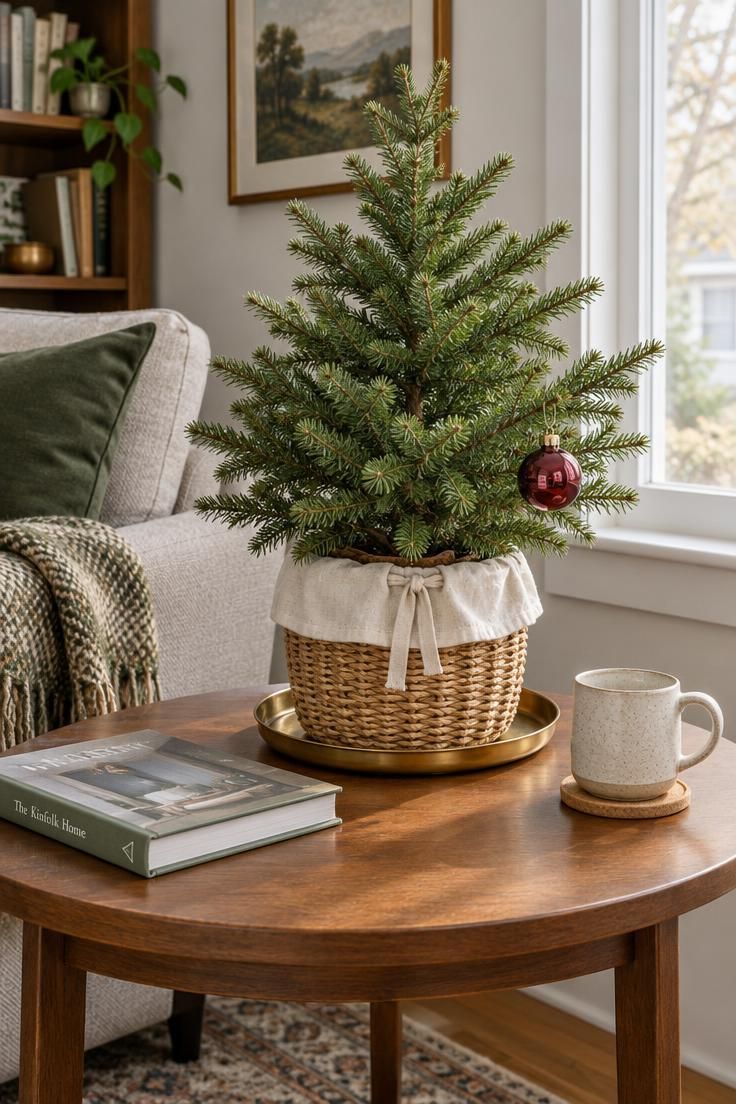
Rooms where floor space is already spoken for can still hold a tree, as long as the tree lives on a surface rather than in a walkway.
The best small space christmas tree ideas start with the surface, not the tree.
A small living tree set on a side table or credenza, finished with a simple fabric skirt, brings the ritual of a full tree into a compact footprint.
The skirt hides the container and gives the tree a deliberate base.
A sculptural branch arrangement hung on a wall hook suits a room where a standing tree would block movement.
It uses vertical wall area that is otherwise empty and keeps the floor entirely clear.
Three miniature trees clustered on a tray at varied heights create a small forest with more presence than one tiny tree alone.
The tray groups them into a single object, which reads as intentional.
Visual weight matters at this scale.
A smaller tree needs a deliberate base or container, such as a basket, a crock, or a weighted stand, to feel anchored rather than incidental on the table.
Choose the surface first, then size the tree to leave room for that surface's normal function.
A tabletop piece reads best when one surface is dedicated to it rather than competing with everyday clutter, so clearing the mail and keys matters as much as choosing the tree.
Fresh, Dried, or Faux: Material Tradeoffs for Greenery and Wreaths

Three material routes dominate greenery decisions, and none of them wins outright.
Each brings a different relationship between upkeep, appearance, and storage.
Fresh greenery offers a natural scent and silhouette that nothing else matches.
It also needs watering, sheds needles, and declines faster in heated rooms, which makes placement near a heat source a poor fit.
Dried materials, from eucalyptus to preserved citrus and pinecones, hold a longer life and a softer, muted palette.
They fade in direct sun and dislike damp conditions, so a sheltered spot away from windows and humidity suits them.
Faux greenery is reusable, low-maintenance, and available in convincing forms.
Matte finishes read far better than shiny plastic, which tends to catch light in a way that reveals the material.
The main choice, fresh versus faux christmas greenery, comes down to how much upkeep fits the season.
A household that enjoys watering and trimming will get more from fresh, while one that travels or prefers simplicity will get more from faux.
Form matters as much as material.
A wreath built from mixed evergreens with visible stems and varied needle lengths looks more natural than one made from uniform sprigs, regardless of whether it is fresh or faux.
For a cohesive home, apply the same material family across rooms, or change material family deliberately at a threshold such as the front door.
Mixing fresh and faux at random within one sightline tends to show.
Maintenance is the real tradeoff.
Fresh requires a watering schedule and needle cleanup, while faux requires storage space for eleven months of the year.
Design Pro-Tip: Keep a short written list of the greenery placements and palette notes after the season ends, then use that list next year to repeat the arrangement without starting from scratch.
Why the Stairwell and Hallway Are Where a Single Large Gesture Works Better
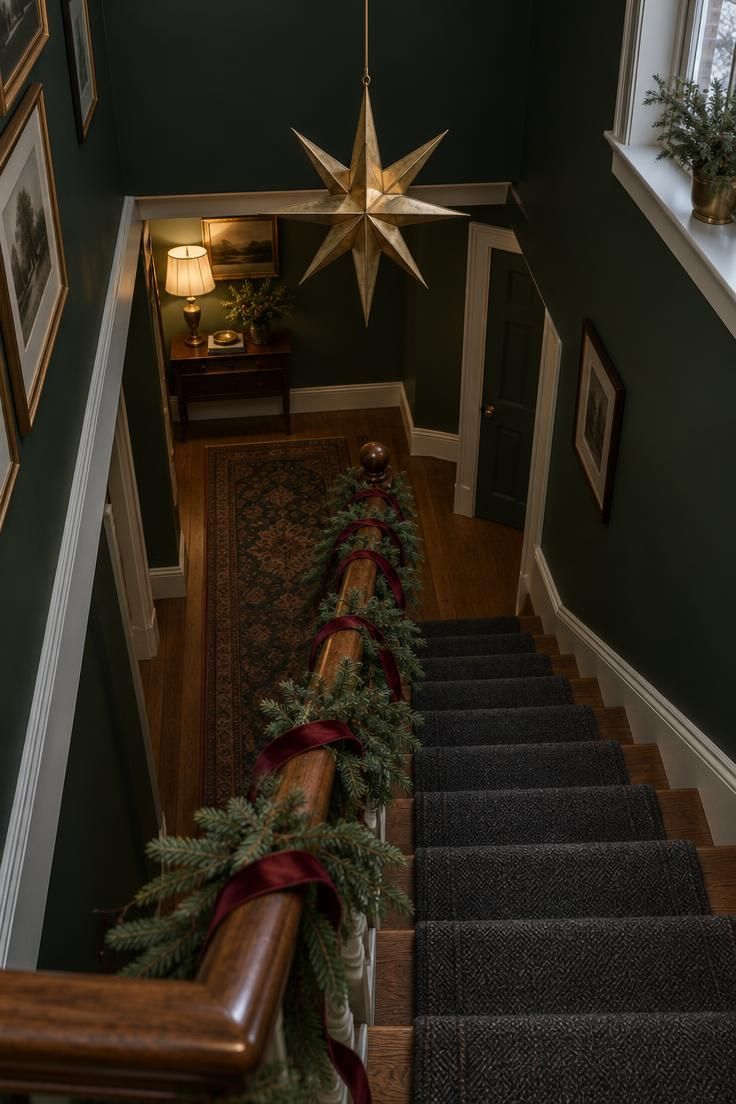
Stairwells and long hallways hold tall volumes that small decorations cannot fill.
One large object, such as a big star, a suspended hoop, or an oversized branch arrangement, can own that space better than a cluster of small items.
This large gesture should repeat a color or material from the entry or the tree, which is what keeps it inside the scheme rather than beside it.
A brass star that echoes a brass tray at the door connects two rooms across a floor.
In a small hallway, a wall-mounted or hanging piece keeps the floor clear and preserves movement through a narrow passage.
Height becomes the usable dimension.
The tradeoff is storage.
Large pieces are harder to store for the rest of the year, so it helps to choose one that can be packed flat or hung in a closet.
A Holiday Decor Decision Sequence That Prevents Clutter Before It Starts
A short sequence worked through in an afternoon can prevent most of the clutter that builds over a season.
The order matters, because each decision narrows the ones that follow.
First, pick one lead piece and let it supply the palette.
Second, pull two or three colors plus one metallic from that piece.
Third, choose one material family for greenery and decide where, if anywhere, the family changes.
Fourth, decide the one decorated surface in each room, and stop there.
Fifth, assign one light source per zone so the warm tone repeats from room to room.
Skipping a step tends to produce visual noise.
Buying before choosing a lead piece scatters the palette, and decorating several surfaces per room defeats the restraint the sequence is built around.
The annual cycle of unpacking and repacking is a natural moment to prune.
Decorations that no longer fit the palette can be passed on before anything new comes in, which keeps storage manageable and the scheme sharp.
The tension from the start returns here: editing before adding is the central method.
A home that feels decorated rather than filled has been through this sequence in some form, whether in one afternoon or over several seasons.
Conclusion
A cohesive Christmas home comes from choosing one lead decoration, repeating a small set of colors and materials, and leaving negative space in each room.
The result looks deliberate from the front door to the top of the stairs without every surface holding an object.
Work through the decision sequence in order: lead piece, palette, material family, one surface per room, one light source per zone.
Start with the first step today by placing your lead piece where you can see it, then pull its colors into a short list.
The one thing to try first is the doorway test: stand in each entry and look toward the next decorated zone.
Whatever repeats is your scheme.
Whatever competes is what to edit.