This post may contain affiliate links. If you make a purchase through these links, we may earn a commission at no additional cost to you.
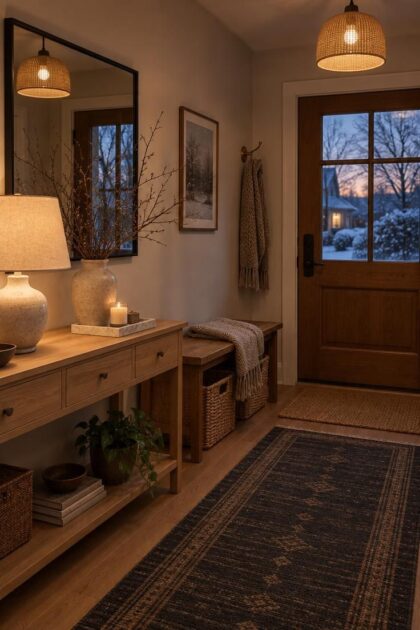
A winter entryway has a demanding job: it meets wet boots, heavy coats, and dark afternoons without losing the sense of welcome that a home should offer at the door.
The most useful seasonal styling leans on texture, layered light, and gathered natural materials rather than a shelf full of holiday objects.
A narrow console, a bench, a row of hooks, and a warm rug can carry most of the work.
The ideas below focus on practical arrangements that handle the mess of the season while still reading warm and considered.
Each one stays within the footprint of a real landing zone, so the result feels lived in rather than staged.
Chunky Knit and Faux Fur Console Styling
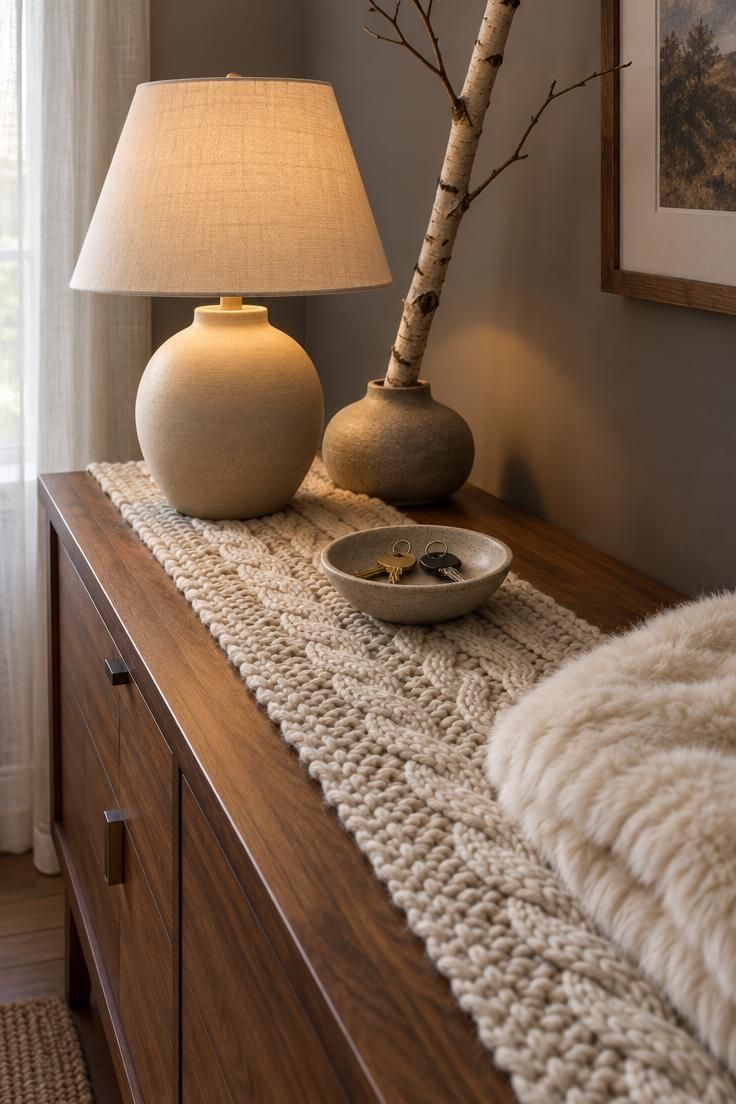
Textured layers give an entry console a seasonal identity without relying on anything overtly holiday-themed.
A knit runner softens the hard surface and gives the lamp and bowl a defined base, while the folded faux fur adds volume at one end.
Keeping the arrangement to a lamp, a bowl, and one natural element leaves visual breathing room.
The tradeoff is upkeep.
Faux fur and chunky knits collect dust and lint, and they sit exactly where wet sleeves and bags pass through.
Shake them out regularly, and keep the textile layers toward the back half of the console rather than at the edge nearest the door.
Tone matters as much as texture here.
A neutral palette of cream, oatmeal, and warm wood lets the lamp shade carry the only strong warm glow, which keeps the composition calm instead of busy.
That restraint makes this winter entryway decor easy to live with through the whole season and simple to shift toward spring later.
Depth is the quiet decision point.
A shallow console keeps the walkway clear, and a narrow runner sized to the console top avoids overhang that catches sleeves.
If the top surface is small, drop the bowl and let the lamp and throw do the work.
Style Blueprint:
- Chunky cream knit runner sized to the console top
- Matte ceramic lamp with a linen shade
- Ivory faux fur throw folded at one corner
- Small stoneware key bowl
- Single birch branch in a low matte vase
Eucalyptus and Berry Wreath Above a Bench
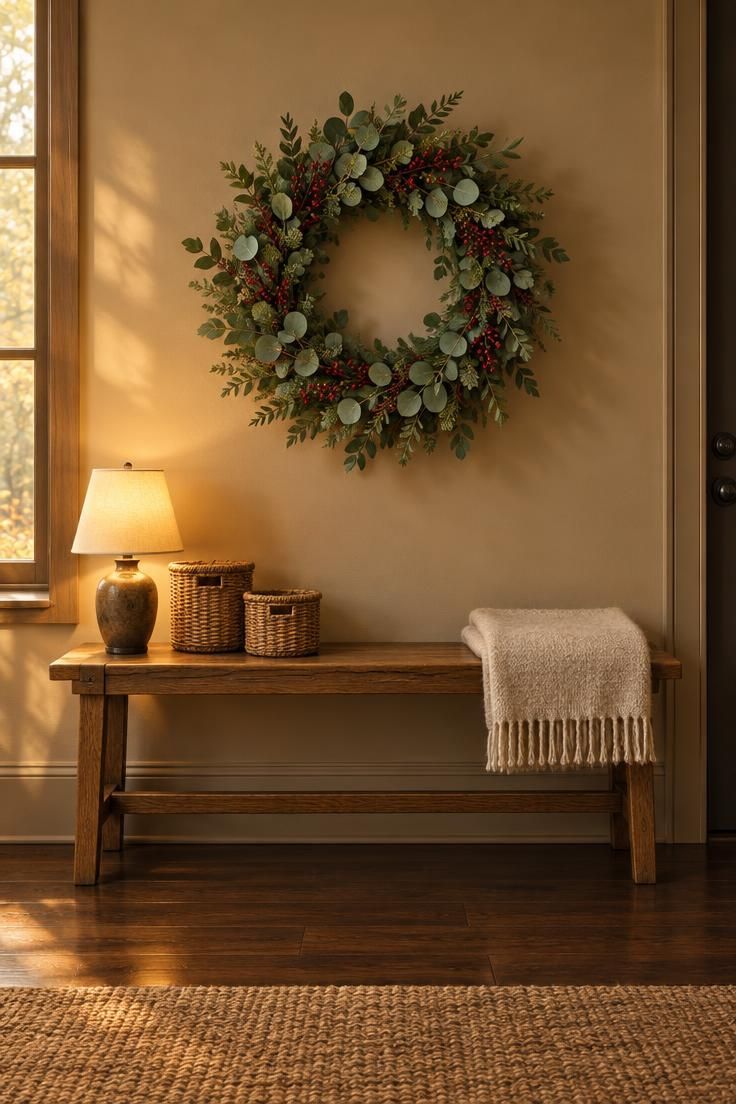
A generous wreath above a cozy entryway bench turns a plain stretch of wall into the room's focal point.
Mixed green tones and muted berry sprigs read seasonal without tipping into holiday decoration, so the arrangement can stay up from the first cold week into late winter.
The bench below stays useful: a folded throw invites a pause, and two baskets absorb gloves and small gear.
Dried eucalyptus sheds a little as it ages, and the flakes land directly on the bench below.
A washable throw or runner beneath the seating area makes cleanup simple, and shaking the wreath occasionally keeps the shelf and floor tidier.
Balance the wreath's width against the bench rather than the wall.
Slightly narrower than the bench reads intentional; noticeably wider starts to feel top-heavy.
The lamp at one end offers a second light source at a different height, which gives the corner depth in the evening.
Style Blueprint:
- Eucalyptus wreath with mixed greens and berry sprigs
- Wooden bench with a painted or stained finish
- Folded oatmeal wool throw
- Two small wicker baskets
- Compact table lamp with a warm shade
Galvanized Boot Tray with Pebble Base
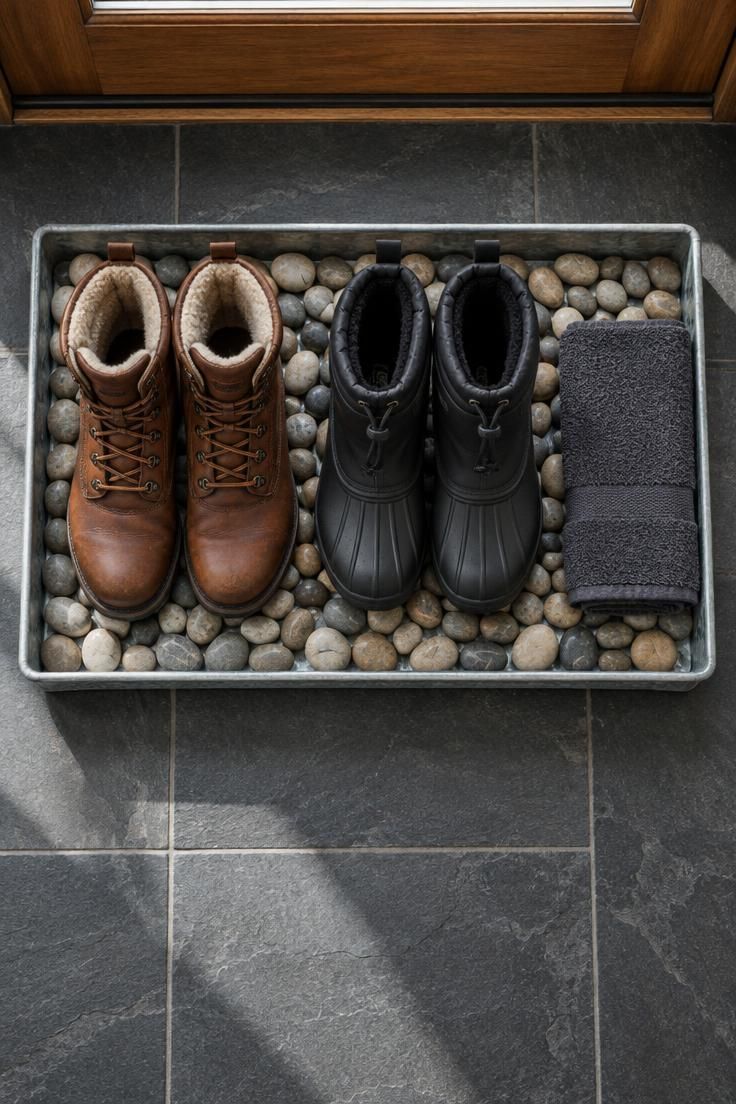
A galvanized tray filled with river pebbles turns the messiest corner of the entry into a composed winter station.
Boots rest on the stones rather than in a puddle, and the gray and beige mix picks up the tones of slate, concrete, or dark tile.
A folded towel in one corner handles the practical part without looking like an afterthought.
Boot tray styling works best when the contents are edited.
Two pairs of boots and one towel read deliberate; five pairs read like a pile.
Households with several boot sizes can shift the pebbles to suit different footprints, which keeps the tray adaptable through the season.
Keep delicate textiles away from this zone.
Water flick from wet soles can reach a nearby runner or curtain, and salt residue is hard on wool and linen.
A hard floor with a washable mat nearby suits the tray better than anything soft.
The pebbles need occasional rinsing, since grit and salt collect between the stones.
Lifting the tray to empty it every week or two keeps the surface from looking dull.
Style Blueprint:
- Rectangular galvanized metal tray
- Bag of smooth river pebbles in mixed gray and beige
- Folded charcoal towel
- Dark slate or concrete floor surface
- Boots in leather and rubber finishes
Brass and Wood Wall Hooks with a Wool Scarf
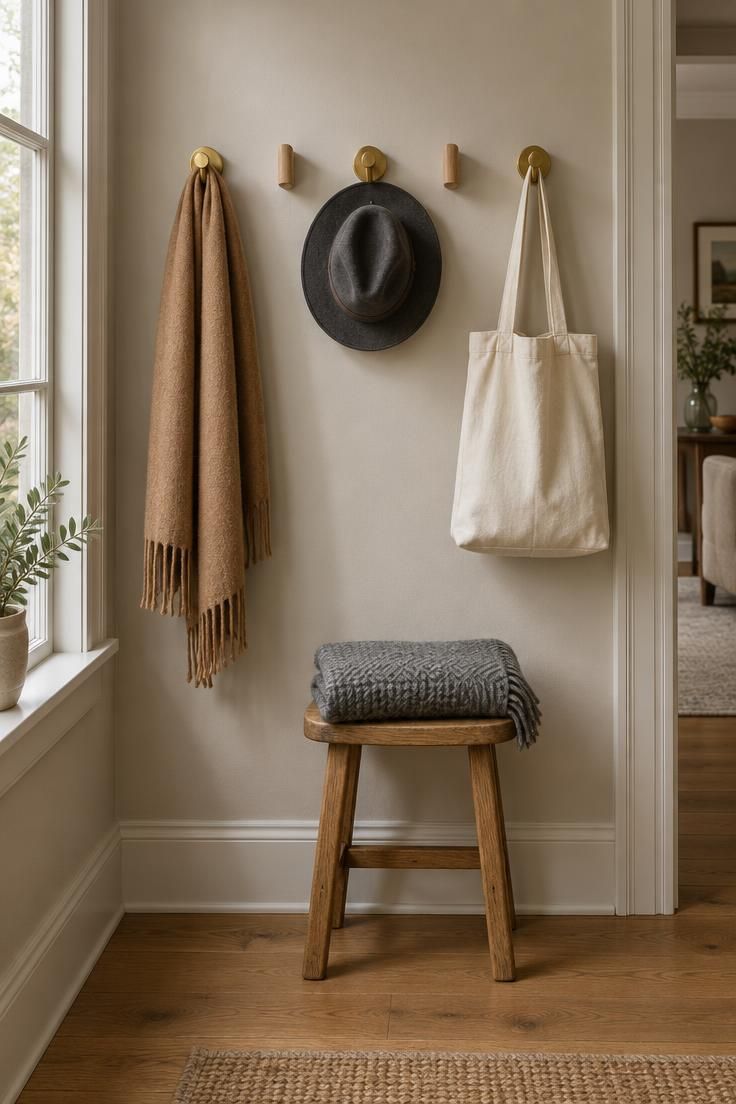
A short run of hooks can carry an entire entryway when the hardware itself is treated as part of the design.
Alternating brass and light wood creates a rhythm along the wall, and the repetition reads as intentional even when only a few items hang there.
A single chunky scarf, a felt hat, and a canvas tote give the arrangement color and softness.
Limiting the display to one or two pieces per hook keeps the wall calm during heavy outerwear weeks.
The temptation is to fill every hook, and the result quickly turns into a jumble of straps and sleeves.
Editing the arrangement each morning takes seconds and keeps the composition legible.
This approach suits small entries especially well, since the wall holds the storage and the floor stays clear.
A low stool at the base adds a place to sit without blocking the path.
Mixed metals need a little attention over time.
Brass darkens with handling, which many people like, and a soft cloth now and then keeps the wood clean.
Wipe the hooks where damp scarves rest so the finish stays even.
Style Blueprint:
- Five wall hooks alternating brass and light wood
- Thick camel wool scarf
- Charcoal felt hat
- Natural canvas tote
- Small wooden stool with a folded gray knit blanket
Layered Runner and Jute Doormat
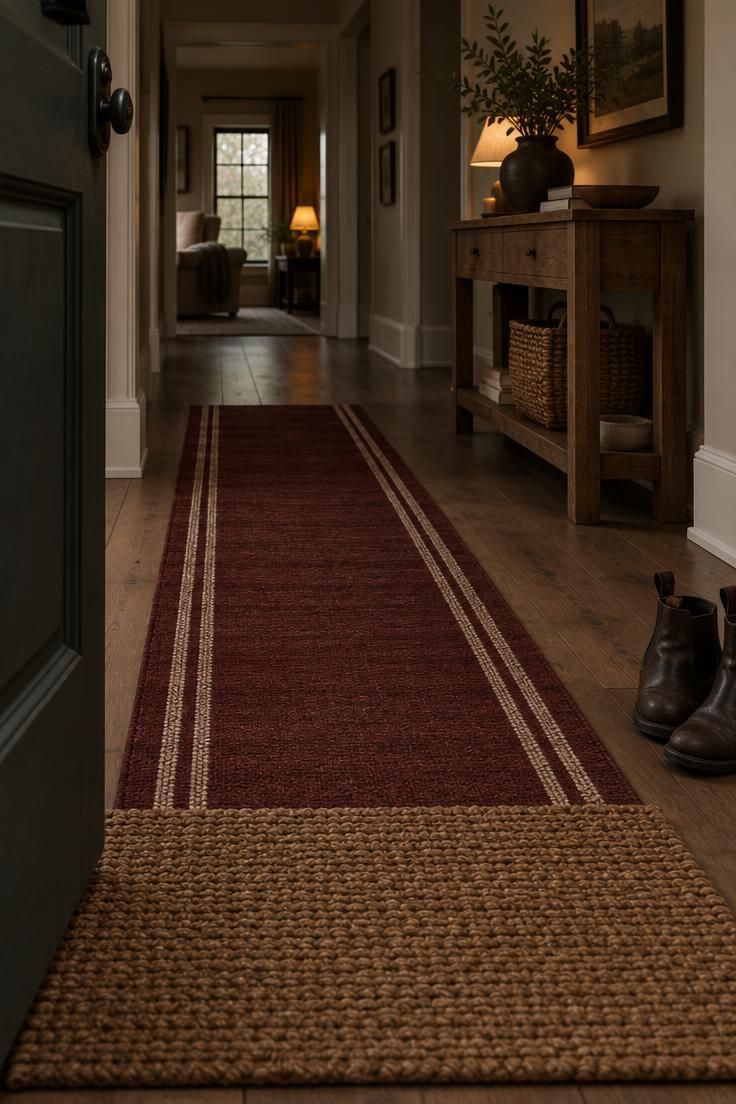
Two mats in different weaves do more than one mat alone.
The wide jute layer at the door catches most of the slush and grit, and the runner continues the welcome farther into the room with color and a flatter, softer surface underfoot.
The visual effect comes from the contrast between rough natural fiber and the tighter weave above it.
Choose a runner with a low-pile, dark-toned pattern if salt marks are a concern between washes.
Dark red, charcoal, or deep green hides the white residue that pale mats show immediately, and cream stripes keep the pattern from feeling heavy.
Stack height is the practical constraint.
A thick layered pile can catch a door that swings inward, so keep the combined height minimal and position both mats well clear of the door's arc.
A thin jute base and a flat runner solve this more gracefully than two plush layers.
On the lighting question, layered entryway lighting applies as much to the floor as the walls.
A low lamp or a warm fixture nearby brings out the texture in the jute and keeps the runner from disappearing into shadow on dark afternoons.
Style Blueprint:
- Wide natural jute doormat
- Narrow dark red flatweave runner with cream stripes
- Low-pile, washable construction
- Dark leather boots placed beside the mat
- Warm nearby lamp or fixture
Dried Magnolia and Dried Citrus Stem Vase
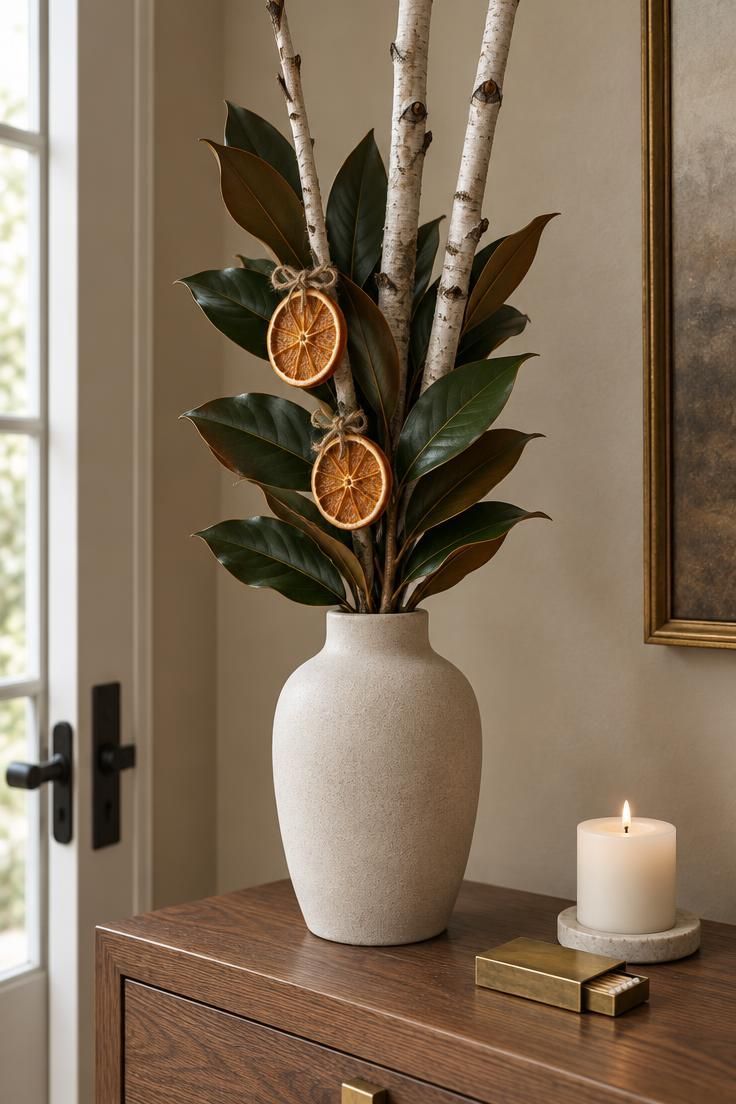
A tall vase of preserved magnolia, dried citrus, and bare branches gives an entry console strong vertical presence without the fuss of fresh flowers.
The dark leaves contrast with the pale stoneware, and the dried orange slices add a small warm accent that reads seasonal through the darker months.
Preserved materials need little water and hold their shape for weeks, which suits a busy landing zone.
Magnolia can darken or curl over time, so rotate stems or replace single pieces rather than restyling the whole arrangement.
That approach stretches the display from early winter into early spring.
Arrangement matters more than volume here.
A few tall stems with space between them look intentional; a dense bundle looks like a hedge.
Keeping the branch tips below eye level preserves sightlines across the entry.
Entryway console styling benefits from editing the surrounding objects as carefully as the vase itself.
One candle and a brass matchbox keep the surface feeling composed, and they leave room for keys or mail when the day demands it.
Consider the vase's base before choosing stems.
A narrow opening holds branches upright without fuss, while a wide mouth needs the stems gathered and tied.
Matching the opening to the arrangement saves daily adjustments.
Style Blueprint:
- Matte cream stoneware vase with a narrow opening
- Preserved magnolia leaves
- Dried orange slices tied with jute twine
- Three slim birch branches
- Small white pillar candle and brass matchbox
Design Pro-Tip: For the tightest-looking small entry, choose one tall vertical element and keep the surrounding surface nearly bare. Height does the decorating, and the empty space keeps the walkway feeling open.
Black-Framed Mirror with a Mini Boxwood Wreath
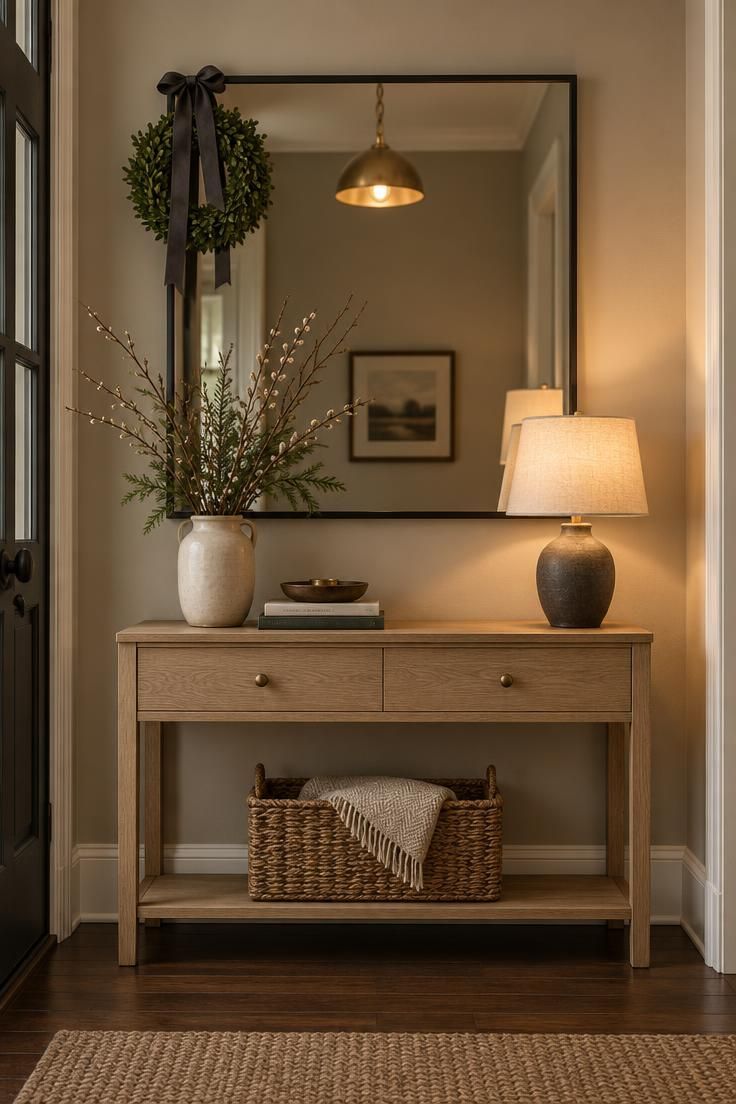
A black-framed mirror above the console does two visual jobs: it reflects the room back into the entry, and it makes a narrow space feel less closed in.
A mini boxwood wreath at one upper corner adds a single seasonal note without covering the glass.
Entryway wreath ideas often center on a large statement piece, and a small wreath is the quieter alternative.
Its scale keeps the mirror useful for a last glance before heading out, and the charcoal ribbon ties the black frame to the greenery.
Fresh boxwood lasts only a few weeks indoors before it dries, which is fine for a short seasonal accent.
If low maintenance matters more, a preserved boxwood wreath holds its color far longer and can move to another spot in the house afterward.
Position the wreath to avoid blocking the reflection where people check their appearance.
The upper corner leaves most of the glass clear, and it keeps the composition asymmetrical in a way that feels natural rather than fussy.
Style Blueprint:
- Rectangular black metal mirror
- Small boxwood wreath
- Charcoal ribbon
- Light oak console beneath
- Simple vase of winter branches
Pillar Candle and Lantern Cluster by the Door
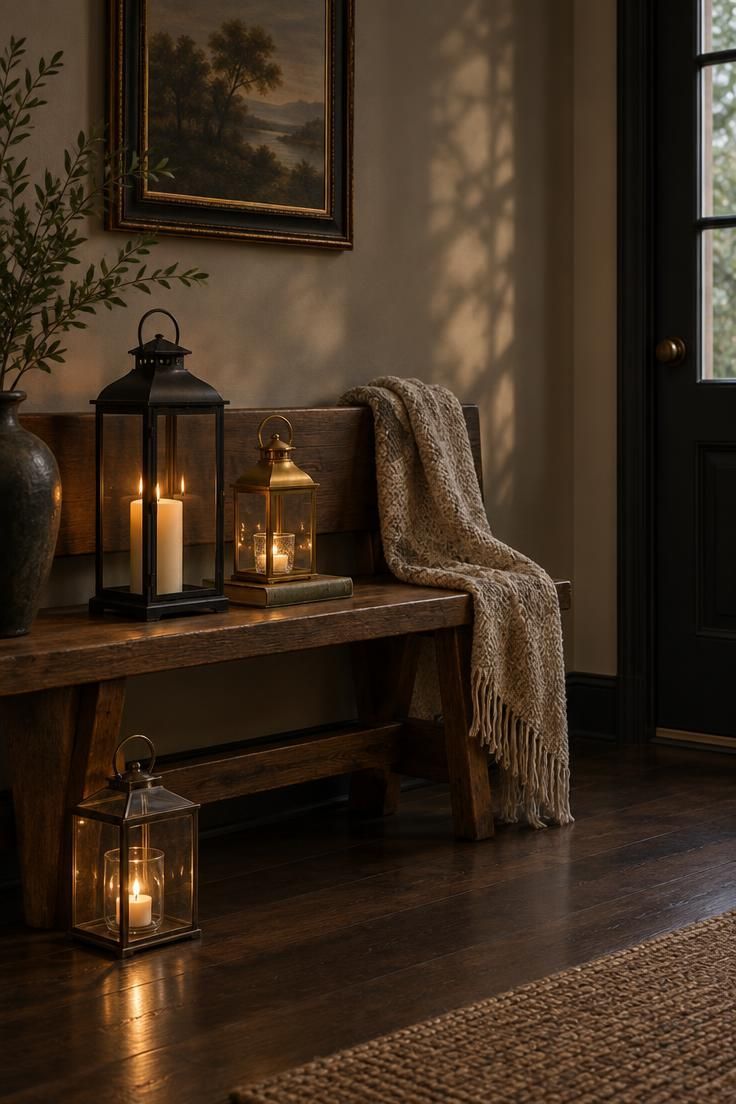
A cluster of lanterns near the door gives early evenings a warm anchor.
Staggered heights and mixed finishes of black iron, brass, and glass create depth, and the glass panels let the light move across the wall in a way a single fixture cannot.
Place lantern clusters away from the path where people move in and out, and keep them clear of hanging coats and door drafts.
Keep an eye on any lit candle and put flames out when leaving the room or settling in for the night.
Unscented pillars keep the entry neutral for guests and avoid competing with whatever is cooking.
The practical side of this idea is flexibility.
Battery-operated pillars suit households with young children or pets, while wax pillars give the quieter, softer glow that many people want in winter.
Either version benefits from a few books or a small tray beneath the group to define the composition.
Scale the group to the corner.
Three lanterns in mixed sizes read as a designed moment; six start to look like a shop display.
Style Blueprint:
- Black iron lantern with an ivory pillar candle
- Brass lantern with a glass votive
- Compact clear glass lantern
- Low wooden bench or a floor corner
- Throw draped over the bench back
Woven Floor Basket with Rolled Wool Throws
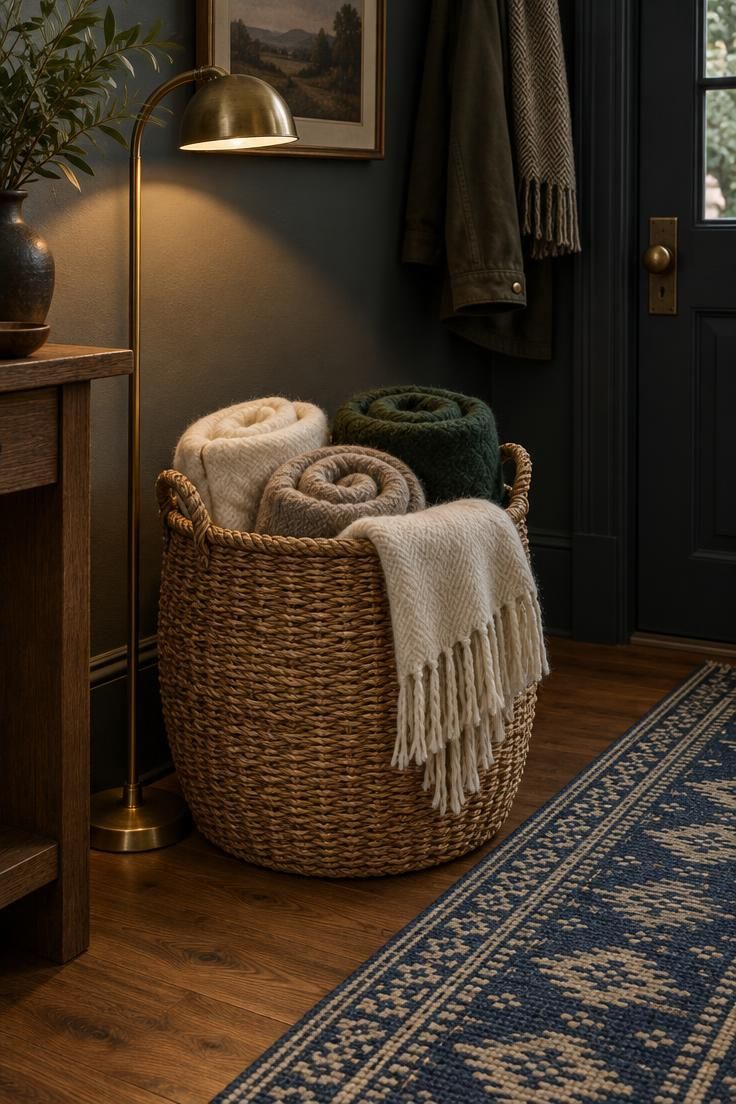
A tall floor basket of rolled throws brings volume and softness to the entry without taking up wall space.
The mix of cream, oatmeal, and forest green reads as winter through color as much as texture, and the slightly unrolled throw over the rim suggests the basket is actually used.
Choosing machine-washable wool and cotton makes daily use practical.
Throws that come in and out of the basket all season need laundering more often than decorative ones, and washable fabrics keep the arrangement from becoming precious.
Keep the basket out of the direct splash zone near the door.
Seagrass and wool both dislike steady damp, and a spot a step or two inside the landing area gives the basket a longer life.
One practical wrinkle: tightly rolled throws look best, and looser folds start to look messy after a few days.
Rolling each throw before it goes back in the basket takes seconds and keeps the display crisp.
Style Blueprint:
- Round seagrass floor basket
- Rolled wool throws in cream, oatmeal, and forest green
- Machine-washable fabrics
- Small brass floor lamp
- Blue-and-cream flatweave runner nearby
Rotating Gallery Wall with One Seasonal Print
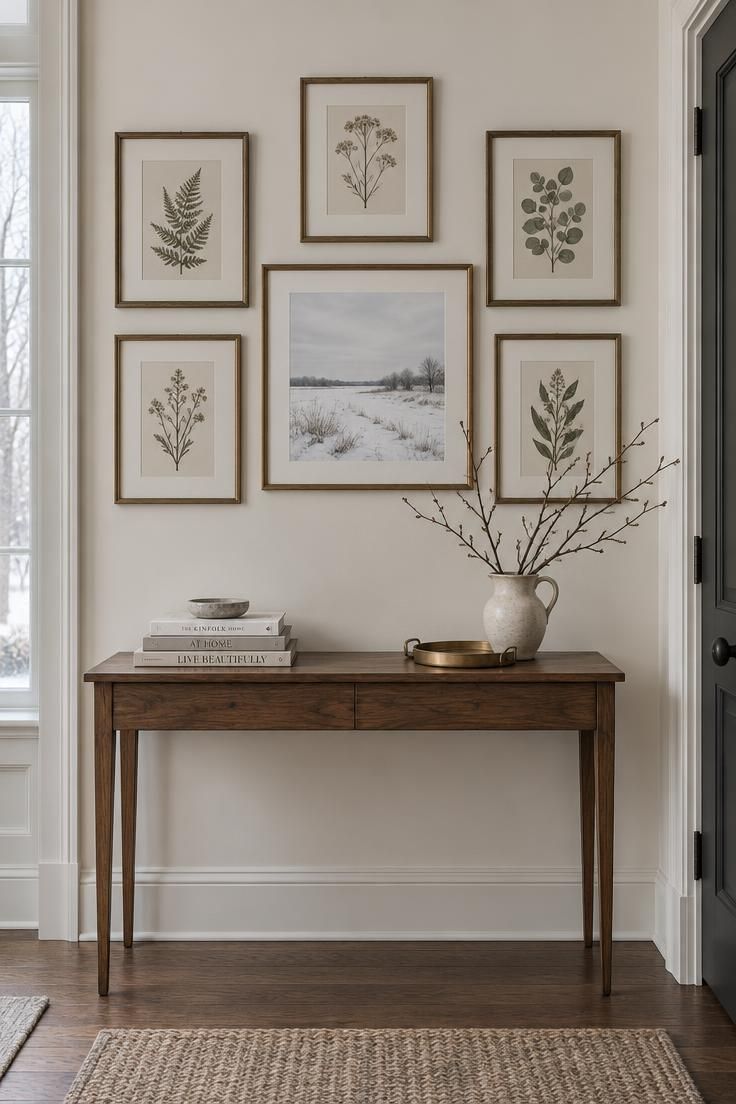
A gallery wall with a consistent frame and mat system can absorb seasonal change without a full restyle.
Swapping one or two prints for a snowy landscape, a study of bare branches, or a cool neutral abstract shifts the mood of the entry with little effort and minimal storage.
Consistency is what makes the rotation feel intentional.
Matching frames, mats, and spacing keeps the wall reading as one composition, so the seasonal piece stands out as a deliberate change rather than a random substitution.
Start with a permanent base of prints that work year-round: botanicals, simple line drawings, or quiet abstracts.
Winter pieces fit naturally into that set and can come down in favor of spring imagery later.
The console below the frames should stay calm, since the wall already carries visual weight.
A short stack of books, a pitcher of bare branches, and a tray are enough.
Anything more competes with the grid.
Style Blueprint:
- Seven matching black or wood frames
- Consistent mat color and size
- Neutral botanical prints as the base
- One or two seasonal winter prints
- Slim wood console with a light edit of objects
Scented Candle and Match Tray Vignette
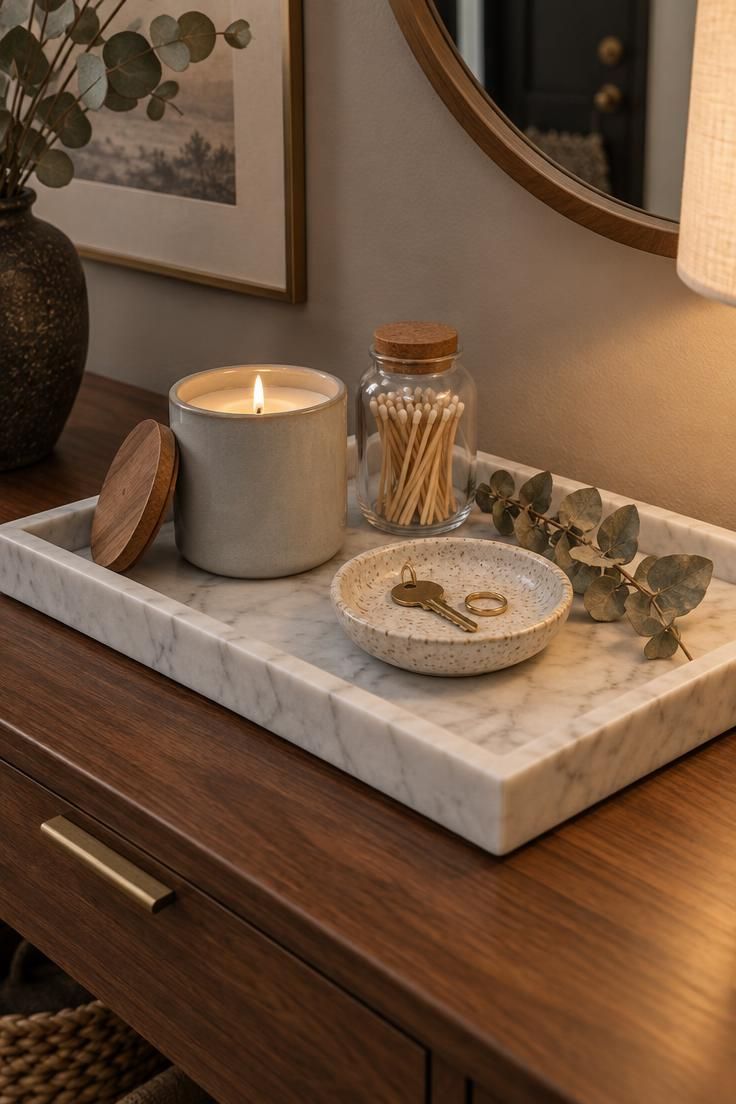
A small tray concentrates the eye on a tight cluster of objects, and it keeps a console surface from scattering.
A candle, a jar of matches, a shallow dish for keys and rings, and one dried sprig cover the essentials of a winter welcome in a very small footprint.
The scent decision deserves care.
Pine, cedar, and amber notes read seasonal and tend to suit shared spaces, while very sweet or heavy fragrances can be divisive when guests arrive.
A subtle note also leaves the room ready for cooking smells from the kitchen nearby.
This vignette works best on a console that already has a mirror or artwork above it.
The small grouping then acts as a grounded detail beneath a larger focal point rather than competing with a bare wall.
Long matches in a glass jar are the practical center of the tray.
They are easy to reach and keep the arrangement self-contained.
Style Blueprint:
- Rectangular white marble or wood tray
- Ceramic candle in a subtle pine, cedar, or amber scent
- Glass jar of long matches
- Shallow dish for keys and rings
- Short sprig of dried eucalyptus
Narrow Wall-Mounted Shelf with a Mini Drop Zone
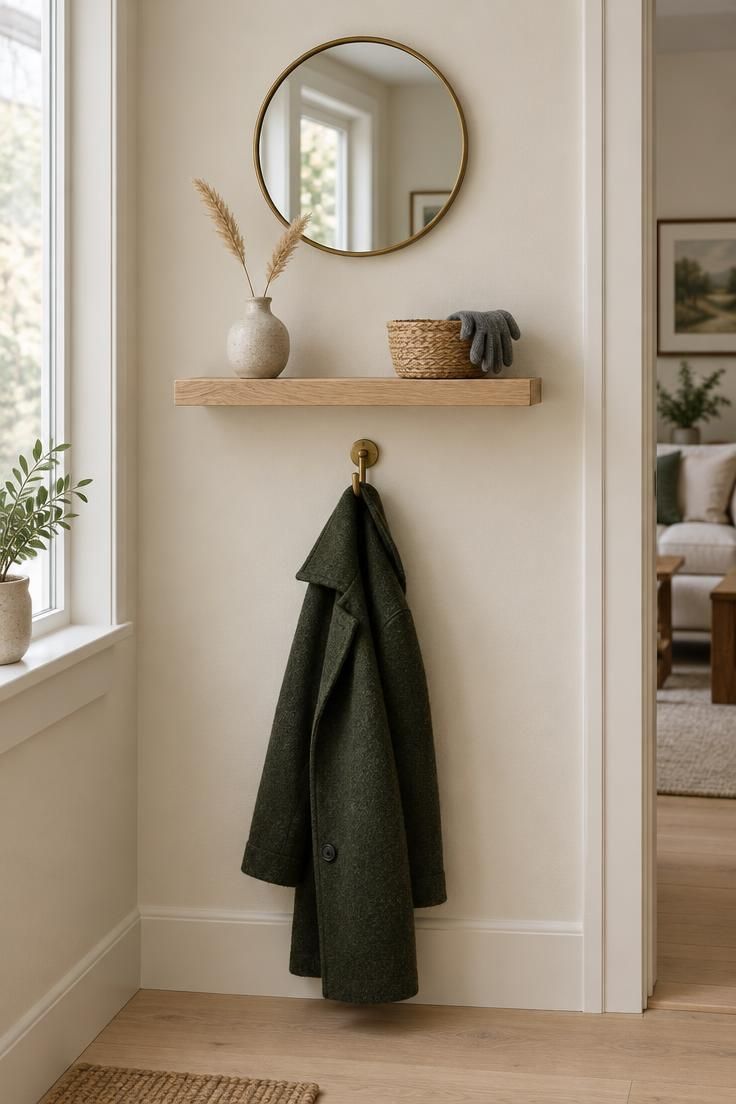
A narrow shelf at eye level turns a slim wall into a compact drop zone without taking any floor space.
A small vase of dried grasses and a miniature basket for gloves give the surface a seasonal purpose, and a single hook below holds the coat that would otherwise land on a chair.
Restraint keeps this idea working.
A small surface fills quickly, and one decorative object plus one catchall is enough.
Adding a third and fourth item turns a composed moment into a cluttered shelf within a week.
This setup suits apartments, side doors, and back entries where a full console is out of the question.
The shelf and hook carry the greeting, and a small mirror above them adds reflected light and one last check before heading out.
The arrangement stays useful when the basket has a clear purpose.
Gloves, keys, or a folded tote belong there; loose mail and receipts do not.
Emptying it each evening keeps the vignette intact.
Style Blueprint:
- Narrow light oak floating shelf
- Small stoneware vase with dried grass stems
- Miniature woven basket for gloves
- Single brass hook
- Small round mirror above the shelf
Conclusion
Winter entryway decor works when it accepts the season's mess instead of resisting it.
A layered mat at the door, a console with a warm lamp and a textile layer, a bench with a throw and baskets, and a few small natural or candlelit details cover the practical needs of a wet landing zone while keeping the greeting warm.
The most durable arrangements share a common trait: they separate the permanent base from the seasonal layer.
Mirror, hooks, rug, and console stay put, while wreaths, stems, candles, and prints rotate through the colder months.
Be willing to shake out the knits, rinse the pebbles, replace a curled branch, and clear the small surfaces as the season goes on.
That modest upkeep is what keeps the entry feeling cared for from the first frost through the last.