This post may contain affiliate links. If you make a purchase through these links, we may earn a commission at no additional cost to you.
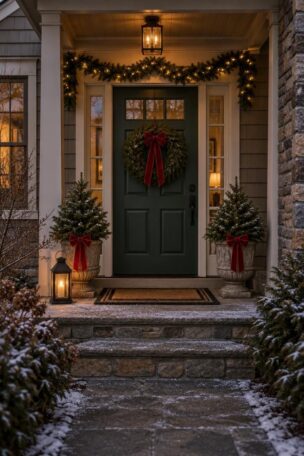
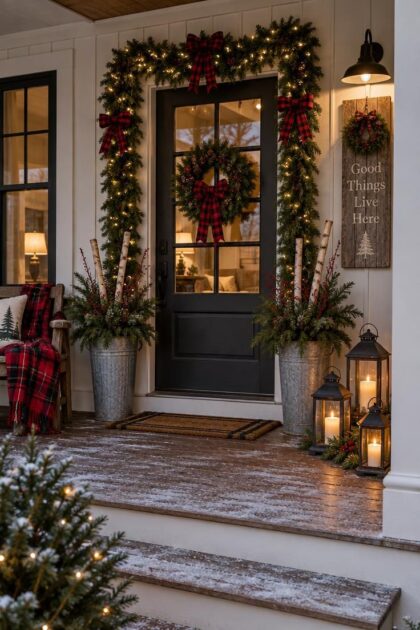
A farmhouse entry at Christmas feels gathered rather than staged, as if each piece was carried in from a shed or found at a weekend sale.
Weathered wood, matte galvanized metal, full evergreen boughs, and a simple plaid ribbon do most of the work, held together by a narrow palette of cream, deep green, and barn red.
The style suits porches and small yards because it tolerates a little wear and looks better when the greenery is loose instead of clipped.
This collection of farmhouse outdoor christmas decor ideas moves through bucket planters, lantern groupings, rustic signage, and warm white light, with notes on placement, scale, and the tradeoffs worth weighing before the first bough goes up.
Galvanized Bucket Christmas Planter by the Door
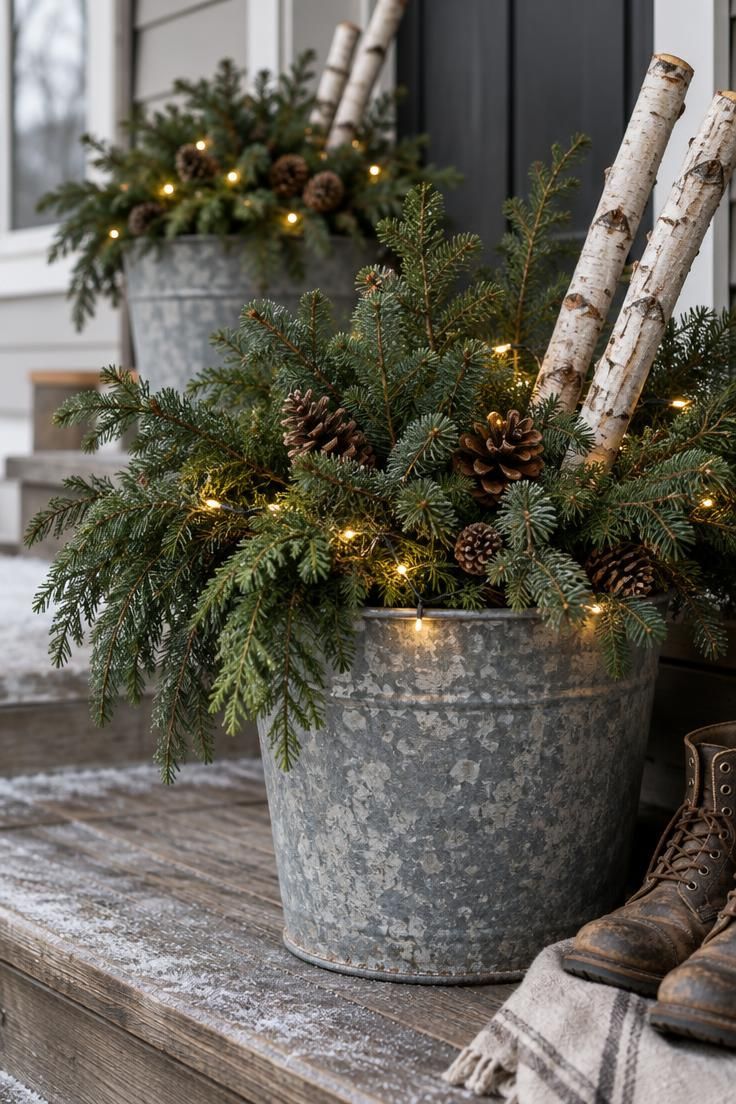
A galvanized bucket earns its place at the door because the matte, slightly mottled metal sets off soft greenery without competing with it.
Fill one with loose evergreen boughs, a few birch branches for a pale vertical note, and a cluster of pinecones pushed toward the front so the texture reads from the walkway.
A short strand of warm white lights tucked among the needles gives the entry a quiet glow after dark without turning the planter into a light display.
Placement matters more than the contents.
Set the bucket on one side of the door or at the top of a step, then add a second bucket at a different height so the pair looks collected rather than matched.
Keep the arrangement full but a little untidy, trimming only the longest stray pieces so the overall shape stays natural.
Real boughs bring fragrance and a softness that artificial greenery cannot match, though they dry out and lose needles as the season wears on.
Artificial boughs hold their color and shape from year to year, which suits a porch that sees heavy traffic or a household that decorates early.
A bucket resting directly on concrete may show rust over a season; that patina can read as weathered charm, or it can be avoided with a lighter liner set inside.
Style Blueprint:
- A worn galvanized bucket with a visible seam and dull patina
- Dark green fir boughs, pinecones, and two or three birch branches
- A short warm white light strand tucked inside the greenery
- A second bucket set lower to create an uneven pair
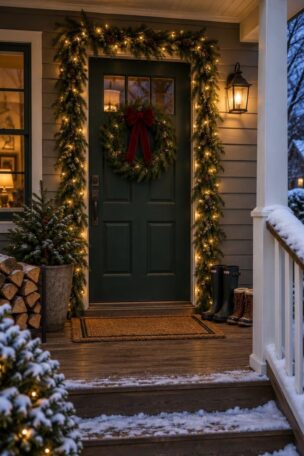
- A frost-dusted wood step and a pair of worn boots nearby
Design Pro-Tip: In a narrow doorway, use one bucket only and let a single birch branch rise above the boughs to draw the eye upward instead of sideways.
Plaid Ribbon Evergreen Garland on a Covered Porch
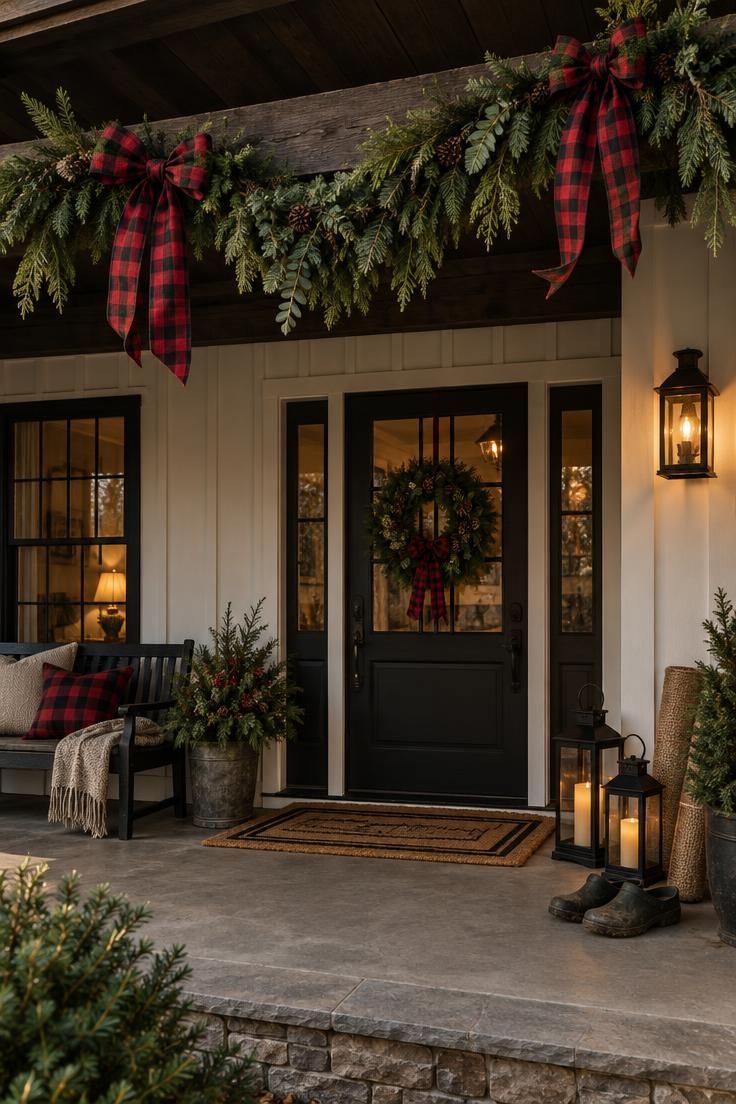
For a plaid ribbon evergreen garland, a thick evergreen garland swagged along the porch beam or framing the door gives the facade its main horizontal line.
Vary the mix with fir, pine, and cedar pieces rather than one uniform strand, so the garland looks gathered from the yard instead of pulled from a box.
Wide plaid ribbon tied in floppy bows at two uneven points adds the pattern accent, and keeping it to a single red-and-black or red-and-cream plaid prevents the porch from tipping into visual noise.
Warm white lights run through the garland if the porch is visible from the street, since the soft glow ties the greenery to the rest of the entry.
Real garland brings fragrance but sheds as it dries; artificial garland holds up across seasons and can be reshaped each year.
Changing the ribbon color or width is the fastest way to refresh the same base without buying new greenery.
Route the garland so it clears the door swing and any porch screen.
A swag that brushes a door seal or catches on a screen loses its tidy line quickly, and a small gap at the hinge side keeps the arrangement looking deliberate.
Style Blueprint:
- A mixed fir, pine, and cedar garland with slight asymmetry
- One red-and-black plaid ribbon in a wide width
- Two floppy bows placed at staggered intervals
- Warm white lights woven through the needles
- Black metal lanterns set below on a jute mat
Rustic Wooden Christmas Sign Paired with a Simple Wreath
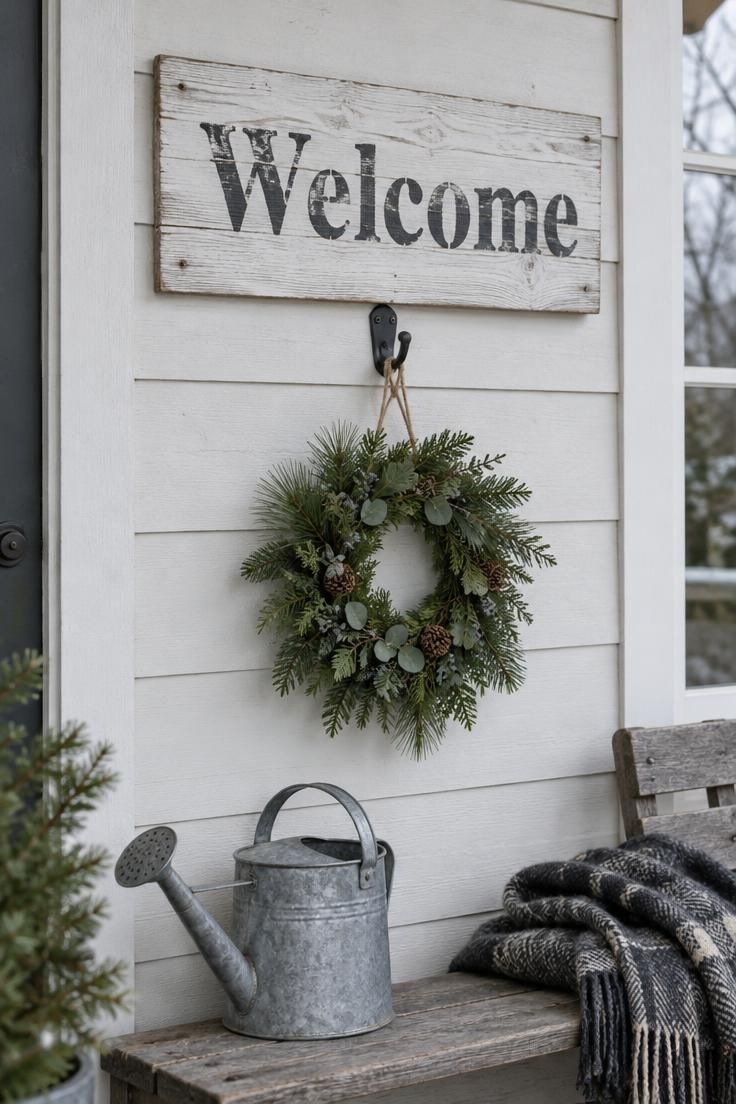
For a rustic wooden christmas sign, a hand-finished wooden sign with a short seasonal phrase in low-contrast paint or stencil works best when it shares a focal area with something living.
Place it above or beside the door, then hang a smaller evergreen wreath on a single nail nearby so the two pieces read as one composition.
Let the sign be weathered or whitewashed with visible grain rather than perfectly smooth, since the texture is half the appeal.
One or two words carry farther than a longer message, which can look busy from the street.
Stand at the sidewalk or the end of the driveway and check whether the lettering is legible from that distance before committing to a phrase, because text that reads clearly up close may vanish from the curb.
The wreath should stay a little sparse at the bottom so it does not cover the lettering.
Swapping pinecones for a small red berry sprig changes the mood without repainting anything, and that small edit keeps the same sign feeling fresh from one season to the next.
Style Blueprint:
- A whitewashed or weathered wood sign with visible grain
- One or two words in low-contrast stenciled paint
- A small mixed evergreen wreath hung on a black metal hook
- A jute twine loop and slightly uneven placement
- A galvanized watering can or wool scarf nearby for lived-in texture
Design Pro-Tip: Choose lettering a shade darker than the wood rather than stark black, so the sign looks salvaged from a barn wall instead of newly printed.
Lantern Cluster Porch Display with Foraged Greenery
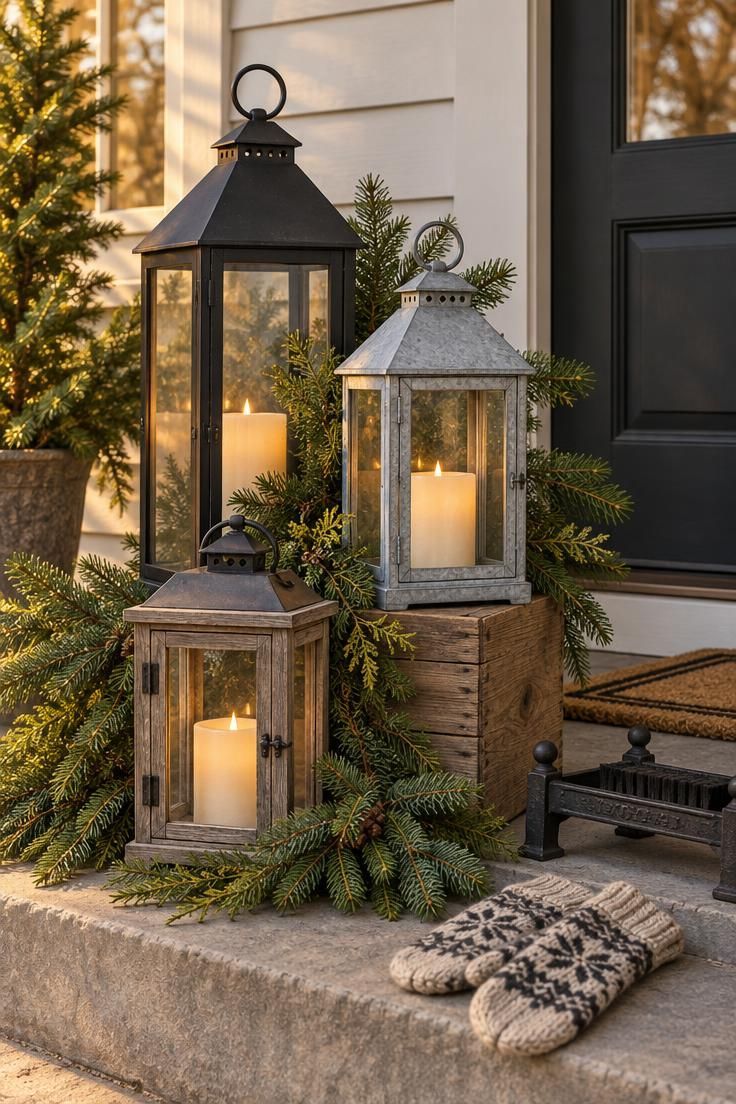
Group three lanterns of different heights and finishes on the porch floor, the steps, or a low wooden crate, then nestle fresh evergreen sprigs between them and around their bases.
For a lantern cluster porch display, choose one lantern in black metal, one in aged galvanized, and one in a weathered wood or glass combination so the cluster looks assembled over time rather than bought as a set.
Odd numbers read more informal than a pair, and raising one lantern on a brick or small crate keeps the grouping from sitting as a flat line.
If the lanterns hold candles, battery-powered flameless options give a steady glow that suits an unattended porch.
Empty lanterns can be filled with a small ball of greenery inside two of them so the cluster stays full even when the light source is subtle.
The sprigs may need refreshing if they sit in direct sun, and the whole arrangement takes only minutes to shift when the season changes.
Style Blueprint:
- Three lanterns in black metal, galvanized, and weathered wood
- A small wooden crate to raise the middle lantern
- Fir and cedar sprigs tucked between and around the bases
- Flameless candles for a steady glow
- A nearby pair of mittens or boot scraper for everyday texture
Dried Orange Slice Wreath with a Loose Burlap Bow

A mixed evergreen or twig wreath layered with dried orange slices, cinnamon sticks, and a few cotton stems gains a matte, natural accent that suits the farmhouse palette.
Cluster the orange slices in groups of two or three rather than spacing them in a perfect ring, since uneven placement keeps the wreath from looking like a craft kit.
A wide burlap bow at the bottom or slightly off to one side finishes the piece, and long ribbon tails look more relaxed than short trimmed ends.
Dried citrus darkens over time and can draw small insects if it stays wet, so a covered porch or a sheltered door is a practical spot.
On a fully exposed door, painted wooden slices can stand in for the real fruit and keep their color through rain and wind.
Keep the palette to warm neutrals and a little greenery so the wreath works as a standalone piece or as a layer above a simple sign or lantern.
The result is a handmade dried orange slice wreath that reads as made rather than bought.
Style Blueprint:
- A mixed evergreen or twig wreath base
- Dried orange slices in uneven clusters of two or three
- A few cinnamon sticks and cotton stems tucked in
- A wide burlap bow with long, untrimmed tails
- A sheltered door or covered porch spot
Design Pro-Tip: Dry the orange slices slowly in a low oven and flip them once, so they keep a deeper amber color instead of browning at the edges.
Warm White Lights Woven into a Porch Railing Planter
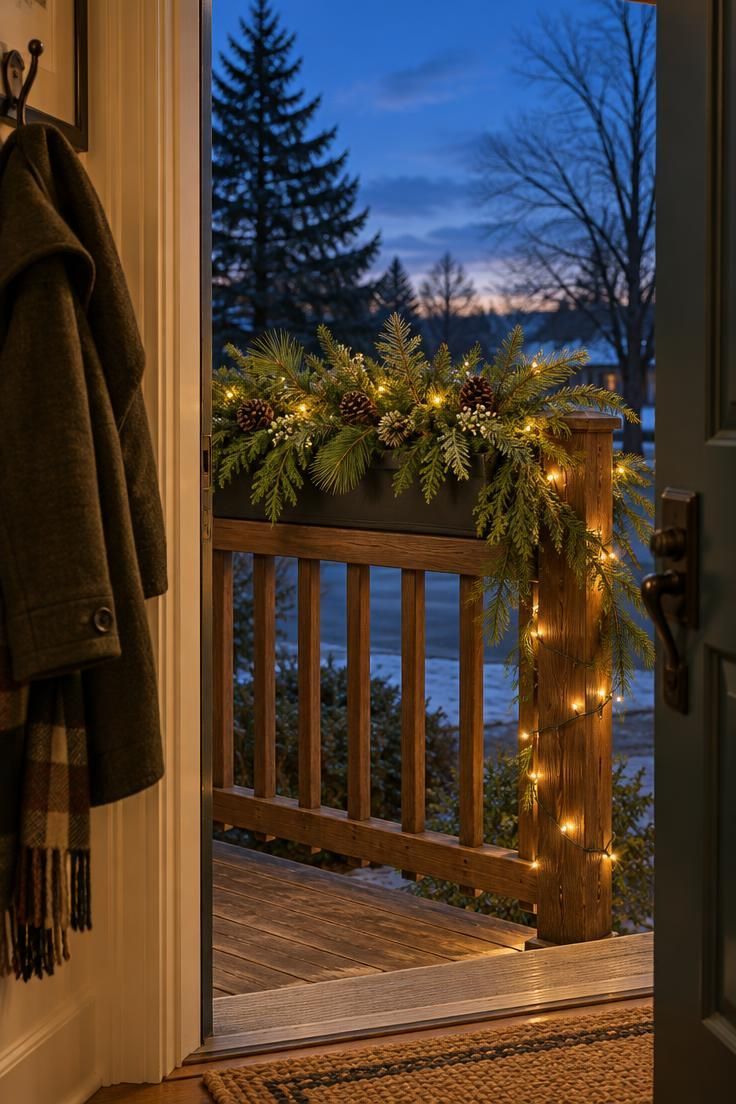
A long, narrow planter box set on the porch railing and filled with thick evergreen branches and small pine cones gives the entry a continuous line of greenery.
Weave a strand of warm white lights through the greens so the bulbs sit partly hidden, then let the strand travel down the rail post in one path to keep the glow coherent.
Warm white reads as candle-like and suits the farmhouse mood, while bright white or multicolor leans more commercial.
A timer or remote lets the lights come on at dusk without a daily plug-and-unplug routine, which is a practical convenience for a porch used every evening.
The planter needs to sit stably on the rail, and if the rail is narrow, keep the soil or floral foam modest so the box does not become top-heavy.
A single large window box can carry the same effect in a small yard, using the same greens and light path along a sill or ledge.
Style Blueprint:
- A long rectangular planter box sized to the railing
- Fir and pine boughs packed but slightly irregular
- A warm white light strand woven through and down the post
- A timer or remote for dusk lighting
- A window-box variant for tight spaces
Design Pro-Tip: Push most bulbs an inch or two into the needles and leave only a few exposed, so the strand looks like glow coming from within the greenery.
A Single Porch Tree in a Wooden Crate
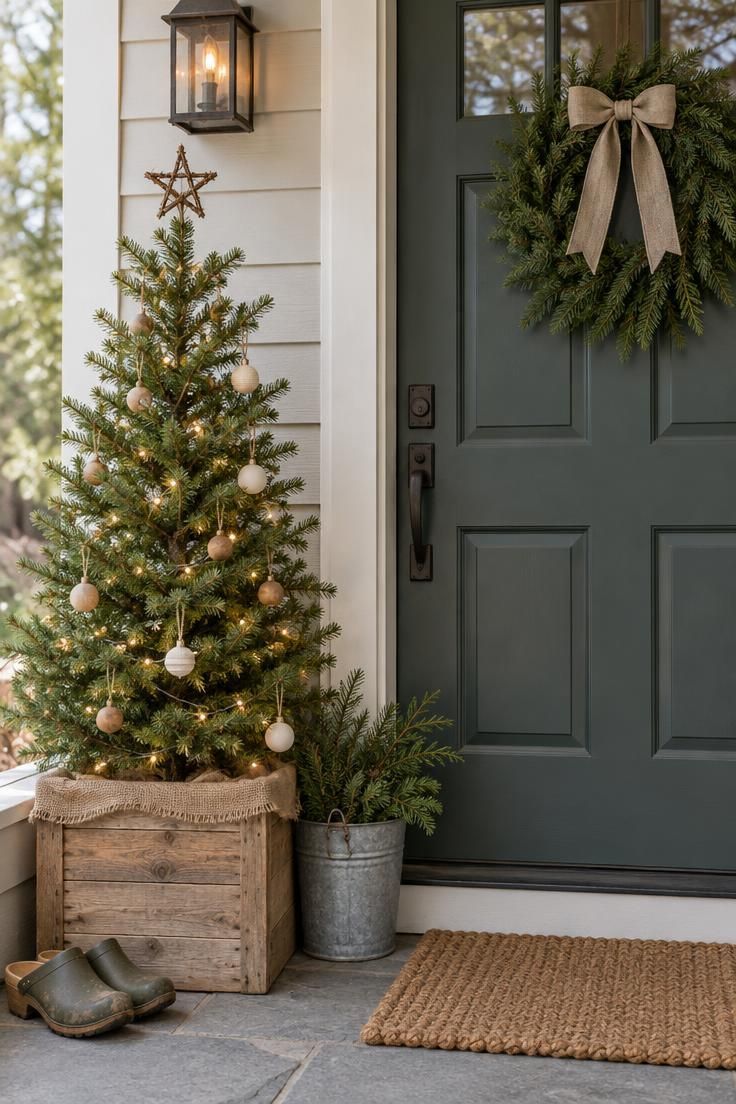
A small to medium evergreen set in an open wooden crate rather than a traditional pot gives the entry a looser, more collected look.
Drape a strip of burlap or jute around the crate lip to soften the wood edge, and choose a tree with a slightly irregular shape rather than a perfectly conical one.
Dress it lightly with warm white lights, a few wooden or fabric ornaments, and a simple star or twig topper, keeping the ornament count low.
A crate keeps the tree looking less formal than a matched planter set, and raising it on a small bench or box adds height if the porch has depth.
The tradeoff is storage: a larger tree takes up space in the off-season, while a smaller one can move to the yard as a potted plant after the holidays.
Artificial greenery holds up best under a covered porch or entry, where it is not exposed to full sun and weather.
Keep the palette within cream, natural wood, and one accent so the tree stays quiet beside the door.
Style Blueprint:
- A slim evergreen with an irregular silhouette
- A raw wood crate with a burlap strip on the lip
- Warm white lights and a few cream and wood ornaments
- A simple twig star topper
- A small galvanized bucket of extra boughs beside it
Red Plaid Blanket Draped on an Entry Bench
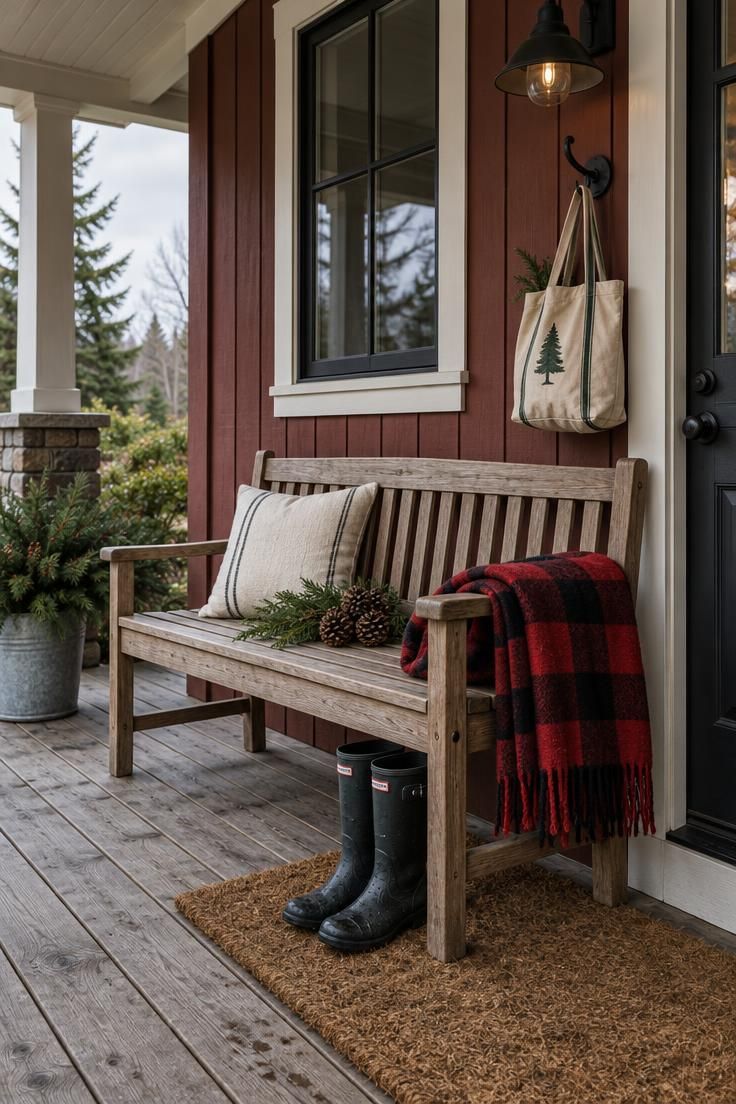
A plain wood or woven bench on the porch or just inside an open entry gives a soft, warm layer to an otherwise utilitarian spot.
Drape a red-and-black or red-and-brown plaid blanket over one arm or across the seat, then add a single small evergreen sprig or a pine cone cluster so the bench does not look like indoor furniture moved outside.
If the bench sits under a deep roof, an indoor throw can work, though an outdoor-friendly wool or wool blend holds up better on a fully exposed porch.
Pair the plaid with one solid cream or charcoal pillow if a cushion is needed, so the pattern does not compete with a wreath or garland nearby.
Fold the blanket to one side so the seat stays usable for taking off boots or setting down packages.
This idea is about adding a textile accent to an everyday entry, not about leaving a blanket outside permanently.
Style Blueprint:
- A simple slatted wood or woven bench
- A red and black plaid wool blanket folded over one arm
- A pine cone cluster and cedar sprig on the seat
- One solid cream or charcoal cushion
Design Pro-Tip: Choose a plaid that repeats the barn red already used on the door or garland, so the bench ties the porch palette together instead of adding a new color.
Birch Log Bundle with a Small Wreath and Lantern
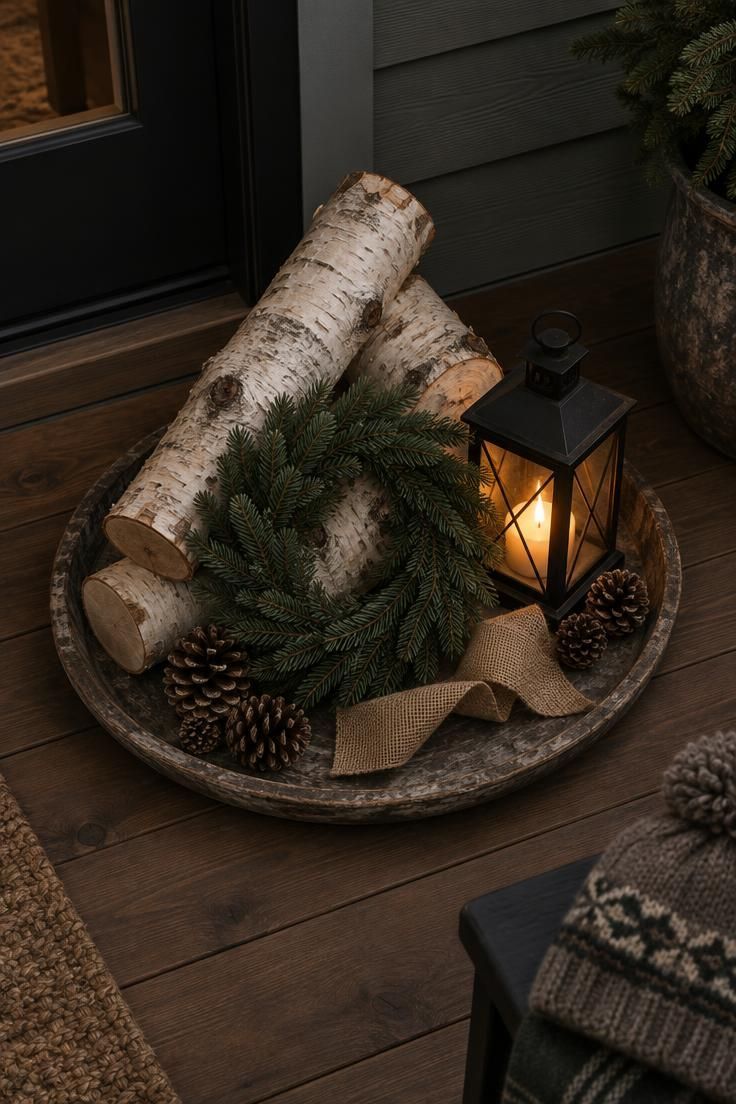
Three or four birch logs stacked in a loose pyramid on the porch floor or in a shallow tray give the entry a cool, pale accent.
Lean a small evergreen wreath against the front of the stack, then set a single short lantern beside the logs, either with a flameless candle or empty with a sprig of fir inside.
The white bark shifts the palette slightly toward cool tones without abandoning the warm farmhouse base, and the contrast with dark evergreen makes the stack read from a distance.
Birch weathers to gray if left exposed to rain, which can look natural or can dull the effect if the bark is still bright.
Moving the stack under cover preserves the white for longer.
Keep the logs purely decorative and set the stack well away from any open flame or fire feature, since the arrangement is meant to be looked at rather than burned.
A slight lean and an uneven log length keep the pile from looking stacked like firewood.
Style Blueprint:
- Three or four white birch logs in a loose triangle
- A shallow weathered tray underneath
- A small fir wreath leaning against the stack
- A short black metal lantern with a flameless candle
- A strip of burlap ribbon and a few pine cones
Cotton Bolls and Eucalyptus in Galvanized Wall Pockets
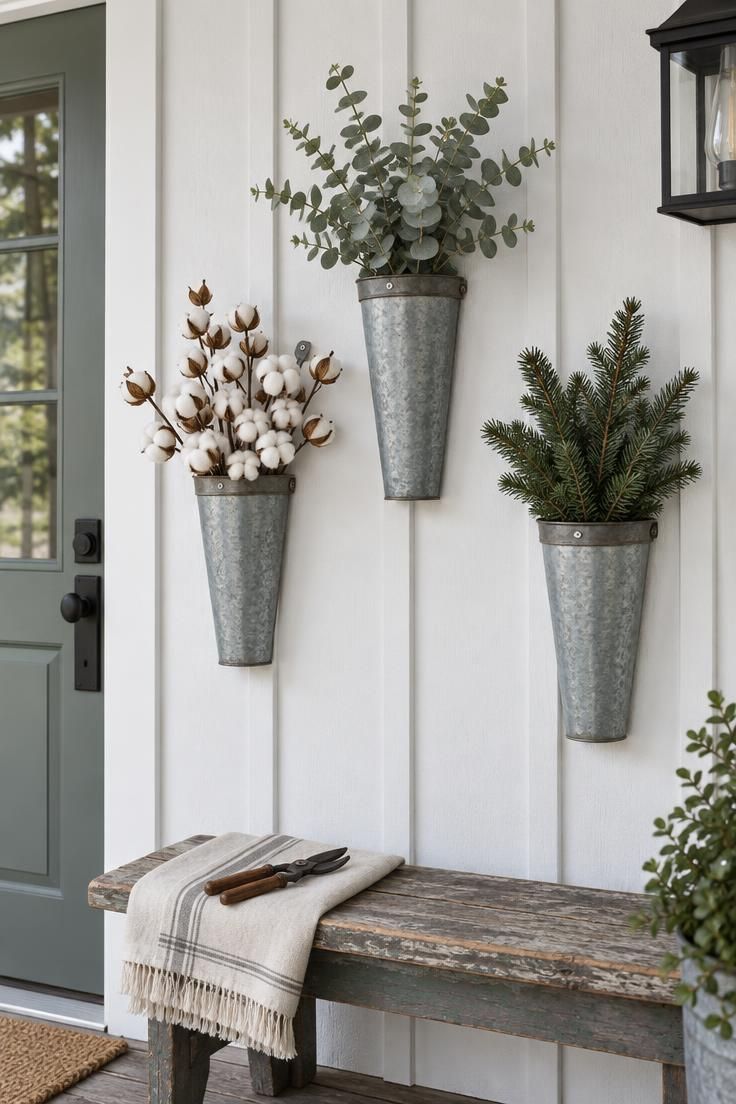
Three galvanized metal wall pockets hung beside the door can hold a different texture in each: cotton bolls, eucalyptus, and a single evergreen sprig.
Space the pockets unevenly, with one set slightly higher, so the arrangement looks like a growing collection rather than a symmetrical set.
Keeping the metal finish consistent with other galvanized pieces on the porch ties the wall to the galvanized bucket christmas planter nearby, while varying the plant textures keeps the group from reading as a matched set.
Eucalyptus dries with a muted sage tone and a soft scent, while cotton bolls stay fluffy but may look dingy after a damp season.
On a fully exposed wall, small pinecones or dried hydrangea can stand in for the cotton.
Hang the pockets where their contents will not fall into a walkway, and treat them as visual display only.
The pockets also work as a small vertical garden of textures in a tight entry where floor space is limited.
Style Blueprint:
- Three galvanized metal wall pockets with a dull finish
- Cotton bolls in one, eucalyptus in another, a fir sprig in the third
- Uneven spacing with the middle pocket higher
- A worn bench and folded linen cloth below
- Consistent galvanized metal with varied plant textures
Design Pro-Tip: Stagger the pocket heights by a hand’s width rather than a full arm’s length, so the group stays connected while avoiding a rigid row.
Rustic Wagon Wheel Propped with a Plaid Bow and Boughs
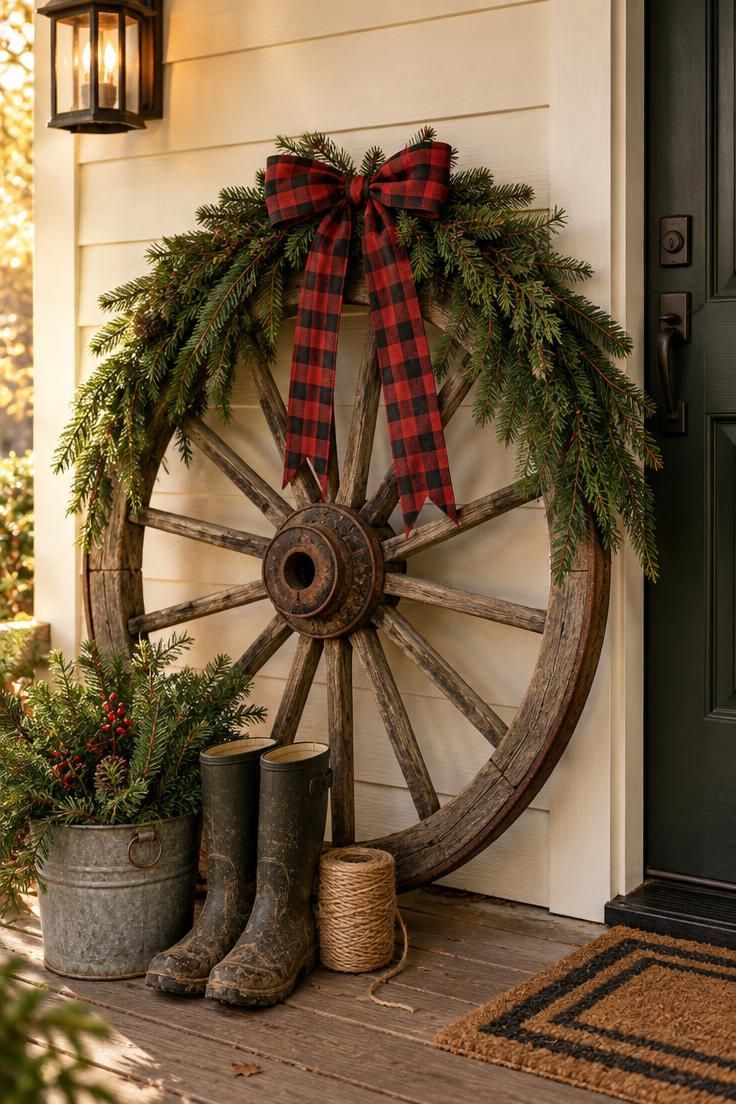
Lean a decorative wooden wagon wheel or a similar large rustic circle against the house wall or porch post, then fasten a generous evergreen bough to the top arc with twine.
Add a wide red plaid bow at the point where the bough meets the wheel, and let the ribbon tails hang long.
An unpainted wheel can show its aged wood, while a painted white or red wheel calls for a ribbon that complements rather than matches.
A wagon wheel reads as a sculptural piece, so it does not need many nearby props.
A single lantern or a small bucket of greens at its base is enough, and a slightly asymmetrical composition with the bough reaching farther to one side keeps the display from feeling stiff.
Tie the bow through the spokes and bough rather than wiring it in place, so the display can come down quickly after the season.
Storage is the main tradeoff: the wheel can be large and awkward to handle, though it packs flat against a garage or shed wall.
For a renter or a small porch, a smaller decorative hoop can stand in for the full-size wheel and keep the same silhouette.
Style Blueprint:
- An aged wooden wagon wheel with an iron hub
- A generous fir bough arched over the top arc
- A wide red and black plaid bow with long tails
- A small galvanized bucket of greens at the base
- Complements rather than matches in the ribbon choice
Conclusion
The farmhouse look outdoors lives in the mix of weathered materials, full greenery, and warm, simple accents rather than in any single object.
Each idea here can stand alone or join a collected entry, and the strongest results come from a restrained color story and a clear focal point in each zone.
Most of these displays ask for a small amount of seasonal upkeep, whether refreshing real boughs, storing textiles out of the weather, or settling a lantern cluster after a windy night.
Leaving a little room for the materials to look lived-in keeps the entry welcoming rather than overworked.