This post may contain affiliate links. If you make a purchase through these links, we may earn a commission at no additional cost to you.
A decorated front door sets the tone for a home during the holidays, greeting household members and visitors before anyone steps inside.
The best treatments read clearly from the sidewalk or the end of a hallway, with one strong focal point and materials that suit the door beneath them.
This collection focuses on residential entries and interior doors, built around evergreen, ribbon, dried citrus, and soft light rather than crowded arrangements.
Scan the headings for the composition that fits a particular door color, style, and daily use.
Classic Evergreen Wreath with a Broad Red Bow
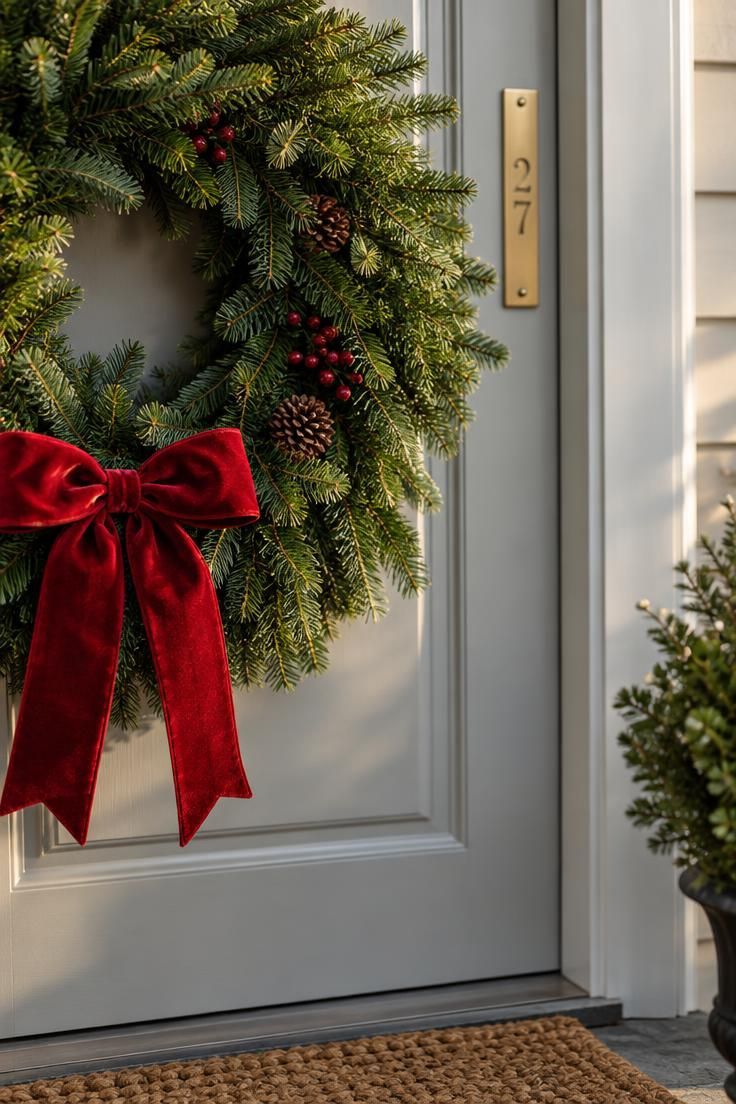
For an evergreen wreath for a front door, an evergreen wreath remains the most recognizable way to dress an entry, and its success depends on scale.
Choose a wreath that spans roughly half the door width, which leaves visible space above, below, and to each side.
That breathing room keeps the circle from looking like a dot on a large door or a crowded mass on a narrow one.
The bow is the second decision.
A wide red velvet bow placed at the bottom of the wreath breaks the circular silhouette and gives the eye a clear destination.
Fresh fir or cedar brings a dark, dense green that stands out against a light-painted door, while faux greenery offers a more uniform look that holds its shape season after season.
For a variation with more vertical presence, combine three small wreaths in an arc above the handle.
The stacked arrangement fills the upper portion of the door without covering the hardware or the viewing area, and it reads as a deliberate composition rather than three separate pieces.
Practicality favors this format.
A basic evergreen wreath stores flat in a box and returns year after year, and swapping only the bow changes the palette without a new purchase.
A fresh wreath will dry over the weeks, so expect the needles to darken and the scent to fade as the season passes.
Pairs well with a simple doormat and a single porch light, where the red bow carries the color story on its own.
Style Blueprint:
- Dense fir or cedar wreath at about half the door width
- Wide red velvet bow positioned at the lower edge
- Pale gray or white door as the backdrop
- Slim brass house numbers for a quiet metallic accent
Design Pro-Tip: Match the bow width to roughly one-third of the wreath diameter so it reads as intentional rather than accidental.
Asymmetrical Cedar Swag on a Dark Door
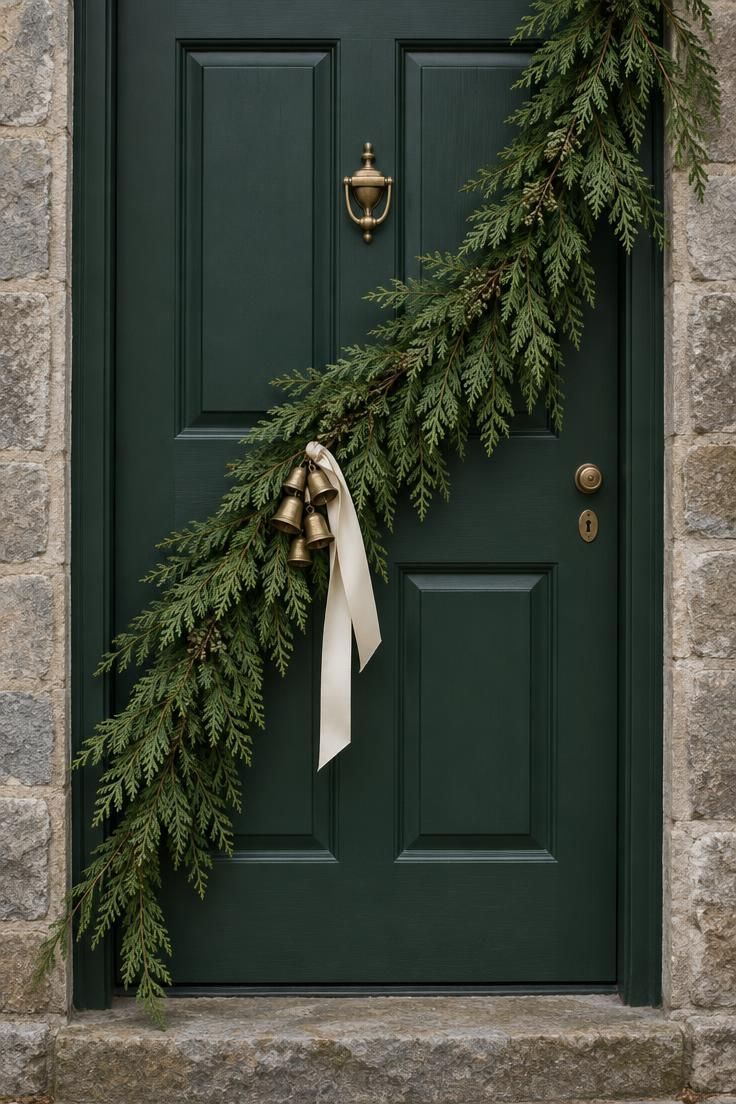
A swag replaces the perfect circle with a diagonal line, and that single change gives a door a more relaxed, less formal look.
Cedar works well here because its loose, feathery tips create a soft silhouette against a flat painted surface.
The drape runs from the top right corner toward the lower left, with the tip extending a few inches past the door edge.
Dark door colors suit this treatment best.
Forest green or charcoal lets the cedar read as a textured shape rather than a busy pattern, and the contrast stays gentle rather than sharp.
A cluster of small brass bells gathered at the turning point adds a metallic note and a small focal anchor.
Keep the lower portion of the door clear.
The swag should stop well above the handle so the door remains fully usable, and the diagonal line should not cross the viewing area at eye level.
That clearance is a placement decision, not a structural one, and it keeps the entry working through a busy season.
This format rewards a light hand.
One ribbon, one bell cluster, and the greenery do the work, so adding more elements would compete with the diagonal sweep that makes the idea distinctive.
Style Blueprint:
- Long cedar garland draped diagonally corner to corner
- Dark green or charcoal door as the backdrop
- Small brass bells gathered at the swag's turning point
- Single cream or champagne satin ribbon
- Clear space kept below the handle
Oversized Plaid Ribbon Door Bow
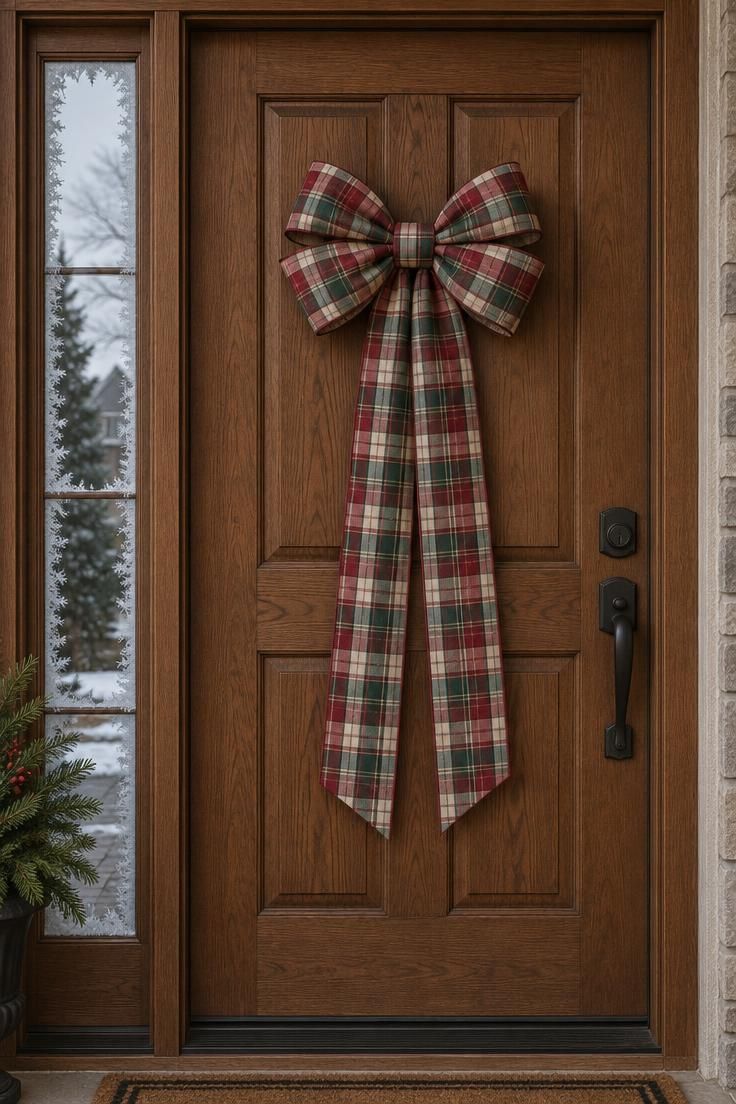
One large plaid ribbon door bow can carry an entire entry without any greenery.
The graphic impact comes from scale and pattern: ribbon at least four inches wide reads clearly from the street, while a narrower ribbon would disappear at that distance.
The plaid brings a textile warmth that foliage cannot, and its muted red, green, and cream mix stays classic without shouting.
Solid wood doors make the strongest backdrop for this look.
Visible grain gives the bow a neutral, natural field, and the wood tone keeps the composition from feeling like wrapping paper.
The bow becomes the only decoration, which is the point: a single element with confidence beats several small ones competing for attention.
The tails create vertical lines down the center of the door, so their length shapes the overall proportion.
Long tails draw the eye downward and make a tall door feel balanced; shorter tails keep the focus tight around the bow itself.
Storage and effort favor this option.
A ribbon bow stores flat, takes minutes to place, and costs far less than a foliage arrangement.
The tradeoff is that it offers no texture or scent, so it suits households that prefer a clean graphic look over a layered natural one.
Style Blueprint:
- Plaid ribbon at least four inches wide in muted red, green, and cream
- Solid wood door with visible grain
- Bow centered at eye level
- Tails run vertically down the door center
Dried Citrus and Greenery Wreath
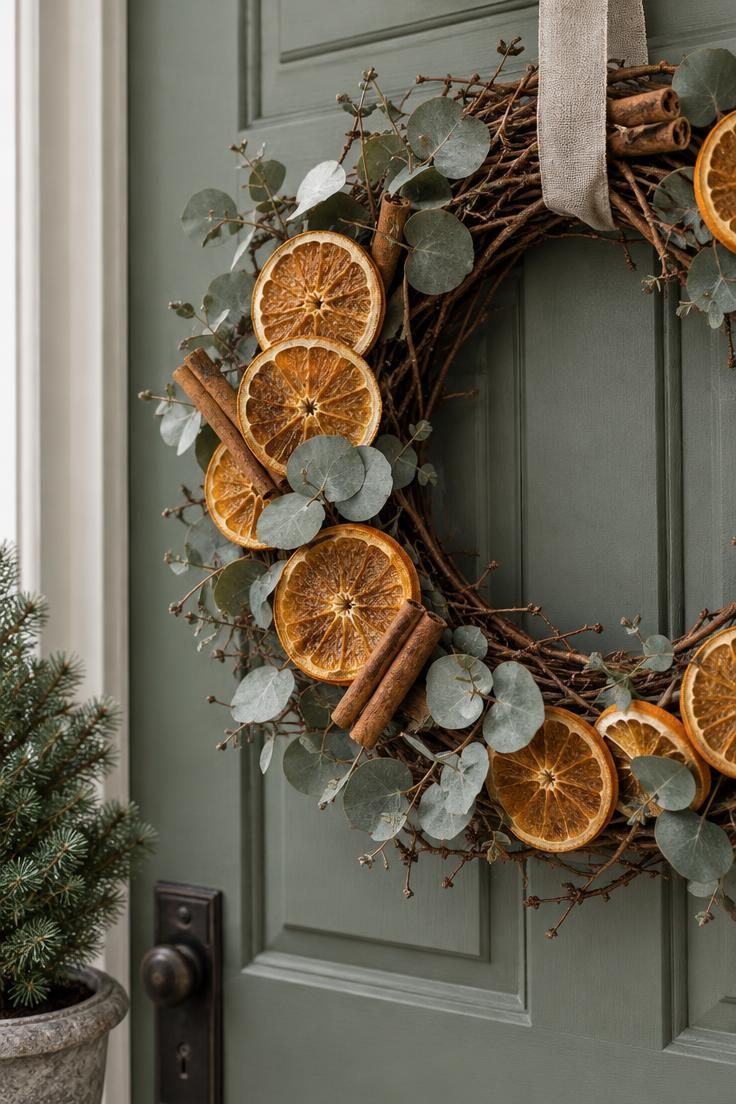
Dried fruit changes the palette of a holiday door.
Orange slices, cinnamon sticks, and eucalyptus on a grapevine base bring warm browns and muted oranges that sit quietly against a cool door color like slate blue or sage.
The matte finish of the dried elements reads very differently from glossy ornaments or fresh needles.
Density matters more here than with an evergreen wreath.
Keeping the ornament count low lets the grapevine texture show through between the citrus pieces, and that visible structure is part of the appeal.
A tightly packed version would lose the handmade character that makes this direction distinctive.
This is one of the more flexible Christmas door decorations for a long season.
The natural materials suit the weeks after the holiday as well, so the wreath can stay up through winter without looking out of place.
Expect the citrus slices to darken gradually, which shifts the look toward deeper amber tones as the weeks pass.
Weather is the honest tradeoff.
Dried fruit and twigs fare better under a porch roof than in direct rain, and prolonged damp will soften the materials.
A covered entry or an interior door gives this wreath its best conditions.
Style Blueprint:
- Grapevine base with visible twig structure
- Dehydrated orange slices in a loose arrangement
- Cinnamon sticks tucked between the fruit
- Silver-green eucalyptus for contrast
- Cool-toned door such as slate blue or sage
Lit Garland Door Frame
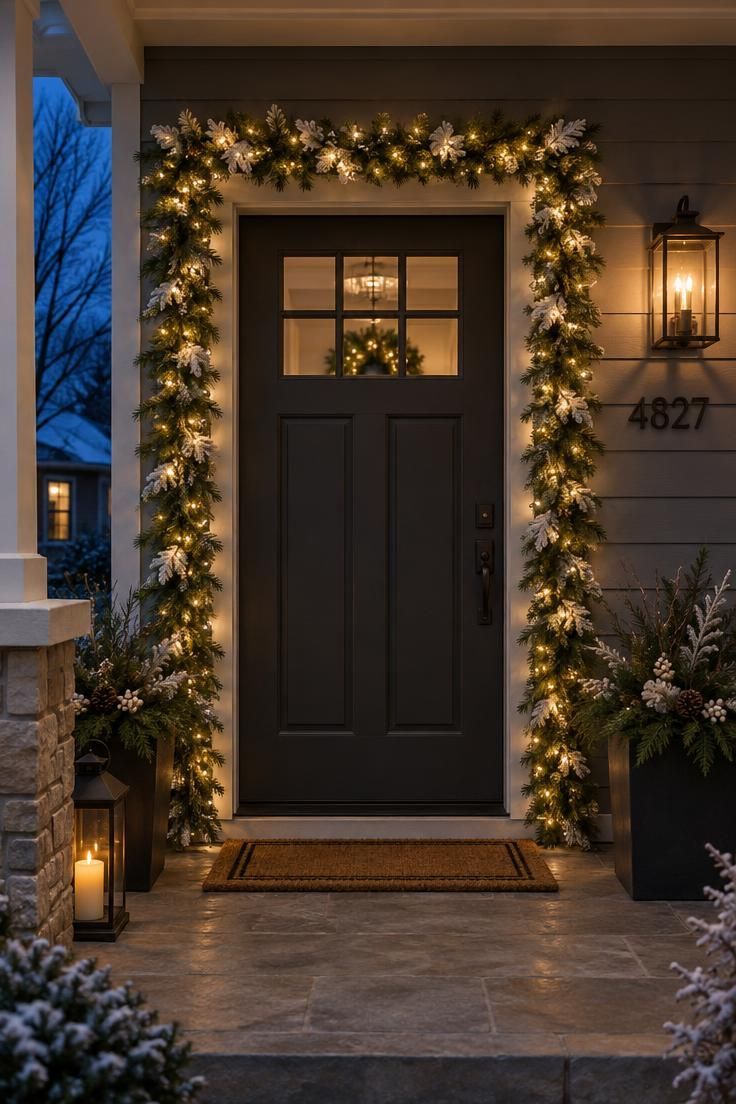
Framing the door rather than covering it gives a different kind of welcome.
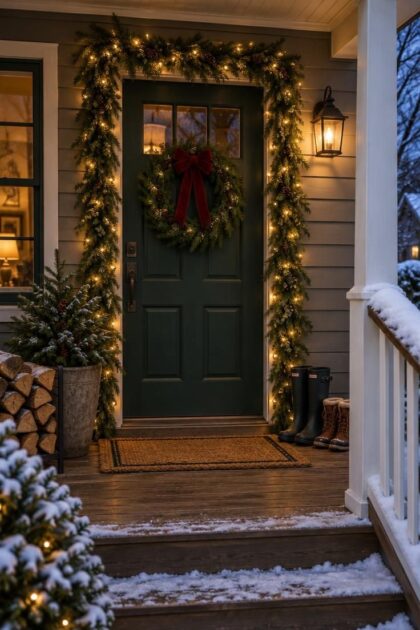
For a lit garland door frame, a garland following the top and both sides of the frame treats the doorway like a picture, and the door surface stays visible in the center.
Faux pine works well because it holds a consistent shape along straight lines, and a mix of flocked and unflocked tips adds subtle tonal variation.
The glow line is the real subject.
Warm white micro lights along the garland provide a soft wash at night without turning the entry into a light display, and the shadows they cast on the door surface add depth after dark.
This is often enough to make an entry feel composed in the evening without adding separate porch lighting.
Reuse is a strong argument for this format.
Faux greenery withstands damp weather far better than fresh boughs, and the garland can return each year.
The lights need an occasional check for dead bulbs, since a dark stretch interrupts the continuous line that makes the frame read cleanly.
Keep the garland on the frame rather than across the door itself.
That placement preserves the door's function, keeps the center clear for the handle and any glass, and maintains the picture-frame logic that gives the idea its structure.
Style Blueprint:
- Faux pine garland along the top and both sides of the frame
- Warm white micro LED lights woven through
- Mix of flocked and unflocked tips
- Door surface left visible in the center
- Porch sconce for secondary evening light
Design Pro-Tip: Run the garland in one continuous line around the frame so the corners read as deliberate turns rather than overlapping ends.
Mercury Glass Ornament Cluster
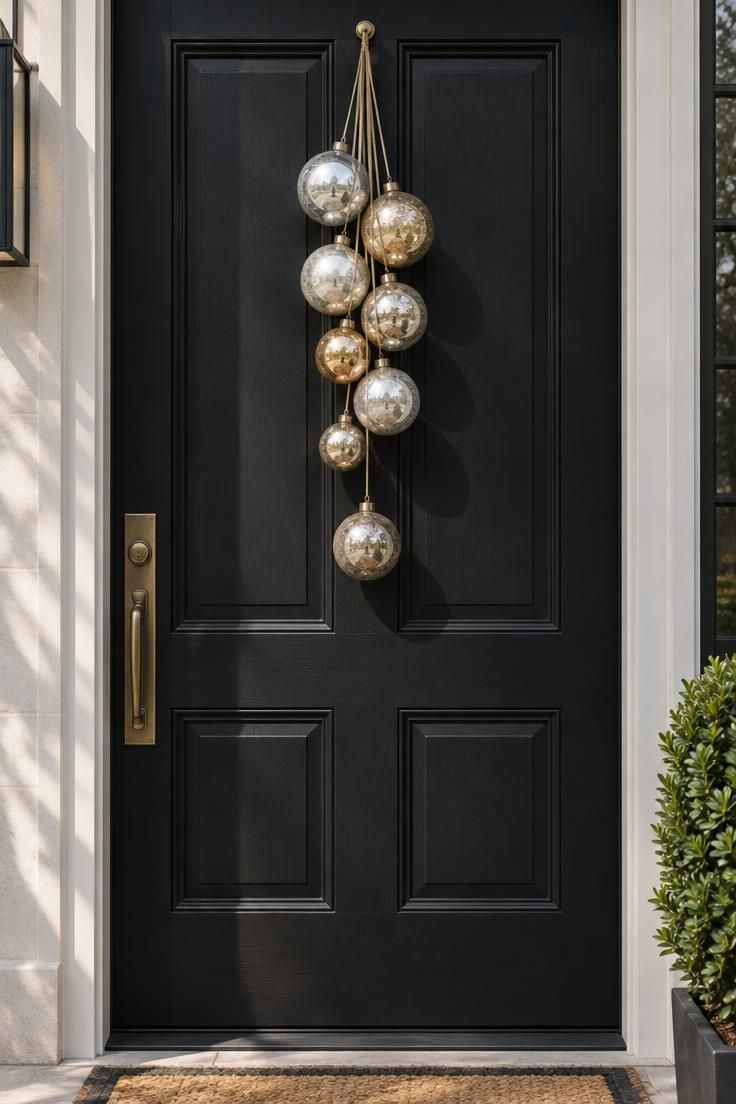
A hanging cluster turns the door into a vertical composition.
Mercury glass ornaments grouped at different lengths from a single point above the center create a loose teardrop shape, and the varying drop lengths give the arrangement rhythm.
Matte mercury finishes catch light without the glare of polished glass, so the orbs read as soft points of brightness rather than hard reflections.
High-contrast doors make this idea work hardest.
Black or deep navy paint lets the silver, champagne, and gold tones stand out like a constellation, and the darkest ornament still separates from the surface behind it.
The lowest ornament hanging about two-thirds down the door keeps the cluster from crowding the handle area.
The material choice carries a real tradeoff.
Glass ornaments are fragile, so this treatment suits a door that opens gently and is sheltered from strong wind.
A covered porch or an interior door reduces the chance of breakage over the season.
Storage is simple: the ornaments return to their box, and the arrangement can be rebuilt in a different mix of tones next year.
The single hanging point keeps setup quick, which matters for anyone dressing a door late in the season.
Style Blueprint:
- Mercury glass ornaments in silver, champagne, and gold
- Single hanging point above the door center
- Loose teardrop silhouette with varied drop lengths
- Black or deep navy door for contrast
- Sheltered entry to protect the glass
Buffalo Check Ribbon Grid Door
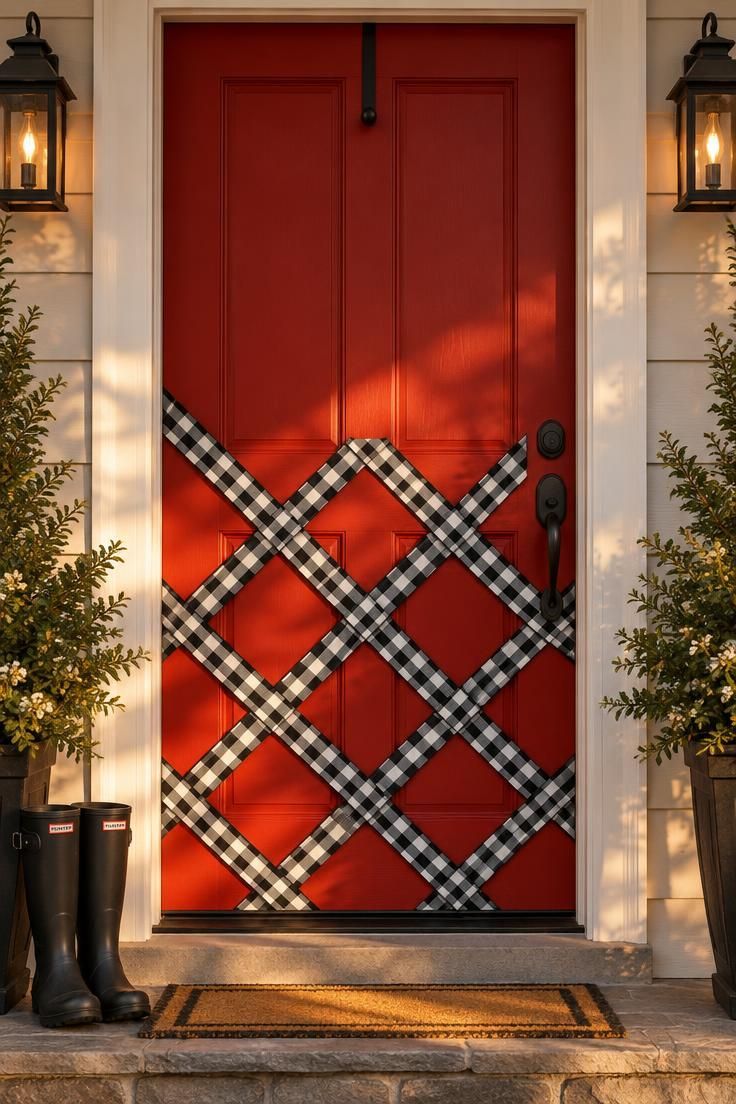
Wrapping the door like a parcel is a graphic idea that needs no foliage at all.
Wide buffalo check ribbon laid in a diagonal grid across the lower half creates a crisp geometric pattern, and the black-and-white check pairs with nearly any holiday palette.
On a red or green door, the contrast is strong enough to make the door itself the statement.
Proportion determines whether the result looks composed or cluttered.
Ribbon four to six inches wide gives the grid enough weight to read from the street, and spacing the stripes widely apart keeps the pattern from turning busy.
Leaving the top half of the door bare provides the negative space that makes the lower grid feel intentional.
This approach is affordable and reusable in the strict sense that it needs only ribbon, which stores flat and takes little room.
The tradeoff is wear: ribbon can wrinkle or snag where it passes near the frame, so a door with generous clearance around its edges gives the cleanest result.
The pattern also adapts easily to interior door holiday decor, where a smaller grid in the same check can dress a hallway or laundry door without overwhelming a narrow space.
Style Blueprint:
- Black-and-white buffalo check ribbon four to six inches wide
- Diagonal grid confined to the lower half of the door
- Red or green door for strong contrast
- Top half left bare as negative space
- Generous clearance around the door edges
Single Golden Bell on a Ribbon
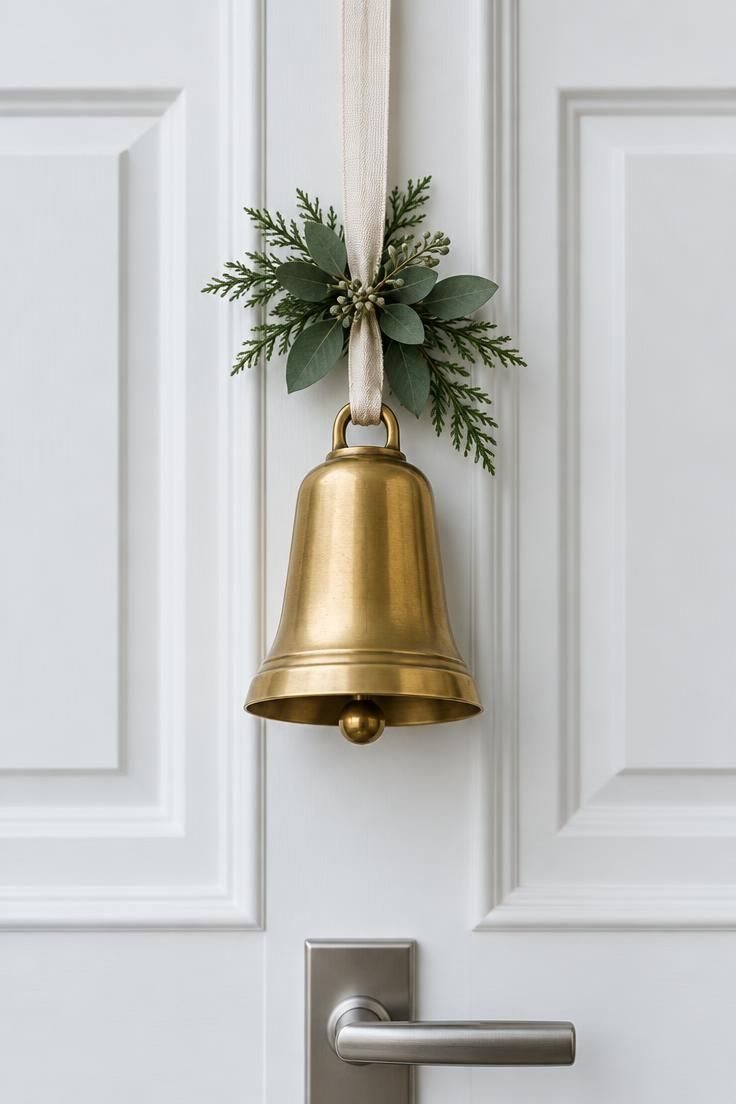
Minimalism can hold a front door when the single element has enough presence.
One large golden bell suspended from a narrow cream ribbon becomes the focal point through size and finish, and the metallic surface brings warmth to a white or cream door without any additional color.
The bell reads clearly from a distance, which quieter small ornaments often fail to do.
A small sprig of faux greenery above the bell breaks the vertical ribbon line and keeps the composition from feeling too severe.
A thin ribbon, rather than a wide one, lets the bell dominate and keeps the door surface visible on both sides.
Movement is part of the charm.
The bell shifts slightly when the door opens, so the entry gains a bit of animation from a single object.
That quality suits a modern home where a dense arrangement would feel out of step with the architecture.
Placement deserves attention: hanging the bell at roughly chest height keeps it visible from the threshold and clear of the handle.
The format stores in almost no space and takes a moment to position, which makes it a practical choice for a household that wants decoration without a storage commitment.
Style Blueprint:
- Large golden bell with a warm metallic finish
- Narrow cream ribbon as the suspension line
- Small faux greenery sprig tucked above the bell
- White or cream door as the backdrop
- Bell hung at roughly chest height
Interior Door Mini Wreath
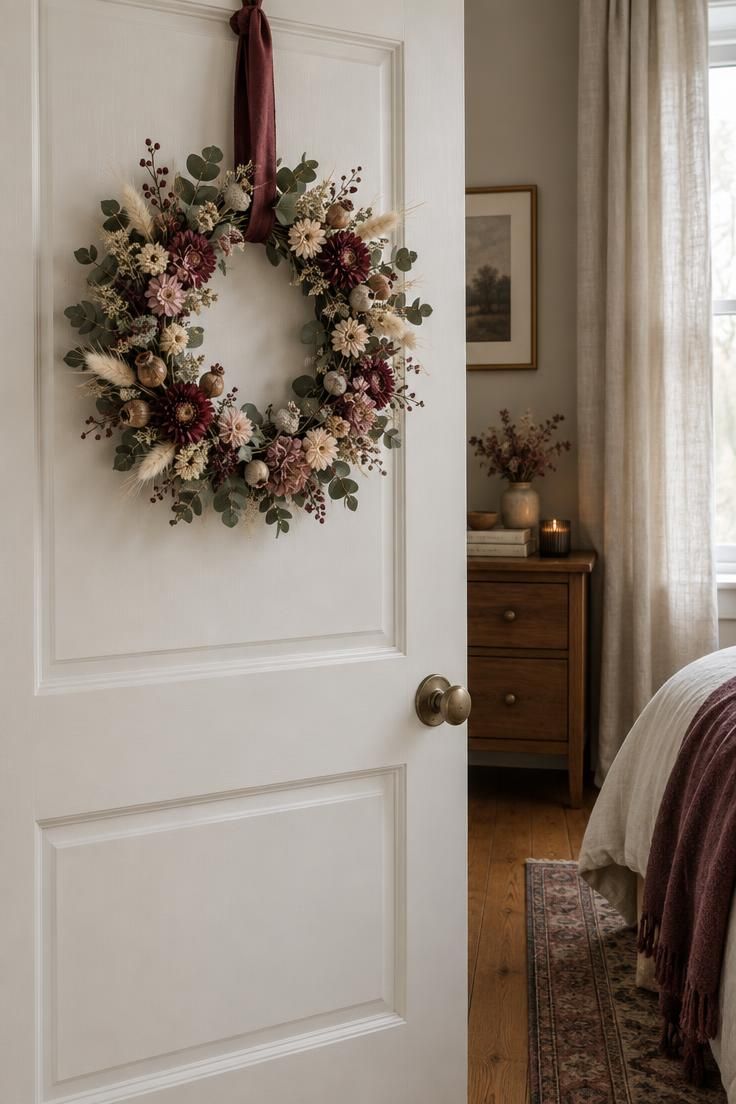
Bringing the decoration inside changes the scale.
For a dried citrus wreath, a small dried flower and eucalyptus wreath suits a bedroom or hallway door because it is seen up close, where fine details like dried berries and seed pods actually register.
A muted palette of burgundy, dusty pink, and cream sits comfortably against neutral walls.
Interior placement removes weather from the equation entirely.
Paper, dried botanicals, and delicate ribbon all behave differently indoors, so materials that would suffer on an exposed porch become practical choices here.
The result is a softer, more personal kind of decoration that lives in the private parts of a home.
The scale difference matters.
A six-inch wreath on a front door would disappear, but on an interior door it reads as a complete composition.
That smaller footprint also makes this a reasonable option for renters or anyone decorating a single room rather than the whole house.
A ribbon loop at the top keeps the wreath hanging straight and lets it be moved between doors.
Lightweight dried materials also mean the wreath can shift from a bedroom to a pantry door without much effort.
Style Blueprint:
- Six-inch dried flower and eucalyptus wreath
- Muted burgundy, dusty pink, and cream palette
- Simple burgundy ribbon loop
- Interior door with neutral surroundings
- Fine details such as dried berries and seed pods
Design Pro-Tip: On an interior door, choose a wreath small enough to leave visible door surface on all sides so the arrangement feels placed rather than improvised.
Felt Ball and Pinecone Wreath
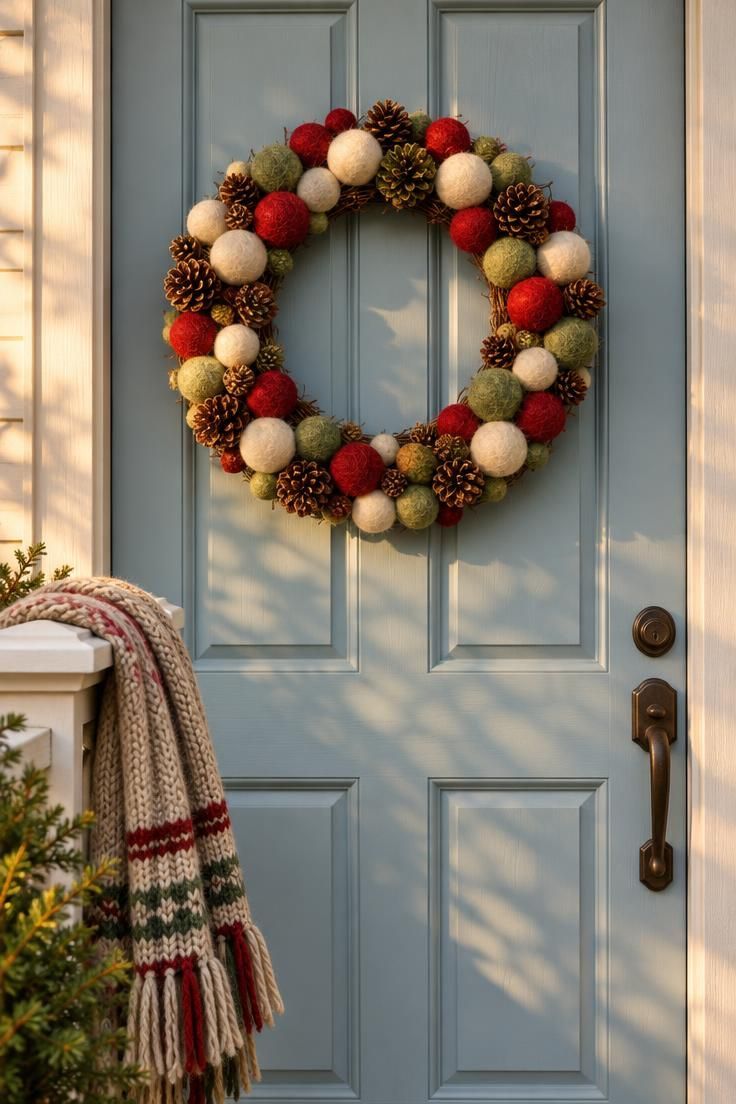
Texture does the work in this wreath.
Wool felt balls in warm red, cream, and soft green alternate with small pinecones tucked into a grapevine form, and the contrast between fuzzy felt and rough cone scales gives the arrangement a tactile quality that glossy ornaments lack.
Up close, the mix of surfaces rewards a second look.
Bright doors suit the palette.
A white or pale blue front door lets the warm red and cream felt stand out without the composition turning heavy, and the light backdrop keeps the playful character intact.
On a dark door, the same wreath would read more muted.
Weight and storage favor the handmade approach.
Felt balls are light, so the wreath stores and travels easily between seasons, and the materials hold their color well over time.
The tradeoff is surface wear: felt can shed small fibers where it rubs, so a door that opens and closes gently gives the wreath a longer life.
Arrangement follows a simple rhythm.
Alternating felt and pinecone in loose clusters creates movement around the circle, while a strict alternation would look mechanical.
Varying the cluster size slightly keeps the wreath feeling made rather than manufactured.
Style Blueprint:
- Grapevine base with visible structure beneath
- Wool felt balls in warm red, cream, and soft green
- Small pinecones tucked between the felt clusters
- White or pale blue door as the backdrop
- Loose cluster rhythm rather than strict alternation
Birch Branch Star and Greenery
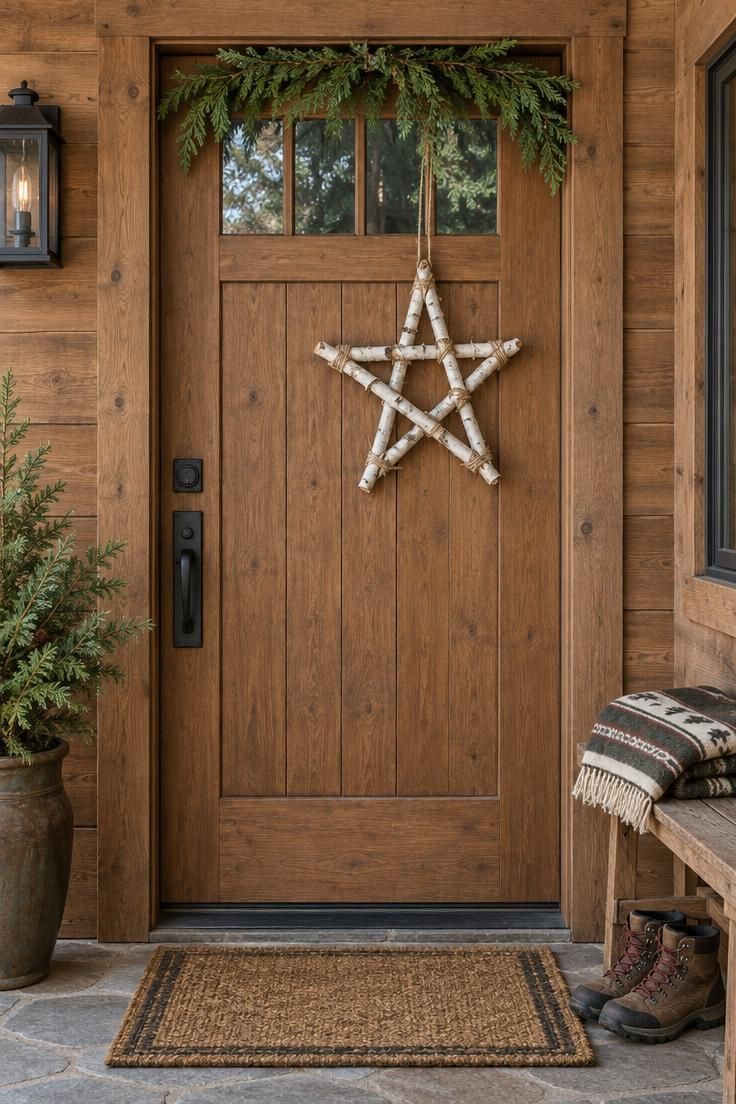
A birch star brings a woodsy note to an entry without relying on holiday reds.
The pale bark and rough texture give the star a natural, slightly rustic character, and its light color reads clearly against a range of door finishes.
Hanging it slightly off-center keeps the composition relaxed rather than formal.
Greenery plays a supporting role here.
A few short cedar sprigs along the top edge of the door add a green accent and echo the star's natural material without competing for attention.
Keeping that greenery minimal is what lets the star stay the dominant element.
This direction suits homes with natural wood tones, whether the door itself is wood or the surrounding trim is.
The star's irregular edges and visible bark keep it from looking too polished, which fits a cabin-style entry or a home with a lot of timber detail.
Longevity is good, with one small caveat.
Birch branches hold their shape for a long season, though they may drop small pieces of bark over time.
A quick sweep of the threshold now and then keeps the entry tidy.
Style Blueprint:
- Star-shaped bundle of white birch branches
- Thin twine or leather hanging loop
- Short cedar sprigs along the top door edge
- Slightly off-center placement
- Natural wood tones in the surrounding entry
Velvet Ribbon Door Swags
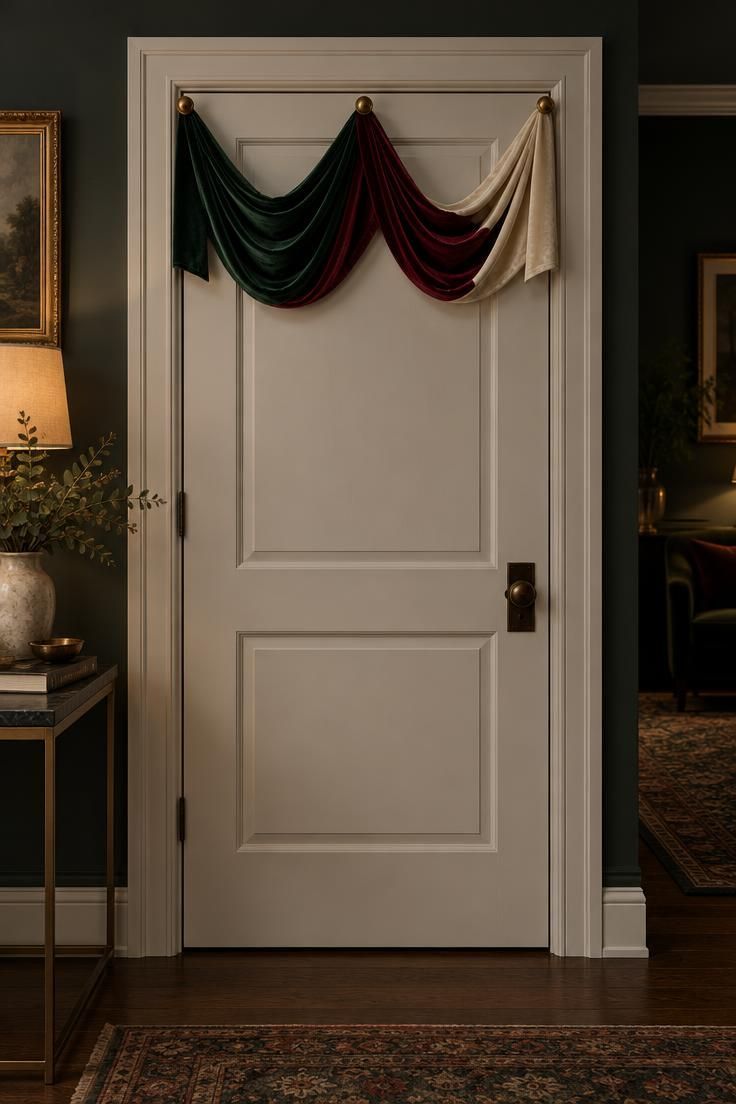
Three velvet swags across the top third of a door create rhythm through repetition.
Deep green, burgundy, and cream ribbons drape in soft curves, and the plush texture contrasts with a smooth painted surface.
Repeating the swag shape at even intervals gives the composition a measured, almost architectural quality.
The proportions determine the effect.
Confining the swags to the upper third leaves the door's surface visible below, so the treatment reads as a decorative band rather than a full wrap.
Even spacing across the door width keeps the curves from bunching or stretching.
This works best on a door that is not the main entry.
Purely decorative ribbon arrangements deserve gentle handling, and an interior door opened with care keeps the swags hanging cleanly.
The format also suits a hallway where the door is seen from a short distance and the velvet texture is visible.
Velvet shows dust and lint more readily than satin, which is a genuine maintenance consideration in a busy home.
A quick pass with a soft brush keeps the nap looking even.
Storage is easy, since the ribbons can be rolled and reused in other rooms.
Style Blueprint:
- Velvet ribbon in deep green, burgundy, and cream
- Three swags confined to the top third of the door
- Even spacing across the door width
- Interior door opened with care
- Soft brush kept handy for dust and lint
Paper Snowflake Door Collage
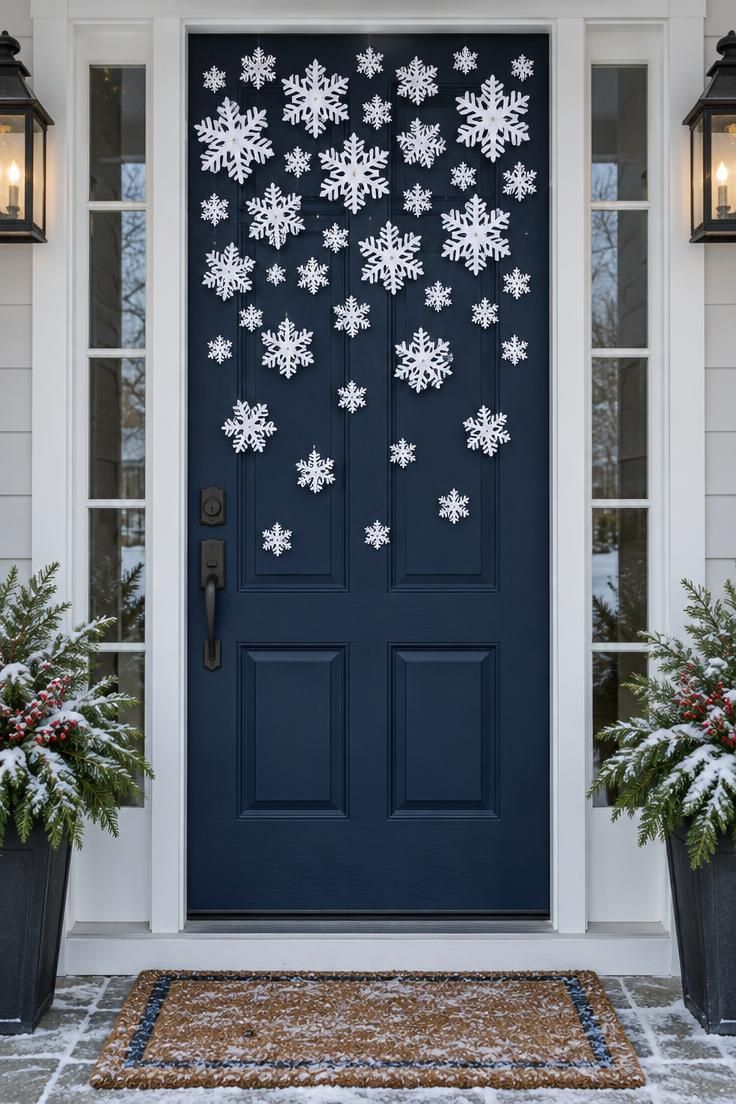
A paper snowflake collage turns the upper half of a door into a falling pattern.
Three sizes of handmade white flakes cluster densely near the top and spread apart as they descend, creating a sense of movement that a single centered decoration cannot achieve.
Removable adhesive tabs hold the flakes in place with a small gap between each one.
Dark doors give this idea its contrast.
Navy, black, or deep green paint lets the white paper pop, and the cut edges of each flake stand out clearly against the flat surface.
On a light door, the same collage would lose much of its definition.
This is among the most budget-friendly options, requiring only paper and a template, and it can be redone in an evening.
The tradeoff is durability: paper is delicate and will need replacing if the door faces rain or long stretches of direct sun.
A covered porch or an interior door extends its life considerably.
Arrangement makes or breaks the effect.
A uniform grid of identical flakes looks static, while three sizes in a descending scatter mimics how snow actually gathers.
Varying the gap slightly as the flakes descend reinforces that natural rhythm.
Style Blueprint:
- Handmade white paper snowflakes in three sizes
- Dense cluster at the top spreading downward
- Navy or black door for strong contrast
- Removable adhesive tabs at each center
- Small gaps kept between flakes
Design Pro-Tip: Cut at least three different snowflake shapes so the collage reads as falling snow rather than a repeating pattern.
Conclusion
These Christmas door decorations range from classic evergreen wreaths to graphic ribbon wraps and dried natural materials, and each one treats the door as a canvas for a single clear focal point.
Matching the treatment to the door's color, the home's style, and the household's appetite for upkeep keeps the result cohesive rather than crowded.
Most of the ideas scale up or down with the size of the main element, so a narrow interior door and a wide front entry can both be dressed from the same approach.
A little planning around proportion, palette, and daily use is all it takes to make an entry feel ready for the season.