This post may contain affiliate links. If you make a purchase through these links, we may earn a commission at no additional cost to you.
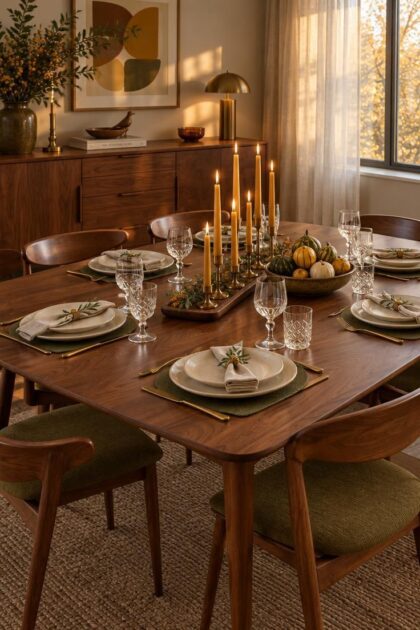
A mid-century modern Thanksgiving table keeps the spare geometry of the style without losing the warmth of a holiday meal.
Think low arrangements, warm walnut tones, and one or two saturated accents instead of layered abundance.
The goal is a composed tabletop that still allows platters, conversation, and easy clearing.
Start with the table itself as the visual anchor.
A mid-tone wood surface gives every object something warm to sit against.
From there, the discipline is simple: decide which pieces carry color and which stay neutral, then let the arrangement stay low and horizontal so the meal can take center stage.
Walnut Tray With Brass Taper Candles
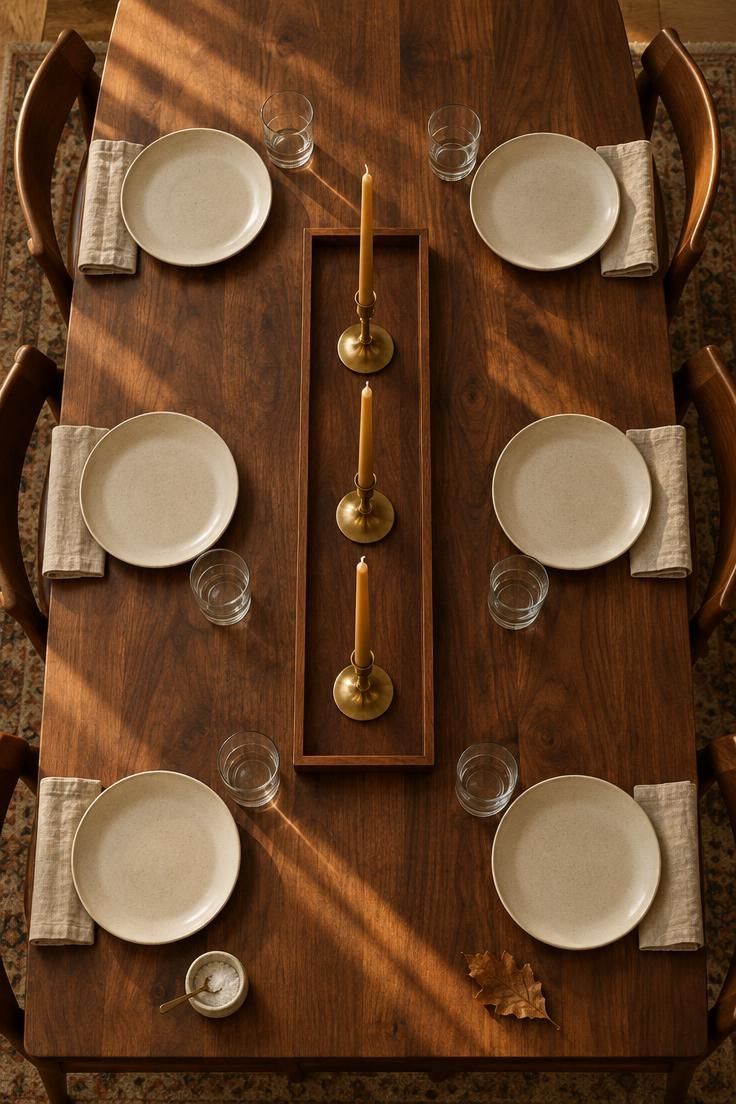
This arrangement works because the tray gives the centerpiece a clear boundary.
Three candles lined up inside it create a low, horizontal composition that echoes the long lines of mid-century furniture, and the tapers repeat the angled geometry of chair legs and table edges.
A mid century modern thanksgiving table often needs permission to stay quiet, and a single tray of candles does exactly that.
Reserving the tray as the only centerpiece element leaves the rest of the surface open for serving dishes.
Brass adds a warm metal note against the walnut without introducing another strong color.
The practical benefit is easy to overlook.
When the turkey and platters arrive, the entire centerpiece lifts away in one piece, freeing the middle of the table.
Set the tray back out after the plates are cleared, and the table returns to its composed state in seconds.
Consider the tray's length first.
It should run visibly along the center without crowding the place settings, so shorter tables may suit two candle holders rather than three.
Candle height matters too: keep tapers short enough that seated guests see across the table.
Style Blueprint:
- Long rectangular walnut tray
- Three matching brass taper holders with slim tapers
- Cream stoneware plates
- Clear glass tumblers
Design Pro-Tip: Decide the tray's placement before setting any plates. Marking its footprint first keeps the candle arrangement centered and leaves even space for place settings on both sides.
Mustard and Olive Table Palette
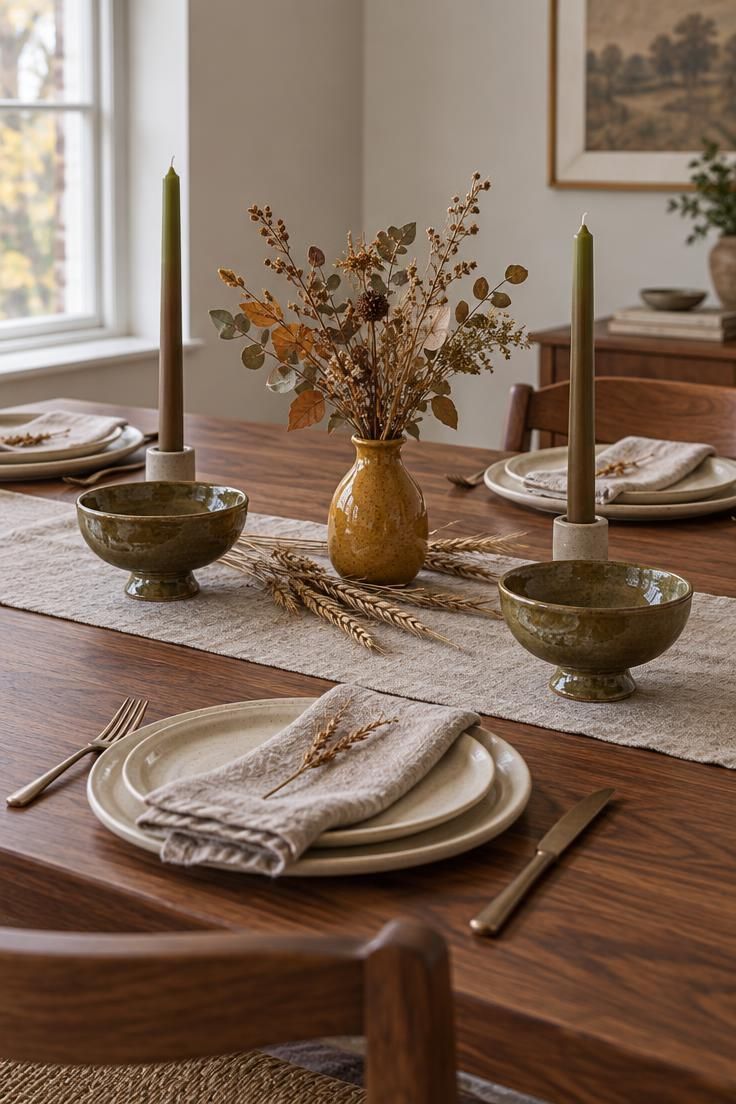
A mustard and olive table palette depends on a neutral base to work.
Cream plates and oatmeal linen give the two accent colors a calm field, so the mustard bud vase and olive bowls read as deliberate choices rather than scattered color.
Repeating each accent color twice is the balancing trick.
The mustard appears in one vase and can return in a folded napkin, while olive shows up in both the footed bowls and the candles.
Two appearances per color tie the table together without tipping into clutter.
This palette suits a mid-tone walnut or teak table best.
A very dark table can swallow the olive tones, and a very pale wood may weaken the mustard.
Mid-tone wood keeps both accents legible and warm.
Expect some flexibility in the exact shades.
Mustard ranges from soft ochre to deep gold, and olive from grayish green to a richer moss.
Choosing pieces in person helps confirm that the two accents relate rather than fight.
Keep patterned textiles out of this scheme.
Solid linens let the mustard and olive do the talking, and they are easier to launder after a big meal with gravy and cranberry sauce in play.
Style Blueprint:
- Cream stoneware dinner plates
- Oatmeal linen napkins and runner
- One mustard-glazed bud vase
- Two olive footed bowls
- Two olive taper candles in ceramic holders
Matte Stoneware Plates in Burnt Orange
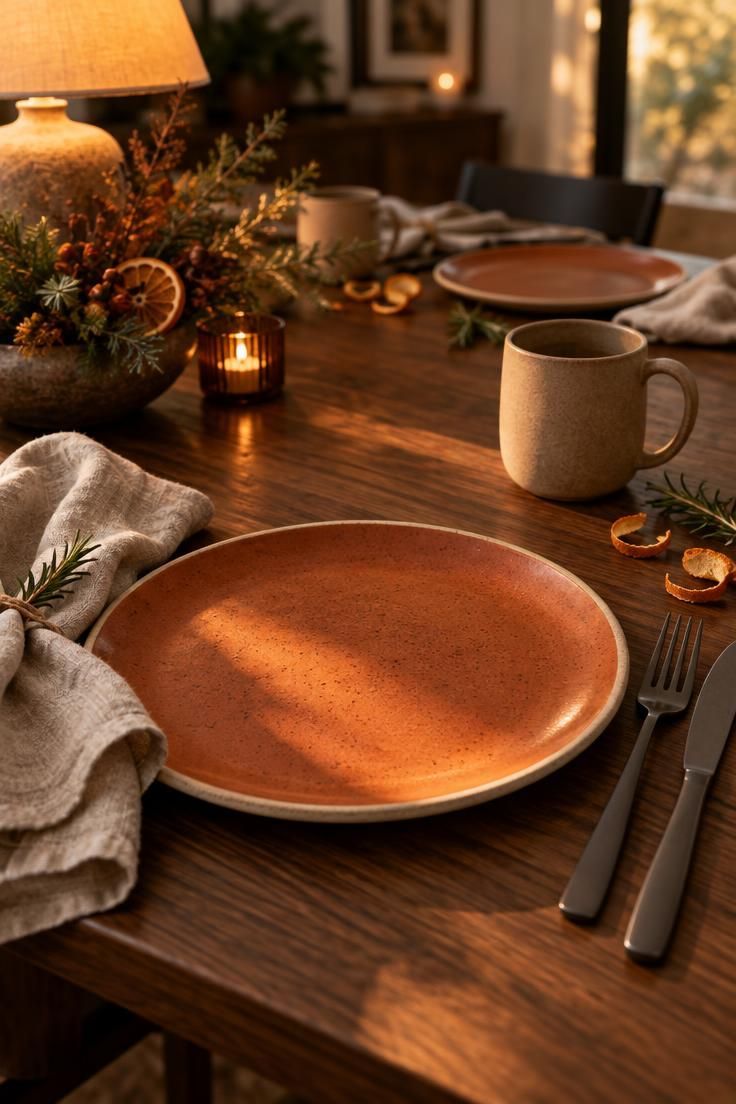
Setting the table with matte stoneware plates in a single burnt orange color gives the whole meal a strong visual anchor.
Because the dinnerware carries the saturation, the centerpiece can stay almost bare: one low bowl of a single gourd type is enough.
The matte finish is what keeps this idea from feeling glossy or overly themed.
Unglazed rims and subtle speckling show the material honestly, and the orange reads as earthy rather than decorative.
Natural linen napkins and unglazed mugs continue that same textural story.
One color across every plate creates a bold, unified block of color at each place.
That strength is also the limitation.
If the orange feels heavy on a large table, mixing in cream plates at alternating settings lightens the effect while keeping the palette coherent.
Burnt orange shows crumbs and drips less than pale dishes, which helps during a crowded meal.
Matte glazes can hold onto oily residue, so a quick hand wash after the holiday keeps the finish looking even.
Style Blueprint:
- Matte burnt orange stoneware plates with unglazed rims
- Natural linen napkins
- Unglazed ceramic mugs
- Simple matte flatware
- One low bowl of a single gourd type
Design Pro-Tip: Stack spare plates at a sideboard rather than on the table. The clean tabletop lets the orange dinnerware read as one strong gesture instead of a crowded field of color.
Oval Walnut Serving Board as a Low Runner
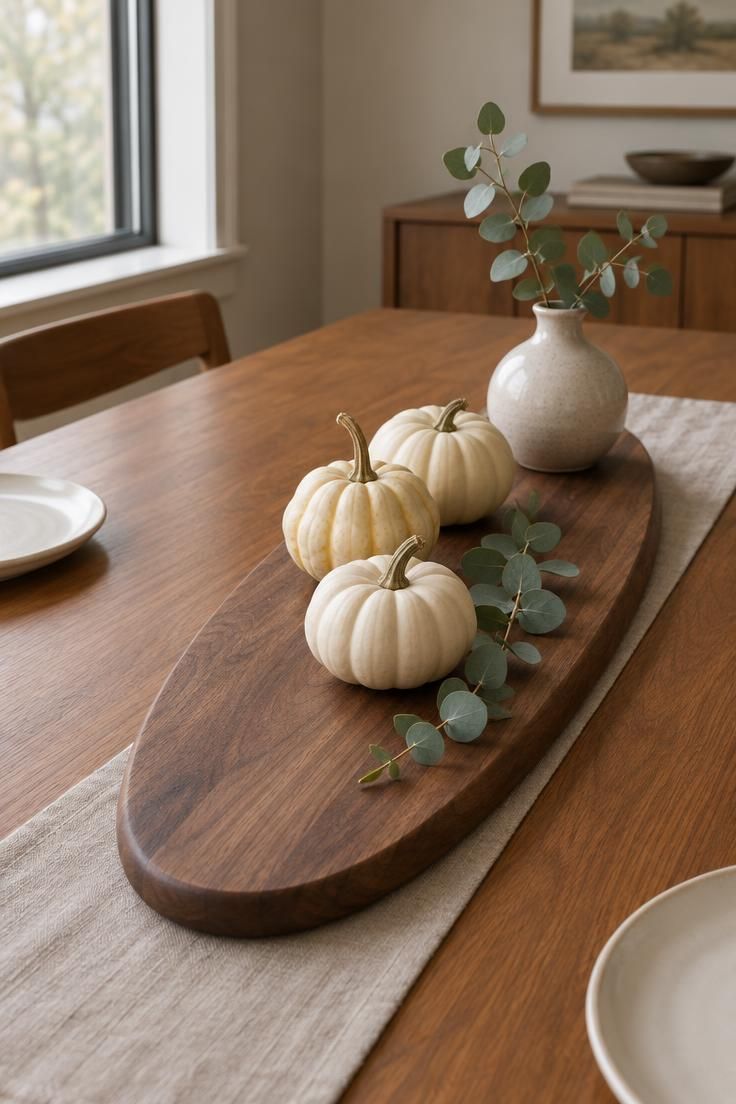
A wide oval walnut serving board can stand in for a traditional runner.
Clustering small gourds, a eucalyptus sprig, and one small vase at the end of the board creates a low arrangement that repeats the table's wood while softening its straight lines with an organic curve.
The board works best when the grouping stays below the height of any nearby candlesticks.
Keeping it low preserves sightlines across the table, which matters at a holiday meal where conversation carries the evening.
Offset the cluster toward one end rather than centering it.
A little open wood at the other end gives the arrangement breathing room and keeps it from reading as a formal centerpiece.
If the decorative load feels heavy once platters arrive, the board can move to the sideboard and return after the main course.
Walnut boards need only a wipe with a damp cloth and occasional conditioning to keep the surface from drying out.
Style Blueprint:
- Wide oval walnut serving board
- Three small gourds in one cream tone
- A single eucalyptus sprig
- One small rounded ceramic vase
Row of Wood Candle Holders Down the Length
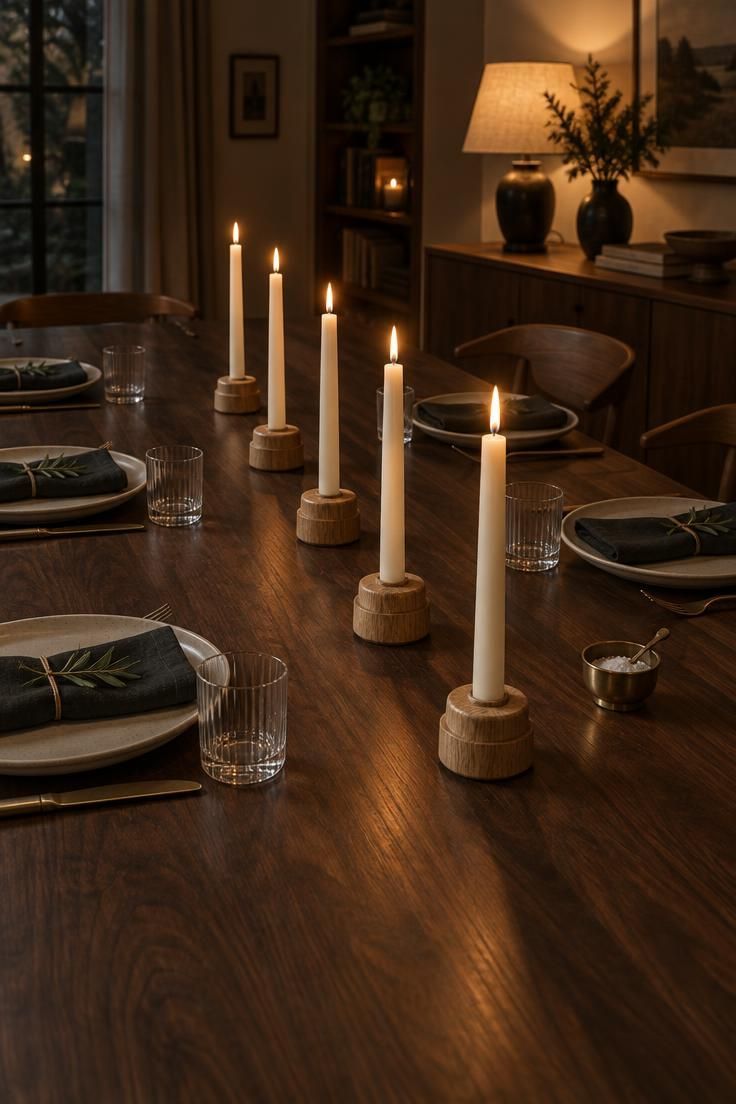
Repetition is the engine of this idea.
Five matching low wood holders in a straight line create a rhythm that reads as unmistakably mid-century, and the even spacing does more visual work than any single object could.
Choose holders in a lighter oak to contrast with a walnut table, or match the table wood for a quieter monochromatic effect.
Either choice works; the mistake is mixing several holder styles, which breaks the rhythm the row depends on.
Spacing needs attention.
Leave a clear gap between the last holder and the table edge so platters and serving bowls have room without disturbing the line.
The row should feel like a spine down the table, not a barrier across it.
This taper candle centerpiece suits a darker, more intimate dinner.
Cream tapers keep the row from disappearing against a dark table, and low holders keep the flames below eye level for seated guests.
Style Blueprint:
- Five matching low oak candle holders
- Cream tapers in each holder
- Dark linen napkins for contrast
Design Pro-Tip: Set the holders in place, then walk around the table once. Adjust any gap that looks noticeably wider or narrower than its neighbors before lighting the tapers.
Single Sculptural Branch in a Wide Bowl
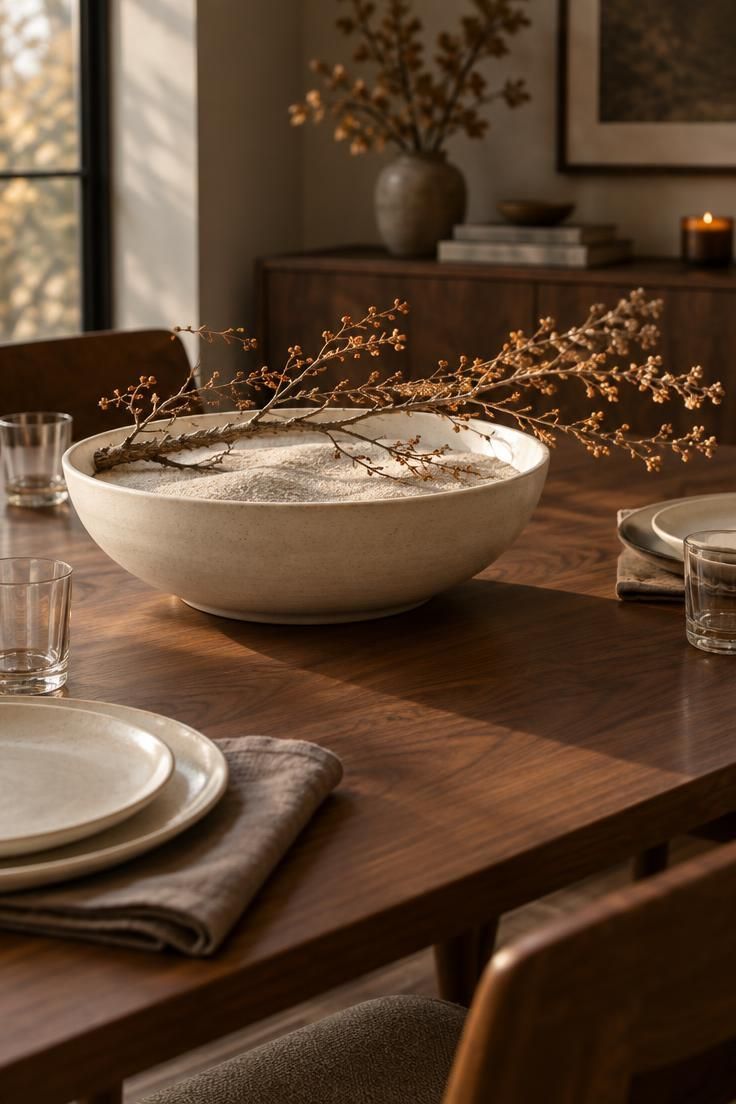
One branch in a wide, shallow bowl makes a case for restraint.
The branch's natural curve plays against the bowl's simple geometry, and its nearly flat profile keeps the table usable for serving.
Position the bowl off-center or toward one end.
Centering a single horizontal branch can make the table feel divided; offsetting it lets the eye travel down the length of the branch and back into the room.
Sand adds a quiet textural base and holds the branch in place without fuss.
A pale sand tone keeps the arrangement light, while a darker sand would give the bowl more weight and contrast.
The main limitation is fragility.
Dried branches shed small pieces, so choose one that holds its form and handle it gently when clearing the table.
A sideboard placement works well if the table needs more room.
Style Blueprint:
- Wide shallow ceramic bowl in cream
- Pale sand fill
- One long dried branch with a natural curve
- Taupe linen napkins
Smoked Glass Taper Holders With Amber Glassware
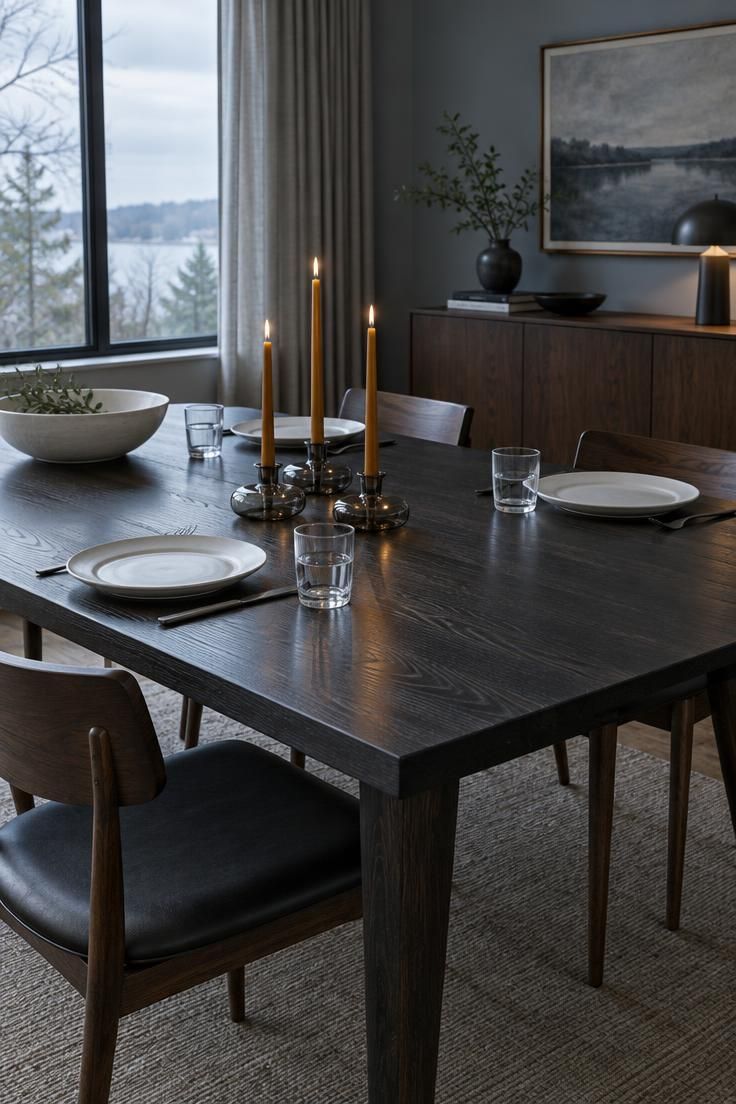
Smoked glass holders with amber tapers offer a cooler reading of the mid-century palette.
Against a dark walnut or black-stained table, the translucent materials let the surface show through, so the setting stays light even with a dark foundation.
Echo the glass theme at each place with clear or amber tumblers.
Simple white or cream dinnerware keeps the place settings quiet, letting the glass pieces carry the visual interest.
The transparency is also practical.
Smoked and amber glass reveal less visual weight than opaque ceramics, which helps a long table feel open.
Mixing two glass tones, smoked and amber, adds depth without adding more colors.
Glass needs gentle handling.
Wash the holders by hand and store them with a little padding, since thin tapers and glass rims chip easily.
Amber tapers can fade in strong direct sun, so keep spares in a drawer.
Style Blueprint:
- Black-stained or dark walnut table
- Three low smoked glass taper holders
- Slim amber tapers
- White or cream plates
- Clear glass tumblers
Design Pro-Tip: Group the smoked glass holders slightly off-center on a dark table. The asymmetry keeps the cool palette from feeling rigid and gives the amber tapers more presence.
Low Ceramic Bud Vases in Deep Teal
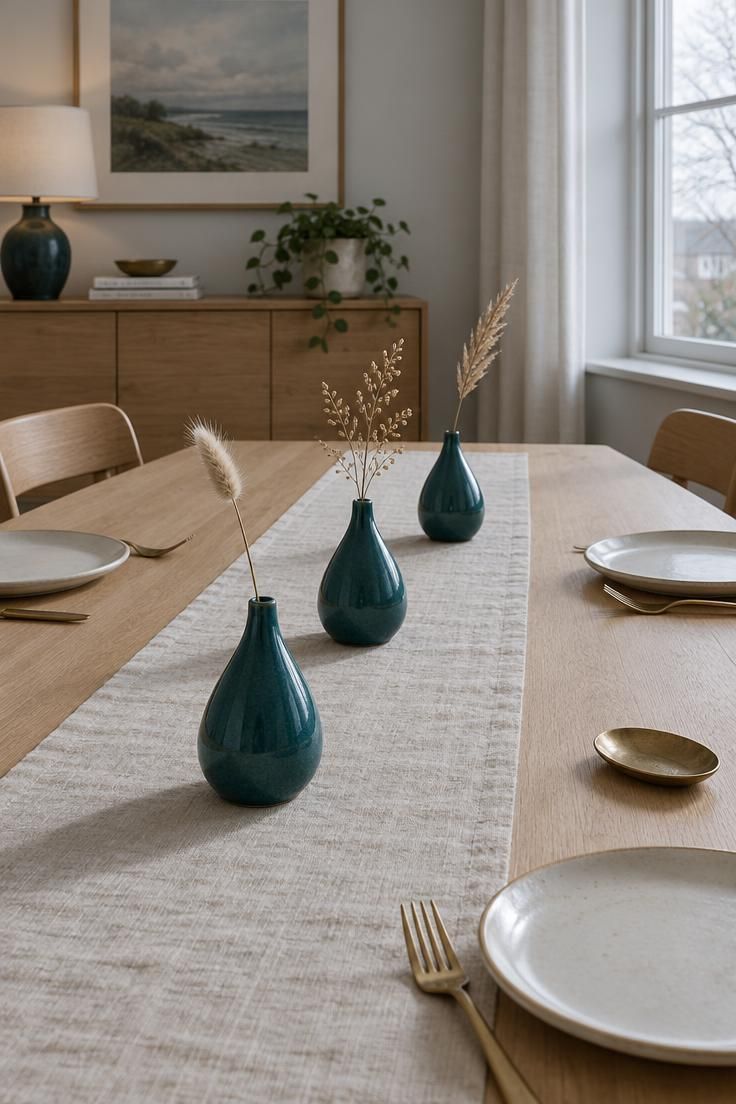
Small deep teal bud vases bring organic mid-century shapes to the table without taking up much room.
Their rounded teardrop silhouettes contrast nicely with straight-edged plates, and a single dried stem in each keeps the arrangement spare.
Because the vases are small, they leave the table open for serving.
That smallness is the idea's strength and its limit: on a very large table, three small vases can get lost, so a fourth or a slightly taller stem may help them hold their ground.
Brass flatware warms the cool teal and ties the vases to the wood.
Keep everything else neutral so the teal remains the single accent.
Cream plates and a pale runner give the color room to register.
Dried grass and wheat shed, so trim stems to sit securely in the narrow necks.
Rinse the vases between uses to keep the interiors clear.
Style Blueprint:
- Three deep teal ceramic bud vases
- Dried grass or wheat stems, one per vase
- Cream plates
- Brass flatware
Kidney-Shaped Ceramic Tray Holding Gourds
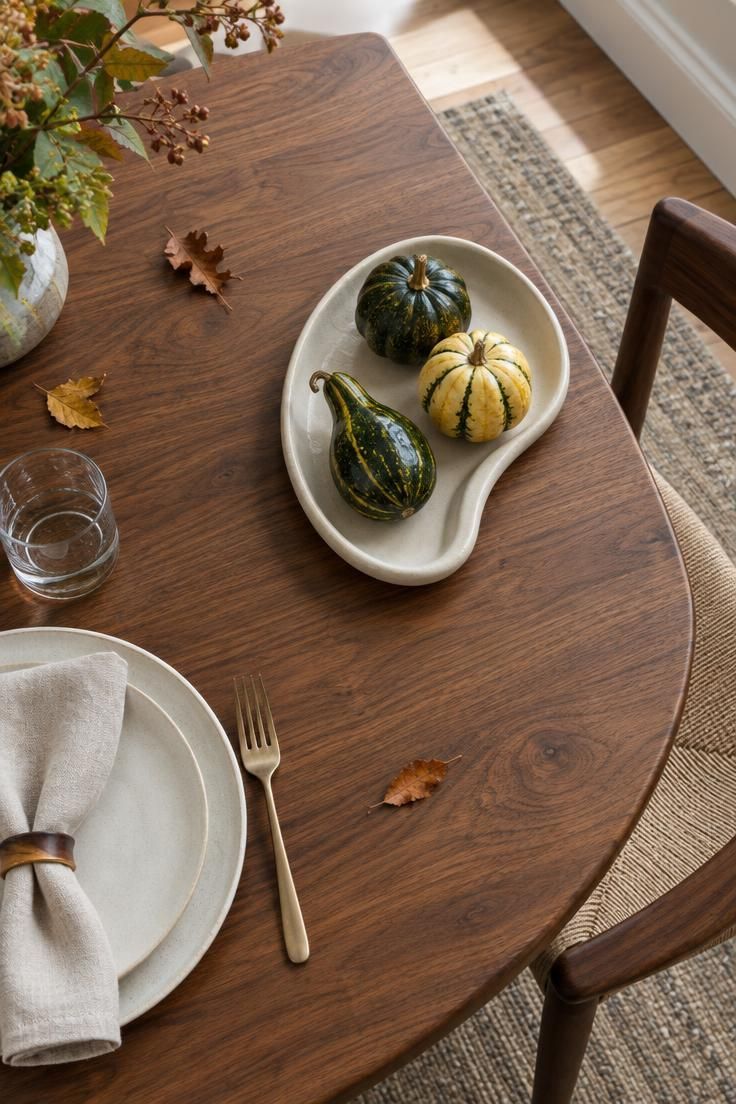
A kidney-shaped ceramic tray is a classic mid-century silhouette, and its biomorphic curve does something a rectangular tray cannot: it softens the table's grid of plates and straight edges.
The curved indentation also gives fingers an easy place to lift.
Use this wood tray centerpiece as an accent rather than a full arrangement.
Placing it near one end leaves the middle clear for platters and keeps the composition from feeling symmetrical.
Three small gourds in a single color family, such as olive and pale yellow, keep it restrained.
Because it is small, the tray can shift to a sideboard if the meal needs the space.
Cream glaze hides dust well and wipes clean easily, which suits a surface that will hold produce.
Style Blueprint:
- Kidney-shaped cream ceramic tray
- Three small gourds in olive and pale yellow
- Cream plates nearby
Geometric Linen Runner in Rust
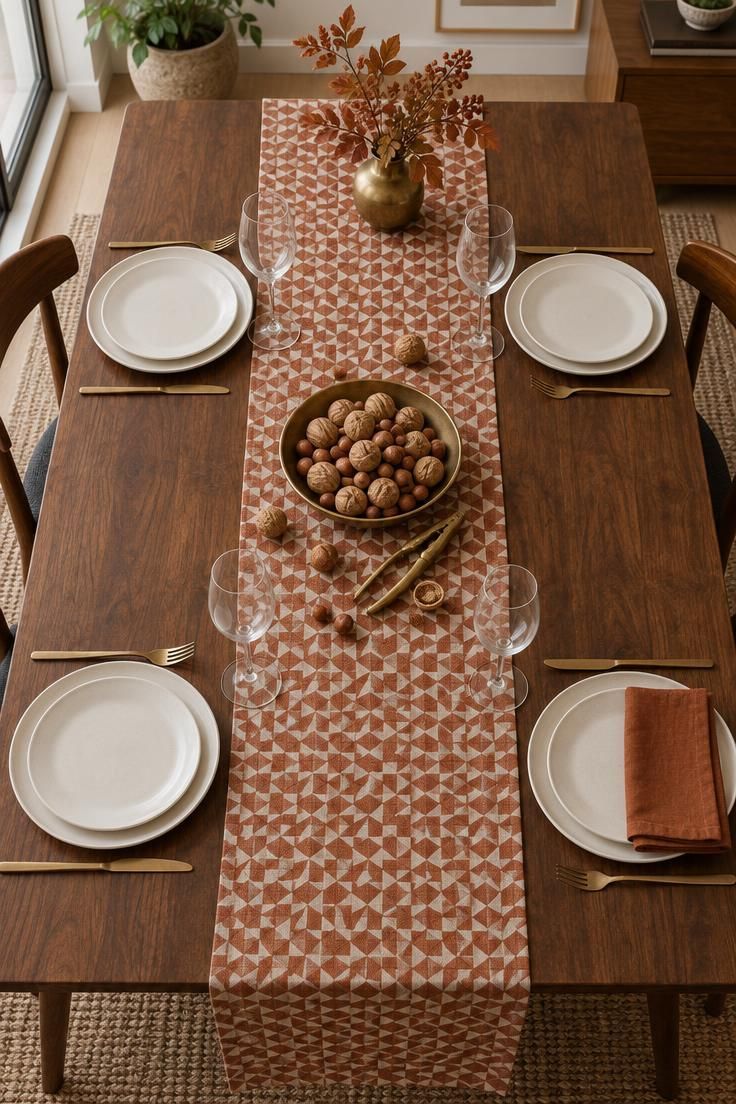
A printed linen runner with a small-scale geometric pattern brings a period-appropriate graphic note to the table.
Let the runner carry the pattern, then keep dishes and centerpiece very simple: white plates, clear glasses, and one low brass bowl of nuts.
The pattern's scale matters more than its exact motif.
Small repeats read as texture from a distance and stay calm under a meal, while large bold prints compete with the food.
Rust and cream keeps the scheme autumnal without adding another accent color.
A solid rust runner is the quieter alternative when the table already has visual weight.
The patterned version adds energy, so choose it when the rest of the setting is genuinely spare.
Linen runners crease and stain, so press before the meal and choose a washable version.
Spills on a busy holiday are likelier than on an ordinary evening.
Style Blueprint:
- Geometric rust and cream linen runner
- White plates
- Clear stemware
- Low brass bowl of nuts
Design Pro-Tip: Pull the runner slightly past each end of the table center rather than stopping it short. The overhang makes the pattern read as a deliberate band instead of a floating rectangle.
Walnut Pedestal Nut Dish With Brass Scoop
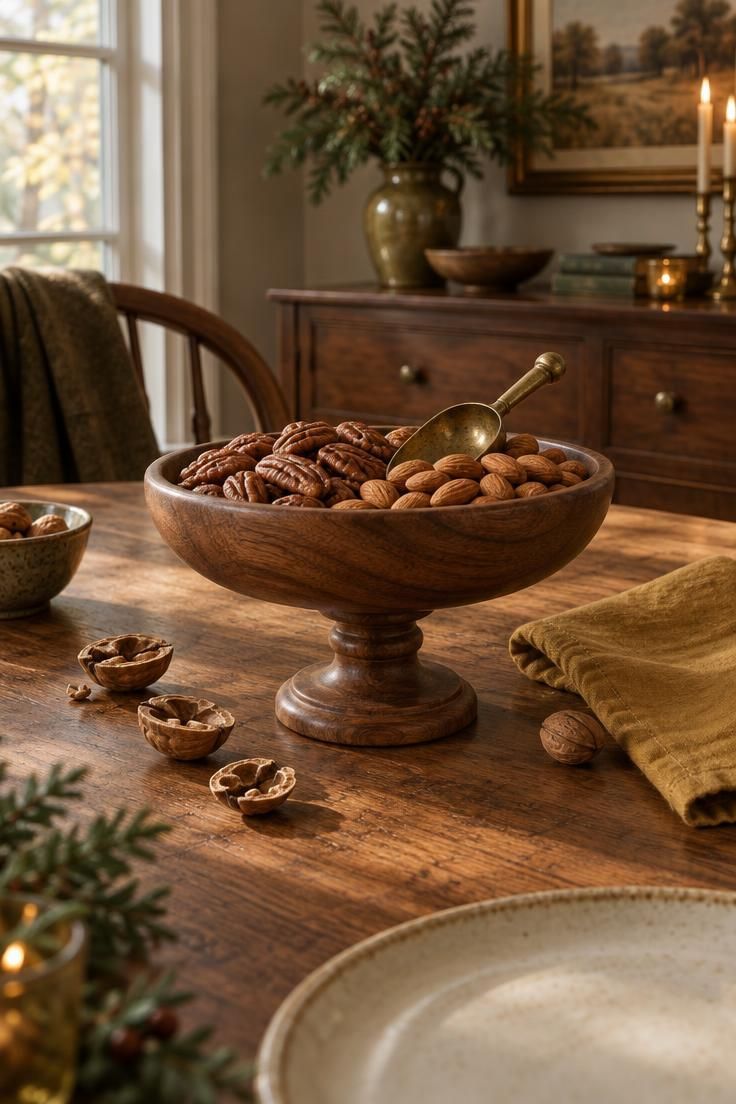
A pedestal nut dish gives the center of the table a quiet focal point without taking up much room.
Turned walnut echoes the curved legs and rounded profiles common in mid-century casegoods, so the dish can feel collected rather than merely seasonal.
Loading it with pecans, almonds, and a few empty shells makes the table feel occupied before the meal begins.
A brass scoop invites household members and guests to serve themselves without reaching across a shared basket.
The dish works because it combines two functions in one object.
It raises the nuts enough to feel intentional, while the shallow bowl keeps the display low and easy to reach from either side.
Choose a dish with visible grain variation so daylight picks up the turning lines.
Avoid a high-gloss finish if you want the look to lean slightly more casual and practical for a long meal.
Style Blueprint:
- One turned walnut pedestal nut dish
- Whole pecans and almonds in the bowl
- A small vintage brass scoop resting at an angle
- A few empty walnut shell halves scattered nearby
- One folded mustard linen napkin to anchor the setting
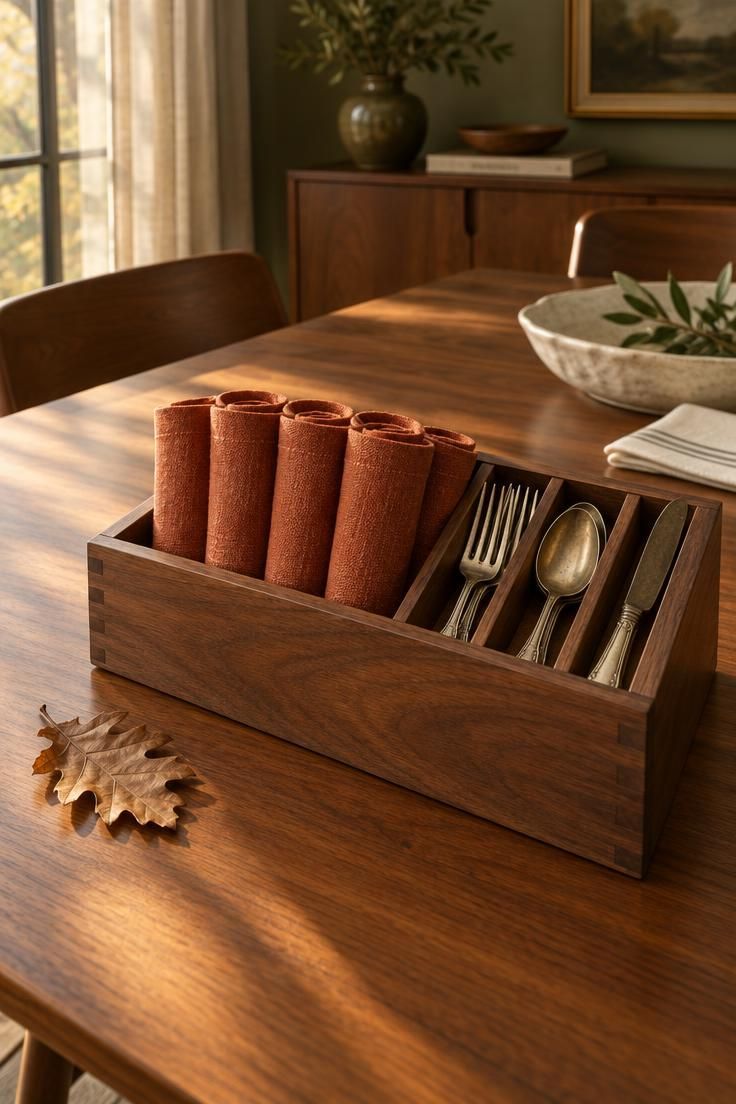
Sunken Walnut Box for Flatware and Cloth Napkins
A recessed walnut box placed near the table edge keeps rolled napkins, serving pieces, and extra flatware together without interrupting the main centerpiece.
Leaving the table's middle open makes room for platters and bowls as the meal moves and gives the setting a relaxed, uncluttered rhythm.
Build the arrangement around one low rectangular box in a warm walnut finish.
Choose a version with divided interior compartments so paring knives, serving spoons, and folded linen napkins stay separated and upright.
Position the box off-center rather than dead center, which keeps it reachable while preserving space for shared dishes.
The napkin material sets the visual tone.
Rolled rust linen or heavy ivory cotton napkins introduce soft texture against the wood, and the rolled ends read as small sculptural details from across the table.
Tuck a few slender forks and spoons in the forward slot so their handles remain visible without rising above the box rim.
A flat felt liner in mustard or olive helps the contents stand out against the walnut and softens the sound of cutlery landing.
Let the box sit directly on the table without a runner so its grain line and rounded corners remain the focus.
Style Blueprint:
- Low rectangular walnut flatware box with divided interior slots
- Rolled rust linen napkins standing on end in one compartment
- Spare place-setting flatware arranged by type in the other compartments
- A removable olive felt liner for contrast and easy cleaning
- Off-center placement near a short table edge with open serving space opposite
Conclusion
A mid-century modern Thanksgiving table works when restraint and warmth meet.
Choose one low centerpiece strategy, repeat a single material or accent color, and leave the rest of the table uncluttered for the meal itself.
The result is a holiday table that feels both intentional and practical for home hosting.