This post may contain affiliate links. If you make a purchase through these links, we may earn a commission at no additional cost to you.
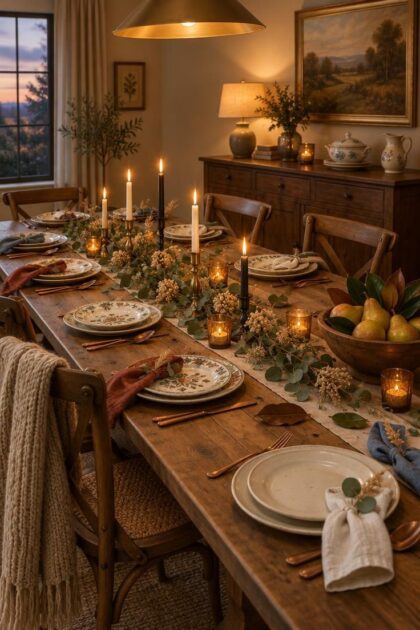
A Thanksgiving table holds more than plates and candles.
It carries the shape of the meal itself, from the first reach for the bread basket to the last cup of coffee.
Treating the surface as a composition with a footprint helps: a low and sprawling line of foliage leaves room for platters, while a concentrated vertical moment keeps sightlines open at the center.
The pages that follow work through both approaches, plus place settings that feel collected rather than staged.
All of it happens at home, sized to a real dining room and a real gathering of family and friends.
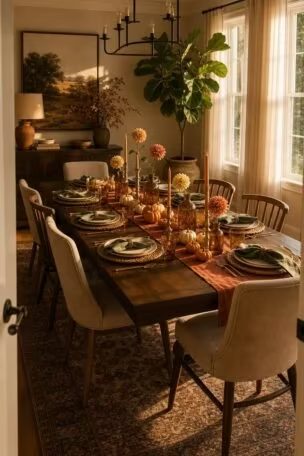
Low Eucalyptus Greenery Runner With Tucked Tapers
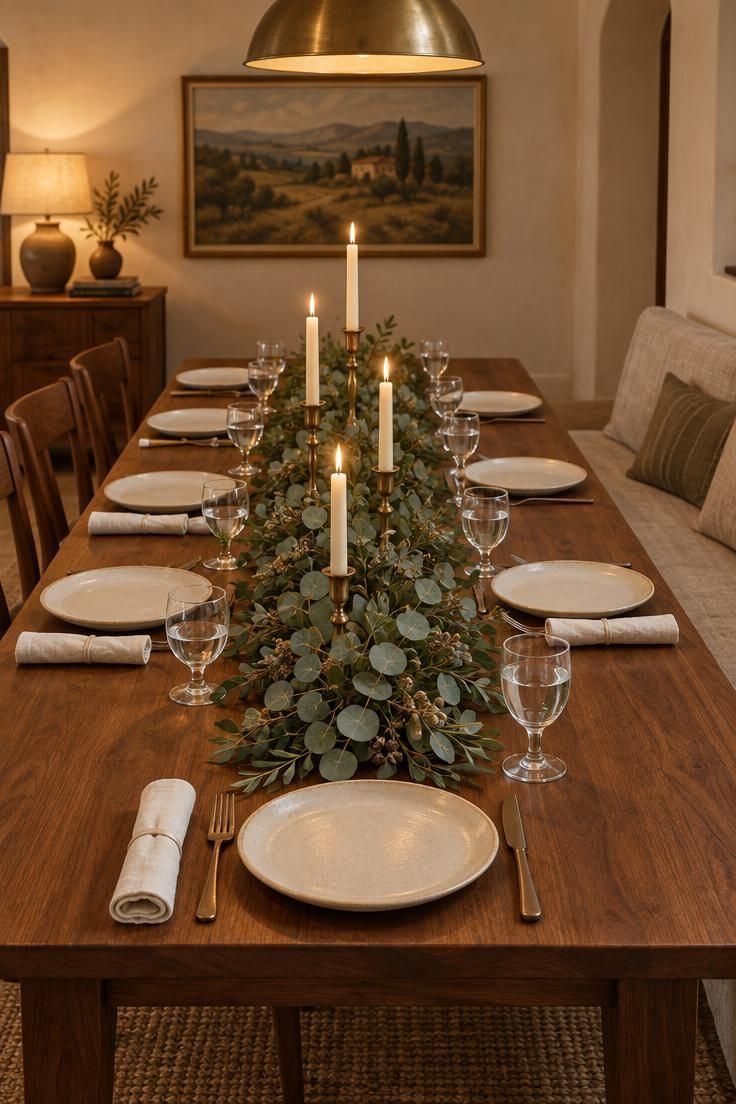
A continuous line of foliage down the center gives the table direction without lifting into anyone's view.
Eucalyptus works well here because its stems are pliable and its leaves sit close together, so the runner reads as one soft horizontal band rather than a row of separate bouquets.
Brass candlesticks pushed down into the greenery interrupt that band at uneven intervals, which keeps the composition from looking measured or symmetrical.
The quiet place settings do a lot of the work.
Cream plates and warm white napkins let the silver-green foliage and the candlelight carry the table, and they also give the eye somewhere neutral to rest between the busier center.
Bronze flatware echoes the brass of the candlesticks without matching it exactly.
Because the arrangement stays low, most of the table's center remains usable for serving dishes.
Thin tapers take up very little visual width, so conversation across the table stays open.
This is a forgiving setup for a large meal: the greenery can be lifted in a few sections if a platter needs more room.
Fresh eucalyptus holds its color reasonably well through a long afternoon, though it will soften as the day goes on.
A handful of dried sprigs kept nearby can fill any thin spots in the runner without a noticeable change in texture.
Dried stems also last far longer, which suits a table that stays dressed beyond the meal.
Style Blueprint:
- Warm white or oatmeal linen napkins, rolled rather than fanned
- Cream stoneware dinner plates with a matte glaze
- Bronze or aged brass flatware
- Four to five brass taper candlesticks in mismatched heights
- Fresh eucalyptus stems, or a mix of fresh and dried
Warm Neutral Harvest Table With Dried Grasses and Gourds
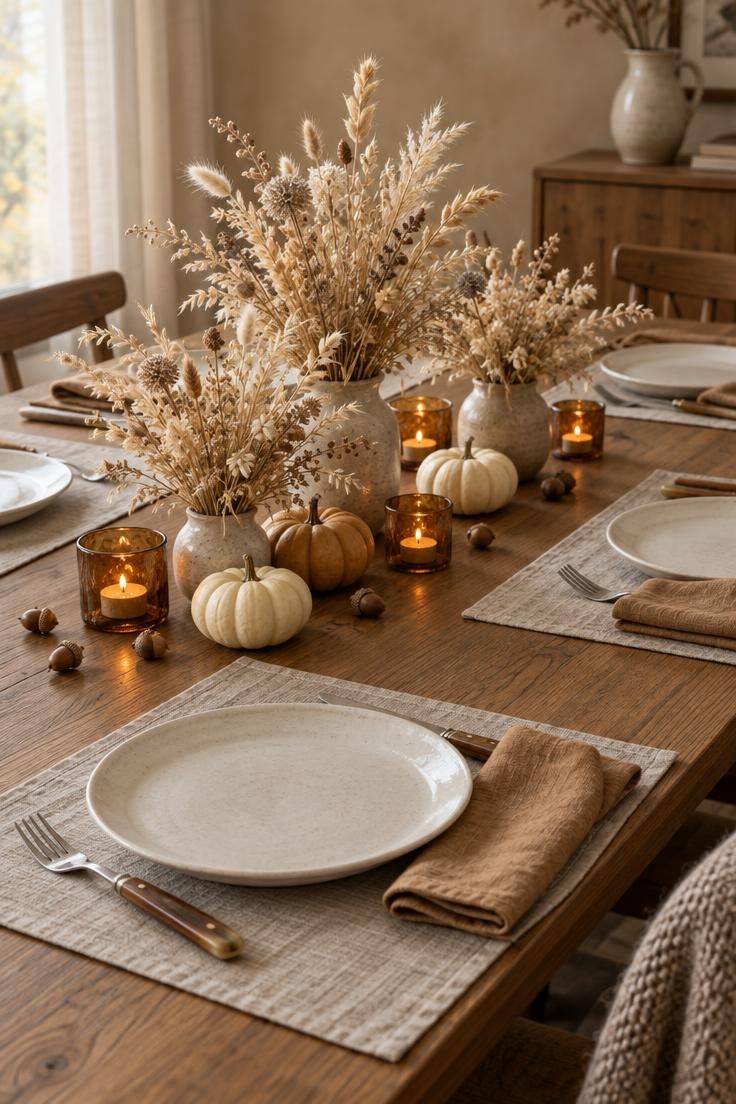
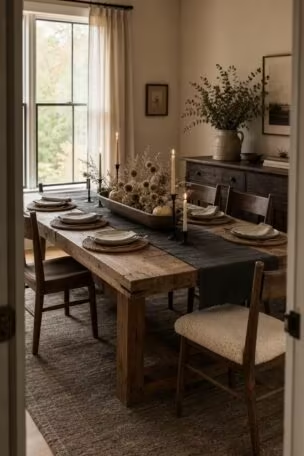
Tonal dressing depends on texture more than color.
Oatmeal linen, ironstone, and camel cotton sit within a narrow range of warm neutrals, so the differences have to come from weave, glaze, and surface finish.
The dried grasses add a fine, wispy texture that contrasts with the smooth plates and the glass votives.
Loose clusters down the center keep a warm neutral harvest table decor scheme from turning stiff.
Three small groupings read as collected over time rather than purchased as a set, and they leave generous gaps where serving pieces can land.
Amber glass brings a low, warm note that ties the earthen palette together.
The sparse center is the practical advantage here.
A turkey platter or a stack of bread boards can sit directly on the table without displacing the decorations.
Dried grasses also need no refreshing, so the arrangement can go out days ahead and stay put through the weekend.
One limitation worth knowing: dried grasses shed.
A light shake over a bin before the table is set saves a scattering of seeds across the linens.
The amber votives should be checked for wax level before the meal so they don't gutter out midway.
Style Blueprint:
- Oatmeal linen placemats
- Off-white ironstone plates and horn-handled flatware
- Camel cotton napkins
- Amber glass votive holders with tealights
Rust and Dusty Blue Contrast With Transferware Plates
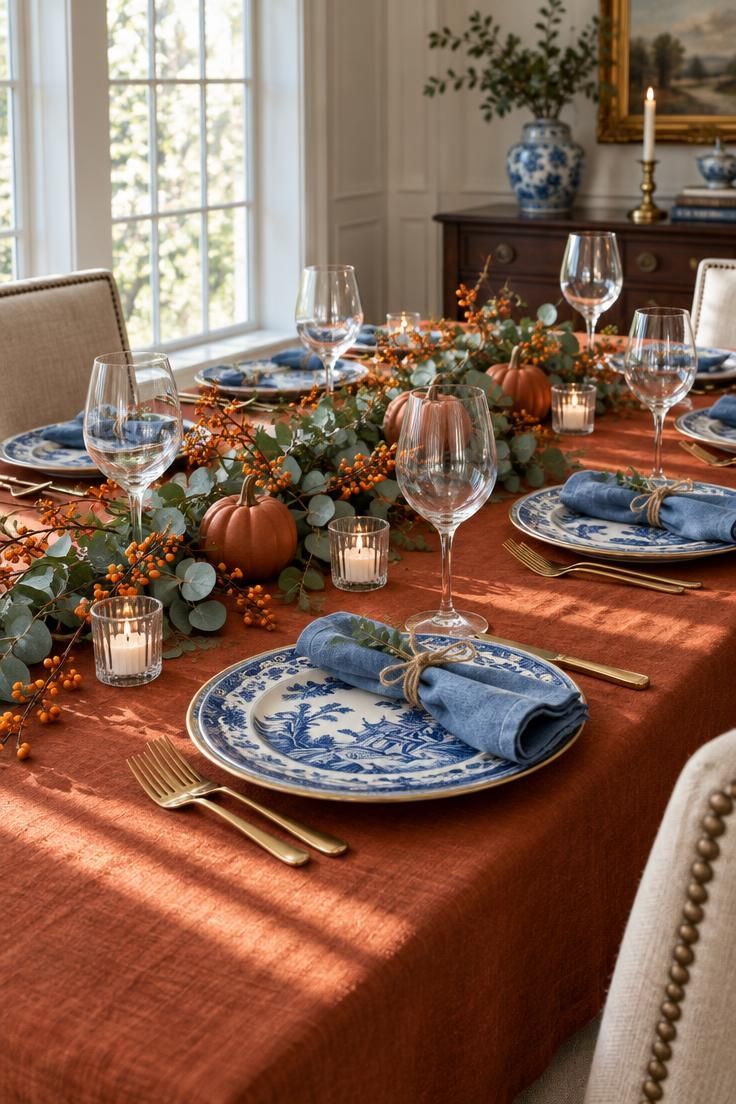
Rust and dusty blue sit opposite each other on the color wheel closely enough to feel deliberate, and far enough to keep the table from reading as one flat autumn tone.
The rust cloth grounds the setting, the blue-and-white plates carry the pattern, and dusty blue napkins repeat that cooler note at every seat.
Brass flatware bridges the two families with a warm metallic that belongs to neither.
A candlelit dining table arrangement can still work in bright daytime when the decor stays low.
Seeded eucalyptus and bittersweet branches give the center a loose, twiggy texture that reads well under strong window light, and the small terracotta pumpkins repeat the cloth color in a matte material.
The low profile keeps the pattern on the plates in view.
This is a good choice for a table where the china matters.
The plates become the focal point, and the center stays supportive rather than competitive.
Because the runner is wide while the decor remains low, platters can sit on the cloth at either end without covering the arrangement.
Transferware and rust linen both show stains, and the cloth will hold onto a spill until it is washed.
A washable cloth or a runner over a plain base makes the look easier to maintain through a long meal.
Clear votives should be emptied and wiped between uses so soot doesn't cloud the glass.
Style Blueprint:
- Deep rust linen tablecloth
- Blue-and-white transferware dinner plates
- Dusty blue linen napkins tied with twine
- Brass flatware and clear glass votives
- Seeded eucalyptus, orange bittersweet, and small terracotta pumpkins
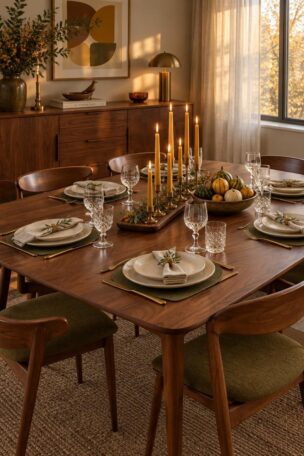
All-White Table With Olive Branches and Bare Wood
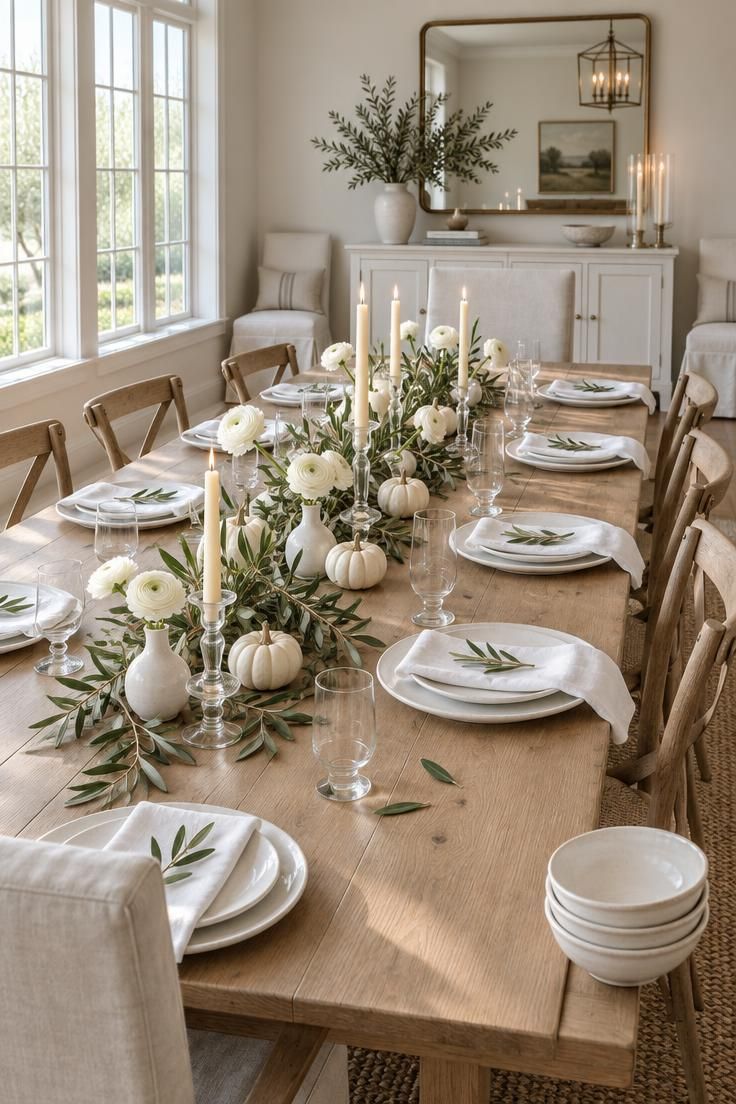
Stripping the table back to bare wood and white tableware makes the wood itself the source of warmth.
The contrast between pale oak grain and white ceramics gives the table structure, and the olive branches introduce a muted green that reads as harvest without tipping into autumnal orange.
Thanksgiving tablescapes built on this idea depend on restraint: the fewer materials, the more each one shows.
A line of white pumpkins, pears, and low ceramic bowls keeps the center low and layered rather than tall.
Cream tapers added at intervals give a soft vertical note that doesn't block the view.
The overall effect is open and bright, which suits a daytime meal or a dining room with generous natural light.
The tradeoff is maintenance.
White surfaces show every crumb and drip, and a bare wood top needs quick wiping between courses.
Linen napkins in white also crease visibly, so a light press before the table is set keeps them looking crisp.
These small chores are the cost of the bright, quiet look.
Style Blueprint:
- White stoneware plates and white linen napkins
- Clear glass taper holders with cream candles
- Small white pumpkins and fresh pears
- White ceramic bud vases with white ranunculus
- Fresh olive branches
Moody Jewel-Tone Table With Dark Florals and Brass
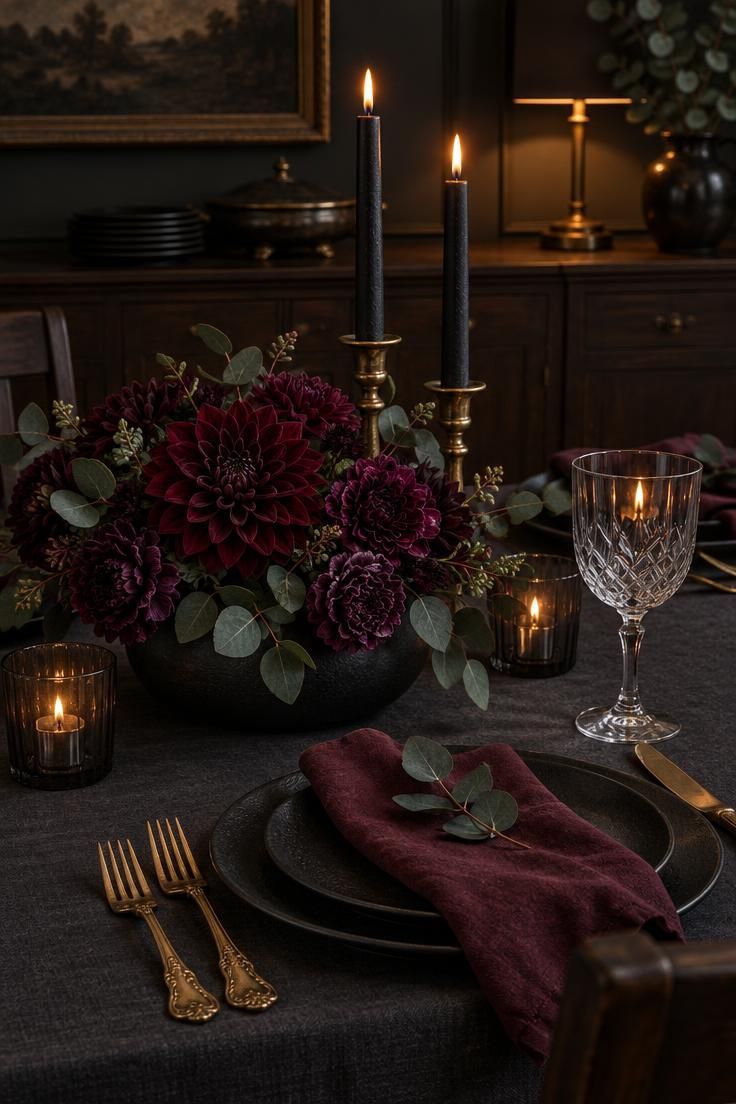
Dark linens and saturated flowers carry a lot of visual weight, so the composition needs strong materials to hold together.
Charcoal cloth sets a low base, burgundy plates and plum napkins add depth, and brass flatware provides the only bright note at the place settings.
Black tapers in aged brass holders extend the darkness upward without adding visible clutter.
This is a table where a sideboard serving station setup earns its place.
The center is occupied by a dense mass of dark blooms, so platters and bowls are better staged on a nearby surface and passed from there.
That division keeps the table itself intact as a visual anchor, and it makes clearing between courses simpler because the serving pieces never pile up around the flowers.
Smoke-glass votives and cut-crystal glasses catch the dim light and break up the dark surfaces with small reflections.
Without them, the table could read as flat.
Their placement among the flowers rather than at the edge is what gives the center its depth.
Low light flatters this palette, but it also hides detail.
A small lamp or an additional votive near the table's edge keeps the settings legible without washing out the mood.
Dark cloth also shows wax drips and crumbs, so a lint roller and a small brush kept nearby help between courses.
Style Blueprint:
- Charcoal linen tablecloth
- Black stoneware dinner plates and burgundy linen napkins
- Ornate brass flatware and aged brass taper holders
- Black tapers and smoke-gray glass votives
- Dark dahlias, purple carnations, and dark green eucalyptus
Design Pro-Tip: Set the table in the same light it will be seen in. A jewel-tone arrangement that looks rich by lamplight can read nearly black in flat afternoon light, so check the composition at the hour your meal will be served.
Mismatched Vintage China With Unified White Flowers
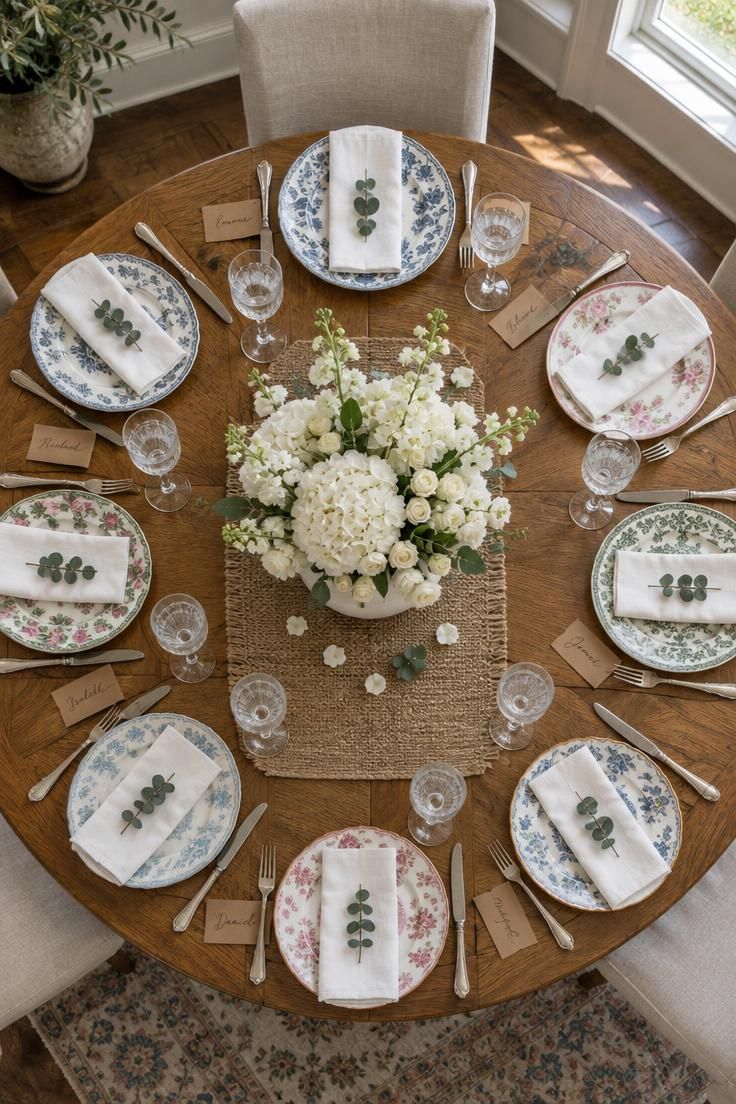
A table of mismatched vintage china place settings can tip into visual noise quickly.
The way to hold it together is to unify everything that isn't the plate: one flower color, one napkin treatment, one kind of place card.
Each vintage plate then reads as a deliberate variation rather than part of a jumble.
White flowers do the unifying here because they repeat across the center without competing with any of the plate patterns.
Hydrangea, stock, and spray roses give a mix of rounded and spiky forms so the bowl doesn't look like one solid mass.
Keeping it low means the varied plates stay visible from every seat.
The plate variety carries a practical benefit.
Different patterns and ages hide drips, crumbs, and small chips far better than a matched set, and a collected table feels forgiving to host.
Mismatched silver flatware reinforces the same logic.
There is a limit to how far the variety should go.
Differences in scale read as intentional, but plates of wildly different sizes make the place settings uneven.
Sorting the china into a few consistent size groups before setting the table keeps the arrangement orderly.
Style Blueprint:
- A collected mix of vintage floral china plates
- White linen napkins with a eucalyptus sprig
- Mismatched silver-plate flatware
- Kraft paper place cards with handwritten names
- A low white ceramic bowl of white hydrangea, stock, and spray roses
Casual Family-Style Spread With Kraft Paper Runner
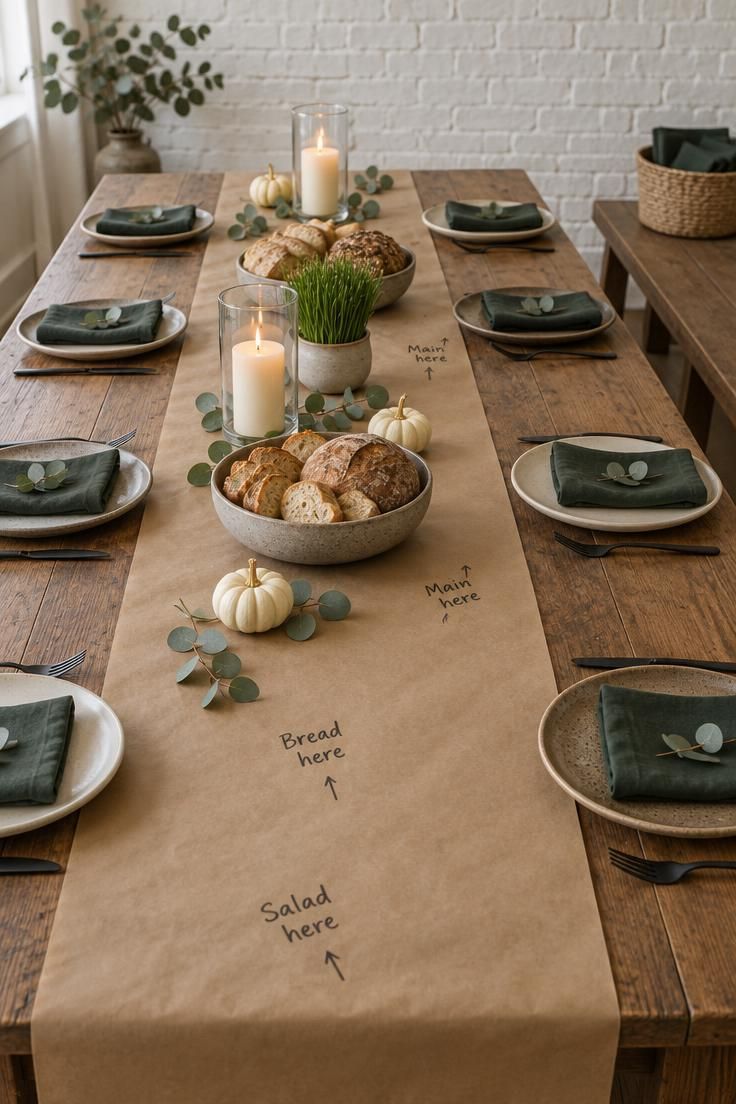
Kraft paper changes the whole character of a table because it reads as a working surface rather than a finished cloth.
Handwritten labels for dishes, simple sketches, or the date can go directly onto the runner, which turns the table into part of the meal's organization.
That practicality suits a family-style spread where bowls are passed and plates are filled in the middle.
The rest of the setting stays sturdy and low.
Stoneware plates, dark cotton napkins, and matte black flatware can handle a crowded table and a long meal without needing delicate care.
Small pots of wheatgrass and squat pillar candles in glass hurricanes give the center interest without adding clutter or height.
This composition leaves the middle free for serving because the decor hugs the runner.
Bowls of mashed potatoes, bread, and a stack of plates can sit directly on the paper.
When the meal ends, the runner can be rolled up with the crumbs still on it, which is a real advantage with a house full of guests.
The look is intentionally casual, and that won't suit every household.
Some hosts prefer the formality of linen and matched china, and kraft paper will always read as relaxed.
It also marks if anything wet sits on it for long, so a small tray under damp dishes helps.
Style Blueprint:
- Kraft paper runner with handwritten labels
- Cream and speckled brown stoneware plates
- Dark green cotton napkins and matte black flatware
- Small pots of wheatgrass
- Clear glass hurricanes with cream pillar candles
Tall Bittersweet Branch Arrangement Over Low Votives
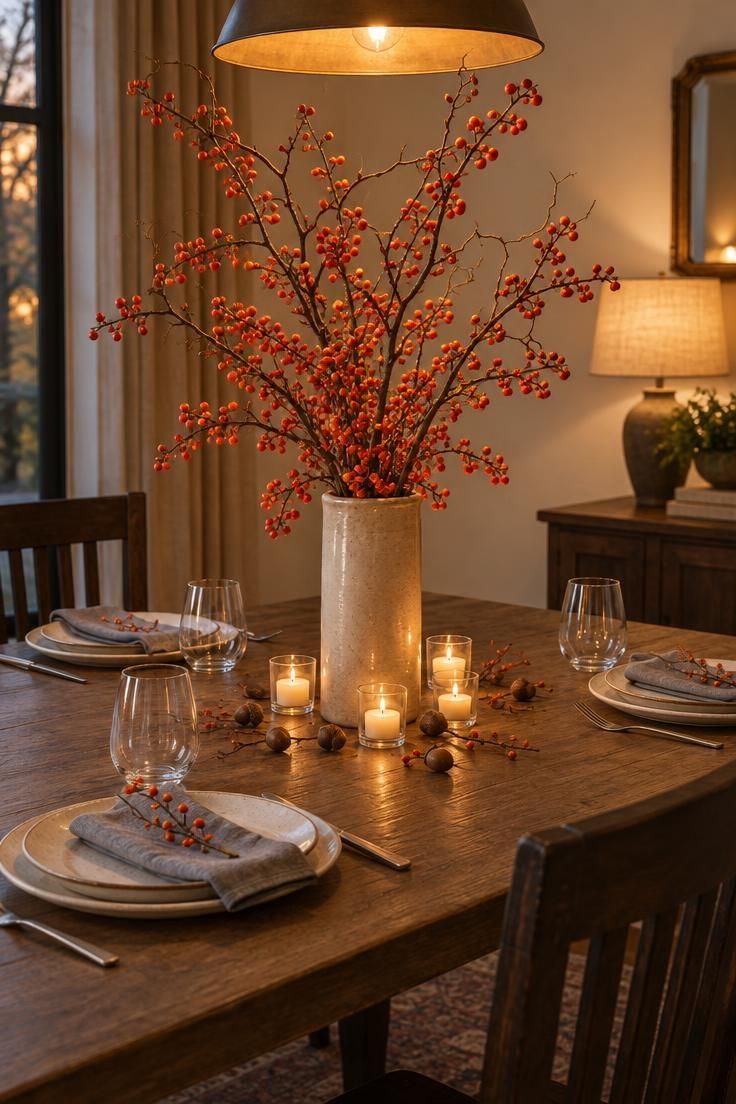
Concentrating height in one spot changes how the table reads.
A tall stoneware crock of bittersweet branches gives the center a strong vertical focal point, while the rest of the surface stays nearly clear.
Thin branches occupy little visual width, so sightlines across the table remain open in a way a wide floral centerpiece would not allow.
The low votives at the base anchor the tall arrangement and provide a second, quieter layer of light.
They also keep the center from looking like a single object dropped onto the table.
Small clusters of acorns and chestnuts spread outward from the crock to ease the transition between the tall center and the bare table.
Bittersweet is a useful material because the dried vines hold their berry color and can be stored between seasons.
The low votives make serving simple in the evening, since hands reaching for a bowl never have to navigate around height.
A table with this footprint can hold platters at both ends without disturbing the centerpiece.
One practical caution: keep open flames away from the dried branches and the linen, and place the votives so they can't be knocked over as dishes are passed.
That single consideration governs the whole center, and the rest of the styling can stay as loose as the arrangement suggests.
Style Blueprint:
- Cream stoneware plates and gray linen napkins
- A tall stoneware crock of bittersweet branches
- Clear glass votive candles clustered at the base
- Scattered acorns and small twigs
Edible Fruit and Foliage Centerpiece With Magnolia Leaves
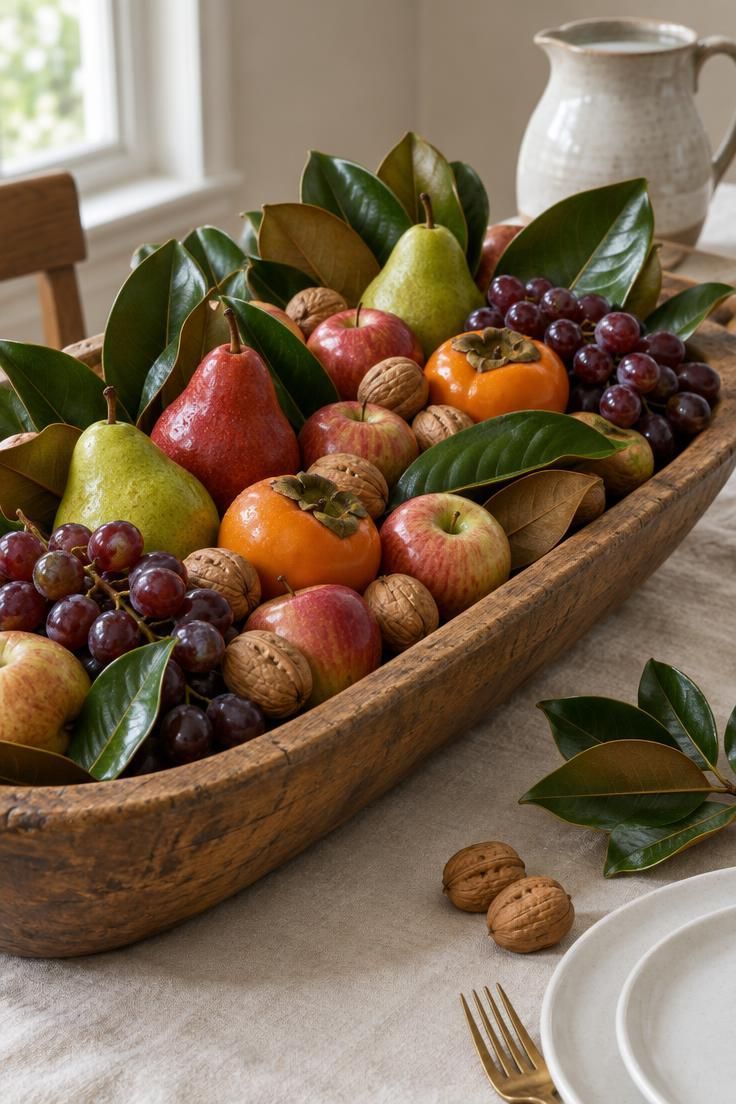
A long wooden tray or ceramic trough packed with fruit and magnolia leaves makes the centerpiece do double duty.
The fruit supplies the color, moving through deep red, golden green, and orange without a single flower.
Nuts in the shell and small clusters of grapes add texture and a sense of abundance, and everything in the bowl can be eaten or moved to a plate.
Magnolia leaves carry the composition because their glossy tops and matte undersides give two finishes in one material.
That mixed texture holds up under side light, and the leaves dry well enough to be reused for weeks.
The wooden bowl reinforces the harvest theme without adding a pattern that would compete with the fruit.
A long, narrow tray leaves reachable space on both sides, which matters when serving bowls need to sit nearby.
Guests can pass bread or a dish over the arrangement rather than around it.
This is a useful setup for a table where the meal is served in courses and platters keep returning.
Fruit that goes uneaten should be rotated out after the meal, since ripe pears and grapes soften quickly at room temperature.
Wiping the bowl and replacing the top layer of leaves refreshes the arrangement for a second gathering.
The magnolia leaves themselves need little attention and will hold their shape for weeks.
Style Blueprint:
- A long wooden dough bowl or ceramic trough
- Fresh magnolia leaves
- Pears, apples, persimmons, and red grapes
- Walnuts in the shell
Candlelight-Forward Minimalist Table With Single Greenery Sprigs
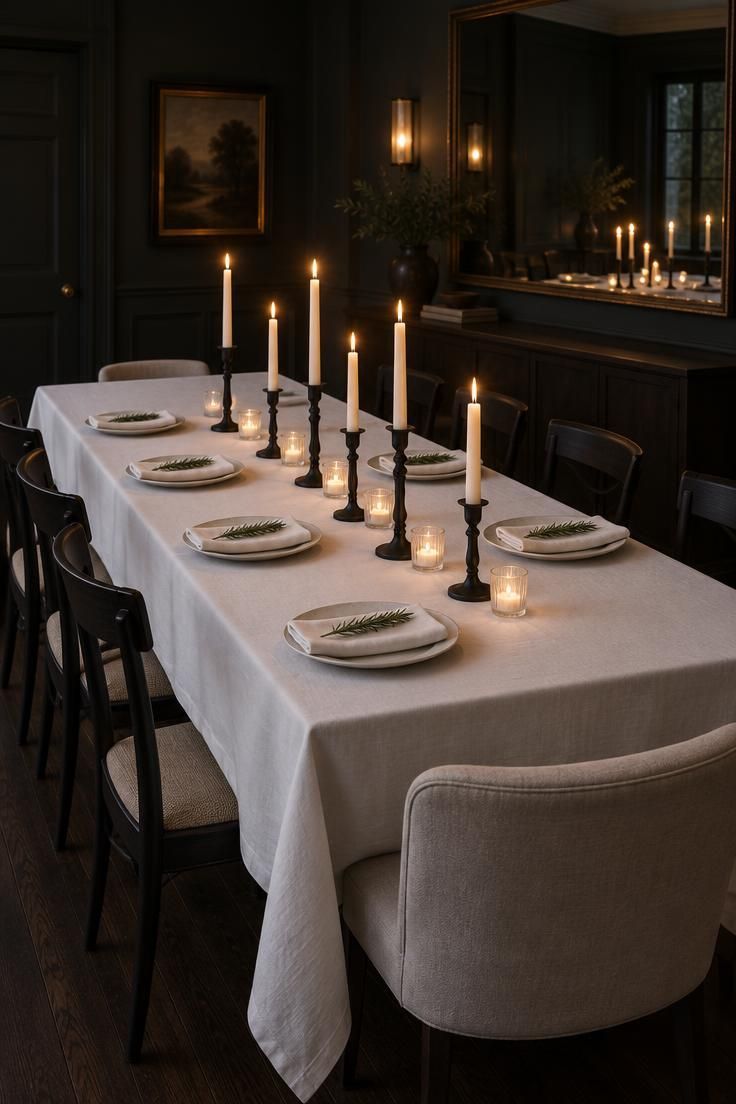
When the decoration is almost entirely candlelight, the table depends on rhythm rather than objects.
A row of black metal candlesticks in descending heights creates a repeating vertical line, and the clear votives between them fill the gaps with small pools of light.
A low centerpiece greenery runner is reduced here to a single sprig at each place, which keeps the line of flames as the main event.
The white cloth and white plates act as a reflective base.
Candlelight on white linen produces a soft glow across the table's whole width, so even the outer place settings stay legible.
Black metal holders provide a graphic counterpoint that keeps the composition from turning purely soft.
With almost no centerpiece, the full table surface is available for serving.
Dishes can be set down anywhere along the center without disturbing the candles, as long as they clear the line of holders.
Cleanup between courses is quick because there is little to move.
The white cloth shows spills immediately, and it also shows every crease.
A washable runner layered over the cloth can absorb the risk while keeping the bright surface visible at the edges.
Candle wax should be allowed to cool and harden before it's lifted from the linen, and the candlesticks checked for stability each time they're moved.
Style Blueprint:
- Crisp white linen tablecloth and white stoneware plates
- A row of black metal candlesticks in varied heights
- White taper candles and clear glass votives
- One rosemary or olive sprig per napkin
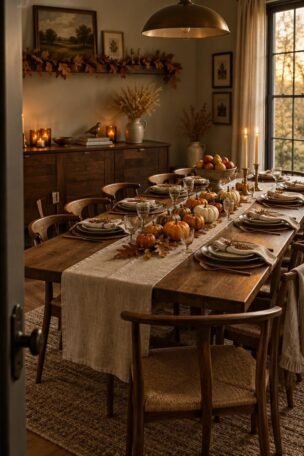
Plaid Runner and Woven Chargers With Copper and Wheat
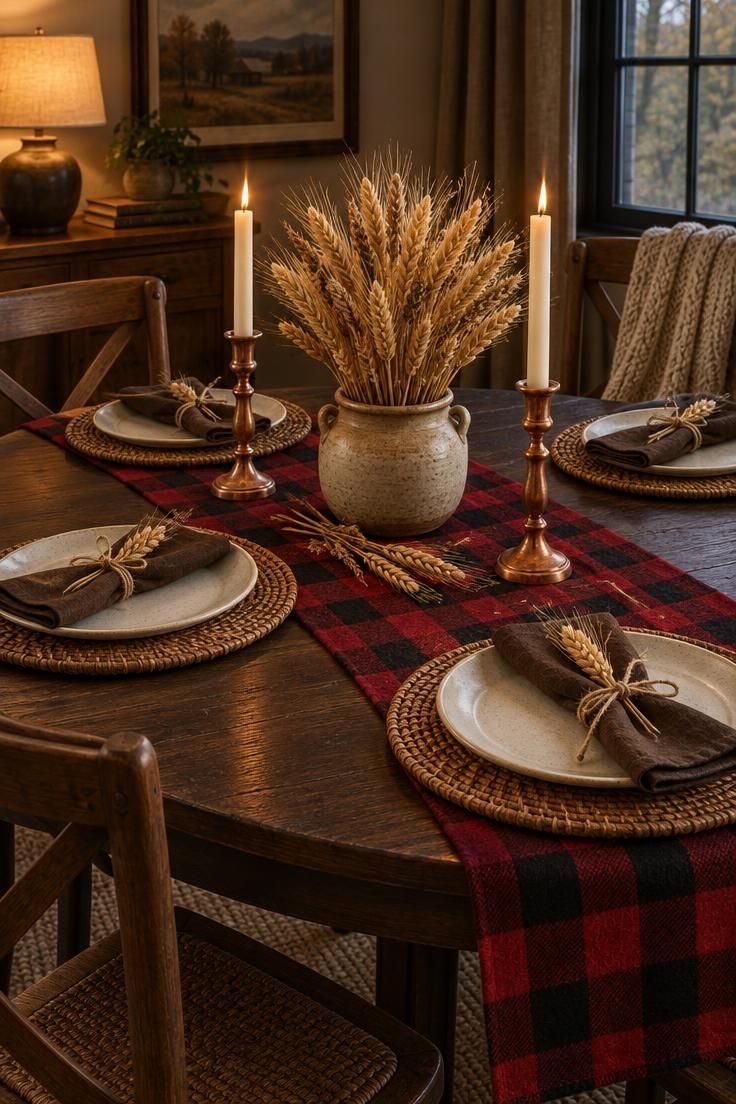
A plaid wool throw used as a runner brings pattern and a cabin-like feel to a wooden table in one move.
Because the plaid already provides strong visual noise, the rest of the setting stays simple: cream stoneware, brown linen napkins, and a single wheat sprig tied to each.
Woven rattan chargers add texture under the plates that reads as rustic without adding another color.
Copper candlesticks and dried wheat tie the composition together.
Copper brings a warm metallic note that suits the red in the plaid, and the wheat bundles reinforce the harvest theme with minimal bulk.
Keeping the center to one crock and two candlesticks prevents the table from feeling crowded.
This is a forgiving composition for a busy household.
The wool runner can be spot-cleaned or washed, the woven chargers can be stacked and stored after the meal, and the wheat bundles last from year to year.
Because the plaid is visually dense, one or two low wheat bundles are enough center interest.
The tradeoff is coordination: a strong pattern limits what else can sit on the table.
Keep serving pieces plain and let the plaid be the decoration.
Wool also needs a little care around spills, so a damp cloth and a quick blot do more good than a full wash mid-meal.
Style Blueprint:
- Red-and-black plaid wool runner
- Round woven rattan chargers
- Cream stoneware plates and brown linen napkins
- Copper candlesticks with cream tapers
- A crock of dried wheat stalks
Design Pro-Tip: Decide where the platters will land before arranging the center. Leaving two clear zones at either end of the runner means the decoration can stay in place once the food arrives.
Conclusion
Choosing a tablescape comes down to three things: how much open center the meal needs, how formal the table should feel, and which materials are already on hand.
Low runners and edible centerpieces leave more room for platters, while dense floral or candle-heavy compositions often work better with a sideboard set apart for serving.
Fresh greenery and fruit look their best assembled near the meal, whereas dried materials and vintage dishes can be set out days ahead.
Match the footprint to the way the meal will actually be served and cleared, and the rest of the table tends to fall into place.