This post may contain affiliate links. If you make a purchase through these links, we may earn a commission at no additional cost to you.
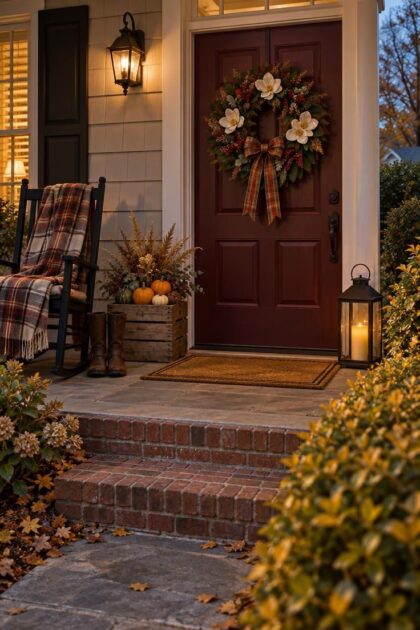
Late autumn arrives quickly, and the front door becomes the first place guests see a household's seasonal style.
Thanksgiving front door decor sits between the theatrical weeks of October and the twinkling start of December, so it tends to favor dried botanicals, natural fibers, and warm earth tones over lights or saturated holiday color.
The short November window rewards looks that go up fast, hold up outdoors, and store away without fuss.
This guide moves from a single hanging bundle to a full double-door composition, with each idea built around a different material, silhouette, or threshold arrangement.
Dried Wheat Bundle on a Door Hook
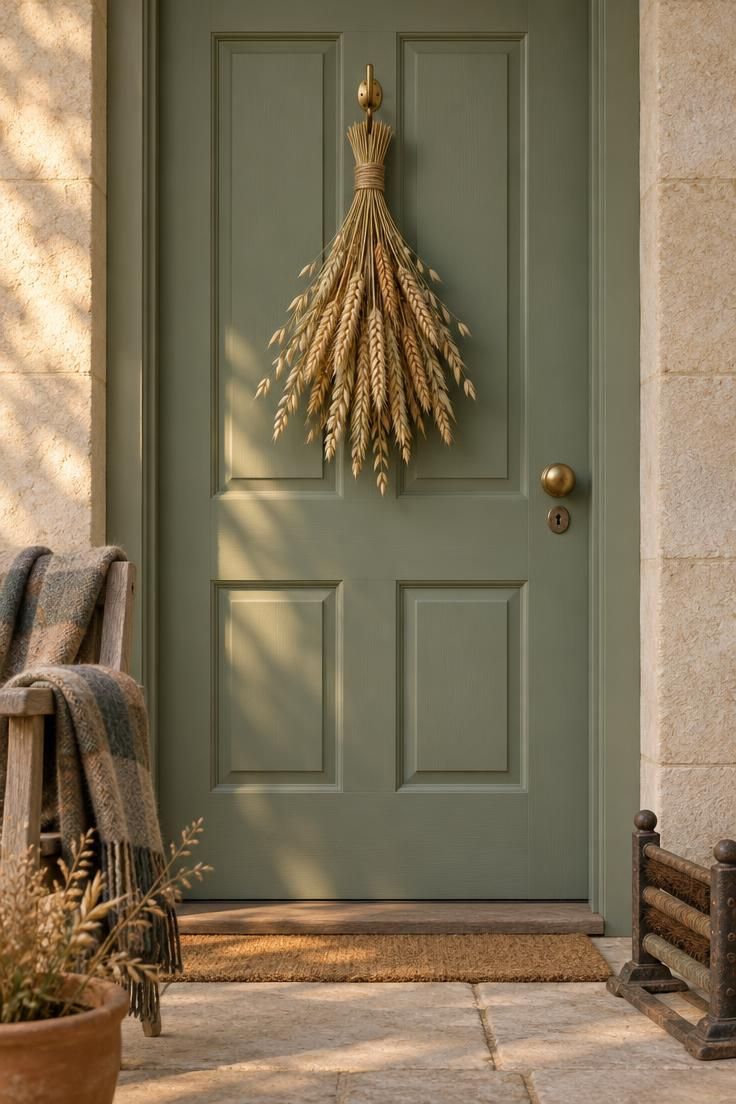
A gathered wheat bundle treats the door like a simple gallery wall with one piece of art.
Stems bound at the top and trimmed at uneven lengths fan outward, which softens the door's hard rectangular edges without covering its paneling.
Matte gold against muted green or slate blue gives the entry a crisp contrast, while the same bundle on a cream door would read quieter and more tonal.
Leaving ribbon off the bundle keeps attention on the grain heads, which have enough texture to carry the composition alone.
The arrangement works on almost any paint color and stores flat in a box between seasons, making it the easiest idea here to live with.
Weathering is part of the deal: sun and dry air deepen the wheat from pale gold toward amber, and the color shift suits the harvest theme.
Design Pro-Tip: Hang the bundle slightly above the door's horizontal midpoint so the fan of stems reaches toward the center of the door rather than crowding the knob.
Style Blueprint:
- Bundle of dried wheat and oat stems tied with jute twine
- Small brass hook placed near the door's upper center
- Muted sage or slate-blue door paint for contrast with the grain
Magnolia Berry Wreath with Plaid Ribbon
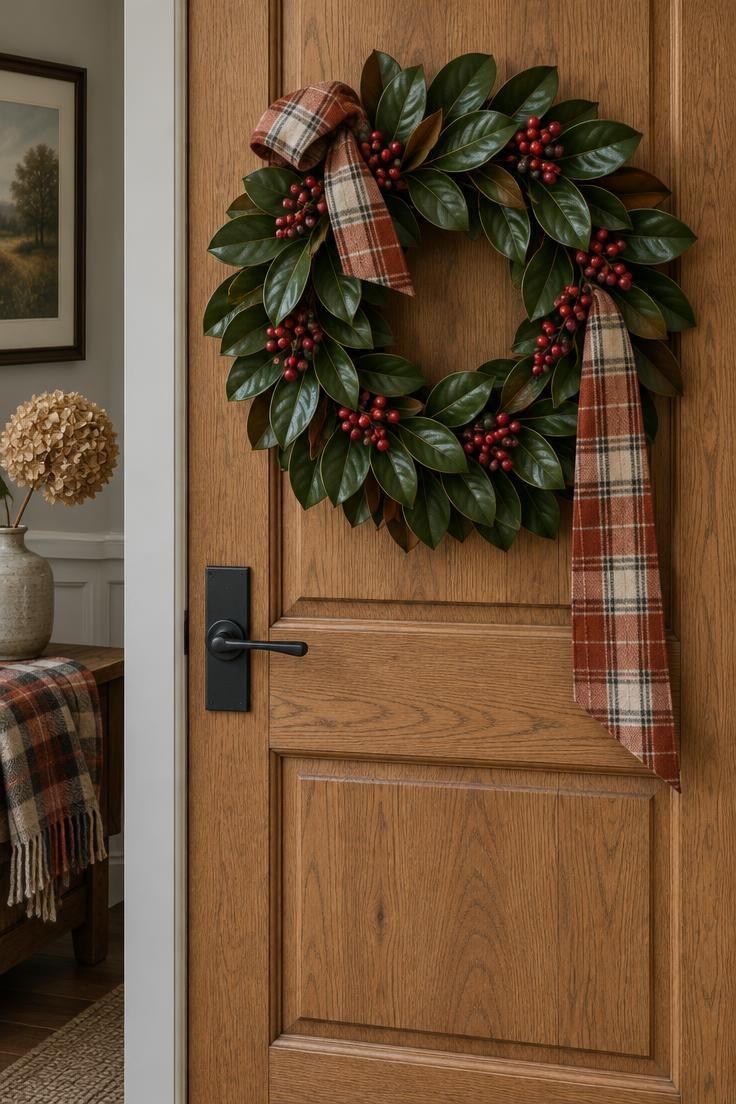
Magnolia leaves give a wreath weight, and the deep green makes the red berries read as a deliberate Thanksgiving accent rather than generic autumn color.
A plaid ribbon in rust and cream supplies the warm note that ties the wreath to the rest of the entry, and hanging it as an uneven tail rather than a formal bow keeps the look relaxed.
This pairing is the most traditional option in this collection of thanksgiving front door decor, and it suits a door with clean trim and modest house numbers.
The ribbon also makes the wreath adaptable.
Swap the plaid for a solid velvet sash after the holiday and the preserved base carries into December without a rebuild.
On a door already busy with bold hardware or heavy molding, the double statement of berries and plaid can tip toward crowded, so the quieter frame is the better host.
Plan for storage: preserved magnolia holds its shape but can flatten under weight, so a flat box with crumpled paper between layers protects it.
Ribbon tails should be untied before packing to avoid permanent creases.
Design Pro-Tip: Position the ribbon's tail so it falls just past the wreath's lower edge, which keeps the plaid visible without hiding the berry clusters.
Style Blueprint:
- Grapevine wreath base layered with preserved magnolia leaves
- Small red berry sprigs tucked between leaf layers
- Wide plaid ribbon in rust and cream, tied as an asymmetrical tail
- Natural oak or warm wood door for contrast with deep green foliage
- Flat storage box with padding to protect preserved leaves
Burlap Ribbon Door Swag
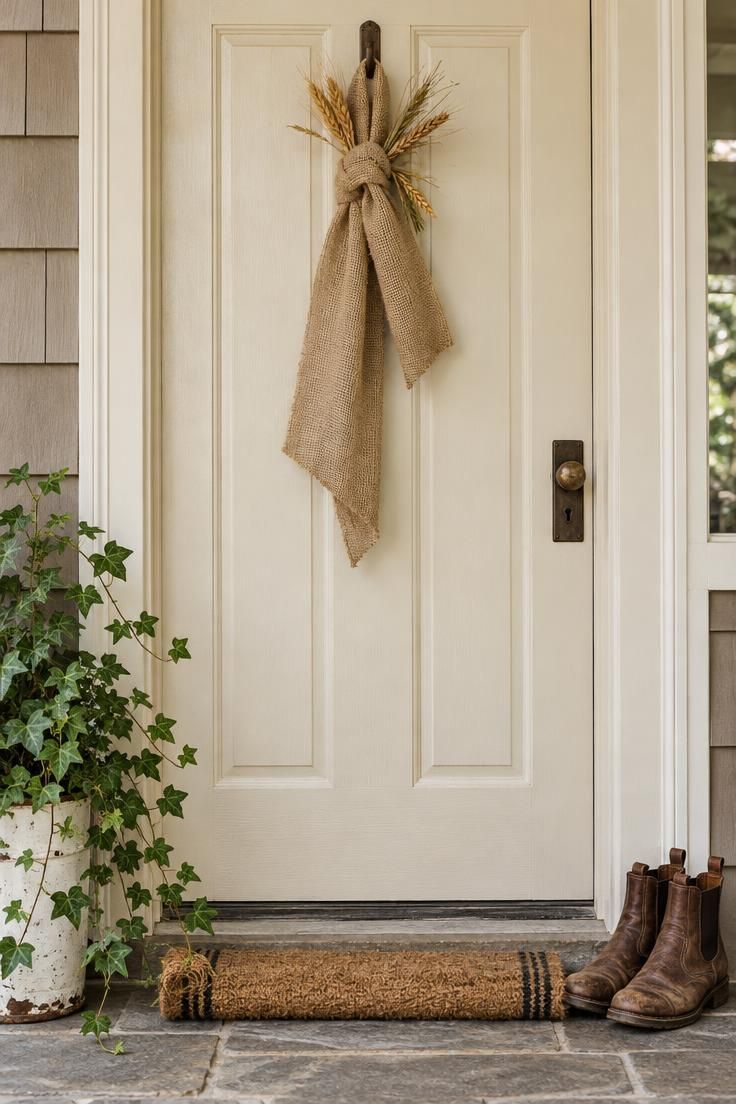
A ribbon swag asks less of the door than a wreath.
The center of the door stays visible, the profile is lighter, and the whole thing reads as handmade rather than purchased.
Burlap's coarse weave gives the swag enough texture to hold its own against plain paint, and a loose knot with uneven tails keeps it from looking too precise.
Anyone who wants the character of a dried wheat wreath without a full circle of stems can tuck a few stalks behind the knot and stop there.
This is the most renter-friendly idea in the guide because the arrangement touches only a single point near the top of the door.
The tradeoff is presence: a swag occupies less visual area than a wreath, so it suits narrow doors and entries where the door itself has good paneling or color.
Burlap softens and lightens with sun exposure over the years, which some households like and others replace.
Style Blueprint:
- Wide burlap ribbon in natural jute tone
- Small hook near the top of the door
- Dried wheat stalks tucked behind the knot
- Cream or soft neutral door paint to let texture lead
Grapevine Wreath with Dried Accents
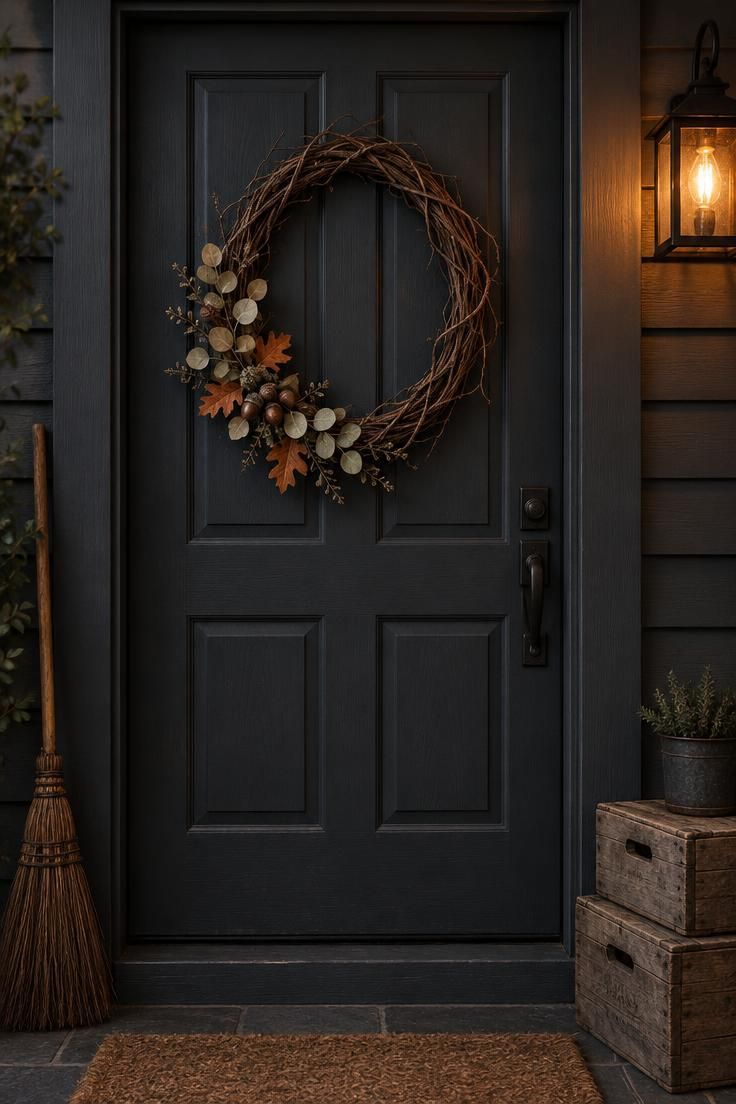
An unadorned grapevine base does most of the work here.
Its irregular loops give the door an organic silhouette that a perfectly round wreath cannot match, and leaving most of the vine exposed keeps the look airy instead of dense.
Three or four small bundles tucked into one area, rather than spread evenly, make the arrangement feel gathered rather than manufactured.
Dark doors are the natural partner for this style because pale dried stems and orange leaves stand out sharply against charcoal or deep brown.
For grapevine wreath with dried accents, the wreath is also the most renewable idea in the guide: replace the dried stems each November and the vine base serves year after year, which cuts down on storage and cost.
Style Blueprint:
- Bare grapevine wreath base with visible twisted vines
- Dried eucalyptus stems and orange oak leaves
- Small faux acorn sprigs clustered on one side
- Deep charcoal or dark brown door paint
- Replacement dried stems for refreshing the look each year
Coir Mat and Lantern Threshold
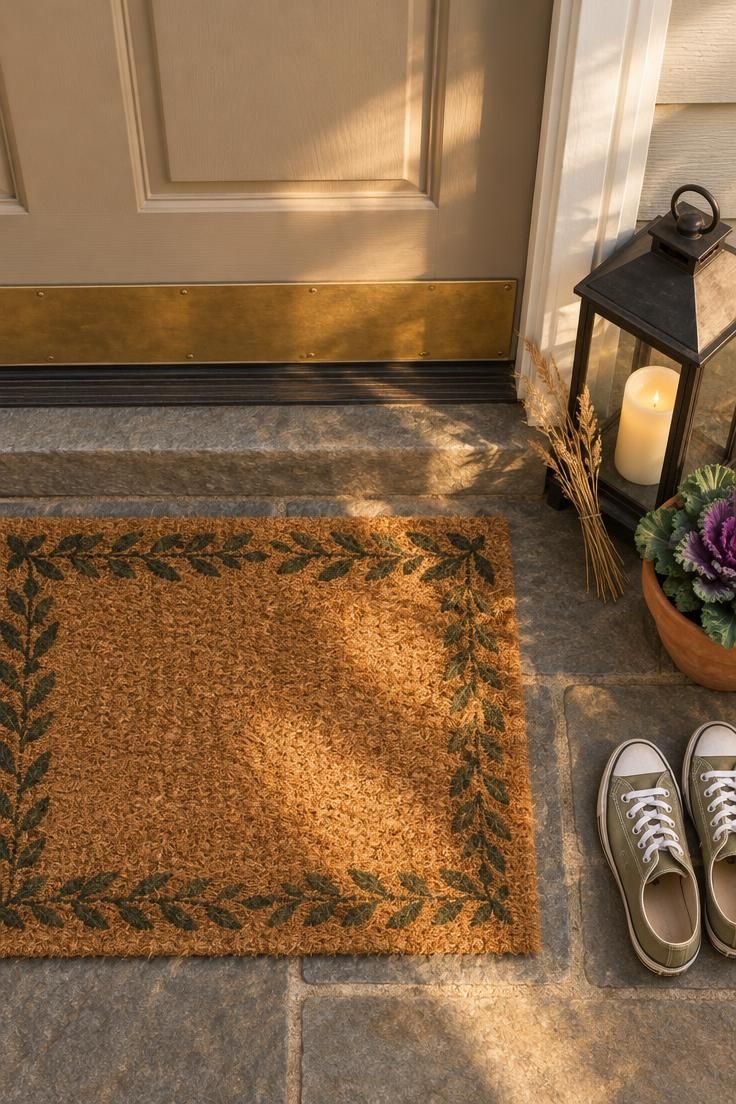
Grounding the entry at floor level changes how the whole door reads.
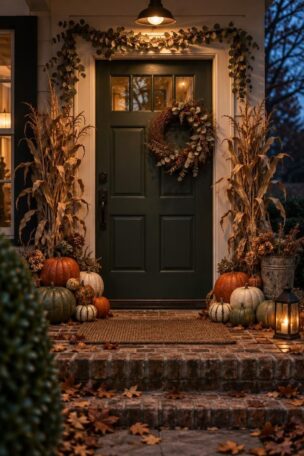
A coir mat and lantern threshold arrangement keeps the door face entirely clear, which suits a door that already has strong color, glass, or hardware.
The single lantern at one side gives the composition an anchor and a warm point of light, while dried grasses leaning against its base add height without clutter.
A flameless candle inside the lantern provides the glow without an open flame, a sensible default for a covered porch where decor may sit unattended.
Coir wears honestly: rain darkens it, foot traffic flattens the bristles, and the mat gradually softens into a lived-in texture.
Households that want a crisp mat should plan to replace it every season or two.
Style Blueprint:
- Rectangular coir mat with a subtle harvest motif
- Black metal lantern with a flameless pillar candle
- Bundle of dried grasses leaning at the lantern base
- Small potted ornamental kale to one side
Felt Leaf Wreath in Wool Tones
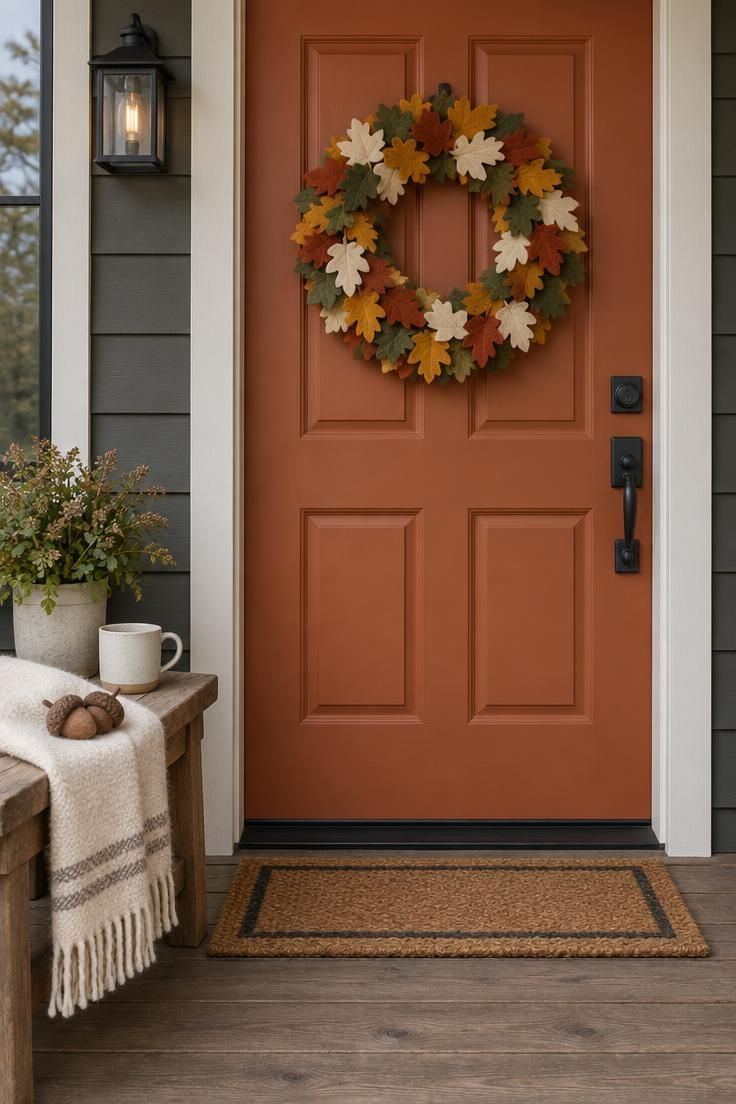
Felt brings a textile quality that no dried botanical can match.
Layered wool leaves in rust, mustard, olive, and cream overlap in rows, and the soft matte surface absorbs light rather than reflecting it.
Under a covered porch, the wreath holds its color far longer than ribbon or dried stems, and it does not shed the way wheat or eucalyptus can.
Variety in leaf shapes keeps the result from reading as a school project.
Mixing oak and maple silhouettes in a range of sizes creates rhythm across the circle, and four colors give the eye something to travel through.
The tradeoff is weather tolerance: felt should stay out of direct rain, so an exposed entry is a poor host for this one, while a covered or recessed doorway lets it shine.
Style Blueprint:
- Wool felt in rust, mustard, olive, and cream
- Flat straw wreath base
- Leaf templates in oak and maple shapes at varied sizes
- Covered or recessed entry to protect the felt from rain
Wooden 'Give Thanks' Plaque
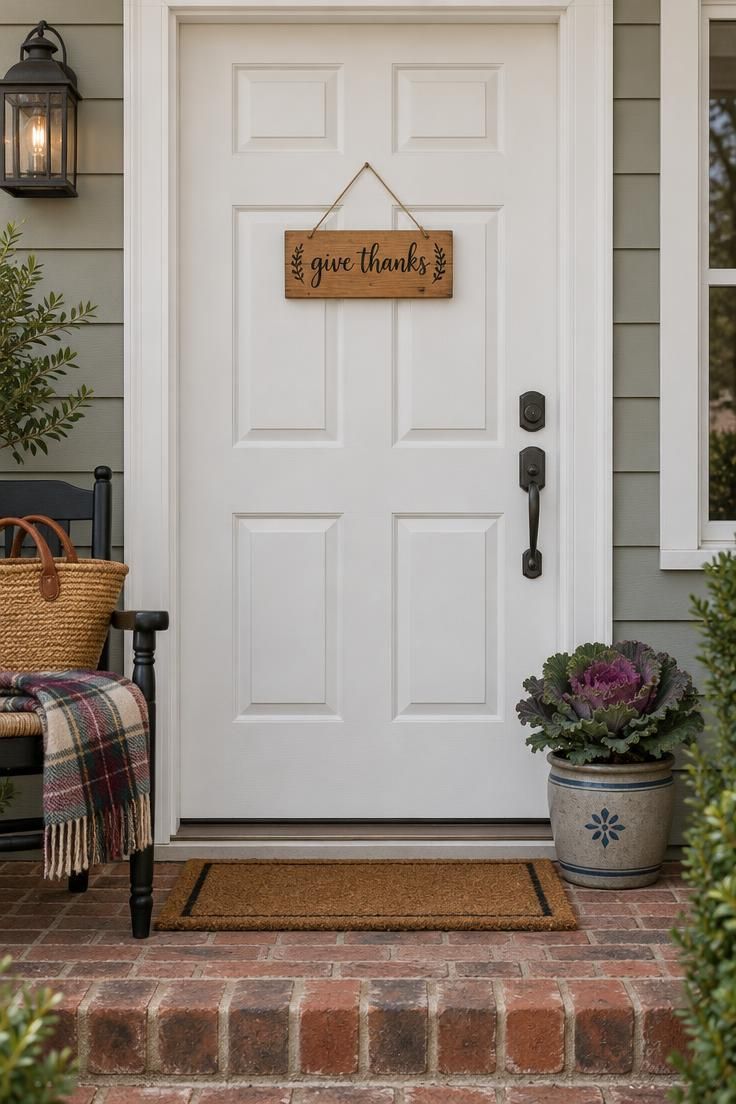
A plaque is the answer for anyone who would rather skip botanicals altogether.
One rectangle of wood with lettering carries the seasonal message without a single stem, and the door's own architecture takes the spotlight.
Natural, whitewashed, or muted harvest paint finishes each shift the mood, and the same plaque can sit at eye level alone or just above a small wreath when a layered look is wanted.
Proportion decides whether a plaque looks intentional.
A sign that is too small relative to a broad door reads as lost, and one that is too large overwhelms the panels.
As a starting point, a plaque roughly one quarter of the door's width tends to sit comfortably, though the visual test on the actual door matters more than any number.
Storage is a flat-box affair, and the plaque can stay up through the end of November without maintenance.
Households that prefer craft-forward, text-based decor will find this the simplest expression in the guide.
Style Blueprint:
- Rectangular wooden plaque with "give thanks" lettering
- Thin jute string for hanging
- Natural, whitewashed, or muted harvest paint finish
- Potted ornamental kale or greenery at the base
Asymmetrical Eucalyptus Swag
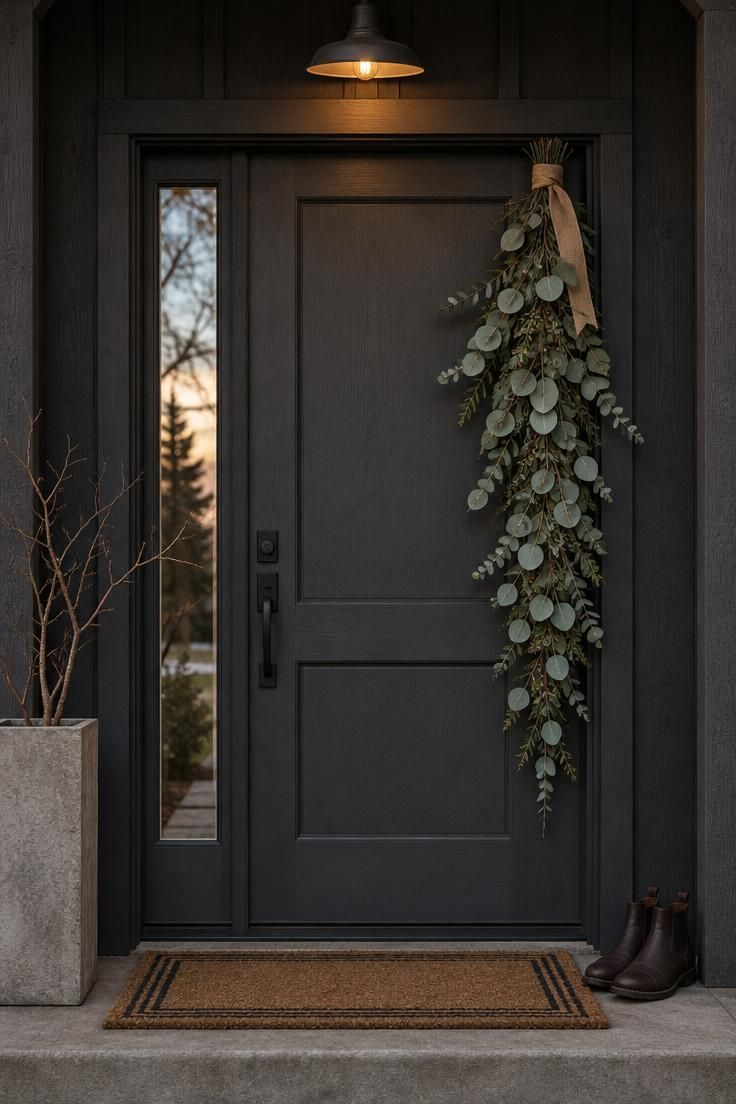
An off-center swag changes the geometry of the entry.
Instead of a circle in the middle, a long diagonal line draws the eye upward and makes a door feel taller, which helps narrow doors and entries flanked by sidelights.
Trailing eucalyptus does this with a looser, less formal gesture than a wreath, and a thin burlap ribbon door swag at the top reads as part of the foliage rather than a separate ornament.
Eucalyptus variety sets the tone.
Silver dollar has a pale, silvery cast that suits light and modern facades, while seeded eucalyptus carries a moodier blue-green that pairs well with charcoal and deep brown.
The style spans modern and farmhouse entries because the material itself is neutral.
A swag takes a little more arranging than a wreath, since the stems need to follow one graceful line rather than a circle.
Once hung, it stays put and stores flat between seasons.
Style Blueprint:
- Dried eucalyptus stems, silver dollar or seeded
- Thin burlap ribbon for the top tie
- Upper corner placement for an asymmetrical line
- Charcoal or deep-toned door to set off the silver-green foliage
Dried Stems in a Door-Side Planter
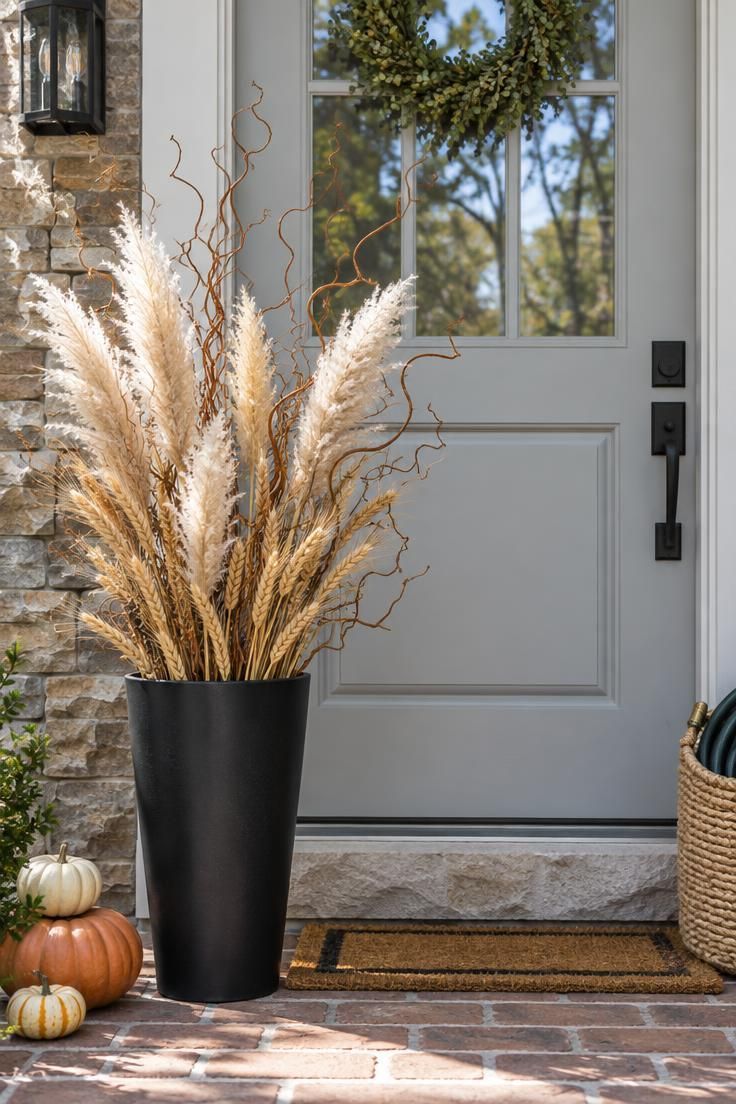
Not every entry wants something on the door itself.
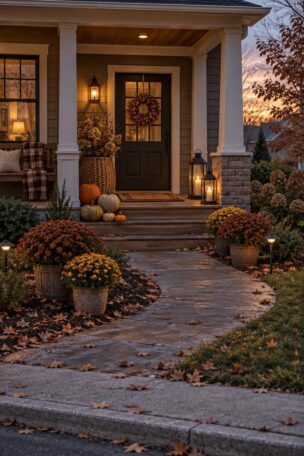
A tall planter or galvanized bucket at one side keeps the door face clear while adding height and texture at floor level, and it suits households that prefer not to hang anything at the entrance.
Curly willow supplies twisting vertical lines, wheat adds its warm gold, and pampas grass softens the top of the composition with feathery tips.
Stem height relative to the door is the main decision.
A bundle that reaches the lower half of the door looks balanced and generous, while short stems in a tall planter leave an awkward gap.
Stone or brick entries tolerate this arrangement well because the planter's weight and the masonry share a solid, grounded mood.
Practical care is limited to weather.
A planter like this can be moved indoors during heavy rain to protect the dried stems, and the whole arrangement relocates easily if the household wants to shift it to a back porch later in the season.
Style Blueprint:
- Tall narrow planter or galvanized bucket
- Dried curly willow, wheat stalks, and pampas grass
- Stone or brick porch floor for a grounded base
- Muted pumpkins in orange and cream nearby
Plaid Ribbon Sash Over a Hoop
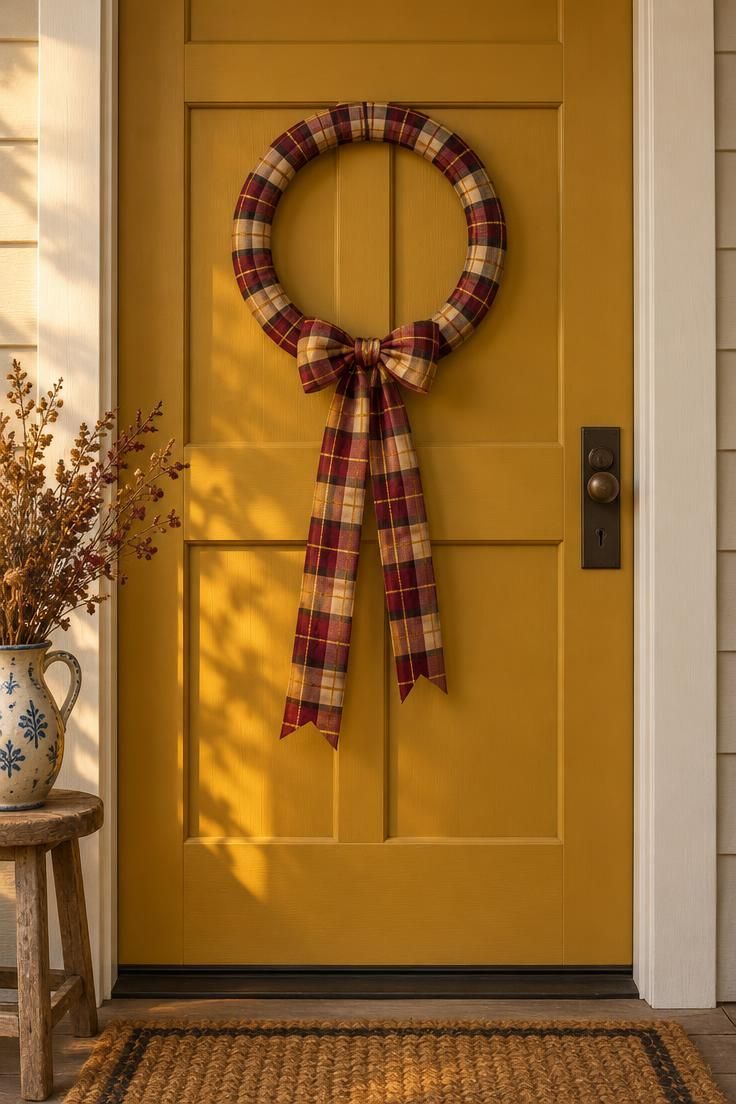
Wrapping the hoop completely in ribbon turns the circle into a clean geometric ring, with the plaid pattern carrying the entire composition.
A loose bow at the bottom with two long tails gives the shape a soft finish, and stopping there keeps the pattern as the focal point.
The style pairs especially well with doors that have strong horizontal lines, since the ribbon's crosswise pattern quietly echoes the architecture.
A magnolia berry wreath with plaid ribbon would compete with this much pattern, while a solid ribbon on the same hoop would change the mood entirely.
Storage is a strong point because the hoop lies flat in a drawer.
The ribbon can also be swapped or rewrapped after Thanksgiving for a different holiday scheme.
Households that like variety from year to year get more use from one hoop than from several fixed wreaths.
Style Blueprint:
- Simple metal or wooden hoop
- Wide plaid ribbon in burgundy, gold, and cream
- Loose bow with two long tails at the bottom
- Door with strong horizontal lines to echo the plaid
Layered Double-Door Composition
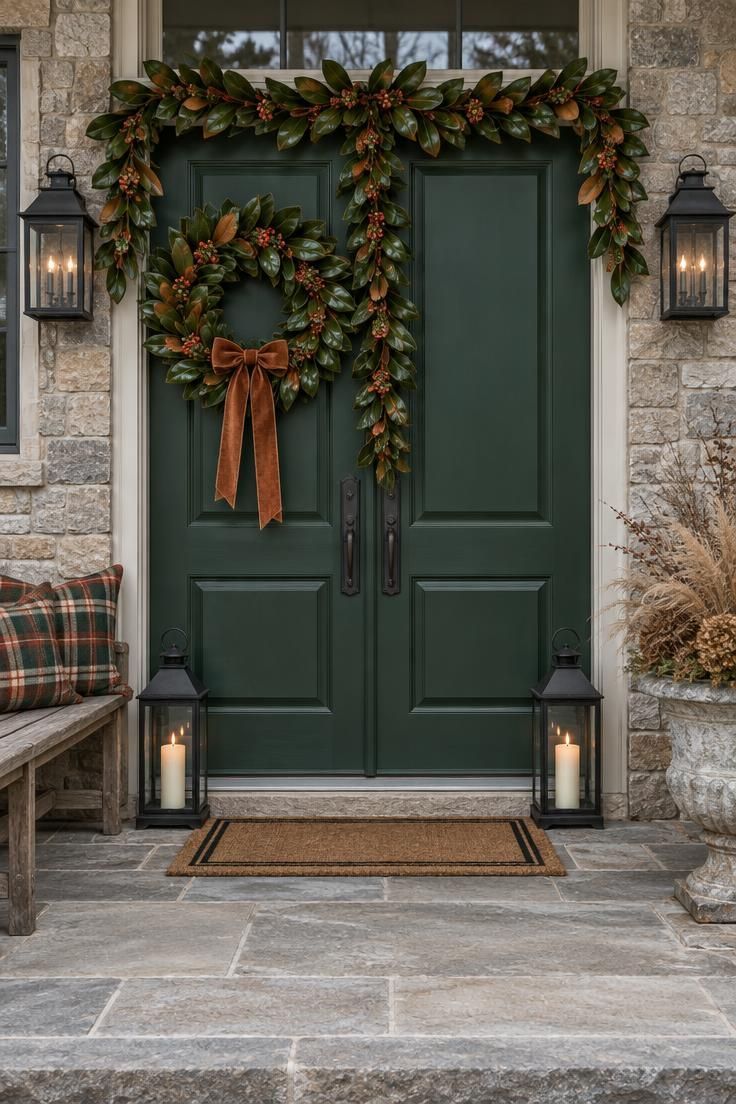
Wide and double doors need a composition with enough reach.
One wreath centered on a broad double entry can look undersized, so a coordinated set fills the span: a magnolia and berry wreath on one door, a matching garland across the top and down the center seam, and a pair of low lanterns at the threshold.
The garland ties the two doors together visually, and the lanterns repeat the dark metal note at floor level.
Holding the palette to three colors, rust, olive, and cream, keeps the separate pieces from competing.
Matching materials across the wreath and garland does the same work, and many households buy them as a set or build both from the same preserved stems.
This is the most involved setup in the guide, with the longest assembly and takedown.
It rewards households that enjoy a full display and have a wide entry to fill, while smaller entries are better served by the single-element ideas above.
Design Pro-Tip: Run the center garland down the seam between the doors rather than stopping at the top, which visually connects the two leaves of a double door.
Style Blueprint:
- Magnolia and berry wreath for one door
- Matching garland across the top and down the center
- Rust, olive, and cream as a three-color limit
- Pair of low black lanterns at the threshold
Conclusion
The front door looks best when its Thanksgiving dressing feels gathered rather than assembled all at once.
Pick one or two materials that suit the house, whether that is dried wheat, plaid ribbon, or preserved greenery, and let the entry build around them.
A modest threshold arrangement usually reads better than a crowded one, and it keeps the short November season simple to enjoy.
When the last guest leaves, pack the wreath or swag flat, clean the mat, and give the door a quiet stretch before winter decor arrives.