This post may contain affiliate links. If you make a purchase through these links, we may earn a commission at no additional cost to you.
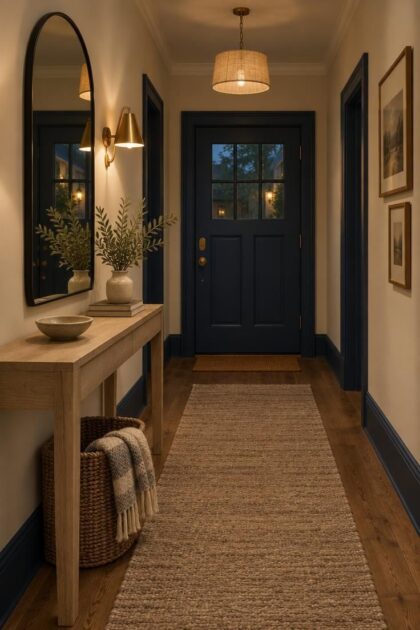
A narrow entry asks a lot of a small footprint: it has to hold coats, keys, mail, and shoes while still letting people move through without sidestepping furniture.
The most successful versions lean on a few carefully scaled elements instead of trying to fit a full foyer into a corridor.
Warmth helps here, though not through any hidden mechanism.
Light wood, clay tones, brass, wool, and woven fibers give a slim hall the look of a room that was considered rather than ignored.
The ideas below treat that palette as a starting point, then vary the furniture, wall treatment, and lighting so each entry has its own character.
Slender Oak Console with a Low Bowl and a Single Brass Sconce
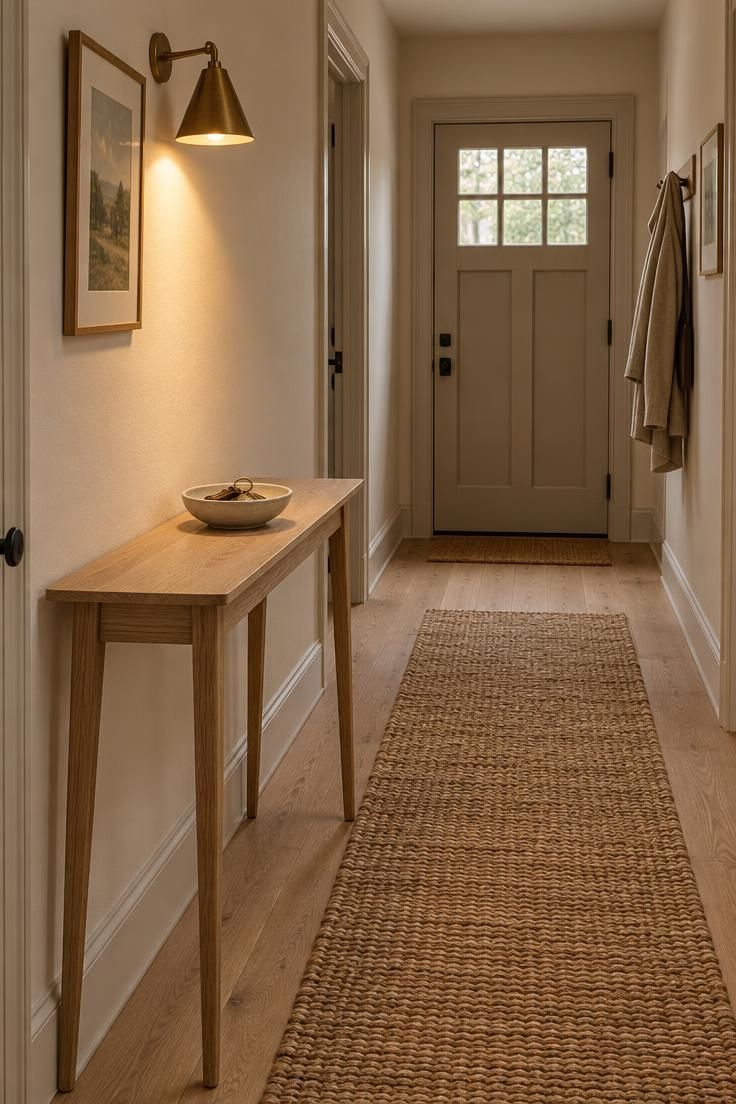
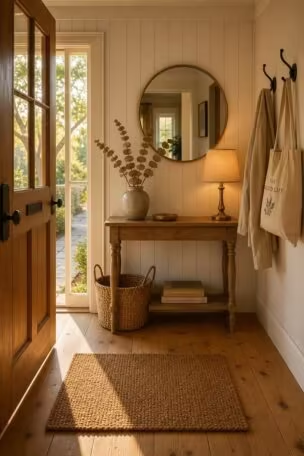
A shallow console table in light oak does the heaviest lifting in a slim hall because it gives the eye a horizontal line without eating the walking path.
Tapered legs and a thin top keep the piece visually light, so the wall behind it stays the dominant plane.
The grain itself becomes the decoration, which means the surface can stay nearly empty without looking unfinished.
The low ceramic bowl is the whole point of the setup.
Keys, mail, and a spare pair of sunglasses land in one place instead of scattering across the floor or the kitchen counter.
Keeping the bowl matte and neutral stops it from competing with the wood.
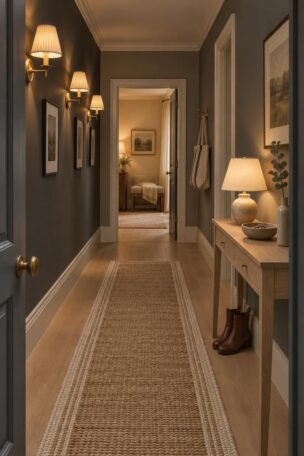
One brass sconce above the table creates a soft pool of warm light exactly where hands need it when arriving home.
A pair would clutter the composition; a single fixture reads as deliberate and keeps the wall calm.
Depth is the deciding factor when choosing the console.
A top that projects too far into the hall turns a helpful surface into an obstacle, so a slim profile and wall-hugging placement matter more than drawer count.
Deep drawers and chunky hardware add visual weight that a light oak piece does not need.
Style Blueprint:
- Pale oak console with a thin top and tapered legs
- One matte ceramic bowl for keys and mail
- Single brass sconce centered above the console
- Jute or flat-weave runner in a warm neutral
Tall Arched Mirror Over a Slim Faux-Leather Bench
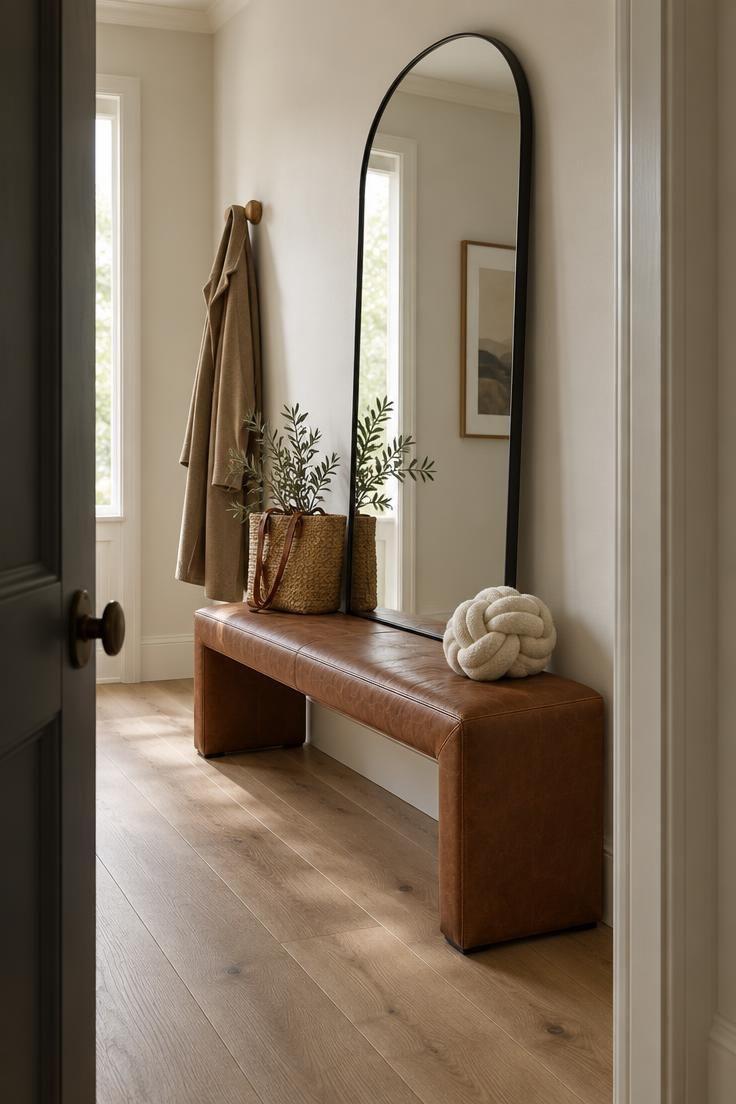
A tall narrow mirror follows the wall's height rather than its width, which suits a corridor better than a wide rectangular piece.
The arched top softens the hallway's straight lines and gives the entry a focal point right at eye level.
Reflection does the spatial work here.
Placed where it catches a window or a sconce, the mirror doubles the light in the hall and suggests a depth the room does not actually have.
It also shows fingerprints and stray clutter quickly, so placement opposite a messy zone defeats the purpose.
The bench beneath needs a low profile to stay useful.
Faux leather in a warm cognac wipes clean easily, which matters near a door where wet shoes and bags pass through daily.
A single knotted cushion adds texture without stacking into a pile that blocks the seat.
Tucking the bench tightly against the wall keeps the walkway clear.
Small hall seating works as a perch for pulling on boots, not as a place to linger, so shallow depth is the priority over generous cushioning.
Style Blueprint:
- Arched mirror with a slim black metal frame
- Low bench upholstered in cognac faux leather
- One small knotted wool cushion
- Wide-plank light wood flooring
- Soft daylight or a nearby wall light for reflection
Vertical Slat Wall with a Floating Walnut Ledge and One Drawer
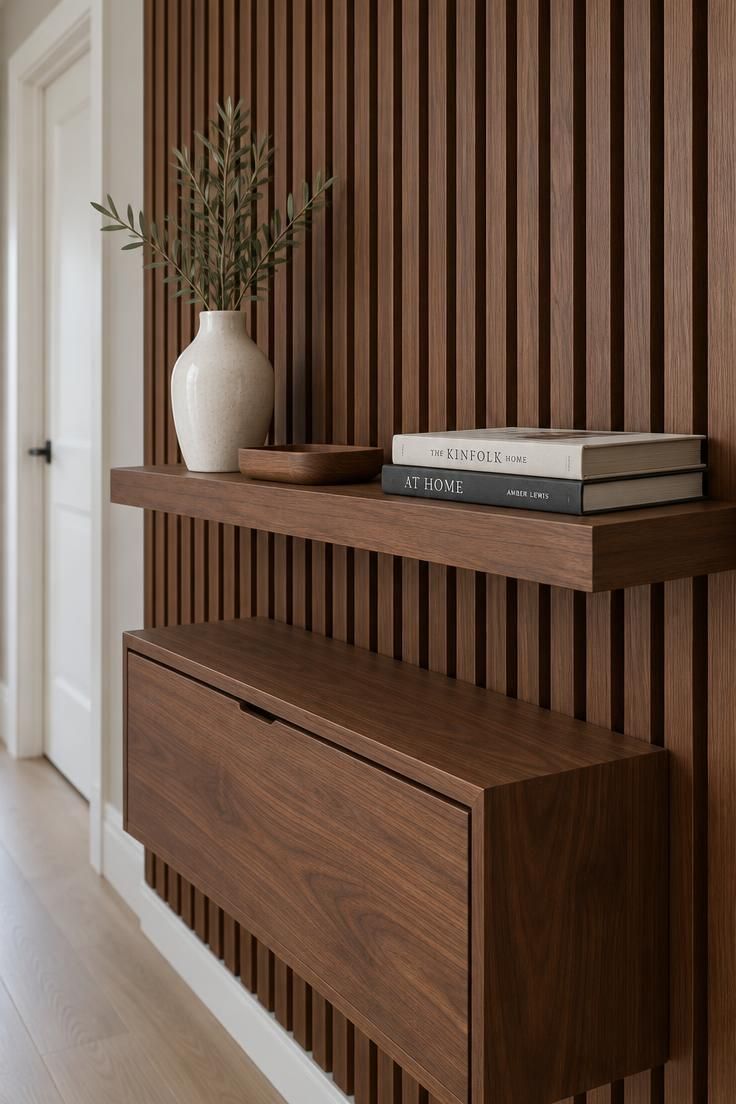
Slats give a narrow entryway a rhythm that plain drywall cannot.
Each strip catches light on one edge and shadow on the other, so the wall reads as textured and intentional even before any furniture arrives.
Walnut brings depth without darkening the hall the way a painted accent wall might.
A floating ledge in the same wood tone becomes the display moment.
Two or three objects are enough: a vase, a small stack of books, a tray for a watch.
The vertical grain behind them pulls the eye upward, which makes the ceiling feel a touch higher.
Closed storage handles the practical side.
A slim cabinet with one drawer holds gloves, spare keys, or a dog leash out of sight, and keeping it in the same walnut family lets the whole composition read as one built-in gesture rather than a collection of pieces.
The styling discipline matters more than the slat pattern.
Openings between the strips collect dust, so a quick pass with a brush-style vacuum attachment becomes part of the routine.
Crowding the ledge with extra objects would flatten the wall's rhythm.
Style Blueprint:
- Walnut vertical slats running from baseboard to above eye level
- Matching walnut floating ledge
- Two or three small objects, kept spare
- Slim walnut cabinet with a single drawer
Runner Rug with a Border Reveal and Low-Profile Basket Storage
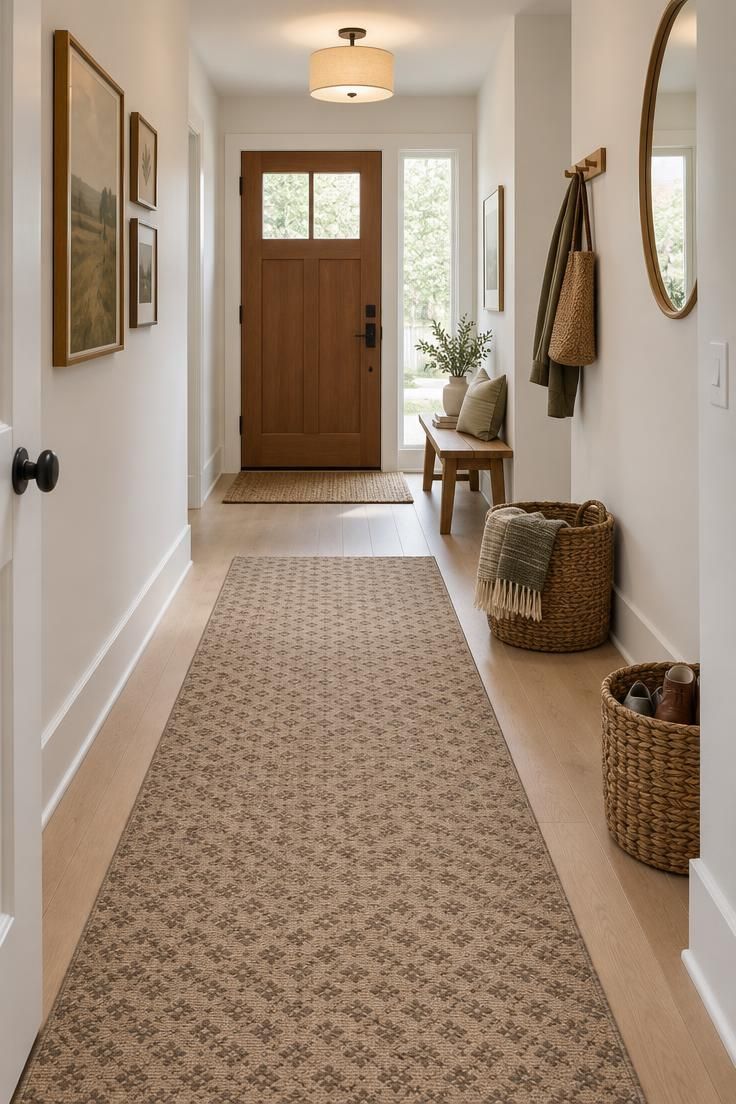
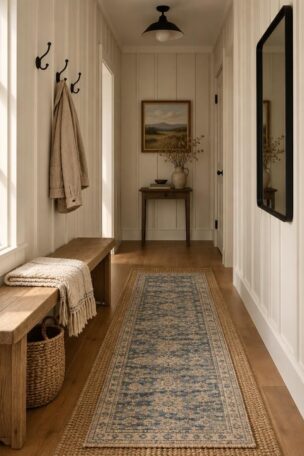
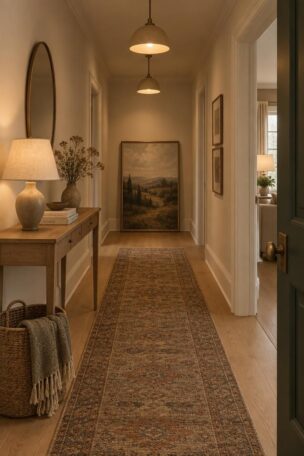
A runner rug in a narrow hall works best when it does not span wall to wall.
Leaving a visible strip of floor along each edge preserves the sense of a walking path and stops the corridor from looking carpeted end to end.
A flat-weave or low-pile wool in a warm neutral with a small repeating pattern hides everyday dirt without shouting for attention.
At the door end, two low woven baskets take on the mess that usually lands on the floor.
One holds shoes, the other umbrellas or a folded throw.
Because they sit low and hug the wall, they organize without creating the tall visual barrier a cabinet would.
Rug pads sized slightly smaller than the runner keep the edges from curling, and a low pile is easier to vacuum in a high-traffic spot.
Baskets benefit from a periodic edit; when they fill up, the clean lines that made them useful disappear.
Style Blueprint:
- Flat-weave wool runner in a warm neutral
- Small repeating pattern for practical camouflage
- Two low woven baskets for shoes and umbrellas
- Rug pad sized slightly smaller than the runner
Deep Green Accent Wall with Brass Coat Hooks and a Round Mirror
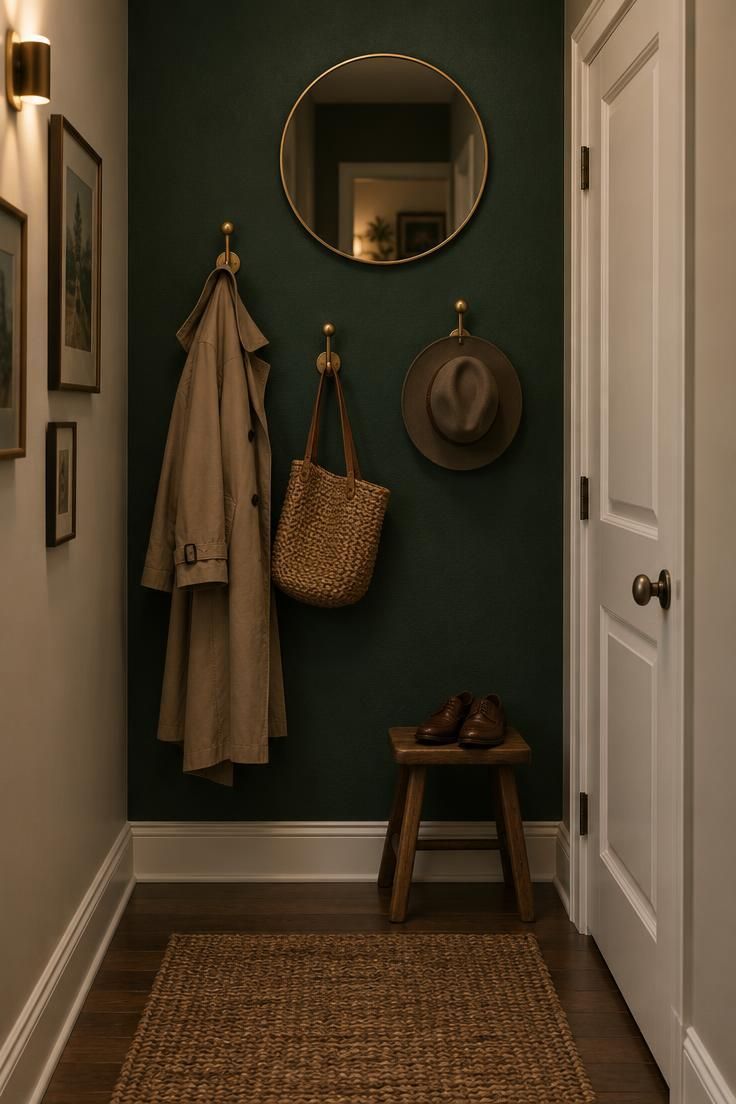
A single saturated wall turns a narrow entry into a jewel-box moment.
Deep forest green or muted teal on the wall opposite the door gives arriving guests something rich to look at without wrapping the whole hall in dark color.
The adjacent walls stay light so the corridor does not close in.
Brass hooks against the dark paint provide the contrast that makes the arrangement work.
Three hooks at slightly different heights hold a coat, a bag, and a hat, and the warm metal picks up whatever light reaches the wall.
The round mirror above breaks up the flat plane and adds a second point of light.
Its thin brass frame ties back to the hooks, so the whole wall reads as one composition rather than separate errands.
Restraint is what keeps this idea from turning into a coat rack.
One coat, one bag, one hat, and the wall stays a backdrop.
On especially dark or short halls, a lighter paint is the more forgiving choice, since a saturated tone can make the space feel enclosed.
Style Blueprint:
- Deep forest green or muted teal paint on one wall
- Three brass hooks at varied heights
- Round mirror with a thin brass frame
- Small wooden stool for shoes
- Light neutral paint on adjacent walls
Wall-Hung Cane Cabinet with a Small Display Ledge and Pendant
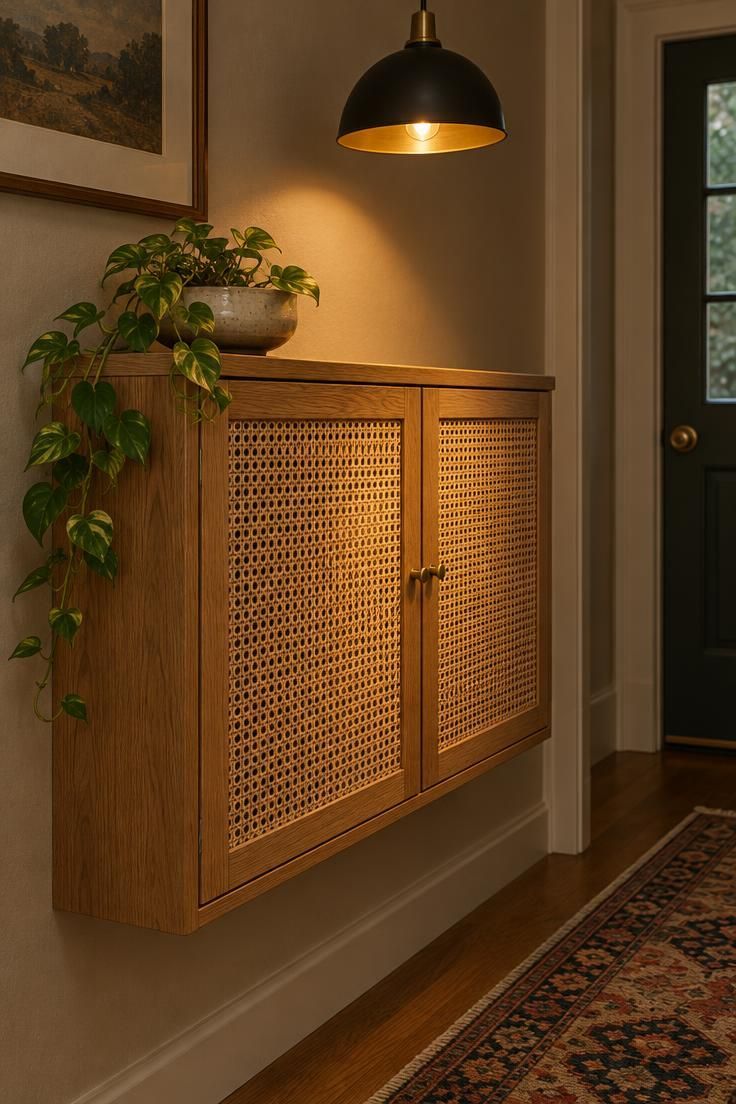
Closed storage keeps a slim hall calm, but plain cabinet doors can look flat on a narrow wall.
Cane or rattan fronts add texture and a bit of shadow play while still hiding gloves, dog leashes, and reusable shopping bags.
The cabinet reads as furniture rather than utility.
Hanging it on the wall leaves the floor open, which matters in a corridor where every inch of walking space counts.
A shallow depth keeps the projection modest, so shoulders clear it easily and the hall keeps its proportions.
A single pendant above turns the cabinet area into a small lantern-like moment, especially in a hall without natural light.
The glow catches the cane weave and gives the entry a warm anchor at eye level.
On the narrow top ledge, one trailing plant or a small sculpture is enough.
The cane grain is the star, and piling objects on top would hide the texture that made the cabinet worth choosing.
Style Blueprint:
- Wall-hung cabinet with cane or rattan doors
- Warm oak frame
- Black pendant with a brass interior
- One trailing plant or small sculpture on the ledge
- Shallow cabinet depth to keep the hall open
Monochrome Gallery Ledge with Black Frames and a Warm Wall
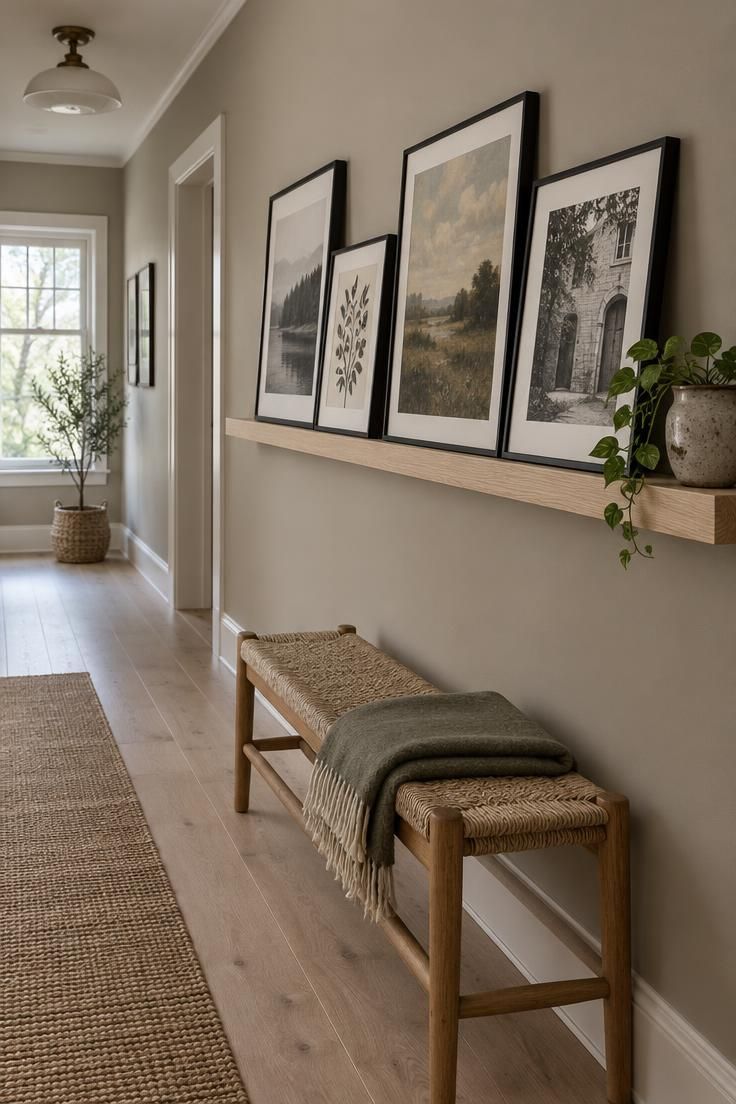
A vertical gallery wall of individually hung frames can make a narrow space feel busy, with each hook adding another decision to the eye.
A single picture ledge running the length of the wall solves that by letting the art sit as one horizontal band, even as the frames vary in size and overlap slightly.
Matching finishes do the organizing.
Matte black or oil-rubbed bronze frames across every print let the arrangement read as one unit rather than a collection.
Warm paint, such as pale terracotta or greige, gives the art depth without competing with it.
Leaning frames on a ledge also makes rotating prints simple, since nothing needs to move except the artwork itself.
The wall plane stays intact, so the eye travels upward along a continuous surface.
The ledge depth should stay modest so shoulders and bags clear it in the hall.
A small bench below gives the composition a base and a spot to set down a bag while shuffling keys.
Style Blueprint:
- White oak picture ledge spanning the wall
- Four or five black-framed prints in mixed sizes
- Warm greige or pale terracotta wall paint
- Small woven bench with a folded blanket
Bone-Inlay Pattern Tiles with a Solid Wool Runner
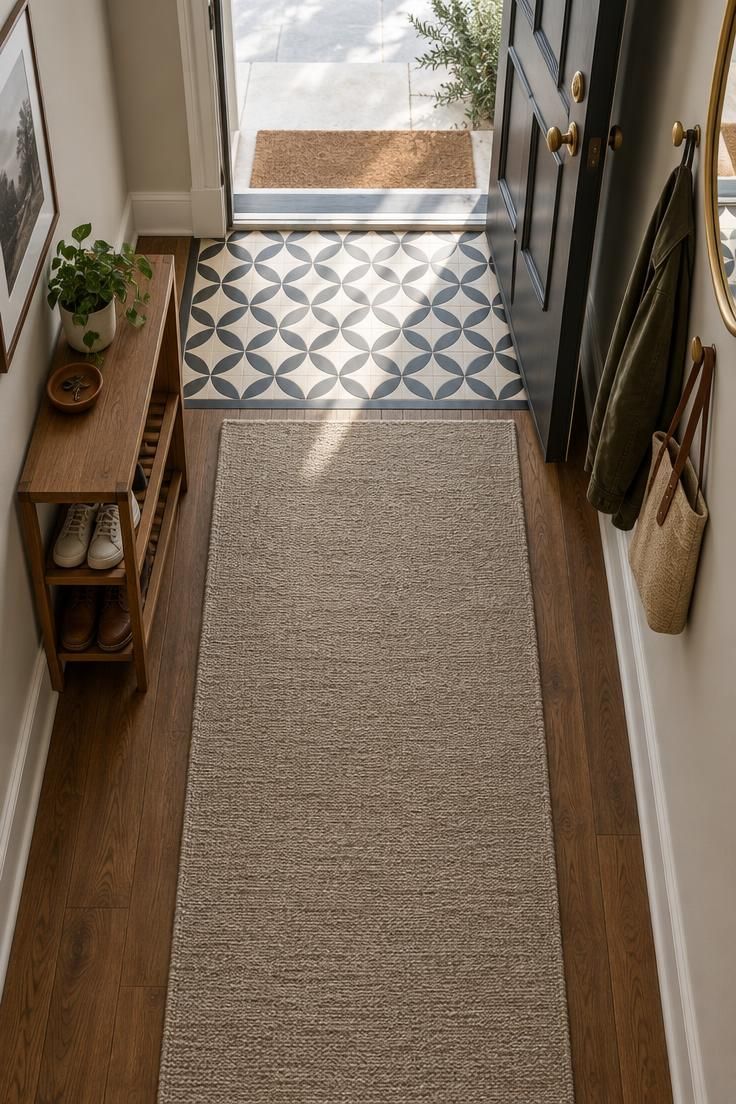
Floor pattern can do the work that furniture would otherwise have to do.
A short run of bone-and-charcoal tile right inside the door marks a landing zone, so the entry reads as having a beginning rather than being one long tunnel.
A solid wool runner beyond the tile keeps the two patterns from competing.
Oatmeal, camel, or light gray adds warmth underfoot and lets the tile hold the visual interest.
The shift in texture between tile and wool gives the floor layers without a single extra piece of furniture.
Keeping the runner slightly narrower than the hall leaves the tile border visible, which preserves the defined landing area.
A low pile is easier to vacuum near the door, where grit collects fastest.
The wooden shoe rack against the wall handles the everyday pairs without adding height to the composition.
Together, tile, runner, and rack form a sequence that guides feet and eyes toward the rest of the home.
Style Blueprint:
- Bone-and-charcoal patterned tile inset near the door
- Solid oatmeal or camel wool runner
- Low-pile runner for easy cleaning
- Slim wooden shoe rack against the wall
Painted Door and Frame in a Single Saturated Hue
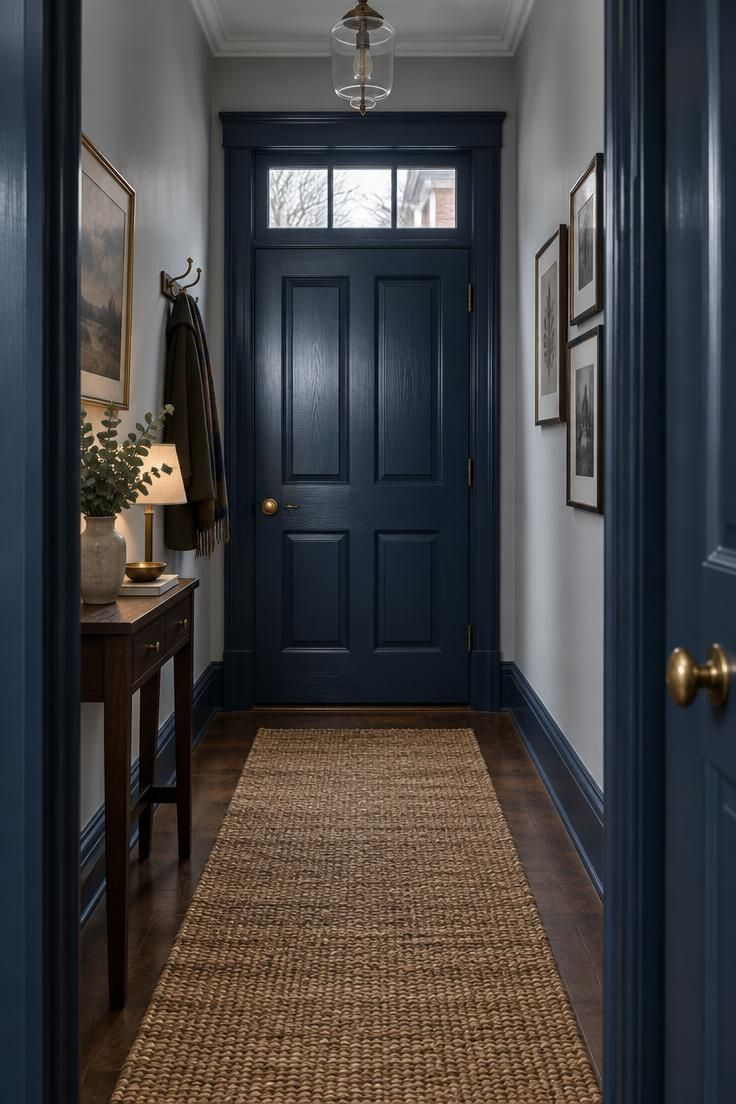
The front door can carry the focal point in a narrow entry all by itself.
Painting the door and its surrounding trim one saturated color, whether deep navy, oxblood, or terracotta, turns the end of the hall into a solid block of color that looks chosen rather than leftover.
Light walls around it keep the effect from becoming heavy.
The colored door then reads as a jewel at the end of the corridor, visible from the living room and giving the hall a natural destination.
A brass doorknob that ties to other hardware in the entry is enough embellishment.
Extra decoration on or around the door would compete with the color block, which is doing the work on its own.
This approach suits entries visible from main living areas, where the door becomes part of the view.
A slim runner leading toward the door reinforces the line of sight and softens the hard floor underfoot.
Style Blueprint:
- Saturated paint on the door and surrounding trim
- Pale gray or warm white walls
- Brass doorknob and matching hardware
- Simple woven runner leading to the door
Slim Freestanding Coat Tree in Curved Birch with a Floor Basket
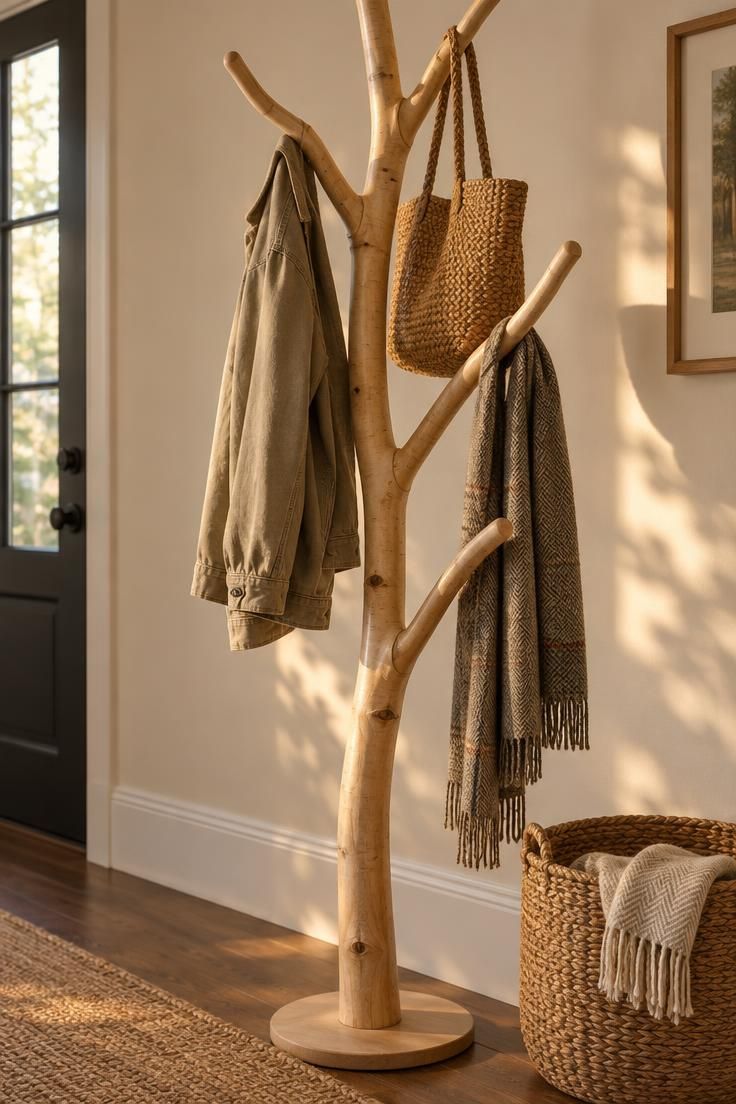
A coat tree with a curved silhouette in light birch or ash works as sculpture first and storage second.
The bent branches give the entry something organic to look at, and because the piece stands on the floor rather than the wall, it suits rentals where drilling is not an option.
A small footprint keeps it practical.
Three or four legs placed close together let the tree hug the wall without widening the path, and it can shift position as the seasons change.
A wide, low seagrass basket at the base catches shoes or a folded throw.
The natural fiber echoes the wood and softens the transition between the tree and the floor.
What hangs from the branches needs periodic editing.
A jacket, a tote, and a scarf read as styled; a full wardrobe turns the tree into a silhouette of clutter.
A small mirror on the adjacent wall can add a second light source if the hall feels dim.
Style Blueprint:
- Curved birch or ash coat tree
- Three or four legs clustered for a small footprint
- Wide low seagrass basket at the base
- One jacket, one bag, one scarf at a time
Terracotta Plinth Stool with a Single Woven Wall Basket
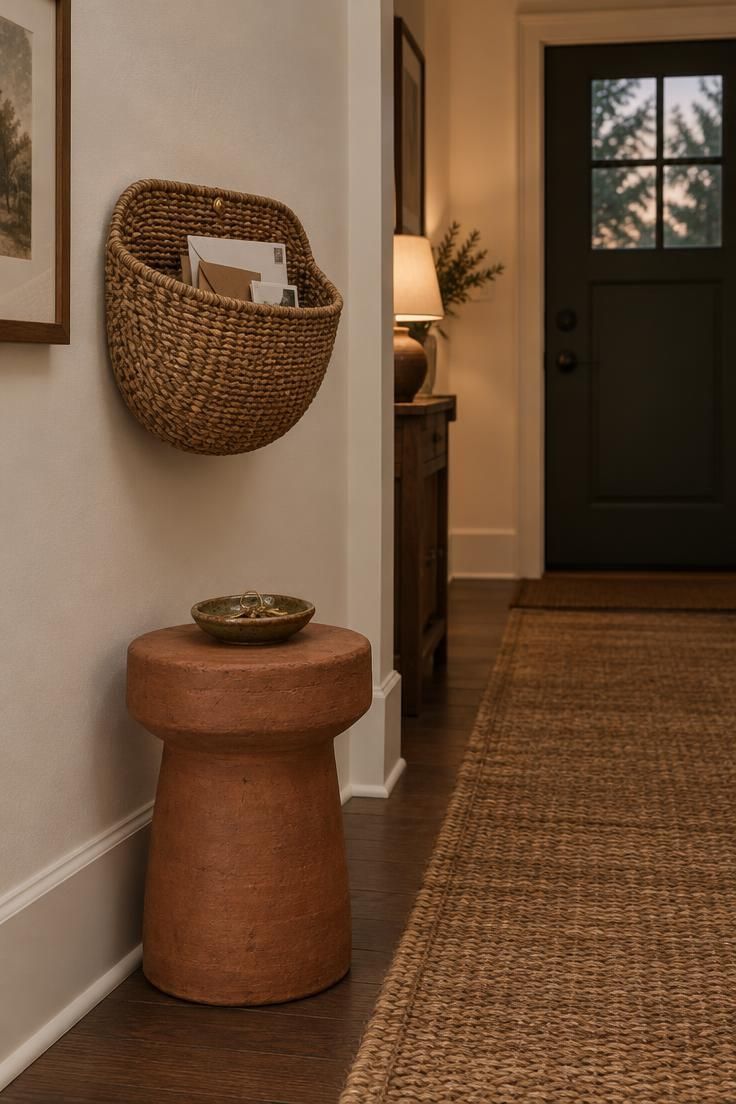
A low plinth stool in terracotta or rust clay brings warmth to a pale wall without the spindly visual noise of legs.
Its block form sits solidly at the door end of the hall, and the clay tone picks up any wood or woven texture nearby.
The stool earns its place by being useful at the exact moment someone arrives.
It holds a bag while the door is unlocked, or a parcel while a coat comes off.
A single small dish on top keeps keys from sliding off the surface.
Above it, one wide woven basket with a flat back handles mail, a leash, or sunglasses in a way that reads as an object rather than a bin.
Leaving the basket mostly empty preserves that impression.
Keeping the composition spare is the challenge.
A second basket or a row of hooks above would tip the wall from considered to crowded.
The clay and fiber tones need room to breathe against the white wall.
Style Blueprint:
- Low terracotta or rust clay plinth stool
- One wide flat-backed woven wall basket
- Small glazed catchall dish on the stool
- Jute or sisal runner in a matching neutral
Brass Picture Light Above a Single Slim Oak Shelf
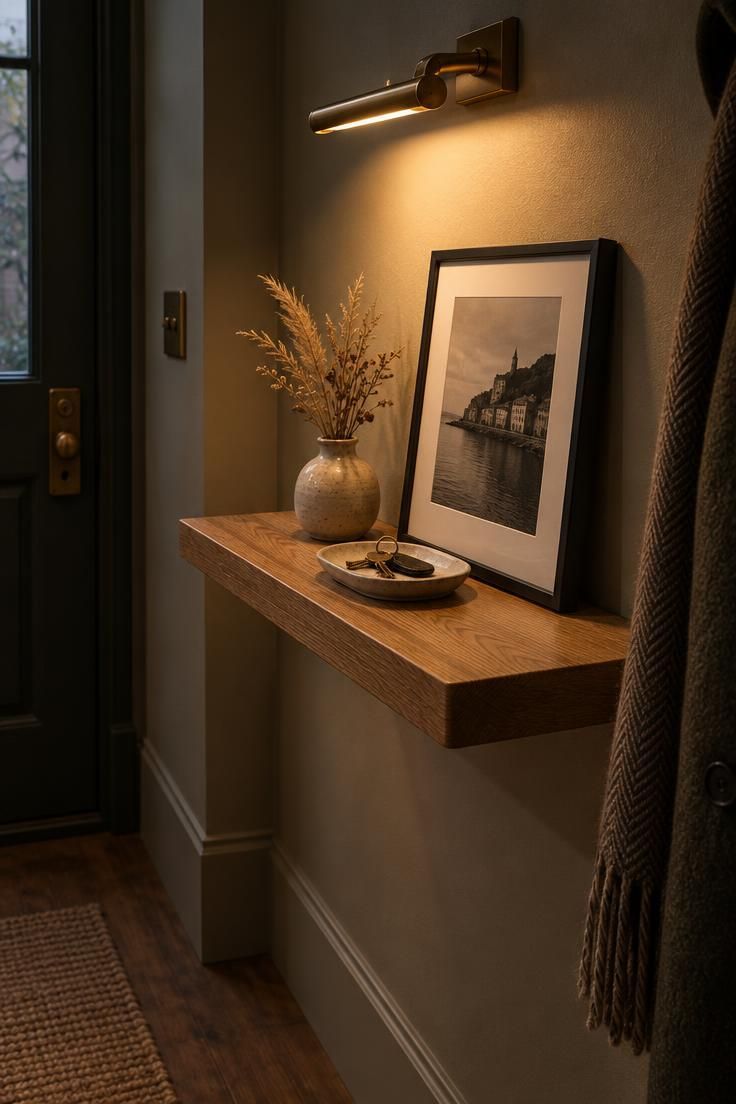
A single floating shelf can serve as a mini drop zone where a full console would be too deep.
Mounted near the door, it holds only what the household actually needs at the threshold, which keeps the surface clear and the hall uncluttered.
The brass picture light above changes the shelf from storage into a moment.
Its warm wash makes the objects visible and gives the entry a hotel-like quality, especially in a hall where daylight never reaches.
On the shelf, a small tray for keys, a slim vase with dried stems, and one framed photo are enough.
More would crowd the shallow surface and hide the glow on the wall.
Depth is the deciding constraint.
A shelf that projects only a few inches stays out of the walking path and avoids shoulder bumps, while a deeper one turns the hall into an obstacle course.
Style Blueprint:
- Slim oak floating shelf mounted at chest height
- Brass picture light above the shelf
- Small ceramic tray for keys
- One slim vase with dried stems
- Single black-framed photo leaning against the wall
Oak Peg Rail with a Hook-Free Shelf and Woven Floor Basket
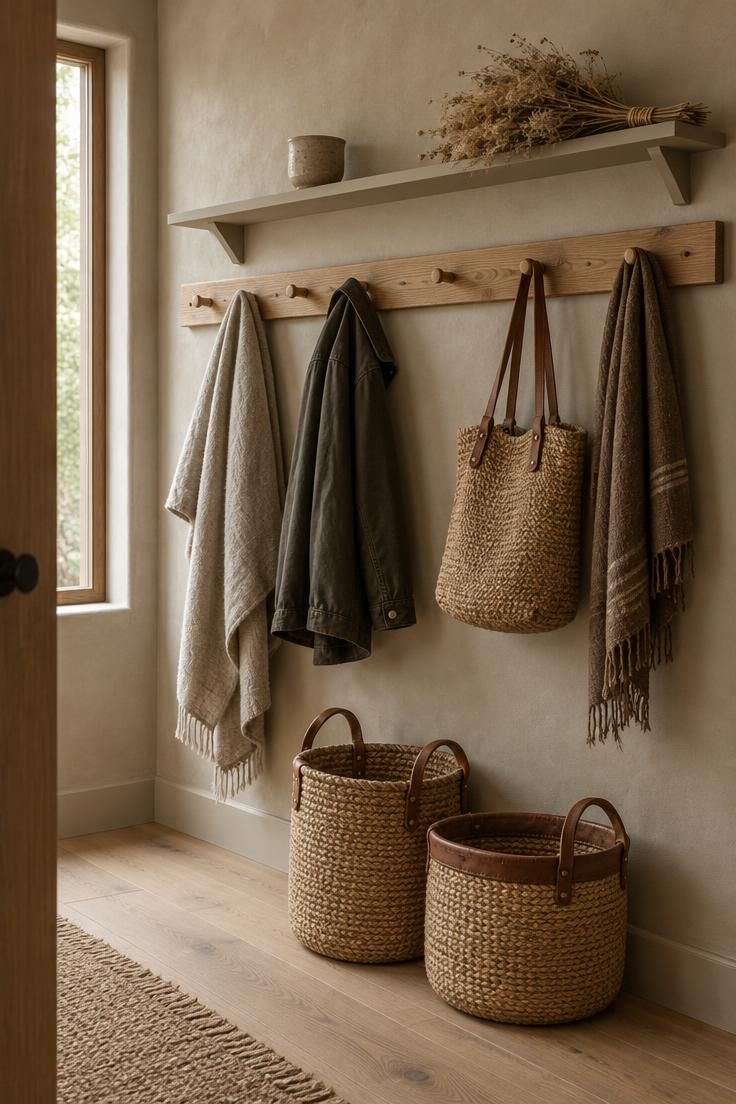
For wall-mounted hooks, a peg rail does the quiet work that hooks cannot.
Instead of fixed metal points that snag sleeves and crowd a tight space, the pegs let household members rest hats, a light tote, or a canvas jacket at irregular heights without protruding far from the wall.
Choosing oak in a naturally pale finish keeps the narrow area open while adding visible grain.
The rail may run longer than a typical hook board because it reads as a horizontal line, which leads the eye through a small entry without consuming floor space.
Below it, two woven baskets hold everyday carry items: one for shoes or slippers, another for scarves and gloves.
Placing them side by side rather than stacked keeps the display calm and makes each basket reachable without kneeling or digging.
A small shelf above the rail breaks the vertical field without adding much weight.
A stoneware cup and a bundle of dried grass soften the wood tones, while the low limewash wall keeps the shallow depth from feeling closed in.
Style Blueprint:
- Long pale oak peg rail mounted at coat height
- Two woven floor baskets with leather handles
- Low painted wooden shelf above the rail
- Stoneware cup and dried grass bundle on the shelf
- Pale limewash wall and oak flooring for a warm neutral base
Conclusion
The strongest narrow entry ideas share a simple logic: a shallow surface or ledge for the daily drop, a vertical moment in a mirror or panel, and one warm layer of light or texture.
The combination gives a slim hall a sense of arrival without demanding square footage it does not have.
Mix closed storage with one open texture or metallic finish, and leave space for the eye to rest between elements.
Before adding anything, check the walking path; every piece should hug the wall or fold away cleanly.
With that limit respected, even the slimmest entry can feel deliberate.