This post may contain affiliate links. If you make a purchase through these links, we may earn a commission at no additional cost to you.
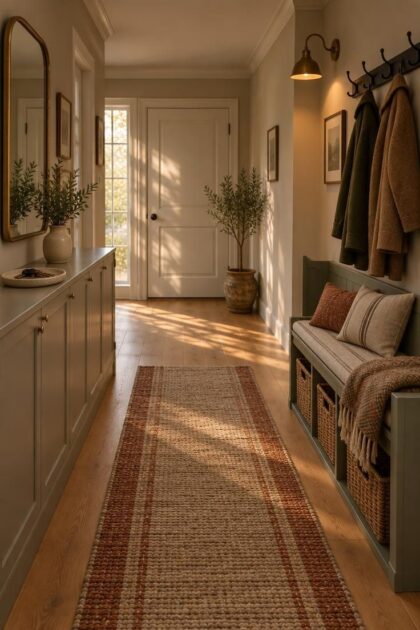
A hallway is the tightest circulation space in most homes, yet it collects the most transitional objects: shoes, coats, bags, mail, keys, leashes.
Every one of those items has to land somewhere, and the passage that connects the front door to the rest of the house is usually where it lands first.
The tension that shapes every good solution is storage volume against remaining walking width.
In a passage, width is the scarce resource, not style.
Each format below is presented as a visual composition first, with notes on depth, door swings, and the object flow it suits.
The organizing lens is simple: match depth to the wall, not the wall to the depth.
Slim Shoe Cabinet With a Mirror Above
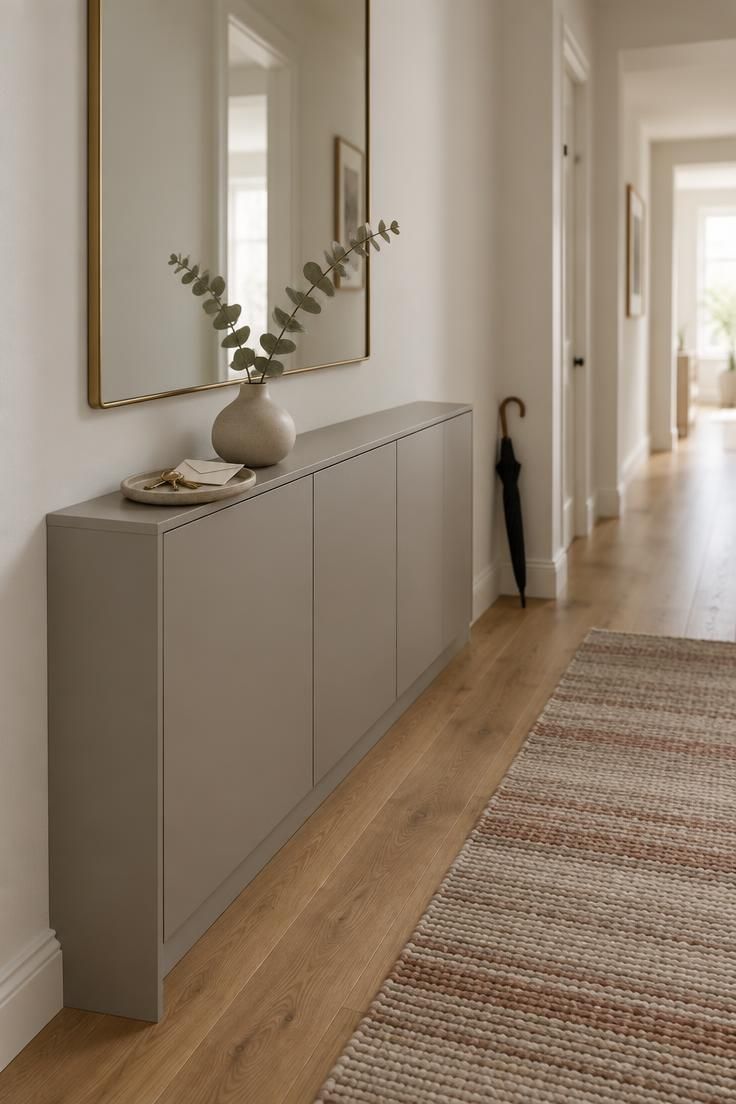
A shallow cabinet stays out of the walking path because it barely intrudes past the baseboard line.
Flip-down or lift-up doors open with a small arc, so the unit can sit even on a wall opposite a swinging door.
The mirror fills the wall zone above the cabinet and returns whatever light the passage receives, which counts most in a windowless hall.
On the cabinet top, one tray or bowl keeps keys, mail, and sunglasses from spreading into a pile.
This format suits the everyday drop: shoes, umbrellas, small bins, and the paper that arrives through the door.
Among hallway storage ideas, this setup stays tidy only when the top surface has a single defined container, because the mirror doubles any overflow.
Look at how the cabinet depth compares to the wall opposite a swinging door before committing to it.
Style Blueprint:
- Matte white or warm grey cabinet face with a slim shadow-gap base
- Thin black or brass-framed mirror, slightly narrower than the cabinet
- Small stoneware tray sized to the cabinet top with room to spare
- One low-maintenance plant or single dried stem to break the mirror's symmetry
Bench, Hooks, and High Shelf in Three Bands
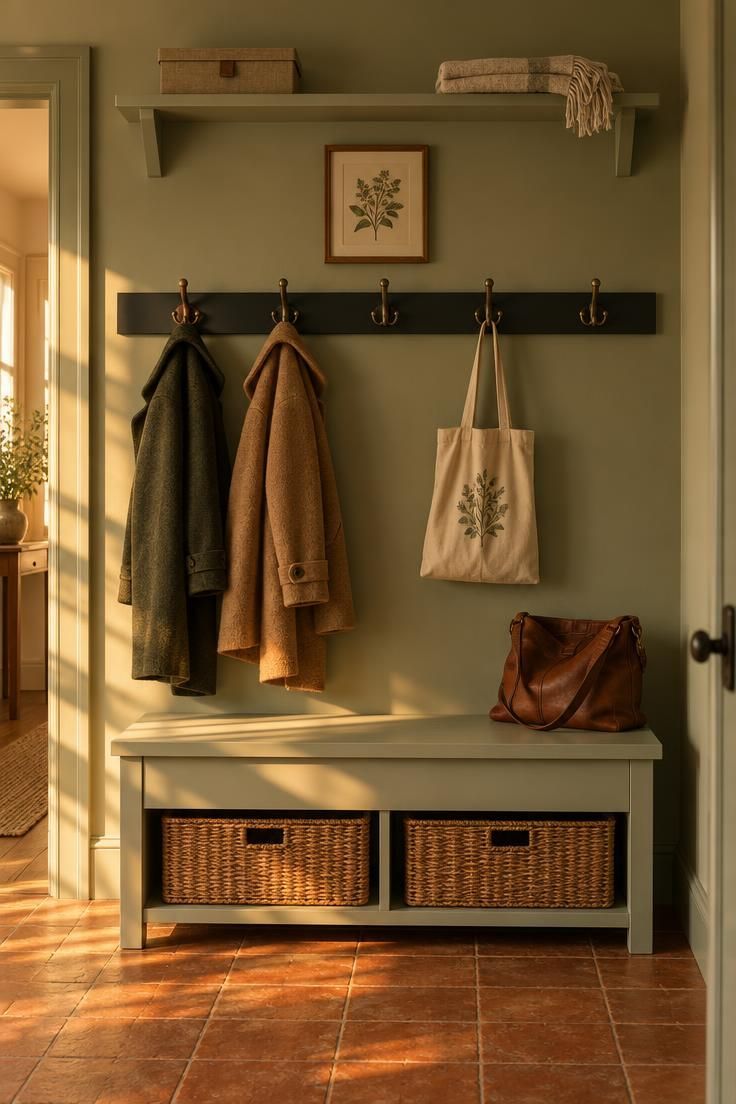
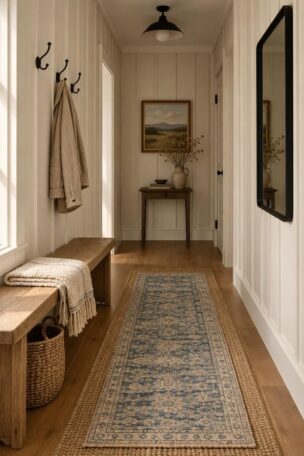
The three-band arrangement uses the wall's full vertical range, so no single band needs much depth.
Hooks take the daily coats and bags, the bench seats someone pulling on shoes, and the high shelf holds items that don't need weekly reach.
That division keeps the middle of the wall, which is the busiest sight line, relatively calm.
This suits the arrival pattern of a household where more than one person comes home at once and layers come off fast.
Hooks hold a great deal but read untidy when overfilled, and a tray or box on the high shelf keeps the upper zone from looking scattered.
Small hallway storage ideas like this three-band setup work best when each band has a clear job rather than absorbing overflow from the others.
Check whether the bench depth still leaves comfortable passage, and whether the high shelf can be reached without a step that blocks the corridor.
Style Blueprint:
- Painted MDF bench with a wipeable finish at the shoe-contact band
- Matte black or aged bronze hook rail with hooks spaced for coats
- High shelf painted the same color as the wall so it recedes
- Woven baskets on the high shelf to conceal seasonal contents
- One framed print above the hooks to anchor the composition
Design Pro-Tip: Judge a unit's depth against the wall opposite it. If a door swings there, keep the unit shallow enough that the door clears it comfortably.
Floor-to-Ceiling Wardrobe Painted to Match the Wall
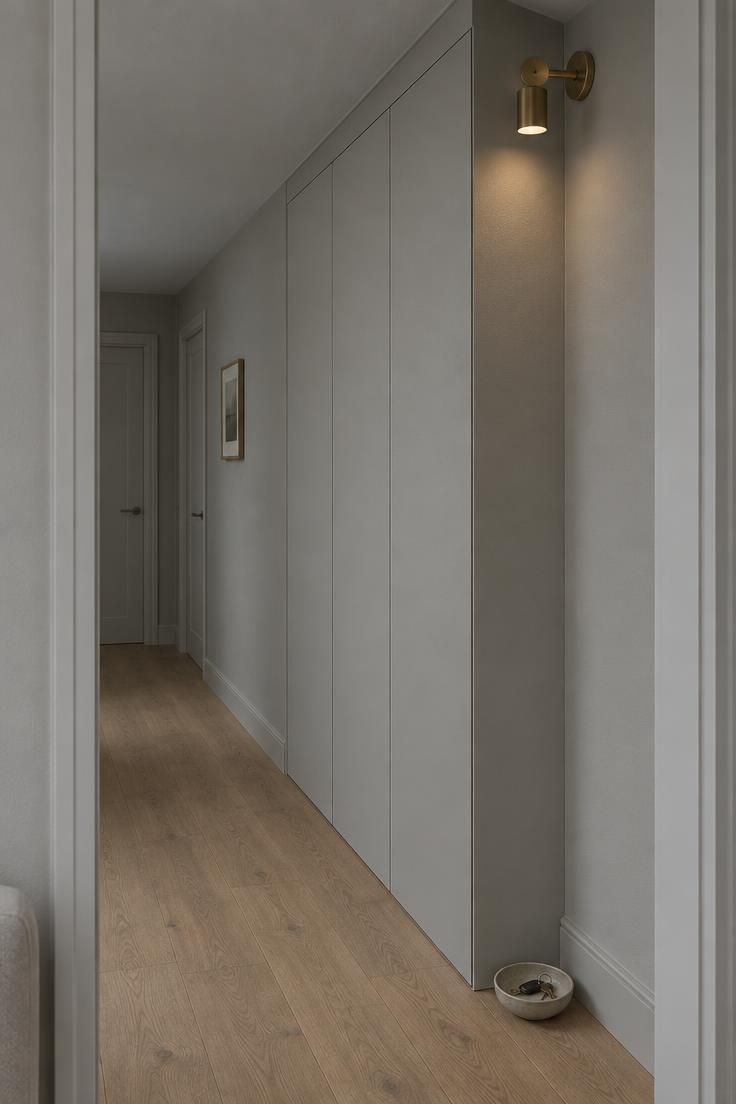
A full-height unit uses the vertical range that shallow storage cannot, which makes it the highest-capacity option on a single wall.
It also carries the most visual weight of any format here, and that weight is what shapes the choice of finish.
Painting the wardrobe to match the surrounding wall is the most effective move to keep it from dominating the view down the hall, because the eye reads it as part of the building rather than as furniture.
A contrasting finish turns the same unit into a heavy object dropped into a narrow passage.
This suits bulk coat and shoe storage, or a household that needs the hallway to work as a second closet.
Built-ins look the most composed, yet they are the least forgiving when the household's needs shift, since a stroller, a pet, or a growing shoe collection can outgrow the internal layout.
Style Blueprint:
- Smooth painted MDF or plywood in the same tone as the wall
- Slim shadow-gap or push-latch doors for a clean face
- Matte black or brass slim pulls, or none at all with push-latch
Open Shelving With Woven Baskets
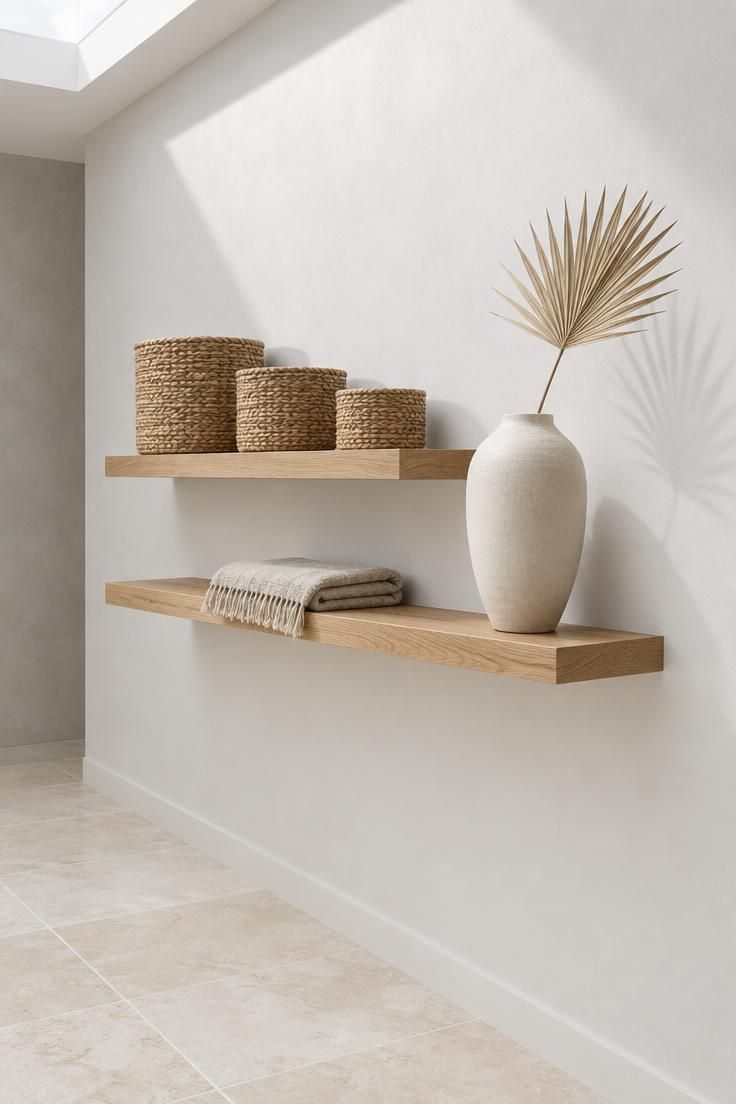
Open shelves cost less than closed cabinets and read lighter because the wall shows through the gaps between objects.
That lightness only holds when the contents are contained, since the format photographs well only with discipline behind it.
Baskets are the mechanism: they hide the small, irregular items that would otherwise read as clutter at eye height.
A hallway shelf with baskets suits shoes, hats, gloves, and small bags, the categories that group better in a bin than lined up individually.
Open storage looks best when it is nearly empty, and a shelf of a dozen small objects reads as accumulation while three baskets read as design.
Dusting is part of the deal, and woven baskets keep their color longer when kept out of direct, sustained sunlight.
A purely internal corridor handles open bins well, while a hallway seen from the living room or entry rewards closed fronts.
If the contents cannot be grouped into a few closed containers, closed storage will serve better than open shelving.
Style Blueprint:
- Oak or ash shelves with a matte clear finish
- Woven baskets in a consistent tone across two or three sizes
- One larger object per shelf, such as a vase or folded textile
- Matte black brackets to keep the shelf line quiet
Pegboard and Rail Wall for Changing Objects
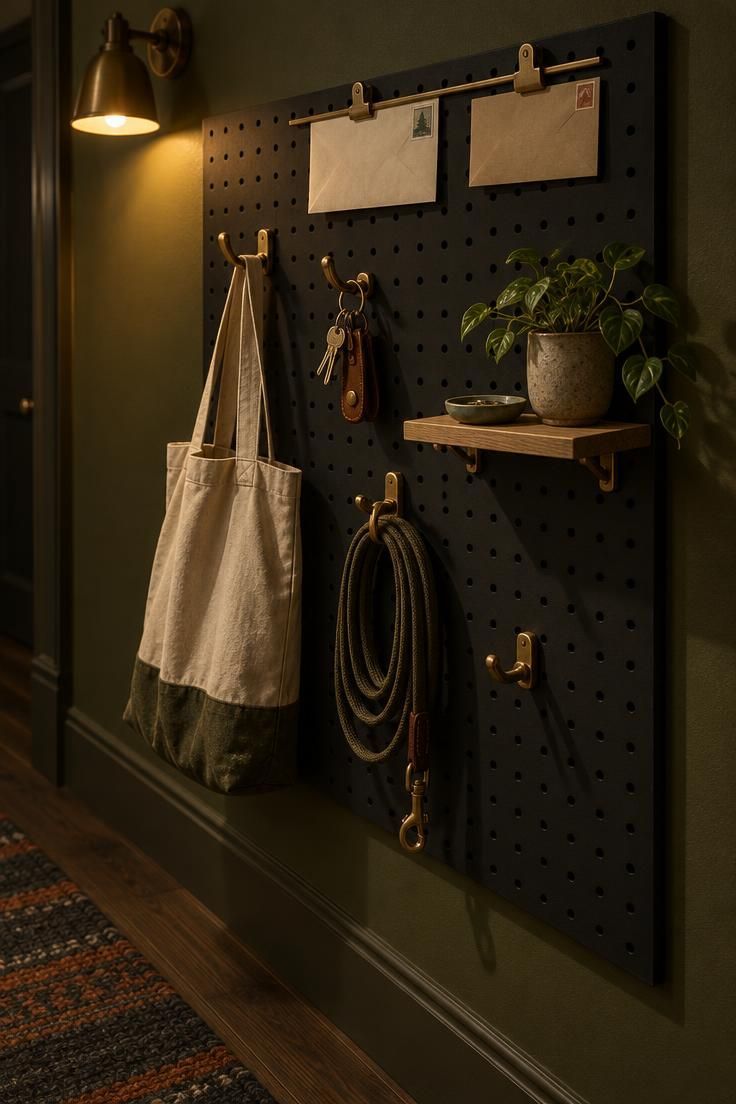
This is the most flexible format in the list because the same panel holds coats in winter and bags in summer, with hooks and small shelves repositioned as needs change.
It reads as a working wall rather than furniture, which suits an internal corridor better than a styled console would.
The pegboard's rhythm of holes gives the wall its own texture, so even a sparse arrangement has visual interest.
Leashes, keys, small bags, and reusable totes fit the format, and the rotating cast of items that never found a permanent home finds a place here.
Flexibility comes with exposure, since everything stays visible and the wall reads busy unless the contents are edited often.
Hook rails are worth checking now and then for wobble, and rotating contents with the season keeps any single hook from carrying too much.
Style Blueprint:
- Painted pegboard in the wall color, or in a contrasting tone as a feature
- Matte black or brass hooks in mixed sizes
- A clip rail for paper and mail along the top edge
- A small clip-on shelf for a tray or a plant
- One canvas tote hung at the base as a catch-all for overflow
Console Table With Shallow Drawers
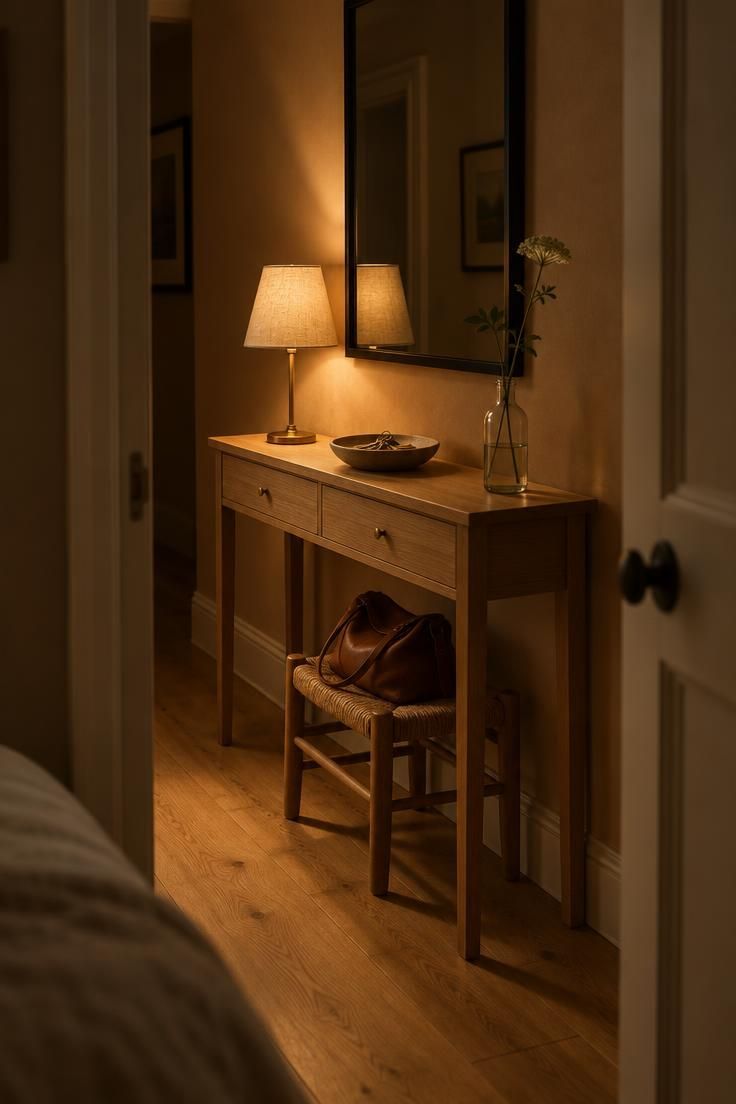
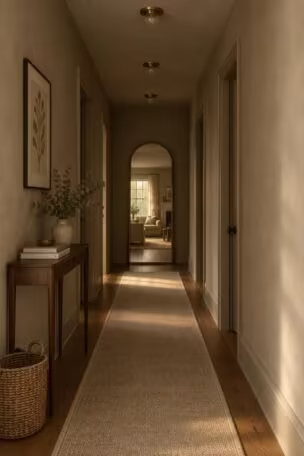
The console offers something no other shallow format does: a working surface at standing height.
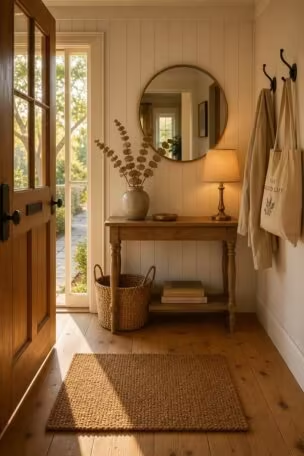
That surface makes room for a lamp, a tray, a bowl, and a mirror-check spot near the door.
Depth decides whether it works here, because a table with a broad visual presence can feel cramped in a passage even when its footprint matches a slim cabinet.
Mail, keys, a small bowl for change, and the small rituals of arriving and leaving are the natural contents.
Entryway hallway storage often benefits from this kind of small surface, but the top invites a pile unless a defined container limits what can gather there.
A narrow profile in oak, black metal, or a painted finish keeps the piece from reading heavier than the passage can carry.
Style Blueprint:
- Narrow console in oak, black metal, or a painted finish
- A tray or shallow bowl sized for keys and mail and nothing more
- A small table lamp or picture light to mark the zone
- A low stool or basket beneath the console for shoes or a bag
Over-Door and Above-Door Storage
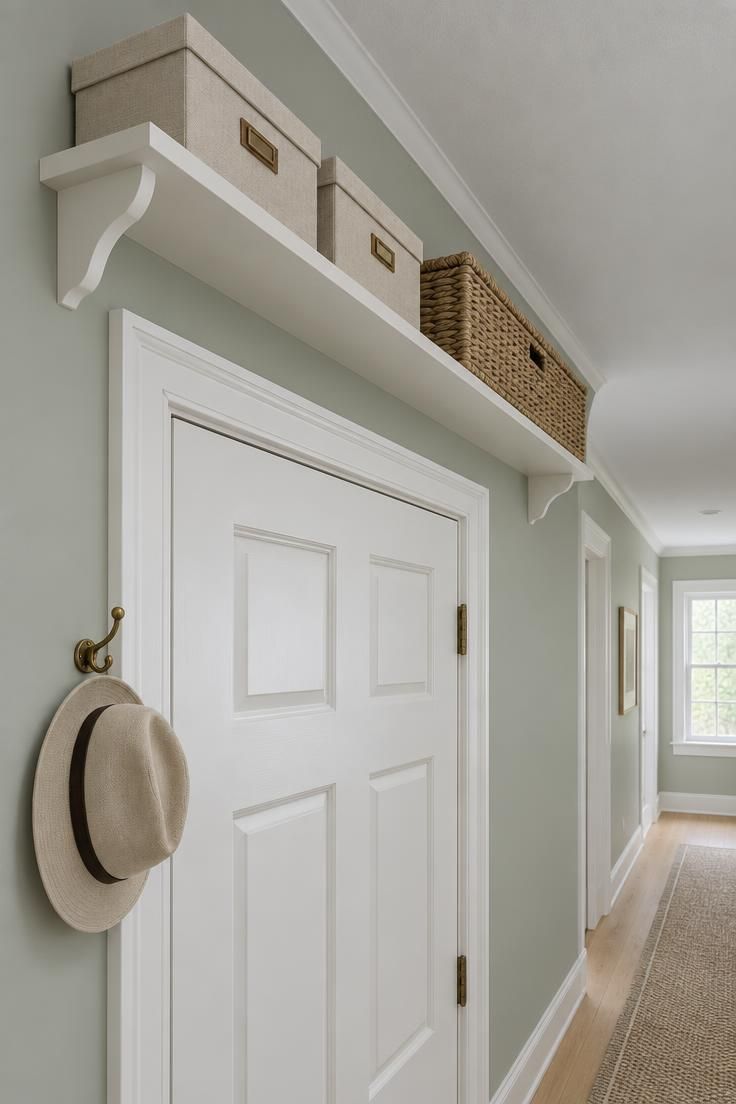
The area above a door frame sits higher than the eye travels during a normal trip down the hall, so storage there is felt less with each pass.
Over-door hooks and shallow above-door shelves suit seasonal or occasional items, the things that need a home but not daily reach.
This suits seasonal coats, gift wrap, board games, and off-season shoes, the category of objects that has no other place to go.
The zone is visually subtle, which also makes it easy to forget what is stored there, and forgotten storage tends to fill with duplicates.
A hallway with a door that already interrupts the wall is the right host, since the storage uses the interruption rather than fighting it.
If an item is needed at least once a season, above-door storage is a reasonable home, and if it is needed weekly, it belongs lower.
A label or tag system keeps the contents findable without pulling everything down to look.
Style Blueprint:
- Shallow painted shelf or slim over-door hook frame in the wall tone
- Matching lidded boxes or one long basket to keep contents concealed
- A small label or tag system so contents stay findable
Slim Freestanding Tower in a Short Wall Segment
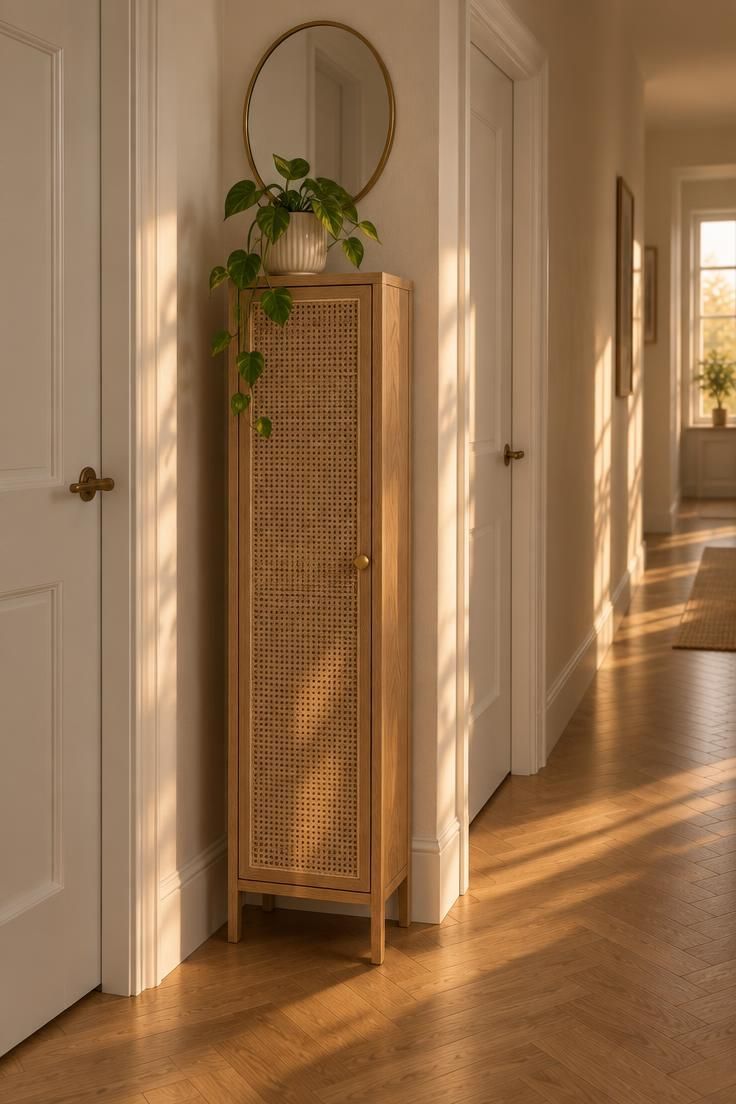
A slim tower fits the short wall segments that door swings leave behind, where a full-width unit would not sit cleanly.
Because it stands on its own, it can be moved or doubled when the household's needs change, a flexibility that built-ins do not offer.
Rattan fronts hide contents while adding texture, which keeps the piece from reading as a solid block in a tight corridor.
Gaps on either side of a freestanding unit collect dust and can read as clutter unless the finish and the wall tone sit close together.
Style Blueprint:
- Slim tower in painted MDF, rattan-front, or oak
- Slim pulls in a single metal finish shared with the rest of the hallway hardware
- One small object on top, scaled to the tower's width
Under-Stair or End-of-Hall Niche Storage
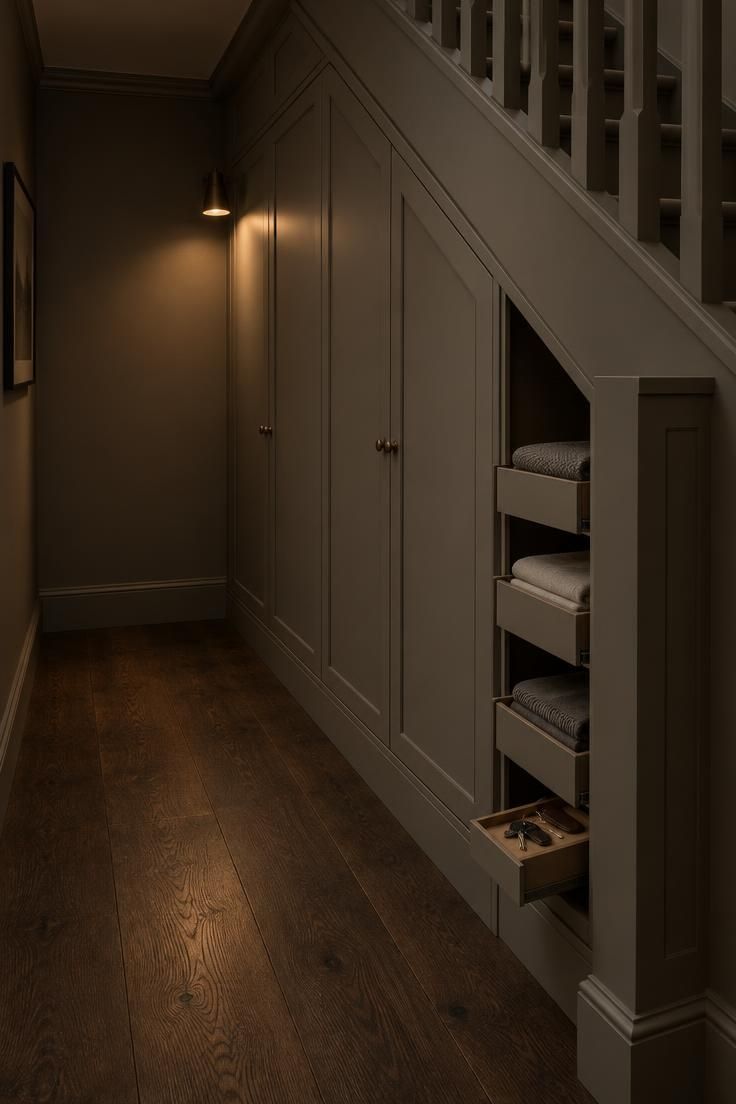
Where the architecture already provides a recess or an under-stair volume, storage fits without narrowing the corridor at all.
That makes this format the exception to the depth constraint that shapes every other idea here.
The result reads as part of the building rather than as an object placed in the hall, which is why this zone often looks the most resolved.
Bulk shoes, coats, sports equipment, and pet gear fit here, since these are the deep categories that cannot work on a shallow wall.
The format depends on the architecture, so a plain corridor has no equivalent, and shallow wall options are the realistic path there.
A dead end, an under-stair volume, or an unused recess is the natural host for it.
Style Blueprint:
- Fitted painted doors in the wall tone so the storage recedes
- Slim internal drawers or pull-out trays so items at the back stay reachable
- One warm wall light to make the recess read as intentional
- A small tray or hook zone at the front edge for daily-drop items
Design Pro-Tip: List what actually lands in the hallway every day before choosing a format, and let that object list drive the decision rather than the other way around.
Integrated Coat Niche With a Drawer Bench
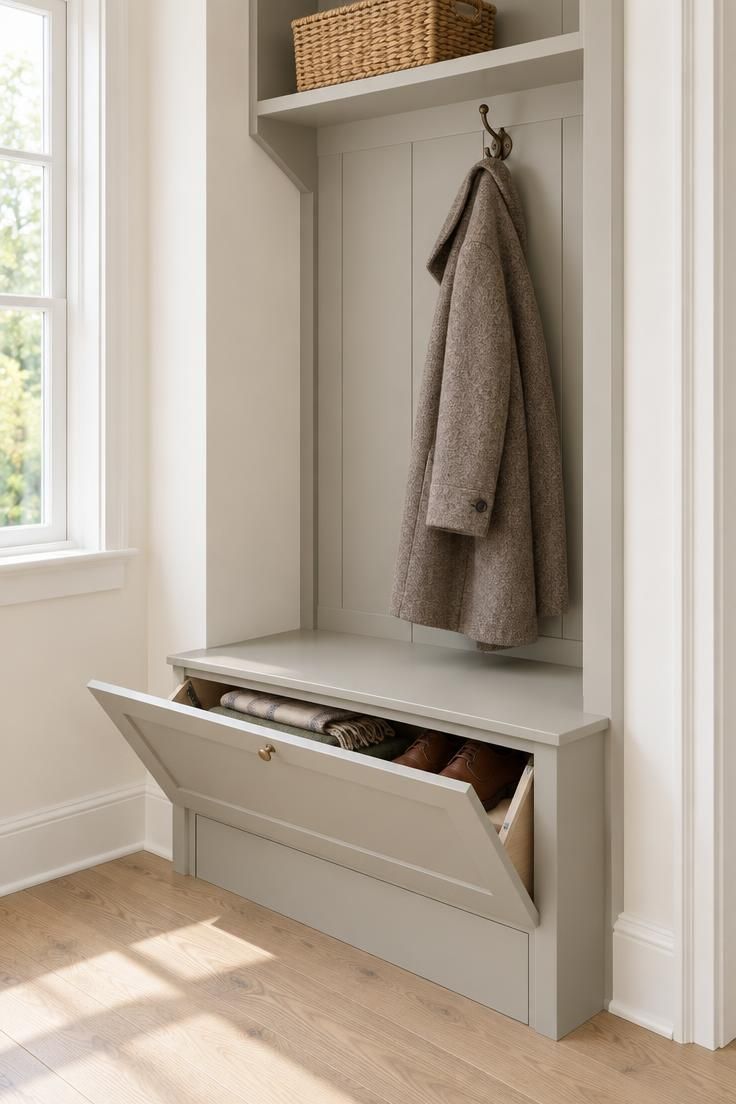
This is the compact version of a mudroom, scaled to fit a single hallway wall.
A bench with lift-up or pull-out storage beneath holds shoes, bags, or a leash below seat height, where storage is felt least during passage.
A small hook zone above takes the coat and bag, and a shallow shelf over that holds a basket or tray.
The full daily drop from one or two people fits here: coat, bag, shoes, keys, and whatever came through the door with them.
This format serves household entry patterns well, yet it is the least forgiving of overflow, since a full bench and drawer leave the next arrival's items nowhere to go.
A wipeable finish at the shoe-contact band is a practical choice, because painted built-ins show scuffs where shoes and bags make contact.
A hallway that serves as the primary entry, with a predictable daily flow, is the right setting.
Check whether the bench depth leaves comfortable passage, and whether a coat hanging above the bench intrudes into the walking path at shoulder height.
If the household arrives home in waves rather than together, a deeper or wider version of this format will serve better than a compact one.
Style Blueprint:
- Painted bench with a lift-up or pull-out drawer beneath
- Wipeable finish at the shoe-contact band
- Hooks at shoulder height, spaced for coats rather than crowded
- A shallow shelf above the hooks for baskets or a small tray
- One framed print or small mirror to break the wall above the shelf
Slim Wall-Mounted Cabinet for Narrow Hallway Storage
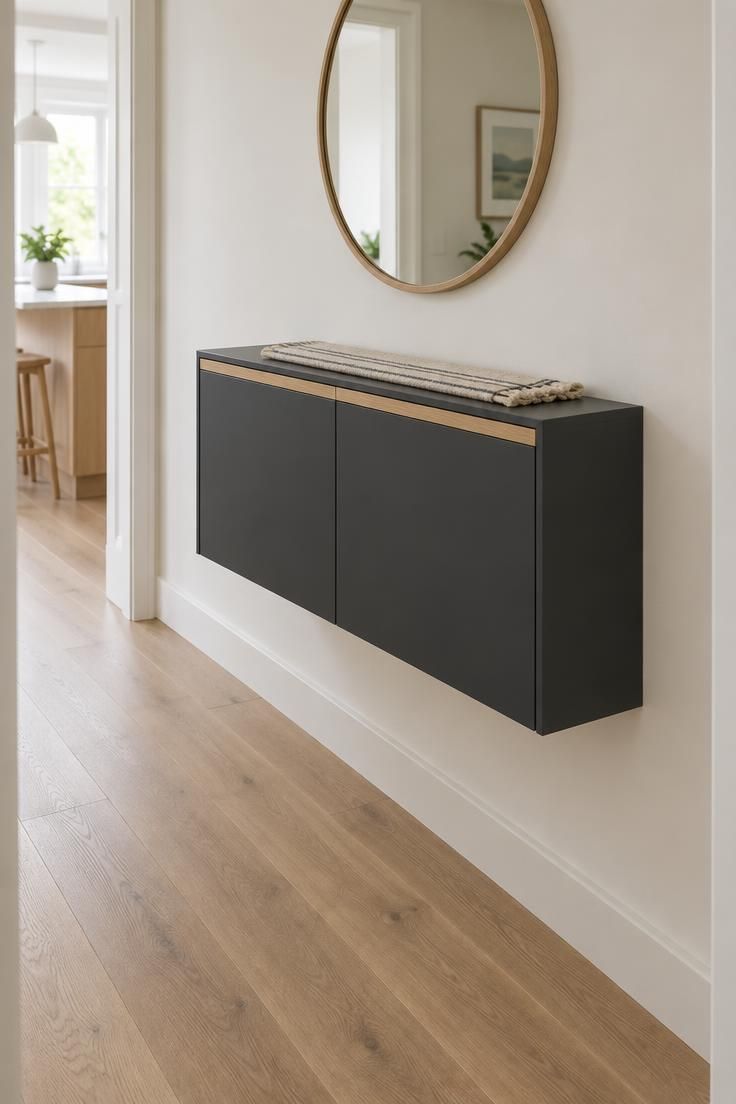
A wall-mounted cabinet leaves the floor clear beneath, which makes the passage feel less interrupted than a floor-standing unit would.
The visual gap under the cabinet also makes the hallway read wider, since the eye travels past the unit without stopping at a base.
This format suits narrow hallway storage in a corridor where even a slim freestanding piece would crowd the walking path.
A shallow depth keeps the cabinet face close to the wall, and push-latch doors avoid projecting hardware that could catch a sleeve or bag.
Inside, one or two shelves hold the small daily items that would otherwise sit on a console: keys, a phone, a small pouch, or a folded scarf.
The top surface works as a narrow ledge for one or two objects, but it should not become a landing zone for everything.
Because the cabinet floats, the floor stays open for a runner or a slim basket placed beneath, which adds storage without adding visual weight.
Look at the wall opposite before choosing this format, since a door that swings near a floating cabinet will demand a tighter clearance.
Style Blueprint:
- Wall-mounted cabinet in matte charcoal, warm white, or oak
- Push-latch doors with a thin wood or metal pull strip
- A round mirror above, slightly narrower than the cabinet
- A slim runner or shallow basket placed beneath on the floor
- One small tray on the top ledge for keys and mail
Conclusion
Depth is the decision criterion that matters most in a passage, and every format here is a different way of matching storage depth to the wall, the door swings, and the daily object flow.
The visual payoff, a hallway that looks intentional rather than apologetic, comes from consistency of finish and discipline of contents rather than from the size of the unit.
Start with what actually lands in the hallway every day, then choose the format whose internal layout fits that list.