This post may contain affiliate links. If you make a purchase through these links, we may earn a commission at no additional cost to you.
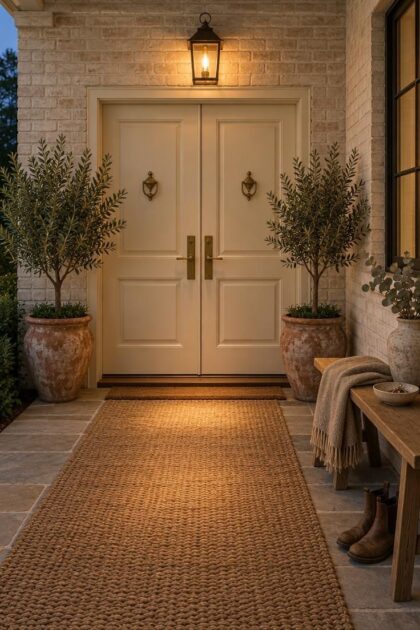
A double door entryway reads as one architectural moment rather than two separate leaves.
The center meeting line sets up symmetry, depth, and a clear arrival point from the street or the front path.
This list of ideas works from that twoness: matched panels, glazed pairs, unequal leaves, and the hardware, lighting, and landing choices that make the pair feel intentional.
Each idea is written as a visual plan first, with enough practical reasoning to help a homeowner judge what fits their own entry.
Symmetrical Forest-Green Paneled Pair Against a Pale Brick Facade
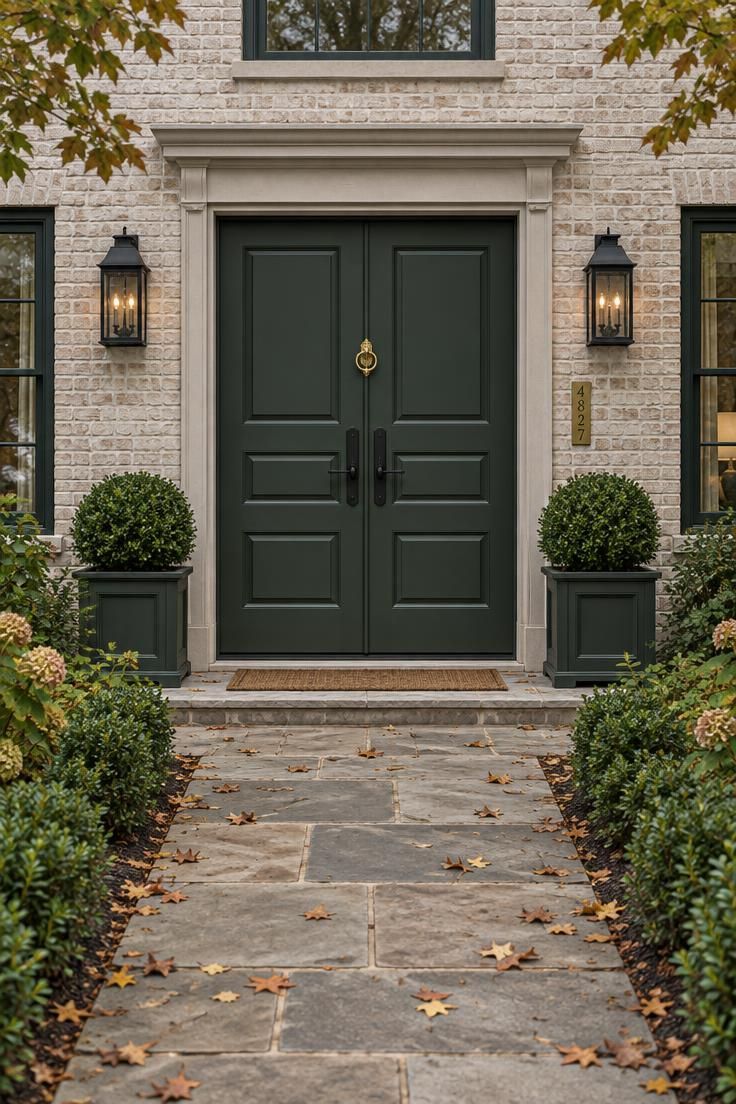
The strength of this composition is discipline.
Every element balances across the center line: planters of equal size, handles at matching heights, and a path that points straight at the meeting stile.
For double front doors, deep green against pale brick gives the pair a single graphic shape, so the doors read as one form even though they open separately.
Choosing identical panel patterns on both leaves keeps the symmetry honest.
A raised panel on one side and a flat slab on the other would break the mirror effect, and the eye would notice it from the street before anything else.
Satin black handles sit quietly against the dark paint, which lets the brass knocker carry the smallest point of shine.
A matched pair like this depends on a symmetrical surround.
If the casing, step, or lanterns sit off center, the doors will look crooked even when they are not.
Walk the path from the street before committing to planter sizes, because a boxwood that looks modest at the door can read as a small shrub from the sidewalk.
Keeping the porch floor clear matters as much as the planting.
Boots, deliveries, and a stray watering can all break the unbroken line of the path, so a slim bench or storage spot placed off to one side of the composition helps the entry stay composed in daily use.
The painting and upkeep are straightforward but constant.
Pale brick shows every leaf and cobweb, and dark green paint shows dust near the handles, so a soft brush and a damp cloth kept nearby make the routine short.
Seasonal dressing works best when it follows the same mirror logic: two wreaths, two lantern arrangements, one calm center.
Style Blueprint:
- Two matching paneled doors painted a consistent matte forest green on both leaves
- Satin black lever handles mounted at matching heights
- Mirrored boxwood planters of equal size flanking the opening
- A single centered brass knocker as the only bright accent
- A straight stone path that meets the threshold at the center line
Full-Lite Glazed Pair Under a Fanlight Transom With Black Divided Grids
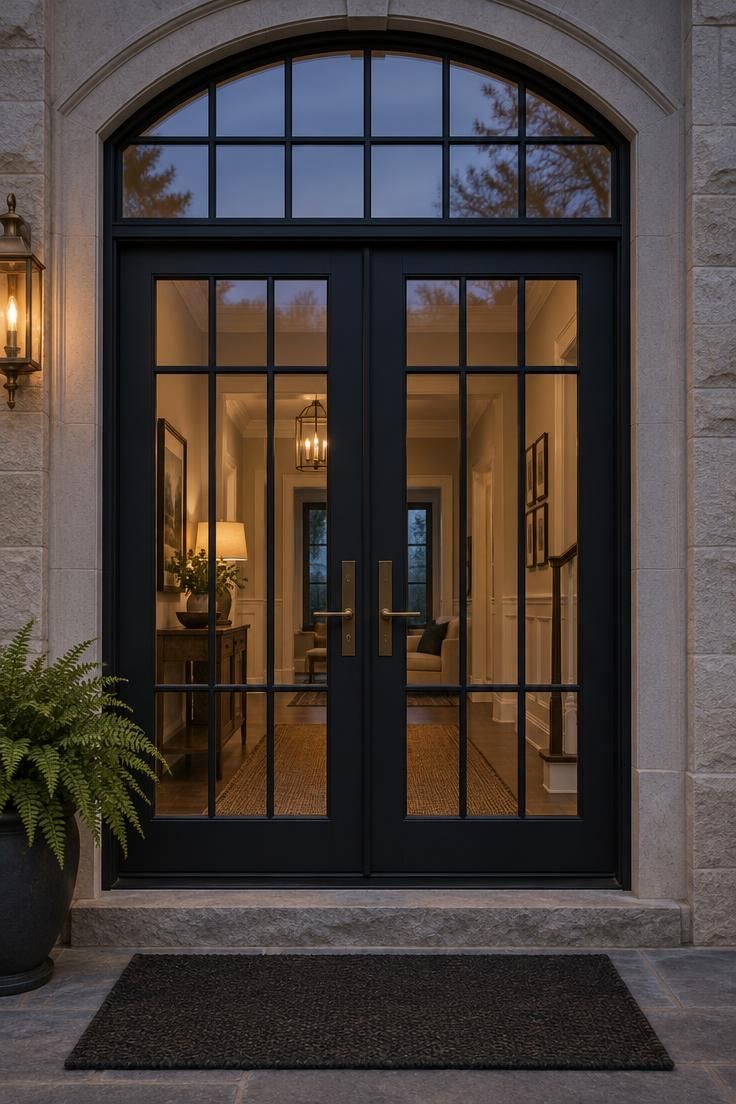
The vertical line of slim muntins does the visual work here.
Each narrow pane stacks above the next, and the fanlight transom repeats the same rhythm in a curve, so the whole doorway reads taller than its actual height.
On a smaller facade this matters: the glazed pair adds presence without needing a heavy portico or deep surround.
Glass changes how the entry is read from the approach.
The hallway beyond becomes part of the composition, so a clear sight line to a console, a runner, or a stair matters more than with solid doors.
Keep that first view uncluttered, since anything parked just inside the glass will be visible from the path every evening.
The grid spacing deserves attention during planning.
Panes that are too wide look blank, and panes that are too narrow can feel busy, so hold a sample frame against the opening and step back to the path before deciding.
The transom should echo the door grid rather than introduce a new pattern, or the two elements will compete.
Warm interior light at dusk is what makes a glazed front door pair feel welcoming, and a single fixture inside the hall often does more than several outside.
Exterior sconces placed beside the frame rather than on it keep the glass surface uninterrupted.
Upkeep focuses on glass and dark metal.
Fingerprints near the handles and dust on the muntins show quickly, and a microfiber cloth with a mild glass cleaner keeps the panes clear.
The black finish benefits from an occasional wipe so it does not collect a gray film over the seasons.
Style Blueprint:
- Full-lite doors with a black divided grid in narrow rectangular panes
- A fanlight transom that repeats the door grid
- A warm interior fixture placed to glow through the glass at dusk
- Sconces mounted beside the frame, not on the door surface
- A low step and a dark, flat doormat to ground the threshold
Reeded Glass Pair With Slim Oak Frames and Brass Lever Handles
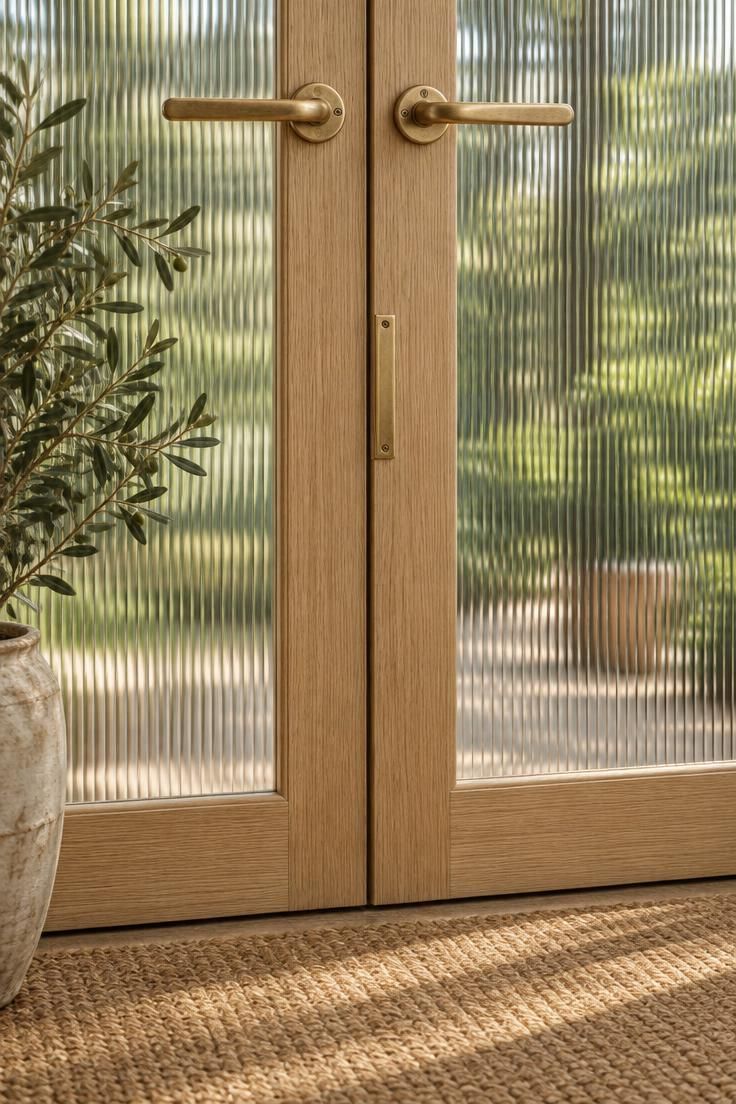
Fluted glass turns the door surface into a soft screen.
It obscures the interior while letting daylight through, so the entry hall receives even light and the approach stays visually calm.
The texture becomes the main event, which means this idea suits both true pairs and a door-plus-fixed-panel setup without changing its character.
Slim oak frames keep the composition light.
Thick frames would crowd the fluting and make the pair feel heavy, so the proportion between glass and wood matters more than the overall size.
Pale oak also holds up visually beside the brass, since the two warm tones sit close together without matching exactly.
Unlacquered brass lever handles will patinate over time, moving from bright gold toward a deeper bronze.
Some homeowners love that shift and others prefer a consistent finish, so it is worth deciding which camp you are in before choosing hardware.
Lever handles mounted high keep the fluting visible below them and read as a deliberate line.
The jute mat carries the oak tone down to the floor and gives wet shoes somewhere to land.
A mat that runs wider than the opening echoes the width of the pair and keeps the entry from looking pinched at the base.
Cleaning reeded glass takes a little patience.
A cloth dragged horizontally leaves streaks across the ridges, so wipe with the flutes rather than against them.
The oak frames need only a dry cloth, and the brass can be left alone to age or polished back to brightness depending on preference.
Style Blueprint:
- Reeded glass leaves with a fine, even flute pattern
- Slim pale oak frames that keep the glass dominant
- Unlacquered brass lever handles mounted high
- A slim brass letterplate at the center line
- A wide natural jute mat in a warm tan tone
Deep Blue-Black Arched Pair With Unlacquered Brass House Numbers
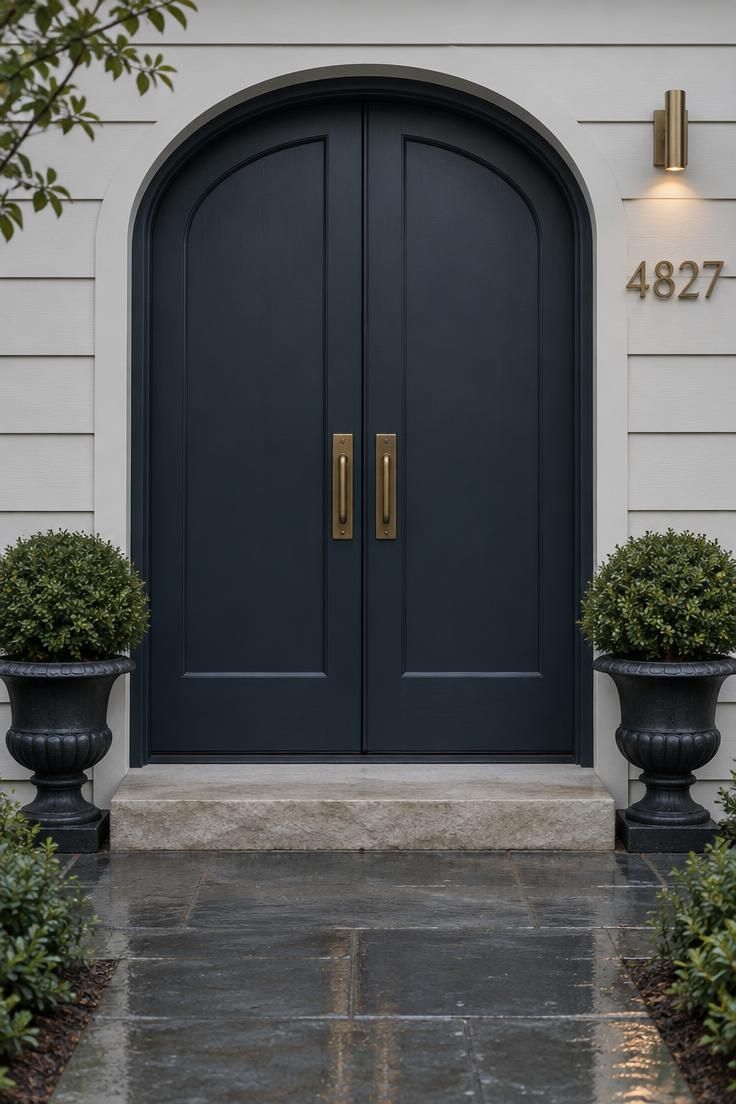
An arch softens the top of the composition.
Square-topped pairs can feel severe against certain facades, and the curve gives the doorway a gentler silhouette while keeping the center line strong.
Blue-black paint pulls the whole entry forward against lighter siding, since the dark shape reads as one block from a distance.
House numbers placed on the wall beside the doorway, rather than on a door leaf, keep the arched surface clean.
Large unlacquered brass digits become a small sculptural element in their own right, and their patina will shift with weather.
This is one of the front door color ideas worth testing with a painted sample board before committing, because blue-black shifts noticeably between bright and overcast light.
Matching pulls on both leaves keep the pair balanced even though only one is used daily.
The dummy pull is purely visual, and its presence tells the eye that the two leaves belong together.
Keep both at the same height so the horizontal line holds.
The planters should stay low here.
Tall urns would compete with the arch, while squat topiary in dark containers lets the door shape lead.
A pale stone step under the threshold separates the dark doors from the path and gives the base a clean edge.
Brass patina is uneven by nature, which is part of the appeal and part of the maintenance question.
Some homeowners polish the numbers twice a year and others let them darken.
Either approach works, as long as the choice is consistent across pulls, numbers, and lighting.
Style Blueprint:
- Solid arched doors painted a deep blue-black
- Large unlacquered brass house numbers on the adjacent wall
- Matching centered pulls on both leaves, one functional and one decorative
- Low topiary in dark urns that stay below the arch line
- A pale stone step to separate the dark doors from the path
Asymmetrical Pair With One Active Leaf and a Tall Planter Counterweight
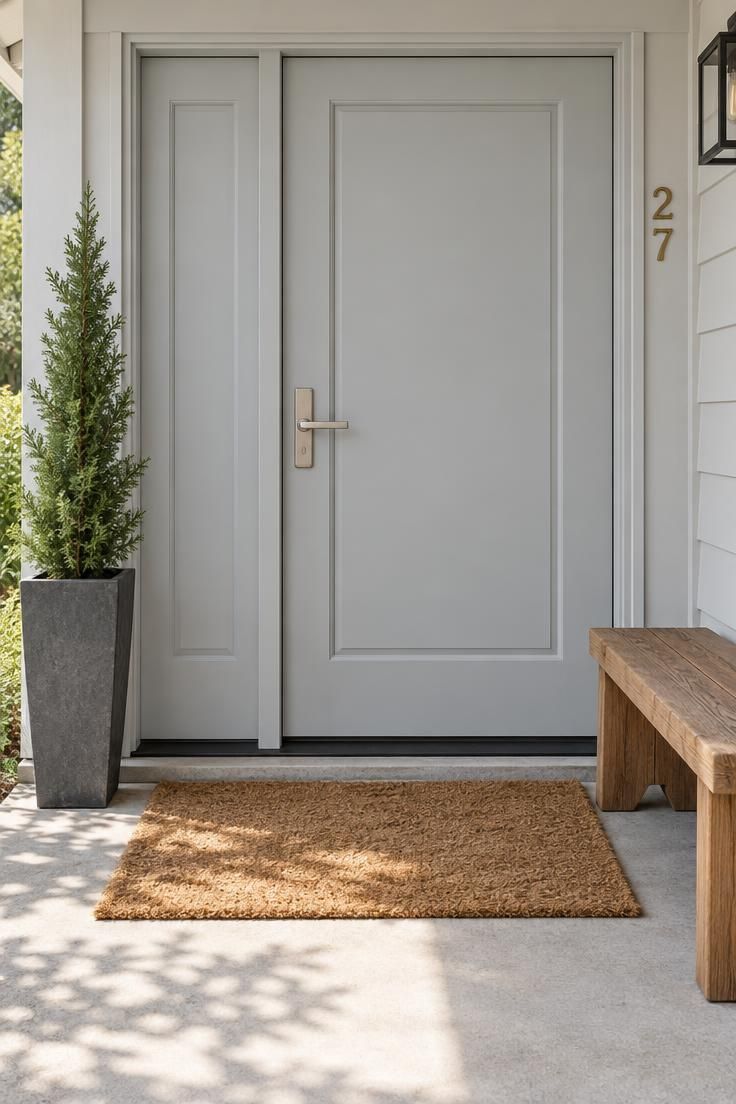
This arrangement plays out in many homes that people describe as having a double door entryway, even when one leaf stays fixed most of the year.
The visual challenge is balance: the wide active leaf carries more mass, so the narrow side needs something tall to hold its own.
A slender planter with an upright evergreen does that job without crowding the opening.
On the active side, a low bench and a wide mat serve the everyday pattern.
Keys, bags, and wet shoes land there, and the bench sits below the handle so the traffic path stays clear.
Keep the fixed leaf’s surface clean, because a handle or knocker on a leaf that does not open reads as a mistake rather than a detail.
The asymmetry should look intentional rather than unfinished.
Matching paint and matching trim across both leaves unify the pair, and the single handle makes the working side obvious.
A visitor will read the arrangement correctly within a few steps, which is the point.
Porch depth decides how much furniture fits.
A shallow landing may only accommodate the mat and a narrow planter, while a deeper porch can take the bench as well.
Step back to the path and check whether the bench crowds the door swing before committing to its width.
Coordination between the two sides takes some restraint.
If the planter is tall and the bench is low, the horizontal mat ties them together at floor level.
Adding a second tall element on the active side would tip the balance back and undo the deliberate offset.
Style Blueprint:
- An unequal pair with one fixed narrow leaf and one wide working leaf
- A tall narrow planter set on the fixed side as a counterweight
- A low bench and wide mat on the active side
- One handle only, placed on the working leaf
- Matching paint and trim across both leaves to keep the pair unified
Walnut Pair With Six-Panel Raised Pattern and Wrought-Iron Strap Hinges
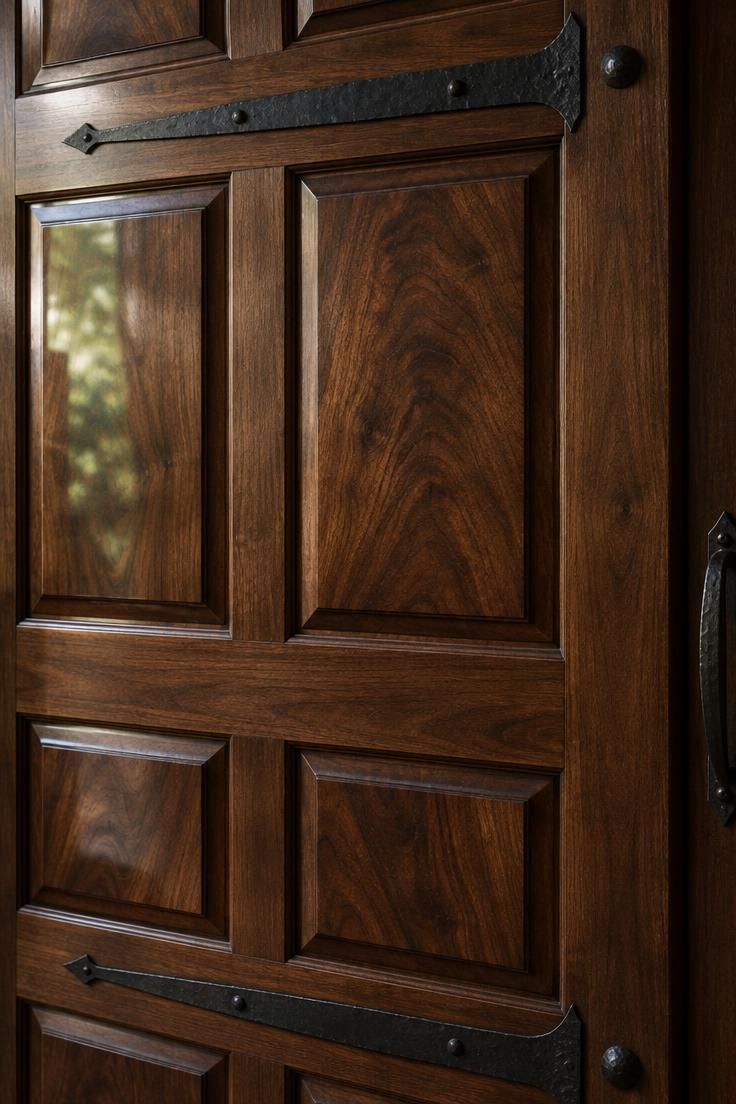
Grain becomes the ornament with a wood pair.
The raised panel pattern gives the surface structure, and the walnut’s color carries the composition without any paint.
For door hardware finishes, keeping hardware minimal lets the geometry of the panels and the straight lines of the grain stay dominant, which is why this direction suits homeowners who want warmth rather than color.
Strap hinges add a deliberate rustic reference.
They run across the door edge in a long tapered line, and the black iron against warm walnut creates contrast that follows the frame.
Because the hinges are the only decorative element, their proportion matters: too wide and they overwhelm the panels, too narrow and they disappear.
This pair reads well against pale plaster or whitewashed brick, where the warm brown stands forward.
Against dark siding it can lose its definition, so consider the surrounding wall color before settling on the walnut tone.
Walnut ages.
It tends to darken and deepen over time, and the shift is gradual enough that most people notice only when comparing an old photograph.
Finishes vary in how much they change and how often they need refreshing, so ask what a given finish does over the years rather than assuming all walnut behaves the same.
Strap hinges and iron hardware need little beyond an occasional dry wipe.
Avoid wet cloths on the iron if the finish is not intended to rust, and keep the wood away from standing water at the threshold.
Style Blueprint:
- Solid walnut leaves with a six-panel raised pattern
- Blackened wrought-iron strap hinges crossing each door edge
- Minimal additional hardware so grain and panels lead
- A pale plaster or whitewashed brick wall behind for contrast
- A dry cloth routine for both wood and iron
Coastal White Pair With Louvered Panels and a Wide Woven Bench
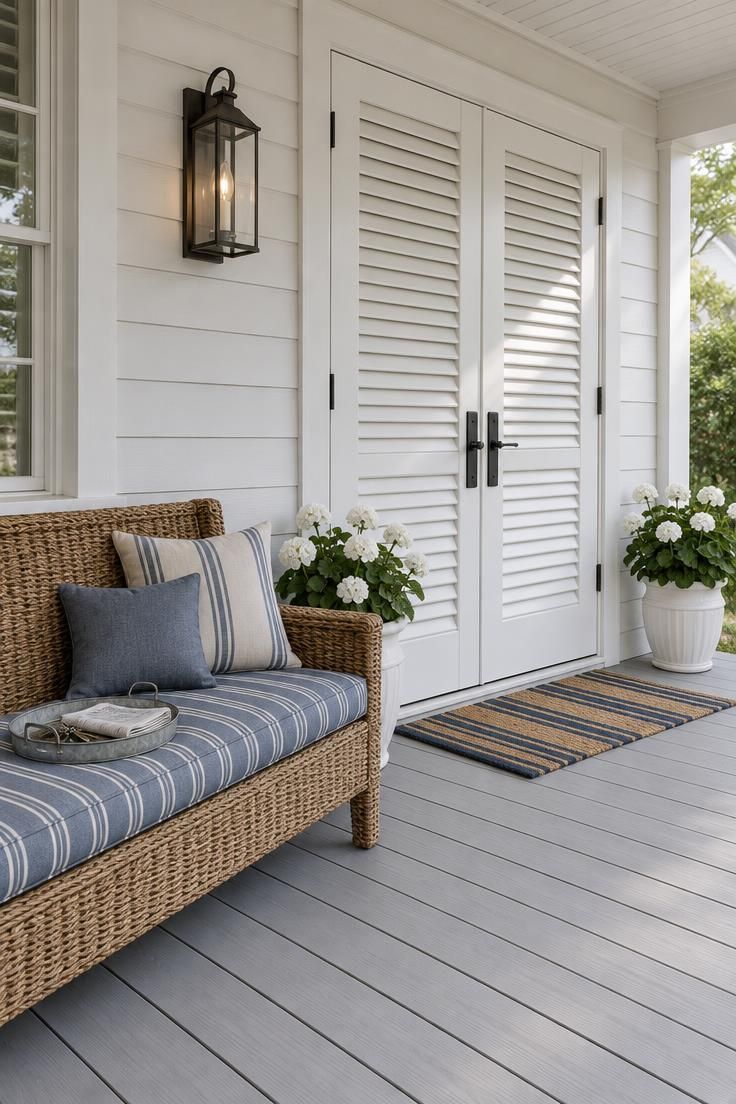
Louvers give a door pair a ventilated look that suits coastal settings.
The horizontal slats create a fine rhythm across both leaves, and white paint keeps the porch bright even under a roof.
This composition works for true pairs and also for a louvered pair sitting behind a storm door, where the horizontal lines still carry the visual message.
The woven bench beside the entry turns the porch into a usable spot.
Keep it low enough that it does not crowd the door swing, and set it against the wall rather than in front of the leaves.
A striped cushion in blue-gray and a small tray for keys make the bench feel lived in without looking cluttered.
Proportion is the main risk.
A bench that is too tall will fight the doors, and one that is too wide will block the path from the steps.
Measure the wall space beside the opening and leave room for the door to open fully before choosing a size.
White louvered doors show dust and pollen quickly in coastal air.
A soft brush run along the slats, top to bottom, keeps the surface clean without driving debris into the corners.
The woven bench benefits from an occasional vacuum with a brush attachment, and the cushion cover should be washable given how much time it spends near the door.
The palette stays calm because everything sits in the white and blue-gray range.
A single contrasting element, such as the galvanized tray or a pair of terracotta pots, adds interest without disturbing the coastal tone.
Style Blueprint:
- Bright white louvered leaves with an even slat rhythm
- A wide low woven bench set against the wall beside the entry
- A blue-gray striped cushion and a small galvanized tray
- A striped doormat and a pair of white geranium pots
- A slender wall lantern above the bench
Stained Oak Pair Framed by a Soapstone-Look Surround and Oil-Rubbed Bronze Hardware
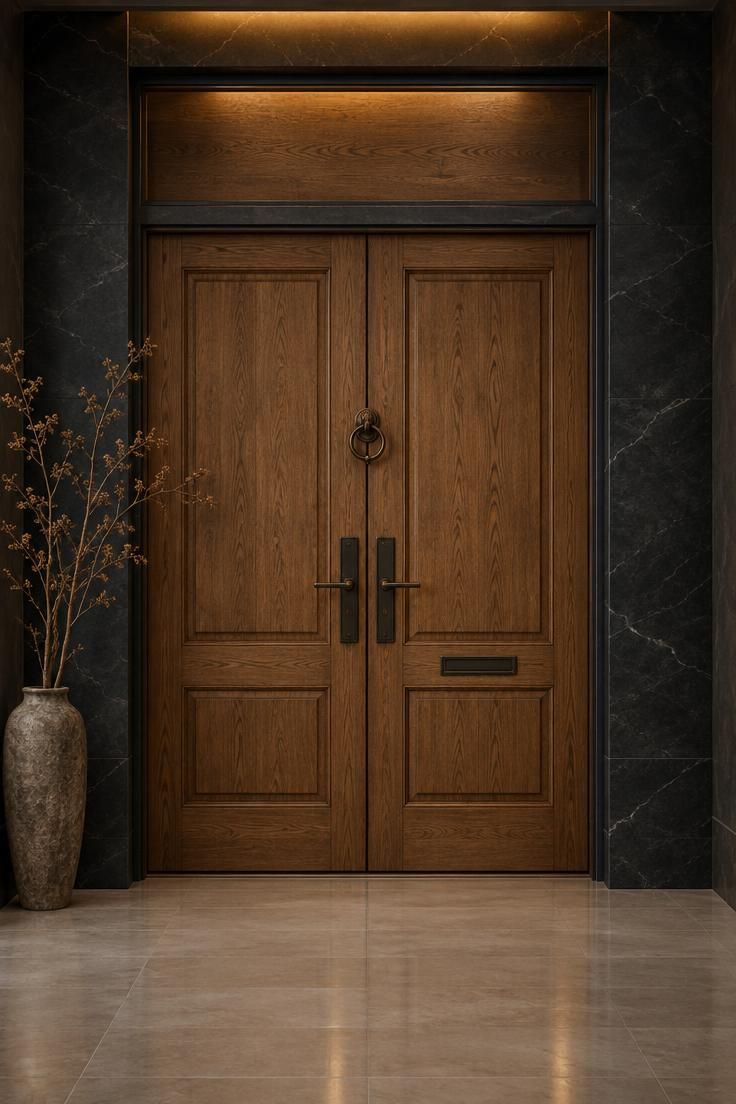
The surround acts as a frame here.
A dark soapstone-look border runs from the floor to the transom and makes the oak grain read as the main event inside a quiet dark edge.
Because the surround wraps the full opening rather than stopping at simple casing, the pair feels set back from the facade and slightly formal.
Oil-rubbed bronze hardware suits the darker frame.
The finish sits between black and brown, so it bridges the soapstone and the walnut-toned oak without competing with either.
A centered knocker repeats the symmetry of the pair, and a slim letterplate adds a practical detail without visual noise.
The pale honed tile floor is the counterweight.
Without it, the dark surround and the stained doors would merge into one heavy block.
A light floor separates the base of the composition and gives the entry a clean footing.
Lighting inside the surround helps the oak read at night.
A concealed source above the transom washes the doors from the top, and the soapstone catches a soft sheen along its veins.
This is the kind of detail that shows up in the evening more than in daylight.
Upkeep centers on the stone-look surface and the bronze.
The surround wipes clean with a damp cloth, and the bronze develops a darker patina over time.
The tile grout line at the threshold should be kept dry so the transition stays crisp.
Style Blueprint:
- Medium-stained oak leaves with visible straight grain
- A full dark soapstone-look surround running to a rectangular transom
- Oil-rubbed bronze handles, knocker, and letterplate
- A pale honed tile floor to lighten the base
- A concealed warm light source above the transom
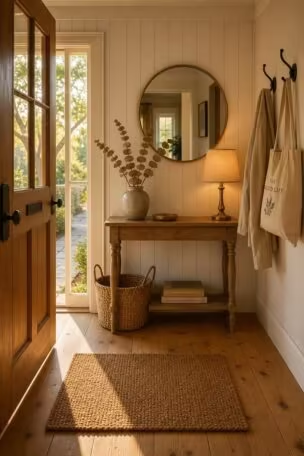
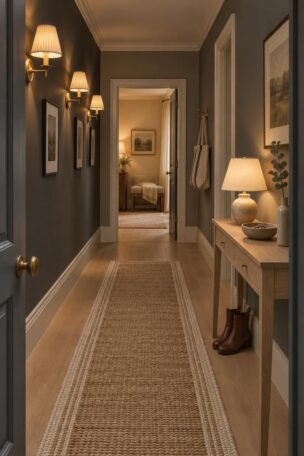
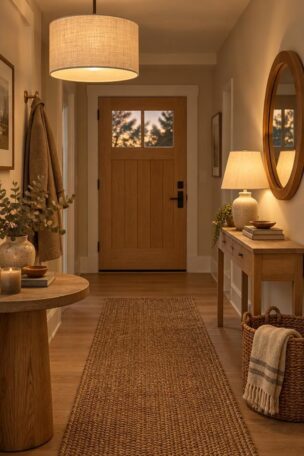
Double Doors Opening to a Console Landing With a Woven Runner
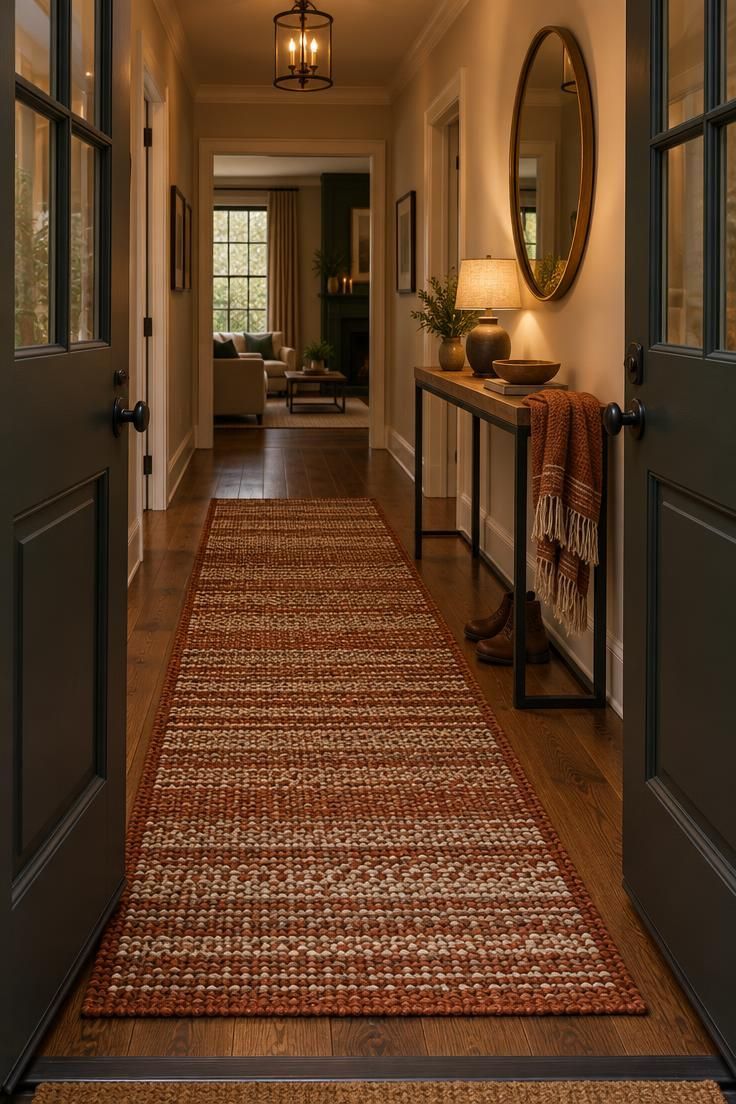
The interior side of a double door entryway is its own composition.
Two open leaves frame the view into the house, and the landing beyond needs to hold that frame rather than fill it.
A long woven runner draws the eye inward, while a slim console placed against the side wall gives the space a working surface without blocking the swing.
Width decides the runner.
It should run wider than a single door but narrower than the full landing so the swing line stays clear.
Measuring the landing before choosing a runner saves a return, and the same measurement guides the console depth: narrow enough that the active leaf clears it when open.
The entryway landing zone carries the daily drop of keys, mail, and bags.
A shallow bowl on the console takes those items, and a small lamp gives the hall a warm point of light in the evening.
A round mirror above the console adds depth and gives one last place to check before leaving.
Keep objects from hanging over the console edge.
A trailing plant or an oversized tray can catch on the door as it swings, and the result is both annoying and hard on the finish.
Tuck the shoes under the console rather than beside it so the runner stays visible.
The palette should connect the outside and inside.
Warm rust and cream in the runner echo the door tones or the exterior brick, so the transition from porch to hall feels continuous rather than abrupt.
Style Blueprint:
- A long woven runner in warm rust and cream, wider than one door and narrower than the landing
- A slim console against the side wall with a shallow bowl and small lamp
- A round mirror above the console for depth
- Shoes stored beneath the console to keep the runner clear
- A folded throw for softness and color at one end
Beadboard-Faced Pair With a Transom and Brass-Toned Sidelight Grilles
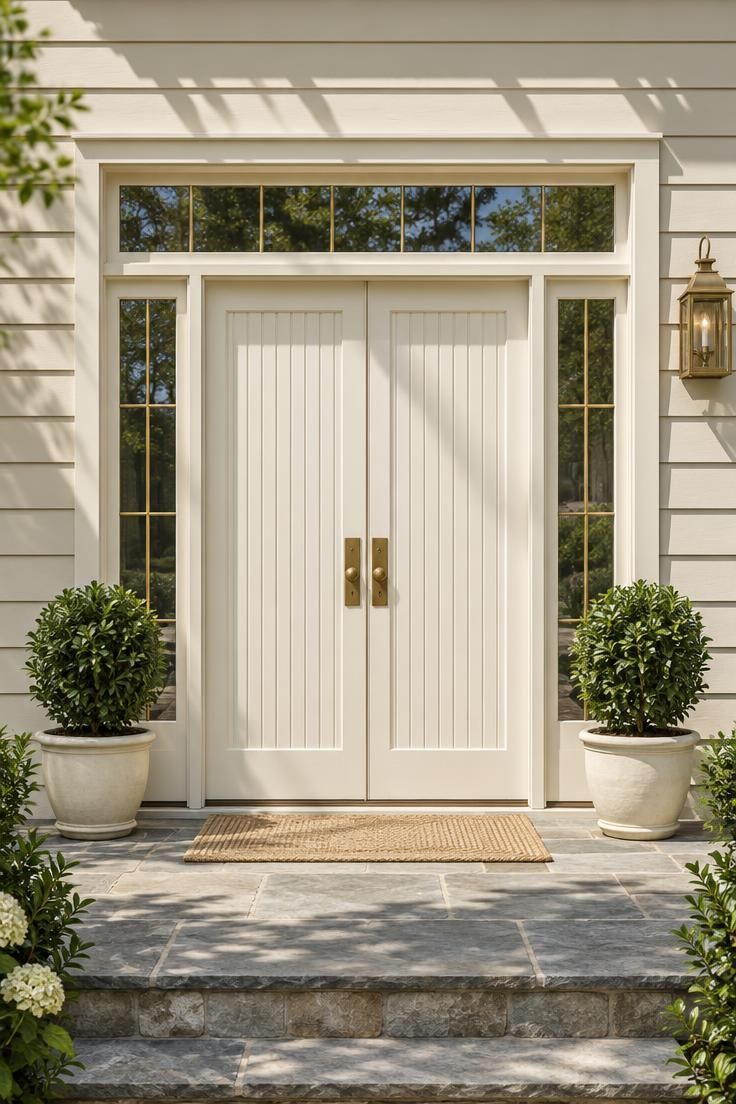
The horizontal transom line balances the strong vertical beads.
Beadboard brings a fine, even rhythm to both leaves, and painting the doors, casing, and transom frame in one warm cream lets the brass grilles in the sidelights become the only metal accent.
This is a softer, more cottage-style pair than a paneled door, and it suits painted clapboard or stucco.
The sidelights echo the door width without matching it exactly, which gives the composition a gentle rhythm rather than a rigid one.
The grilles should be thin so they read as line rather than weight, and the transom should stay plain so the eye does not have to process two patterns at once.
Beadboard texture shows shadow lines in strong sun.
That is part of its charm, but it also means the surface picks up pollen and dust along each groove.
A soft brush run vertically down the board keeps the finish clean without forcing debris sideways.
Paint consistency across doors, casing, and transom is what makes the whole entry read as one frame.
If the doors are cream and the casing is white, the transition becomes busy and the brass loses its quiet contrast.
Choose one tone and carry it across every painted surface in the composition.
The flagstone stoop and cream planters continue the soft palette.
A pale woven mat grounds the threshold and gives the doorway a place to finish rather than ending abruptly at the stone.
Style Blueprint:
- Cream beadboard doors with a fine, even vertical bead
- A rectangular transom with a plain surface
- Thin brass-toned grilles set into matching sidelights
- One cream tone carried across doors, casing, and transom frame
- Cream planters and a wide flagstone stoop to continue the palette
Matte Black Iron Double Doors With Oversized Linear Pulls and a Pale Gravel Approach
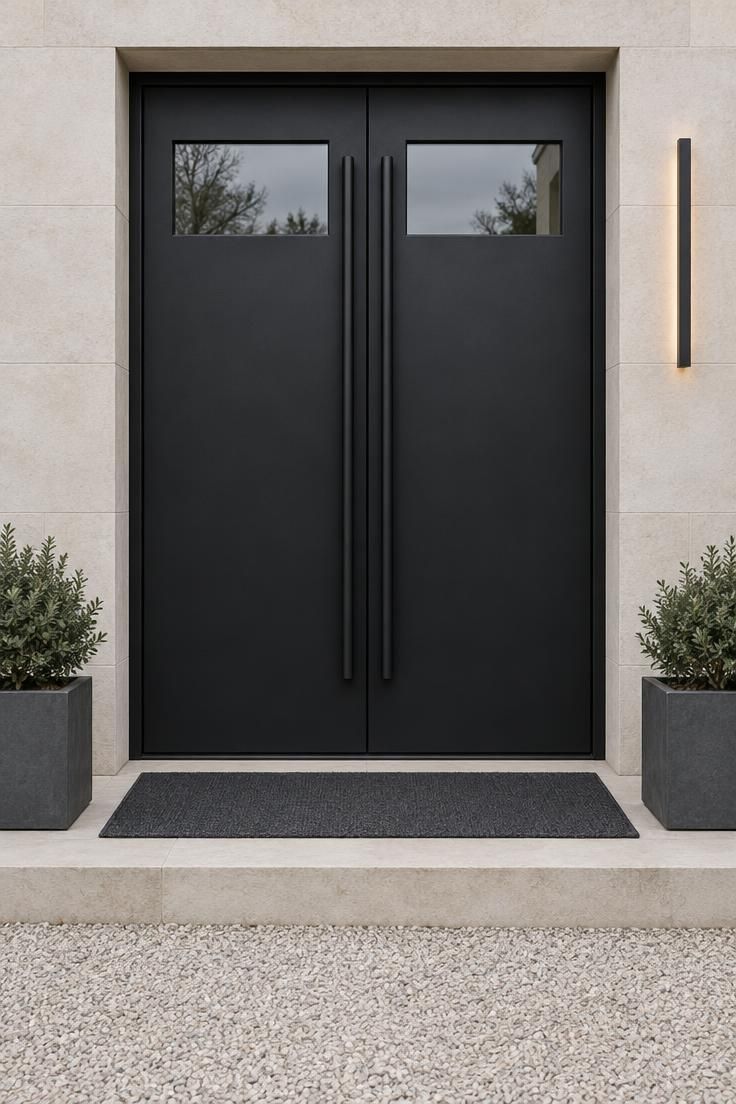
The long pulls make the pair read as one tall composition.
Running nearly the full height of each leaf, they create two parallel vertical lines that frame the center meeting stile.
The narrow glazed strips near the top admit a little light without opening the interior to view, so the doors keep a solid, quiet presence.
Keeping the surround minimal lets the black doors hold the frame.
A pale stone edge and a gravel approach put the matte black in high contrast, and the dark doormat and planters repeat the black at ground level so the composition does not float.
A single tall fixture beside the frame continues the vertical emphasis without competing with the pulls.
The gravel approach needs some attention in daily life.
Loose stones travel, especially in wet weather, so a slightly wider dark mat at the threshold catches what the shoes bring in.
Raking the gravel occasionally keeps the surface even and the path crisp.
Matte black finishes show dust and water spots less than gloss, but they can show fingerprints near the pulls.
A dry microfiber cloth handles most of it.
The narrow glass strips in the doors need the same treatment as any window: a glass cleaner and a cloth, wiped with the pane rather than across it.
Balance comes from the vertical pull rhythm paired with the horizontal line of the black doormat and planters.
If the planters were tall, they would join the vertical lines and the composition would feel crowded.
Style Blueprint:
- Matte black metal leaves with a narrow glazed lite near the top
- Oversized linear pulls running nearly the full height of each leaf
- A minimal pale stone surround and a gravel approach
- A wide dark doormat to catch loose stones and mark the threshold
- Low square planters in dark gray to repeat the black at ground level
Design Pro-Tip: When dressing a matched pair, work from the center line outward. Place the knocker or letterplate first, then mirror planters, lighting, and house numbers at equal distances on each side so the composition stays balanced from the street.
Conclusion
A double door entryway succeeds when the pair is treated as a single composition instead of two separate door surfaces.
The center line, whether symmetrical or deliberately unbalanced, sets the rhythm, and hardware, glazing, surround, and landing floor reinforce it.
Choose the idea that matches the width of the entry, the everyday traffic pattern, and the degree of visibility wanted from the street.
The goal is a door pair that looks framed from the approach and calm from the inside landing.