This post may contain affiliate links. If you make a purchase through these links, we may earn a commission at no additional cost to you.
Most coffee bar photos look tidy because they show a narrow slice of daily life.
The bags, chargers, and backup boxes usually sit just outside the frame.
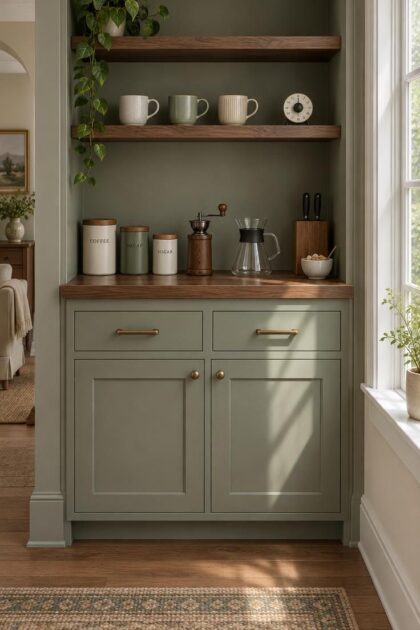
A coffee bar becomes easier to use when the arrangement matches the order in which things are actually reached for, not a shelf display.
The goal is a home coffee station that stays presentable between uses without requiring a reset every morning.
Start With the Daily Sequence, Not Shelf Symmetry
Coffee bar organization begins with movement, not appearance.
Think through a single morning from start to finish: store, measure and grind, add water, brew, serve, clean.
Each step has its own objects, and those objects want to sit in roughly the order your hands reach for them.
The case for planning around routine is easy to see in the numbers. National Coffee Association data show that 66% of U.S. adults reported drinking coffee on the previous day, and 85% reported drinking it at home, the highest at-home share recorded since 2012.
That second figure matters more for this topic than the first.
Home is where the equipment, the beans, and the cleanup all live.
A layout that ignores the sequence of use creates small daily frictions: a mug cabinet across the kitchen, filters in a drawer behind the brewer, spoons in a third spot.
None of these is dramatic on its own.
Together they turn a two-minute routine into a wandering one.
Try mapping your own sequence on paper before moving a single object.
Write the steps in the order you perform them, then list what your hands touch at each step.
The list often reveals that the most-used item sits furthest away, or that two steps compete for the same patch of counter.
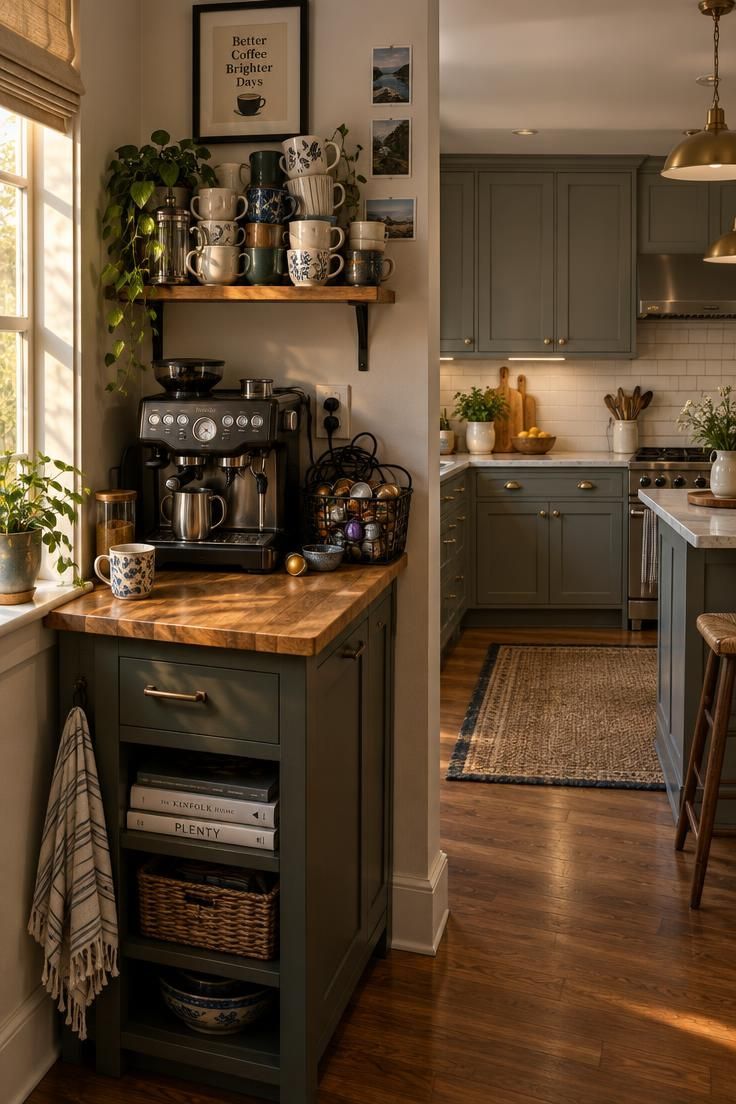
Once the order is clear, arrange the counter left to right along it.
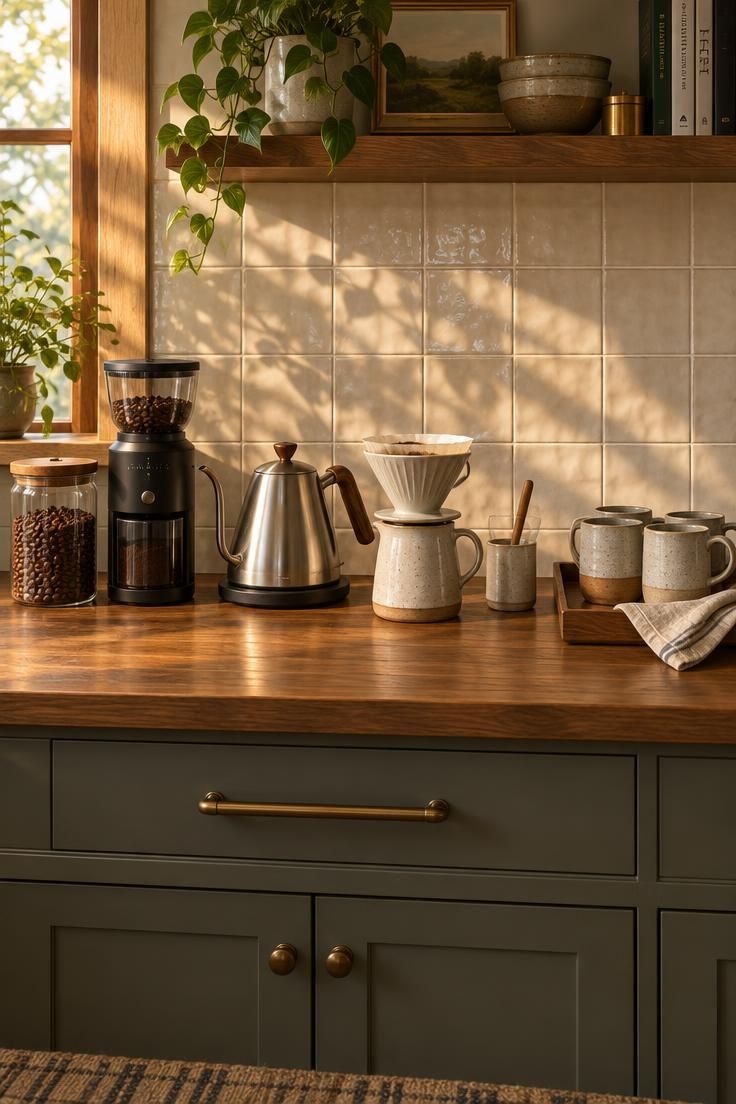
Beans and grinder together, brewer in the middle with open space beside it for filling and stirring, mugs and spoons to the right where the finished cup lands.
Cleaning supplies can sit at the far end or just below, ready for the last step.
This approach also settles arguments about symmetry.
A balanced shelf arrangement can still be a slow one if it separates items that belong to the same motion.
The sequence gives you a tiebreaker whenever two layouts look equally attractive.
Design Pro-Tip: Before moving anything, write your own morning sequence on a sticky note and tape it inside a cabinet door. Rearrange the counter to match the note, not the other way around.
The Five Zones That Prevent Morning Rerouting
Five functional coffee bar zones cover nearly every home setup: a main brewing surface, dry goods storage, mug and serving storage, nearby refrigerated storage, and a small cleaning station.
The names matter less than the boundaries.
Each zone answers one question, so nothing has to travel far to be used.
A generous home beverage center can spread these zones across a run of cabinetry.
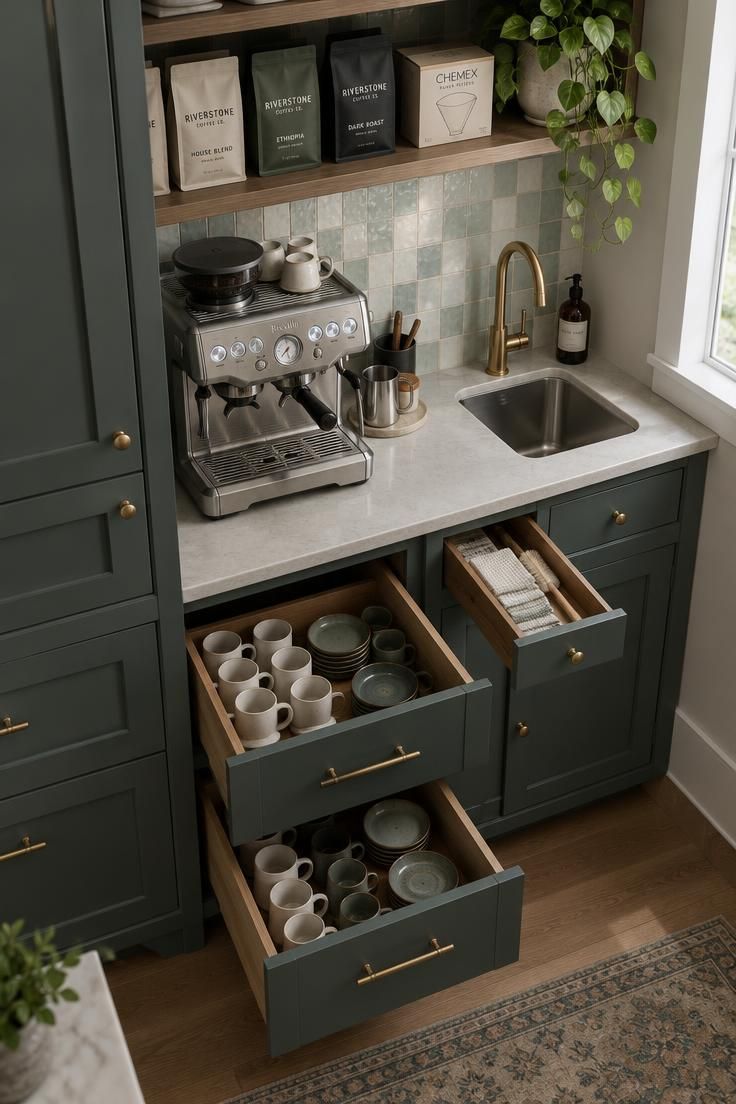
Dry goods live in an upper cabinet, mugs in a deep drawer, dairy in a small under-counter cooler, cleaning cloths in a slim drawer near the brewer.
A cabinet coffee station with pullout shelves handles the same logic in less width, since the shelves slide forward and bring the back row into reach.
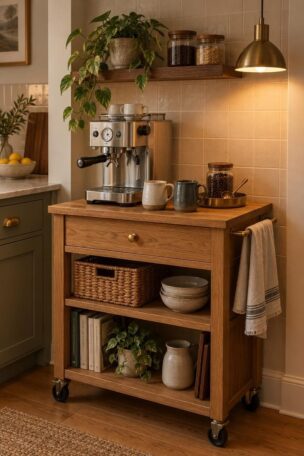
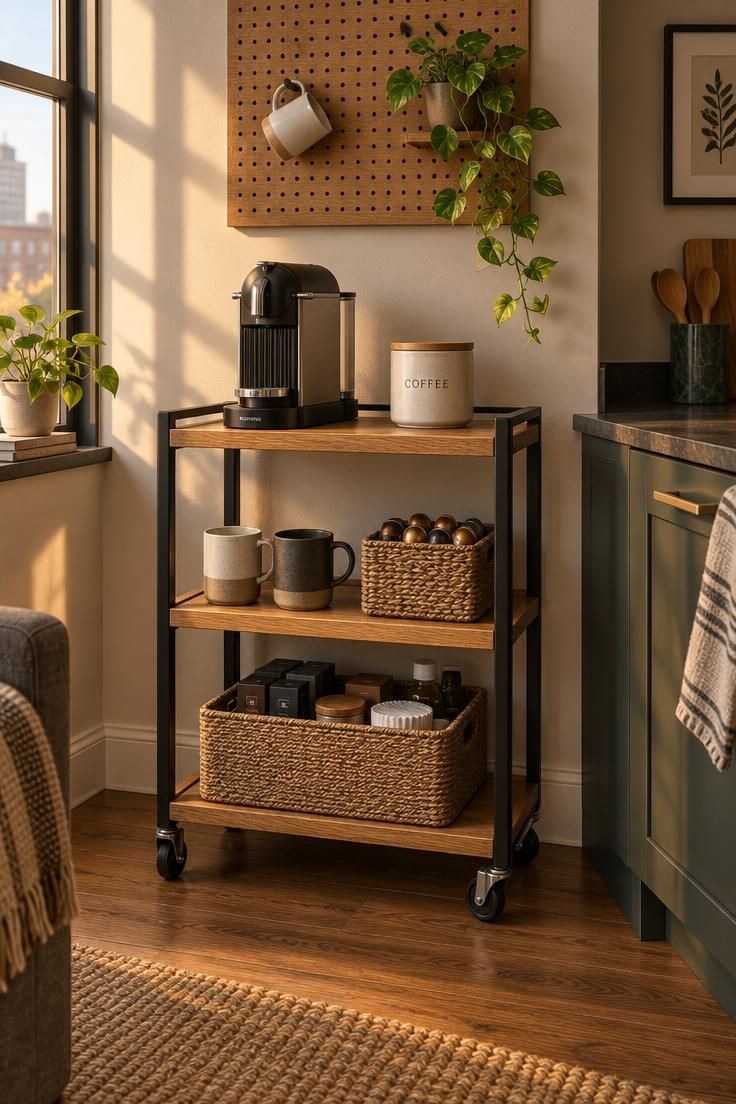
A compact cart compresses all five zones onto three shelves.
The top shelf becomes the brewing surface, the middle shelf holds mugs and dry goods together, and the bottom shelf takes backup stock and cleaning supplies.
The zones still exist, they simply stack instead of spreading.
Trend data supports the idea that households are planning for this kind of dedicated space.
The AIA Home Design Trends Survey reported a 30% positive popularity balance for coffee bars in 2023, up from 17% the previous year, though that figure reflects architects’ perceptions of feature demand rather than how many homes have one.
Houzz’s 2026 kitchen study found that 24% of renovating homeowners adding specialty built-ins chose beverage stations, a renovation-time figure rather than an ownership rate.
Zone boundaries tend to blur in small kitchens, and that is fine as long as each item still has one home.
What causes rerouting is not the absence of zones but the presence of duplicates: two spoons, three half-open bags of beans, a mug here and a mug there.
Consolidation does more for speed than any single organizer.
Design Pro-Tip: Reinforce zone edges with a simple visual cue, such as a painted stripe on a shelf edge or small labels naming Brew, Serve, and Clean. The boundary should be readable at a glance from the counter.
Daily, Weekly, and Backup: Three Storage Speeds
Not every coffee item deserves counter space, and not every item deserves a cabinet slot either.
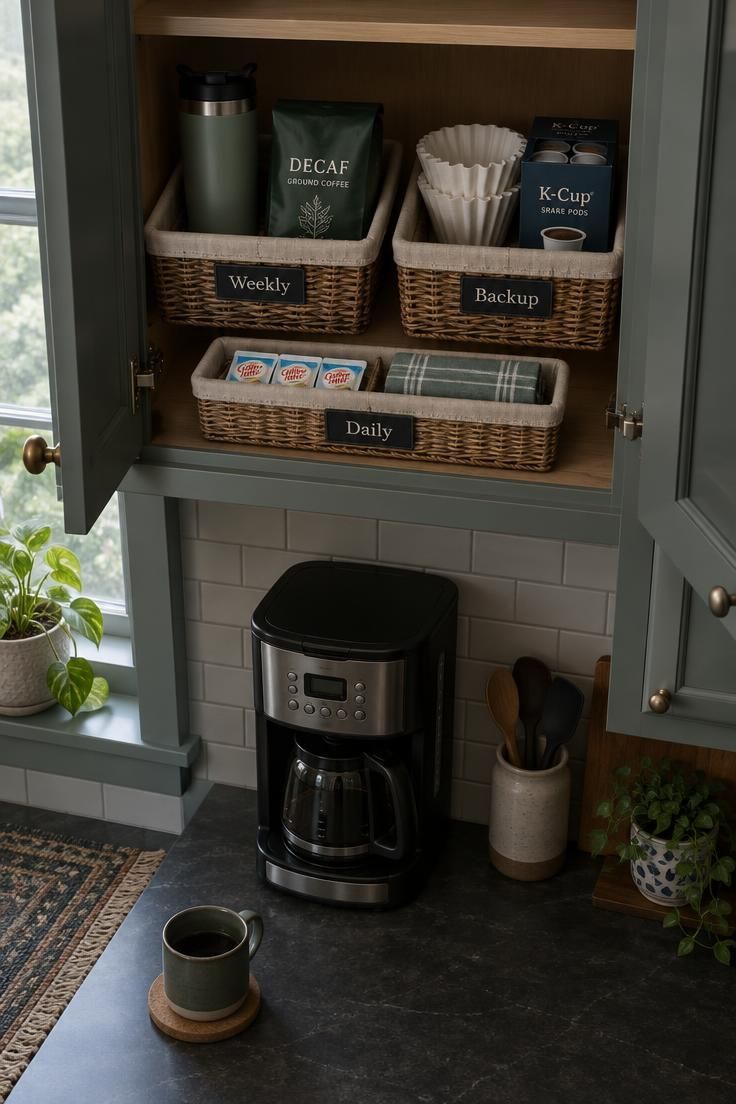
A three-tier system sorts supplies by how often they are touched.
Daily items live on the counter or in the top drawer, weekly items sit in nearby drawers or upper cabinets, and backup stock moves elsewhere entirely, to a pantry shelf or hall closet.
This structure keeps the station from silting up with duplicate bags and half-used boxes.
It also gives you a clear answer when a new item arrives: daily, weekly, or backup.
Anything that cannot justify one of those three placements probably does not need to be at the station at all.
Houzz’s 2026 report found that 94% of renovating homeowners incorporated specialty storage into upgraded cabinetry, which suggests how much weight people place on storage that fits specific objects.
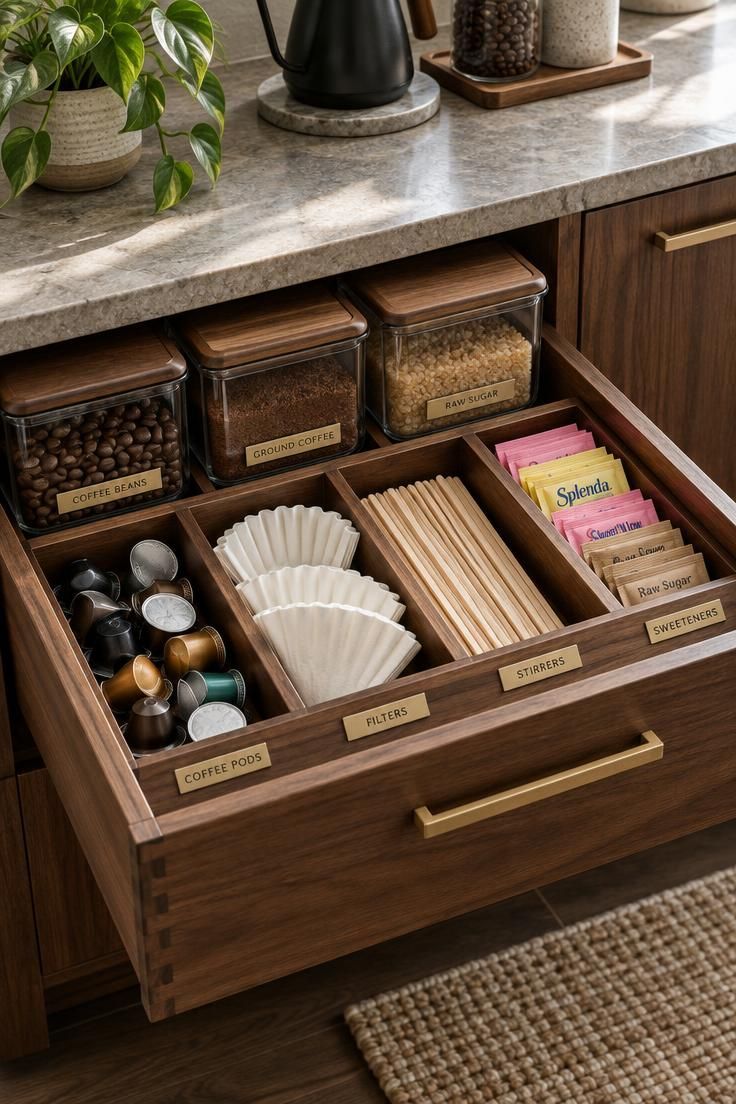
For a coffee station, that means pullout drawers for pods and tea, shallow organizers for filters and stirrers, and vertical dividers that let mugs and travel cups stand in a single row instead of a stack.
The daily weekly backup coffee supply storage split also regulates replenishment.
When the daily container runs low, you refill from the weekly supply, and when the weekly supply runs low, you restock from backup.
Nothing overflows onto the counter because each tier has a defined size.
Design Pro-Tip: Label each tier with everyday language, such as Every Morning, Most Weeks, and Spare, on adjustable labels. Plain words make it easier for everyone in the household to put things back correctly.
Honest Tradeoffs: Counter, Cabinet, Cart, or Beverage Center
Every format for a home coffee station trades one kind of convenience for another.
A countertop tray asks the least commitment and works in a rental, but it holds limited supplies and stays visible all day.
A closed cabinet hides the equipment completely, and it also puts a door between you and the brewer every time you want a cup.
An appliance garage with a fold-down or pocket door offers a middle path, keeping the machine out of sight until it is needed.
Architectural Digest has noted retractable and pocket-door systems as a way to conceal a coffee bar while keeping a furniture-like kitchen appearance.
One limitation applies to any enclosed setup: a steam-producing appliance needs a way for heat and moisture to escape, so a cabinet not built for that use is a poor home for an espresso machine in active service.
A freestanding cart is the most flexible option and often the least expensive.
Its tradeoffs are stability and cord placement.
A cart carrying a heavy machine wants a solid build and a spot where the wheels will not roll, and its power cord should never stretch across a walking path.
A built-in beverage center suits larger homes where coffee happens away from the main kitchen, near a dining room or primary suite.
It costs the most, occupies permanent space, and makes sense only if the location matches how the household actually moves.
Equipment reality pushes the decision further. PR Newswire reporting on NCA data puts drip coffee maker ownership at 62% and single-cup brewers at 42%, with smaller shares for bean-to-cup and espresso machines.
Many households own more than one method, which means a station planned around a single brewer will run out of room.
The practical rule is to size the format for two preparation methods, a grinder, and a kettle, plus whatever serving pieces the household uses daily.
If that feels crowded on a tray, the tray is not the problem.
The format is too small for the routine.
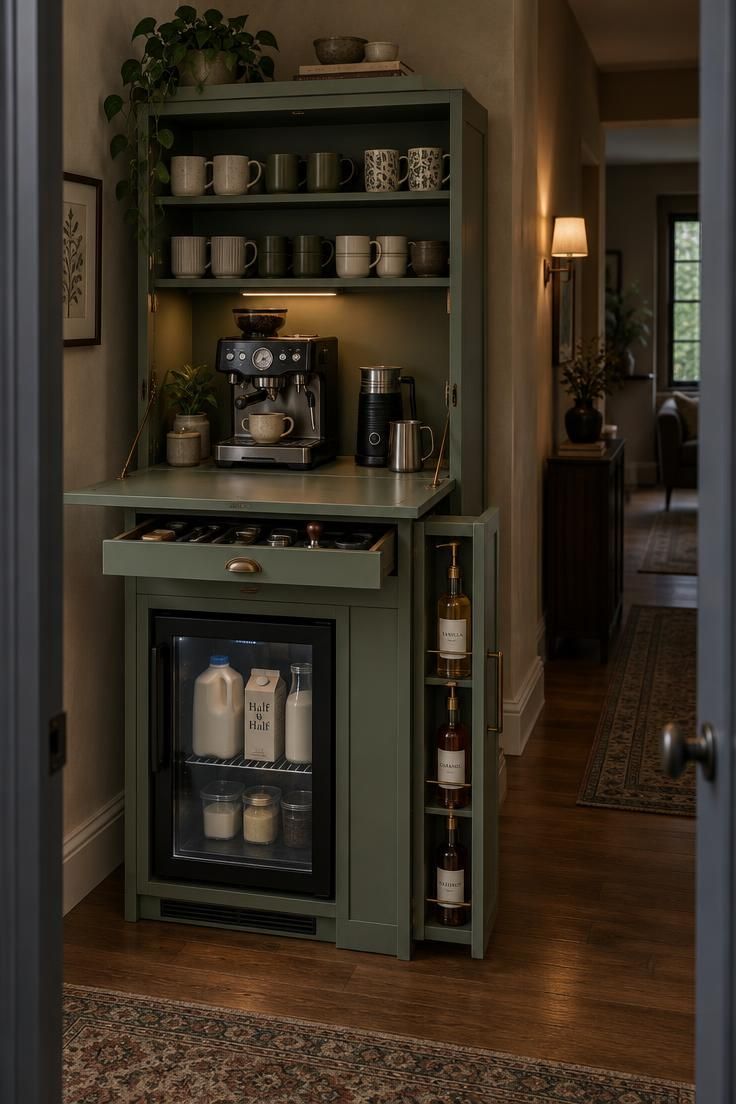
The Small-Apartment Version: Compress Zones Without Losing Function
Apartment kitchens rarely offer a spare run of counter, so coffee cart storage for small apartments often starts with a single movable unit.
A cart lets the station appear when needed and roll out of the traffic path when it is not, which is a flexibility a fixed counter cannot match.
Compression works best when it follows a few rules.
Go vertical above the machine with a wall rail or a narrow shelf for mugs.
Keep one appliance on the counter at a time and store the others in a dedicated cabinet.
Give coffee supplies a single drawer rather than scattering them across three.
Stack containers so the footprint stays small, and use a tray to group the appliances that remain out.
The five-zone model still applies, just at a smaller scale.
On a three-shelf cart, the top shelf serves as the brewing zone, the middle shelf merges storage and service, and the bottom shelf carries backup stock plus a small bin for grounds.
A wall-mounted mug rail above the cart takes over the service zone and frees the middle shelf for dry goods.
A modest setup can be genuinely functional.
One well-organized cabinet with a lift-up door, holding a compact brewer and a short row of mugs, covers the same steps as a full beverage center.
What a small station cannot absorb is indecision, so the value of a clear daily and weekly split grows as the space shrinks.
Pods stored loose in a drawer tend to spread and jam, so a simple organizer with dividers does more here than in a larger kitchen.
The same goes for cords: a short clip or a sleeve keeps them tidy when the cart moves, and it keeps the wheels from rolling over them.
Styling as Editing: Curated Visibility Over Display
Styling a coffee bar works better as subtraction than addition.
The most useful principle is curated visibility: show the objects that earn their place, and hide the ones that only create visual noise.
The five functional coffee bar zones already tell you which is which, since anything in the cleaning zone rarely needs to be on display.
Start with a small group of containers that share a finish or material.
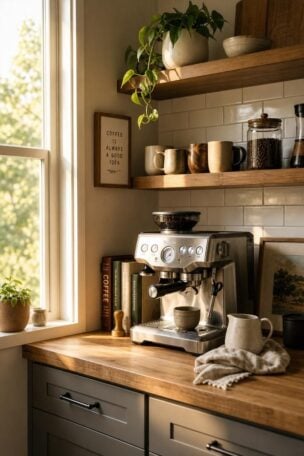
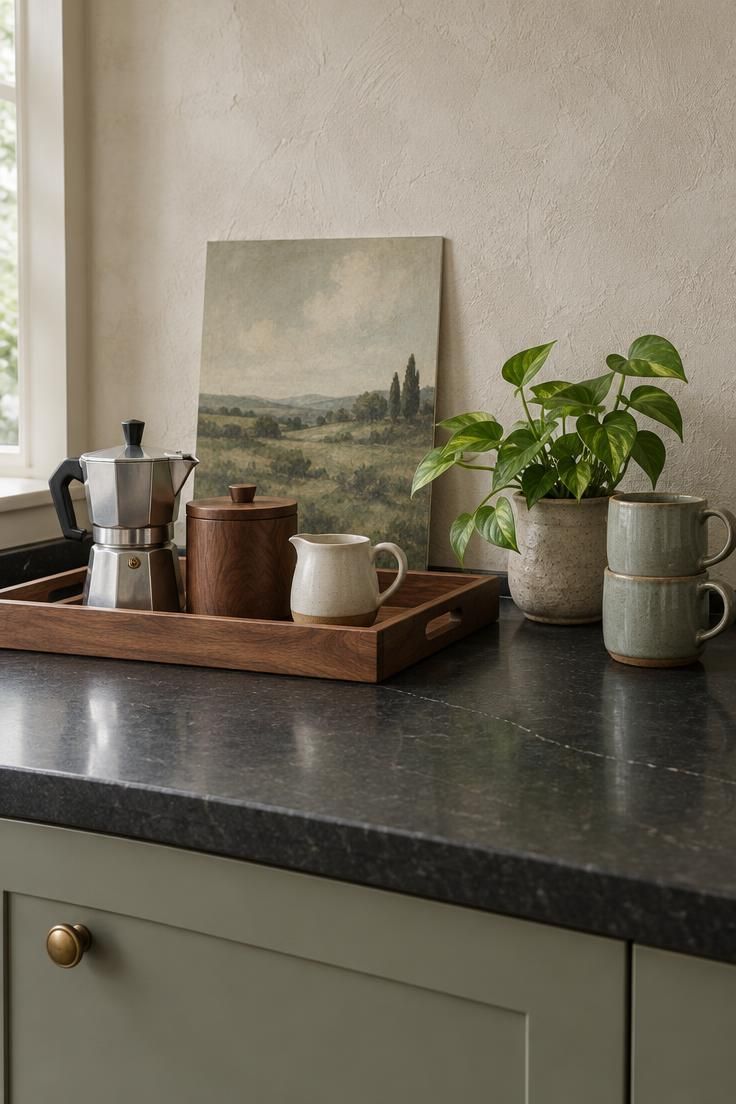
Two or three coordinated canisters, a wooden tray, and a short stack of mugs do more than a shelf crowded with novelty tins.
A single framed print leaning against the backsplash and one small plant add enough personality without competing with the equipment.
Textiles offer an easy seasonal change.
A printed linen towel in a muted pattern can shift the whole palette with one swap, and it folds away when not in use.
Rotating a towel, a small bowl, or a single ceramic piece keeps the station feeling adjusted without adding permanent objects.
Some habits work against tidiness.
Slogan signage, every mug and syrup bottle on open display, and decorative containers that are hard to rinse all look appealing in a shop and become chores at home.
If a container cannot be wiped easily, it will stay dirty, and a dirty container reads as clutter no matter how attractive the shape.
The hardest editing decision is empty space.
Leaving a stretch of bare counter beside the brewer looks unfinished at first, and that empty patch is what makes the station usable.
Rest a small cutting board or a low bowl on part of it to mark the space as intentional.
Design Pro-Tip: Place a small board or shallow bowl on the counter beside the brewer to define a staging area. It keeps the empty work surface looking considered instead of neglected.
Materials That Simplify Cleaning Without a Café Look
The right surface for a home coffee bar is the one that wipes clean quickly enough that you actually do it.
Materials enter the organization conversation through cleanup, not through performance promises.
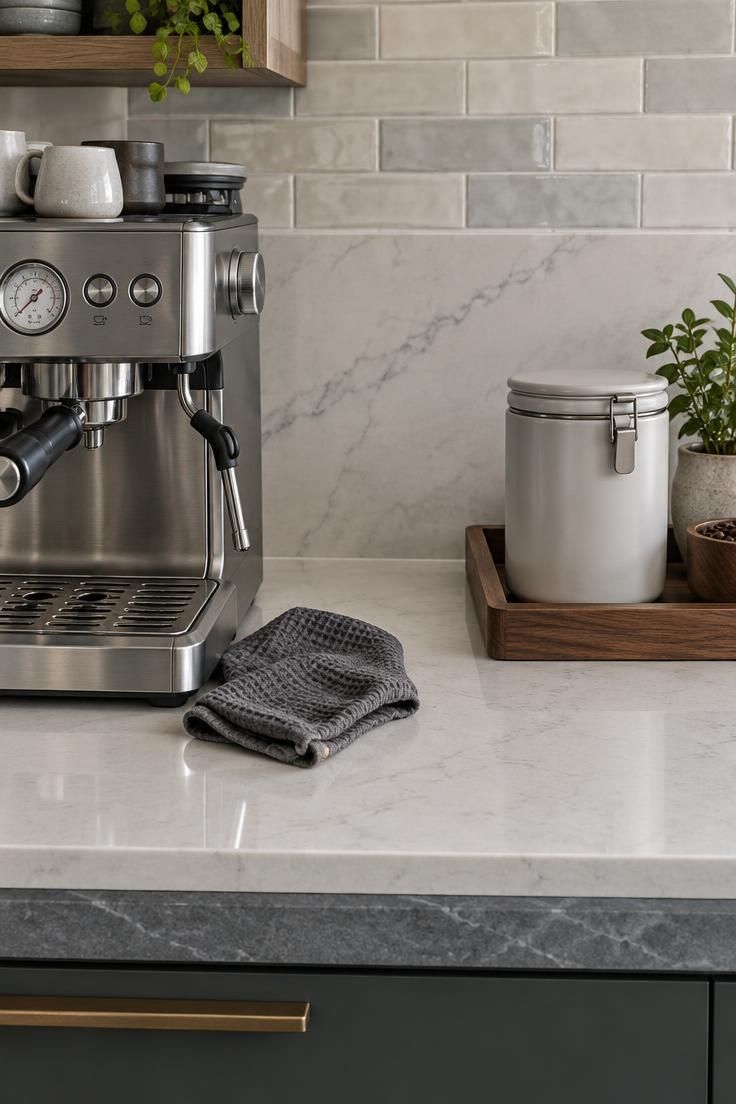
Quartz counters have a low-maintenance reputation and come in a wide style range, which makes them easy to pair with almost any cabinet finish.
Sealed natural stone offers depth and variation, with the caveat that spills left sitting can mark an unsealed surface.
Porcelain slab comes in large formats and reads crisp and uniform.
Stainless steel brings an unmistakable café look that some homeowners want and others avoid at home.
Sealed wood is warm and forgiving in appearance and asks for more attention around spills and moisture.
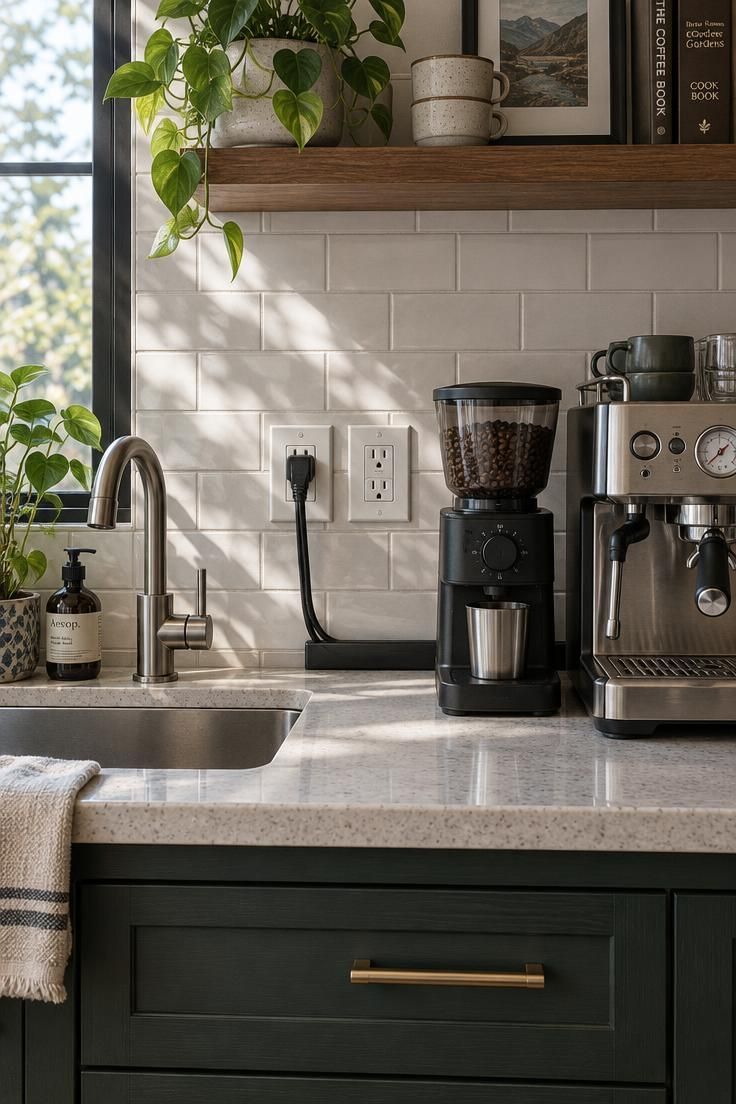
A washable backsplash behind the brewing surface does real organizational work.
It contains splashes from filling a reservoir or rinsing a portafilter, and because the area is small, it can carry more decorative personality than a kitchen-wide backsplash would.
Houzz’s 2026 kitchen report notes that tile remains the dominant backsplash choice, with rectangular tile and horizontal brick patterns leading current renovations.
Counter storage deserves a note too.
Coffee beans and grounds hold up best in an airtight, opaque container kept away from heat, moisture, and direct sunlight.
A shelf above an oven or a spot beside the stove is the wrong home for the daily supply, since warmth and steam work against freshness.
A closed canister in a cabinet just above the brewer stays convenient and out of the light.
Electrical and Water Proximity: Planning Before You Commit
Outlet and sink placement shape daily use more than most people expect when they first plan a station.
A brewer, a grinder, a kettle, and a frother can all want power at the same moment, and their cords have to go somewhere that stays out of the way.
Deciding the layout before the appliances arrive avoids a tangle of extension cords across the work surface.
Two conveniently placed outlets handle most home setups without cord clutter.
Position them so that cords can drop behind or below the counter, and so that a plug does not block a cabinet door or a shelf edge.
The goal is simple: reaching for a plug should never require moving equipment.
Water proximity is an organizational concern rather than a technical one.
A nearby sink makes filling a reservoir, rinsing a portafilter, and emptying a drip tray quick tasks instead of a walk across the kitchen.
When a dedicated sink is not part of the plan, the main kitchen sink is the practical reference point for placing the station.
If a built-in beverage center or high-powered equipment is part of the project, electrical requirements should be reviewed with a licensed electrician before construction begins.
This is the one point where a layout decision moves beyond decoration and into work that needs a qualified trade.
The design conversation can stop at the layout and leave the wiring details to the review.
Keeping It Organized When the Routine Changes
A coffee bar stays orderly when every item has a designated location and the arrangement is revisited as habits shift.
The first setup is rarely the final one.
A new brewer, a change in work hours, or a household member who starts drinking tea all rearrange the daily flow.
Daily-use items should remain at eye level, which is the most reachable zone in any cabinet.
Countertop items should stay limited to what is touched every morning.
Supplies grouped by function are easier to keep in place than supplies grouped by category, since the hand reaches by function, not by label.
A monthly clear-out keeps the station from accumulating expired or rarely used products.
Check open bags for staleness, pull out tools that have not been used in a season, and move anything seasonal to the backup zone.
This is the same daily, weekly, and backup split at work, applied as maintenance rather than as planning.
The guiding rule is to design around behavior rather than an idealized picture.
A station that fits the way the household actually makes coffee gets easier to maintain over time, because putting things back is the path of least resistance.
The Planning Pitfalls That Make Coffee Bars Feel Cluttered
Most cluttered coffee bars are not the result of too many objects.
They are the result of a few layout decisions made in the wrong order.
Home coffee station layout planning starts with the counter, because that is where the work happens.
Insufficient counter space beside the machine is the most common problem.
A brewer needs room for a mug, a spoon, and a place to set a lid while the reservoir is being filled.
When the machine sits flush against a wall with no adjacent surface, every step happens in a cramped spot.
Forgetting outlets is the second.
A station planned for appearance and then plugged in afterward often ends up with cords running across the counter or around a corner.
Deciding outlet placement alongside the layout keeps cords where they belong.
Distance from water creates quiet friction.
Filling and rinsing become trips, so dirty tools pile up at the station instead of being handled on the spot.
The same logic applies to mugs stored in a cabinet far from the brewer, since the most-used object should never be the furthest one.
Shallow shelves and deep cabinets fail in opposite ways.
A shallow shelf cannot hold a tall canister, and a deep cabinet swallows small items at the back where they are hard to reach.
Both push objects onto the counter, which is how a tidy station turns crowded.
Displaying every accessory at once is the final pitfall. Houzz’s kitchen trends report notes that avoiding clutter was the leading motivation behind new butler’s pantries, and the same instinct applies at a smaller scale.
The best arrangement anticipates used grounds, spills, and dirty tools by giving each a home, so the station can be reset in under a minute.
Conclusion
Coffee bar organization solves a daily-use problem, and the solution is mostly about sequence and placement.
Workflow planning, flexible zones, and a three-tier storage system cover almost every decision that matters at a home station.
Equipment evidence supports planning for more than one preparation method.
Since drip brewers and single-cup machines often share a household, the storage plan should leave room for a second brewer, a grinder, and a kettle, even if those items rotate rather than sit out together.
To start, list the first and last things you touch each morning and evening.
The first item belongs within easy reach of the brewer, and the last item, whether that is a cloth or a grounds bin, belongs at the end of the counter or in a drawer that opens with one hand.
Try that single change first: move the cleaning tool to where the last motion happens.
Then rebuild the rest of the station around the same logic.
What to look for is a counter where the next step is always within reach, and how to start is with the sequence, not the shelf.